From the air, the landscape gives up patterns you'd never see from the ground: the braiding of a river, frost lines across a ploughed field, a single fallen tree in snow. This collection is my aerial work, flown with a drone across Britain and further afield, and it leans towards the abstract — shape, texture and light rather than the postcard view from above.
This side of my photography has brought some of my most consistent competition results. I won the Drone category at the British Photography Awards, was recognised at the Drone Photo Awards, and have placed in the Top 101 of the International Aerial Photographer of the Year in consecutive years, most recently with "The Fallen One", made in the Cairngorms in deep winter.
Aerial images suit large-format printing particularly well; the detail rewards size. Selected images from this collection are available as fine art prints. Get in touch if you'd like to order one.

A tidal channel cuts through the dense roofscape of a Vietnamese fishing settlement, its turquoise water threading between corrugated rooftops and moored fishing boats. The nadir perspective flattens the scene into a mosaic of colour and form, the organic sprawl of the village contrasting with the rigid road grid to the east. Captured over Phú Quốc island in January 2023.
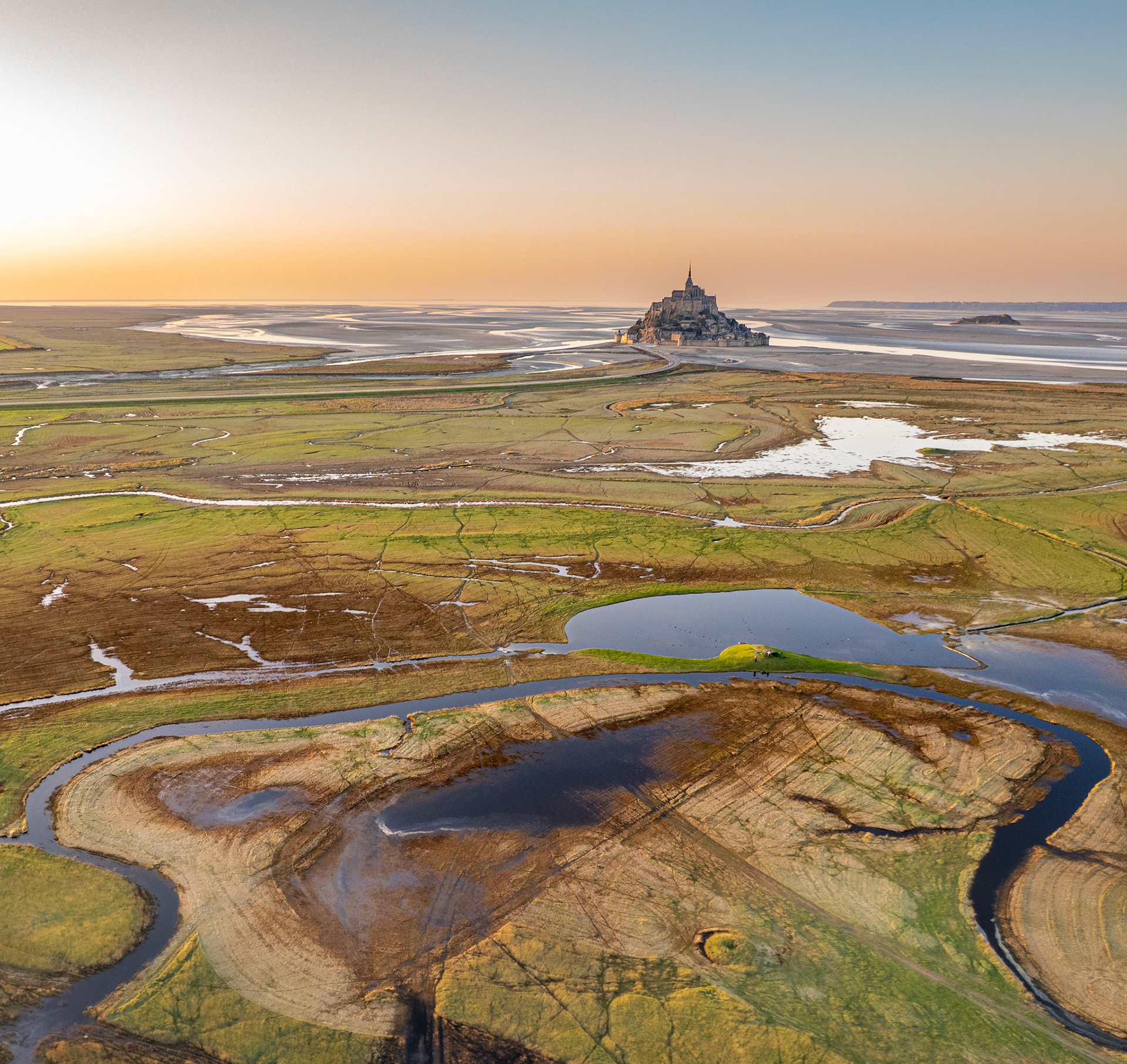
Aerial view across the salt marshes of the Baie du Mont-Saint-Michel at low tide, Normandy, France. Meandering tidal channels and waterlogged grazing land lead the eye toward Mont Saint-Michel, its abbey spire rising from the exposed bay floor at golden hour. The shallow perspective flattens the vast intertidal plain into a pattern of sinuous curves, still water, and eroded sediment.
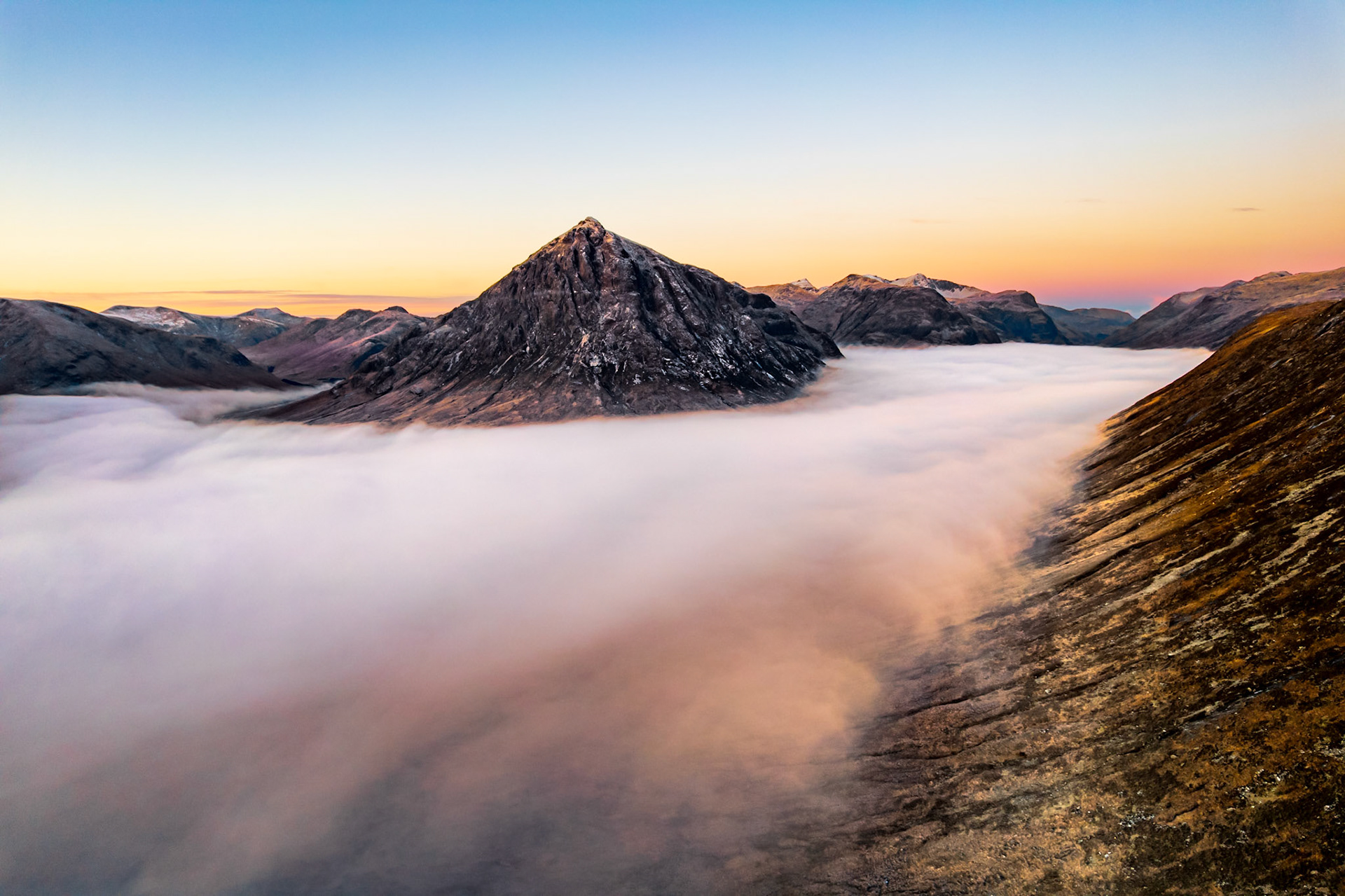
A temperature inversion fills Glen Etive and Glencoe at dawn, leaving Buachaille Etive Beag isolated above a smooth sea of cloud. Shot from an elevated drone position above the eastern ridge, the pyramid peak catches the first warm light against a sky still holding the blue of night. The foreground slope anchors the composition, giving scale to the suspended cloudscape below.
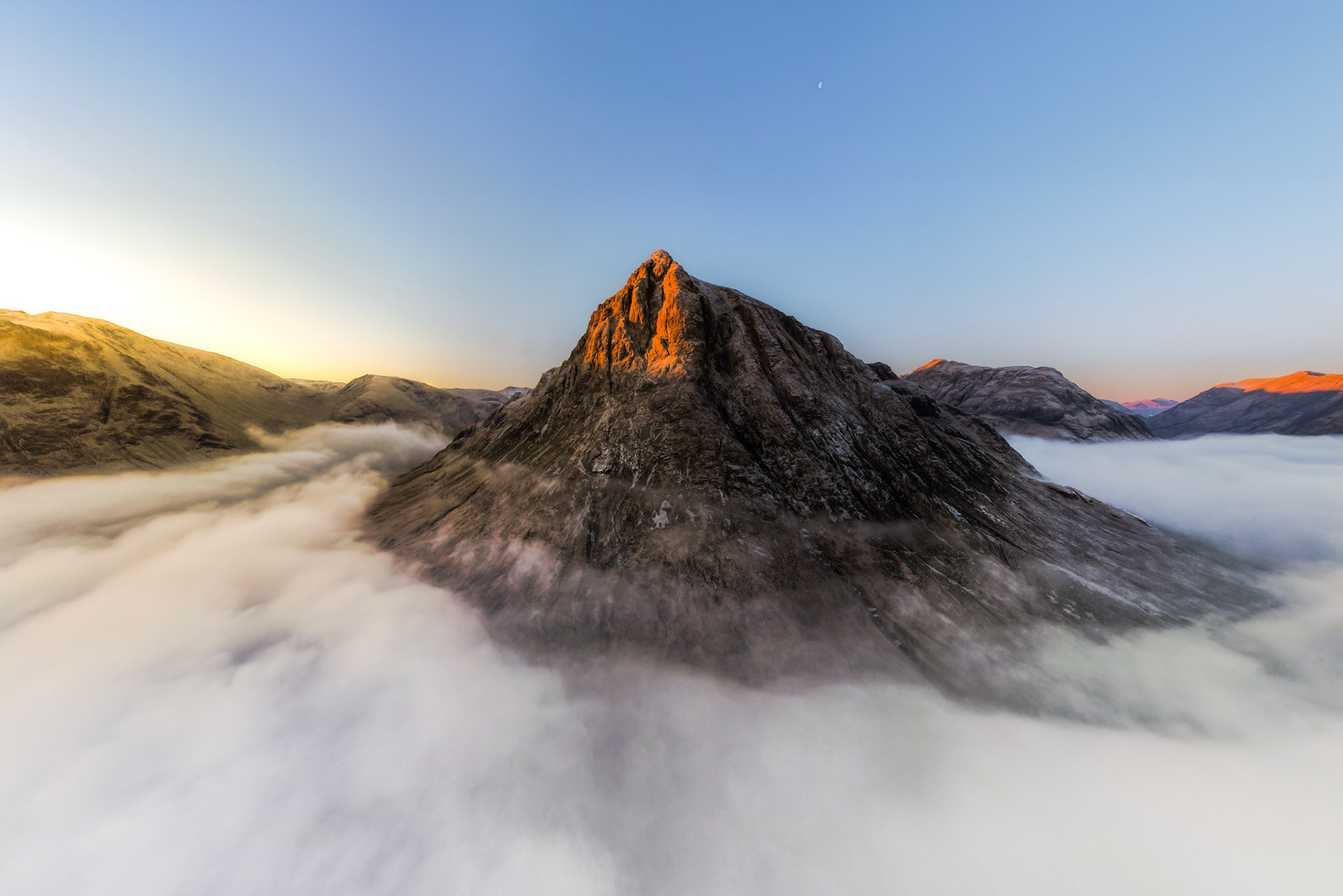
A temperature inversion buries the glens beneath a still sea of cloud, leaving the rocky summit of Sgorr Dhonuill emerging into first light above Ballachulish, Scottish Highlands. The crescent moon holds its position in a steel-blue sky as alpenglow catches the peak's upper ridgeline. The aerial vantage compresses the surrounding mountains into a silent archipelago of stone.
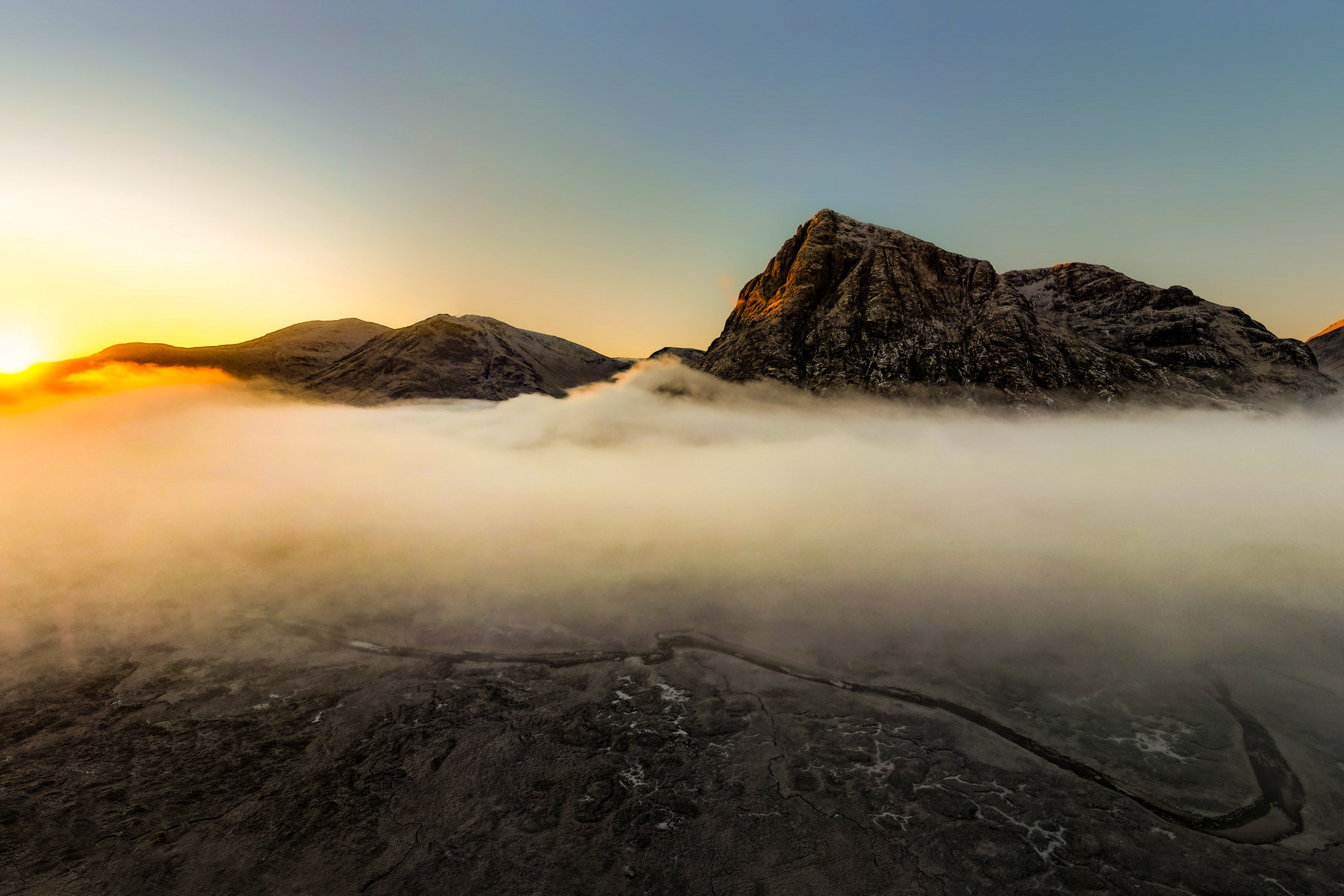
A temperature inversion fills the glen floor with dense fog at sunrise, leaving two rocky summits isolated above the cloud. The winding road beneath the mist surface anchors the composition, hinting at scale and the valley's geometry. Shot in early winter, the frost-dusted ridgelines catch the first direct light while the foreground terrain remains in cold shadow.
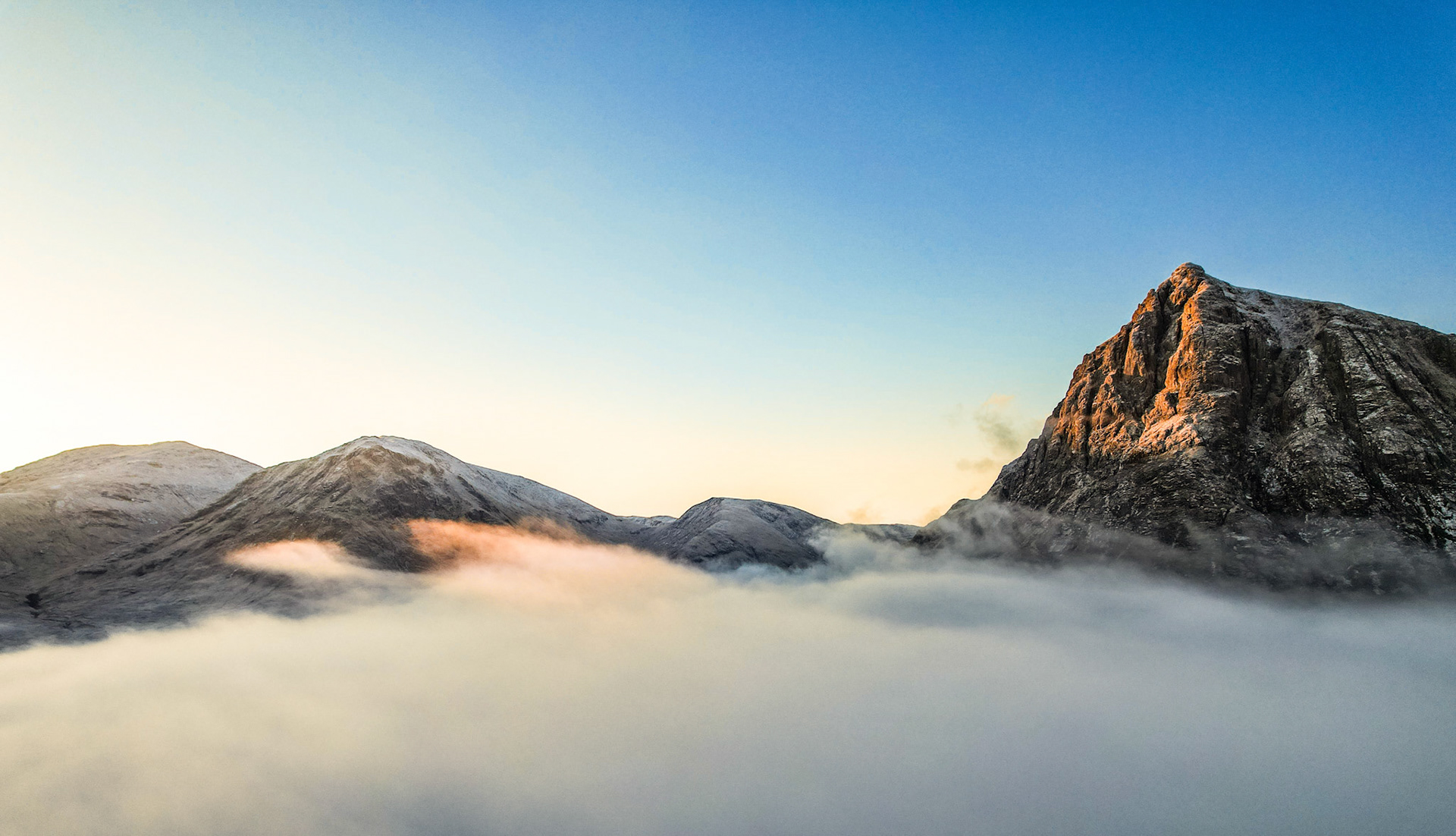
Snow-dusted summits break through a temperature inversion at first light, the valley floor buried beneath a still sea of cloud. Warm alpenglow catches the near rock face while the more distant peaks recede into pale silhouette. The aerial vantage compresses the layers into a clean, elemental arrangement of rock, cloud, and sky.
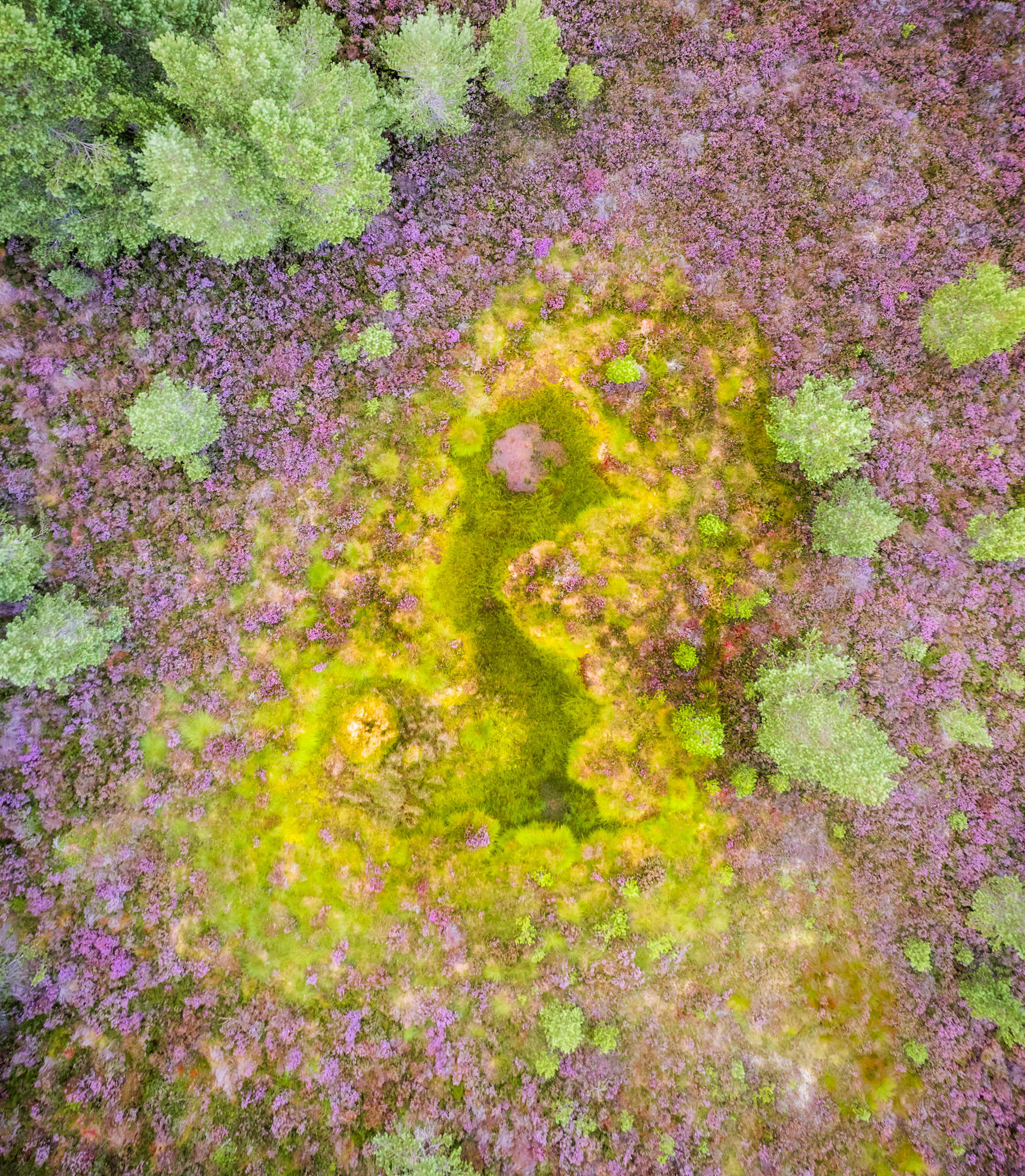
A sphagnum-filled bog pool interrupts a broad sweep of flowering heather on the Cairngorms moorland, seen from directly overhead in late summer. The acid-yellow mosses form an irregular void at the centre, surrounded by the purple of Calluna in full bloom and scattered birch scrub. The nadir perspective reduces the scene to colour and texture, suppressing all horizon and scale.
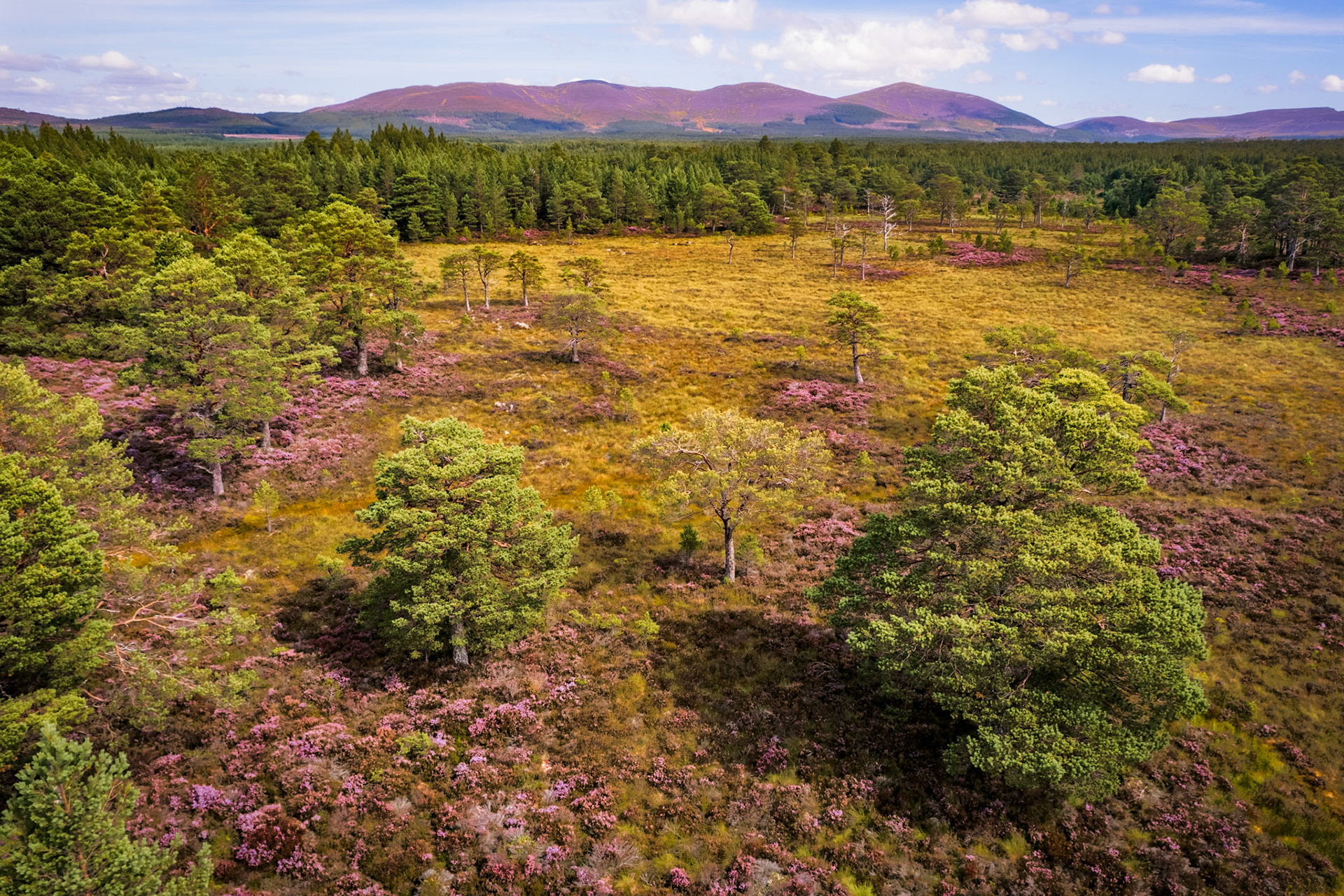
An aerial view across open blanket bog and scattered Scots pine looks north towards the Cairngorm massif, the hillsides still carrying the purple flush of late-summer heather. The flat midday light flattens depth and drains atmosphere, leaving a faithful document of the habitat rather than a composed image.
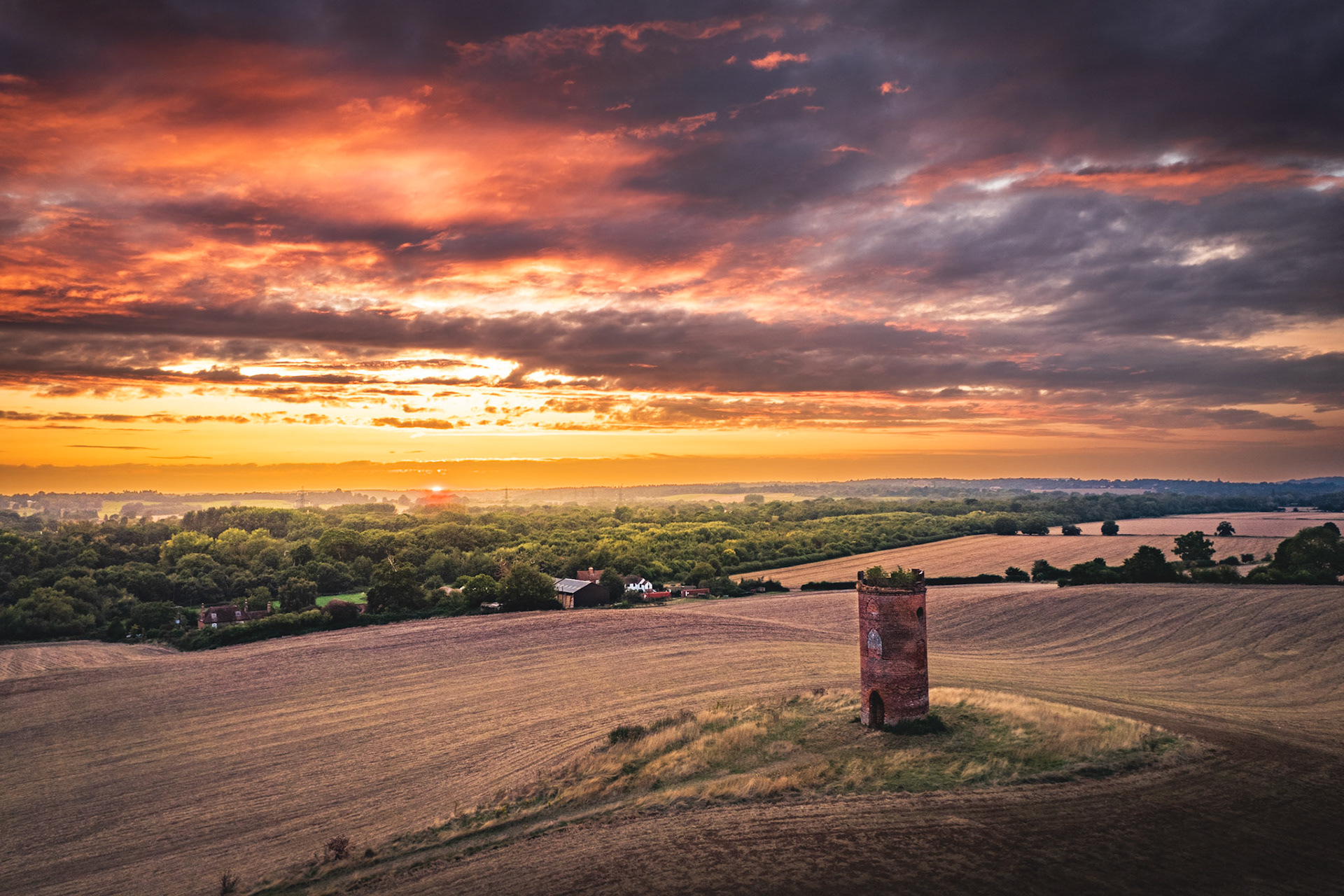
A ruined brick tower stands alone on a harvested hillside above the Thames Valley, south of Reading, as the sun drops below a distant tree line. Heavy cumulus catches the last orange light while mist gathers in the valley floor below. The composition uses the folly as a solitary anchor against a wide, dramatic sky.
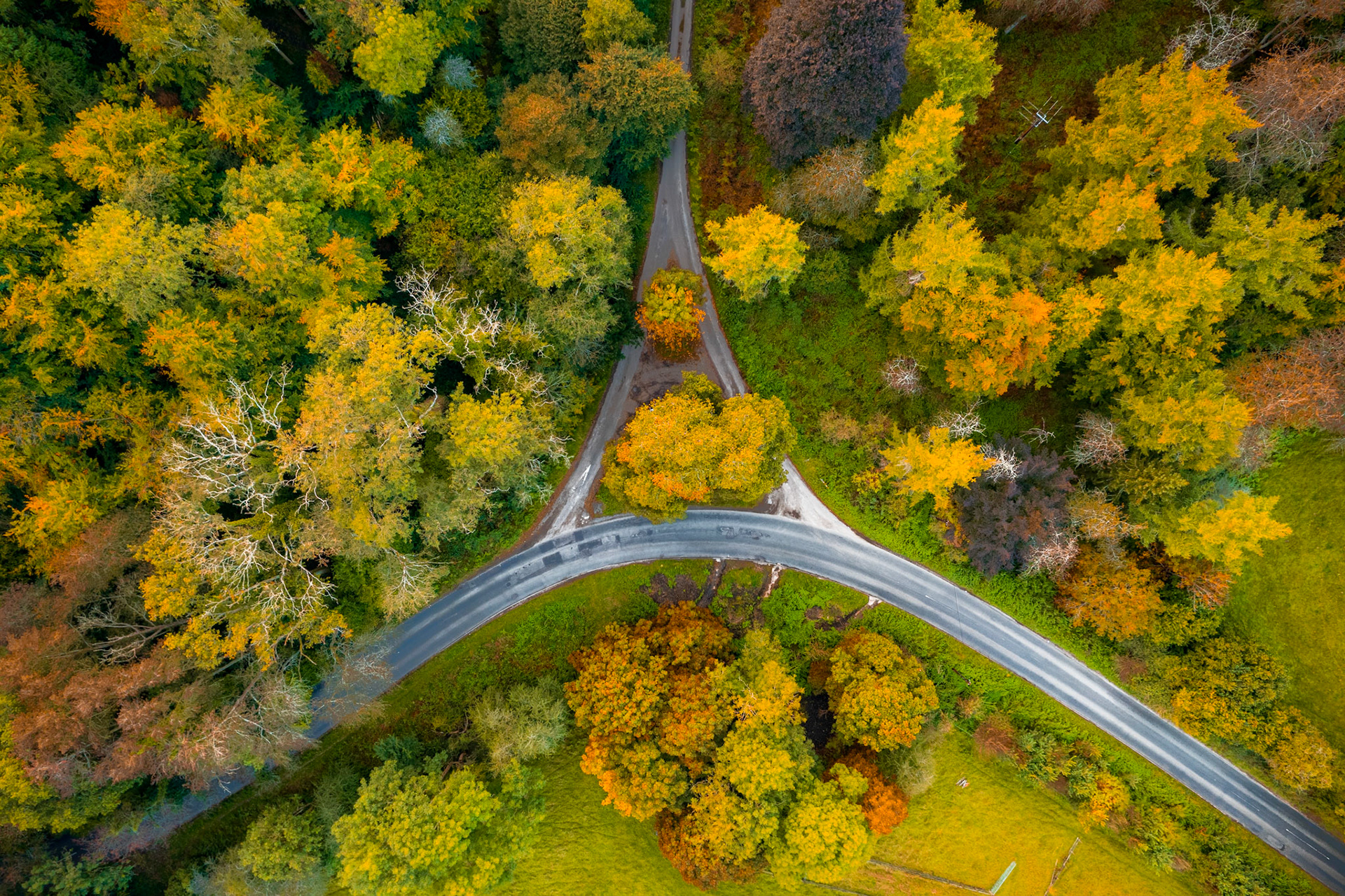
A Y-junction splits a rural road through mixed deciduous woodland near Henley-on-Thames, photographed at near-nadir from altitude during peak autumn colour. The geometric road form reads as pure abstraction against the textured canopy of yellows, ochres and deep greens. Overcast light flattens shadow and gives even saturation across the tree crowns.
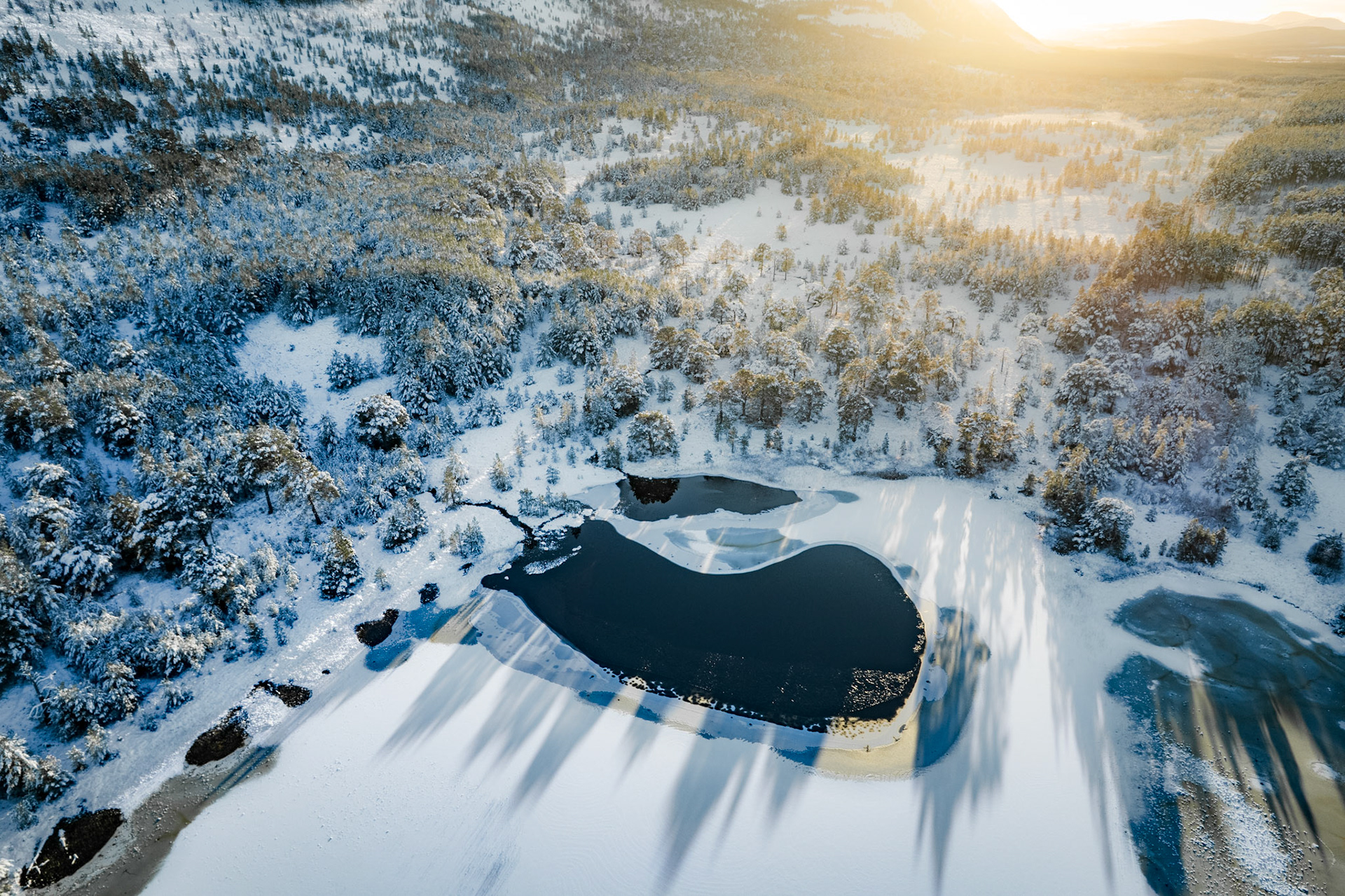
A partially frozen lochan holds open water against a snow-covered Caledonian pine forest near Aviemore, Cairngorms, as low winter sun rakes long tree shadows across the white ground. The organic curve of the water body anchors the composition, its dark surface contrasting sharply with the luminous snowfield. Warm backlight from the south dissolves the valley into haze, lending depth to an otherwise monochrome terrain.
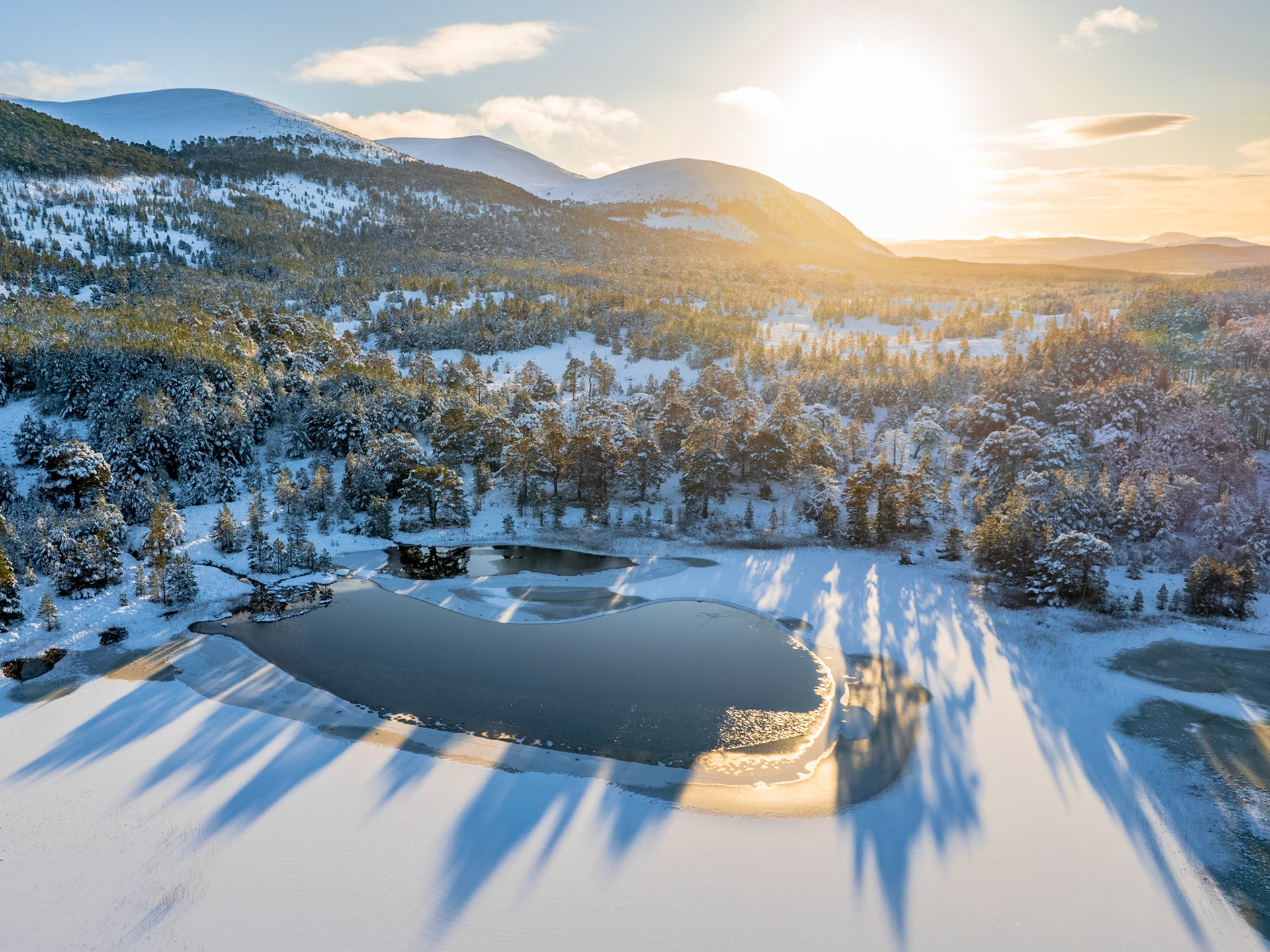
A partially frozen lochan sits among snow-laden Scots pine on the Cairngorms plateau, long tree shadows raking across the snowfield as low January sun breaks behind the massif. The aerial vantage reveals the geometry of ice margin against open water and the radiating shadow pattern that ground-level photography could not yield. Aviemore hinterland, Scottish Highlands.
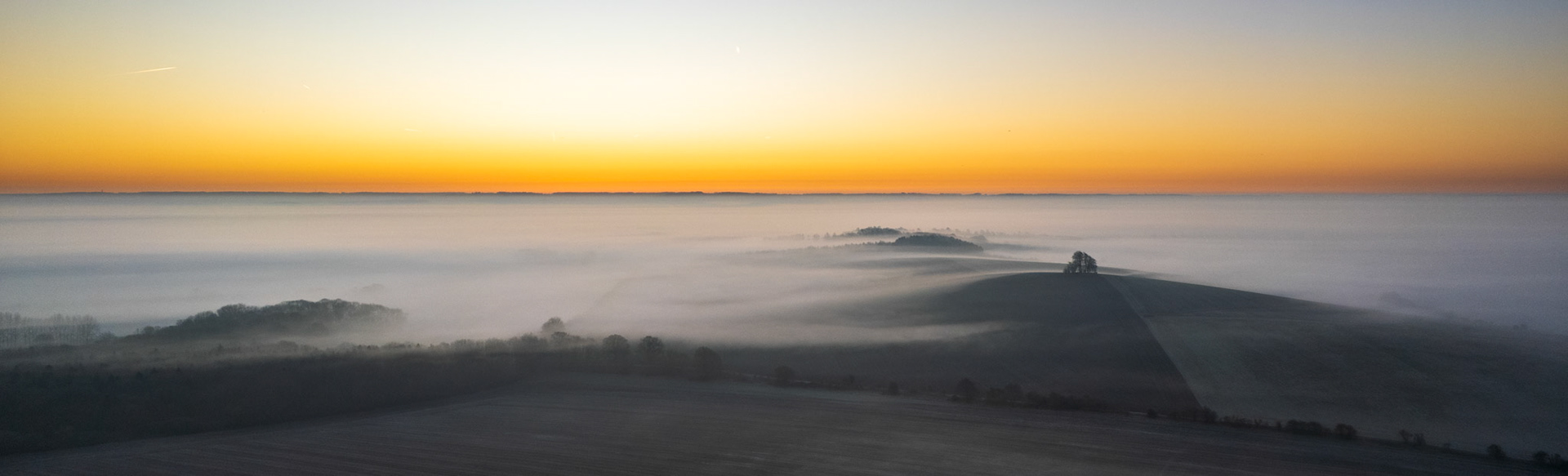
A temperature inversion fills the Vale of White Horse to the hilltops, leaving rounded chalk spurs as islands in a white sea. Photographed from altitude at first light near Abingdon-on-Thames on 1 March 2025, the pre-sunrise horizon holds a band of amber that grades cleanly into a cool blue sky, a crescent moon just visible above. The lone tree group on the nearest ridge provides the single point of scale and anchors an otherwise abstract composition.
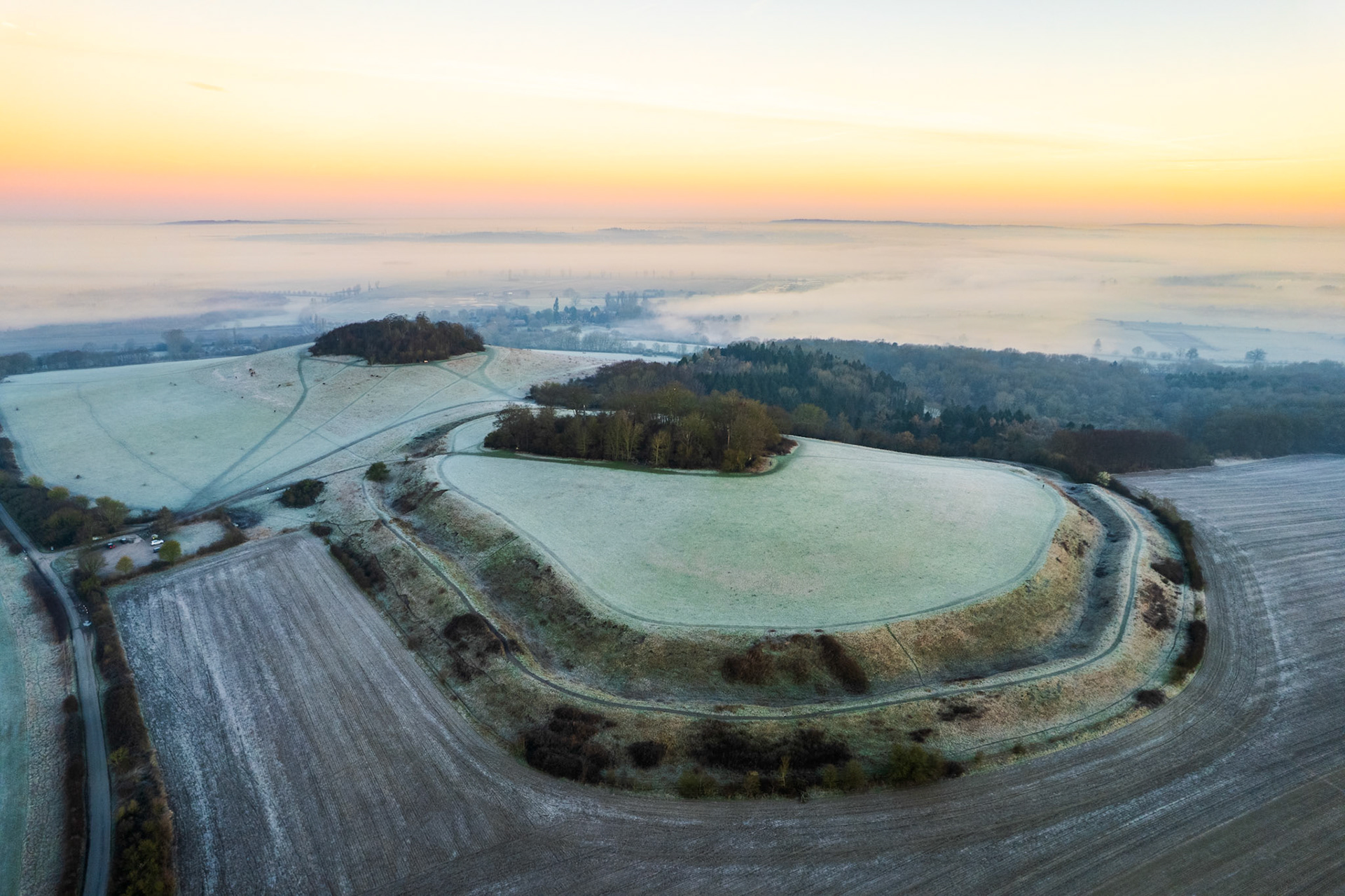
Frost covers the chalk earthworks of Brightwell Barrow, the Iron Age hillfort that sits above the Wittenham Clumps ridge in Oxfordshire, while temperature inversion cloud obscures the valley floor toward Abingdon-on-Thames below. The curved ramparts and field boundaries describe a near-perfect arc against the white-draped lowlands. A warm pre-sunrise horizon holds the moment between mist and open sky.

A solitary bare tree casts a long dark shadow across a fog-covered arable field on the slopes of Brightwell Barrow, near the Wittenham Clumps in Oxfordshire, as low winter sunrise strikes horizontally through the mist. The aerial perspective reduces the scene to near-pure geometry: a diagonal line of darkness dividing cold blue shadow from warm amber light. The tree reads as both subject and instrument, the agent producing the image's central tension.
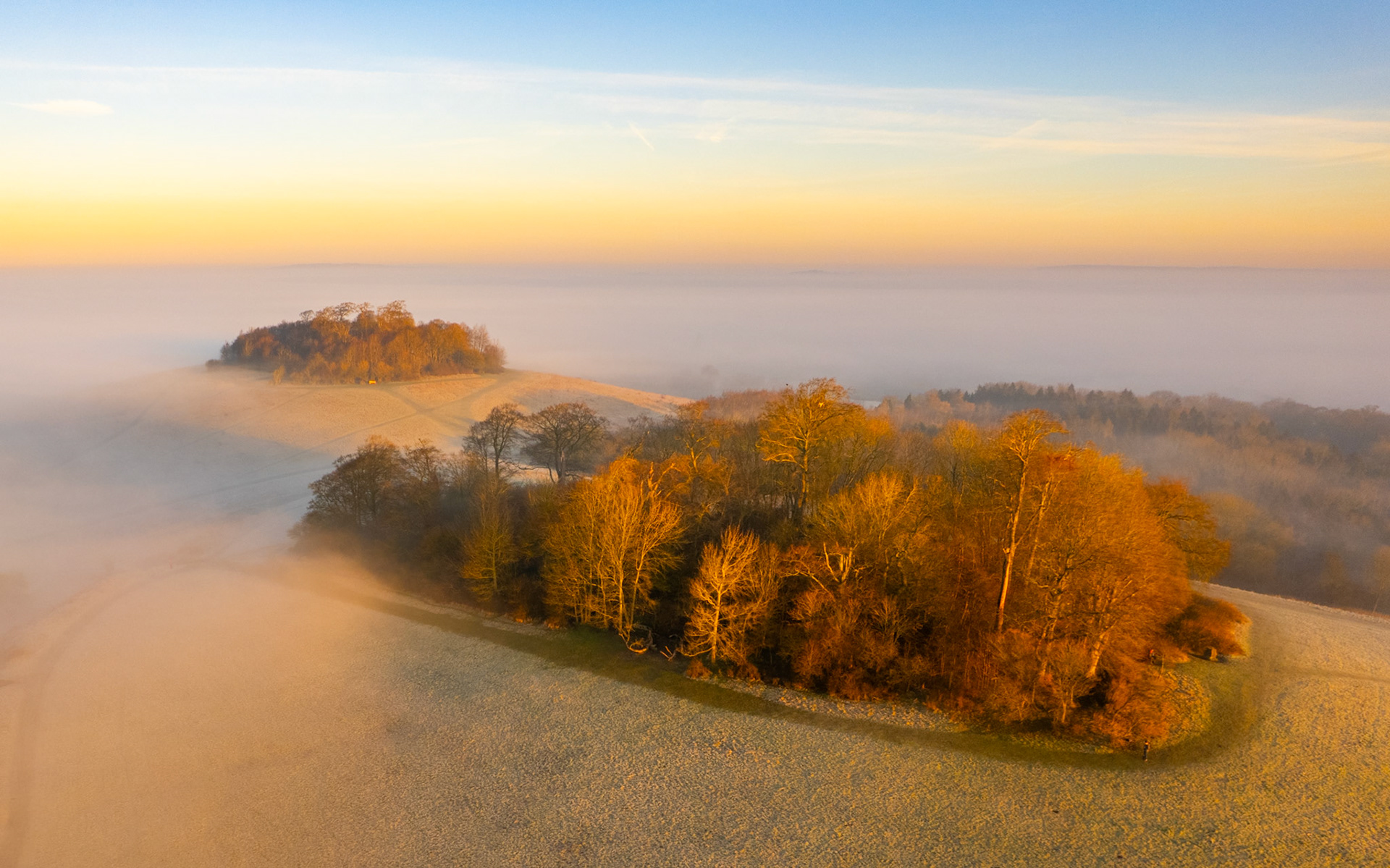
The Uffington White Horse is seen from altitude at midsummer dusk, its chalk outline pressed into the flank of the Berkshire Downs. Warm evening light picks out the patchwork of arable fields stretching north across the Vale of White Horse. The figure reads clearly from above, though the angle flattens its characteristic stylised form.
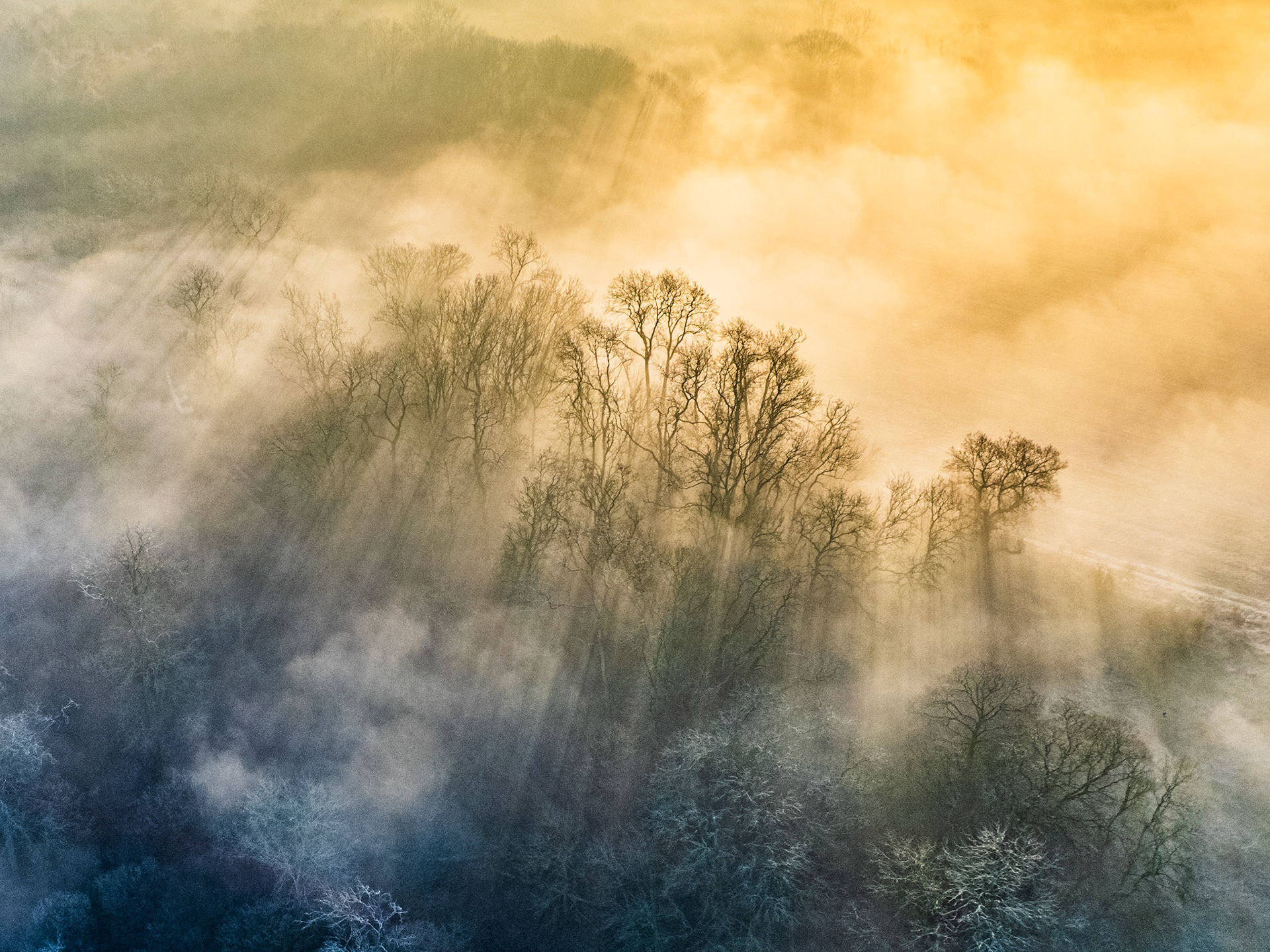
Crepuscular rays penetrate a fog layer over bare-branched woodland near Abingdon-on-Thames, caught from altitude at first light on a frost-held March morning. The diagonal ridgeline of trees divides warm amber light above from cold blue shadow below, the mist acting as a screen on which the beams are made legible. An aerial vantage strips the scene to pure atmosphere and structure.
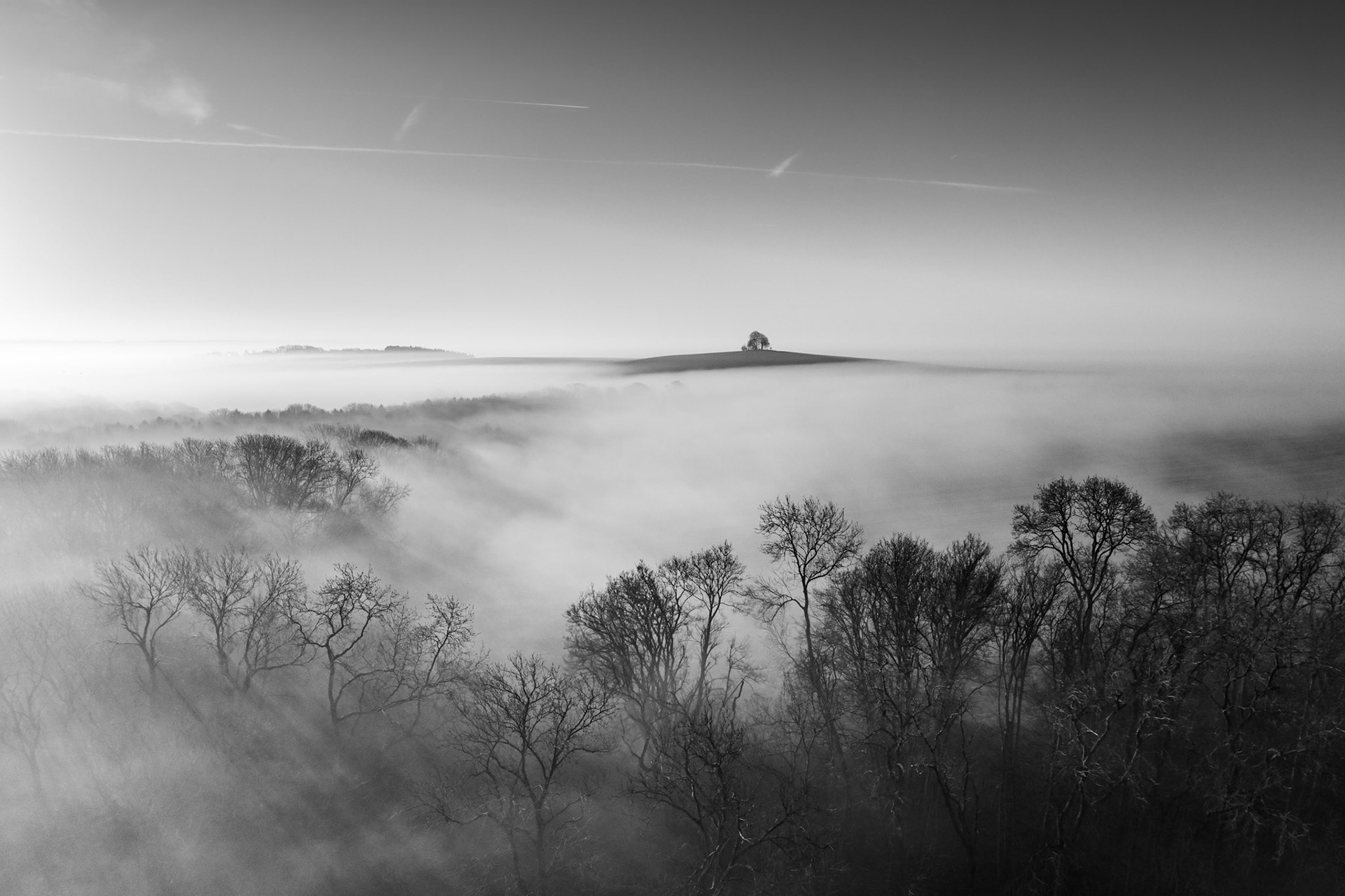
A temperature inversion fills the valley below Abingdon at dawn, submerging bare winter woodland beneath a continuous fog layer while a solitary tree-crowned hill emerges as an island above the white. The monochrome conversion reinforces the tonal separation between the dark filigree of leafless canopy in the foreground and the luminous, backlit mist beyond.
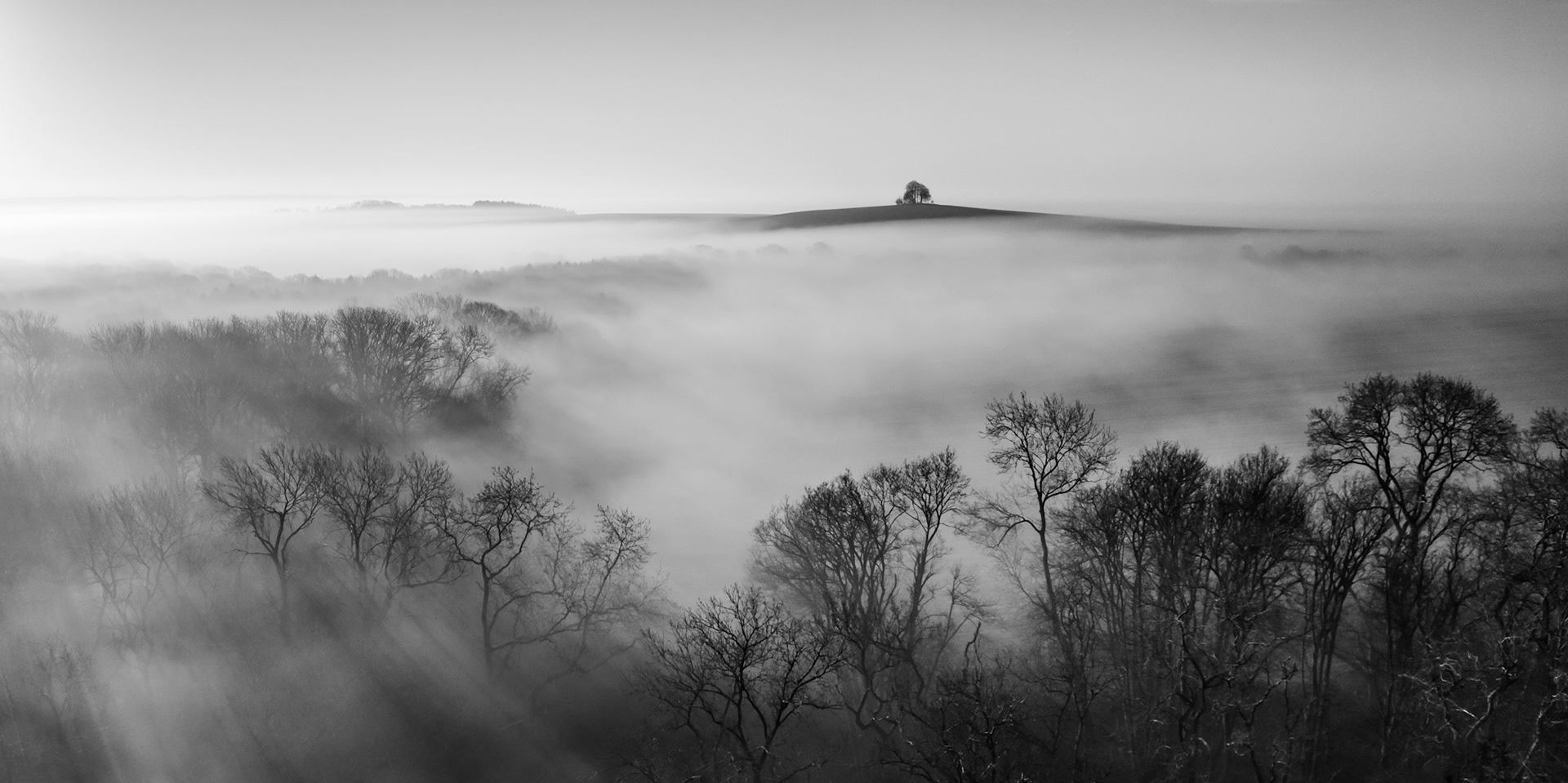
A temperature inversion buries a wooded valley beneath dense fog, leaving a lone clump of trees on a bare hilltop isolated against a pale winter sky. Bare deciduous canopies pierce the fog layer in the foreground, receding in tonal gradients toward the distant hill. Shot from low drone altitude above Abingdon-on-Thames at first light, the panoramic frame distils the scene to three horizontal bands: tree, fog, hill.
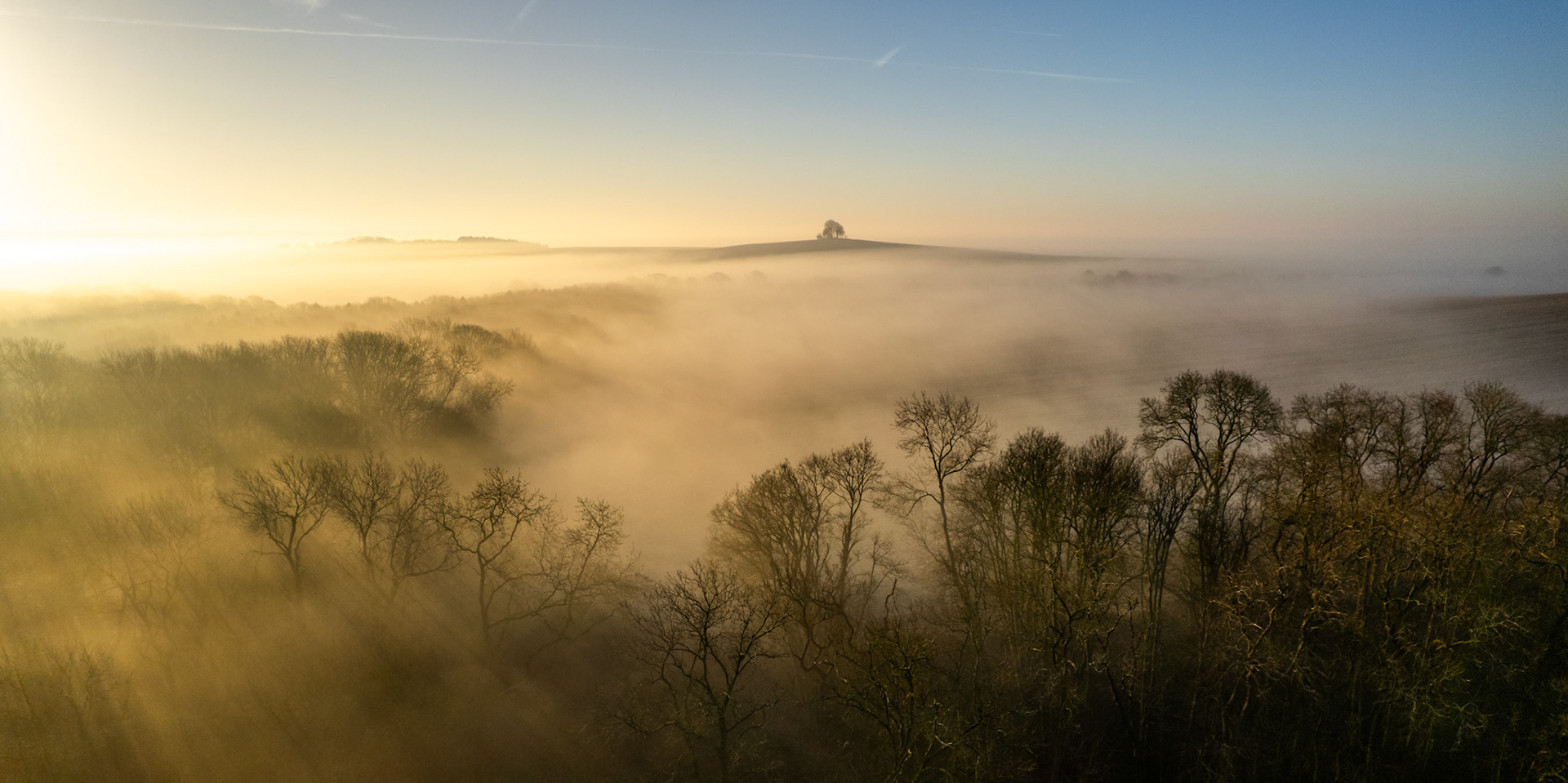
A temperature inversion fills the Thames Valley with dense morning mist at dawn, bare deciduous canopies breaking the surface while a lone hilltop tree stands in silhouette against clearing sky above Abingdon-on-Thames. The low sun from the south-east casts a warm amber wash across the fog layer, creating a clean tonal separation between woodland, mist, and open blue. The composition holds its single focal point — the isolated summit tree — with quiet authority.
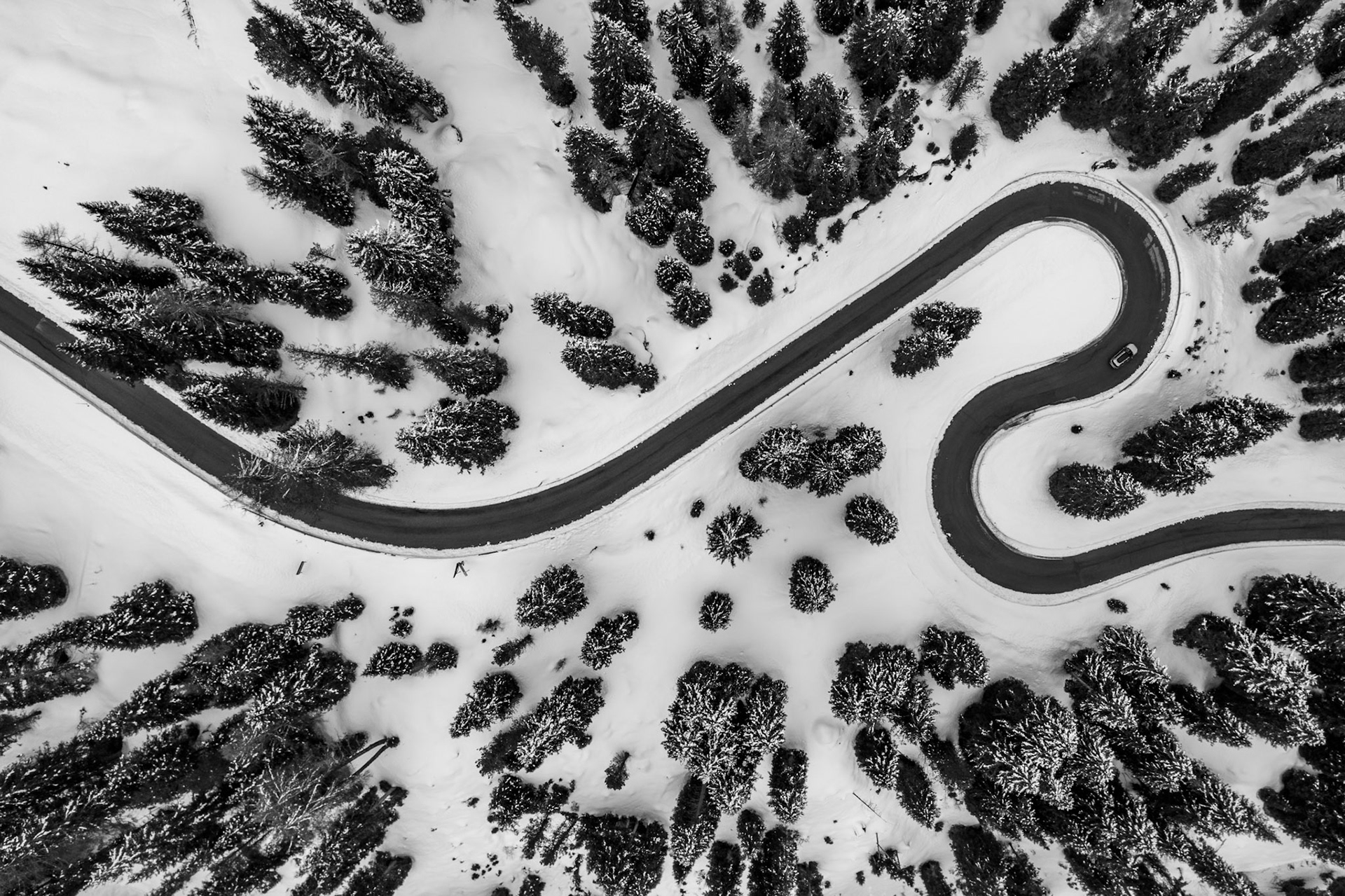
A hairpin mountain road cuts a precise S-curve through snow-covered conifer forest above Cortina d'Ampezzo, rendered from directly overhead in monochrome. The graphic contrast between the cleared asphalt and the white snowpack reduces the scene to pure line and form. A solitary vehicle caught mid-bend provides the only indication of scale.
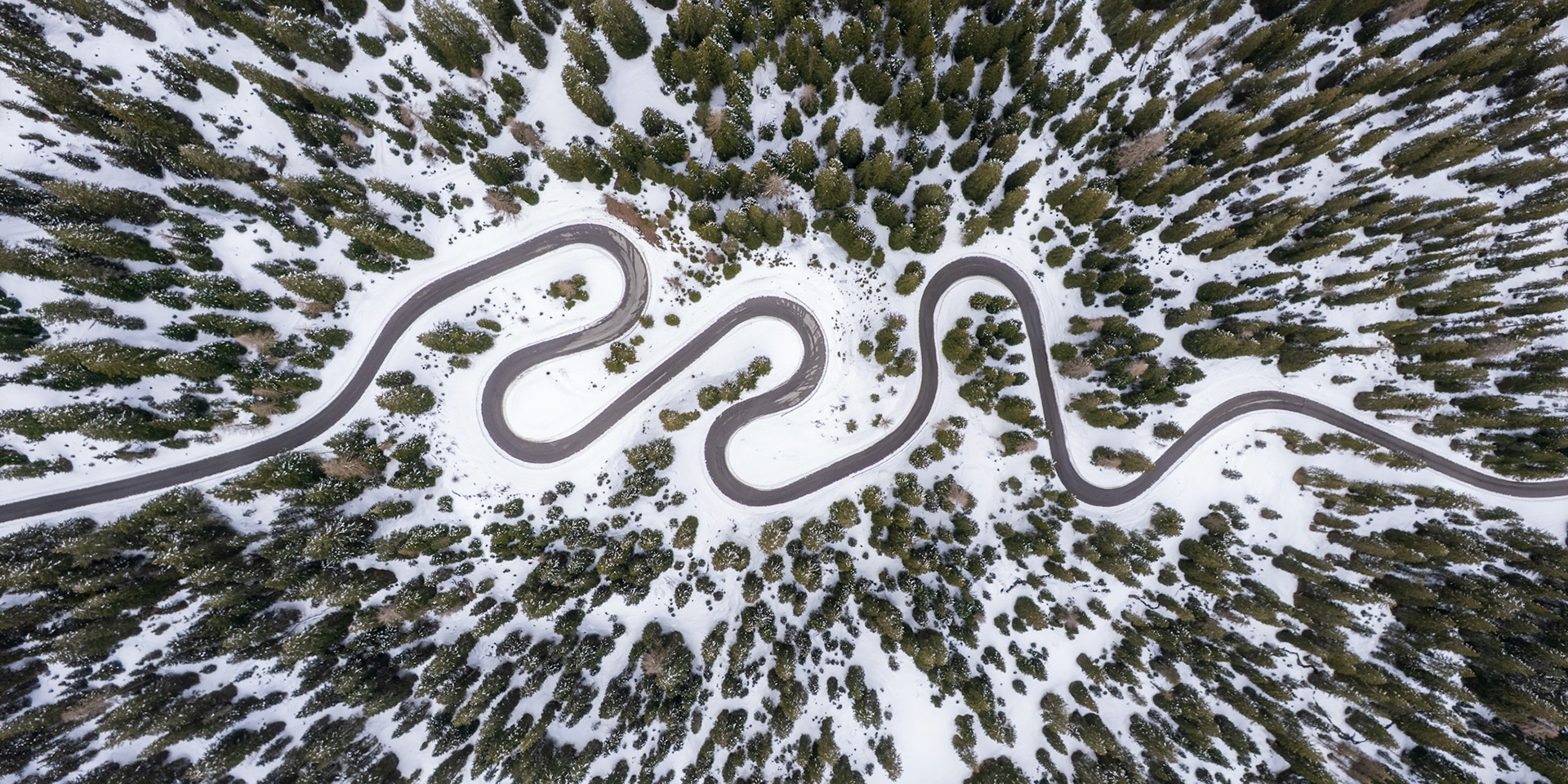
A serpentine mountain pass cuts through a snow-covered conifer forest above Cortina d'Ampezzo, photographed directly overhead at midday. The cleared asphalt road forms a continuous sinuous line across the white ground plane, its curves repeated with near-graphic regularity. Snow between the trees flattens the scene into a high-contrast pattern of grey, white, and dark green.
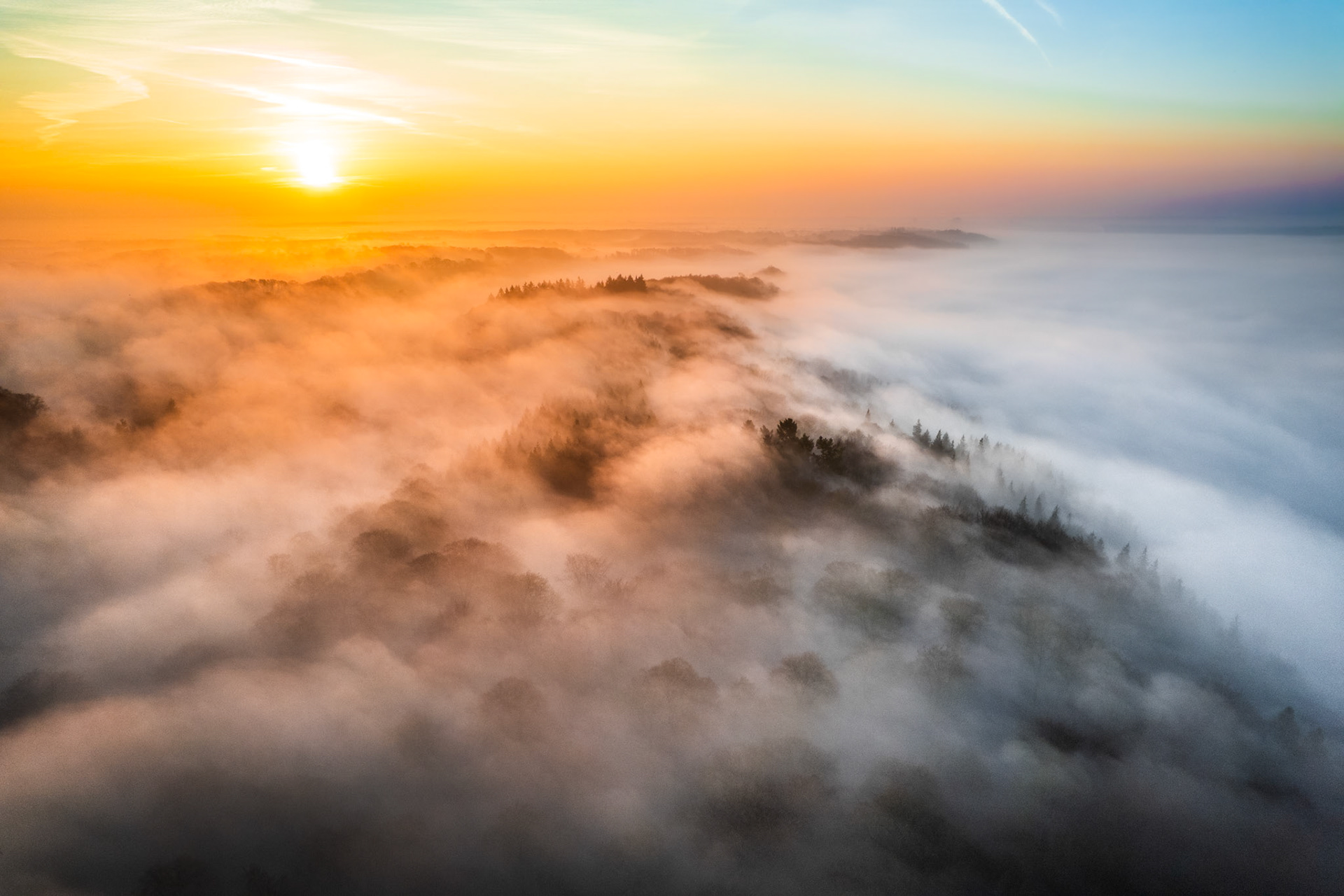
A temperature inversion buries the Thames Valley beneath a continuous fog layer at first light, leaving wooded ridgelines as isolated islands above the white. Warm sunrise light rakes across the mist from the west-northwest, splitting the frame between amber and a cool blue residue of night sky to the east. The compression of aerial perspective draws the fog into a near-abstract surface interrupted only by the dark crowns of emergent trees.
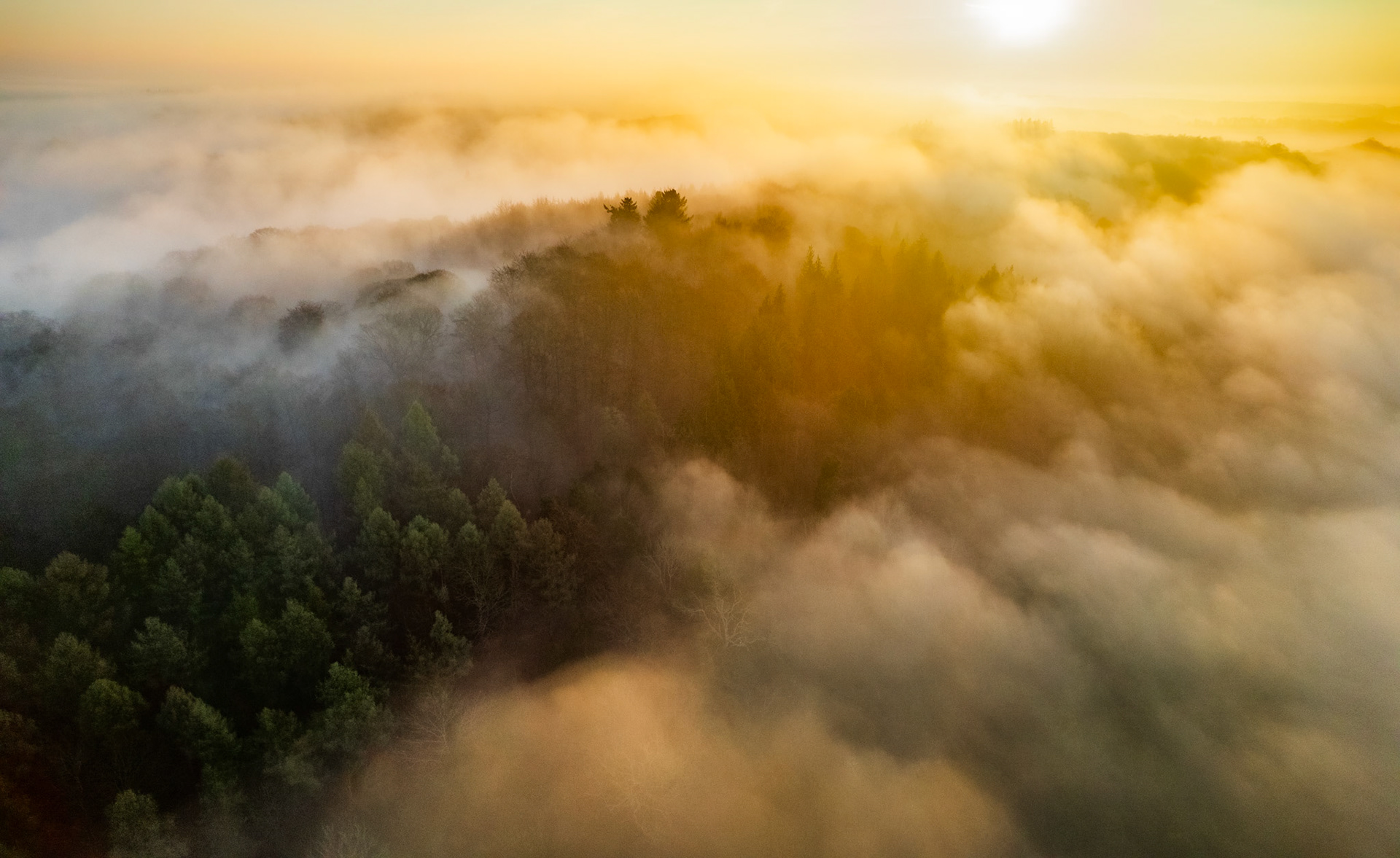
A temperature inversion holds low fog across mixed woodland near Reading, Berkshire, at first light in late March. The rising sun, just above the horizon to the north-east, throws warm golden light across the cloud layer while evergreen canopy breaks the surface in the foreground shadow. The interplay of cool grey fog and amber backlight gives the scene an unusual tonal range for a dawn aerial.
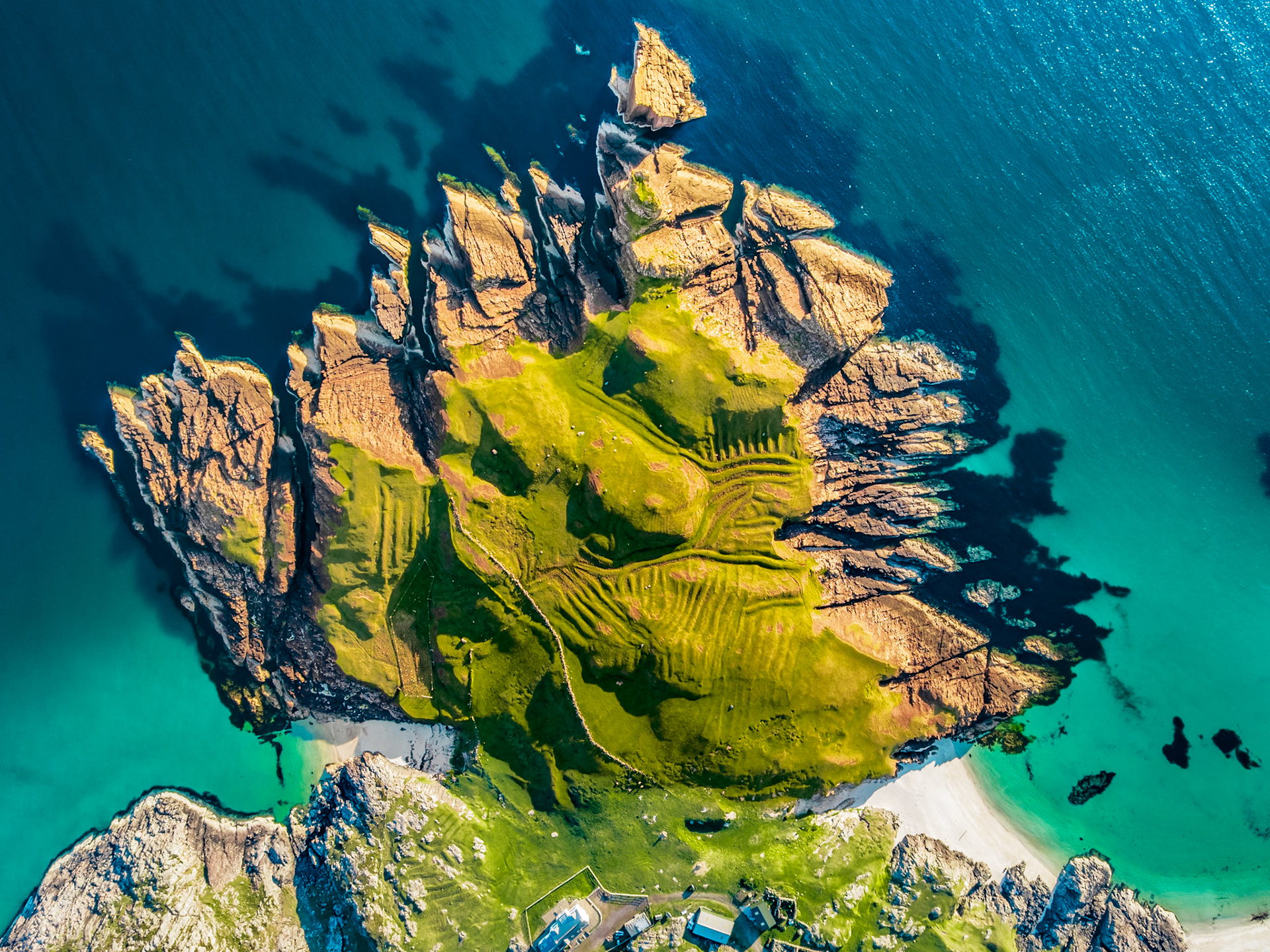
A tidal headland on the north-west Scottish coast, photographed from altitude in late evening light. Folded sedimentary strata radiate outward like fins from a grass-capped central plateau, while ancient lazybeds score the turf in parallel ridges. The surrounding sea shifts from deep indigo to shallow turquoise where sand lies beneath the surface.
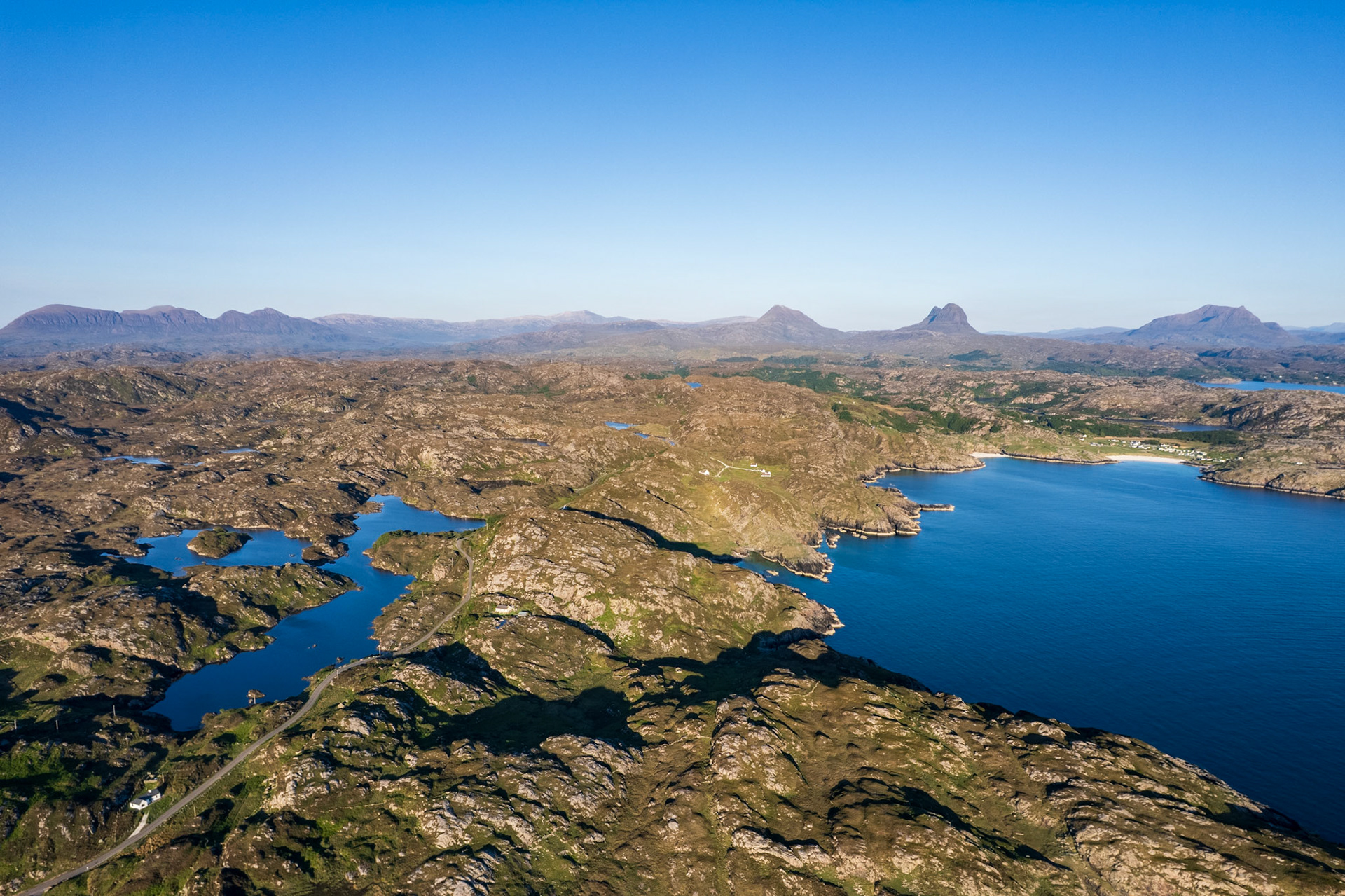
A winding single-track road threads through commercial conifer plantations toward a loch burnished copper by the setting sun, photographed from altitude above the Cairngorms National Park in high summer. The warm afterglow flattens the middle distance into layered bands of forest, open moorland, and still water, with distant hills dissolving into haze on the horizon. The scale of the afforested landscape and the serpentine road provide the composition's tension.
Submerged moorland grasses bend beneath shallow peat-stained water on the Cairngorms plateau near Aviemore, with flowering heather visible at the upper margin. The overhead drone perspective flattens the scene into near-abstraction, the rust-coloured peat pools punctuating the flow of green sedge. Shot in flat midday light, the image lacks the atmosphere or graphic resolution needed to carry the abstract concept.
A bleached, fallen Scots pine lies across a mosaic of heather and young conifers in the Cairngorms, photographed directly from above. The bone-white lattice of dead branches reads against the purple and green understorey with the clarity of a diagram, yet the image carries the weight of ecological succession. Aerial perspective strips away sentiment, leaving structure and contrast alone to carry the meaning.
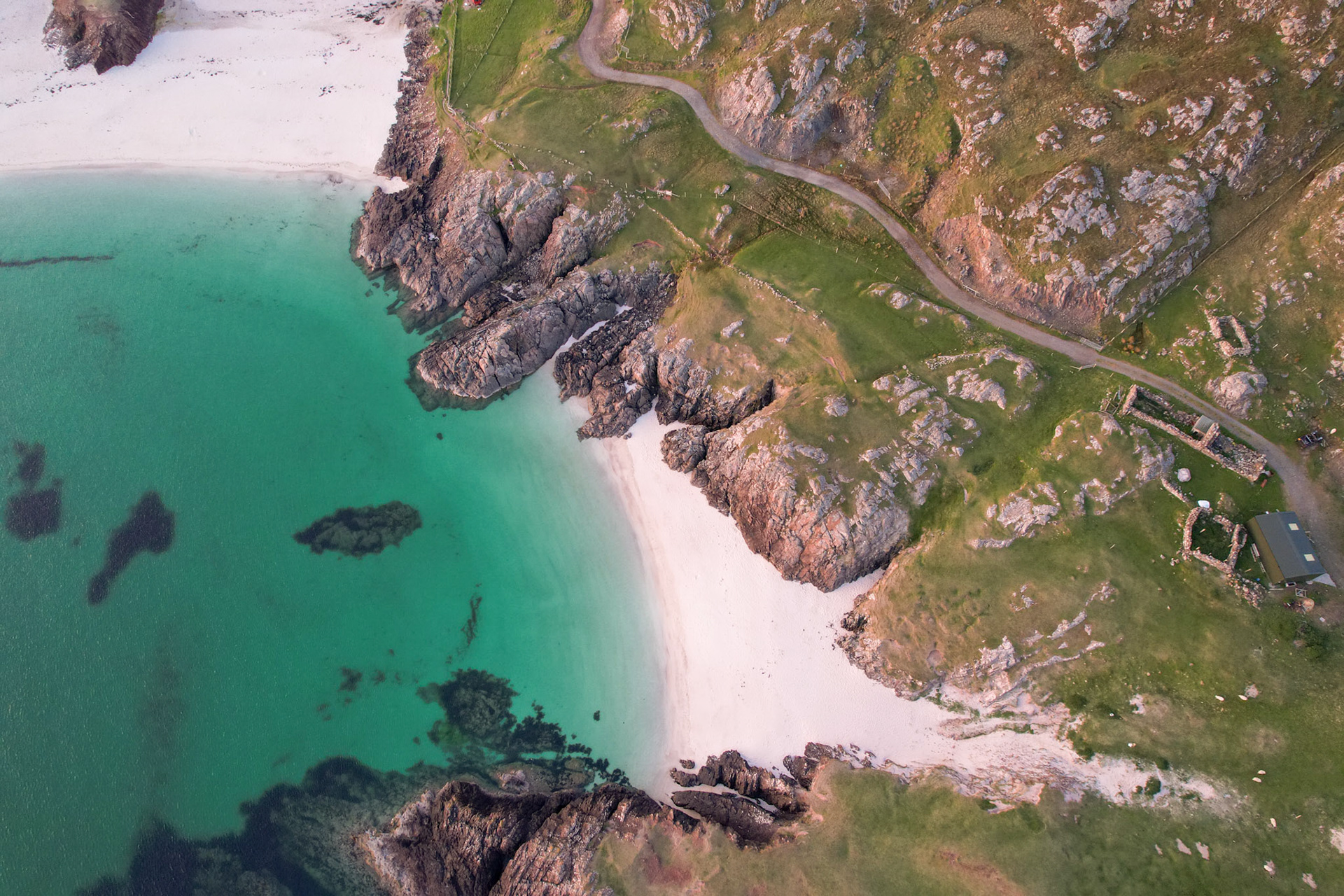
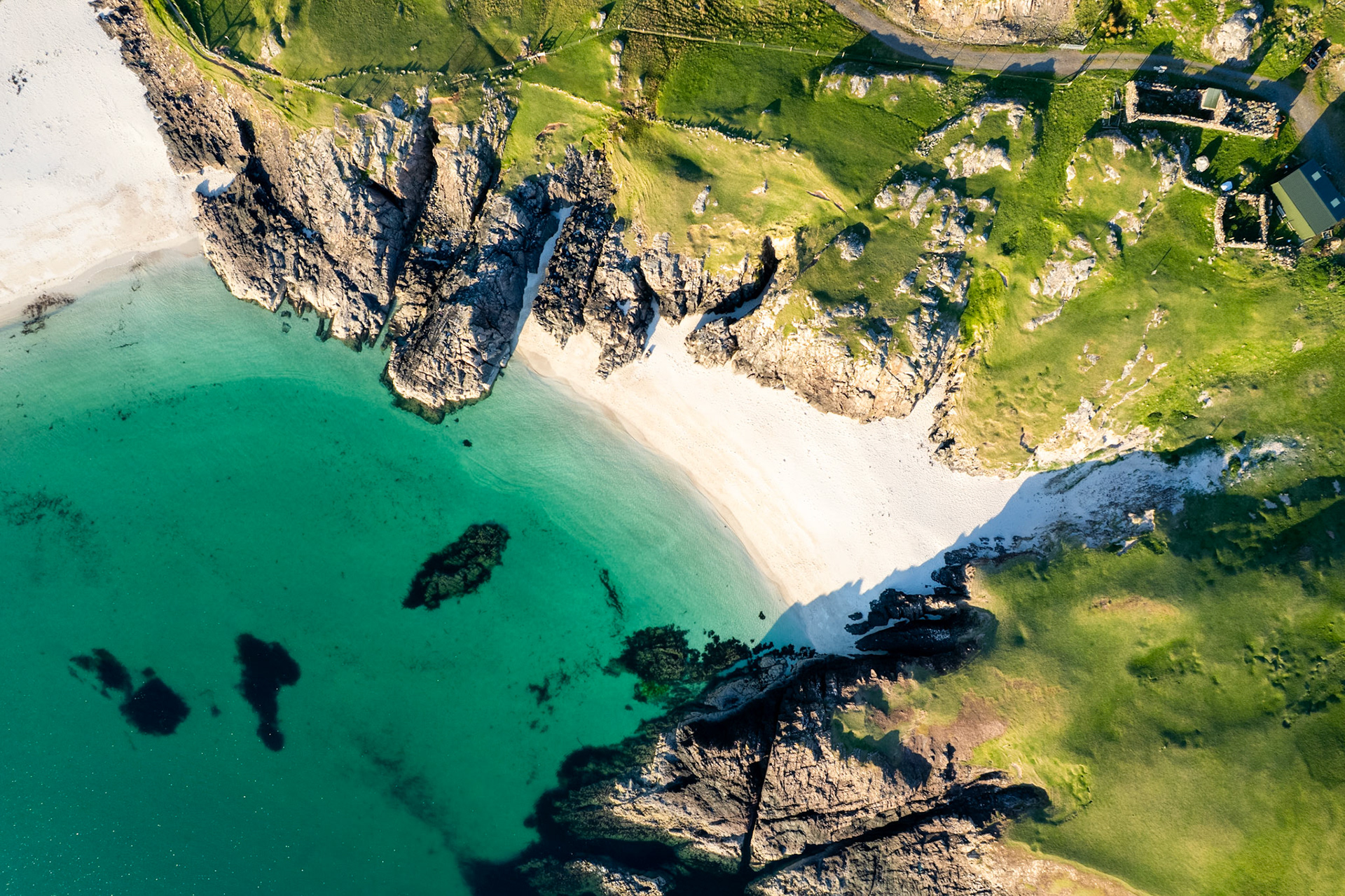
A small pocket beach of white shell sand lies sheltered between exposed gneiss headlands on the northwest Scottish coast, its turquoise shallows giving way to darker open water. Submerged kelp beds cast shadow patterns across the sea floor, while a single-track road and the remains of a stone building on the grassy hillside place this remote cove within a working, inhabited landscape. Shot vertically from altitude, the composition balances the geometry of rock, sand, and water without settling on a single dominant element.
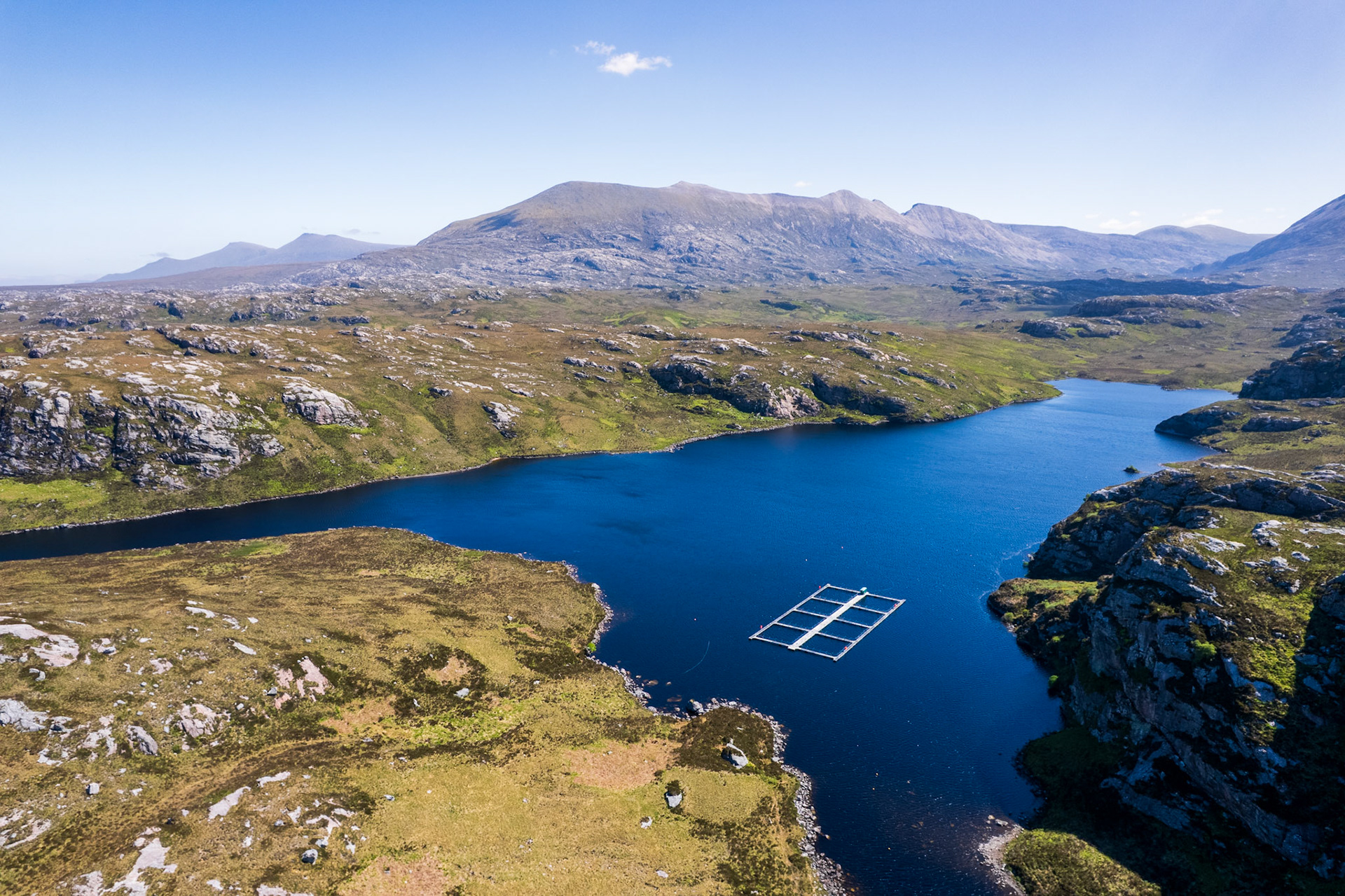
A fish farm installation sits on a dark Highland loch amid quartzite moorland north of Lairg, Sutherland. The industrial structure anchors the eye but pulls against the wilderness scale of the scene. Midday light flattens the terrain and removes the atmospheric separation that might otherwise elevate the composition.
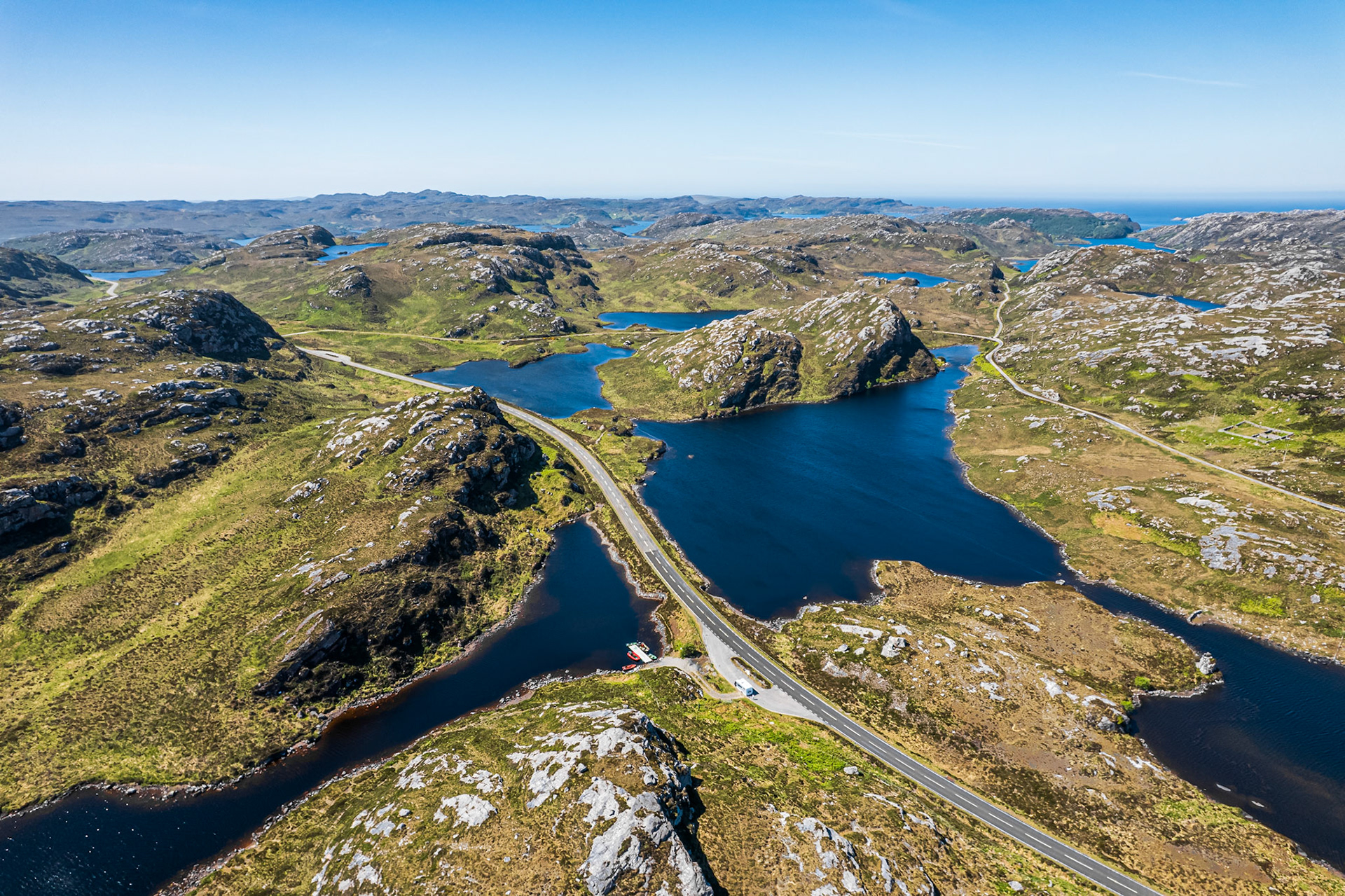
An overhead view of open blanket bog transitioning into boreal woodland on the Cairngorms plateau, captured in flat summer light. Sparse conifers punctuate the peatland surface, while a thin drainage channel traces a branching line through the saturated ground. The absence of shadow and the muted palette flatten the scene, limiting tonal separation.
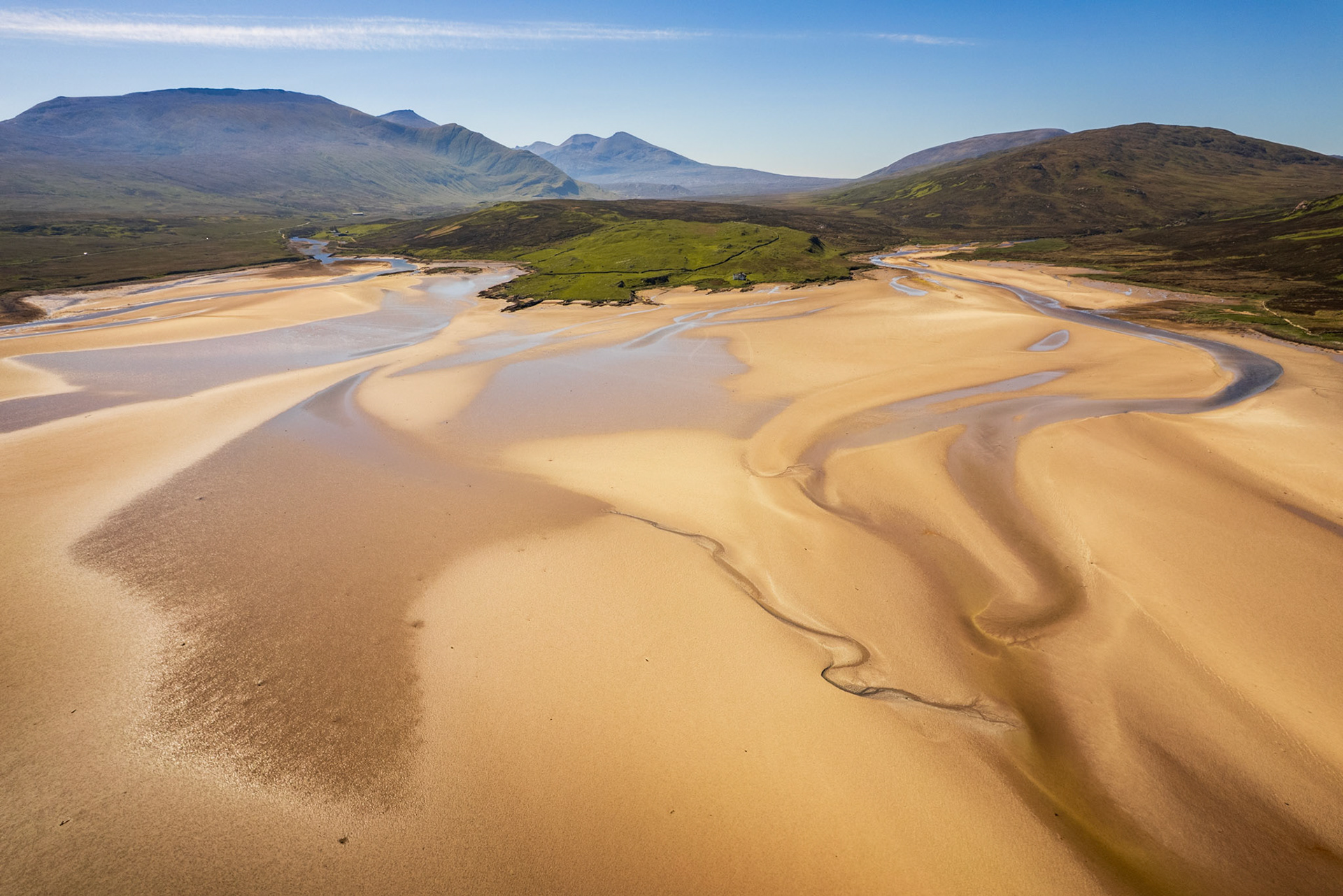
At low tide, braided channels carve sinuous lines across the tidal flats of a sea loch in Sutherland, the warm golden sand contrasting with thin slivers of pewter-grey water. Beyond, a patchwork of moorland and machair gives way to a receding line of mountains under a clear spring sky. The aerial vantage flattens the scene into near-abstraction while retaining the scale of the Highland interior.
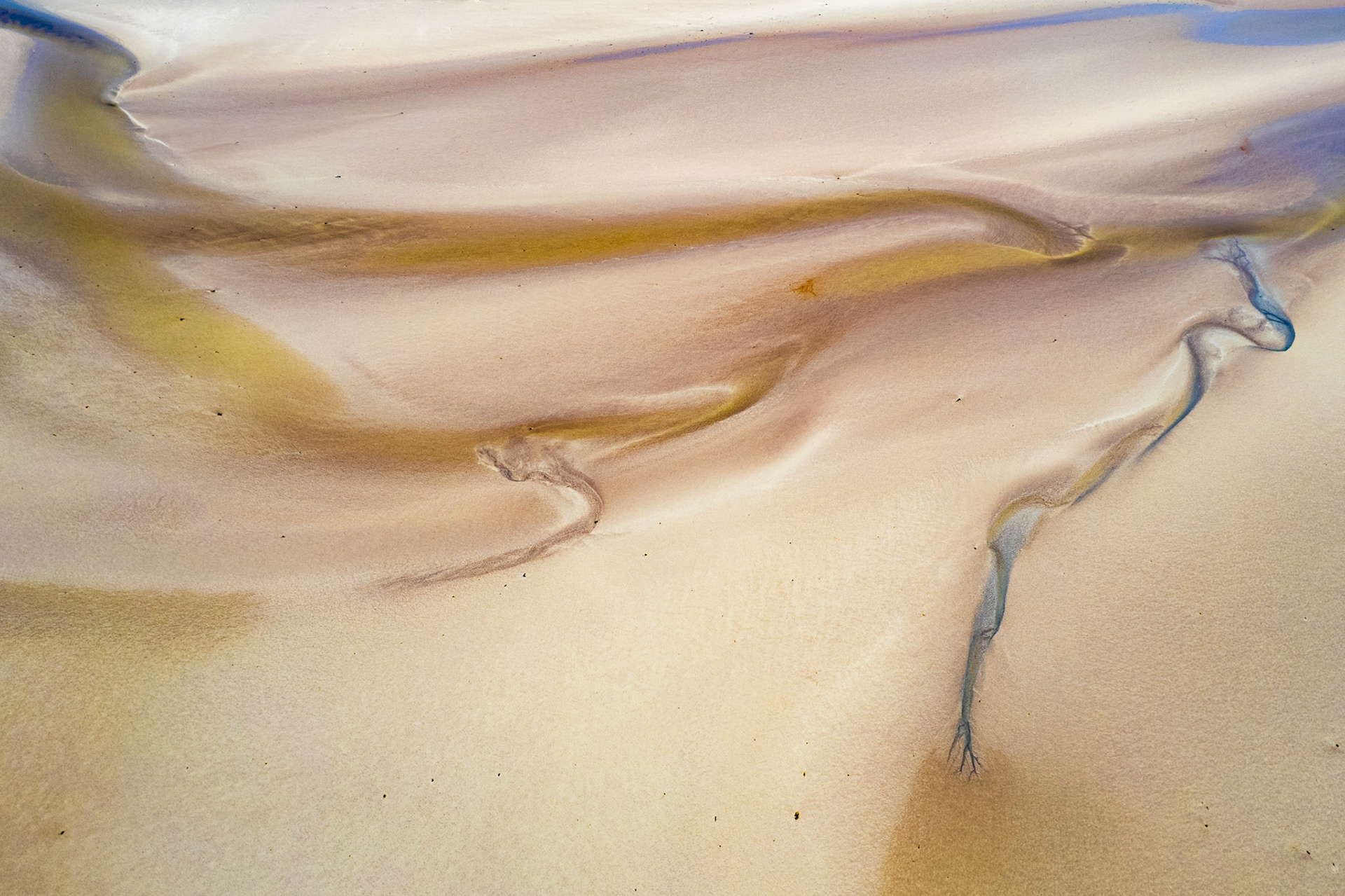
Two bleached snags spread their bare crowns across a clearing in the Cairngorms riparian woodland, their pale branching forms contrasting against the dense summer canopy below. A rocky burn cuts the upper-left corner, anchoring the abstract overhead geometry in place and ecology. The midday light flattens shadow but sharpens the tonal separation between weathered wood and living green.
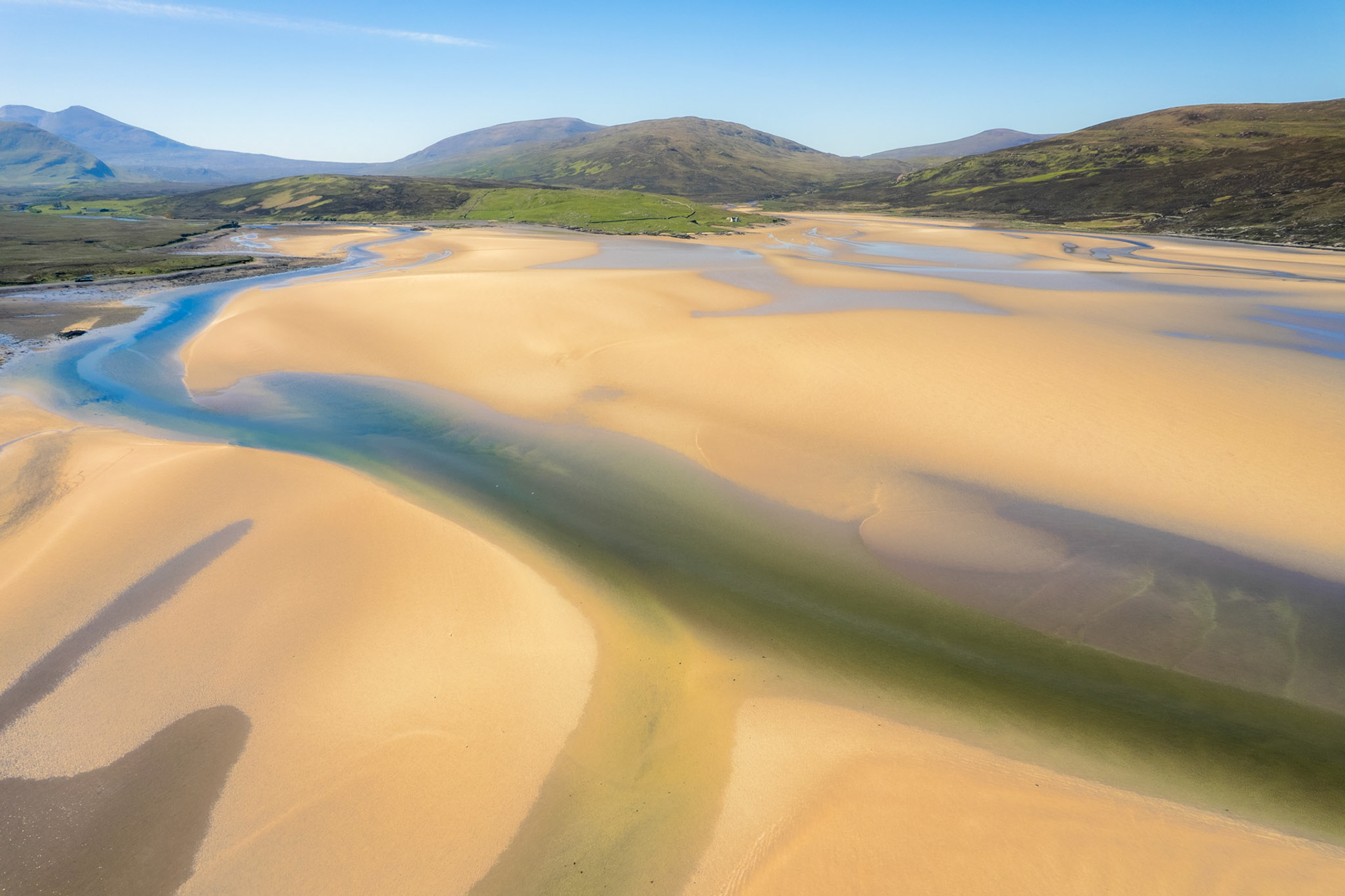
Exposed sandbars and braided tidal channels at low water on a Scottish sea loch, shot from directly above in bright spring light. The sinuous waterways carve abstract forms across the sand, with the mountains of Sutherland receding into haze behind. The aerial vantage reduces the estuary to pattern and colour, balancing graphic structure with a sense of vast, unpeopled space.
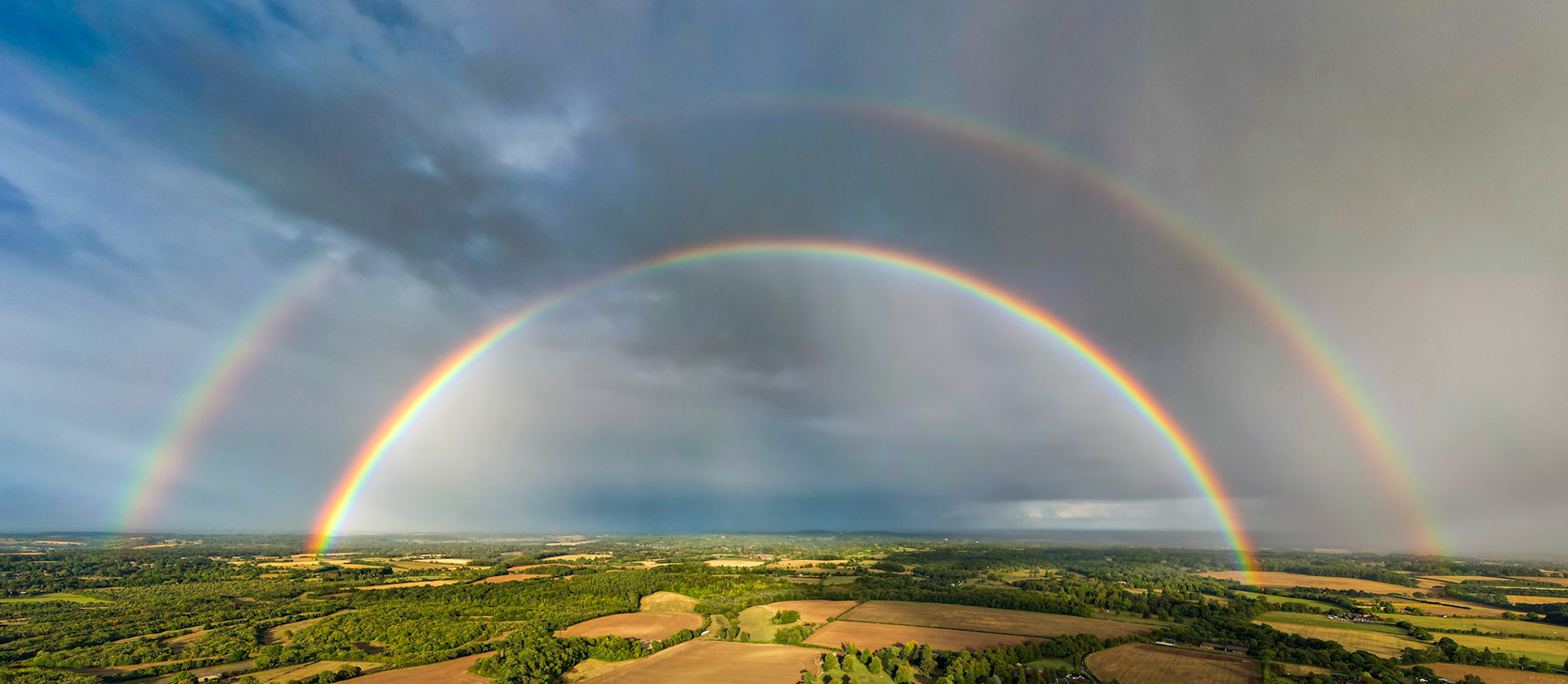
A complete double rainbow spans the full width of the frame above the patchwork farmland and woodland of the Chilterns, photographed from altitude in the aftermath of a late-summer storm. Alexander's dark band is clearly visible between the primary and secondary bows, a rare degree of optical completeness seldom captured in a single unstitched aerial frame. The receding rain curtain to the right anchors the meteorological drama without sentimentality.
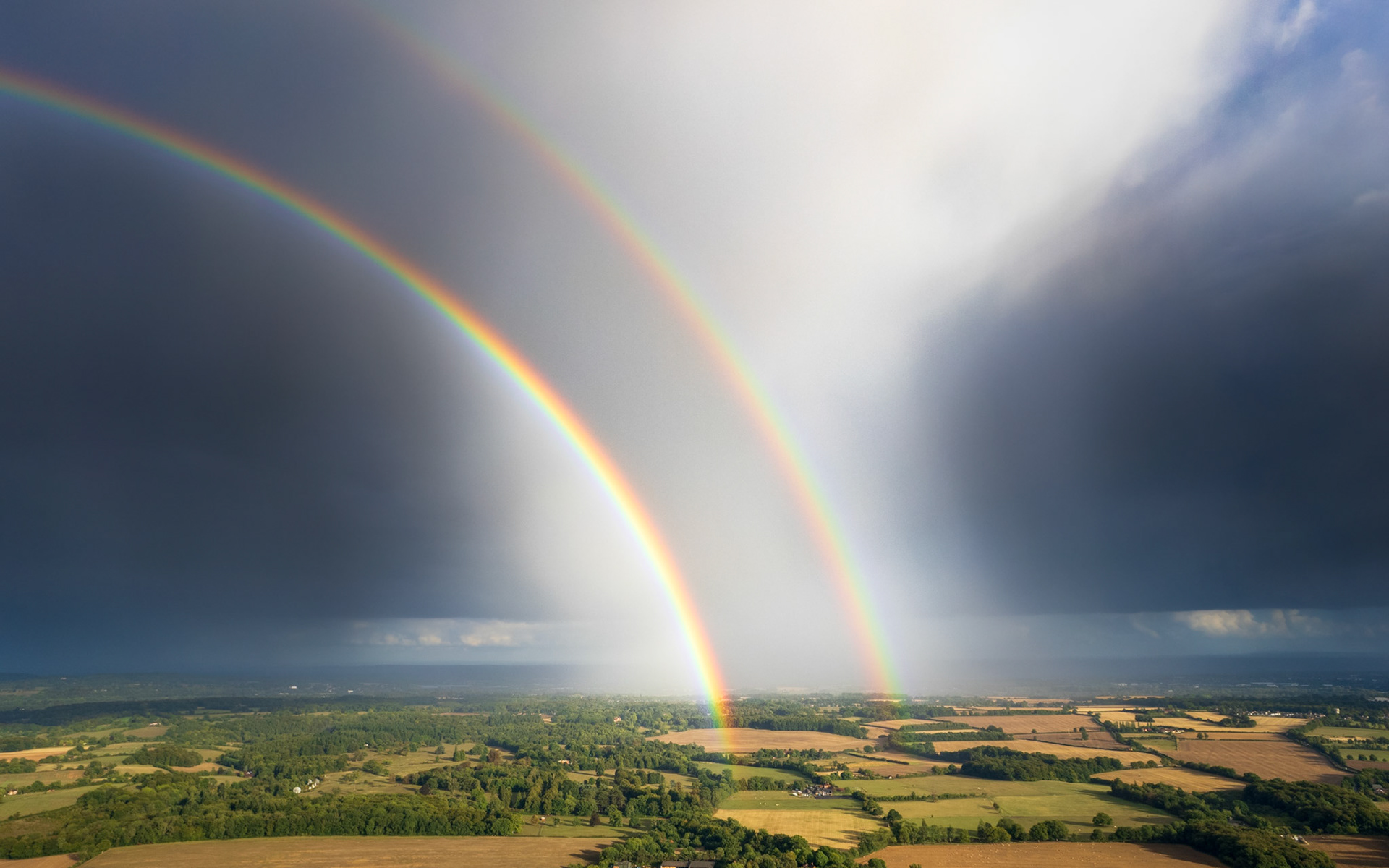
Two simultaneous rainbows converge toward the horizon above the patchwork farmland and woodland of the Thames Valley, photographed from altitude during the passage of a summer storm. The compressed aerial perspective renders both arcs as structural elements against a dark cumulonimbus backdrop, with an unusual shaft of bright sky trapped between them. Captured near Henley-on-Thames in late afternoon light, September 2025.
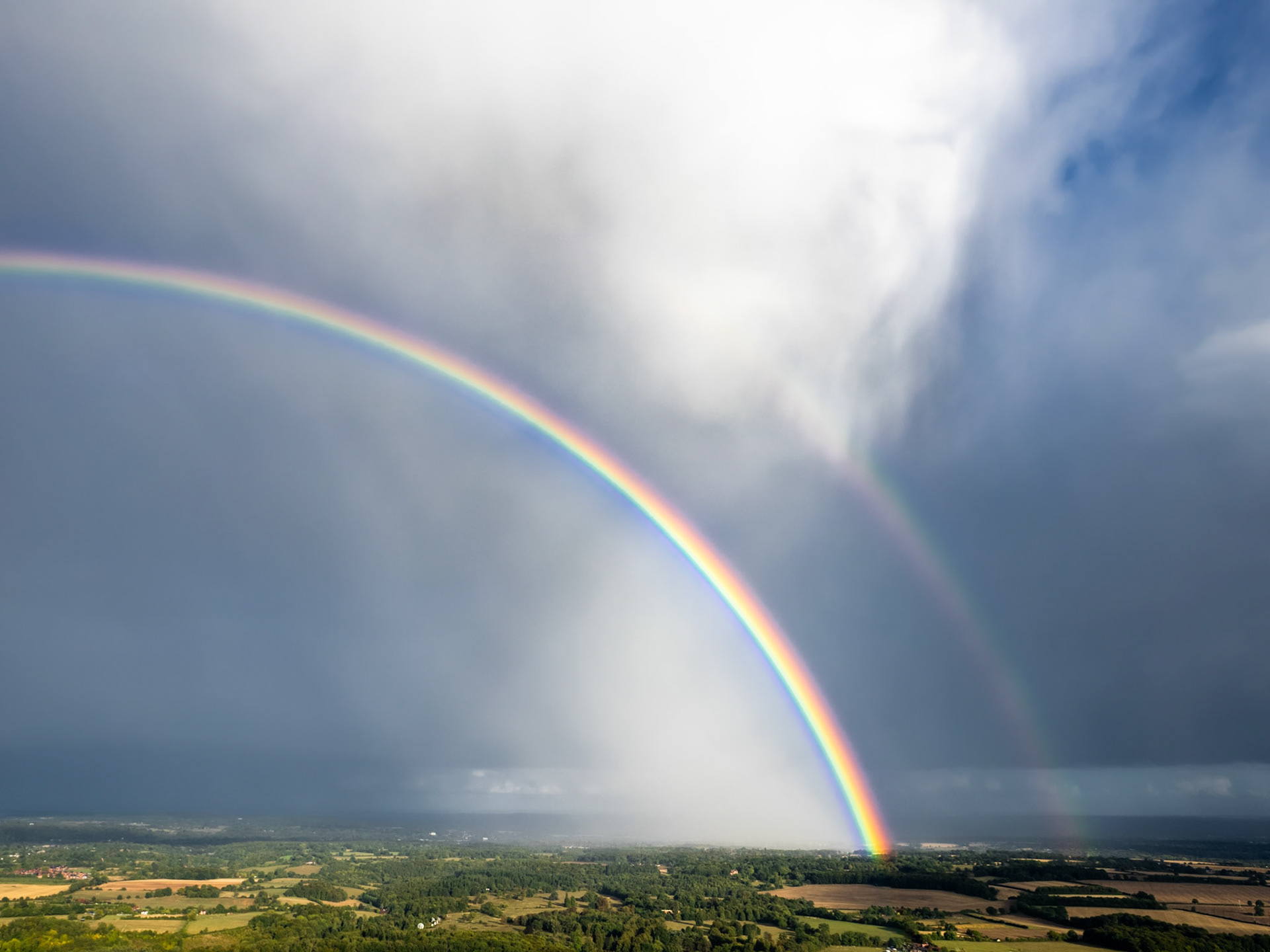
A double rainbow descends through a breaking storm cell over the pastoral patchwork south of Henley-on-Thames, the inner arc saturated against a dark cumulonimbus curtain while virga trails beneath the cloud base. The elevated drone viewpoint compresses arc and storm into a single geometrically forceful frame. Captured late afternoon in the aftermath of a convective summer storm.
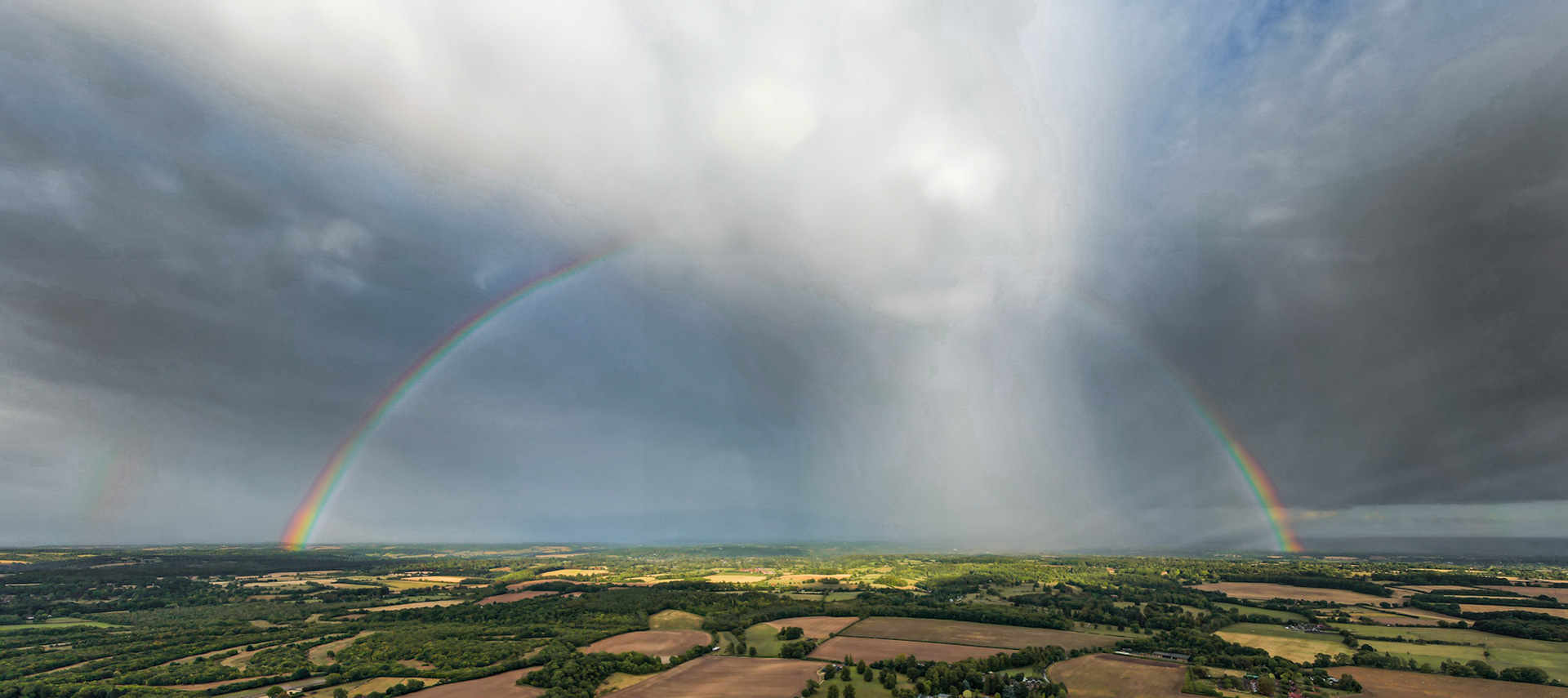
A full primary rainbow spans the patchwork farmland south of Henley-on-Thames, photographed from altitude as a convective storm cell trails virga across the mid-distance. The elevated vantage reveals the complete geometry of the bow against a bruised sky, with sunlit fields caught beneath the arch in sharp contrast to the advancing rain curtain.
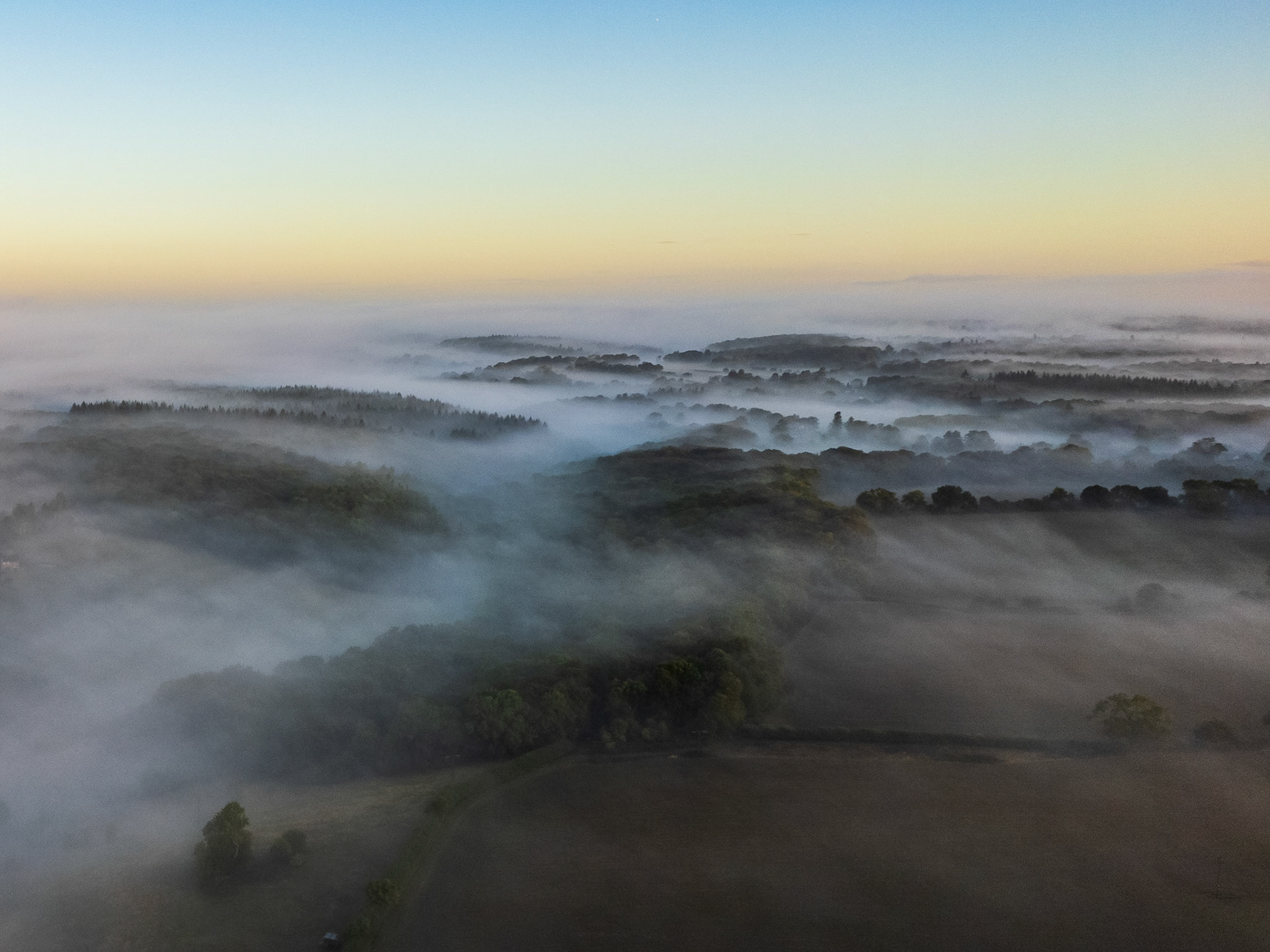
A temperature inversion holds dense mist in the valleys between wooded ridges south of Henley-on-Thames, shot from altitude at first light in early autumn. Tree canopies emerge as dark islands above the fog layers, receding in diminishing contrast toward a pale dawn horizon. The layered depth and tonal restraint give the scene a quiet, almost monochromatic quality despite the colour capture.
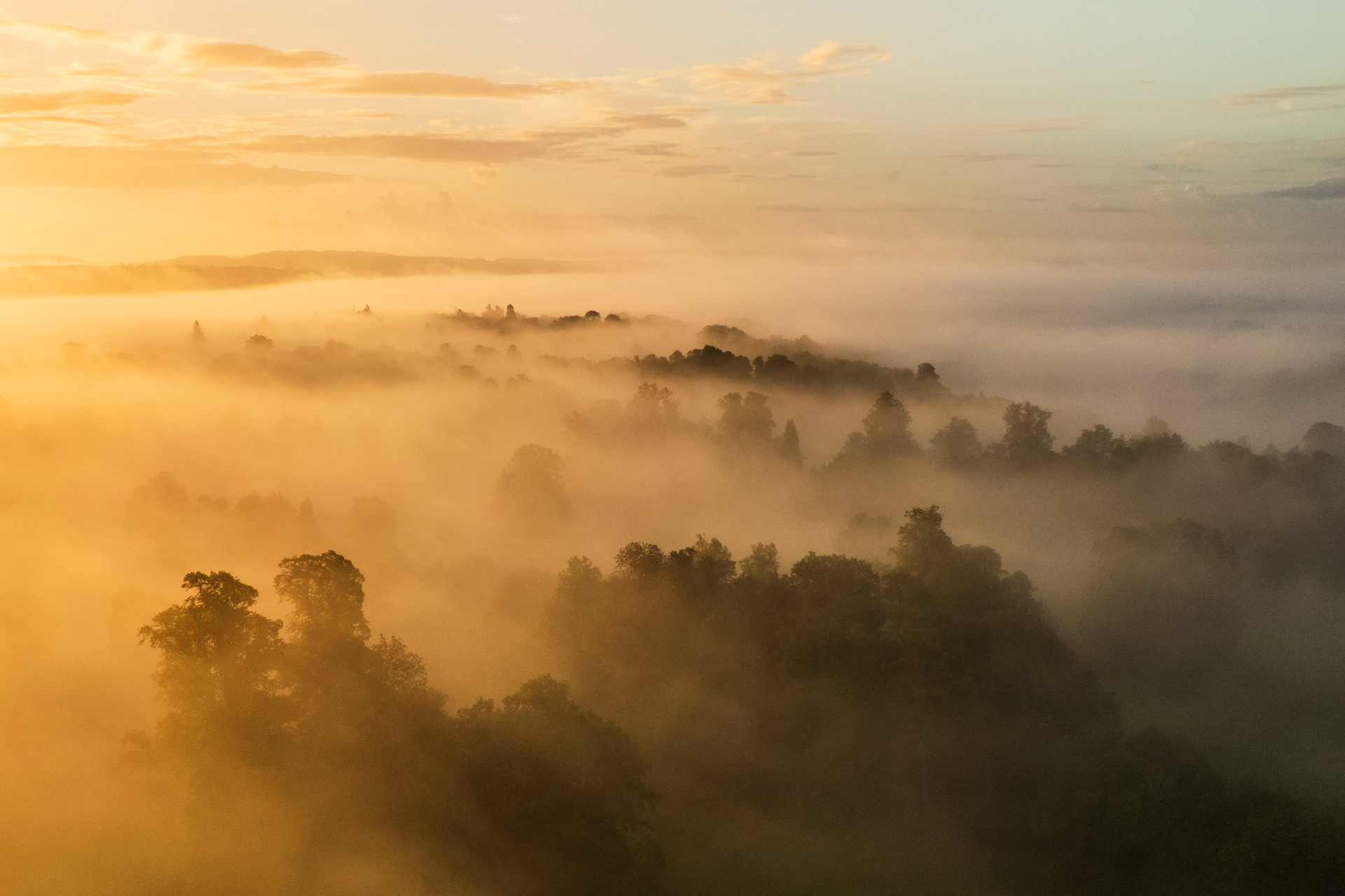
A thermal inversion settles across a wooded valley near Henley-on-Thames at first light, the canopy of deciduous trees breaking through successive layers of fog as warm dawn light rakes in from the south-east. The aerial perspective flattens the landscape into receding tonal planes, with cooler grey mist to the right contrasting the amber wash on the left. The tree crowns, still in full summer leaf, anchor each band of vapour and give the composition its quiet structure.
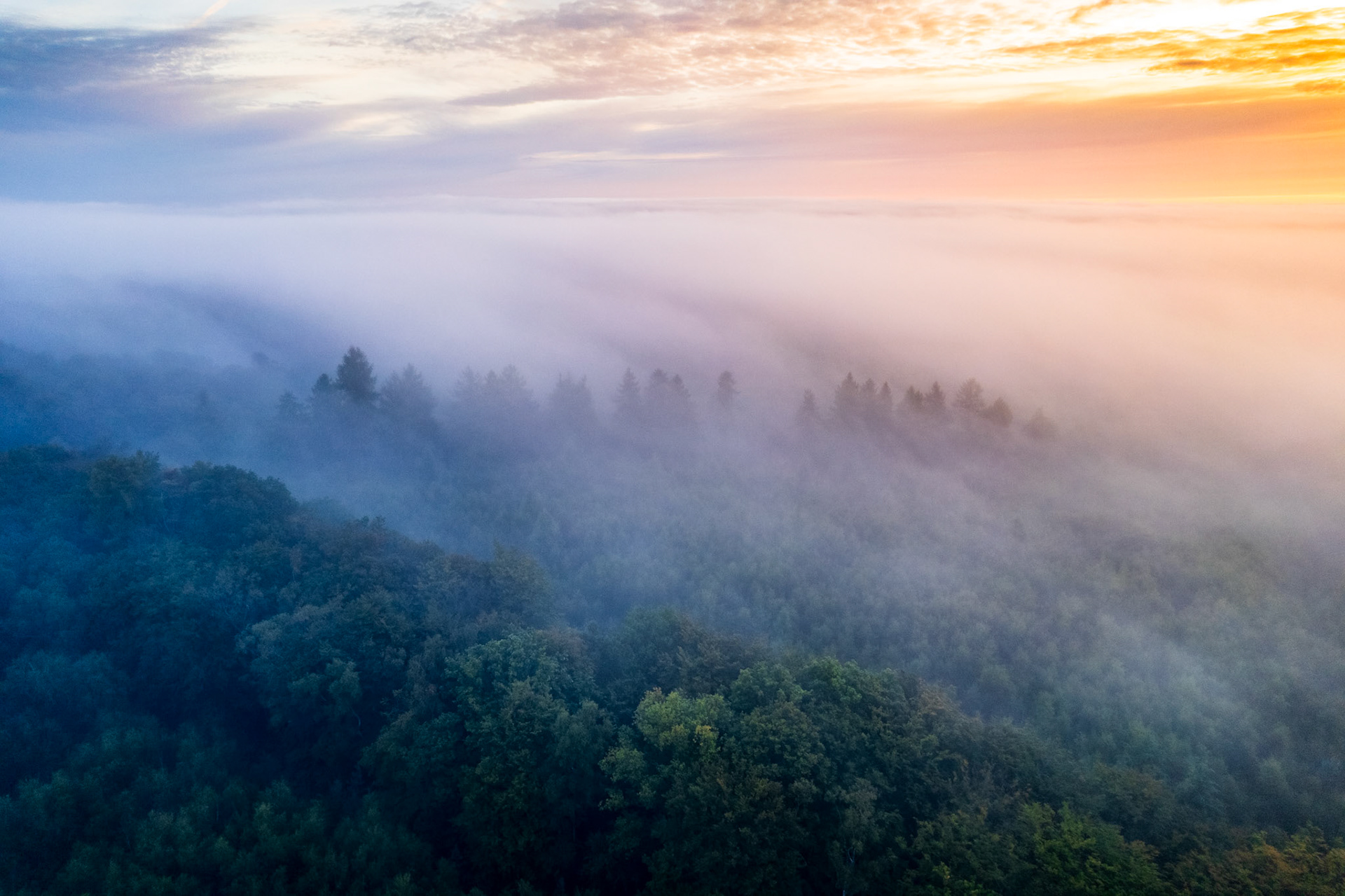
A temperature inversion traps dense mist in the valley below Henley-on-Thames, the canopy of mixed deciduous woodland emerging from the fog bank as dawn light warms the eastern sky. Conifers along the ridge-line break the fog surface in a ragged silhouette, separating cool blue shadow below from the peach and amber of the rising sun. The aerial perspective collapses the familiar into something close to abstraction.
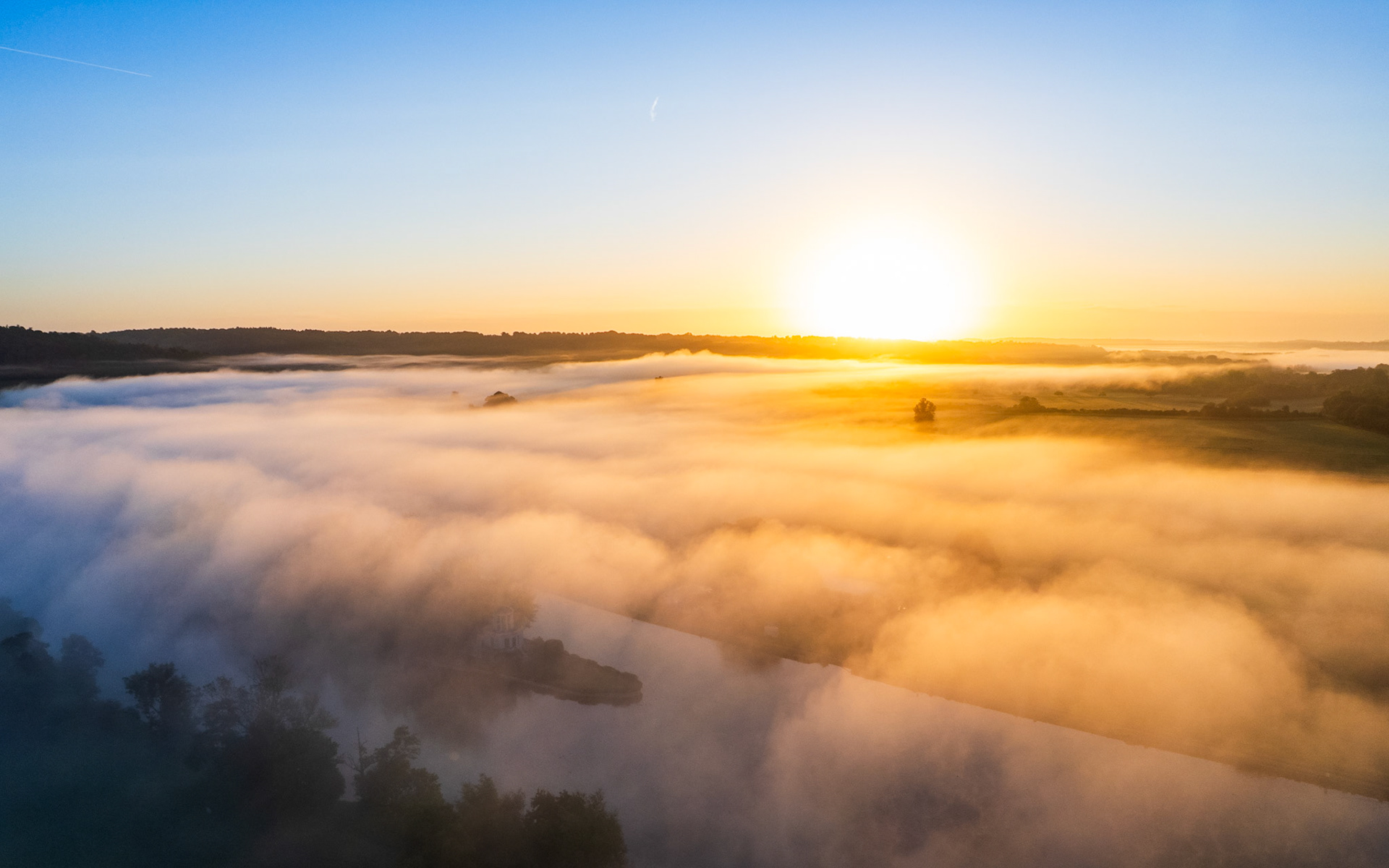
A temperature inversion fills the Thames Valley with dense ground fog at first light, tree canopies and hedgerows breaking the surface like islands. Photographed by drone near Henley-on-Thames in early autumn, the warm solar disc backlit the fog mass from the east, while cooler blue shadow held the foreground. The juxtaposition of luminous mist and dark emerging vegetation gives the scene an almost oceanic quality.
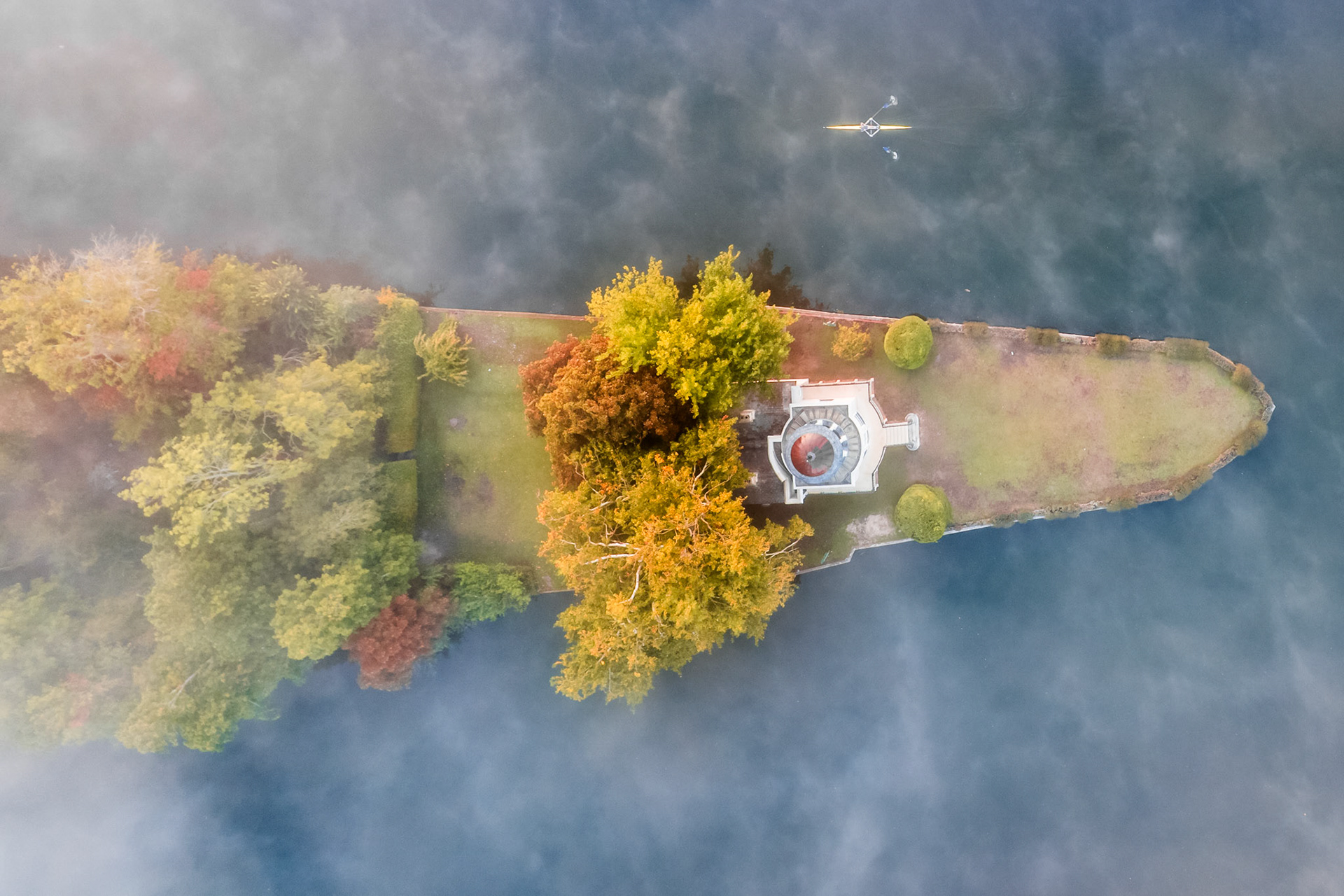
A small ornamental island on the Thames near Henley, viewed directly from above through drifting autumn mist. The neoclassical pavilion sits at the island's centre, surrounded by trees in full turn, while a lone sculler passes on the still water beyond. The low cloud partially obscuring the frame gives the image an accidental painterly quality.
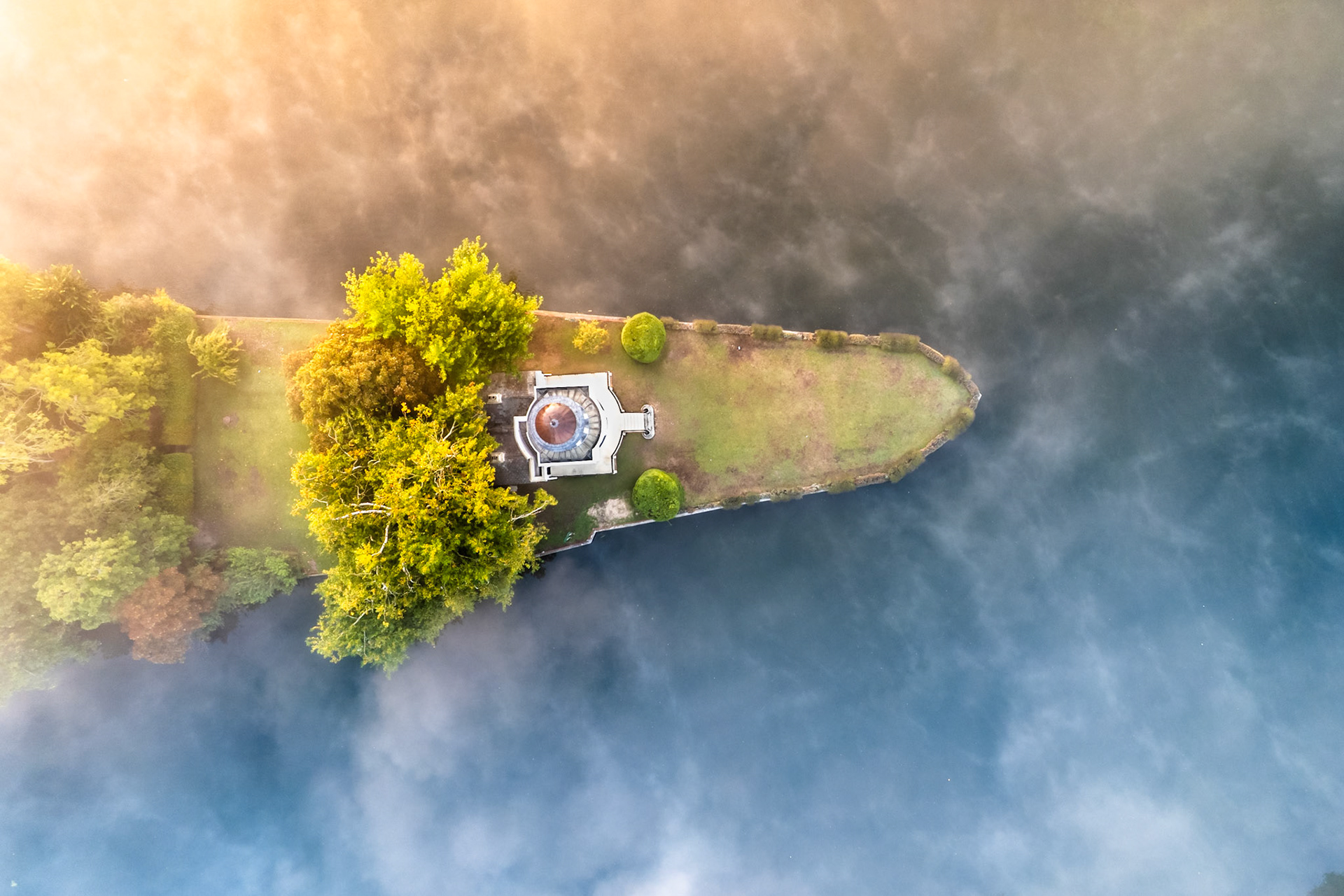
A narrow island on the Thames near Henley emerges from low dawn fog, its domed folly and manicured lawns sharp against the mist-blurred water. Morning light breaks from the upper left, catching the tree canopy and casting a warm contrast against the cool grey vapour that diffuses the river surface. The aerial perspective reduces the scene to a near-abstract arrangement of landform and atmosphere.
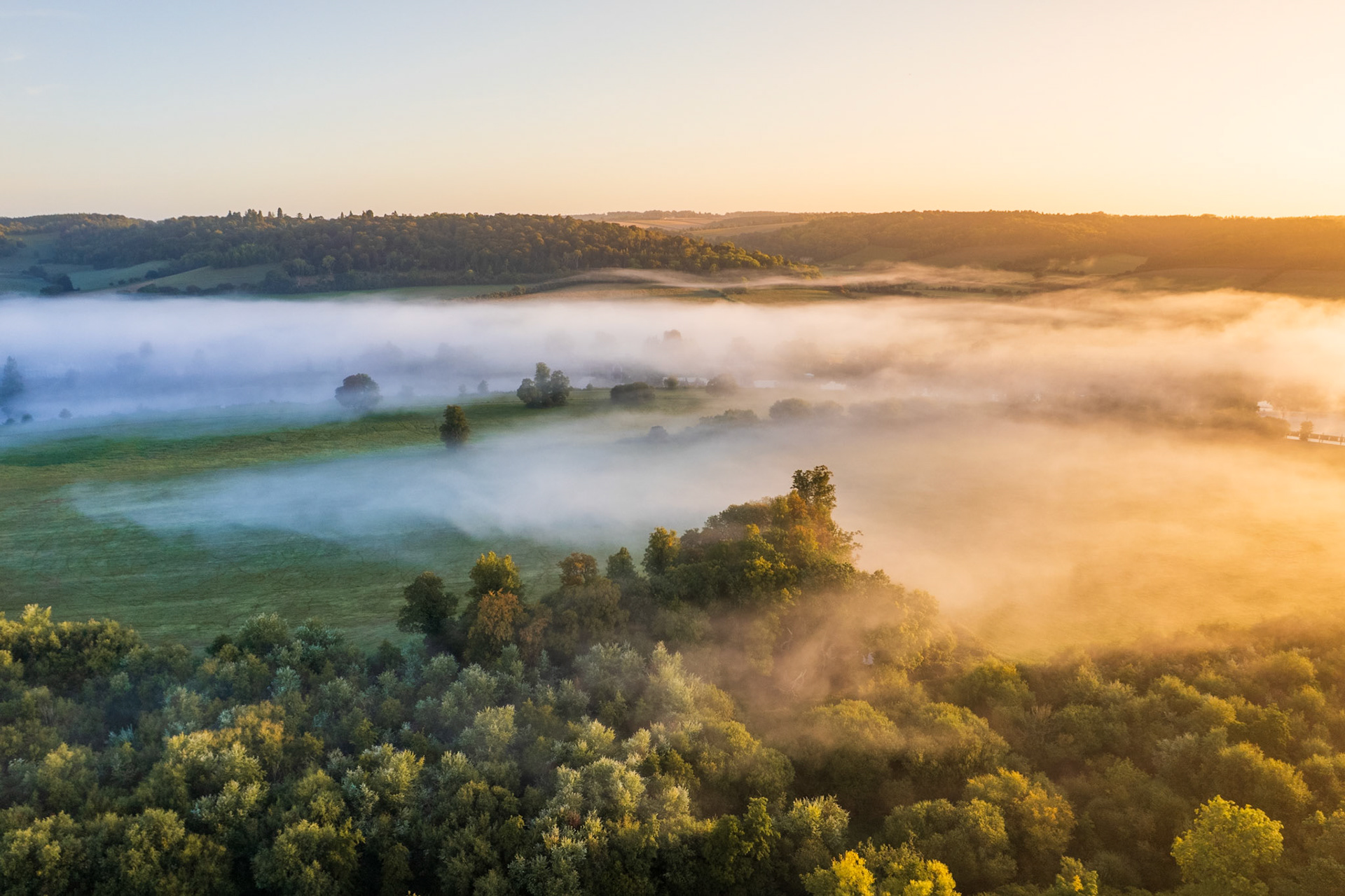
Ground mist pools across a pastoral valley near Henley-on-Thames at dawn, the low sun catching the fog from the south-east and dividing the frame between cool shadow and warm amber light. Deciduous woodland on the valley sides emerges above the mist layer, its canopy already carrying the first tones of early autumn. The aerial perspective reveals the topography beneath the fog in a way impossible from ground level.
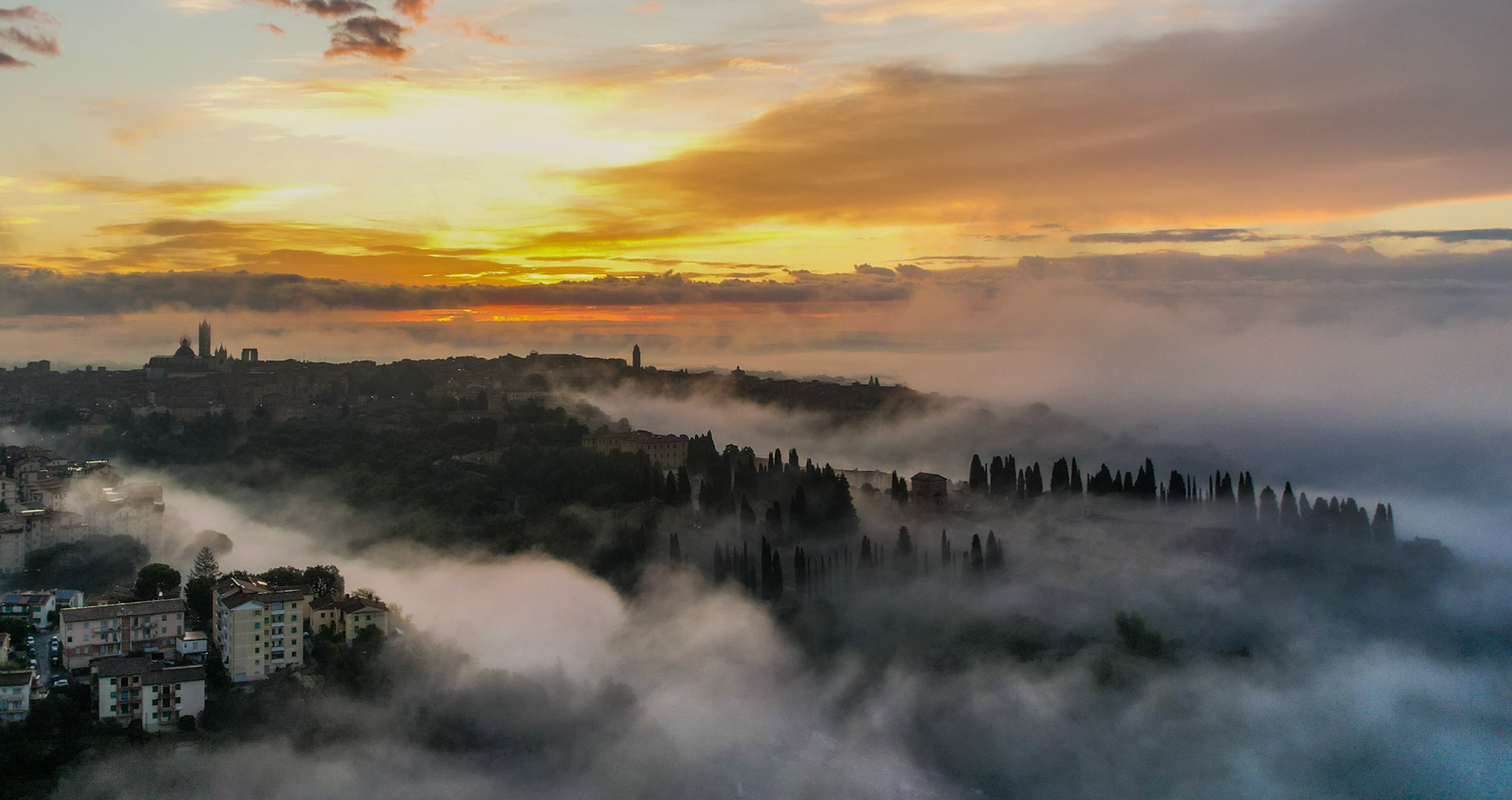
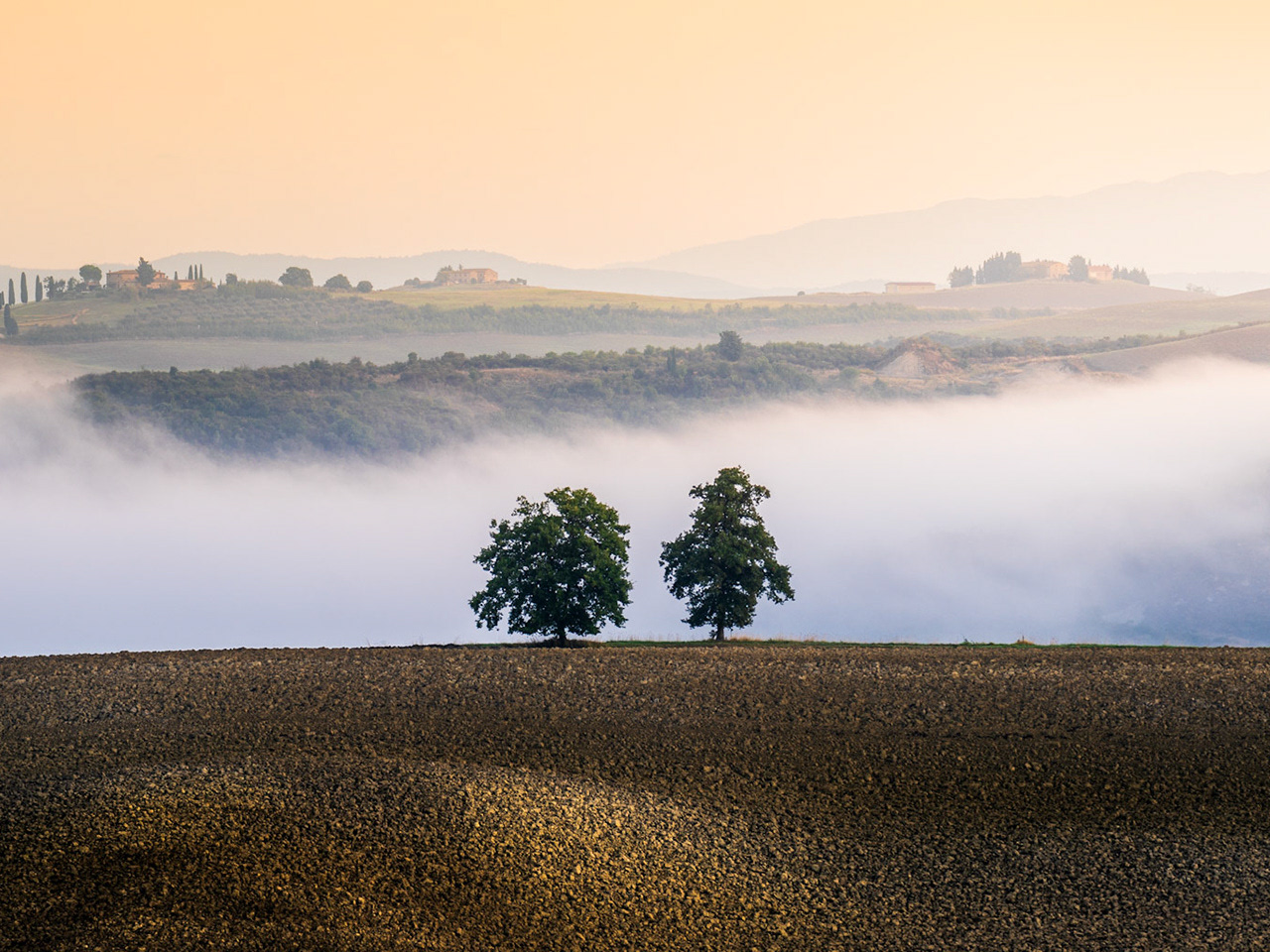
Low inversion fog pools between the hills surrounding Siena at dawn, partially submerging a long avenue of cypress trees and the outlying residential streets. The medieval skyline, including the cathedral silhouette, rises clear above the mist line as the first warm light breaks behind a broken cloud layer. The layering of fog, tree forms, and cityscape gives the frame unusual structural depth for an aerial record shot.
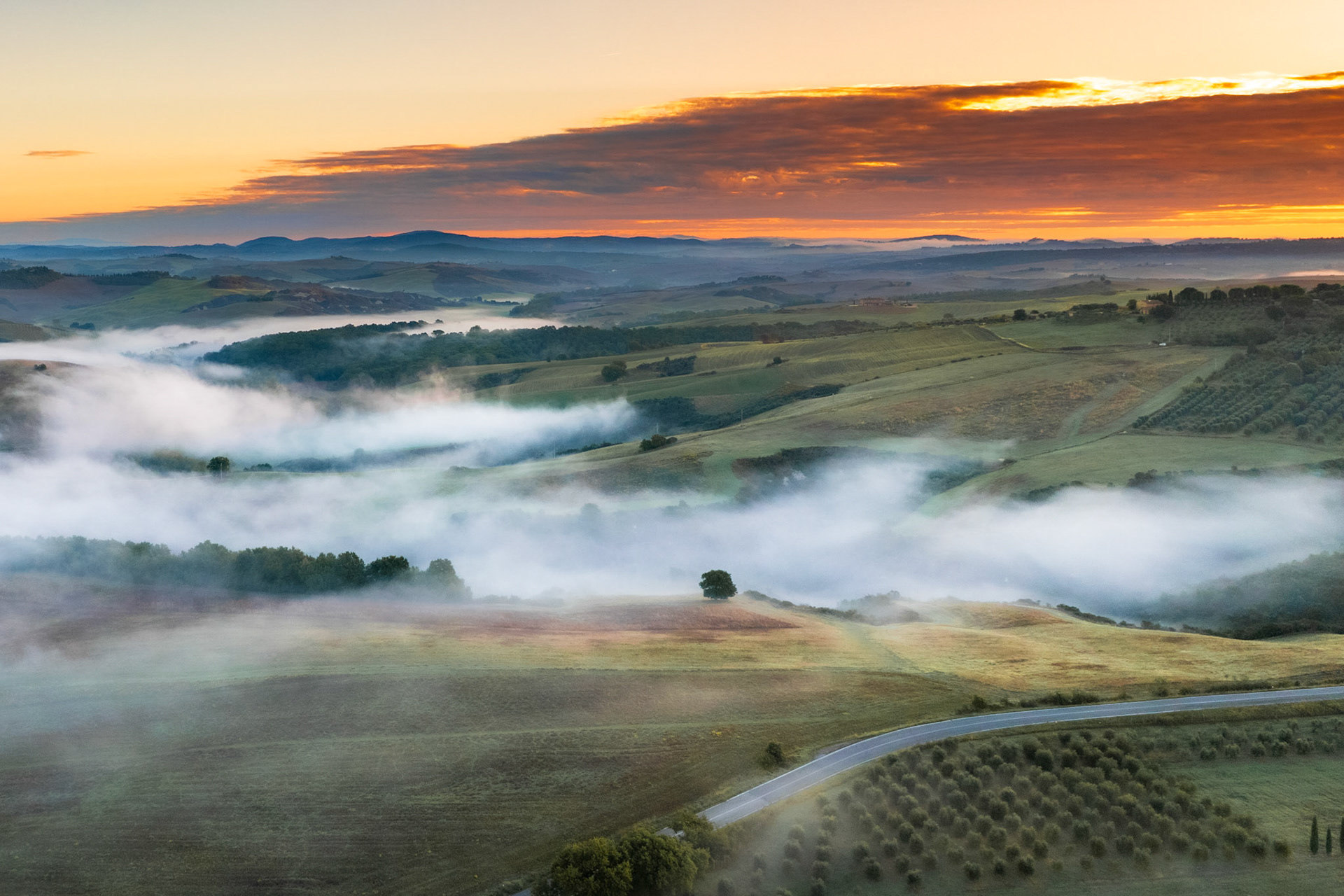
Ground-level inversions pool between the rolling hills of the Val d'Orcia at dawn, the mist threading between tree lines and farmland as the sky ignites above the distant Apennine ridge. Shot from altitude, the layered recession of fog, hill and cloud gives the scene its depth. Autumn colour is still emerging in the canopy below.
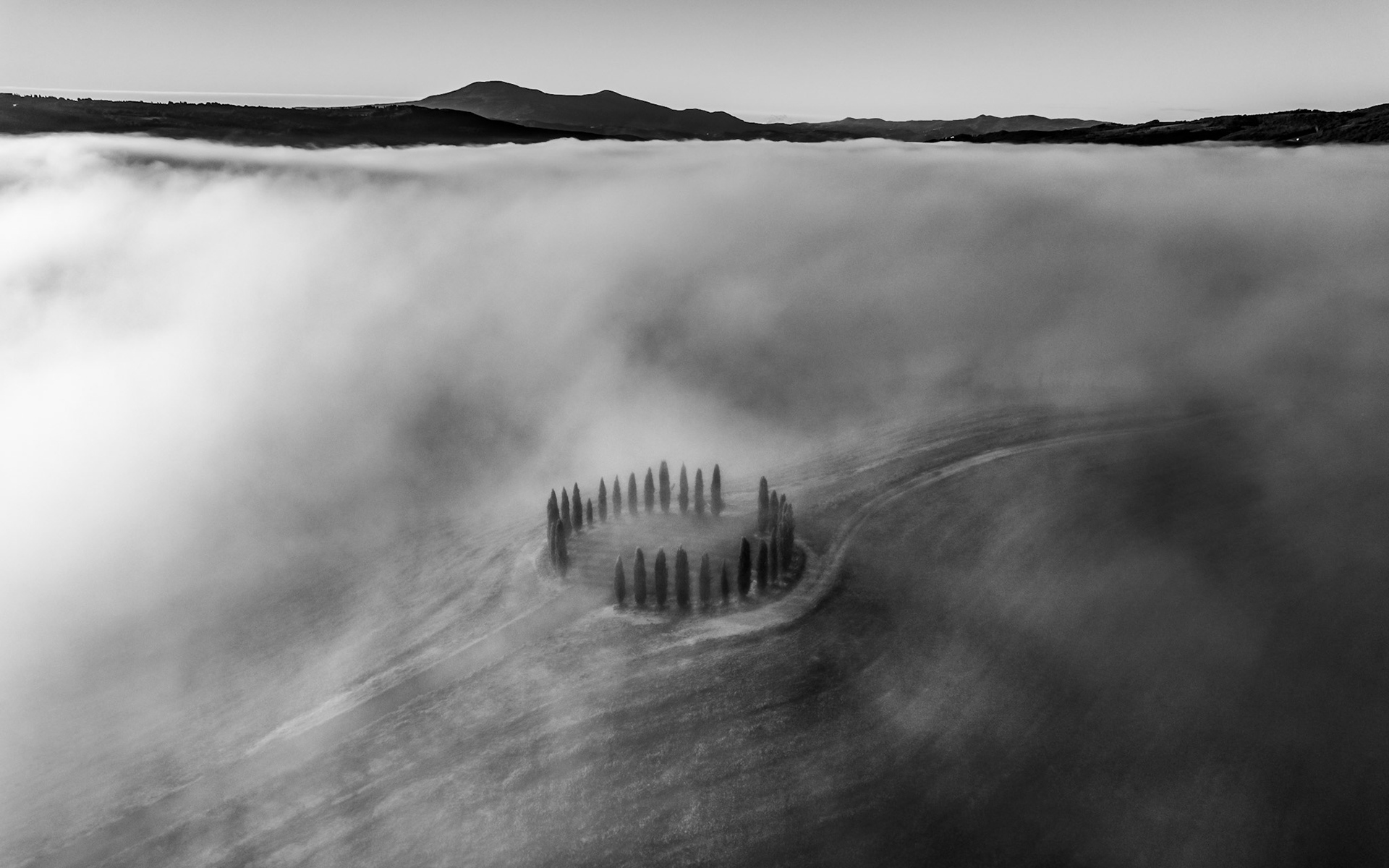
A ring of cypress trees emerges from a valley fog inversion above San Quirico d'Orcia, the circular grove reduced to a near-abstract island adrift in white. A winding track curves around its base before disappearing into the mist, while the Tuscan hills hold the fog's upper boundary in the far distance. The monochrome conversion strips the scene to form, tone, and stillness.
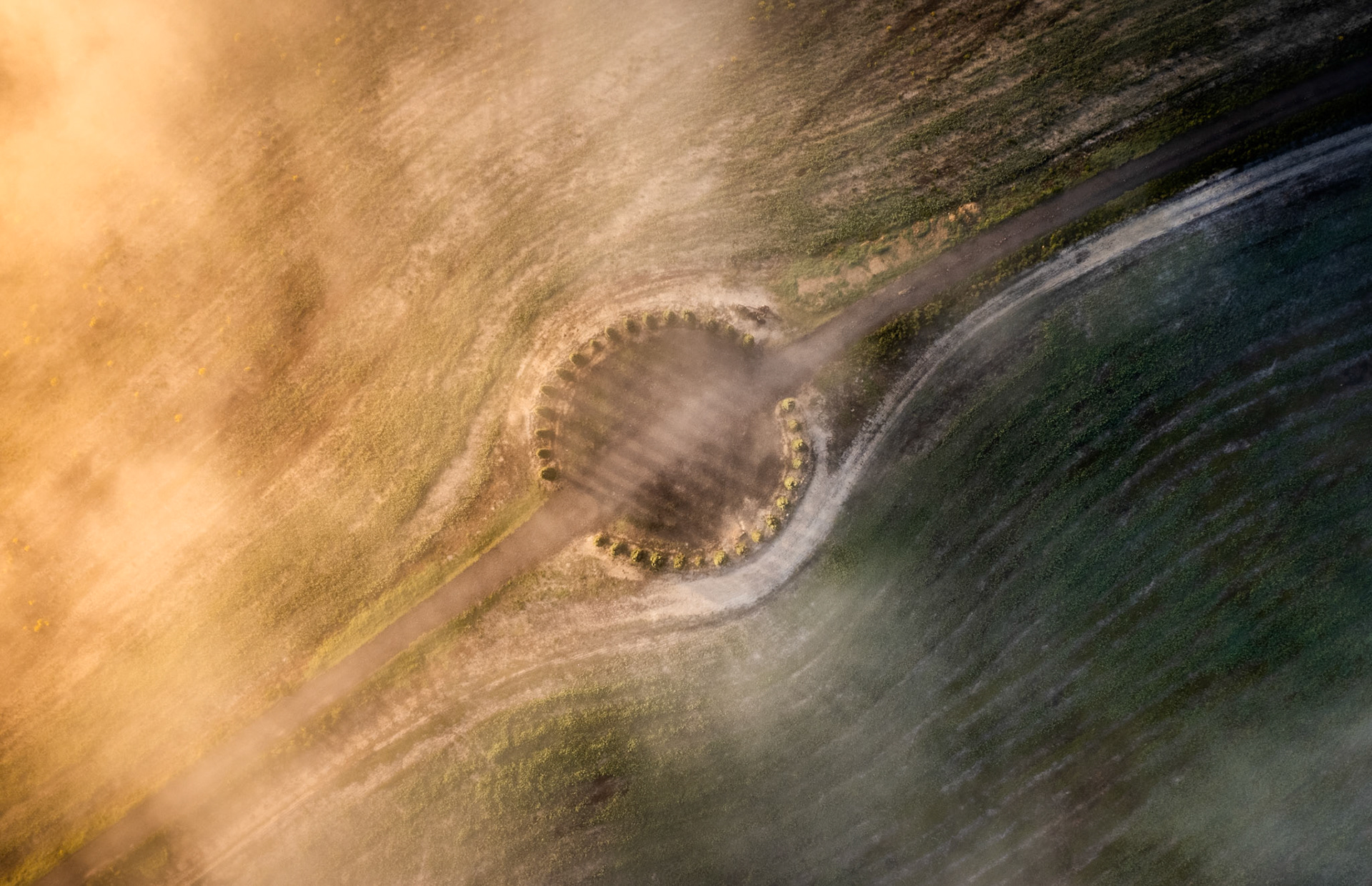
A circular arrangement of young trees on an exposed hillside near San Quirico d'Orcia catches early light as mist drifts across the Val d'Orcia in autumn. Shot from directly above, the ring reads as a near-complete disc against the pale dust of the surrounding track, its geometry sharpened by the diagonal sweep of shadow and warm haze. The interplay of geometric order and atmospheric dissolution gives the frame an abstract quality that belies the pastoral setting.
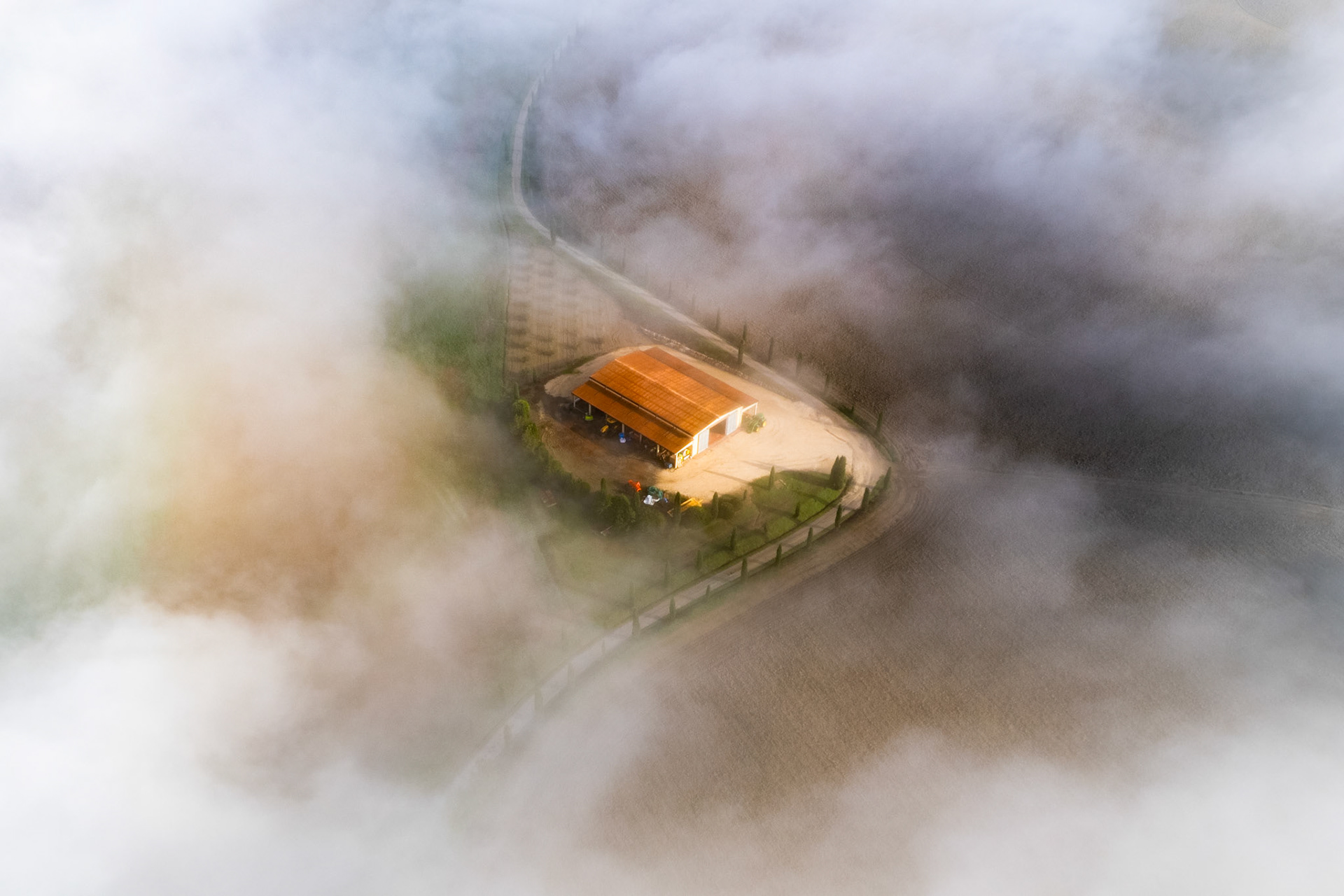
A farmstead near Monteroni d'Arbia emerges through a break in low-lying fog, its terracotta roof caught in early morning light while the surrounding Tuscan fields dissolve into cloud. The circular driveway and fence line anchor the composition, framing a moment of fleeting clarity within the inversion layer.
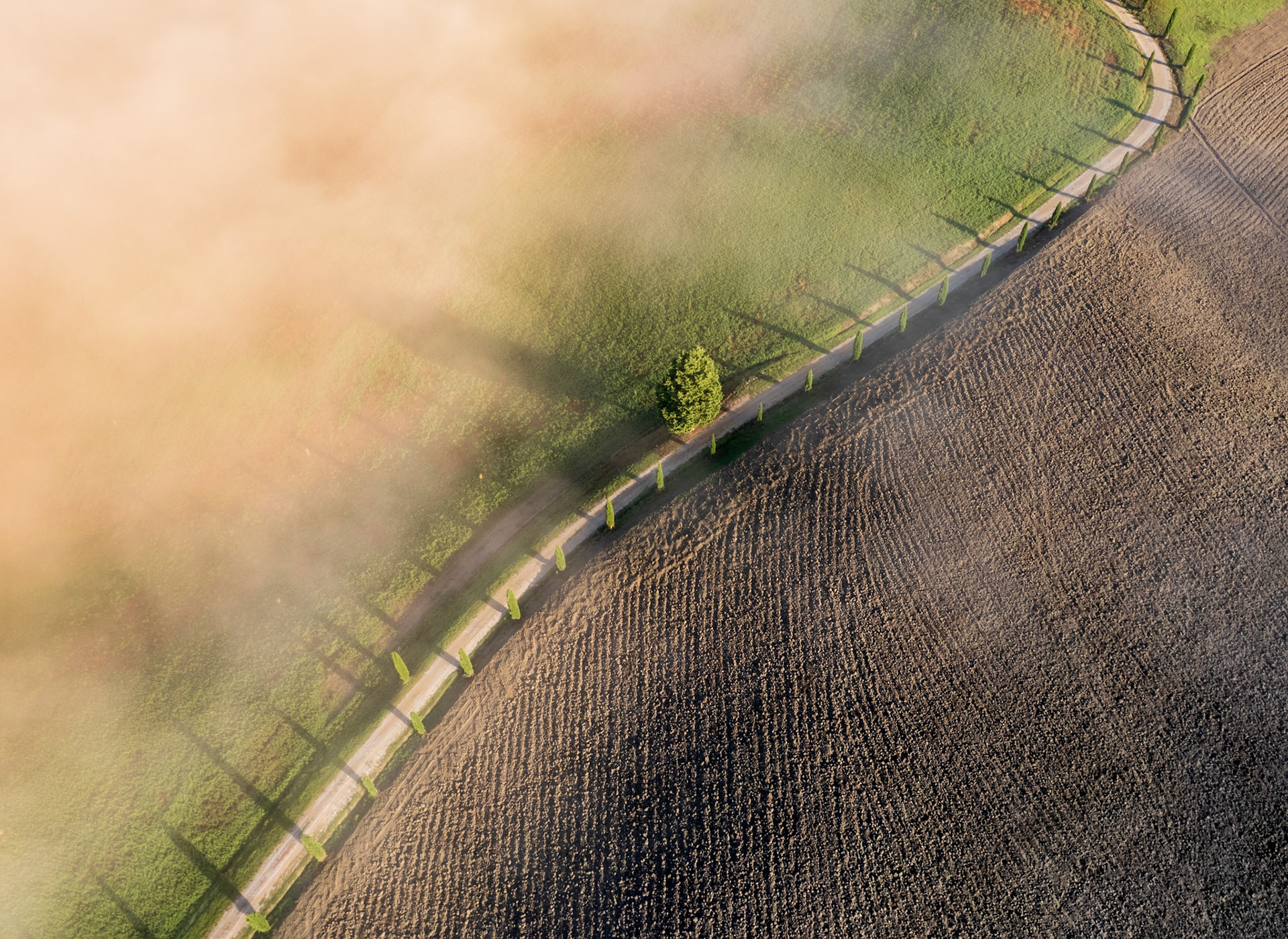
A cypress-lined farm road curves through contrasting fields near Monteroni d'Arbia, Tuscany, as low autumn mist burns off under early morning light. The diagonal road bisects ploughed earth and green pasture, while a solitary broader tree anchors the composition at mid-frame. Long shadows cast by the cypresses reveal raking light just above the horizon.
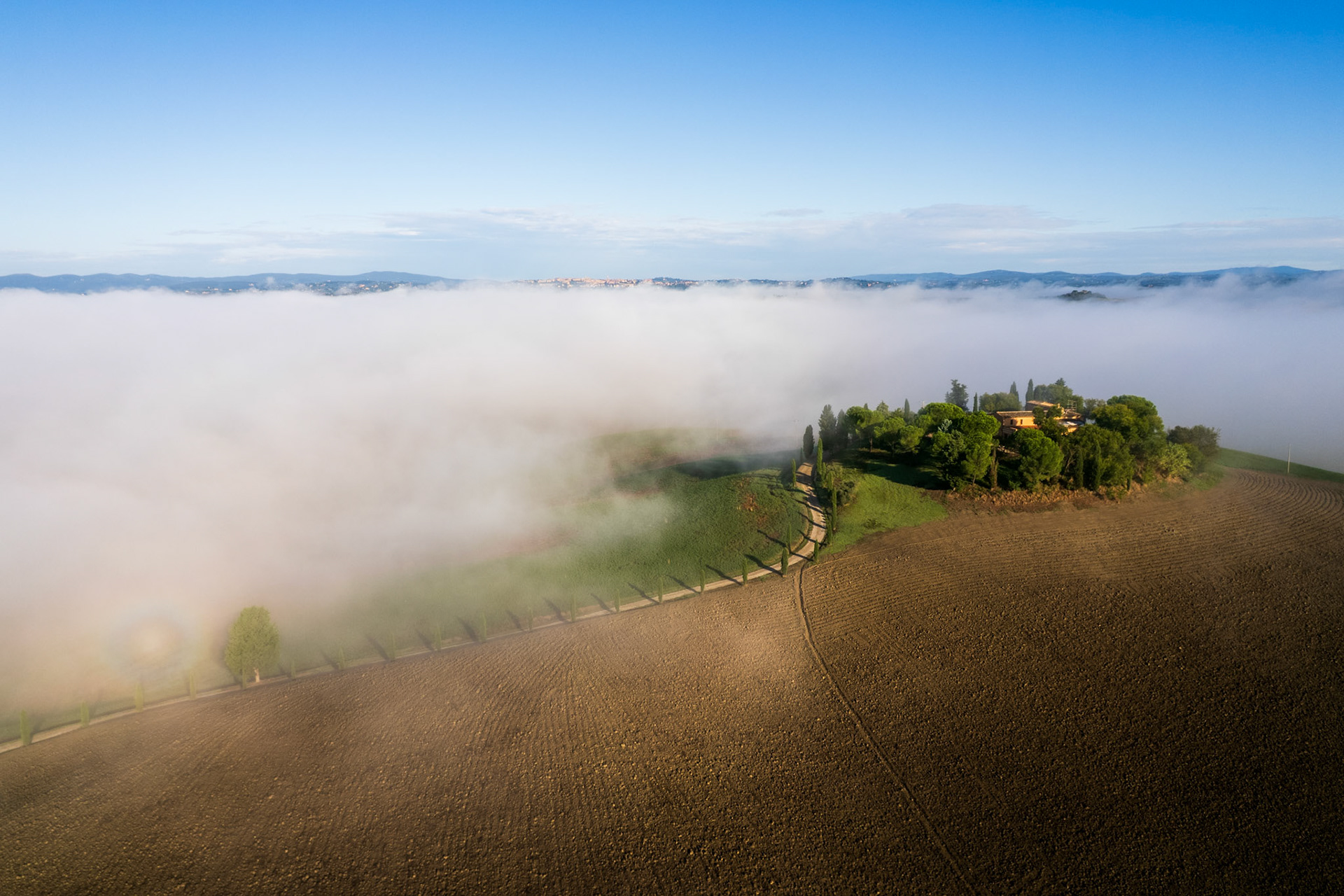
A Tuscan farmstead crowns a low hill above a valley fog inversion near Monteroni d'Arbia, Siena province. A cypress-lined track curves up from the mist-submerged plain, the ploughed field catching the warm early light while a distant hilltop town breaks the cloud horizon. The compression of earth, fog, and sky gives the composition an unusual stillness for an aerial frame.
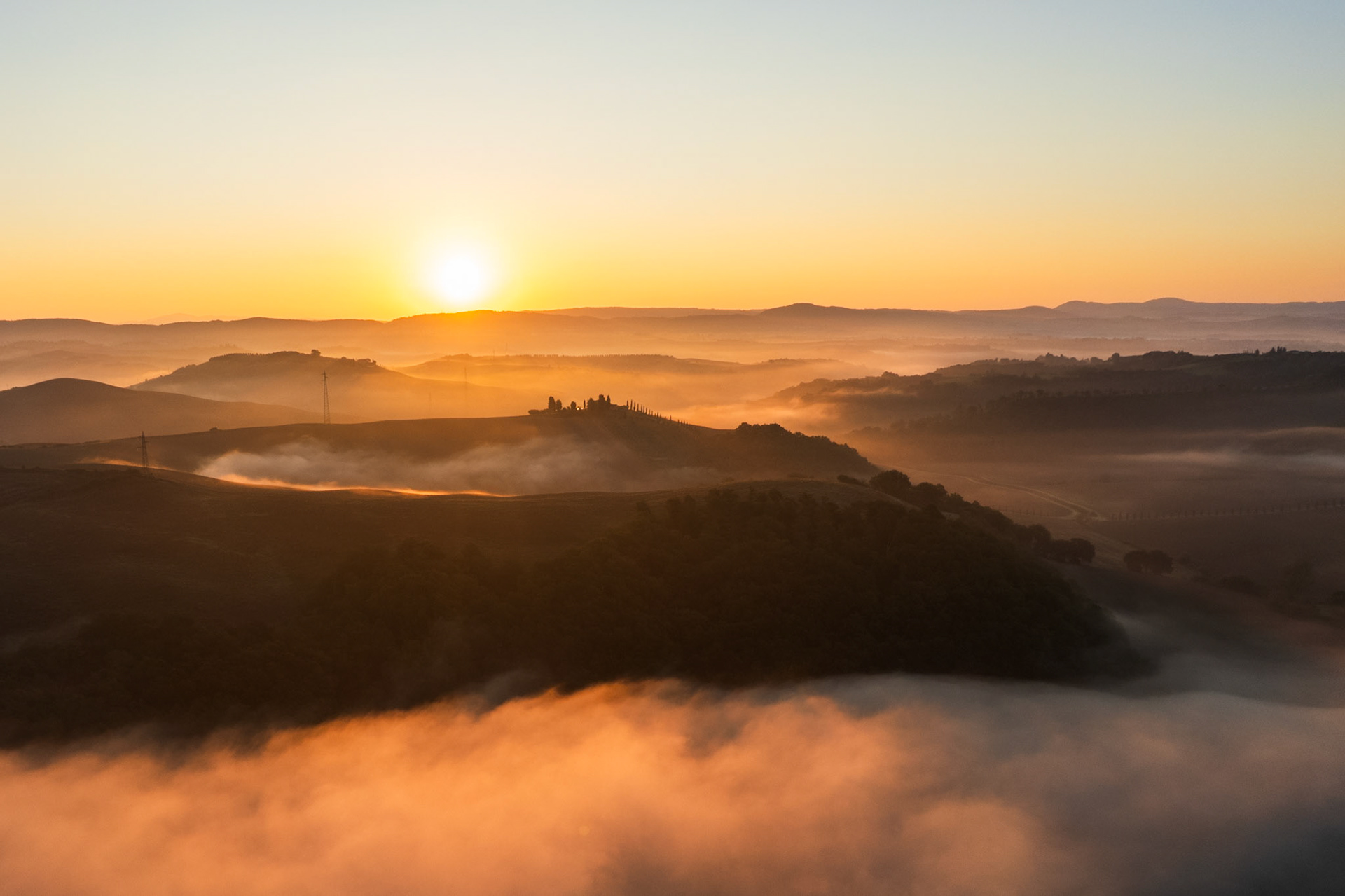
A temperature inversion fills the Val d'Orcia valleys with layered mist at dawn, isolating a hilltop farmstead and its cypress avenue as a lone silhouette against the rising sun. Aerial perspective compresses the rolling Sienese hills into receding tonal bands, the foreground fog mass anchoring the frame. Captured in the last minutes before the inversion burned clear.
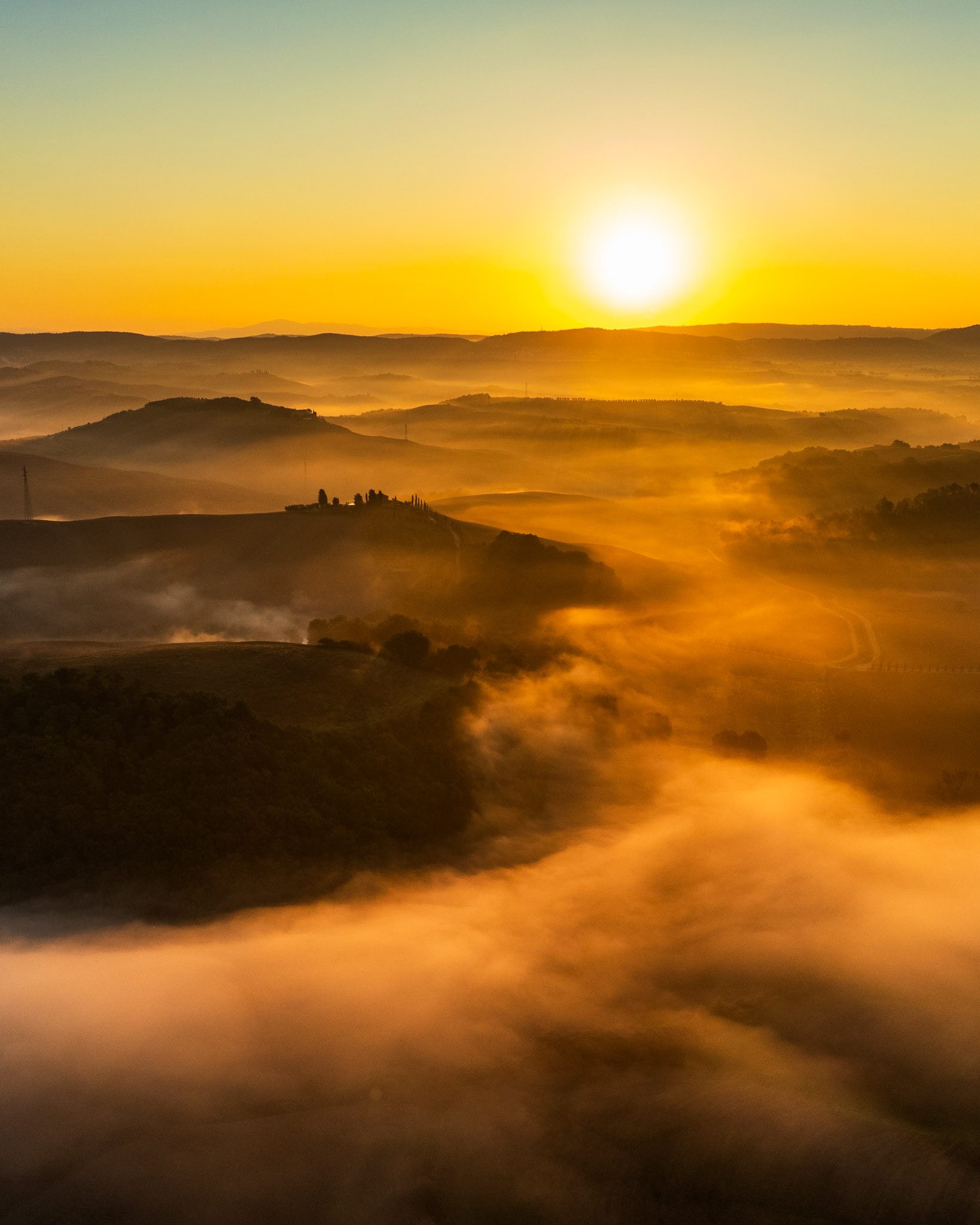
Dawn mist pools in the valleys of the Crete Senesi, leaving isolated hilltop farms and cypress lines as dark silhouettes against the rising sun. A temperature inversion holds the fog in the hollows, creating layered planes that recede toward the horizon. Captured by drone at first light on a still September morning.
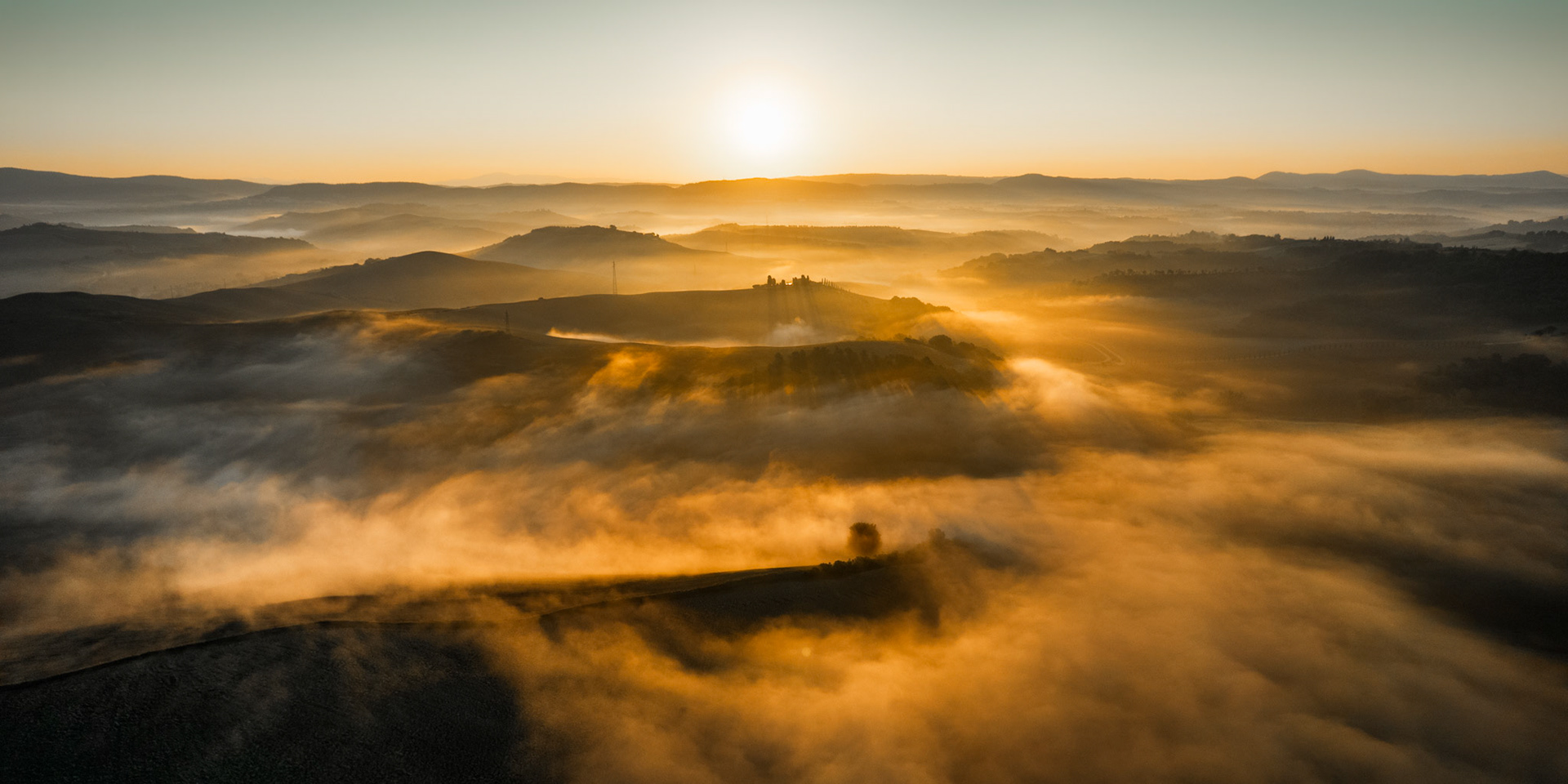
Low-lying fog pools between the rolling hills of the Crete Senesi at dawn, lit from behind by a rising sun still close to the horizon. A lone farmstead on an isolated hillock breaks the surface, anchoring the composition amid the dissolving mist. The image was captured from altitude, compressing the layered landforms into a quiet, painterly sequence of receding planes.
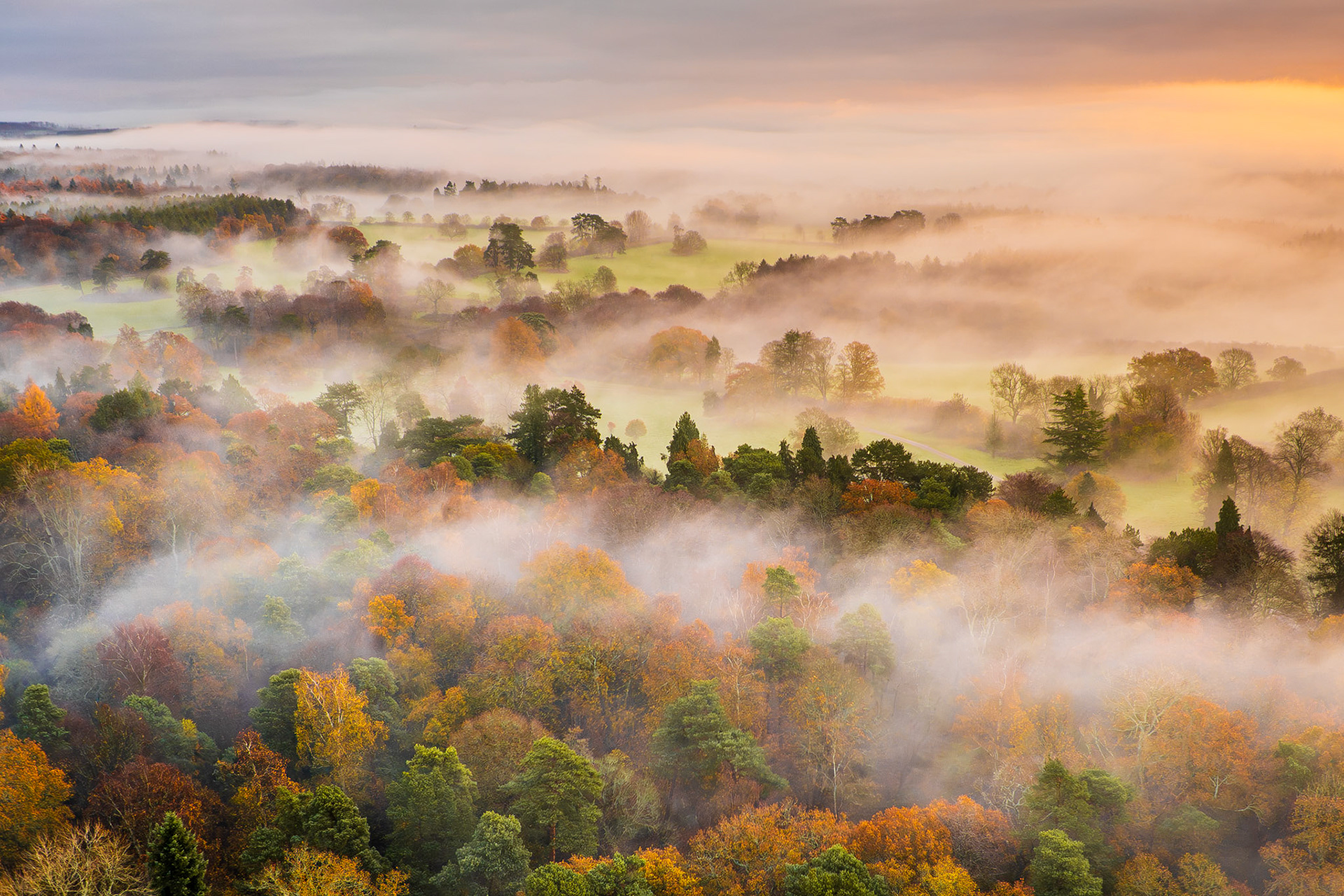
A temperature inversion holds low cloud among the autumn canopy of a Thames Valley woodland at dawn, the rising sun catching the mist from the south-east and warming the scene to amber. Photographed from altitude above Henley-on-Thames, the layered fog separates foreground trees from the open pasture beyond, creating a sequence of receding planes that dissolves into the glowing horizon. The restraint of the palette — amber, ochre, and soft grey — gives the image an unusual quietness for aerial work.
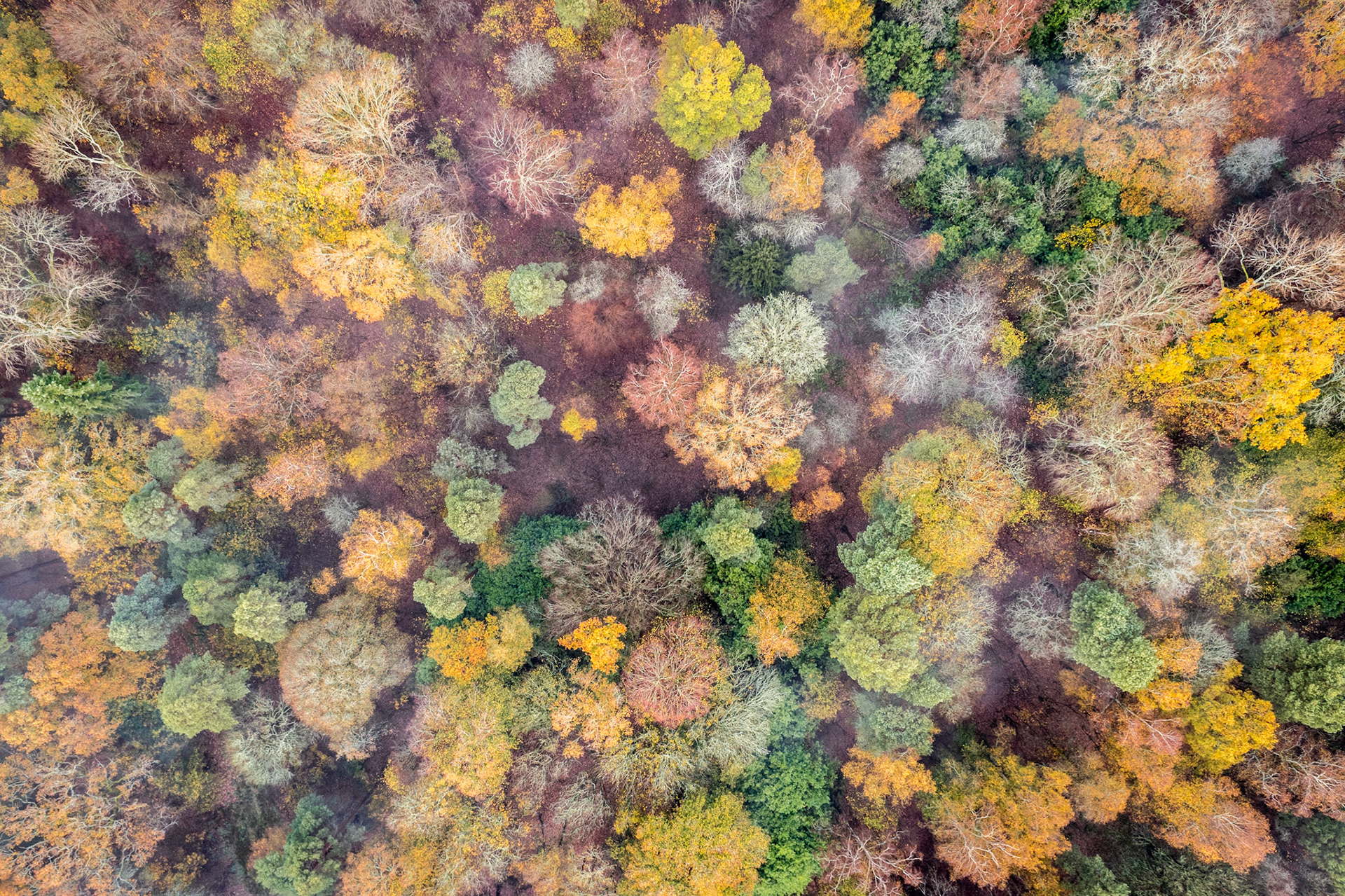
A nadir aerial view over mixed deciduous woodland near Henley-on-Thames reveals the fragmented palette of late autumn: yellowing oak and field maple alongside bare-branched specimens and persistent evergreen scrub. Flat overcast light suppresses shadow and foregrounds the textural complexity of individual crowns, the dark forest floor visible between them lending depth to an otherwise planar composition.
A nadir aerial view over mixed woodland near Henley-on-Thames reveals a sharp transition between healthy conifers and a lower belt of dying or dead deciduous trees, their bare crowns and russet-brown foliage suggesting drought stress or disease. The flat, overcast November light suppresses shadow, allowing the patterned canopy textures and colour contrast to carry the image.
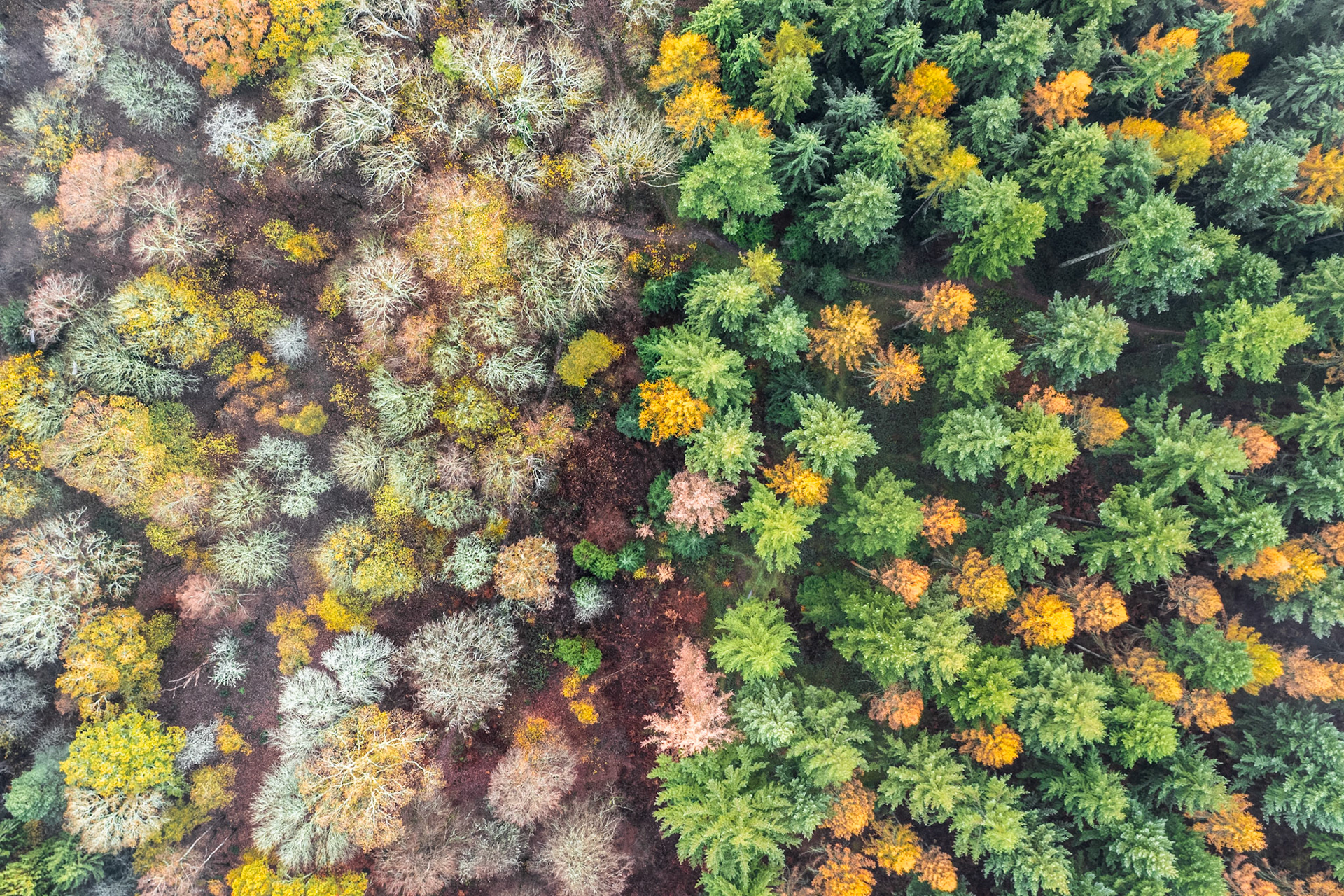
A vertical aerial view above woodland near Henley-on-Thames reveals a sharp ecological boundary dividing open scrub — pale, lichen-silvered and sparsely canopied — from a dense stand of mature conifers in deep green. Captured in mid-November, the transitional foliage holds residual autumn yellows against the muted tones of approaching winter dormancy. The diagonal fault line between the two tree communities carries the composition without artifice.
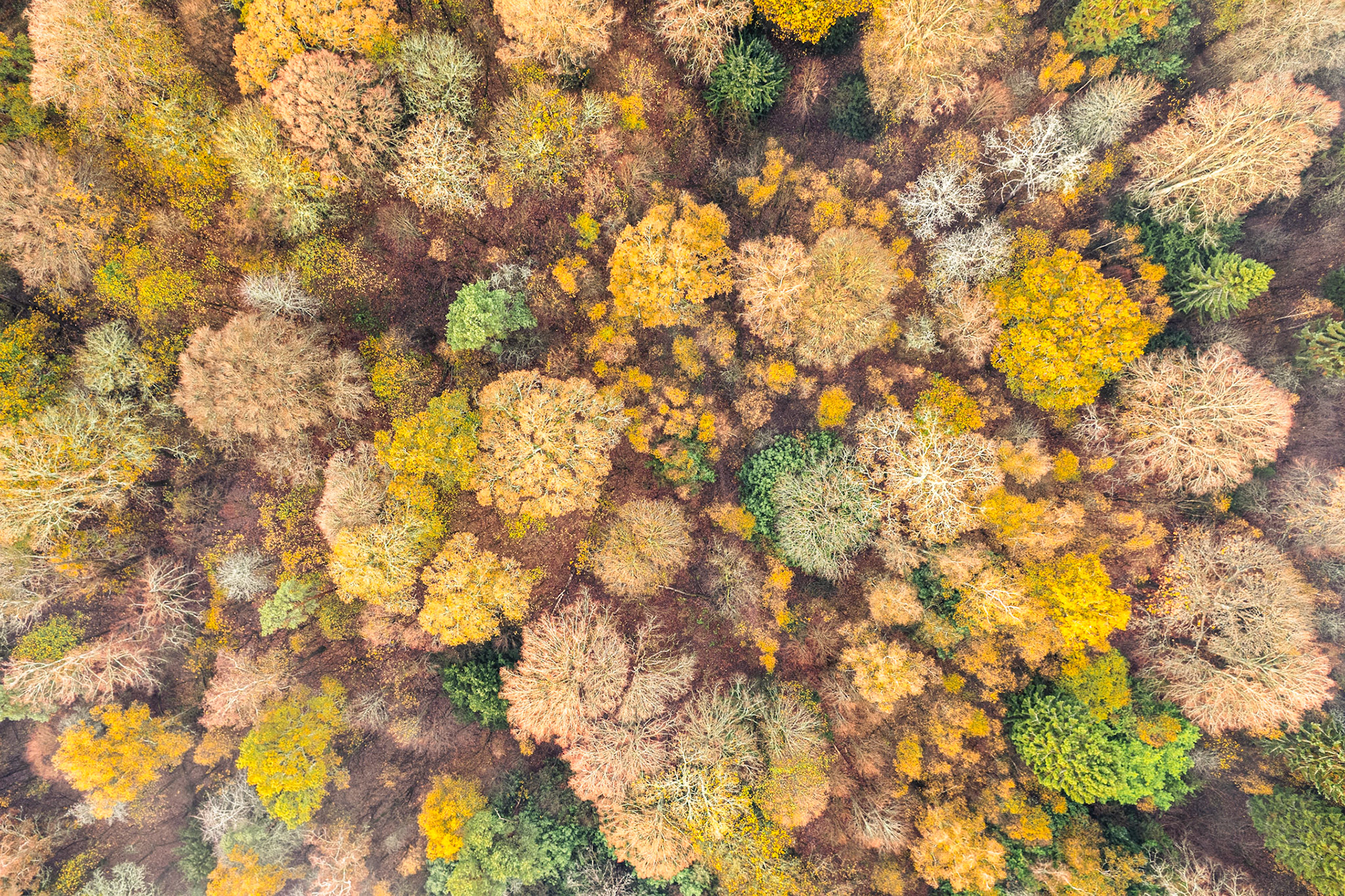
A nadir aerial view over mixed deciduous woodland near Henley-on-Thames records the uneven progress of leaf fall in mid-November, where yellow-gold crowns of oak and field maple sit alongside bare branch structures and the dark cones of retained evergreens. The flat, diffuse light of an overcast morning suppresses shadow and allows the tonal range of the canopy — ochre, buff, pale green and ash-white — to read as near-abstract patchwork.
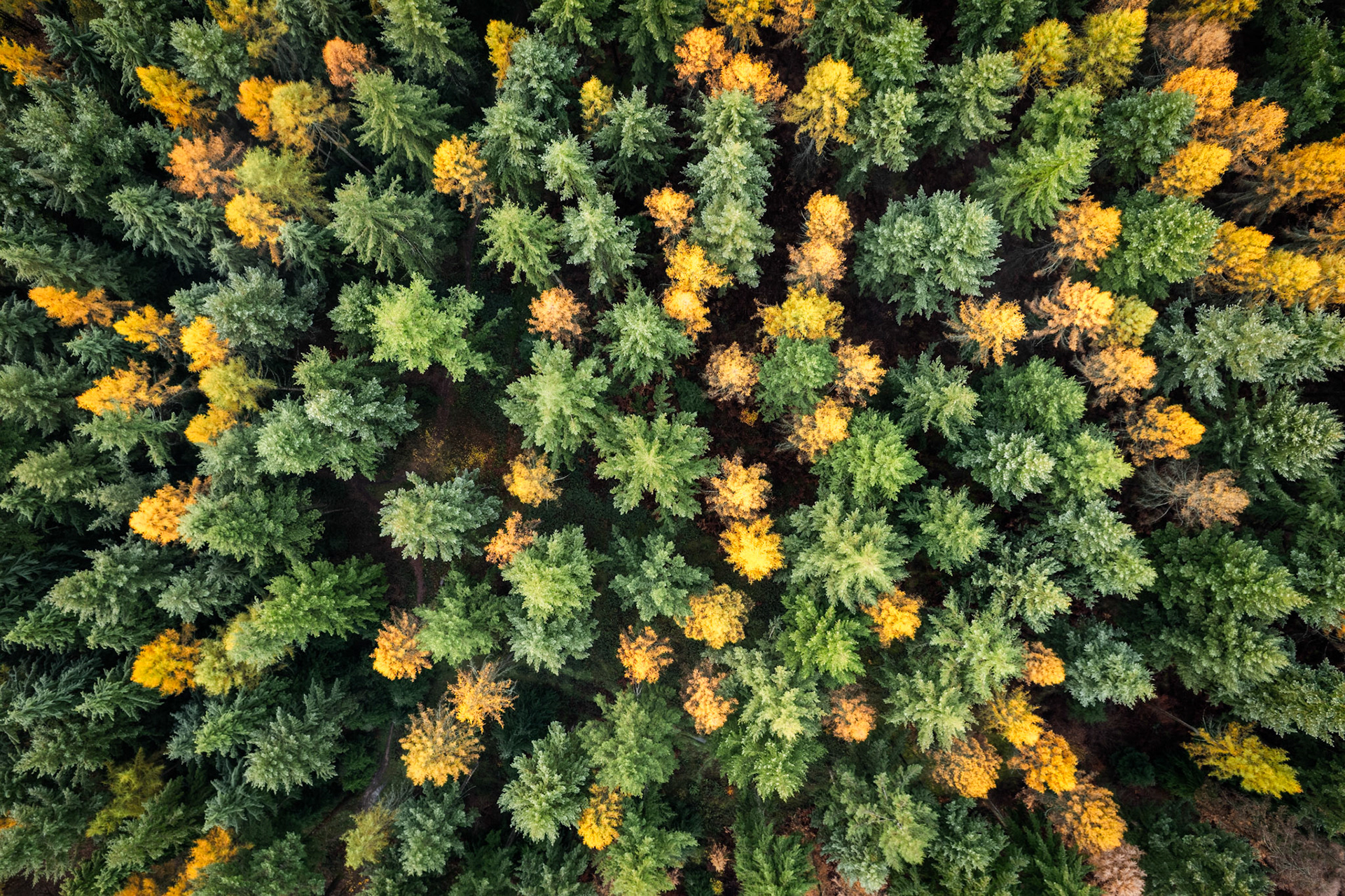
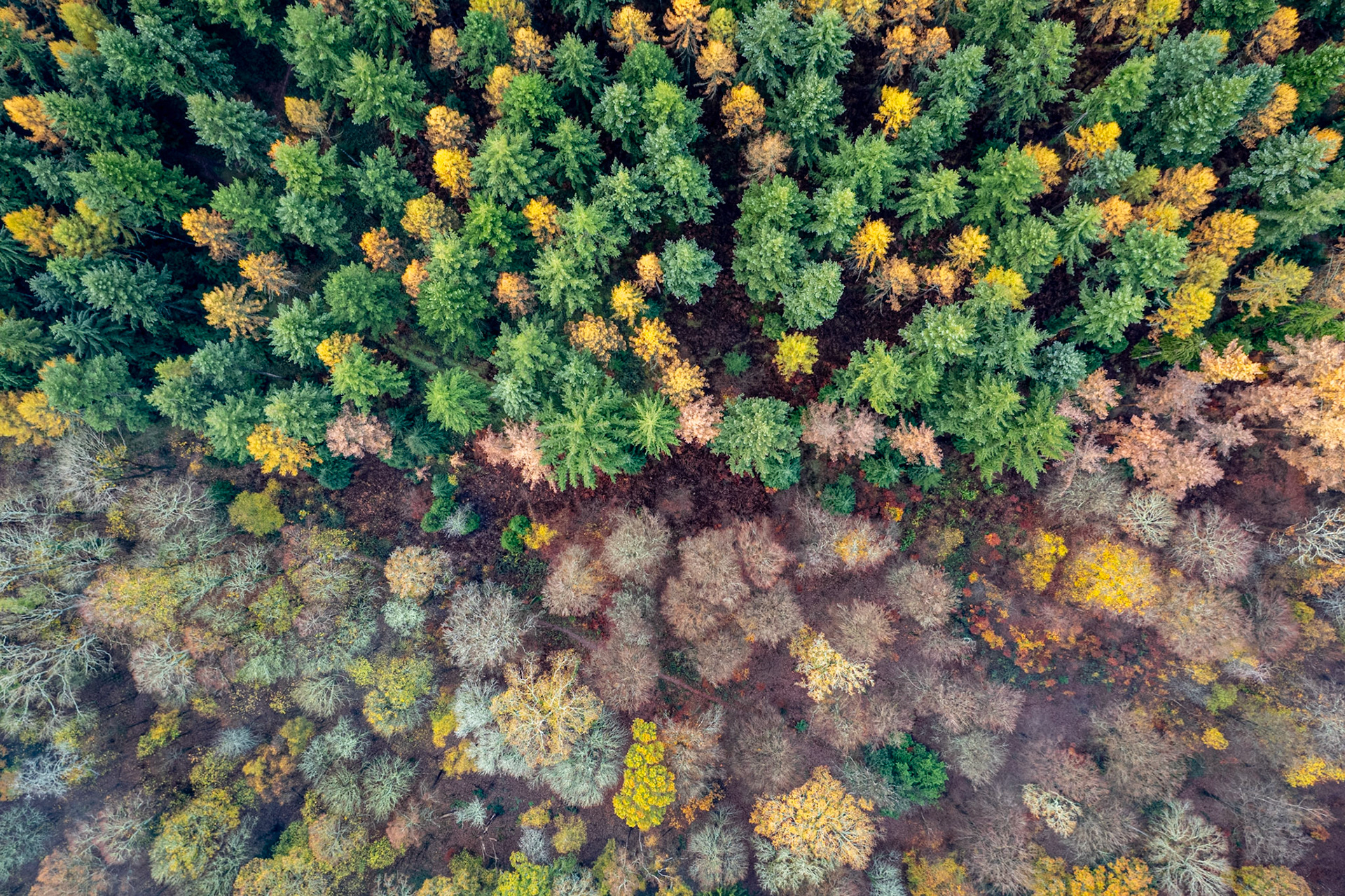
An overhead view of mixed coniferous woodland near Henley-on-Thames reveals larch crowns turning gold among the evergreen spruce, the interplay of colour forming a natural mosaic across the canopy. Captured in mid-November as deciduous conifers approach peak colour loss, the flat overcast light suppresses shadow and flattens the composition into near-abstraction. The scatter of amber crowns punctuating deep green gives the image its only structural rhythm.
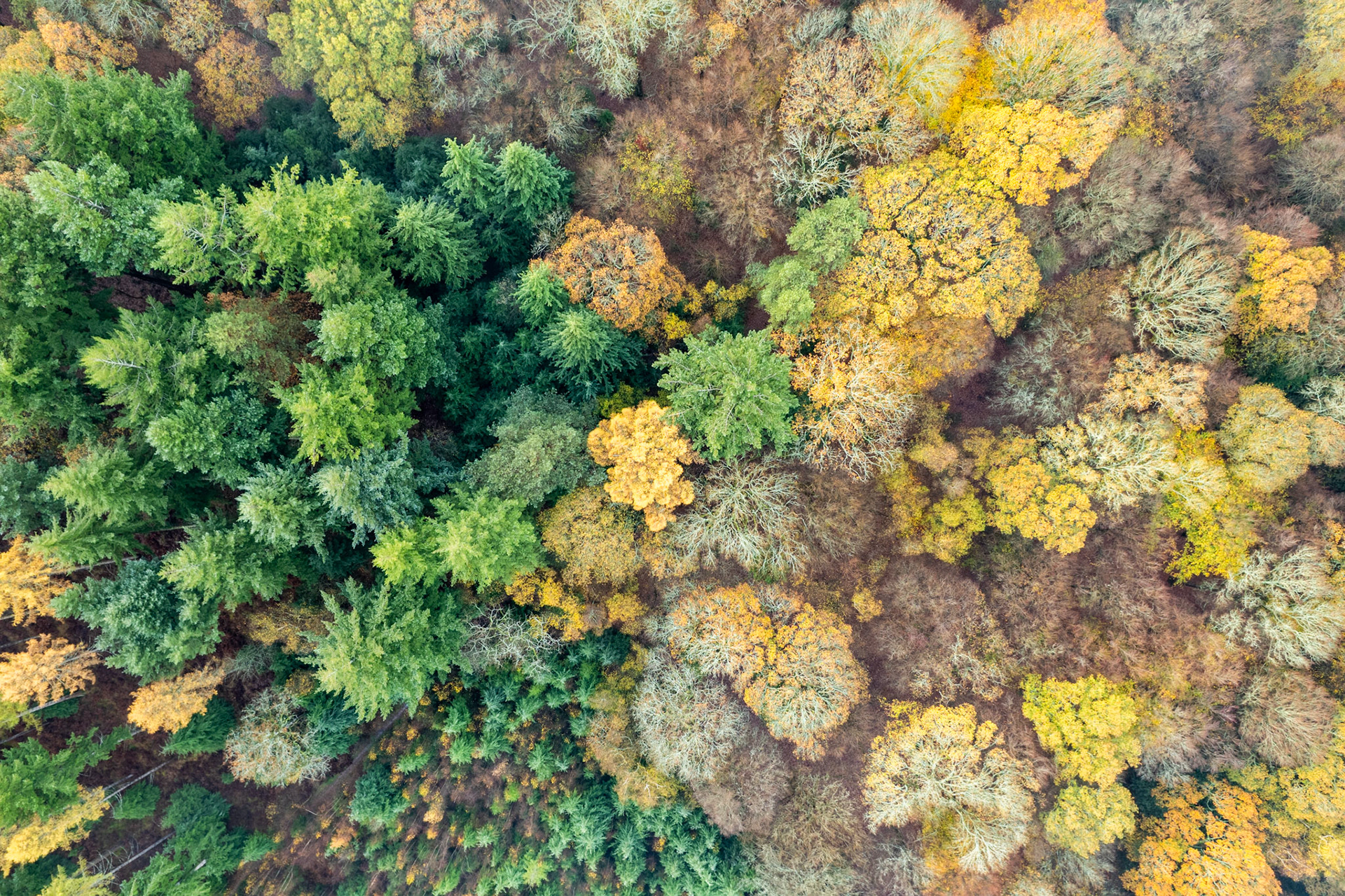
A nadir aerial view over mixed woodland near Henley-on-Thames captures the transition between evergreen conifers and deciduous trees in mid-autumn senescence. The diagonal drift from dense green on the left to muted yellows and bare crowns on the right records the uneven pace of leaf-fall across species. Flat overcast light suppresses shadow and keeps the colour palette honest rather than dramatic.
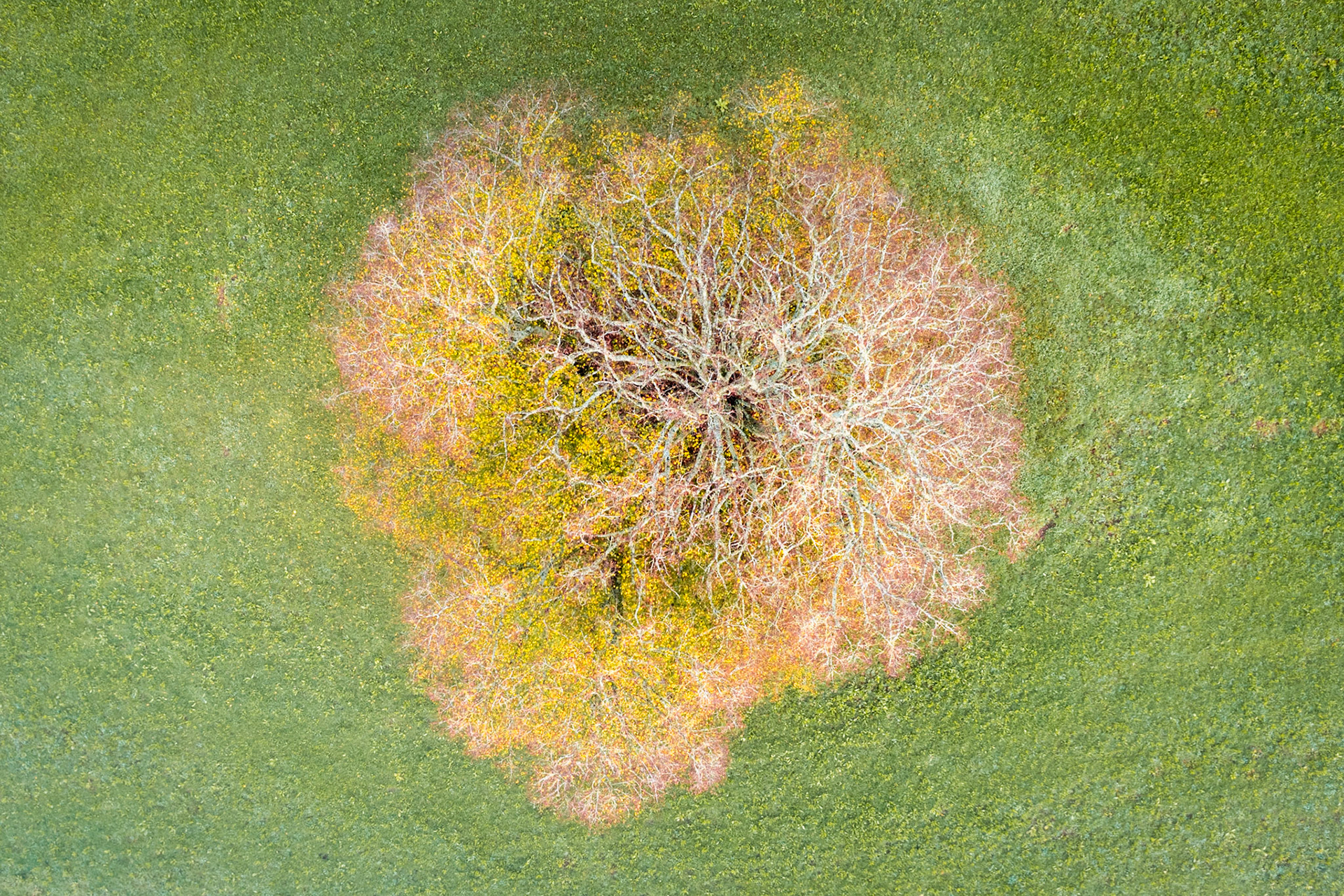
A mature deciduous tree photographed directly overhead from altitude above a field near Henley-on-Thames, its bare branch structure radiating outward like a neural network against a disc of amber and ochre fallen leaves. The surrounding cropped grassland, speckled with late wildflowers, frames the canopy as a self-contained form. Captured in mid-November, the image sits at the threshold between late autumn and winter dieback.
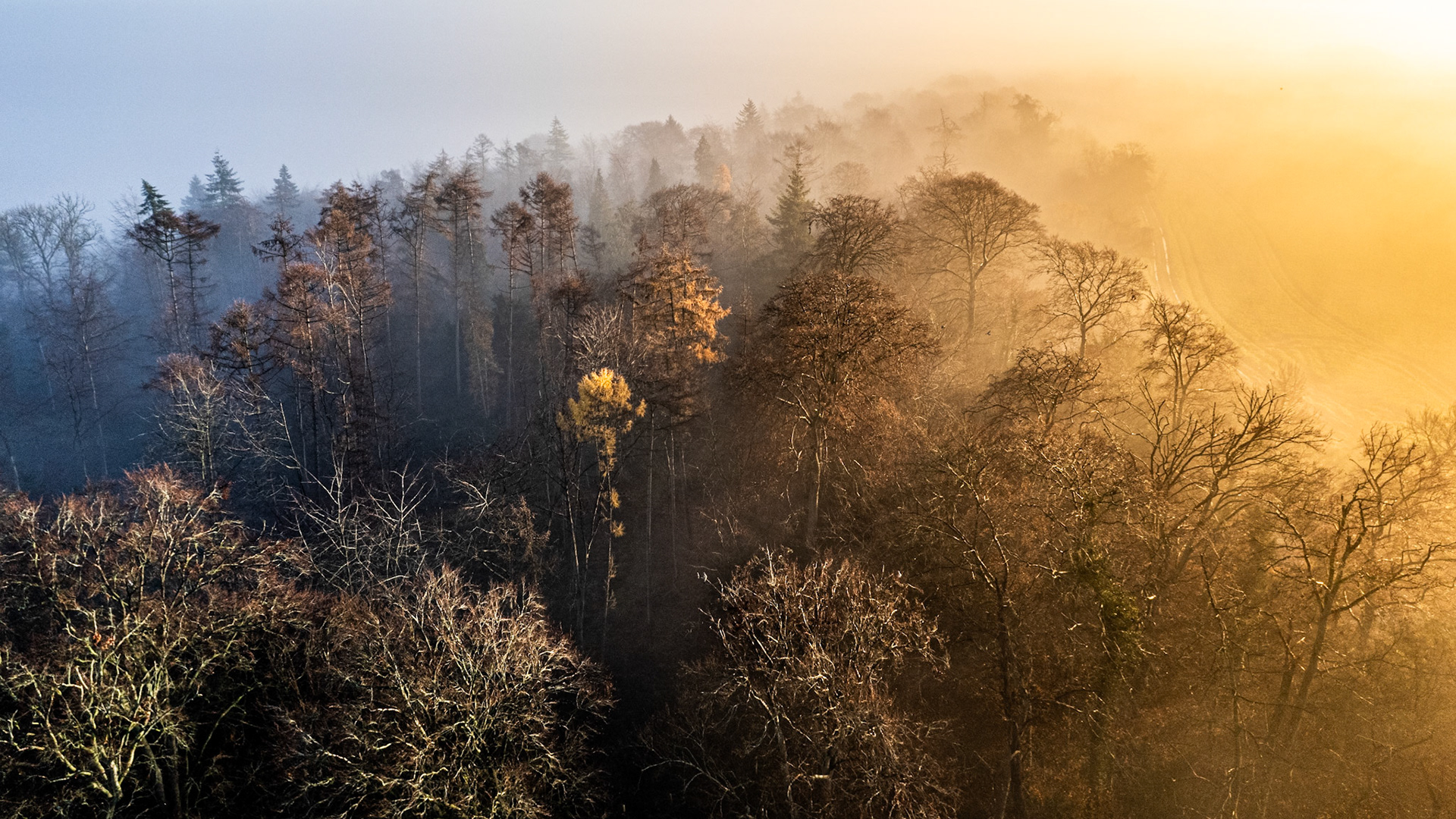
A winter woodland on the Chiltern escarpment above Henley-on-Thames, caught from the air as low morning sun burns through fog from the south-east. The light cleaves the canopy along a near-diagonal axis, leaving conifers and bare deciduous crowns in cold shadow to the left while the right half dissolves into warm haze. A single illuminated pine at mid-frame anchors the transition between the two atmospheres.
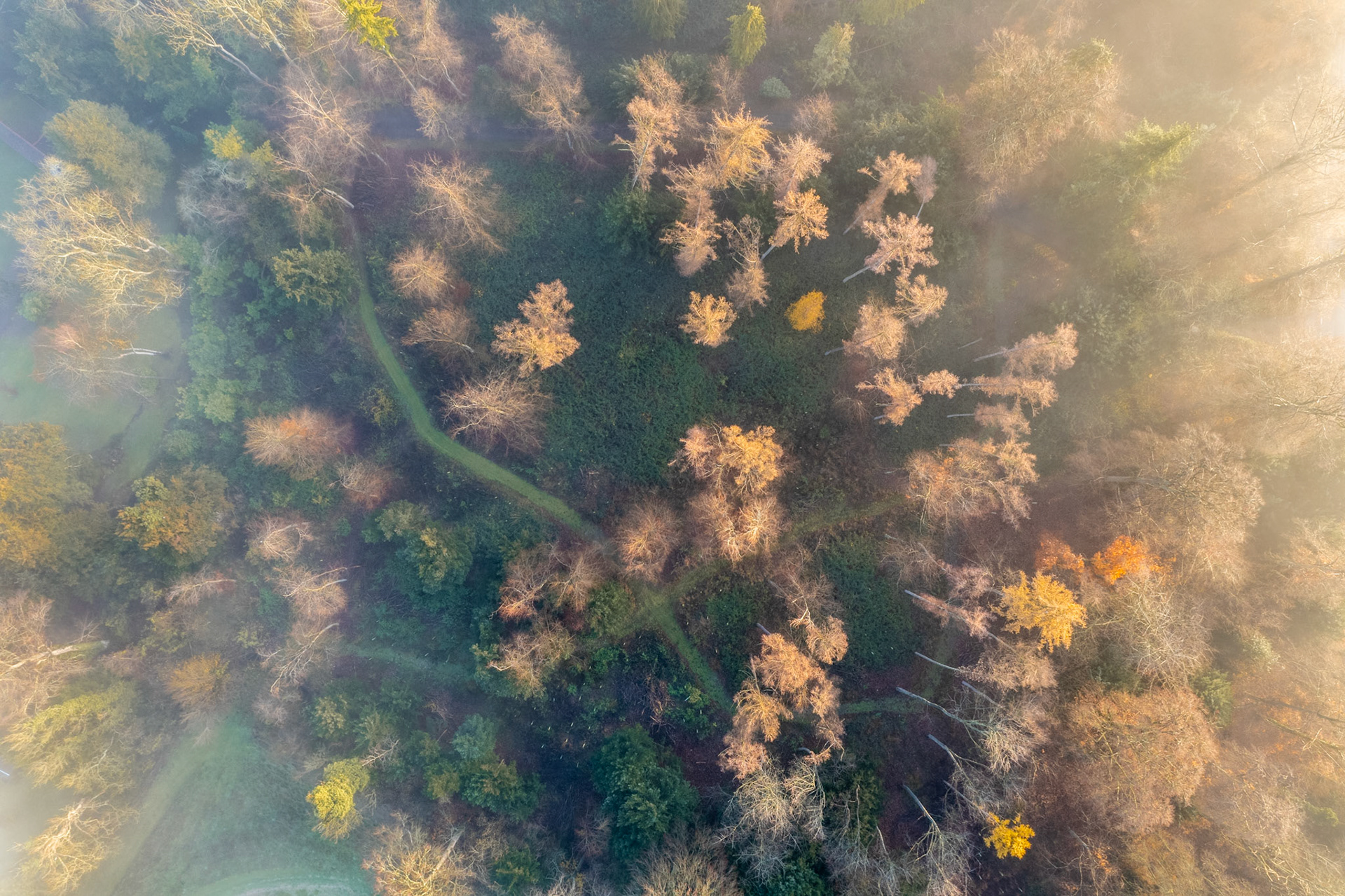
A nadir aerial view over mixed woodland near Henley-on-Thames, taken in early winter morning light. Low December sun rakes across the canopy from the upper right, picking out the pale crowns of leafless deciduous trees against patches of dark evergreen understorey. A faint grass track traces a winding line through the clearing at the image's centre.
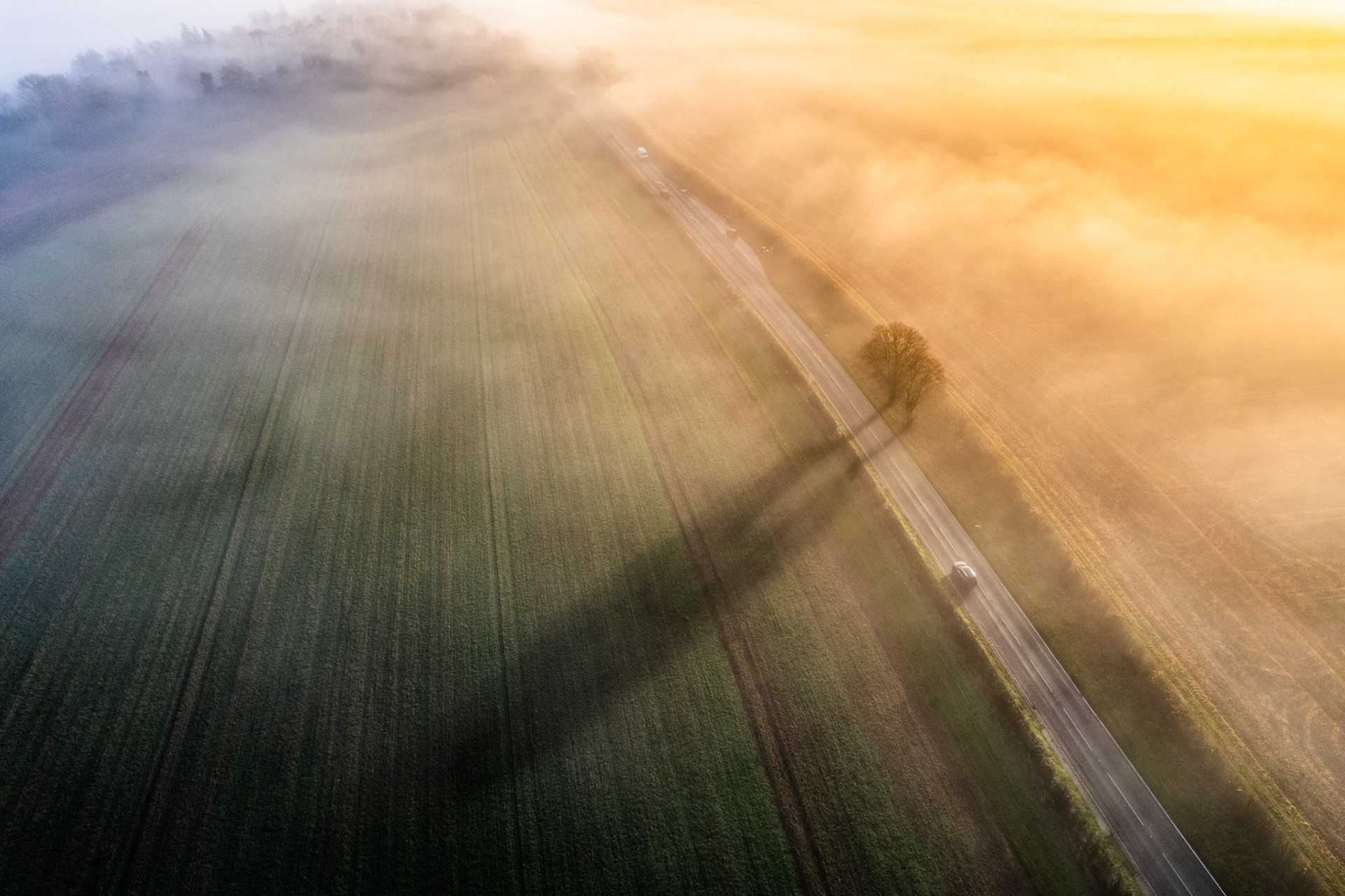
A solitary roadside tree casts an elongated shadow across frost-edged winter arable fields near Henley-on-Thames, its silhouette dramatised by low December sun breaking through advection fog. The diagonal of the road divides warm golden light from blue-grey shadow, while passing cars reduce to white specks within the dissolving murk. The aerial perspective abstracts the landscape into planes of tone and texture.
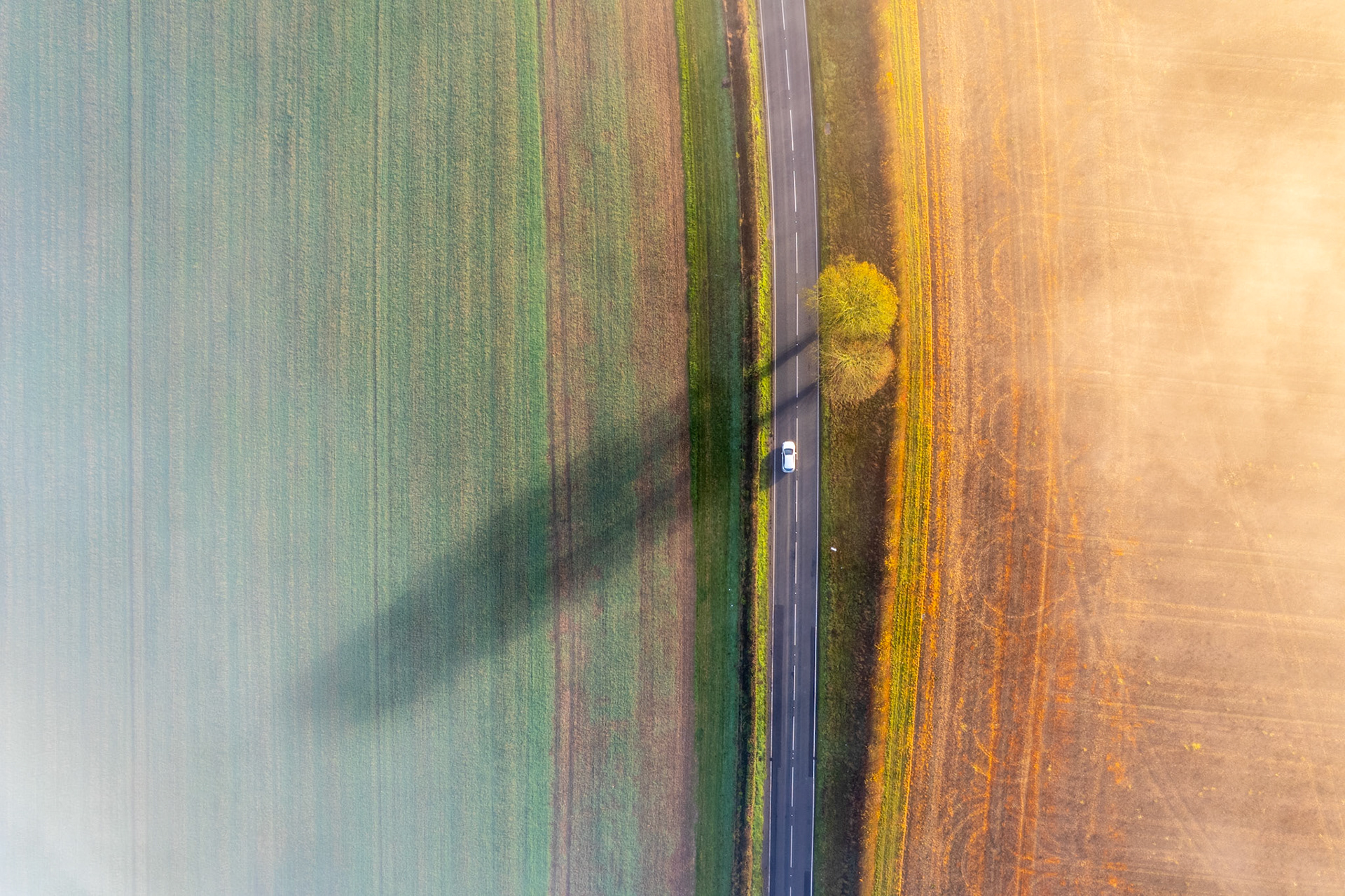
A low winter sun casts the elongated shadow of a roadside tree across ploughed and sown fields near Henley-on-Thames, the geometry bisected by a two-lane road and a single passing car. Shot from directly above at first light, the image sets a cooler, shadowed agricultural plain against warm haze dissolving the eastern field into near-abstraction. The solitary tree anchors the composition, its crown and shadow forming a single diagonal axis across the frame.
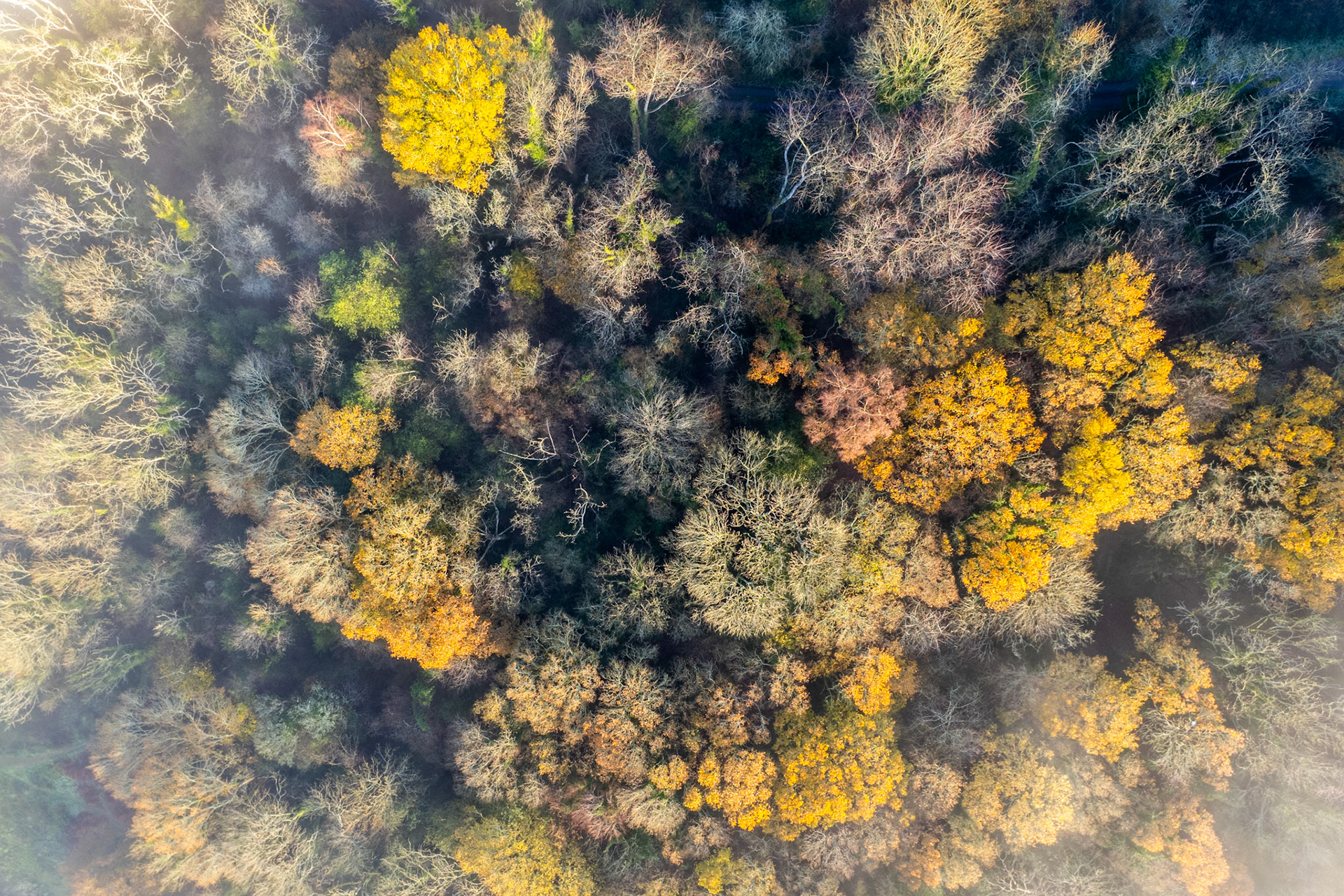
A nadir aerial view over mixed deciduous woodland near Henley-on-Thames reveals the uneven progression of autumn leaf-fall, with vivid yellow crowns punctuating a matrix of bare grey branches and residual evergreen. Low winter sun rakes across the canopy from the upper left, casting the deeper gaps into shadow and lending the composition a mosaic-like depth. The December capture date places this at the ragged tail of the season, where colour and dormancy compete across the same stand.
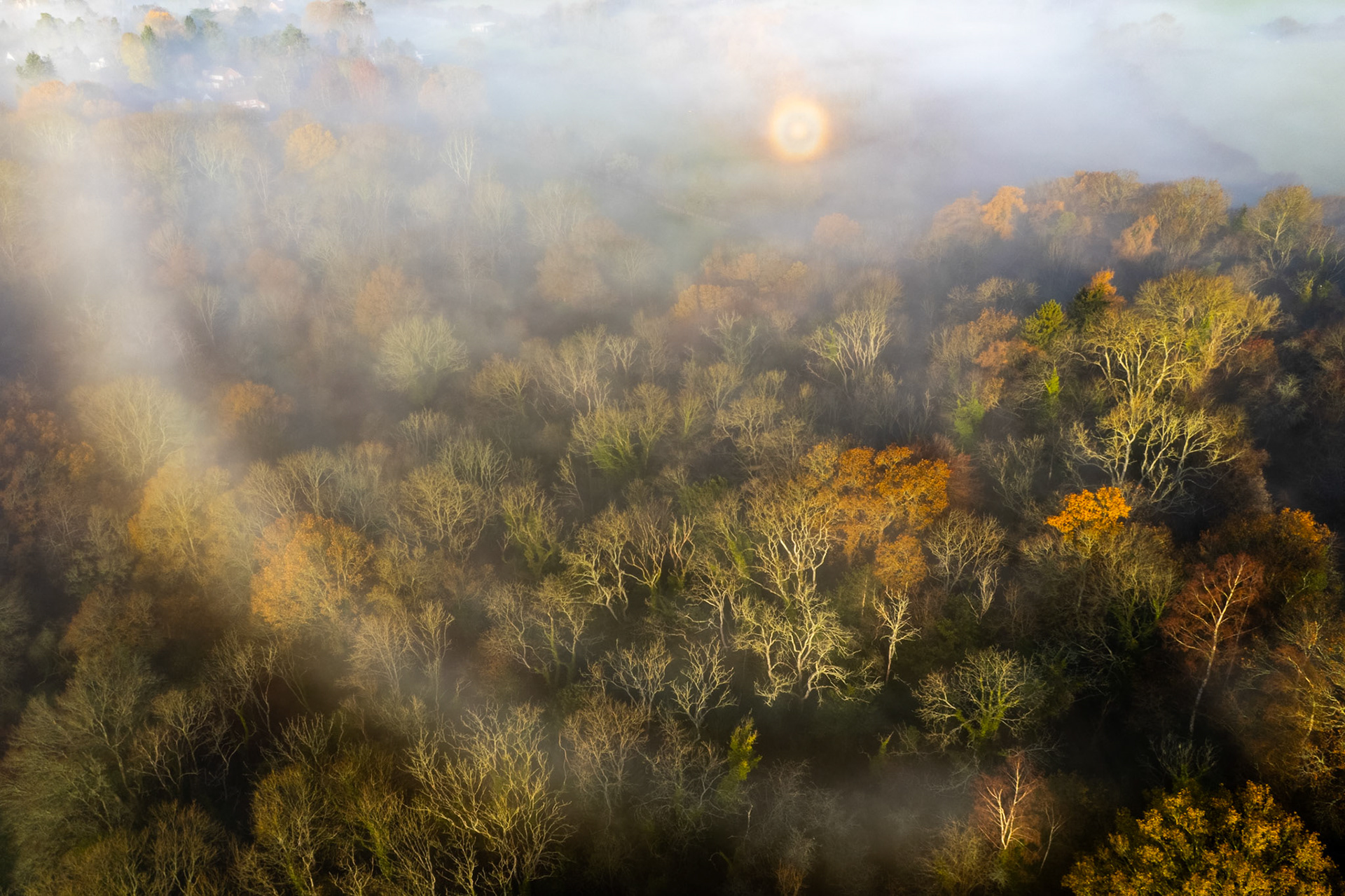
Morning fog rolls across a mixed deciduous woodland above Henley-on-Thames, the low winter sun diffusing through the mist as a soft orb above the valley. Bare branches and remnant autumn foliage create a layered tapestry of ochre, rust, and grey-green beneath the drifting cloud. The aerial vantage compresses the woodland into an almost abstract plane of tone and texture.
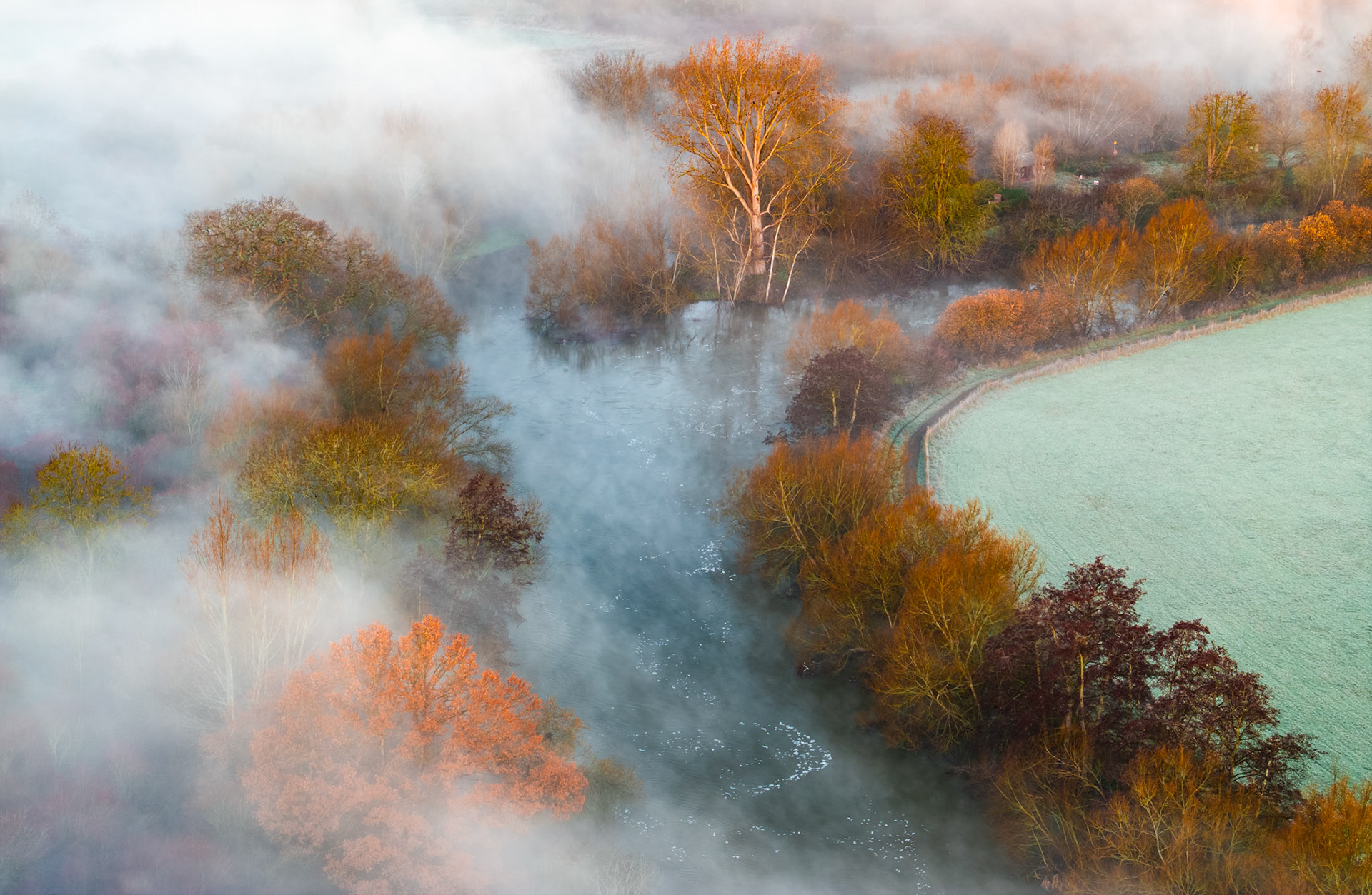
River mist pools between stands of late-autumn riparian woodland above the Thames near Abingdon, the vapour parting to reveal frost-silvered pasture on the valley edge. A single pale birch catches the first warmth of a December dawn, anchoring an otherwise dissolving scene. The aerial viewpoint compresses fog, foliage and frost into a composition of rare chromatic restraint.
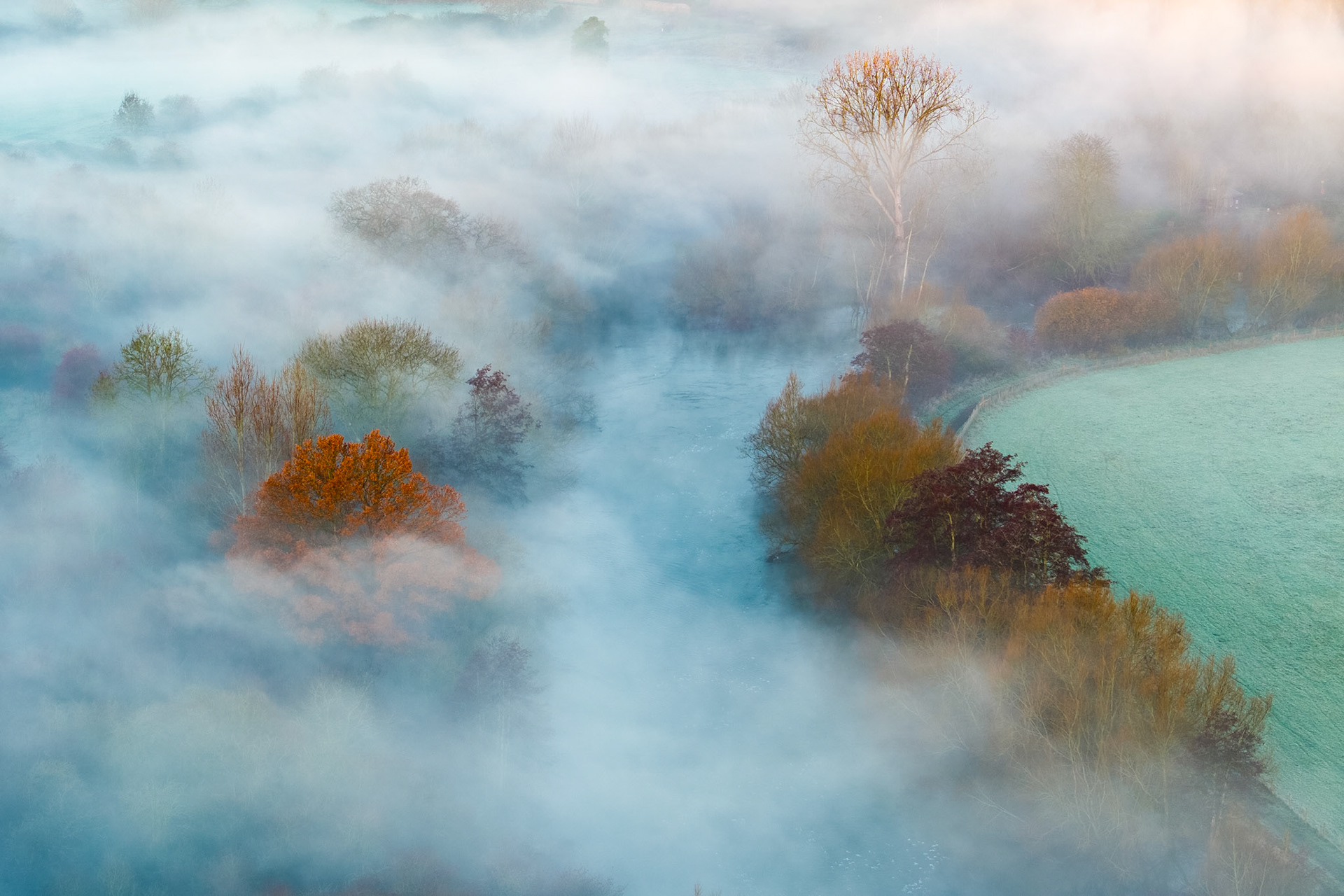
A temperature inversion smothers the Thames valley near Abingdon at first light, leaving trees in full autumn-to-winter transition stranded above a slow-moving sea of cold fog. A frosted meadow breaks clear to the right, its pale green a quiet counterpoint to the amber and burgundy crowns emerging from the mist. The aerial perspective dissolves conventional landscape geometry, reducing the scene to colour, texture, and atmosphere.
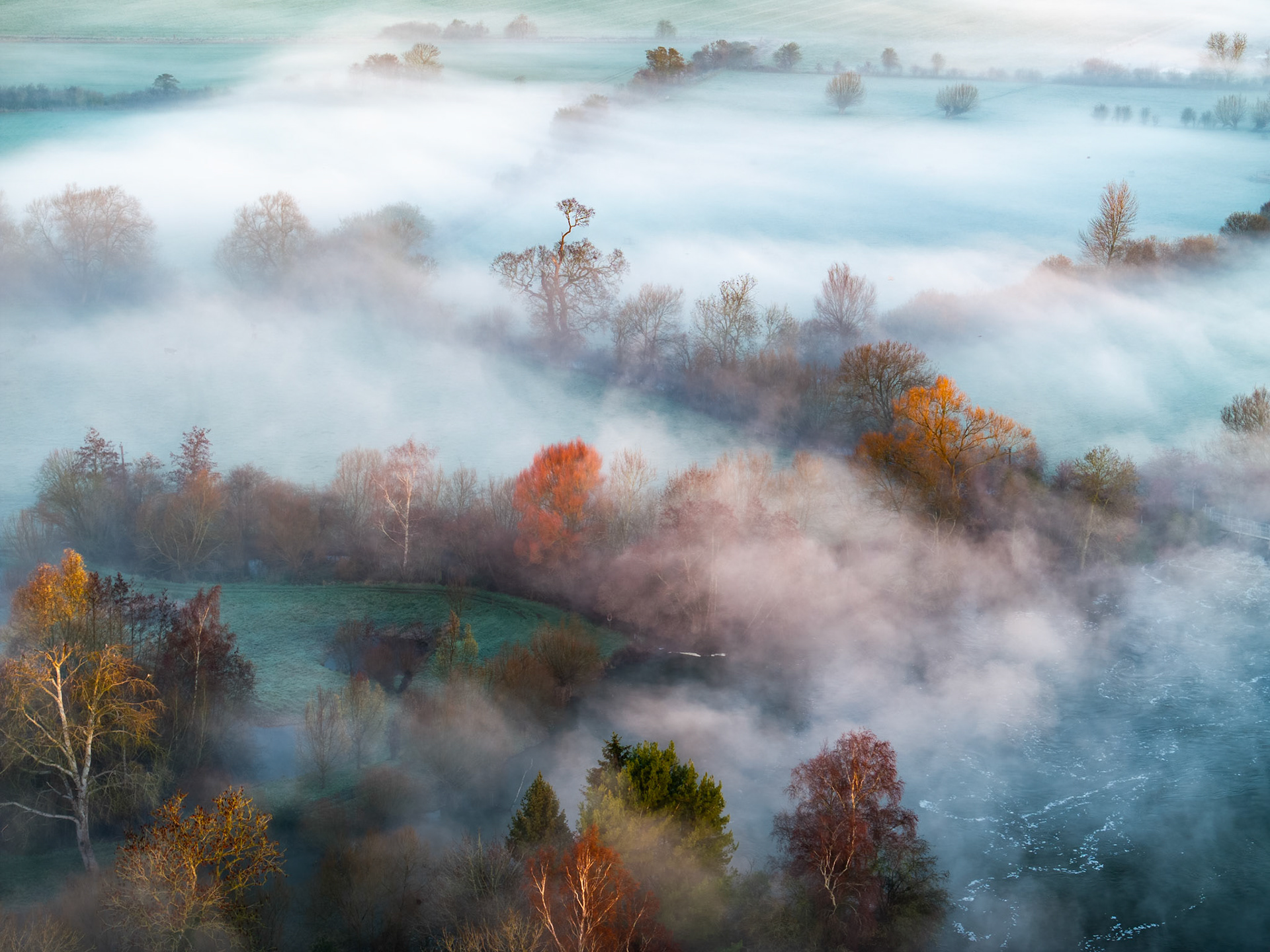
A temperature inversion settles across the Thames Valley near Wallingford, submerging hedgerows and fields beneath a continuous white plane while isolated trees in late autumn colour rise through the fog layer. Shot at low drone altitude, the diagonal ridge of emerging woodland divides the composition, giving structure to an otherwise formless sea of mist. The pale warmth catching copper and amber crowns against the cool tonal ground is what lifts this from record to image.
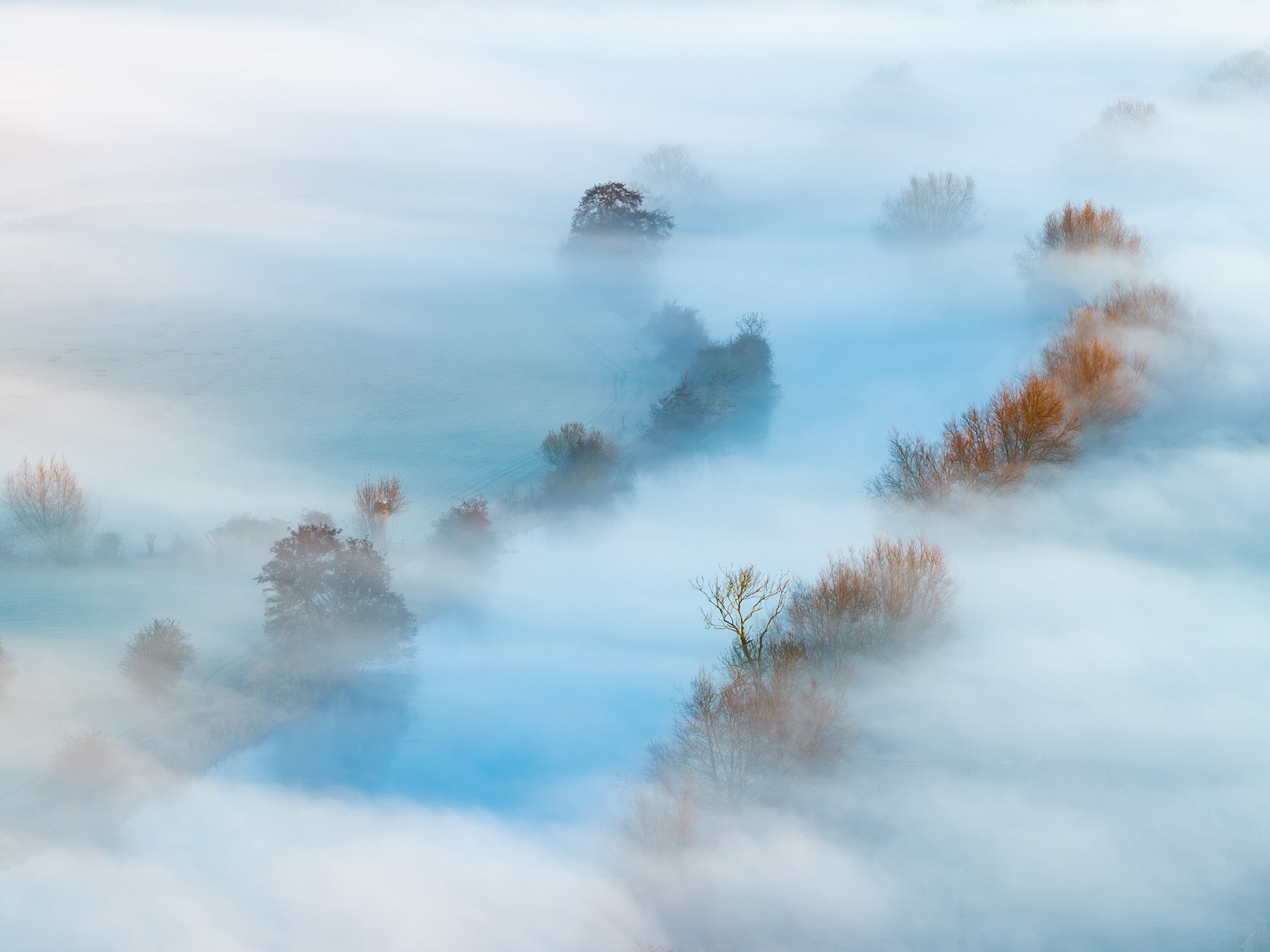
A temperature inversion smothers the Thames valley near Wallingford, leaving only the crowns of riparian trees and the ghost of the river channel visible from altitude. The cool blue of open water mirrors the sky between successive fog banks, while amber willow stems provide the only warm note in an otherwise tonal composition. Captured at dusk in mid-December, the image reads as pure abstraction without surrendering its sense of place.
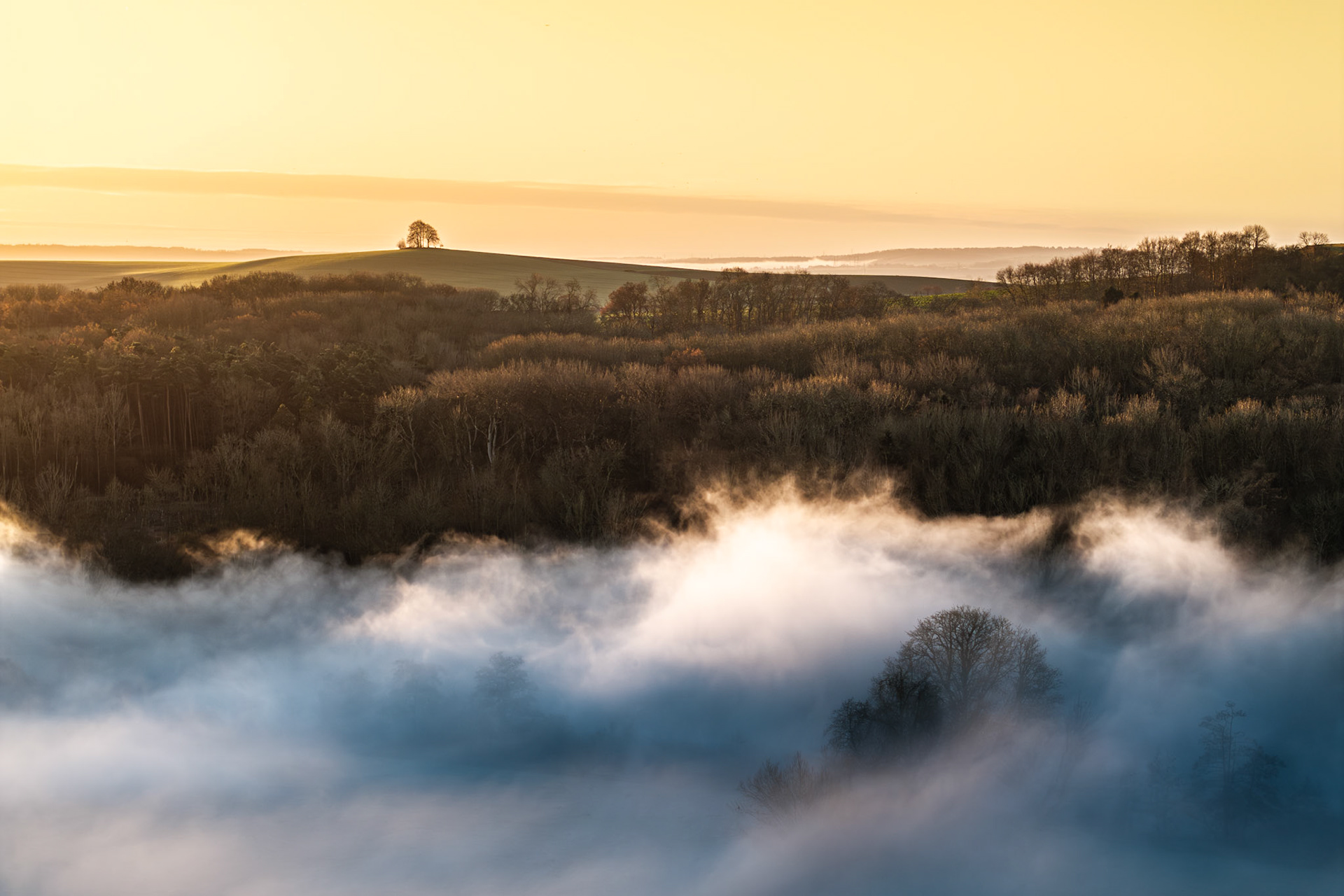
A temperature inversion fills the valley floor with dense fog while bare woodland emerges at the cloud margin, near Wallingford on the Oxfordshire Downs. A lone tree group crowns the distant hill in silhouette against a pale winter dawn sky. The foreground mist, lit from below, separates into distinct layers that give the scene unusual depth and spatial ambiguity.
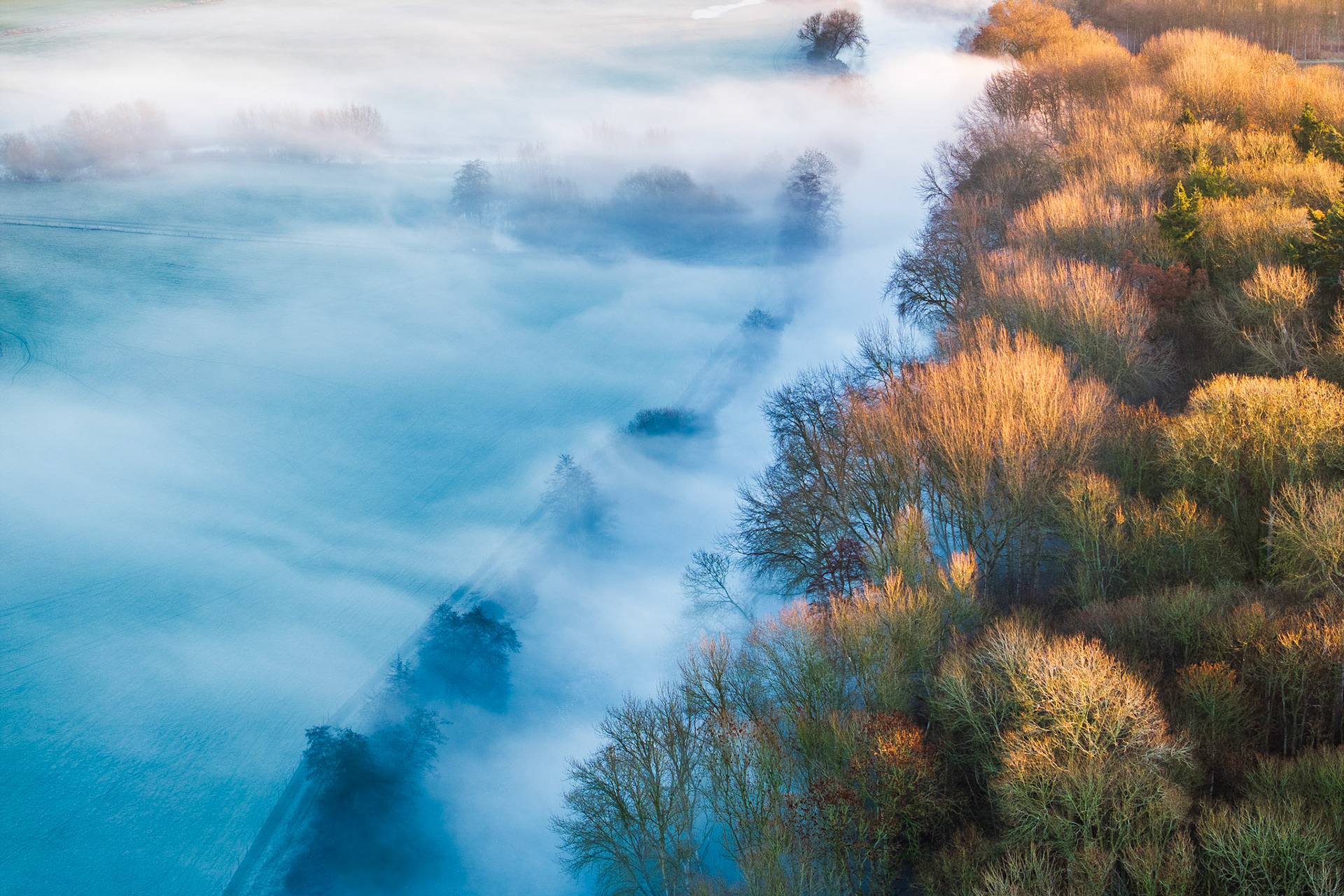
Low winter fog pools across frost-hardened floodplain fields beside the Thames near Abingdon, held in place by a sharp temperature inversion. Riparian trees on the wooded margin catch the first warm raking light from the south-east, their amber canopies standing clear above the mist while isolated hedgerow trees trail long shadow-wakes across the blue-white fog surface below. The diagonal edge between lit woodland and submerged plain carries the composition with controlled tension.
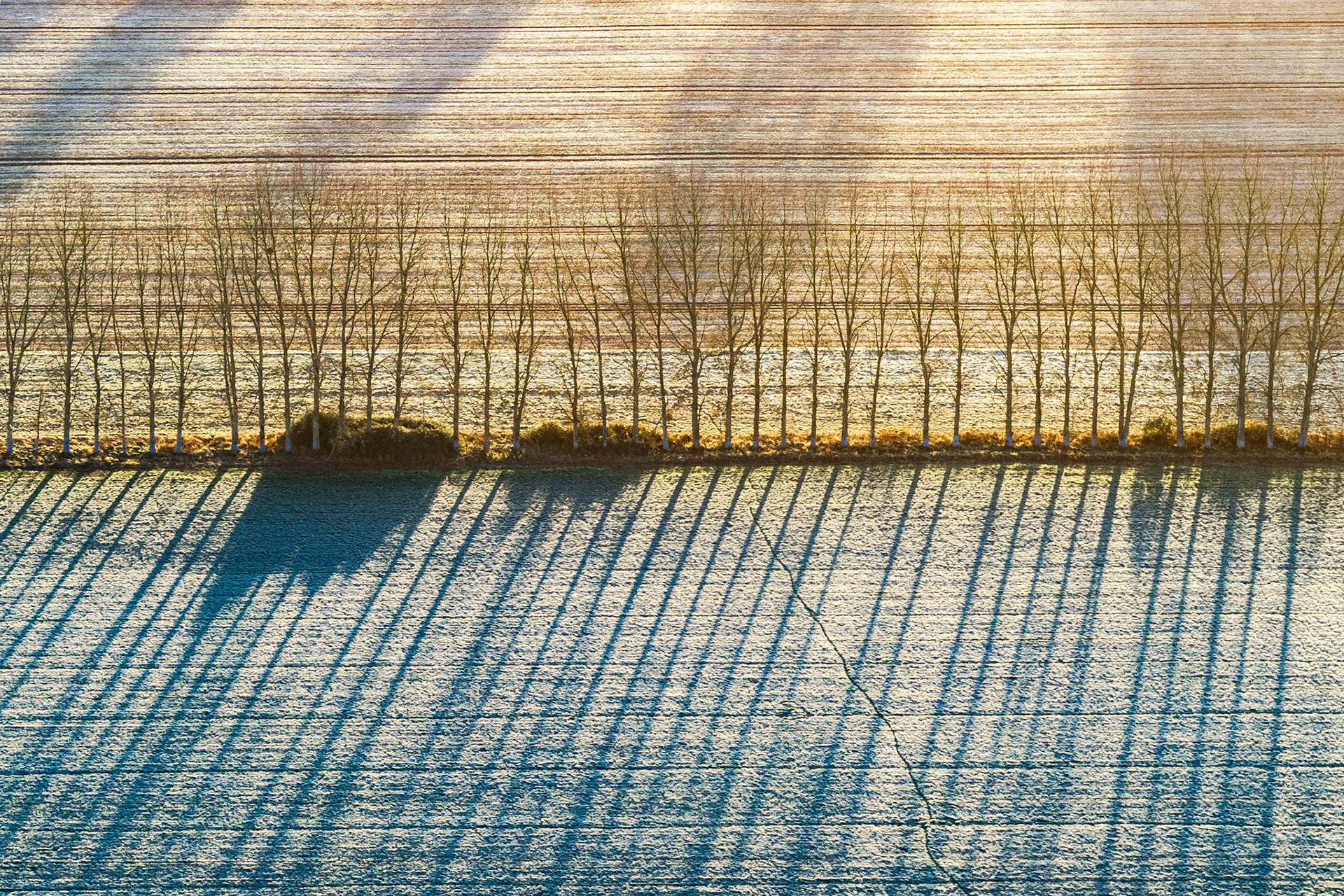
A row of bare poplars divides two frost-covered arable fields near Abingdon-on-Thames, their long shadows cast by a low December sun ruling the foreground field into near-parallel lines. Viewed from directly above, the geometry of agriculture and winter light reduces the familiar to something close to graphic notation. The crack running through the frosted soil in the lower frame introduces a single note of irregularity.
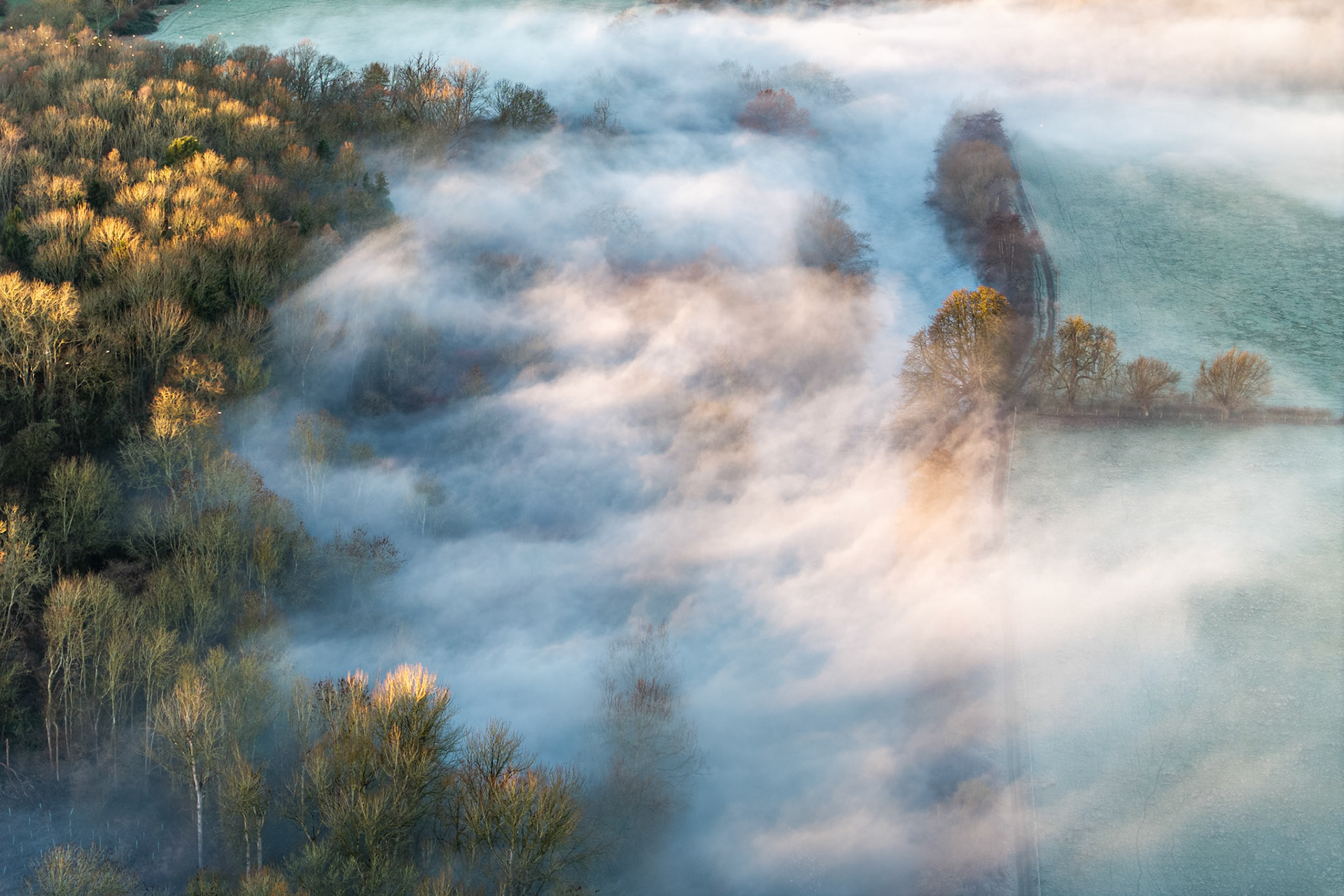
A temperature inversion rolls fog through a Thames floodplain valley near Abingdon, partially submerging riverside woodland in mid-winter light. Tree canopies break the fog surface, their bare branches catching warm low-angle illumination while the fields beyond remain clear. The aerial perspective compresses the layers into an almost painterly dissolution of land and cloud.
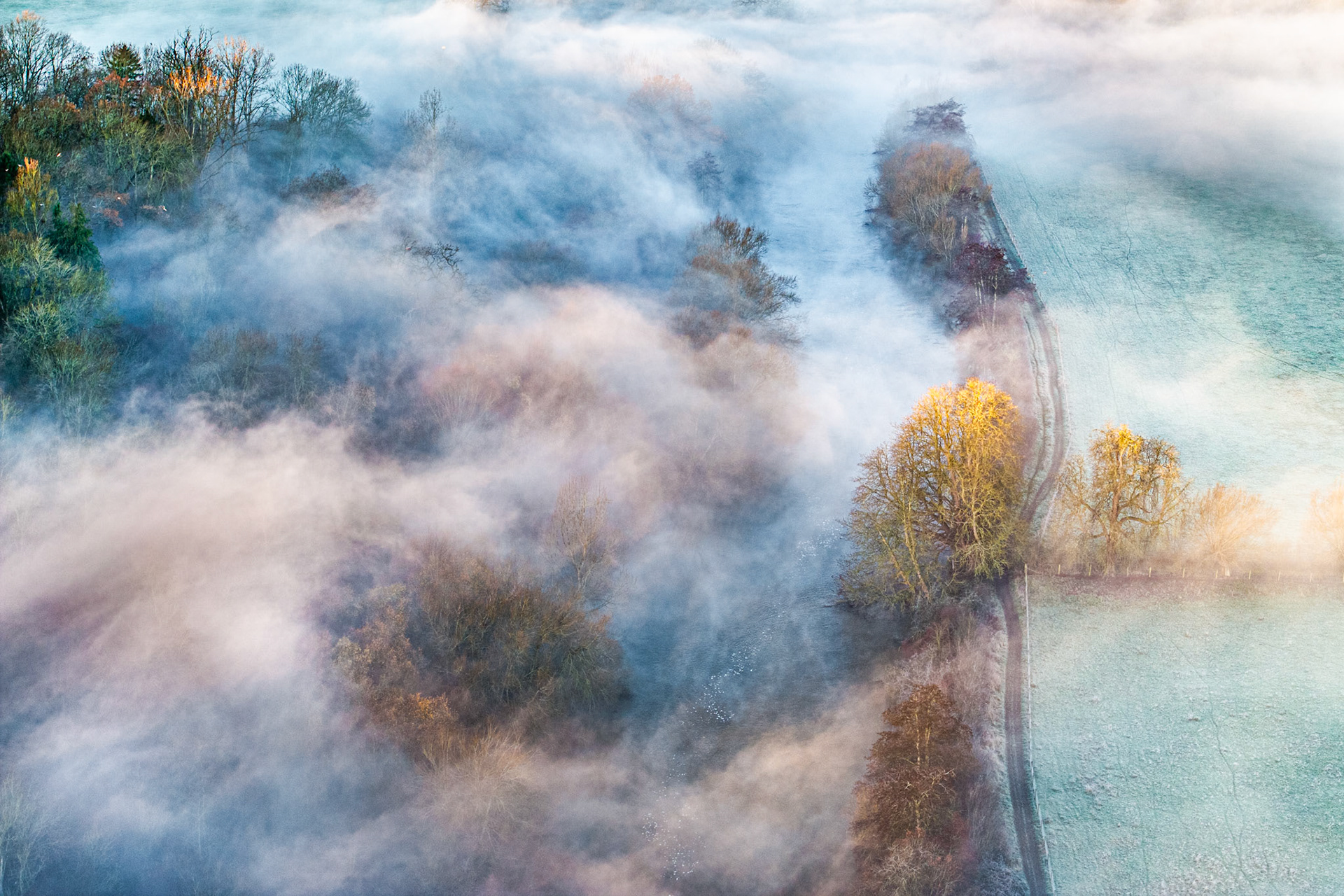
A country road emerges briefly from a low fog inversion blanketing the Thames Valley near Wallingford, Oxfordshire. Golden-leafed trees catch the first winter light above the mist, their canopies isolated like islands in a slow-moving sea of cloud. The aerial vantage transforms a familiar agricultural landscape into something close to abstraction.
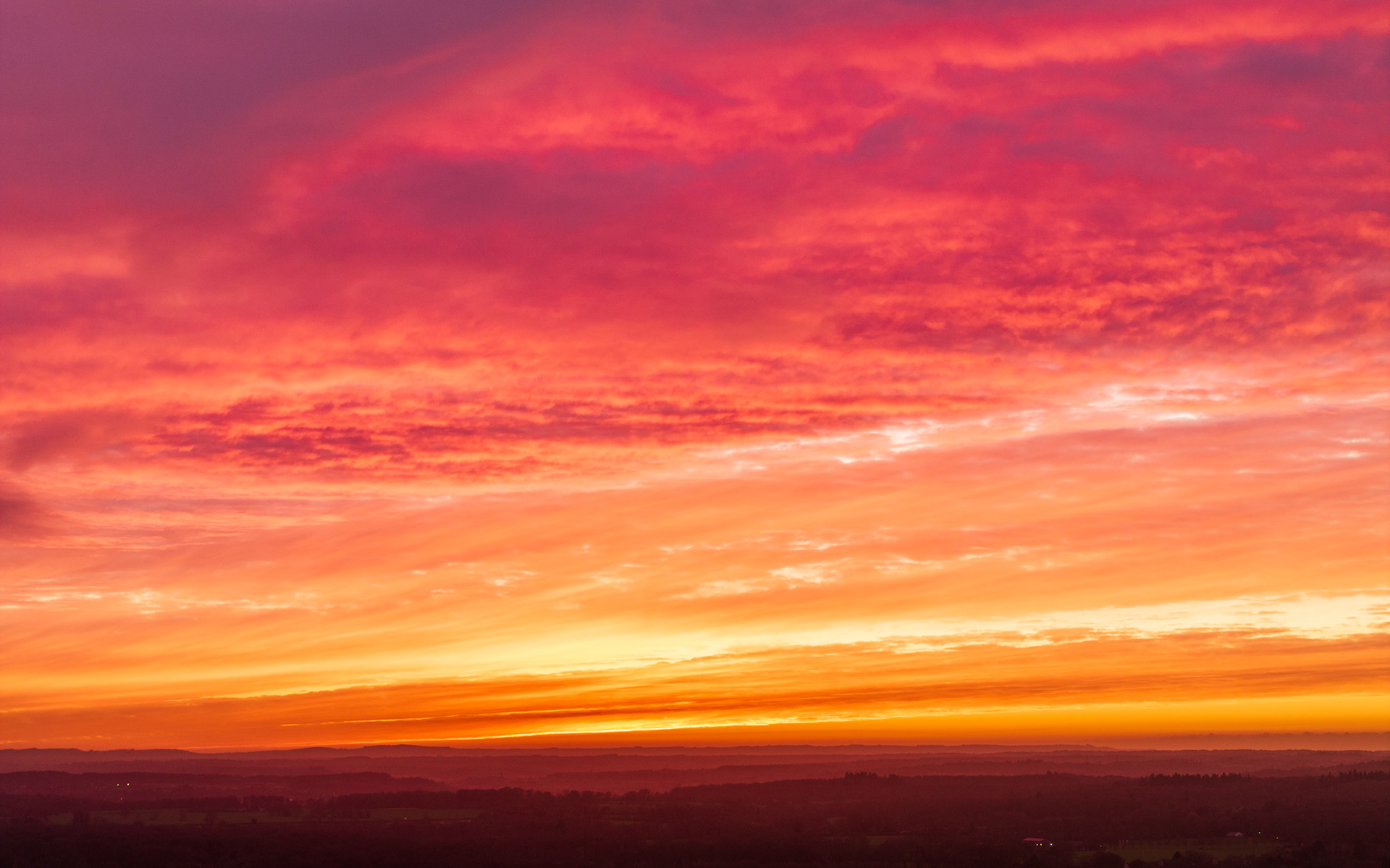
A winter dawn ignites the sky above the Thames Valley, seen from altitude near Henley-on-Thames. Successive cloud layers catch the afterglow in bands of crimson, amber, and gold, while the darkened patchwork of woodland and fields below provides minimal counterpoint. The composition is weighted almost entirely to sky, with little to anchor the foreground.
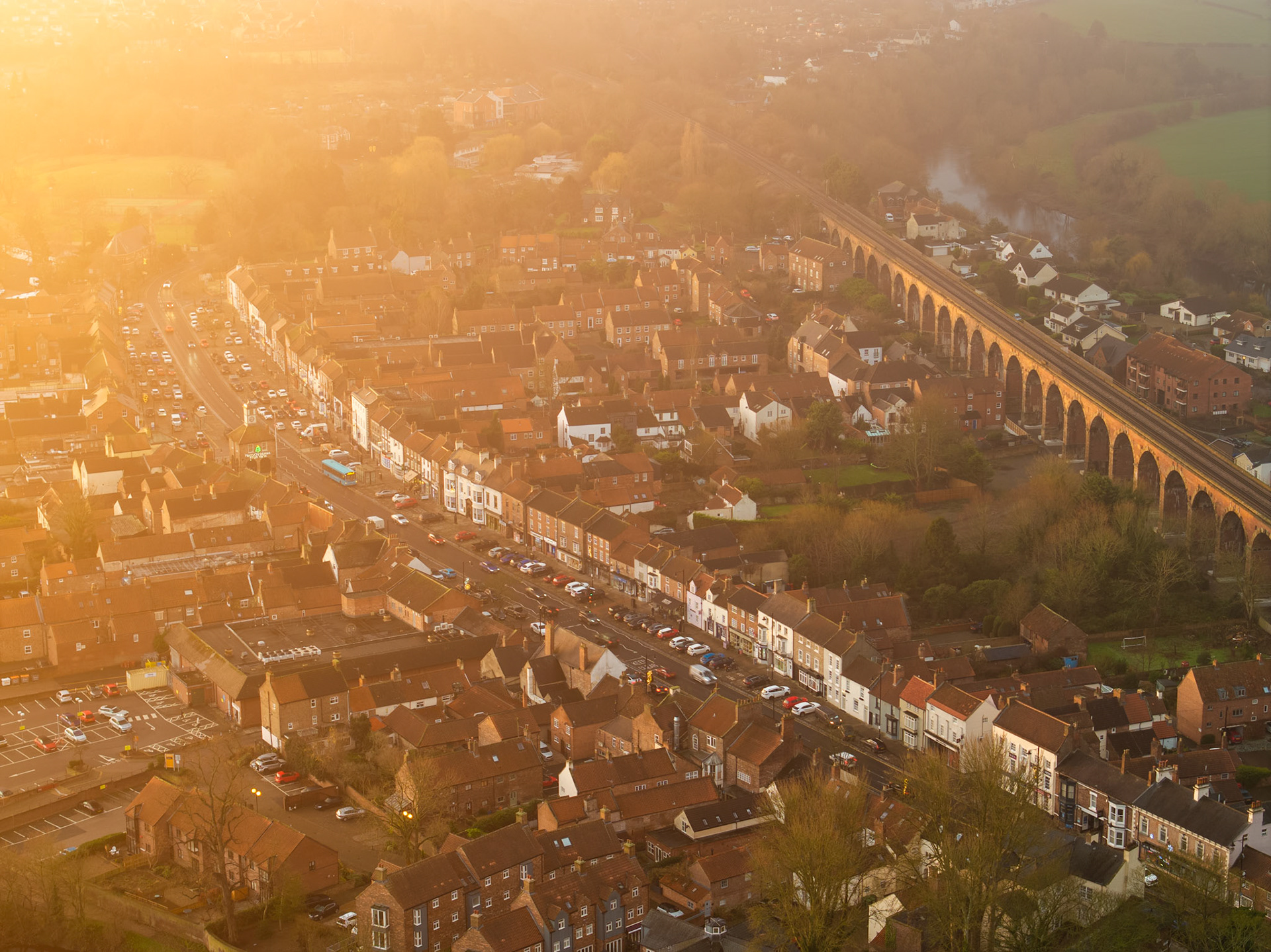
A Victorian railway viaduct arcs through a dense English market town, caught from altitude in the amber haze of a winter morning. The warm light unifies rooftops, high street, and arches into a single tonal plane, while mist softens the tree line to the north.
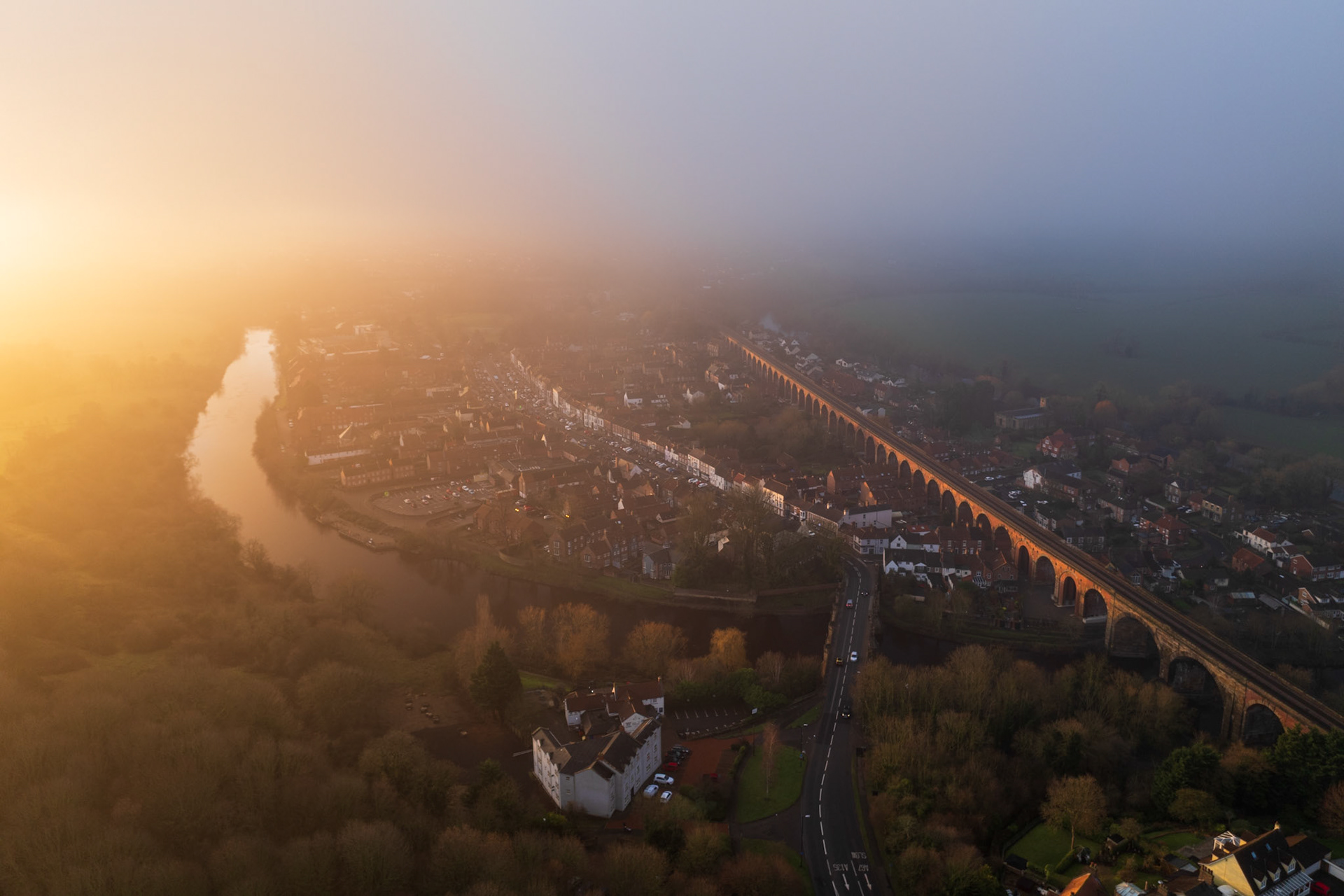
A low winter fog bisects the town, its edge drawn in a near-perfect diagonal across the rooftops and the long arched viaduct. Dawn light floods the western bank of the River Tees in amber while the eastern half of the frame remains suspended in cool grey. The thermal inversion catches a moment of accidental geometry between warmth and cold.
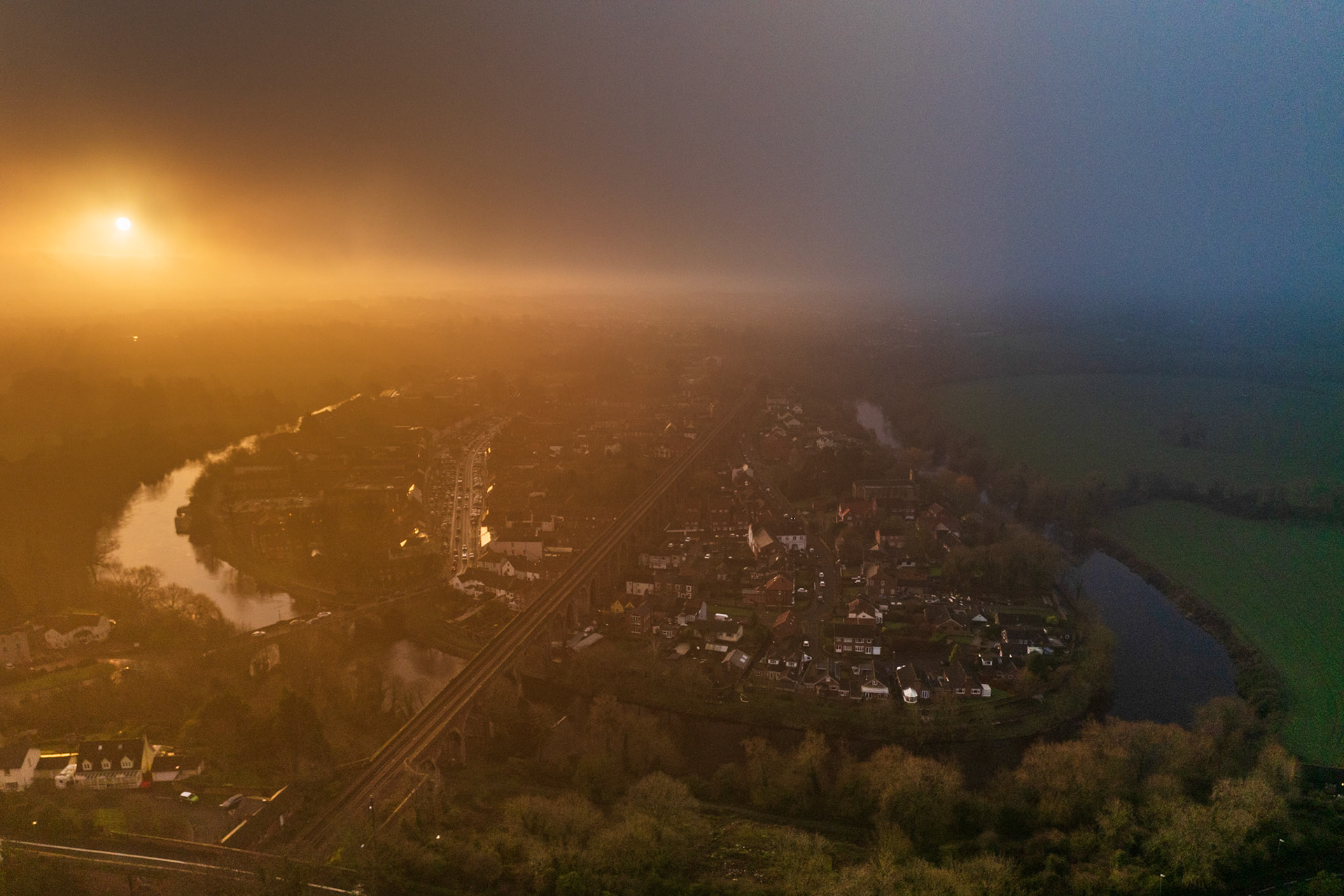
A temperature inversion splits the frame in two above a small English town encircled by a meandering river, the rising sun burning amber through fog to the west while cold blue shadow holds the eastern half. Captured from altitude in mid-winter, the hard colour boundary bisecting the scene gives the image its structural tension. Railway lines cut diagonally through the townscape below, grounding the aerial perspective.
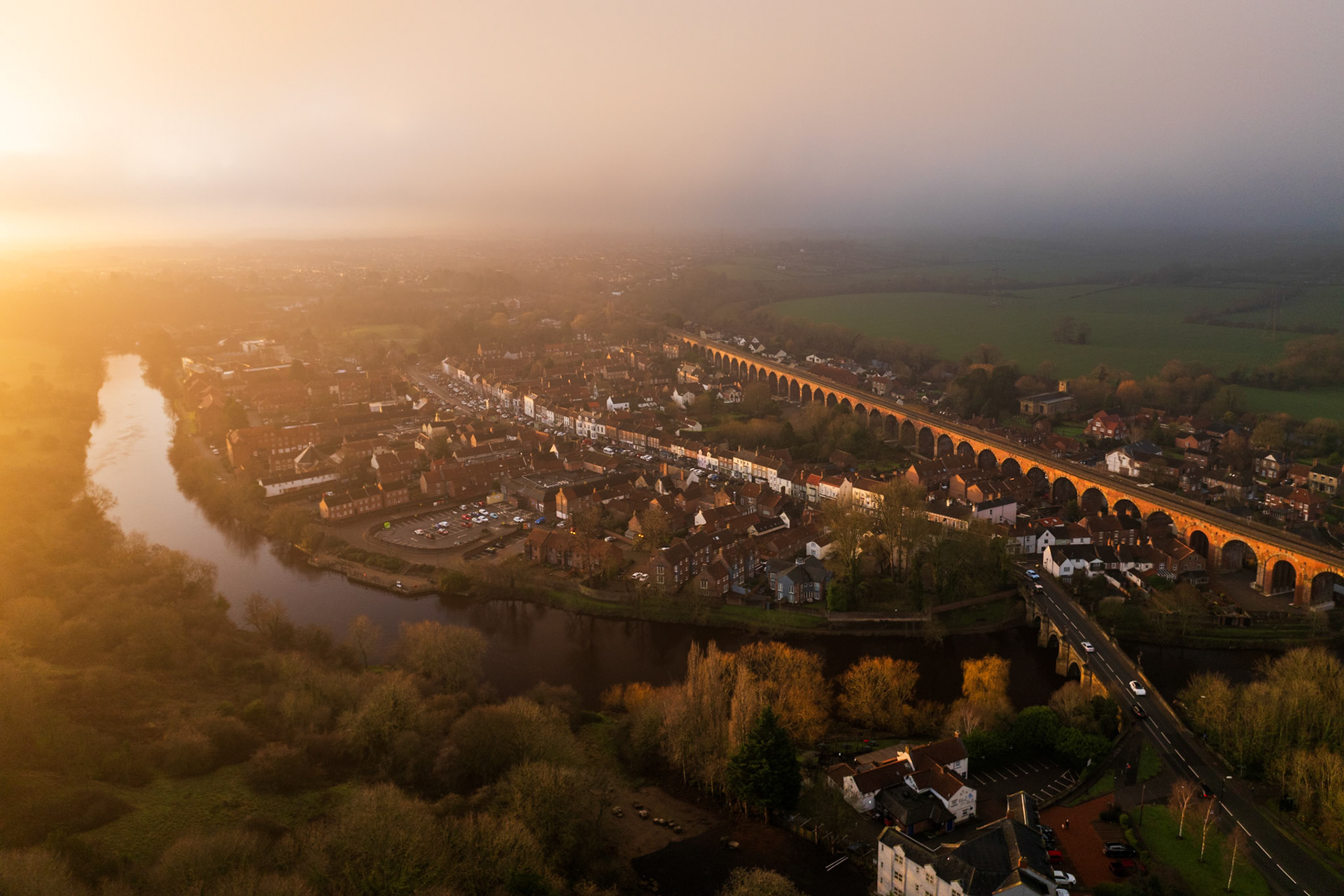
A Victorian railway viaduct bisects a riverside market town as low winter fog softens the horizon and golden light rakes in from the west. The meander of the River Tees anchors the left frame, contrasting the geometric repetition of the arches. Captured at dawn from altitude, the image holds a tension between industrial heritage and quiet atmospheric dissolution.
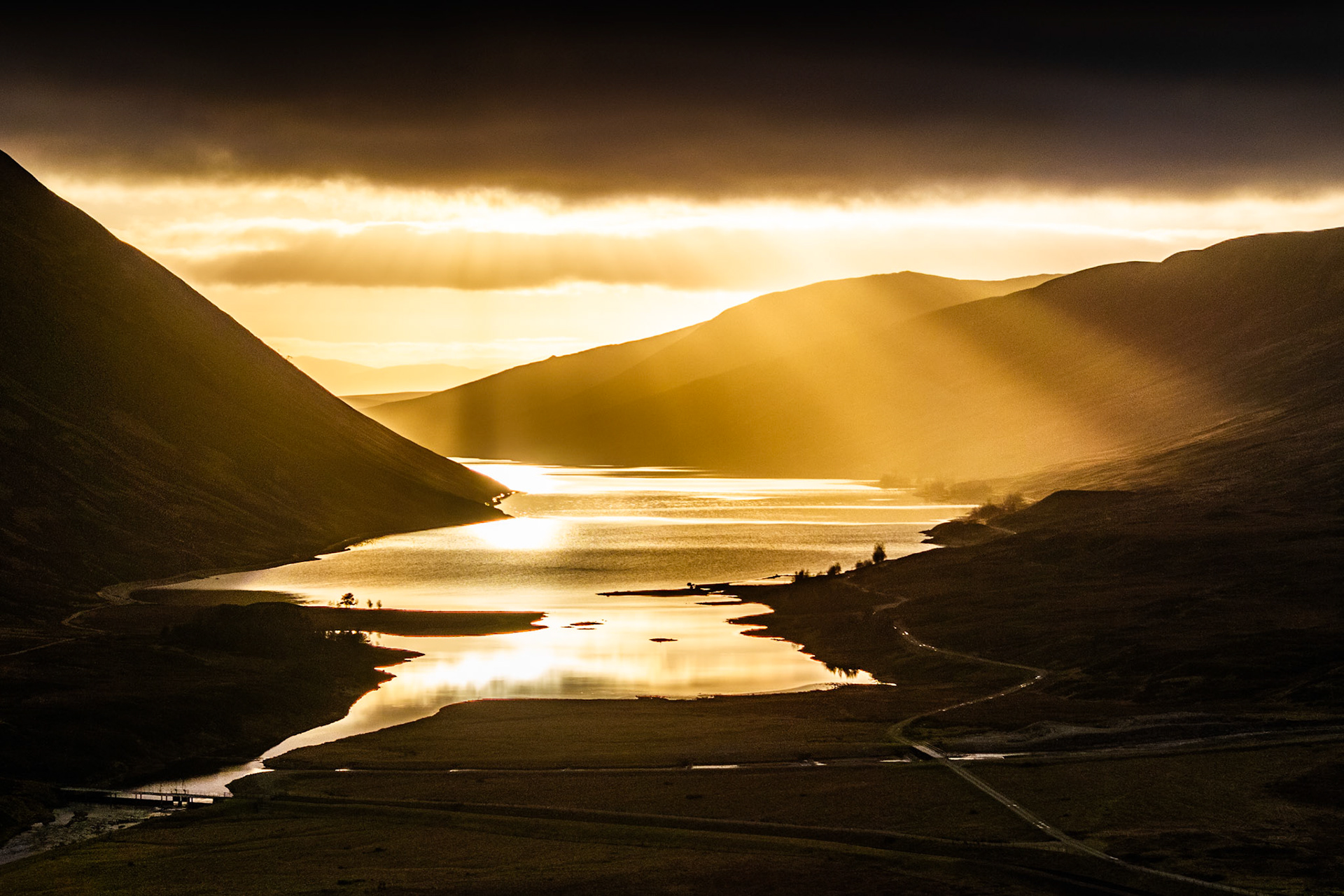
Crepuscular rays break through storm cloud above a Scottish loch near Pitlochry, casting raking winter light across still water and silhouetted hill flanks. The elevated viewpoint compresses the valley, aligning the loch's surface reflections with the source light in a single receding axis. Shot on Christmas Eve at low solar elevation, the geometry of cloud, mountain and water is unusually resolved.
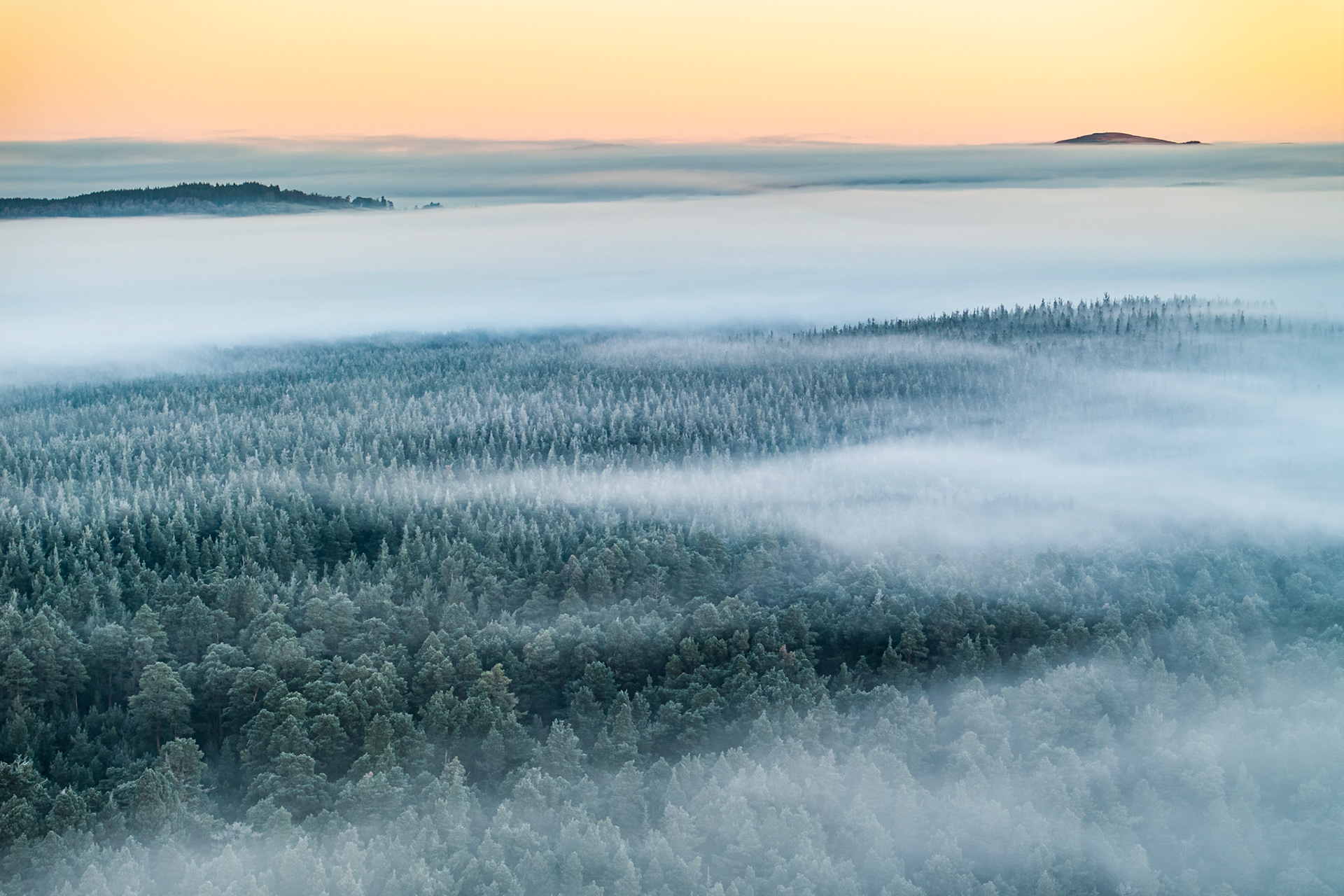
A temperature inversion buries the boreal forest around Nethy Bridge beneath rolling fog on a Christmas dawn, frost-whitened conifers emerging in successive ridges from the mist. The warm apricot horizon separates cloud sea from sky, with distant summits reduced to silhouette. The aerial vantage compresses the layers into a composition of quiet, almost graphical precision.
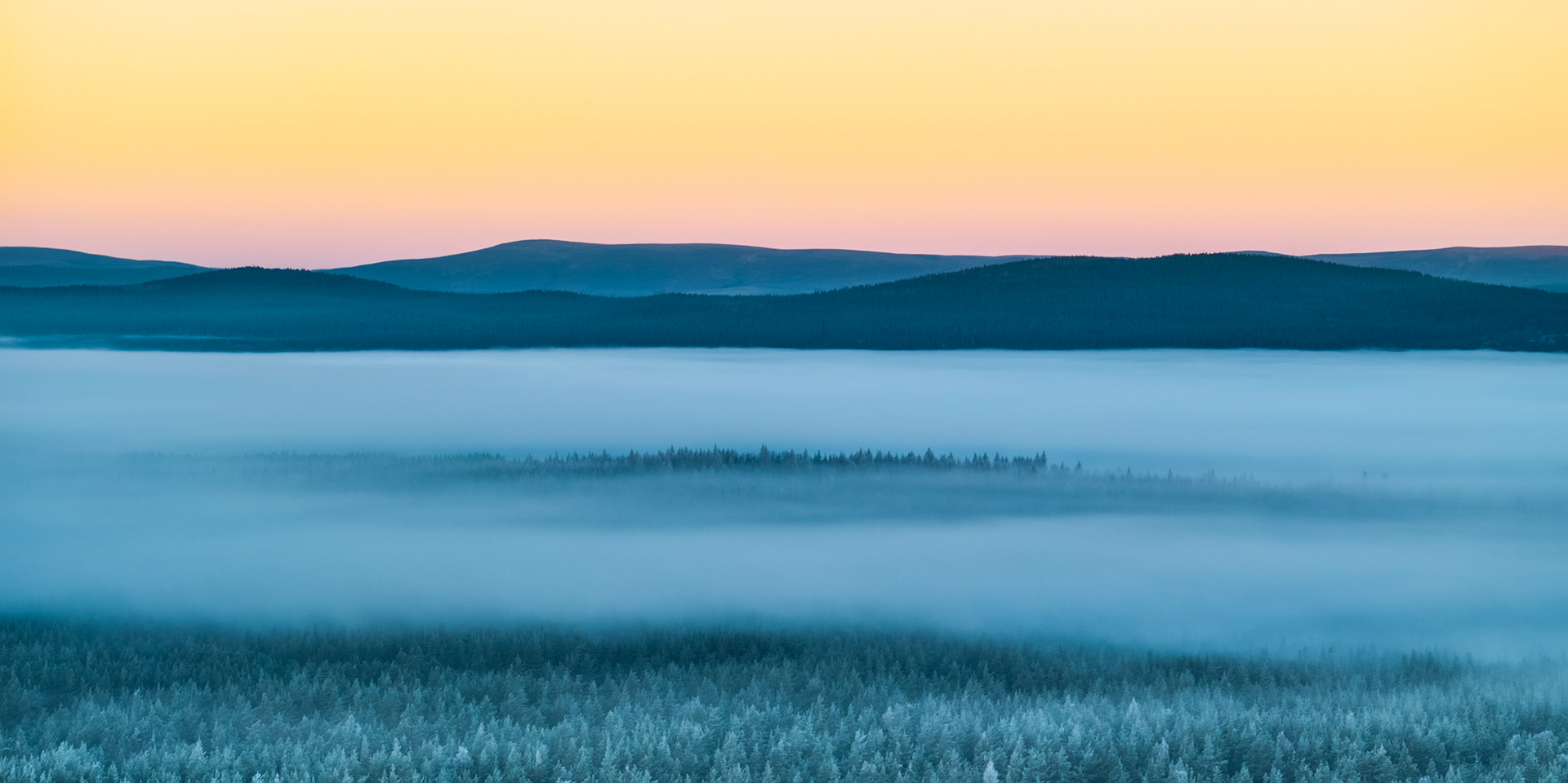
A temperature inversion fills the Spey valley at dawn on Christmas morning, submerging frost-laden boreal forest beneath a still sea of fog. A single ridge of conifers breaks the surface mid-frame, anchoring the composition between the blue cold below and the amber afterglow above the Cairngorm hills. Captured from altitude above Nethy Bridge, the layering of tone and depth is precise without artifice.
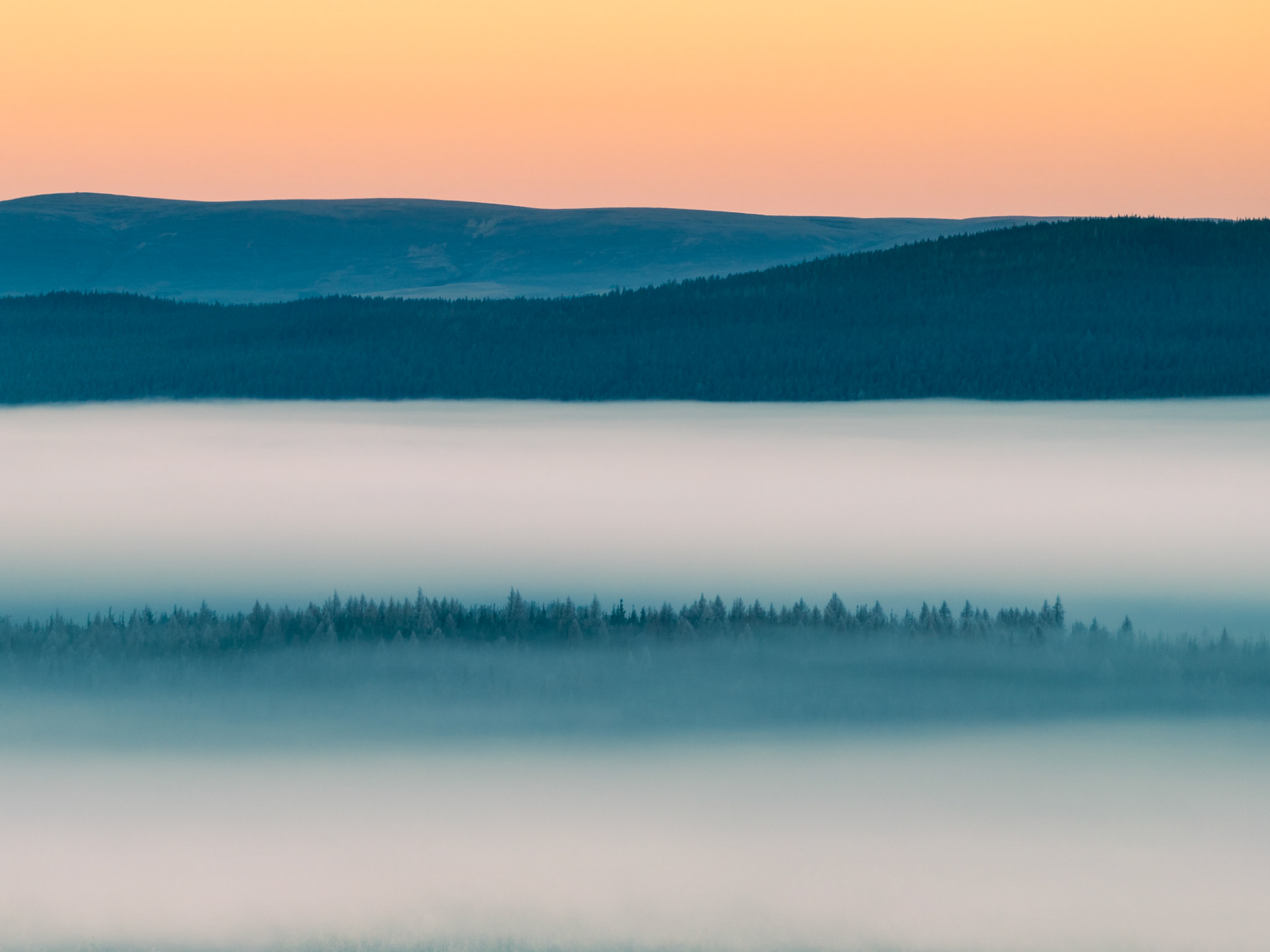
A temperature inversion fills the Strathspey valley with dense radiation fog at dawn on Christmas morning, reducing the conifer forest to a single suspended dark band between tiers of white mist. Shot from elevation above Nethy Bridge in the Cairngorms, the image resolves into four horizontal planes — fog, treeline, forested ridge, and a peach afterglow sky — with near-perfect tonal separation between them. The restraint of the composition and the stillness of the light give the scene an almost monochromatic quality despite the colour present.
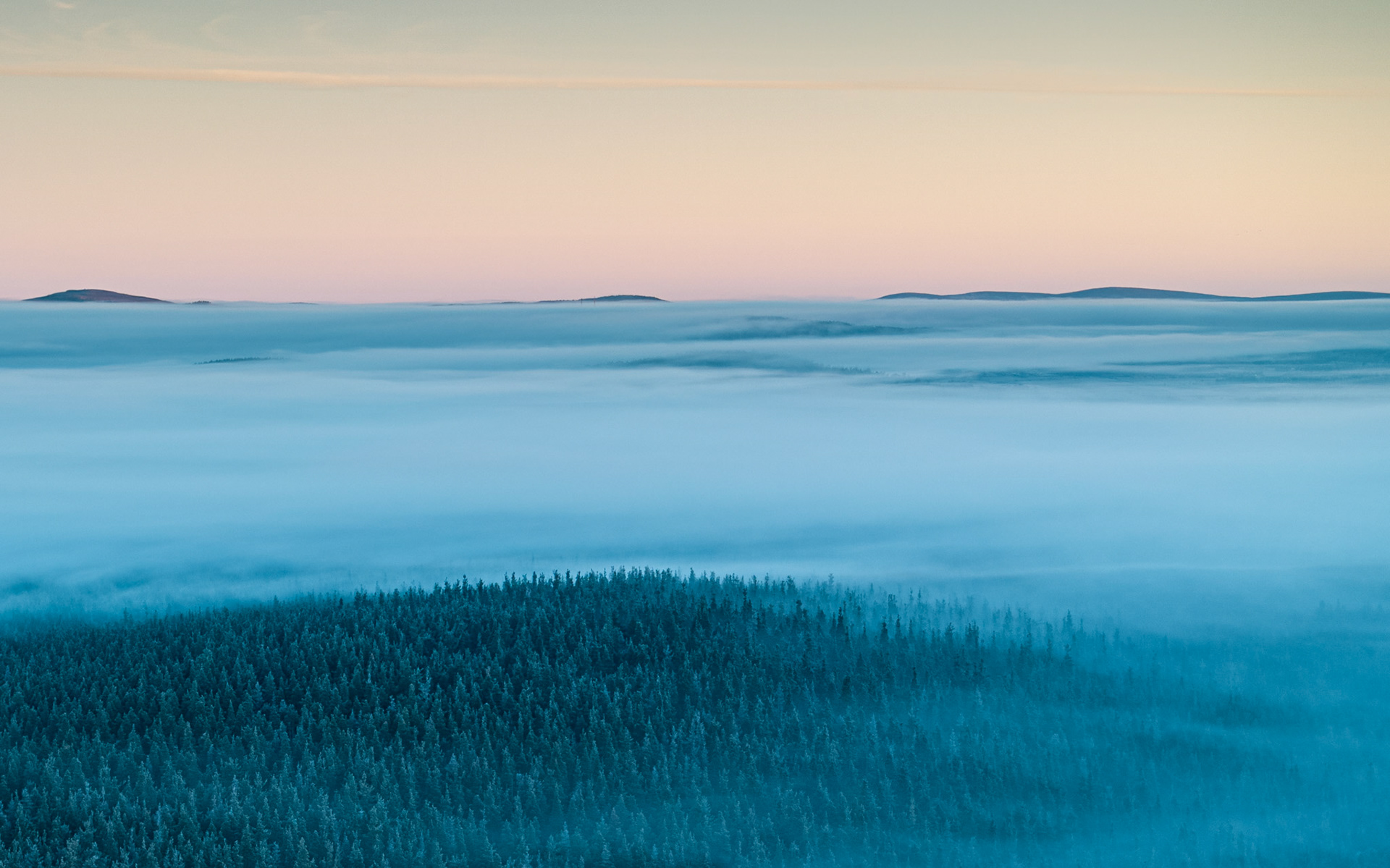
A temperature inversion floods the Spey Valley with cloud on a December dawn, leaving the crowns of a boreal conifer forest breaking the surface like dark archipelagos. Distant fells emerge as silhouettes above the fog layer, set against a sky moving through pink and pale gold in the minutes after first light. The shot was captured by drone above Nethy Bridge, within the Cairngorms National Park.
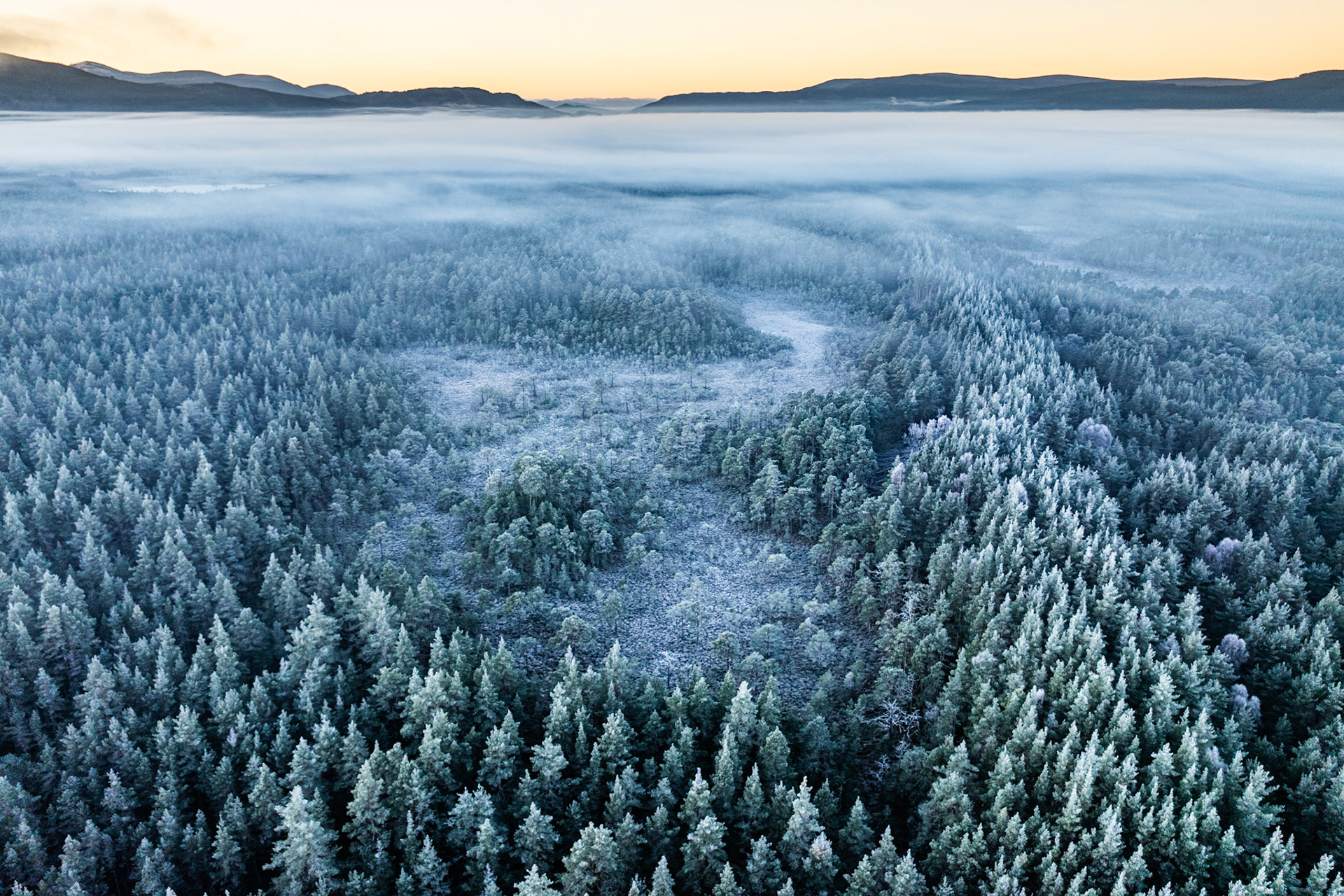
A temperature inversion settles over Caledonian pine forest near Boat of Garten on a December dawn, hoarfrost silvering every canopy while low cloud fills the valley floor. The clearing at centre draws the eye through the frozen trees toward the Cairngorm plateau, its ridgeline lit by the first pale warmth of a winter sunrise. The aerial vantage reveals the fog pooling along drainage channels invisible from the ground.
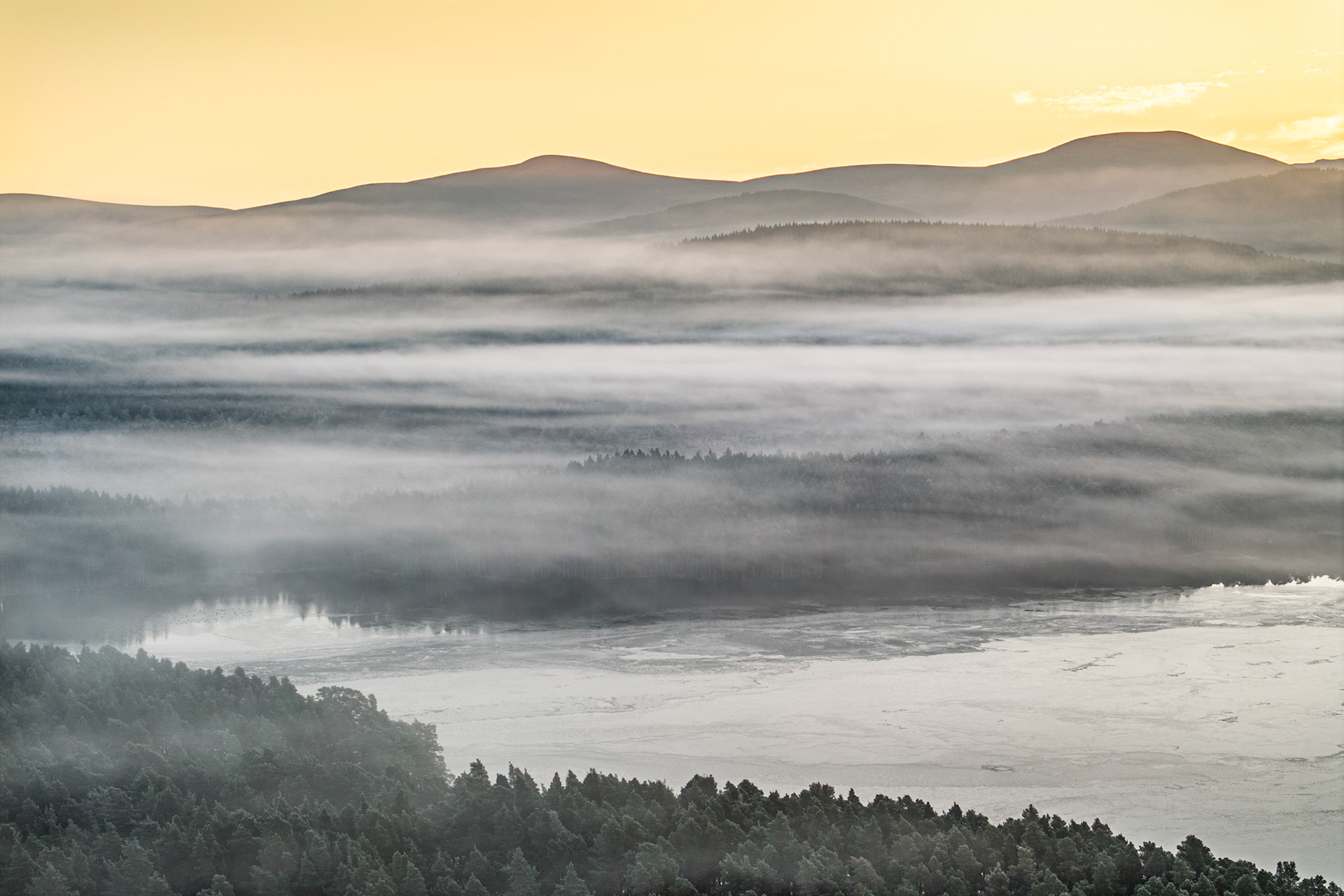
A temperature inversion fills the Spey valley at dawn on Christmas morning, submerging the Caledonian pinewoods of Boat of Garten beneath layered fog while the Cairngorm summits hold clear above. The loch surface below catches faint light between drifting mist banks, and the warm amber sky above the plateau draws a precise tonal separation between the two worlds.
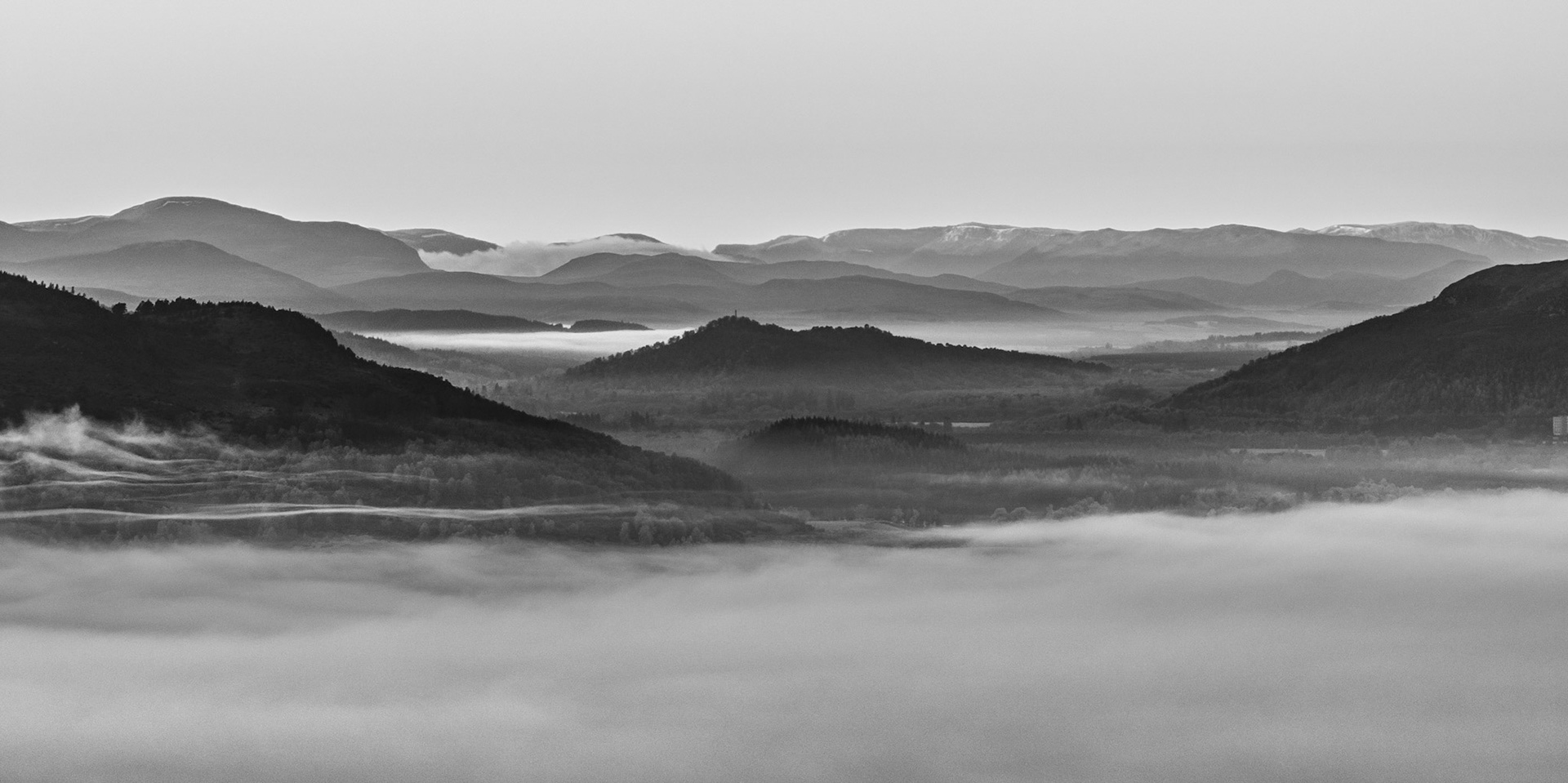
A temperature inversion fills the Spey Valley on Christmas morning, submerging the low ground in dense fog while successive ridgelines recede into haze above Boat of Garten. The monochrome conversion distils the scene to pure tonal recession, with a hilltop structure — possibly a monument — emerging as the sole punctuation in the middle distance. Aerial elevation reveals the full depth of the layering in a way unavailable from the valley floor.
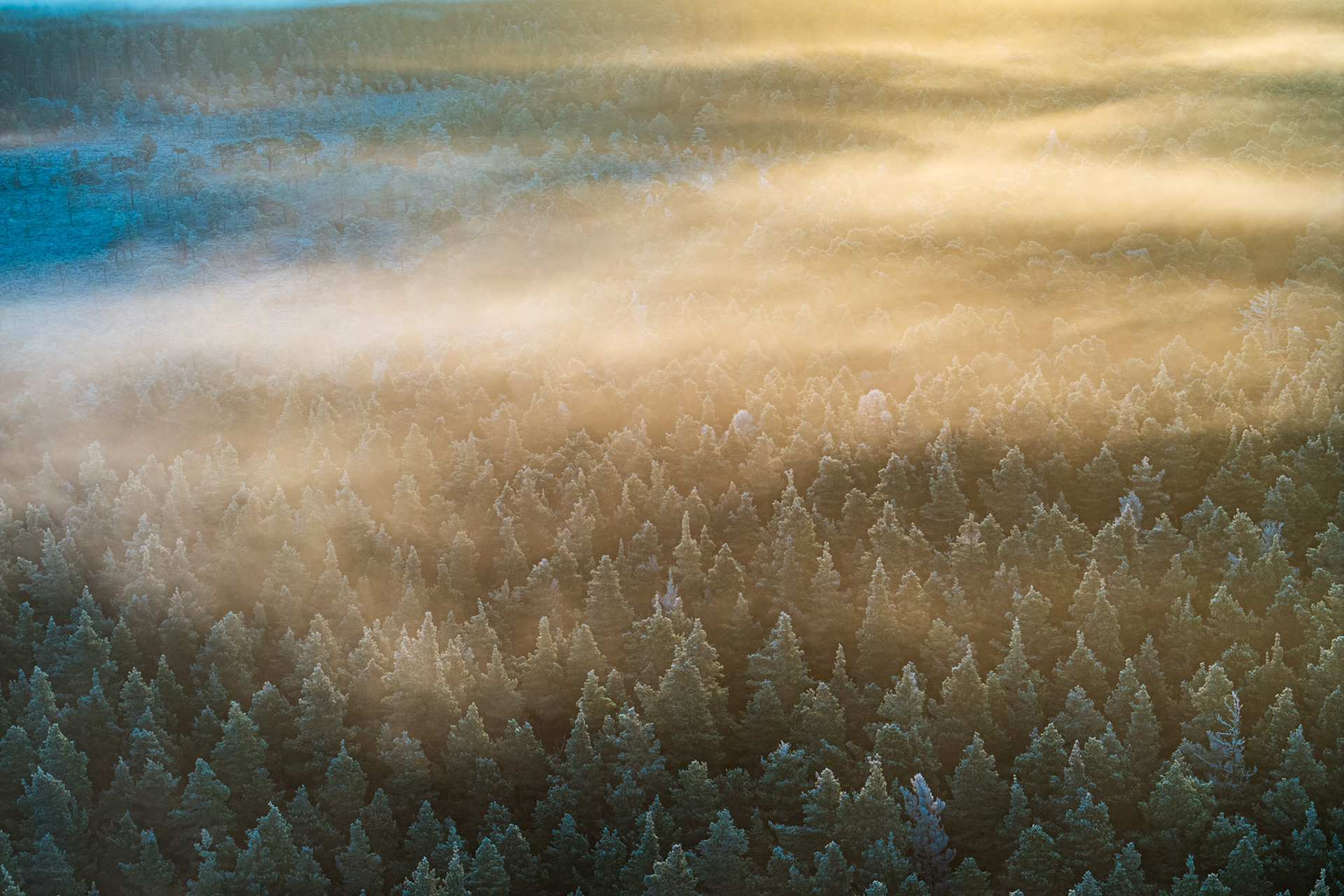
A temperature inversion pools over frost-tipped Scots pine forest in the Cairngorms fringe near Nethy Bridge on a winter solstice morning. Low mist moves in distinct laminar layers, lit from the east with warm raking light that separates the cold blue shadow on the left from the suffused gold of the inversion core. The aerial perspective compresses the canopy into a textured surface, giving the fog the quality of slow water.
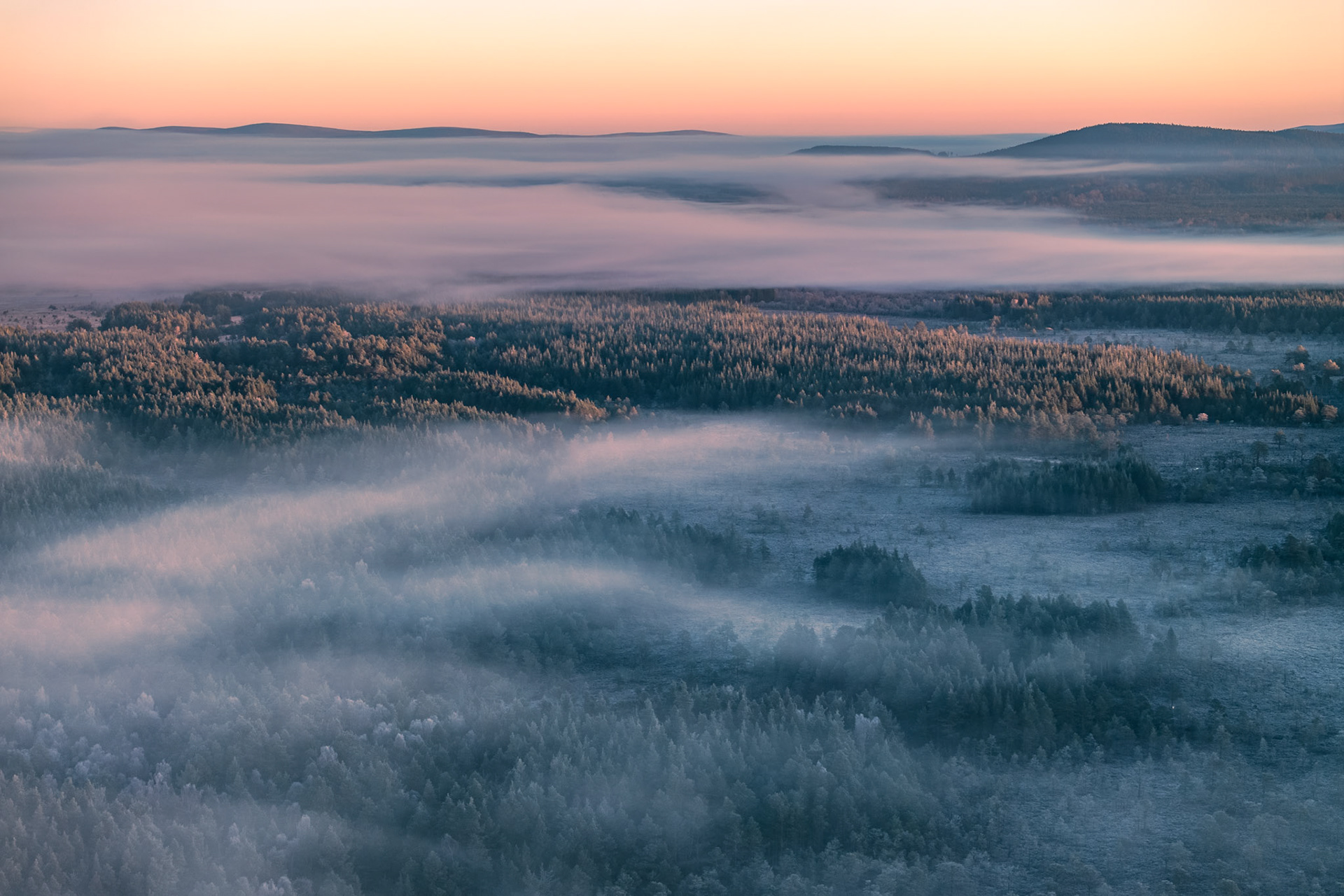
A temperature inversion fills the Strathspey valley with layered fog at first light, leaving frost-rimed boreal forest emerging through the mist like islands. The Cairngorm plateau silhouettes break the horizon beneath a pale salmon afterglow. Captured from elevation above Nethy Bridge on a still Christmas morning.
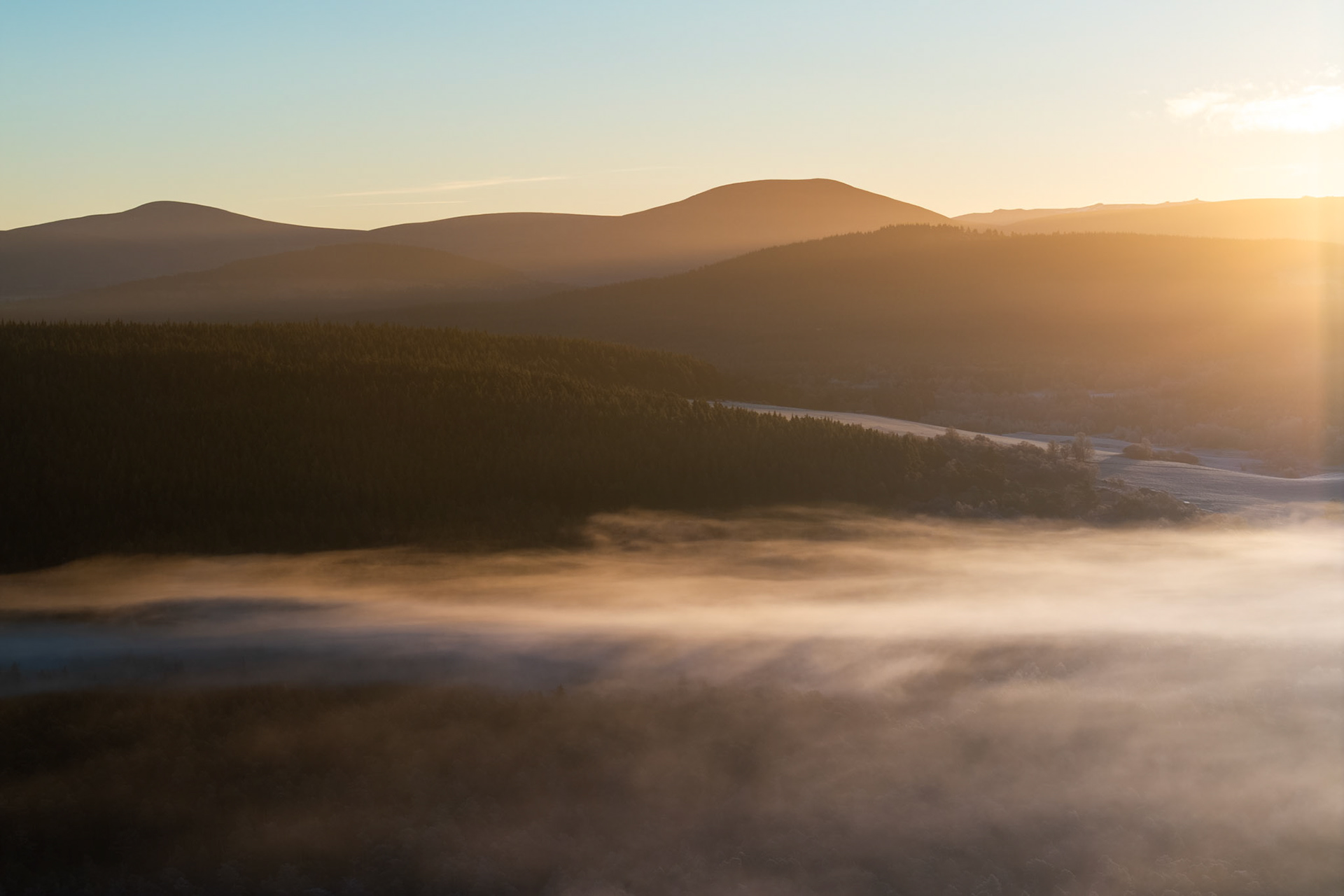
A temperature inversion fills the Nethy Bridge valley with low mist on a winter solstice dawn, the Cairngorm hills receding in warm silhouette against a clear sky. The tree line of Abernethy Forest separates fog from mountain, compressed into distinct tonal bands by the low sun entering from the right. A river channel threads briefly into view before disappearing beneath the cloud.
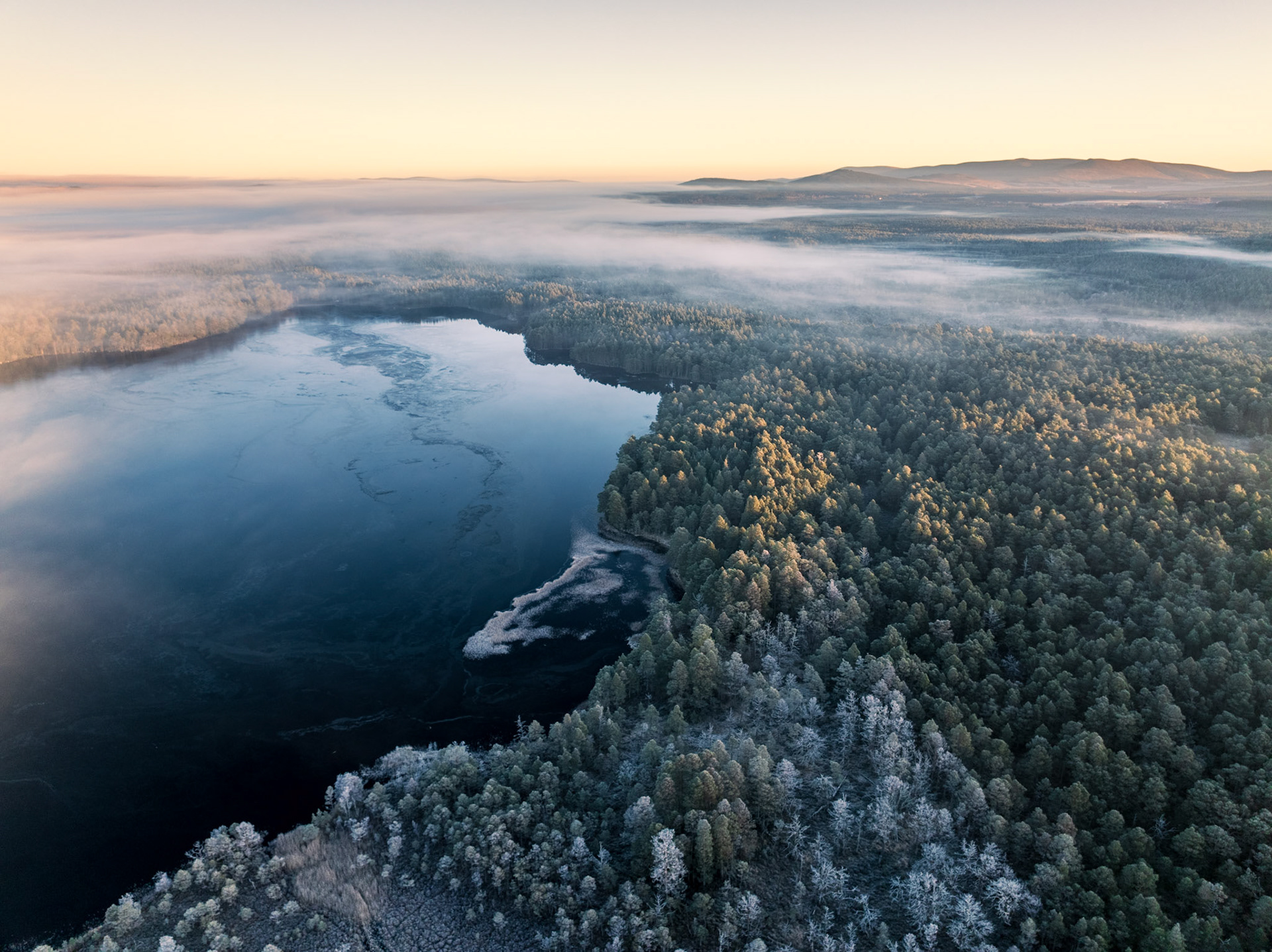
A frost-rimed Caledonian pine forest meets a dark, partially ice-forming loch near Nethy Bridge, Cairngorms, on a Christmas morning inversion. Low cloud pools between the tree canopy and a pale apricot horizon, while hoarfrost whitens the foreground trees and traces the shoreline. The diagonal land-water boundary anchors a scene of considerable stillness and depth.
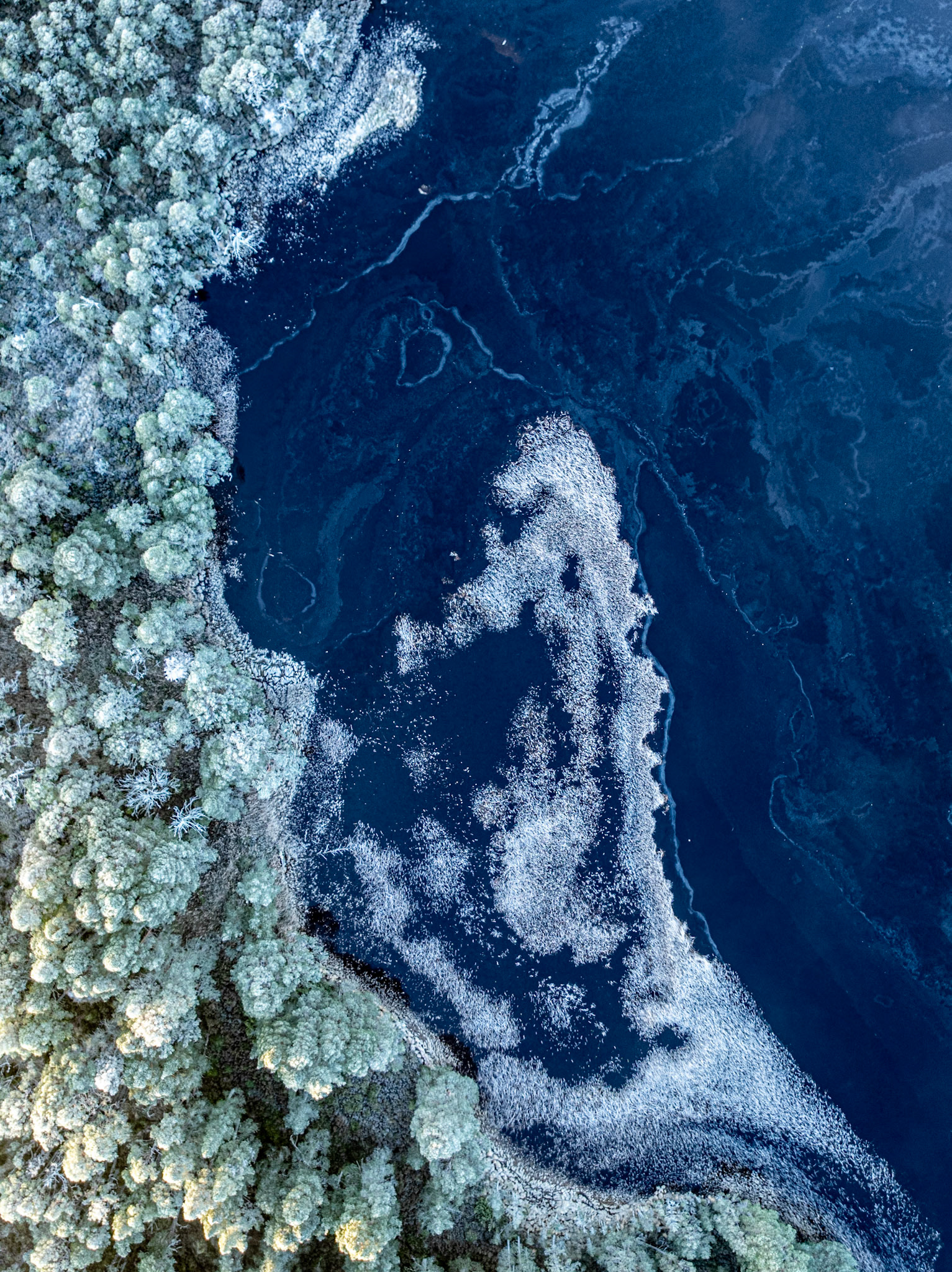
Frost-rimed conifers meet the dark water of a Highland loch at Nethy Bridge, Cairngorms, on a Christmas morning. Fragile ice shelves extend from the treeline into the deep blue water, their organic forms echoing the curvature of the shoreline above. Shot directly overhead, the compressed perspective dissolves the familiar boundary between forest and water into near-abstraction.
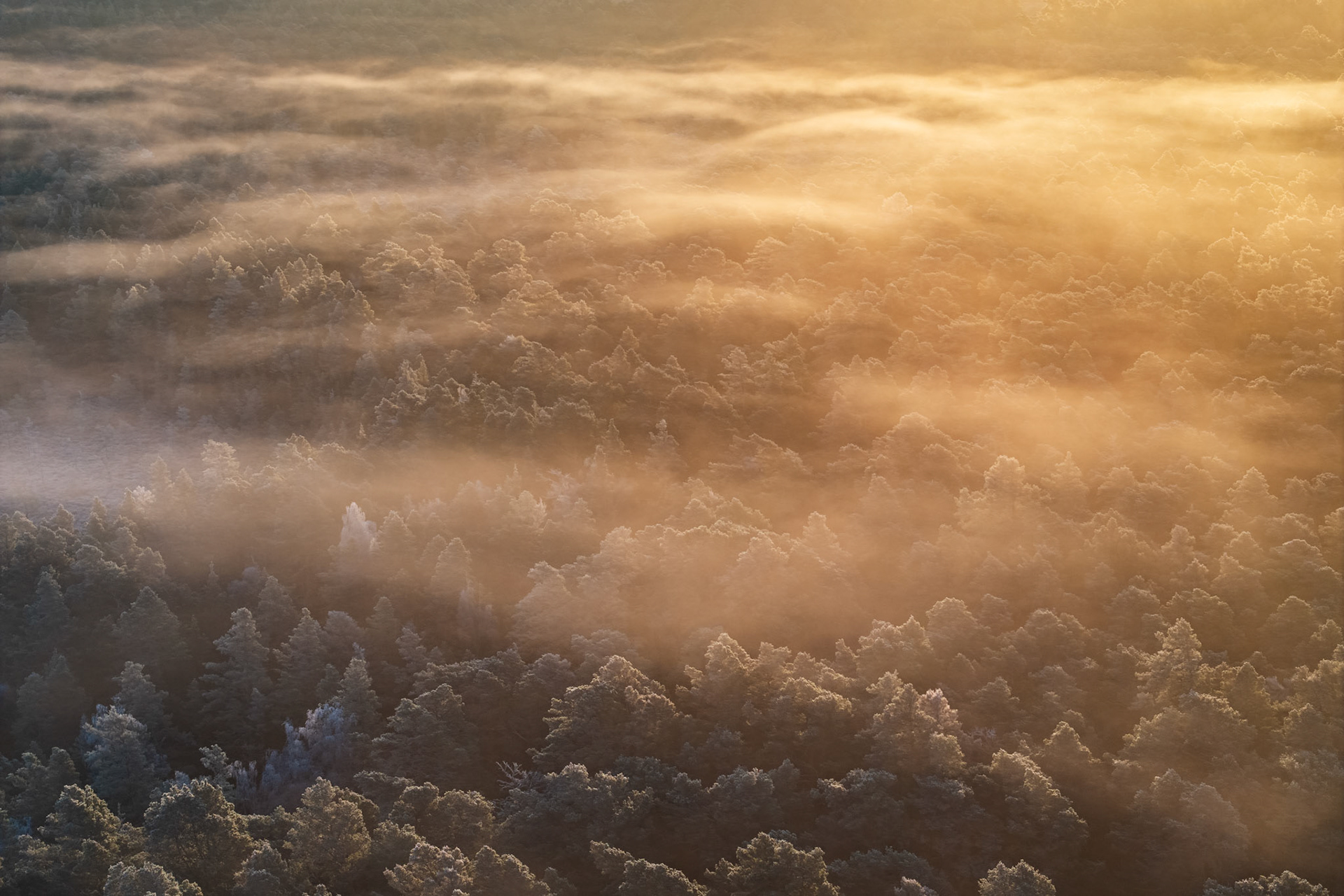
A temperature inversion settles over frost-laden pinewoods in the Cairngorms on Christmas morning, the rising sun dissolving the mist into horizontal bands of amber light. Hoarfrost rims every canopy, softening the distinction between cloud and tree until the forest becomes almost oceanic. Shot from altitude, the image strips the scene to atmosphere and pattern alone.
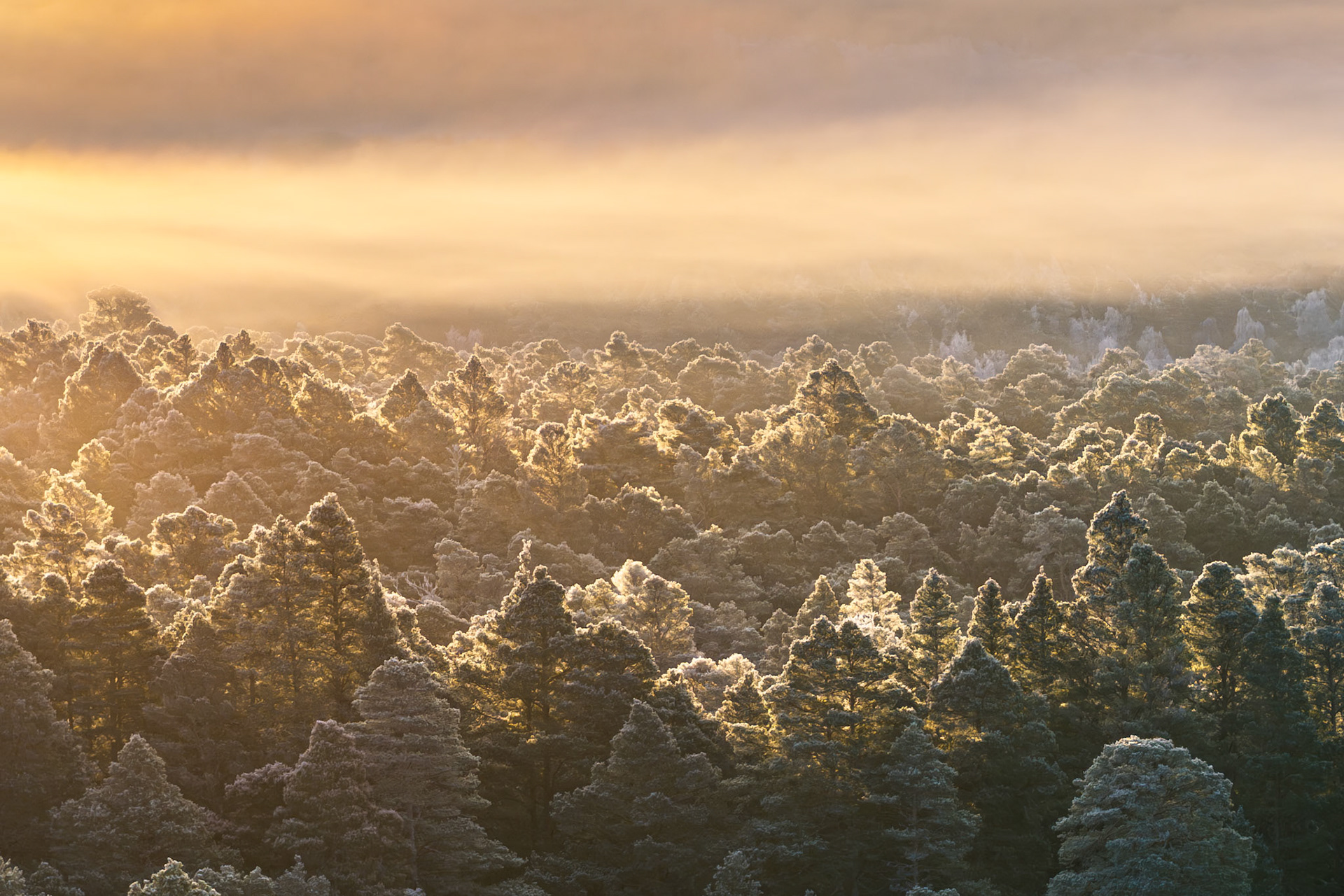
Hoarfrost coats a Scots pine canopy above Nethy Bridge on a winter dawn, the low sun catching each frosted crown against a soft inversion layer that erases the middle distance. The aerial viewpoint compresses the forest into an almost abstract surface of ice and warm light, the mist dissolving the horizon into the sky.
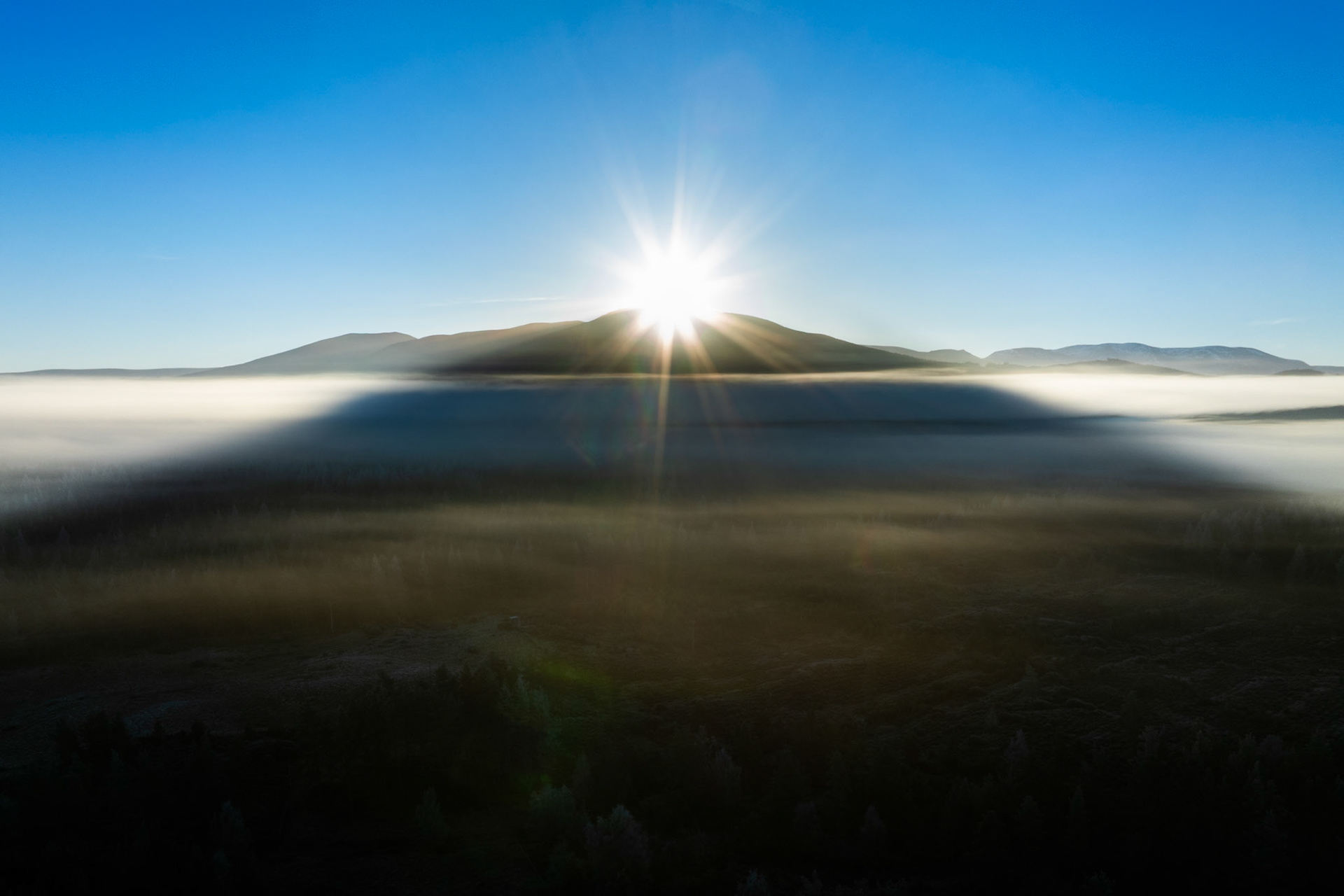
A temperature inversion fills the Strathspey valley floor as the sun crests a hill above Aviemore, casting the mountain's shadow across the fog layer in a near-symmetrical wedge. Captured from altitude on a clear December dawn in the Cairngorms, the image records the brief moment when the shadow geometry aligns with the mist boundary. Lens flare from direct sun contact adds an unplanned graphic element that competes with the composition.
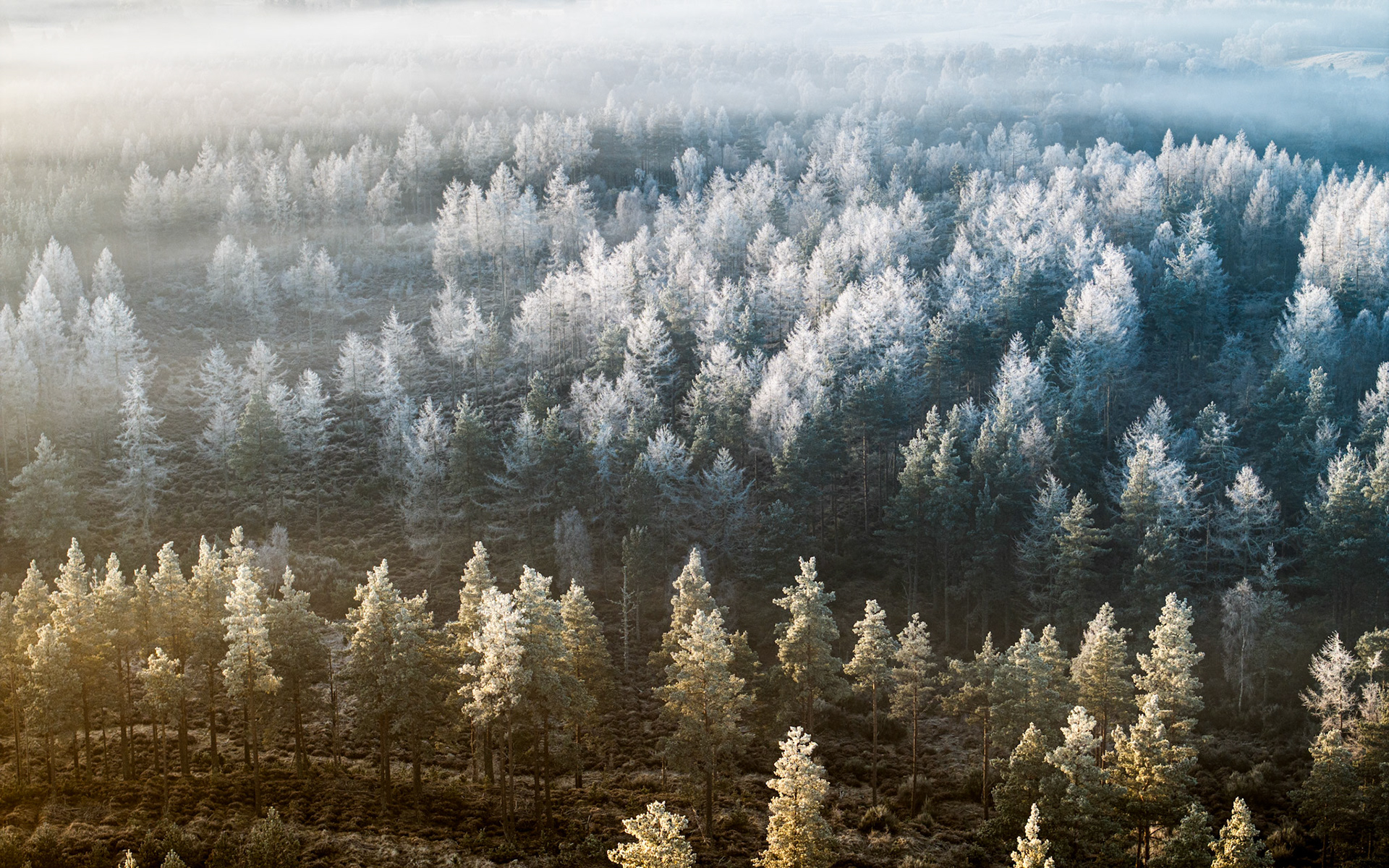
A temperature inversion traps low mist across a Scots pine plantation near Aviemore on a December morning, the hoarfrost catching the low raking light in bands that shift from warm gold at the forest edge to cold silver in the deeper canopy. Aerial perspective flattens the scene into near-abstraction, the tonal gradient reading almost as a single sustained breath held across the trees. Captured Christmas morning 2025, Cairngorms National Park.
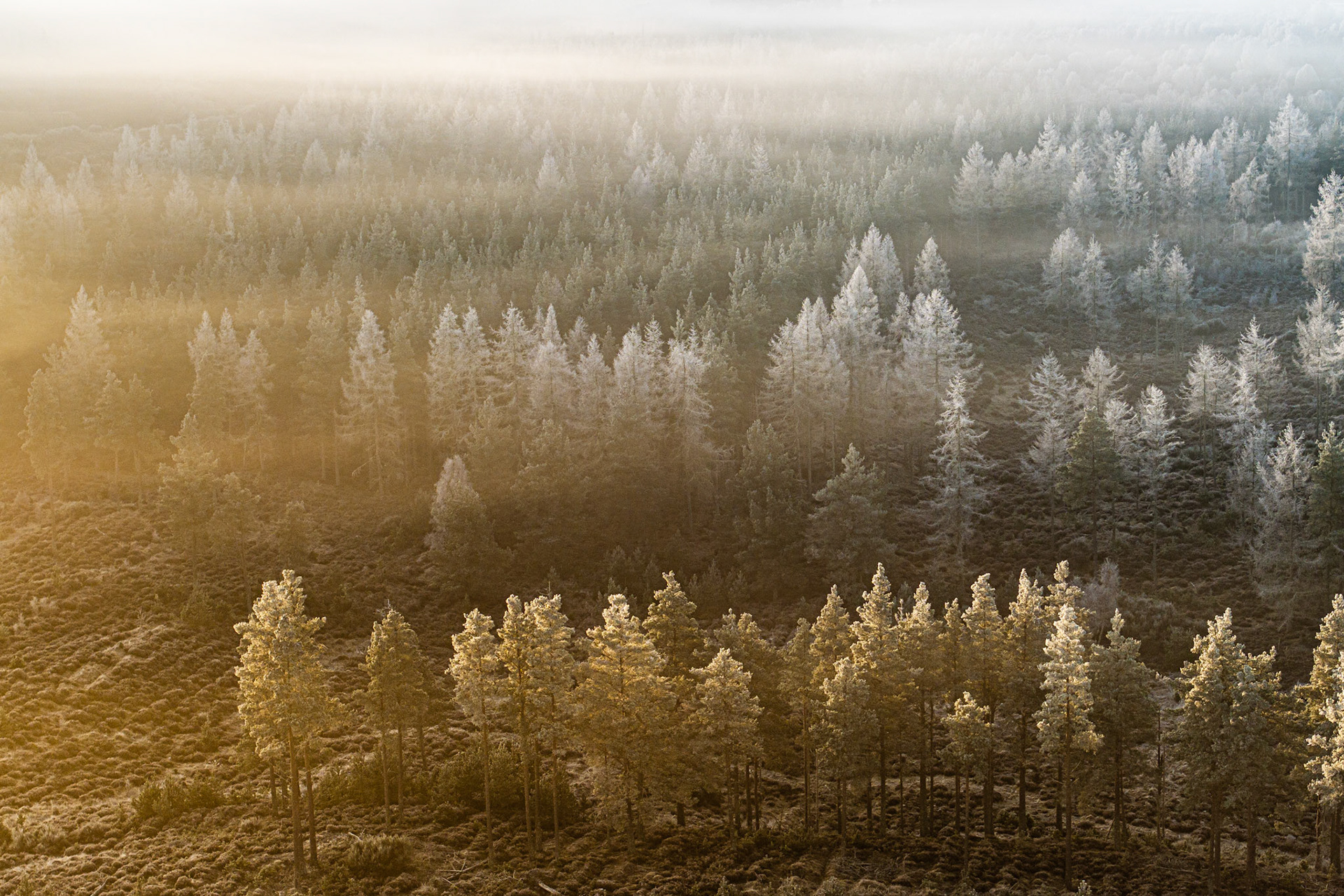
A low winter sun catches the leading edge of a frost-covered conifer plantation above Aviemore, the warm raking light dissolving into cold hoar-grey as the eye moves deeper into the fog. Shot from above on Christmas morning, the image reads as near-abstract — a clean diagonal boundary between light and shadow bisecting the forest canopy. The Cairngorms plateau holds its habitual inversion, compressing the atmosphere into a single luminous band.
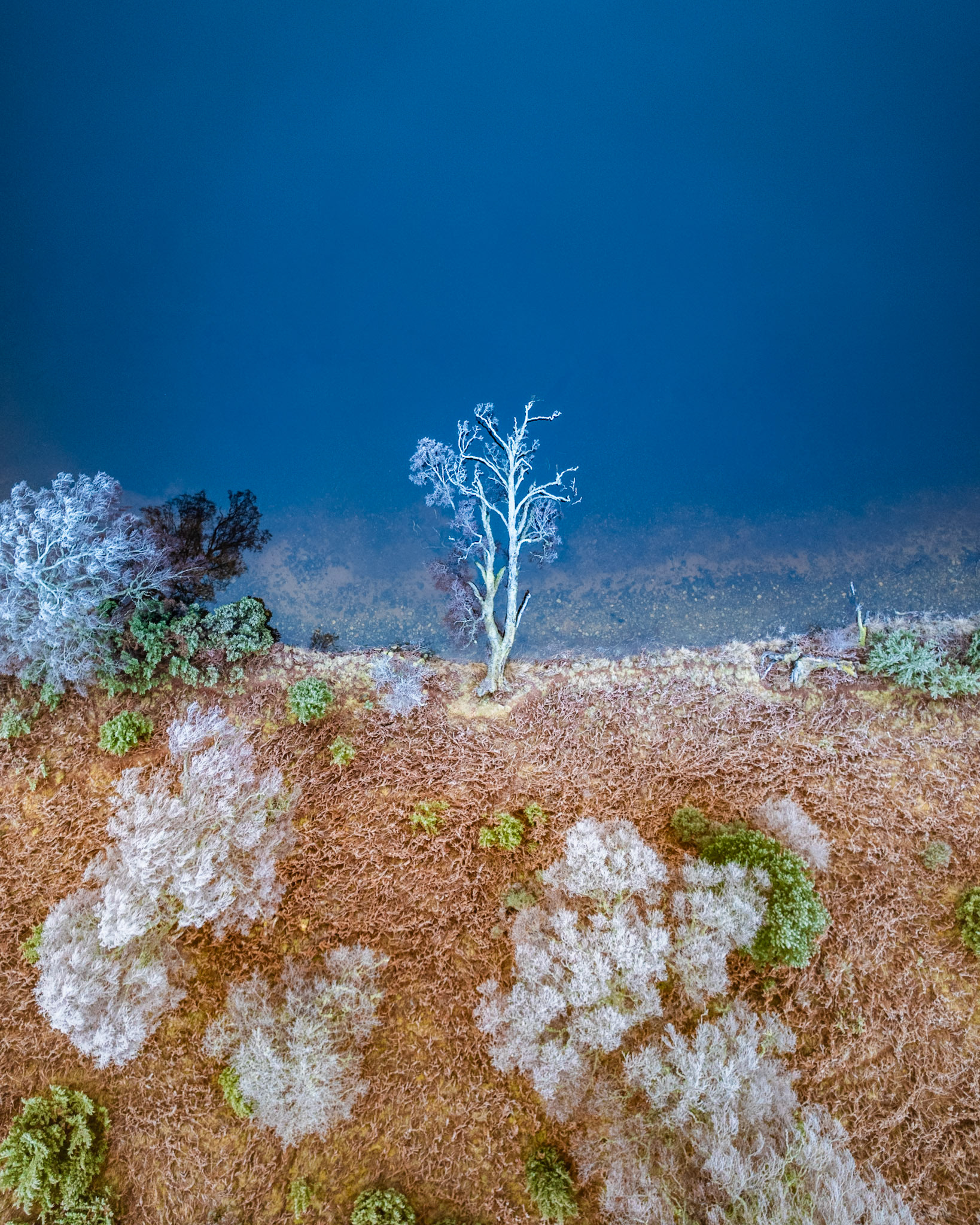
A frost-rimed silver birch stands at the edge of a dark loch on the Cairngorms plateau, its bleached limbs catching the last cold light of a December afternoon. Seen from directly above, the transition from hoar-frosted heather moorland to deep ultramarine water compresses the scene into a near-abstract band of ochre, brown and blue. The lone tree anchors the composition at the boundary between land and water.
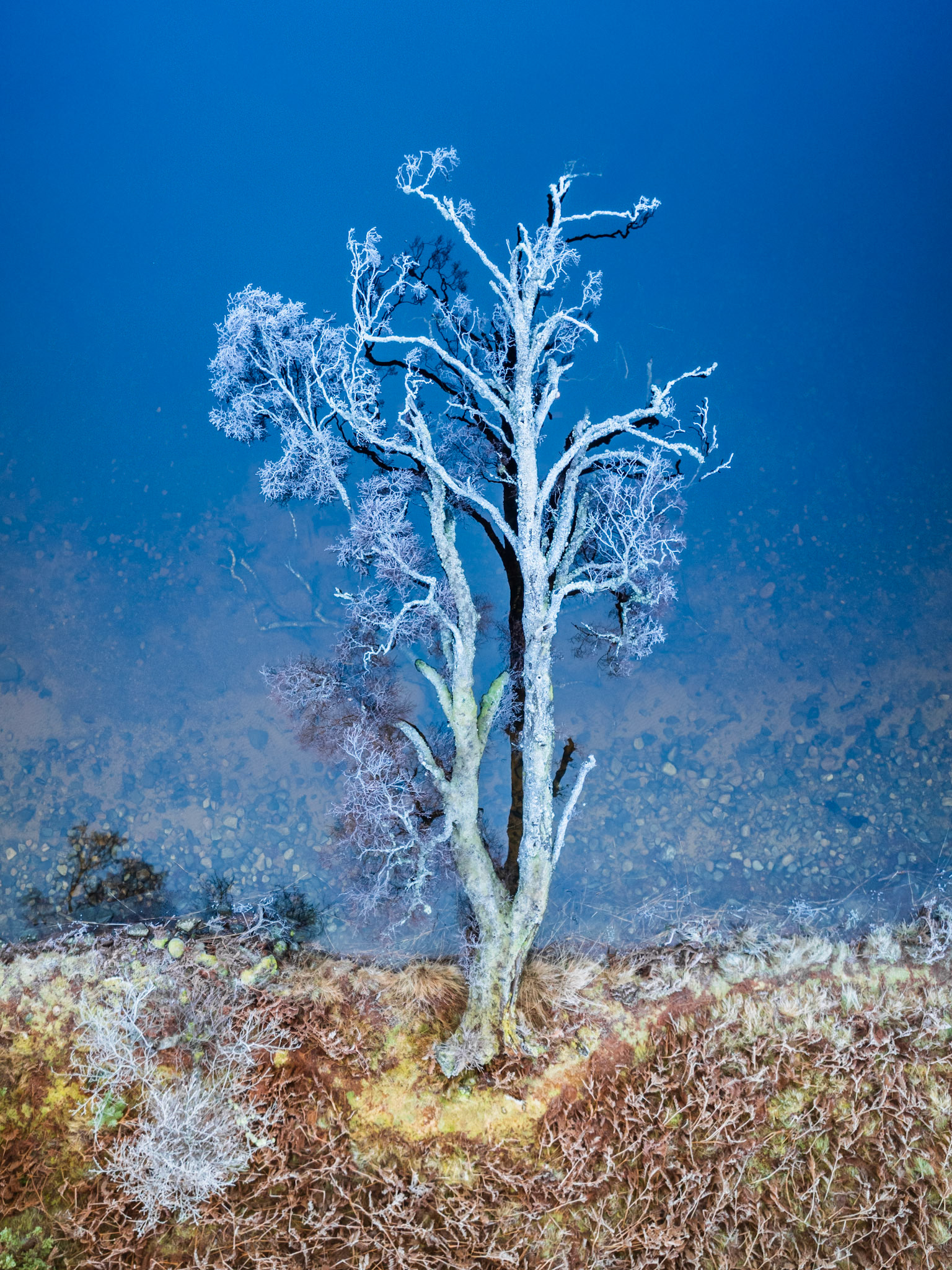
A heavily frosted birch stands isolated above a frozen loch surface on the Cairngorms plateau, photographed from directly above in the cold blue light of a December morning. The aerial perspective compresses tree, shoreline and loch bed into a single plane, stripping the scene of conventional depth and lending the frost-whitened canopy an almost coral quality against the deep cobalt water.
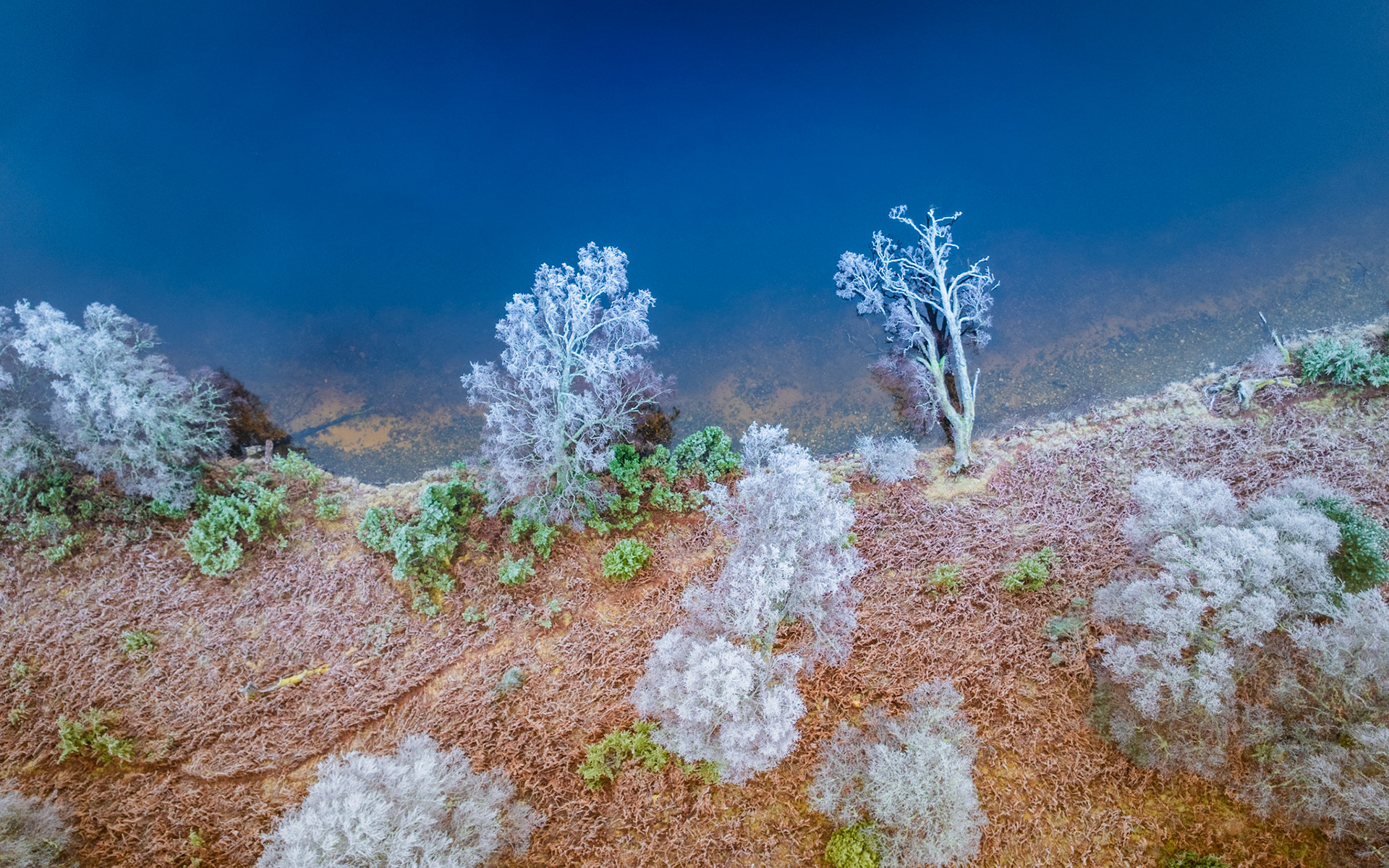
An aerial view of a frost-encrusted lochside in the Cairngorms, December 2025. Hoarfrost coats birch trees and heather along the shoreline, their white forms suspended between the tawny moorland and the deep blue-grey mirror of still water. The tilted perspective dissolves conventional horizon, reducing the scene to texture and tonal contrast.
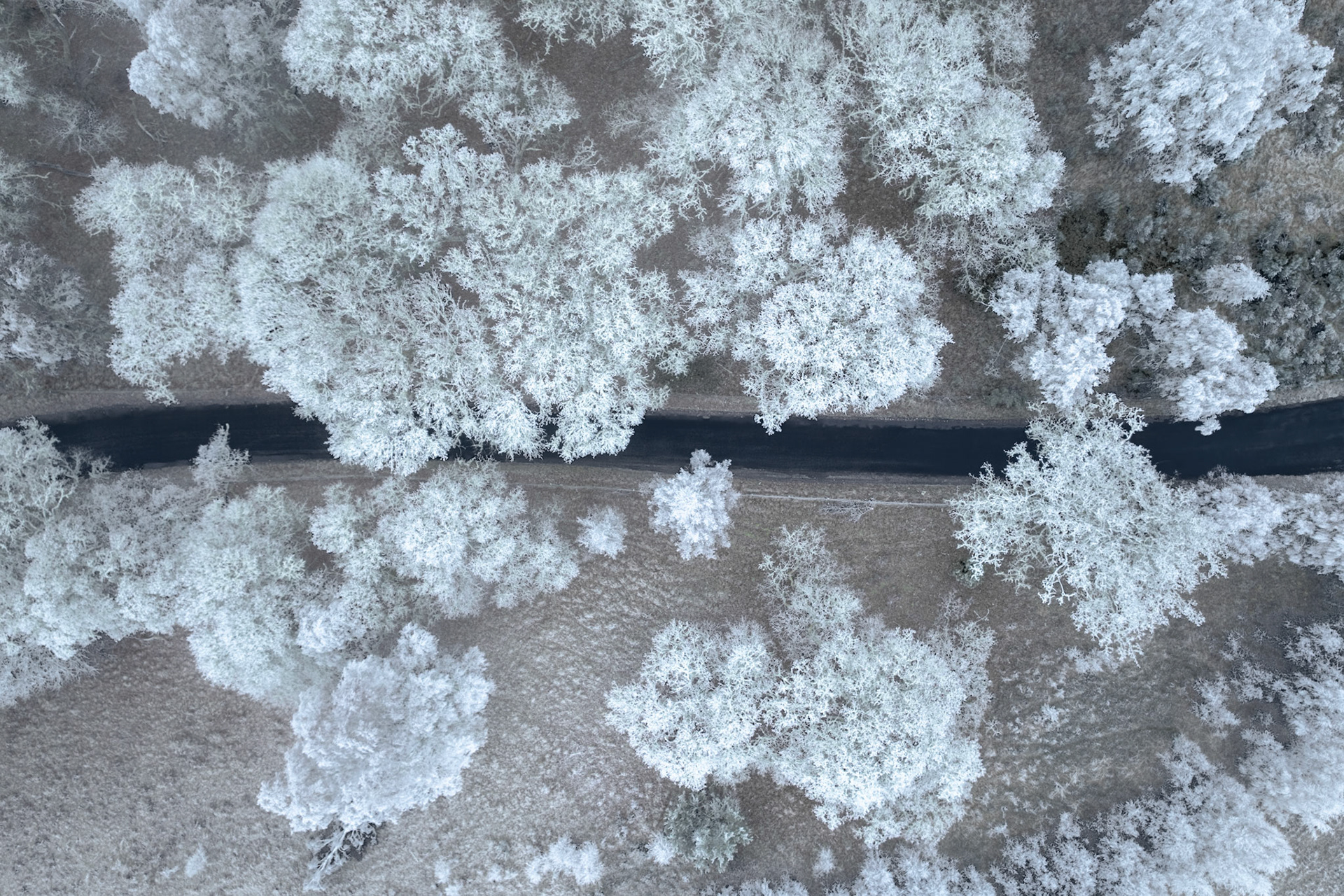
A dark tarmac road bisects frost-laden birch and Scots pine canopy near Aviemore, Cairngorms, photographed from directly overhead in flat winter light. The near-total rime coverage reduces each tree crown to a white botanical form against grey-brown moorland grass, the road's dark thread the sole directional element in an otherwise tonally compressed scene. Overcast conditions have stripped away shadow and colour, leaving the image to work entirely on pattern and contrast.
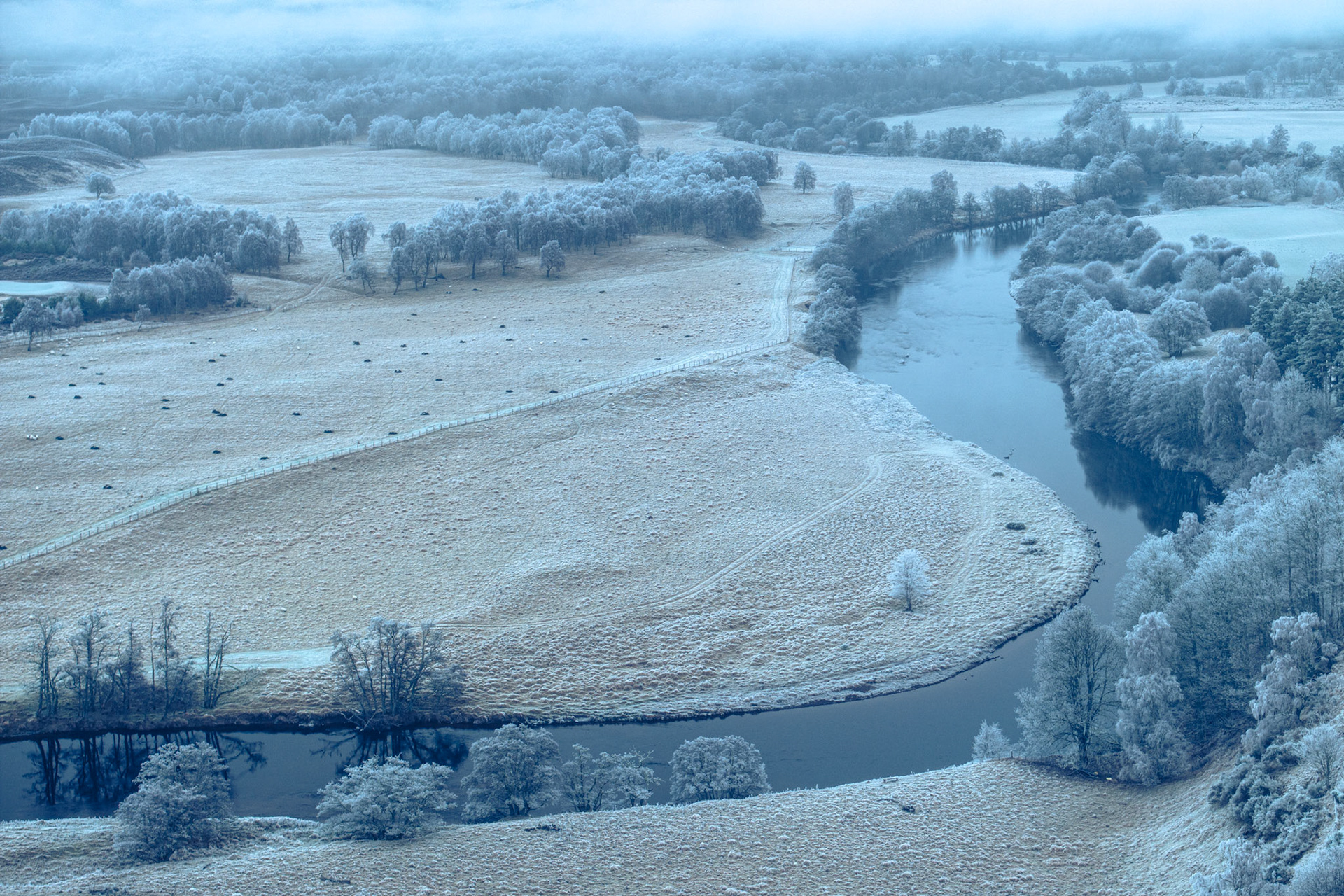
A meander of the River Spey curves through frost-locked flood meadows near Aviemore, the surrounding birch and alder woodland coated in heavy hoarfrost. Low cloud suppresses the horizon, compressing the scene into a near-monochromatic wash of blue-white. Livestock scatter across the fields below, the only mark of scale in an otherwise abstracted winter valley.
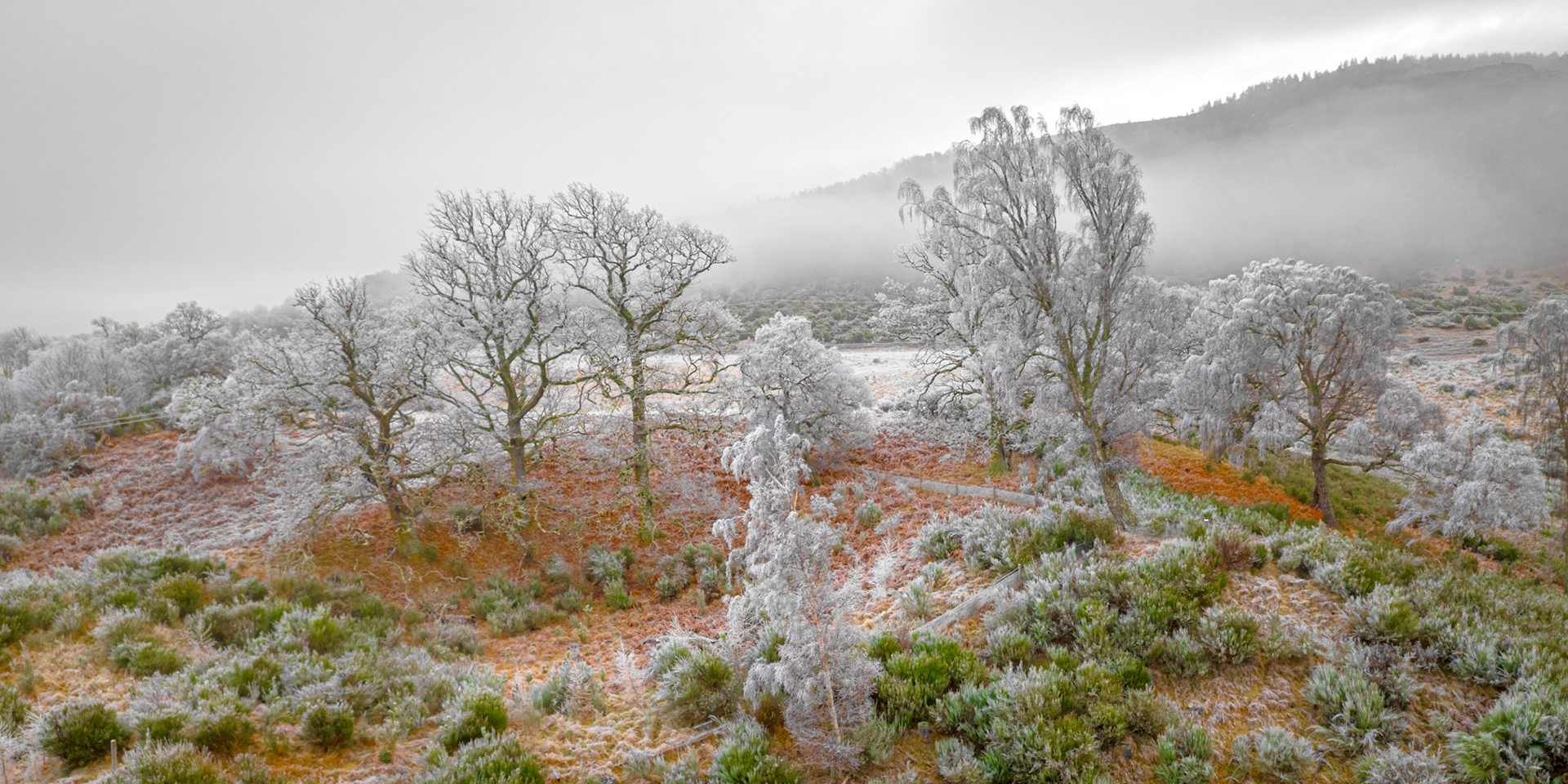
A heavy hoarfrost coats birch, oak and heather across open moorland on the edge of the Cairngorms, December 2025. Low cloud drifts through the valley behind, partially obscuring a conifer-clad hillside and softening depth. The warm ochre of dead bracken beneath the white crust provides the image's only chromatic tension.
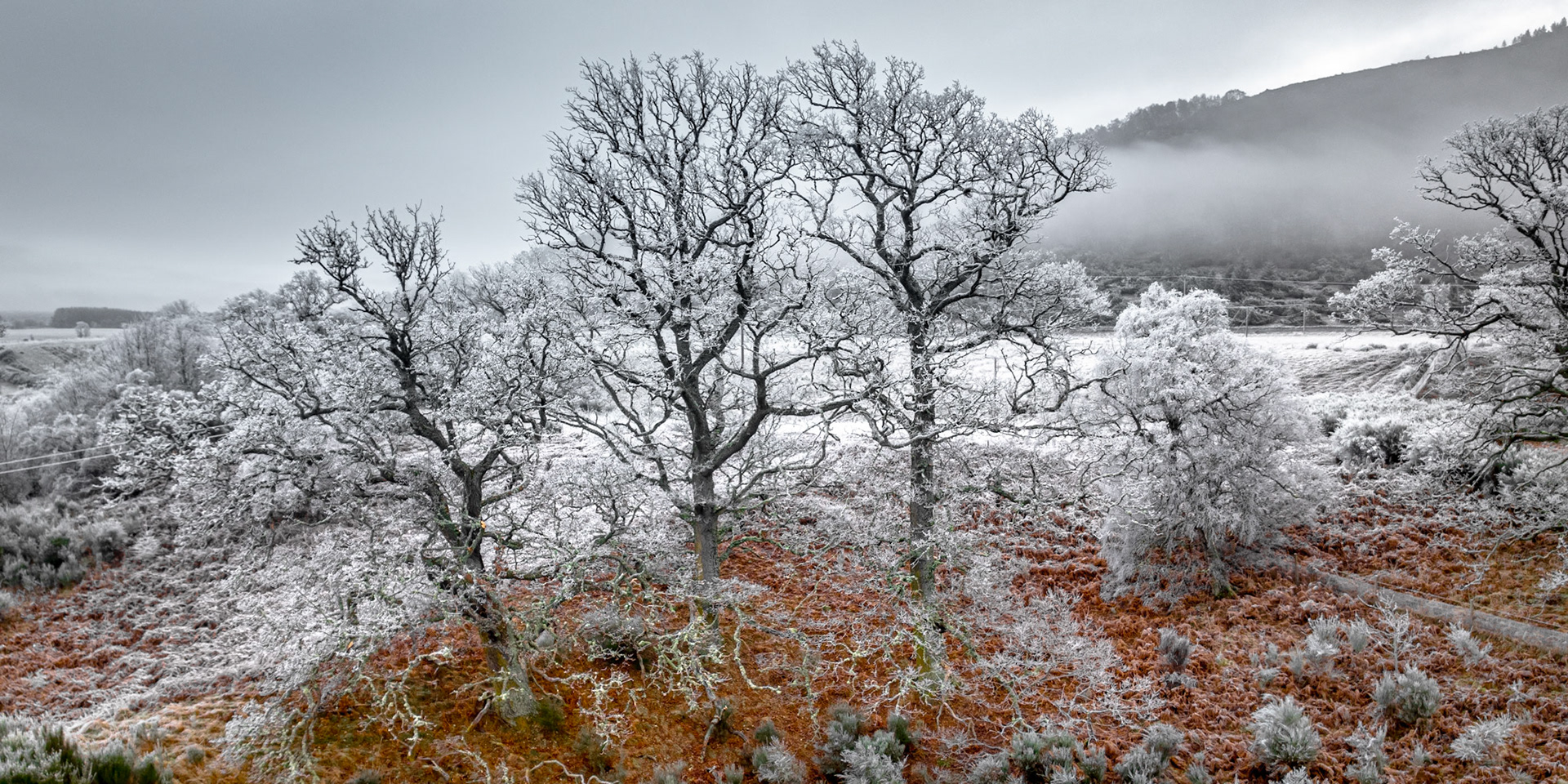
A grove of mature oaks stands heavily rimed with hoarfrost on the floor of Strathspey, Cairngorms National Park, December 2025. The warm ochre of dead bracken beneath provides the only colour against a near-monochrome scene of frosted understorey and hill fog rolling off the slopes above. The elevated drone position reveals the full extent of the frost event across the valley floor.
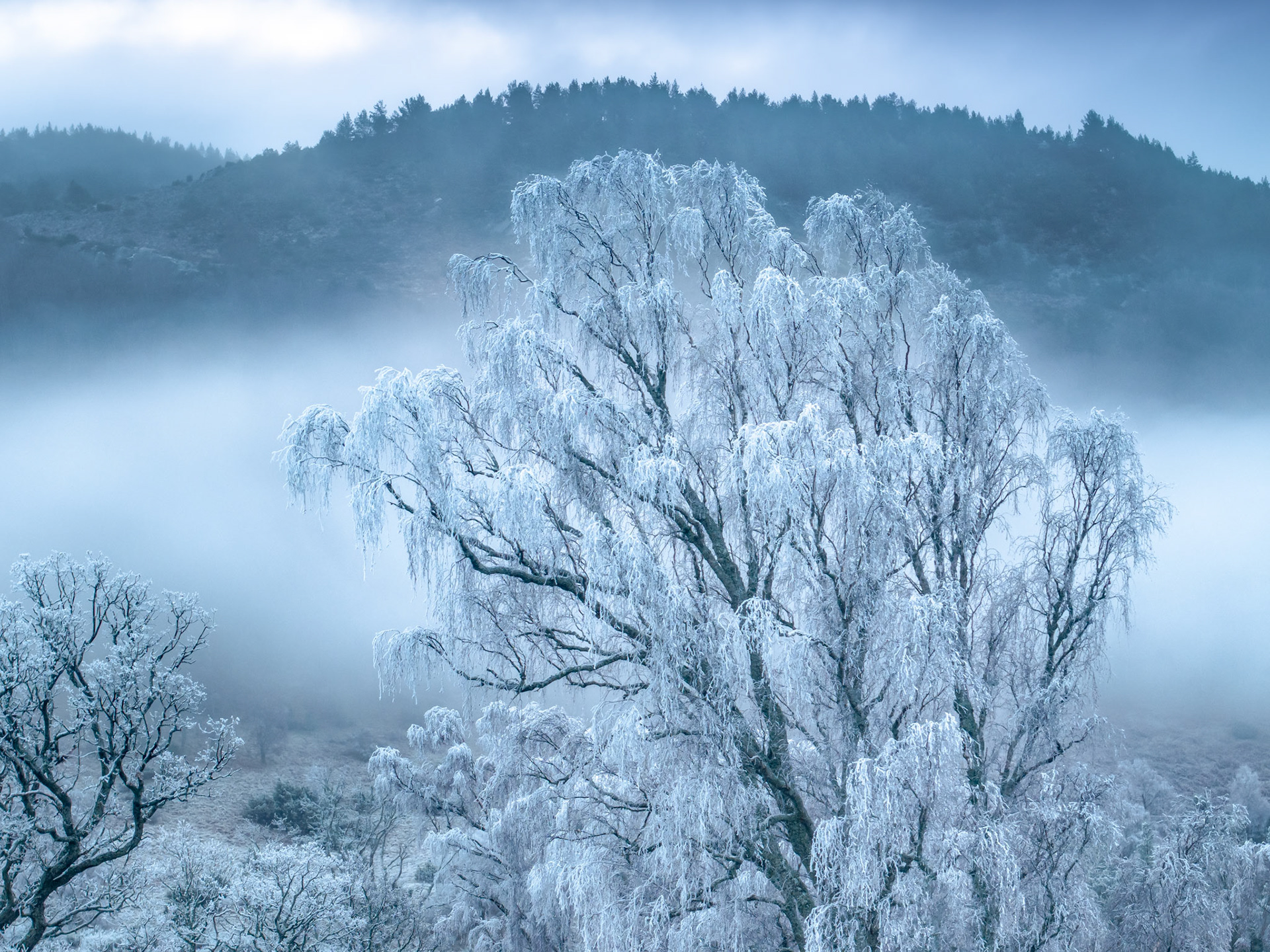
A heavily frosted birch emerges above a temperature inversion in Strathspey, Cairngorms National Park, December 2025. The mist pool fills the valley floor while a conifer-clad ridge recedes into cloud above, compressing the scene into a near-monochromatic study of cold and stillness. The aerial vantage isolates the dominant tree against the white atmosphere without reducing it to abstraction.
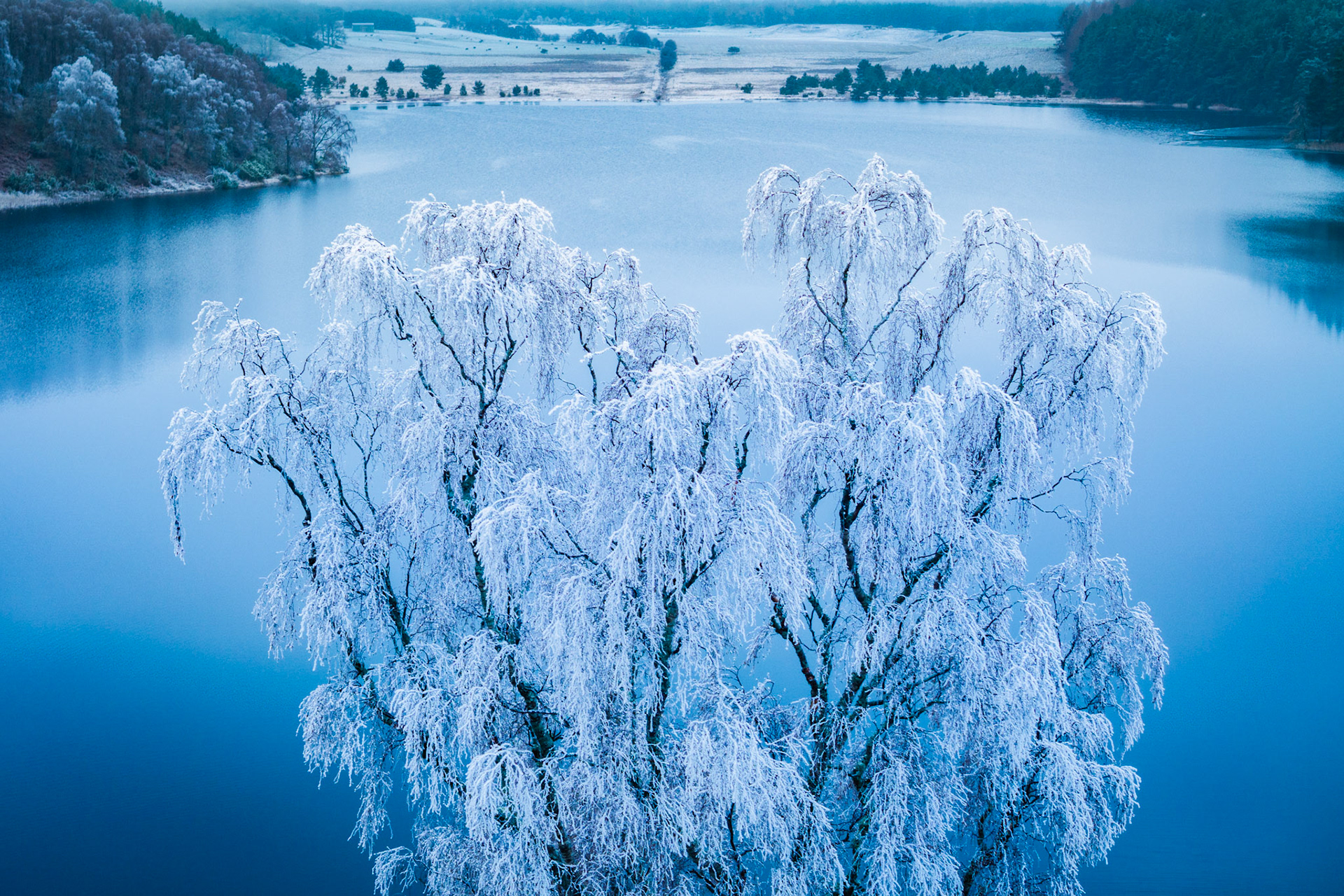
A cluster of birches, heavily rimed with hoarfrost, rises above the calm surface of a loch near Aviemore in the Cairngorms. Shot from altitude in the blue pre-dawn light of a December morning, the white canopy reads almost as smoke against the steel-blue water. The frost-covered woodland and open fields of the valley floor recede quietly into the distance.
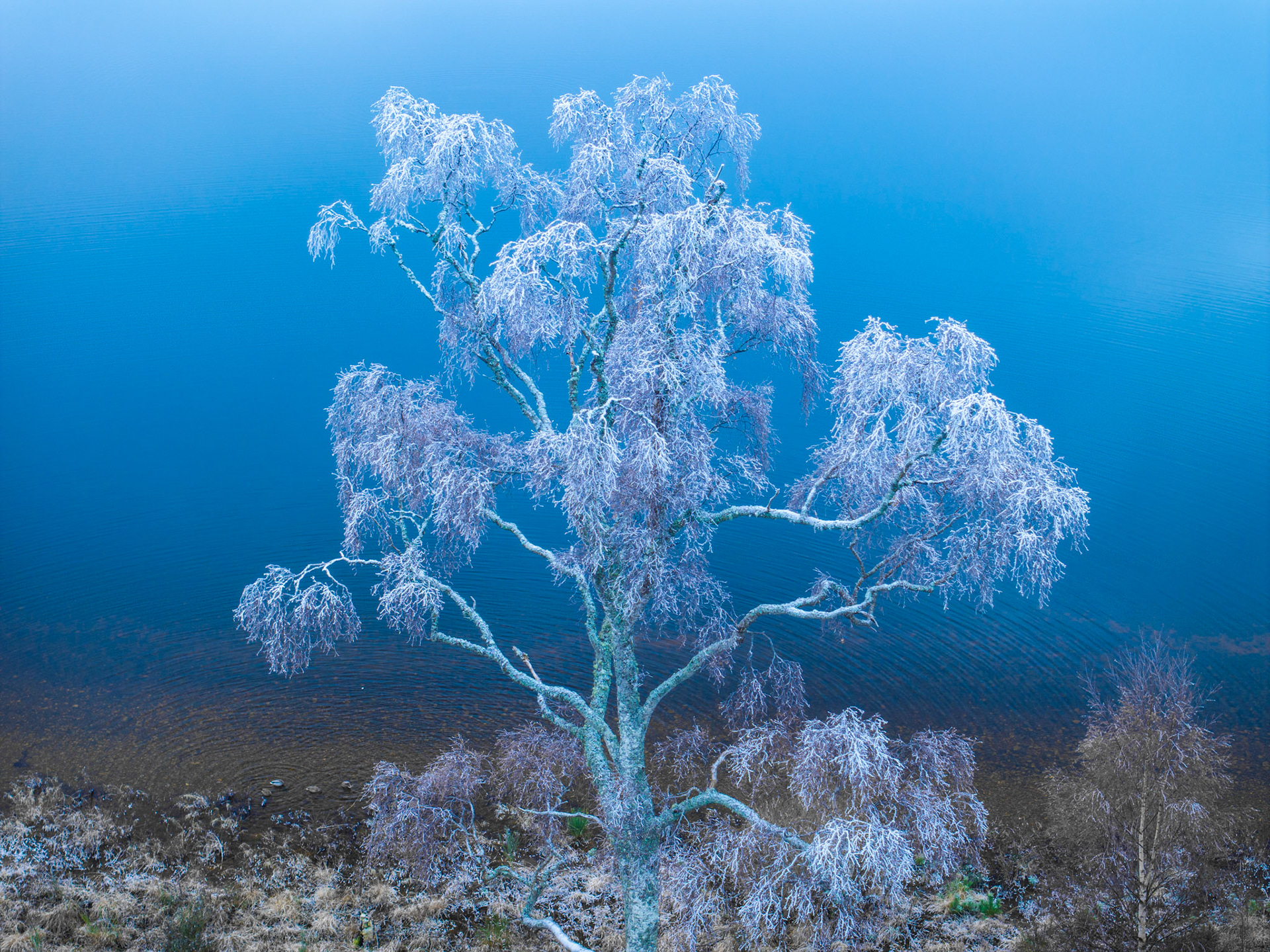
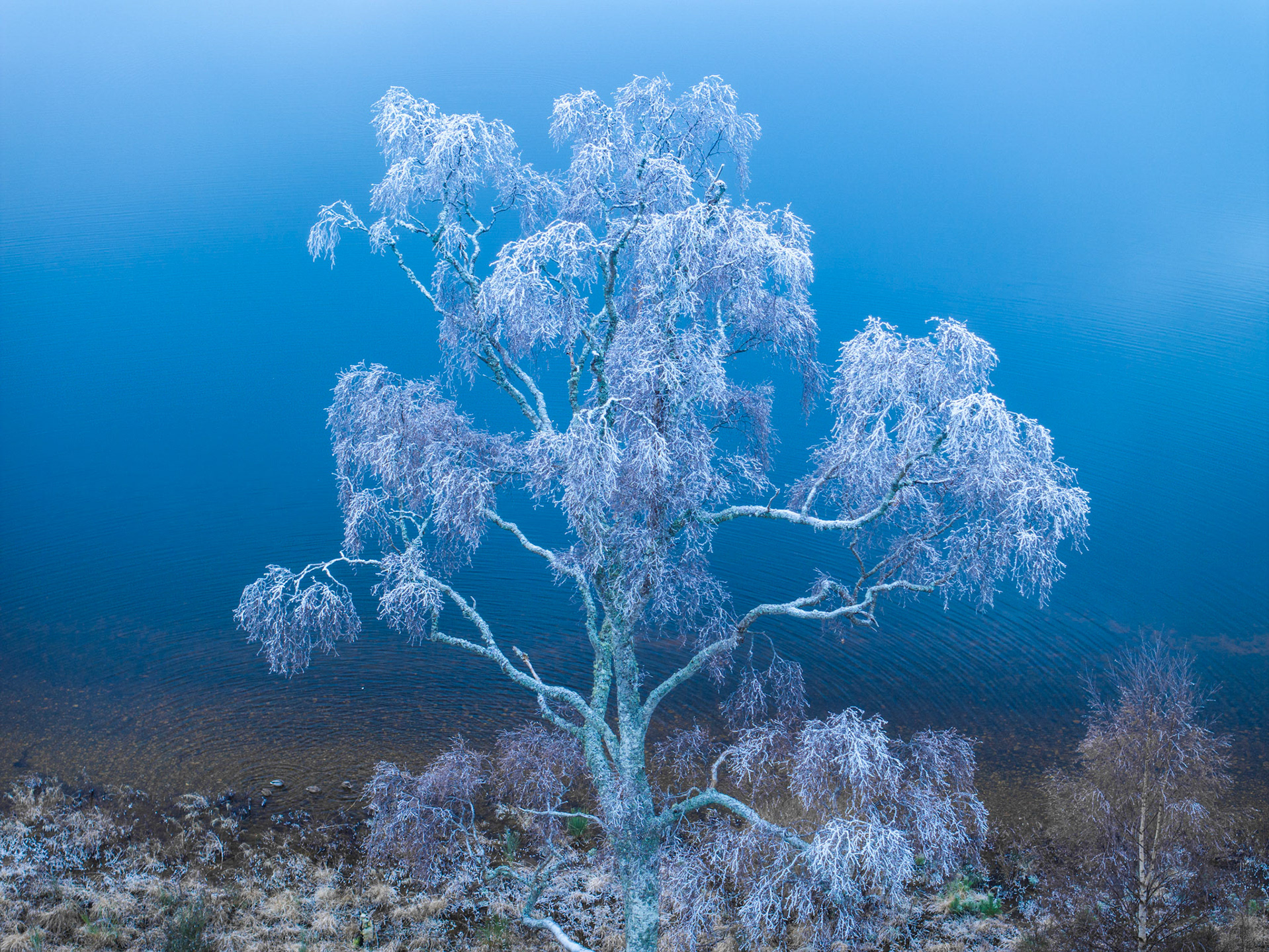
A hoar-frosted silver birch stands at the margin of a still loch in the Cairngorms, photographed from directly above in the cold blue light of a December morning. The mirror-calm water flattens to a near-abstract wash of deep cobalt behind the white-etched canopy, stripping the scene to pure form and tone. Aerial perspective removes any horizon, leaving tree and water as the only subjects.
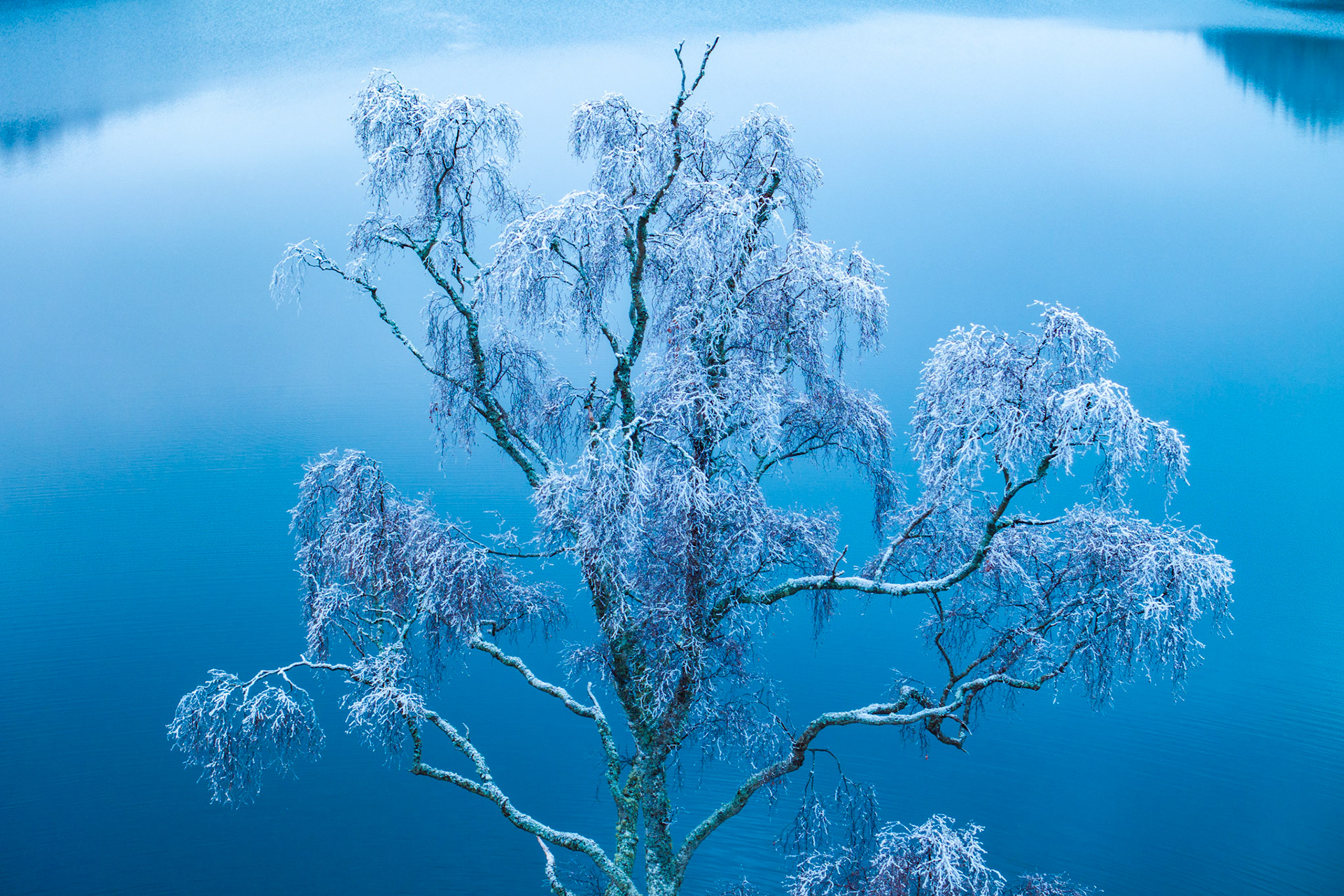
A hoarfrosted birch stands against the glassy surface of a loch near Aviemore, photographed from above in the blue pre-dawn light of a December morning. The still water acts as a near-featureless ground, isolating the tree's delicate, ice-laden canopy into something close to botanical illustration. The aerial vantage strips away all landscape context, leaving only structure and cold.
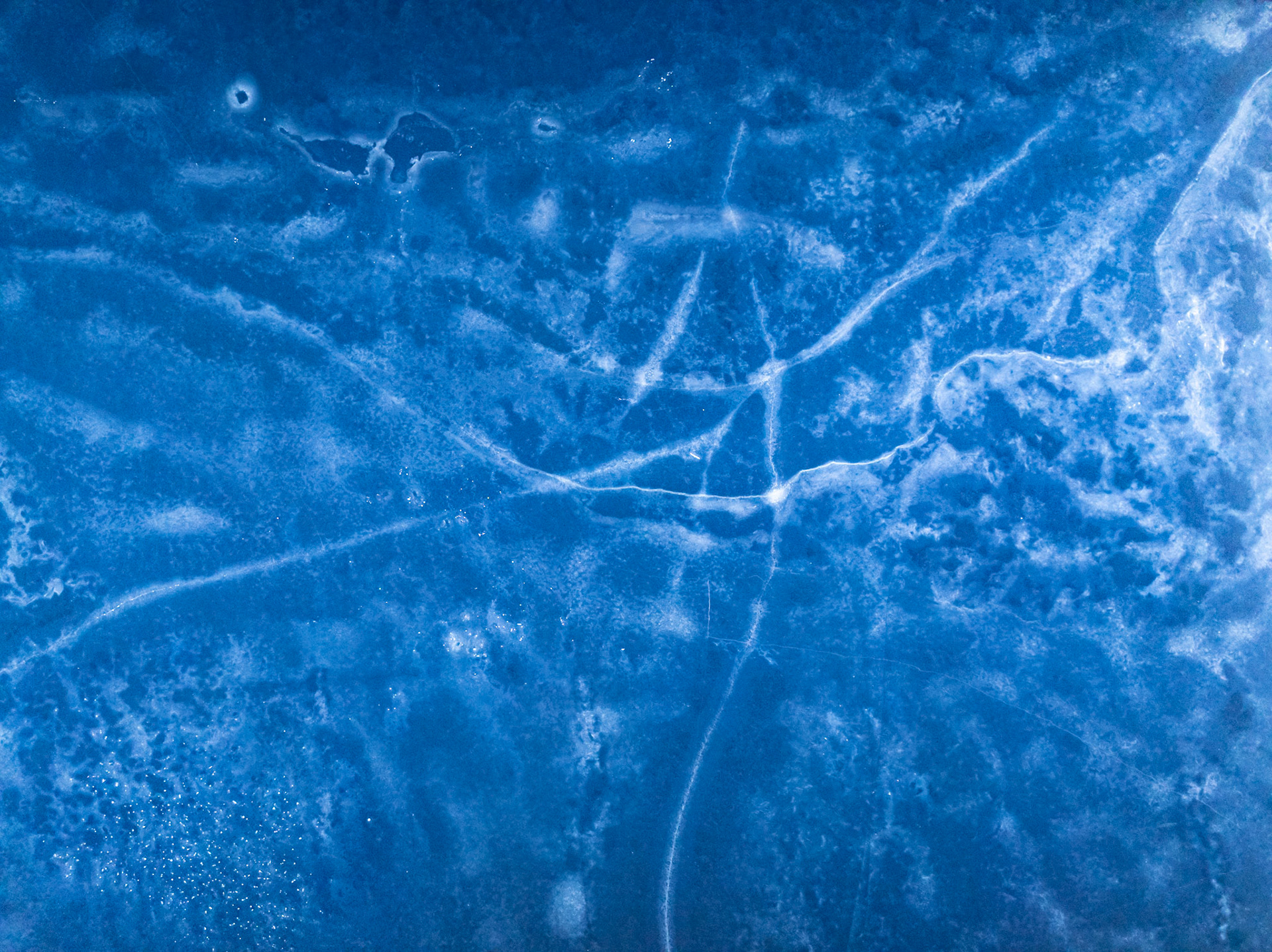
A network of stress fractures radiates across the surface of frozen ground near Nethy Bridge, Cairngorms, captured from directly above in late December. The monochromatic blue palette — deepened by low winter light and the drone's angle of incidence — renders the ice as something closer to celestial cartography than familiar landscape. Frost crystals and air pockets beneath the surface add granular texture at the margins.
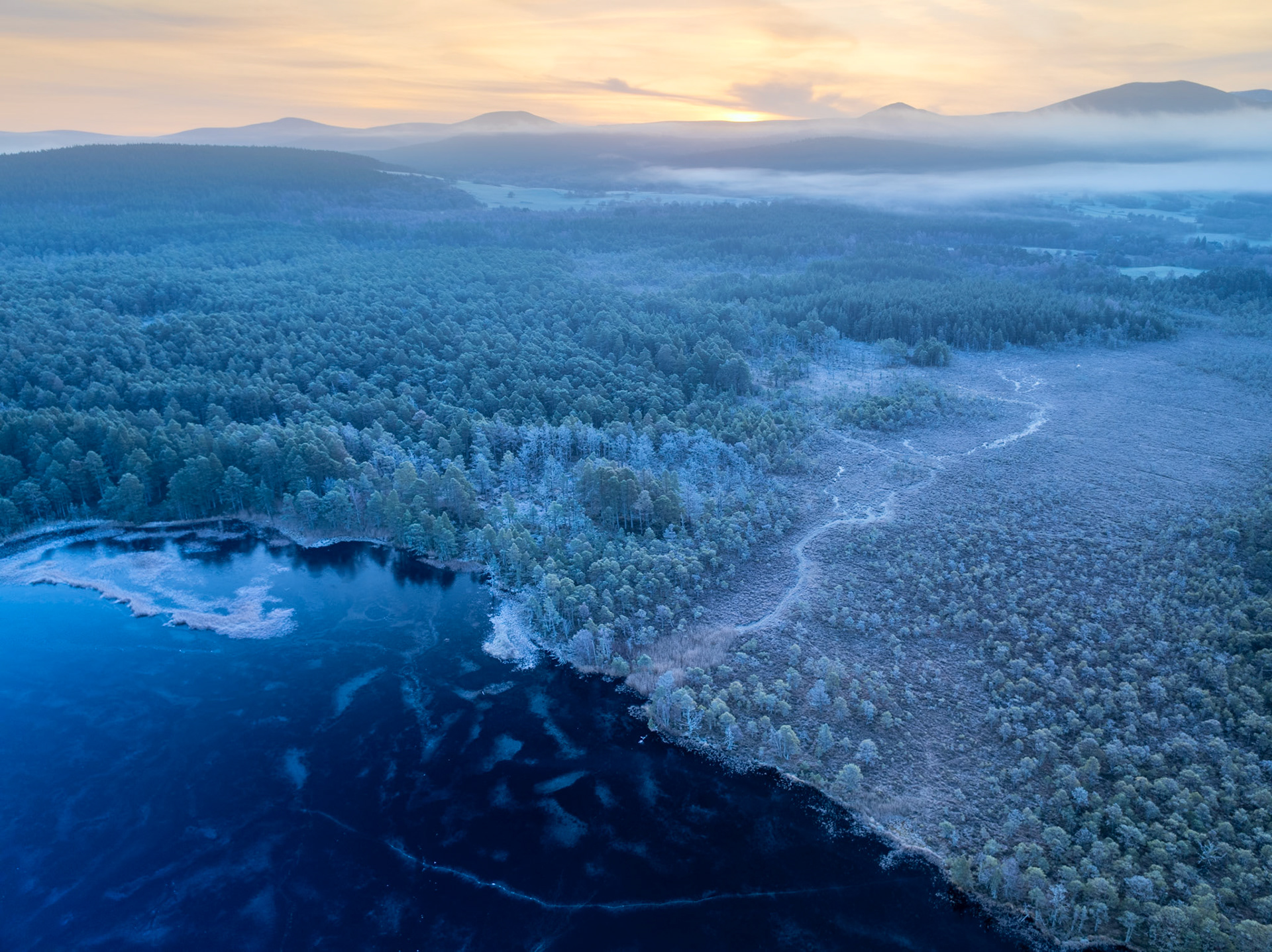
A frozen loch borders hoarfrost-laden Scots pine forest near Nethy Bridge at dawn, with temperature inversion mist pooling across the Strathspey valley below the Cairngorm plateau. The diagonal shoreline pulls the eye from the dark, partially iced water through the silvered canopy toward the warm band of light breaking at the horizon.
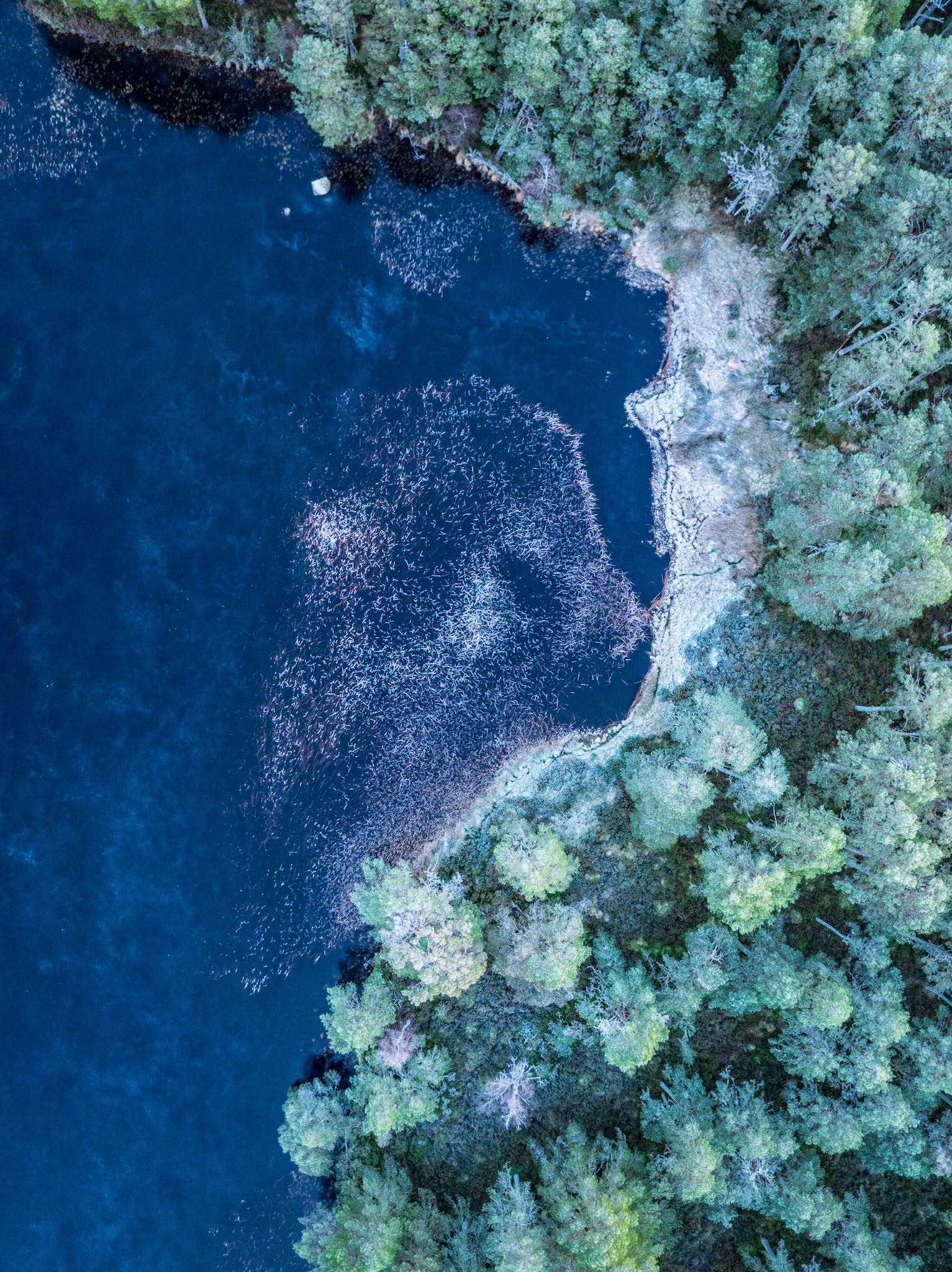
Aerial view of a dark loch shore near Nethy Bridge in the Cairngorms, late December. A pale mass of windblown debris or frazil ice clusters at the woodland edge, forming an organic shape against the deep blue water. The composition plays the geometric boundary of conifer and shoreline against the fluid accident of the ice drift.
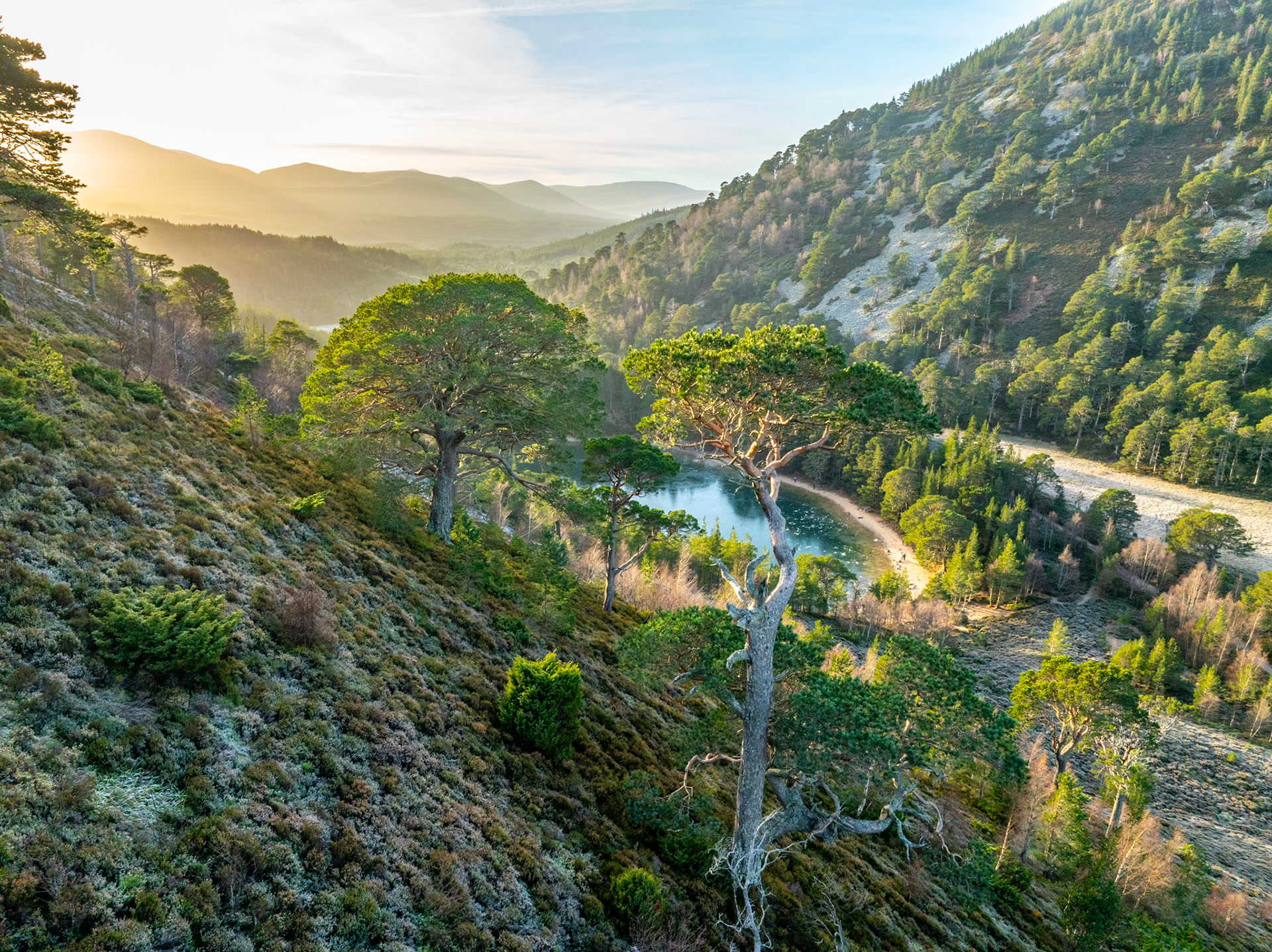
Ancient Scots pines cling to the frost-silvered slopes above a river pool in the Cairngorms, photographed from the air at winter dawn. Low raking light picks out the twisted bark and lichen-pale branches of the foreground tree against a valley still pooled in blue shadow. The receding ridgelines dissolve into warm haze, giving the scene an unusual depth for high winter.
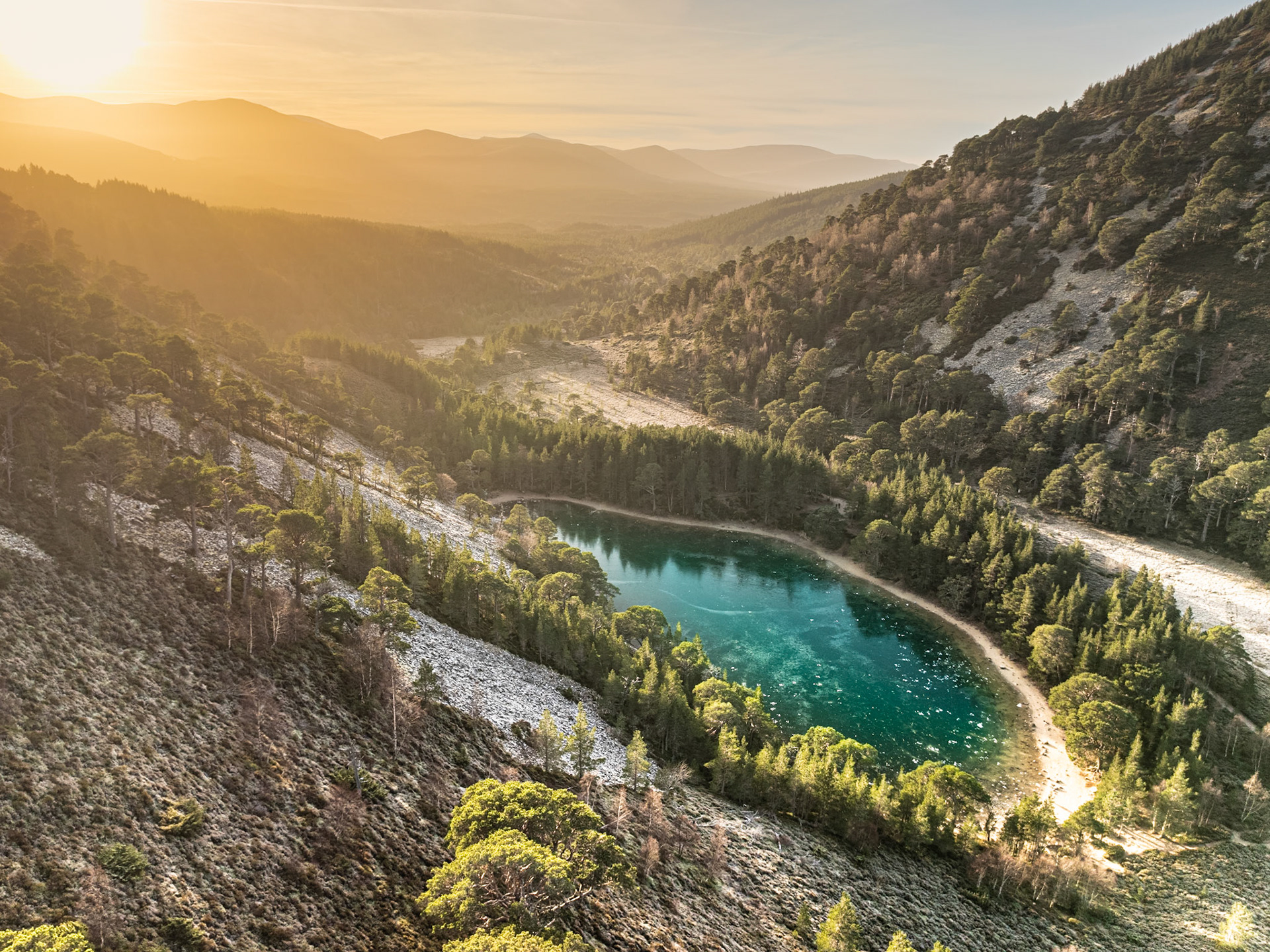
A small lochan catches the last of the winter sun in a pine-forested glen of the Cairngorms, Aviemore. The warm backlight rakes across Scots pine and scree slopes, while layered ridgelines recede into haze. The turquoise water holds its colour against the prevailing amber of the scene.
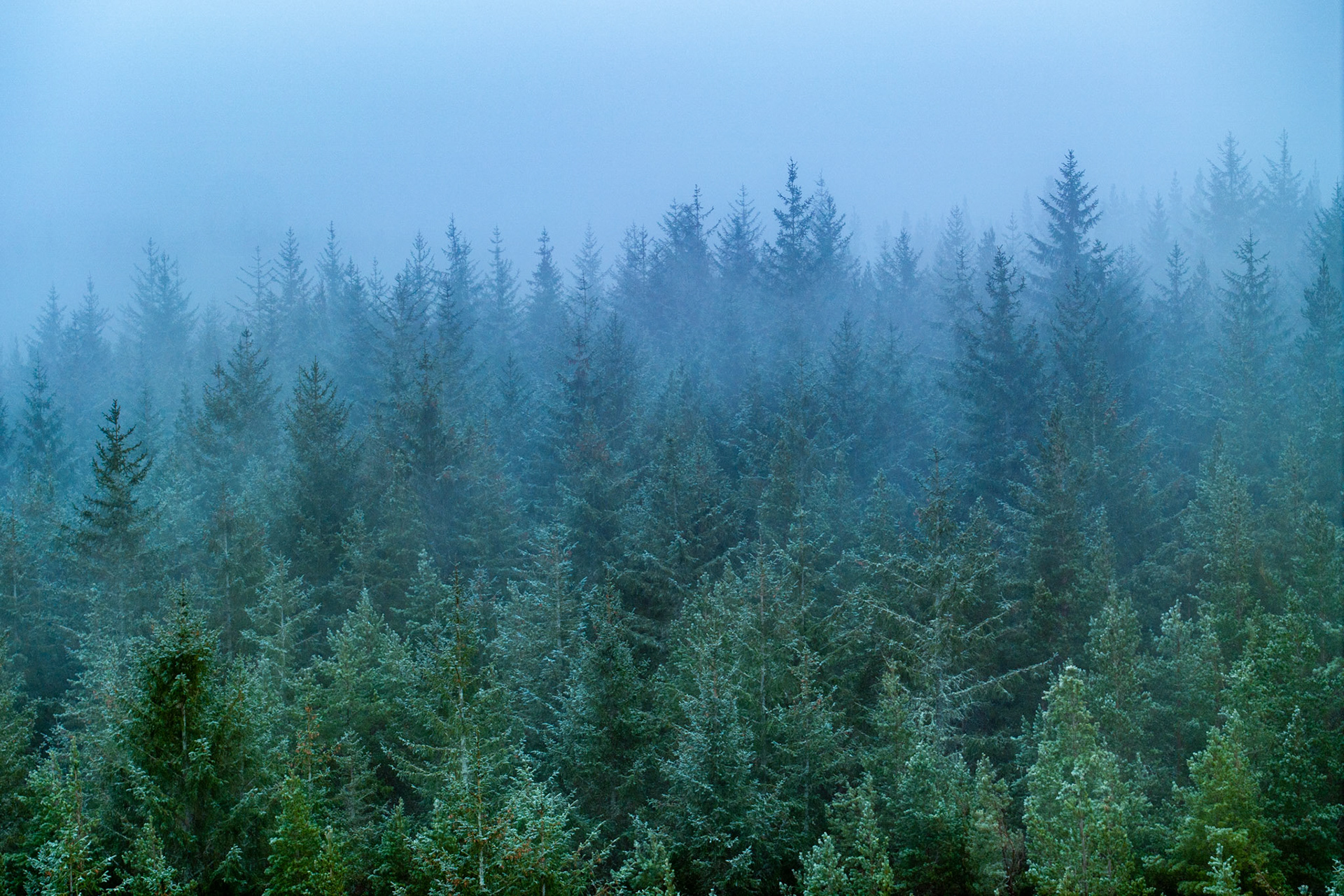
A dense stand of conifers recedes into fog above Kingussie, the Cairngorm foothills lost entirely to low cloud. Natural atmospheric recession renders the canopy in layered planes of blue-grey and muted green, the transition from foreground detail to near-total obscuration giving the frame its structure. Winter moisture coats the uppermost branches, lending a faint silver cast to the nearest crowns.
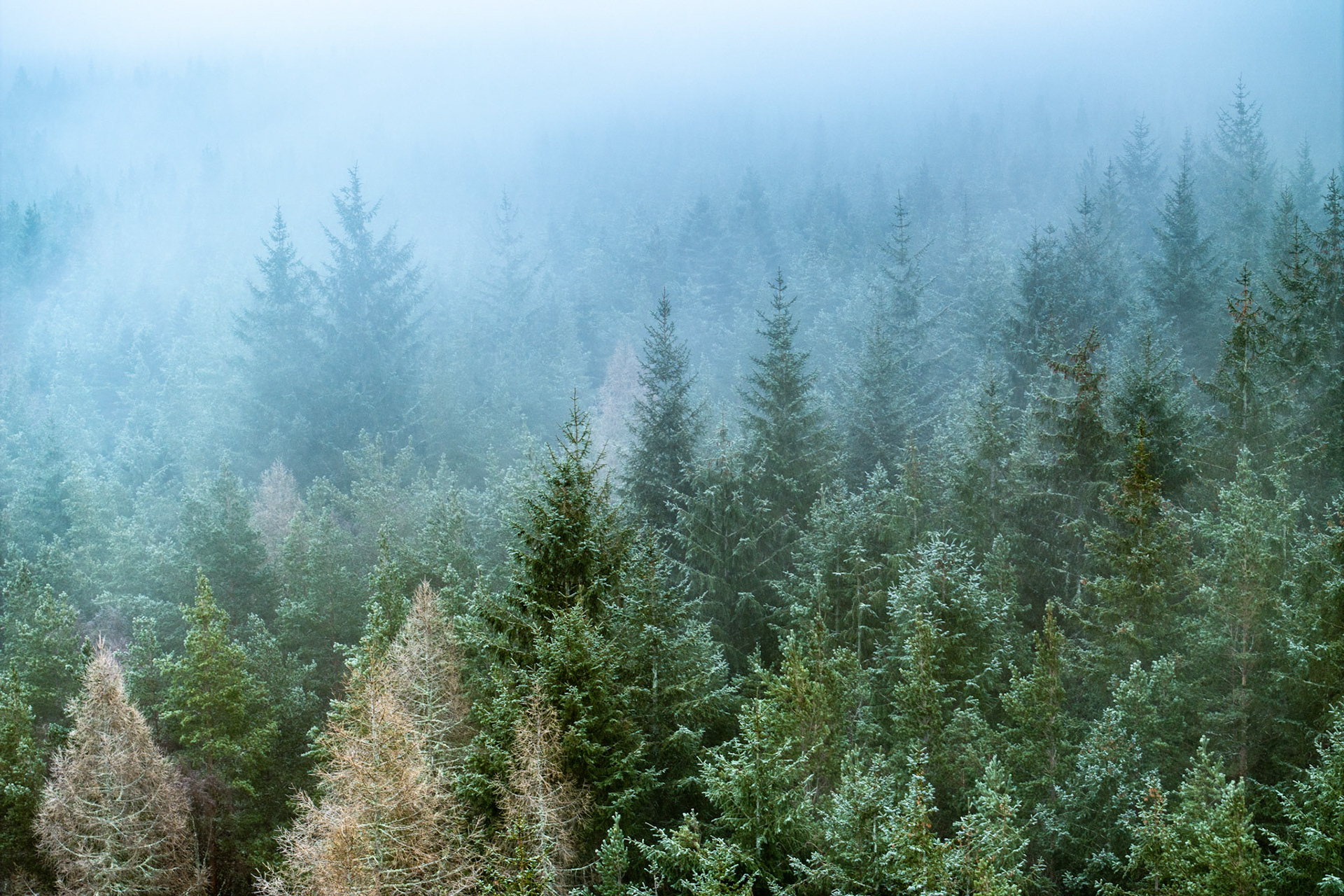
A dense stand of conifers on a hillside near Kingussie recedes into thick winter fog, the progressive loss of detail creating a natural gradient from sharp foreground to near-white obscurity. Hoarfrost clings to the upper branches of trees in the middle distance, adding a pale luminosity to the muted green canopy. The elevated viewpoint flattens the scene into something close to graphic pattern.
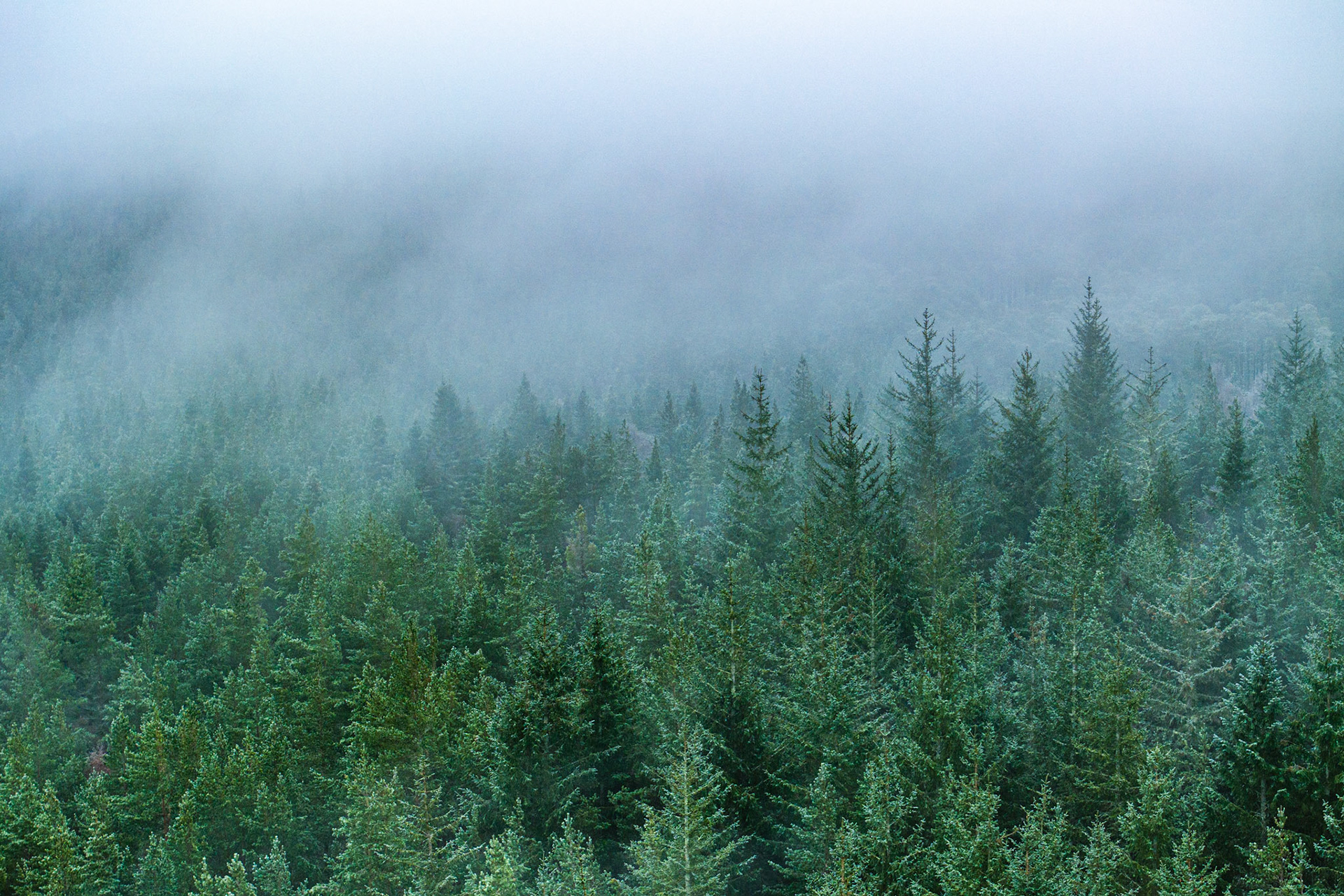
A dense stand of conifers on a hillside near Kingussie dissolves into low cloud, the mist erasing the upper canopy and compressing the scene into layered tones of grey-green. The aerial vantage flattens perspective, reducing the forest to texture and gradient. Captured in late December, the muted palette and diffuse light give the image a quiet, suspended quality.
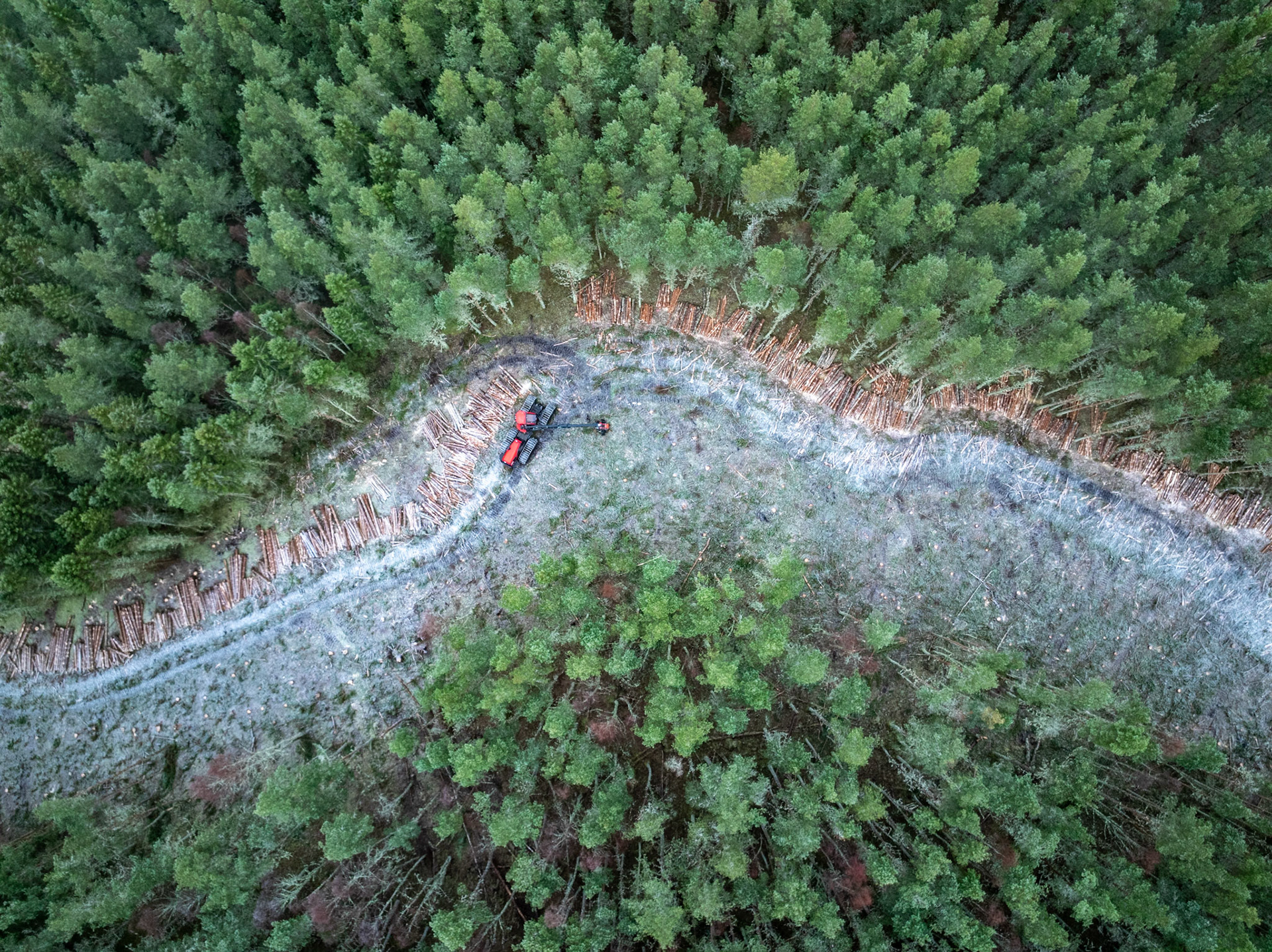
A forestry harvester works a serpentine clearance corridor through conifer plantation near Kingussie, the felled logs ranked in pale arcs against the frosted brash. Shot directly overhead, the machine becomes a small point of industry swallowed by the scale of managed forest. The curved boundary between standing timber and stripped ground gives the frame its geometry.
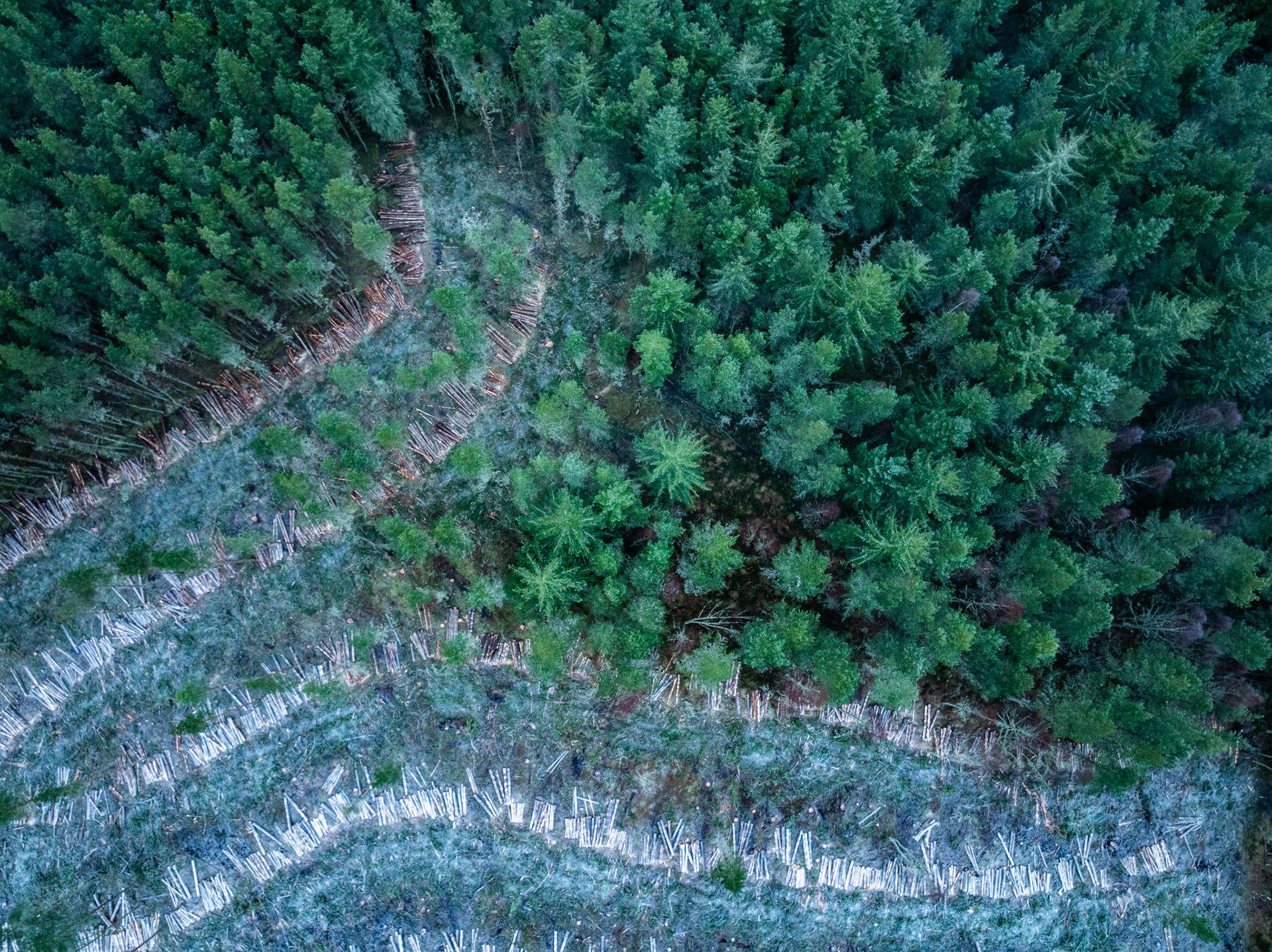
A diagonal frontier between standing conifer plantation and a freshly felled clearing near Kingussie, Cairngorms, photographed from directly overhead in midwinter. Frosted stumps and stacked timber create pale geometric lines against the dark canopy, the composition drawing the eye along the boundary between extraction and continuity. The flat winter light removes shadow, flattening the scene into near-abstraction.
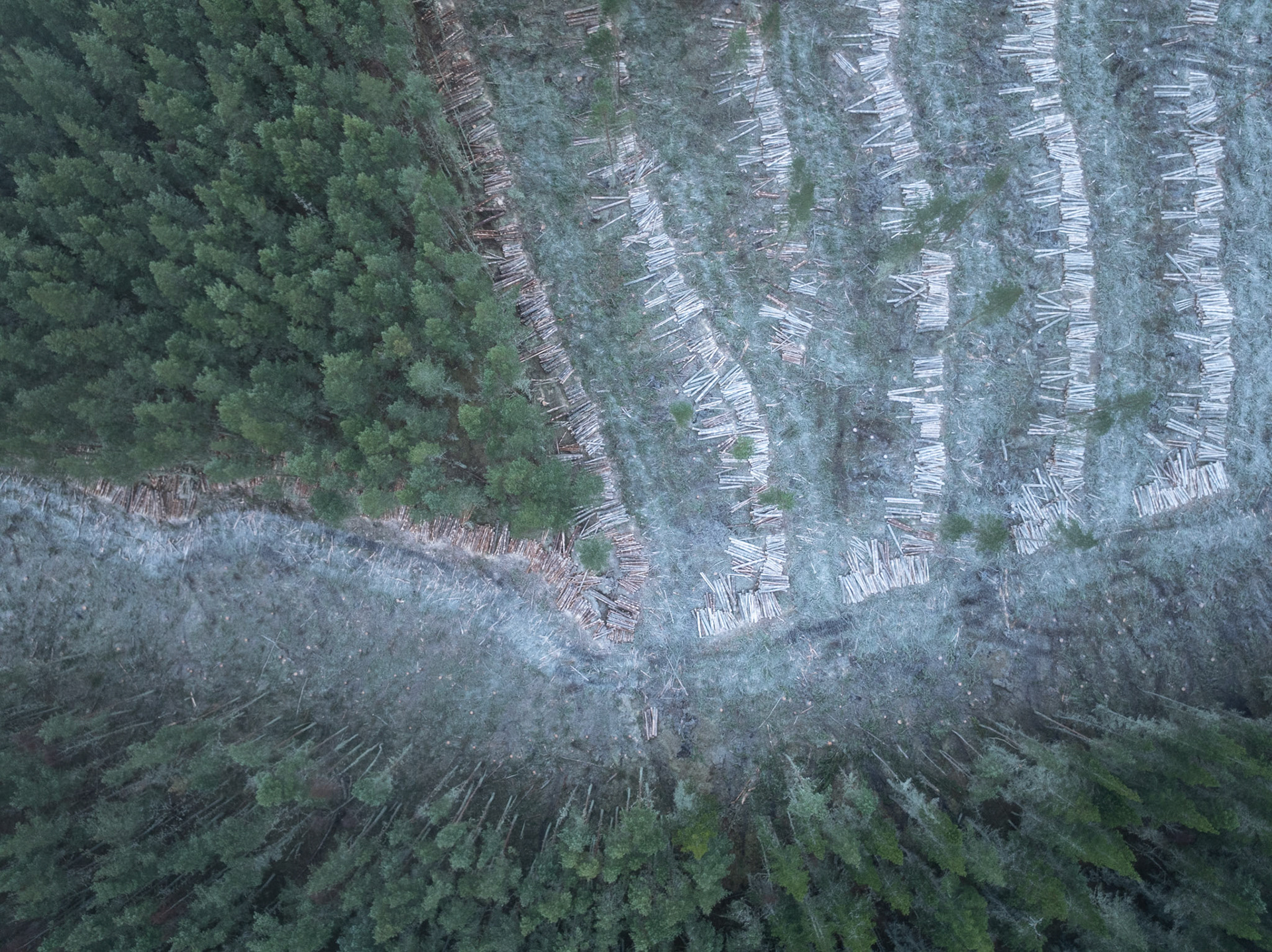
Rows of felled timber lie stacked in arcing lines across a cleared conifer coupe on the edge of the Cairngorms, December 2025. The diagonal boundary between standing plantation and harvested ground creates a graphic tension, the pale frosted ground contrasting with the dense green of the remaining canopy. Flat winter light strips the scene of sentimentality, leaving only the geometry of industrial forestry.
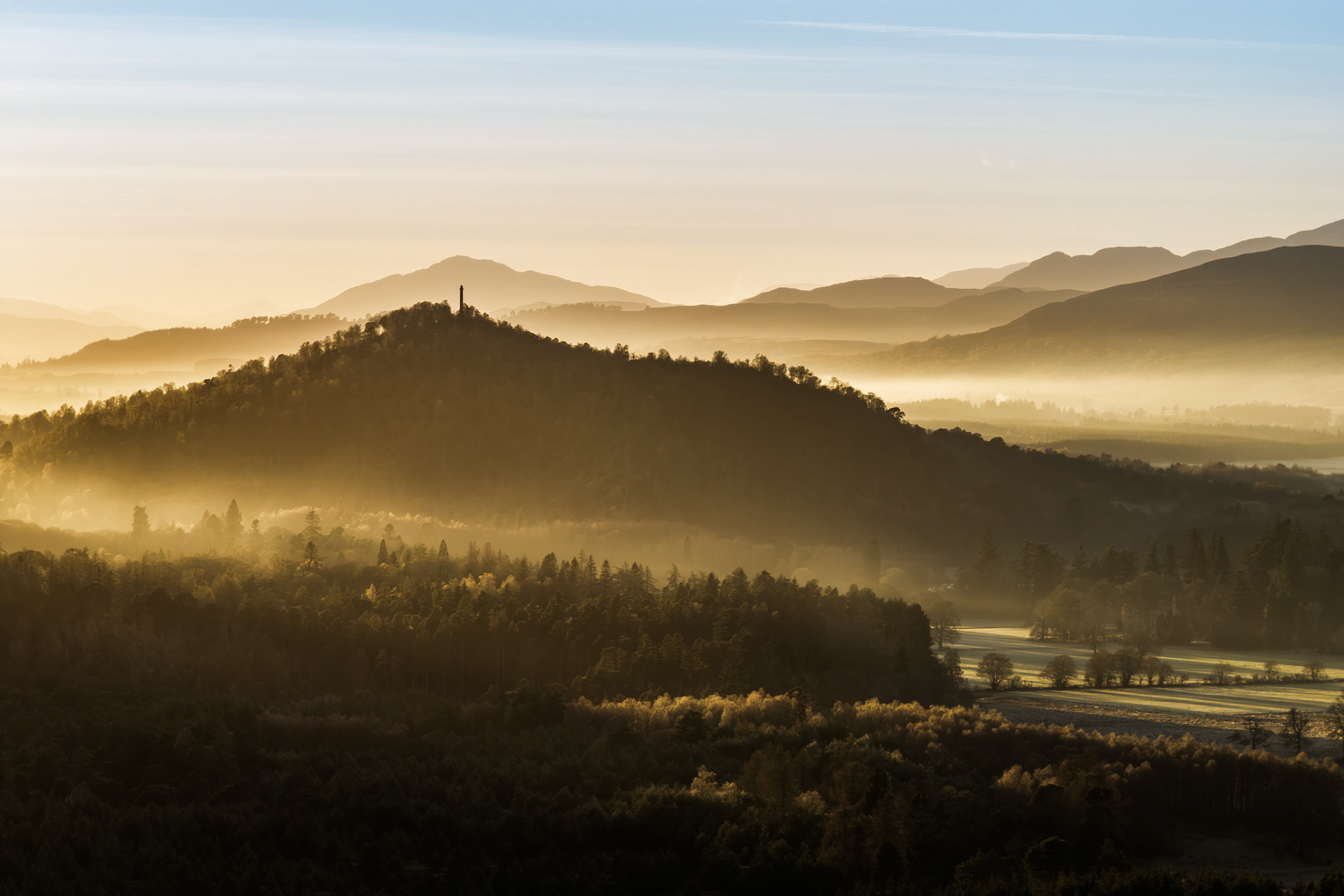
A temperature inversion pools valley mist between forested ridges near Aviemore, the Cairngorms, on a December morning. A solitary monument crowns the nearest wooded hill, its silhouette the only vertical interruption in a composition built entirely from receding planes of light and atmosphere. The distant Highland peaks dissolve into a warm, pale sky, compressing depth into something almost painterly.
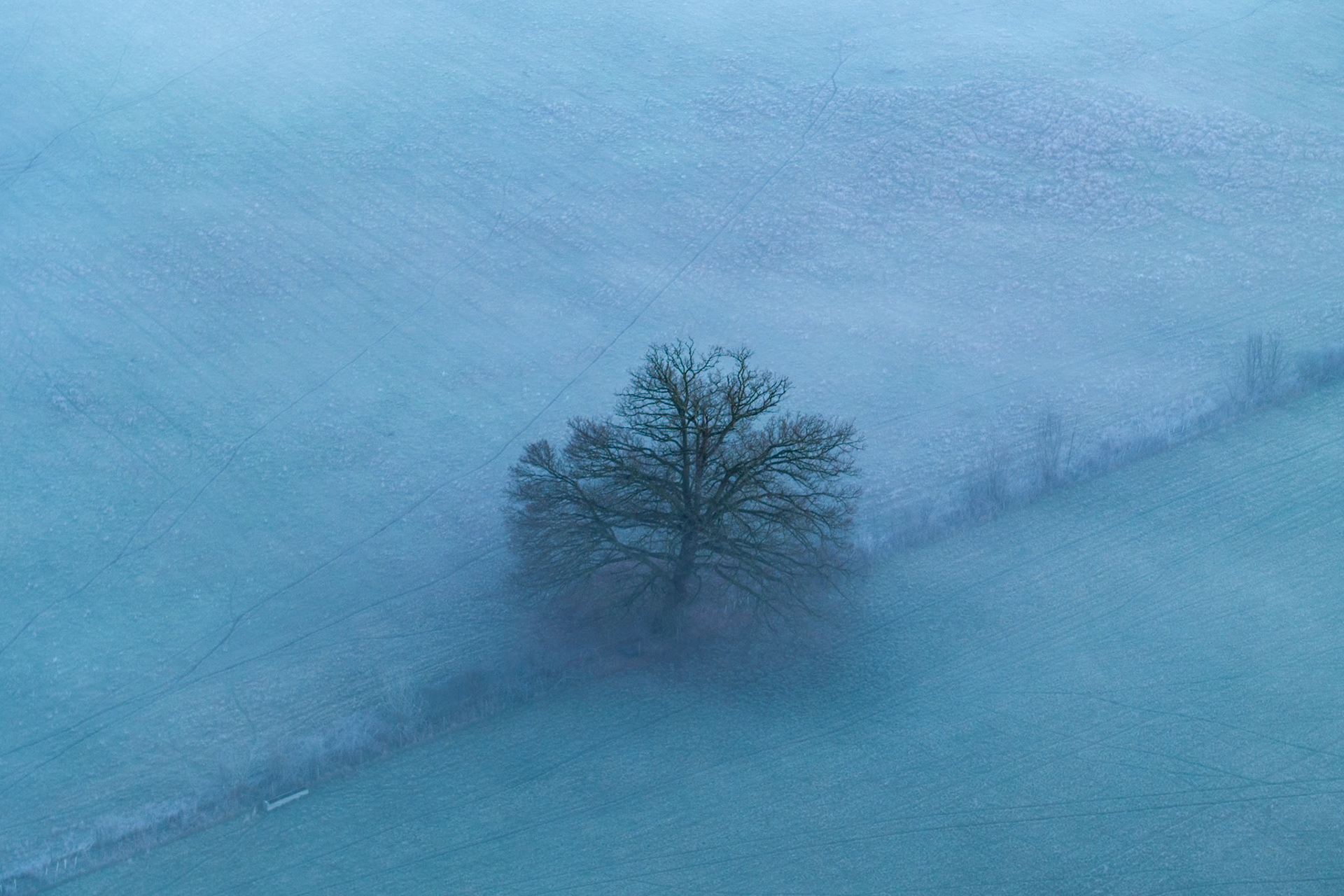
A mature oak stands alone in a frost-tinged arable field near Wallingford, Oxfordshire, viewed from directly above in dense winter fog. Diagonal tractor lines and a faint hedgerow trace the field's geometry around the tree, compressing the scene into near-abstraction. The blue-grey pre-dawn light flattens tonality and isolates the bare canopy as the sole focal point.
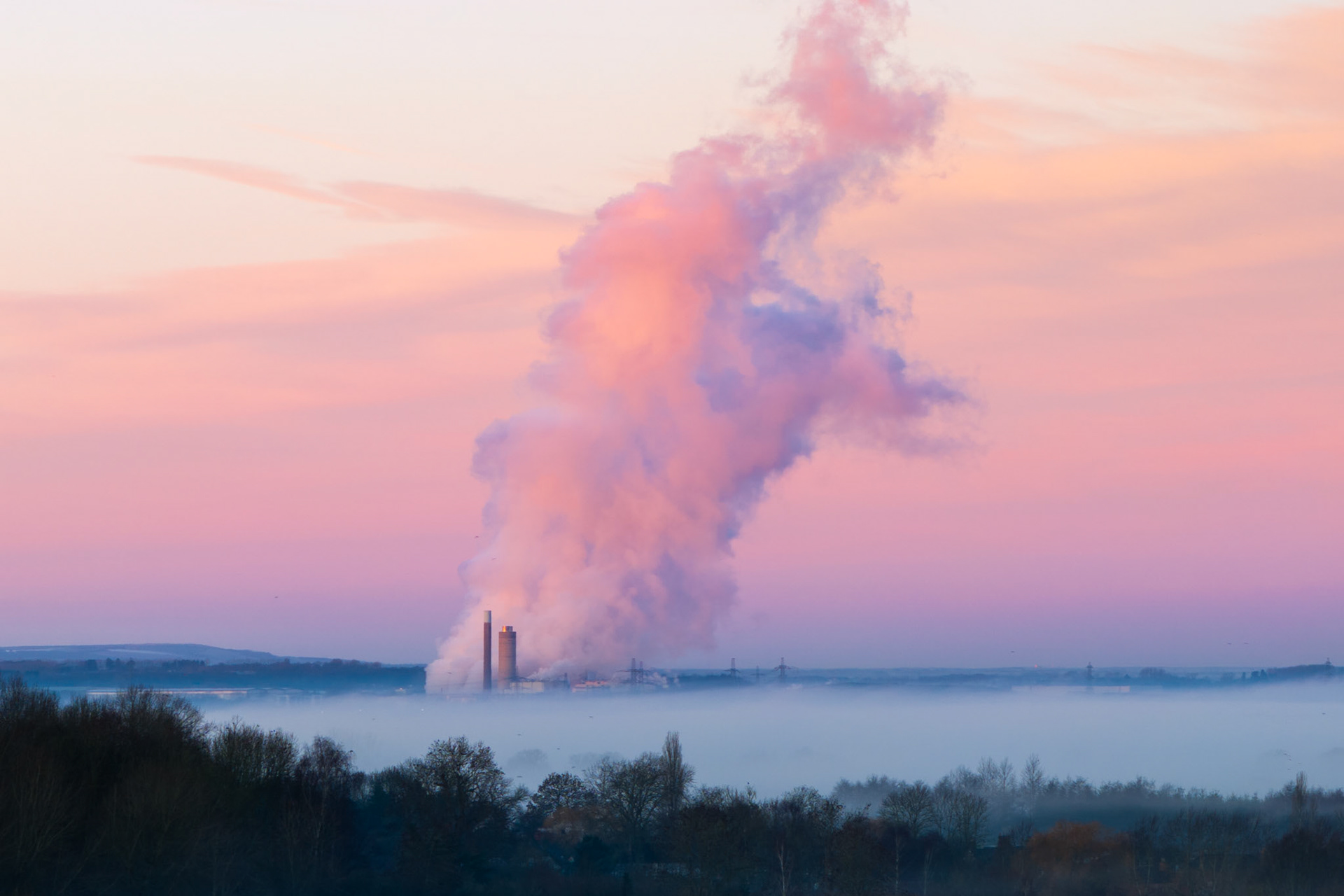
A temperature inversion locks ground fog across the Thames Valley near Wallingford at dawn, while steam and smoke from a distant power station billow upward into a pink and violet afterglow sky. The chimneys barely clear the fog layer, the plume dwarfing the industrial structures beneath it. Shot from a drone in January 2026, the image turns an environmental subject into an exercise in tone and scale.
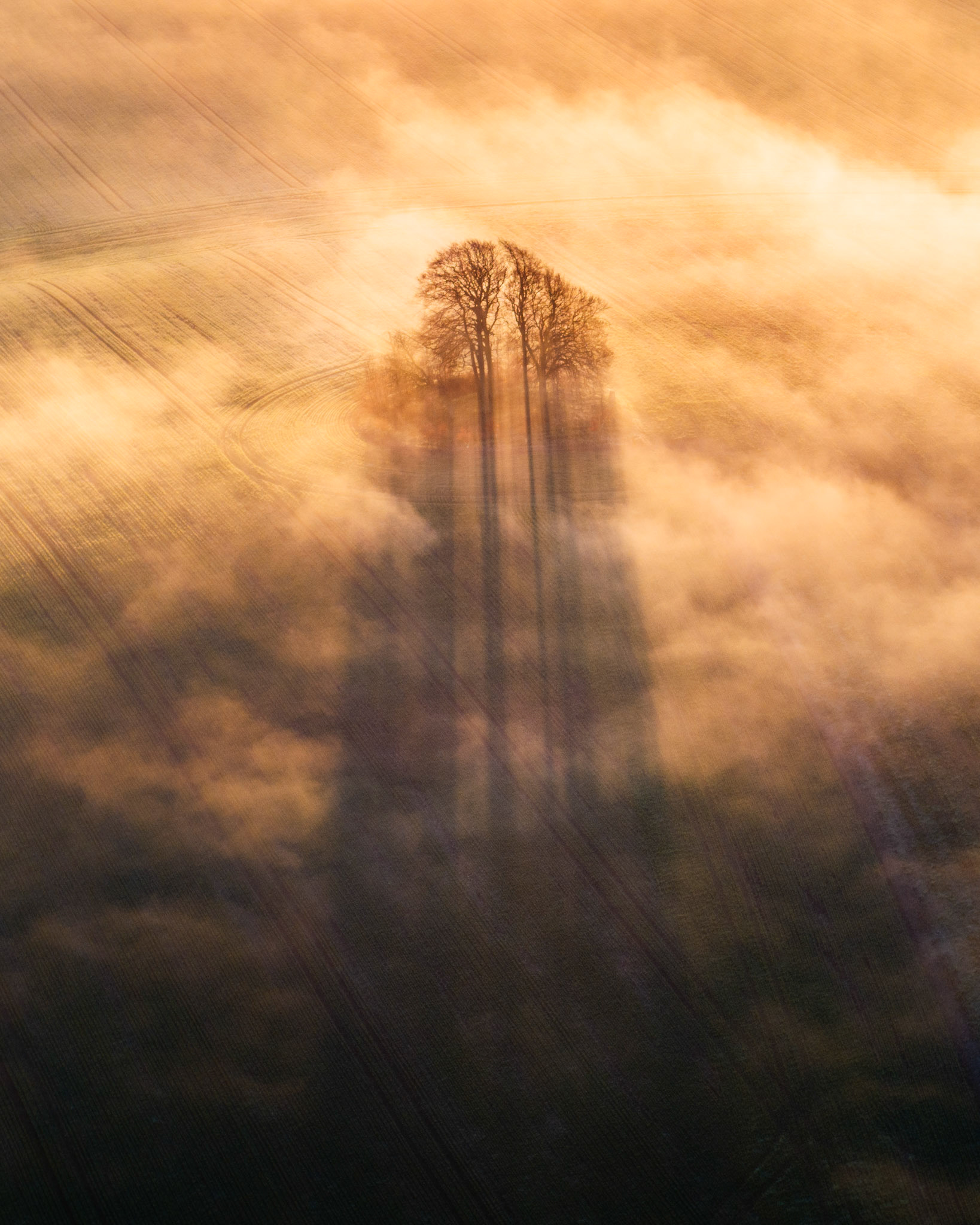
A small cluster of bare winter trees emerges from a ground inversion above ploughed arable fields at Brightwell Barrow, the low ridge near the Wittenham Clumps in Oxfordshire. Backlit by low January dawn light, the trunks cast long shadow-streaks through the dispersing fog onto the field below, reducing the landscape to a near-abstract study in amber and dark earth. The aerial perspective compresses field tramlines and fog layers into a single coherent plane, isolating the trees as the sole vertical anchor.
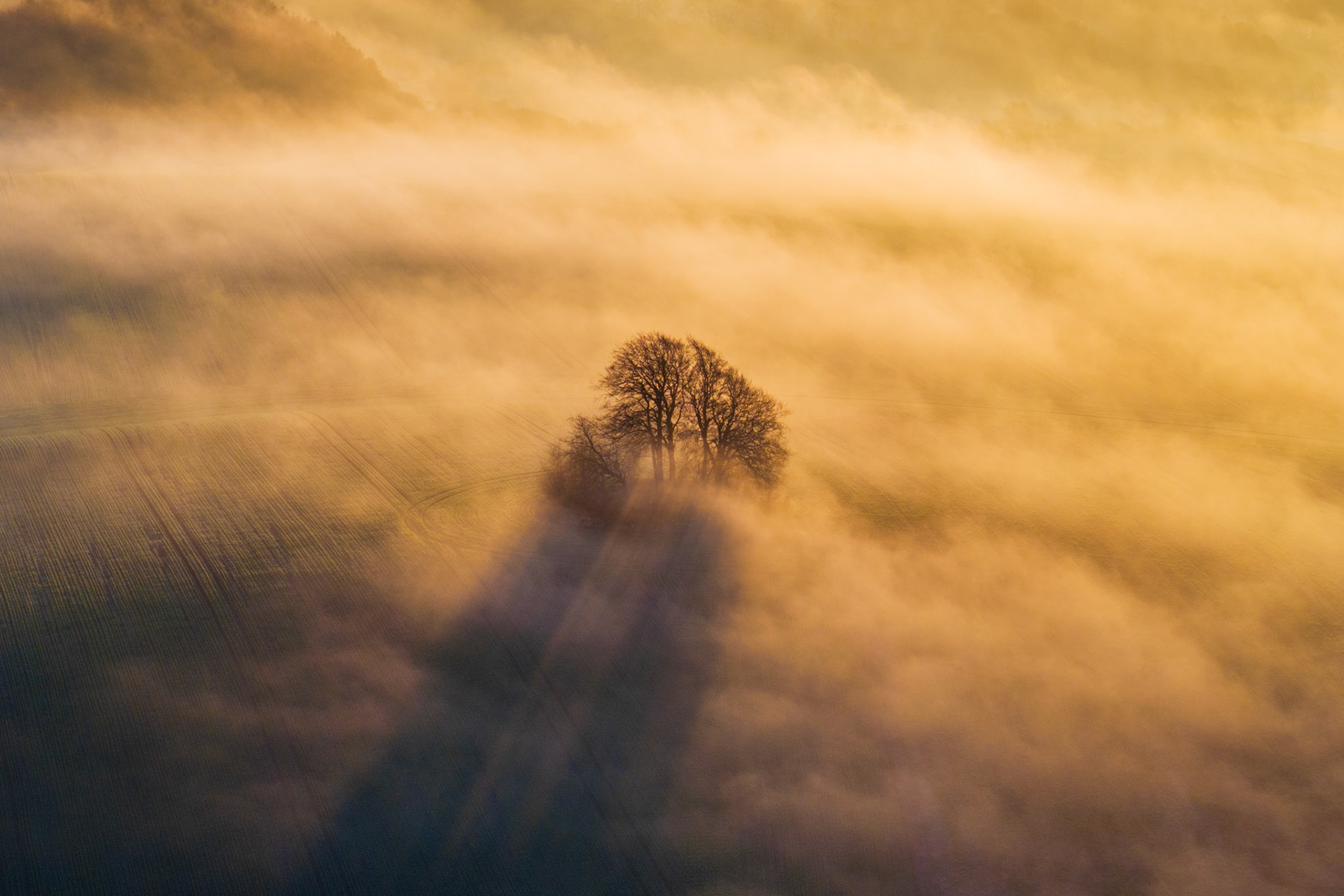
A small cluster of bare winter trees at Brightwell Barrow, near the Wittenham Clumps in Oxfordshire, emerges from a shallow fog inversion above arable farmland. Shot from directly above at low altitude, the trees cast a long shadow through the mist toward the viewer, anchoring the composition against a sea of warm golden vapour. The diagonal tension between fog layers and the singular dark form gives the image an abstract quality rare in aerial landscape work.
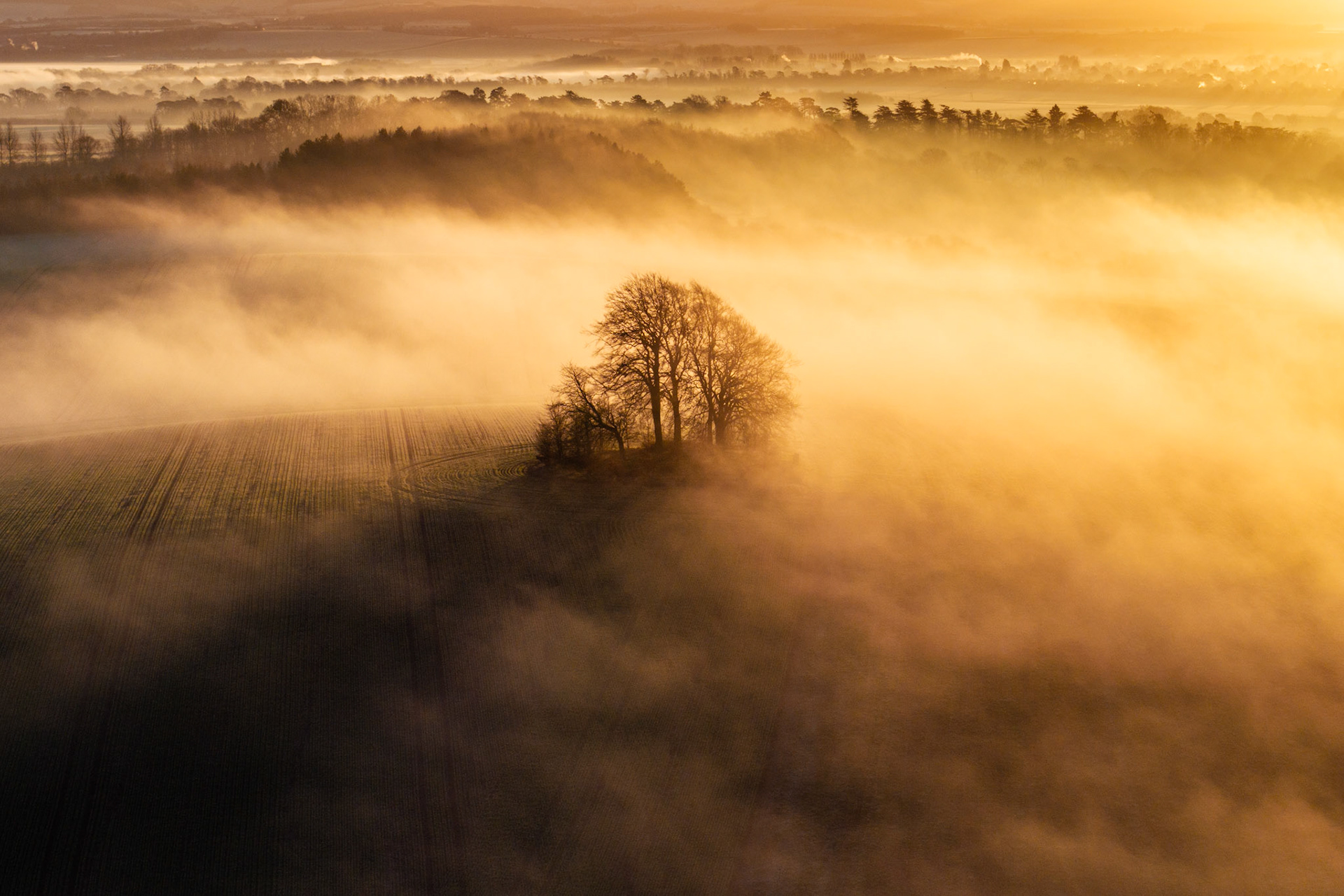
A small copse on Brightwell Barrow, near the Wittenham Clumps in Oxfordshire, emerges from a shallow temperature inversion across the farmland, January 2026. Low winter sun catches the fog from the east, reducing the landscape to a single silhouetted subject against a field of luminous amber. Tractor lines in the crop below anchor the image to the agricultural plain being consumed by the mist.
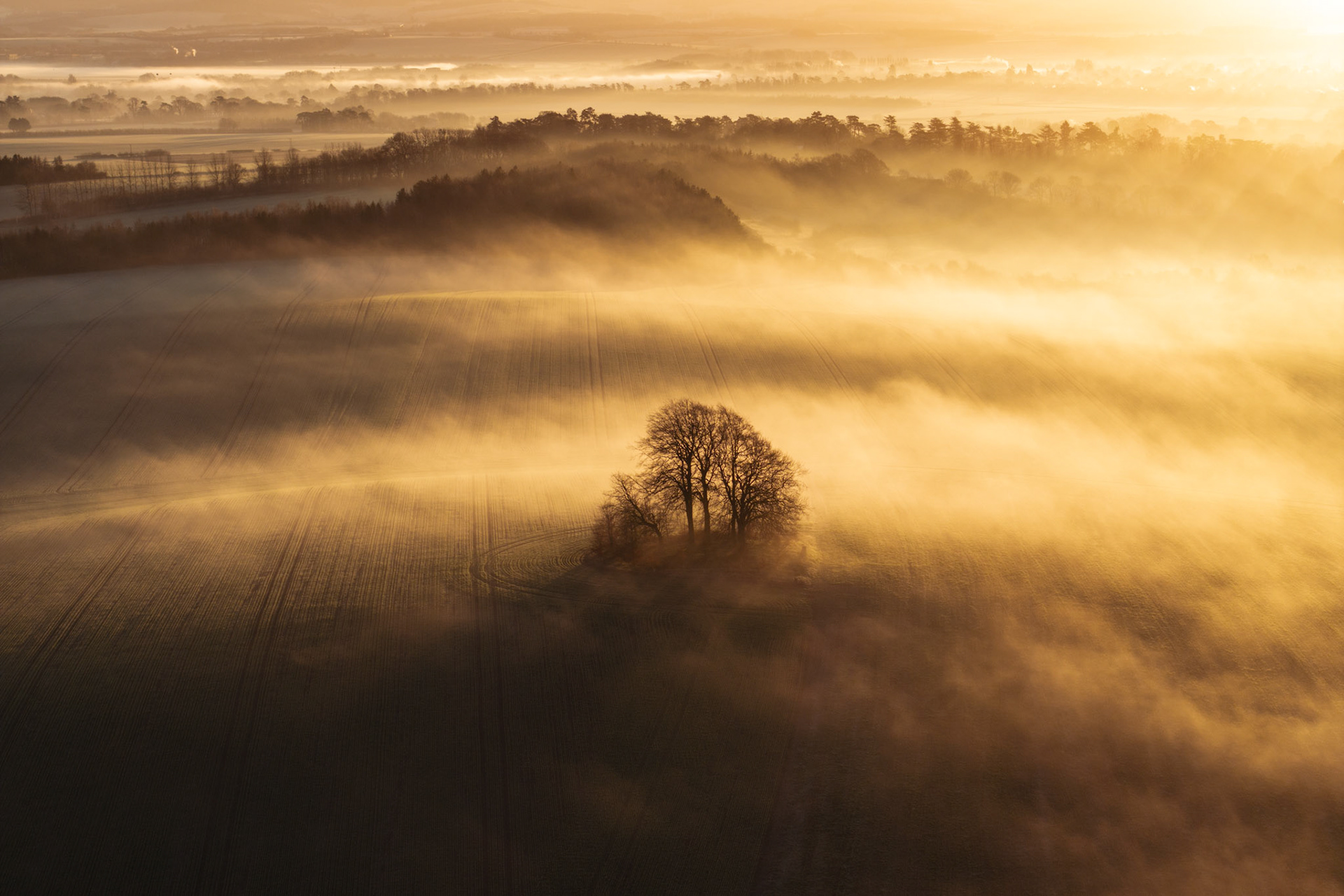
A small copse of bare-limbed trees emerges from a low temperature inversion rolling across arable fields on the slopes of Brightwell Barrow, near the Wittenham Clumps in Oxfordshire, photographed from altitude at first light in January. The mist moves in layered bands, backlit by a low winter sun, reducing the surrounding farmland to tonal abstraction. The isolated stand of trees anchors the composition as the sole vertical element in an otherwise formless, luminous ground.
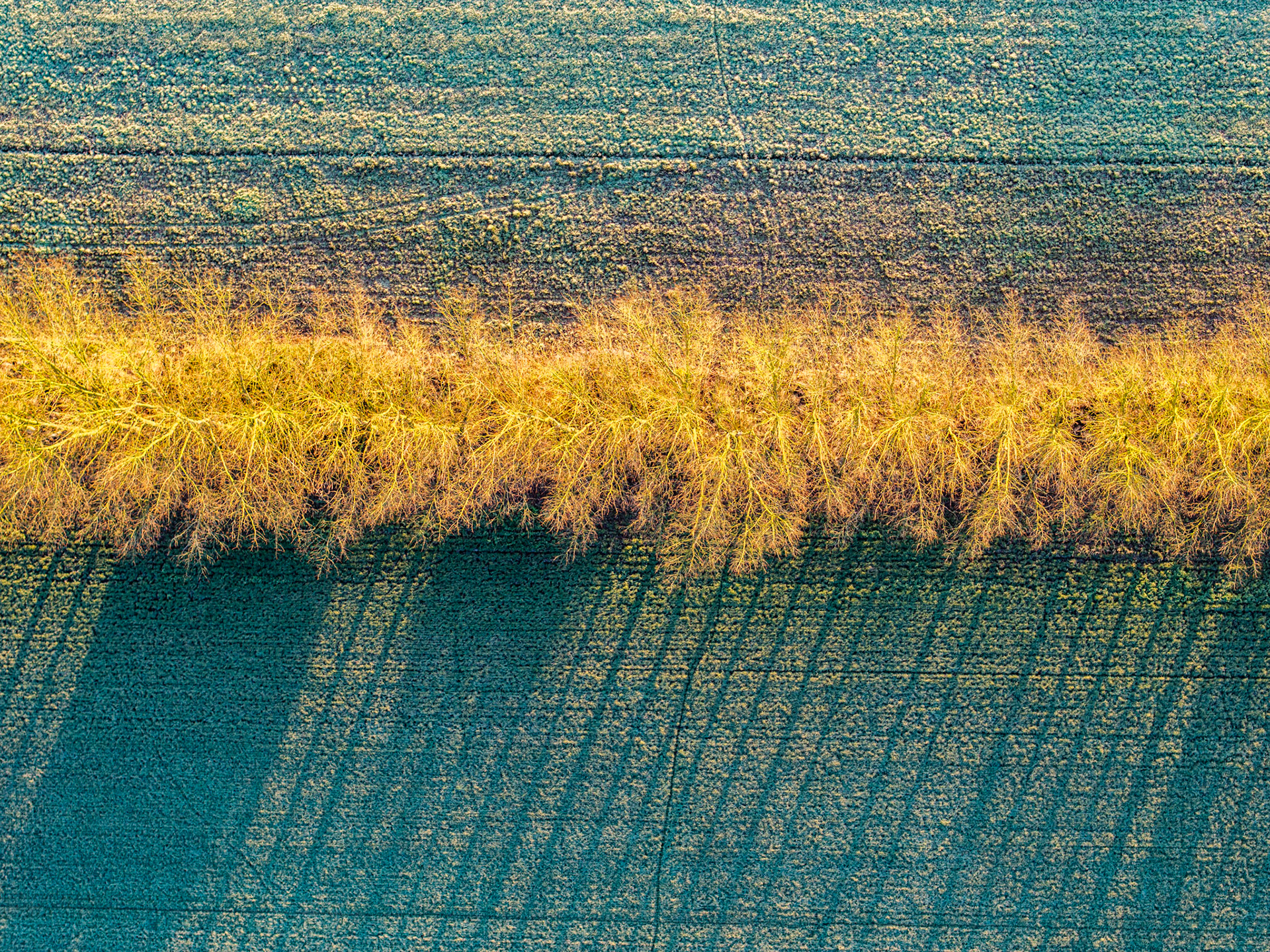
A bare hedgerow bisects two arable fields near Wallingford, Oxfordshire, its leafless canopy glowing amber in low January sun. Long shadows rake southward across frost-dusted winter crops, reducing the agricultural landscape to horizontal bands of colour and texture. The directly overhead perspective strips away depth, leaving pure graphic tension between warm and cool.
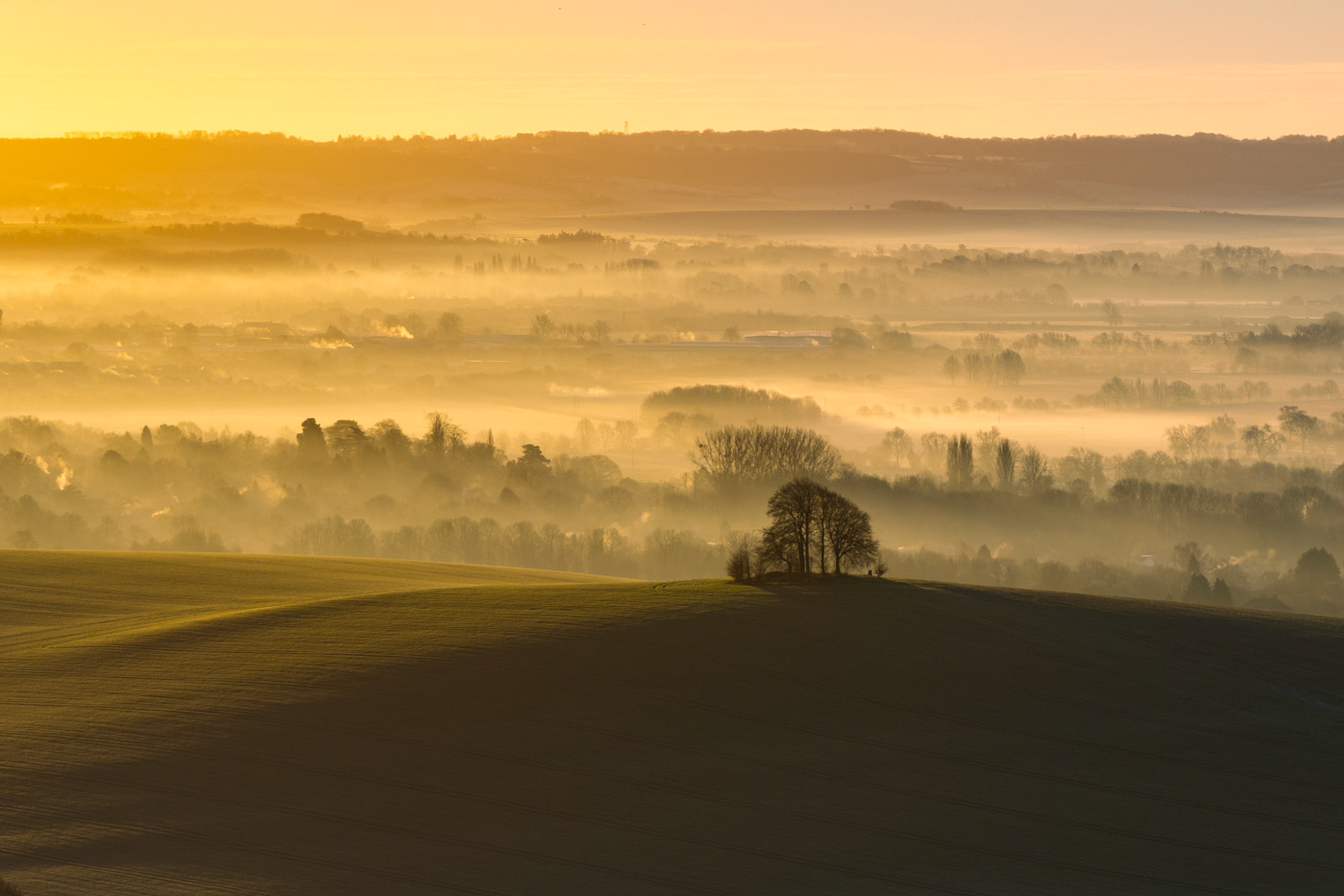
A small copse crowns a dark hilltop above the fog-filled Vale of White Horse near Abingdon, January dawn. Ground-hugging mist has pooled in distinct horizontal layers between bare tree lines, compressed by temperature inversion, while a pale golden sky bleeds light across the entire scene. The lone cluster of winter trees acts as a pivot between the shadowed foreground field and the luminous, stratified valley beyond.
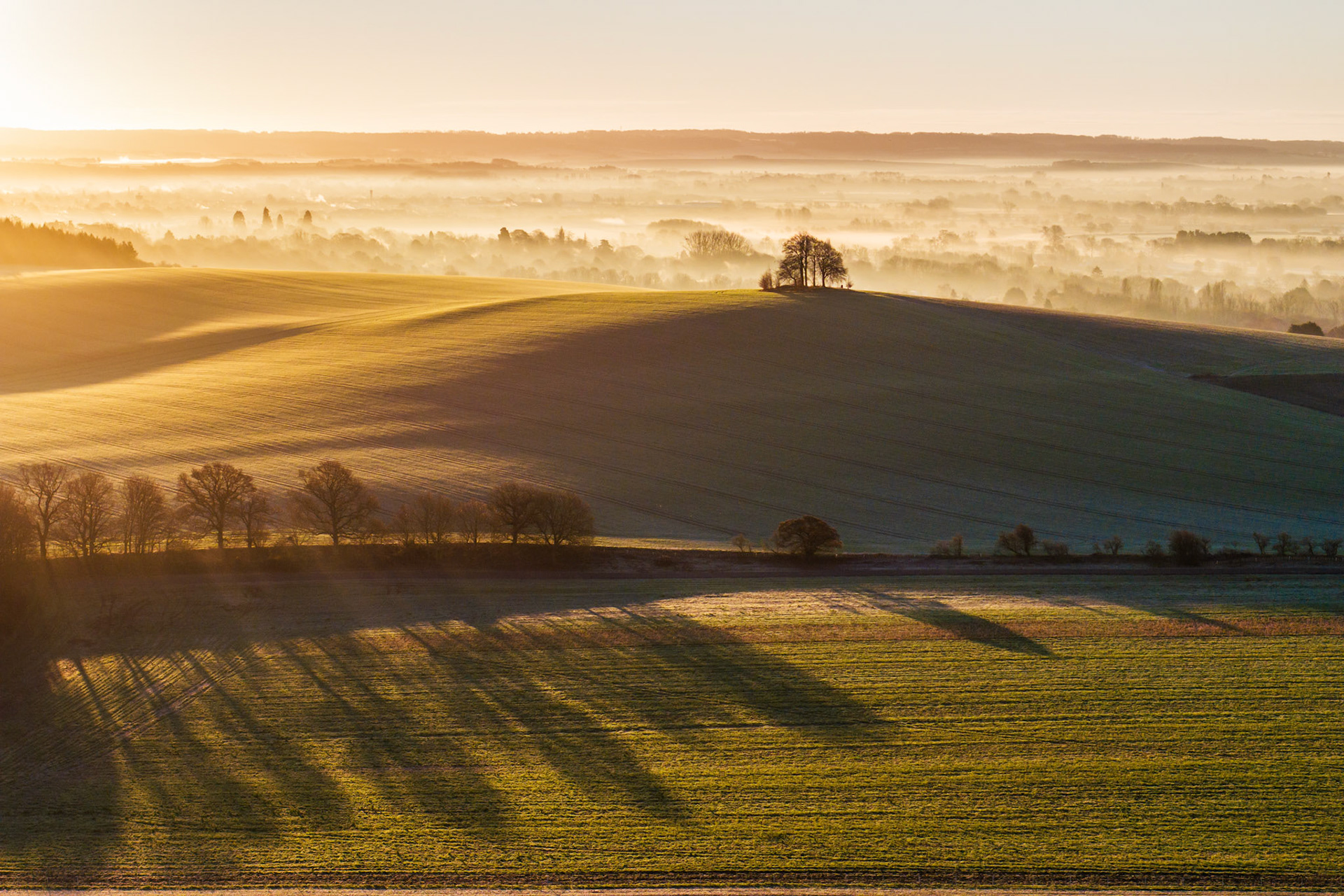
Low winter sun rakes across ploughed downland at Brightwell Barrow, near the Wittenham Clumps in Oxfordshire, casting long tree shadows across frost-touched fields while a temperature inversion holds mist in the vale below. The copse crowning the barrow acts as a focal anchor against the layered vapour and the familiar wooded ridge beyond. The compression of light, shadow, and mist across multiple planes gives the scene unusual depth for a hand-held moment.
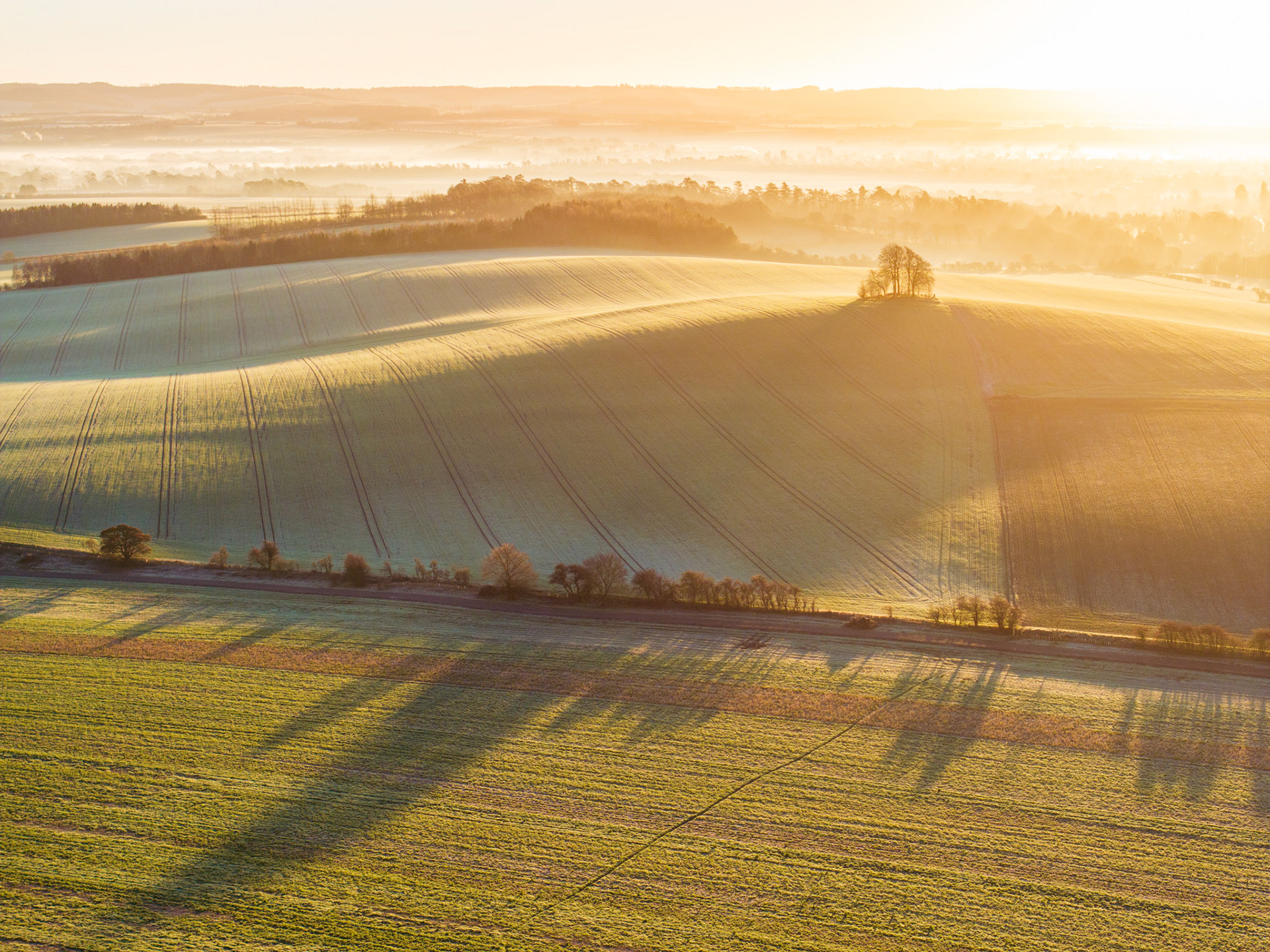
Brightwell Barrow, the low chalk hill near the Wittenham Clumps in Oxfordshire, carries its crown of trees through a frost-covered January dawn in the Vale of White Horse. Ground mist pools in the valley floor beyond, softening the middle distance into successive planes of amber and grey. Long tree shadows rake across the foreground fields, their geometry underscored by tractor lines in the frozen turf.
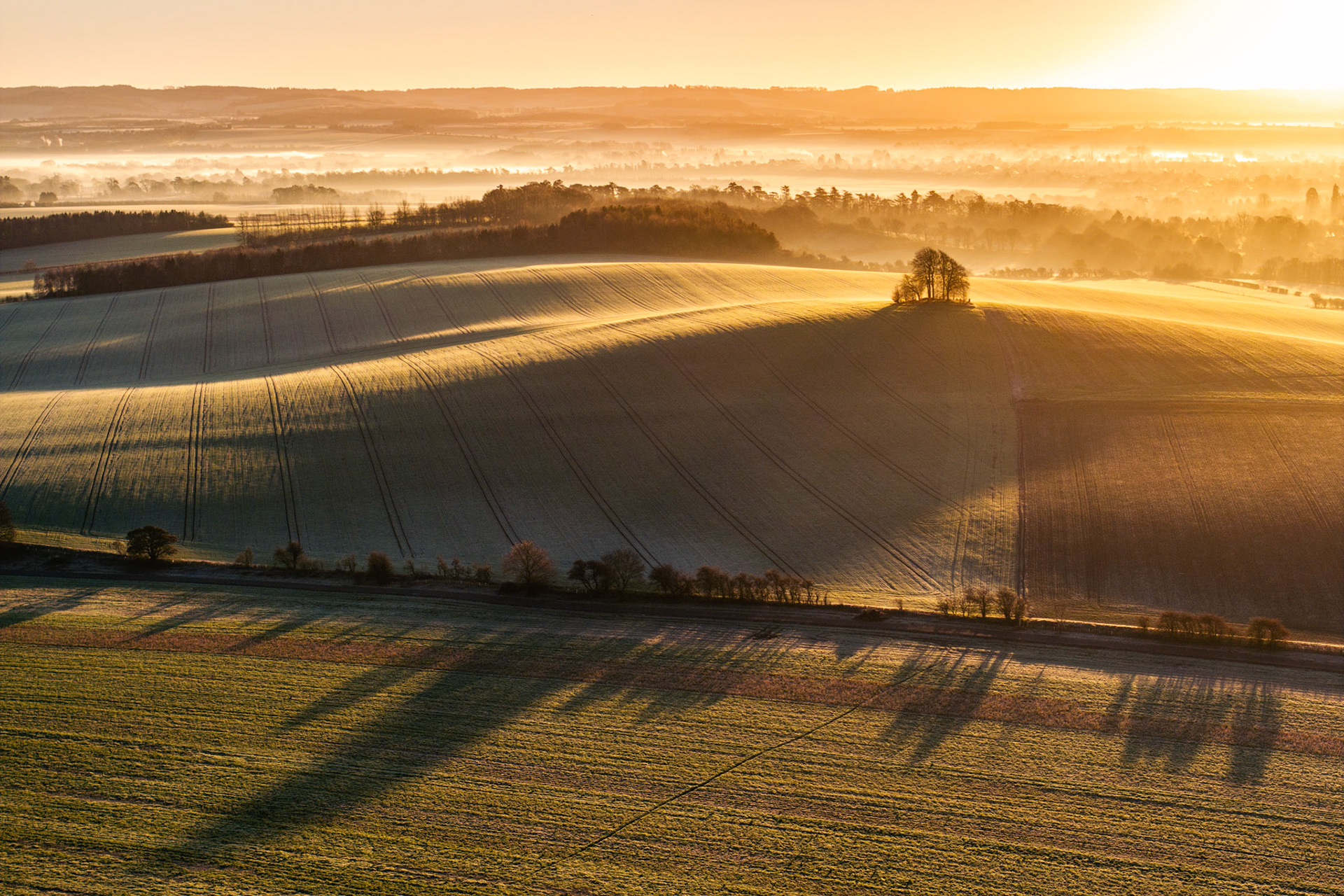
Bare trees crown Brightwell Barrow, a chalk hill near the Wittenham Clumps in Oxfordshire, as low winter sun rakes across frost-covered ploughed fields and ground mist pools in the Vale of White Horse beyond. The aerial vantage compresses receding layers of hedgerow, fog, and distant downland into a single coherent plane of light and shadow. Long tree shadows crossing the lower field anchor the foreground and give the composition its quiet geometric tension.
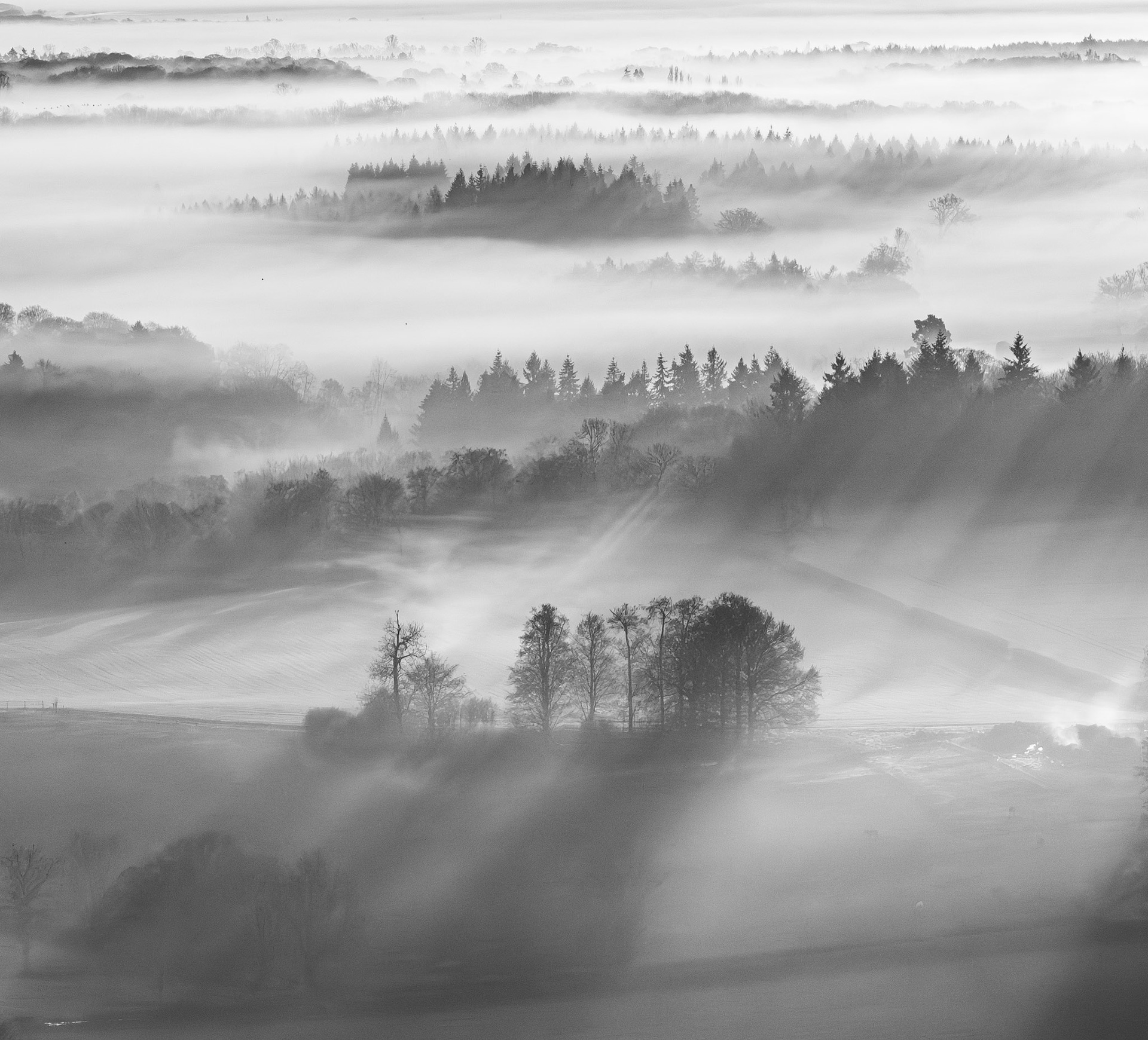
A temperature inversion fills the Thames Valley lowlands with layered fog, isolating copses and conifer ridgelines as dark silhouettes against luminous white. Shot from elevation above Henley-on-Thames in late January, the compression of a long focal length stacks the receding planes into near-abstract bands of tone. A church spire emerges faintly at mid-distance, the sole human measure in an otherwise elemental scene.
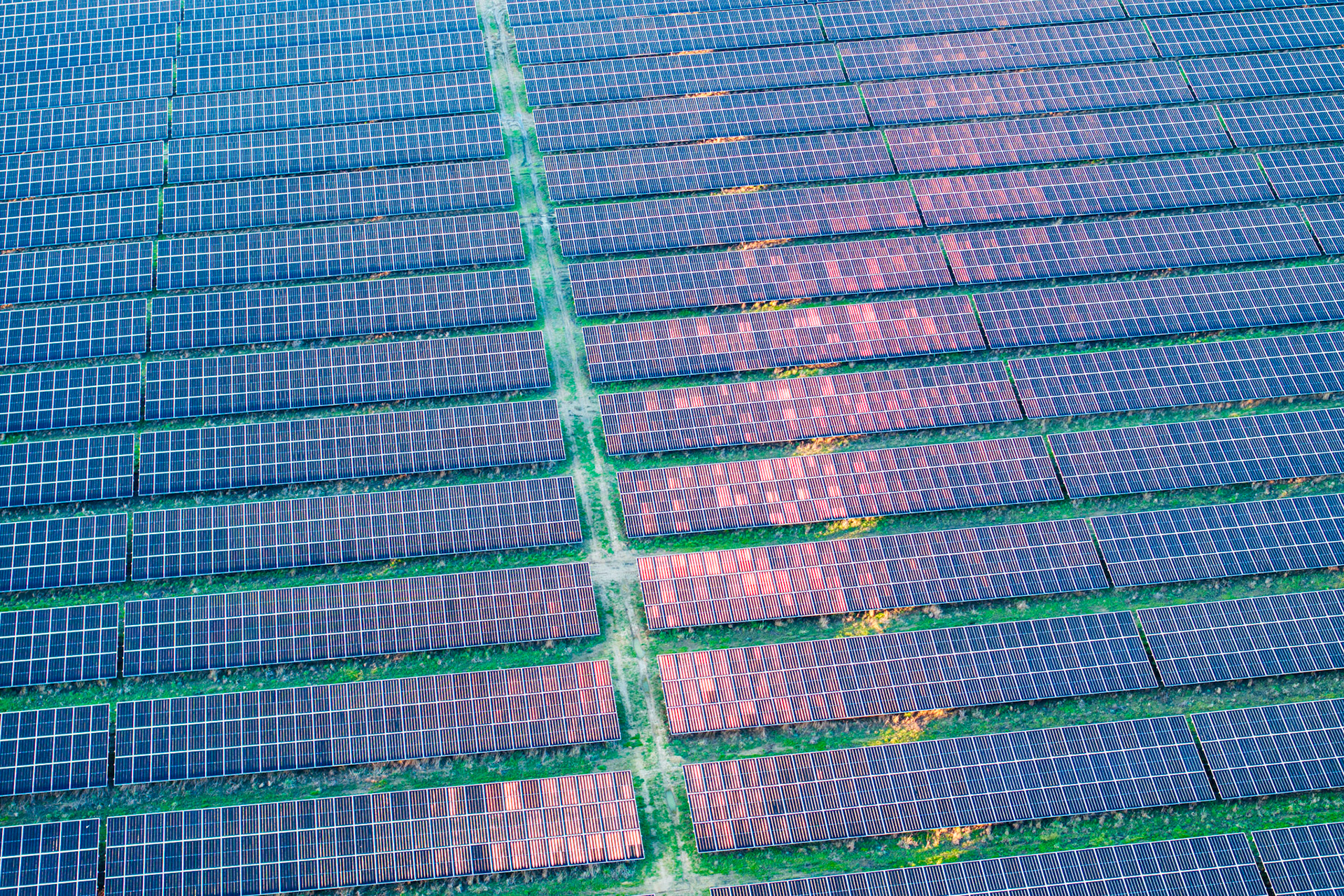
An aerial view of a large solar farm near Oxford, shot in flat winter light. The diagonal axis of access paths divides the frame, while differential reflection across the panel arrays creates a patchwork of blue and warm terracotta tones. The geometry is resolved but the image lacks a decisive atmospheric or compositional moment to lift it beyond the documentary.
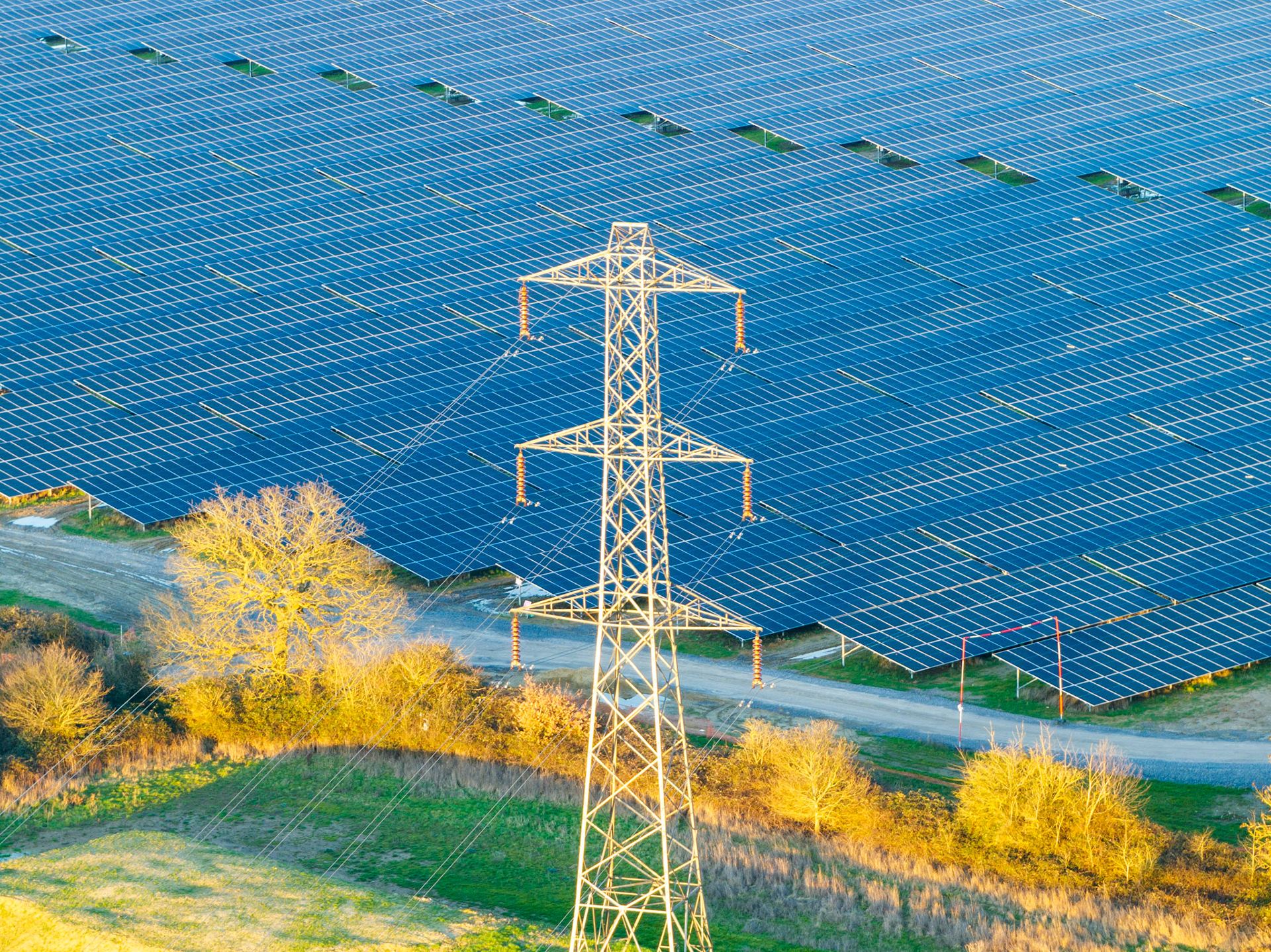
A high-voltage transmission pylon stands within a large solar farm near Oxford, photographed from the air in low winter sun. The warm light catches the latticed steel against a near-total field of blue photovoltaic panels, creating an unintended visual rhyme between two generations of energy infrastructure. Bare hedgerow trees along an access track provide the only organic break in the composition.
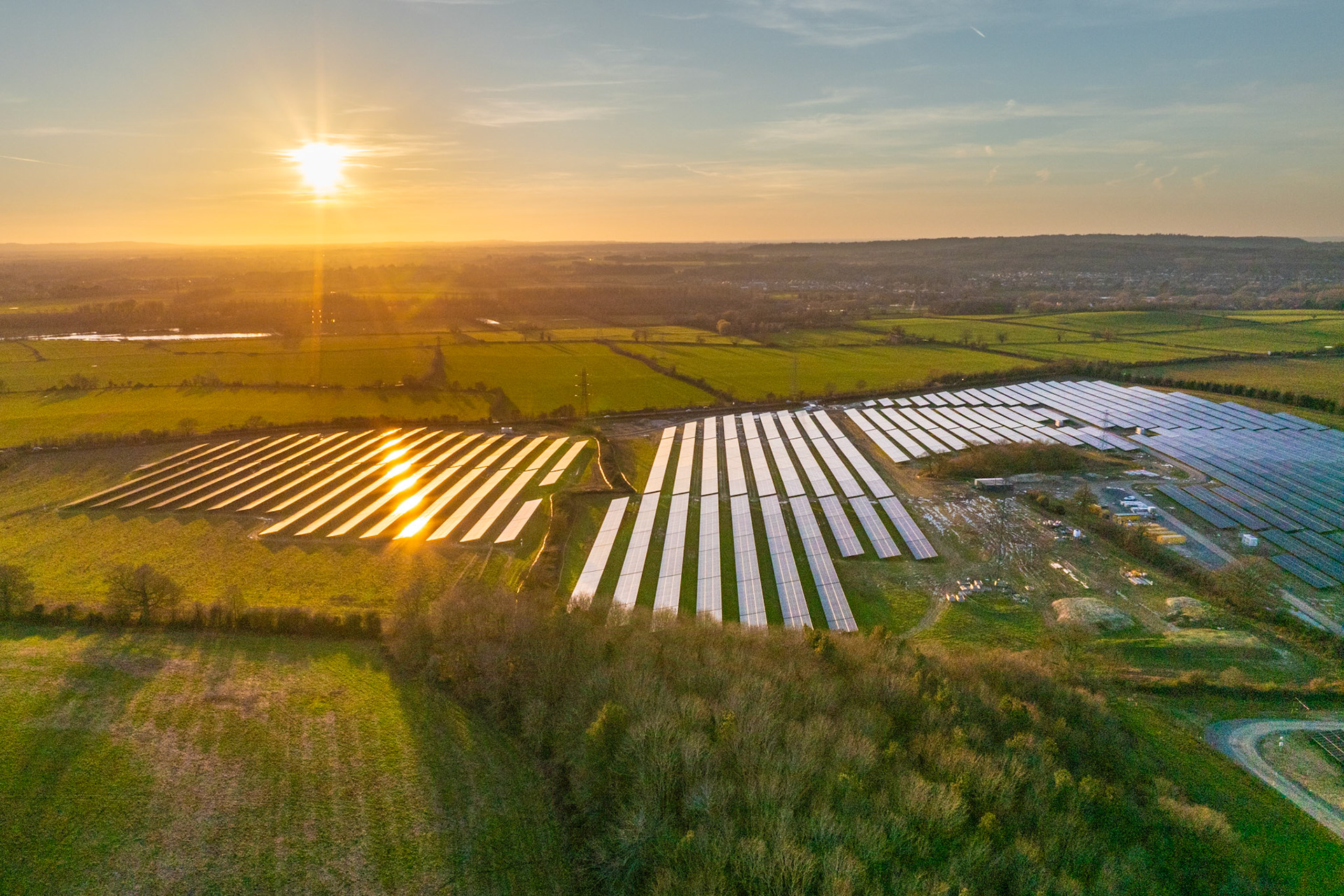
A large solar farm occupies former agricultural land on the Oxford floodplain, the low February sun catching the panel rows at a shallow angle and igniting a line of direct reflections across the left section. The surrounding patchwork of winter fields and hedgerows, with the Thames Valley settlements visible on the distant ridge, frames the geometry of the installation within a broader rural context.
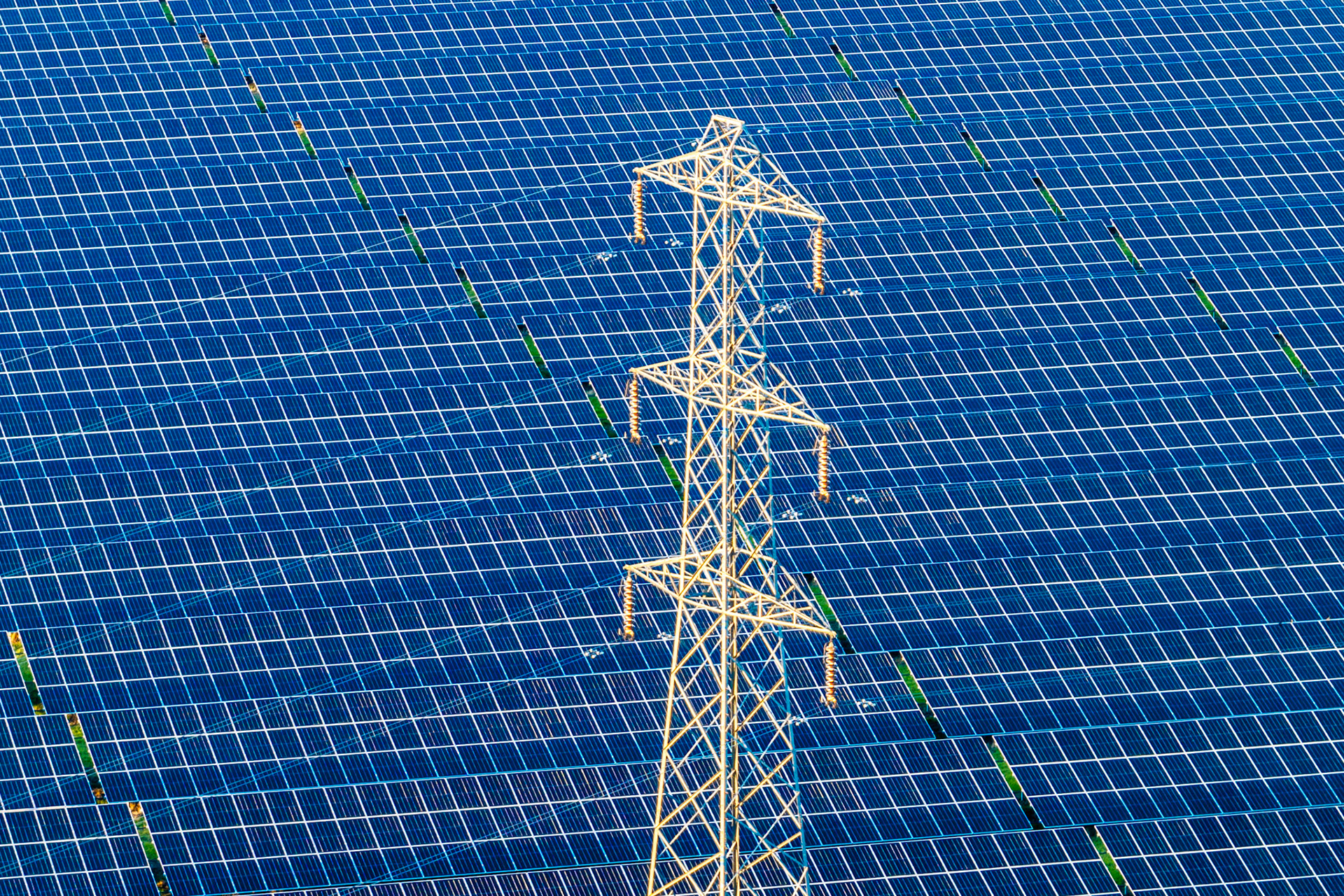
An electricity pylon stands within a large solar farm, photographed from directly above near Oxford. The aerial perspective collapses depth, reducing both structures to competing geometric patterns across a field of deep blue photovoltaic cells. The warm lattice of the steel tower reads as an anomaly against the relentless regularity of the panels beneath it.
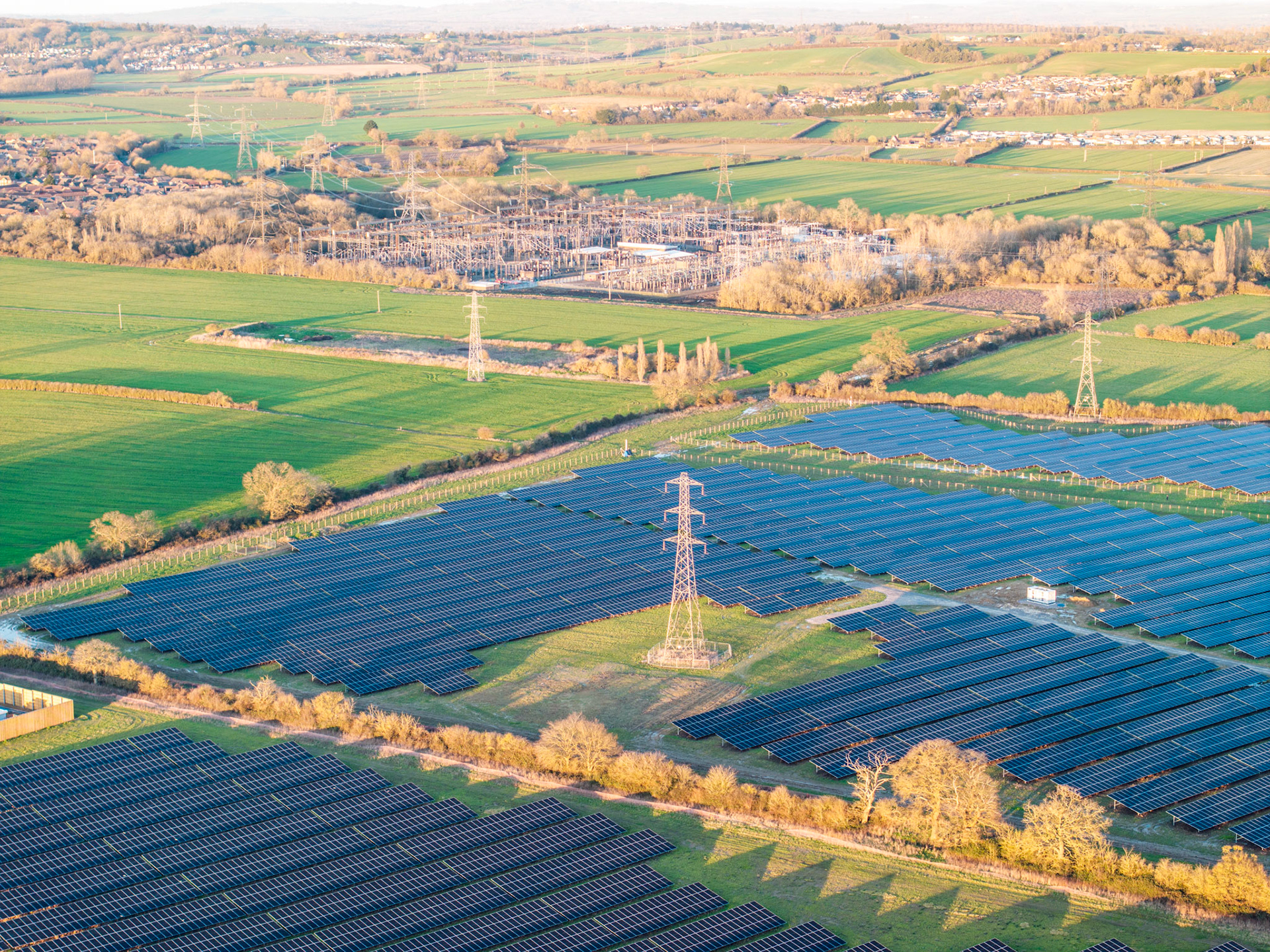
A large ground-mounted solar farm occupies former agricultural land on the outskirts of Oxford, Oxfordshire, its blue-black panel rows bisected by a transmission pylon connected to a visible grid substation beyond. Low winter sun rakes across the site from the south-west, picking out the geometry of the arrays against cropped grass margins and bare hedgerow trees. The composition records an energy-infrastructure landscape of growing familiarity in lowland England.
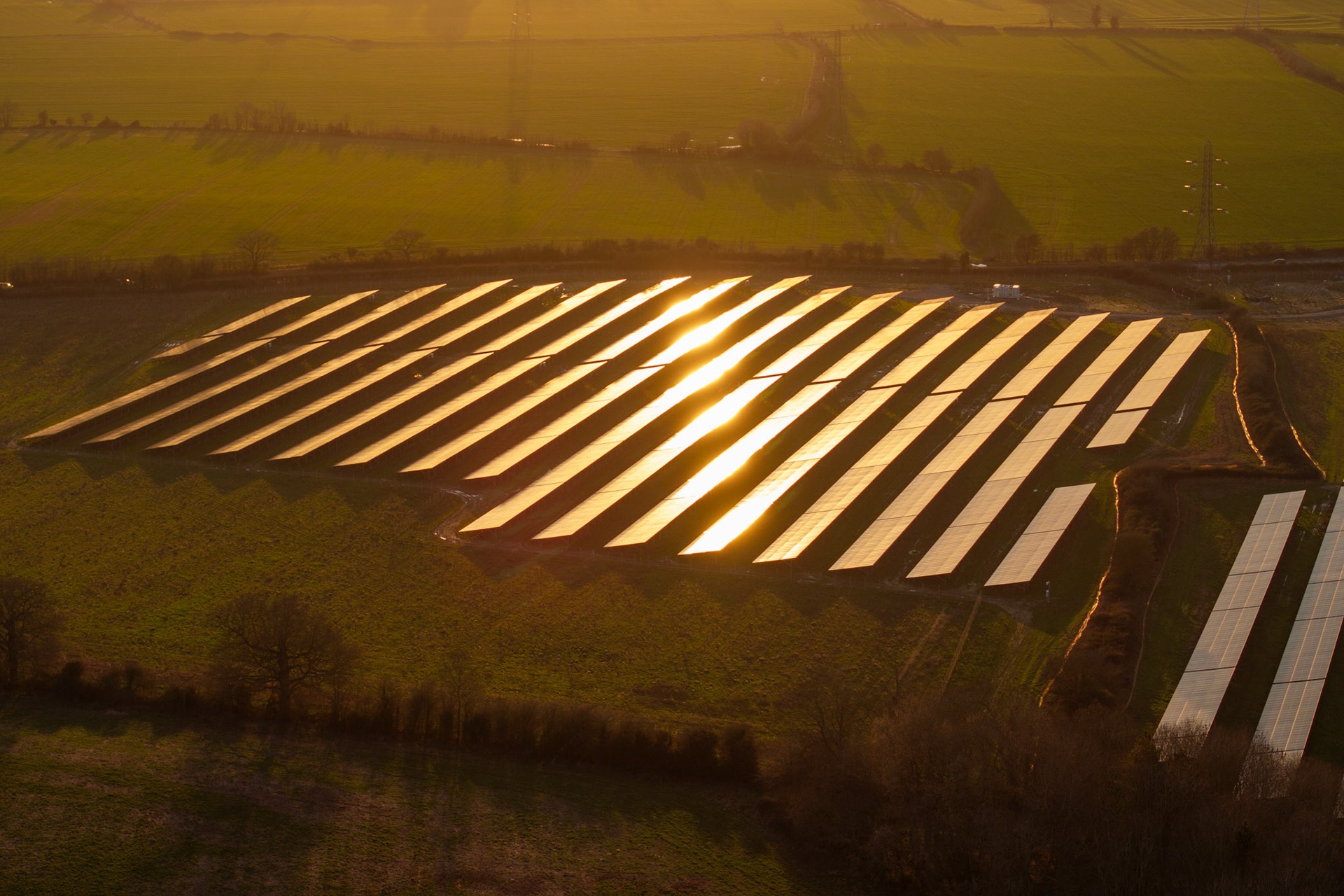
Rows of photovoltaic panels catch the last angle of winter sun near Oxford, their glass surfaces flaring into a concentrated column of reflected light. Seen from altitude, the geometry of the installation resolves into something closer to abstraction than infrastructure. The surrounding fields and hedgerows anchor the composition in the English agricultural lowlands.
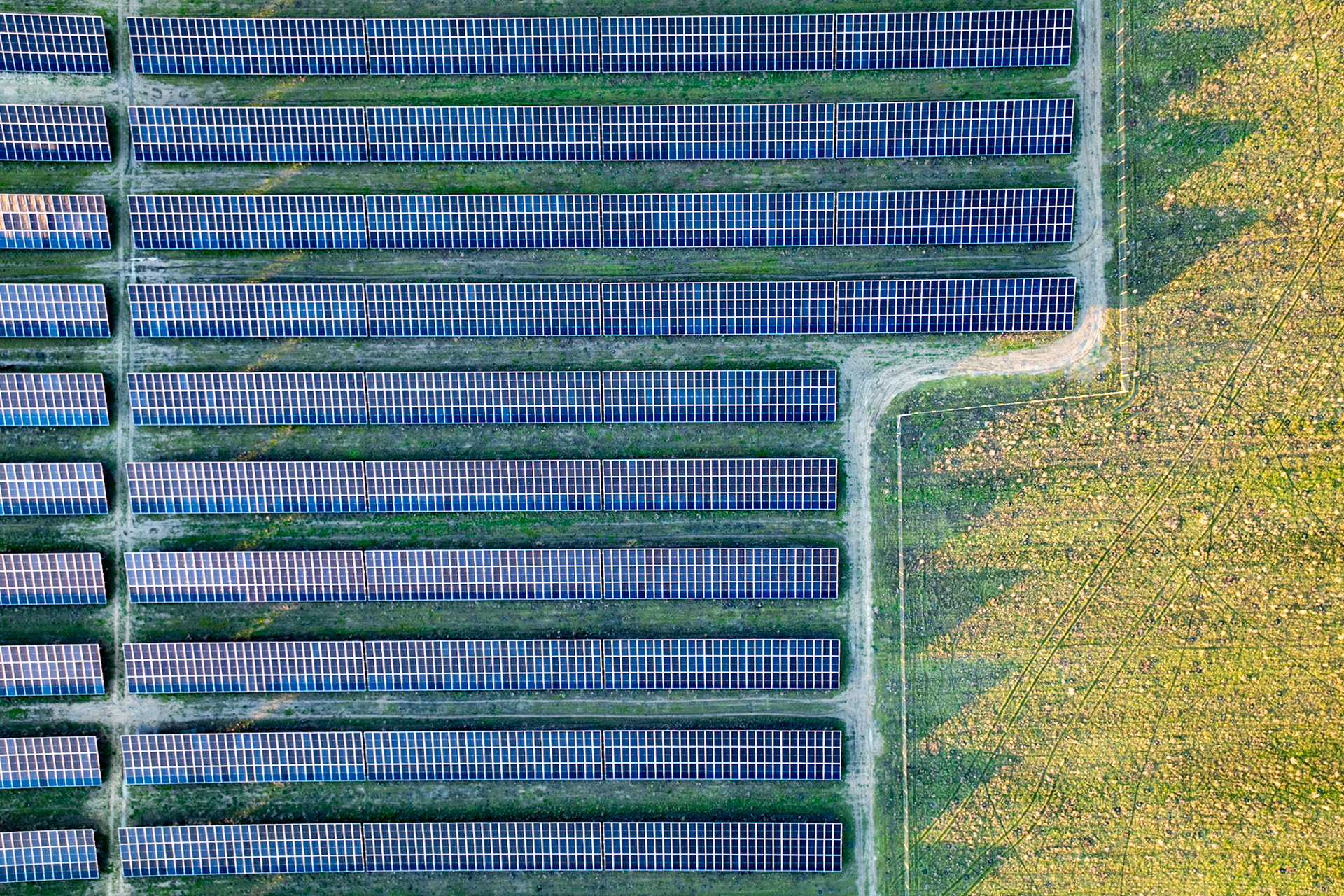
Rows of photovoltaic panels stretch across flat agricultural land near Oxford, their deep blue regularity interrupted at the right edge by an adjacent crop field still carrying the pale residue of winter. The T-junction of access tracks provides the only compositional break in an otherwise relentless grid. The image reads as industrial pattern rather than landscape.

Rows of leisure craft and narrowboats moored in a Thames-side marina near Reading, viewed from directly overhead. The strict geometry of the pontoons and the variety of hull colours create a flattened, almost typographic pattern against the still grey water. Captured in early March, the image reads as urban-industrial inventory rather than landscape.

Dozens of leisure craft moored in parallel pontoon lanes at a marina near Reading, photographed from directly overhead in flat winter light. The geometric regularity of hulls and walkways dominates, with dark still water filling the intervals between vessels.

A sculling boat moves upstream on the Thames near Reading, its oar strokes leaving a precise chevron of interference rings on the glassy teal surface. Shot directly overhead from a drone, the craft is reduced to a small white form overwhelmed by expanding geometry. The near-symmetry and scale contrast give the image a quiet, graphic authority.
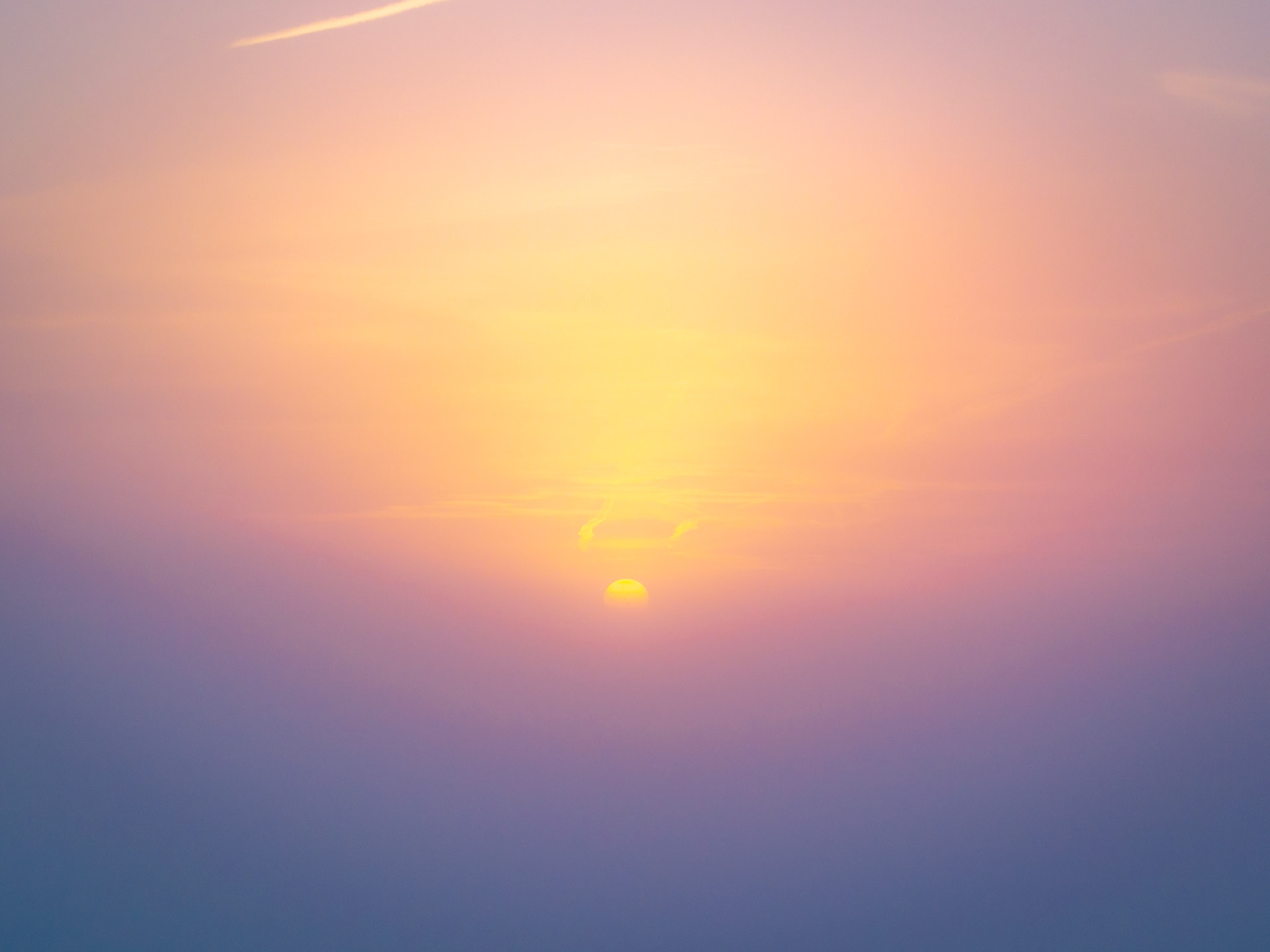
The setting sun drops beneath a thin band of cloud above the Thames Valley, its disc diffused by haze into a soft corona of amber and mauve. Captured by drone near Abingdon-on-Thames in early March, the image records a moment of atmospheric optical separation rather than a conventional sunset composition.
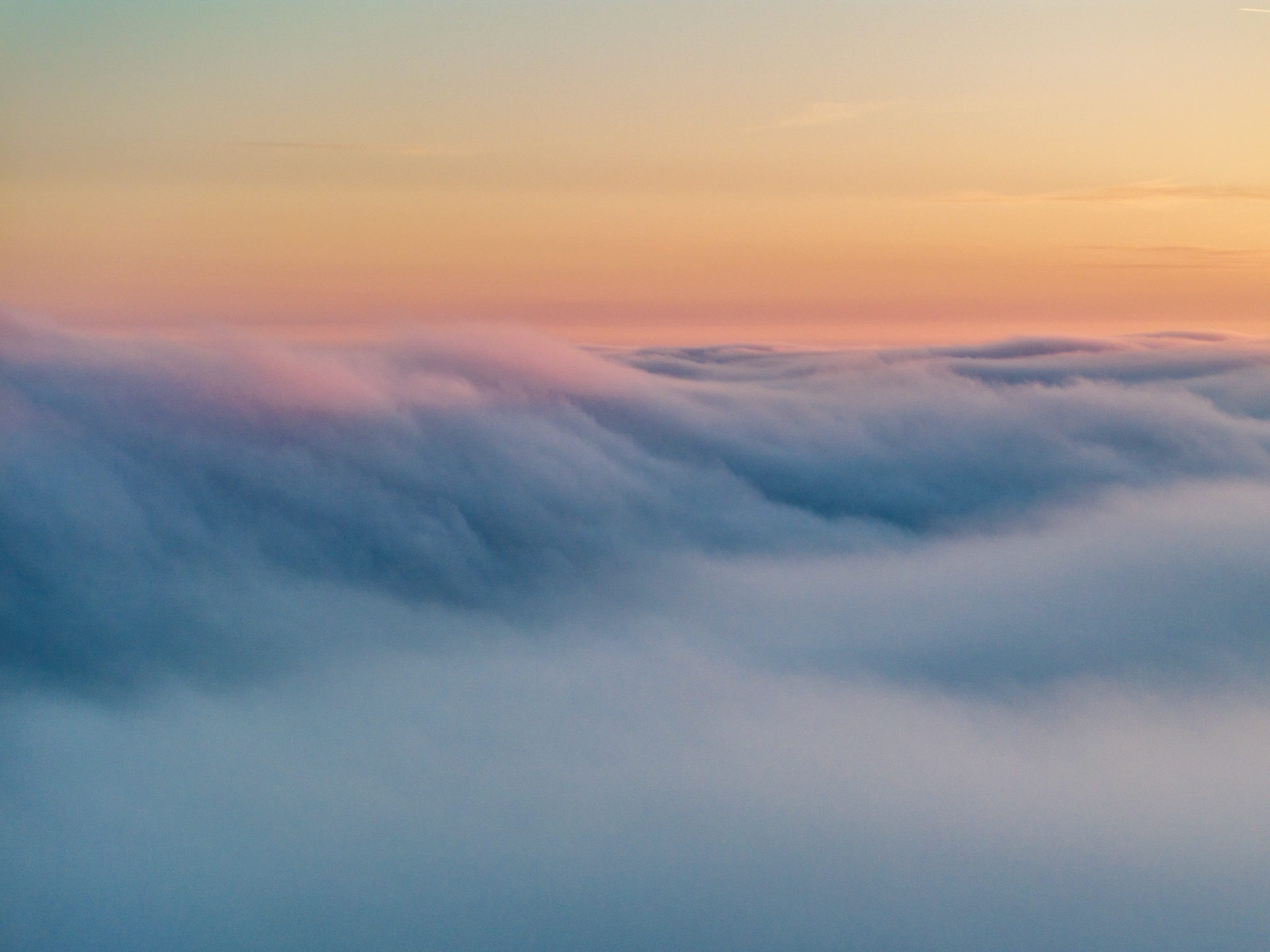
A temperature inversion buries the Thames Valley beneath a rolling sea of low cloud near Abingdon-on-Thames, the upper surface catching the last warm tones of a March sunset. Striations across the cloud top suggest gentle airflow, giving the otherwise featureless mass a quiet structural rhythm. The gradient from cool blue below to peach and teal at the horizon holds the eye without a conventional anchor point.
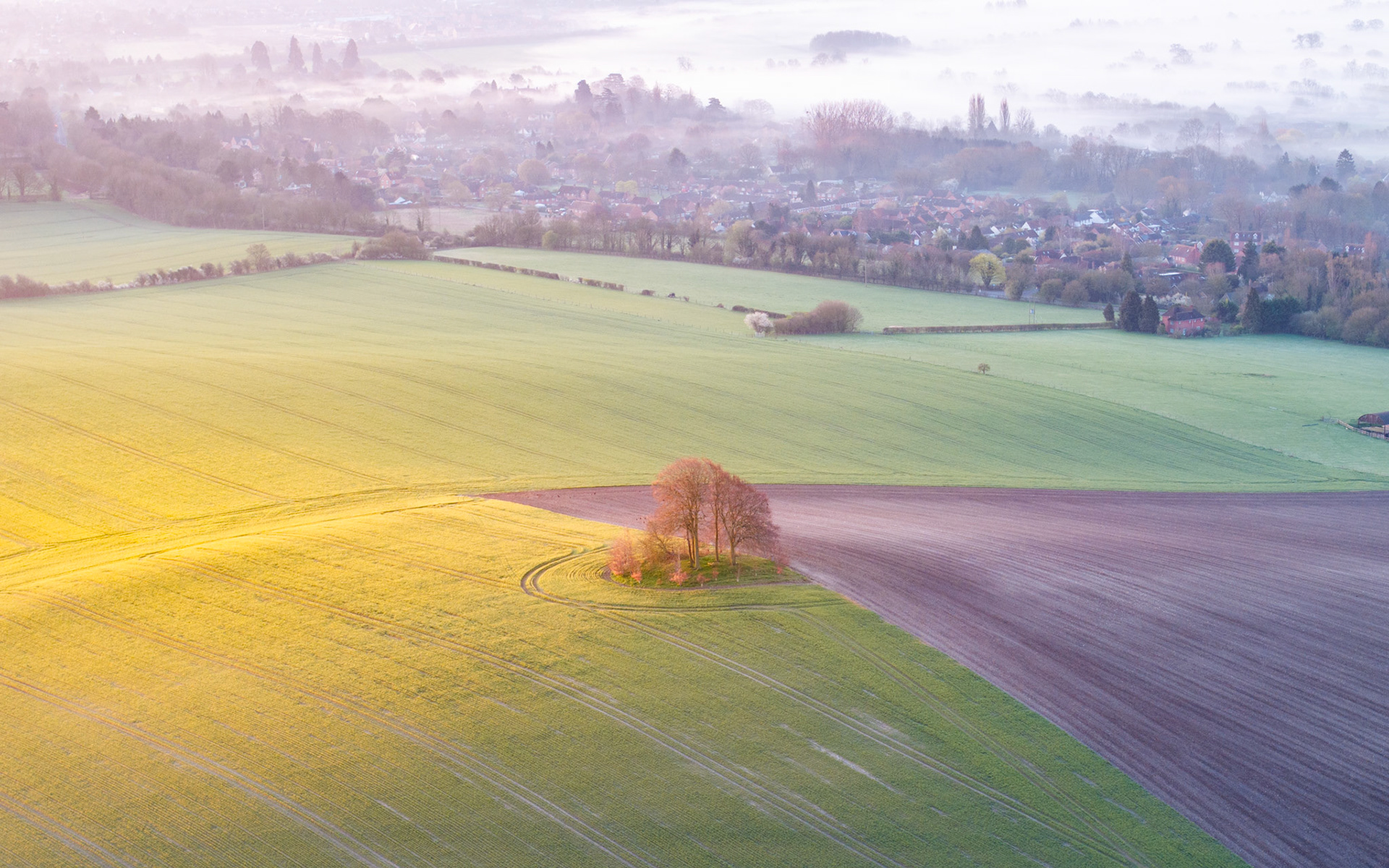
A small copse sits at the intersection of rapeseed, bare soil and winter wheat on the farmland below Brightwell Barrow, near the Wittenham Clumps in Oxfordshire, caught in low spring light with valley mist softening the village beyond. The radiating tractor lines draw the eye to the isolated stand of trees, which divides three distinct land uses in a single frame. Morning fog layers over the settlement and treeline, compressing distance and adding tonal depth to the middle ground.
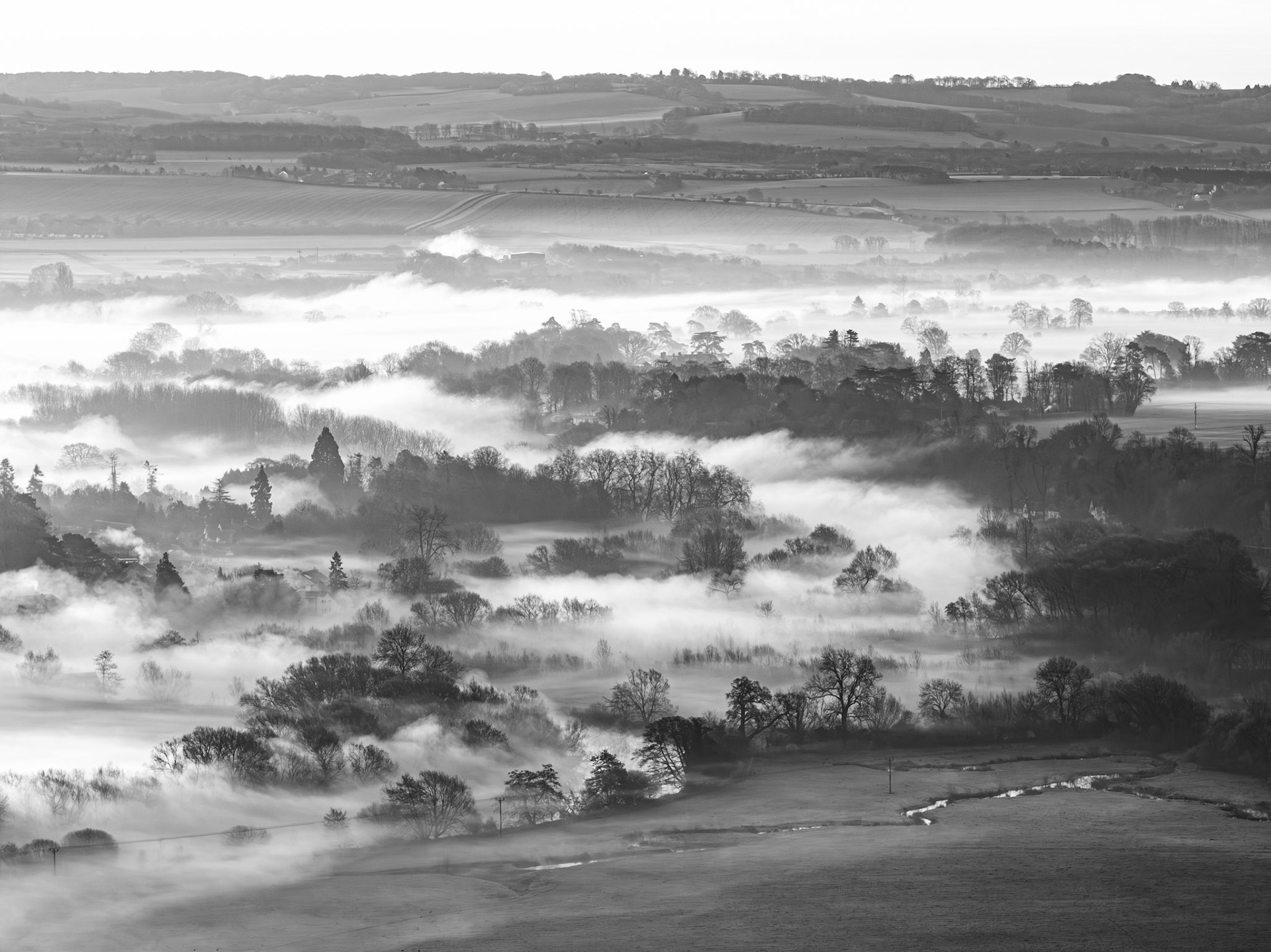
A temperature inversion fills the Thames Valley near Wallingford, submerging the lower ground in dense radiation fog while the bare-branched trees of the valley floor emerge as dark silhouettes between the mist layers. Shot from elevation, the compression of tonal planes across multiple fog bands gives the scene a graphic, almost painterly structure. The monochrome conversion strips out any distraction, leaving only the interplay of light, vapour, and form.
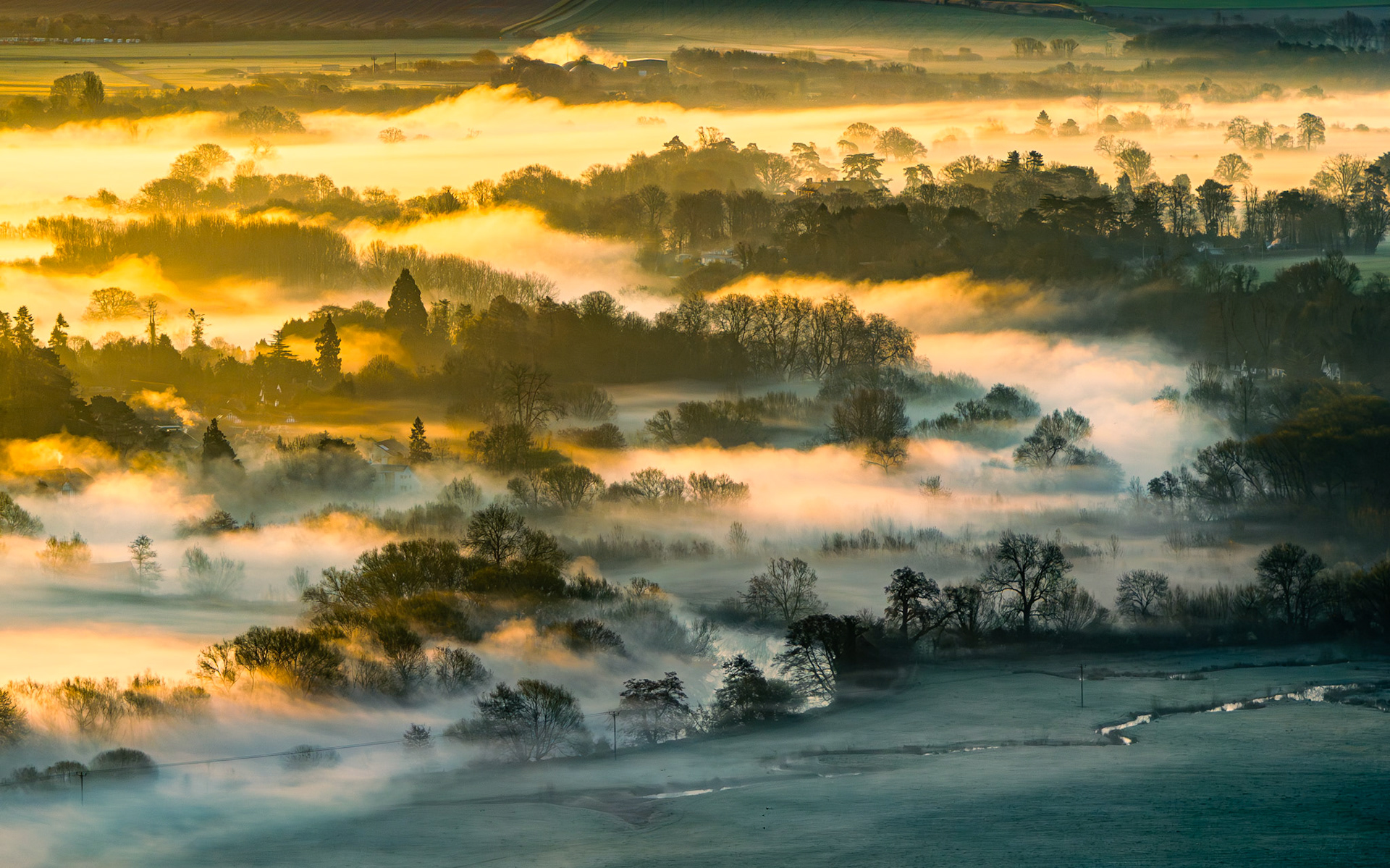
A temperature inversion settles across the Thames Vale near Wallingford, Oxfordshire, at the spring equinox. Layers of ground fog pool between bare-limbed trees, back-lit by a low sun that turns the upper mist to amber while the foreground remains in cool shadow. The effect reveals the valley's topography as a series of receding planes, each defined by light rather than land.
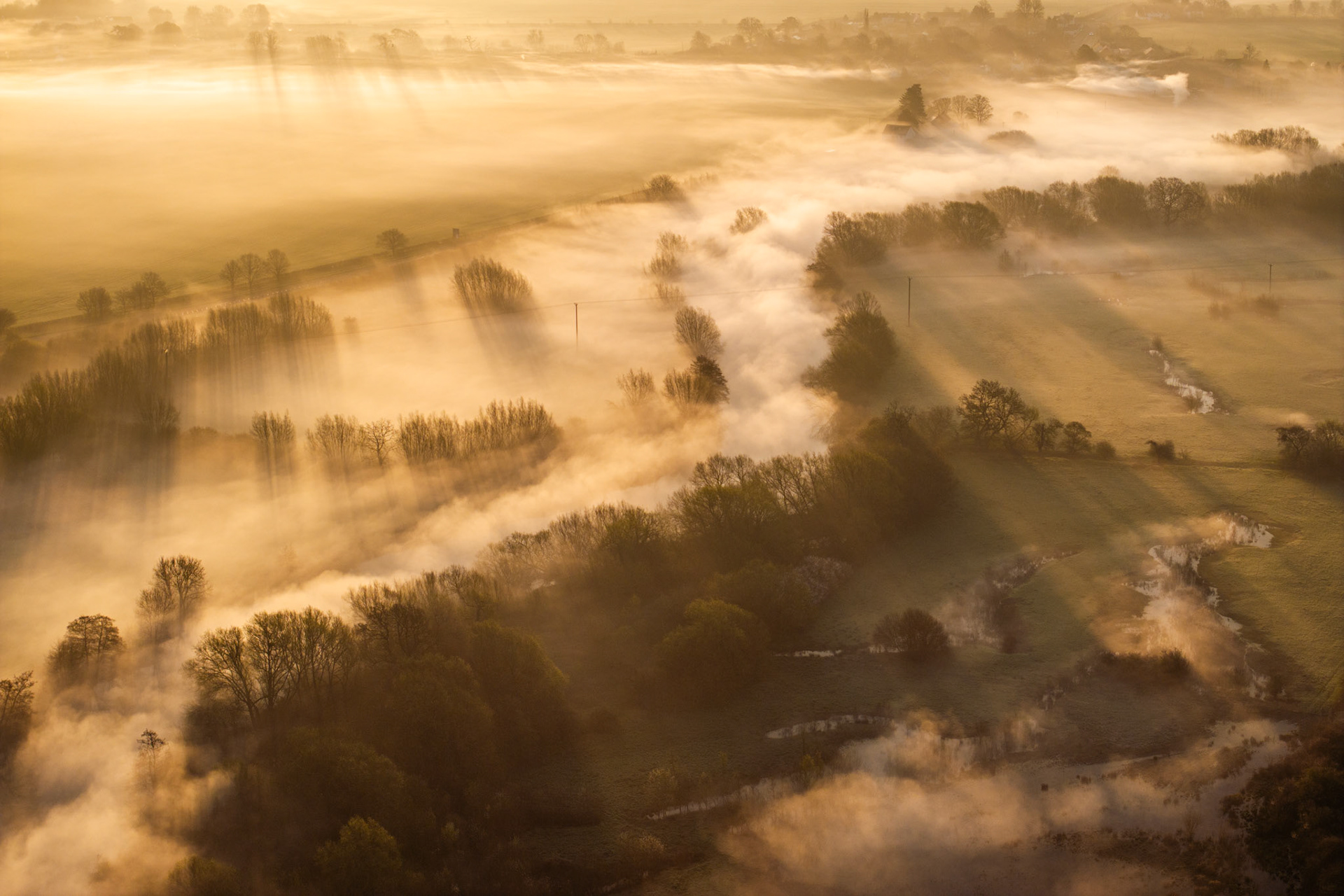
Ground fog pools along the Thames floodplain near Wallingford, pooling between lines of riparian woodland as low March sun casts raking crepuscular rays across the inversion layer. Shot from altitude at the equinox, the image resolves the valley into interlocking bands of light, mist, and bare canopy — the pastoral geometry momentarily obscured and revealed in the same breath.
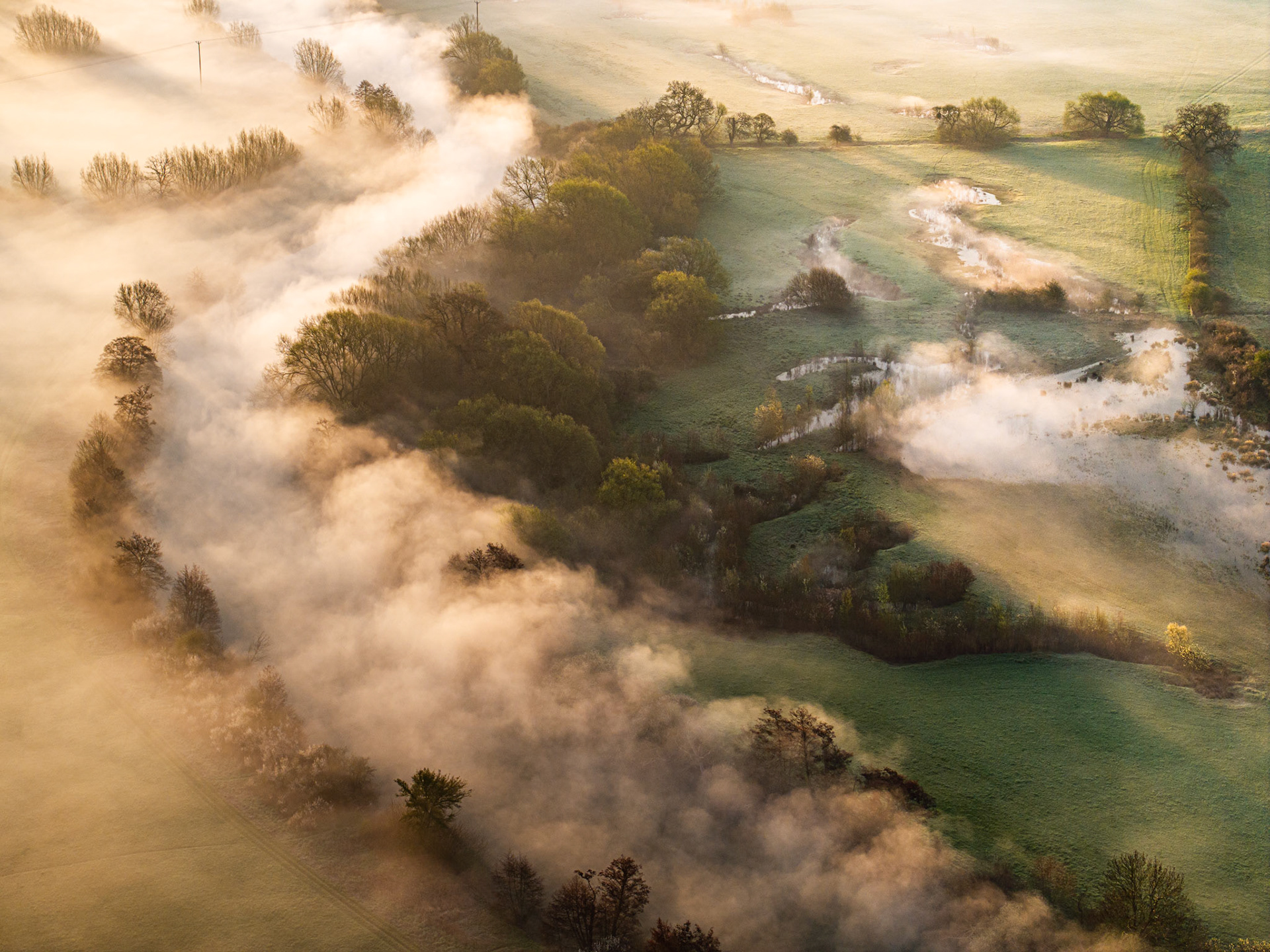
Low inversion fog pools along a chalk stream valley near Wallingford, Oxfordshire, at the spring equinox. Warm early-afternoon light catches the mist breaking from the riparian tree-line, revealing flooded meadows and a braided watercourse beneath. The aerial vantage abstracts the familiar Thames floodplain into something close to aerial geology.
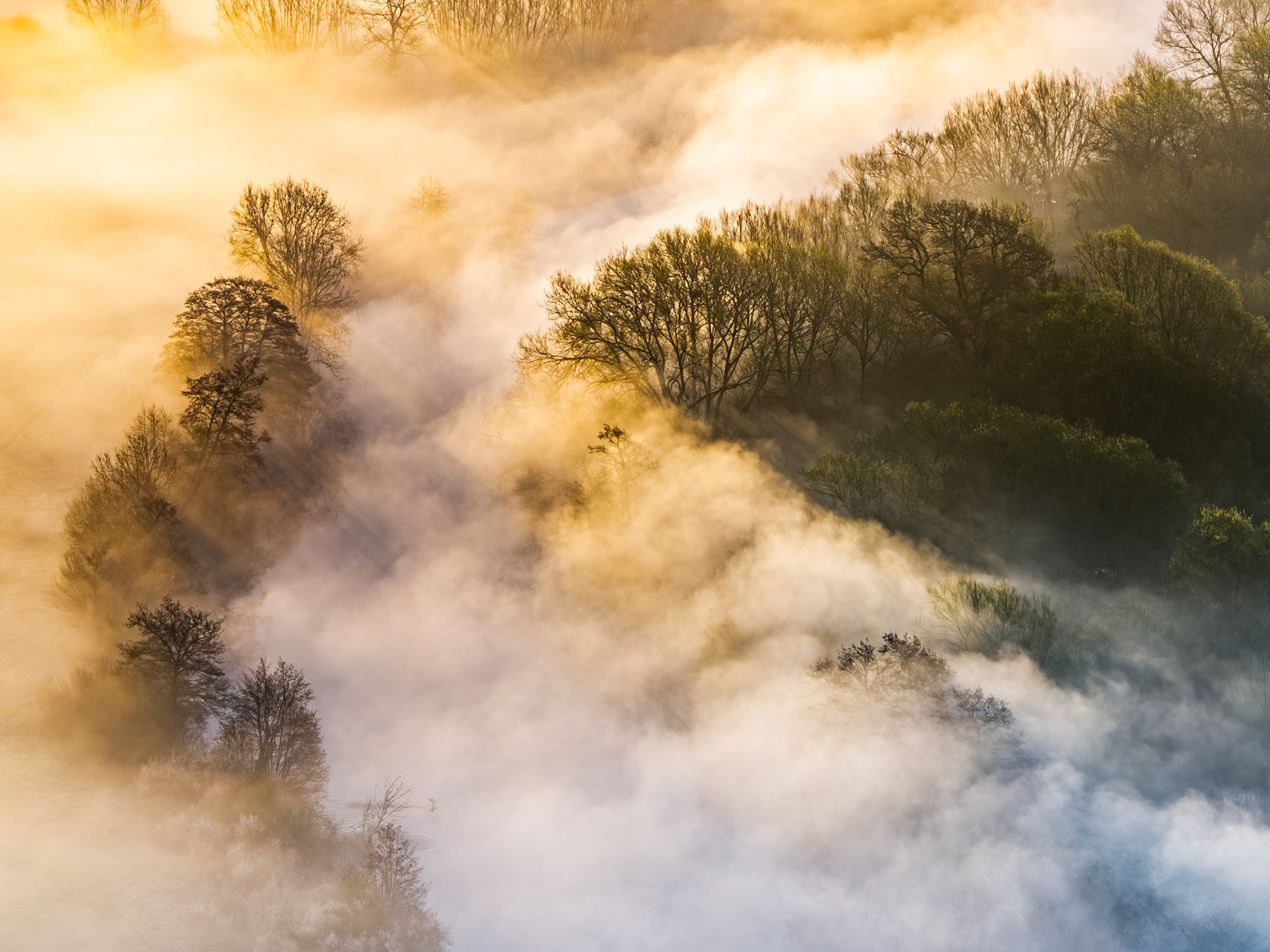
Ground mist pools and breaks across a wooded valley near Wallingford on a March morning, the low sun catching the fog from behind to separate warm and cool tones across a single frame. Bare and evergreen canopies emerge at different heights through the inversion layer, giving the scene an uncommon sense of depth and movement. The aerial perspective dissolves conventional landscape structure into something closer to ink and breath.
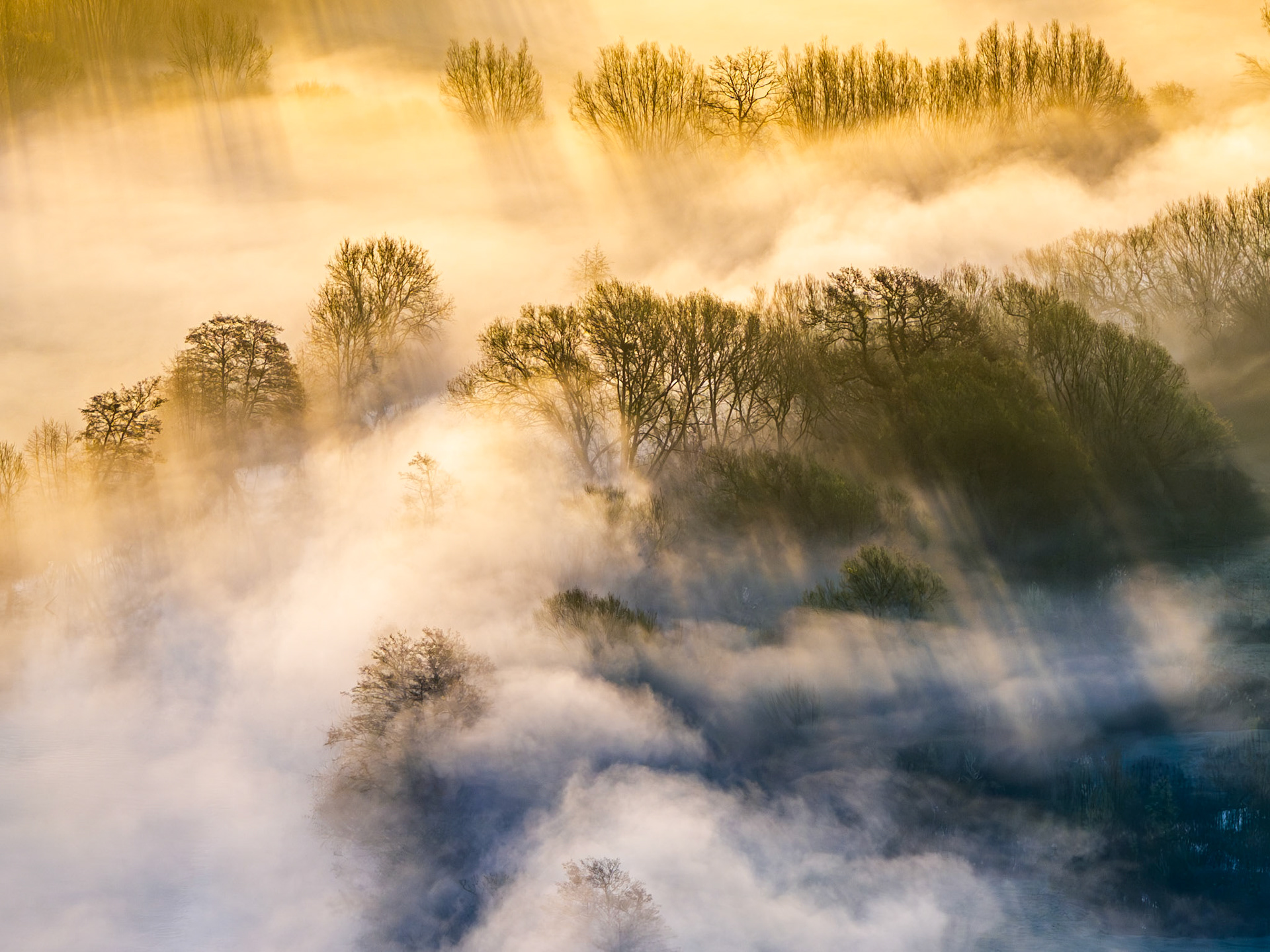
Ground-hugging mist rolls through bare-canopied riparian woodland above the Thames Valley at Wallingford, caught at the moment sunbeams pierce the inversion layer and separate light from shadow across successive tree lines. The aerial perspective dissolves the landscape into layered planes of amber and cold white, reducing woodland to silhouette and vapour to form. Captured at the spring equinox, when overnight cold and morning warmth conspire to produce conditions of this density and movement.
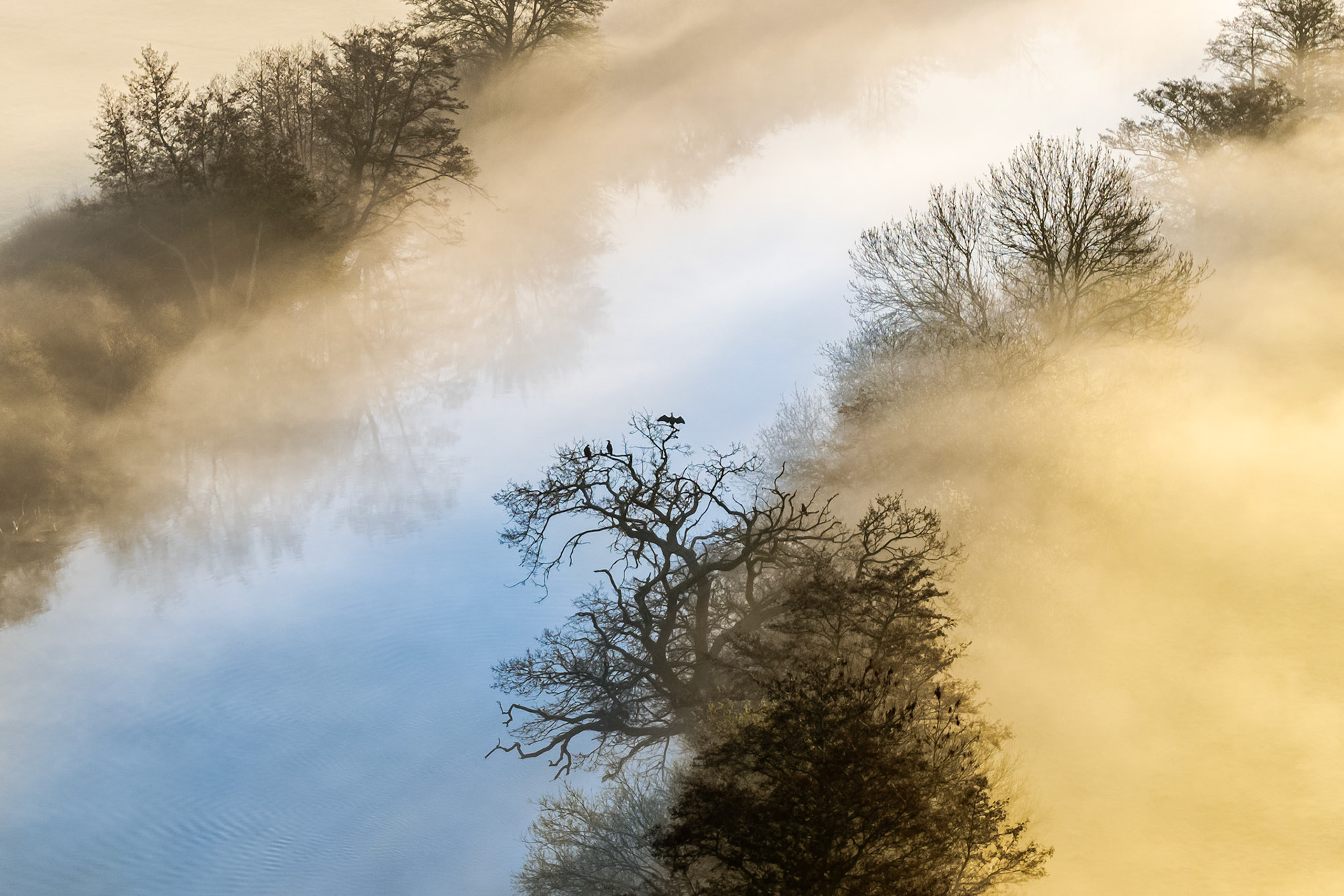
Ground fog pools across the Thames floodplain near Wallingford on a March morning, its warm and cool tones divided by a peninsula of bare-limbed oaks. A cormorant holds its wings outstretched at the crown of the central tree, flanked by roosting birds — a behavioural detail that anchors an otherwise abstract aerial composition.
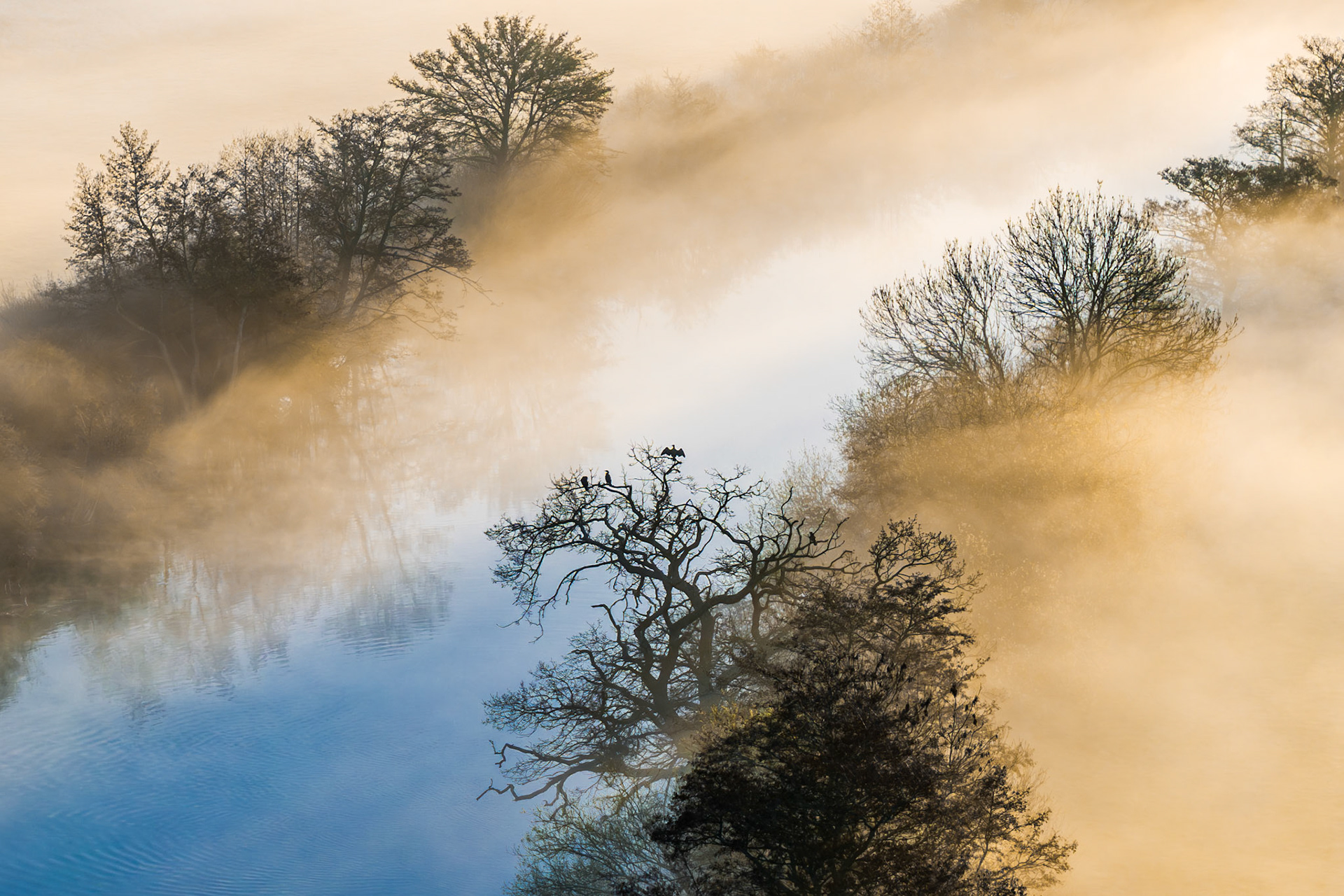
A cormorant spreads its wings from a bare oak standing in the River Thames near Wallingford, as a temperature inversion floods the valley with warm morning mist. The aerial perspective collapses foreground and distance into layered planes of silhouetted canopy and pale water, the bird providing a precise focal anchor within the abstraction. Captured at the spring equinox, when leafless trees retain enough transparency to hold the composition without closing it.
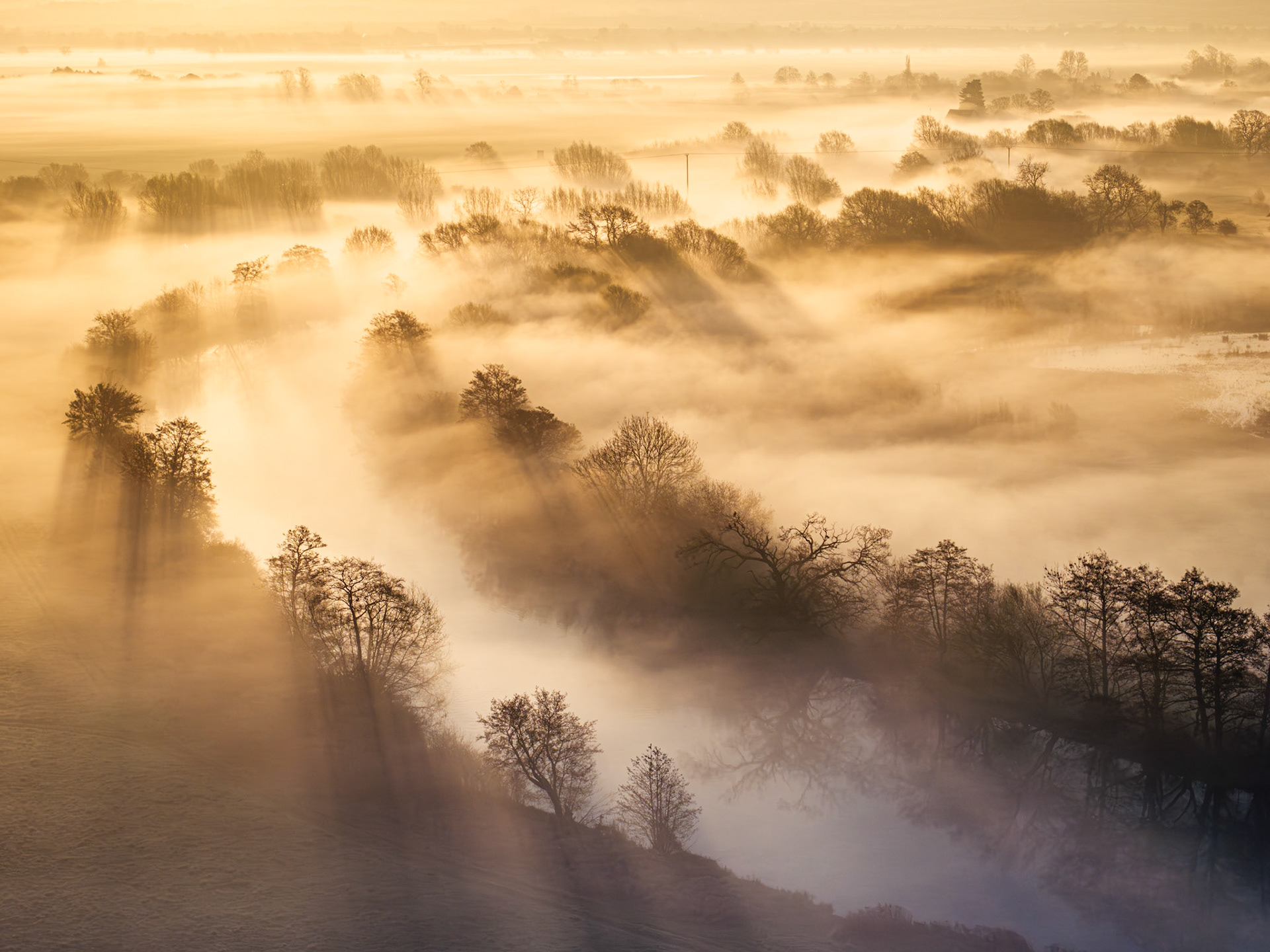
A temperature inversion fills the Thames Valley near Wallingford at dawn, submerging the hedgerows and field boundaries beneath a continuous fog layer. Bare-limbed trees puncture the surface in loose diagonal lines, casting crepuscular rays that radiate across the mist in warm, directional light. The elevated drone perspective compresses the receding treelines into layered planes, rendering the familiar agricultural landscape briefly unrecognisable.
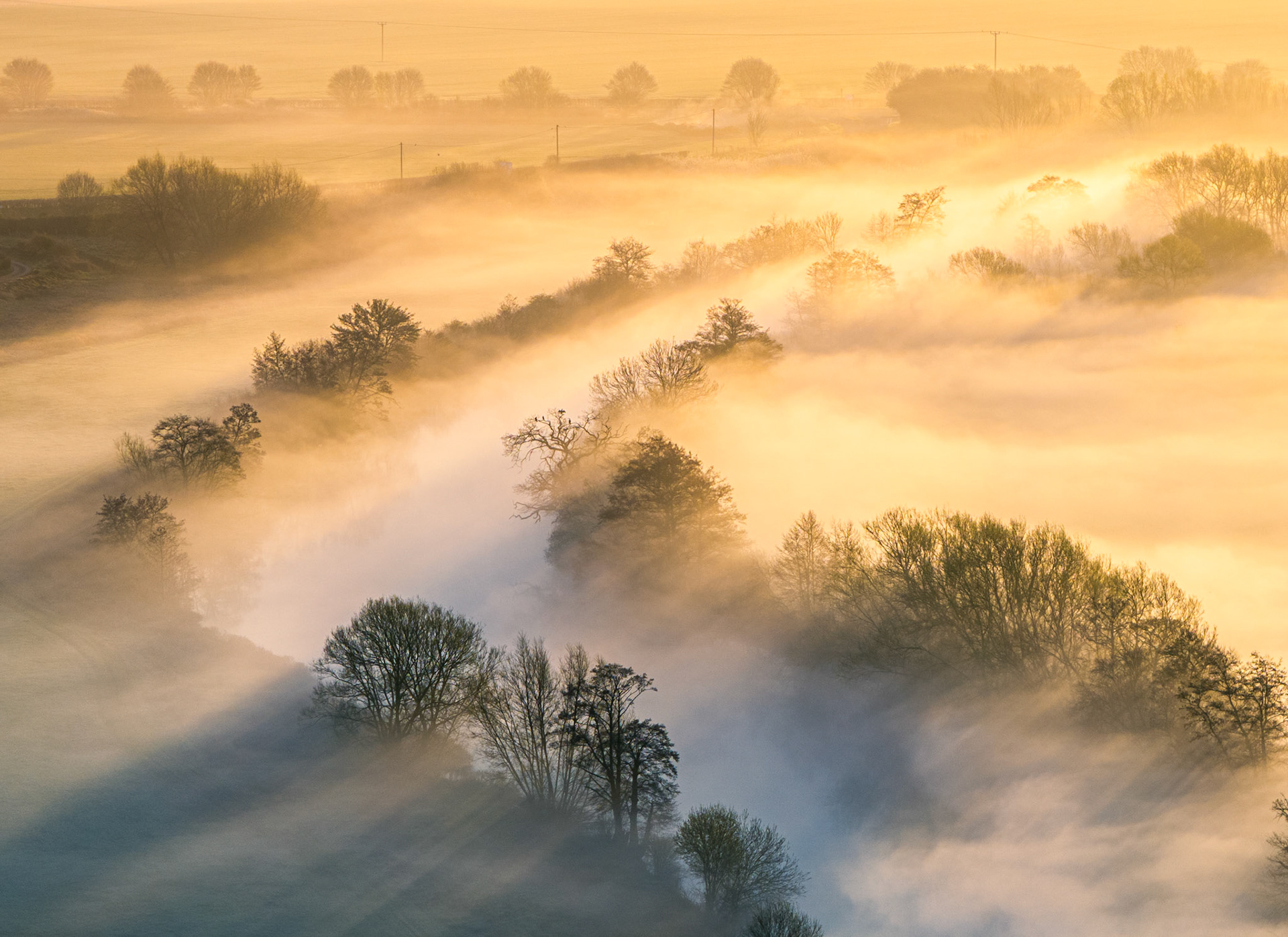
A temperature inversion traps ground fog across the Thames Valley near Wallingford, with hedgerow trees and field copses emerging as dark silhouettes from the luminous white layer. Low March sunlight rakes in from the east, casting long tree shadows across the fog surface and revealing the sinuous lines of field boundaries beneath. The elevated drone perspective flattens the scene into near-abstraction while preserving a strong sense of depth through layered recession.
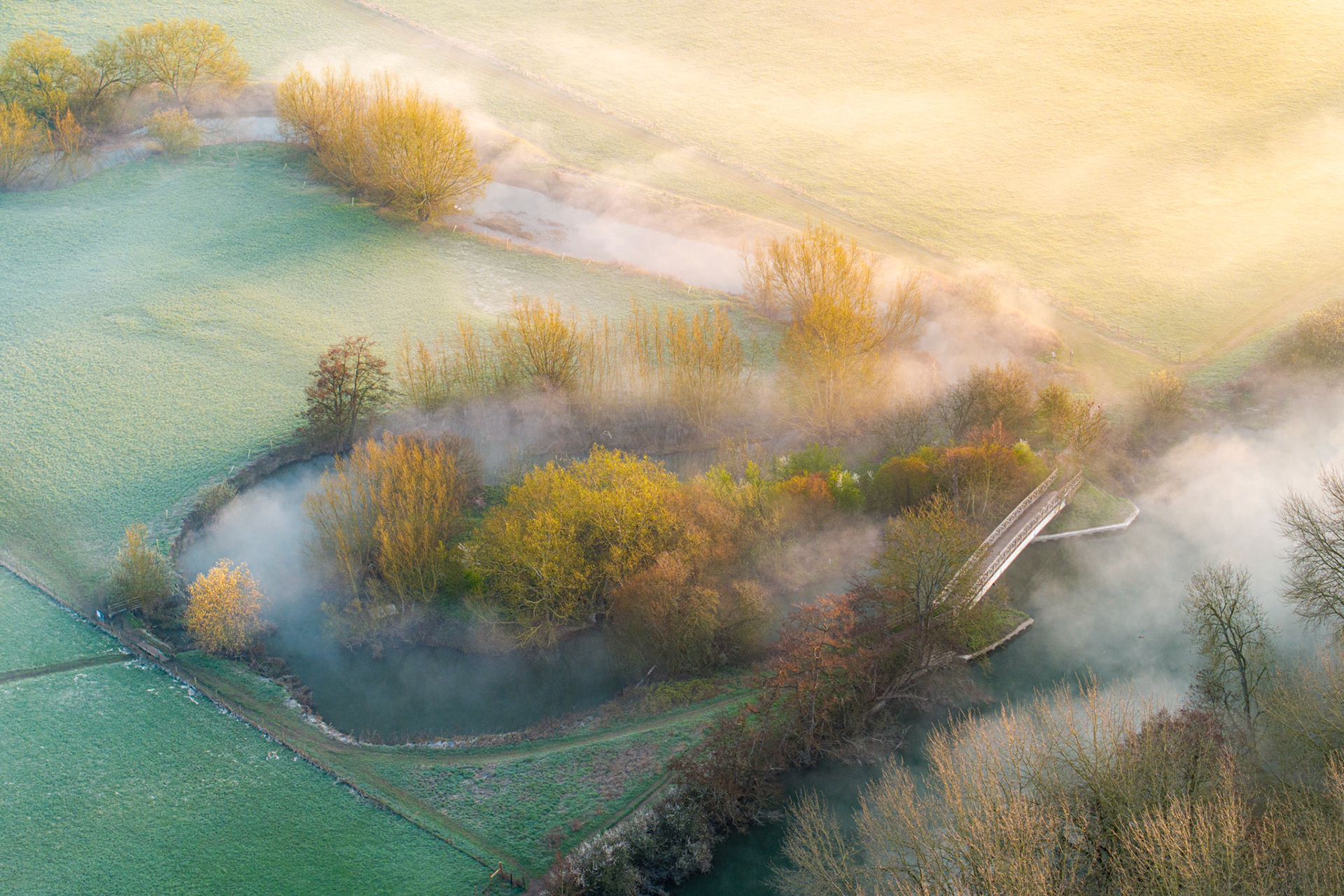
River mist lifts from a wooded meander near Abingdon-on-Thames on a frost-sharp spring morning, the still-bare willows catching low warmth while ground fog pools in the curve of the channel. A footbridge emerges briefly through the vapour on the eastern bank, anchoring the composition without disrupting its dreamlike quality. The aerial vantage reveals the geometry of frost-bleached pasture surrounding the island of trees.
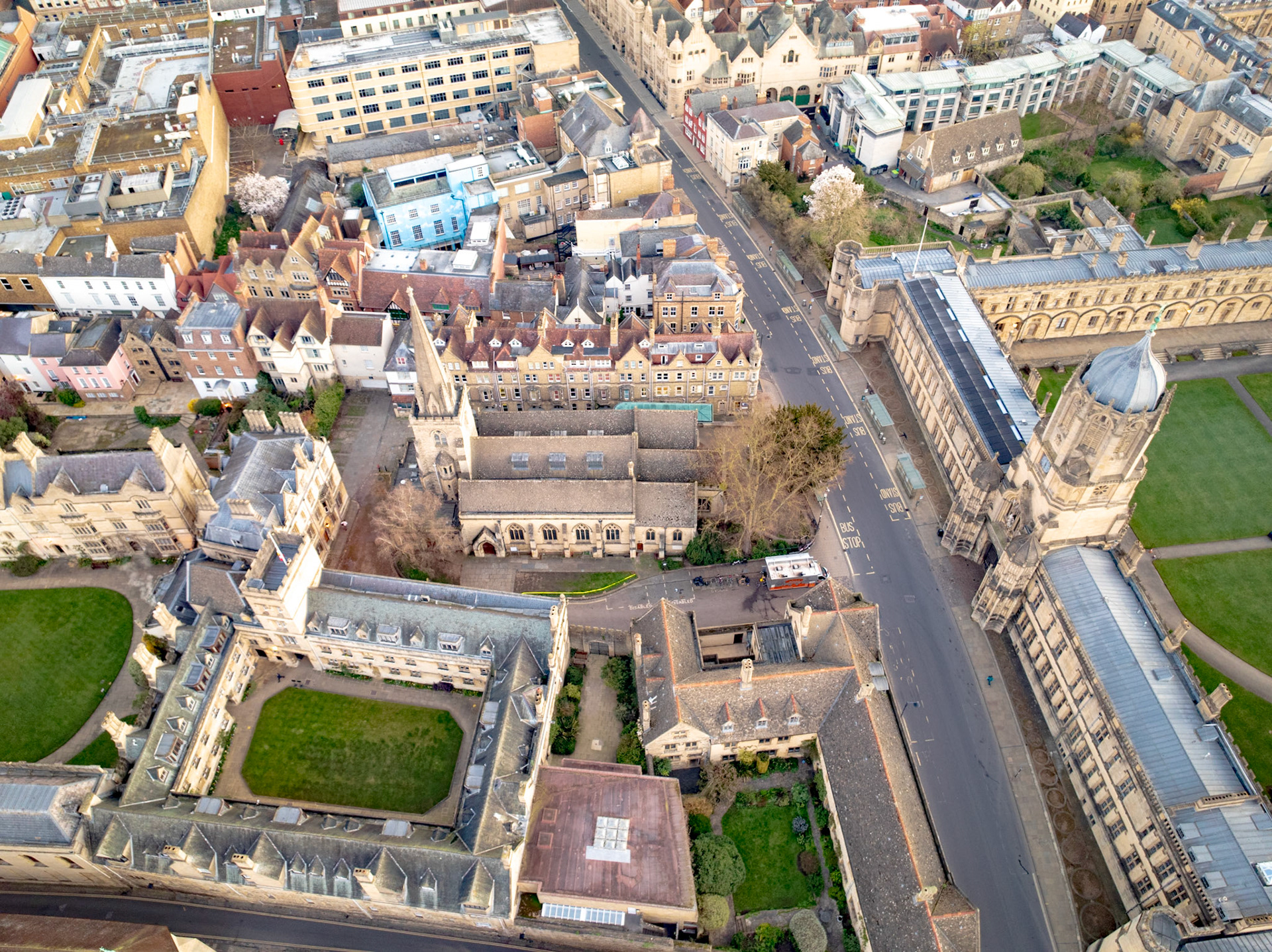
Oxford city centre seen from directly above in flat spring light, the quadrangles and rooflines of historic college buildings arranged in compressed, interlocking planes. The diagonal run of the High Street bisects the frame, anchoring the dense medieval and Georgian fabric against patches of college lawn. Flat overcast diffuses shadow and reduces tonal contrast across the scene.
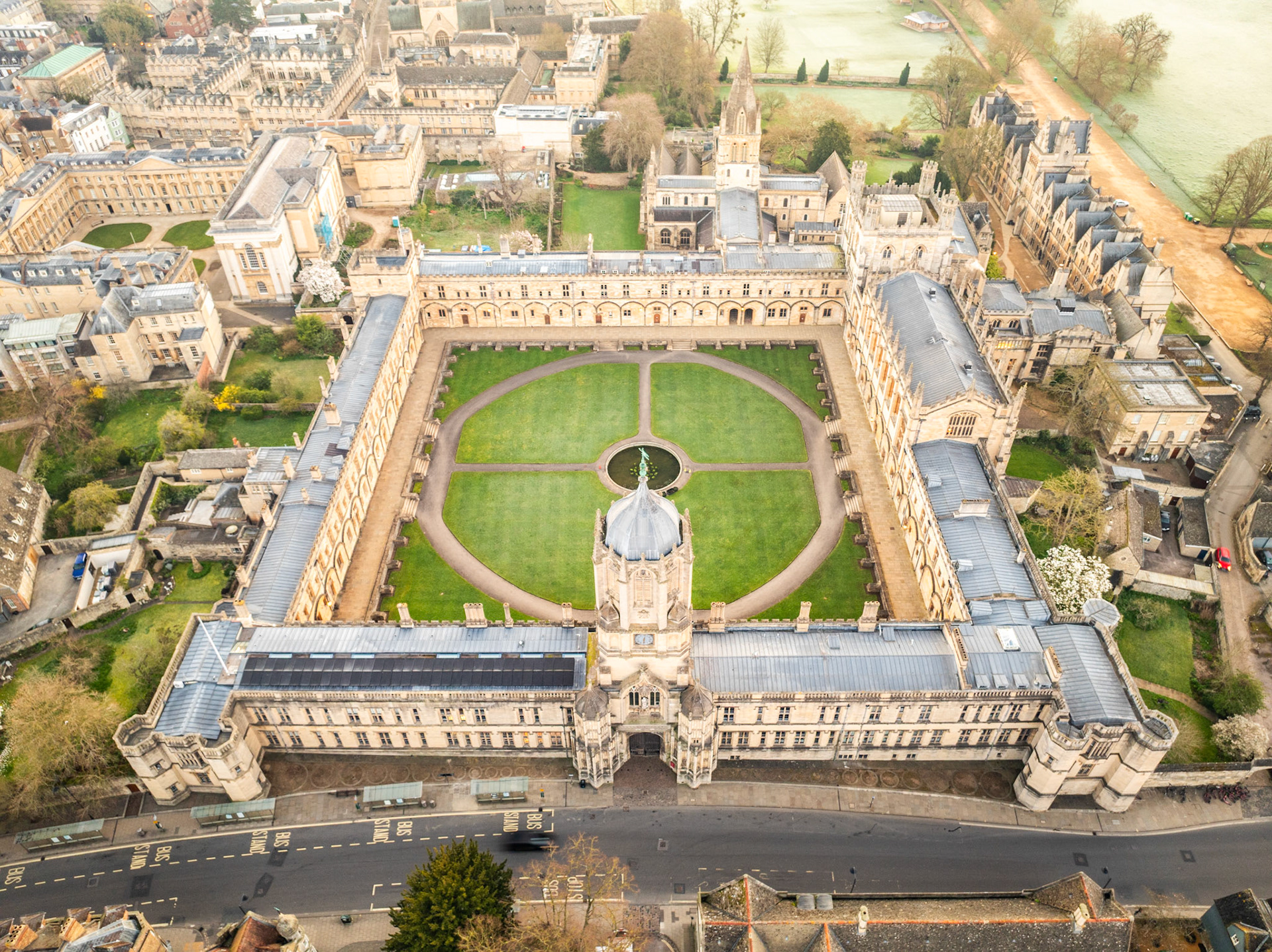
The symmetrical courtyard of All Souls College, Oxford, resolves from directly overhead into a geometry of limestone colonnades and circular lawn paths centred on a small fountain. Shot in flat spring light on 22 March, the overcast sky strips the scene of shadow drama but renders the Cotswold stone evenly, emphasising pattern over atmosphere. The image is competent and well-framed but reads as architectural documentation rather than a distinctive aerial landscape.
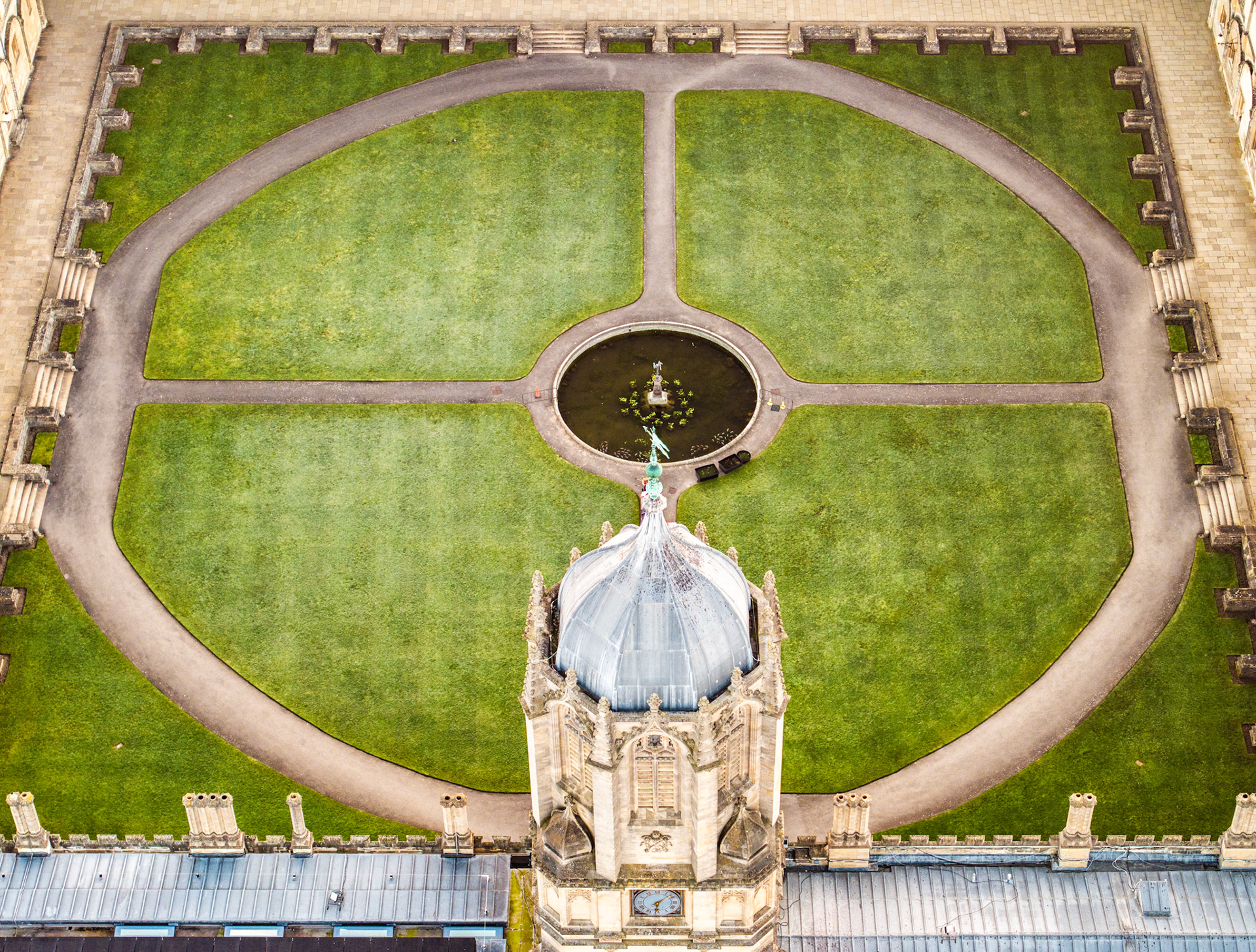
The dome of the Radcliffe Camera intrudes into the lower frame as a drone directly above traces the formal geometry of Radcliffe Square, Oxford. Circular gravel paths divide four quadrants of close-mown lawn, converging on a central fountain pool. The flat March light suppresses shadow and reduces the scene to near-diagrammatic form.
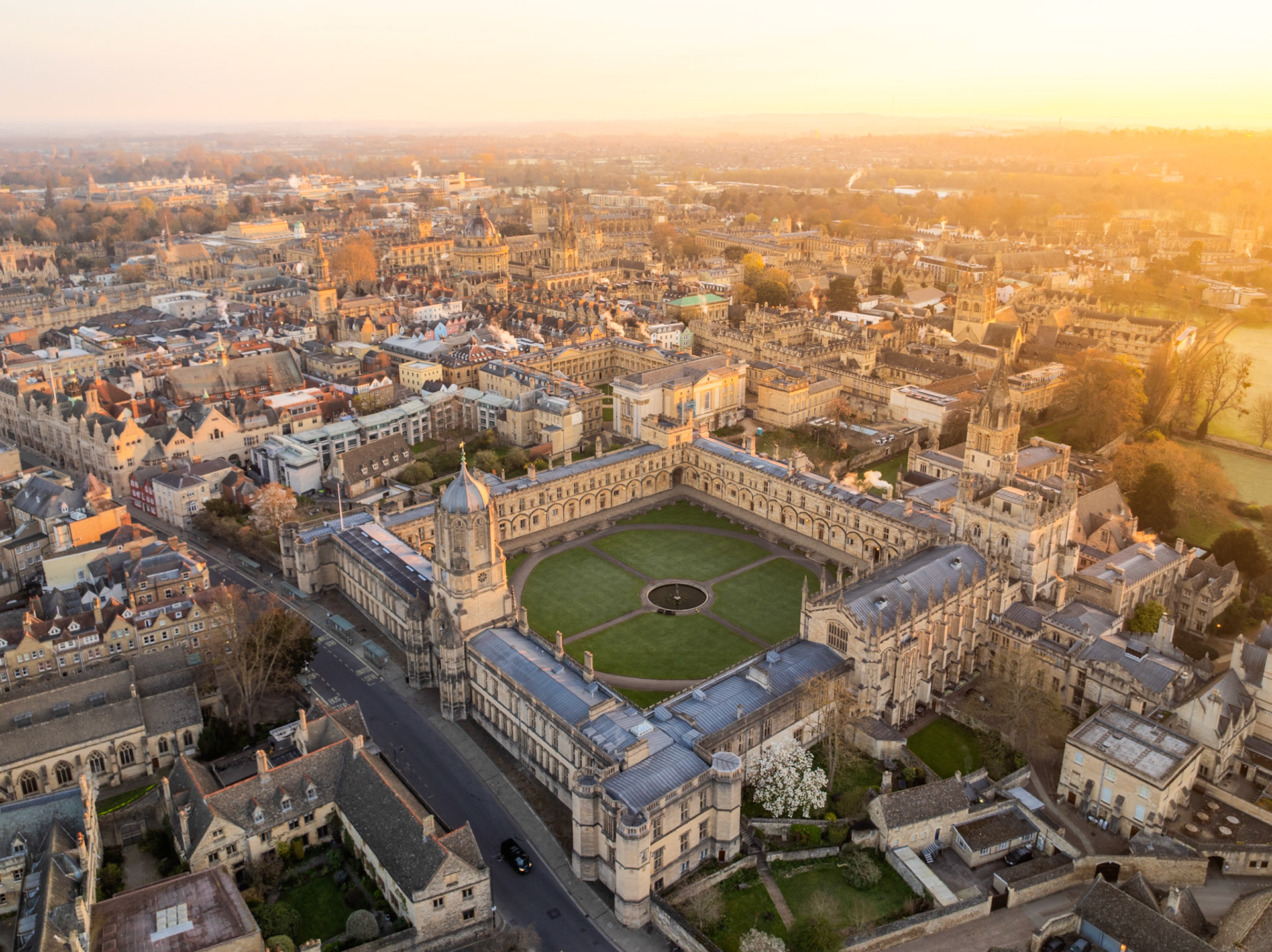
Christ Church College occupies the centre frame at low sun, its Tom Quad lawn and fountain rendered crisp from altitude. The warm raking light of a March late afternoon catches the Cotswold limestone across the Oxford skyline, dissolving into haze toward the horizon. A single flowering tree at the south range adds the only botanical note to an otherwise architectural study.
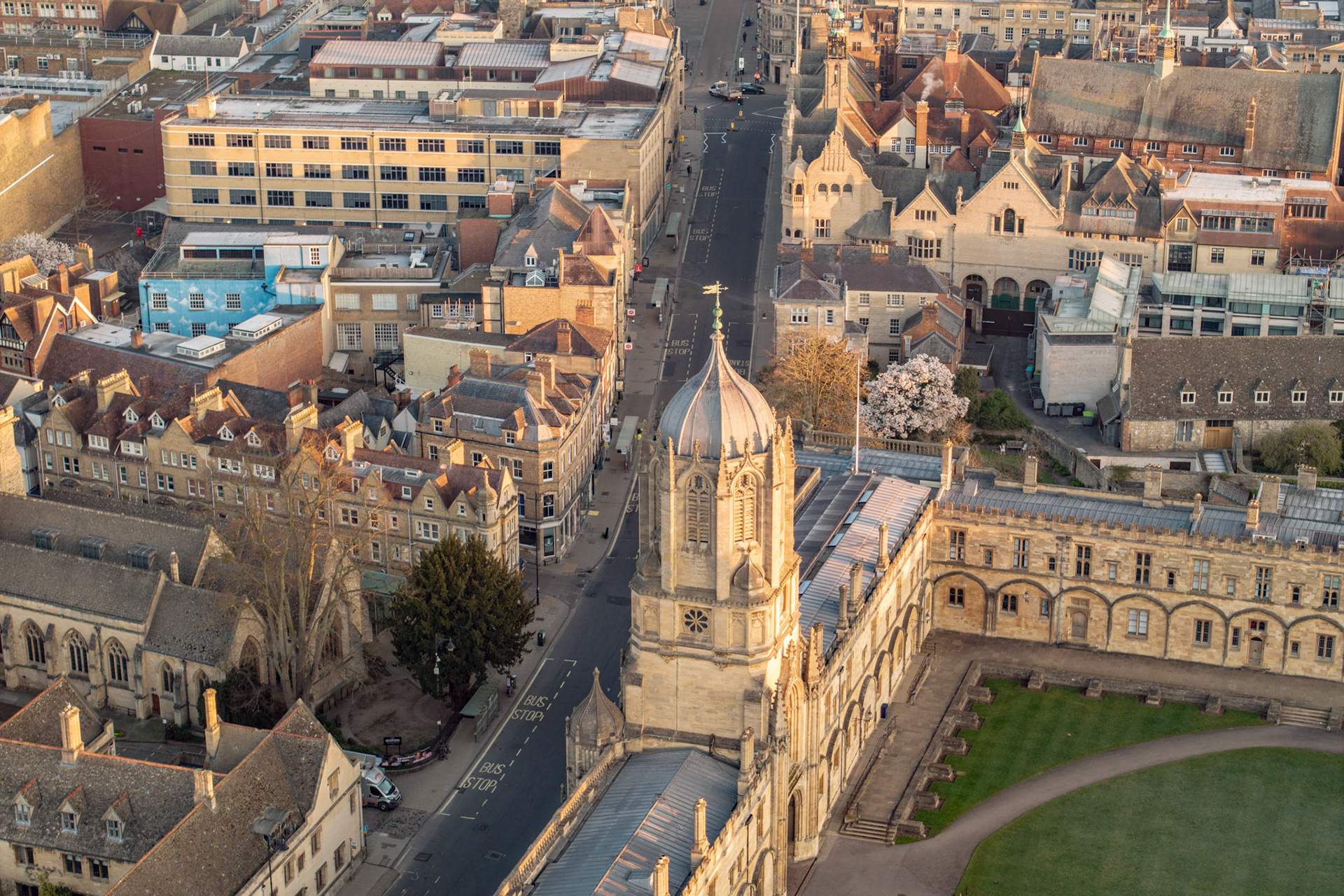
An aerial view across central Oxford catches the Tom Tower of Christ Church bathed in late-afternoon winter light, the pale Cotswold limestone glowing against the shadow-cooled roofscape of the High Street corridor. A single flowering cherry tree punctuates the collegiate stonework to the east. The composition is competent but the urban clutter beyond the college boundary dilutes the quiet authority the subject demands.
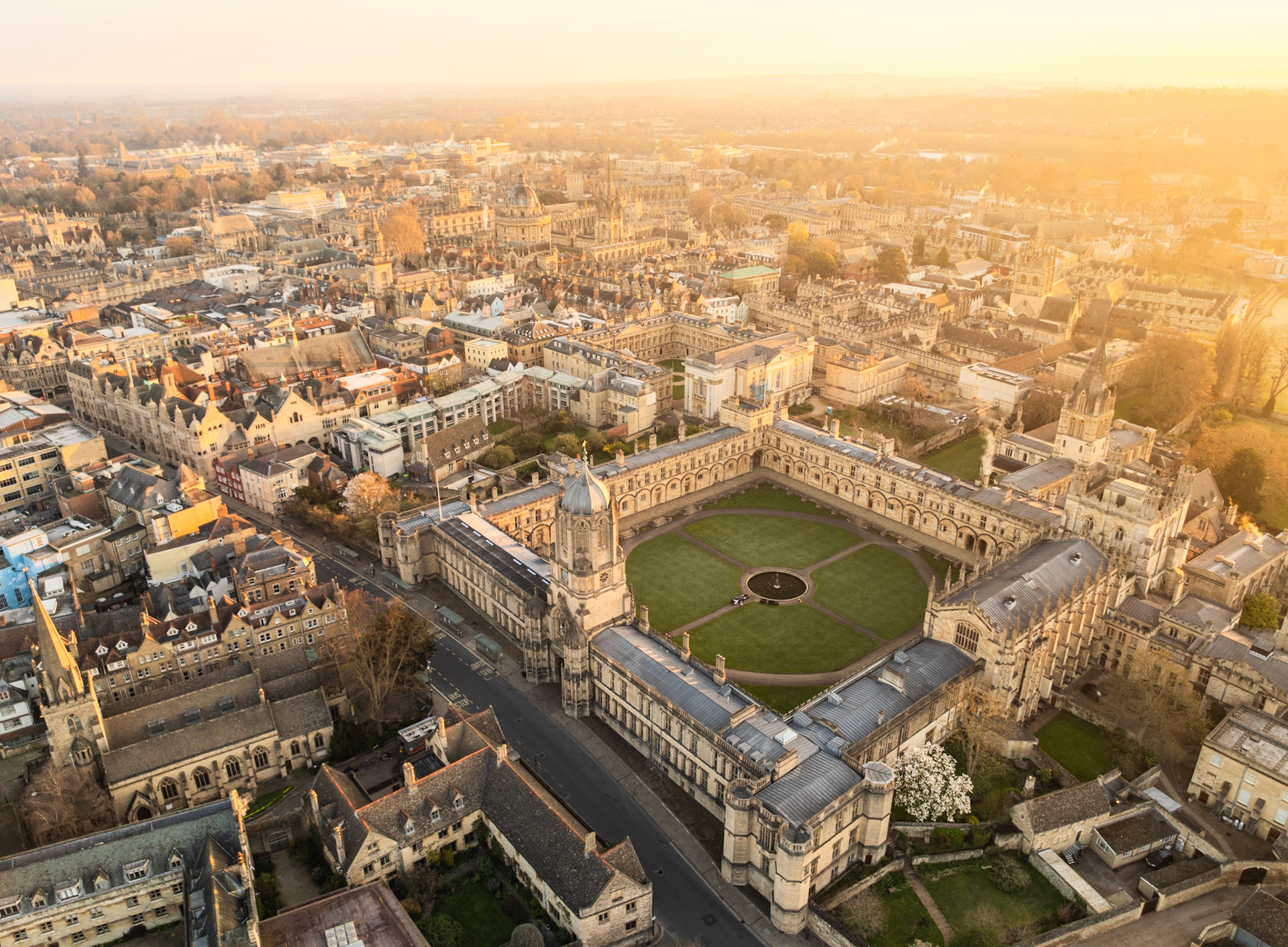
Christ Church College seen from altitude at late-afternoon golden hour in early spring, its quadrangle lawn and central fountain sharply resolved against the honey-coloured limestone of Oxford's medieval core. The warm haze softens the city's edges without obscuring the collegiate geometry that defines the foreground.
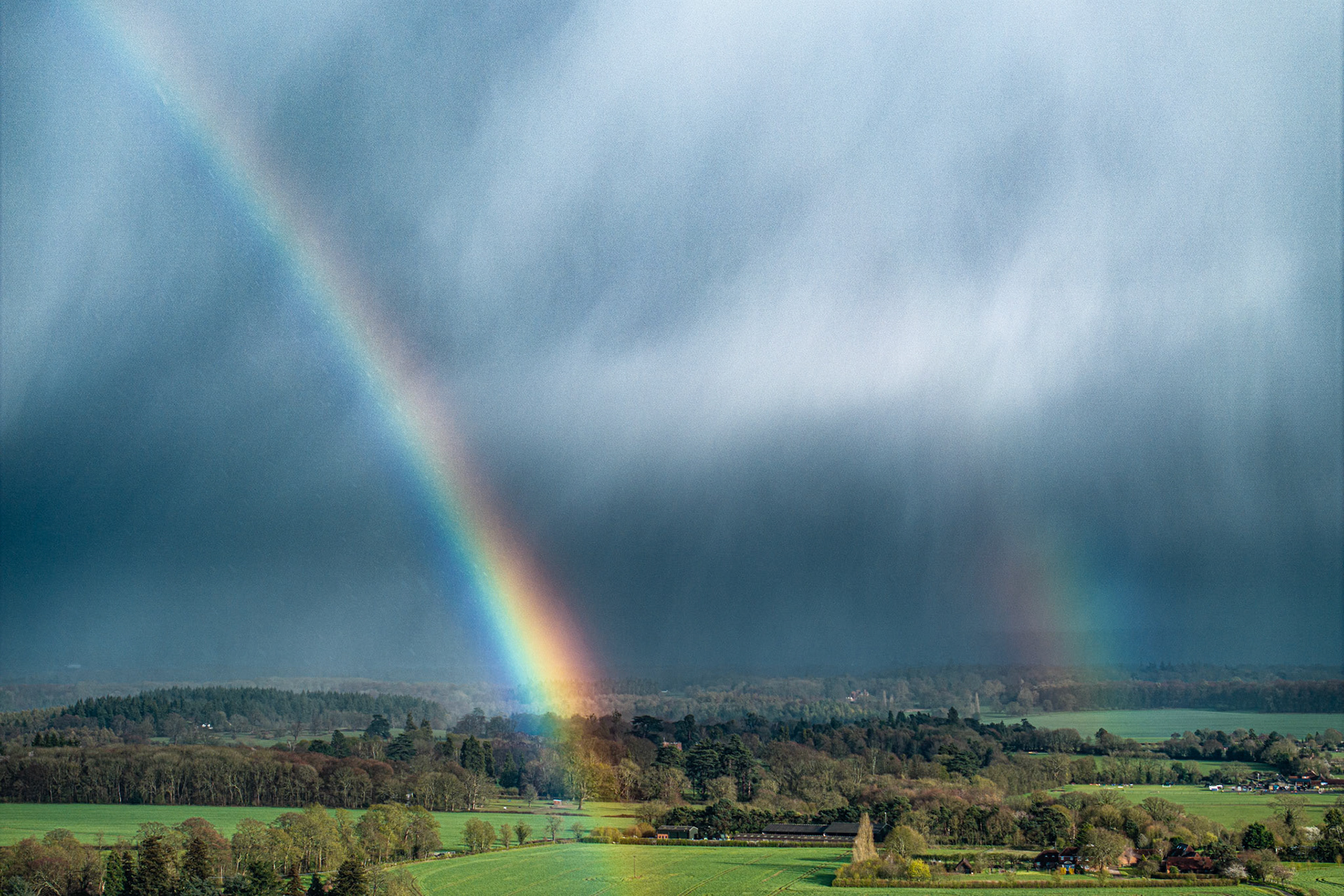
A vivid primary rainbow descends through the base of a storm cell above the Thames Valley near Henley, its foot illuminated by a shaft of low evening light breaking beneath the advancing cloud. The aerial vantage compresses the arc against a dark curtain of rain, while spring fields and deciduous woodland spread beneath in fresh growth. The convergence of storm shadow and spectral colour gives the image an uncommon intensity.
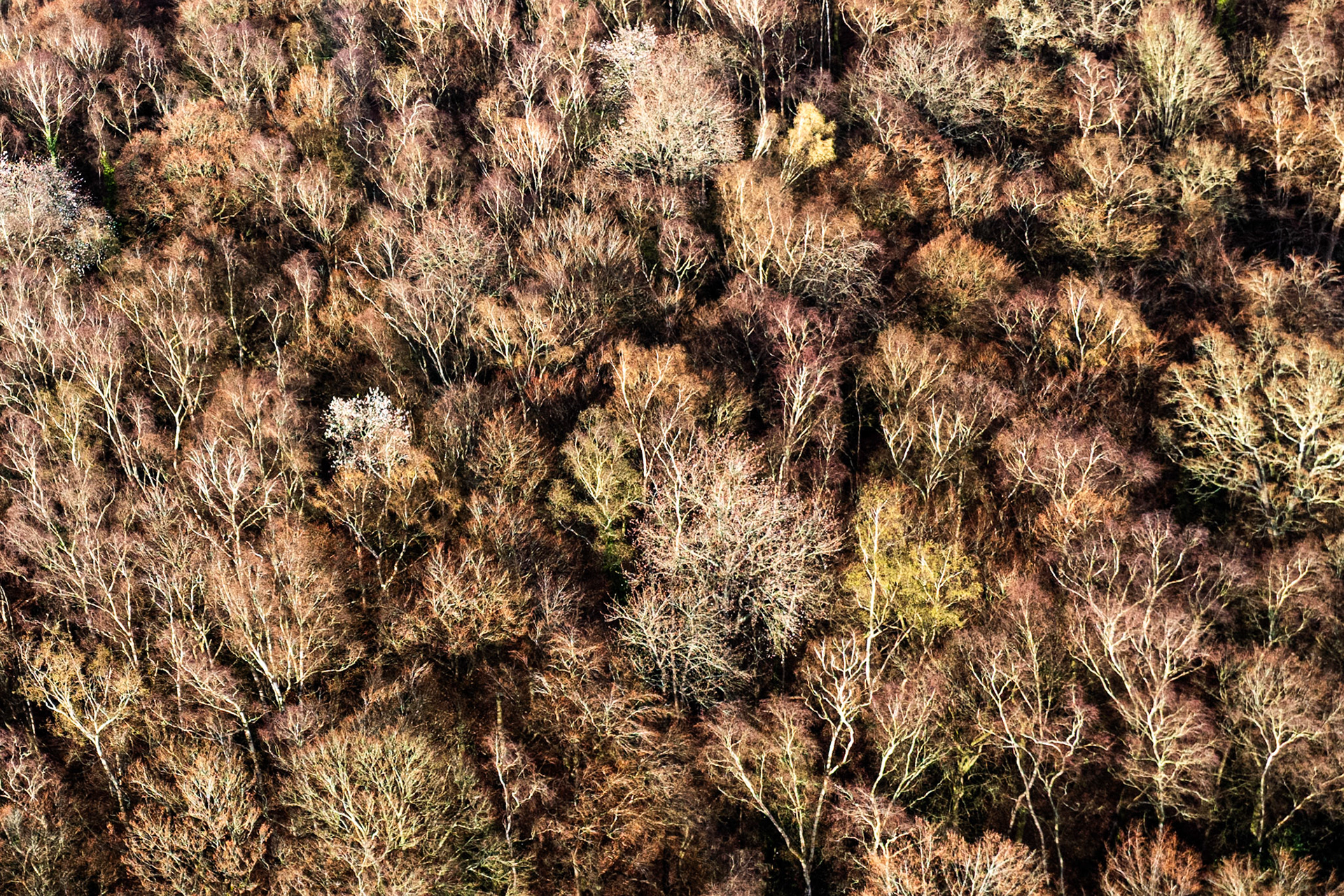
An overhead view of mixed deciduous woodland near Henley-on-Thames captures the canopy in the last days before leaf-break, the pale silver of birch and beech stems threading through residual russet and patches of evergreen understorey. Raking sidelight from a low sun picks out individual crowns against the shadowed mass beneath, giving the flat plane of treetops an unexpected sense of relief and texture.
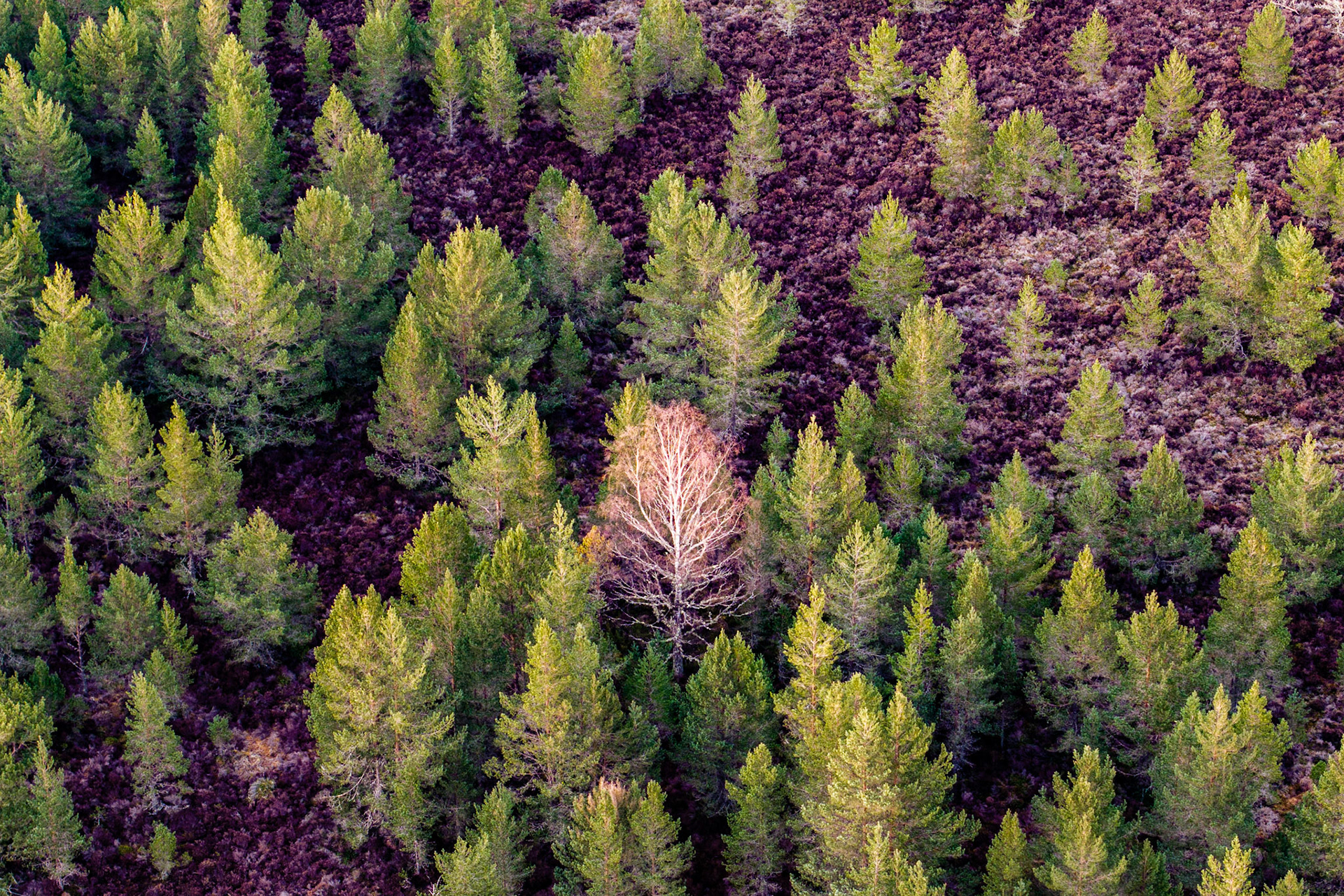
A single leafless birch, its pale branches luminous against a sea of young Scots pines, stands exposed within a mosaic of heather moorland near Aviemore. The overhead perspective flattens the forest into a repeating pattern of conical crowns, disrupted only by this one skeletal form at the centre. The dead or dormant tree reads as both anomaly and anchor, giving the abstract composition an unexpected stillness.
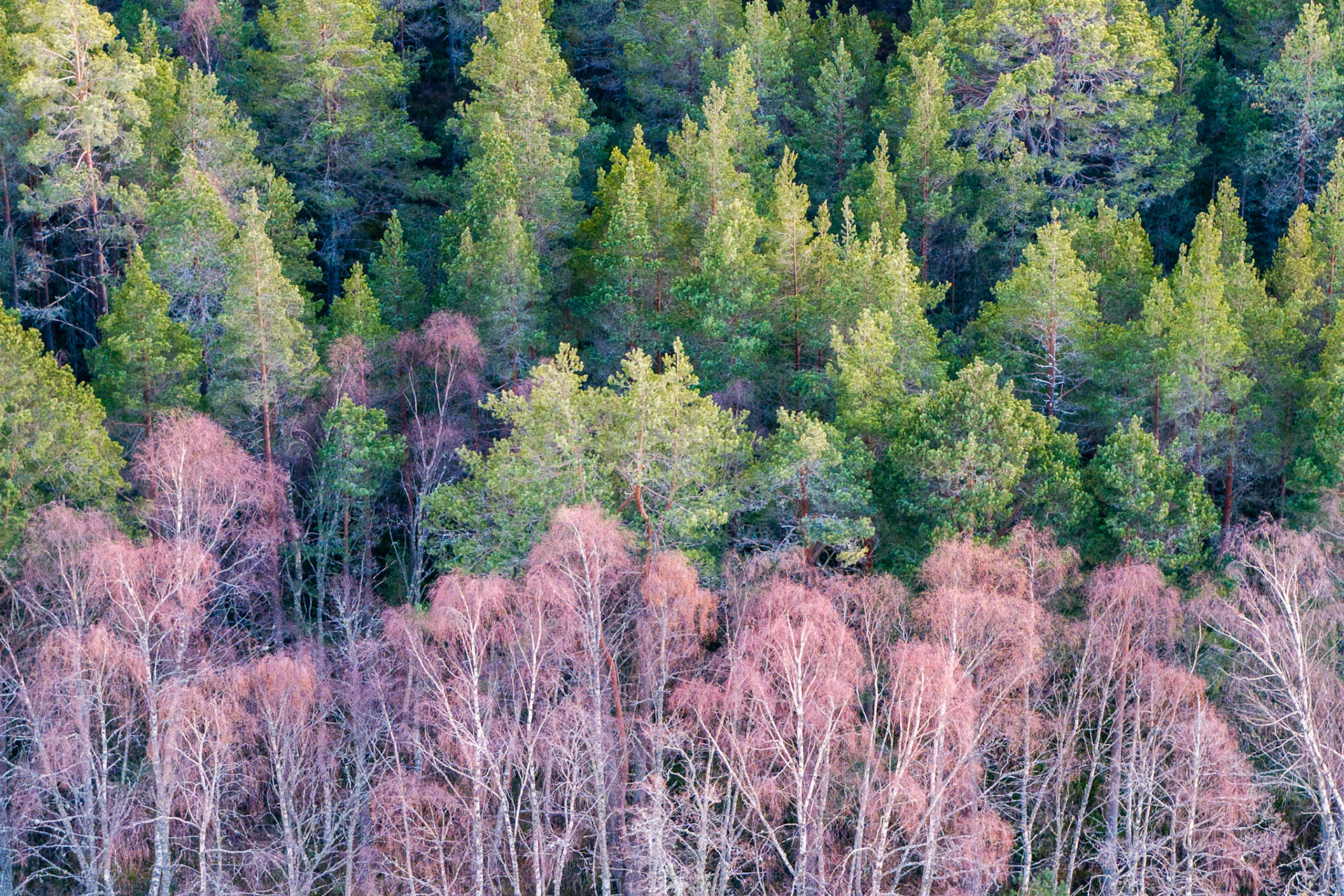
A compressed aerial view over mixed boreal woodland near Aviemore reveals the seasonal contrast between bare silver birch and the year-round canopy of Scots pine. The reddish-purple haze of birch catkins and emerging twigs reads as a soft wash against the sharp green of the pines behind. Early April light catches the upper crowns, drawing a quiet horizontal boundary between the two species.
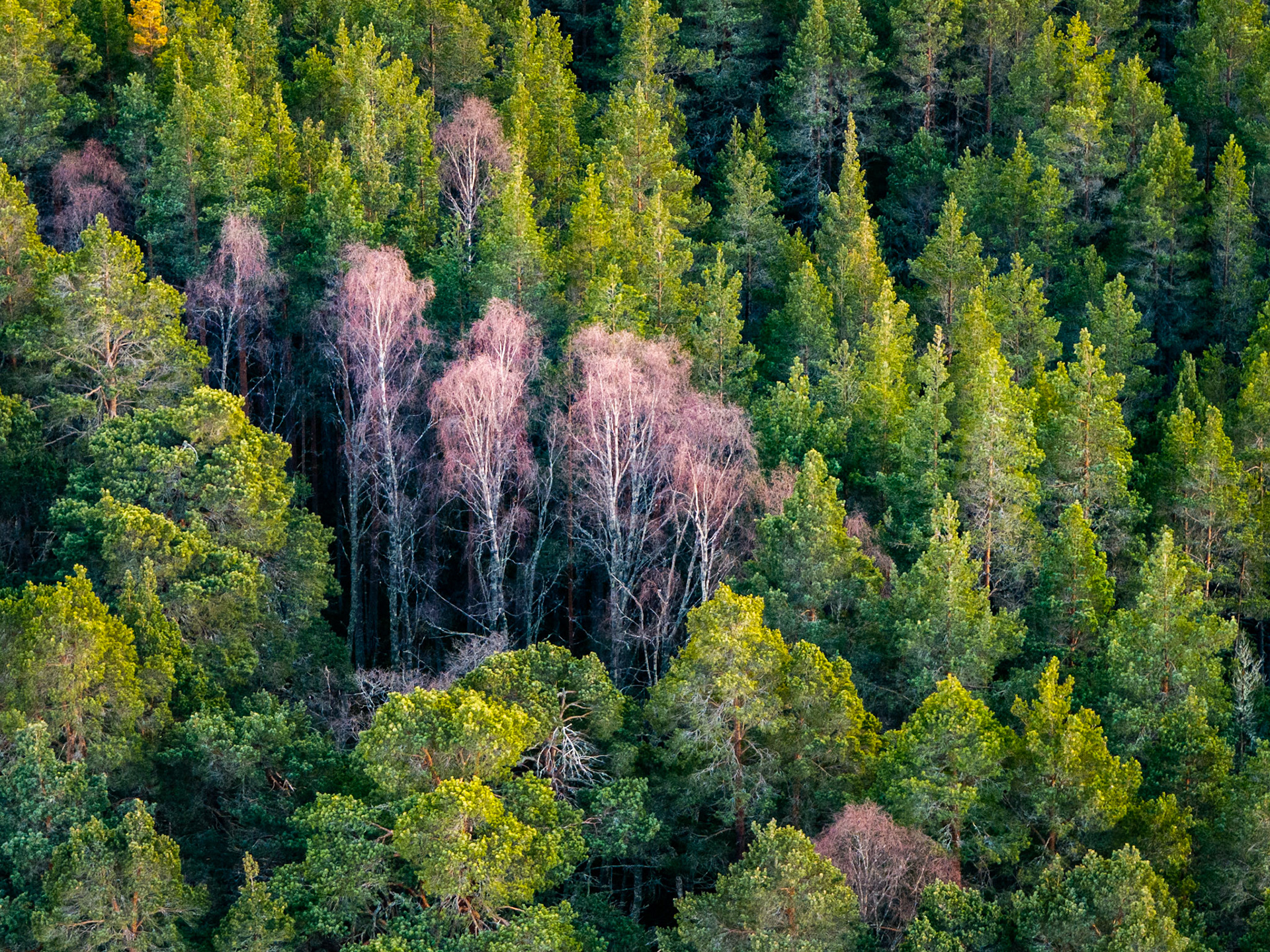
A cluster of leafless birch trees, their white stems catching early light, punctuates a dense canopy of Scots pine on a hillside above Aviemore. Photographed from the air in early April, the dying or recently dead birches read as a pale wound within the otherwise uniform green. The aerial compression flattens depth, turning the forest into near-pattern.
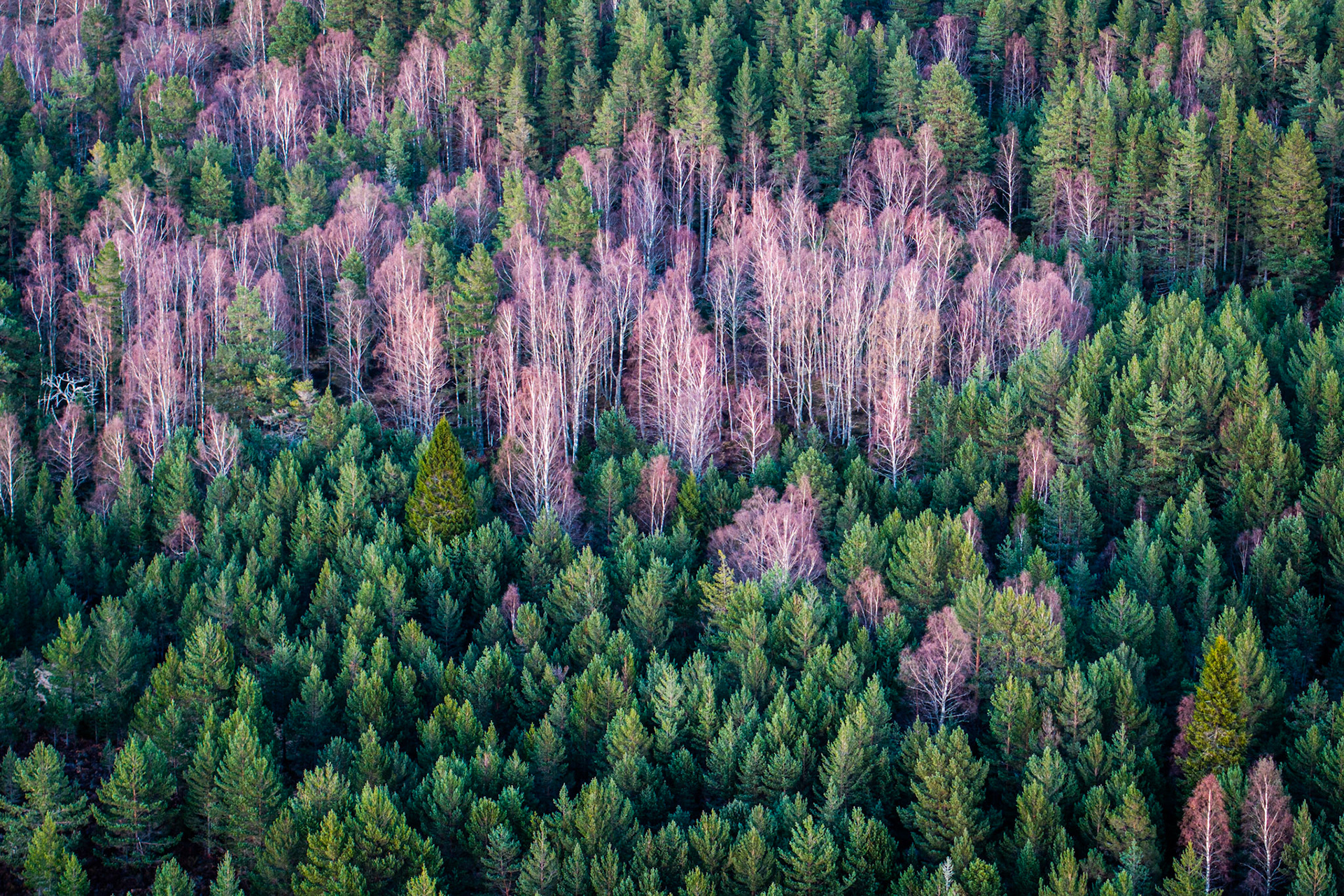
A band of leafless birch, their pale limbs suffused with the pink blush of early bud, runs through a dense stand of Scots pine on a Cairngorms hillside. Photographed from altitude in early April, the tonal contrast between the dormant deciduous trees and the deep evergreen canopy gives the image its quiet structural tension. No sky intrudes; the frame reads entirely as pattern.
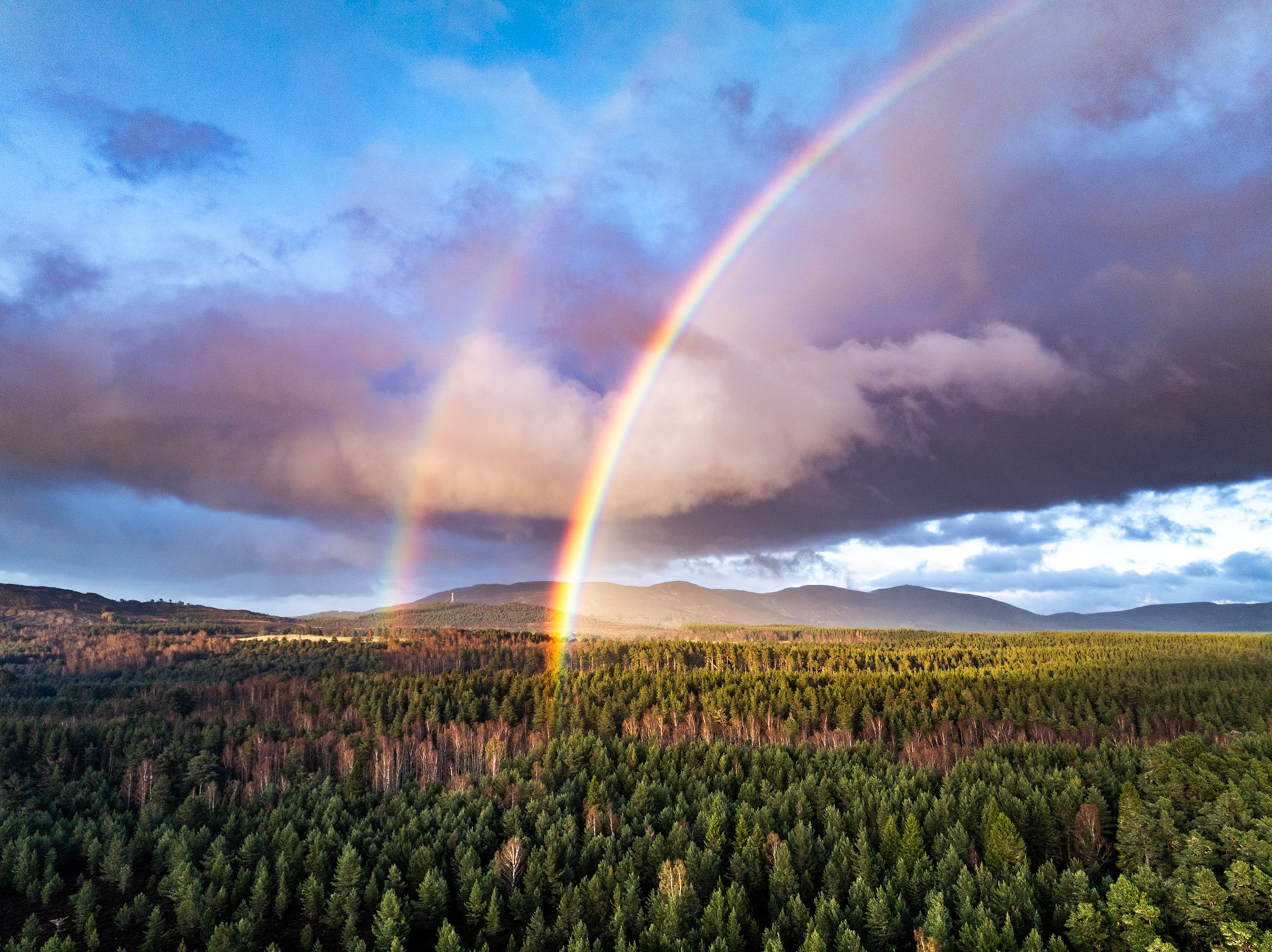
A double rainbow descends into the Scots pine forest of Strathspey, its feet converging near the treeline as a squall clears over the Cairngorm plateau. The aerial vantage compresses the full arc geometry against a bruised cumulonimbus, with raking low sun warming the canopy below. Captured at dusk in April above Aviemore.
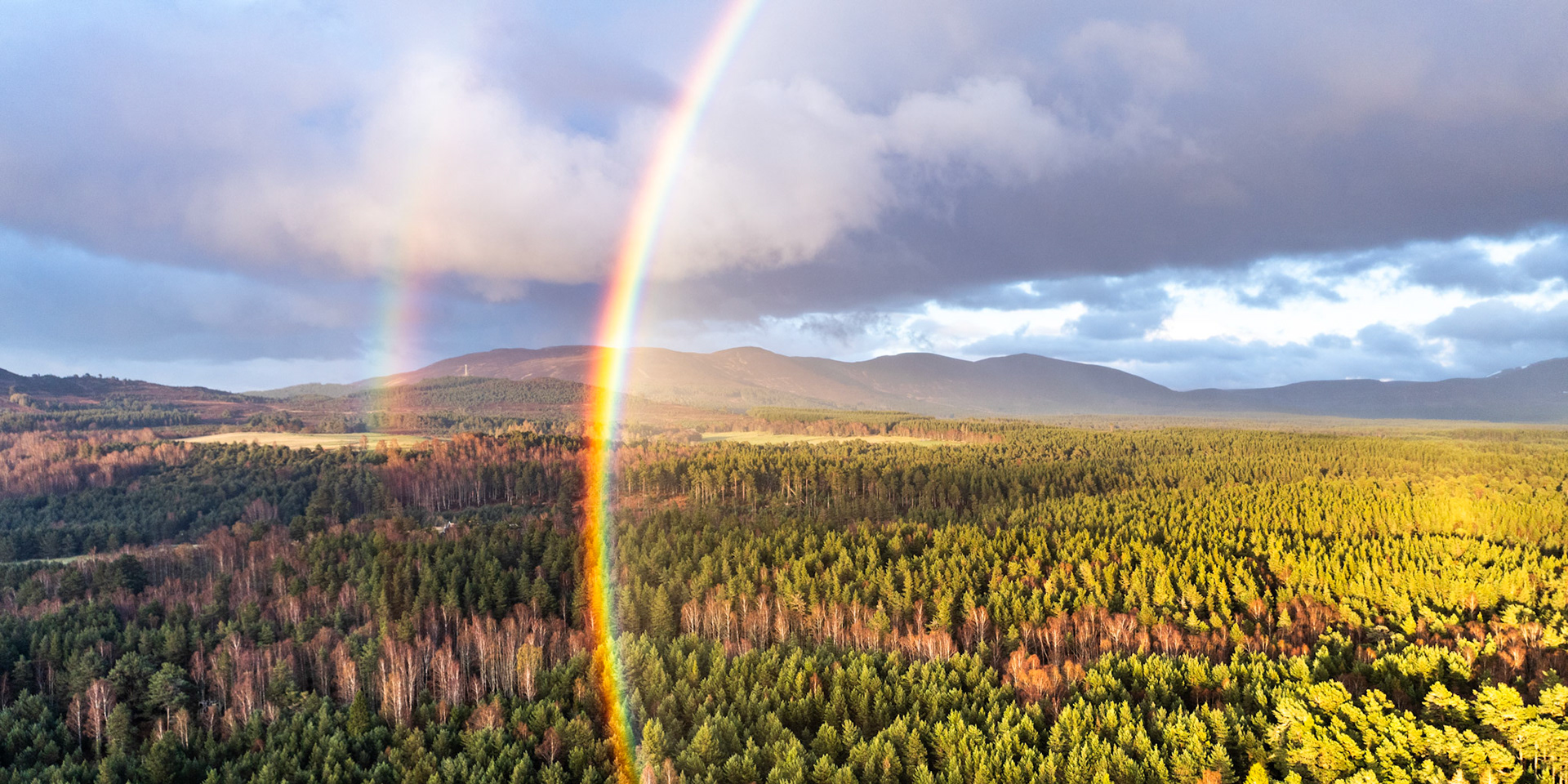
A full rainbow descends into the native pinewood of Rothiemurchus from aerial altitude, its base lost in the canopy as storm cloud retreats north across the Cairngorm massif. Late-afternoon sun rakes the forest floor, separating shadow from warm light across the tree-tops in a patchwork of amber and green. The Cairngorm plateau and its flanking ridges anchor the horizon beneath a broken, dramatic sky.
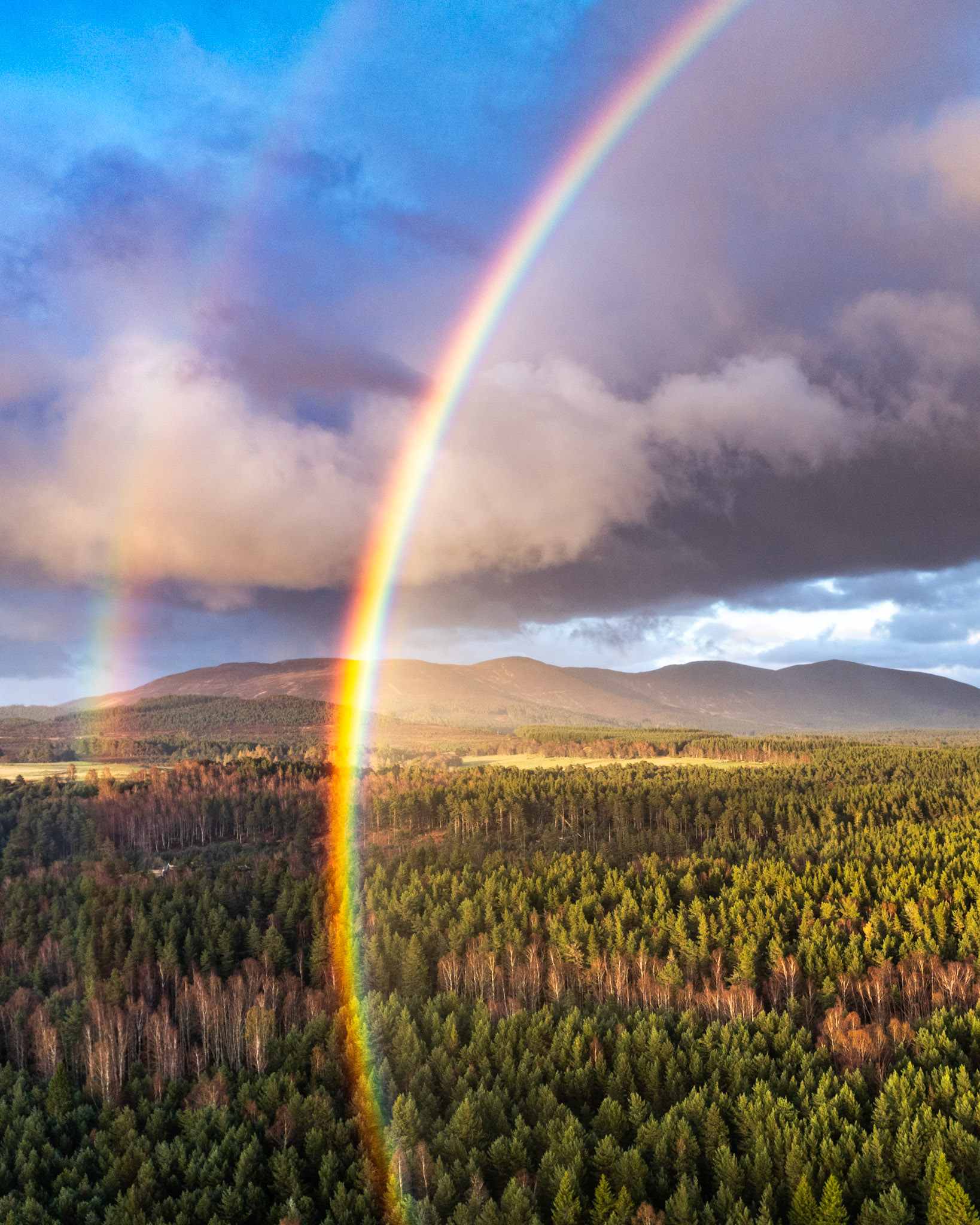
A primary rainbow descends vertically through the frame toward the Scots pine canopy of Strathspey, with the Cairngorm plateau visible beneath a retreating storm. The aerial vantage isolates the base of the bow with unusual precision, compressing forest, open strath, and mountain into a single coherent plane. Warm lateral light catches the treetops against the bruised clouds behind.
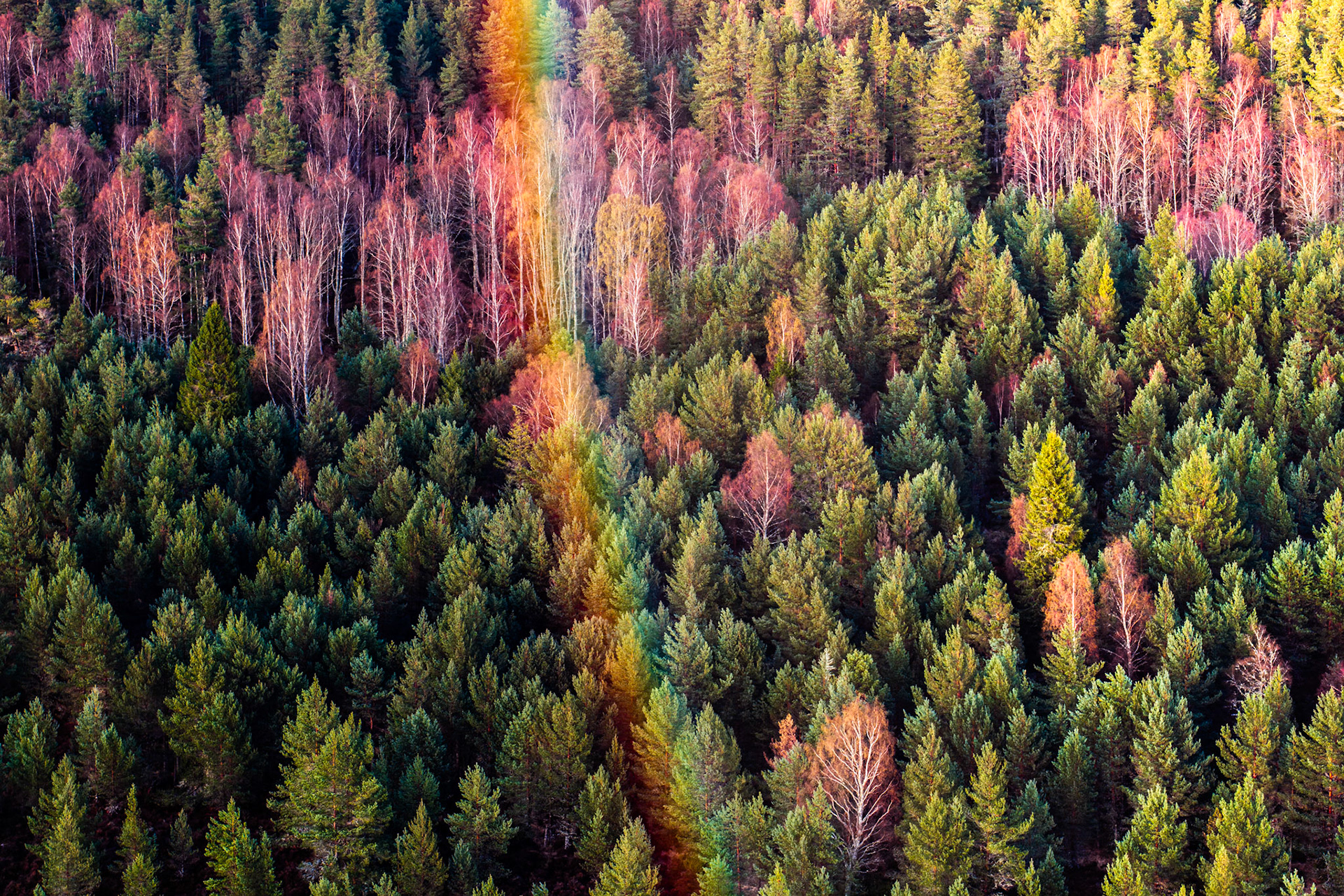
A compressed aerial view of mixed conifer and birch forest on the slopes above Aviemore, Cairngorms, in early spring. A narrow corridor of birch runs vertically through the frame, their bare white stems and russet crowns cutting through the surrounding Scots pine. The image reads as near-abstract pattern, the tonal contrast between evergreen and deciduous species its sole drama.
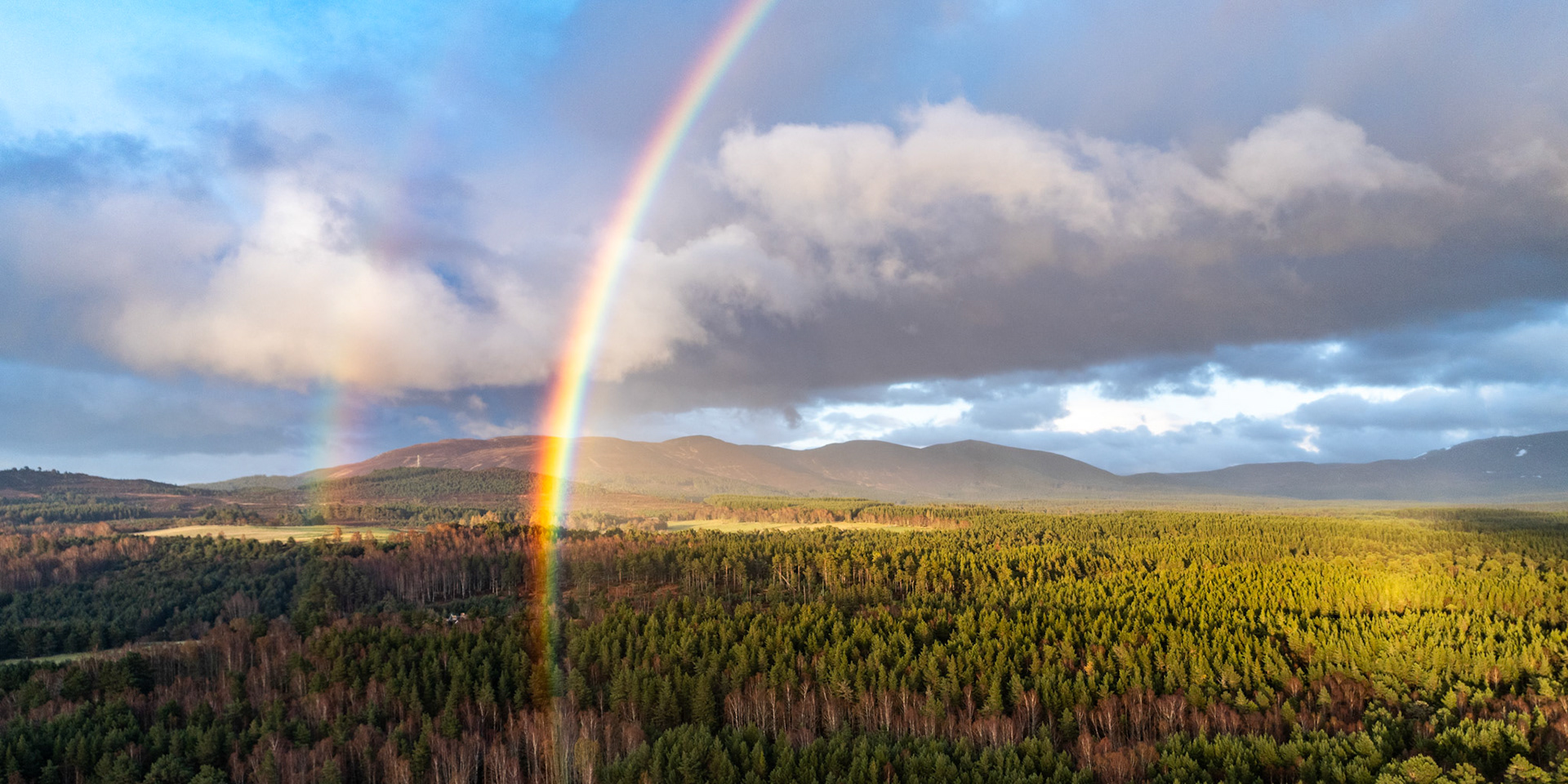
A vivid primary rainbow descends toward the Scots pine canopy of Rothiemurchus Forest, Cairngorms, as a receding storm cloud throws the distant Cairngorm plateau into shadow. Warm late-evening light catches the right-hand portion of the woodland while the left remains in cold half-shadow, dividing the scene along the rainbow's axis. Captured from altitude, the aerial vantage compresses the depth between forest floor and mountain range into a single layered plane.
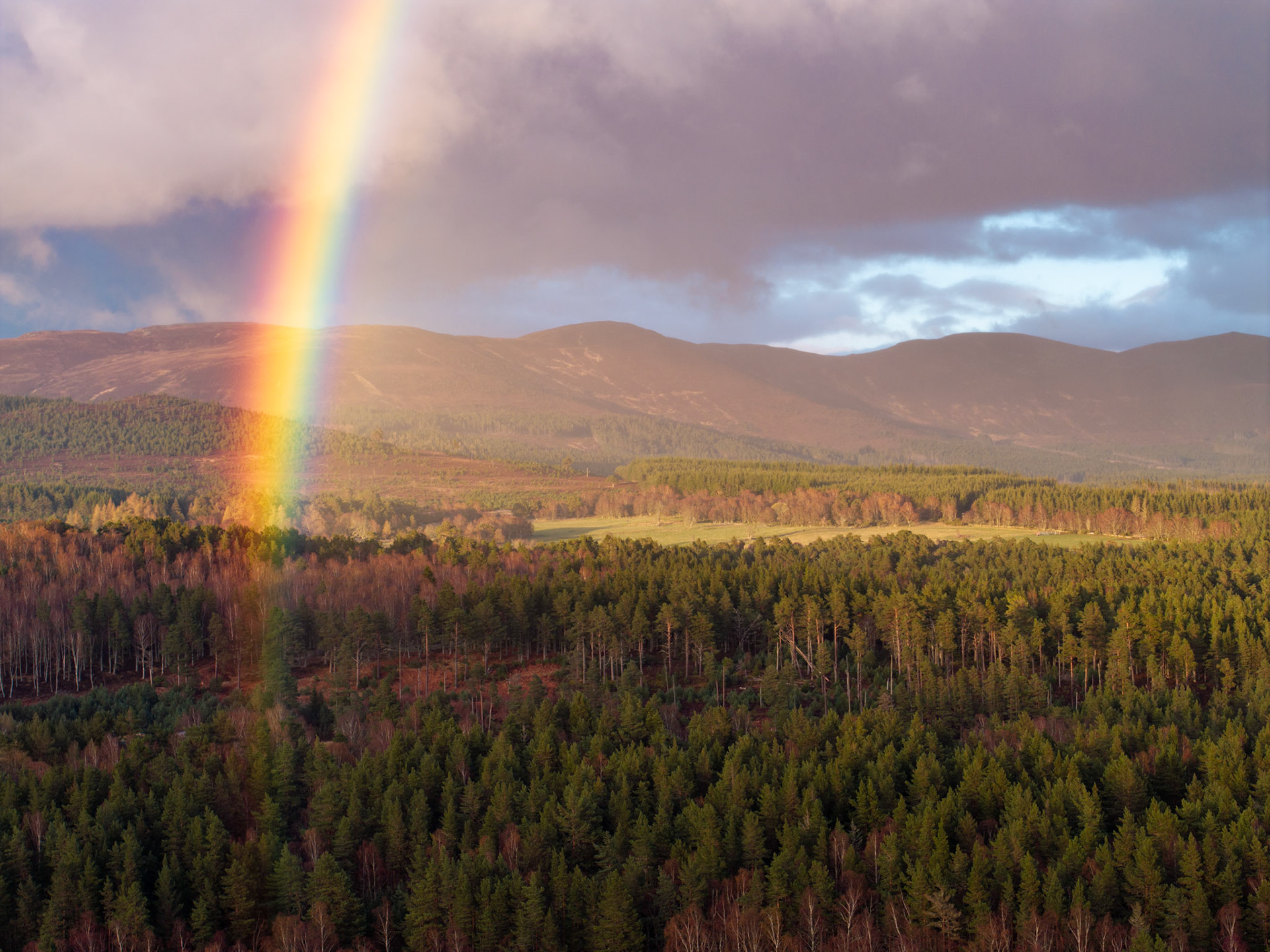
A vivid primary rainbow descends into the Caledonian pinewoods of Strathspey as a departing storm cell releases the last of the afternoon light across the Cairngorm massif. The aerial vantage reveals the scale of the native and plantation forest canopy, still touched with the russet of bare birch and larch. Differential illumination beneath the cloud base divides the valley into shadow and sudden warmth.
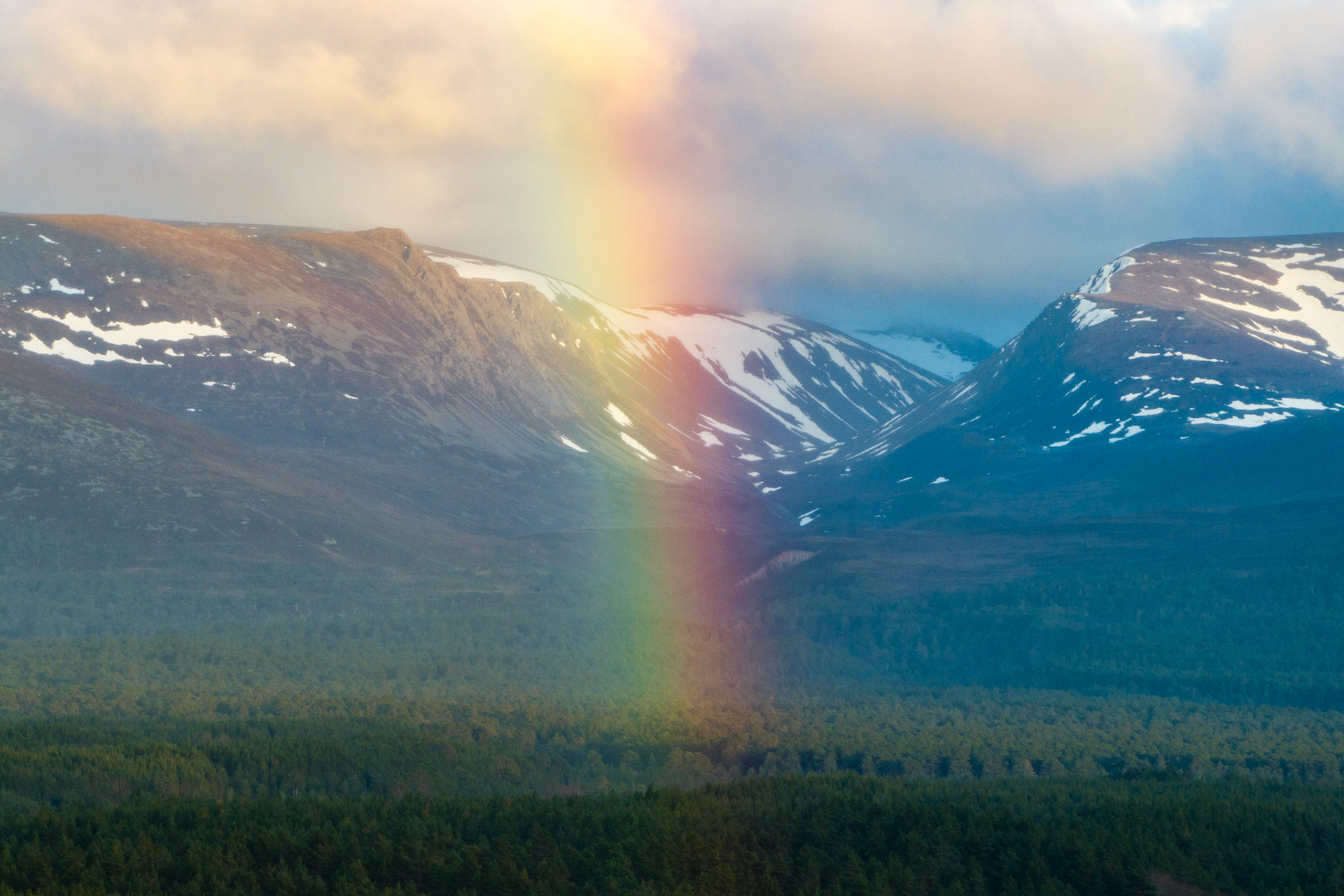
A partial rainbow descends into the mouth of a glacial pass in the Cairngorms, its arc anchored between snow-patched plateau flanks and the boreal pinewoods of upper Strathspey. The shaft of spectral light bisects the col with unusual precision, the surrounding cloud softening the plateau edges while spring snow persists on the higher ground. Captured from altitude in late evening light, the image exploits the elevated perspective to isolate the phenomenon within the mountain topography.
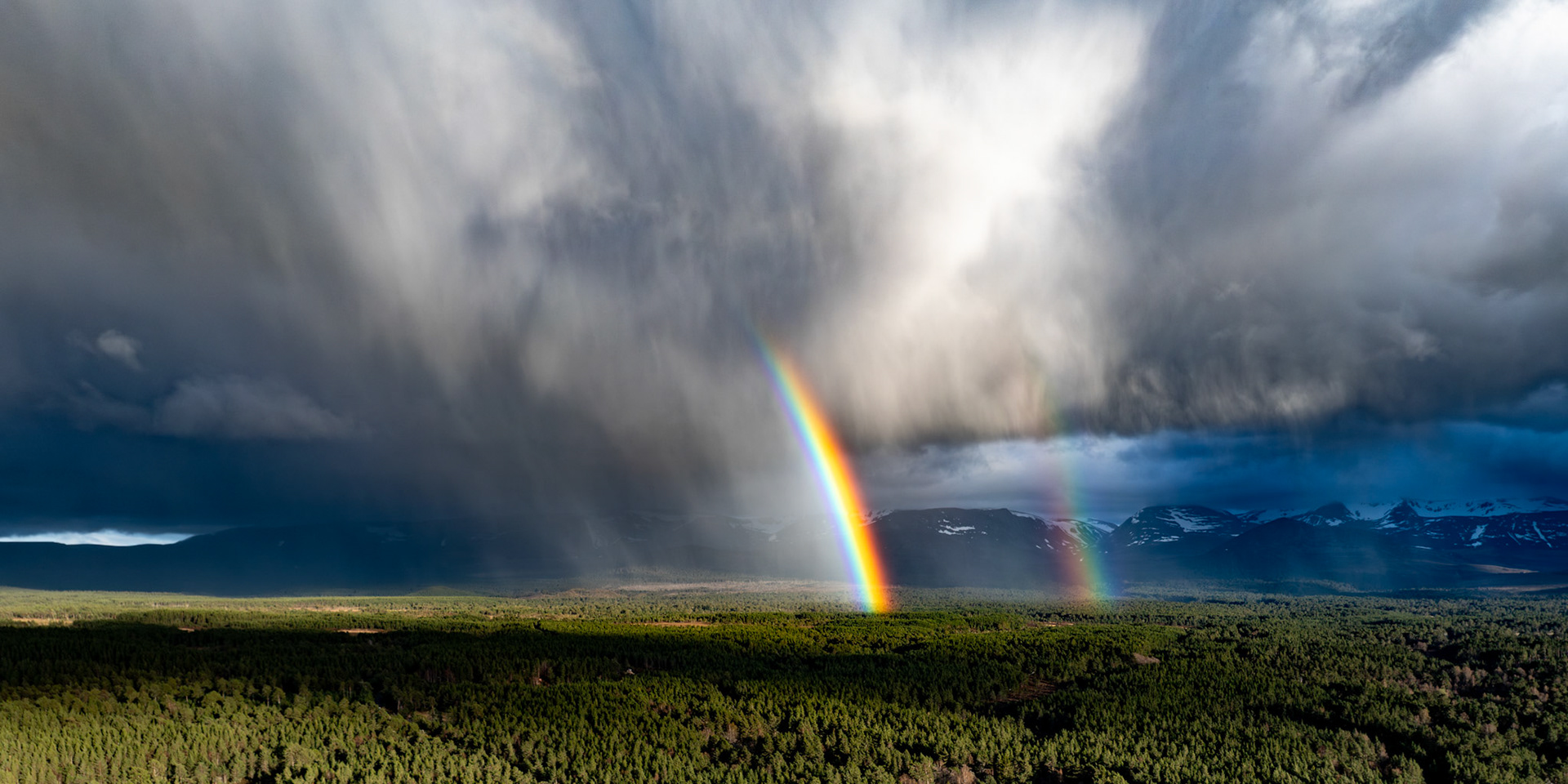
A primary and secondary rainbow descend into a boreal pine forest on the Cairngorm plateau as a curtain of virga sweeps across the massif. The aerial vantage isolates the full arc against a bruised cumulonimbus base, with snow-capped summits visible through a break in the weather to the east. Spring snowpack on the high ground confirms the season.
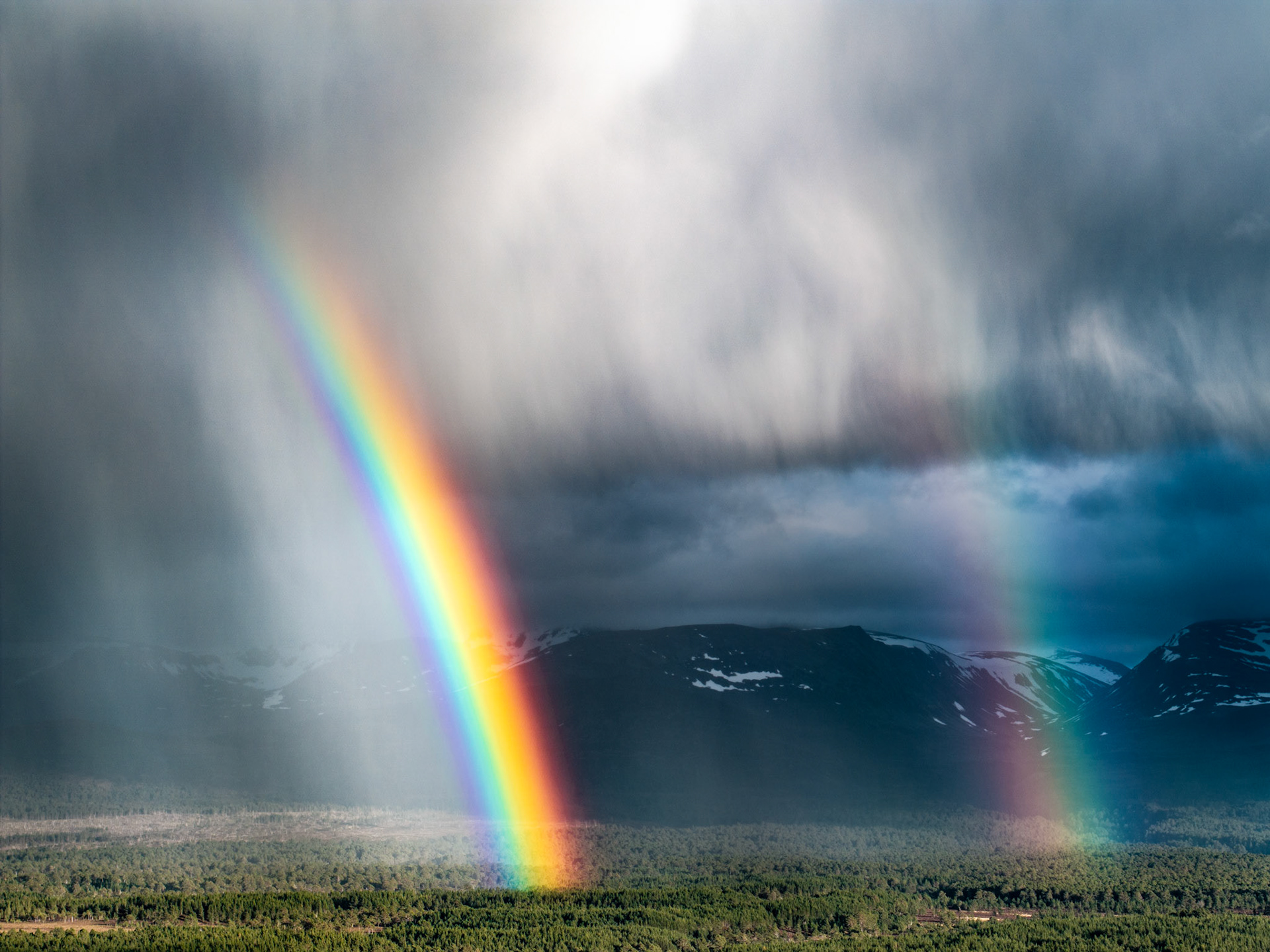
A vivid primary rainbow terminates above boreal forest in the Cairngorms, its arc set against the dark mass of a fast-moving convective storm. Snow-patched mountains anchor the middle distance while virga curtains the left frame, the aerial vantage isolating the optical phenomenon with unusual clarity.
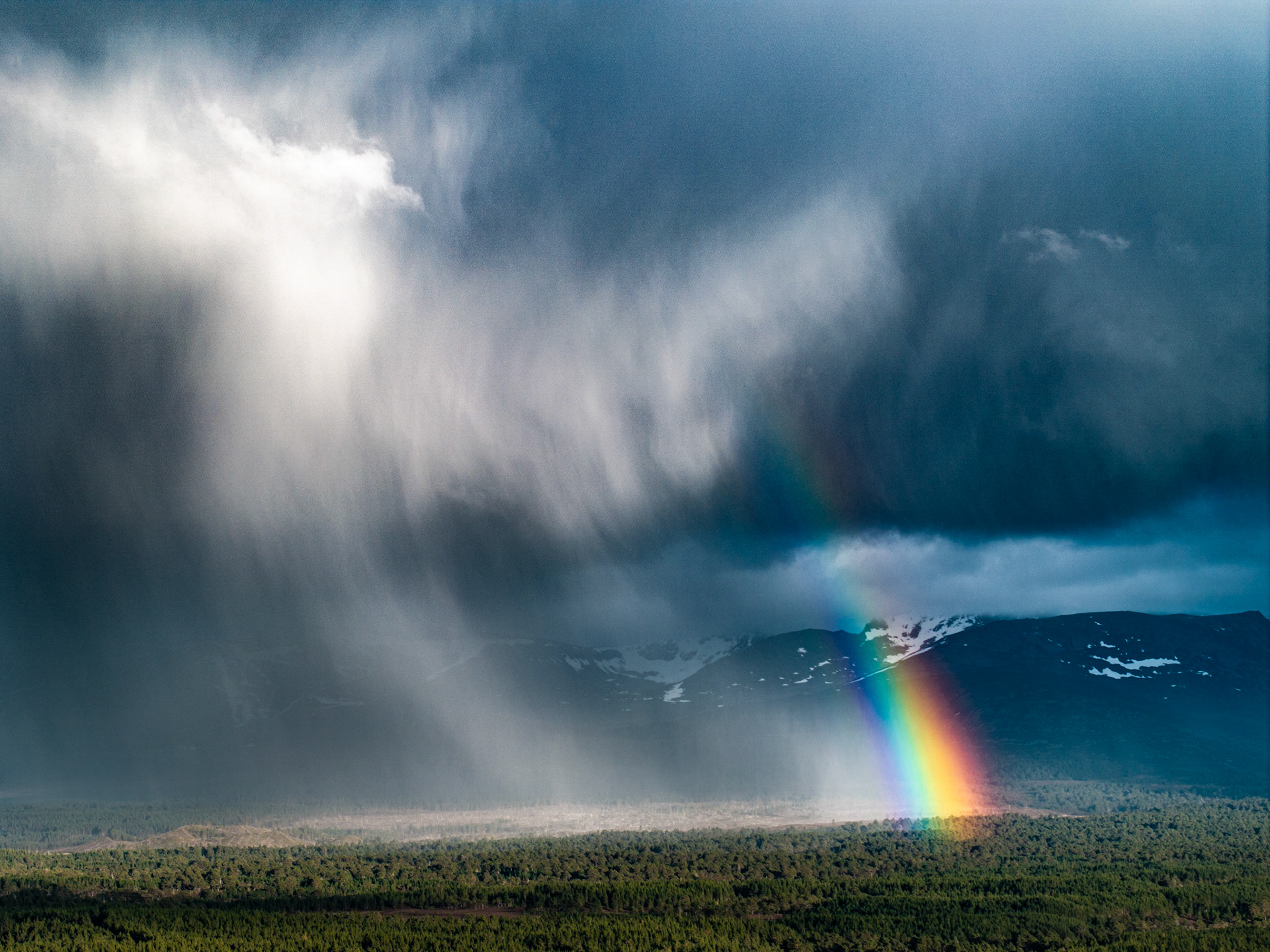
A virga curtain sweeps across the Cairngorm plateau as a vivid rainbow grounds itself at the forest edge near Aviemore. The juxtaposition of precipitation shaft, snow-patched summit, and saturated spectral arc within a single frame captures a fleeting atmospheric collision rarely framed with such compositional weight. Aerial elevation compresses the layers — boreal forest, moorland, mountain and sky — into a single dramatic plane.
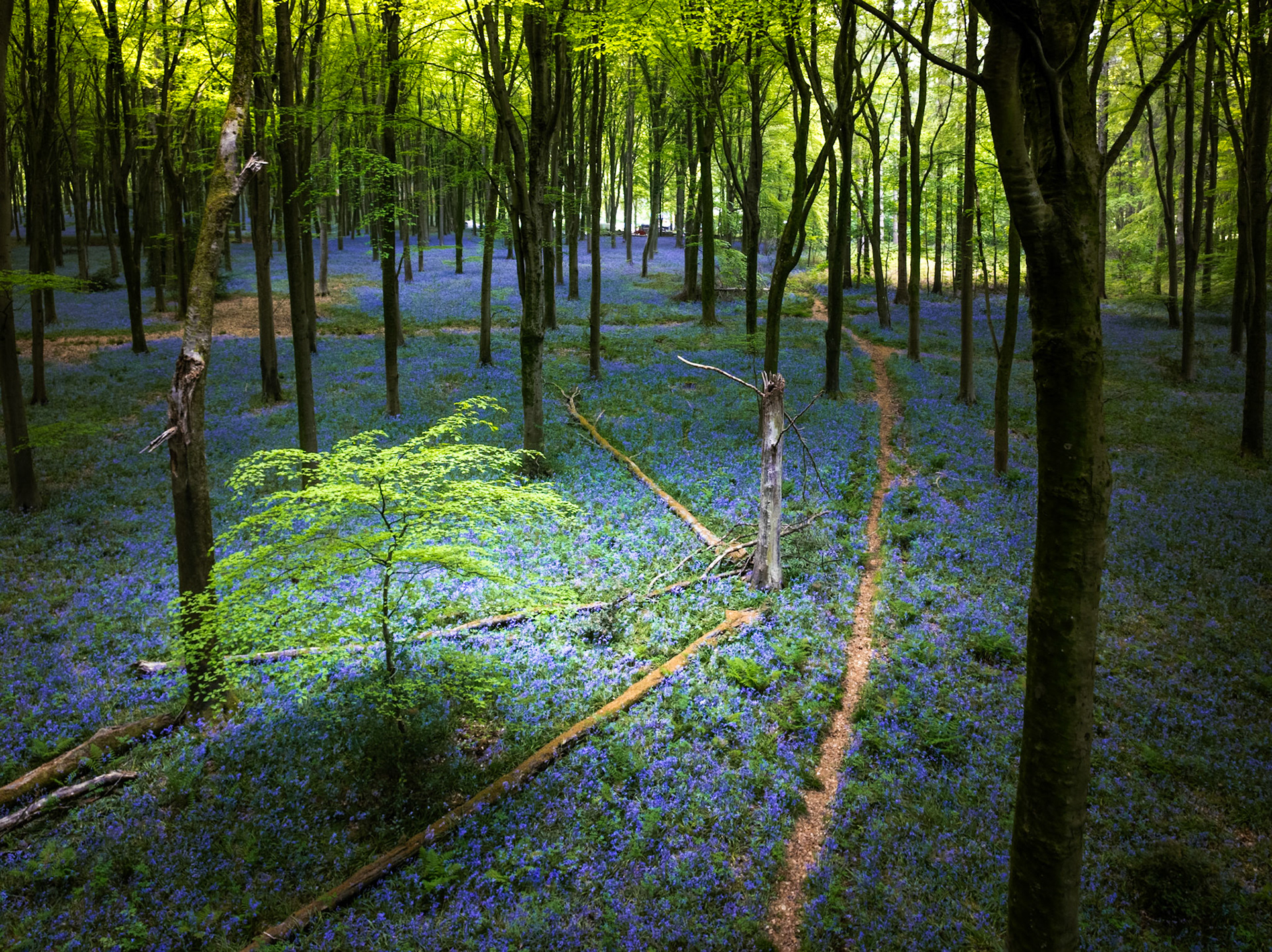
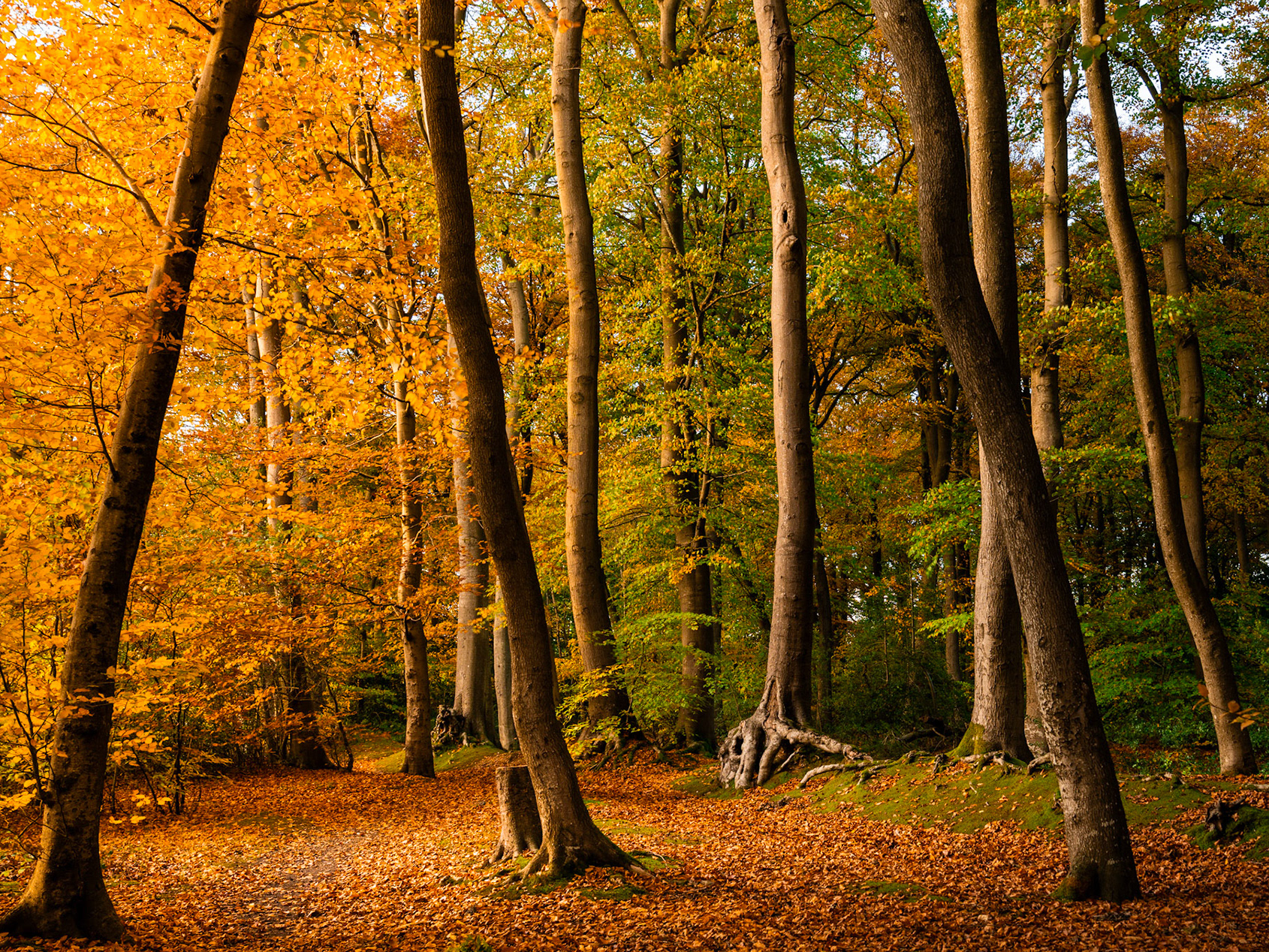
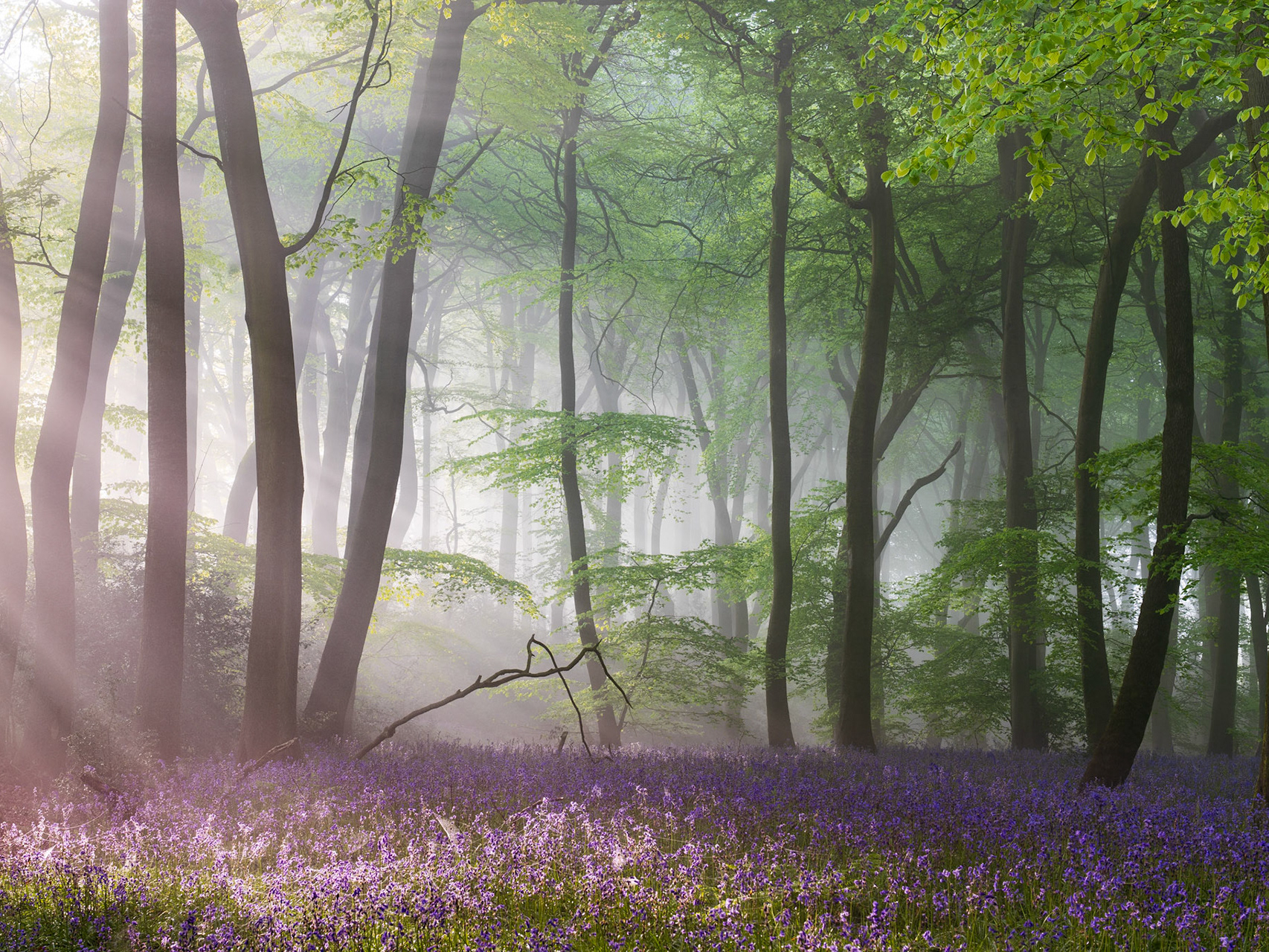
A carpet of native bluebells floods the floor of a beech woodland in Micheldever Wood, Hampshire, in early May. A fallen tree and a narrow footpath cut diagonal lines through the blue, offering structure within the mass. Diffuse cloud light holds the colour flat and even, suppressing shadow and lending the scene a quiet, almost subaqueous depth.

A temperature inversion buries the Thames Valley beneath a flat sea of cloud at dusk, the gibbous moon suspended in a sky grading from powder blue through rose to lavender. Shot from elevation above Abingdon-on-Thames, the compression between cloud ceiling and clear upper atmosphere creates a horizon line of unusual stillness. The near-total absence of hard edges gives the frame a quality closer to watercolour than photography.
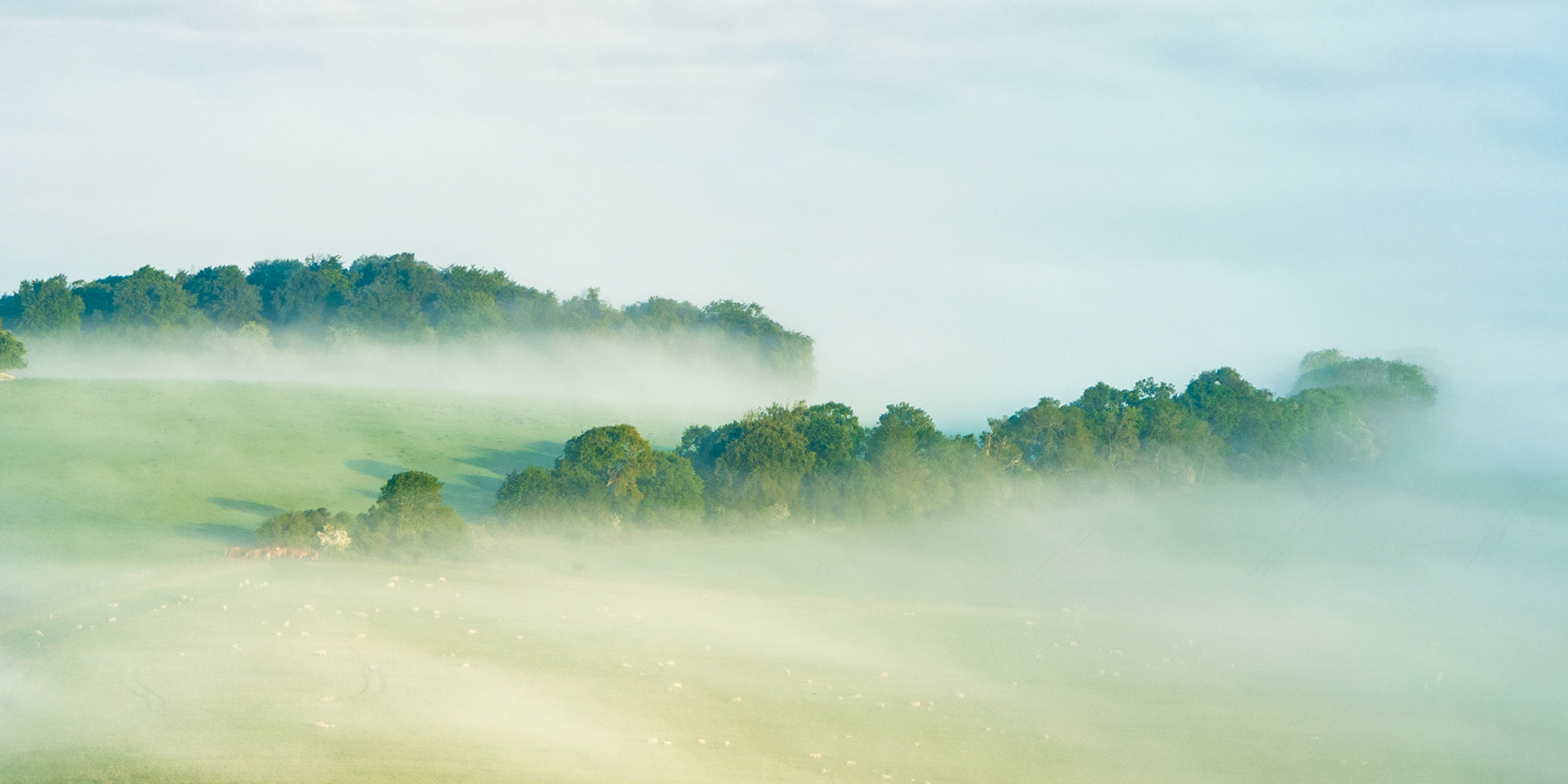
A ground-hugging fog layer fills the valley floor near Henley-on-Thames, partially submerging scattered livestock and hedgerow oaks while the upper treeline of a chalk ridge emerges cleanly above. Captured in mid-morning as a temperature inversion held the mist in the low ground, the layered recession of woodland belts gives the frame a quiet, almost graphic depth. Small details — a cluster of cattle mid-left, sheep scattered across the foreground field — anchor the abstraction in pastoral reality.
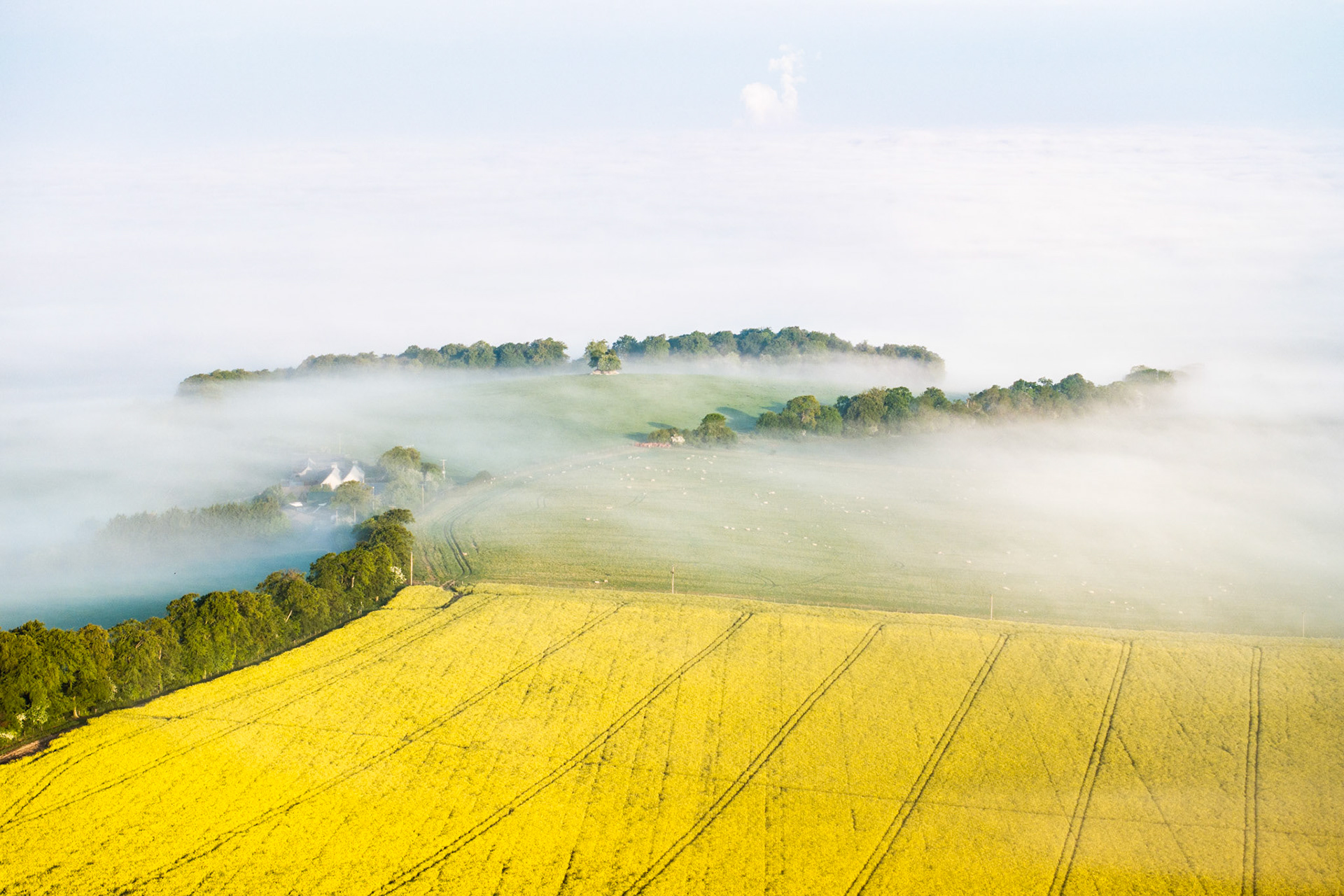
A low temperature inversion pools fog through the valleys around Henley-on-Thames, leaving a copse of mature broadleaf trees stranded above the white. A rapeseed field in full spring bloom anchors the foreground, its tractor lines drawing the eye toward the obscured farmstead and grazing livestock beyond.
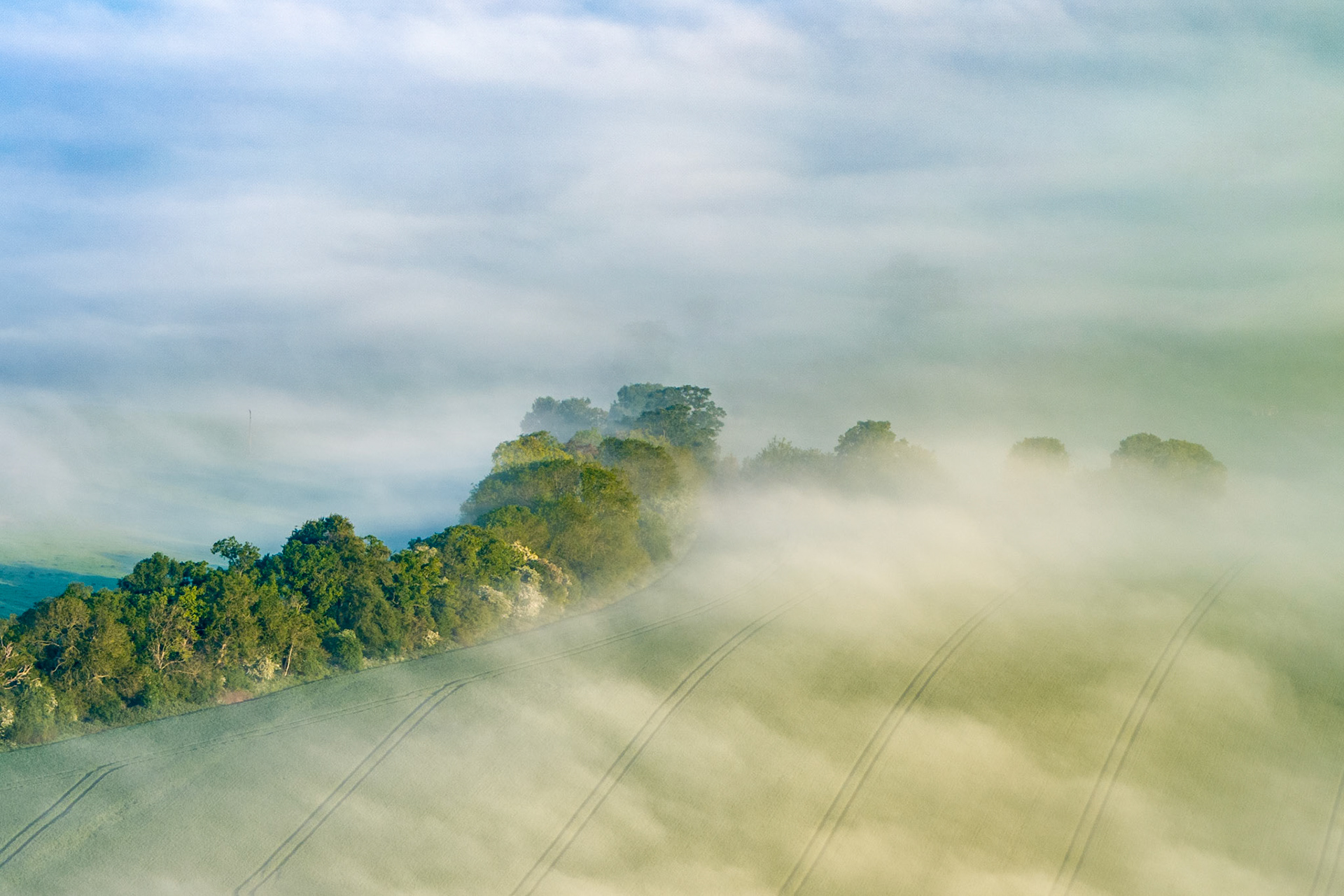
Low inversion cloud pools across an arable field on the Chiltern escarpment near Henley-on-Thames, partially submerging a hedgerow tree line in early May. The tractor tramlines beneath the fog layer give scale and geometry to an otherwise ephemeral scene. Captured from altitude, the image sits at the boundary between topographic record and atmospheric abstract.
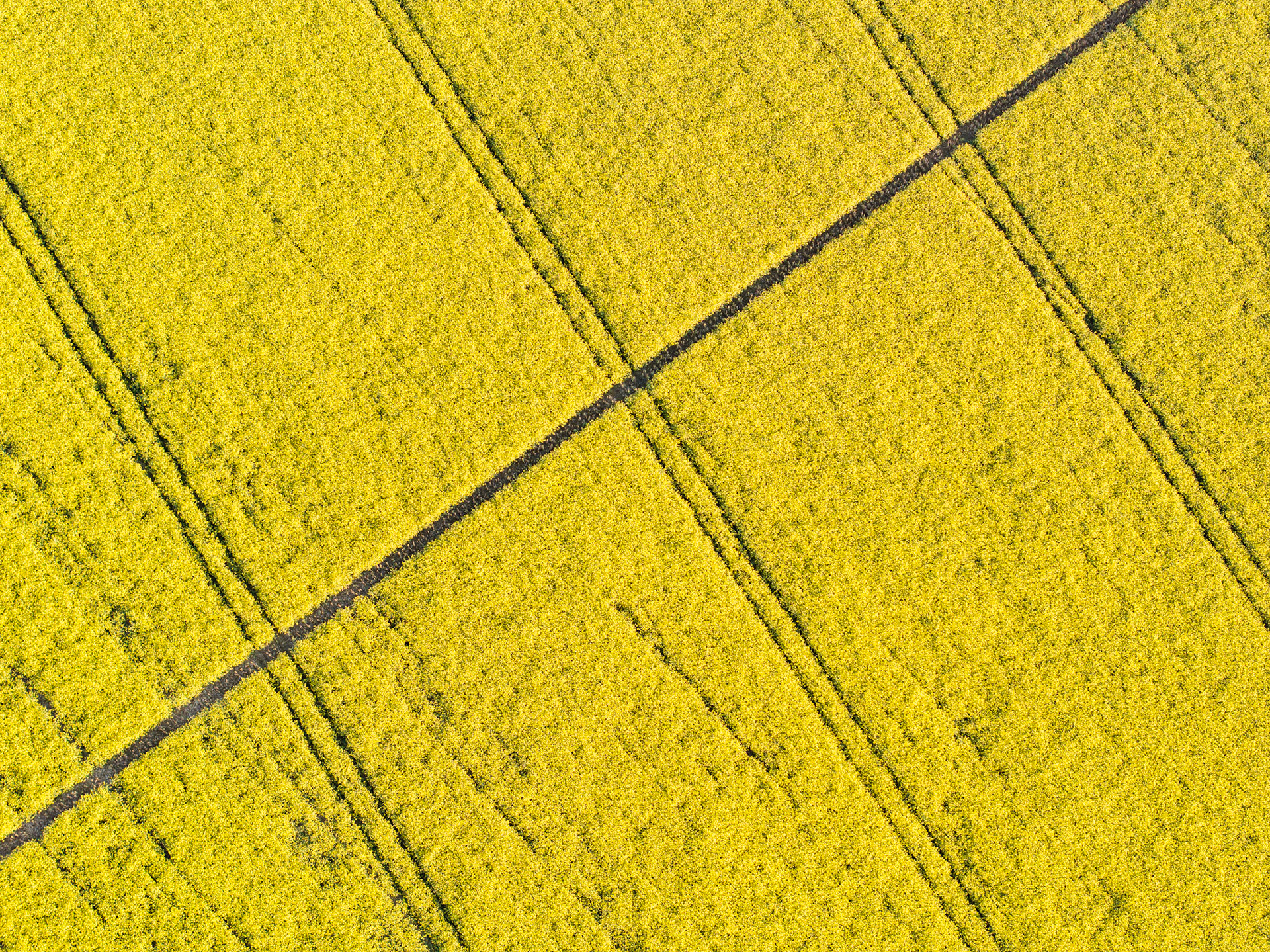
Machinery tracks cut diagonal geometry across a flowering rapeseed field near Wallingford, Oxfordshire, shot directly overhead in flat spring light. The crossing lines divide the uniform yellow canopy into irregular panels, reducing an agricultural field to near-pure pattern. Midday overcast removes shadow and depth, flattening the composition into texture.
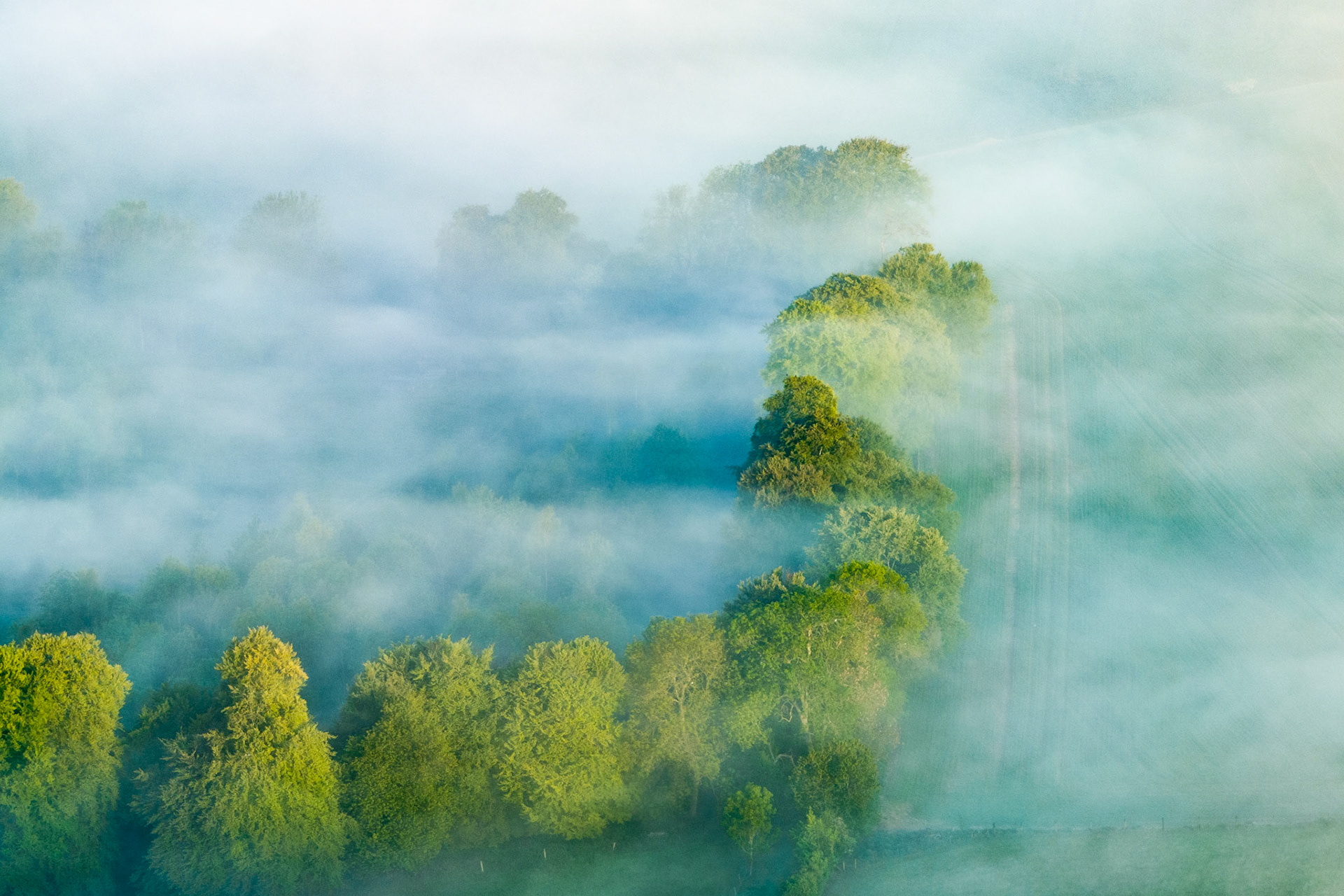
A temperature inversion settles over mixed deciduous woodland near Henley-on-Thames, the upper canopies of oak and ash breaking the mist layer in raking early-season light. The aerial vantage compresses depth into alternating bands of green and pale vapour, giving the scene an almost topographic quality. Shot in early May, the fresh foliage retains its acid-green translucency before the summer canopy densifies.
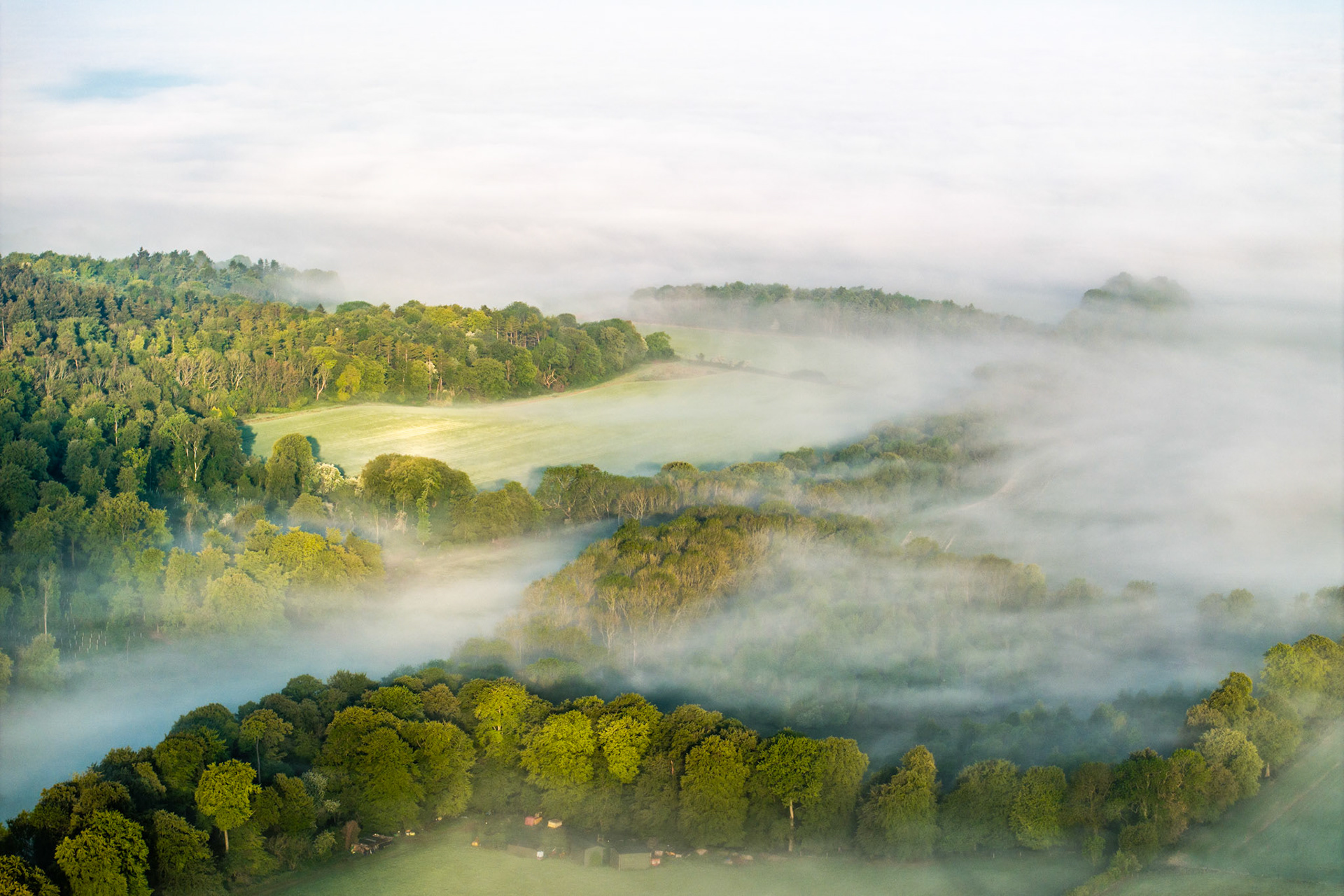
Low-level mist pools between ridges of mixed deciduous woodland in the Chiltern Hills near Henley-on-Thames, captured from altitude in early morning light. A temperature inversion holds the fog in the valley floors while tree canopies emerge as islands above the white. A small cluster of farm buildings in the lower frame provides quiet scale.
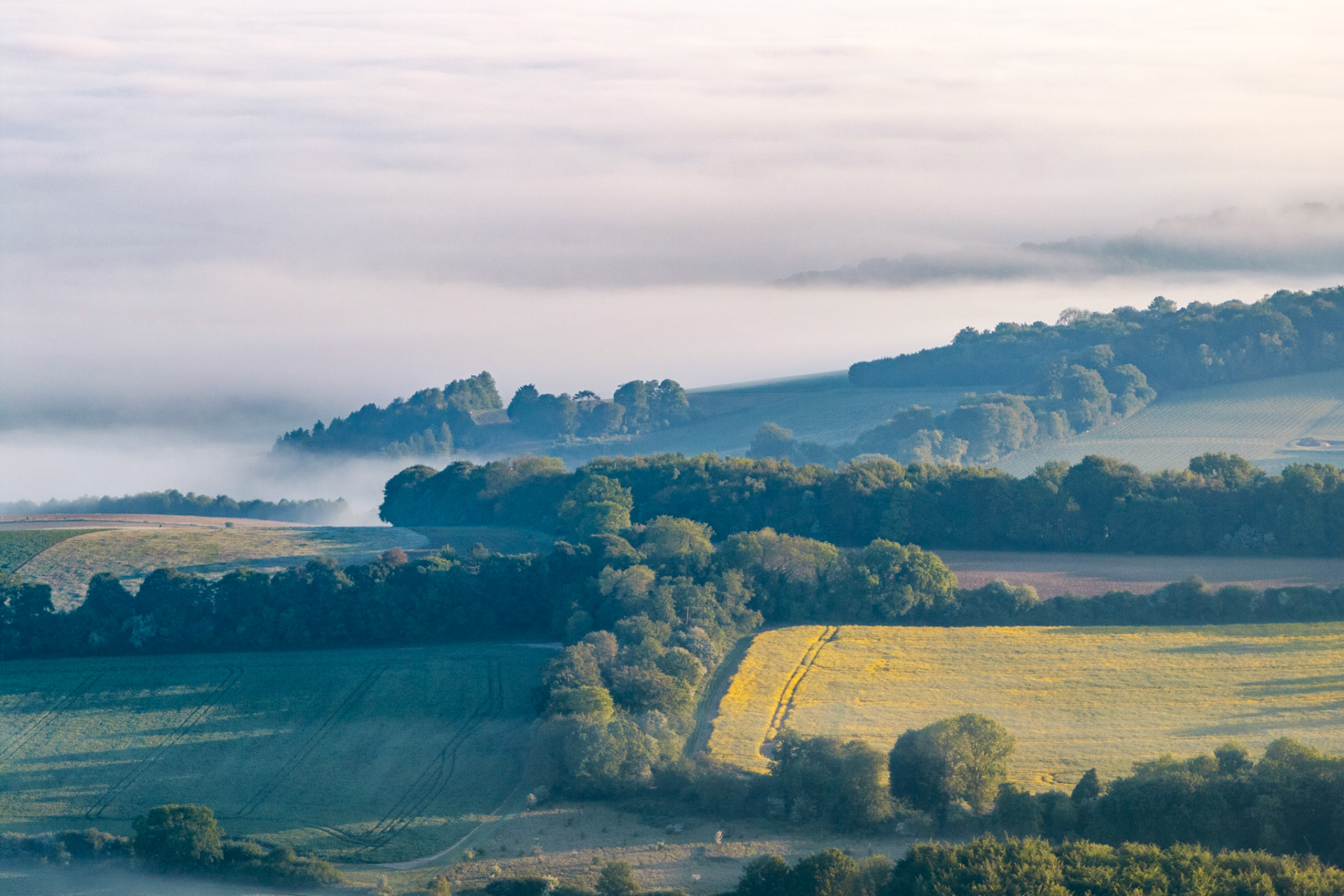
Low cloud pools between the scarp and vale near Henley-on-Thames, breaking just enough to allow early light to catch a strip of meadow among the tree-lines. Shot from altitude in spring, the layering of mist, woodland copses, and arable fields compresses the familiar chalk downland into receding planes of tone.
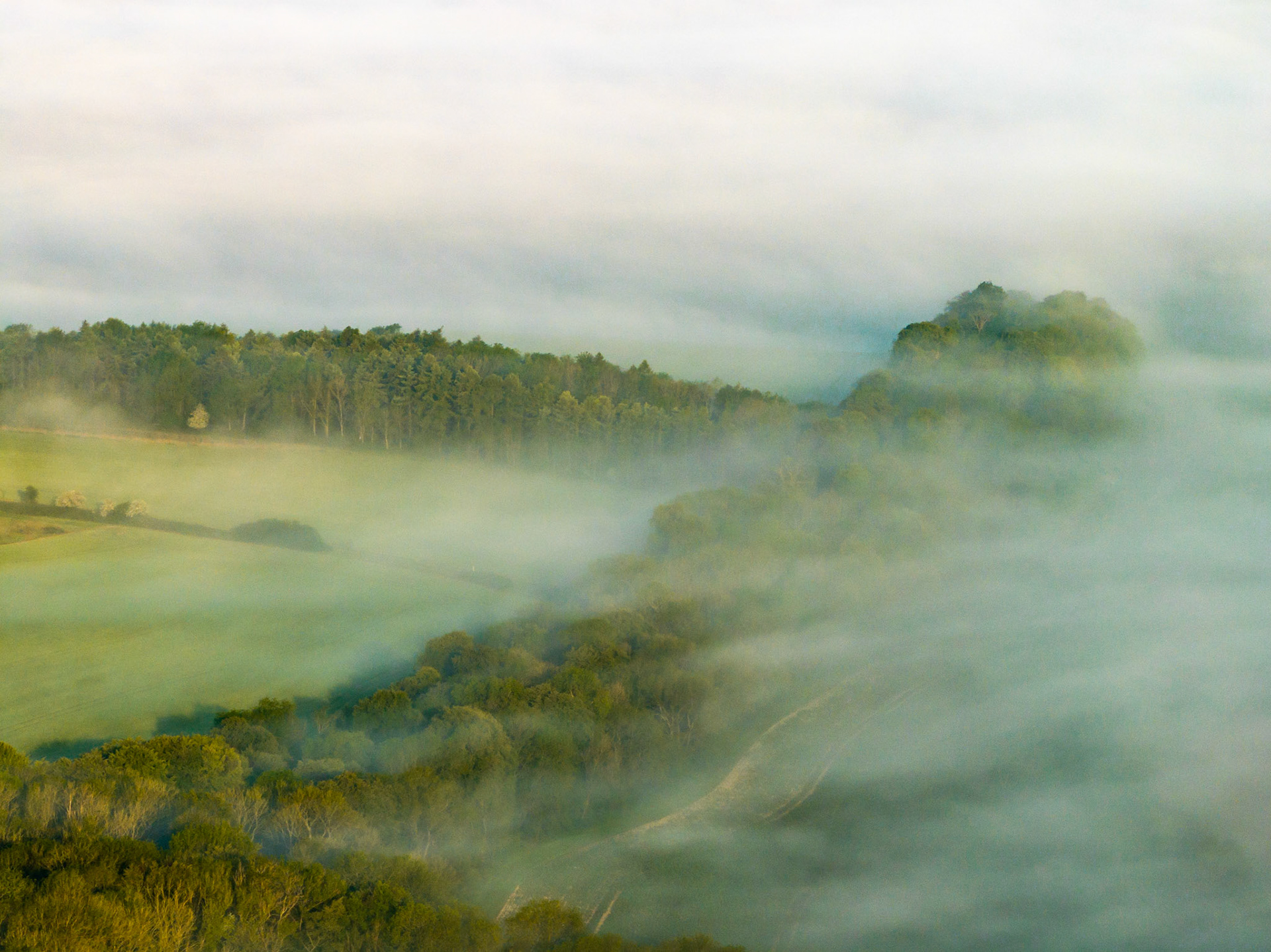
A temperature inversion settles across a wooded valley in the Chilterns, south of Henley-on-Thames, submerging the valley floor in a shallow sea of mist while conifer plantations and deciduous canopies emerge above it. The soft, diffuse morning light produces a restricted tonal palette of grey-green, lending the scene quiet depth without a strong focal anchor. Captured in early May, the full leaf canopy confirms the inversion as a spring phenomenon.
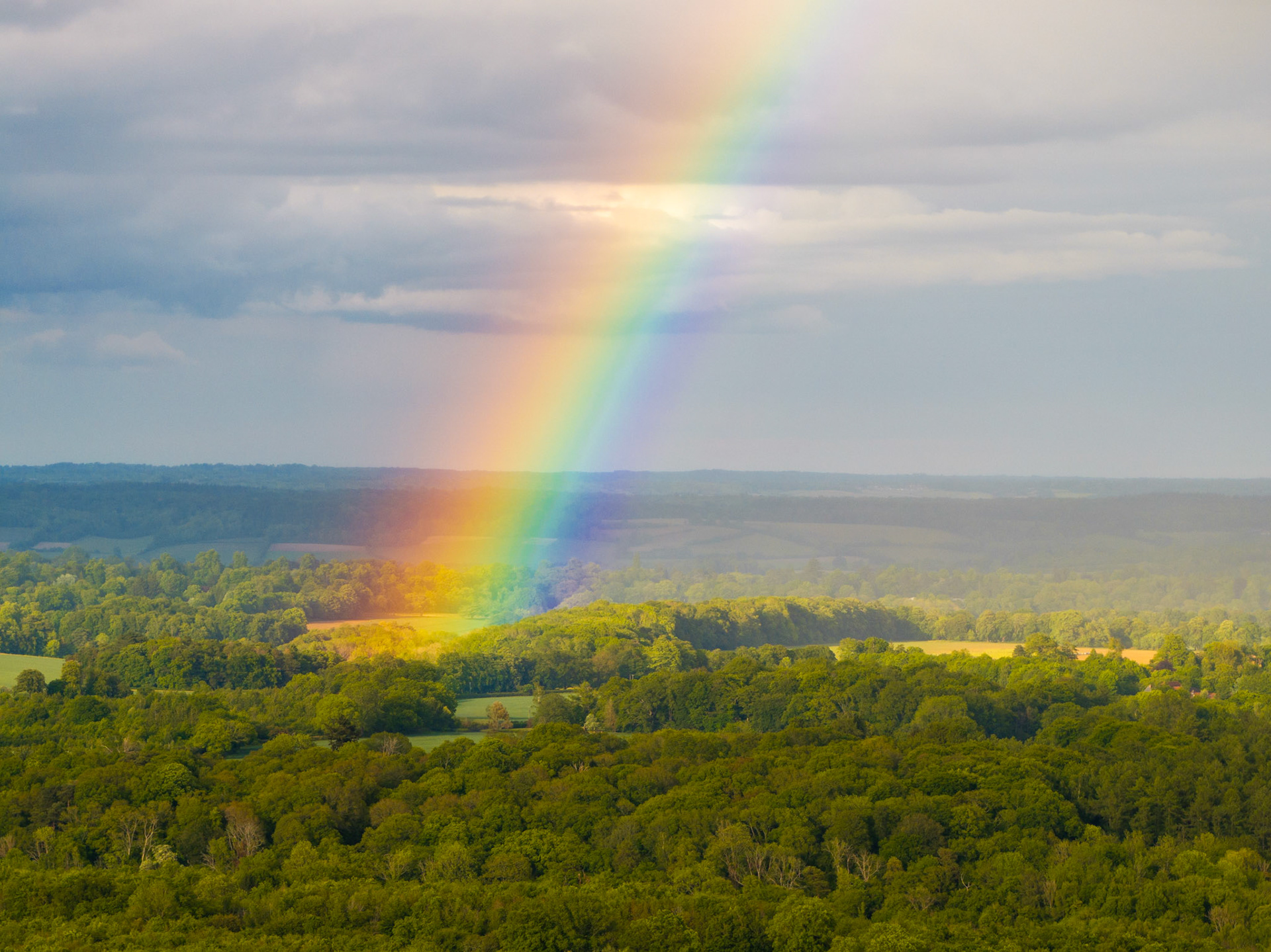
A vivid primary rainbow descends into dense mixed woodland above the Thames Valley, viewed from elevation on an unsettled May afternoon. Rain still falls visibly at mid-distance while low sun catches the canopy, creating a sharp tonal divide between lit and shadowed tree cover. The elevated vantage compresses the rolling patchwork of fields and woodland into a single plane beneath the arc.
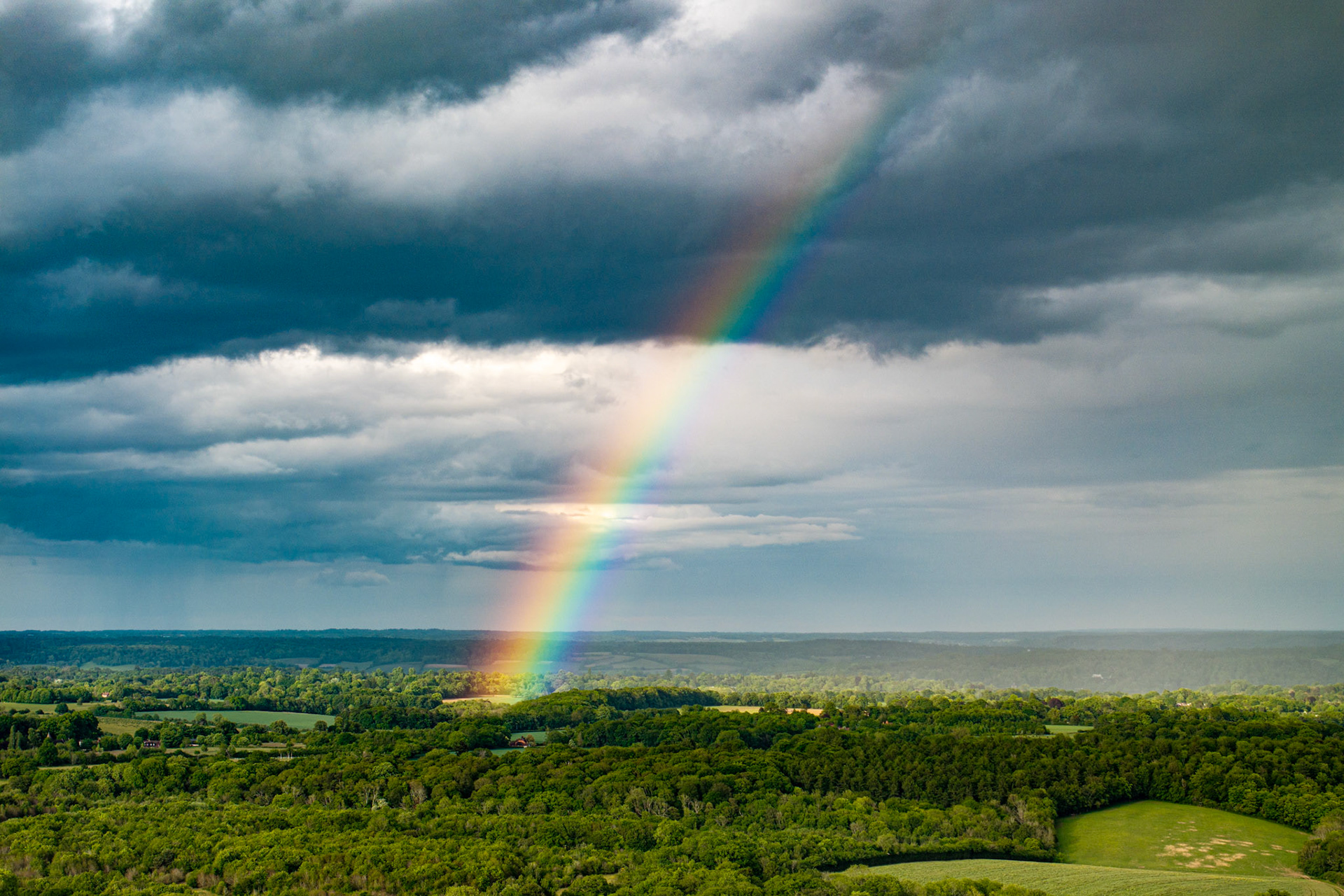
A vivid primary rainbow descends toward the wooded escarpment south of Henley-on-Thames, its foot planted in spring canopy illuminated by a break in passing storm cloud. Shot from altitude, the aerial perspective compresses woodland, farmland and rain curtain into a single dramatic plane. The saturation of the arc against the dark cumulonimbus is entirely natural, owing nothing to post-processing excess.
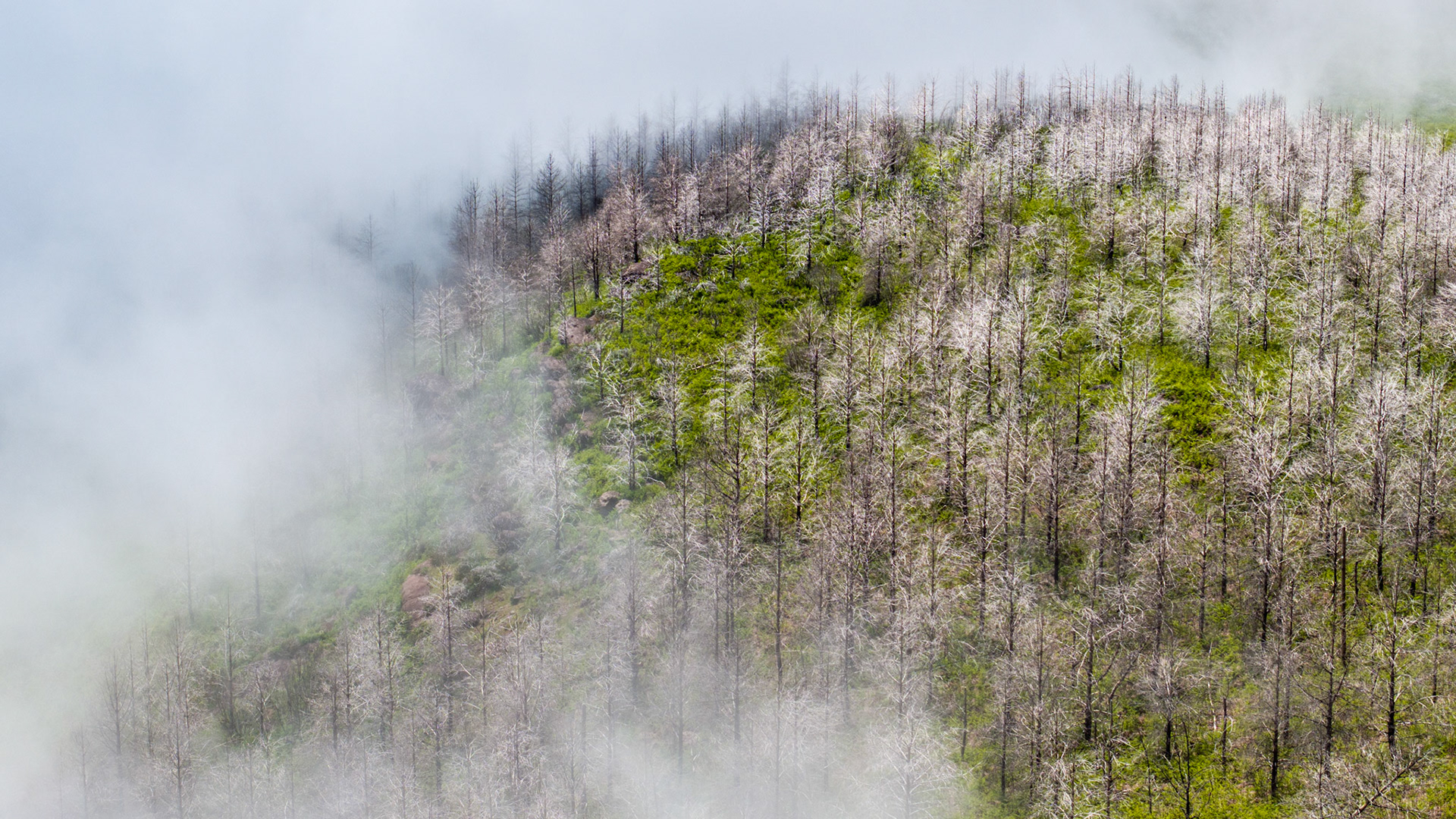
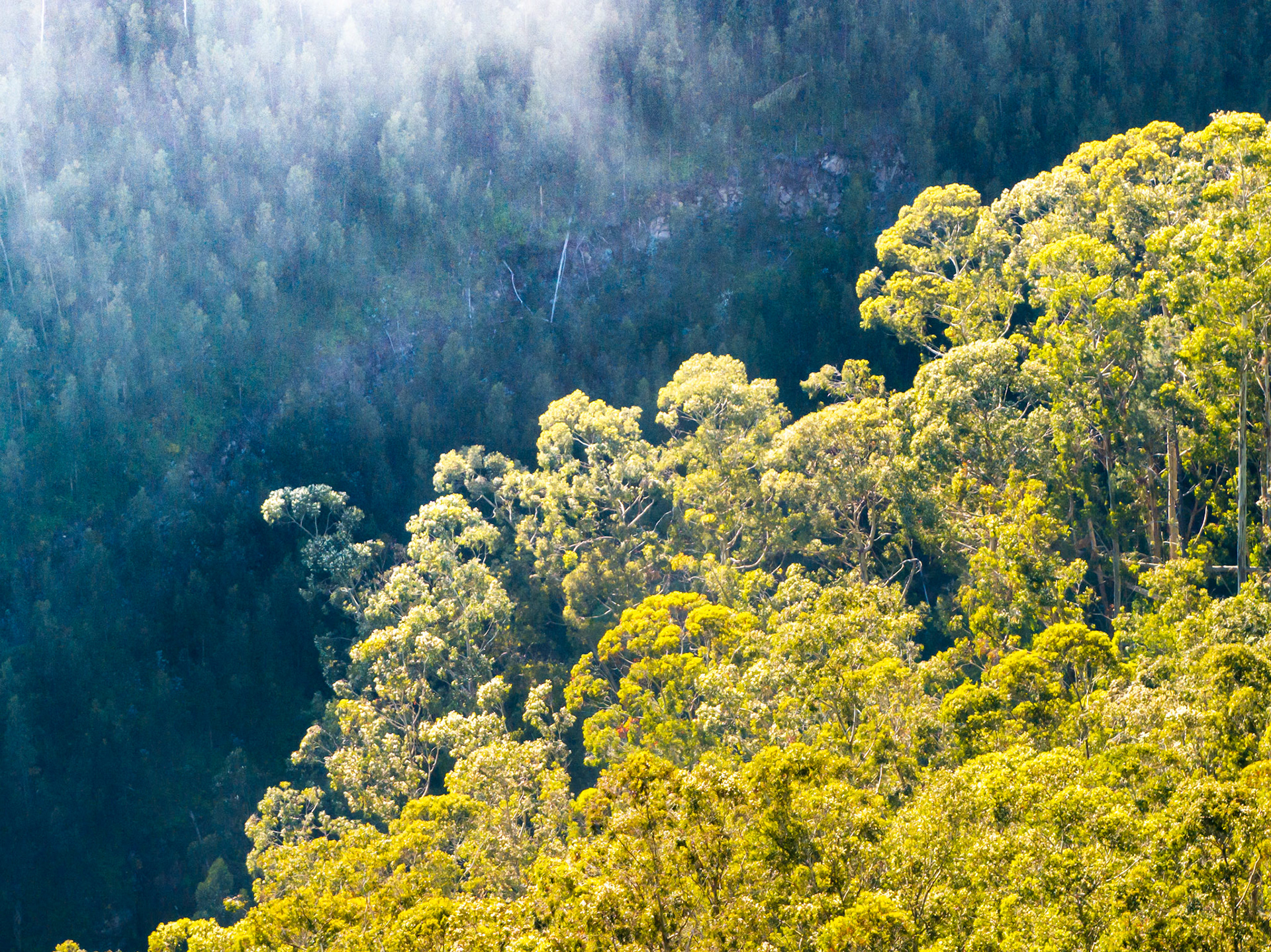
A post-fire hillside on Madeira emerges partially through low cloud, its bleached dead trunks standing among vivid spring regrowth. The fog bisects the ridge diagonally, creating a natural boundary between obscurity and revelation. Shot from altitude in late May, the image records both ecological aftermath and the island's persistent capacity for renewal.
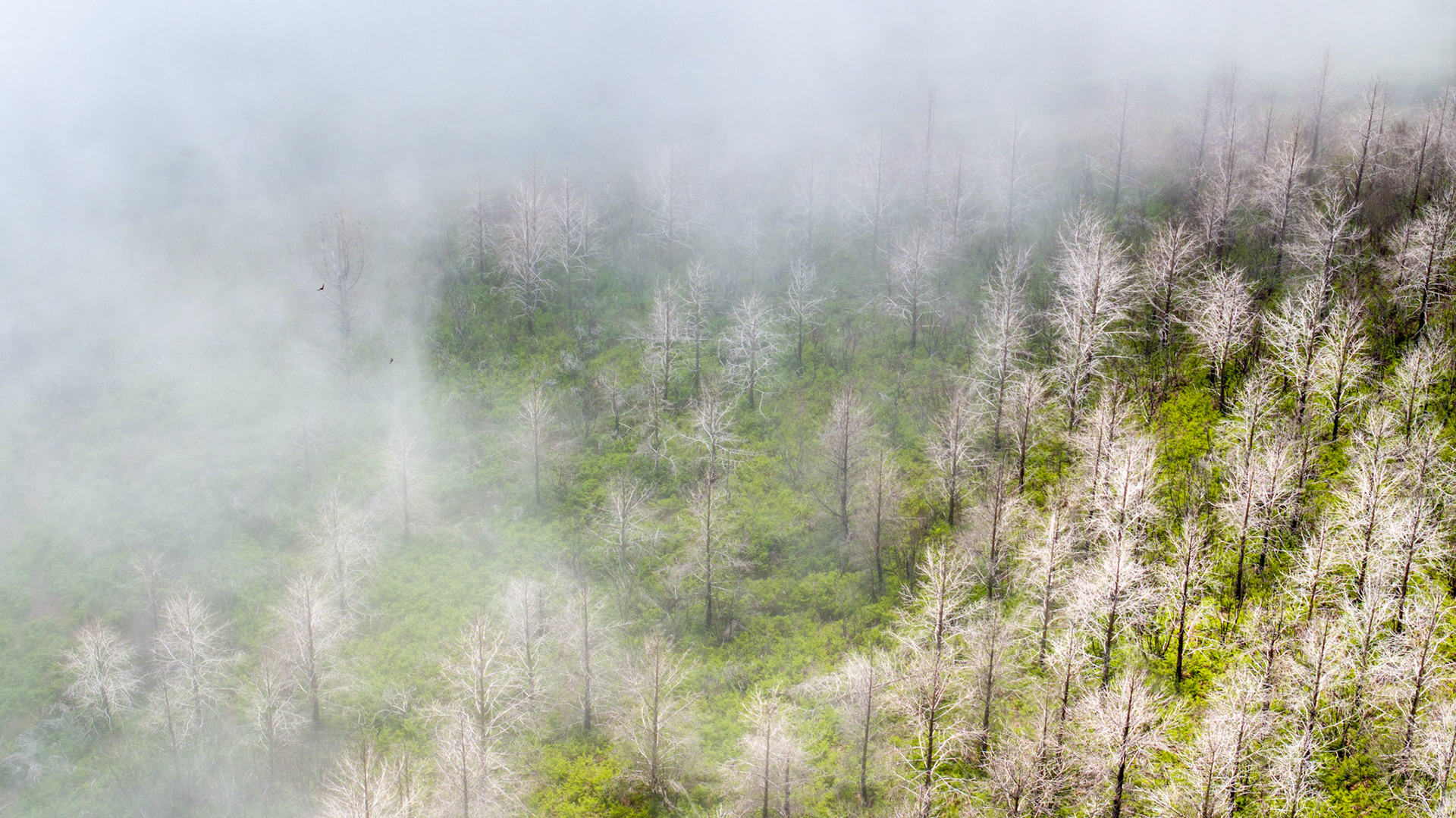
Aerial view of a regenerating hillside forest above Arco da Calheta, Madeira, where bleached standing deadwood rises through spring fog alongside vivid new-season understorey growth. The interplay of pale skeletal trunks against emergent green, softened by rolling cloud, gives the scene an uncommon graphic tension. A single bird — faint in the mist — anchors the scale without demanding attention.
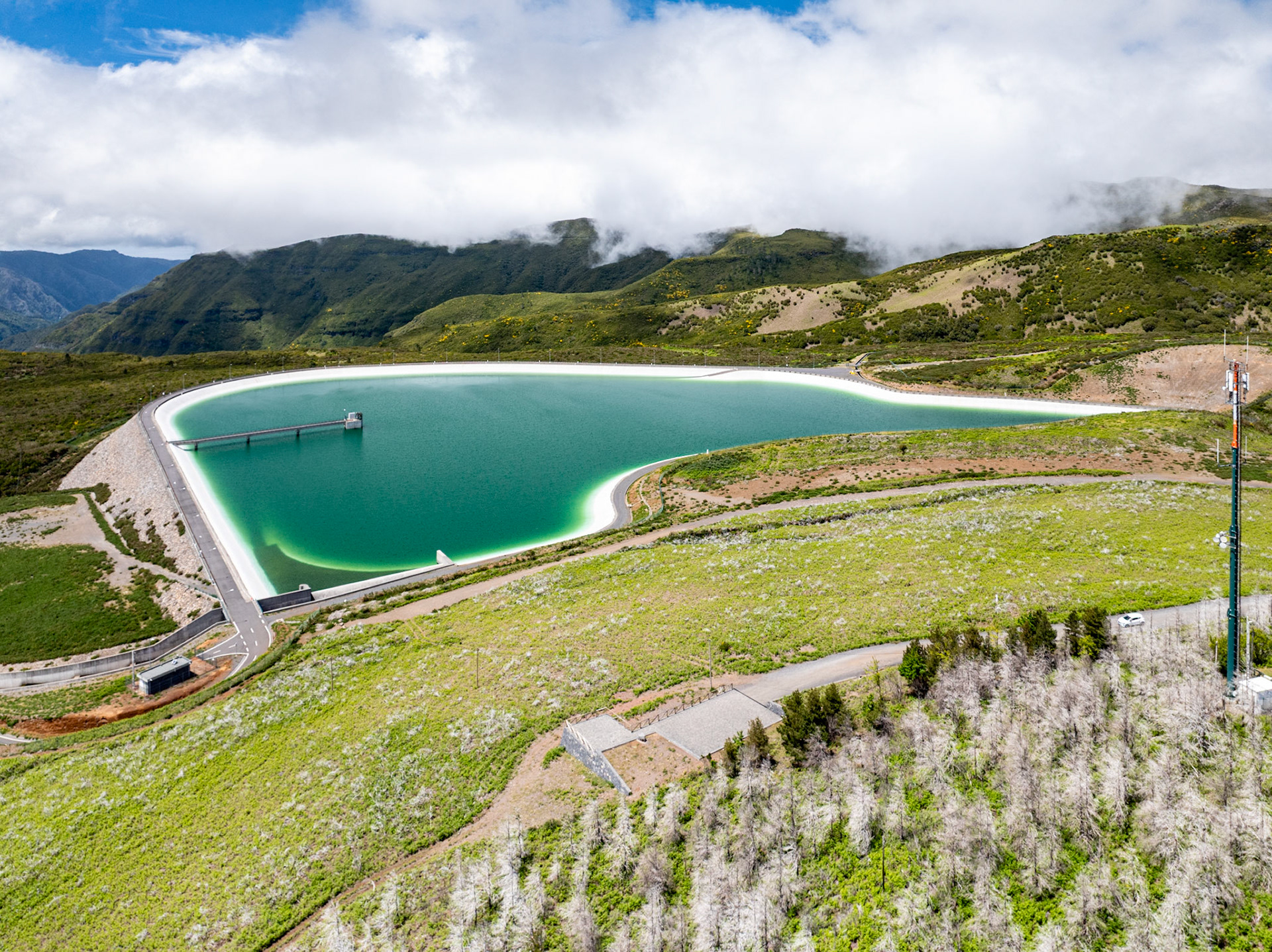
A pumped-storage reservoir sits high above Arco da Calheta on Madeira's southern ridge, its white concrete liner tracing a precise curve against the turquoise water. Low cloud presses against the forested mountains beyond, softening the backdrop without quite lifting into drama. The geometry of infrastructure against the green hillside is the image's only real tension.
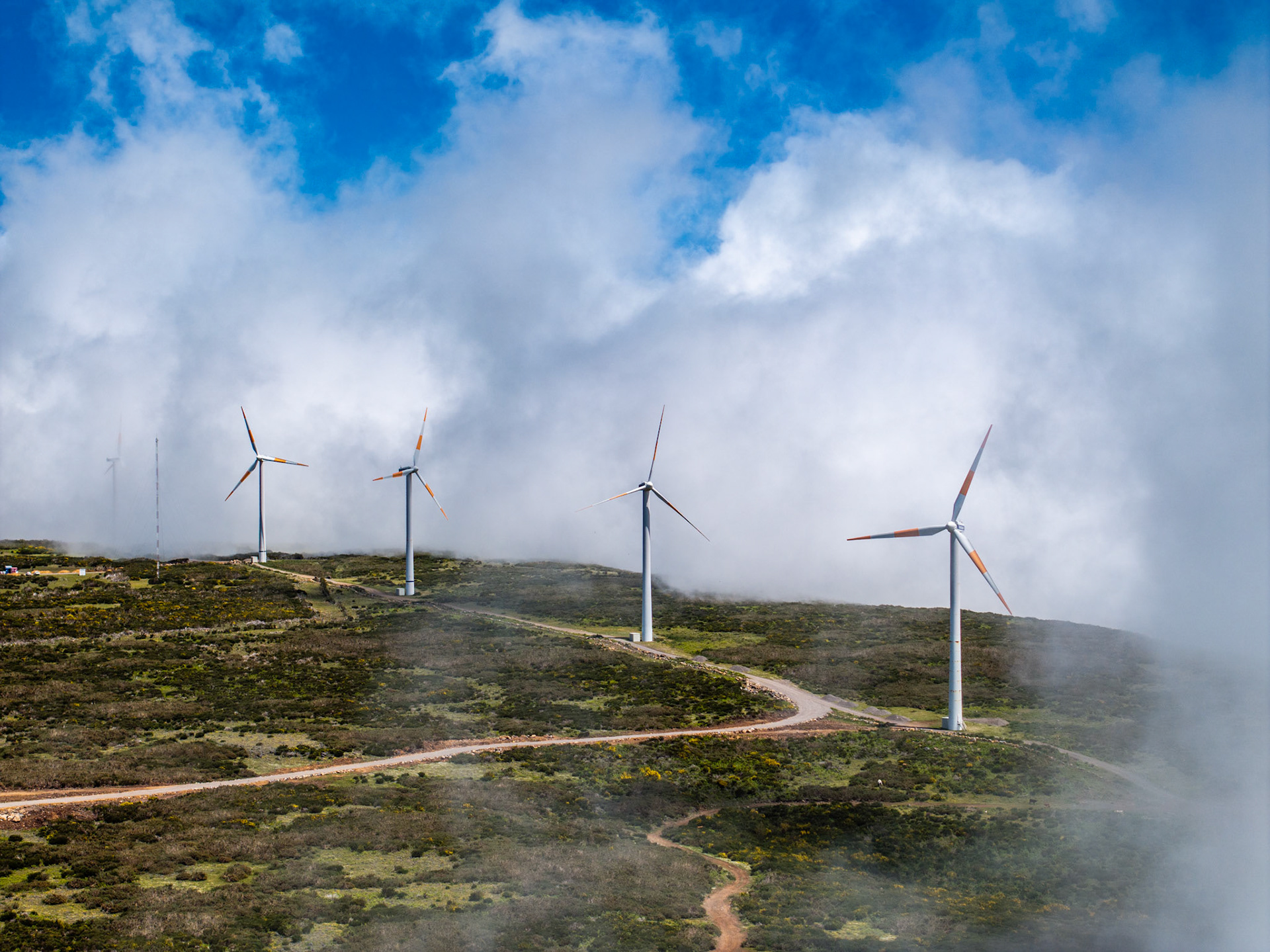
A row of wind turbines lines a ridge on Madeira's western highlands as orographic cloud rolls through the hillside, partially obscuring the turbines in soft mist. The winding service road below anchors the composition and gives scale. Captured in late spring from a drone position level with the cloud layer.
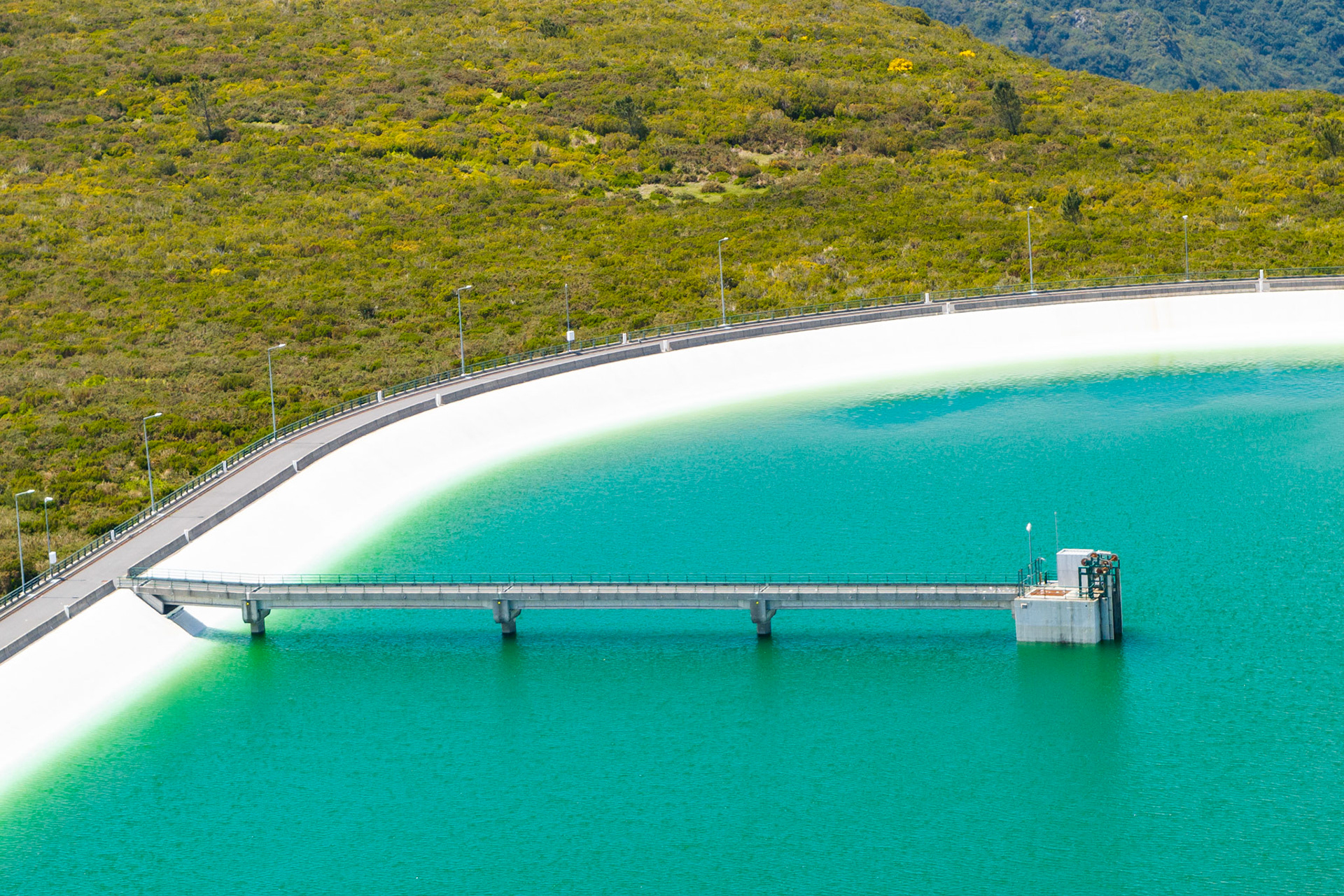
The curved face of the Calheta reservoir dam sweeps across the frame from an aerial vantage, its white concrete wall dividing vivid turquoise water from the scrubland hillside above. A narrow access bridge extends perpendicular to the intake tower, anchoring the geometric composition. Shot in bright overcast light that suppresses shadow and renders the water colour with unusual clarity.
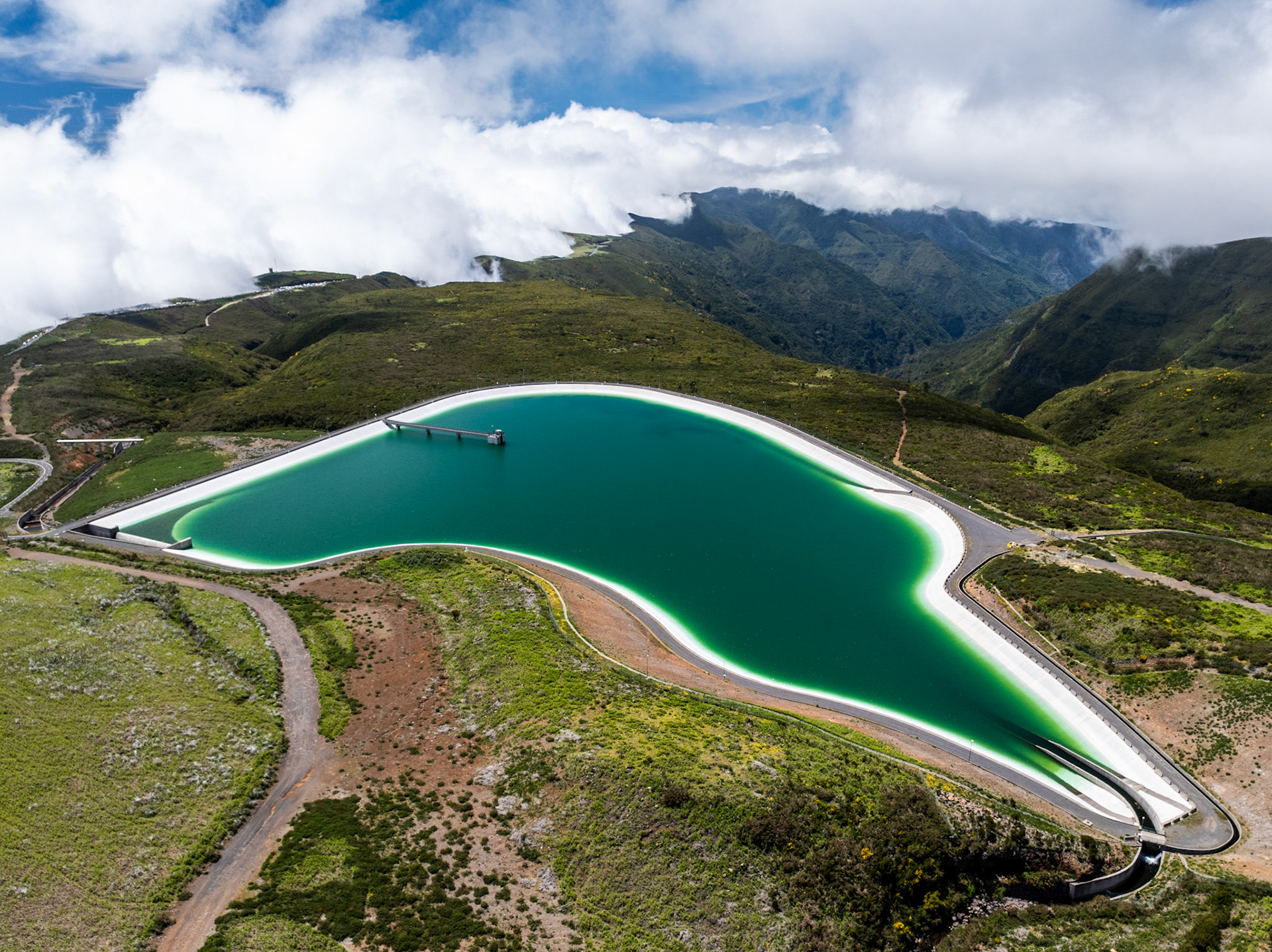
An elevated reservoir on the Paul da Serra plateau, Madeira, its pale concrete liner forming a sinuous white border against the deep teal water. Low cloud clings to the mountain ridge beyond, softening the transition between the engineered basin and the laurisilva-covered slopes. The organic curve of the structure from altitude reads almost as a natural form pressed into the upland terrain.
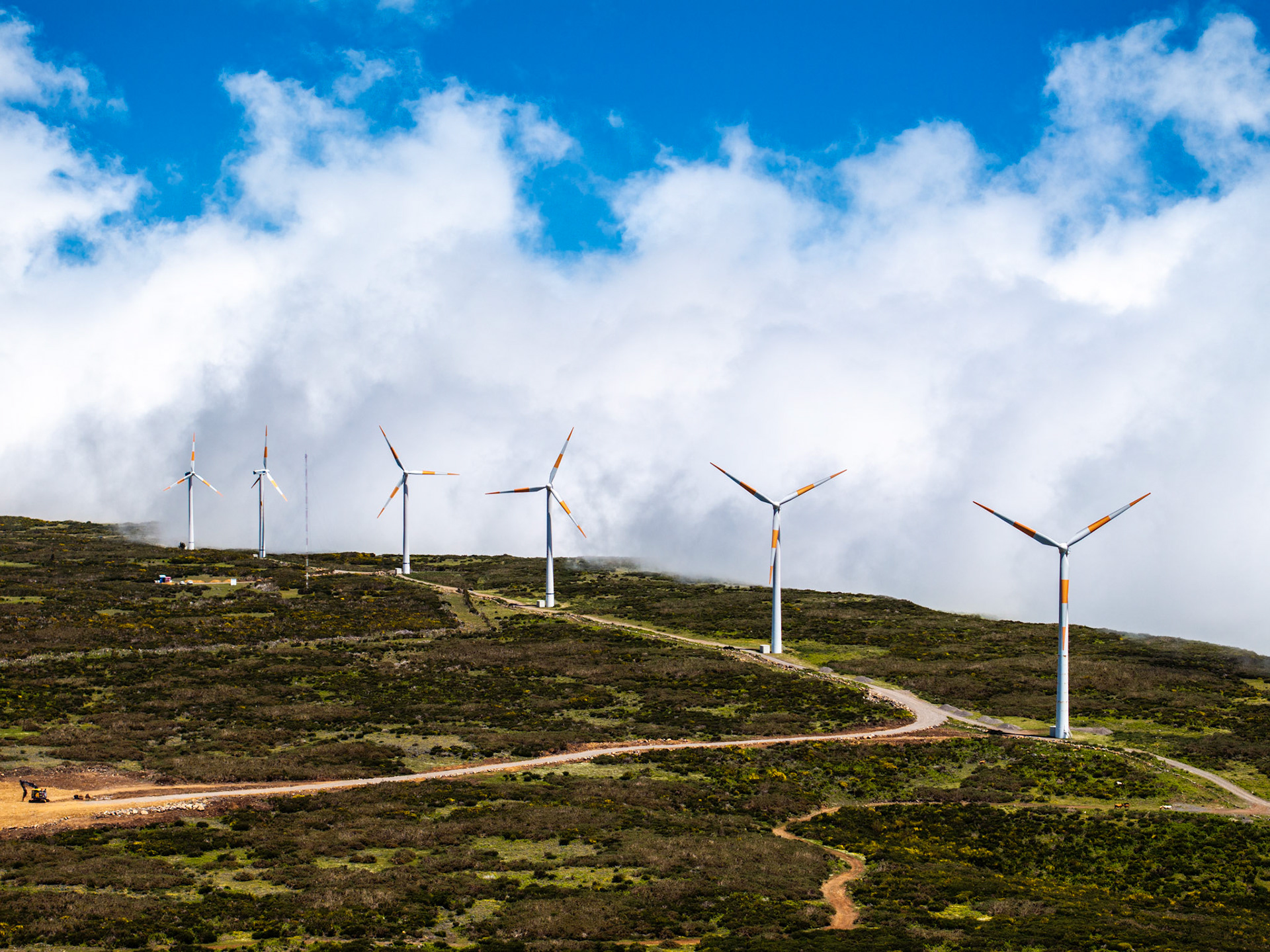
A row of wind turbines traces the ridgeline above Arco da Calheta, Madeira, their orange-tipped blades catching flat spring light against a broken cloud mass that partially obscures the upper slope. The winding service track lends structure to the foreground scrubland, though the composition lacks a singular point of tension to lift it beyond the documentary.
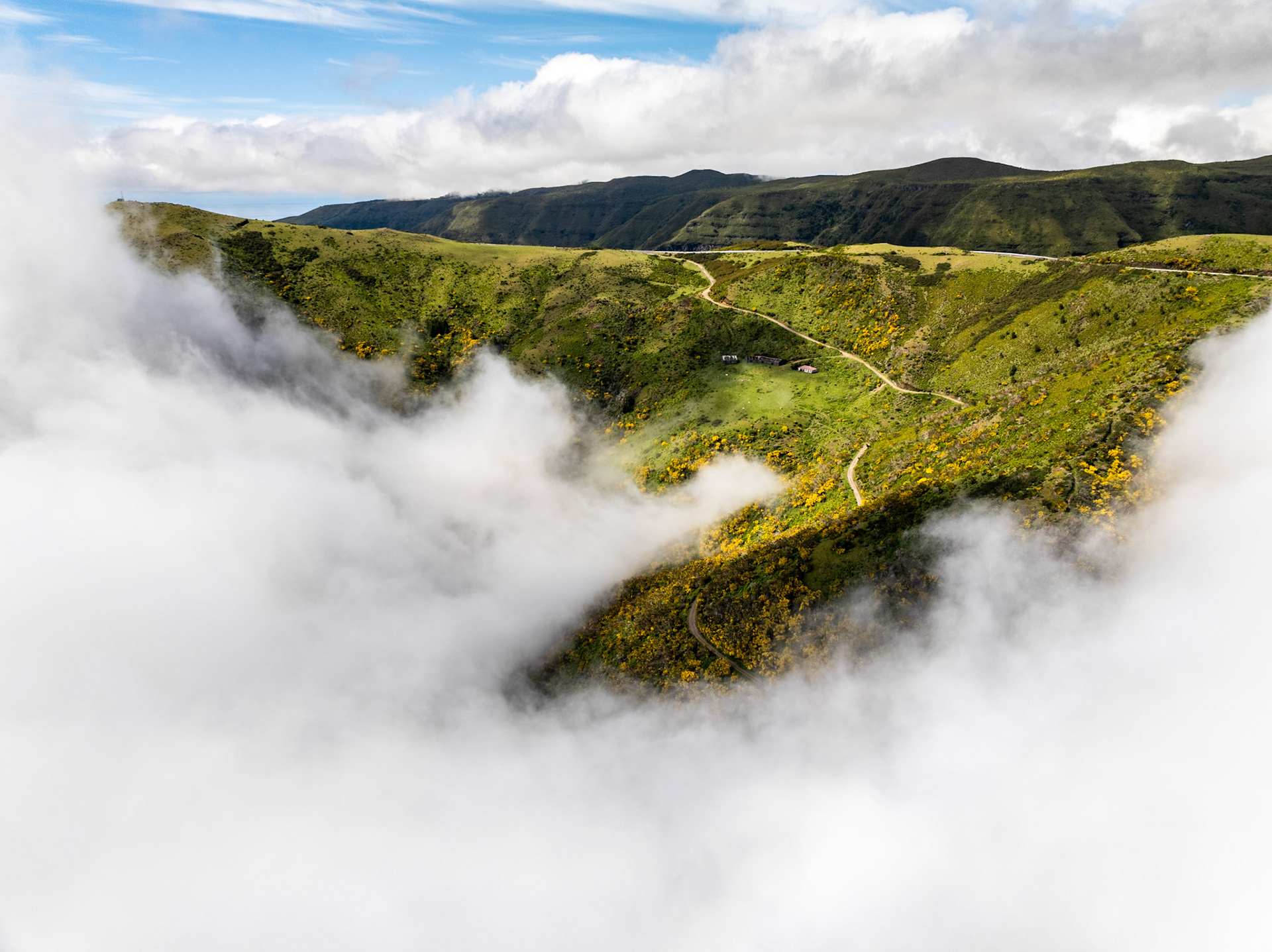
Low cloud pools in a steep-sided valley above Calheta, Madeira, partially obscuring green hillsides dotted with yellow flowering scrub. Shot from directly above the inversion layer, the mist parts to reveal a dirt track winding toward an isolated farmstead. The upper ridgeline and cumulus sky anchor the composition above the cloud floor.
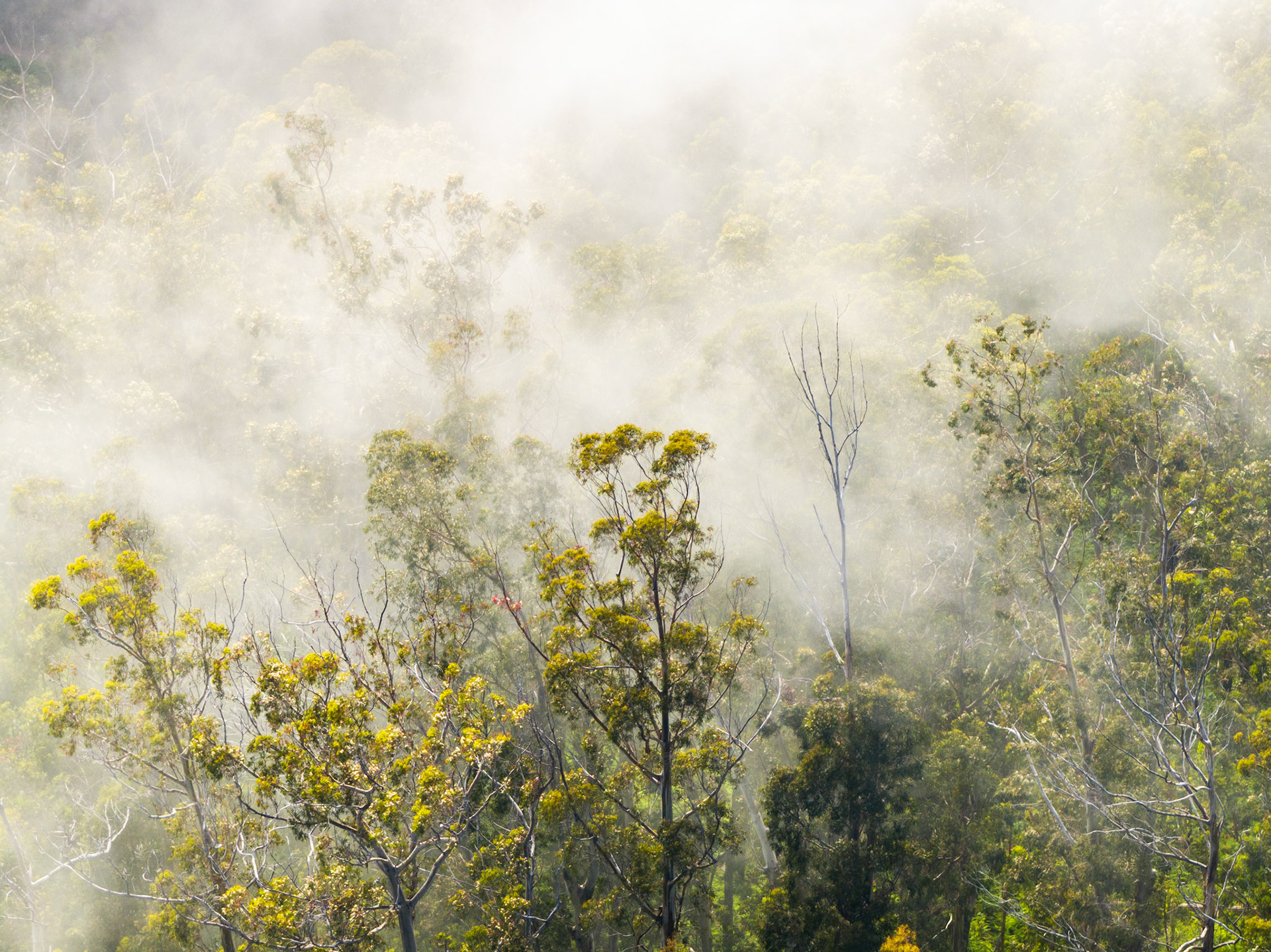
Morning fog moves through eucalyptus woodland on the slopes above Canhas, Madeira, softening the canopy into successive planes of green and white. The aerial perspective flattens depth, turning the mist into a graphic field that isolates individual crowns and bare snags. A small flash of red blossom near centre provides the single note of colour in an otherwise subdued palette.