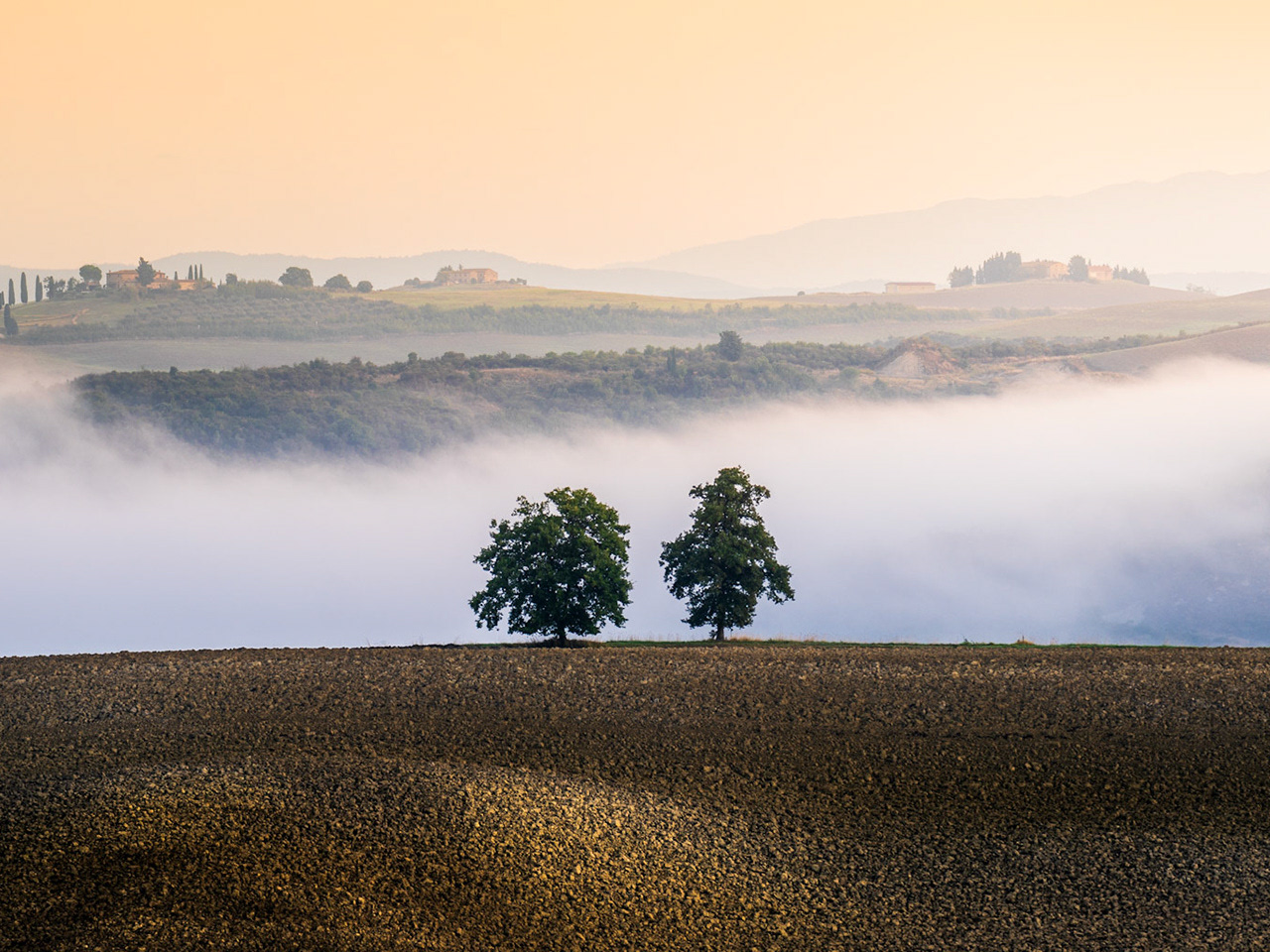
For a few weeks each year, usually late October into November, the beechwoods near my home turn copper and gold, and if the overnight conditions are right the colour comes wrapped in fog. Those mornings are what this collection is about. Almost everything here was made at dawn in the Chiltern Hills, often within the same handful of woods I've walked for years, knowing where the light falls, which trees hold their leaves longest, and where the fog pools first.
Autumn woodland photography is less about finding new places than reading conditions. I use forecast humidity, wind and temperature to pick mornings when mist is likely, then commit to being under the canopy before sunrise. Some years give one good morning; some give a few.
Woodland images from this gallery formed part of "Woodlands Throughout the Year", my winning portfolio in the British Seasons category at the British Wildlife Photography Awards. Prints are available, do get in touch if you'd like to order a particular photograph printed.

An incredible display of mushrooms and fungi on this fallen beech stump. Captured in The Chilterns, near Henley, Oxfordshire, England.

A single small mushroom rises from a dense moss bed, its pale gills catching artificial light against an absolute black background scattered with suspended water droplets. The composition isolates the fruiting body as though adrift in a cosmos of its own, the rain-mist rendered as starfield. Controlled flash or torch lighting gives the subject sculptural precision without artifice.
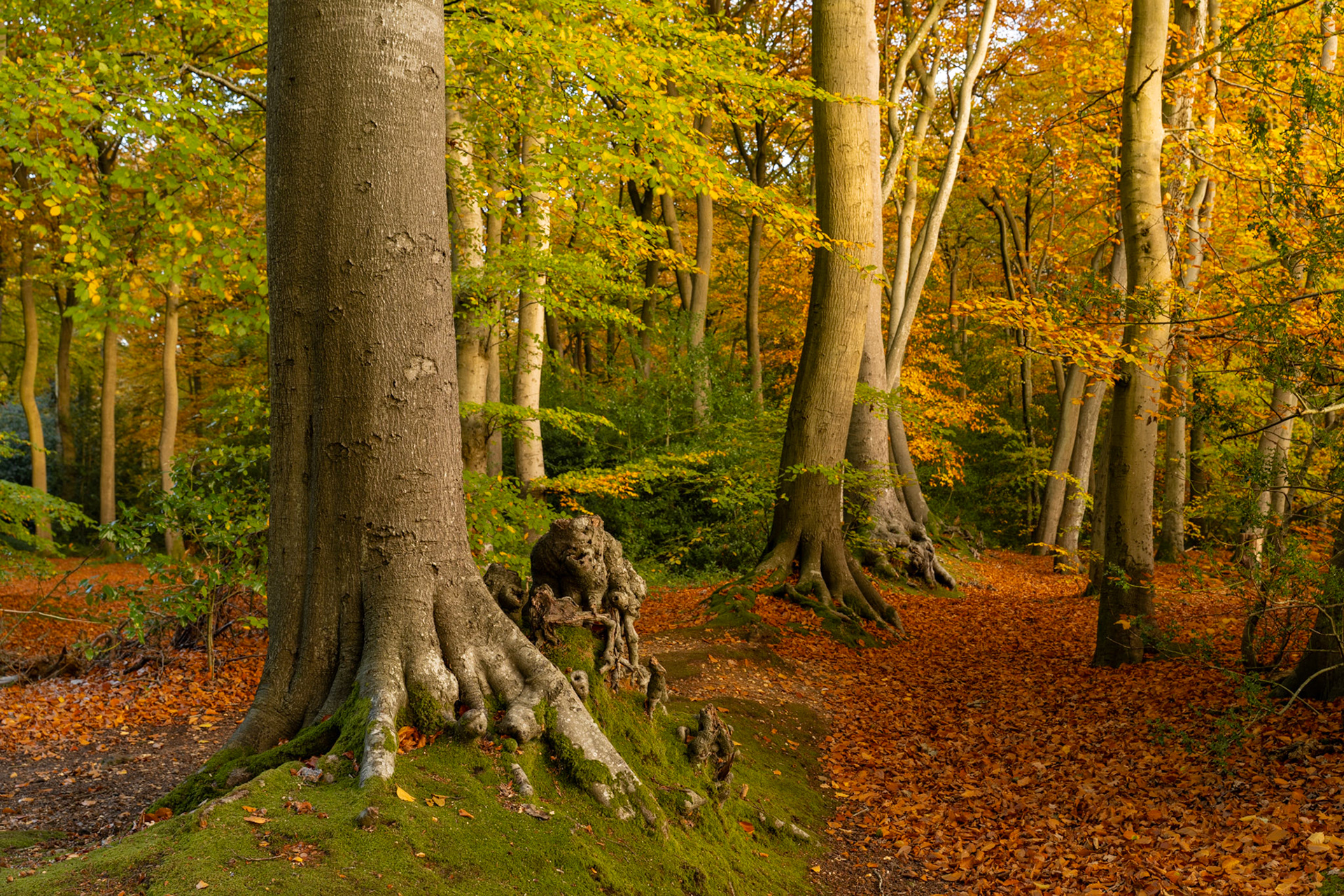
Ancient beech roots grip a mossy bank at the edge of a leaf-strewn path in the Chilterns, Oxfordshire, the canopy holding the last green and gold of autumn. Soft directional light picks out the sculptural form of the buttress roots against a carpet of fallen copper leaves. The receding trunks give depth without revealing a horizon.
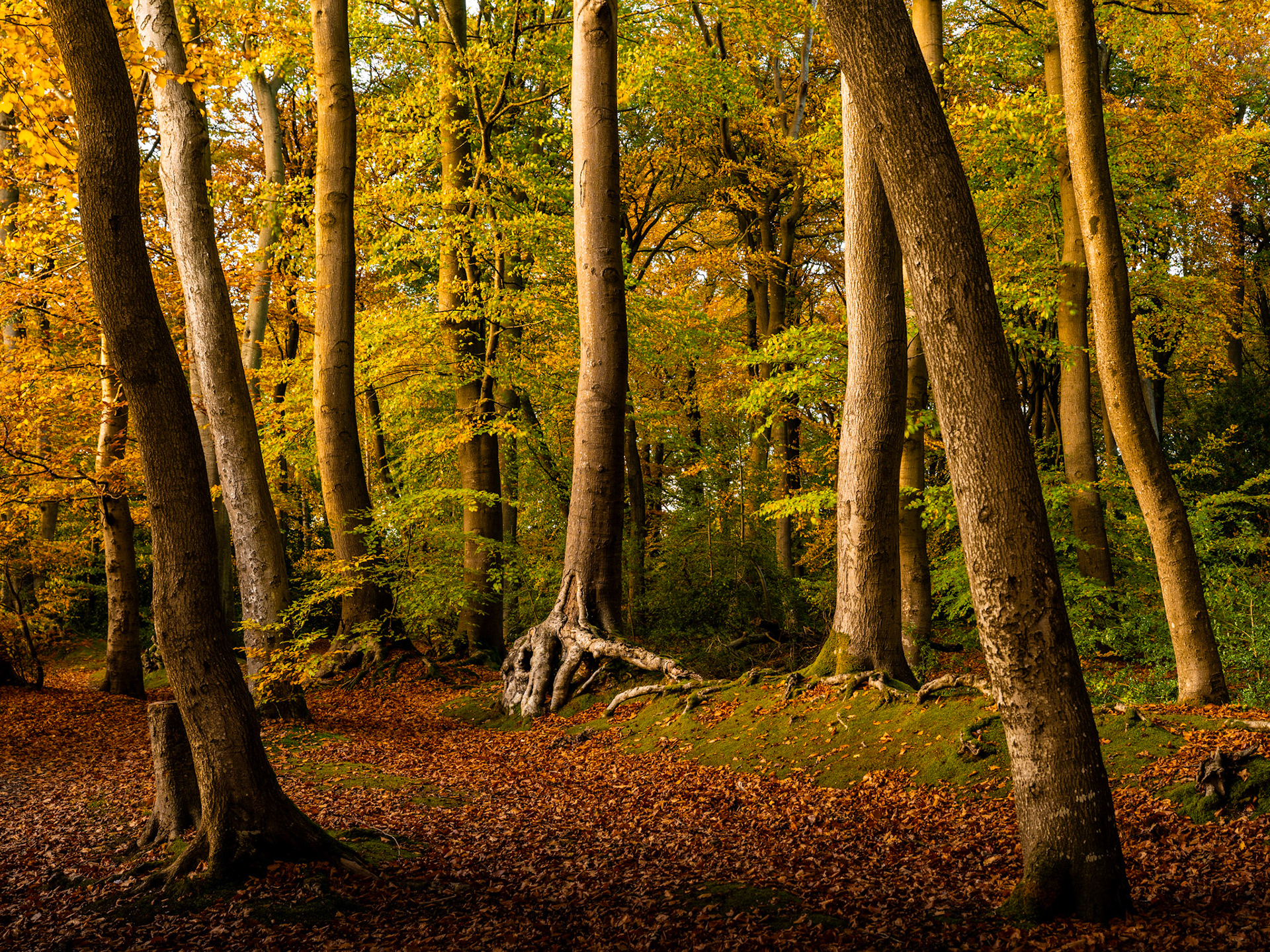
A stand of mature beech trees in the Chilterns, Oxfordshire, caught in late afternoon October light, their exposed surface roots forming an intricate tangle at the base of a mossy bank. Fallen leaves carpet the woodland floor in rusted copper while the canopy retains a last flush of gold and olive green. The raking sidelight separates trunk from shadow, lending the composition quiet structural clarity.
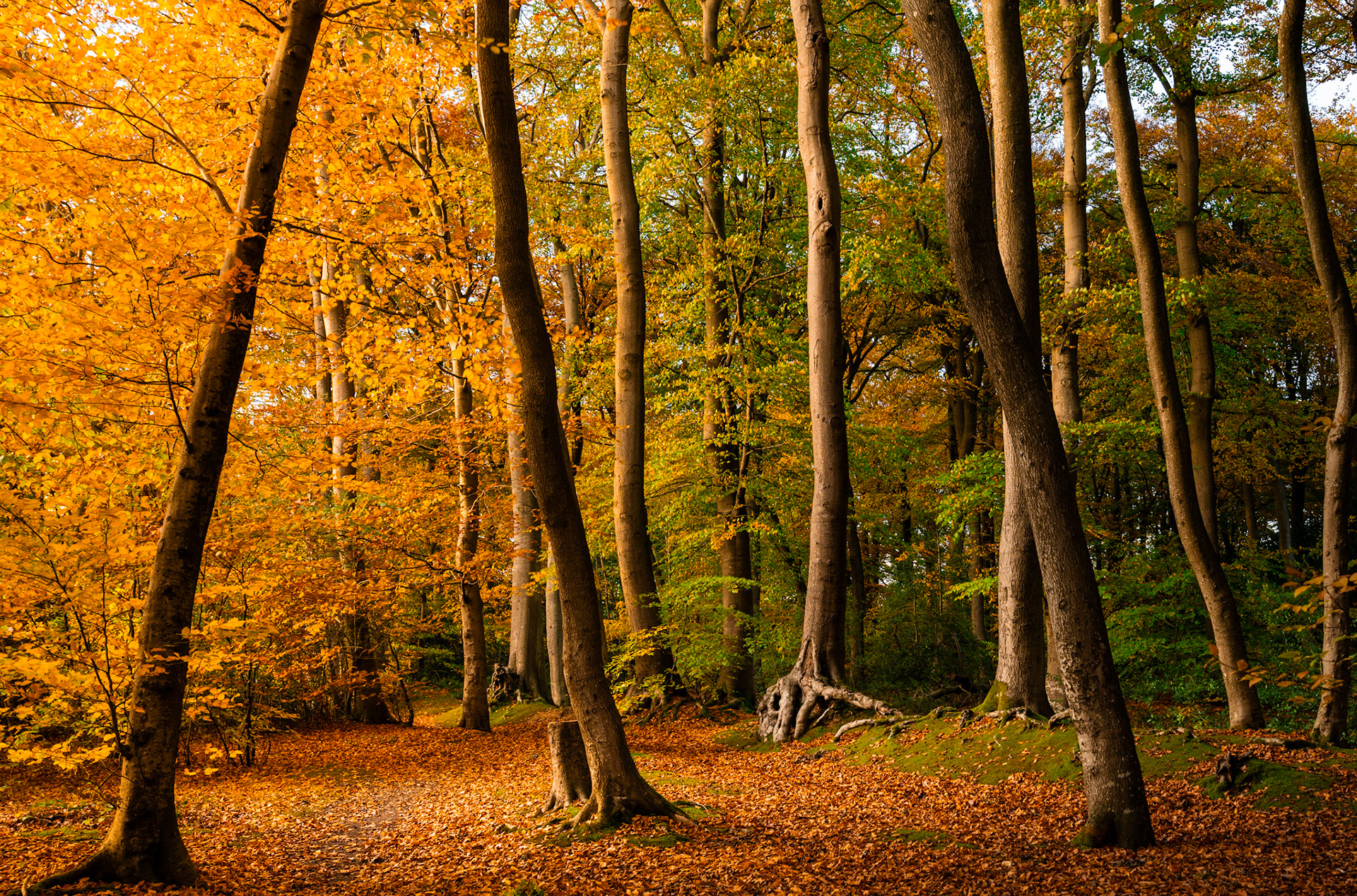
A stand of mature beech trees in the Chilterns, Oxfordshire, photographed in mid-autumn colour, their canopy transitioning from gold on the western side to residual green towards the interior. Fallen leaves carpet the woodland floor around exposed root systems, while dappled afternoon light picks out the smooth grey trunks. The image records the turn of the season with competence, though no single compositional anchor draws the eye.

Autumn beech leaves drift on a shallow pool in the Chilterns, Oxfordshire, their amber and ochre tones set against blue-grey water and a scattering of green duckweed. The overhead perspective reduces the scene to pure pattern and colour, the leaves distributed with a natural randomness that resists easy composition. Captured in flat November light, the image holds a quiet, unsentimental record of seasonal decay.
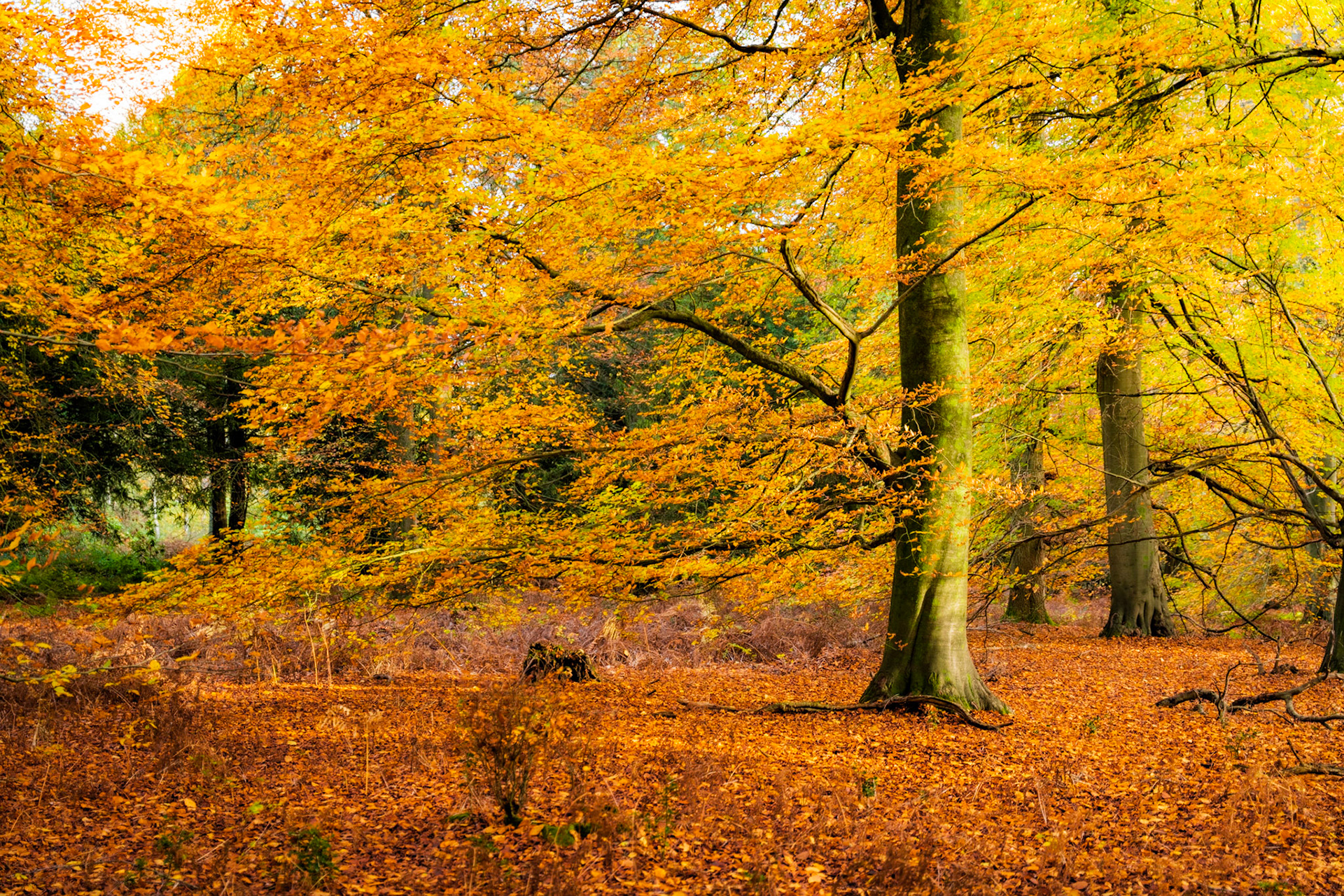
Peak autumn colour holds in a broadleaved woodland clearing in the Chilterns, Oxfordshire, the canopy shifting between gold and ochre above a floor of fallen leaves and collapsed bracken. The dominant beech trunk anchors the right of frame, while receding conifers suggest a mixed-wood edge. Flat ambient light subdues contrast without providing the atmospheric conditions that characterise the photographer's signature work.
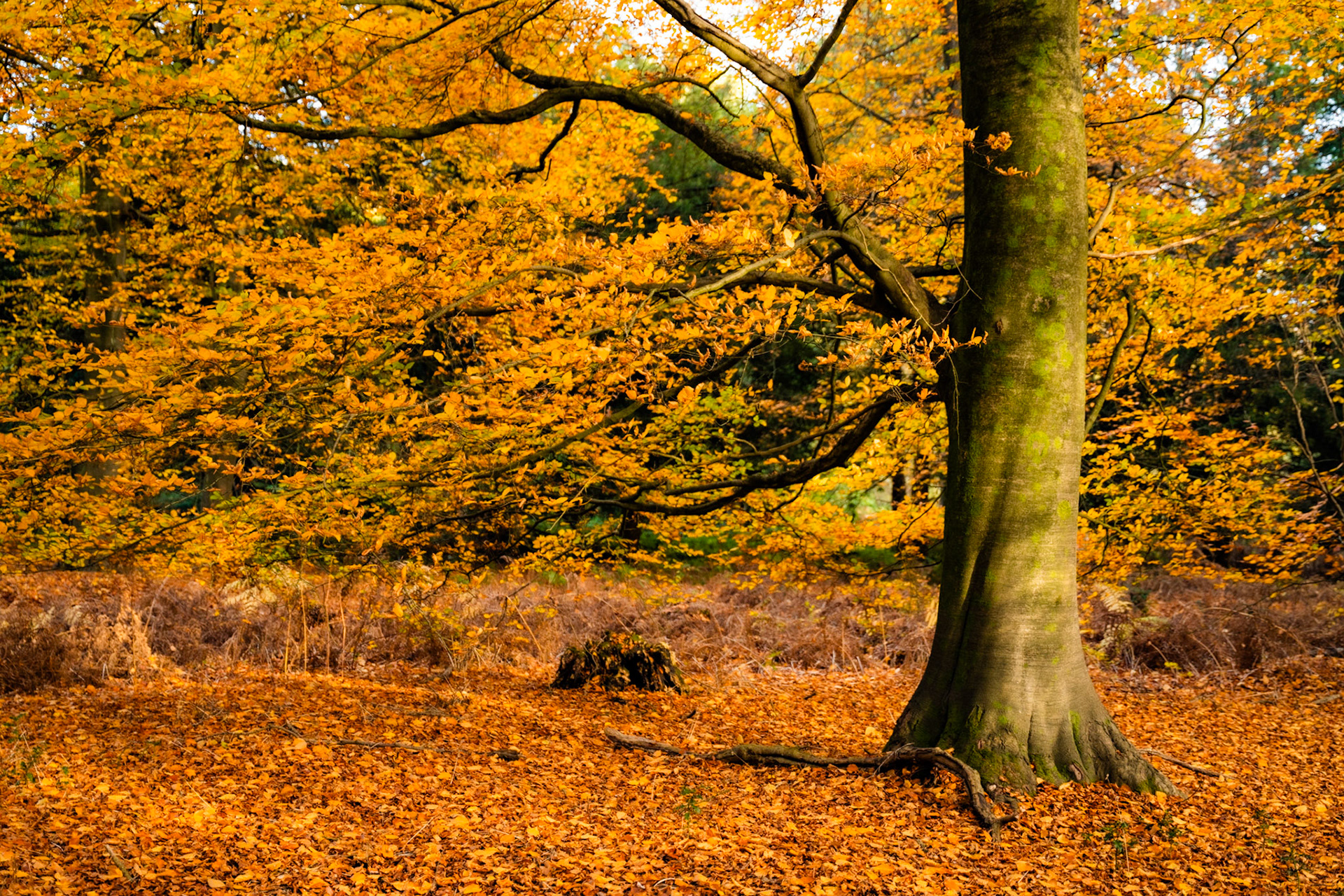
A mature beech stands at the woodland edge in the Chilterns, Oxfordshire, its canopy still holding amber foliage above a floor deep in fallen leaves. Bracken and heathland scrub behind suggest a forest margin. The flat midday overcast gives even illumination but little mood.
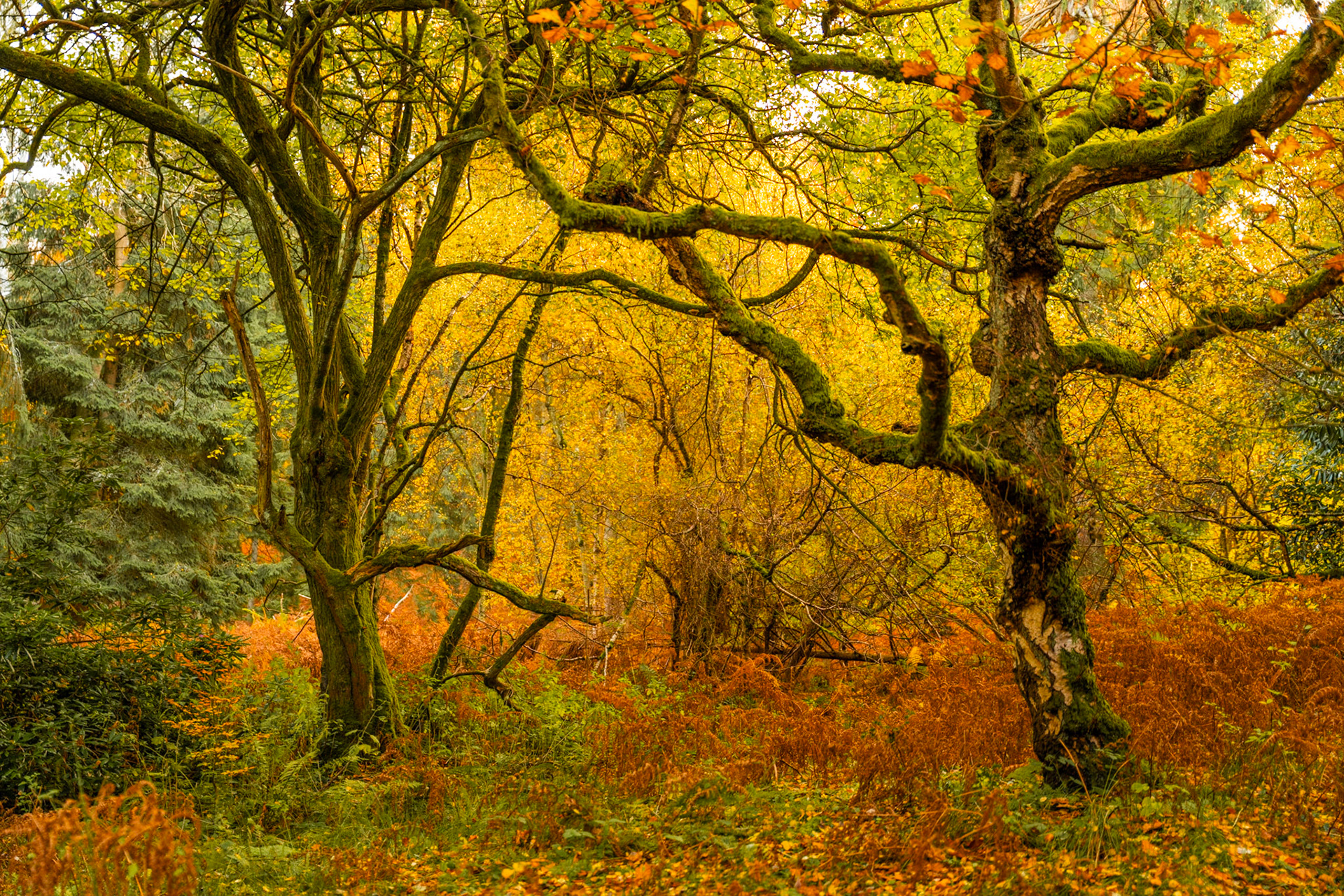
Two moss-covered deciduous trees frame a dense understorey of bracken and fallen leaves in full autumn colour. The flat, diffuse light flattens depth and removes the atmospheric separation that might have elevated the composition. The scene has quiet character but lacks a clear focal anchor to draw the eye through the frame.
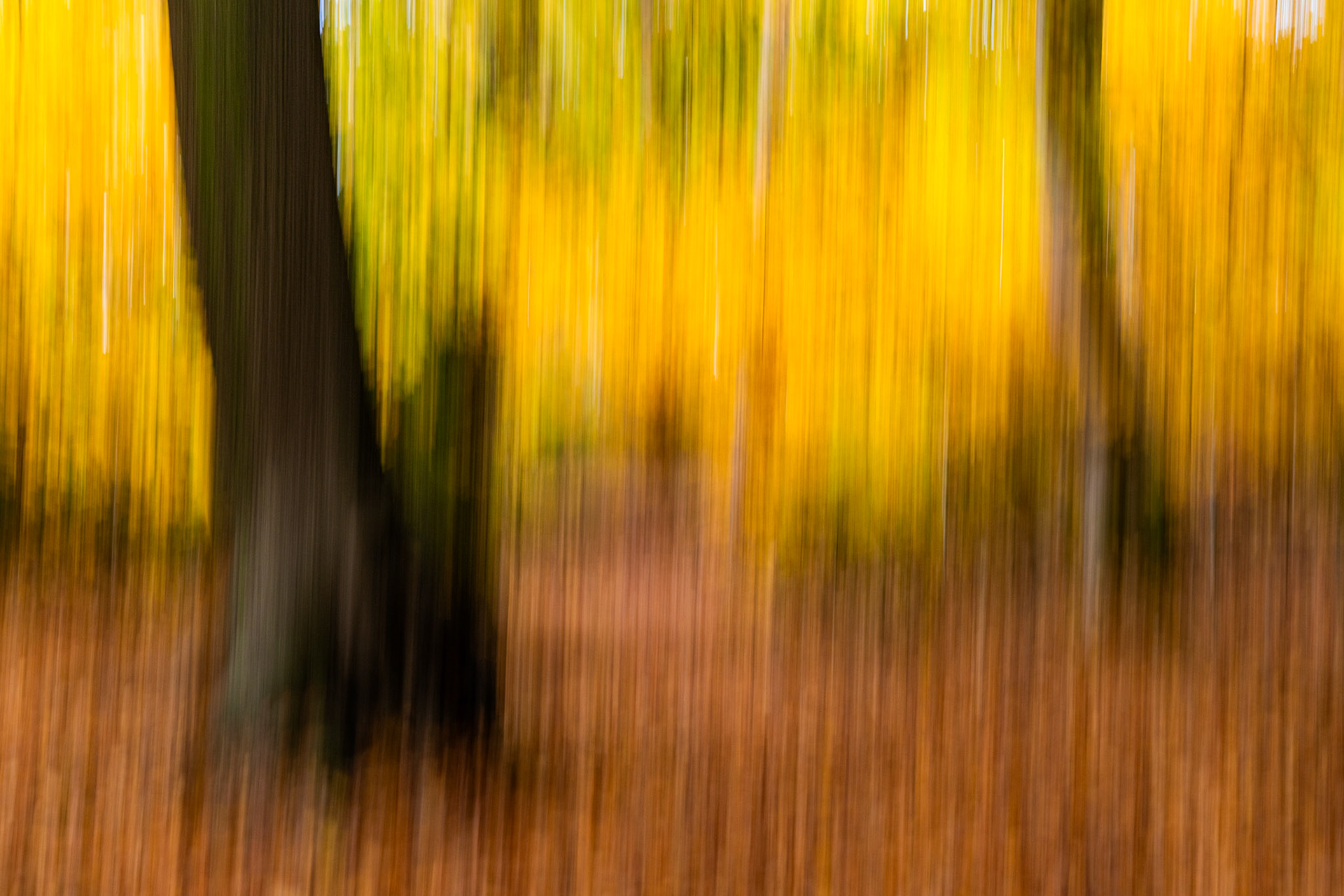
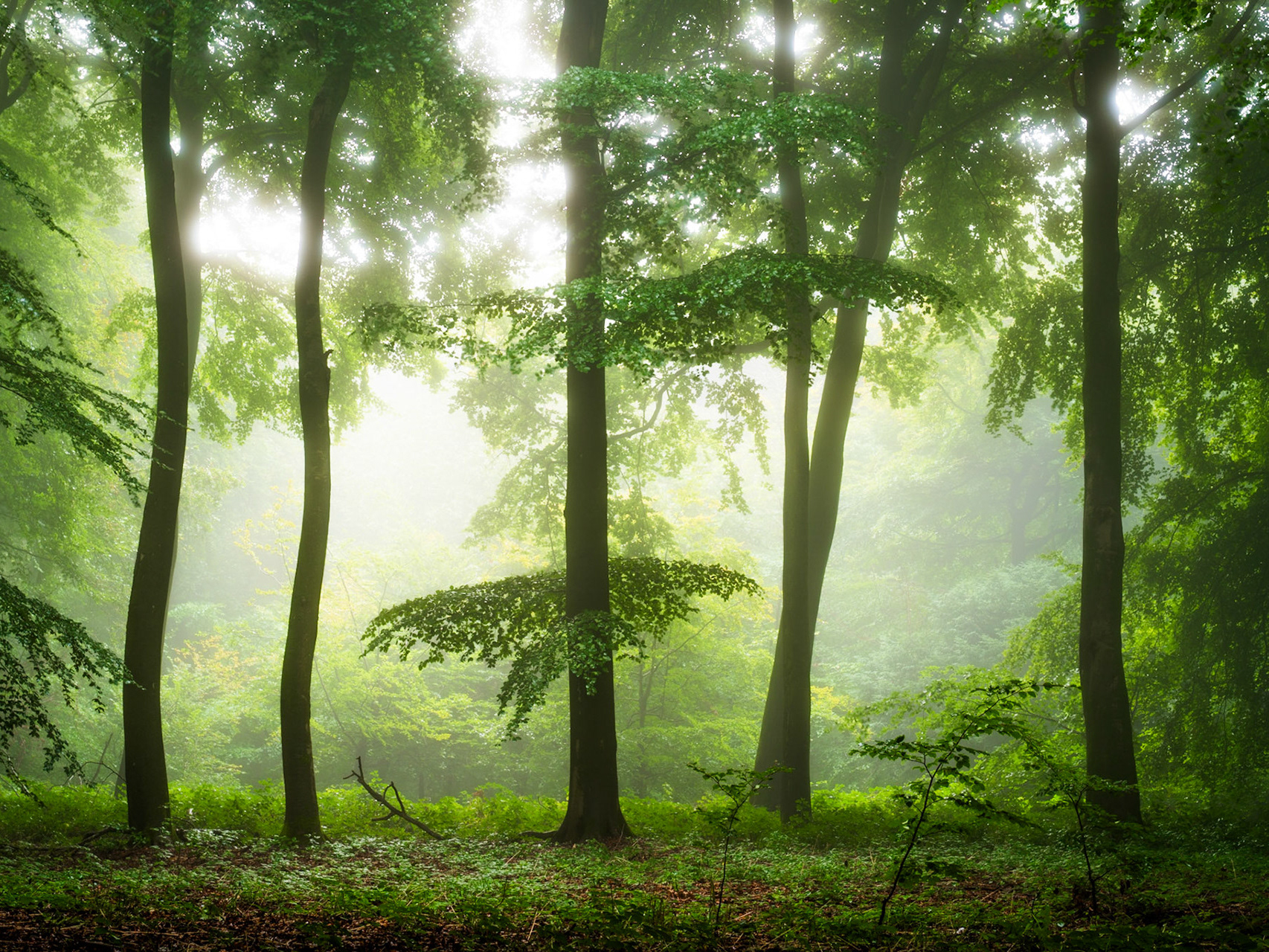
Multi-stemmed ancient beech trees, their bark heavy with moss and lichen, rise from a leaf-litter floor in Savernake Forest, Wiltshire, caught in early-morning mist. The soft diffusion of fog through the emerging canopy compresses the woodland into layered planes of grey-green, lending the scene an ageless stillness. Fallen timber and exposed buttress roots reinforce the sense of an undisturbed, long-established wood.
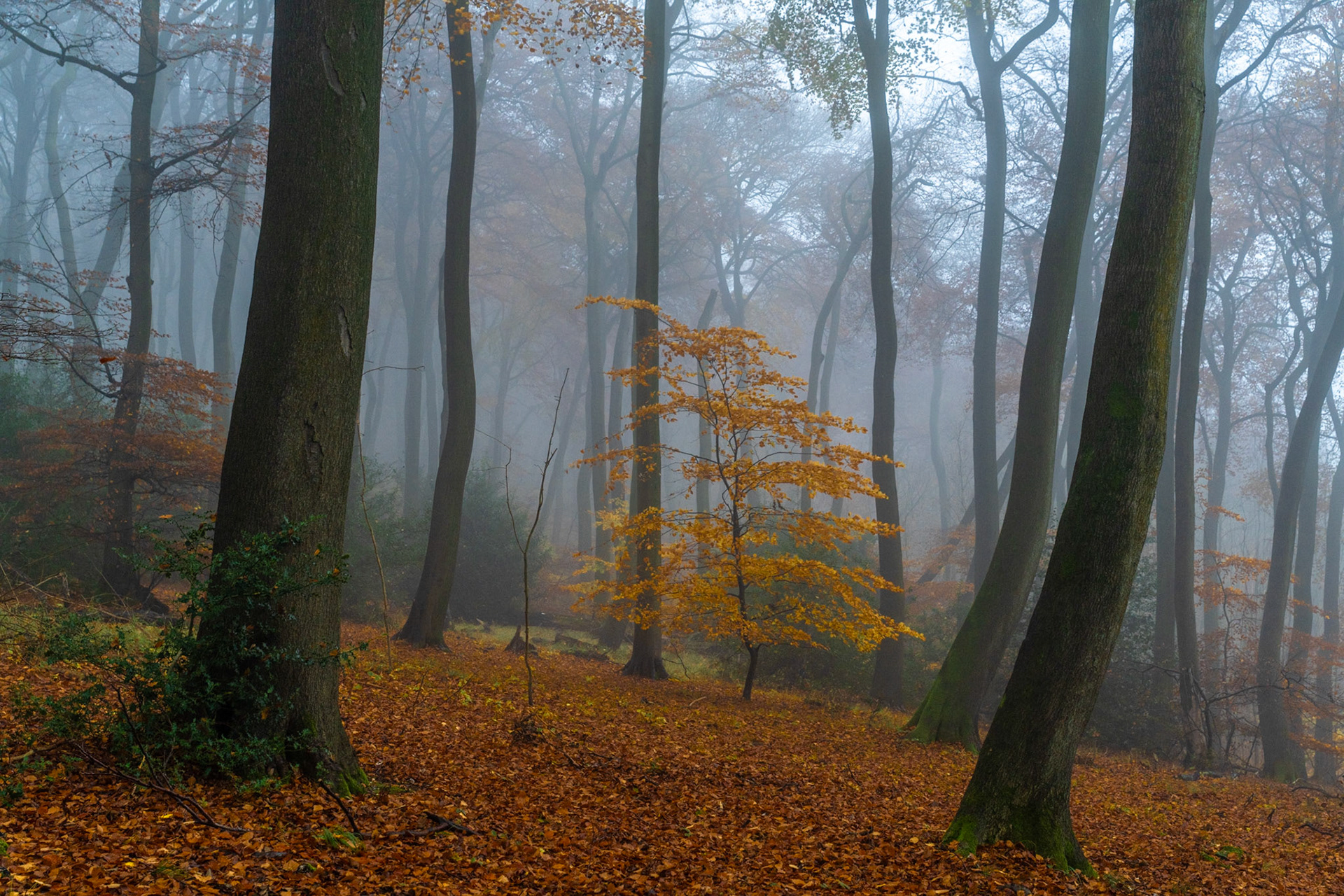
A young beech in the Chilterns retains its amber foliage against a receding curtain of fog, framed by the dark columns of mature trees stripped to their winter silhouettes. The muted cool tones of mist beyond isolate the single golden canopy with quiet precision, drawing the eye to the contrast between the season's last colour and the encroaching bare wood. Fallen leaves carpet the slope throughout, grounding the composition in late November stillness.
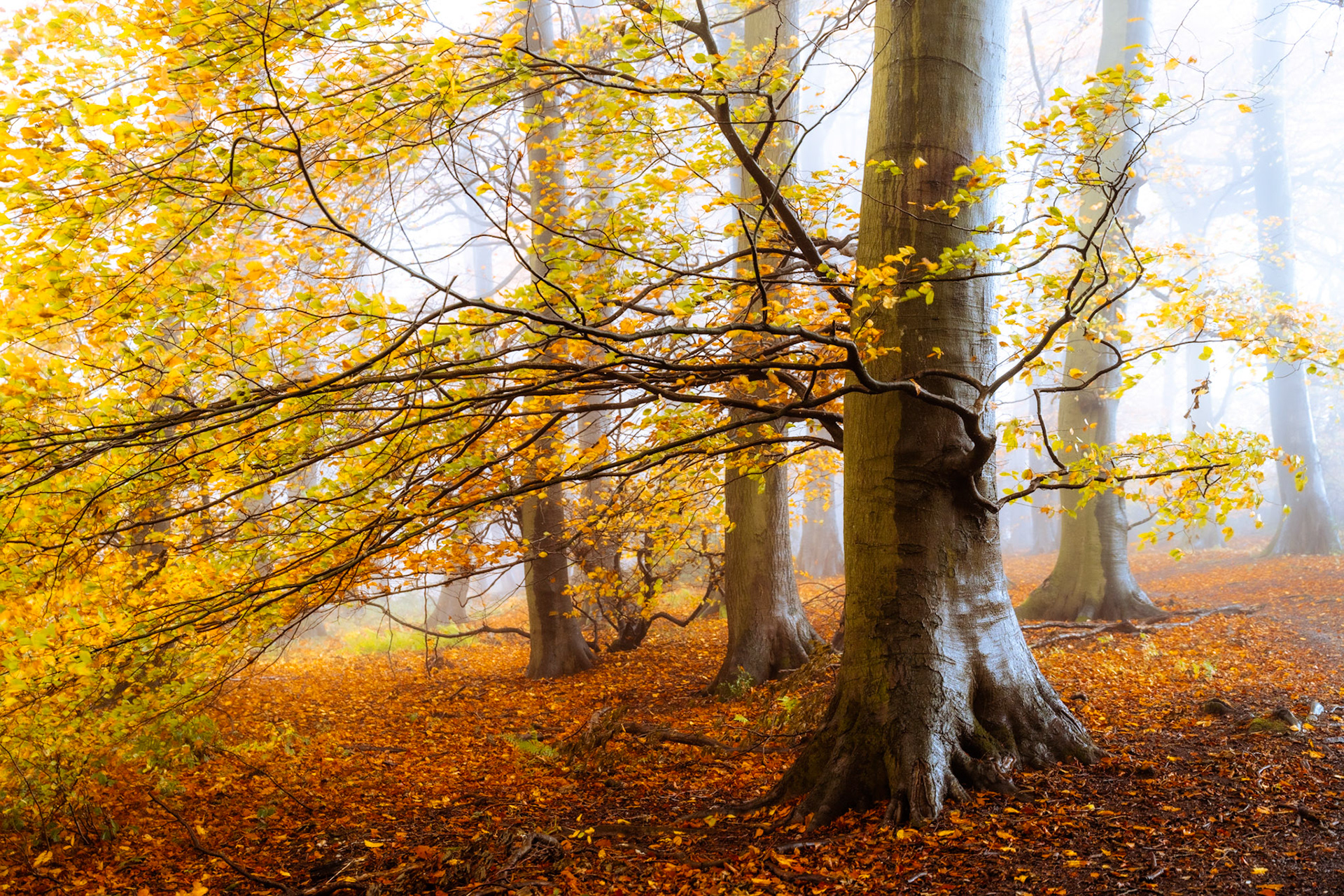
A veteran beech in the Chilterns, its branches arching low across a floor thick with fallen leaves, holds its last autumn colour against dense morning fog. The mist erases the woodland's depth, compressing the stand of smooth-barked trunks into a layered, near-monochromatic distance that contrasts with the warm amber and yellow of the foreground canopy. The composition centres on the tree's character — the knotted branch union and buttressed roots — rather than spectacle alone.
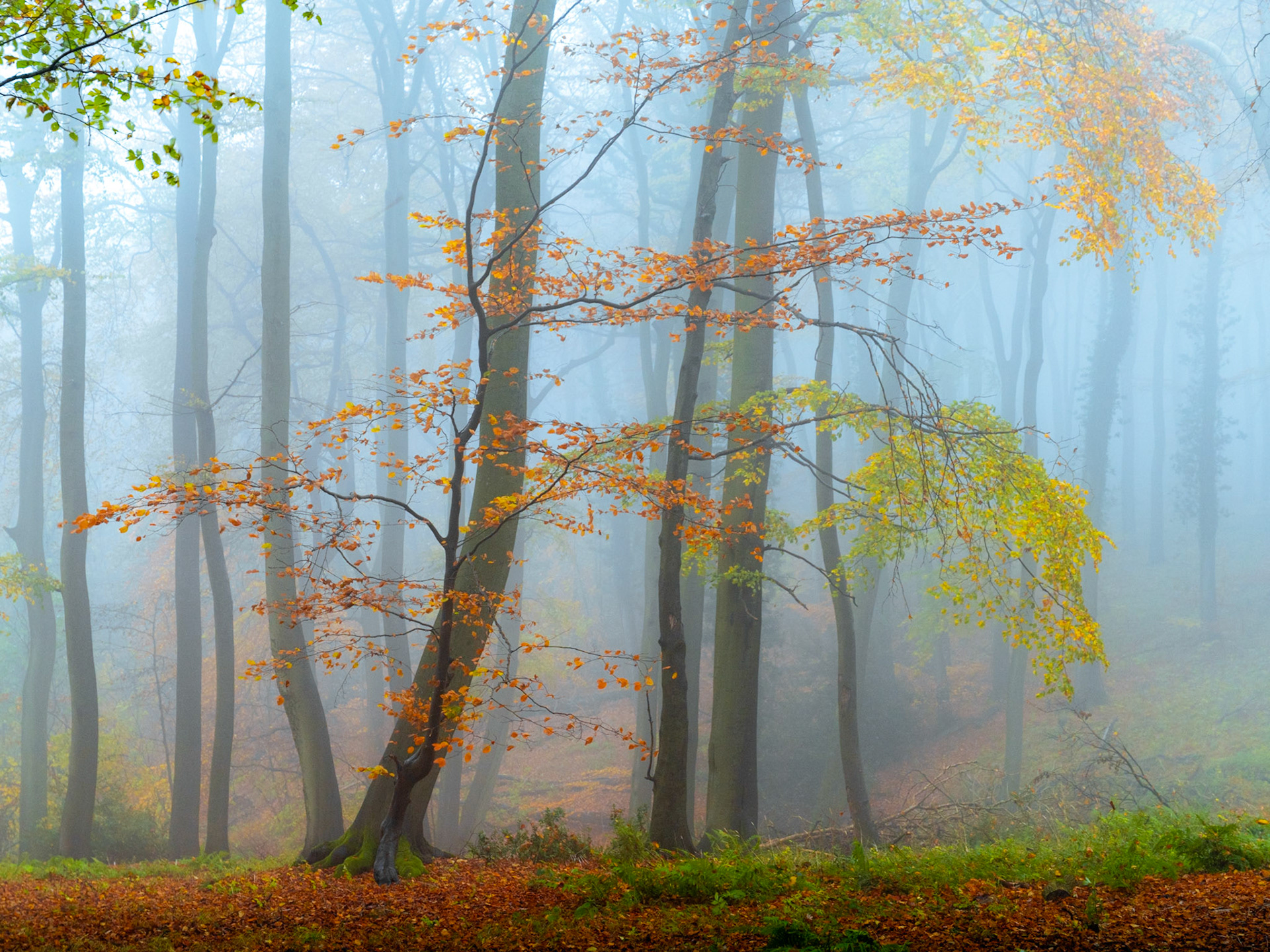
A young beech retains its copper leaves against a stand of tall, fog-softened trunks receding into a pale November morning in the Chilterns, Oxfordshire. The mist compresses depth and drains colour from the background, leaving the foreground foliage to carry the warmth of late autumn. A carpet of fallen leaves and low ferns anchors the composition at ground level.
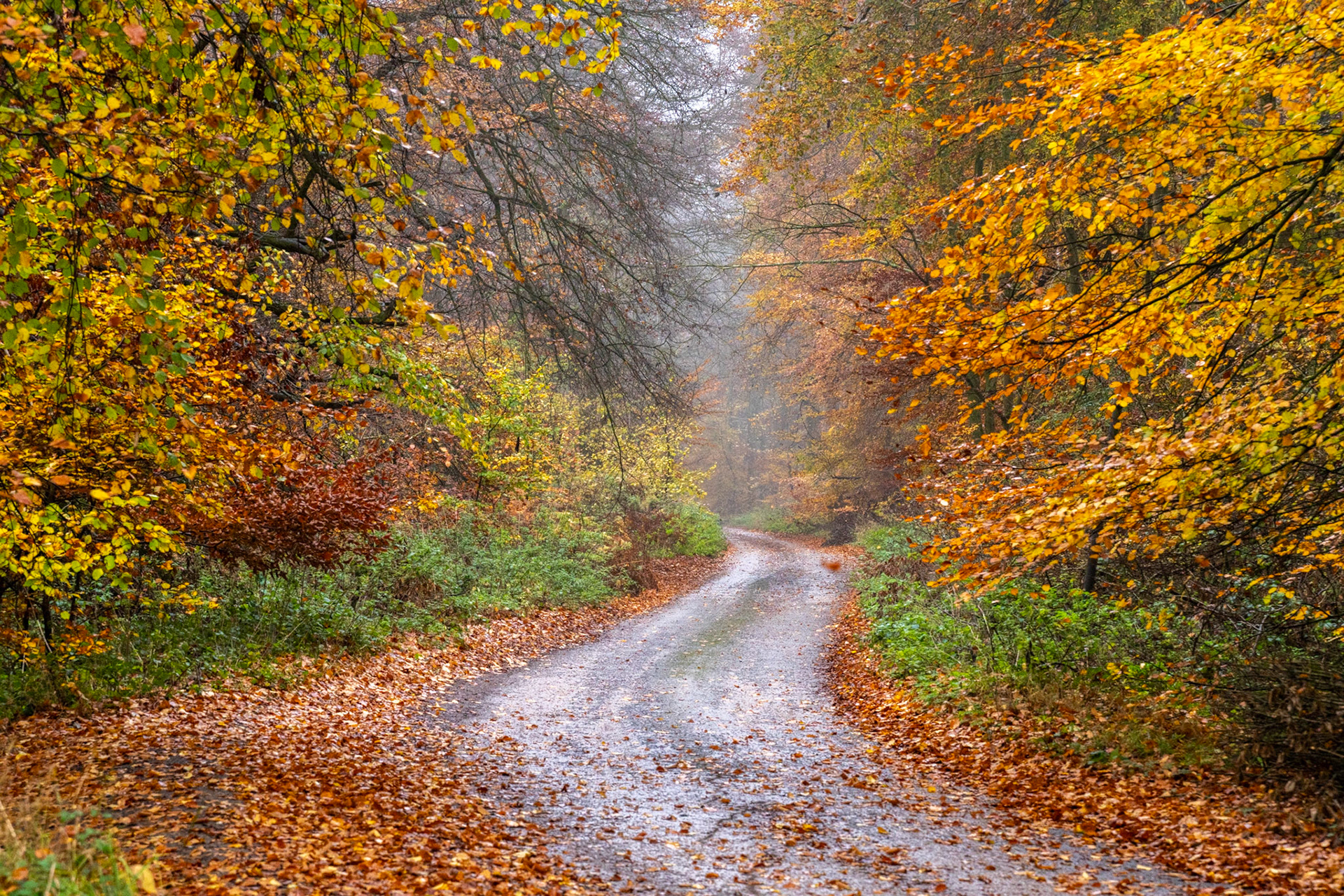
A gravel track winds into autumn woodland in the Chilterns, Oxfordshire, the canopy of beech and mixed broadleaf forming a loose tunnel over the wet path as low mist obscures the trees beyond. Fallen leaves carpet the verges in rust and amber, while the fog compresses depth and quietens the background to soft grey. The curving road draws the eye forward into uncertainty.
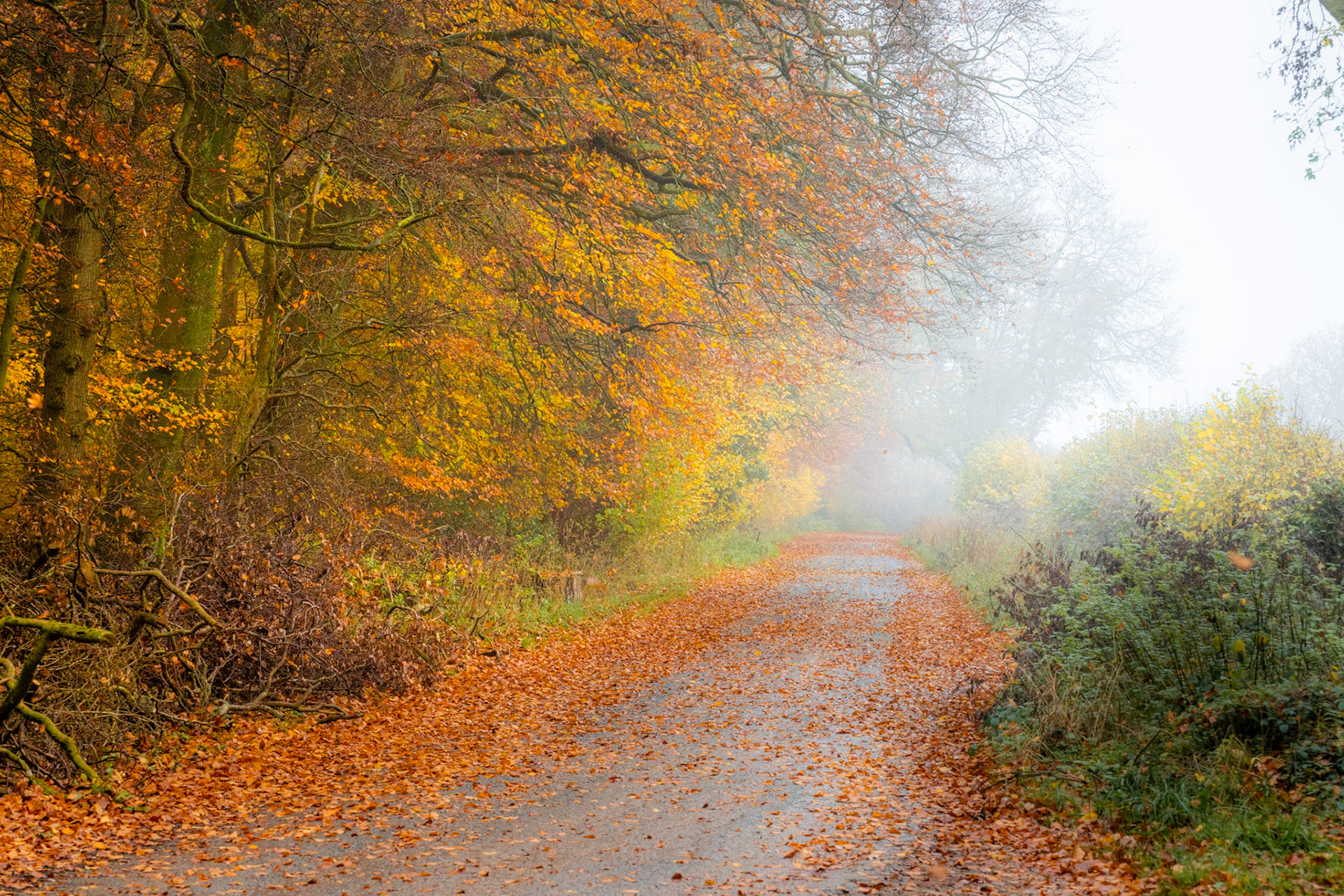
A narrow lane in the Chilterns, Oxfordshire, disappears into autumn mist, flanked by beech trees still holding amber and ochre foliage. Fallen leaves carpet the tarmac and verges, compressing the season into a single plane of warm colour against the grey-white diffusion ahead. The asymmetry of dense woodland left and open hedgerow right gives the composition an unresolved quality that suits the mood.
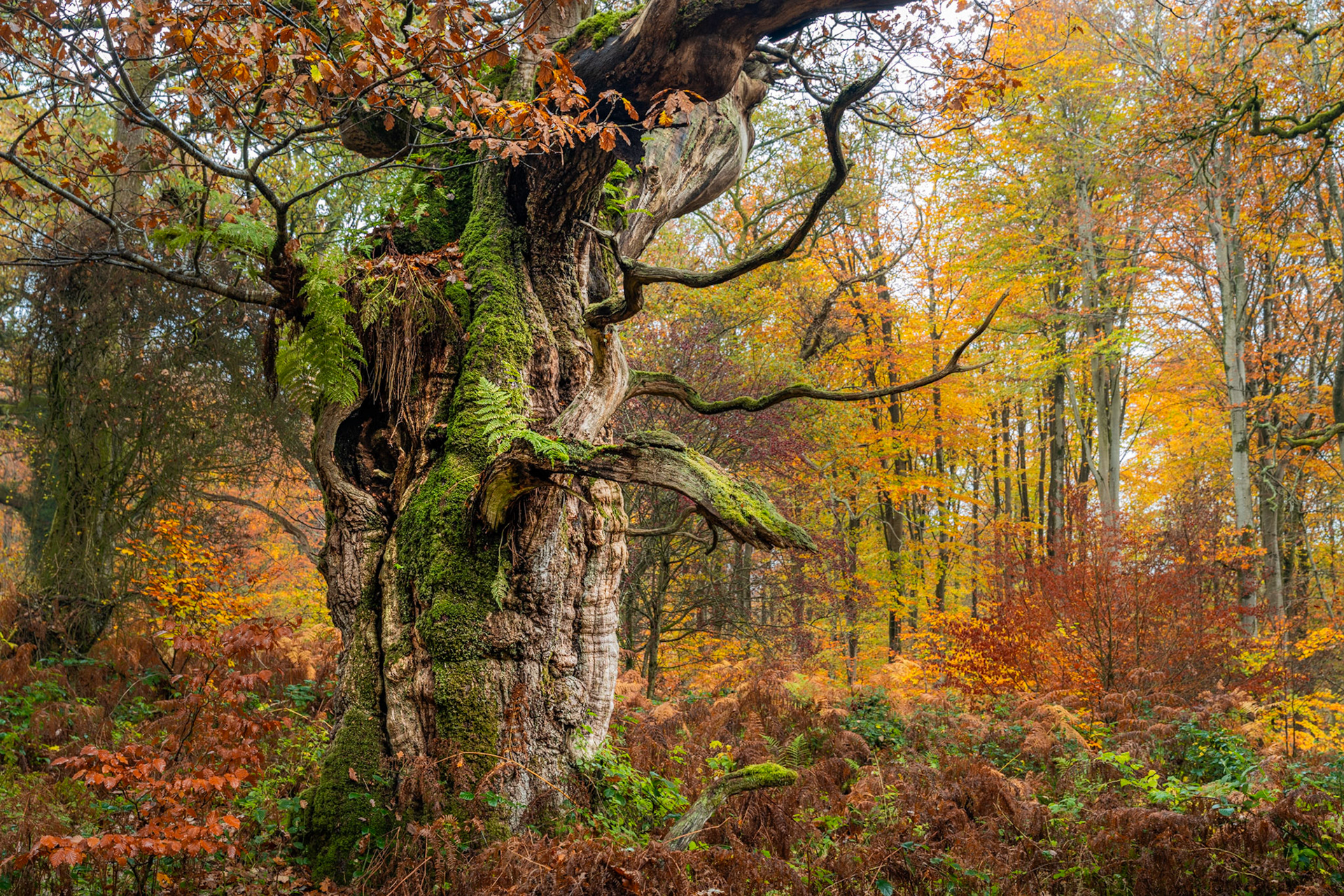
A massively girthed veteran oak, its bark fissured and moss-laden, stands amid bracken and autumn beech woodland in the Chilterns, Oxfordshire, under flat November light. Epiphytic ferns colonise the upper trunk, evidence of decades of moisture retention within a sheltered understorey. The diffuse overcast suppresses shadow, allowing the bark texture and the copper-and-gold woodland beyond to hold equal weight.
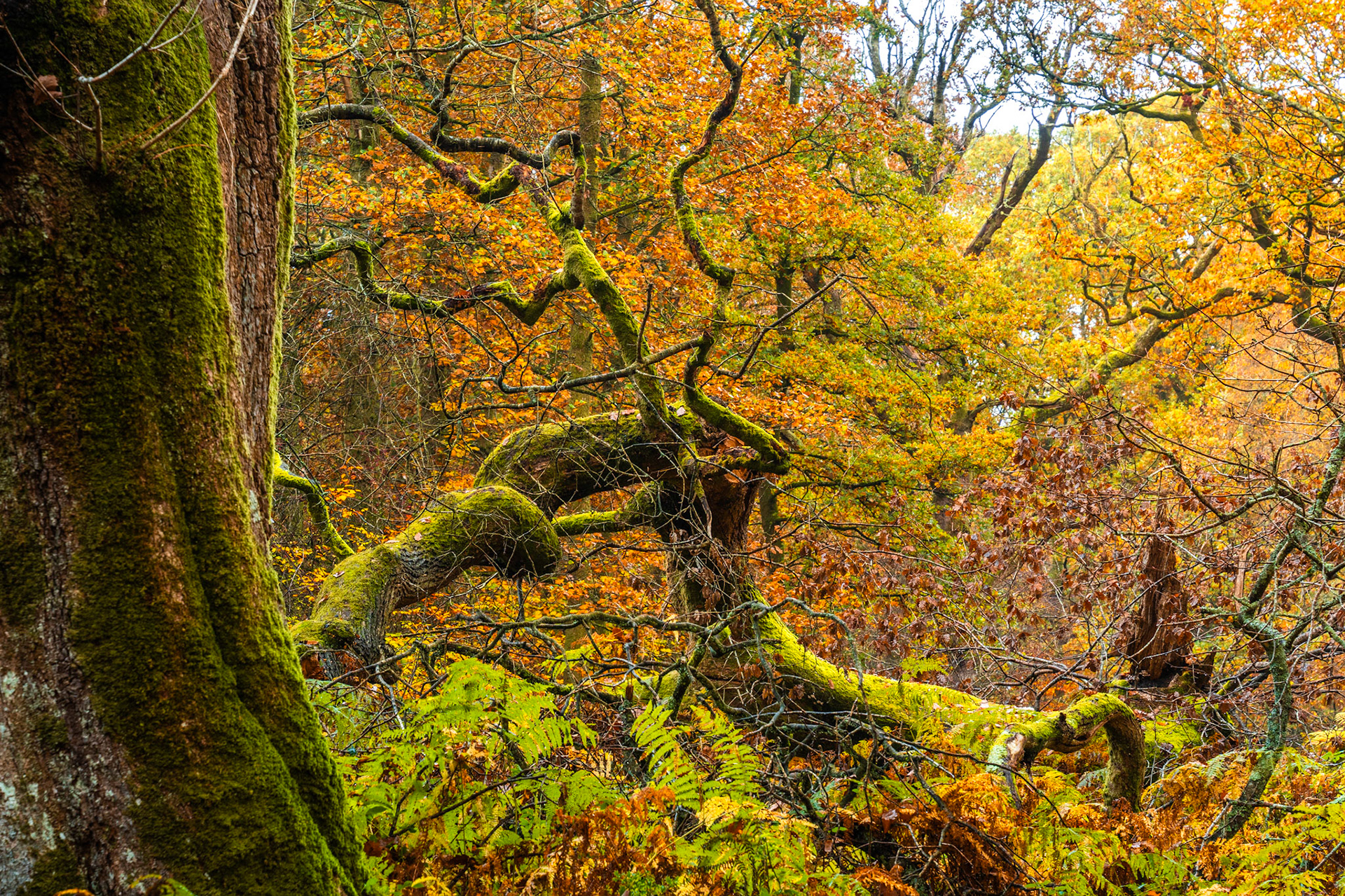
A moss-laden fallen oak sprawls across a woodland floor deep in autumn colour, its contorted limbs mirroring the gnarled canopy above. Bracken and fern litter the understorey in russet and olive, the diffuse overcast light rendering texture without shadow. The scene suggests ancient, unmanaged woodland typical of upland Atlantic oakwood.
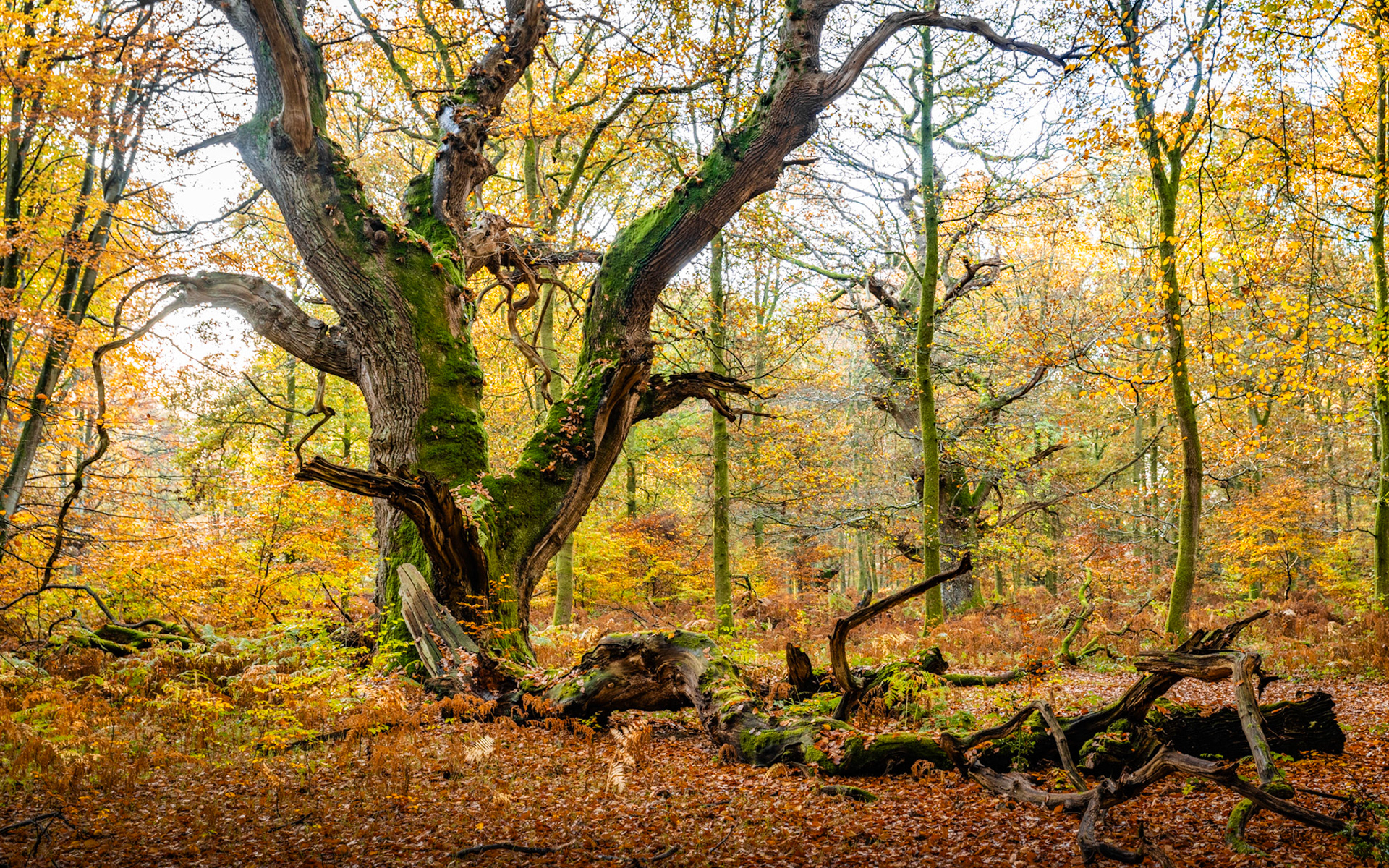
A veteran oak, its trunk heavily moss-clad and limbs fractured by age, dominates an open woodland floor in the Chilterns, Oxfordshire, strewn with fallen leaves and collapsed deadwood. The surrounding beech trees hold their last amber foliage against a pale overcast sky, placing the old tree in its ecological context. Decaying timber and bracken at the base reinforce the image of a tree well past its prime yet still commanding the scene.
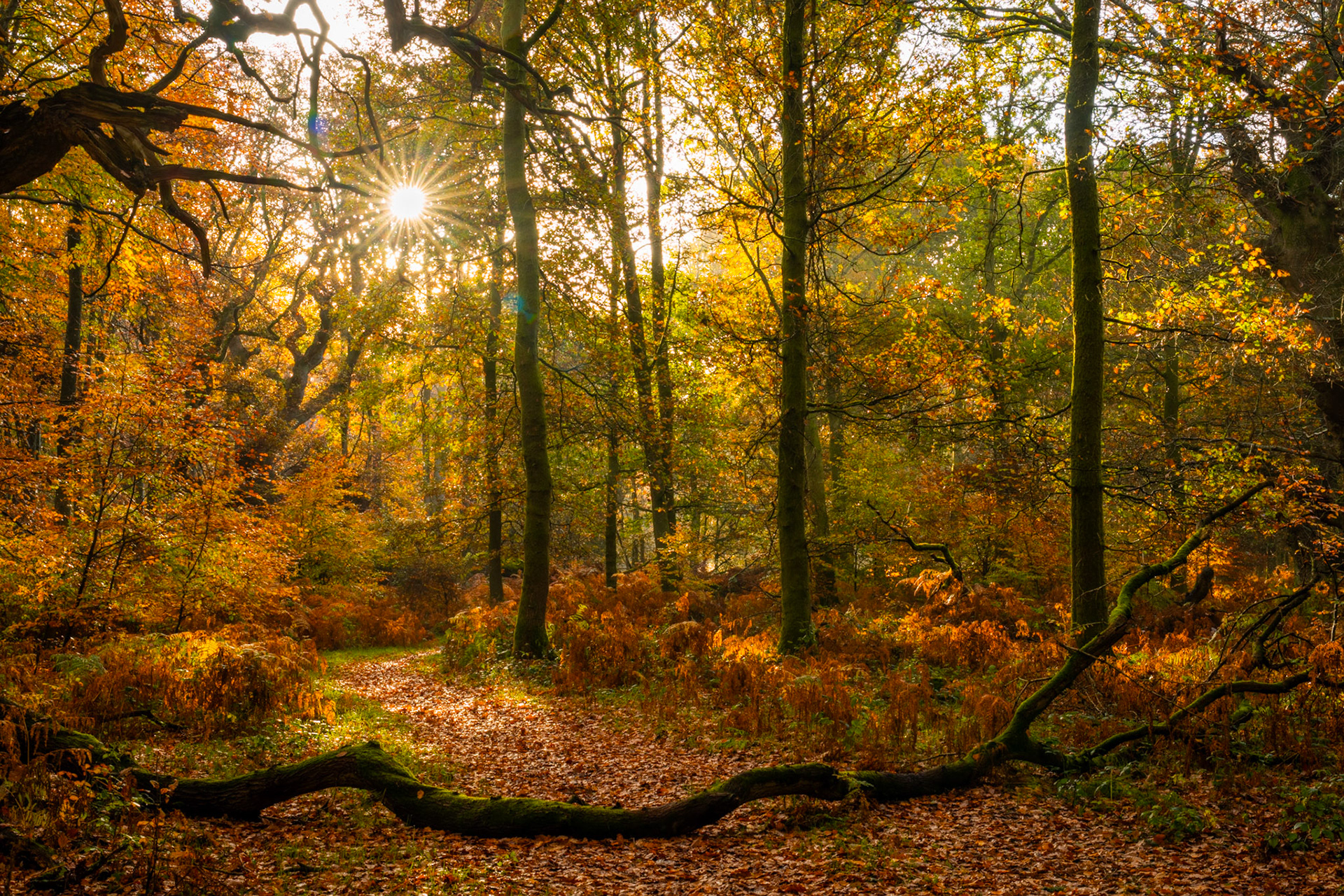
Low autumn sun breaks through mixed deciduous woodland in the Chilterns, Oxfordshire, casting a starburst between the trunks and lighting a leaf-strewn path bordered by dying bracken. A fallen moss-covered branch in the foreground anchors the composition against the luminous mid-canopy. The scene reads as late October or early November, the foliage in its final amber and gold before leaf-fall.
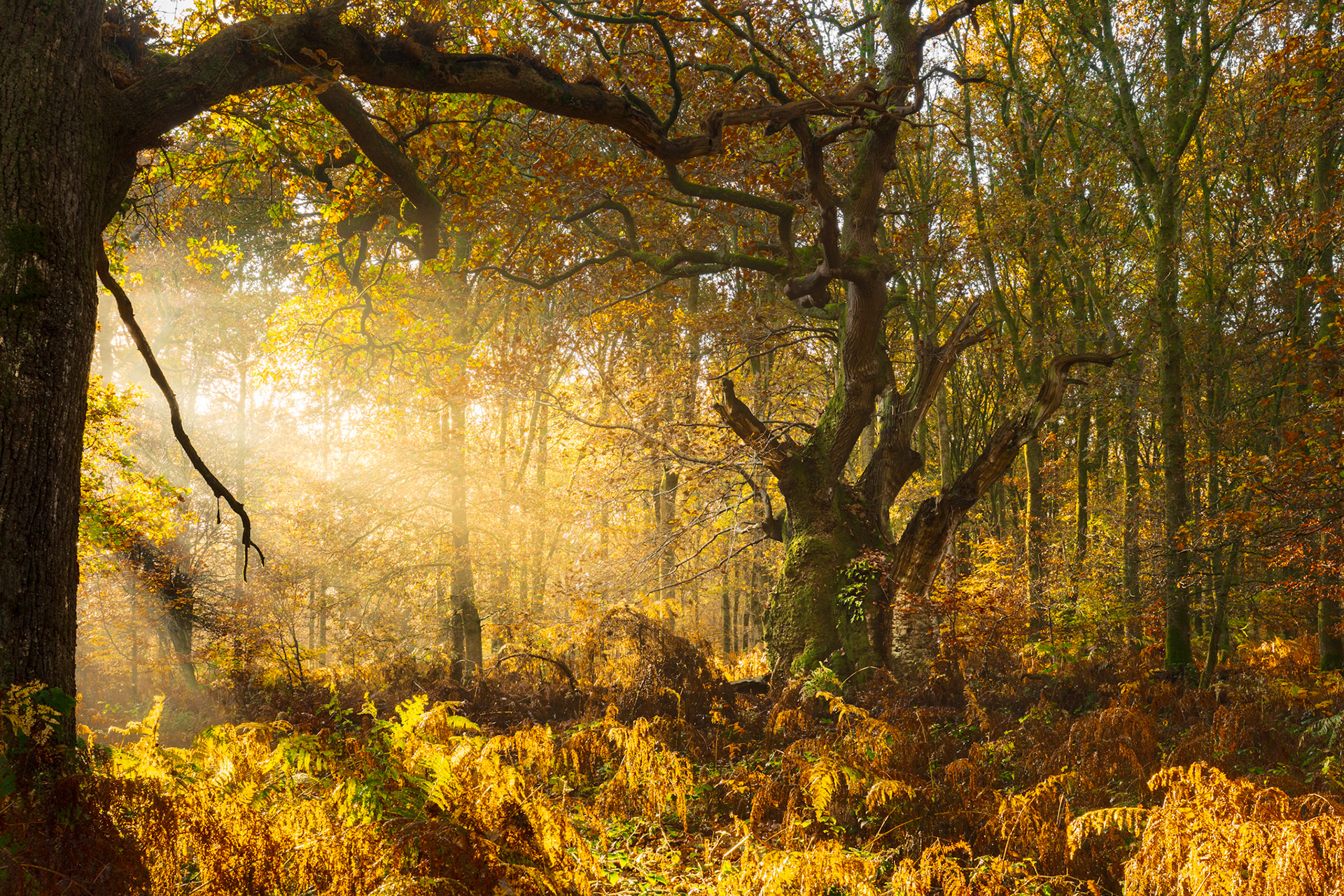
Low November sun breaks through mist into broadleaf woodland in the Chilterns, Oxfordshire, silhouetting the arching bough of a veteran oak against a blaze of backlit amber. A carpet of dying bracken fills the floor, while a second ancient oak anchors the mid-ground. The scene catches a rare conjunction of residual mist and sharp winter-angle sunlight in what reads as ancient, unmanaged woodland.
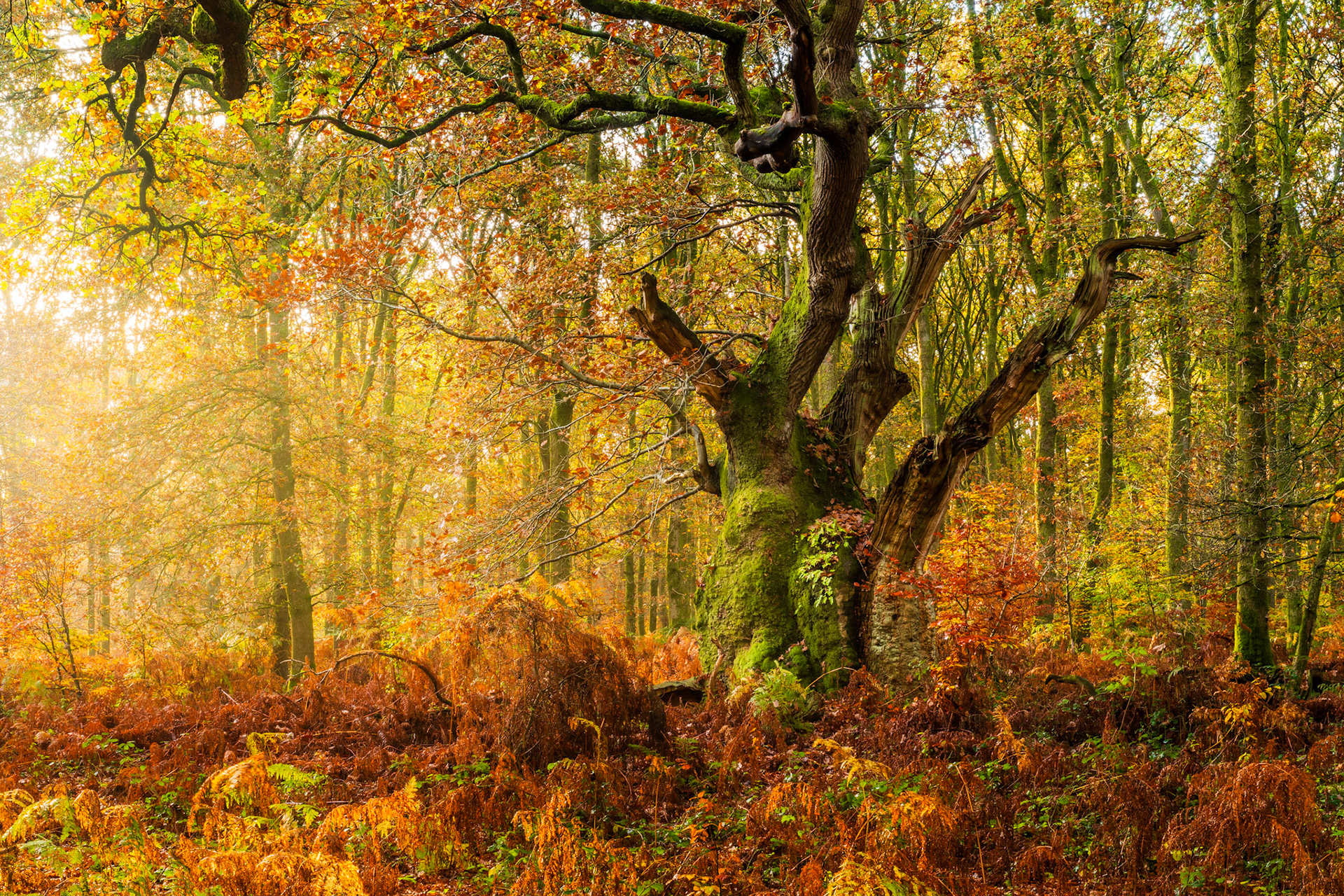
A gnarled, moss-covered oak stands amid bracken and mist-softened woodland light in the Chilterns, Oxfordshire. Angled morning sun pierces the canopy from the left, casting a warm luminous haze through the autumn foliage and lending the scene a quality of stillness rarely captured without careful positioning. The multi-stemmed trunk, weathered and lichen-patched, anchors the frame against a receding stand of deciduous trees still holding their copper and gold leaf.
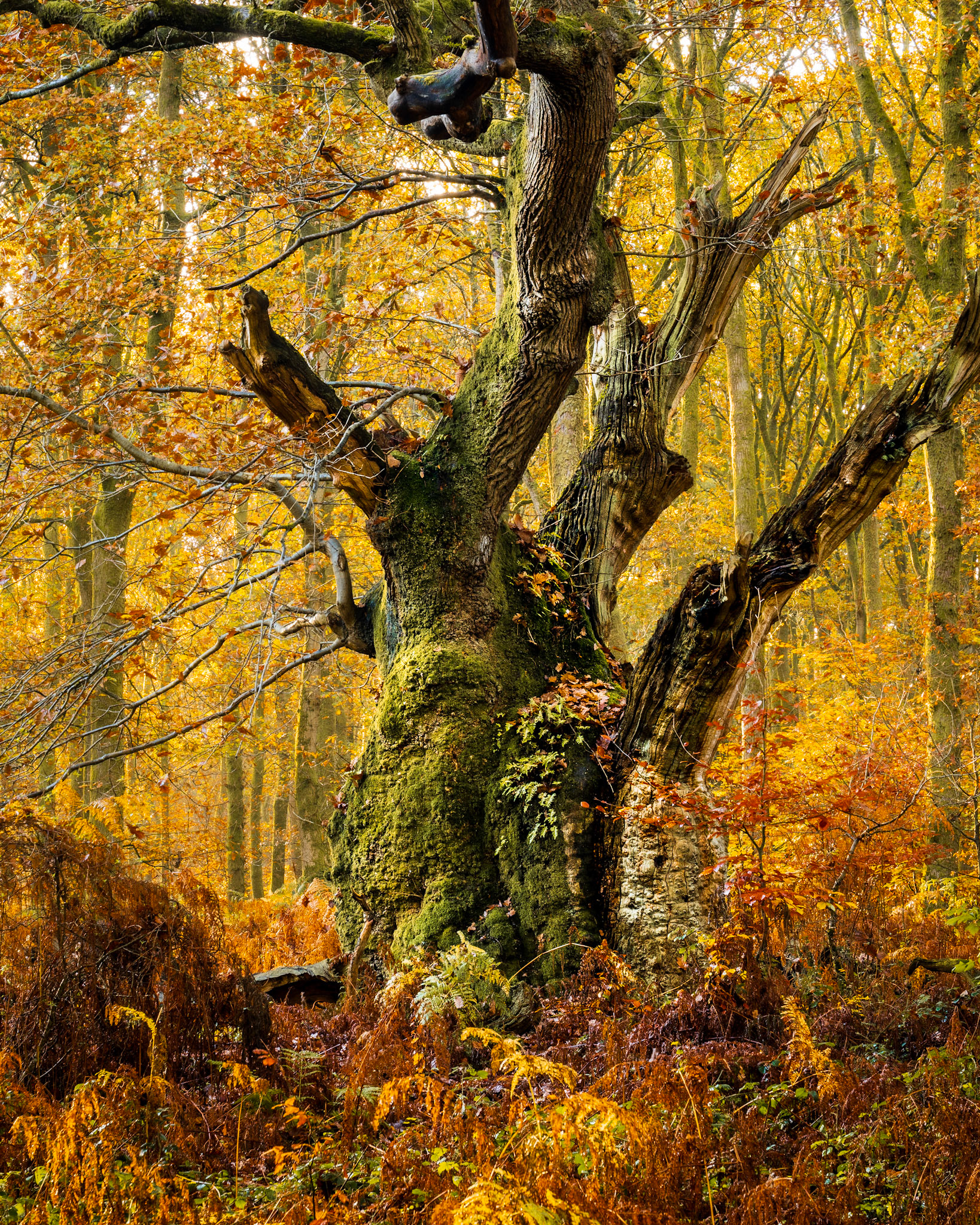
A veteran oak, its trunk heavily colonised by moss and fern, stands among late-turning beech in a managed broadleaf woodland in the Chilterns, Oxfordshire. The mossy base and broken scaffold branches suggest considerable age, possibly pollard origin. Soft, diffuse November light suppresses shadow and allows the warm amber canopy to read cleanly against the textured bark.
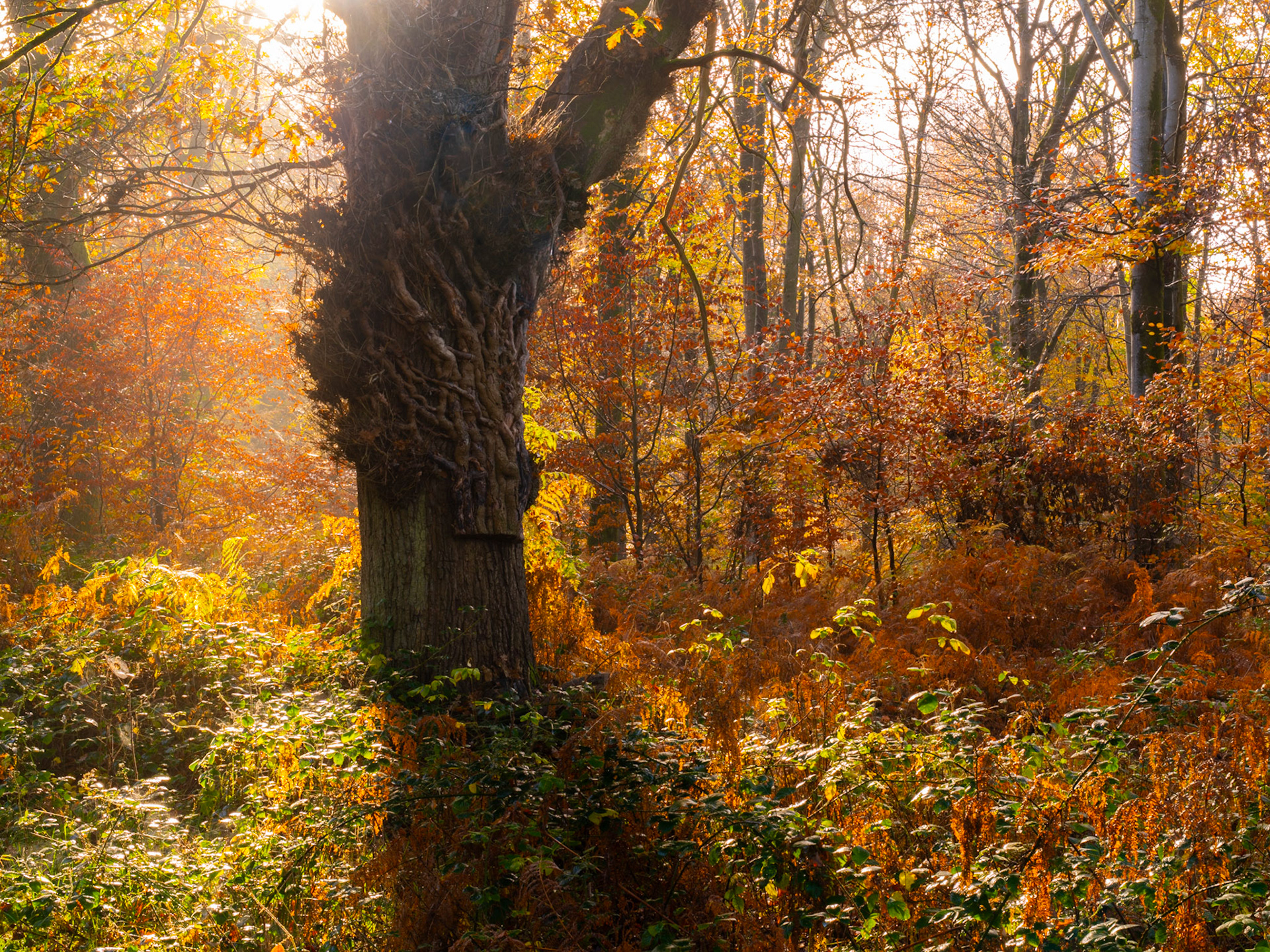
Low autumn sun cuts through deciduous woodland, catching the twisted ivy stems coiling up a gnarled veteran trunk. Bracken and bramble glow amber and gold in the understory, while mist softens the mid-distance trees. The texture of the bark and climbing stems anchors a scene otherwise dissolved in warm backlight.
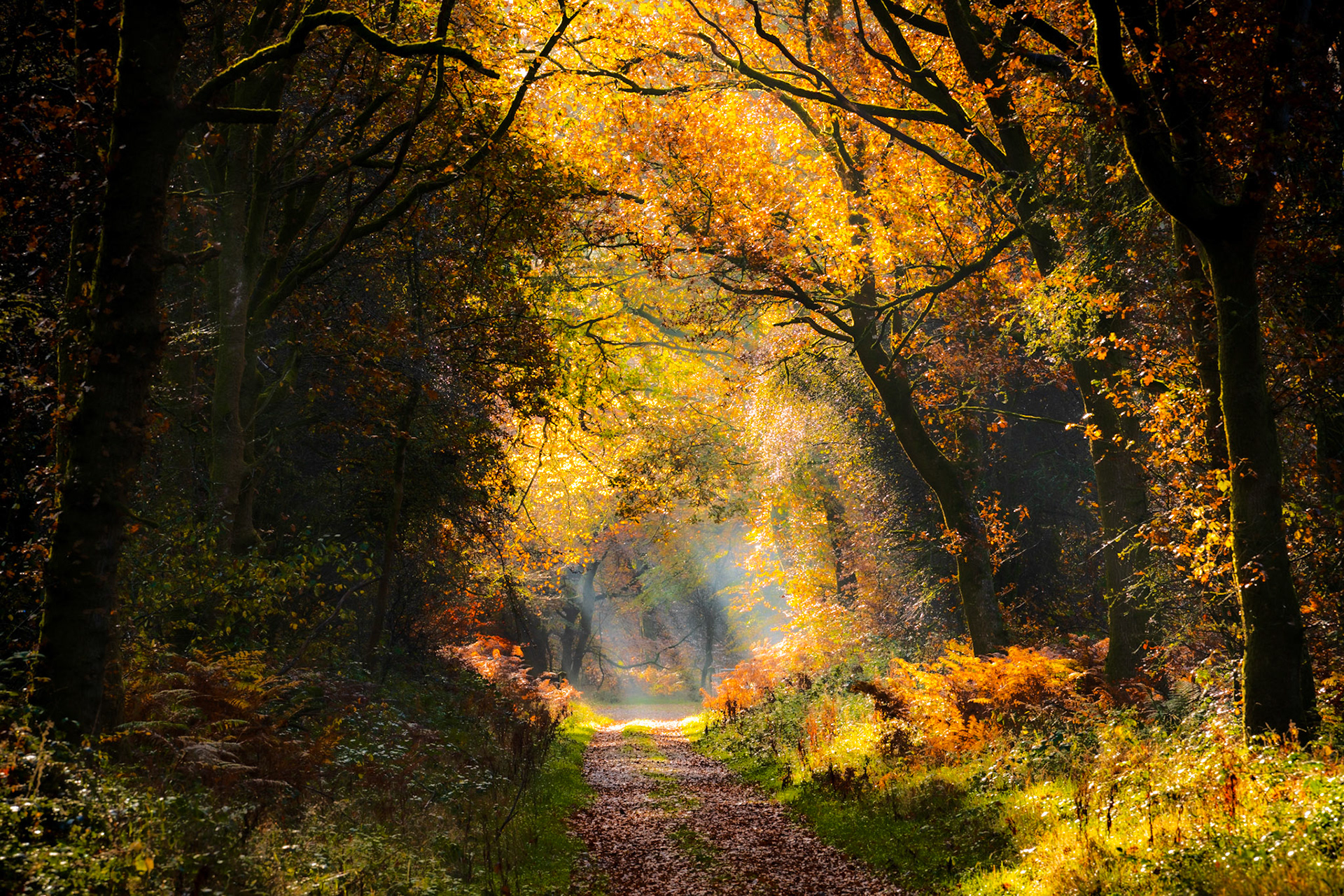
Autumn sunbeams filter through a canopy of turning oak and beech in the Chilterns, Oxfordshire, illuminating a leaf-strewn woodland track flanked by bracken in late colour. Morning mist caught in the mid-ground gives the receding path a luminous, layered depth. The dark framing trunks compress the light into a single corridor of warmth.
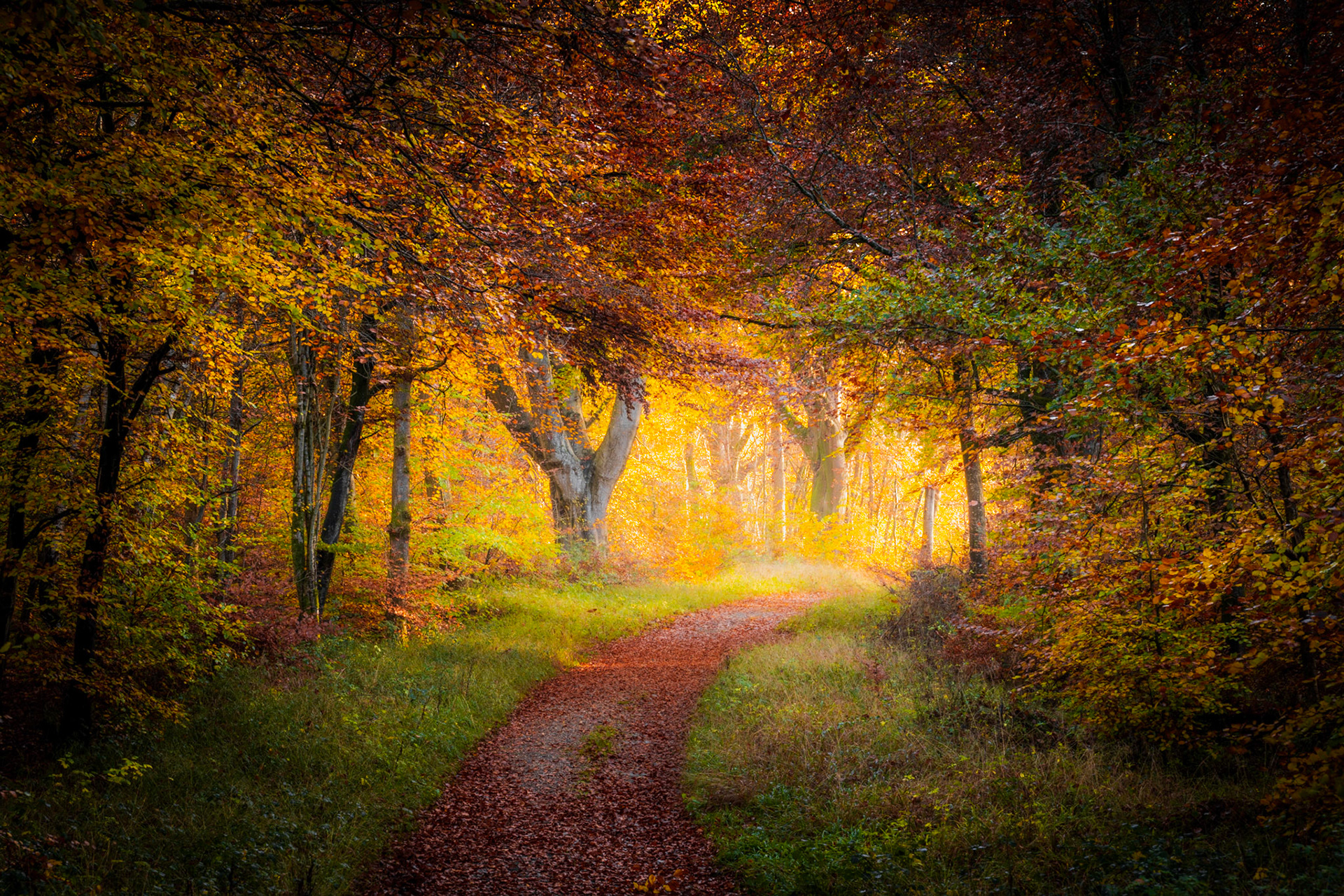
A leaf-covered track in the Chilterns, Oxfordshire draws the eye toward a glowing break in the beech canopy, where diffuse autumn light saturates the mid-distance with amber. The dark foreground framing and arching branches form a natural tunnel, concentrating atmosphere at the vanishing point. Post-processing has deepened the surrounding tones, heightening the contrast between shadow and the luminous centre.

A cluster of small inkcap or Mycena fungi emerge from a moss-covered log in low autumn light. The warm raking sidelight picks out the fine gill structure of each cap and the texture of the moss bed, while shallow depth of field dissolves a fern frond into soft green beyond. A precise, quiet study of woodland decay and regeneration.
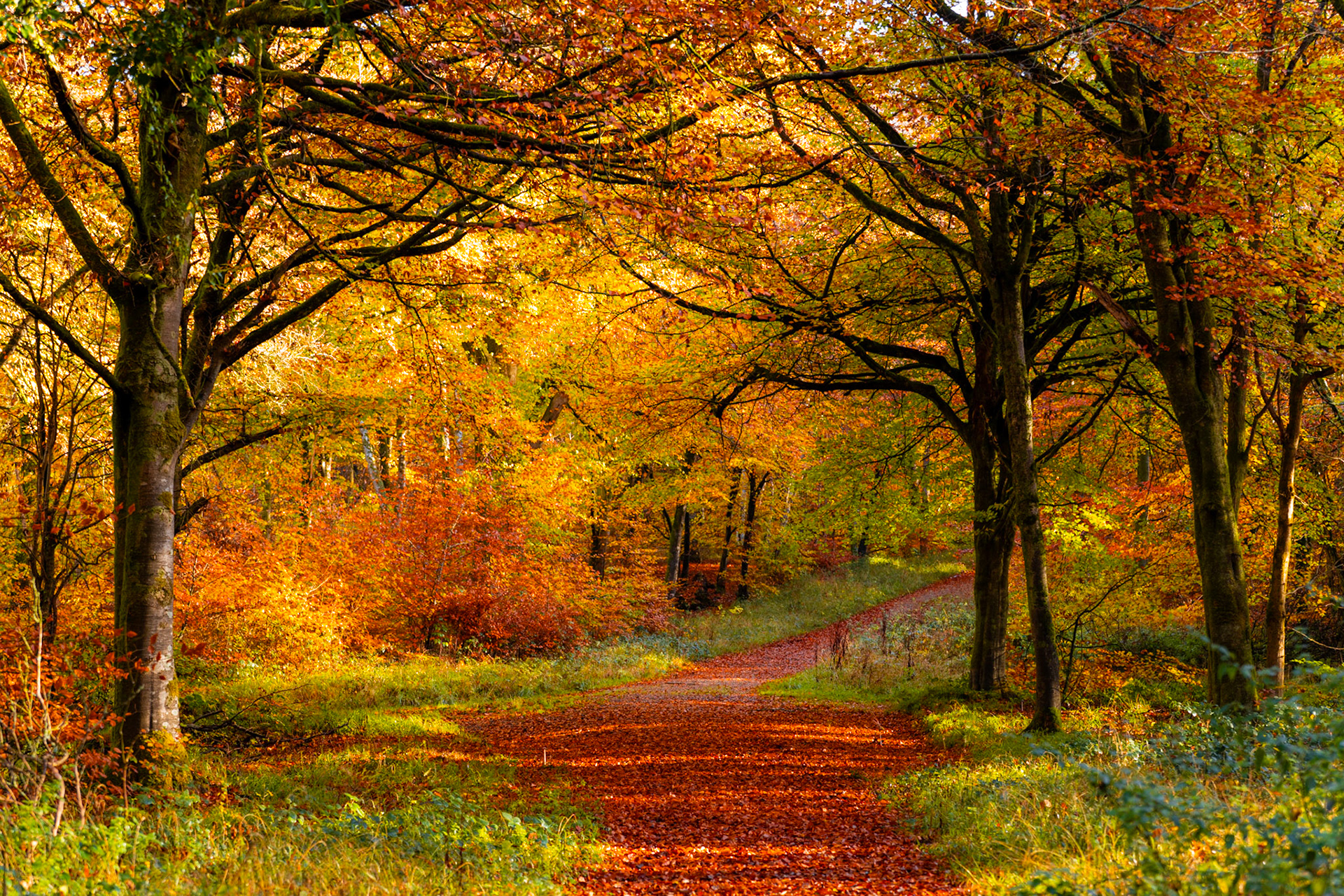
A leaf-carpeted path curves between mature beech trees in the Chilterns, Oxfordshire, the canopy holding peak amber and russet colour. Soft directional light from the south-east separates the warm tones above from the shadowed trunks below. The undulating Chiltern ground and receding path give depth without a strong focal anchor.
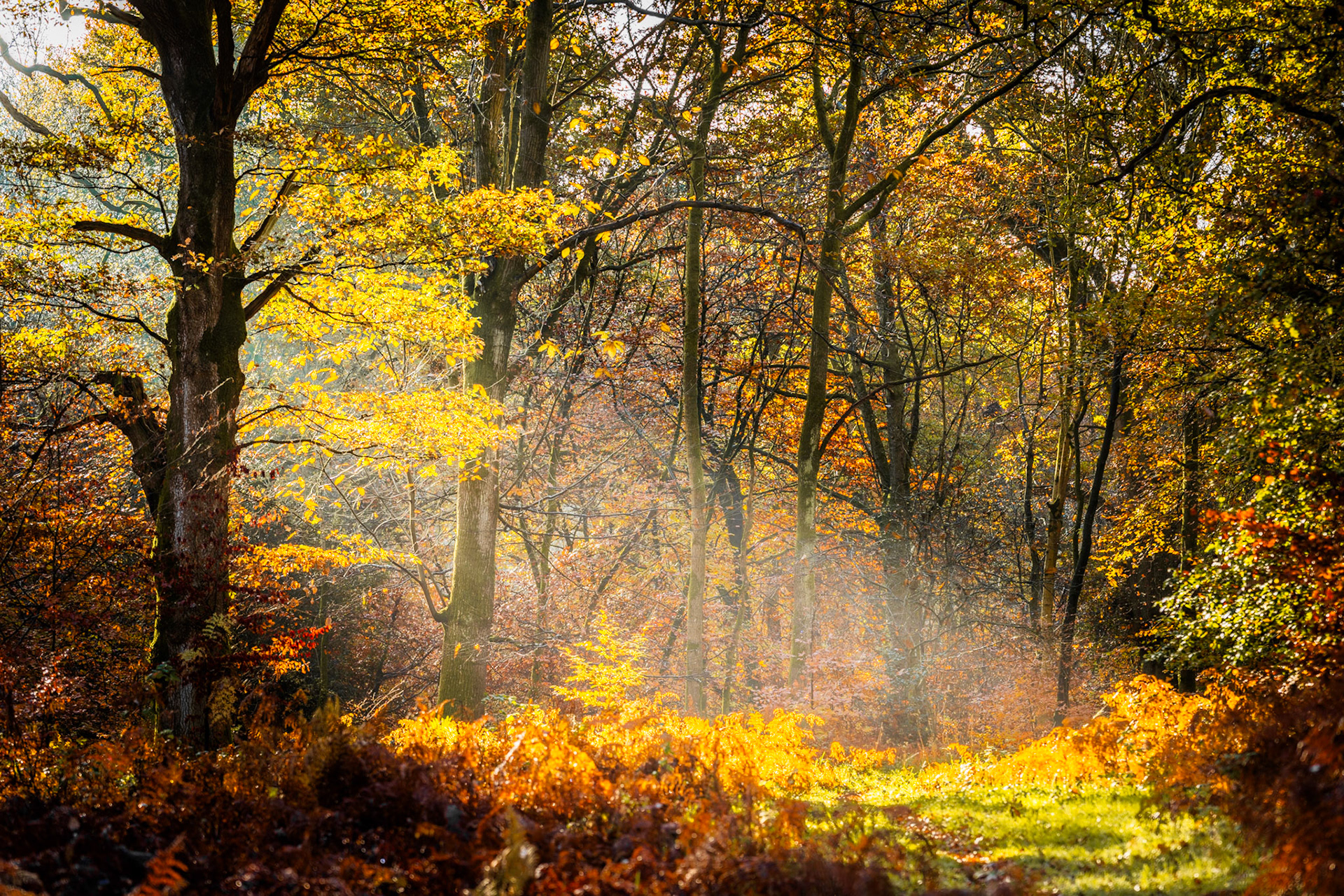
Low autumn sun breaks through a deciduous woodland interior in the Chilterns, Oxfordshire, illuminating a ground layer of dying bracken and fallen leaves. Residual morning mist catches the shafts of light between the trunks, giving the mid-distance a soft luminosity. The scene sits at peak colour turn, with foliage ranging from acid yellow to deep copper.
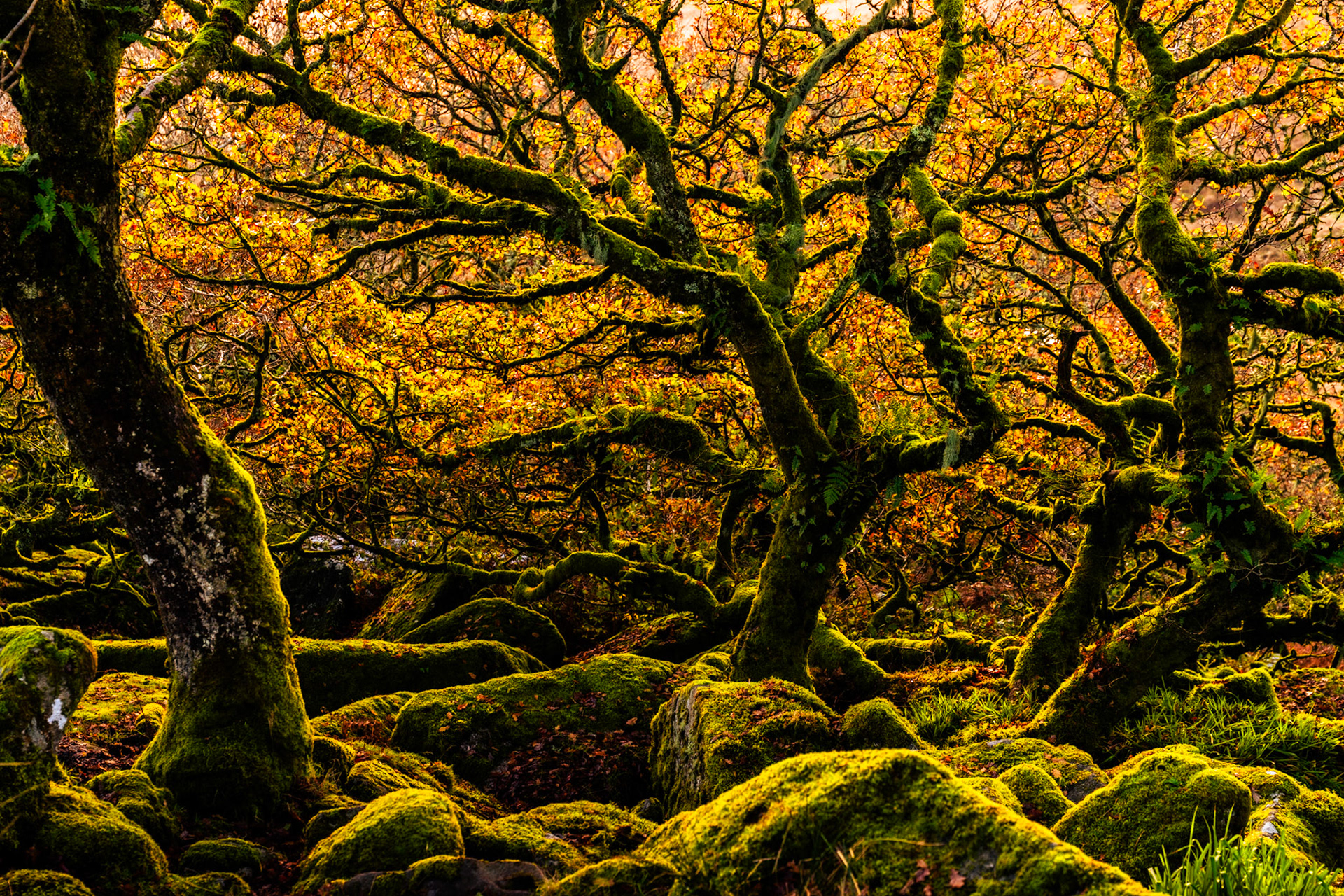
Veteran oak trees rise from a floor of moss-smothered boulders in the Chilterns, Oxfordshire, their gnarled branches interlacing against a canopy still holding amber autumn foliage. The low November sun backlights the upper crown, separating the dark twisted limbs from the warm tonal wash behind. The layering of moss, rock, and branching architecture gives the composition unusual depth for a scene this enclosed.
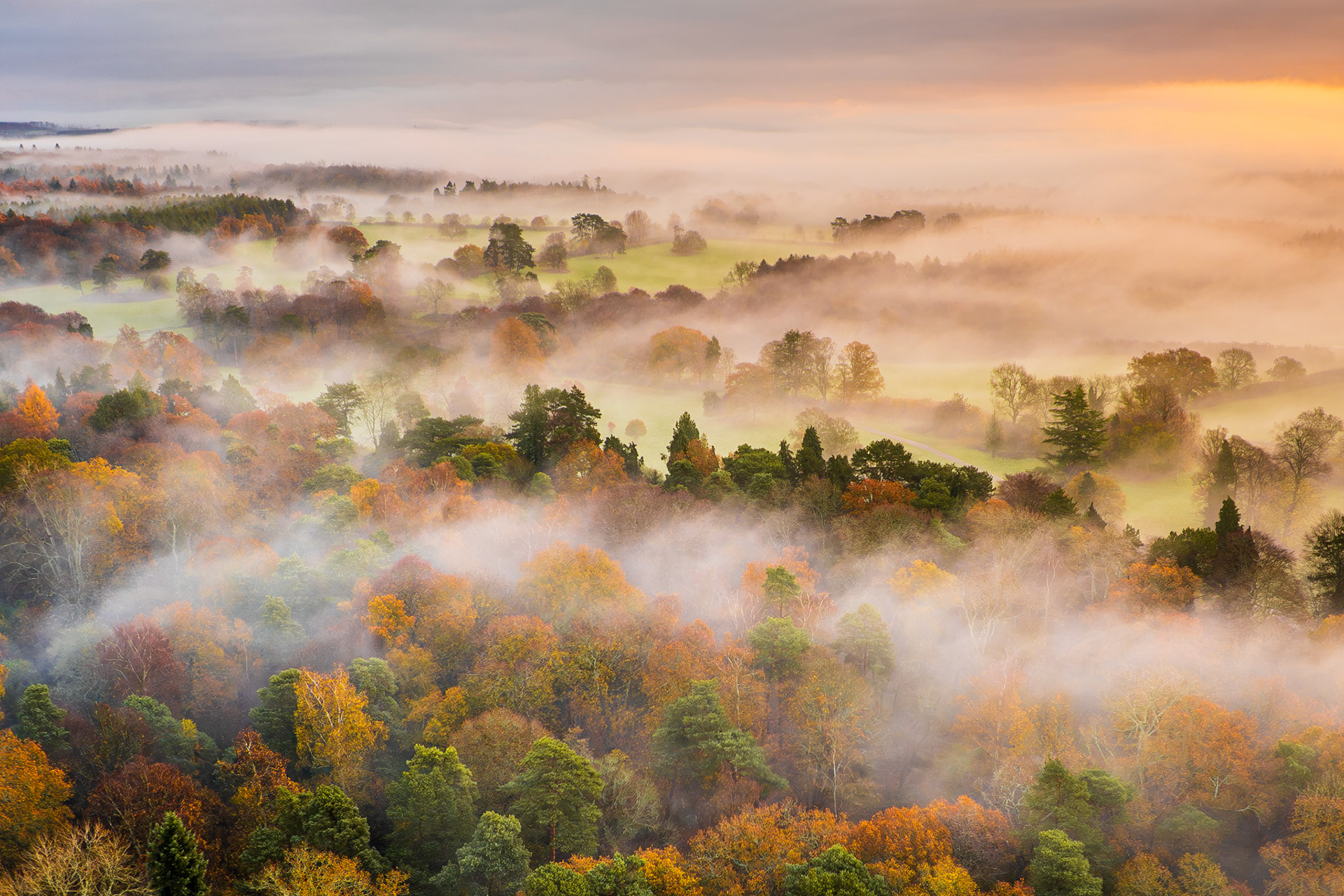
A temperature inversion holds low cloud among the autumn canopy of a Thames Valley woodland at dawn, the rising sun catching the mist from the south-east and warming the scene to amber. Photographed from altitude above Henley-on-Thames, the layered fog separates foreground trees from the open pasture beyond, creating a sequence of receding planes that dissolves into the glowing horizon. The restraint of the palette — amber, ochre, and soft grey — gives the image an unusual quietness for aerial work.
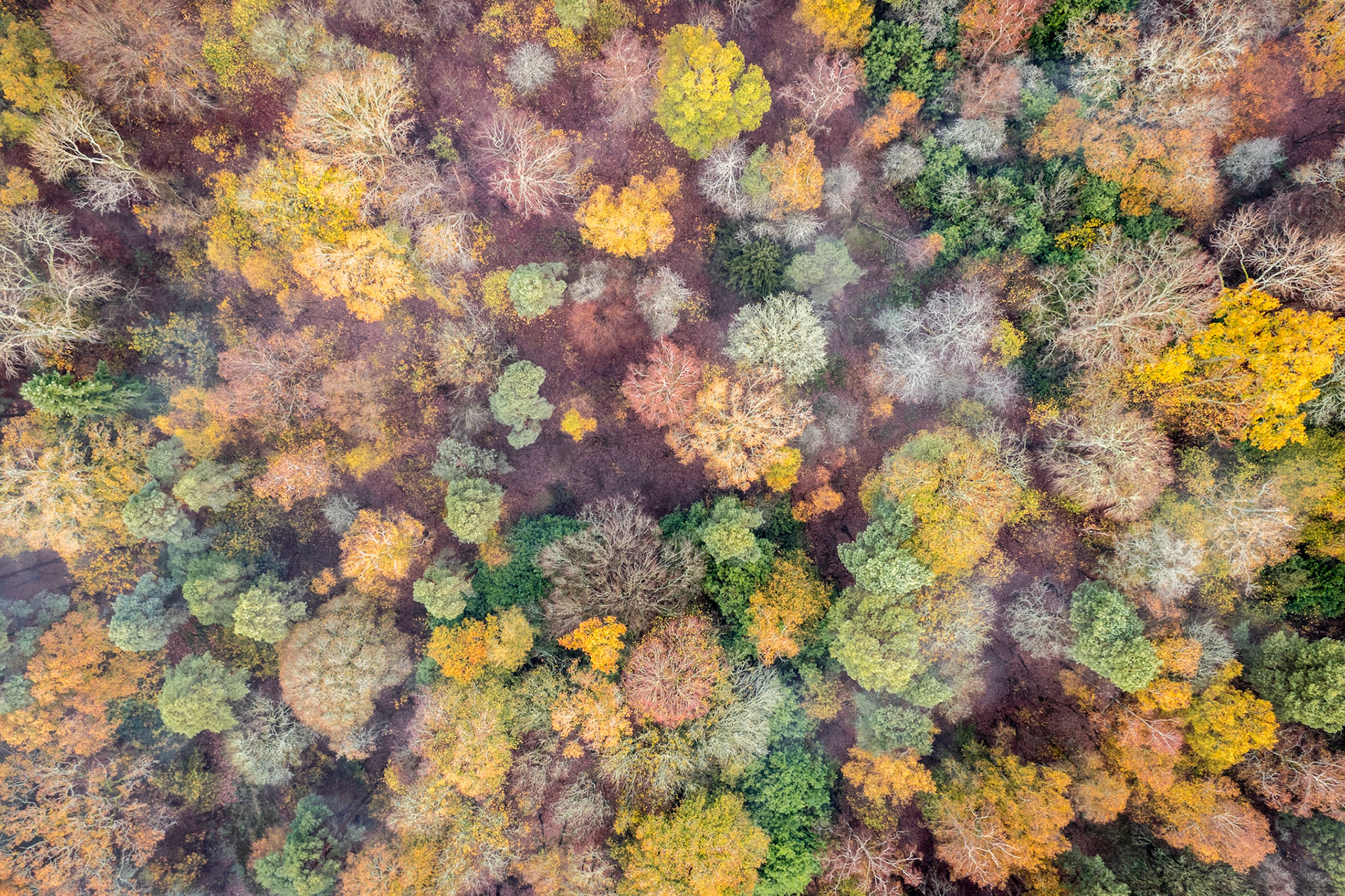
A nadir aerial view over mixed deciduous woodland near Henley-on-Thames reveals the fragmented palette of late autumn: yellowing oak and field maple alongside bare-branched specimens and persistent evergreen scrub. Flat overcast light suppresses shadow and foregrounds the textural complexity of individual crowns, the dark forest floor visible between them lending depth to an otherwise planar composition.
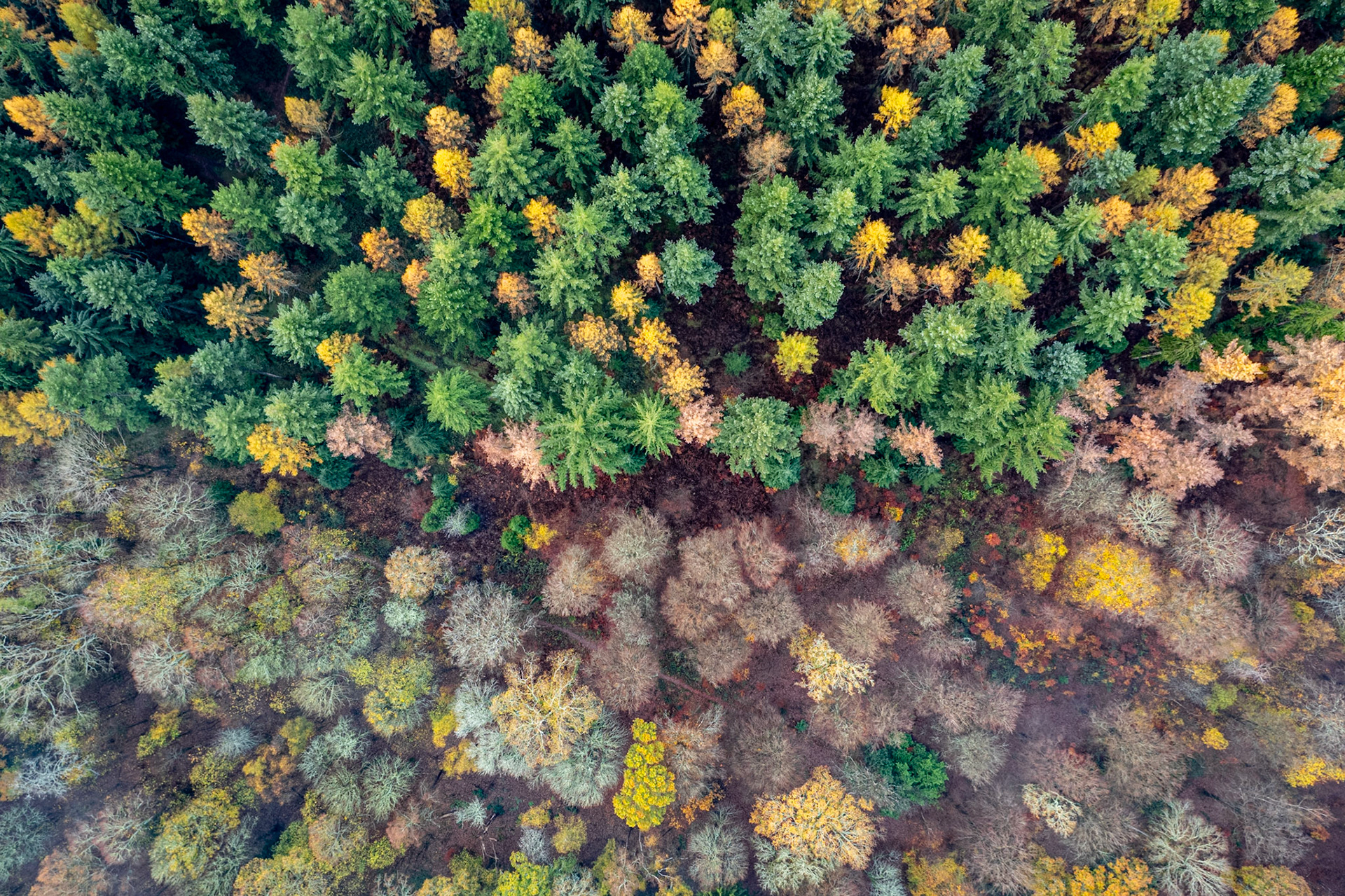
A nadir aerial view over mixed woodland near Henley-on-Thames reveals a sharp transition between healthy conifers and a lower belt of dying or dead deciduous trees, their bare crowns and russet-brown foliage suggesting drought stress or disease. The flat, overcast November light suppresses shadow, allowing the patterned canopy textures and colour contrast to carry the image.
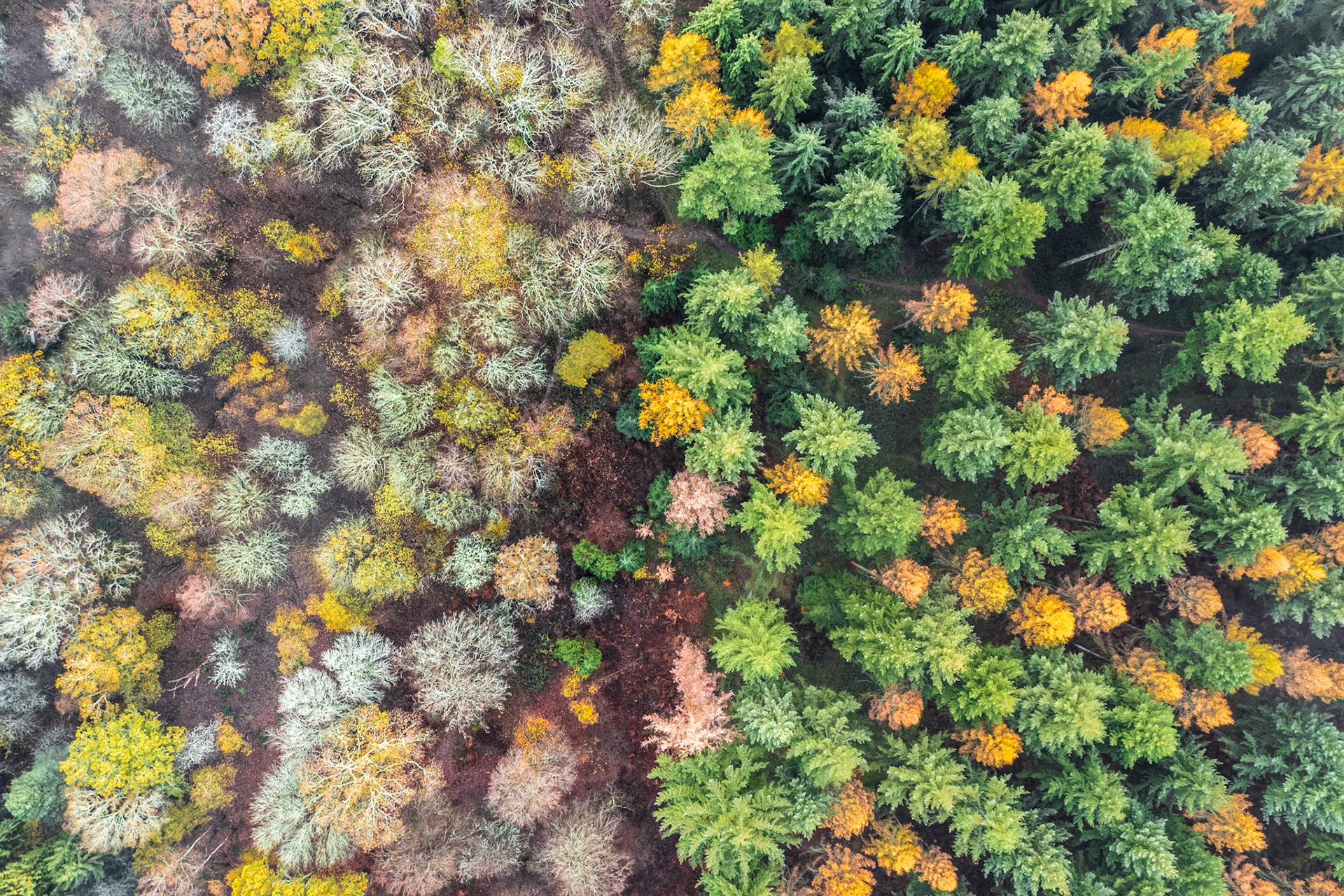
A vertical aerial view above woodland near Henley-on-Thames reveals a sharp ecological boundary dividing open scrub — pale, lichen-silvered and sparsely canopied — from a dense stand of mature conifers in deep green. Captured in mid-November, the transitional foliage holds residual autumn yellows against the muted tones of approaching winter dormancy. The diagonal fault line between the two tree communities carries the composition without artifice.
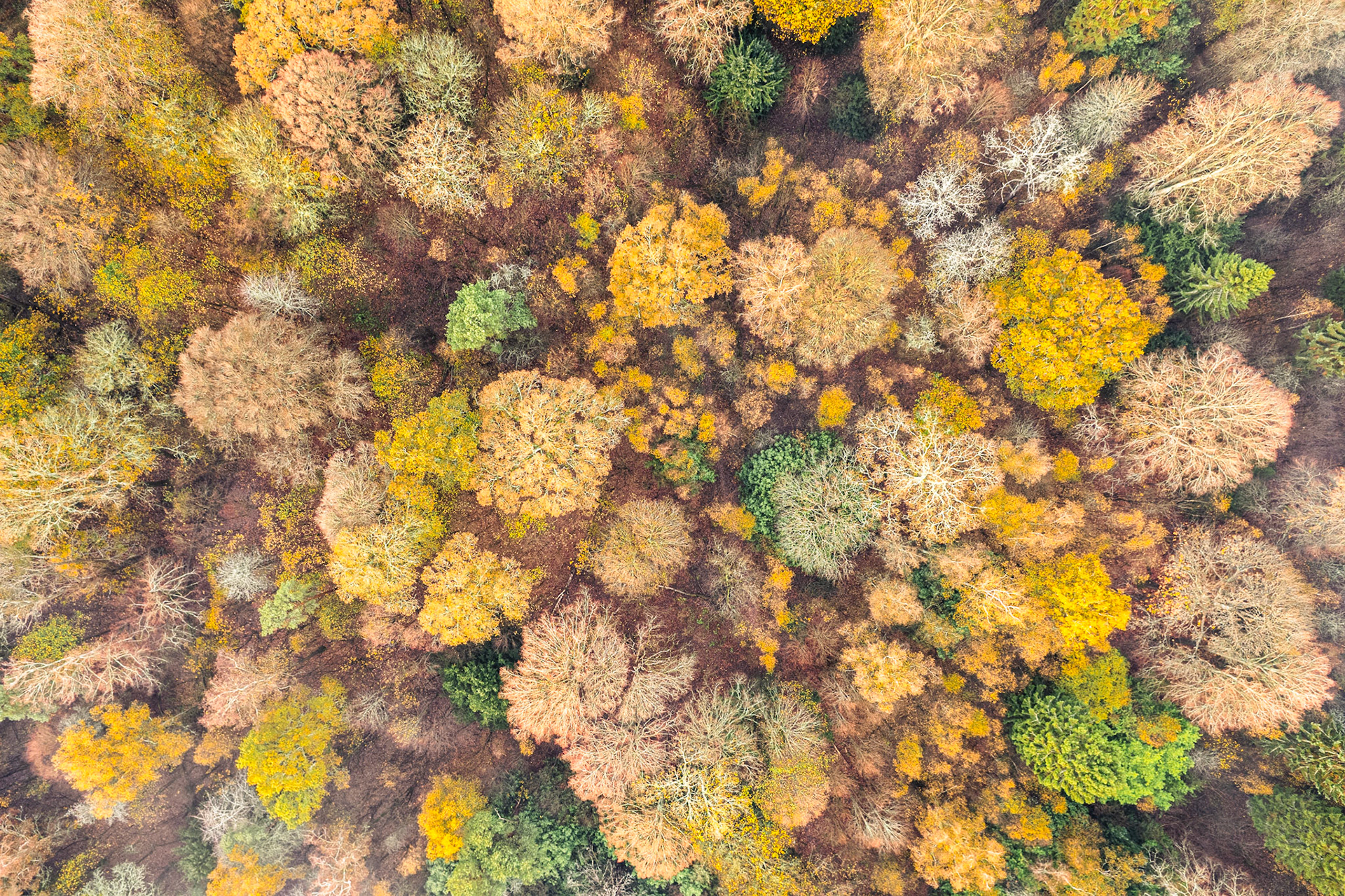
A nadir aerial view over mixed deciduous woodland near Henley-on-Thames records the uneven progress of leaf fall in mid-November, where yellow-gold crowns of oak and field maple sit alongside bare branch structures and the dark cones of retained evergreens. The flat, diffuse light of an overcast morning suppresses shadow and allows the tonal range of the canopy — ochre, buff, pale green and ash-white — to read as near-abstract patchwork.
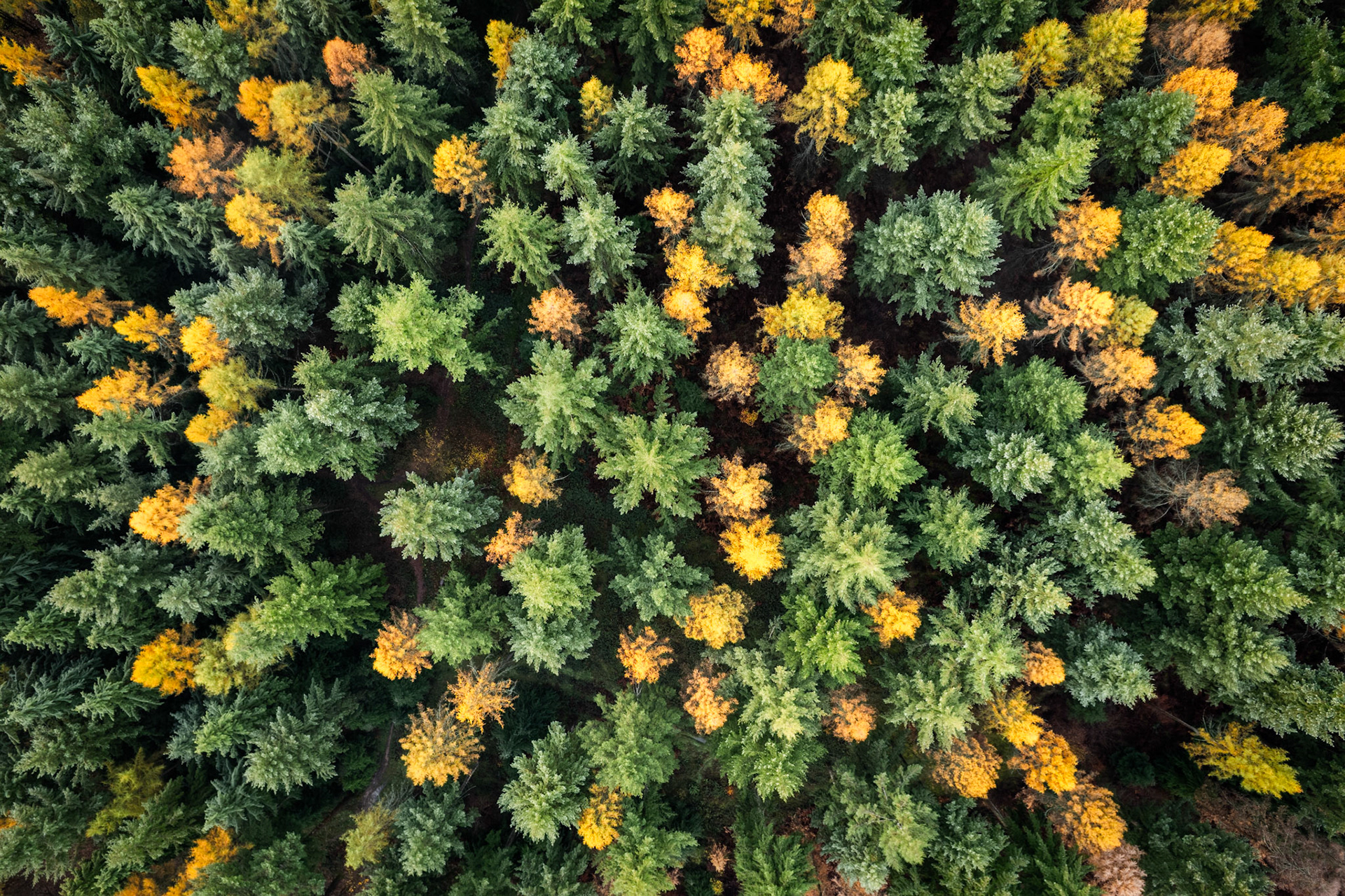
An overhead view of mixed coniferous woodland near Henley-on-Thames reveals larch crowns turning gold among the evergreen spruce, the interplay of colour forming a natural mosaic across the canopy. Captured in mid-November as deciduous conifers approach peak colour loss, the flat overcast light suppresses shadow and flattens the composition into near-abstraction. The scatter of amber crowns punctuating deep green gives the image its only structural rhythm.
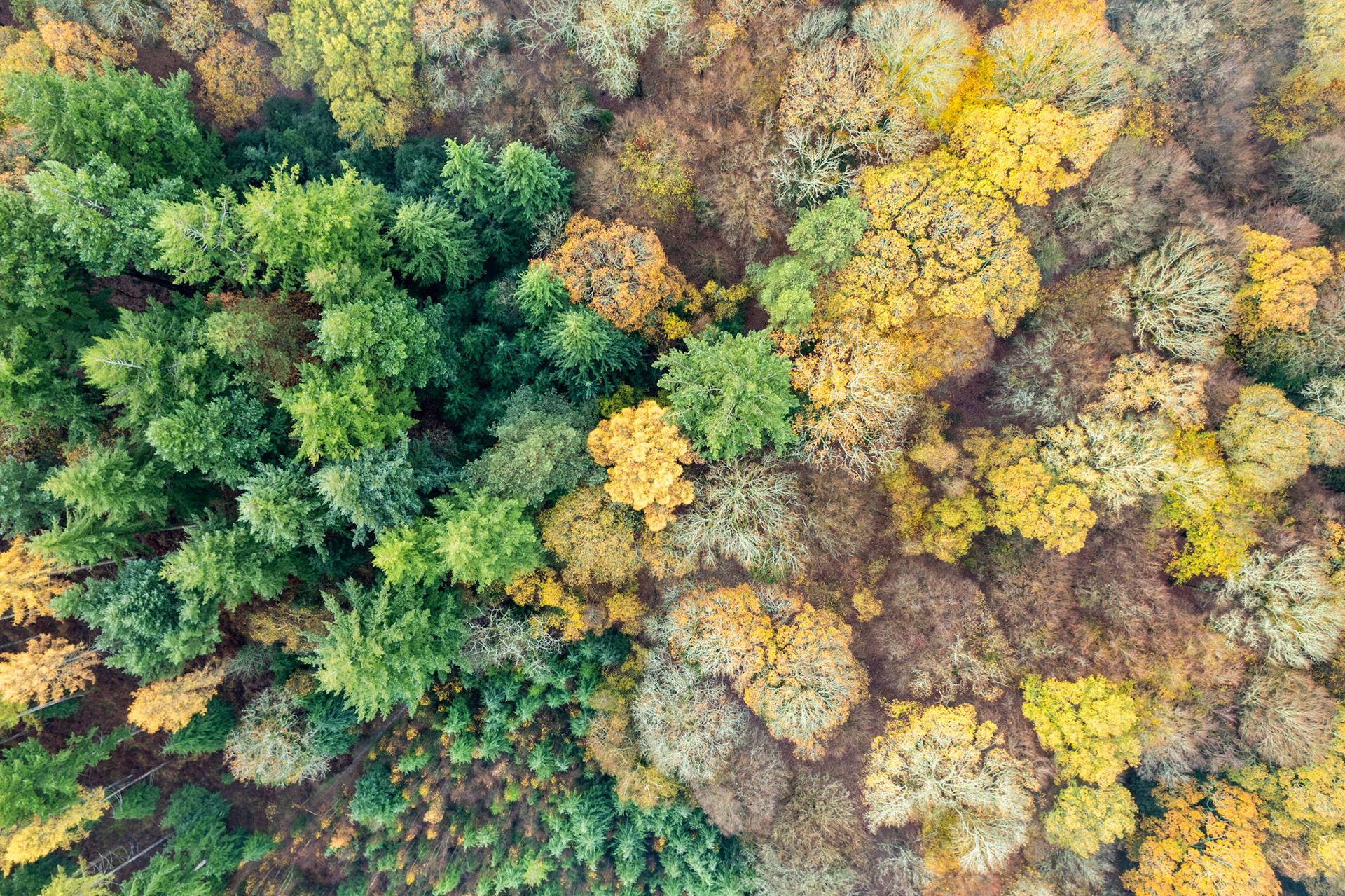
A nadir aerial view over mixed woodland near Henley-on-Thames captures the transition between evergreen conifers and deciduous trees in mid-autumn senescence. The diagonal drift from dense green on the left to muted yellows and bare crowns on the right records the uneven pace of leaf-fall across species. Flat overcast light suppresses shadow and keeps the colour palette honest rather than dramatic.
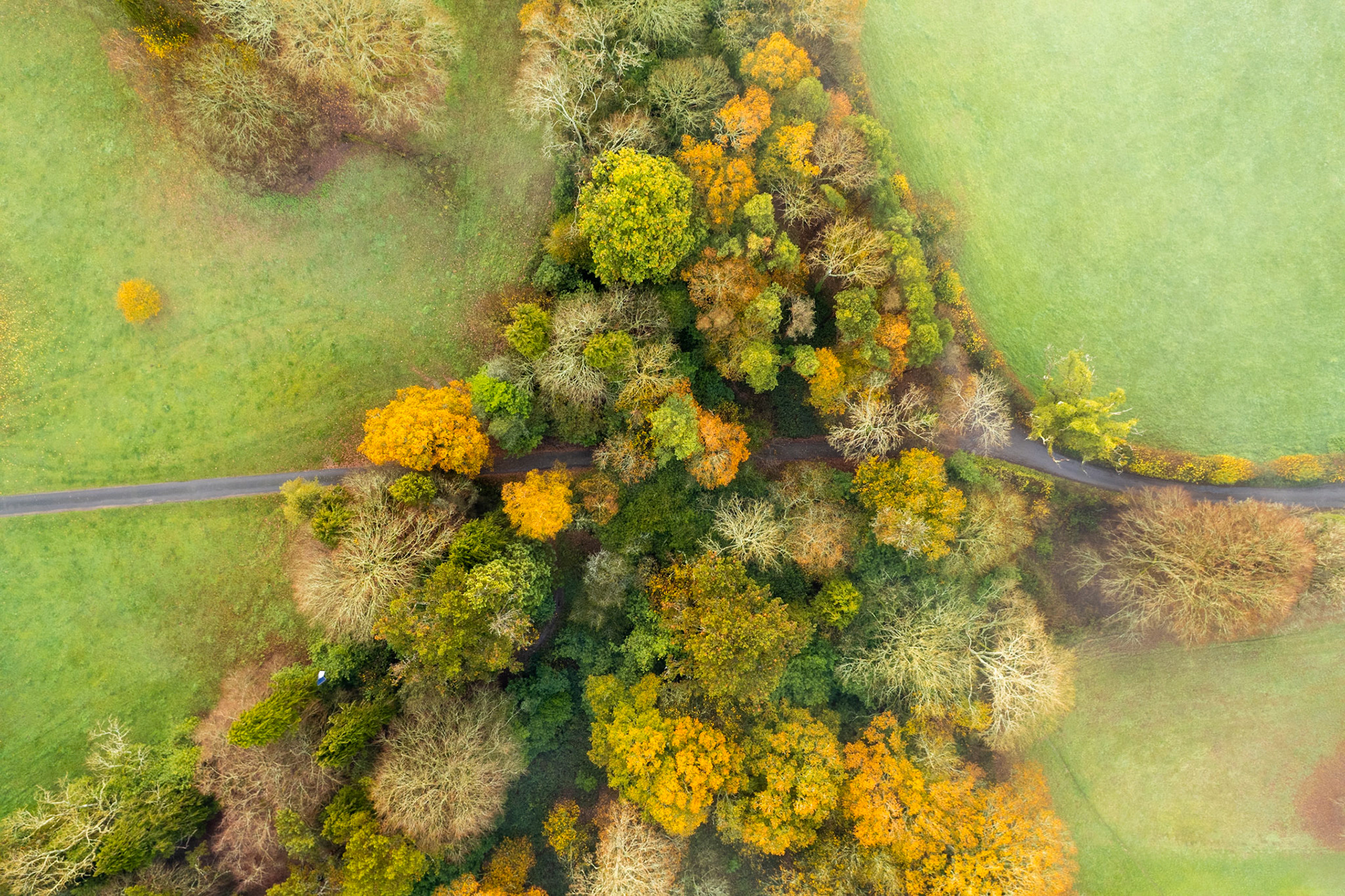
A narrow country lane cuts through a belt of mixed deciduous woodland near Henley-on-Thames, photographed directly overhead in late autumn. The canopy ranges from deep evergreen through amber and gold to bare-limbed grey, mapping the uneven pace of leaf-fall across species. Soft, flat overcast light suppresses shadow and unifies the palette without flattening the texture of individual crowns.
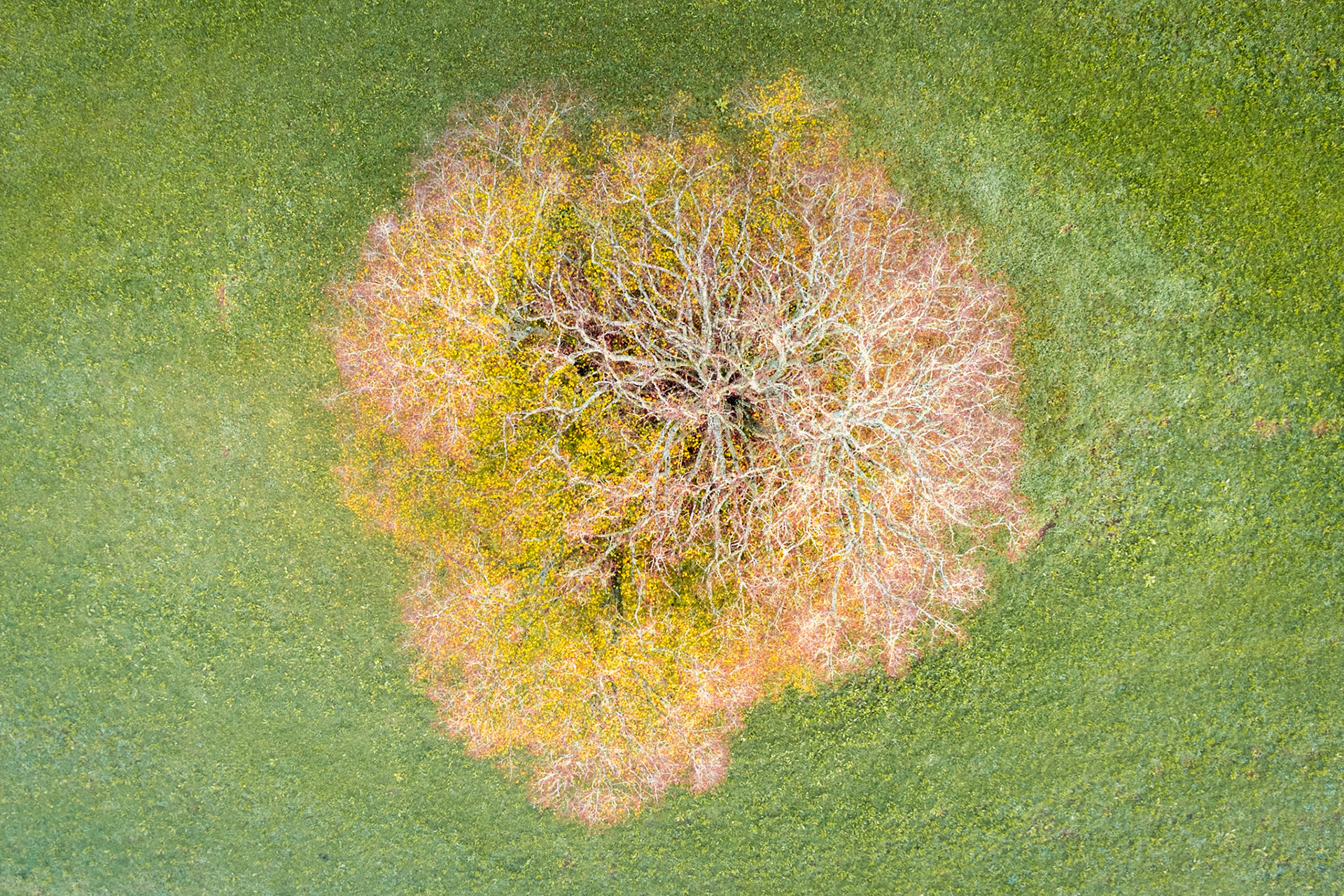
A mature deciduous tree photographed directly overhead from altitude above a field near Henley-on-Thames, its bare branch structure radiating outward like a neural network against a disc of amber and ochre fallen leaves. The surrounding cropped grassland, speckled with late wildflowers, frames the canopy as a self-contained form. Captured in mid-November, the image sits at the threshold between late autumn and winter dieback.
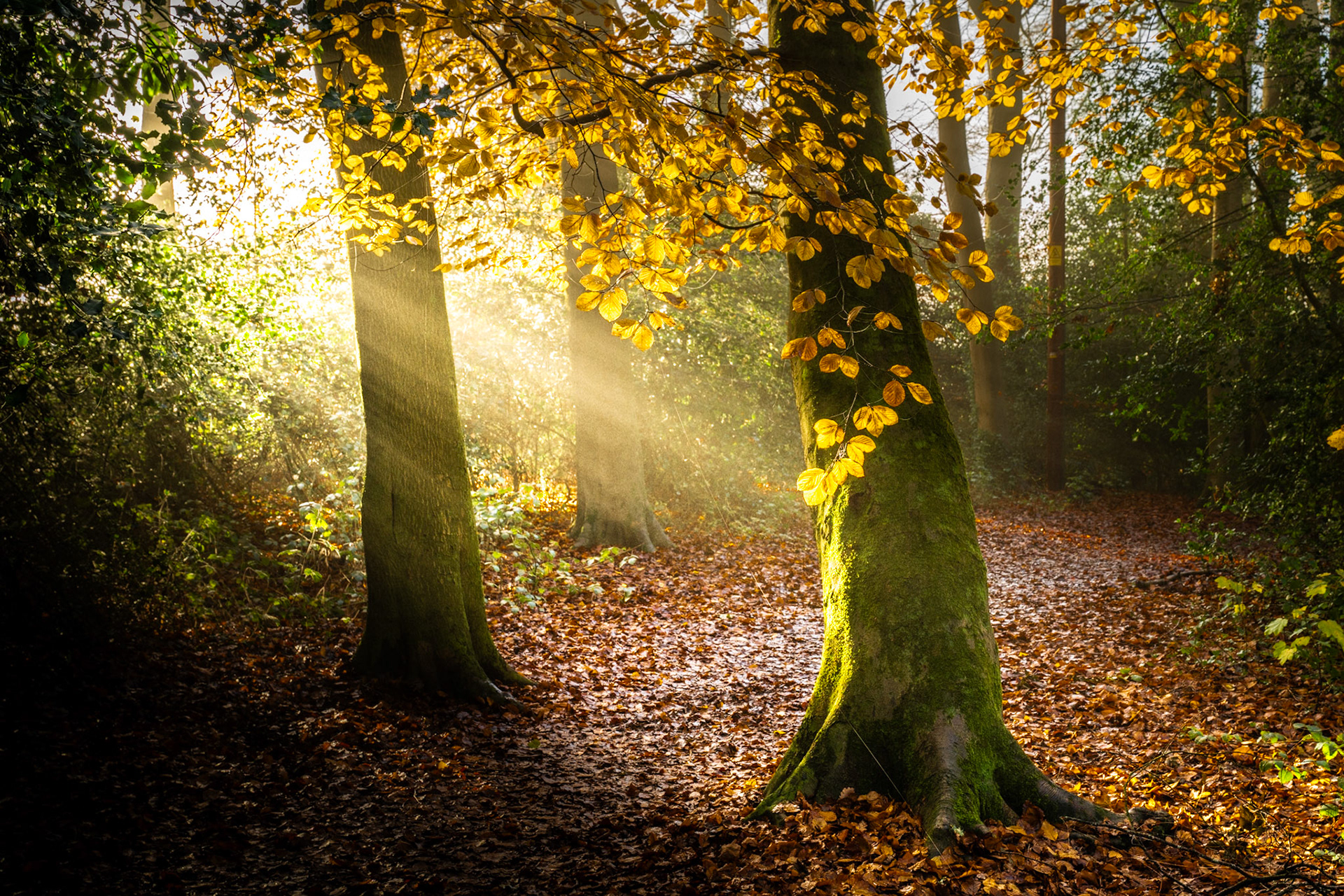
Low autumn sun breaks through a gap in mixed woodland in the Chilterns, Oxfordshire, casting distinct crepuscular rays between two moss-based beech trunks. A carpet of fallen leaves covers the forest floor while backlit golden foliage frames the burst of light. The mist implied by the visible rays adds depth to the receding treeline.
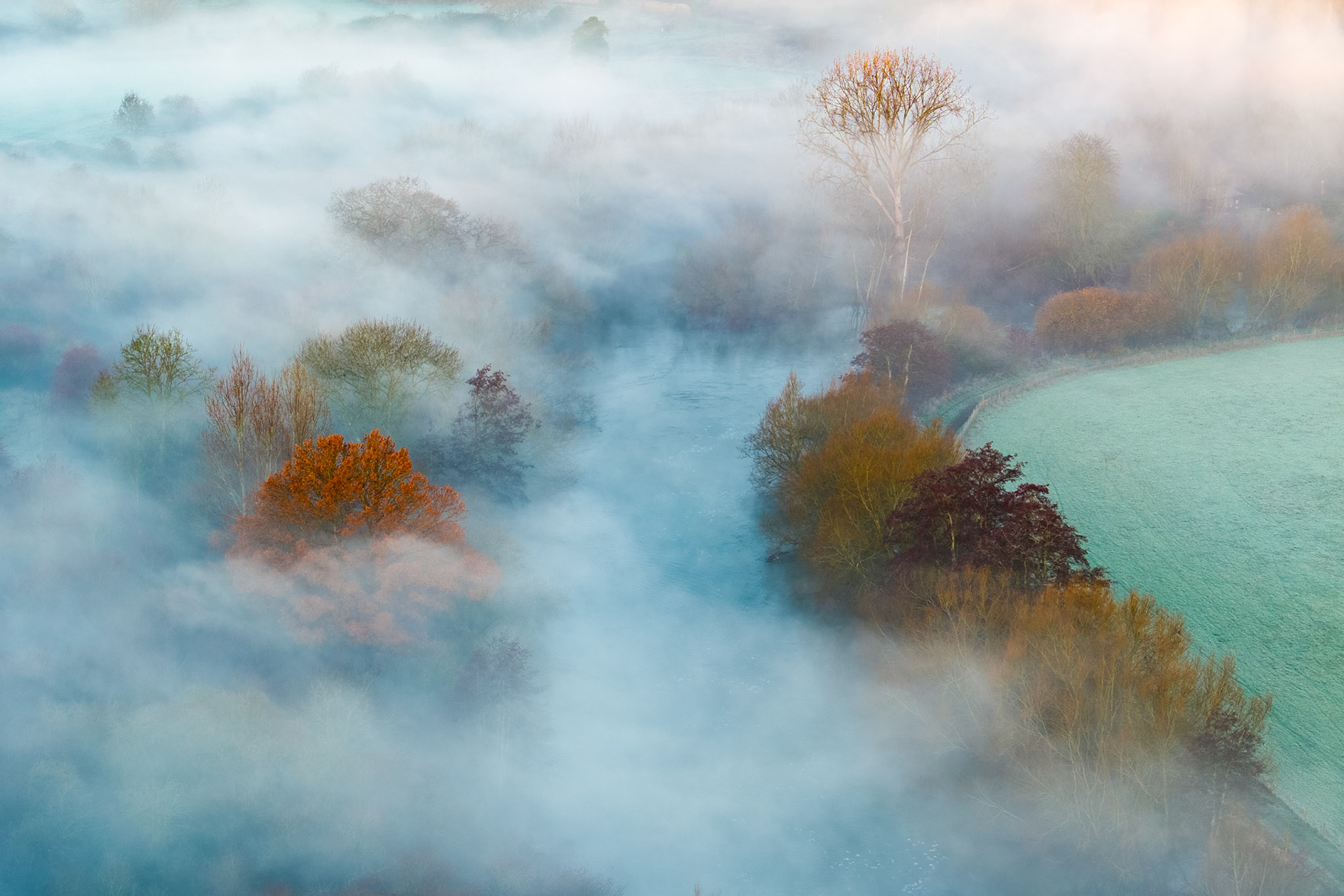
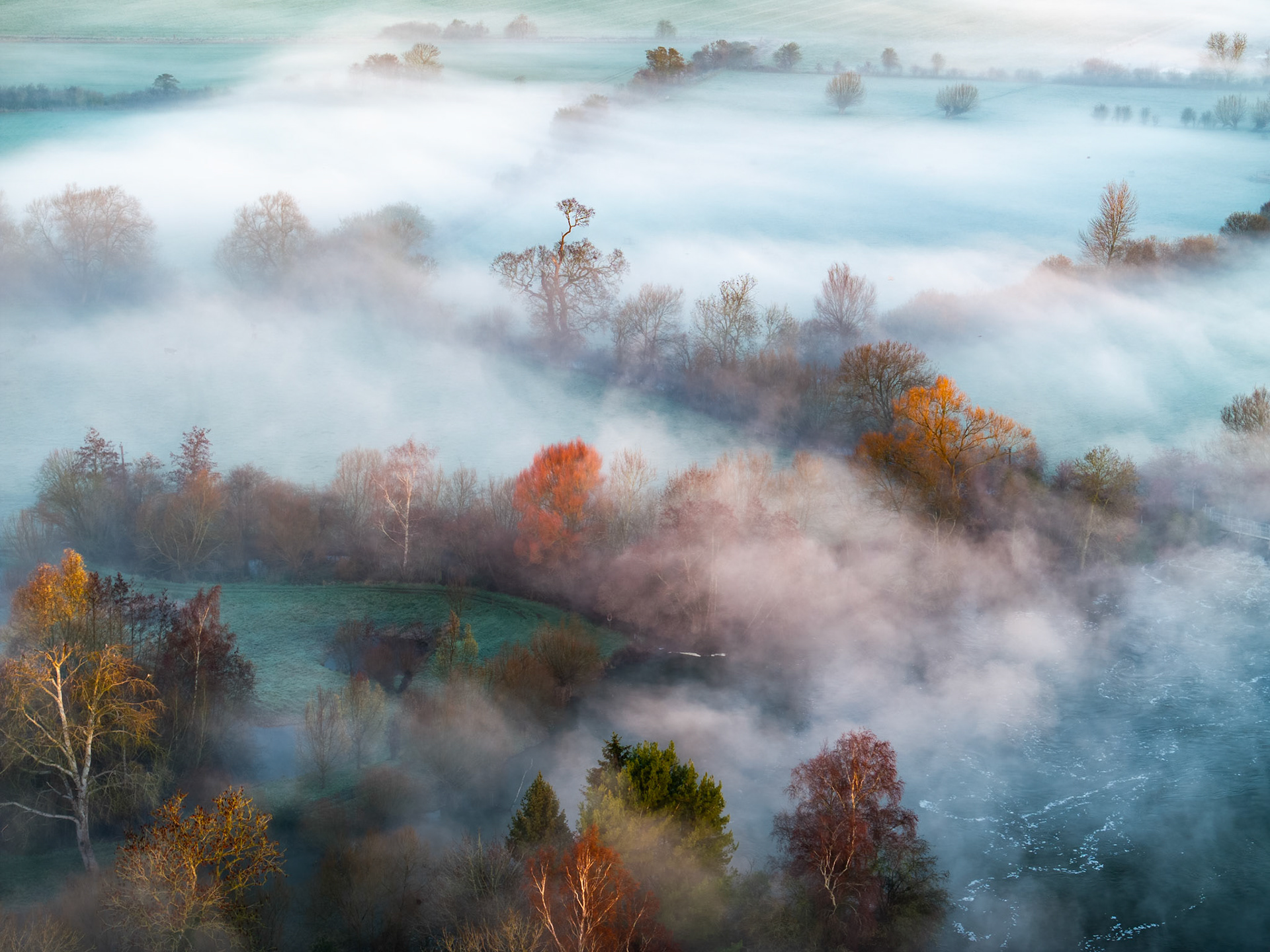
A temperature inversion smothers the Thames valley near Abingdon at first light, leaving trees in full autumn-to-winter transition stranded above a slow-moving sea of cold fog. A frosted meadow breaks clear to the right, its pale green a quiet counterpoint to the amber and burgundy crowns emerging from the mist. The aerial perspective dissolves conventional landscape geometry, reducing the scene to colour, texture, and atmosphere.