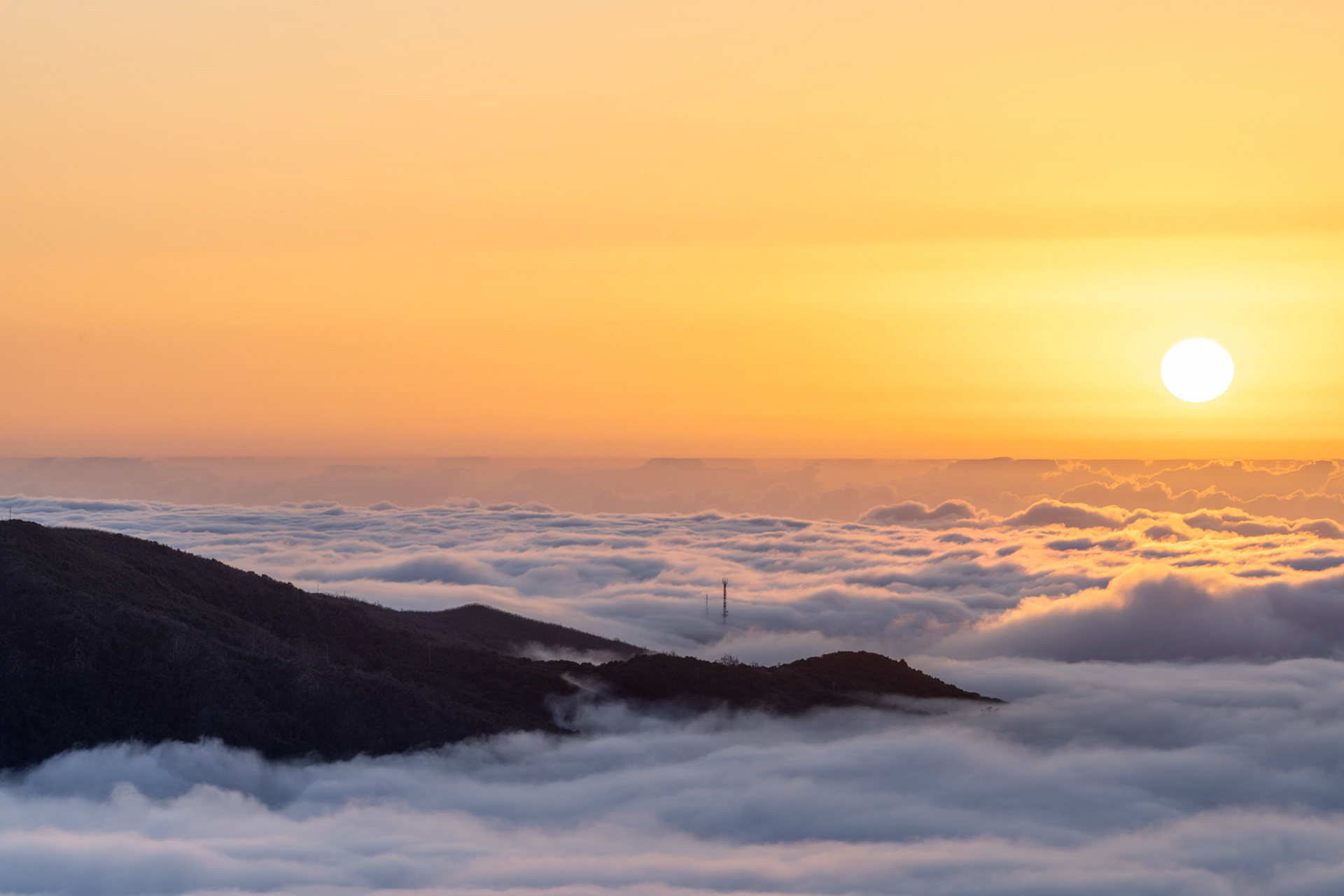
A temperature inversion fills the valleys below a mountain ridge, the cloud layer stretching unbroken to the horizon as the sun sits low and unobscured in a clear amber sky. A communications mast protrudes just above the cloud surface, a small note of the human world otherwise submerged. The image is taken from a high summit vantage at dusk or late evening in late May.
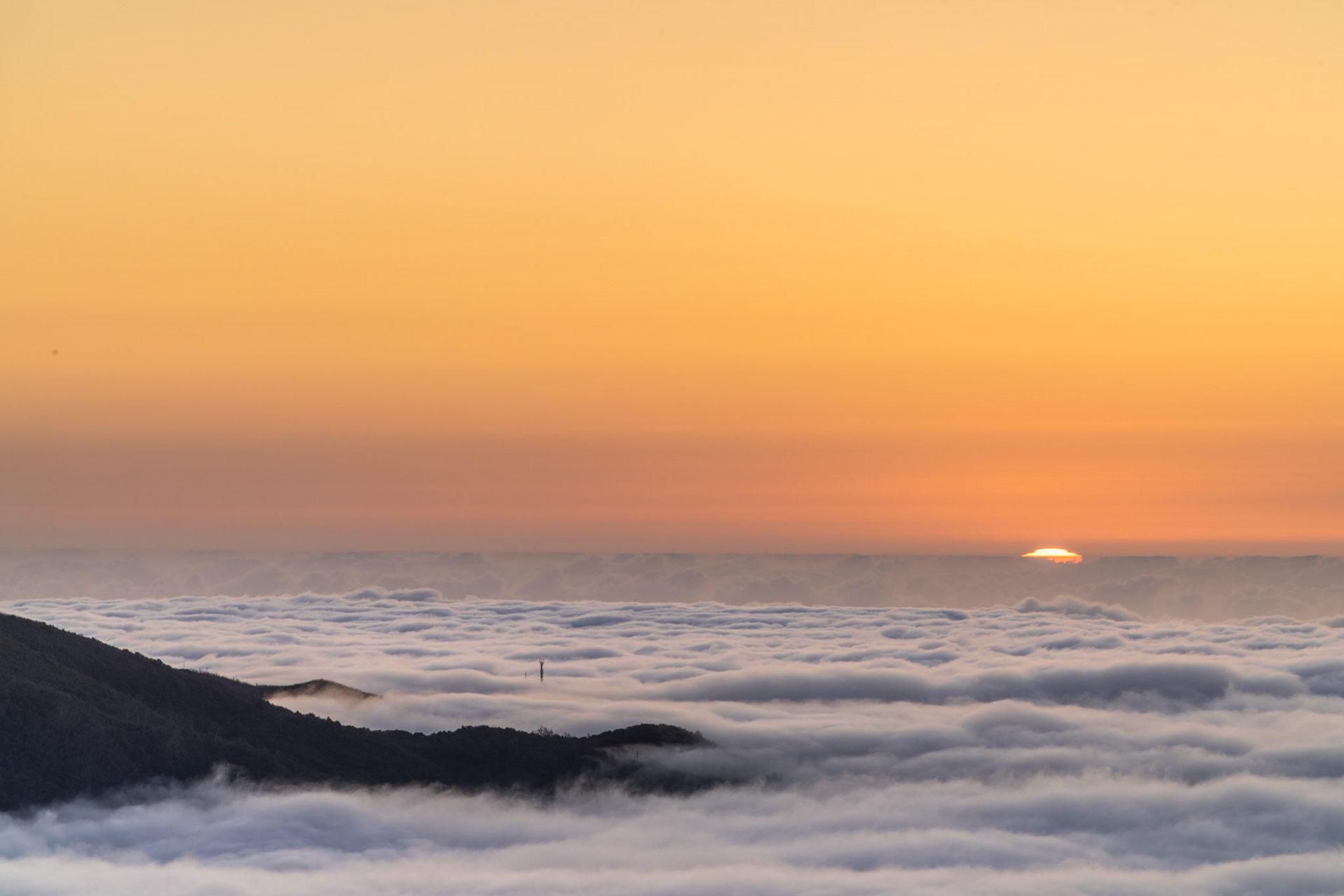
A temperature inversion buries the valleys beneath a level sea of cloud as the sun descends to the horizon, its disc just visible above the fog layer. Mountain ridges break through the white surface in the foreground, anchoring the scene. The unbroken amber sky above gives the image a clean, restrained luminosity.
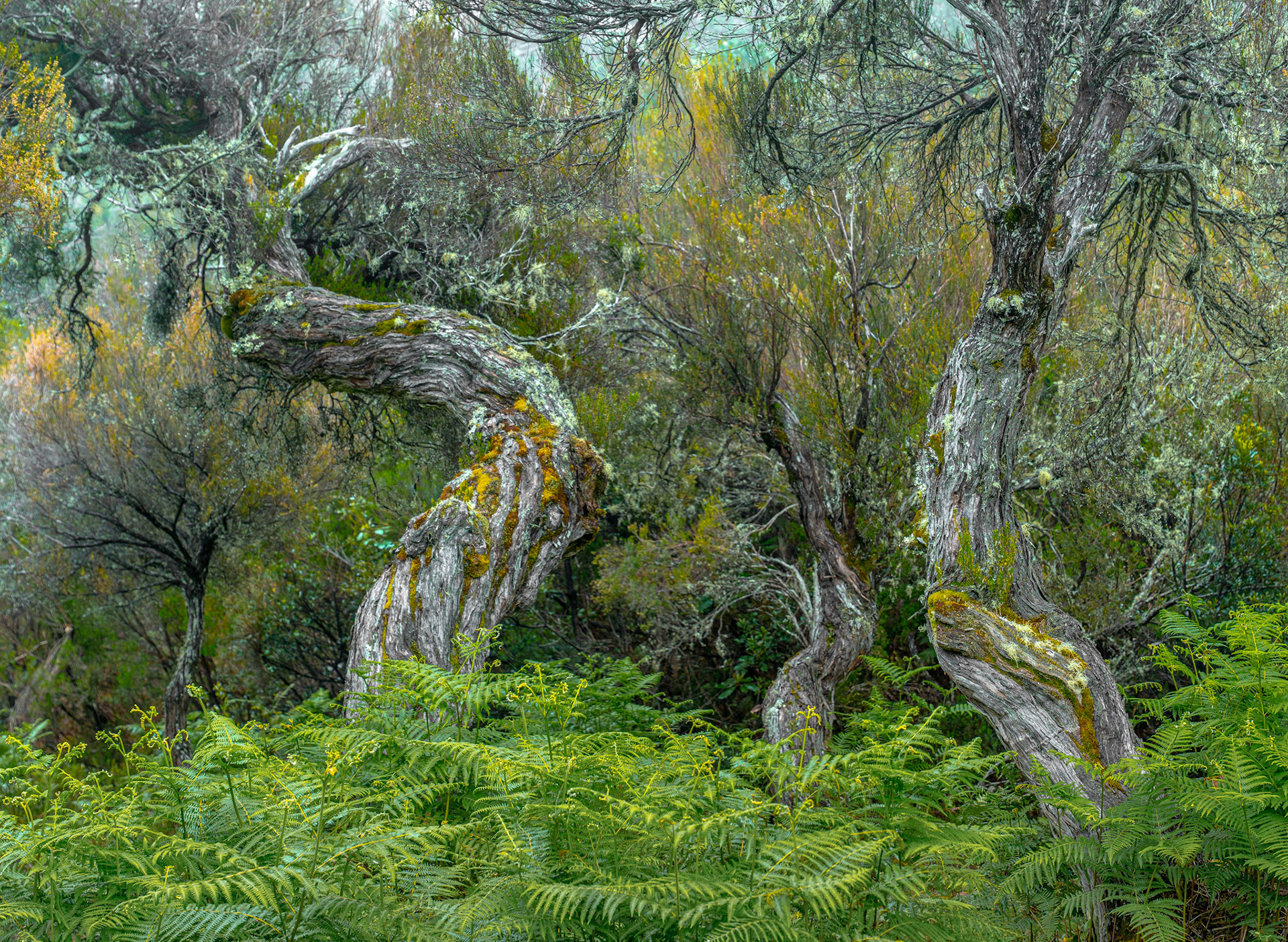
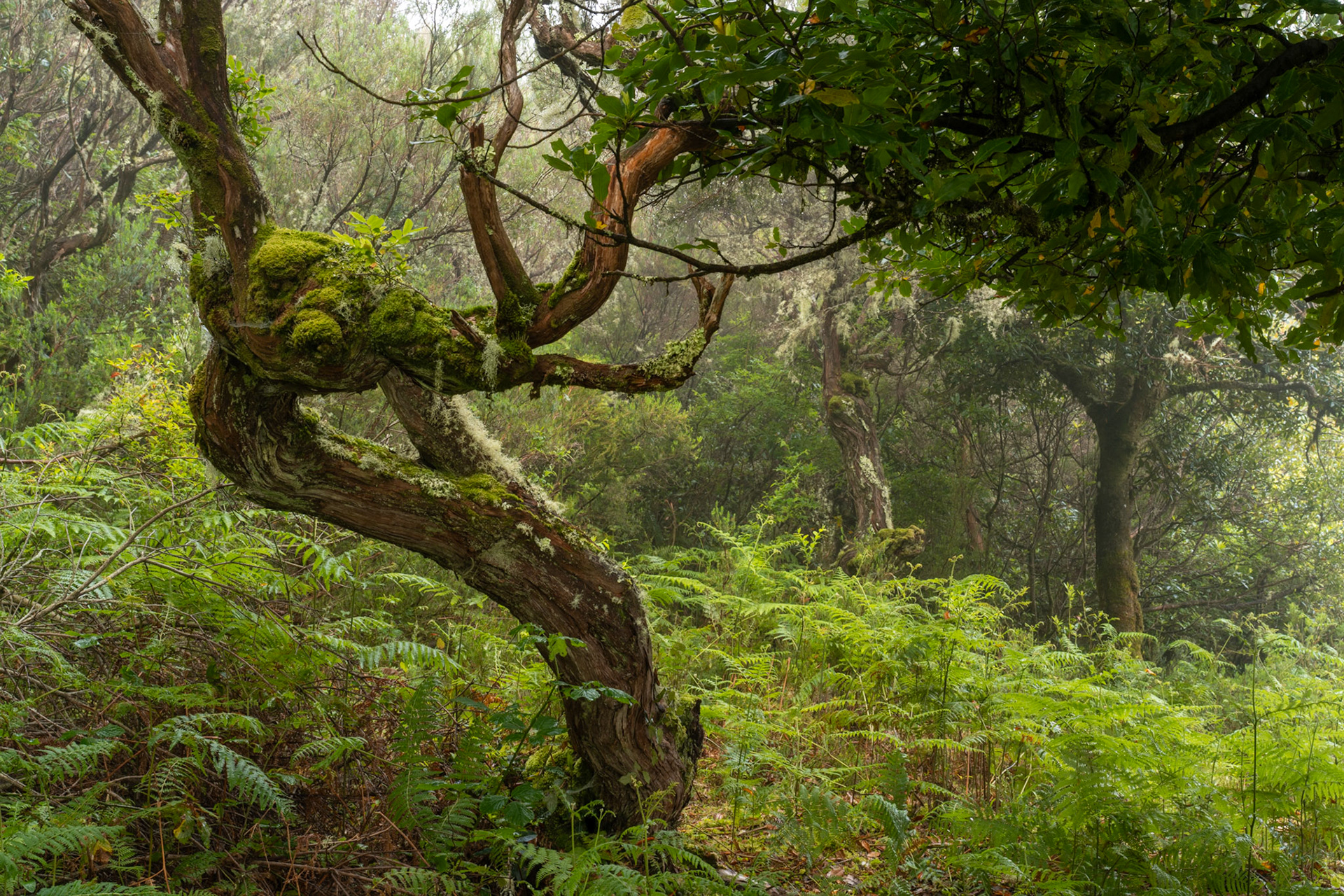
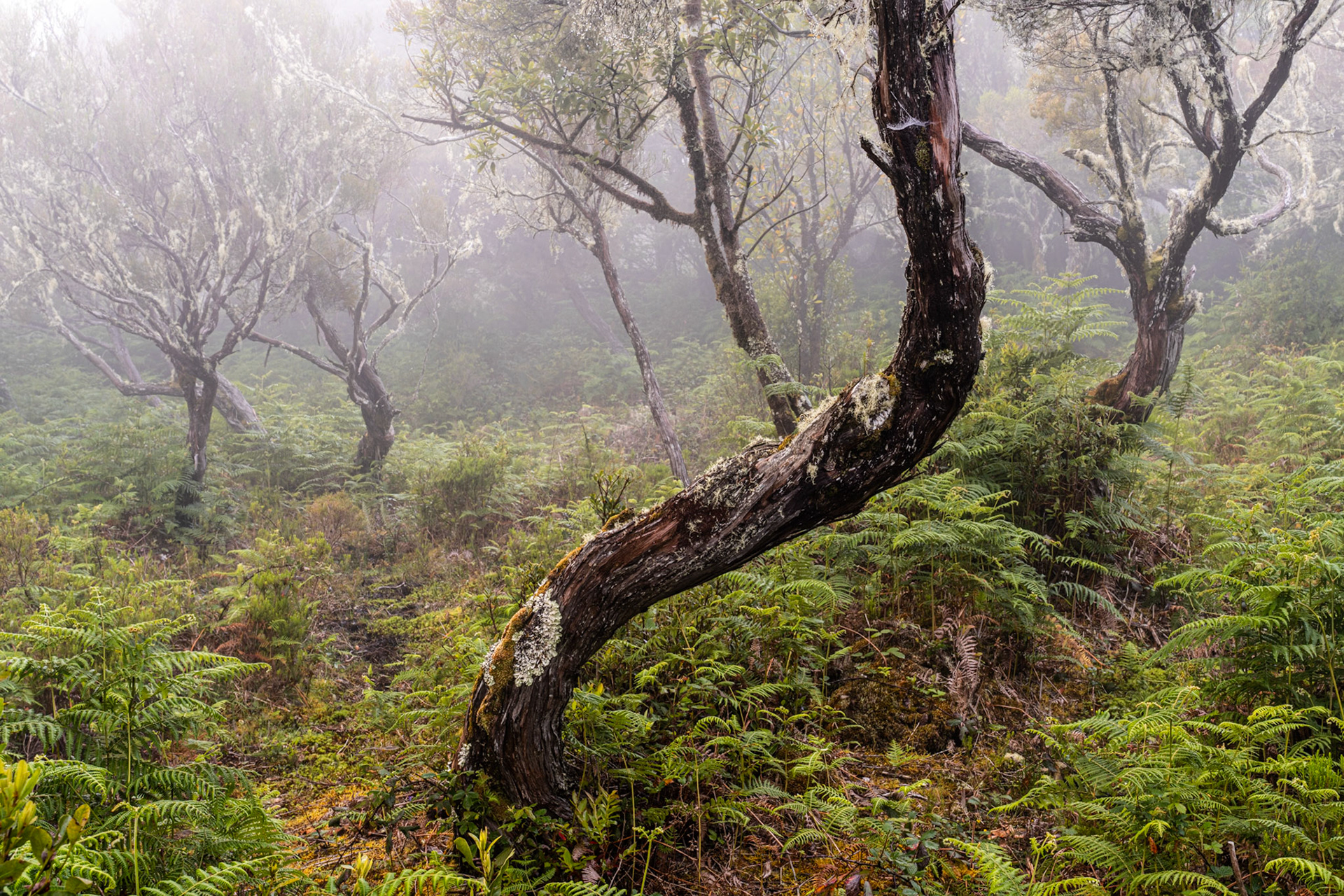
Two dramatically contorted old trees rise from a dense understorey of bracken fern, their deeply furrowed bark encrusted with lichen and moss. The overcast light suppresses shadow and flattens contrast, lending the scene a quiet, interior quality. The arching form of the left trunk carries an almost figurative presence within the layered woodland.
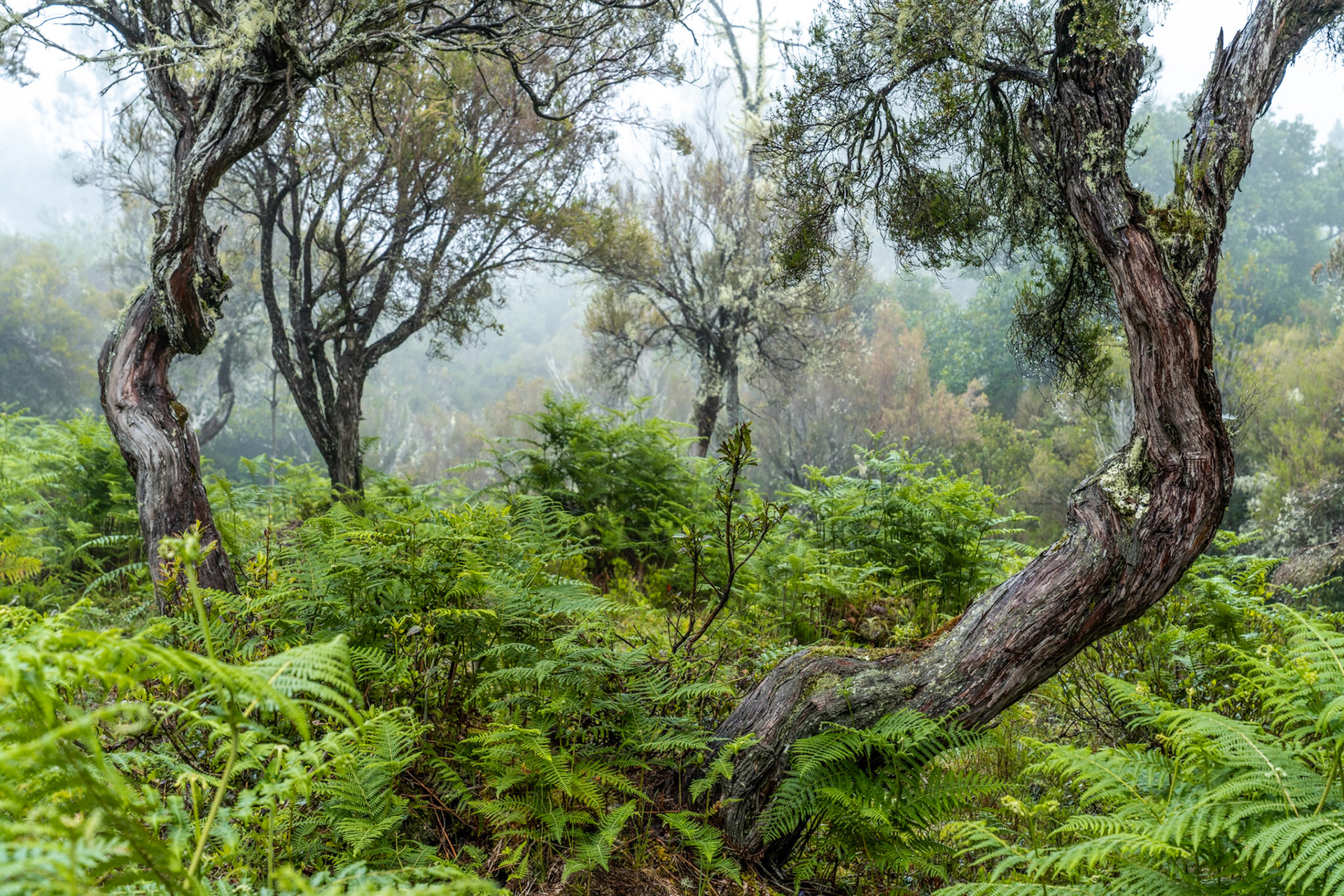
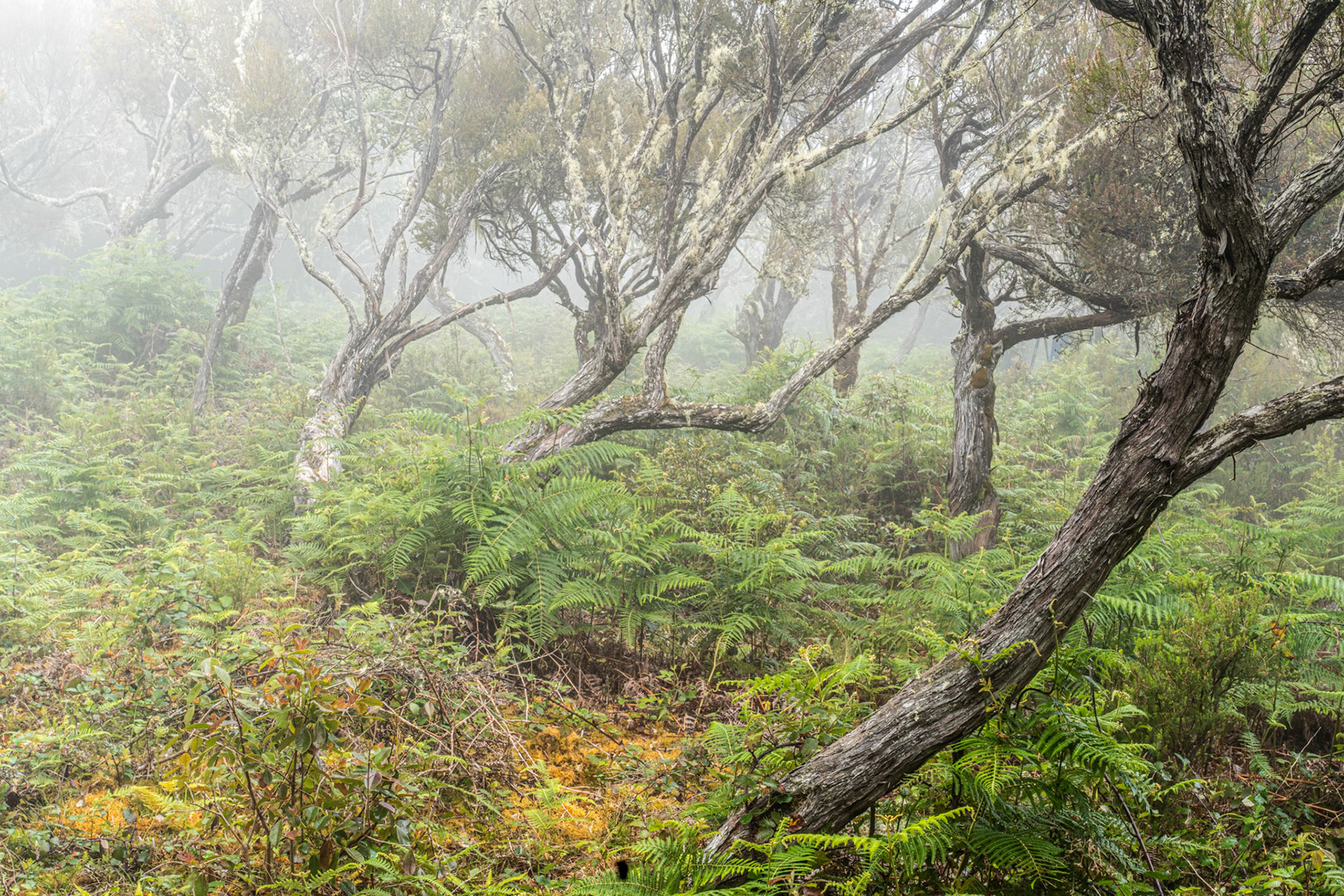
Gnarled, lichen-encrusted trunks frame a dense understorey of bracken and fern in a cloud-forest environment, the mist softening the mid-distance to near-monochrome. The leaning trunk at right introduces tension and scale against the lush spring growth below. Diffuse overcast light holds the scene together without shadow distraction.
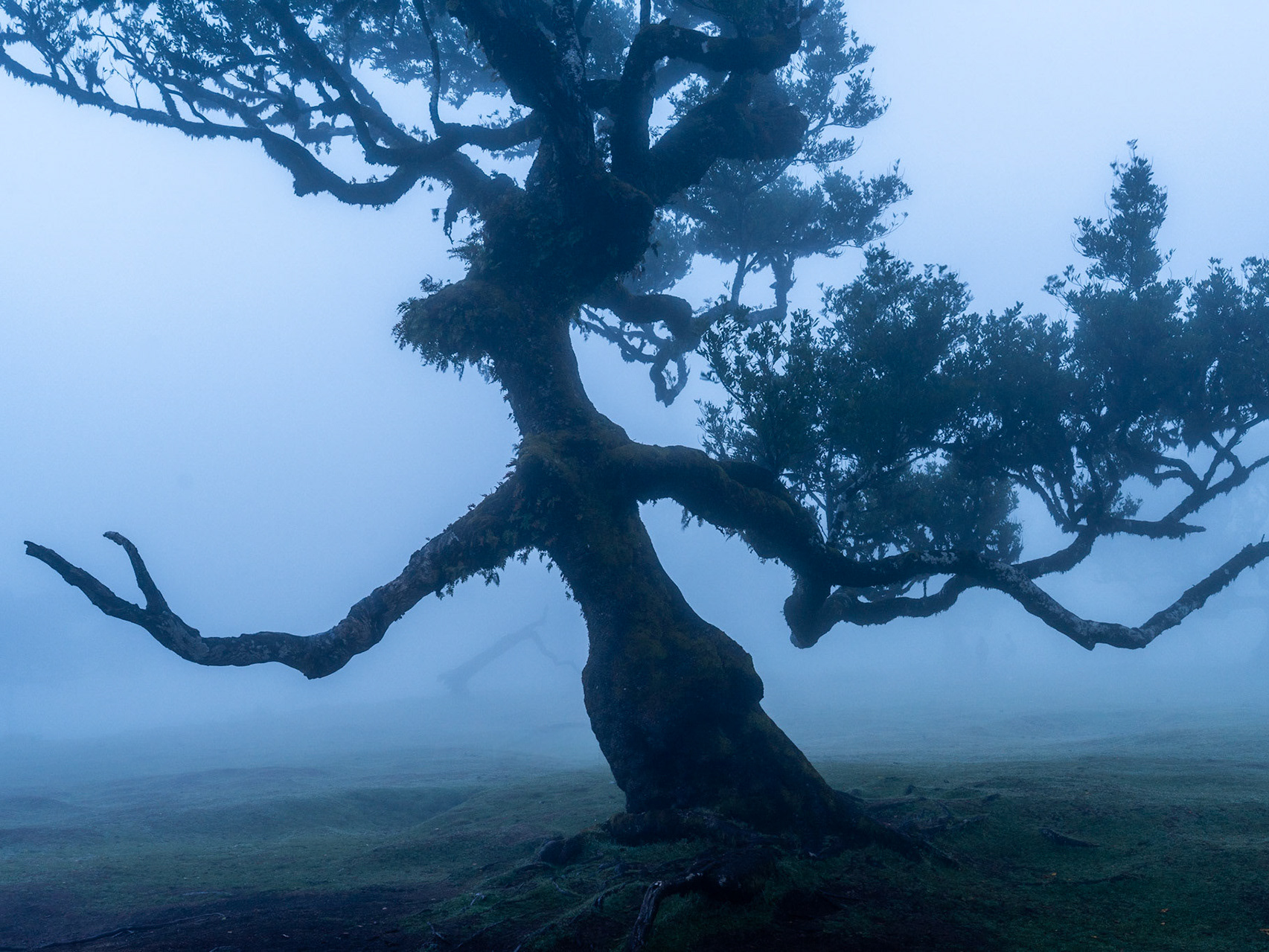
A gnarled, moss-clad trunk spirals through a fern-carpeted understorey, its contorted form suggesting decades of wind-driven growth. Lichen traces the bark in pale threads while soft mist dissolves the background canopy into layers of receding green. The scene is consistent with the ancient laurisilva forest of Madeira, where cloud and humidity sustain this density of moss and fern year-round.
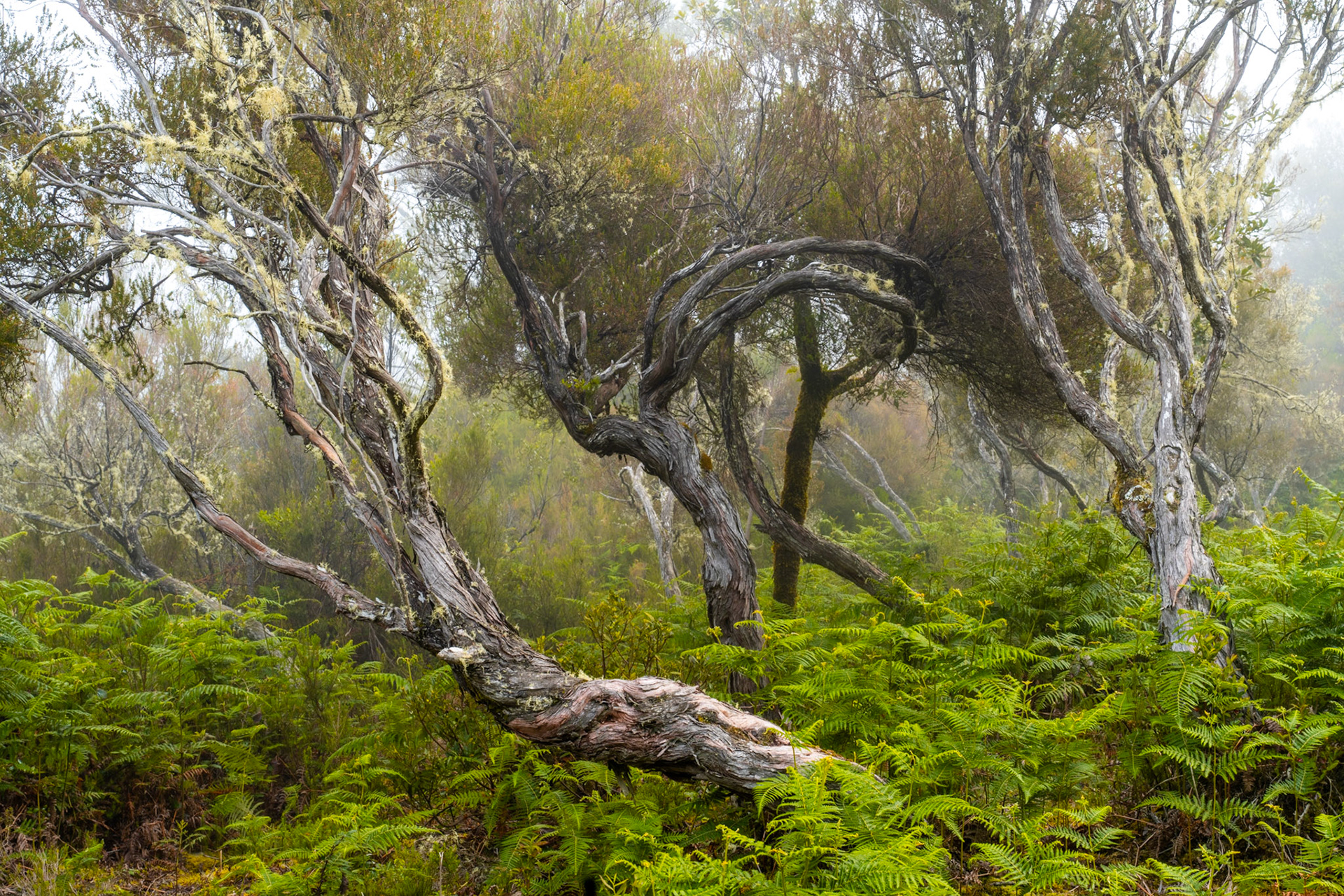
Contorted trees emerge from a dense understorey of ferns in early morning fog, their weathered trunks trailing lichen and peeling bark. A fallen bough curves low across the foreground, anchoring a scene of layered, receding forms that dissolve into diffuse light. The stillness and structural complexity suggest laurisilva-type woodland on Madeira or a comparable Atlantic island habitat.
Twisted, lichen-draped trees emerge from a dense understorey of ferns in morning fog. The pale trunks lean and arch across the frame, their forms softened by diffuse mist that erases depth toward the background. The lush, evergreen understorey and tree habit are consistent with laurisilva or similar Atlantic island cloud forest.
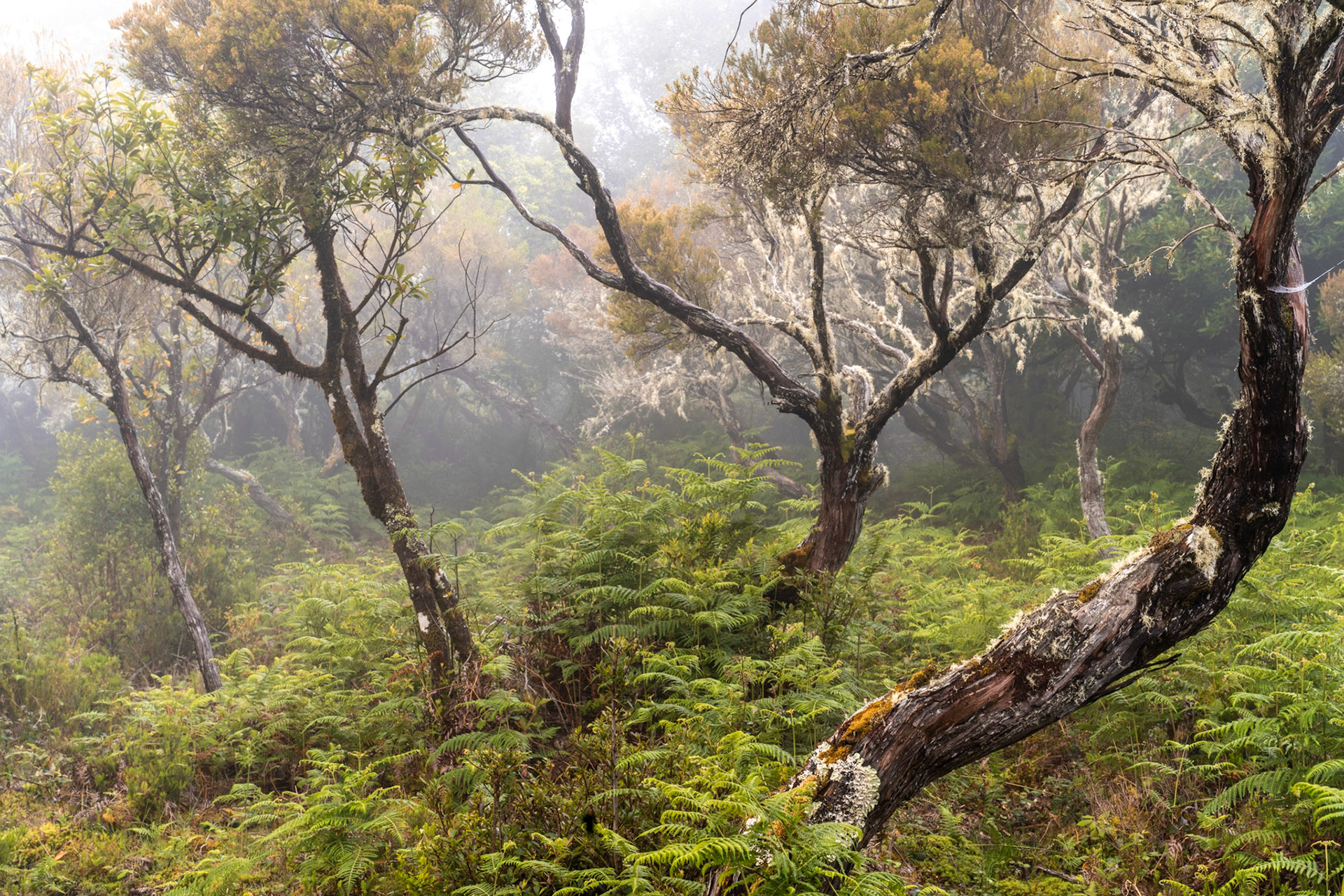
Lichen-draped trees emerge from low cloud in a dense laurel-heath woodland, their contorted forms rising above a dense understorey of tree ferns. Diffuse morning light filters through the mist, flattening contrast and lending the scene a quiet, primordial quality. The foreground trunk, encrusted with lichen and moss, anchors an otherwise weightless composition.
A contorted, lichen-encrusted trunk curves low through a fog-bound forest understorey thick with ferns. The diffuse morning light strips colour to near-monochrome, isolating the serpentine form against a recession of ghost-pale trees. The scene has the character of laurisilva cloud forest, consistent with a high-altitude spring morning.
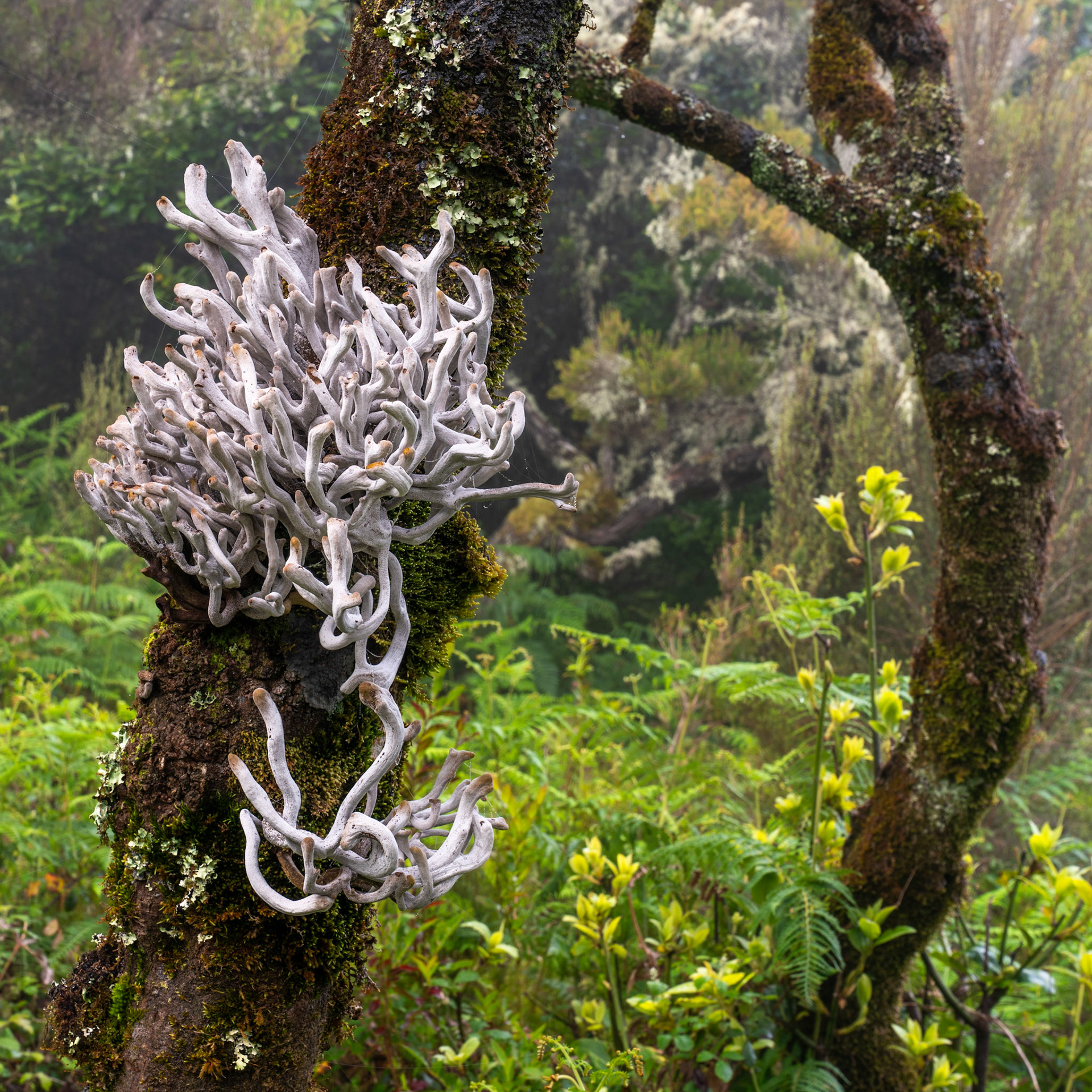
A dense colony of fruticose lichen — likely a Sticta or Cladia species — erupts from a moss-covered trunk in a humid montane forest. The branching white thalli read almost skeletal against the dark bark, their intricate architecture sharpened by the flat, diffuse light of an overcast morning. A second, smaller cluster lower on the trunk anchors the composition and extends the eye downward.
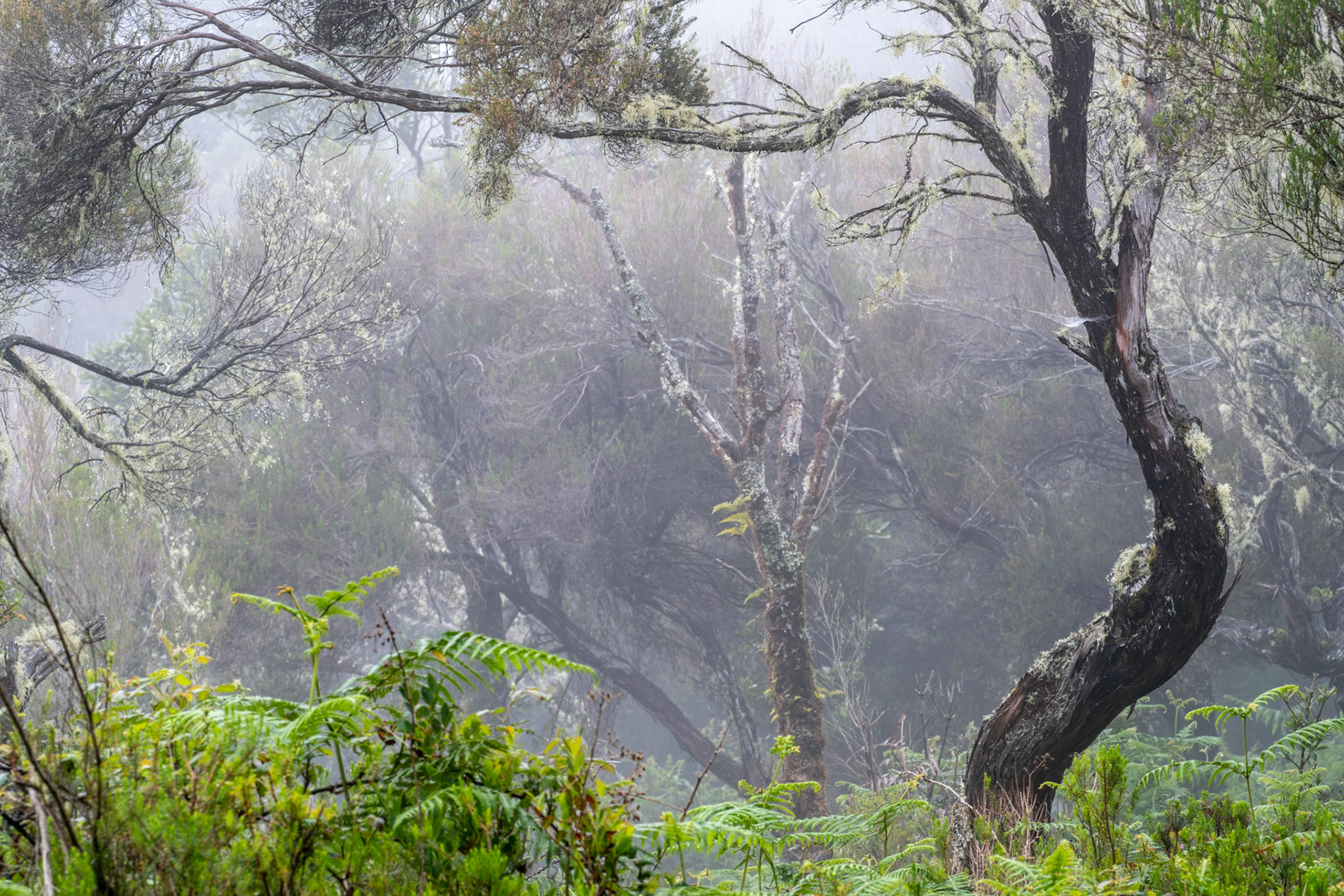
Dense mist dissolves the mid-distance into layered grey, isolating a twisted, lichen-covered trunk that anchors the right of frame. Ferns and low scrub in fresh spring growth occupy the foreground, grounding an otherwise weightless scene. The diffuse light flattens contrast throughout, lending the image a quiet, almost monochrome mood despite its colour.
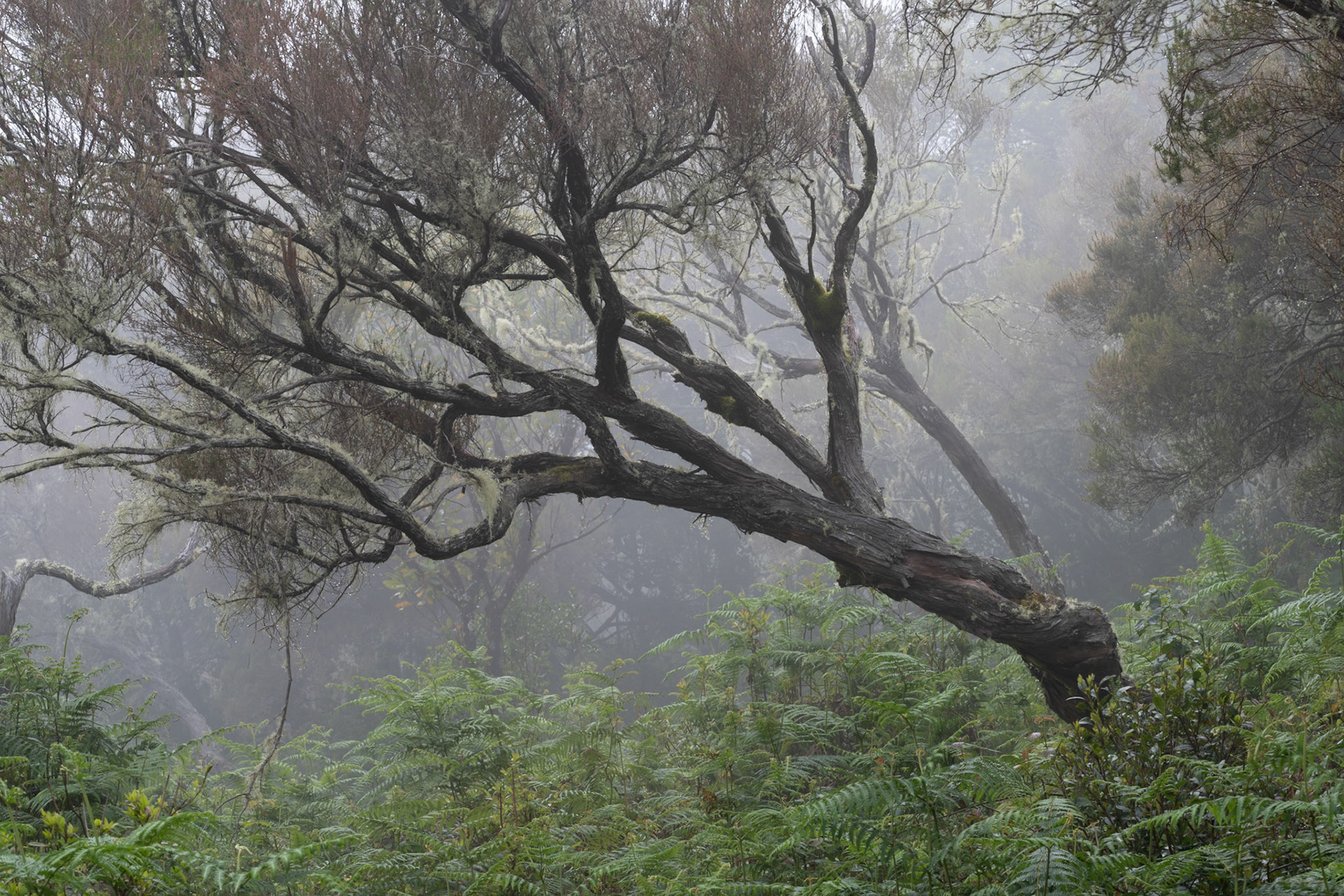
A heavily moss- and lichen-draped tree leans at a near-horizontal angle through dense cloud forest mist, its dark tortured trunk contrasting with a soft understorey of ferns and low shrub. The layered recession of fog-veiled trees behind provides depth without distraction. The image sits within a tradition of laurisilva or high-altitude cloud forest, most consistent visually with Macaronesian laurel woodland.
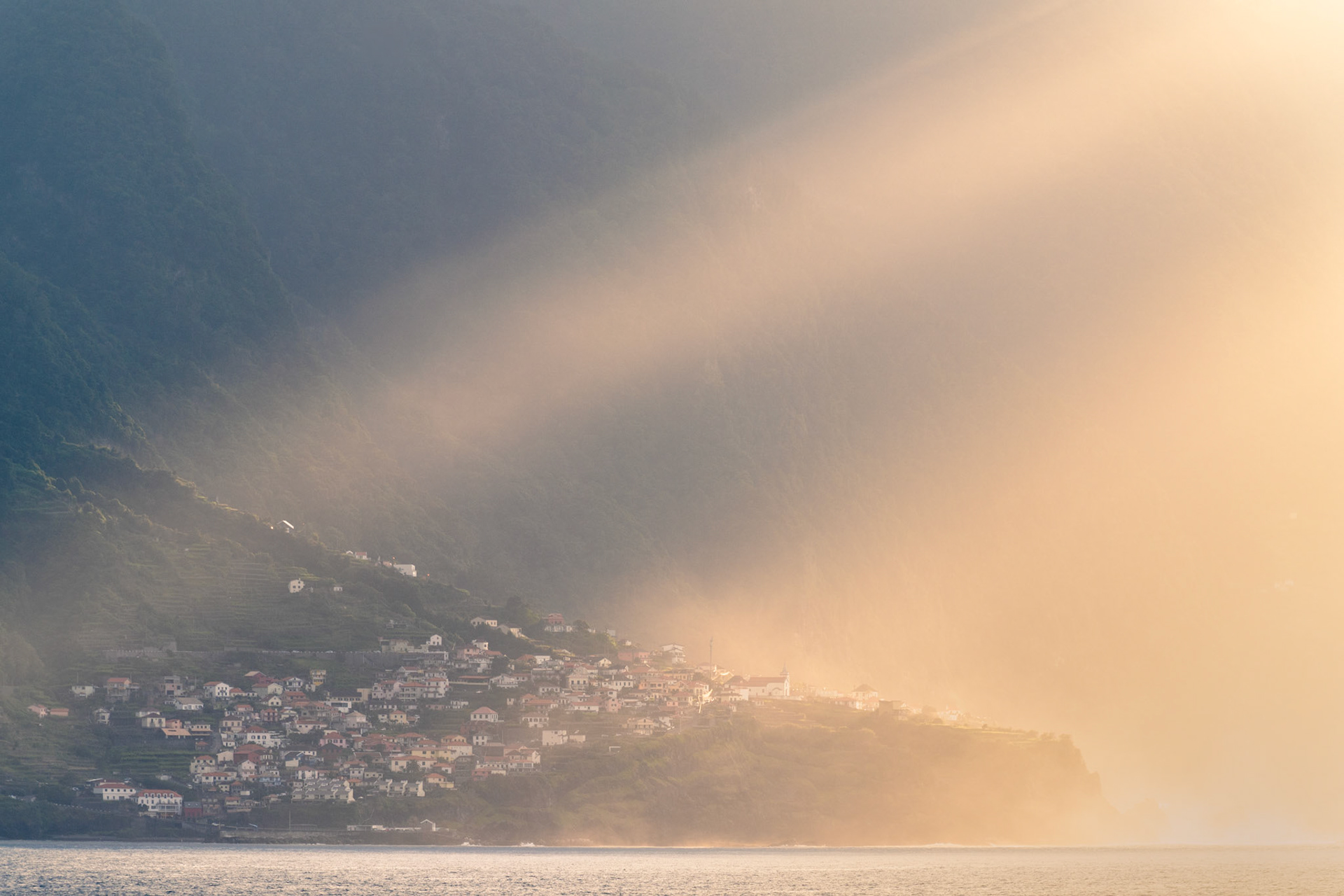
A coastal settlement clings to steep terraced slopes as a wall of mist rolls in from the sea, splitting the scene between cool shadow and warm evening light. The village — most likely on Madeira's north coast — is caught at the threshold of erasure, the golden haze reducing white-walled houses to silhouette at its margin.
Clover-like wildflowers and slender-stemmed plants are held against the broad burnished reflection of a low sun on calm water. The shallow depth of field keeps the botanical forms semi-silhouetted, the background reduced to warm luminous wash. A distant low landmass anchors the horizon without interrupting the stillness.
Drooping grass spikelets, silhouetted against warm-toned bokeh from sunlight reflecting off rippled water below, create a layered interplay of sharp botanical detail and diffuse luminosity. Captured at golden hour in late May, the image uses a shallow depth of field to dissolve the reflected light into massing orbs that read almost as cloud. The restraint of the monochromatic palette reinforces the contemplative mood.
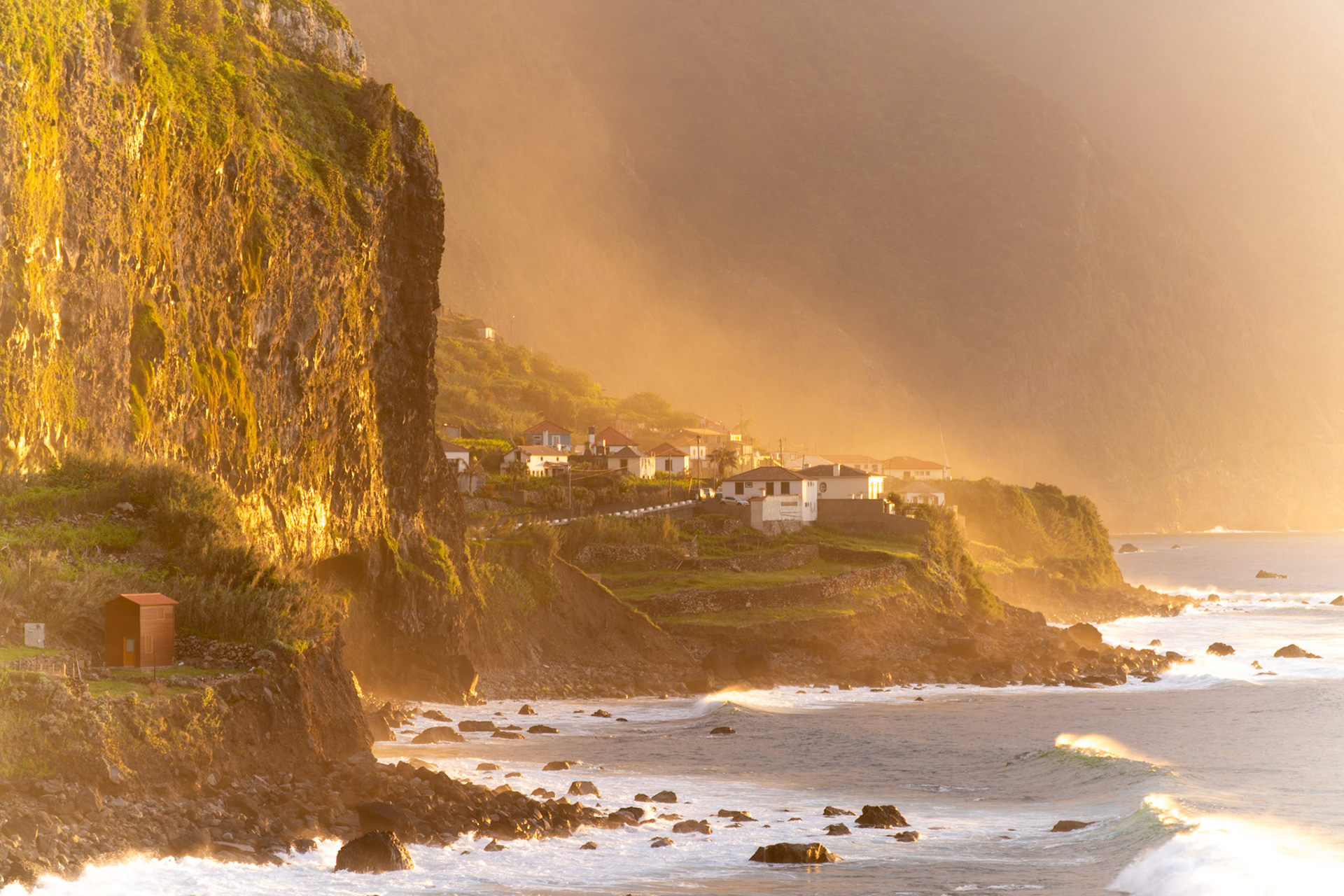
Warm evening light rakes across a moss-covered sea cliff on Madeira's north coast, catching spray-haze above the shoreline and illuminating a small terraced settlement clinging to the headland. Breaking Atlantic swell scatters around dark basalt rocks in the foreground, while a storm sky above deepens the contrast with the golden low sun. The atmospheric haze gives the scene an unusual luminosity that lifts it beyond straightforward travel record.
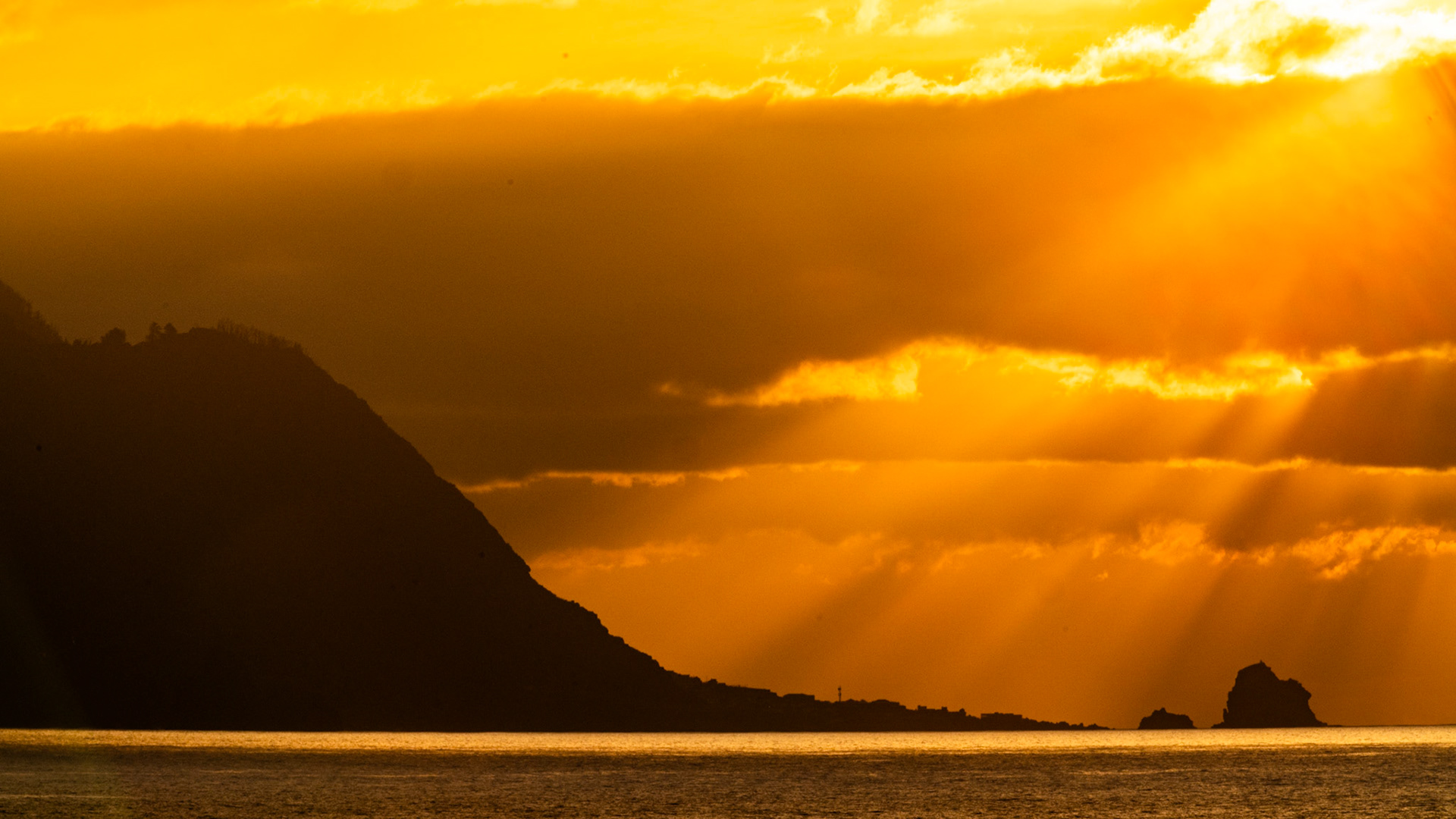
Crepuscular rays break through storm cloud above a volcanic headland, casting the sea in deep amber. Rock stacks punctuate the mid-distance, their silhouettes anchoring the composition against the luminous sky. The light is fleeting and the tonal range extreme, caught in the last minutes before sunset.
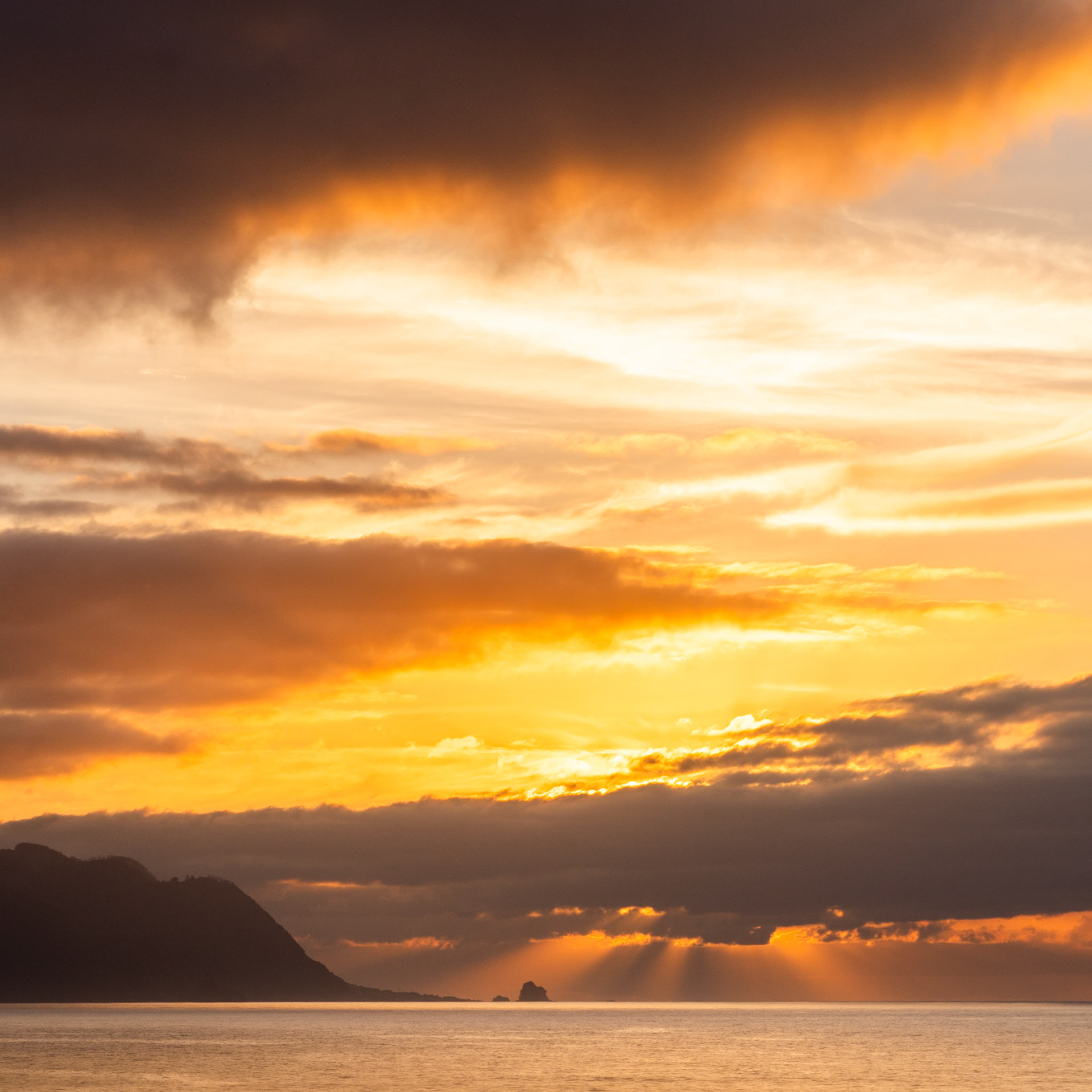
Crepuscular rays break beneath a storm-edged cloudbank at sunset, casting across a calm sea toward distant coastal headlands rendered as dark silhouettes. The compression of weather systems above and still water below gives the image a layered, almost operatic quality, though the foreground offers little to anchor the eye. The moment is convincingly caught but the composition leans heavily on the sky at the expense of ground-level structure.
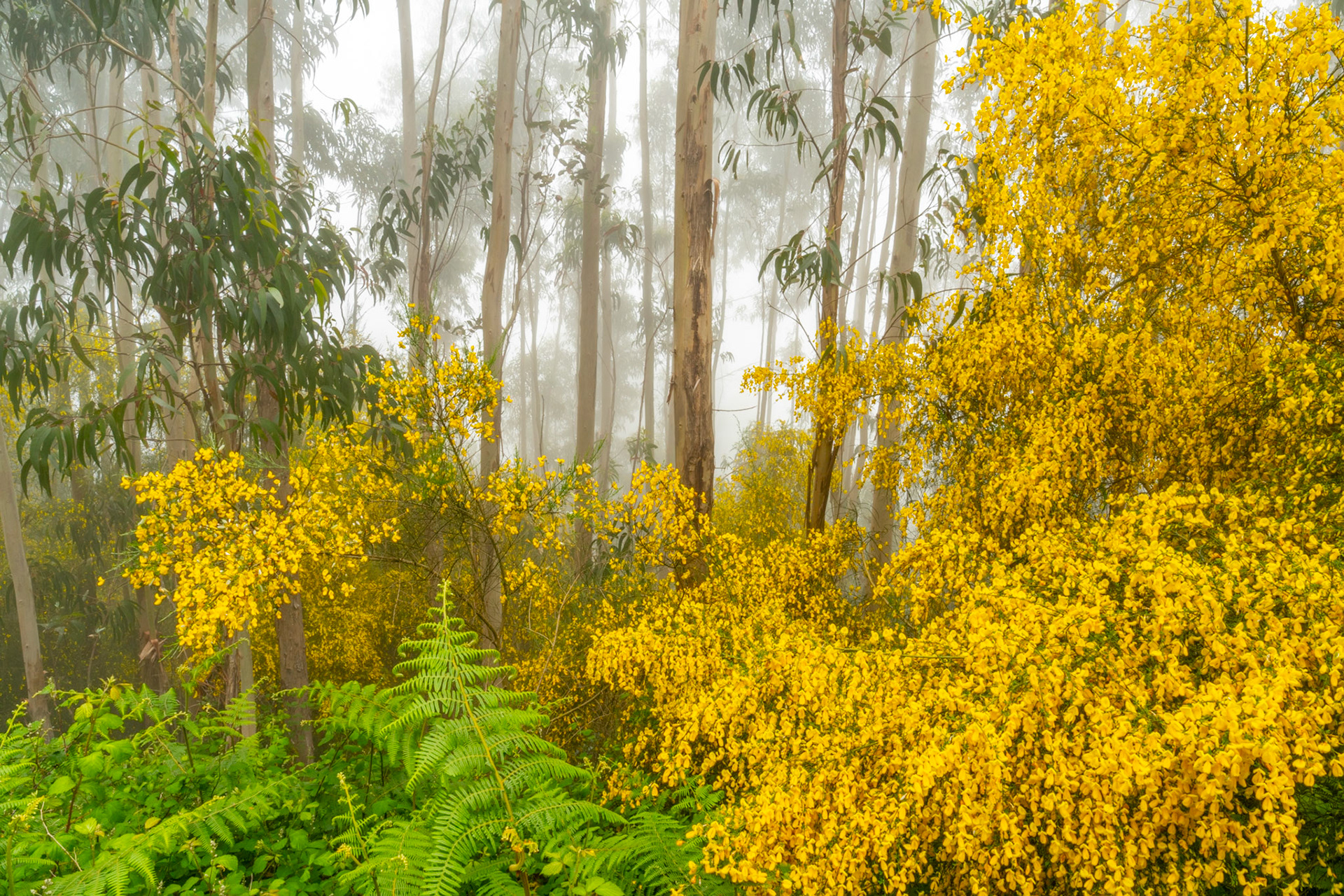
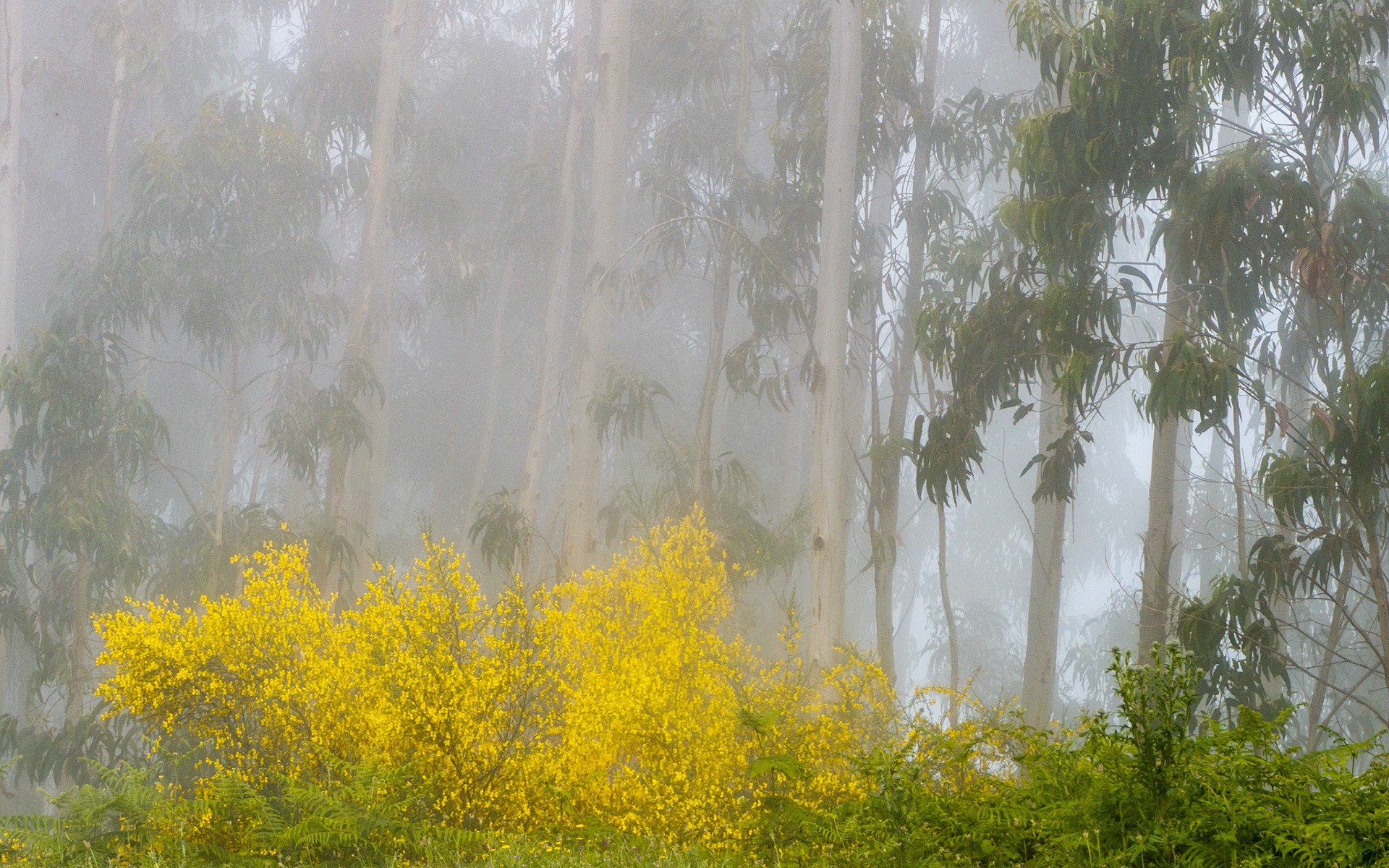
Dense flowering broom pushes through a eucalyptus plantation as morning fog softens the pale trunks into successive planes of grey. The saturated yellow of the shrubs holds against the muted background, creating a tension between the vivid foreground and the dissolving interior of the wood. Bracken fronds in the lower frame anchor the composition in something quieter.
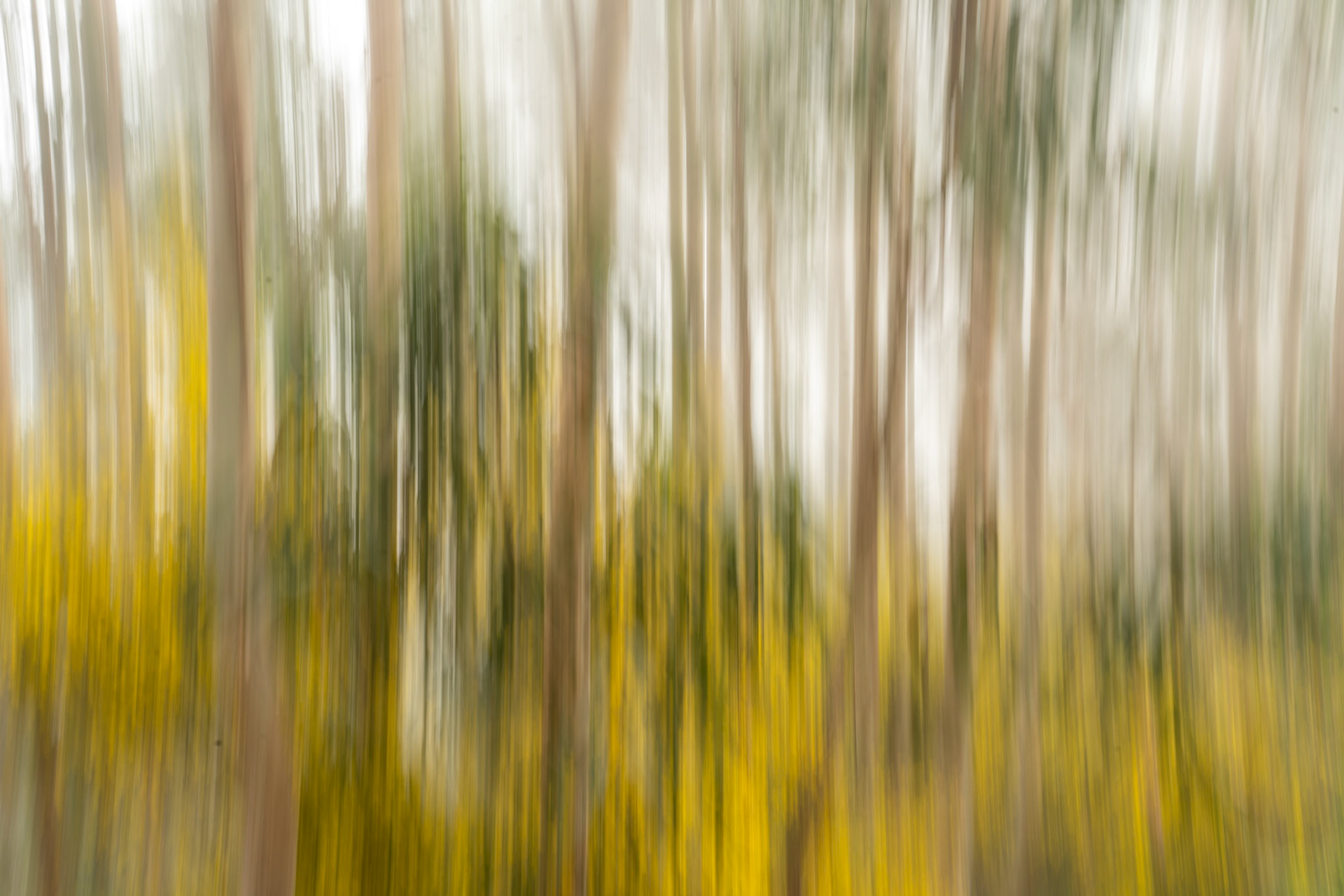
An intentional camera movement exposure renders a stand of tall trees as vertical streaks of ochre, warm brown, and dark green. The technique dissolves individual trunks and understorey into an abstract field of colour, retaining just enough structural rhythm to suggest a dense, light-filled woodland interior. Captured in late May, the yellow-green lower tones indicate fresh understorey growth or bracken.
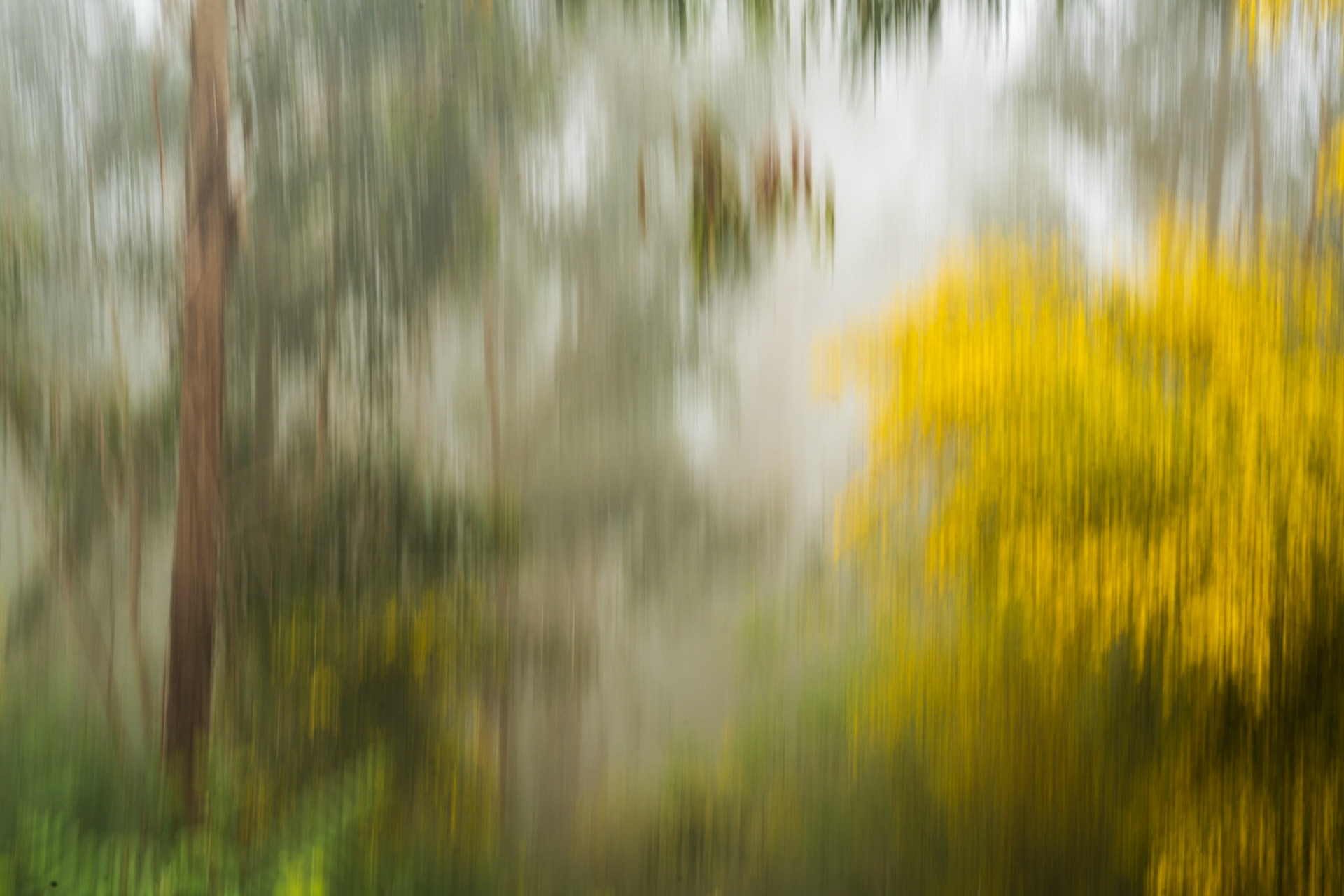
A vertical in-camera movement technique renders a mixed woodland into streaked bands of yellow blossom and grey-green canopy. The strong chromatic contrast between the golden flowering shrub and the cooler tones beyond gives the abstraction a clear compositional anchor. Captured in late May, the image sits at the boundary between documentation and painterly interpretation.
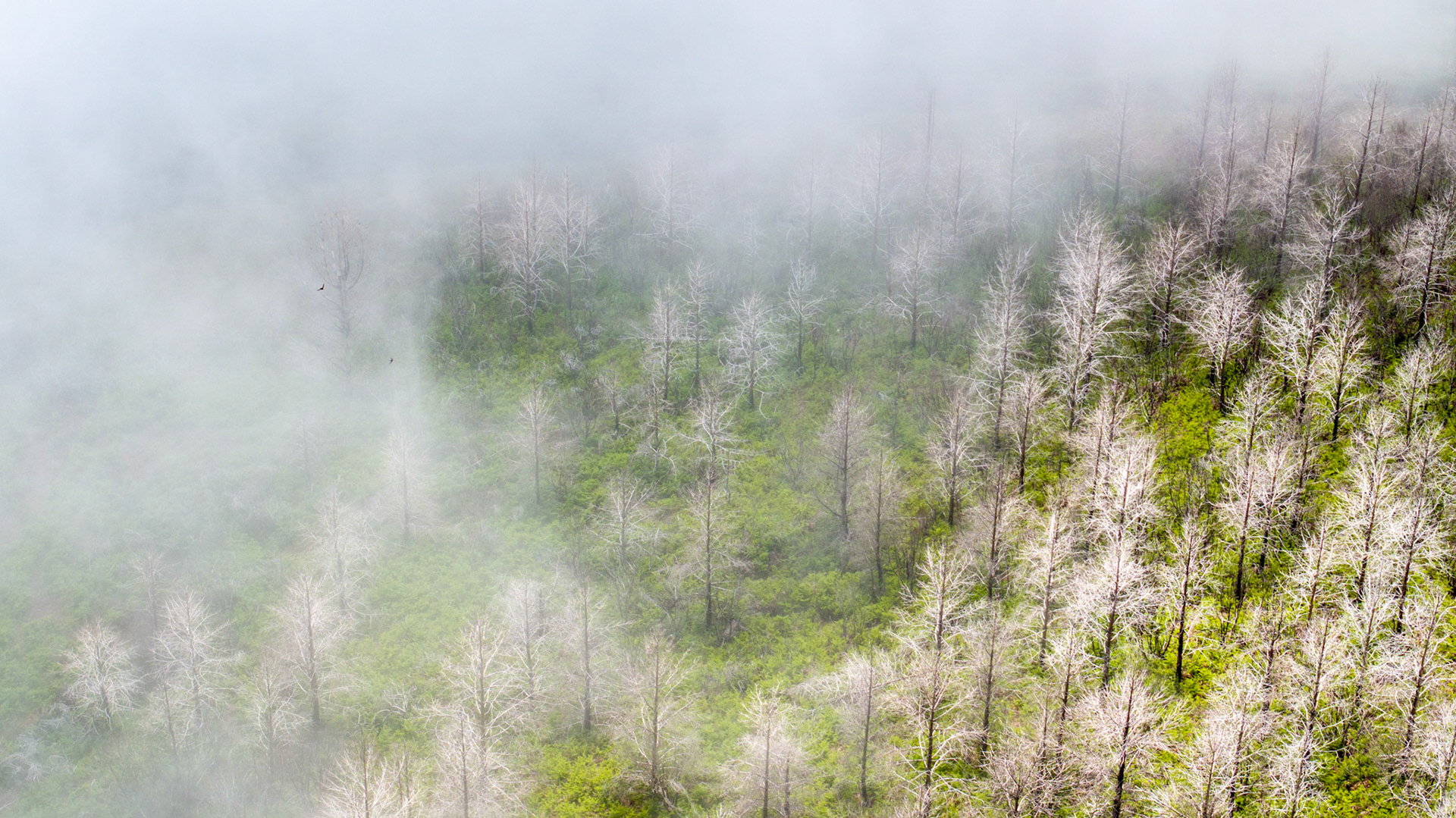
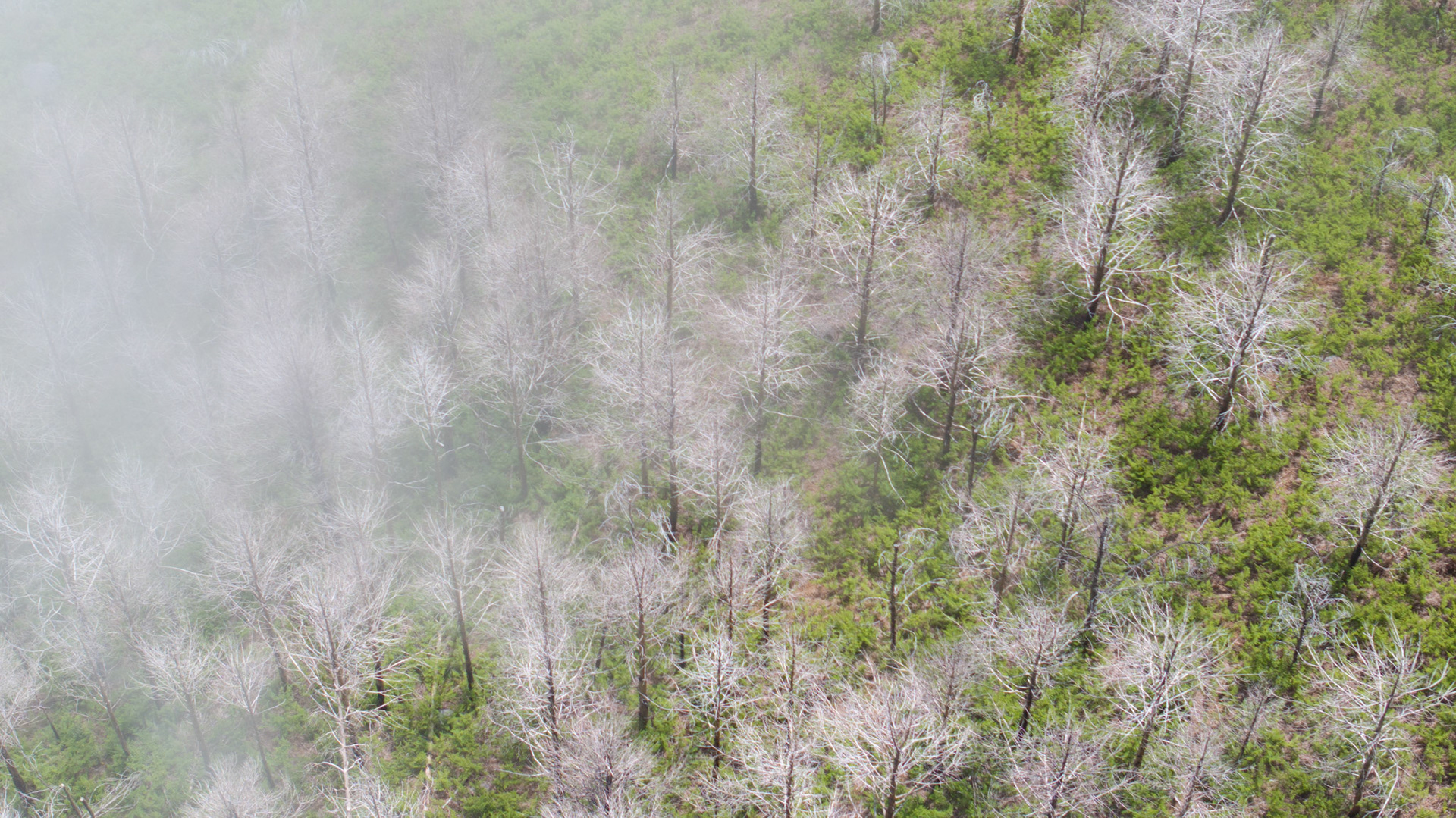
Aerial view of a regenerating hillside forest above Arco da Calheta, Madeira, where bleached standing deadwood rises through spring fog alongside vivid new-season understorey growth. The interplay of pale skeletal trunks against emergent green, softened by rolling cloud, gives the scene an uncommon graphic tension. A single bird — faint in the mist — anchors the scale without demanding attention.
A wall of low cloud advances across a hillside of dead standing trees and young evergreen regeneration, Arco da Calheta, Madeira. Shot from directly overhead, the image reads as a study in forest succession — bleached skeletal trunks interspersed with bright spring growth, half-consumed by mist. The tonal gradient from white fog to saturated green gives the frame its only structural drama.
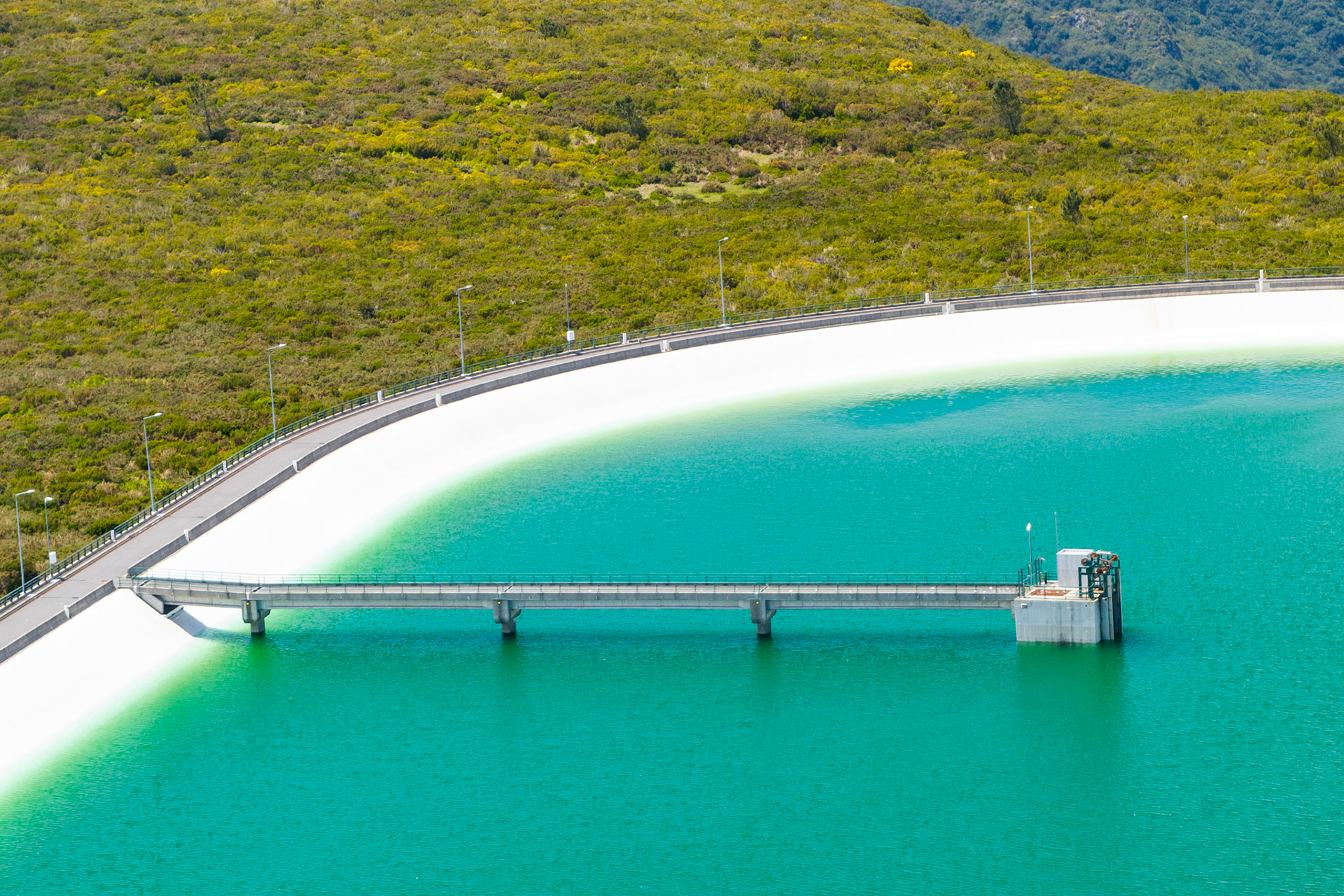
The curved face of the Calheta reservoir dam sweeps across the frame from an aerial vantage, its white concrete wall dividing vivid turquoise water from the scrubland hillside above. A narrow access bridge extends perpendicular to the intake tower, anchoring the geometric composition. Shot in bright overcast light that suppresses shadow and renders the water colour with unusual clarity.
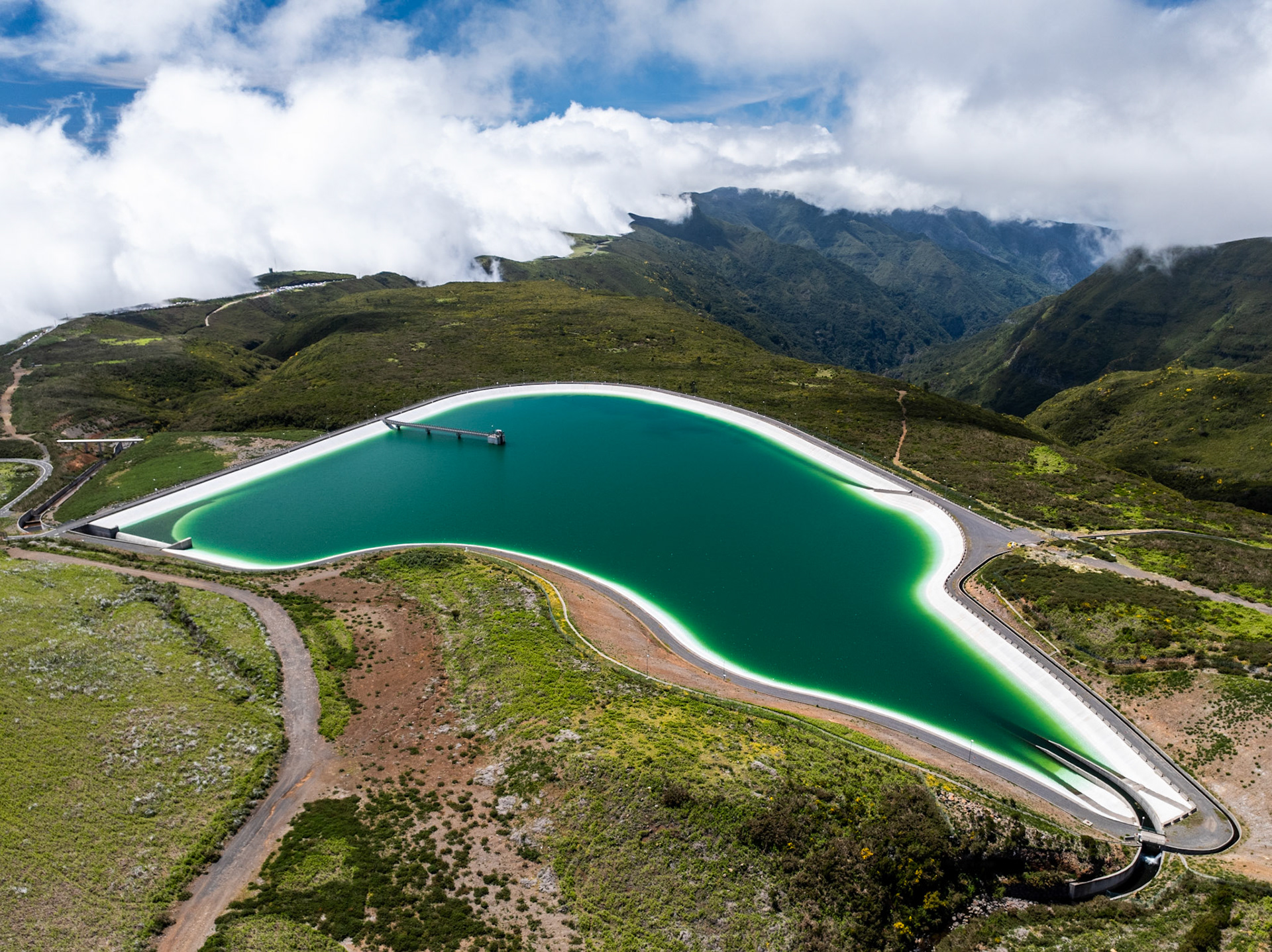
An elevated reservoir on the Paul da Serra plateau, Madeira, its pale concrete liner forming a sinuous white border against the deep teal water. Low cloud clings to the mountain ridge beyond, softening the transition between the engineered basin and the laurisilva-covered slopes. The organic curve of the structure from altitude reads almost as a natural form pressed into the upland terrain.
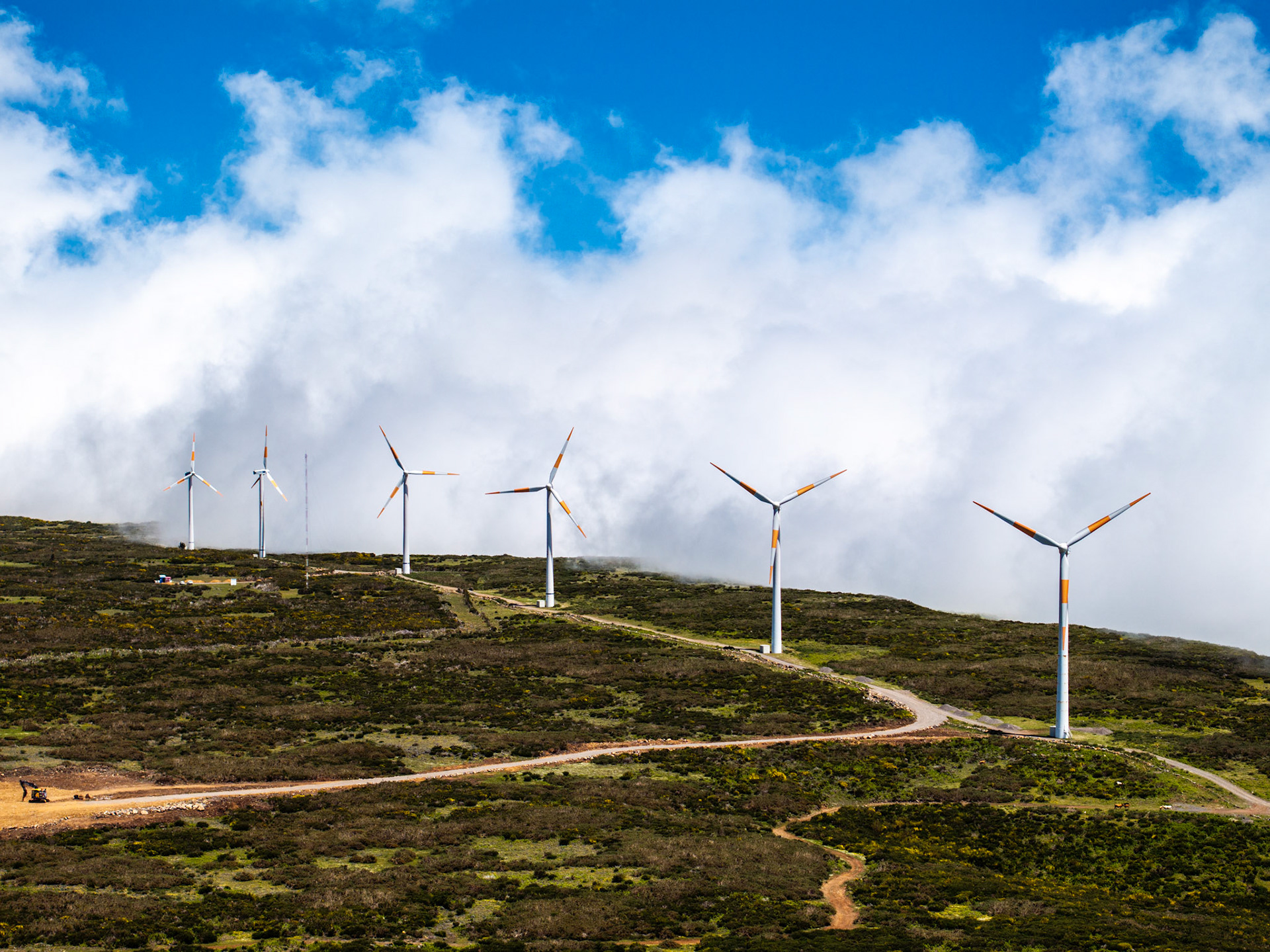
A row of wind turbines traces the ridgeline above Arco da Calheta, Madeira, their orange-tipped blades catching flat spring light against a broken cloud mass that partially obscures the upper slope. The winding service track lends structure to the foreground scrubland, though the composition lacks a singular point of tension to lift it beyond the documentary.
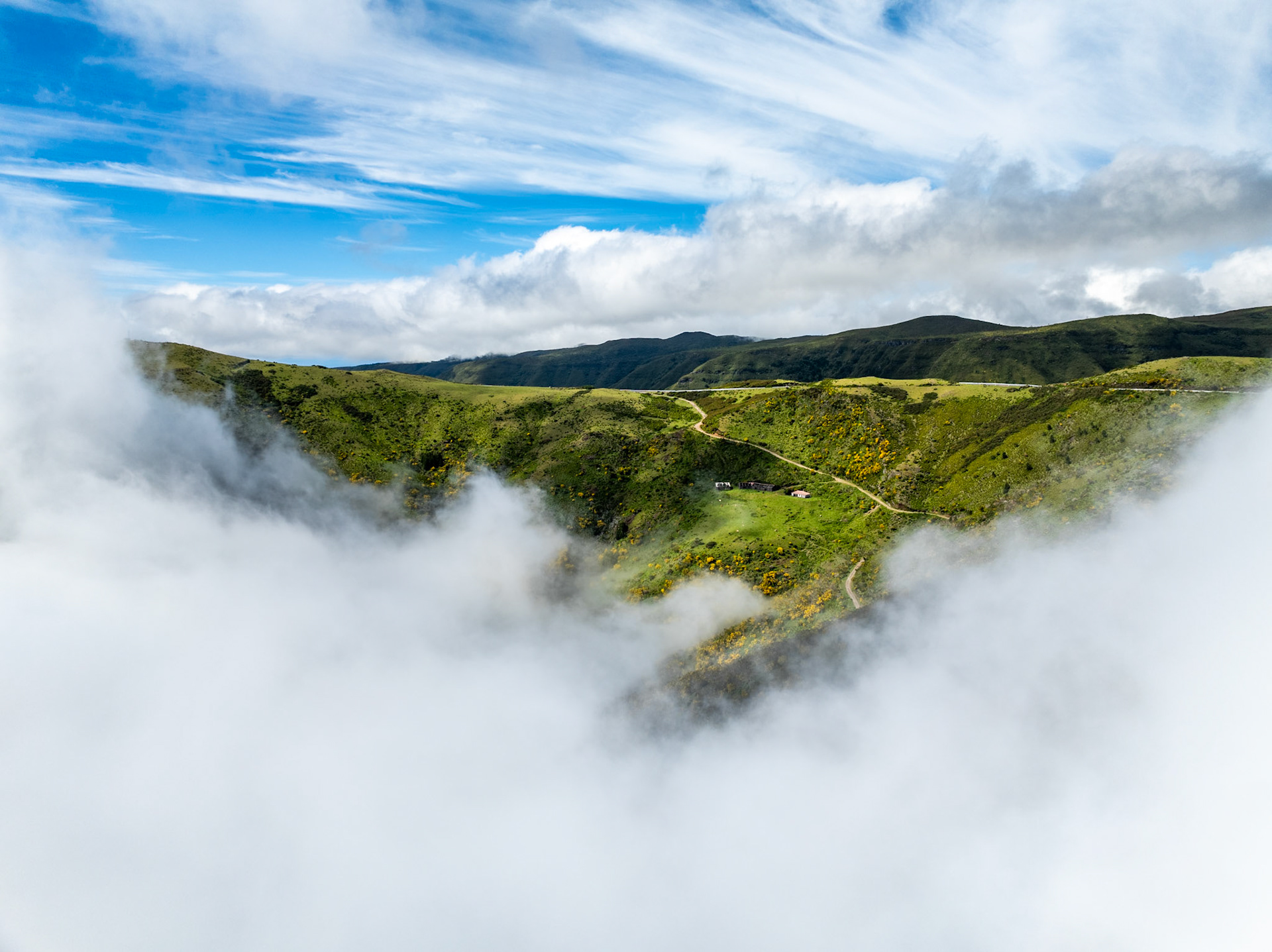
Low cloud pools in a green valley above Calheta, Madeira, partially obscuring a winding track and two small farm buildings. Shot from above the inversion layer, the mist frames rather than conceals the terrain, giving a sense of the valley's scale and isolation. Scattered yellow flowering shrubs punctuate the hillsides.
Flowering broom shrubs stand in vivid contrast against a grove of fog-wrapped eucalyptus, Calheta, Madeira. The mist reduces the tall trunks to pale verticals, compressing depth and lending the scene a quiet graphic weight. Spring colour anchors the lower frame while the forest dissolves behind.
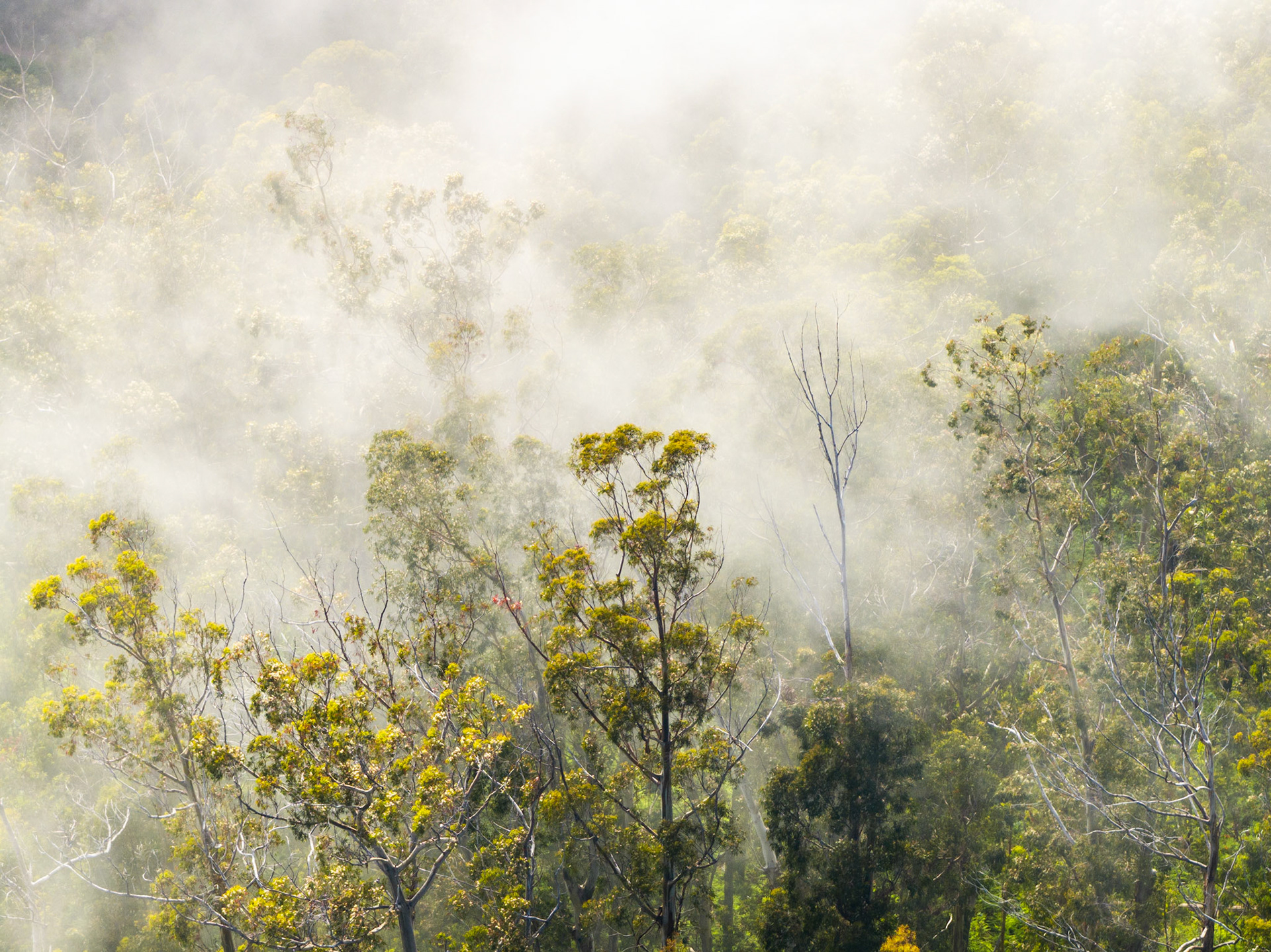
Morning fog moves through eucalyptus woodland on the slopes above Canhas, Madeira, softening the canopy into successive planes of green and white. The aerial perspective flattens depth, turning the mist into a graphic field that isolates individual crowns and bare snags. A small flash of red blossom near centre provides the single note of colour in an otherwise subdued palette.
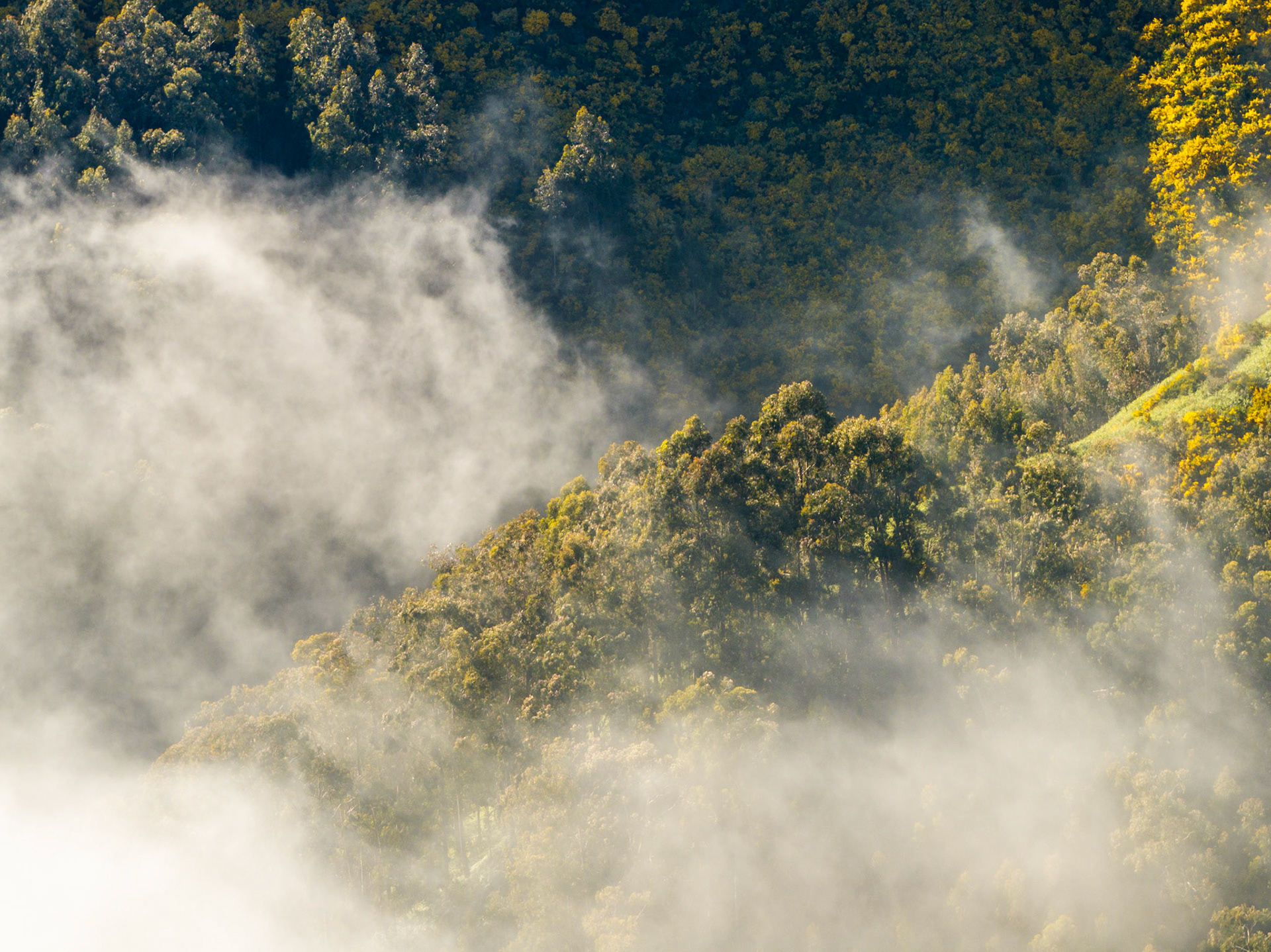
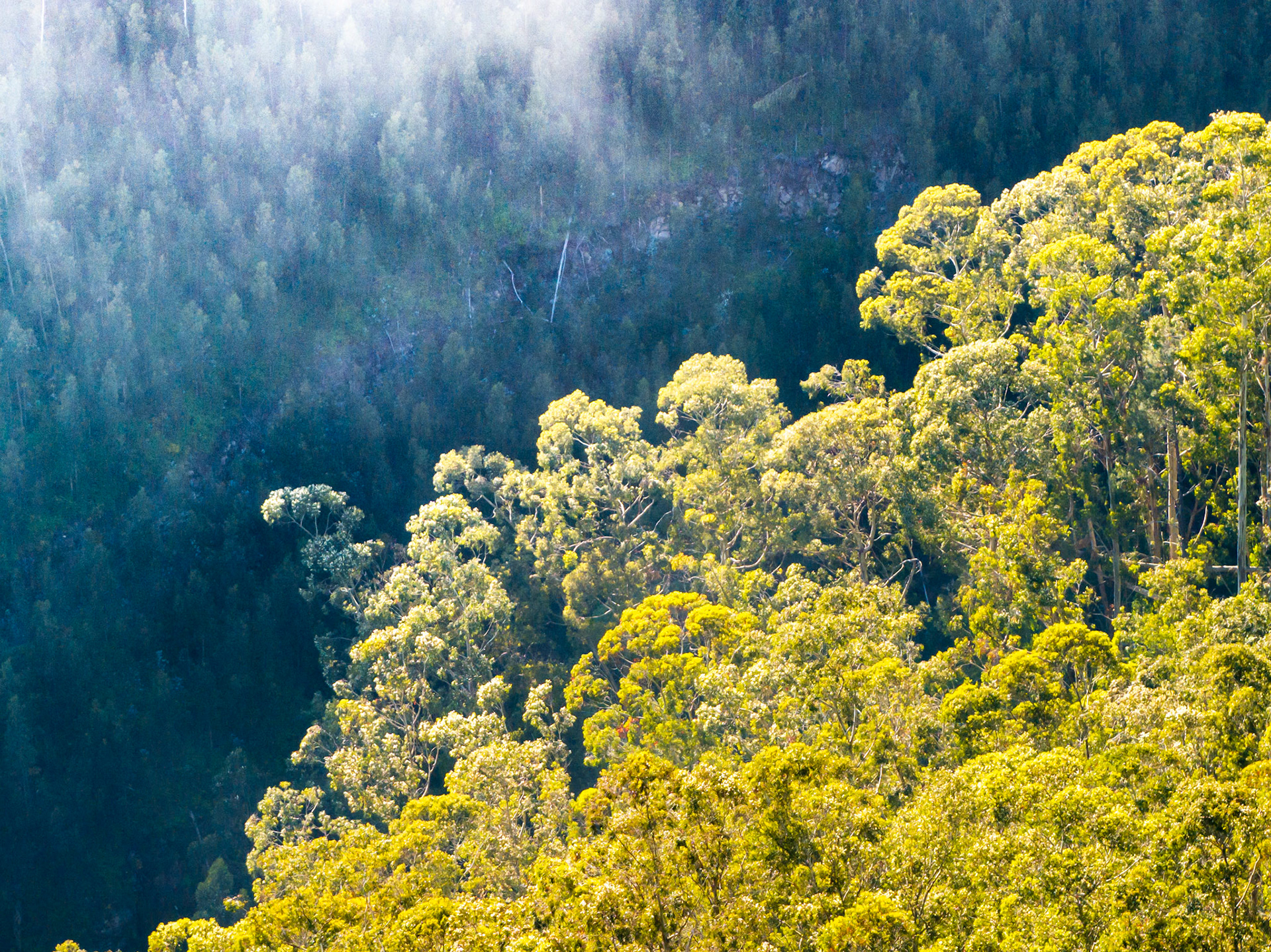
Morning cloud pools in the valleys below Canhas, Madeira, partially submerging a steep hillside of eucalyptus and laurel. Low sun catches the upper canopy in warm yellow-green against the darker, shadow-held forest above. The aerial vantage compresses the diagonal of the ridge into a single layered plane of mist and woodland.
Morning sun catches the upper canopy of a steep eucalyptus and laurisilva forest slope on Madeira, separating sunlit crowns from a misty blue-grey valley below. The diagonal band of illumination creates a natural division between light and shadow across the densely wooded hillside. Captured from altitude in late spring, the image reads as near-abstract despite its documentary clarity.