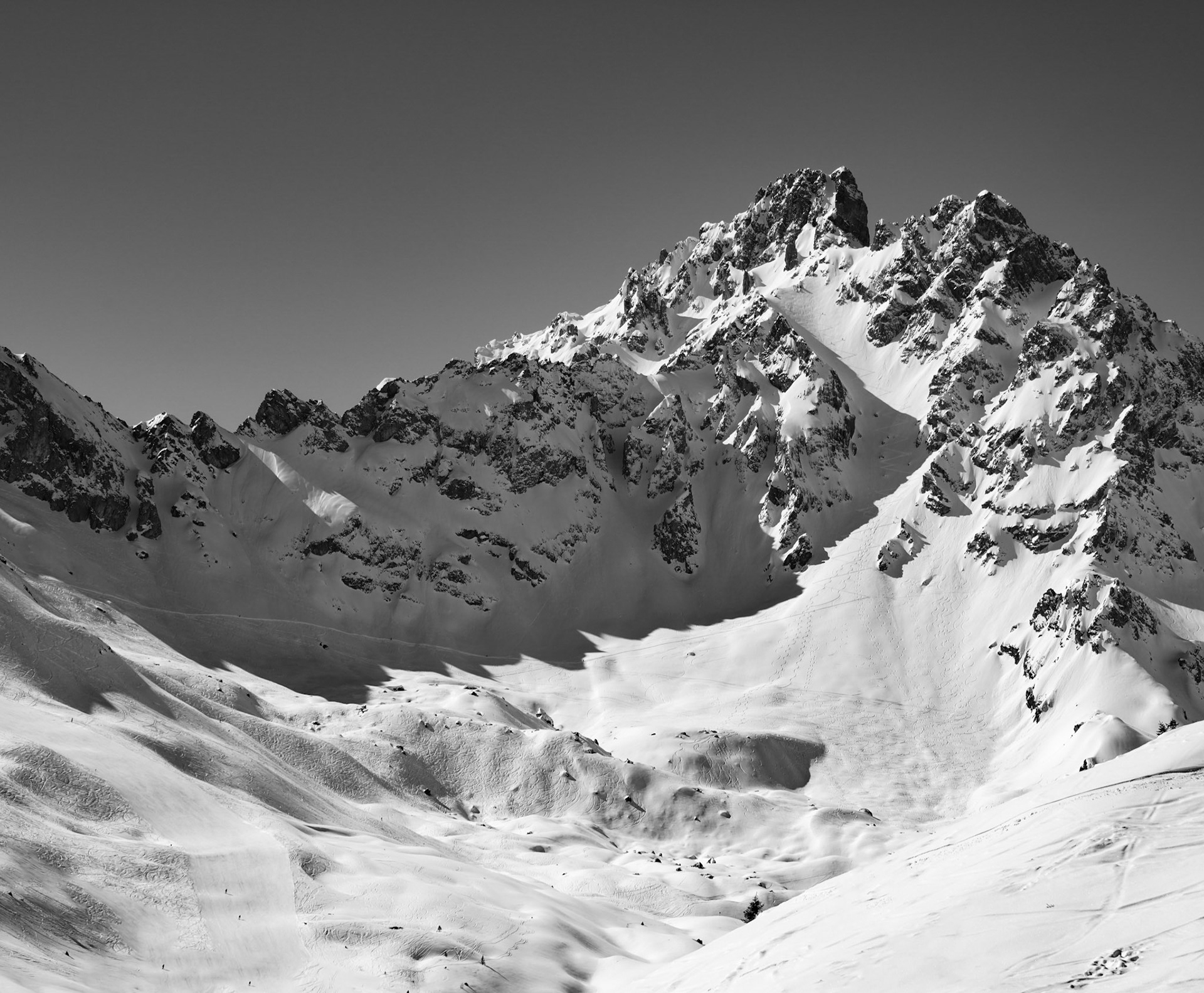
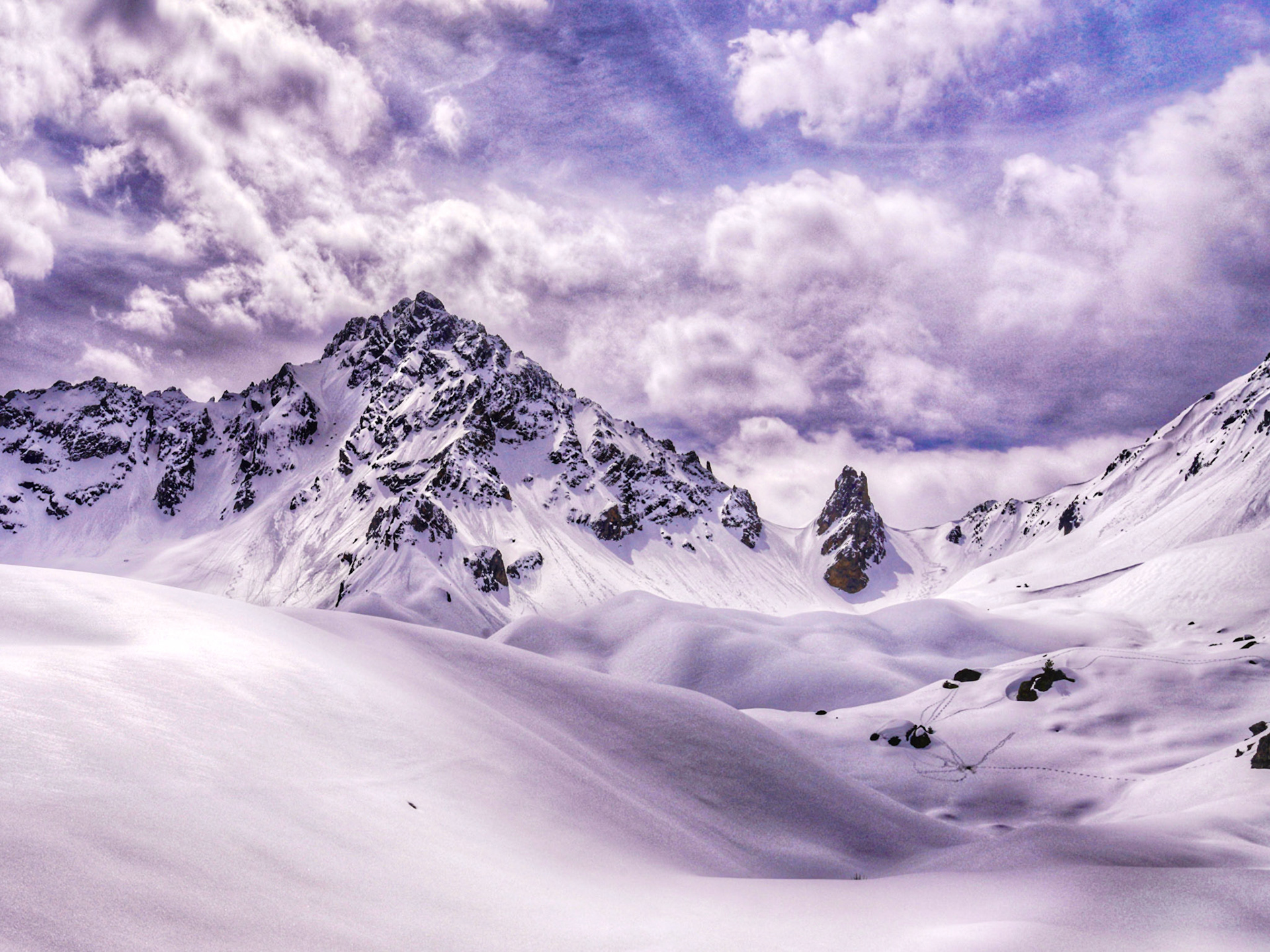
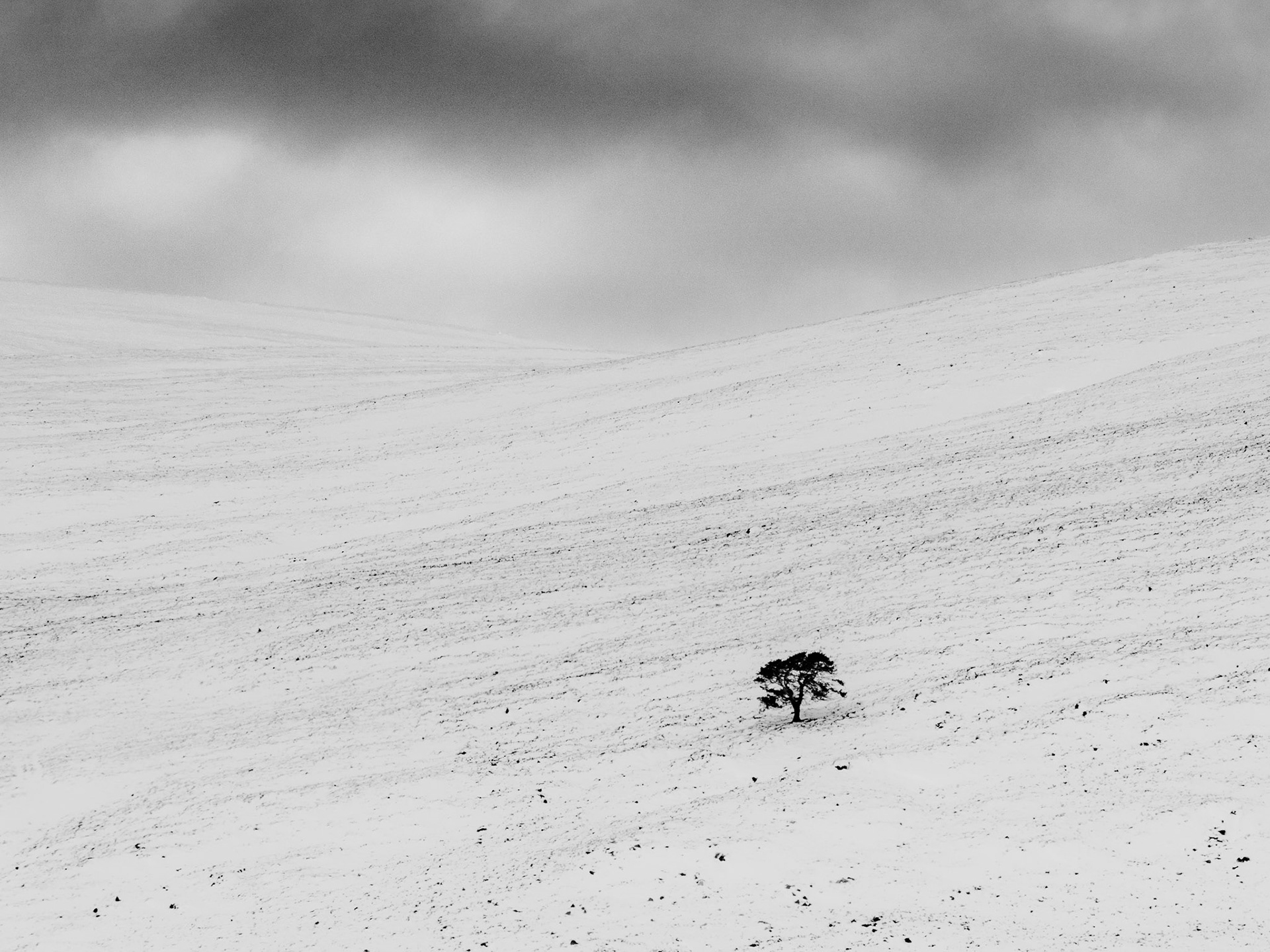
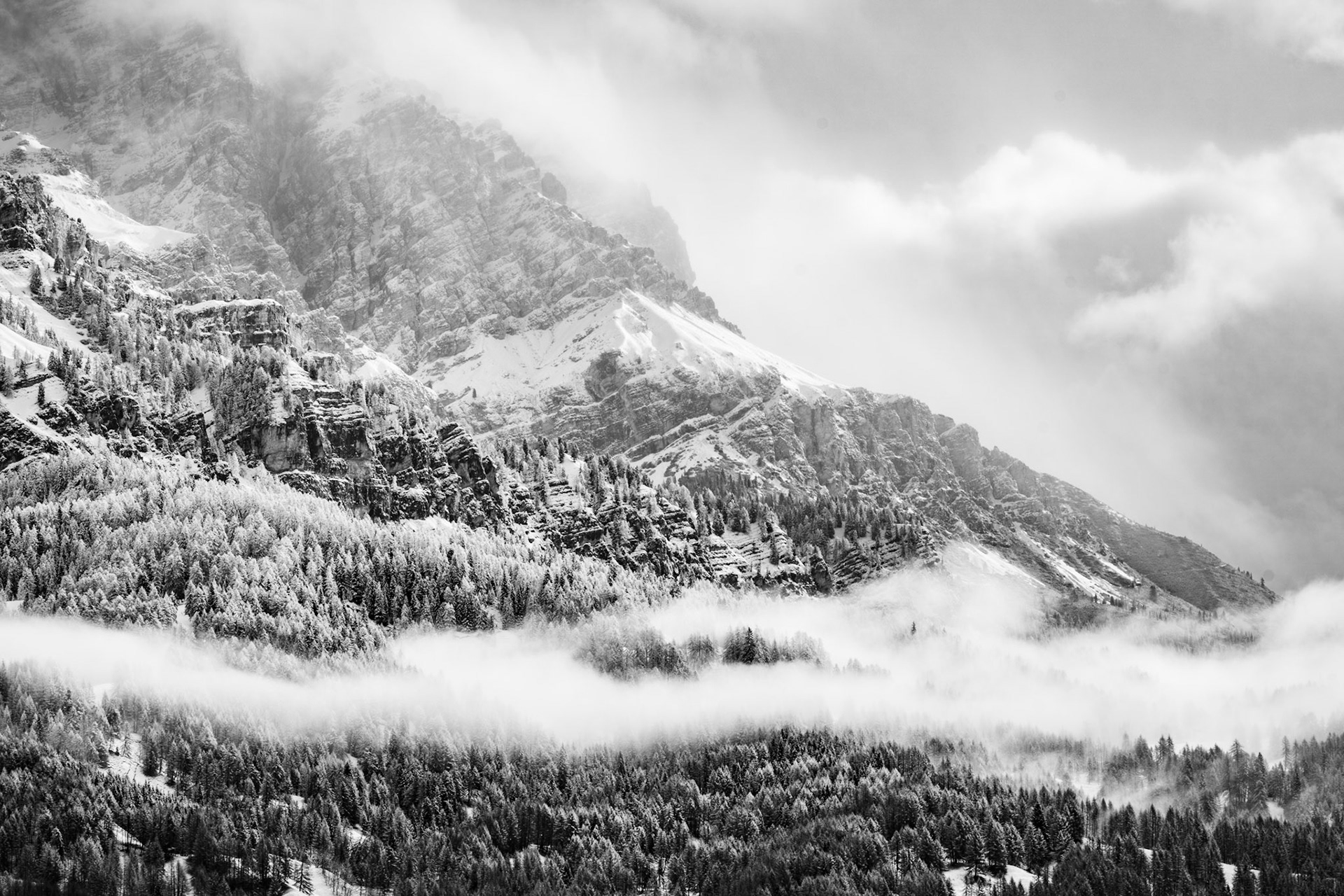
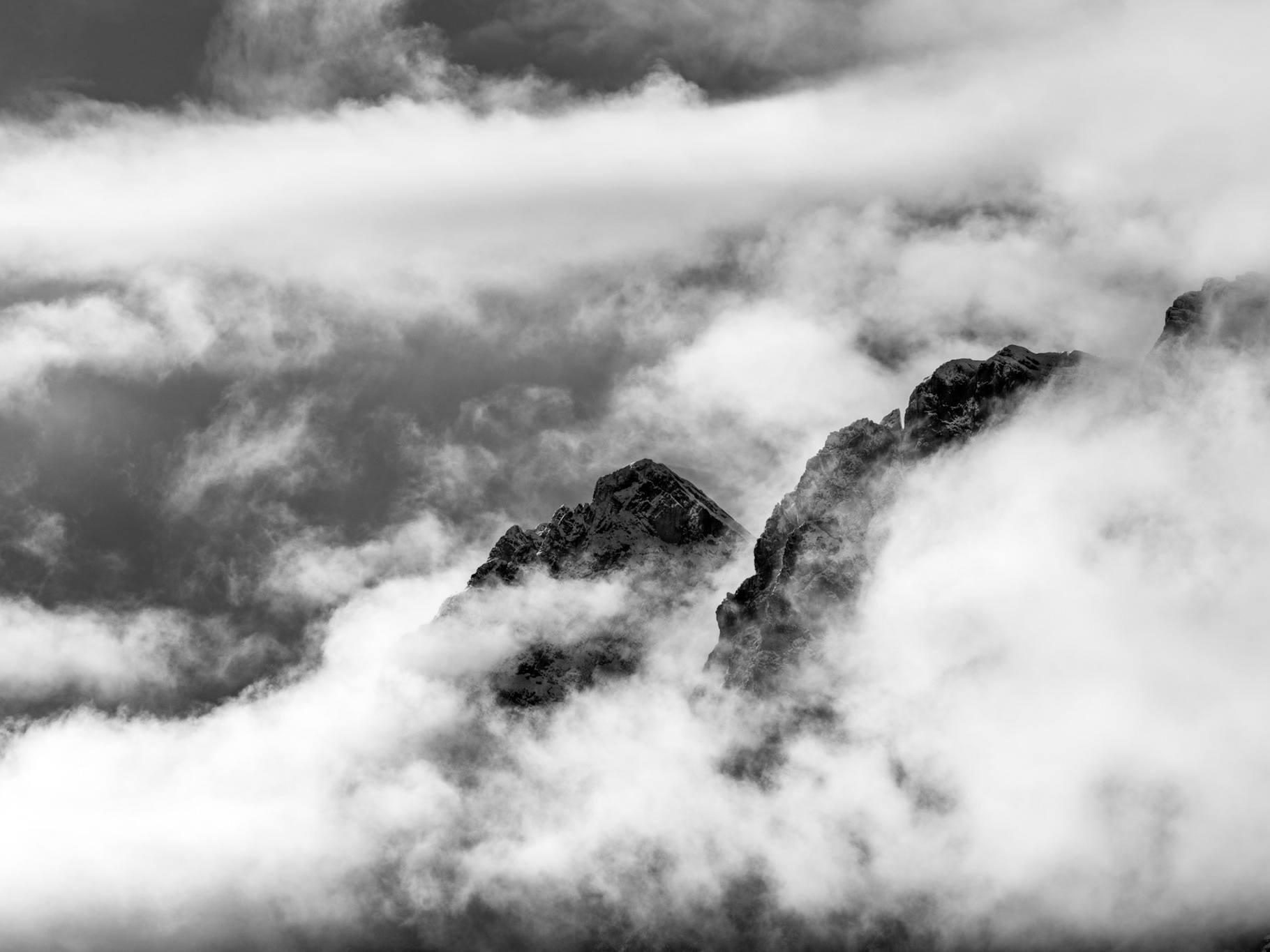
Deep shadows show the ridge line of this mountain peak in Chamonix, France. Black and White
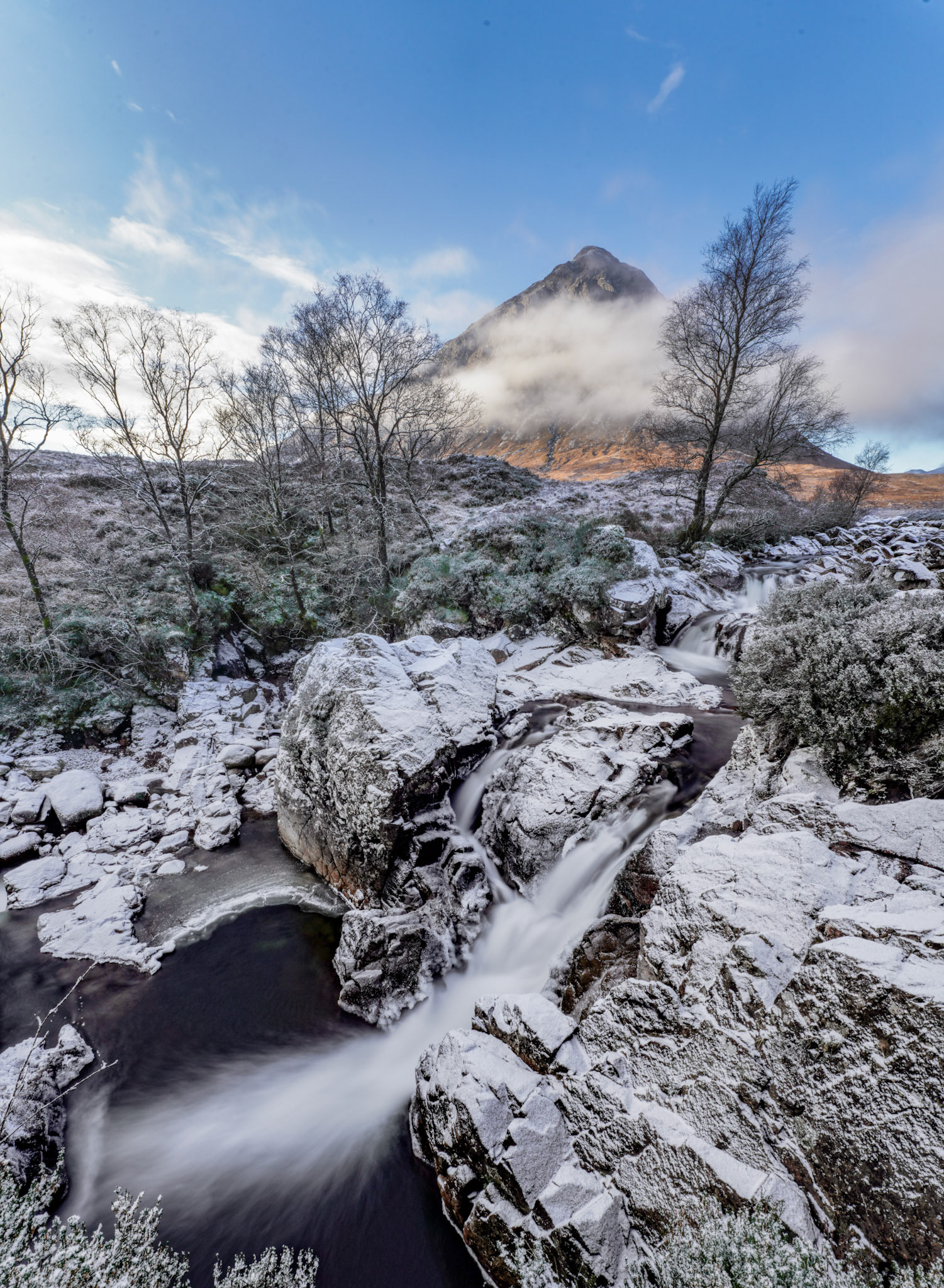
The River Coupall cascades over snow-dusted boulders below Buachaille Etive Mòr, its peak half-consumed by cloud. A long exposure renders the water as silk against the stillness of the frosted rockscape, the bare birches framing the pyramid summit with quiet insistence.
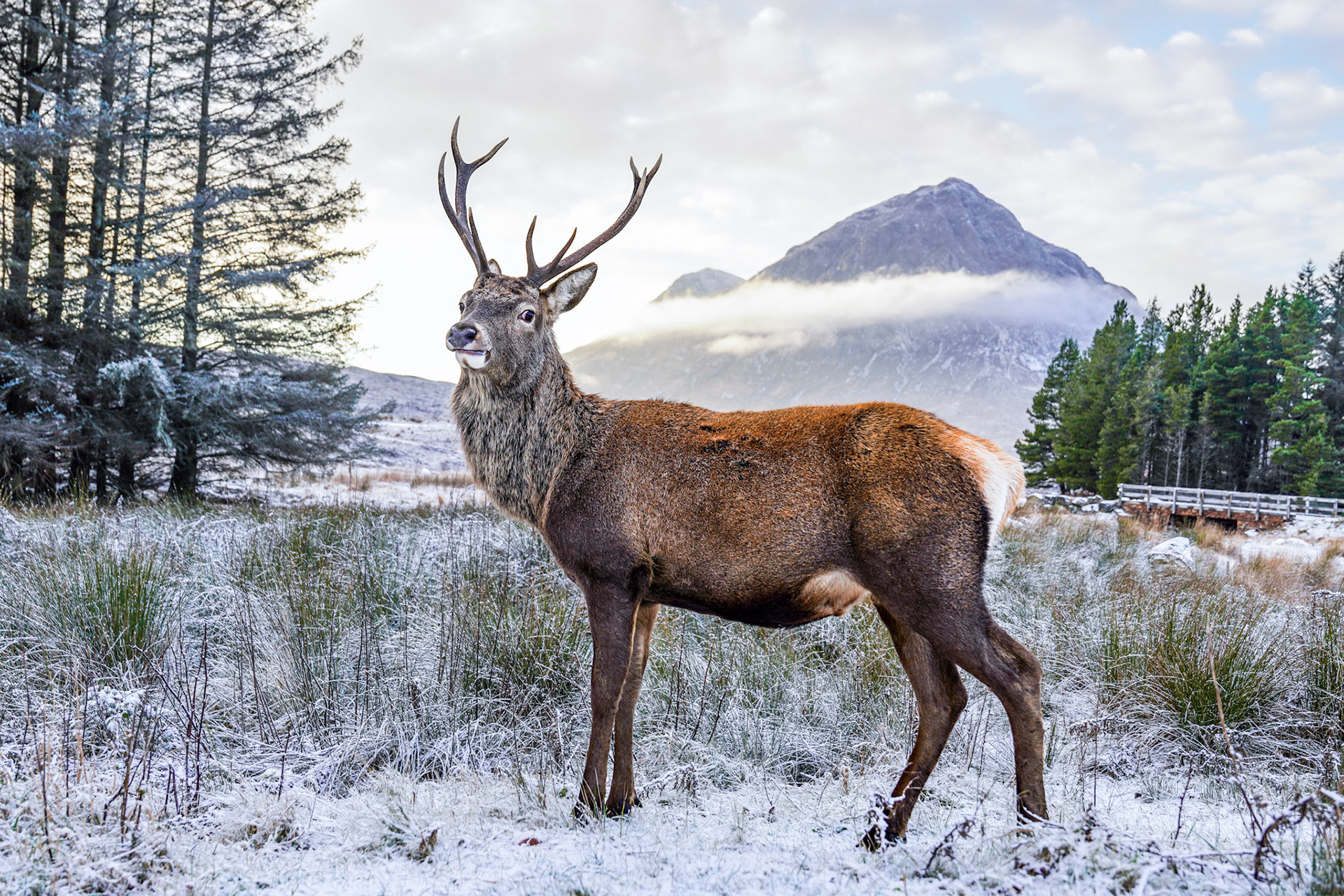
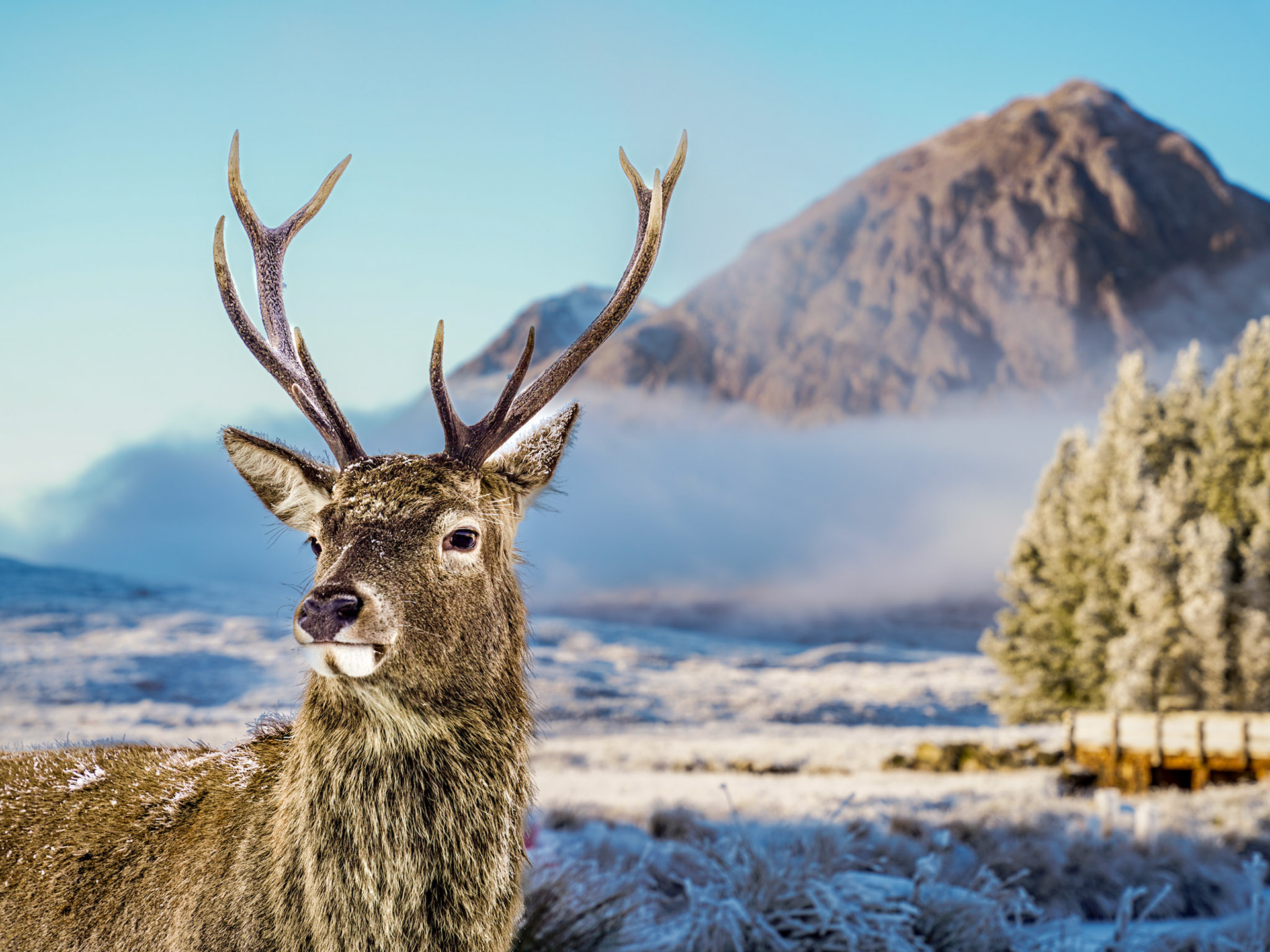
A red deer stag stands broadside on frost-bitten moorland, its breath just visible in the still air. Behind it, a conical Highland peak — likely Buachaille Etive Mòr in Glencoe — emerges from low cloud, framed by Scots pine and frost-white grass. The flat December light strips sentiment from the scene, leaving weight and cold.
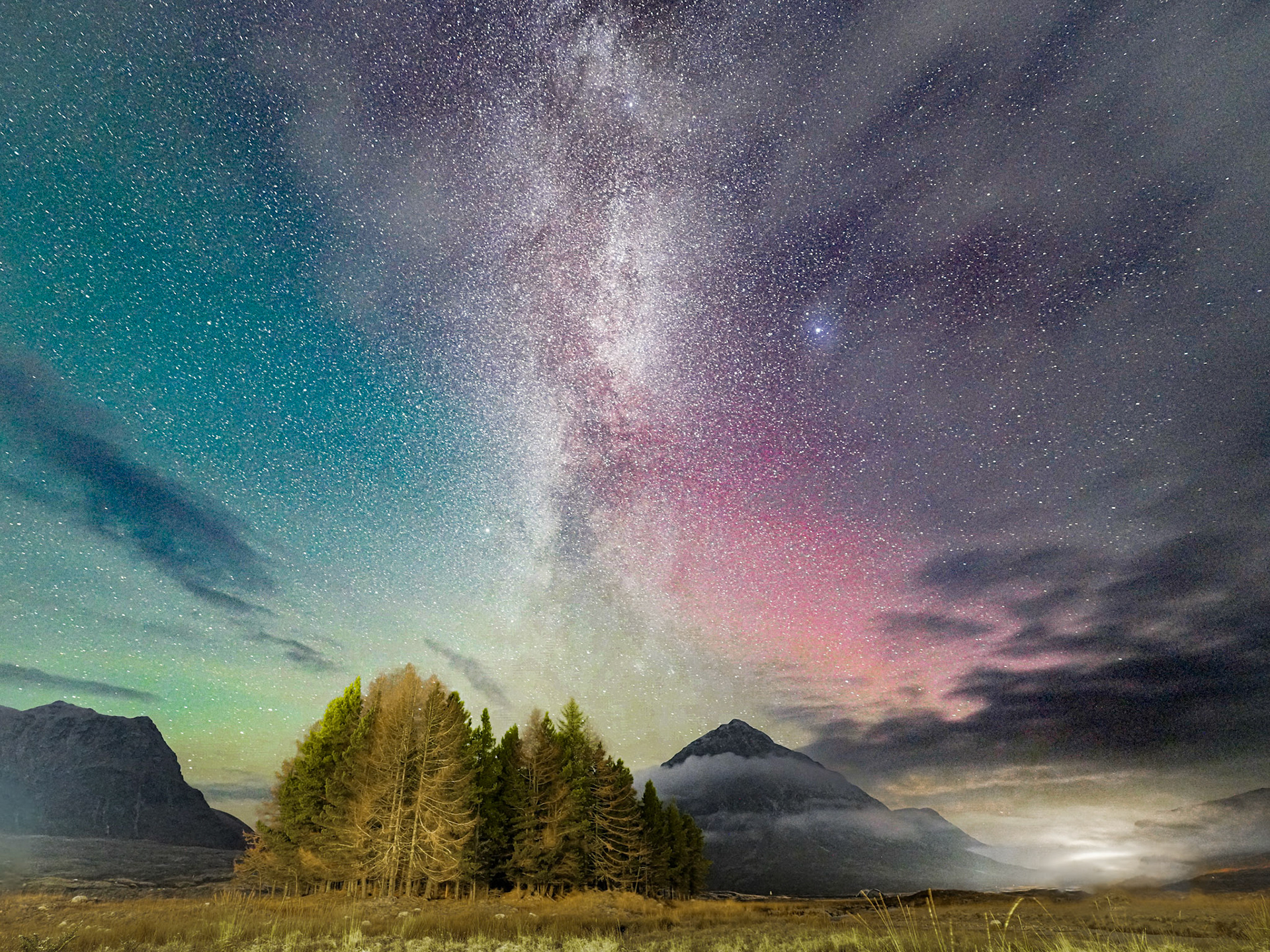
The Milky Way rises vertically above a stand of conifers in a Scottish glen, its core flanked by faint auroral red on the right horizon. Low cloud pools around the base of a pyramidal peak, while green airglow tints the left sky. The coincidence of galactic core, aurora, and valley mist in a single frame is rare and well-judged.
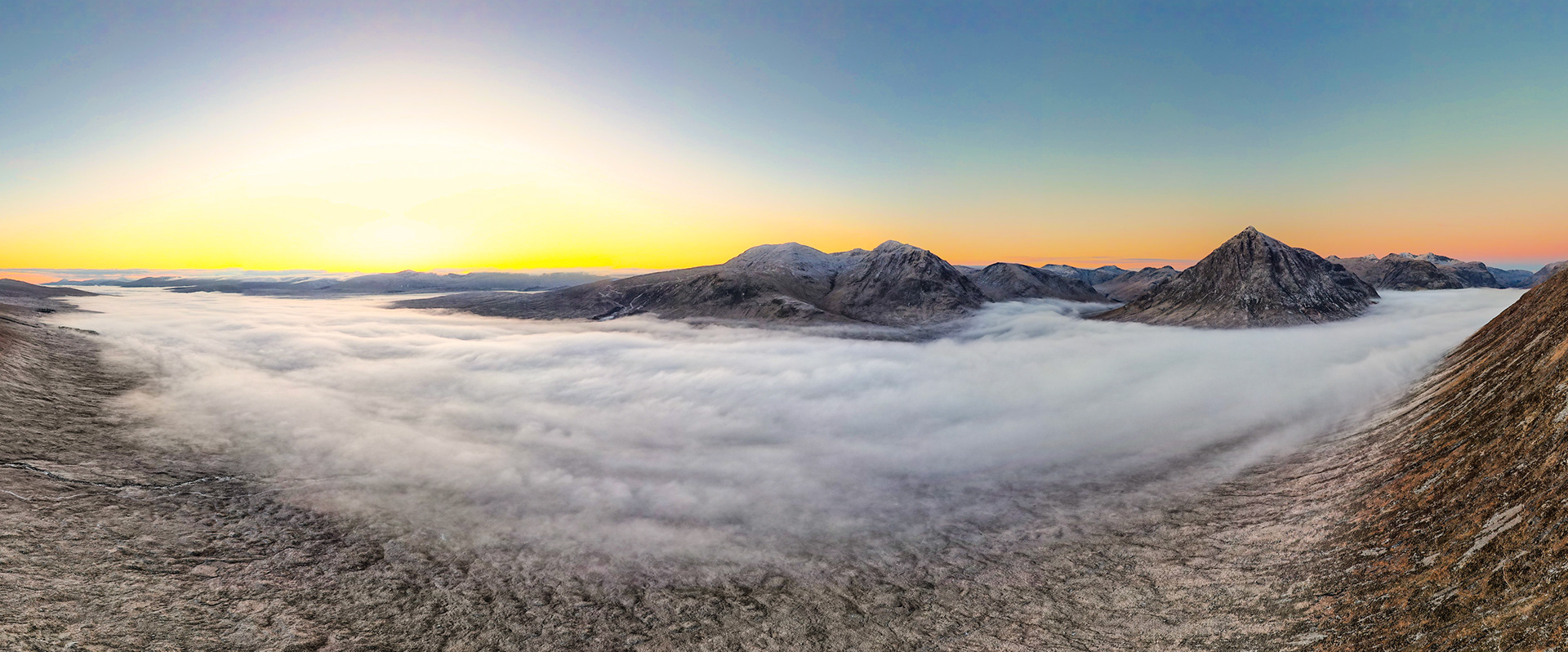
A temperature inversion fills a Highland glen to the brim with cloud, the summits of snow-dusted peaks emerging above the white floor at first light. The panoramic vantage from an elevated ridge compresses foreground frost-bleached moorland against a sky grading from amber to cold blue. The stillness of the inversion and the clean separation of layers give the scene an unusual geometric calm.
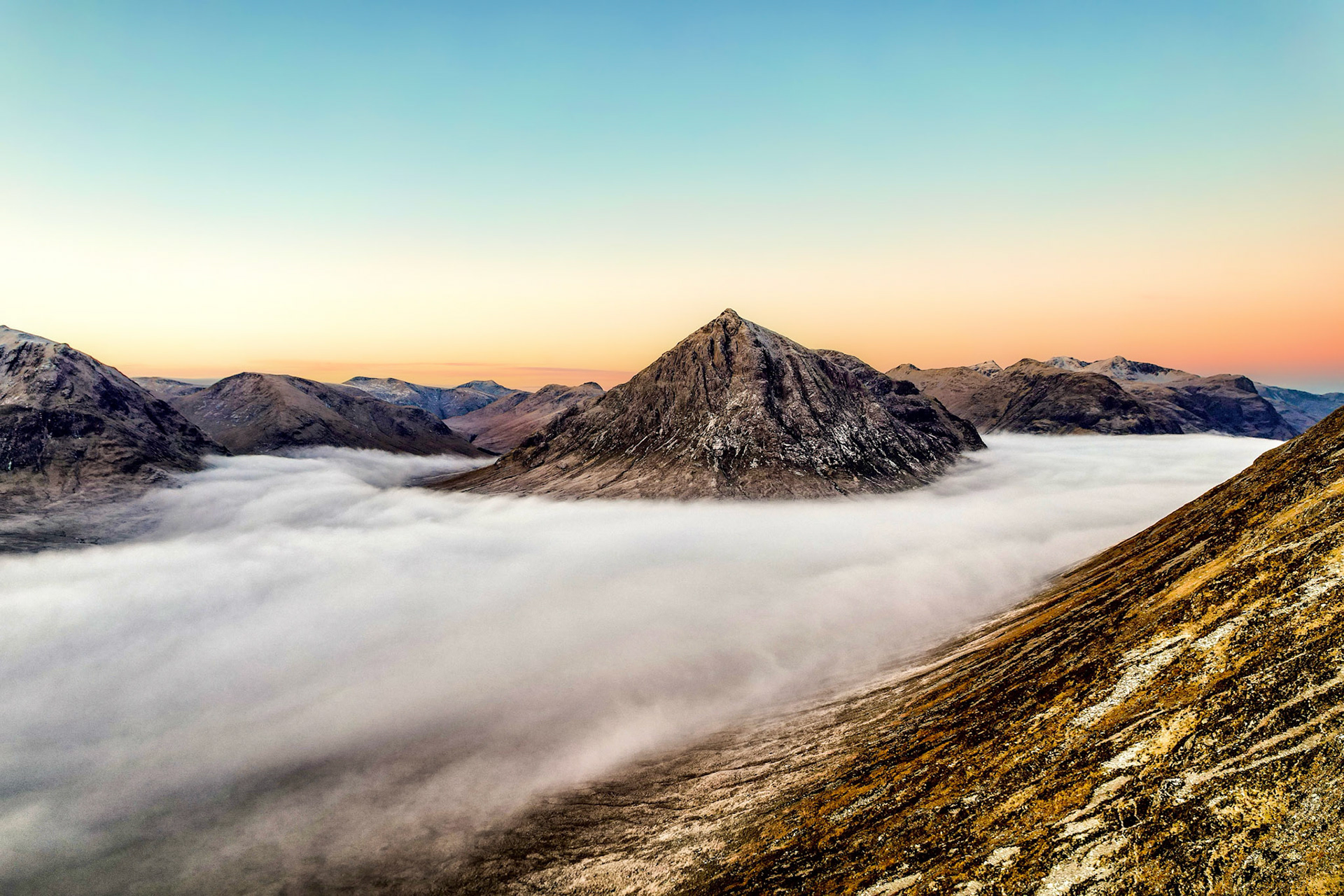
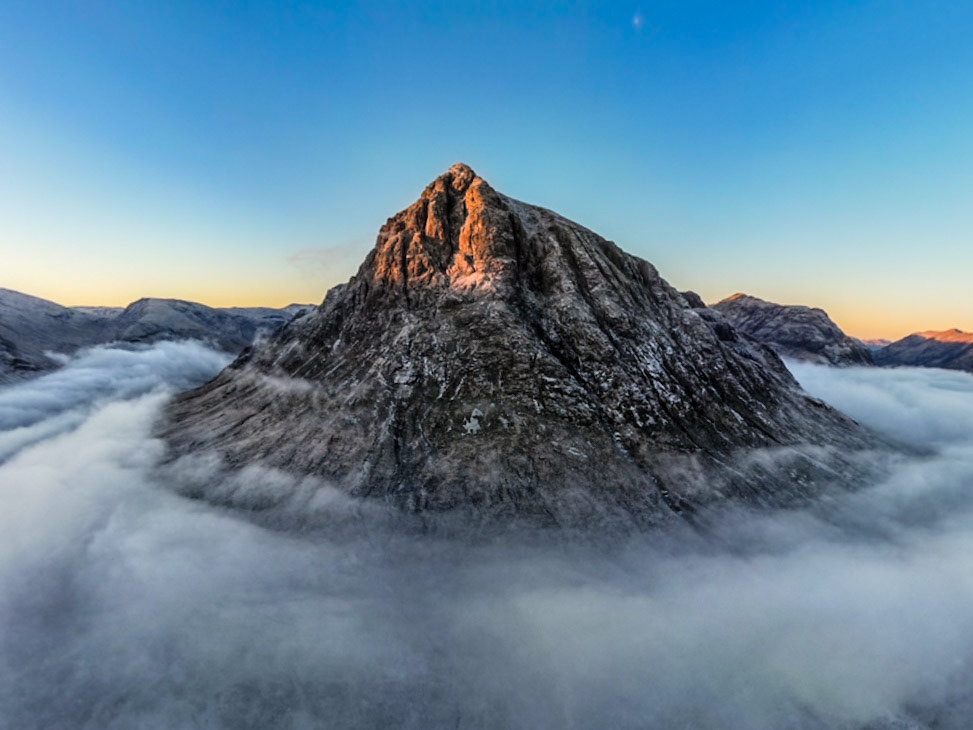
A pyramidal peak rises clear of a temperature inversion that has filled the surrounding glens with cloud, photographed from altitude at dawn in mid-winter. The peach-toned afterglow along the horizon separates the cloud sea from a cool blue sky, compressing the scene into three distinct horizontal bands. The composition is strengthened by the rocky foreground ridge leading the eye toward the isolated summit.
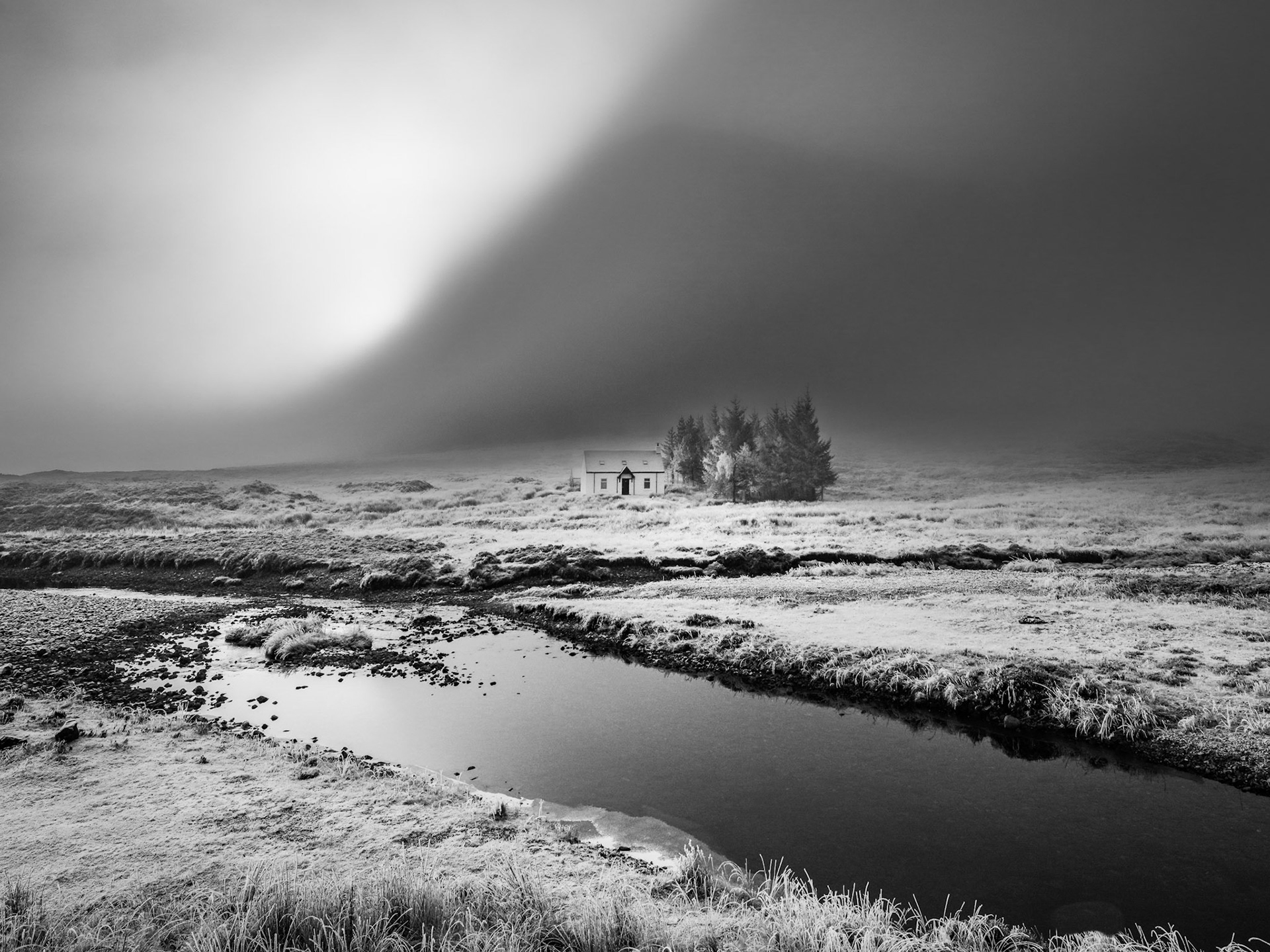
A solitary farmhouse and small stand of conifers sit exposed on a frost-bleached moor as a storm front sweeps overhead, its dark mass bisected by a shaft of diffuse light. A shallow moorland stream curves through the foreground, its still surface reflecting the unsettled sky. The tonal contrast between the luminous cloud break and the advancing darkness gives the image its underlying tension.
default
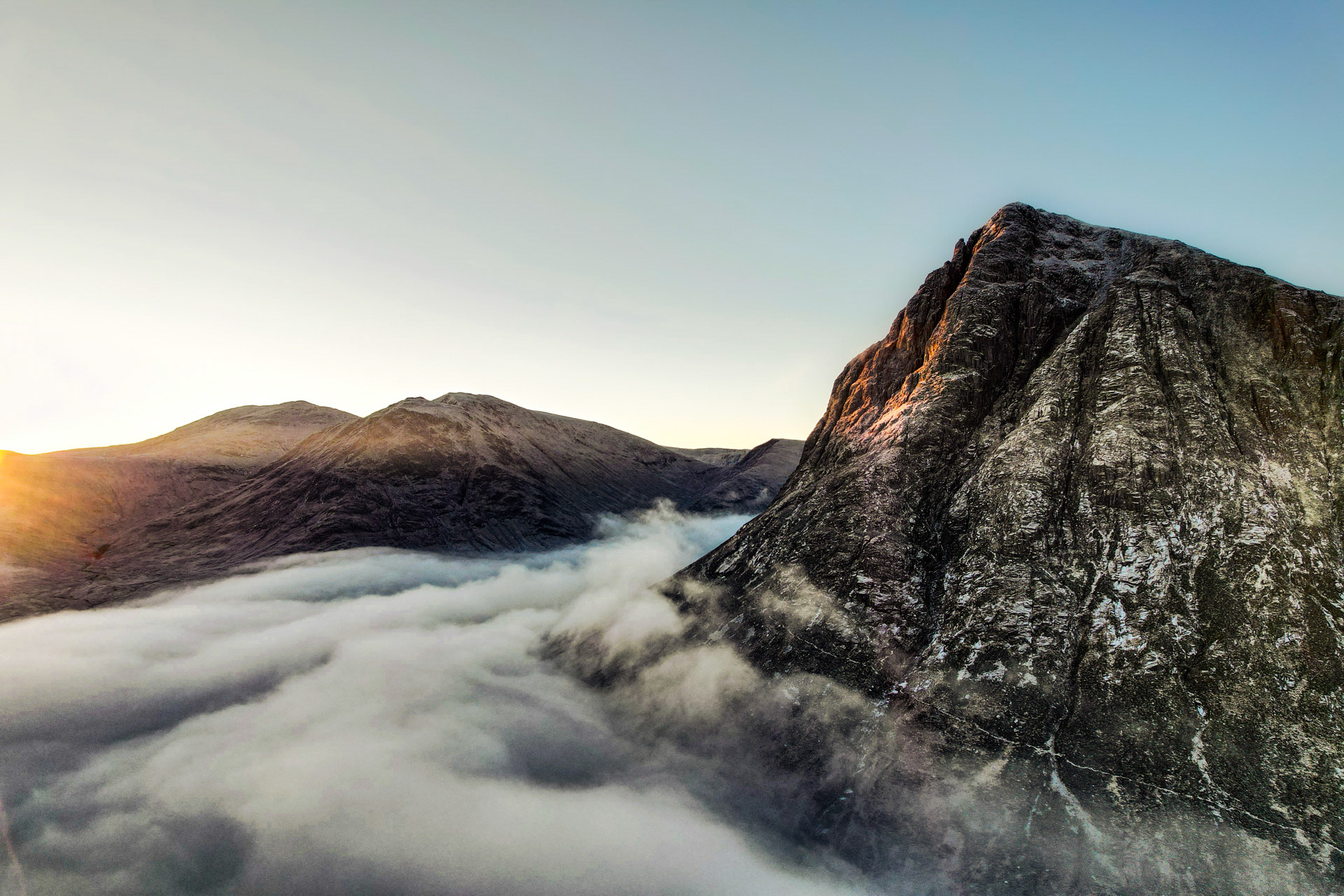
A temperature inversion fills the glen below Buachaille Etive Mòr at first light, the valley fog bisecting snow-dusted rock faces from a cold winter sky. Shot from altitude, the winding single-track road emerges from the mist base across frost-hardened moorland, anchoring the composition between the terrestrial and the atmospheric. The low sun grazes the peaks to the west, warming the summit ridges while the valley floor remains submerged.
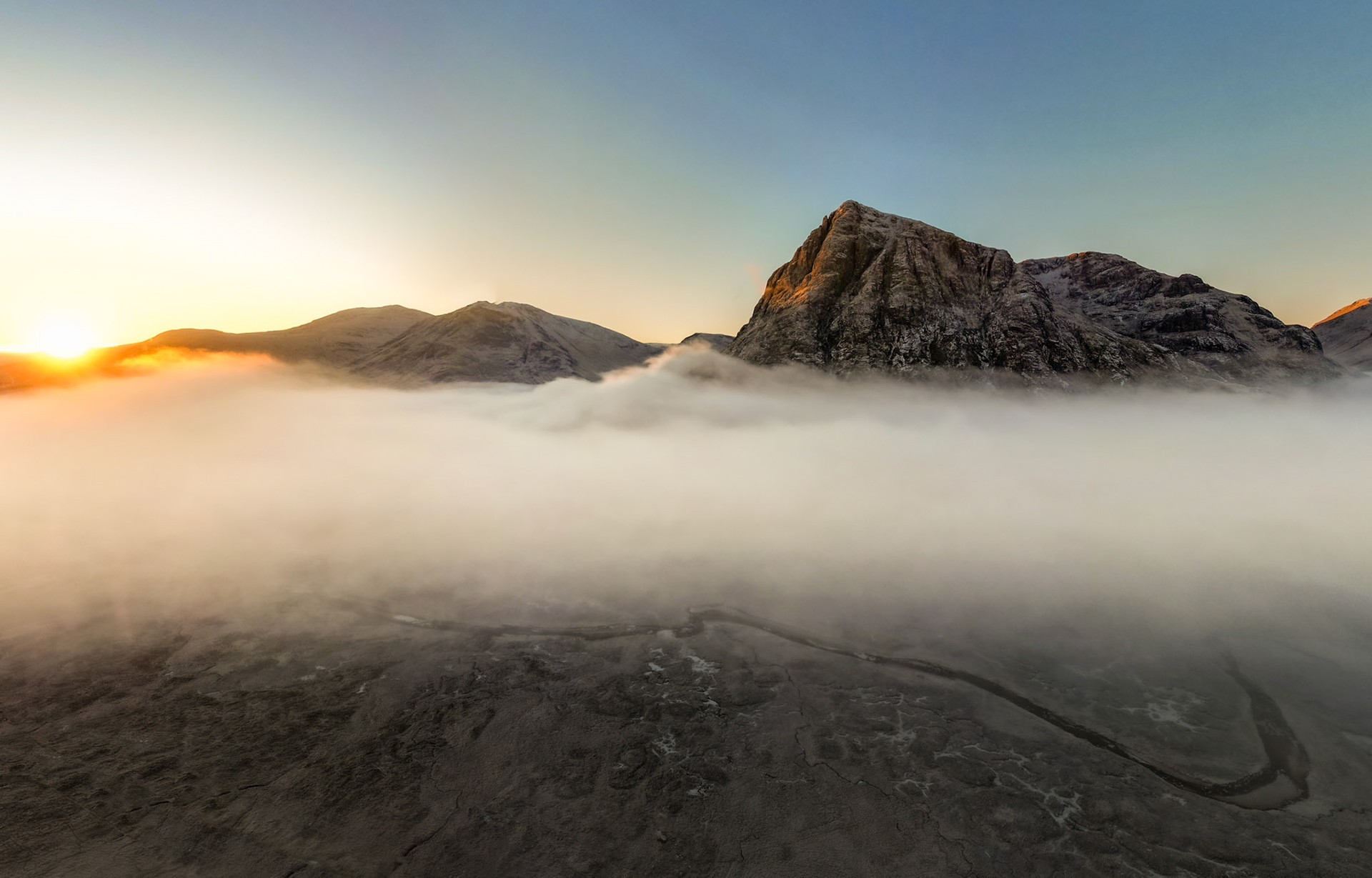
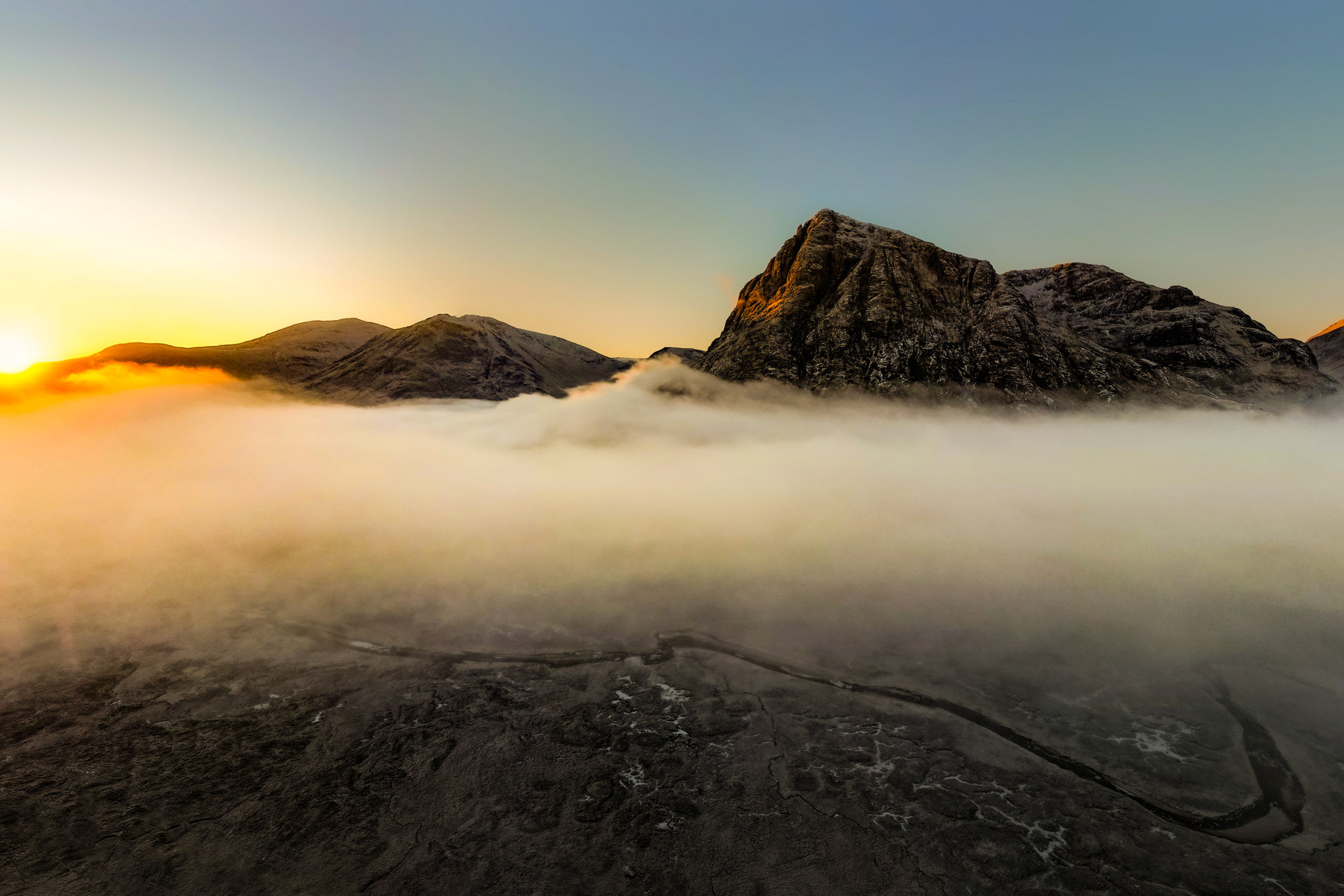
A temperature inversion fills the glen floor with dense fog at sunrise, leaving two rocky summits isolated above the cloud. The winding road beneath the mist surface anchors the composition, hinting at scale and the valley's geometry. Shot in early winter, the frost-dusted ridgelines catch the first direct light while the foreground terrain remains in cold shadow.
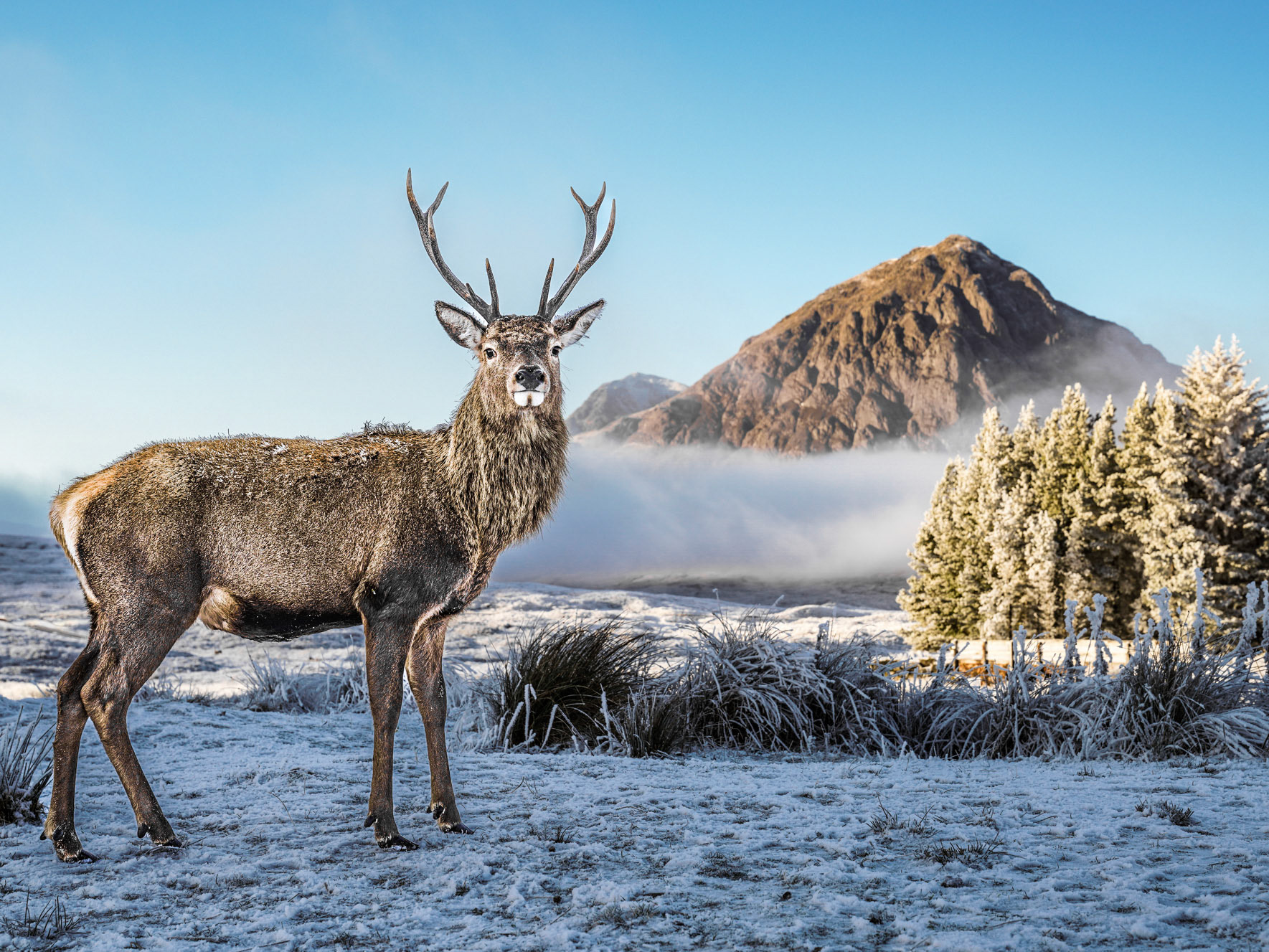
Monarch of the Glen, Stag posing in front of frozen Buachaille, Glencoe Scotland
A red deer stag turns to face the camera at close range, frost dusting its muzzle and antler bases. Behind it, low cloud wraps the flanks of a bare Highland peak above a snow-covered glen floor. The compressed perspective places the animal in direct relationship with the mountain, grounding the portrait in its landscape context.
Caption written by the Classic plugin.
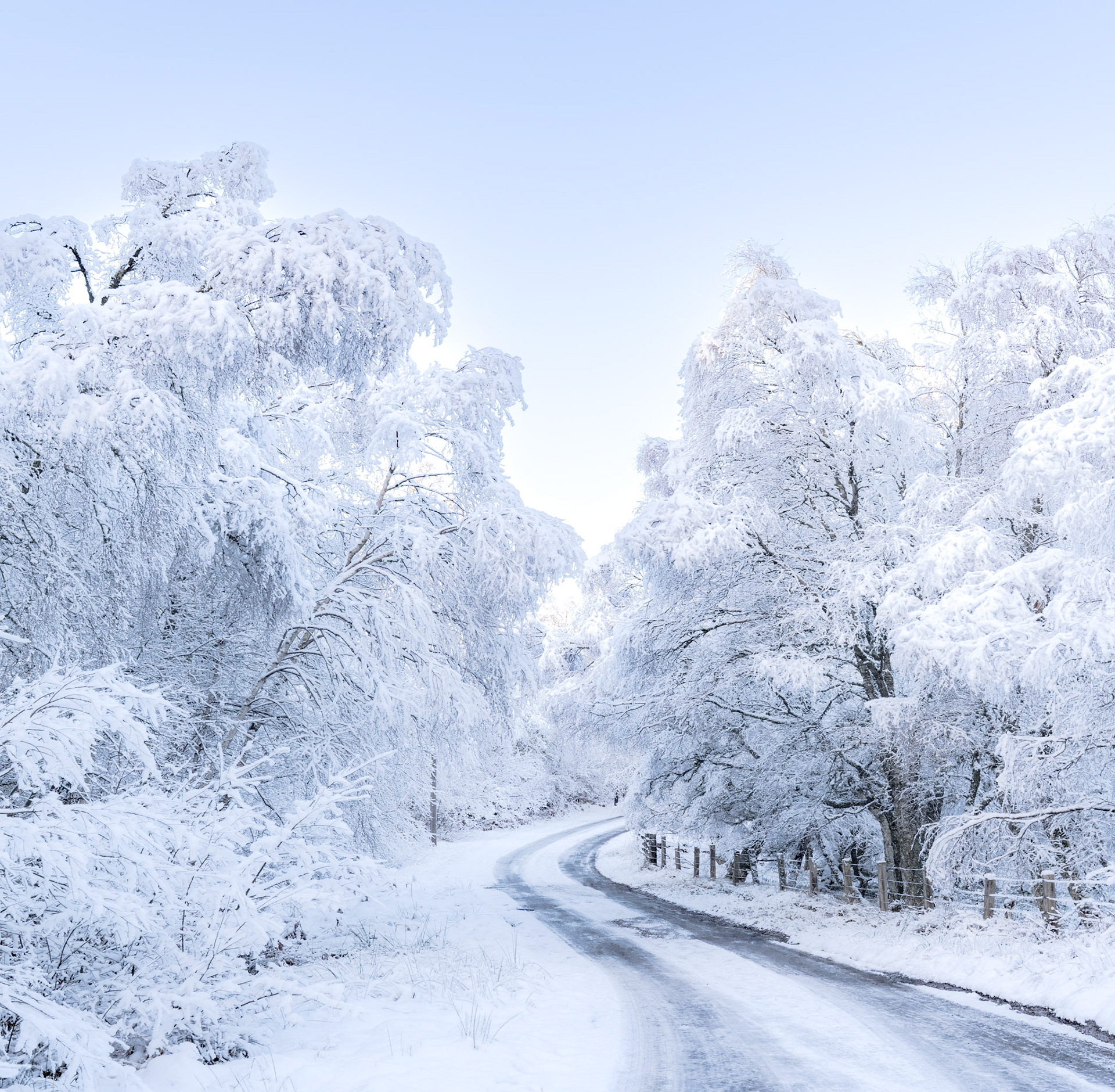
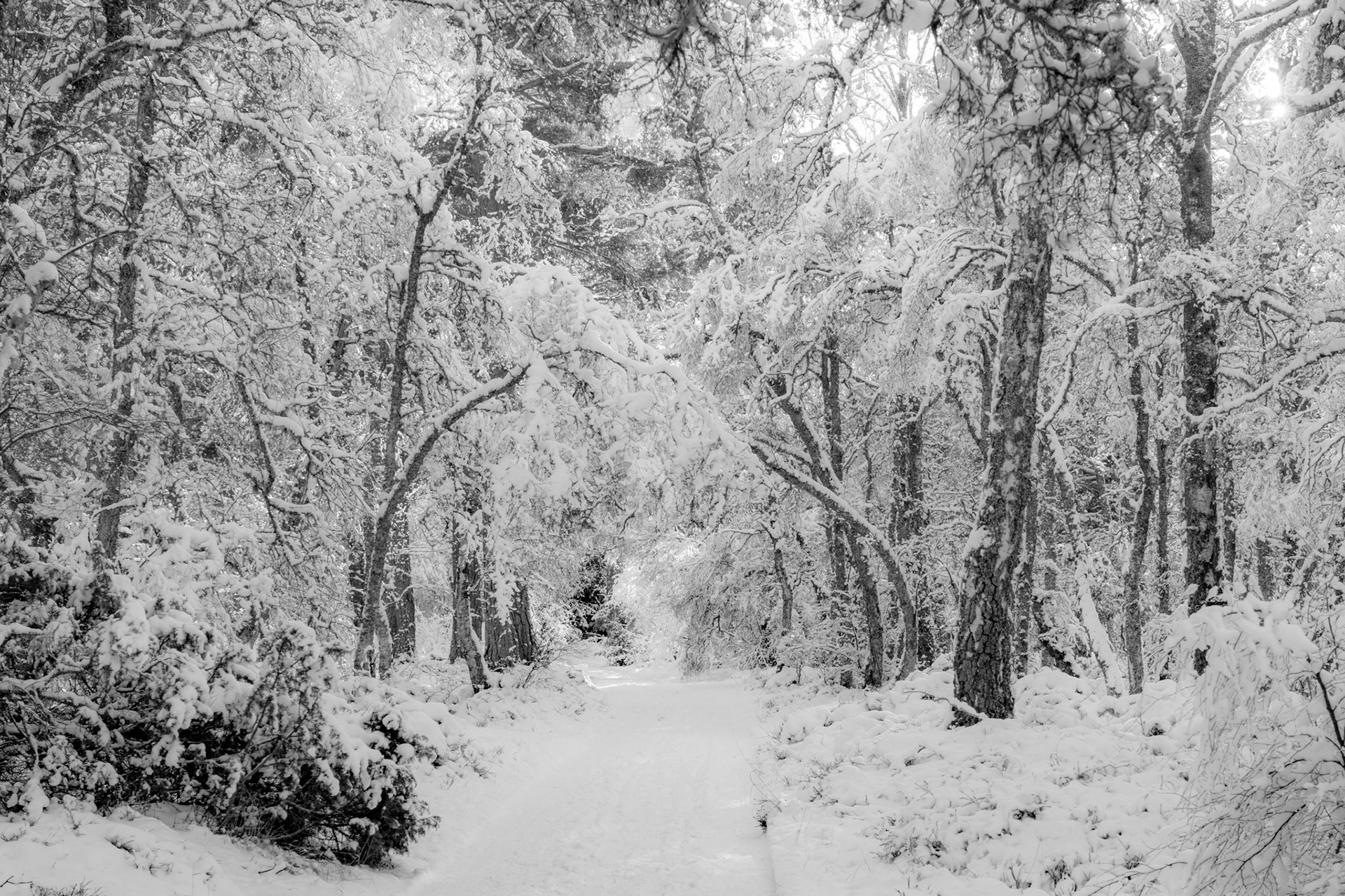
A road leads into the woodland of this Scottish winter scene, where heavy snow had fallen, Cairngorms, Scotland
A road leads into the woodland of this Scottish winter scene, where heavy snow had fallen, Cairngorms, Black and White
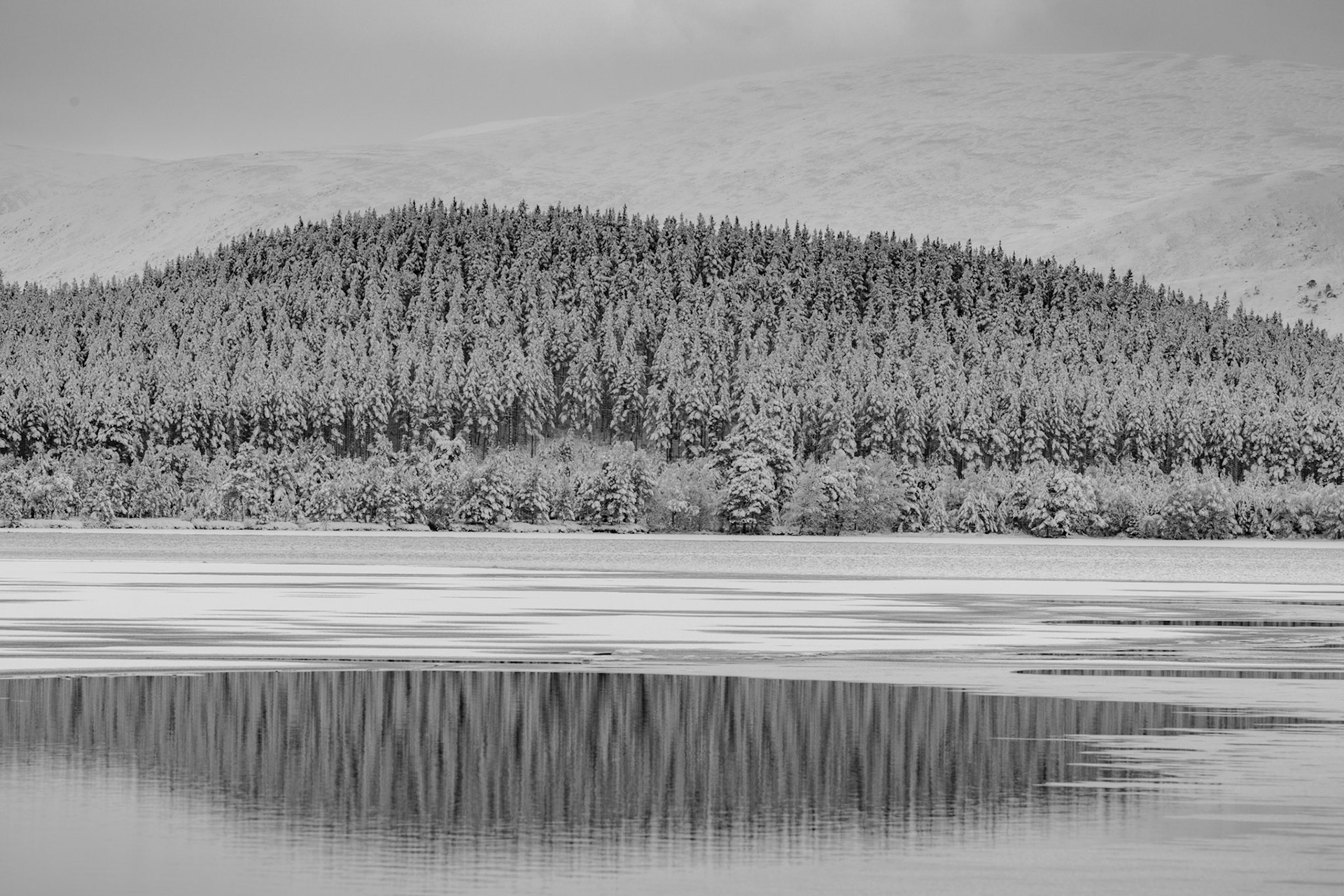
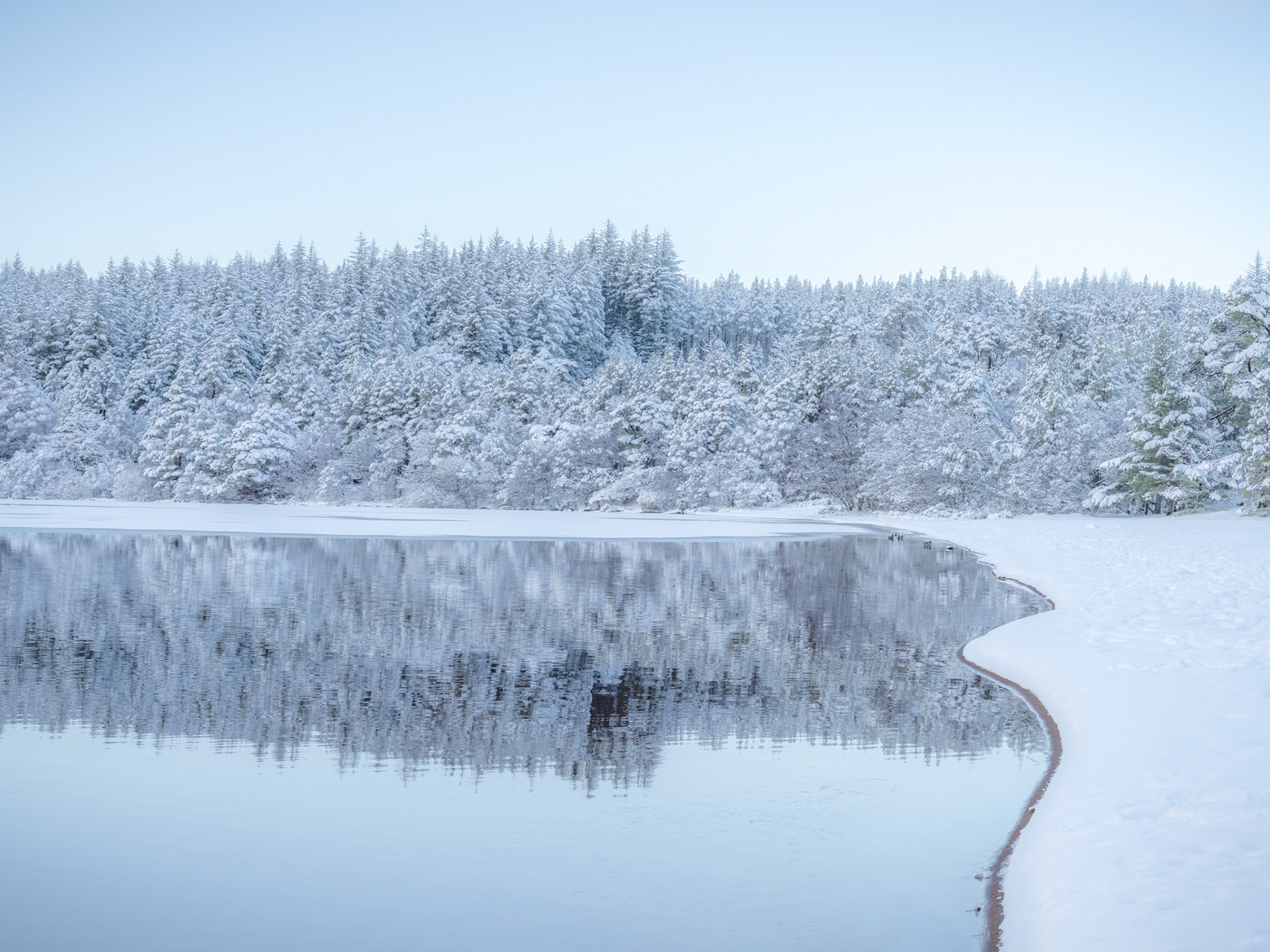
Beautiful reflections on this simple landscape on Loch Morlich, Scotland
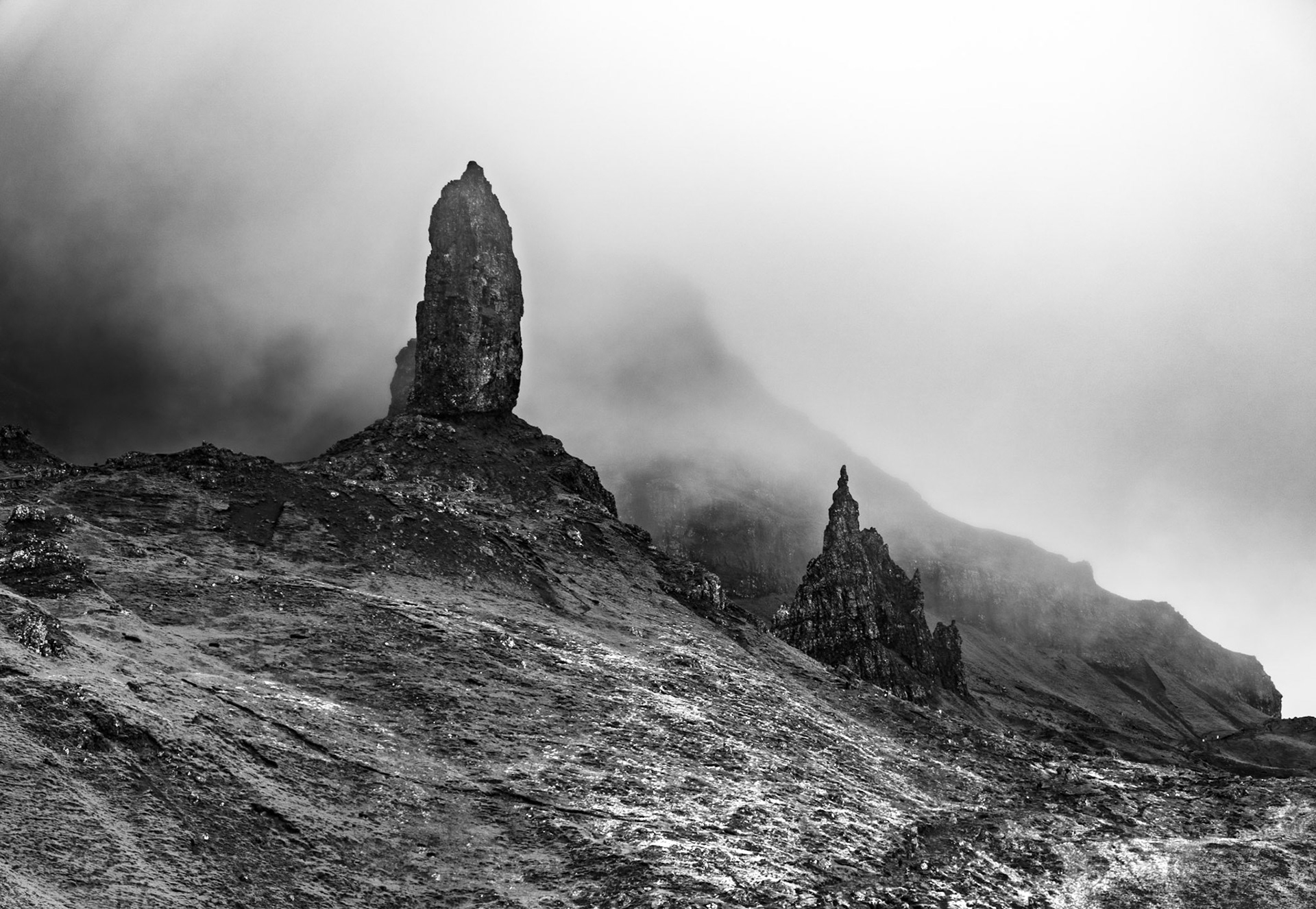
The Old Man of Storr, Isle of Skye, Scotland in Black and White under low cloud
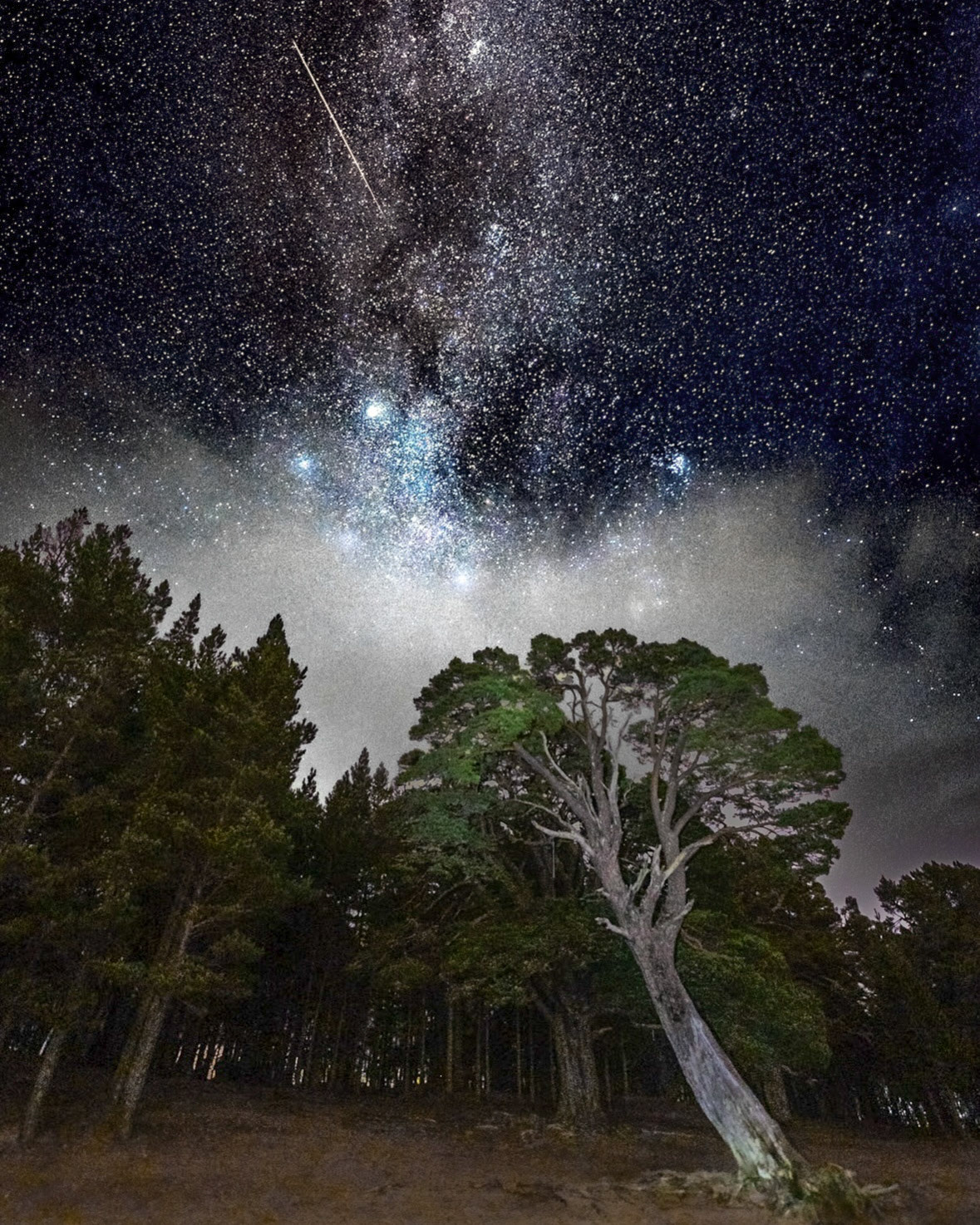
An ancient Pine tree stands tall on the Loch Morlich beach below the dark sky of the Cairngorms, with the milky way clearly visible. Scotland
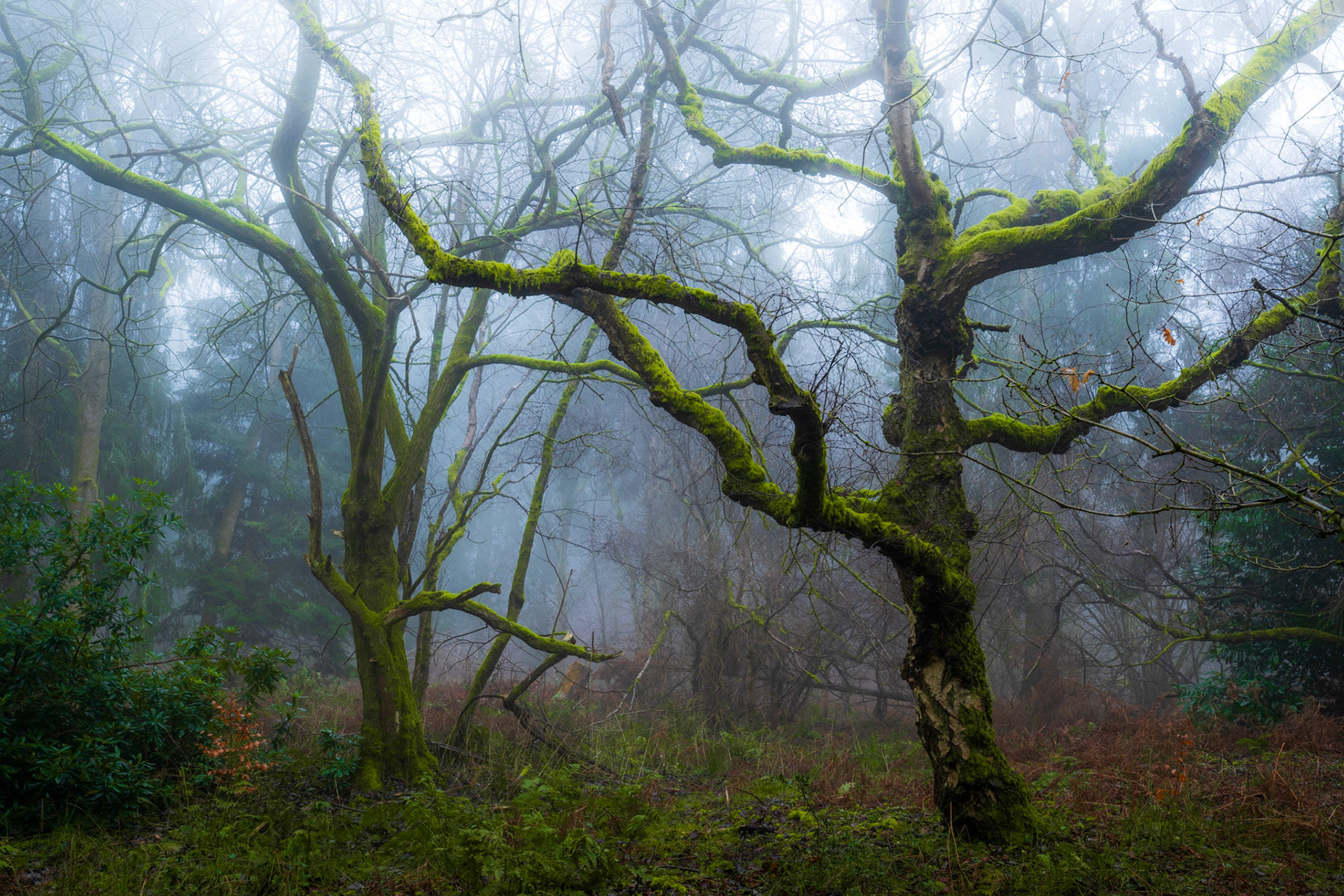
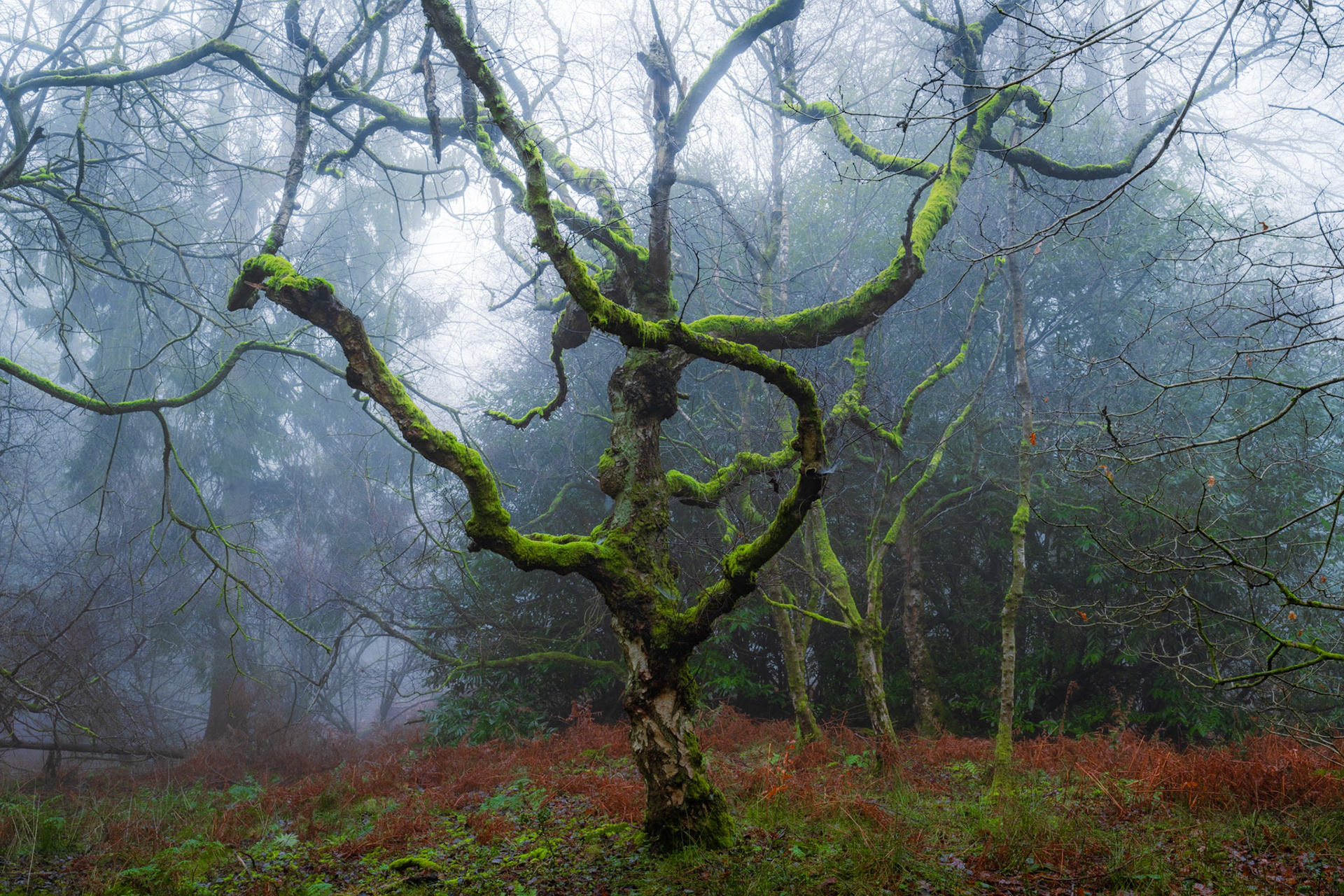
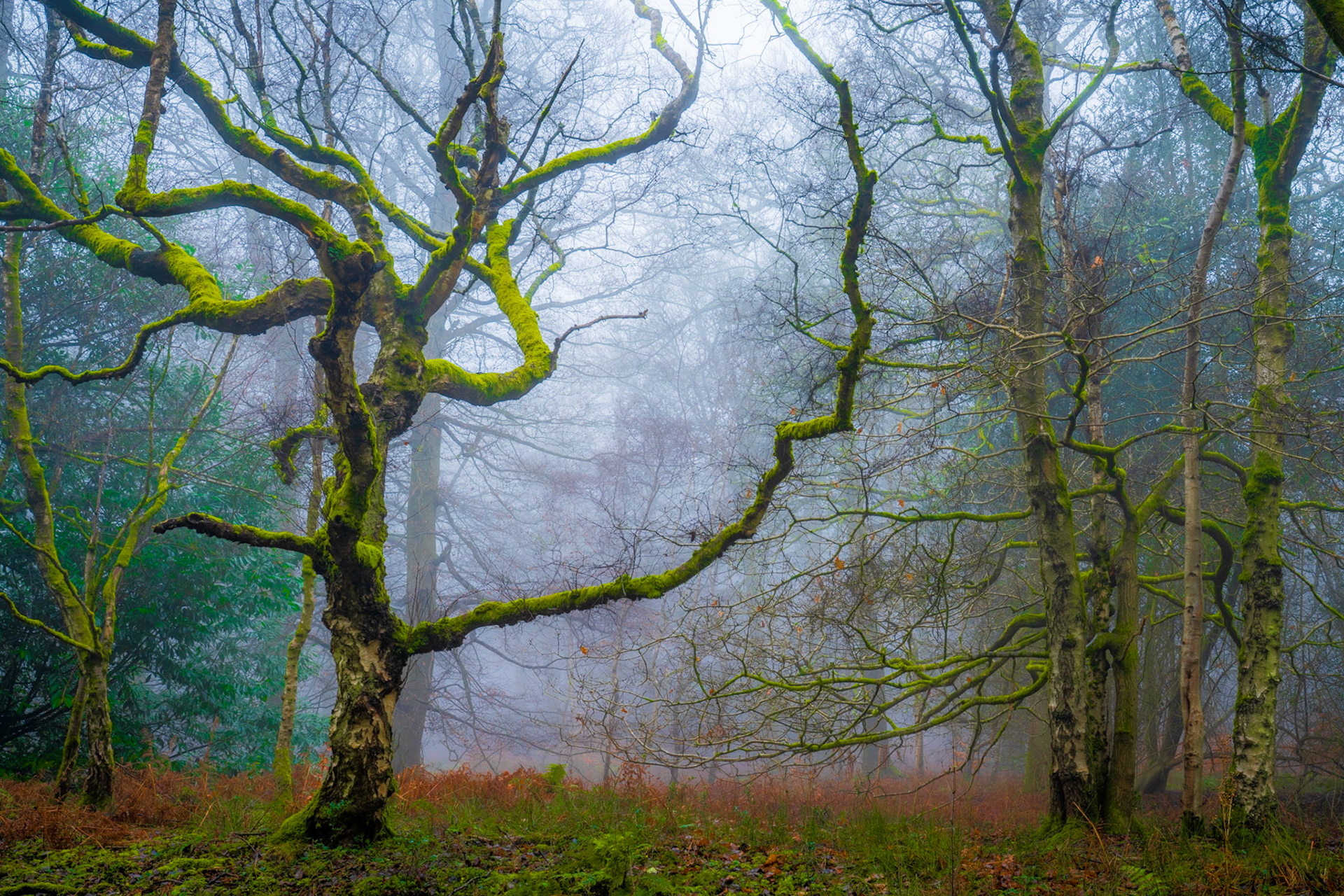
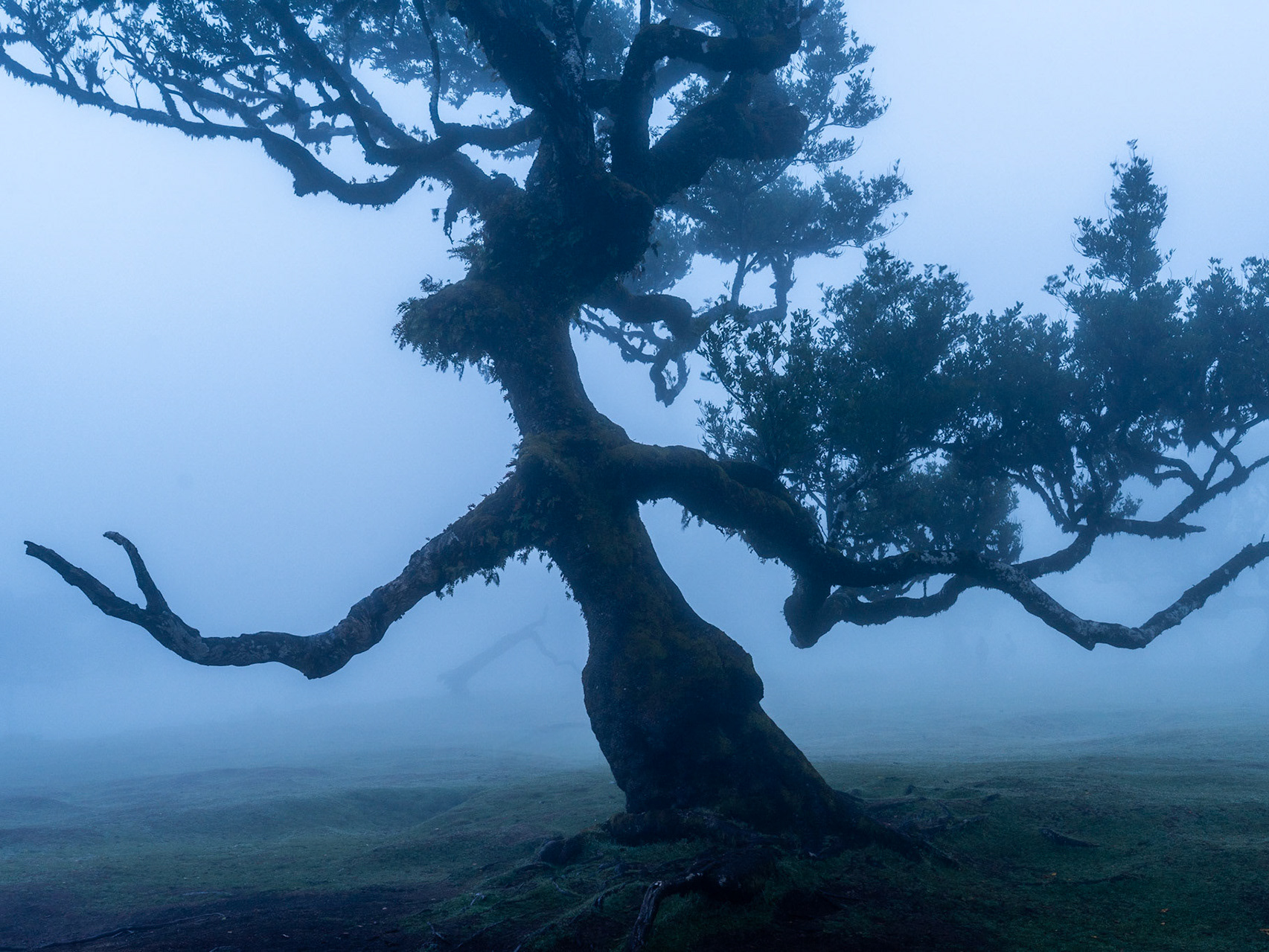
Two trees, both covered in moss, look gnarled and ancient in this winter scene which is full of stubborn fog. A somewhat spooky scene.
A solitary deciduous tree, its gnarled branches heavily colonised by vivid green moss, stands amid a fog-bound winter woodland. The saturated moss contrasts sharply against the cool blue-grey atmosphere and rust-coloured bracken understory. Diffuse backlight from a mist-obscured sky gives the scene a quiet, otherworldly depth.
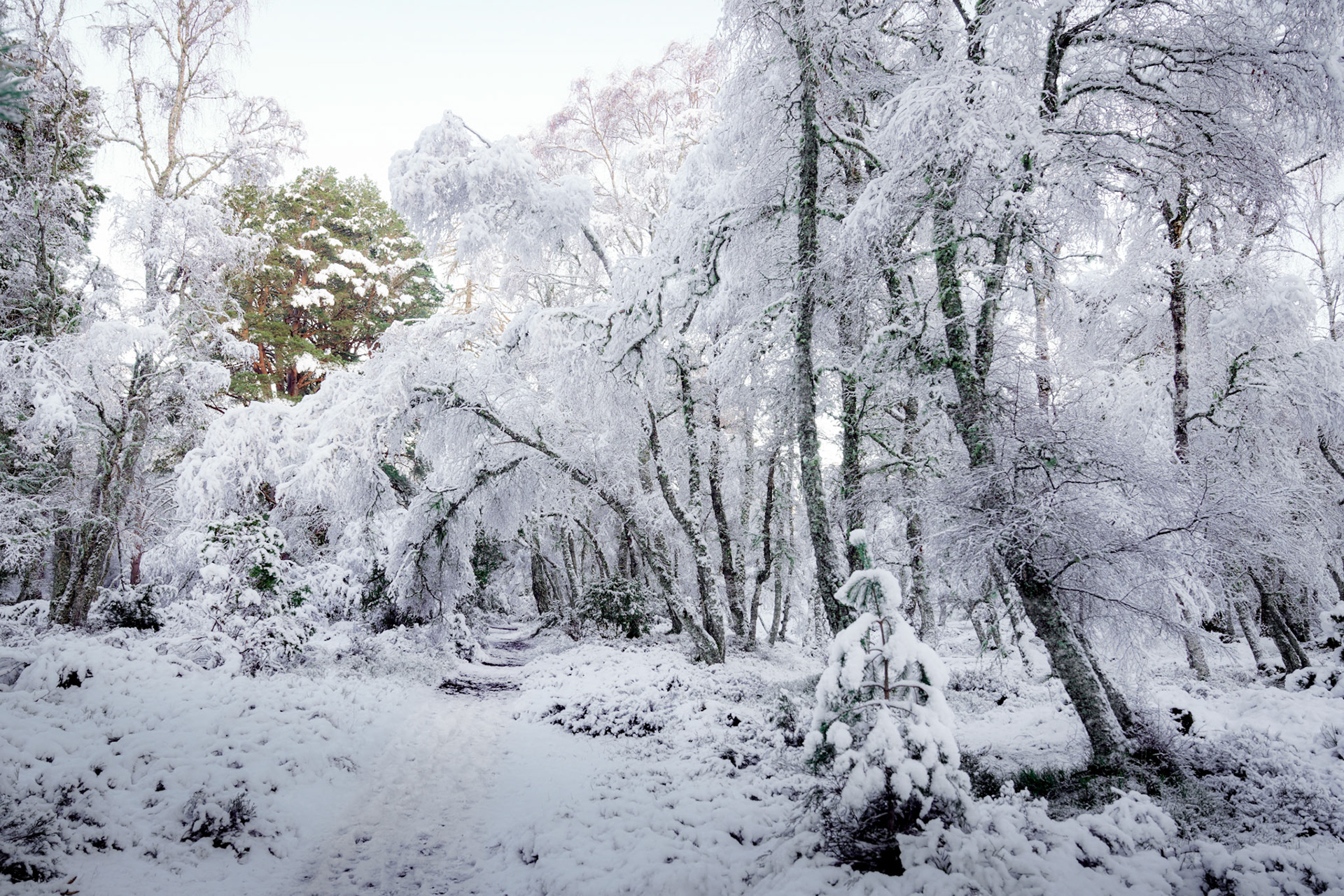
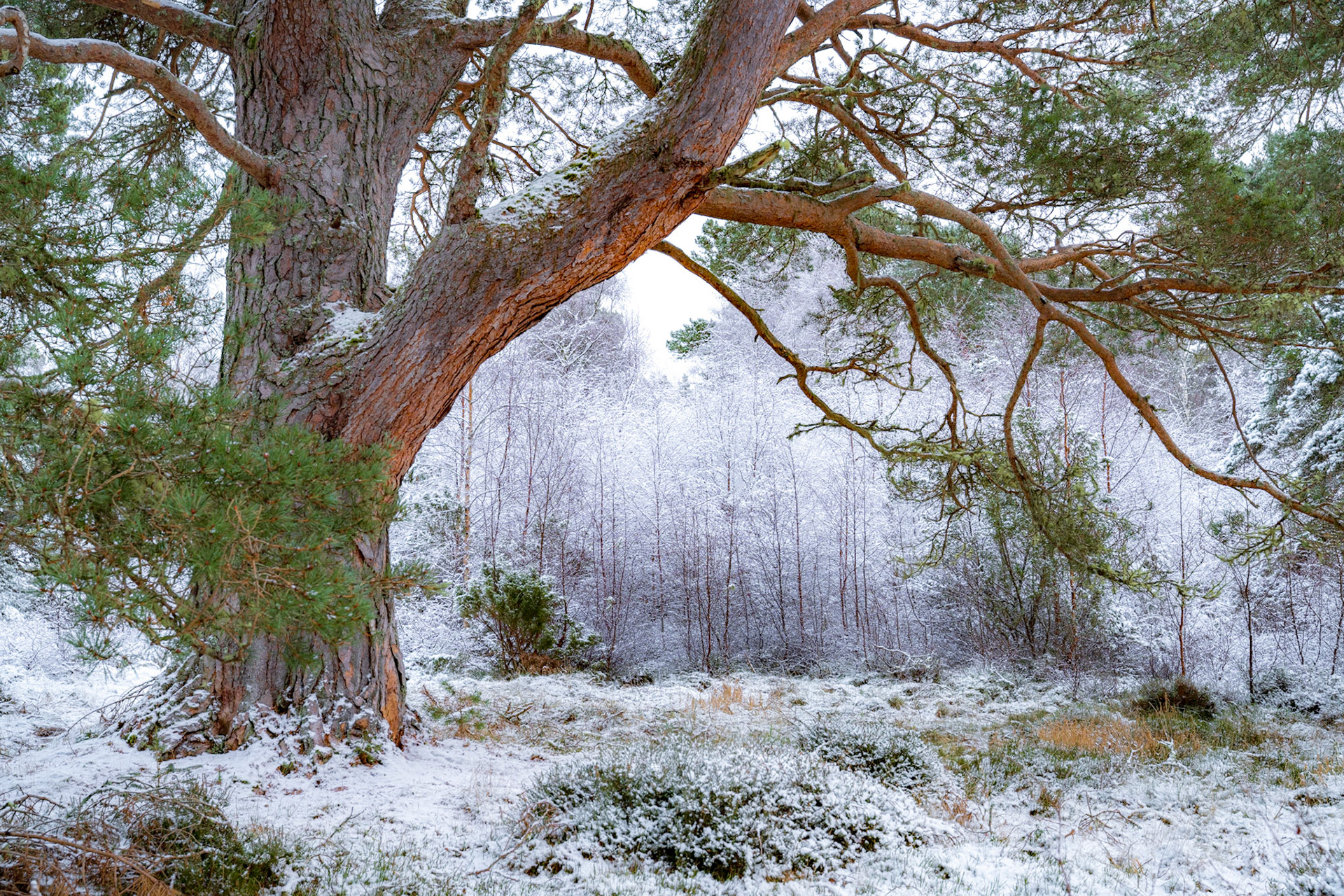
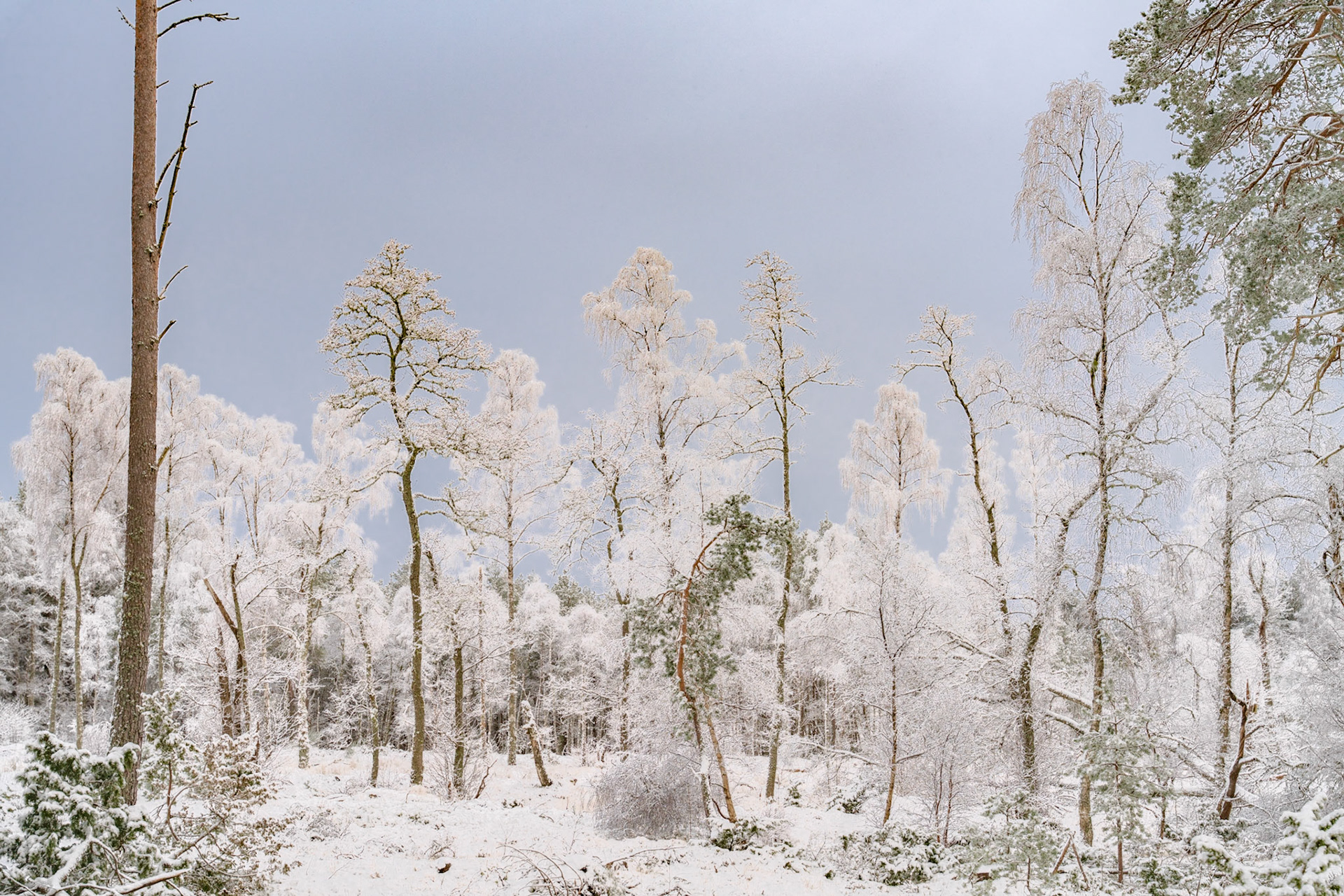
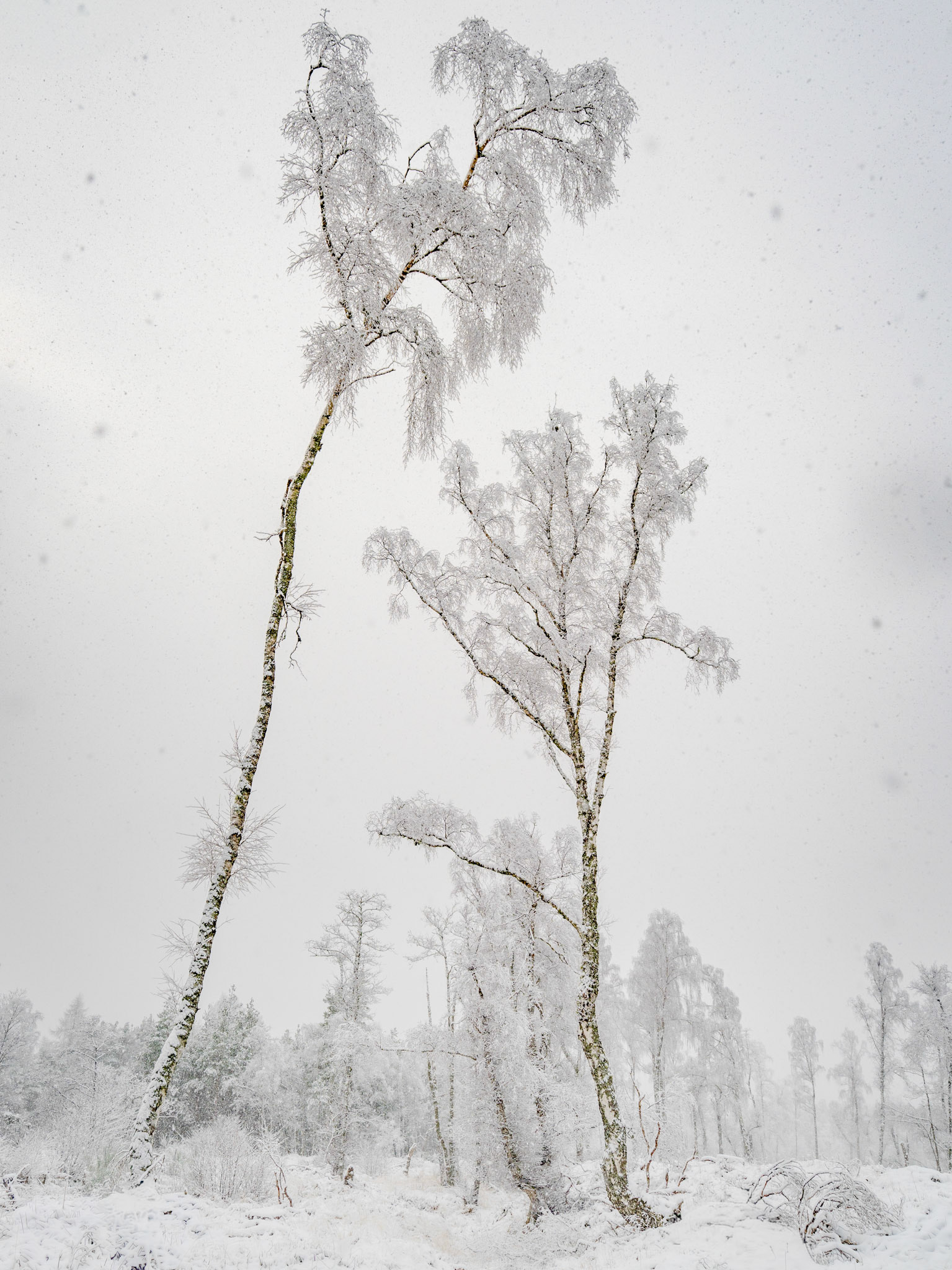
An ancient scots pine tree stands in front of a group of young birch. The scene is painted white in winter snow. From the Cairngorms National Park, Scotland.
A row of deciduous trees stands in near-silhouette at first light, their trunks framing successive layers of mist rolling across a lowland valley below. The cool blue cast and suppressed contrast suggest conditions shortly before sunrise in early May. A distant structure — possibly a farm building — anchors the middle distance without breaking the stillness.
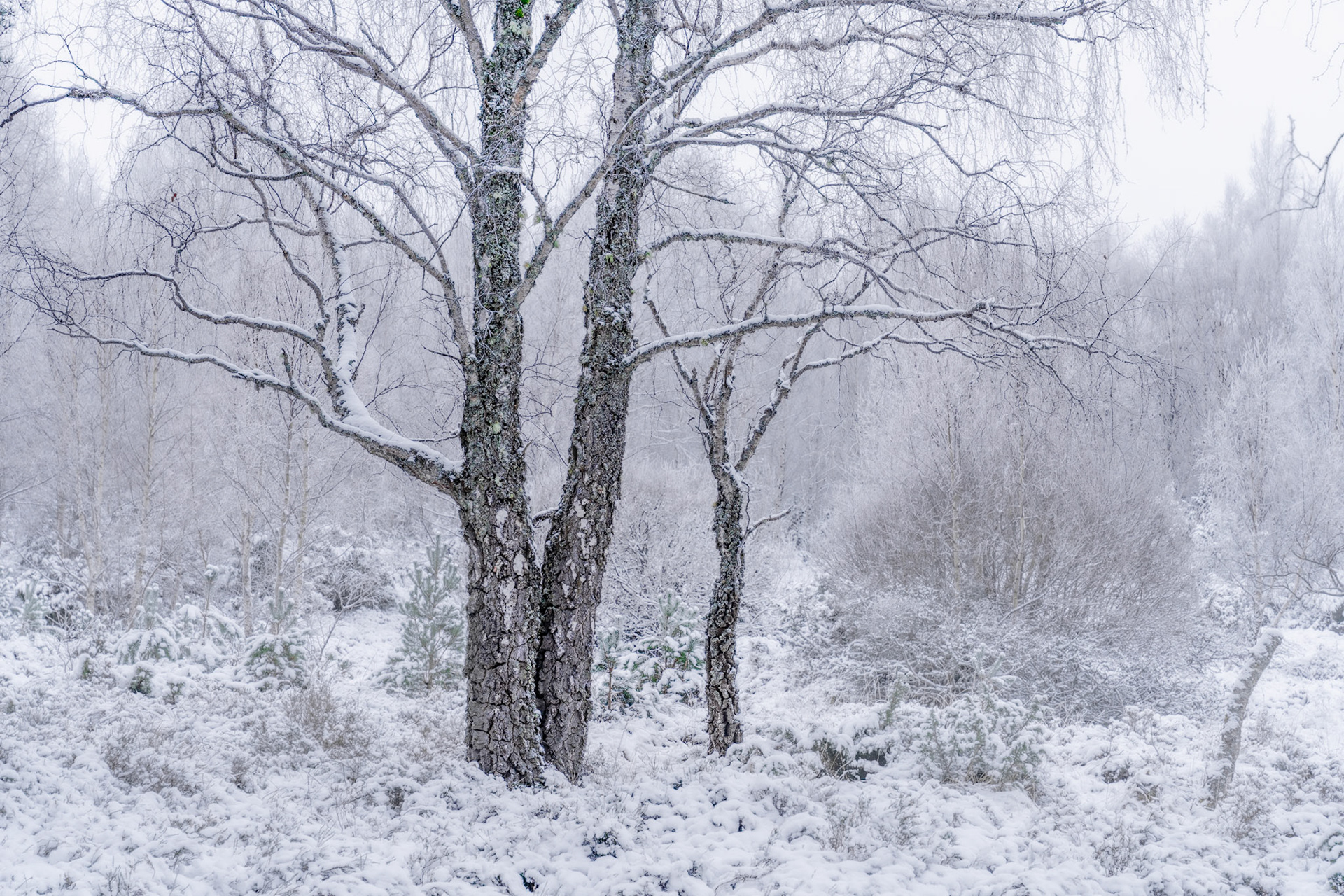
A mixed woodland of birch and pine stands heavily rimed with hoarfrost and fresh snow beneath a flat, pale sky. The uniform coating of white across the canopy creates a near-monochromatic scene broken only by the warm bark tones of the foreground trees. Midday light offers no modelling, flattening depth across the composition.
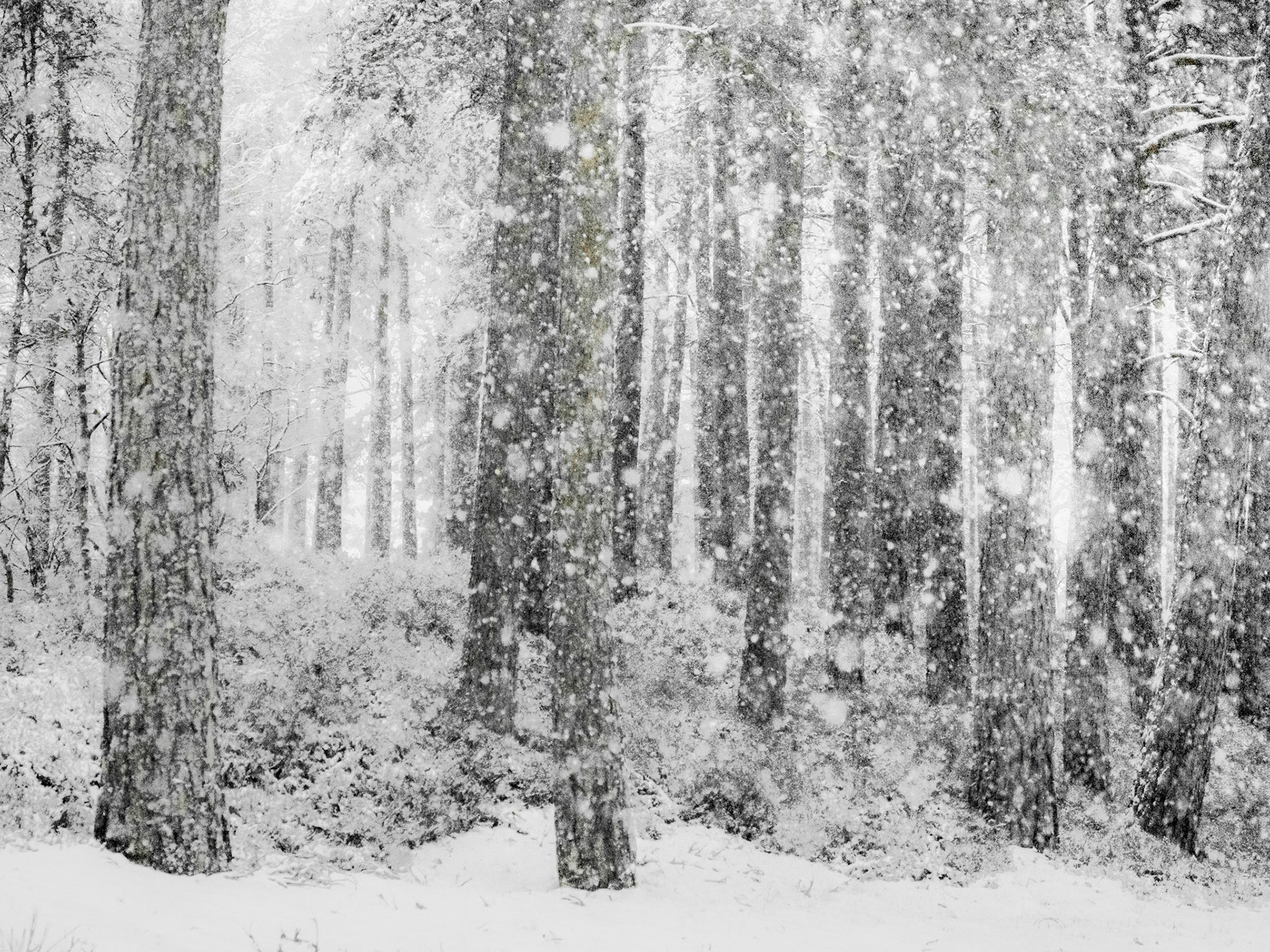
Heavy snowfall reduces a mixed conifer and broadleaf woodland to a near-monochrome arrangement of dark trunks and suspended flakes. The shallow snow cover on the ground and the density of falling snow suggest a sustained mid-afternoon storm. Diffuse overcast light flattens contrast and softens the mid-ground, lending the scene a quiet, compressed atmosphere.
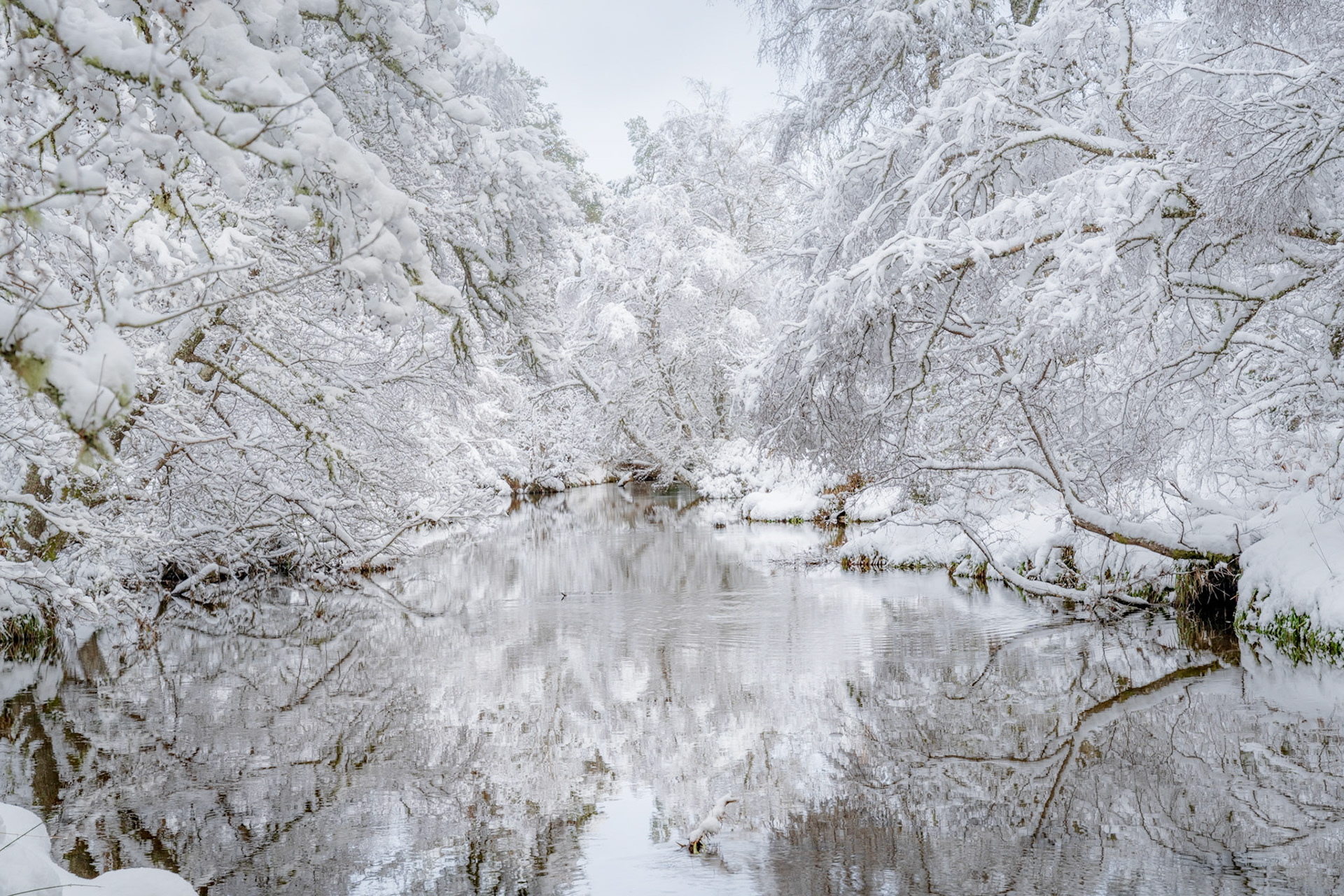
Snow covers every branch on this scene from the Scottish Highlands, along a river that feeds the famous Loch Morlich in the Cairngorms National Park. A truly winter wonderland scene.
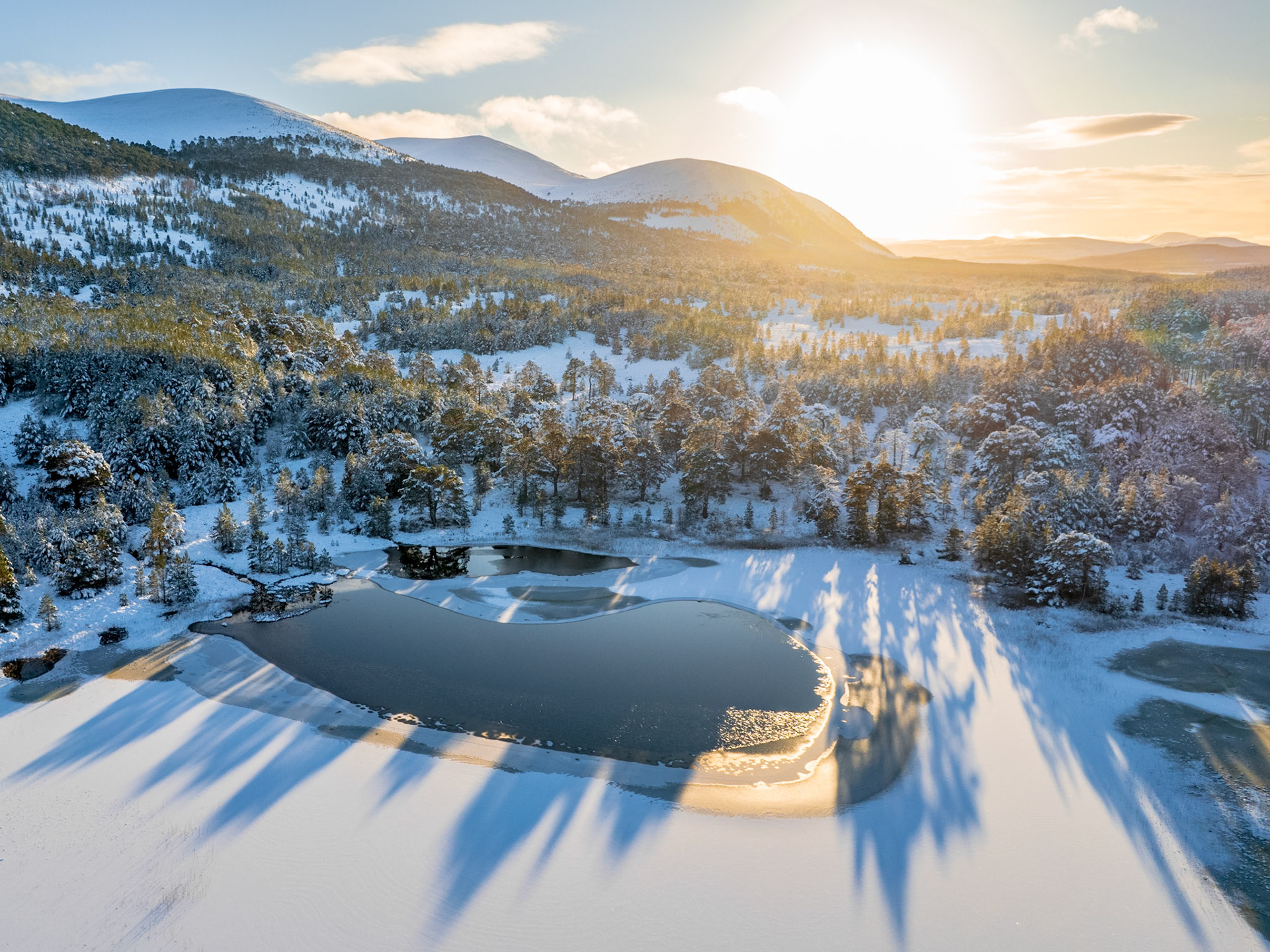
A partially frozen lochan holds open water against a snow-covered Caledonian pine forest near Aviemore, Cairngorms, as low winter sun rakes long tree shadows across the white ground. The organic curve of the water body anchors the composition, its dark surface contrasting sharply with the luminous snowfield. Warm backlight from the south dissolves the valley into haze, lending depth to an otherwise monochrome terrain.
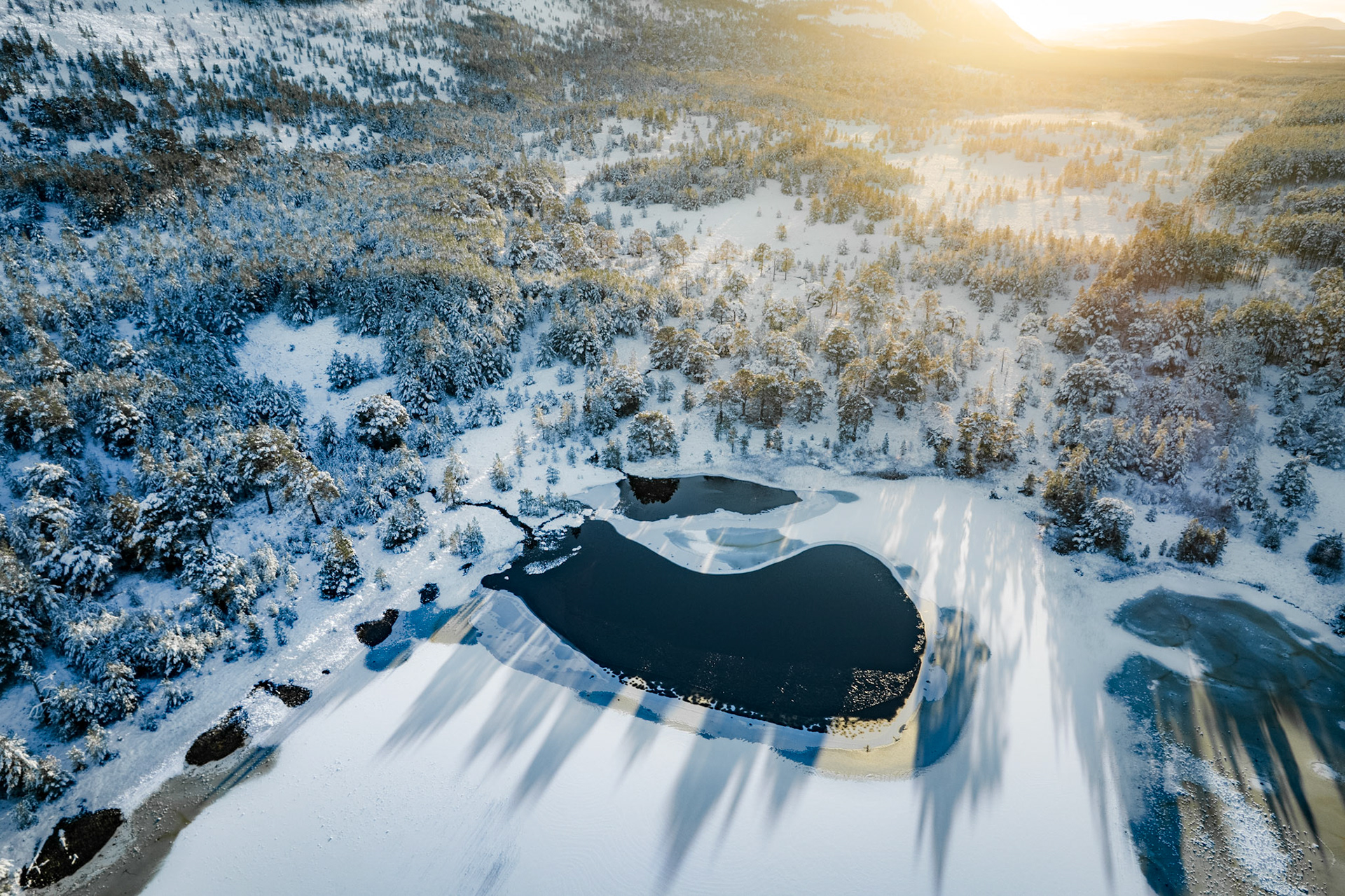
A partially frozen lochan sits among snow-laden Scots pine on the Cairngorms plateau, long tree shadows raking across the snowfield as low January sun breaks behind the massif. The aerial vantage reveals the geometry of ice margin against open water and the radiating shadow pattern that ground-level photography could not yield. Aviemore hinterland, Scottish Highlands.
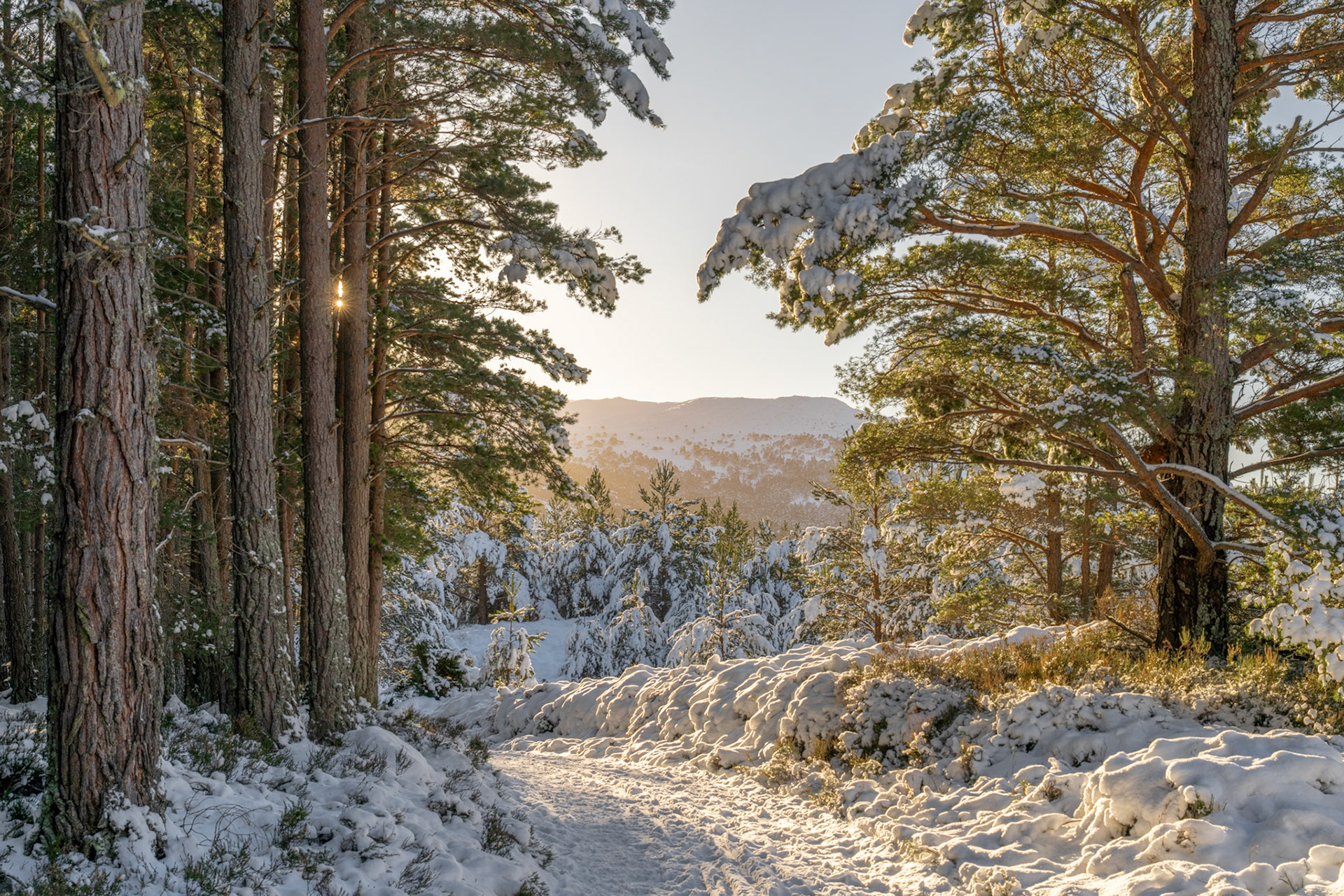
Low January sun breaks through Scots pine, casting warm light across a snow-laden forest track. The path leads the eye toward an open mountain panorama, the middle distance filled with snow-covered young conifers glowing in late afternoon backlight. A small sunstar flares between trunks, anchoring the depth.
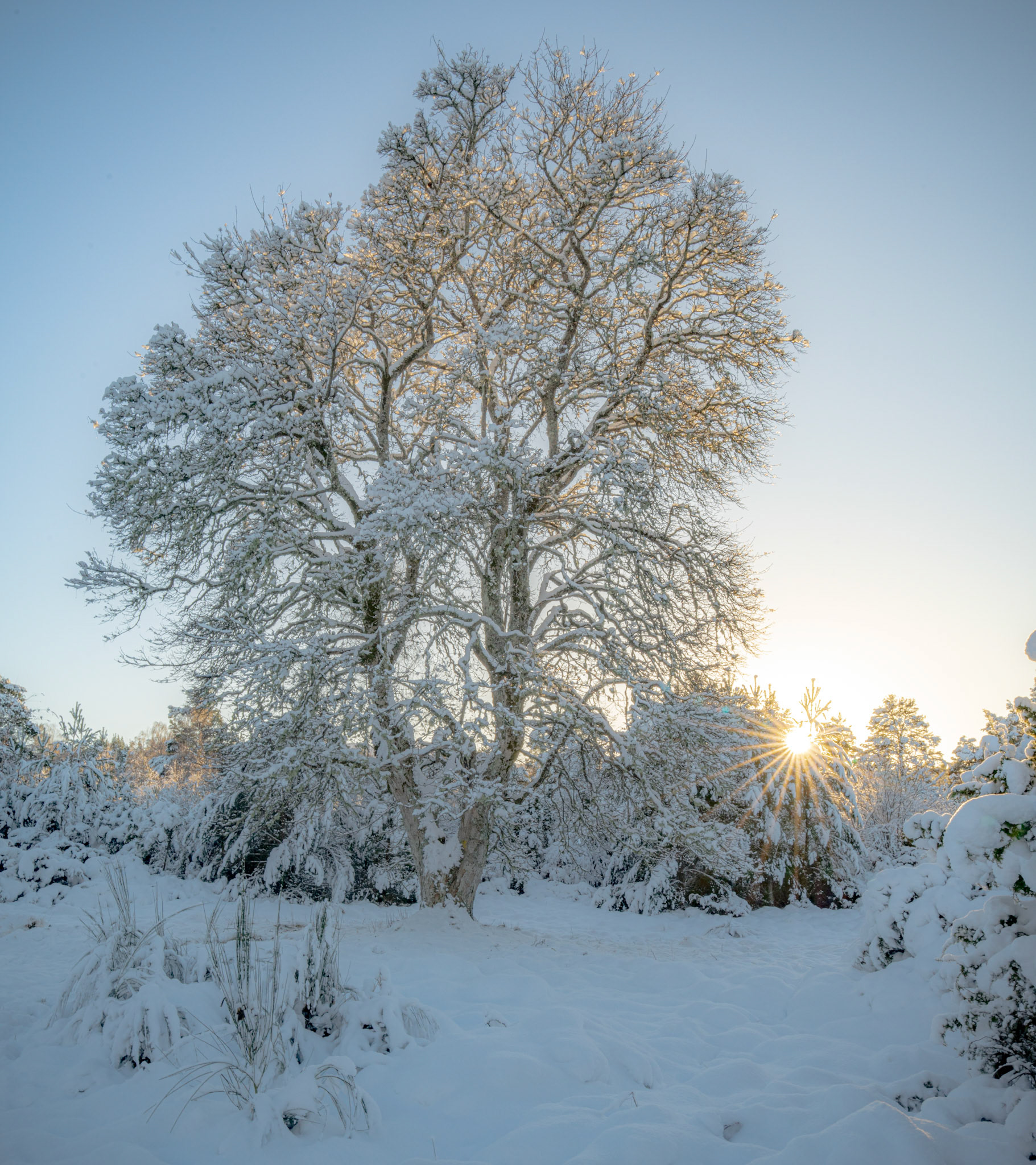
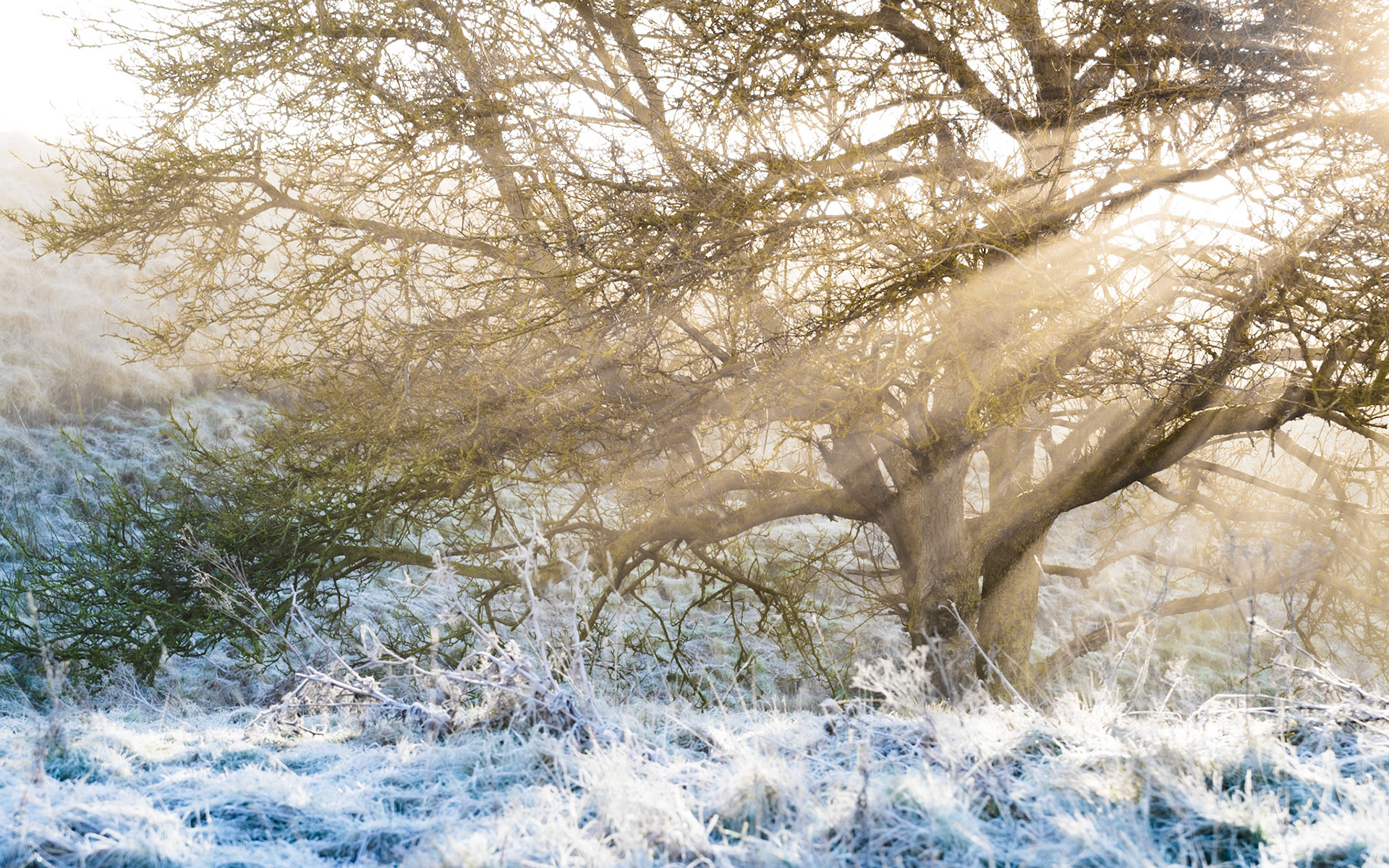
Low winter sun breaks through mist behind a spreading hawthorn, casting visible light rays through bare, lichen-covered branches. Hoarfrost holds on the rough grassland and scrub below, the cold blue of the frosted foreground contrasting with the warm backlight. The combination of crepuscular rays and frost suggests a brief, still moment in early morning before the mist fully lifts.
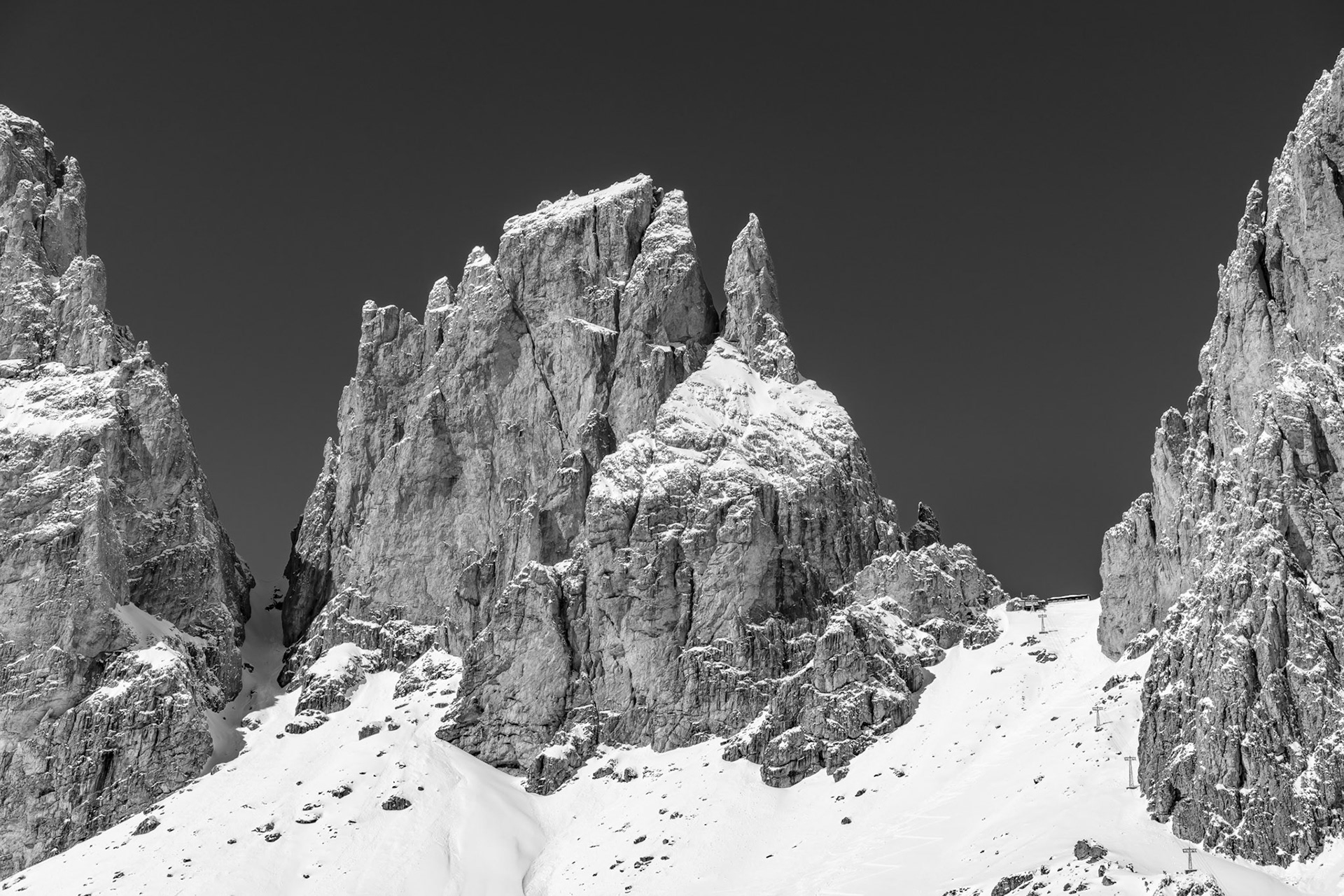
Jagged limestone towers rise from deep winter snowfields, their fractured faces rendered in hard light against a darkened sky. The monochrome conversion amplifies the tonal contrast between sun-struck rock and shadow, giving the spires a graphic, almost architectural weight. A ski lift visible at the right edge anchors the scene in managed mountain terrain.
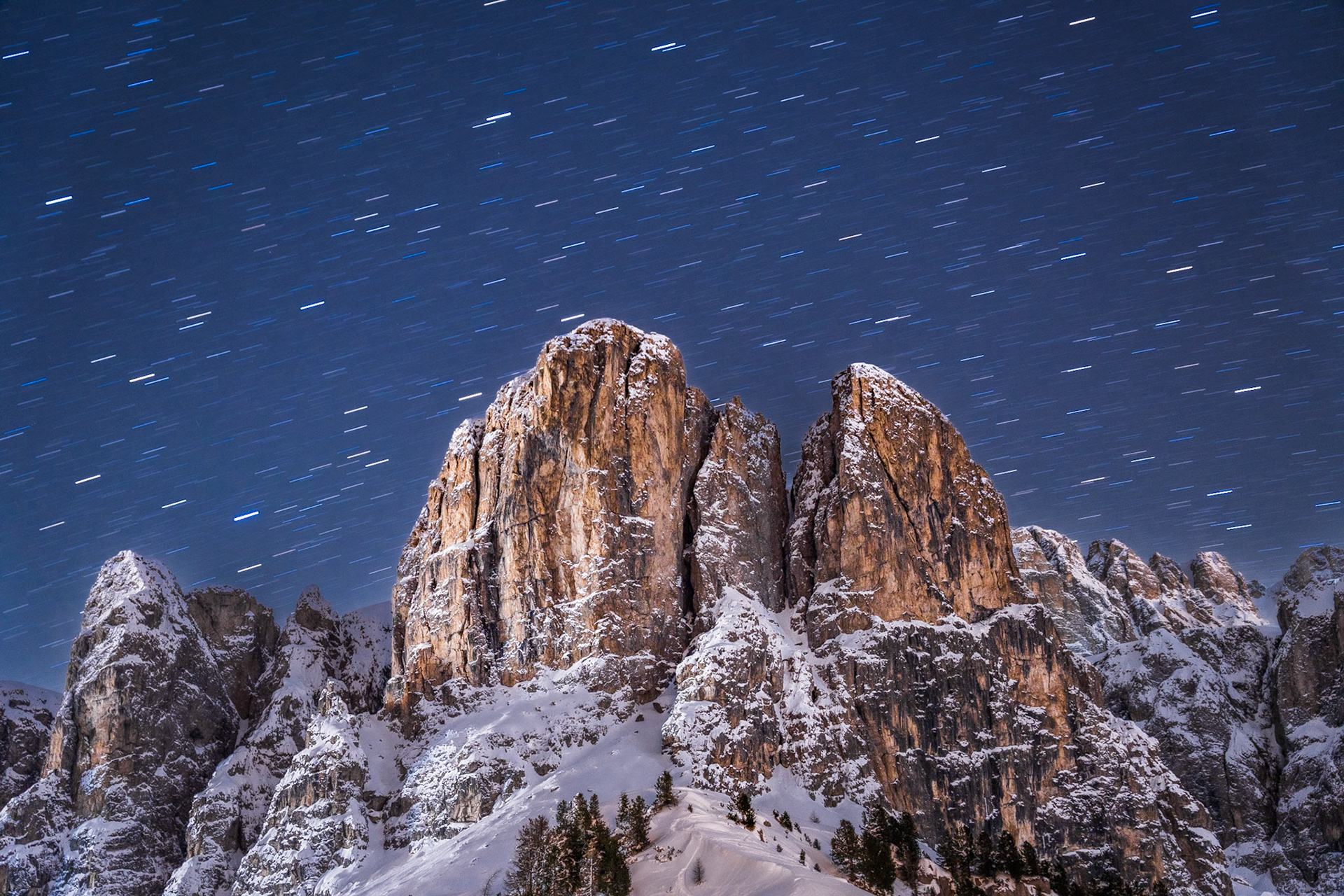
Star trails arc across a deep blue winter sky above the illuminated limestone towers of the Dolomites, their warm amber faces contrasting with snow-laden slopes below. A long exposure of several minutes has resolved individual stellar paths into short parallel dashes, the moon providing the ambient light that reveals every ledge and crack in the rock face. Conifers at the snowline anchor the composition and restore a sense of scale.
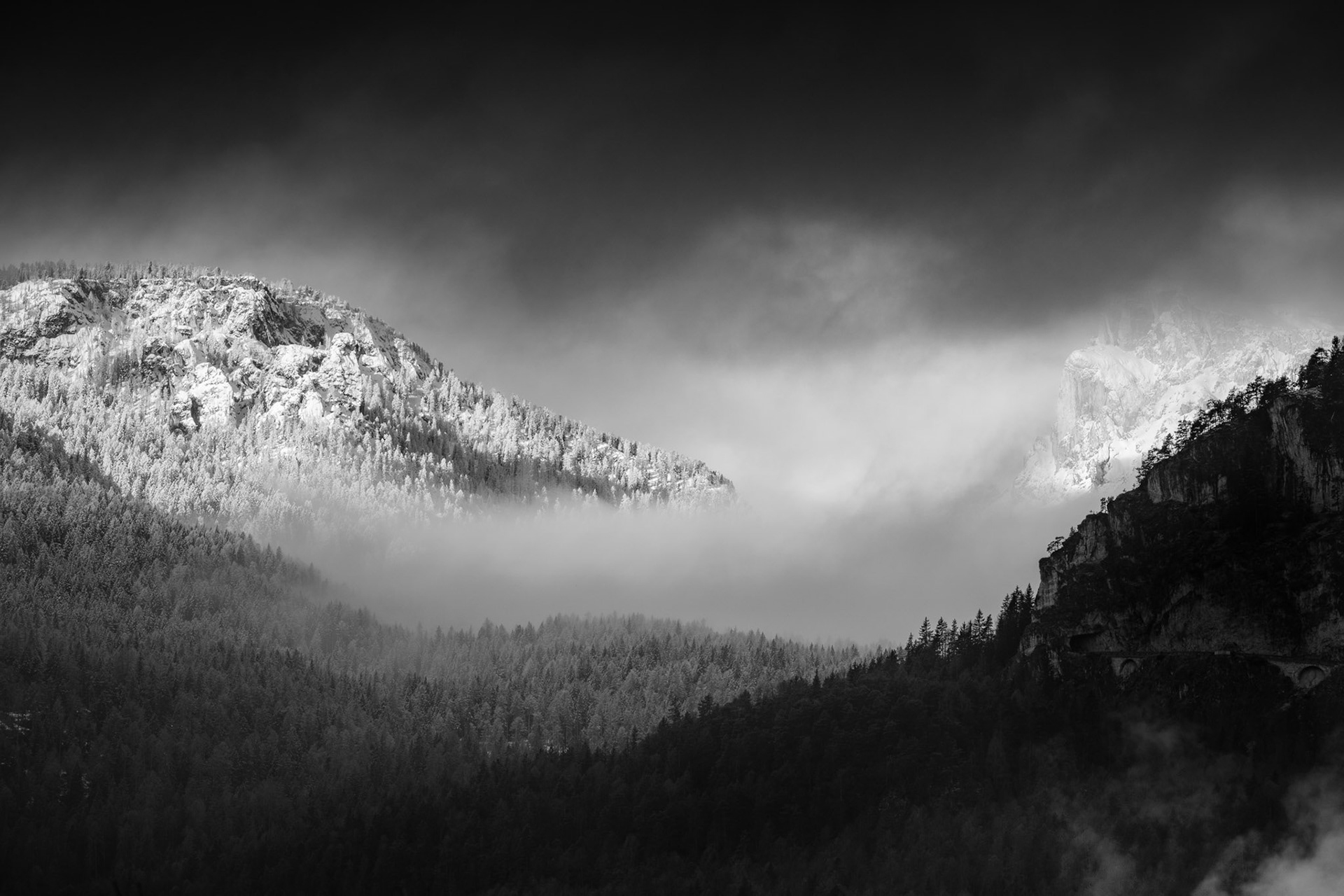
A band of low cloud bisects the scene, separating a dark foreground of snow-dusted conifers from a heavily fractured limestone face above. The monochrome treatment compresses the tonal range into layers, each plane of forest, cliff, and mist receding with quiet authority. The summit disappears into overcast, leaving the mid-mountain geology as the structural anchor.
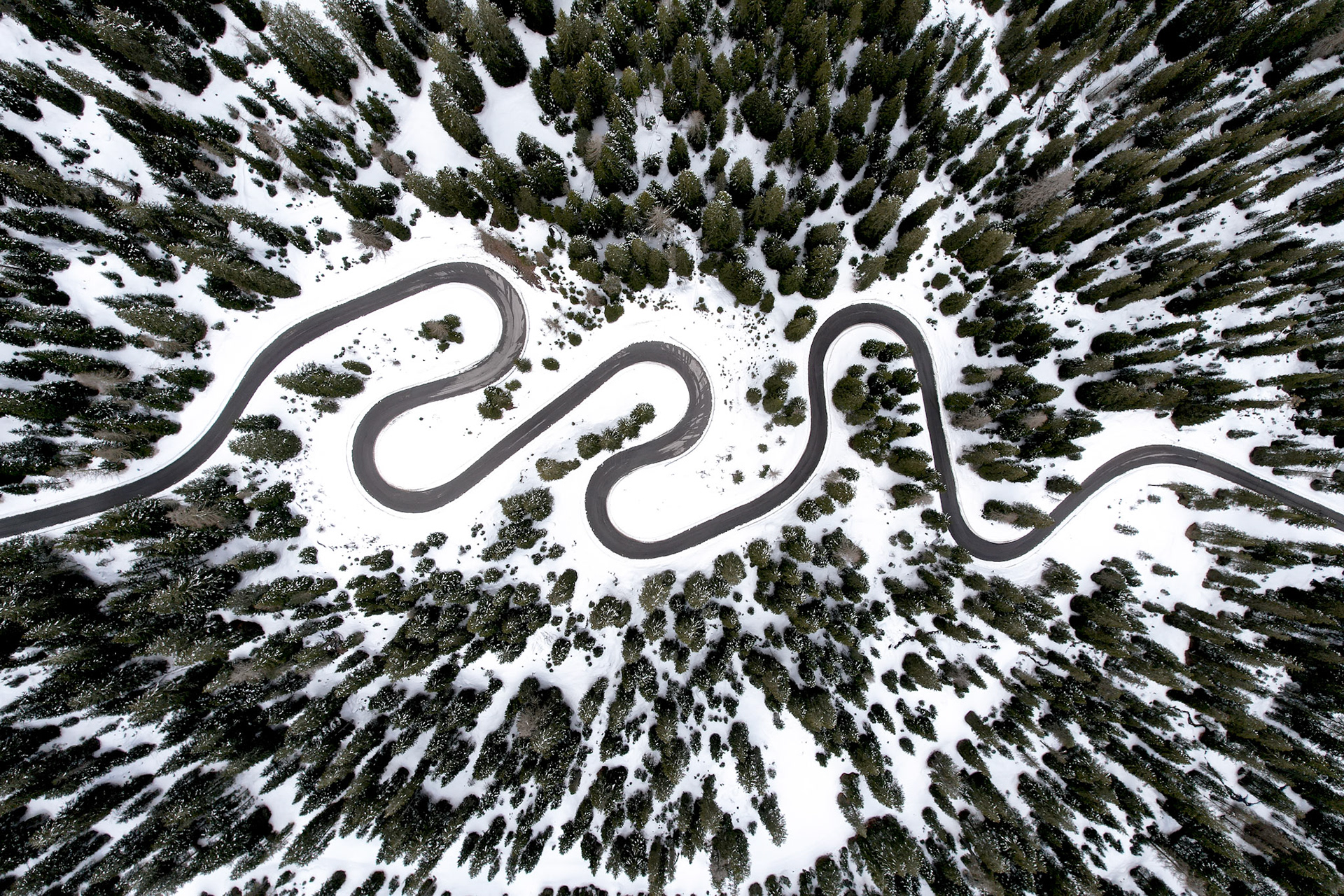
A hairpin mountain road traces repeated switchbacks across a snow-covered alpine slope near Cortina d'Ampezzo, the dark asphalt cutting a rhythmic sinuous line through conifer forest. Shot directly overhead at midday, the nadir perspective strips away horizon and depth, reducing the scene to graphic pattern. The tonal contrast between cleared road, unbroken snow, and dark evergreen canopy gives the composition a near-typographic quality.
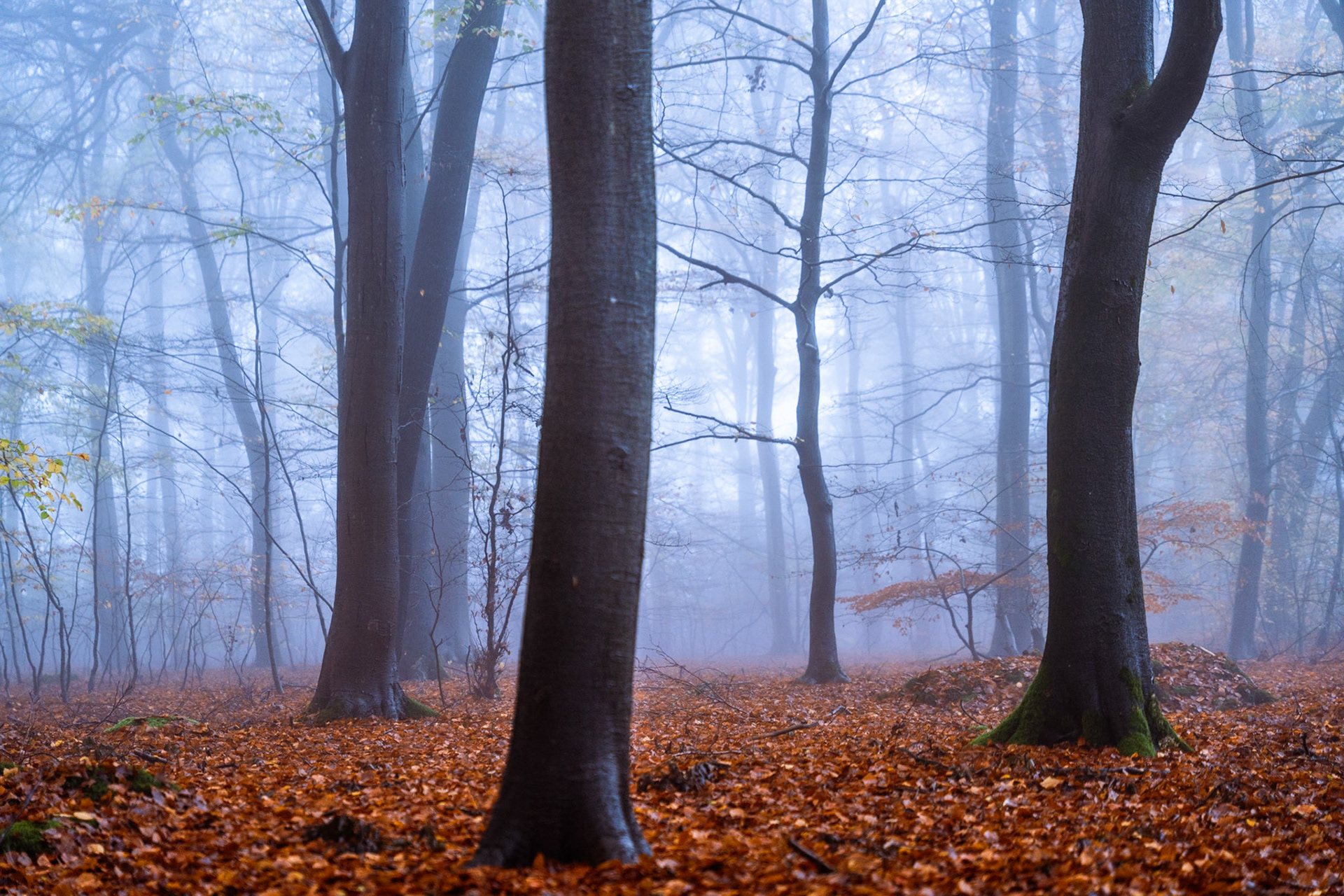
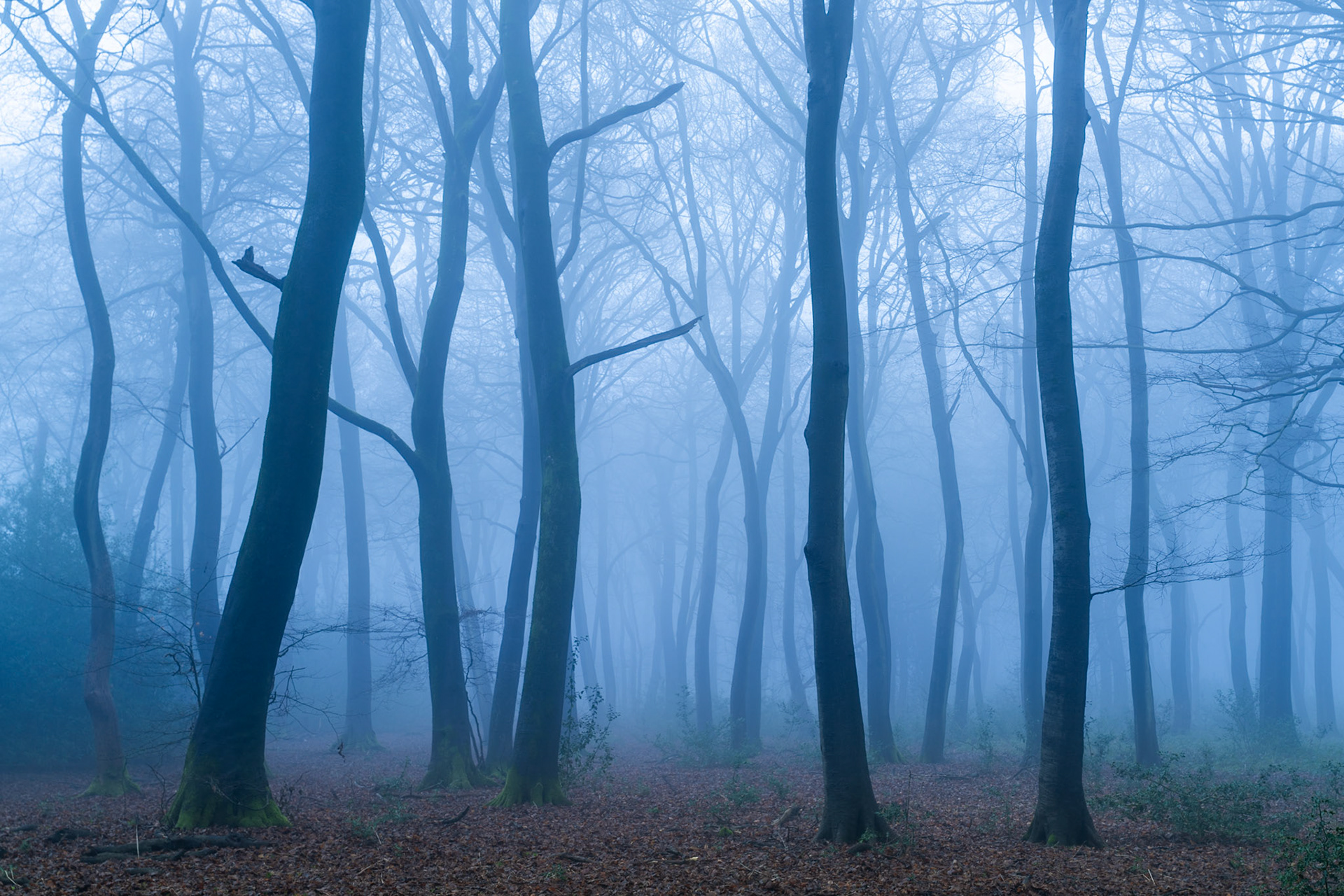
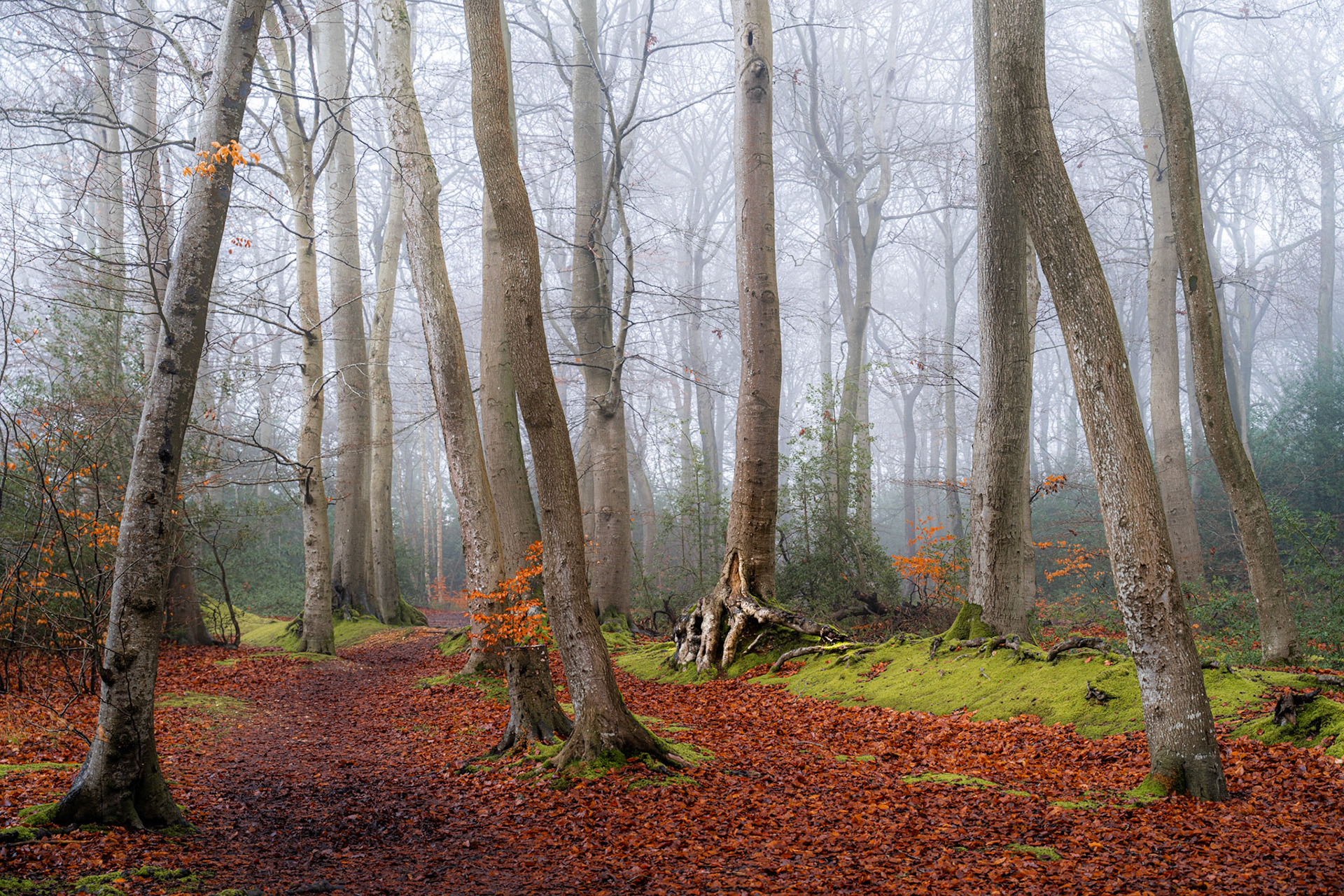
Mature beech trees stand in dense autumn fog in the Chilterns, Oxfordshire, their bark dark against a cold blue-white diffusion of mist. A carpet of fallen copper leaves covers the woodland floor, contrasting sharply with the spectral mid-ground where trunks dissolve into vapour. The layering of near, mid, and far planes gives the scene unusual depth for a still, overcast morning.
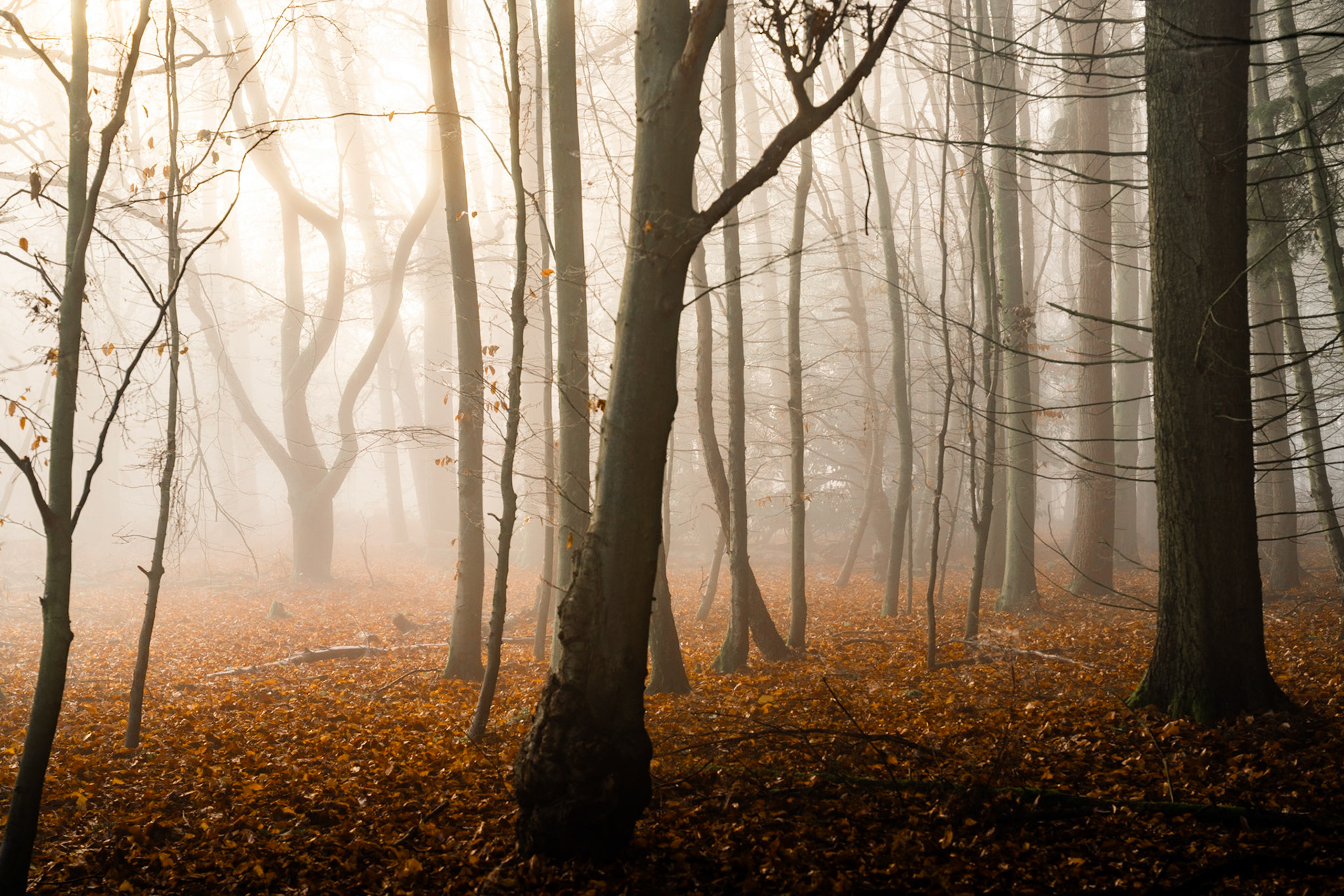
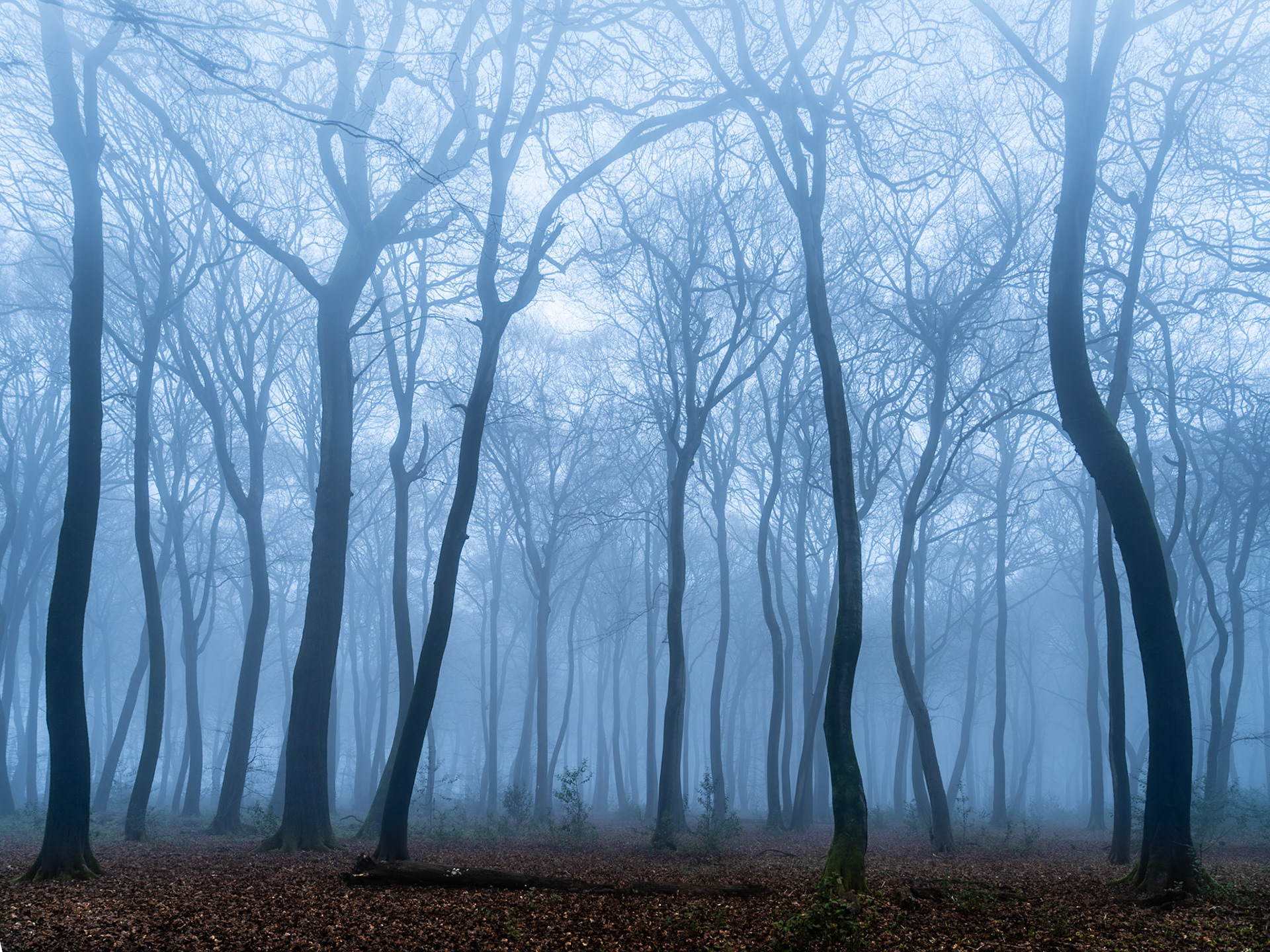
Bare beech trunks recede into dense fog on a December morning in the Chilterns, Oxfordshire, the forest floor carpeted in rust-brown fallen leaves. Diffuse backlight from the upper left creates a pale, luminous atmosphere through the leafless canopy. The layering of trunks gives depth, though the composition lacks a clear singular anchor to draw the eye.
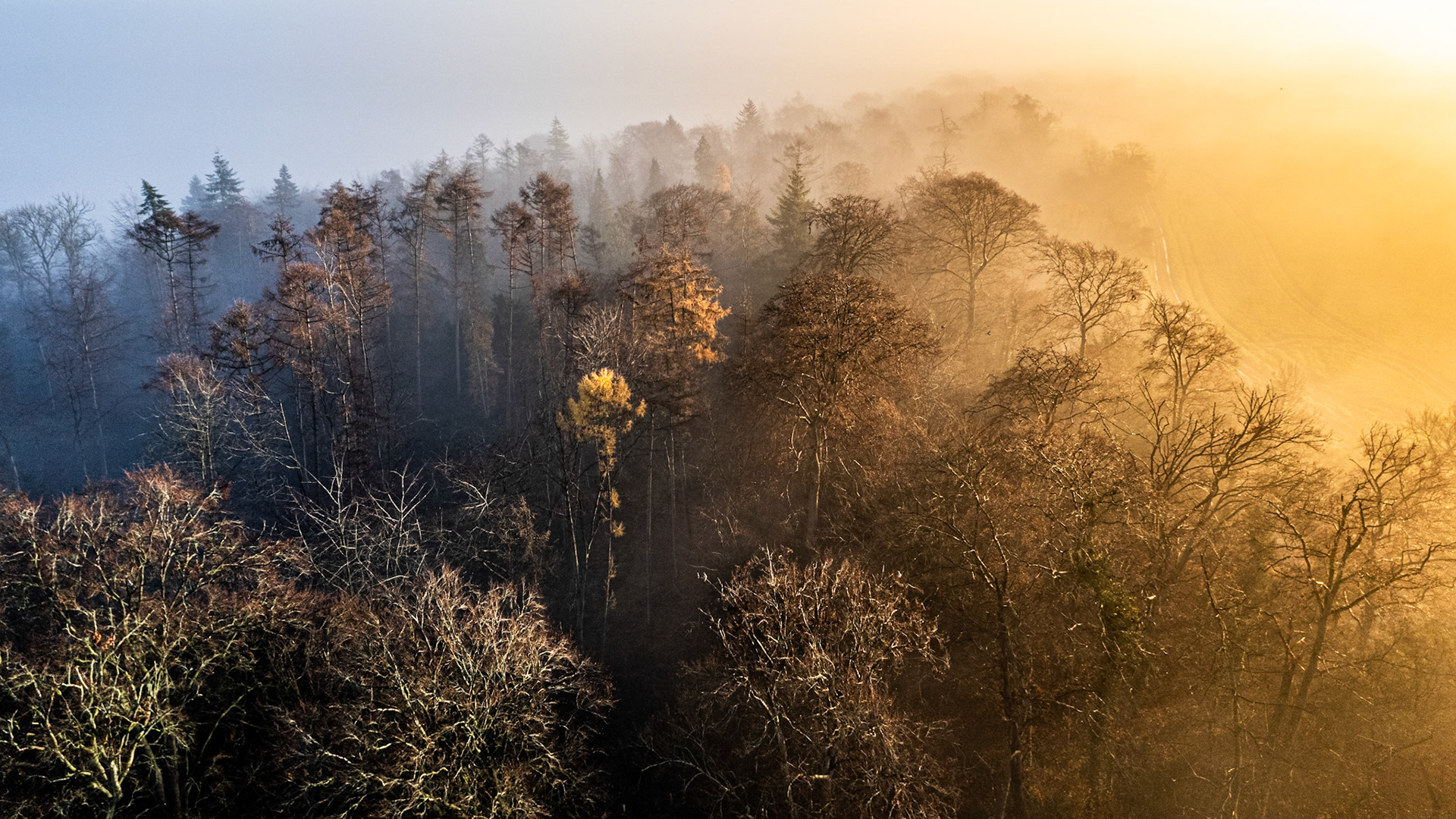
A winter woodland on the Chiltern escarpment above Henley-on-Thames, caught from the air as low morning sun burns through fog from the south-east. The light cleaves the canopy along a near-diagonal axis, leaving conifers and bare deciduous crowns in cold shadow to the left while the right half dissolves into warm haze. A single illuminated pine at mid-frame anchors the transition between the two atmospheres.
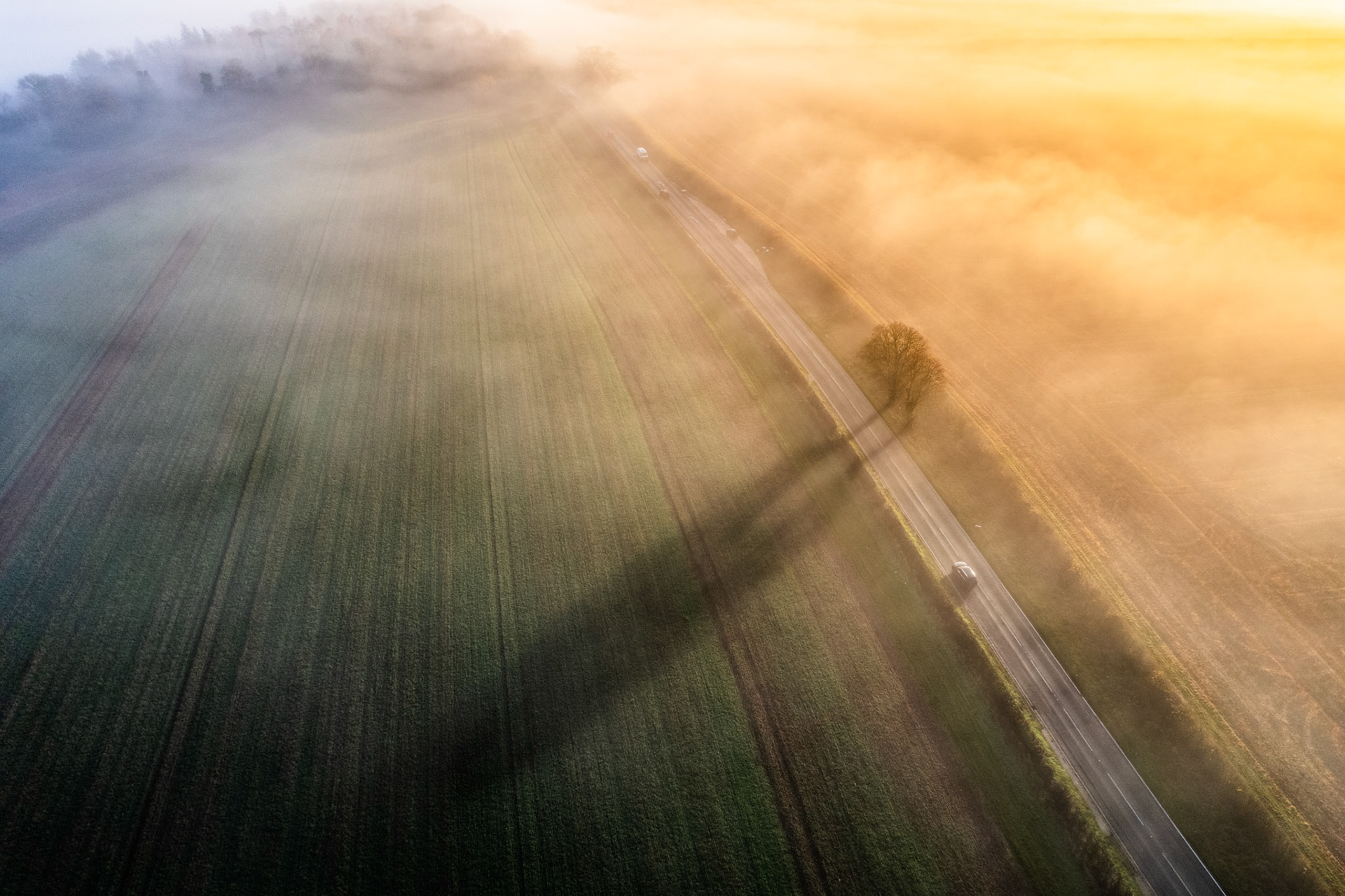
A solitary roadside tree casts an elongated shadow across frost-edged winter arable fields near Henley-on-Thames, its silhouette dramatised by low December sun breaking through advection fog. The diagonal of the road divides warm golden light from blue-grey shadow, while passing cars reduce to white specks within the dissolving murk. The aerial perspective abstracts the landscape into planes of tone and texture.
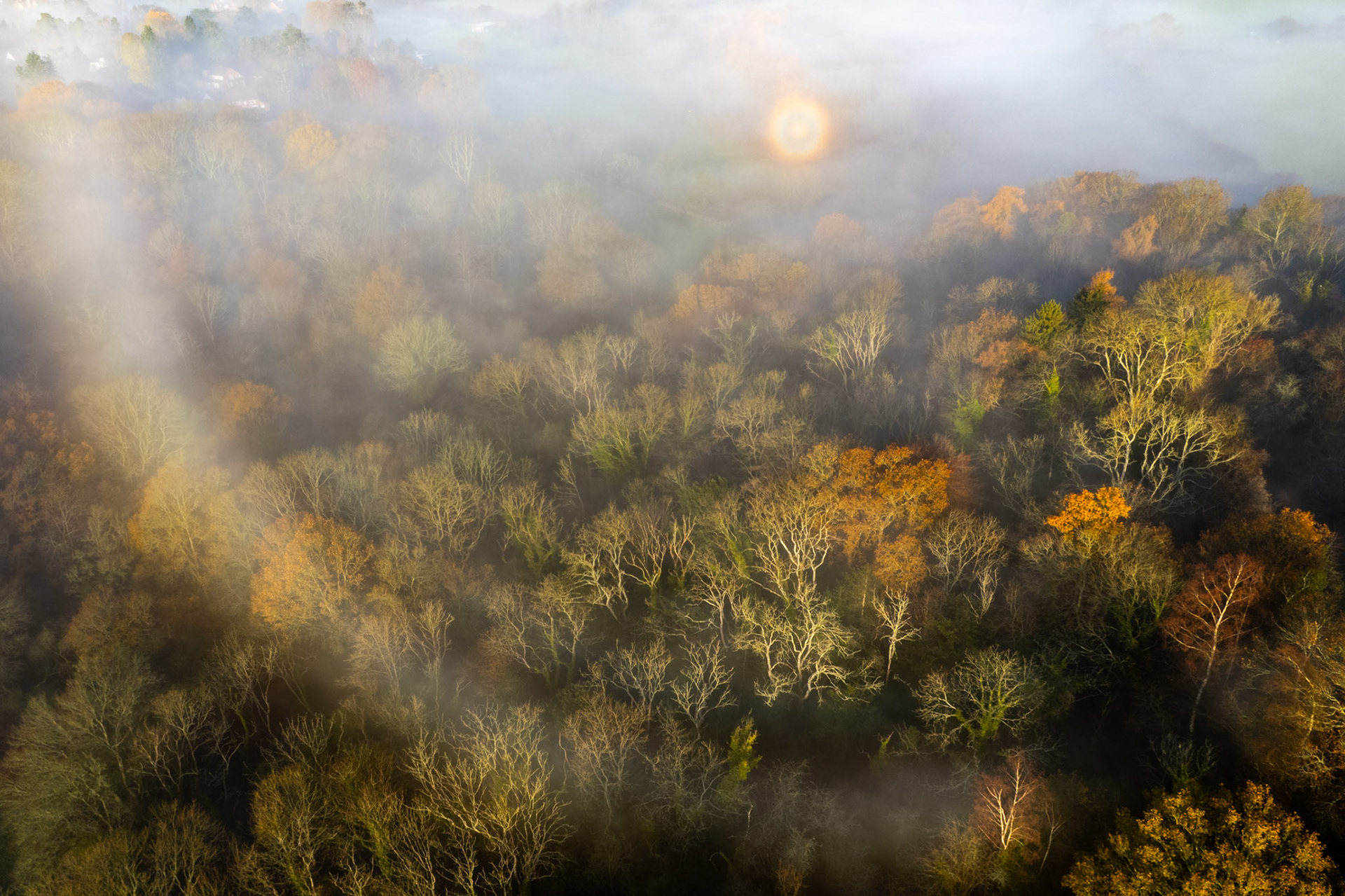
Morning fog rolls across a mixed deciduous woodland above Henley-on-Thames, the low winter sun diffusing through the mist as a soft orb above the valley. Bare branches and remnant autumn foliage create a layered tapestry of ochre, rust, and grey-green beneath the drifting cloud. The aerial vantage compresses the woodland into an almost abstract plane of tone and texture.
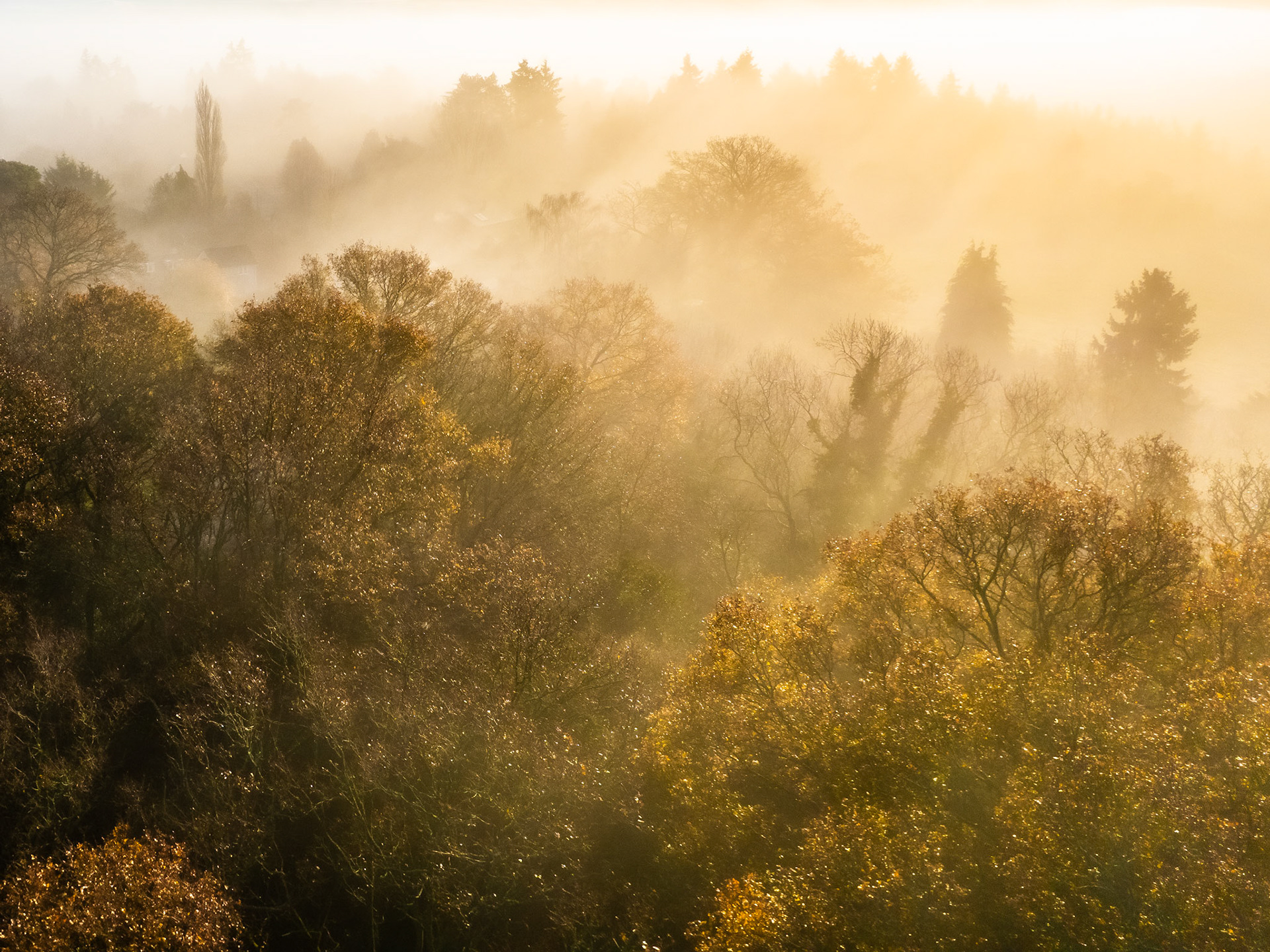
A temperature inversion holds fog among mixed deciduous woodland above Henley-on-Thames, caught at the moment low winter sun begins to burn through. Layers of canopy recede into the murk, the foreground trees still holding remnant autumn colour against bare mid-ground stems. The aerial vantage compresses depth, turning atmosphere into almost pure texture.
Low autumn sun breaks through a gap in mixed woodland in the Chilterns, Oxfordshire, casting distinct crepuscular rays between two moss-based beech trunks. A carpet of fallen leaves covers the forest floor while backlit golden foliage frames the burst of light. The mist implied by the visible rays adds depth to the receding treeline.
Hoarfrost coats a cluster of dried seedheads and trailing spider silk on a slender branch, suspended against a soft blue-grey background suggestive of still water or mist. The freezing conditions have crystallised every spine and filament, creating a delicate tracery that holds the cold air of a December morning.
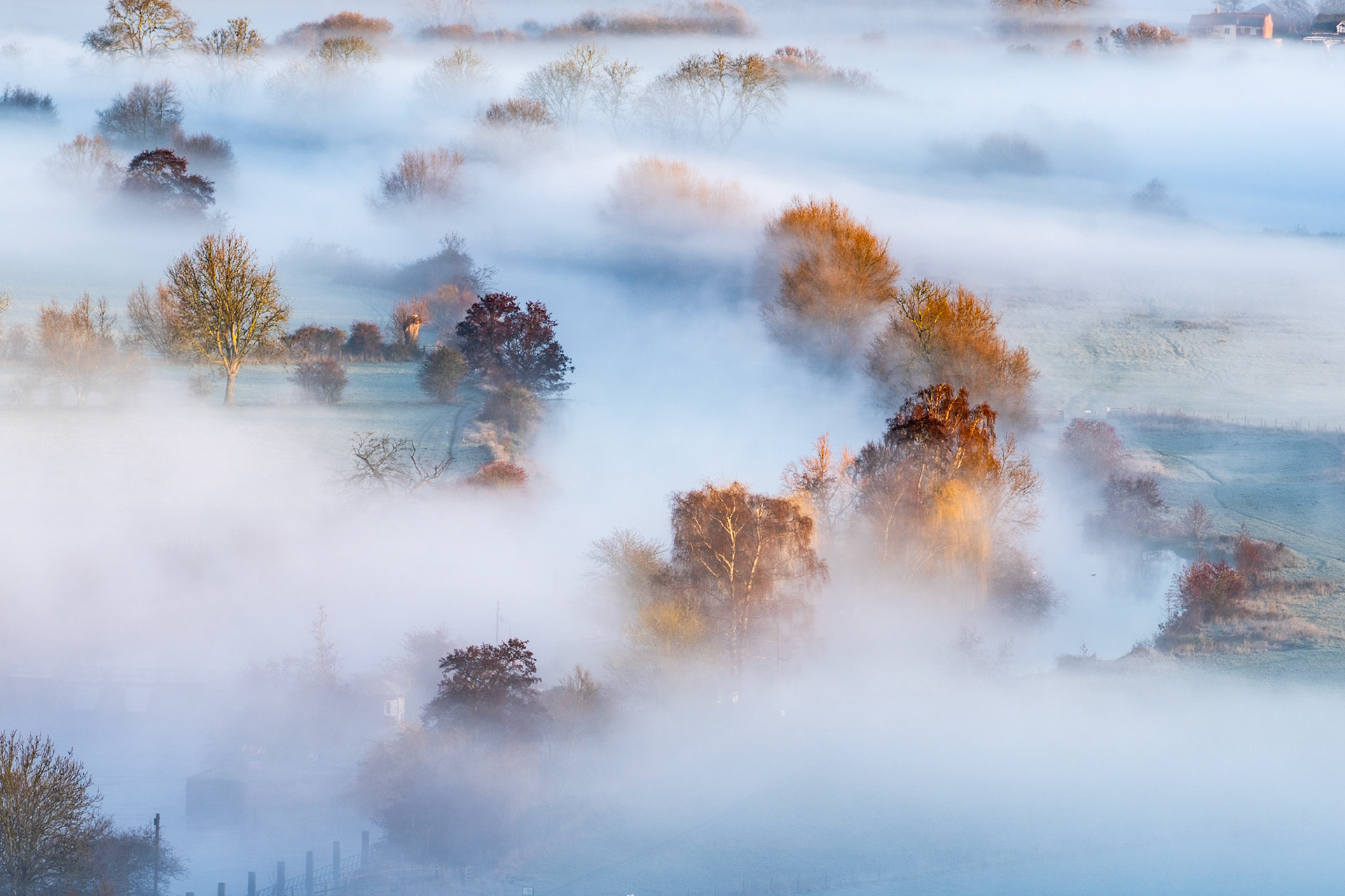
A temperature inversion fills a lowland valley with rolling fog at dawn, reducing the landscape to isolated crowns of autumn colour. Warm first light catches the amber and russet foliage of deciduous trees, each group surfacing from the white like small islands. The layered recession of mist planes gives the scene unusual depth and structural calm.
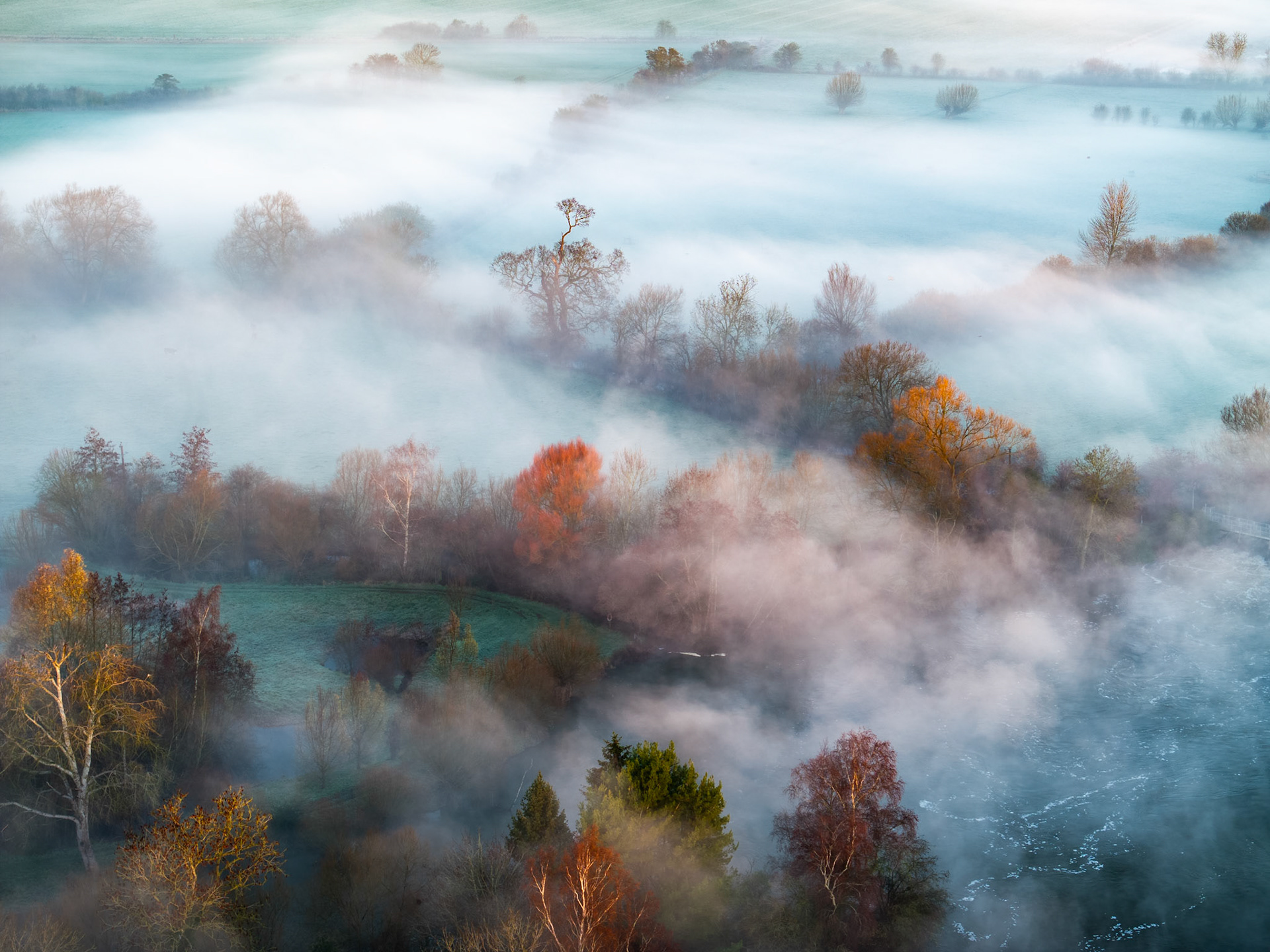
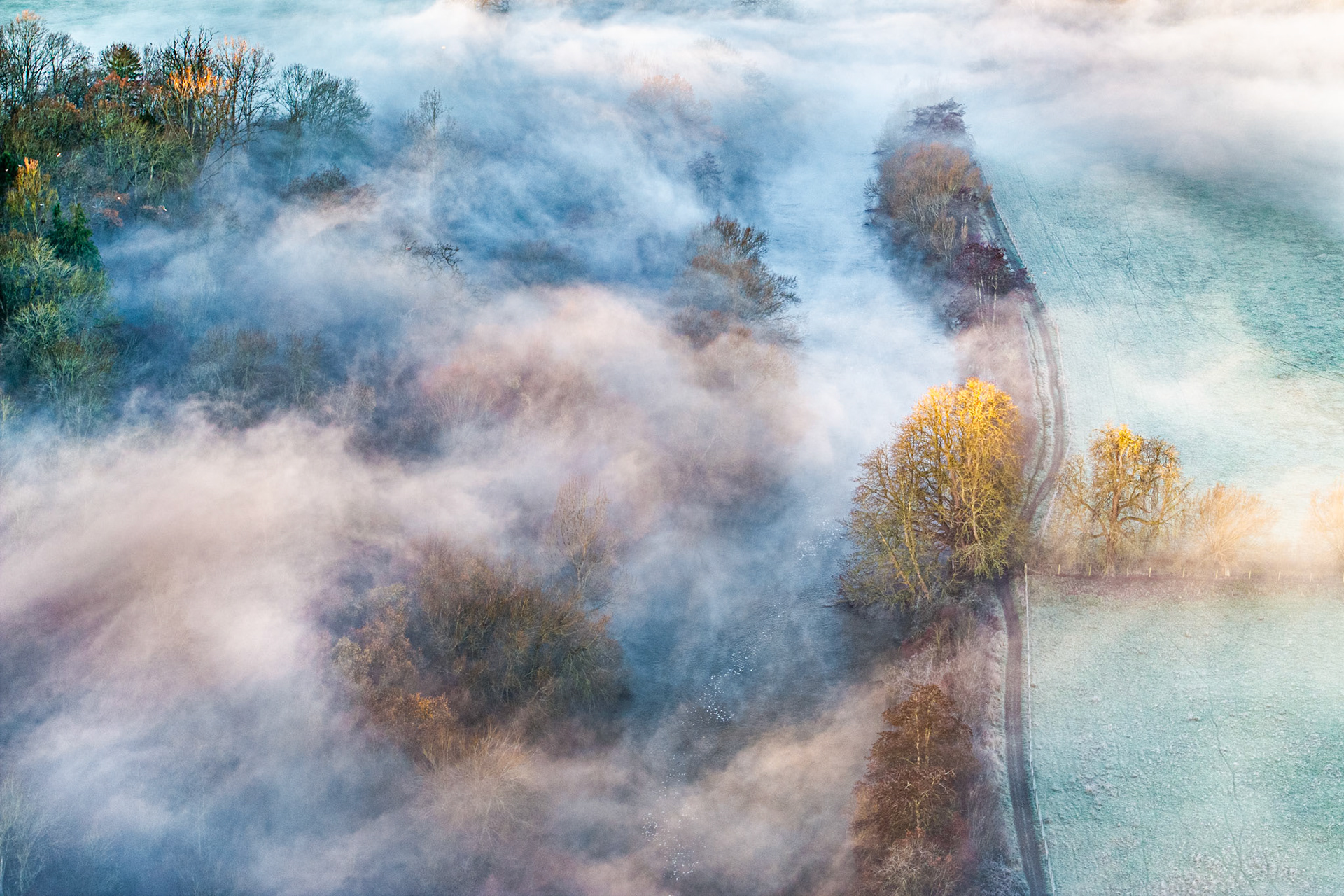
A temperature inversion smothers the Thames valley near Abingdon at first light, leaving trees in full autumn-to-winter transition stranded above a slow-moving sea of cold fog. A frosted meadow breaks clear to the right, its pale green a quiet counterpoint to the amber and burgundy crowns emerging from the mist. The aerial perspective dissolves conventional landscape geometry, reducing the scene to colour, texture, and atmosphere.
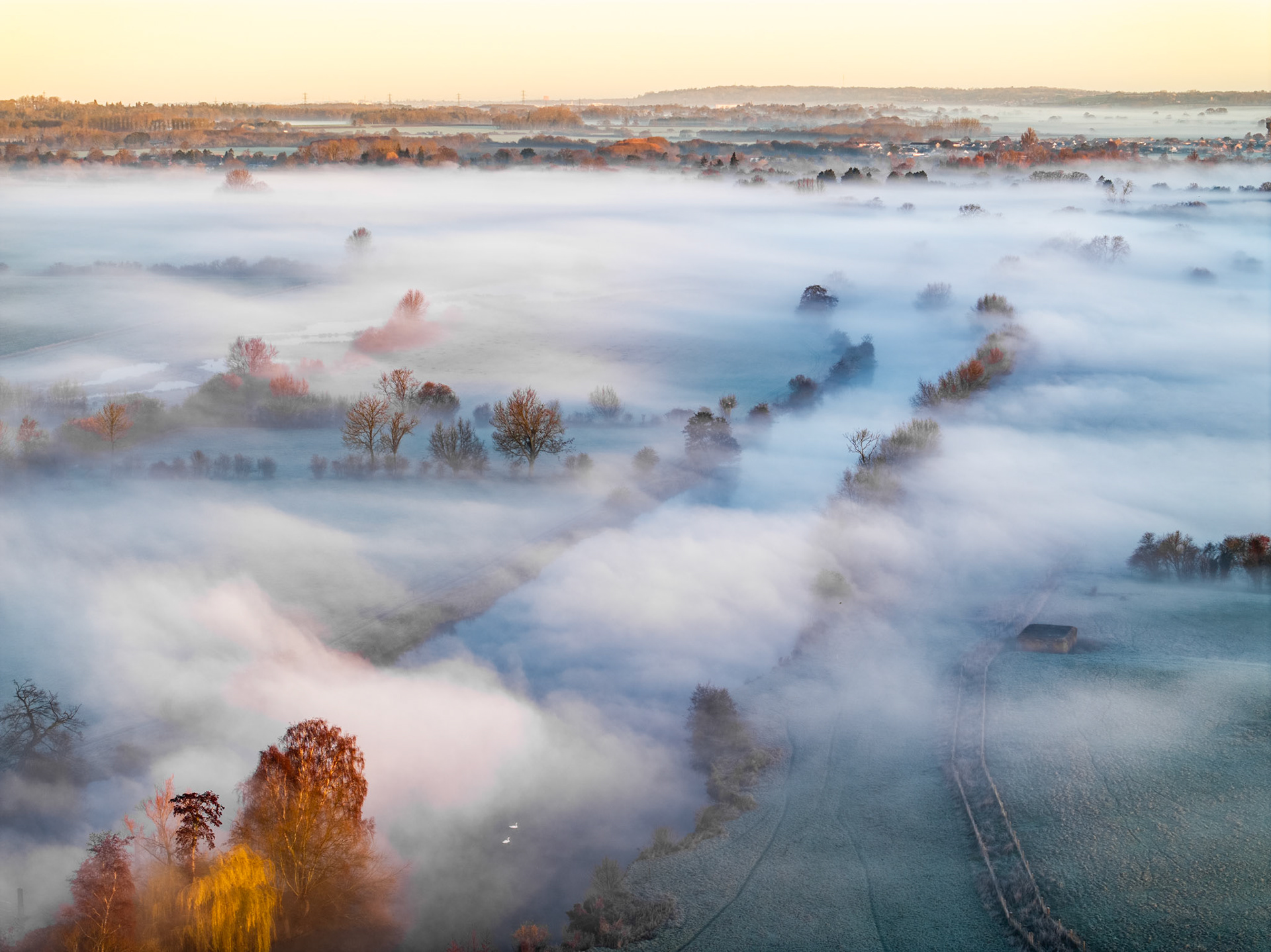
A temperature inversion settles across the Thames Valley near Wallingford, submerging hedgerows and fields beneath a continuous white plane while isolated trees in late autumn colour rise through the fog layer. Shot at low drone altitude, the diagonal ridge of emerging woodland divides the composition, giving structure to an otherwise formless sea of mist. The pale warmth catching copper and amber crowns against the cool tonal ground is what lifts this from record to image.
A temperature inversion fills the Thames Valley floor near Wallingford, submerging hedgerows, farm tracks and scattered woodland to their crowns. Autumn-coloured trees pierce the fog layer, lit warm from the east as first light catches the upper canopy. A frost-whitened field in the foreground anchors the scene against the dissolving middle distance.
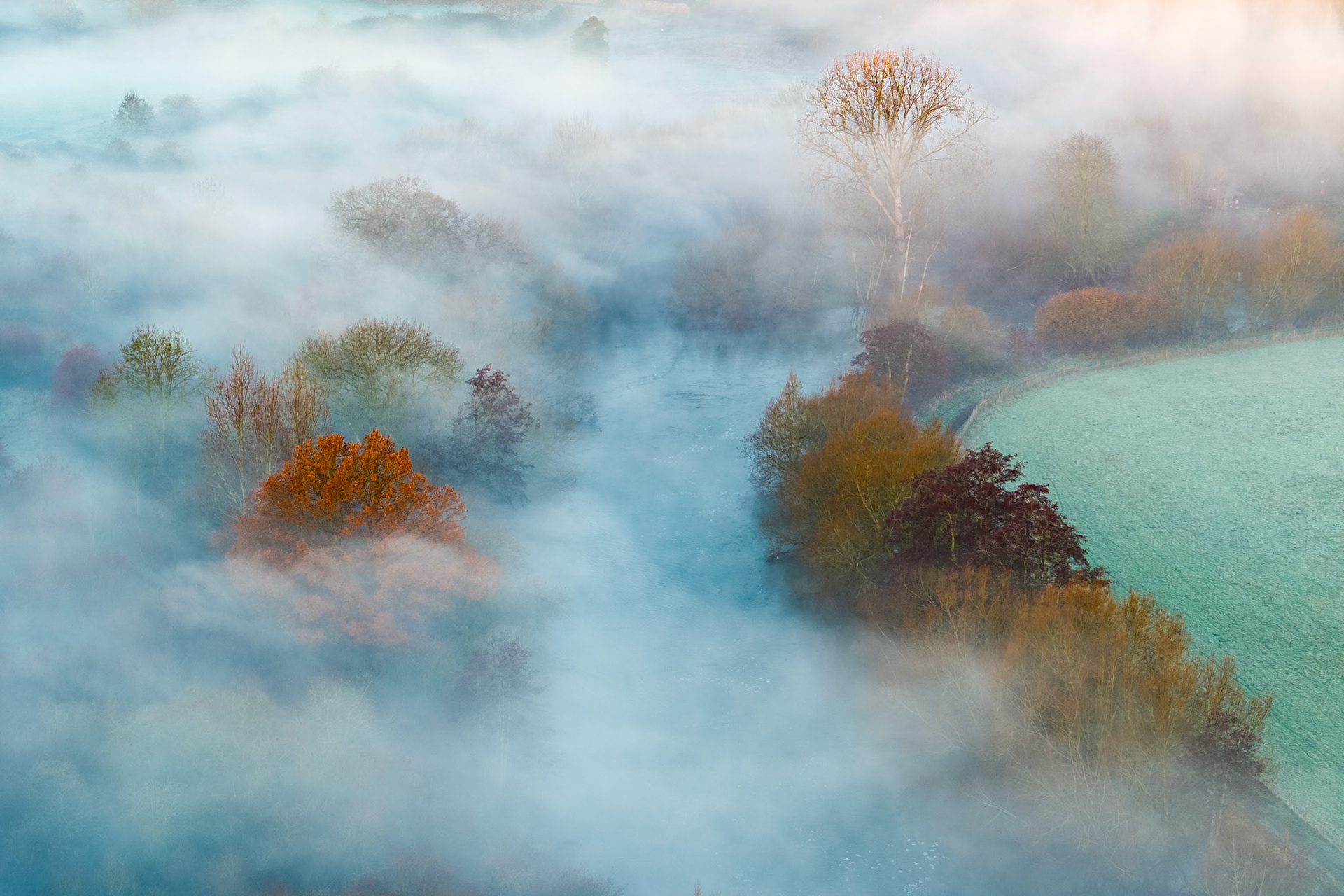
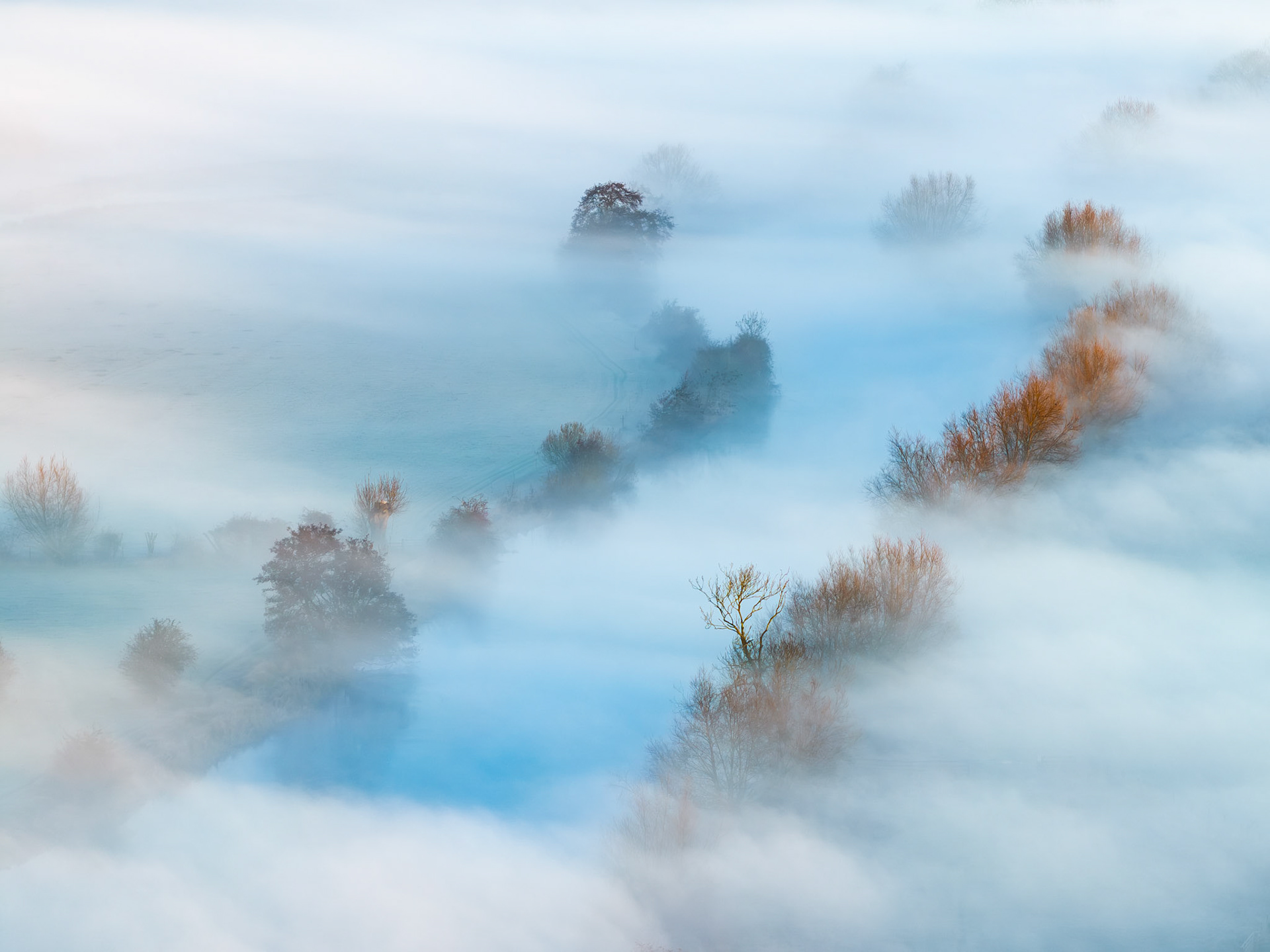
A temperature inversion smothers the Thames valley near Wallingford, leaving only the crowns of riparian trees and the ghost of the river channel visible from altitude. The cool blue of open water mirrors the sky between successive fog banks, while amber willow stems provide the only warm note in an otherwise tonal composition. Captured at dusk in mid-December, the image reads as pure abstraction without surrendering its sense of place.
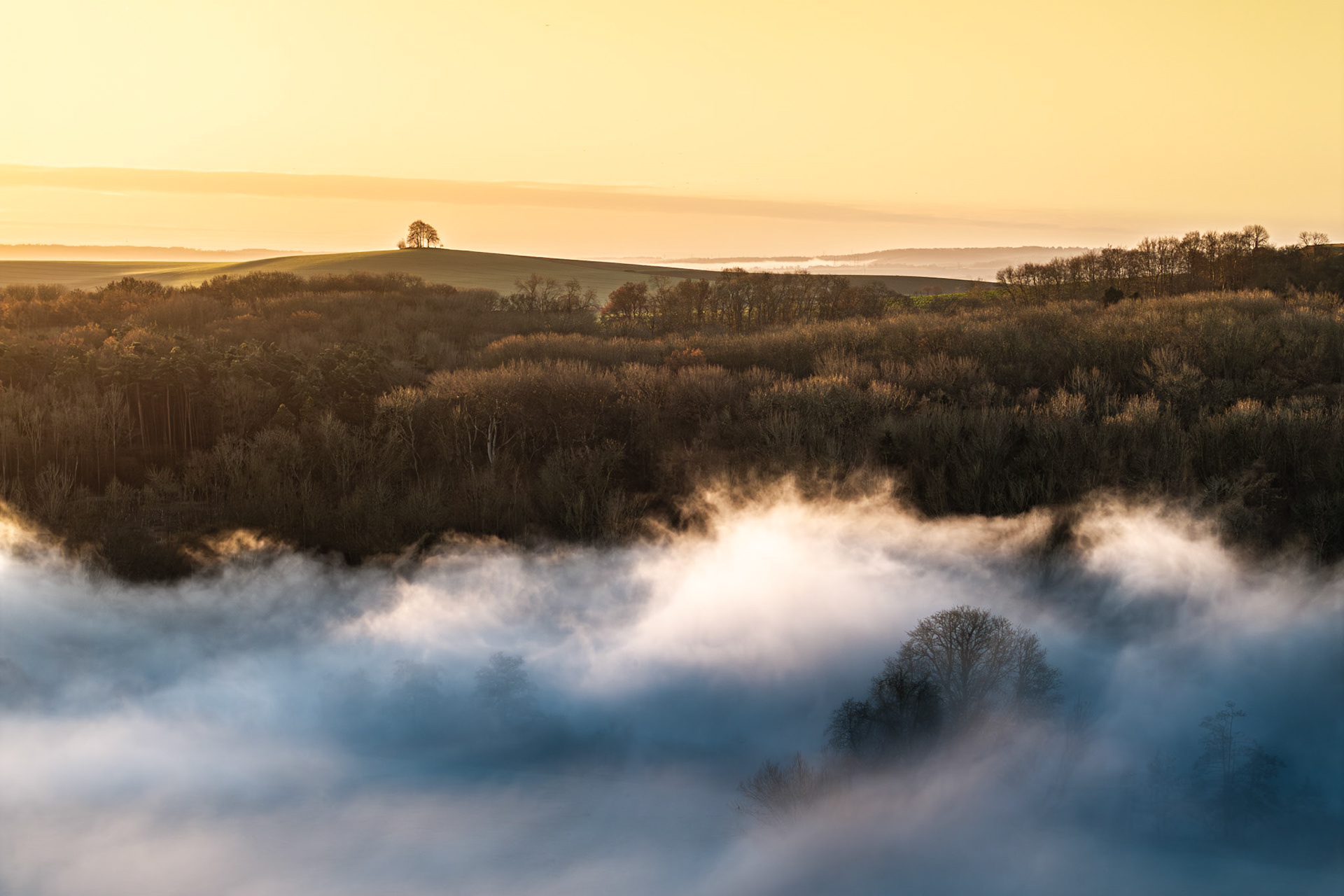
A temperature inversion fills the valley floor with dense fog while bare woodland emerges at the cloud margin, near Wallingford on the Oxfordshire Downs. A lone tree group crowns the distant hill in silhouette against a pale winter dawn sky. The foreground mist, lit from below, separates into distinct layers that give the scene unusual depth and spatial ambiguity.
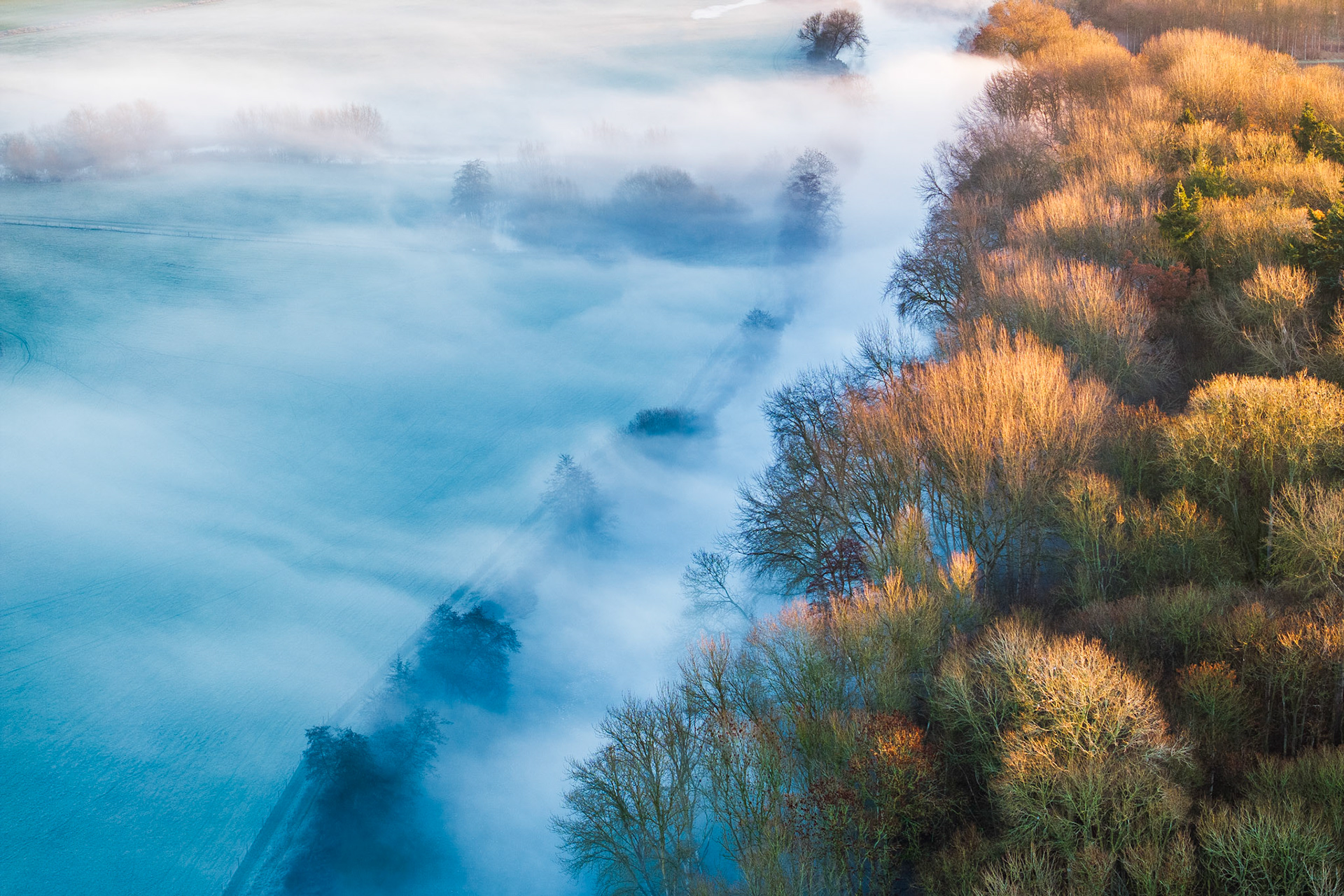
Low winter fog pools across frost-hardened floodplain fields beside the Thames near Abingdon, held in place by a sharp temperature inversion. Riparian trees on the wooded margin catch the first warm raking light from the south-east, their amber canopies standing clear above the mist while isolated hedgerow trees trail long shadow-wakes across the blue-white fog surface below. The diagonal edge between lit woodland and submerged plain carries the composition with controlled tension.
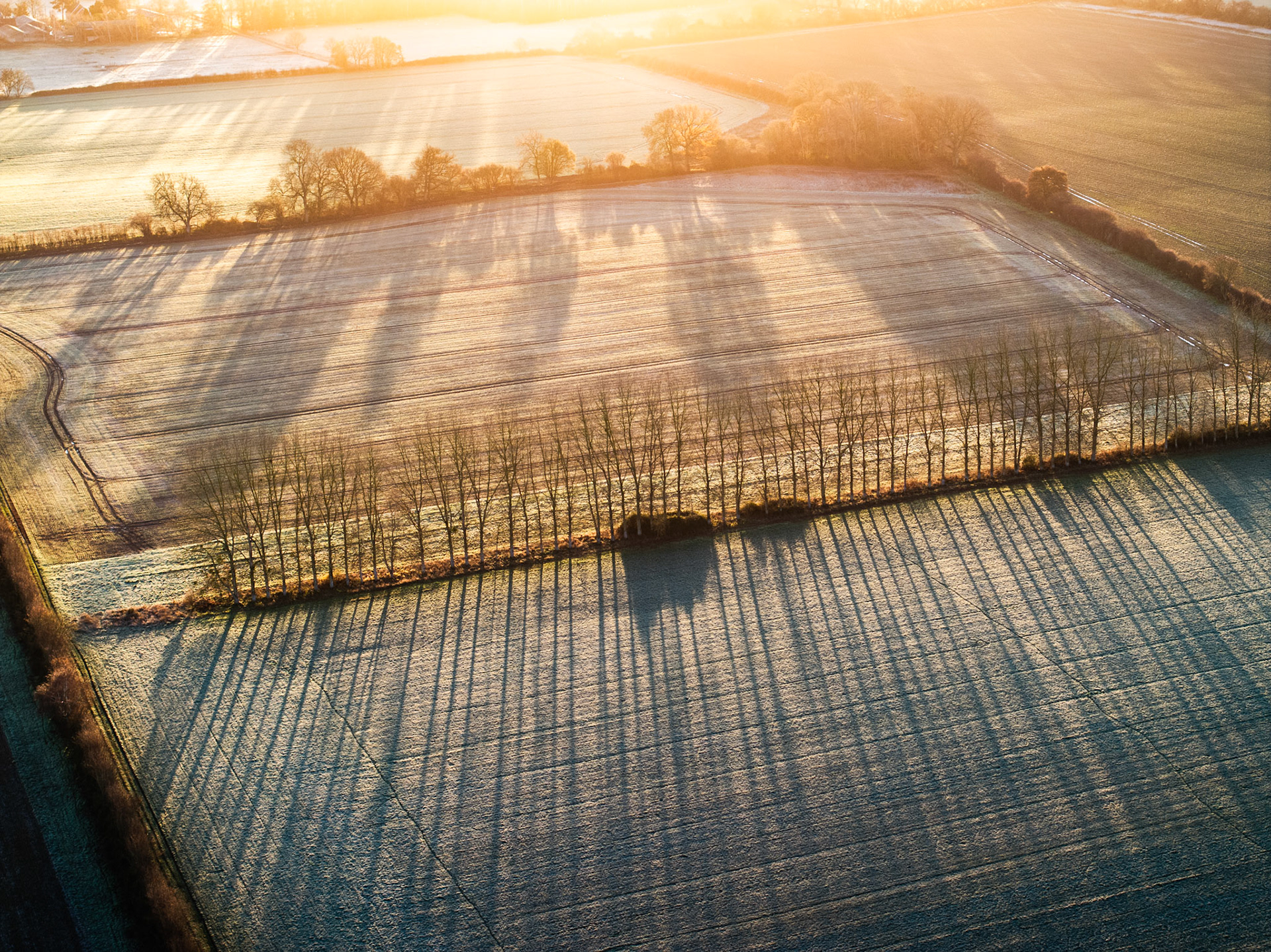
A line of bare-branched trees divides two frost-covered arable fields near Abingdon-on-Thames, their shadows cast in long parallel bars across the frozen ground by a low winter sun breaking from the upper frame. The aerial perspective flattens the geometry into near-abstraction, the warm backlight dissolving into cool silver where frost persists in shadow. Crop striations and field boundaries reinforce the graphic structure without competing with the dominant shadow pattern.
A country road emerges briefly from a low fog inversion blanketing the Thames Valley near Wallingford, Oxfordshire. Golden-leafed trees catch the first winter light above the mist, their canopies isolated like islands in a slow-moving sea of cloud. The aerial vantage transforms a familiar agricultural landscape into something close to abstraction.
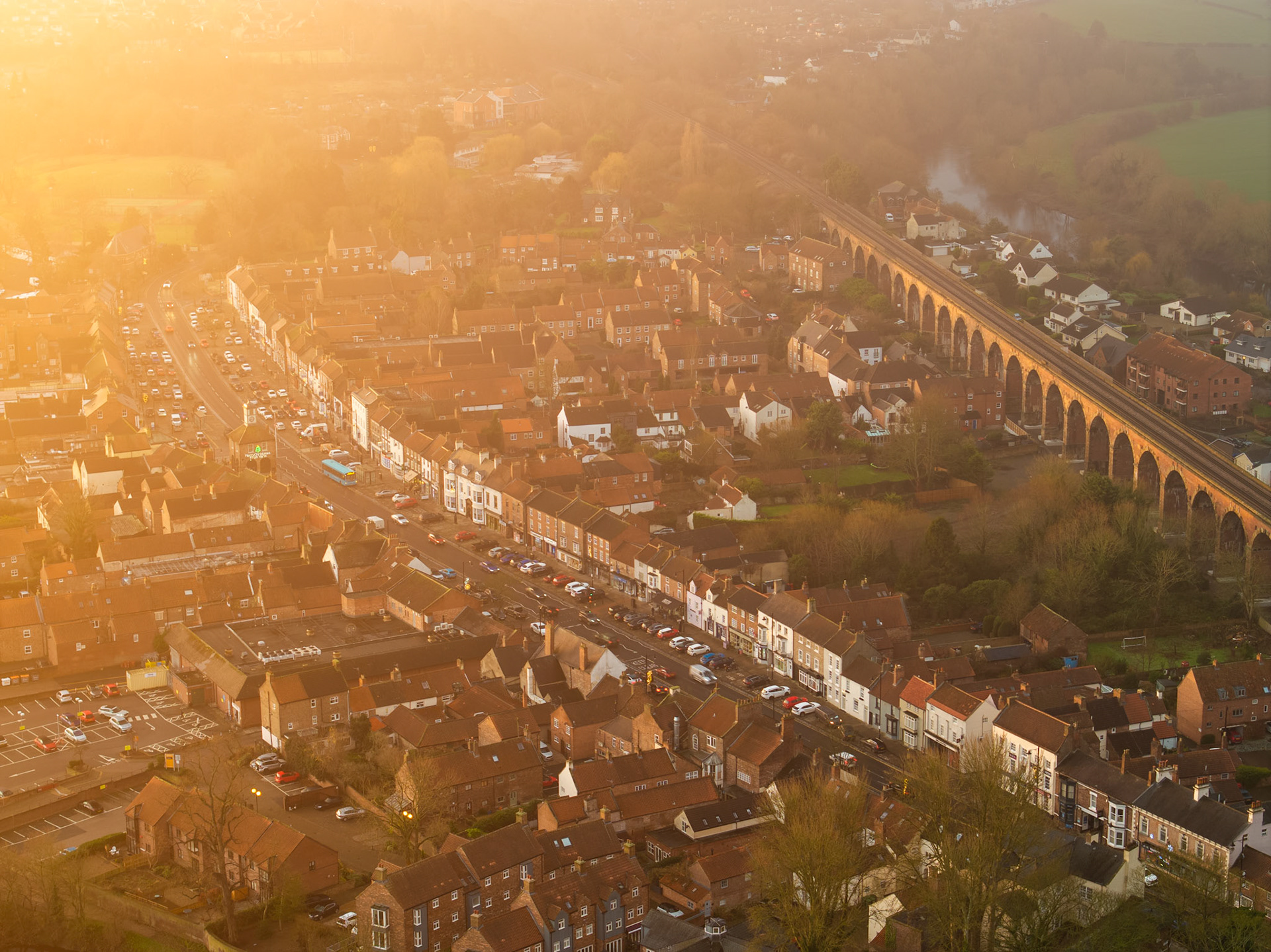
A Victorian railway viaduct arcs through a dense English market town, caught from altitude in the amber haze of a winter morning. The warm light unifies rooftops, high street, and arches into a single tonal plane, while mist softens the tree line to the north.
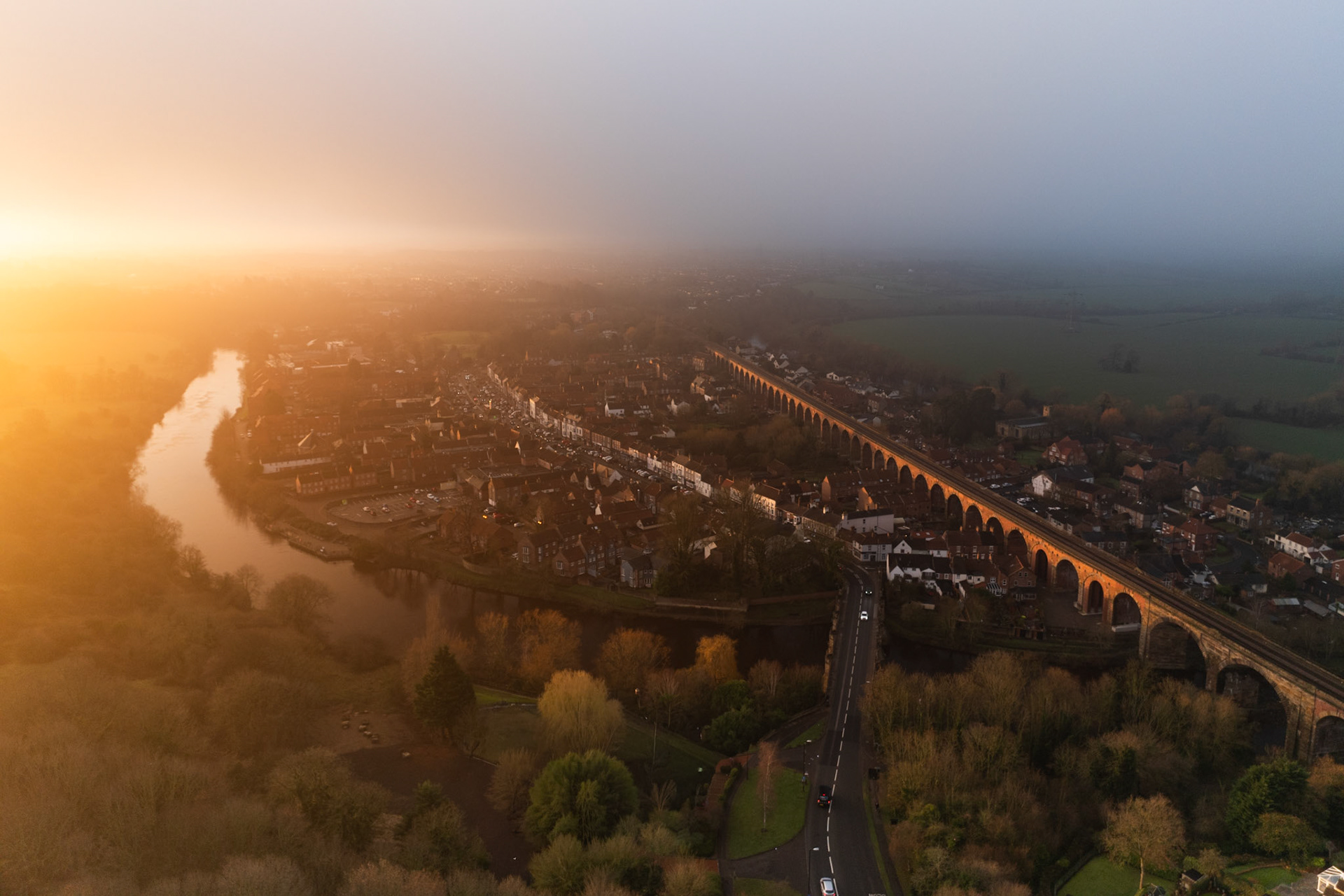
A Victorian railway viaduct bisects a river-bend market town as winter sunrise burns through low mist from the west, splitting the scene into warm gold and cool grey. The meander of the River Tees catches the light in a long reflection, anchoring the composition against the receding fog. Captured from altitude, the image holds a rare coincidence of architecture, weather, and light.
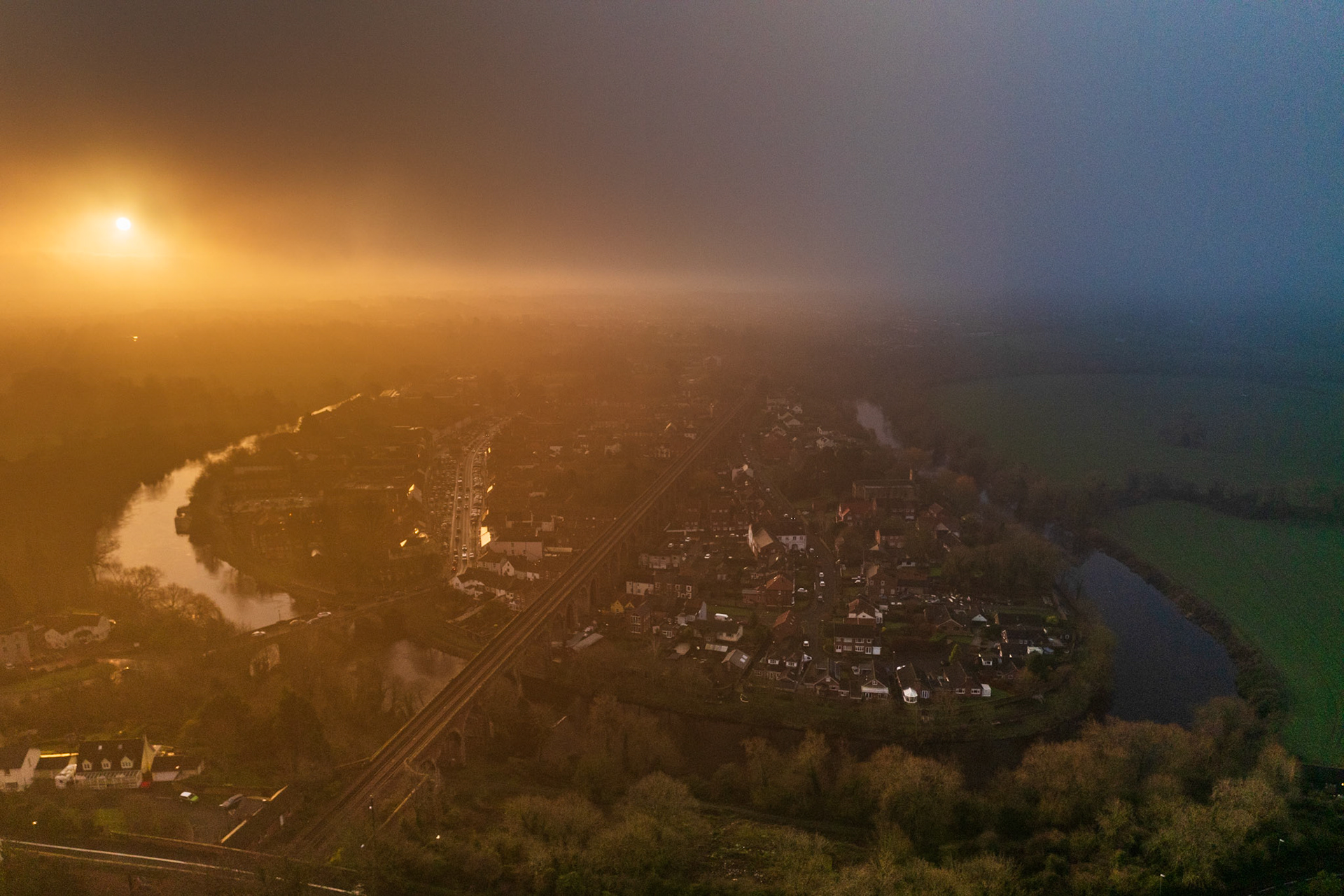
A temperature inversion splits the frame in two above a small English town encircled by a meandering river, the rising sun burning amber through fog to the west while cold blue shadow holds the eastern half. Captured from altitude in mid-winter, the hard colour boundary bisecting the scene gives the image its structural tension. Railway lines cut diagonally through the townscape below, grounding the aerial perspective.
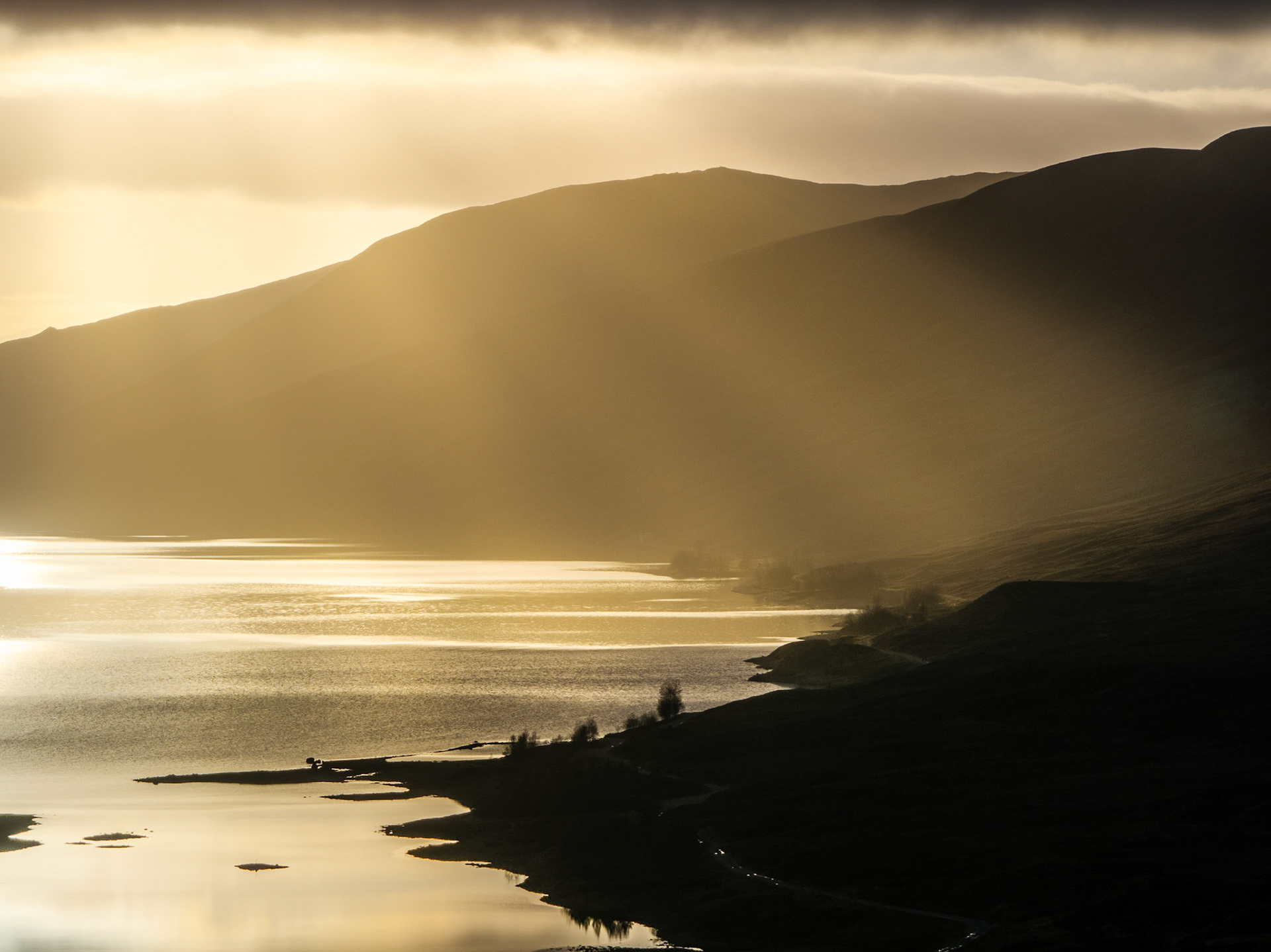
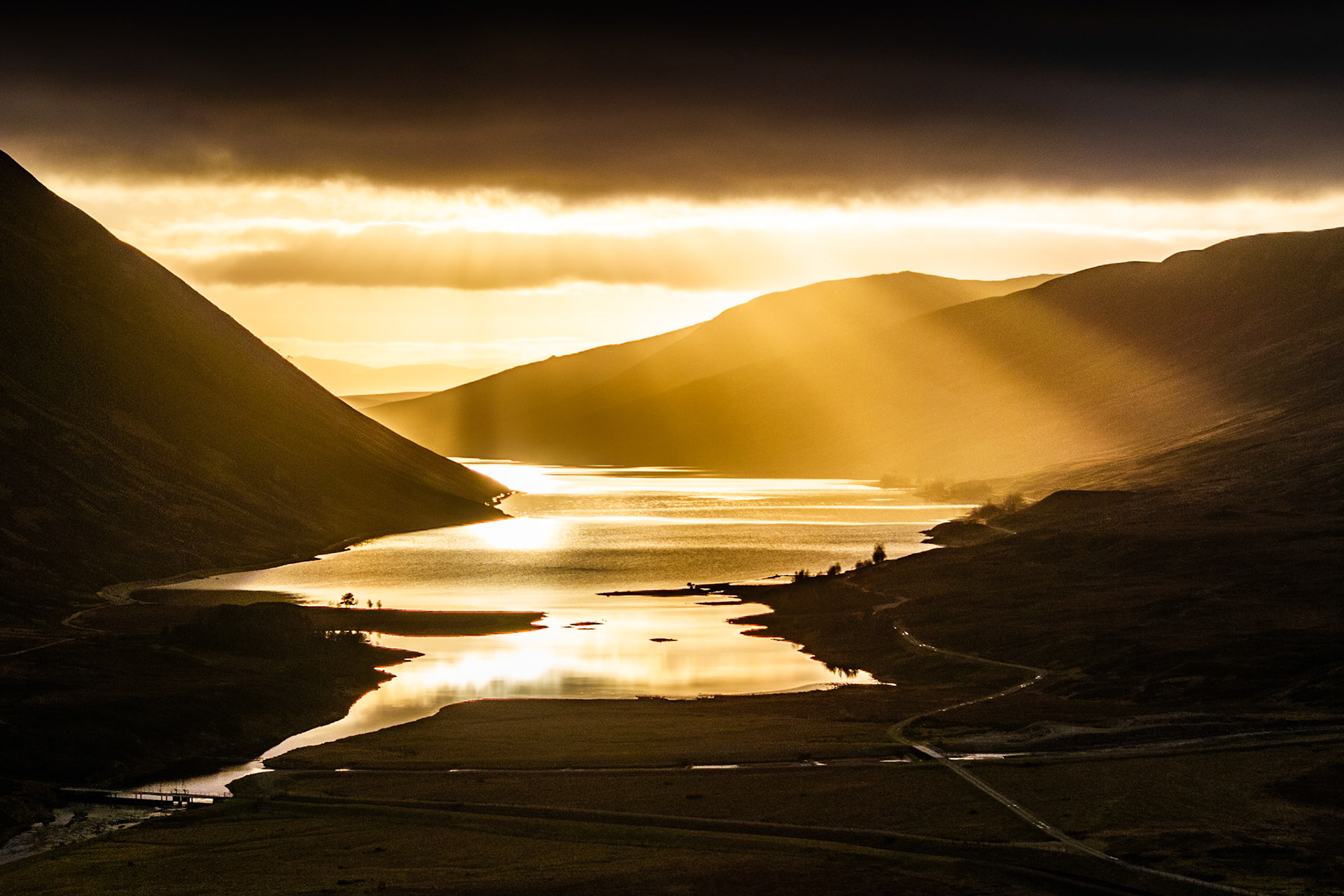
Crepuscular rays break through low cloud above a Scottish loch near Pitlochry, casting raking winter light across silhouetted hillsides and silver water. The aerial vantage compresses the shoreline into dark tonal bands against the luminous surface, while mist diffuses the far slopes into near-abstraction. Captured on Christmas Eve at low solar angle, the scene holds both scale and stillness.
Crepuscular rays break through storm cloud above a Scottish loch near Pitlochry, casting raking winter light across still water and silhouetted hill flanks. The elevated viewpoint compresses the valley, aligning the loch's surface reflections with the source light in a single receding axis. Shot on Christmas Eve at low solar elevation, the geometry of cloud, mountain and water is unusually resolved.
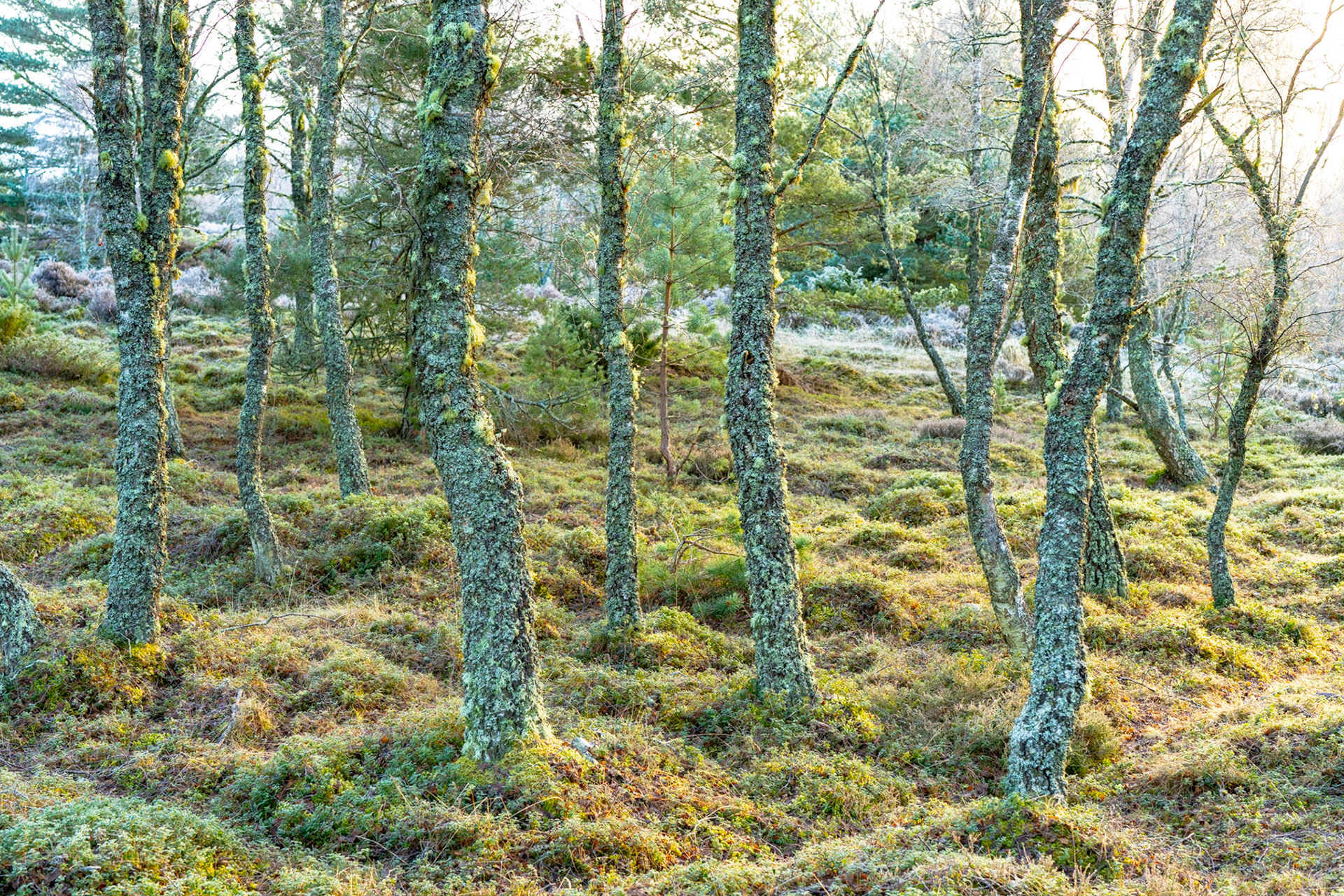
Lichen-encrusted birch trunks rise from a frost-touched understorey of heather and bilberry, the pale winter light filtering through bare canopy from the right. The repeating verticals create a quiet rhythm without resolving into a single focal point.
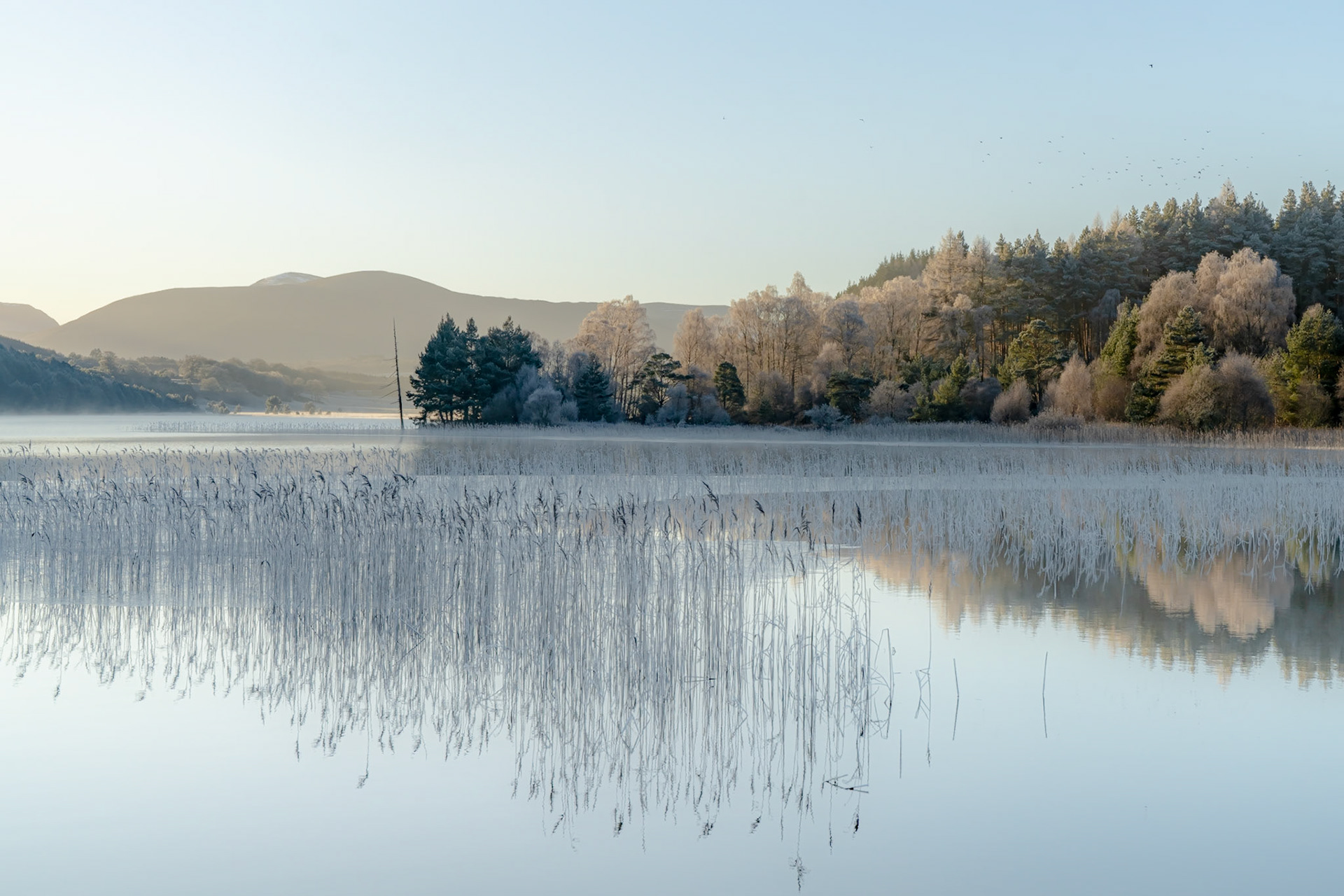
A hard frost coats the birch and pine woodland fringing a Highland loch on a windless winter morning, the frosted canopy reflected almost perfectly in water broken only by emergent reed stems. Ground mist lingers above the surface, softening the distant hills and lending the scene an unusual quietness for midday light.
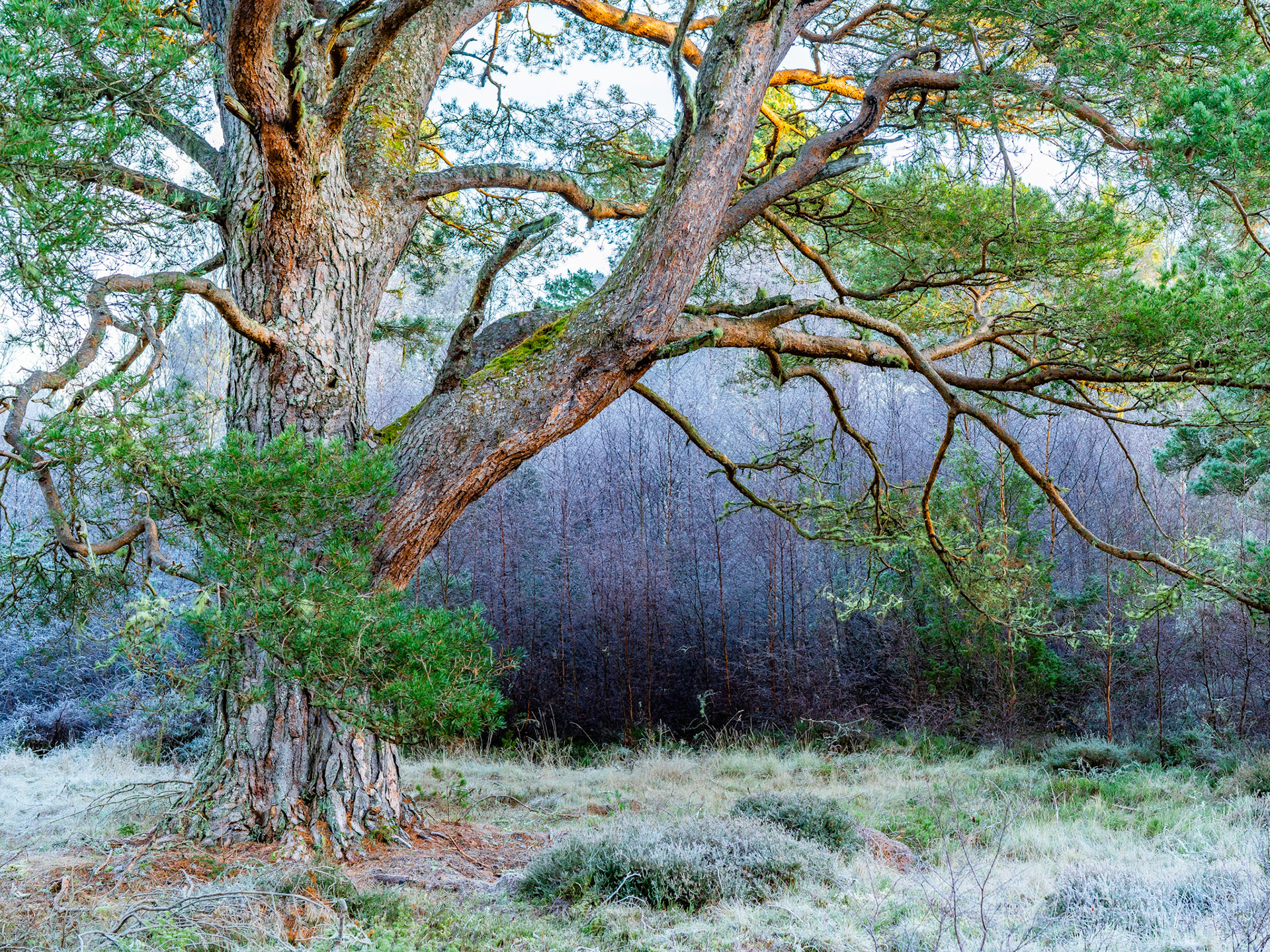
A veteran Scots pine dominates the foreground, its deeply furrowed bark and sweeping lateral branches filling the frame against a frost-bleached understorey. Behind, bare deciduous stems recede into cool shadow, contrasting with the pine's retained green canopy. The frost on grasses and heathland vegetation places the image firmly in a cold, still midwinter morning.
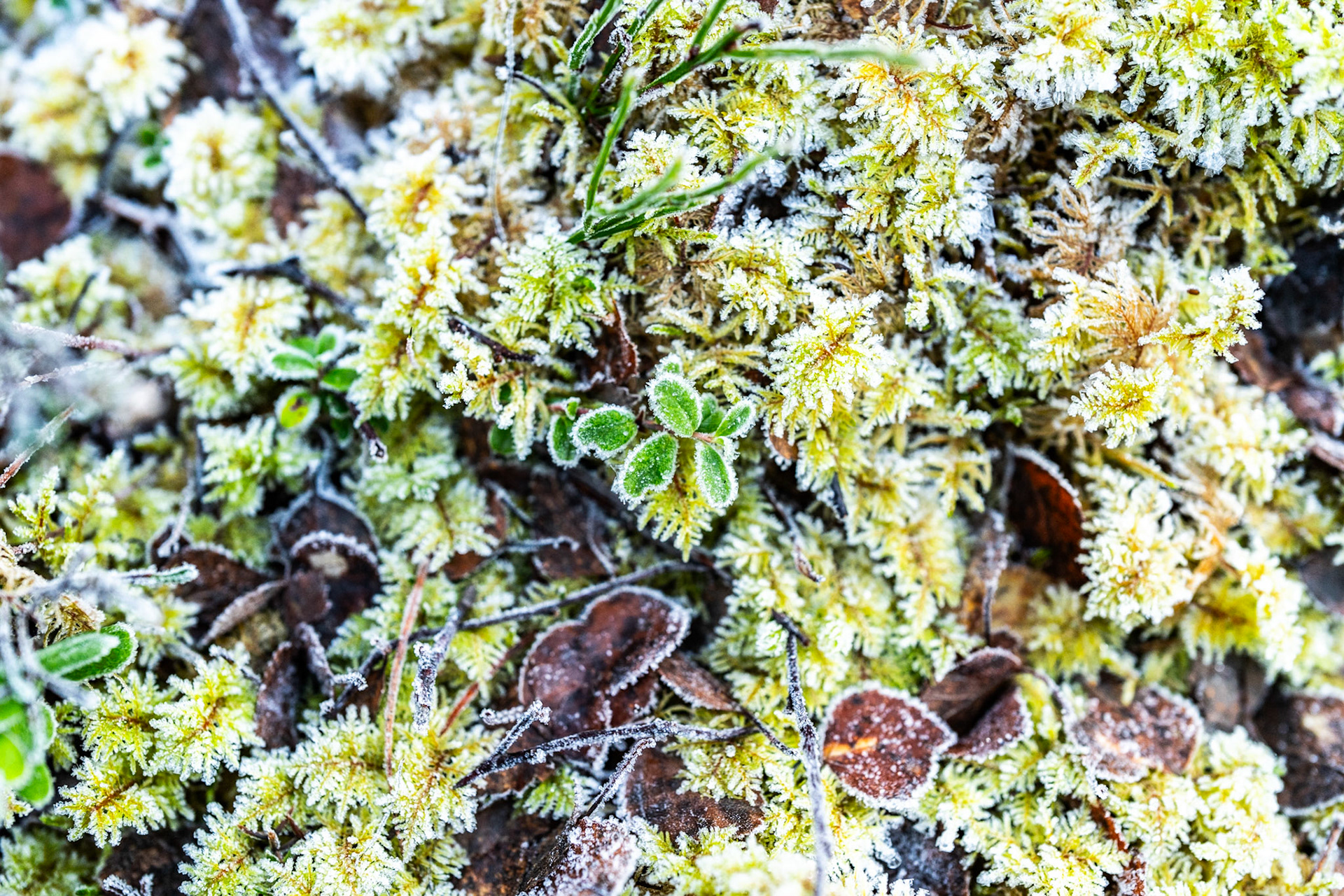
Hoarfrost coats a dense mat of woodland-floor moss, dead leaves, and a small rosette plant on a winter morning. The tight framing reduces the scene to texture and colour contrast — lime green against frost-white and dark leaf litter. Captured on Christmas Day, the image reads as a close study rather than a composed statement.
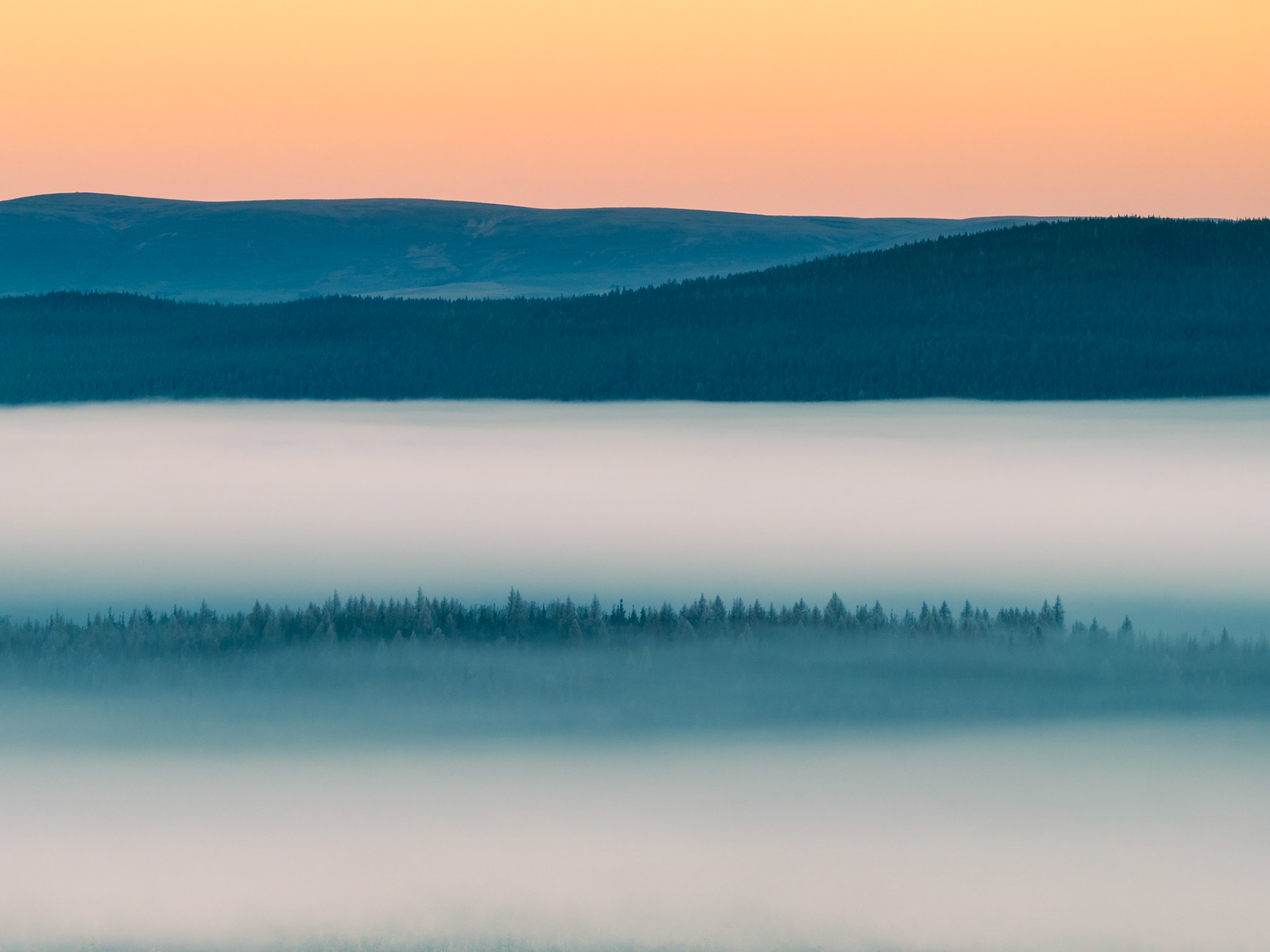
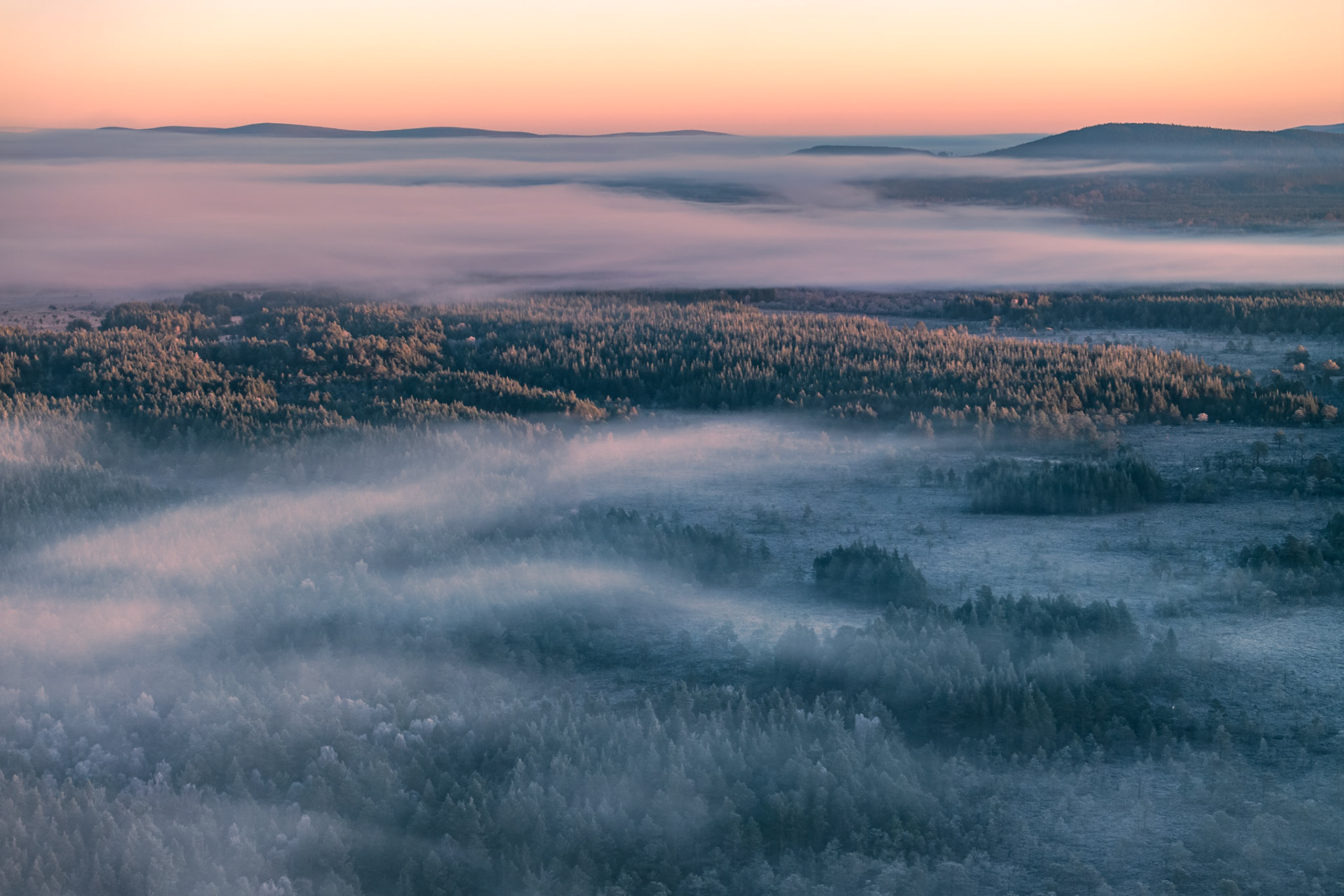
A temperature inversion fills the Strathspey valley with dense radiation fog at dawn on Christmas morning, reducing the conifer forest to a single suspended dark band between tiers of white mist. Shot from elevation above Nethy Bridge in the Cairngorms, the image resolves into four horizontal planes — fog, treeline, forested ridge, and a peach afterglow sky — with near-perfect tonal separation between them. The restraint of the composition and the stillness of the light give the scene an almost monochromatic quality despite the colour present.
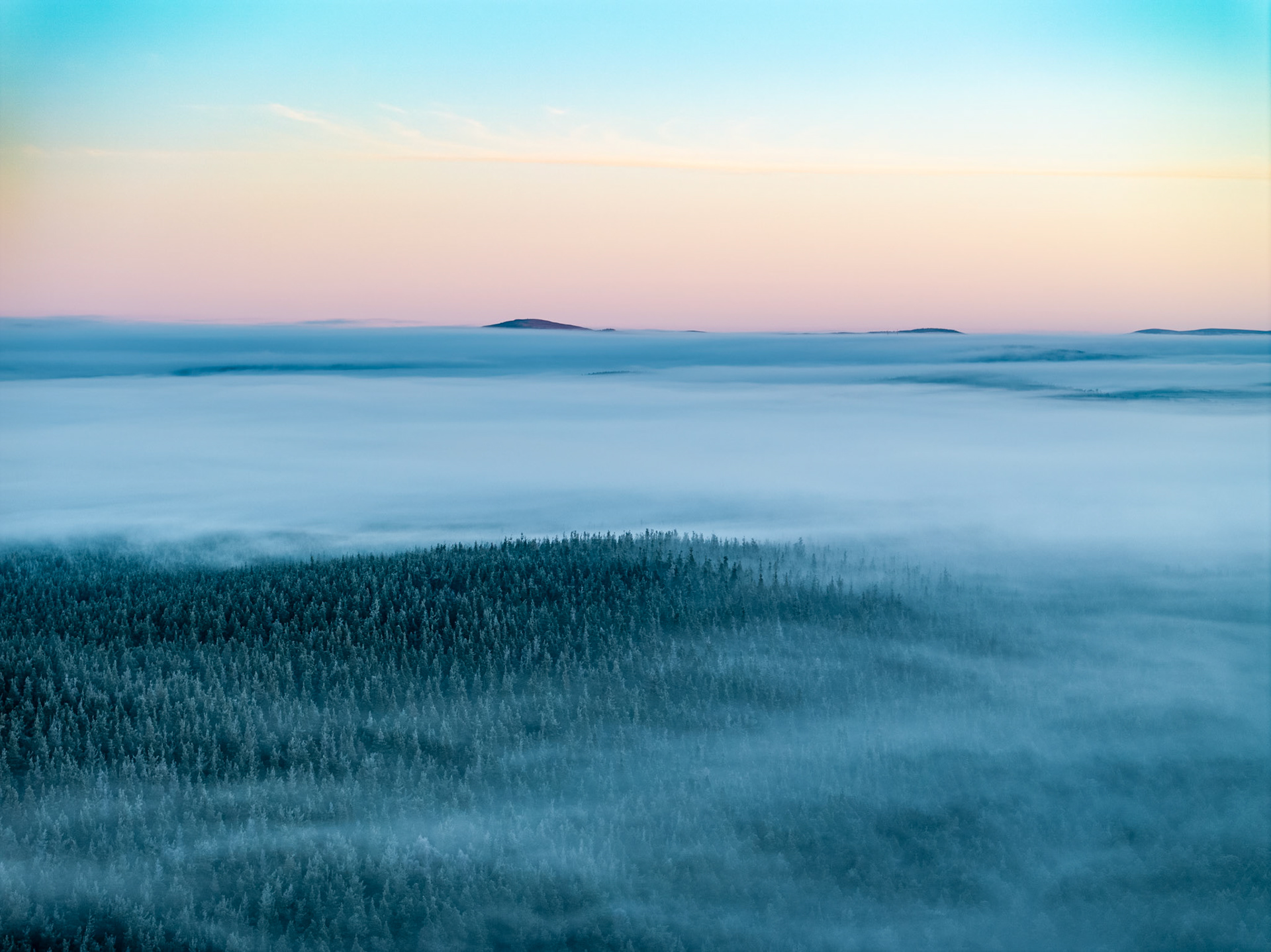
A temperature inversion smothers the Strathspey basin at dawn on Christmas morning, leaving only the frosted crowns of boreal conifers breaking the fog surface near Nethy Bridge. Isolated hilltops emerge as islands in the middle distance, and the sky grades from rose-pink at the horizon through pale cyan overhead. The aerial perspective compresses the layers into a near-abstract register of cold blue and white.
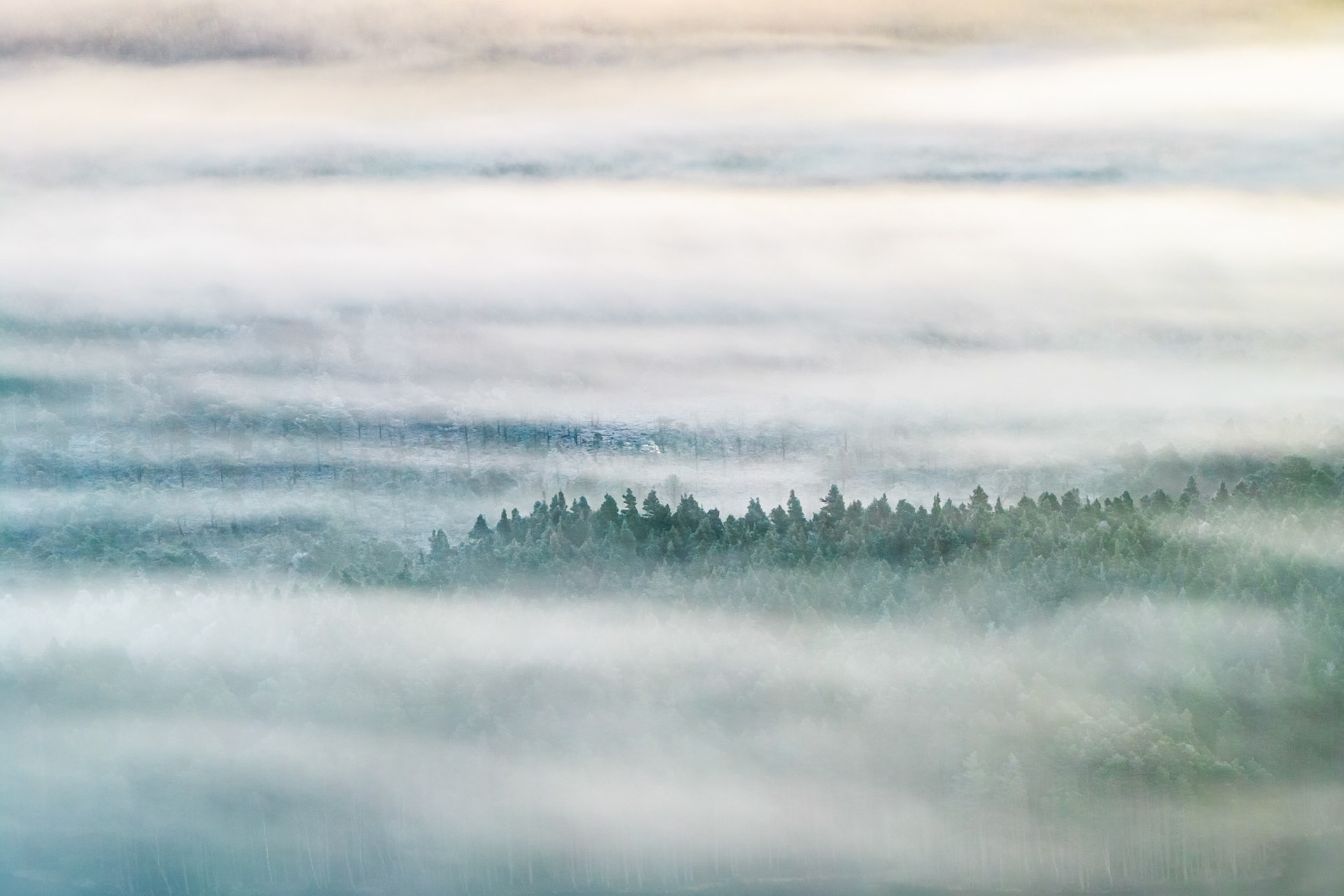
Layers of valley mist envelop a conifer ridge above Boat of Garten on a winter morning, reducing the forest to a single dark horizon between bands of moving cloud. Shot from altitude during a temperature inversion, the compression of the telephoto lens dissolves the landscape into near-abstract horizontal planes of grey, white, and muted green. The restrained palette and the slim reveal of treetops give the image a quality of suspension, as though the forest is surfacing rather than being submerged.
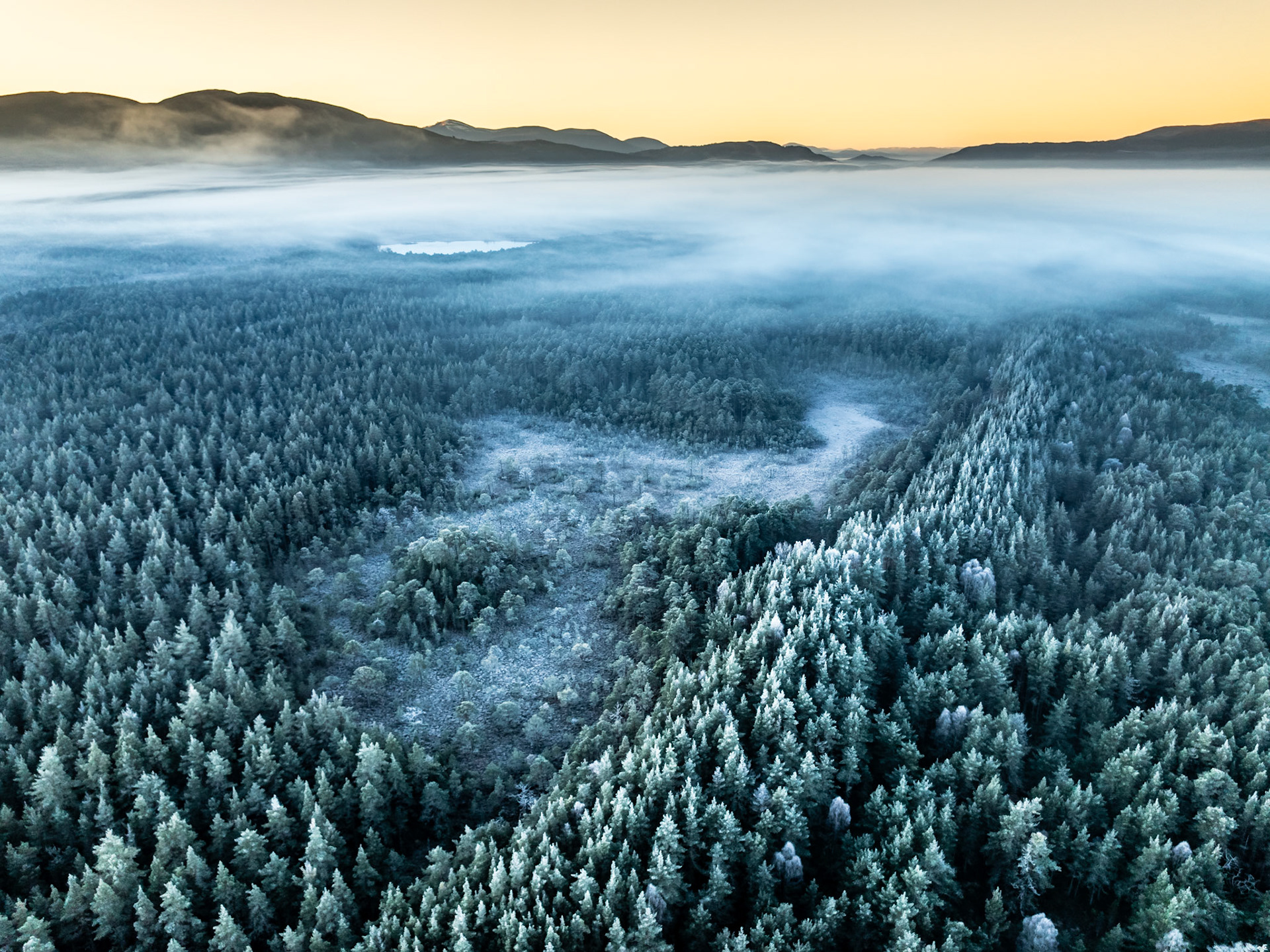
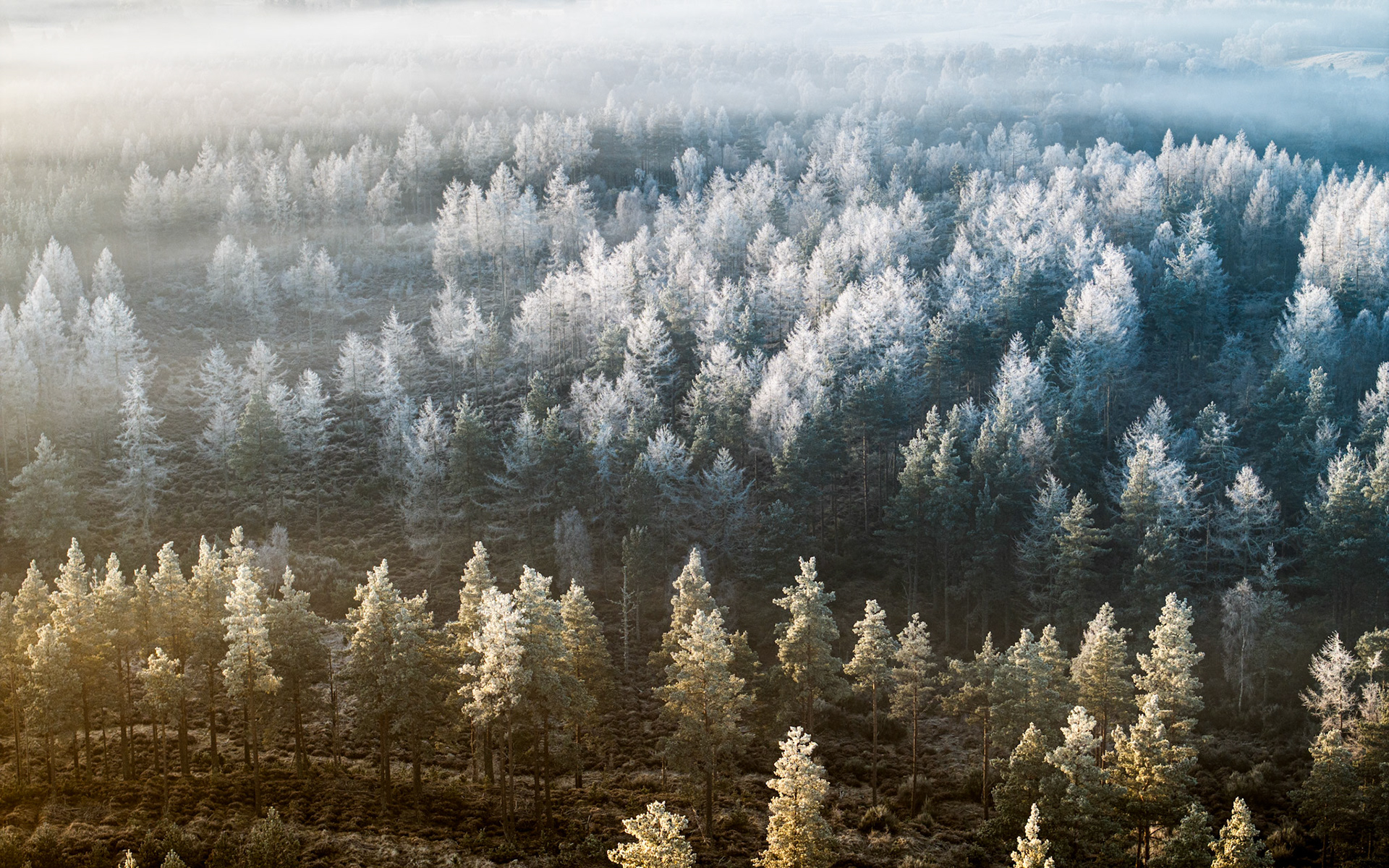
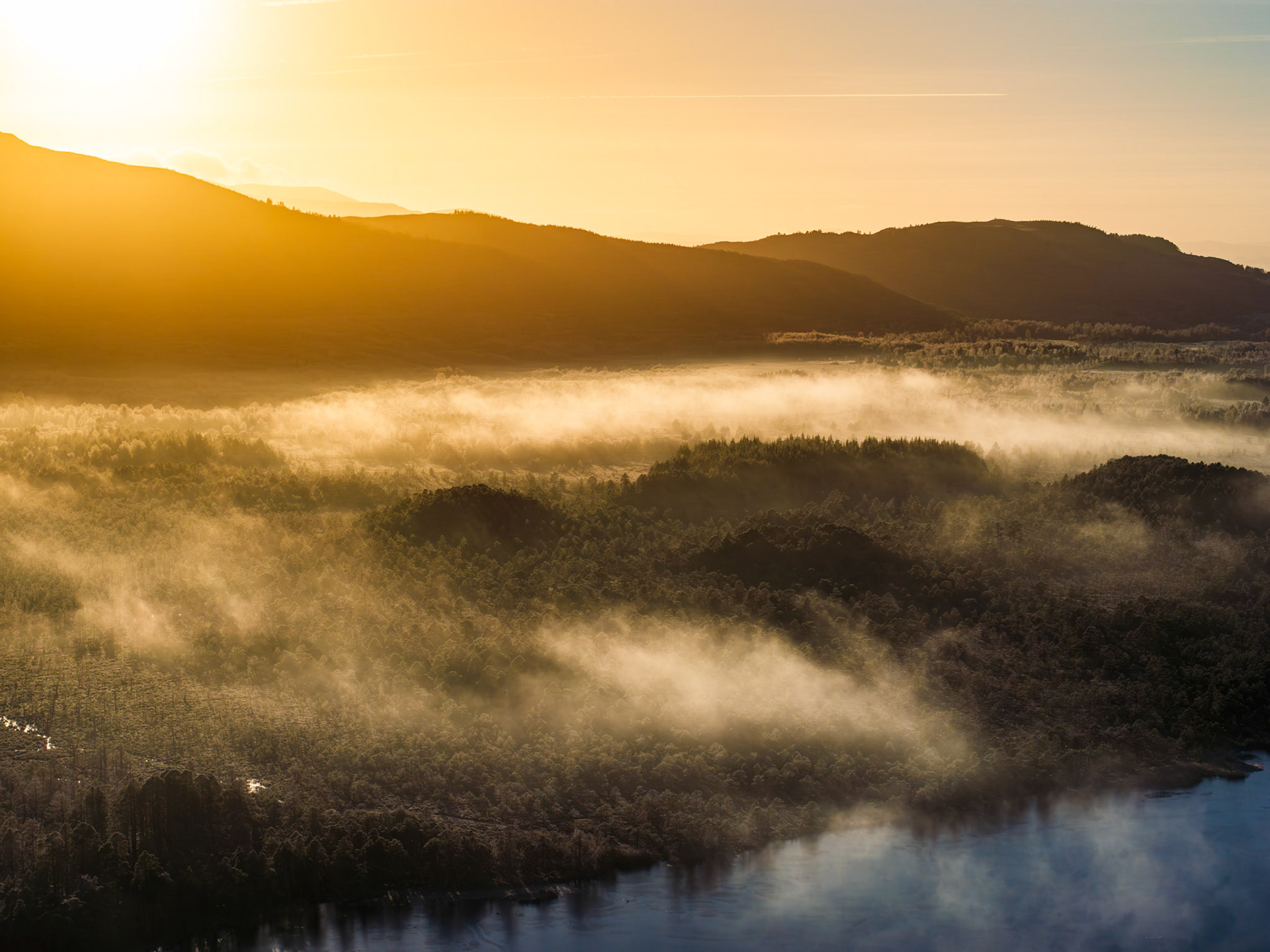
A temperature inversion fills the straths of the Cairngorms at dawn on Christmas morning, submerging the lower glens in fog while Scots pine forest, heavy with hoarfrost, emerges above the cloud line. A frozen lochan glints through a gap in the mist near Boat of Garten, with the profile of the Cairngorm plateau silhouetted against a pale amber horizon. The colour contrast between the warm sky and the blue-grey frost-laden canopy gives the frame unusual tonal range for an aerial winter shot.
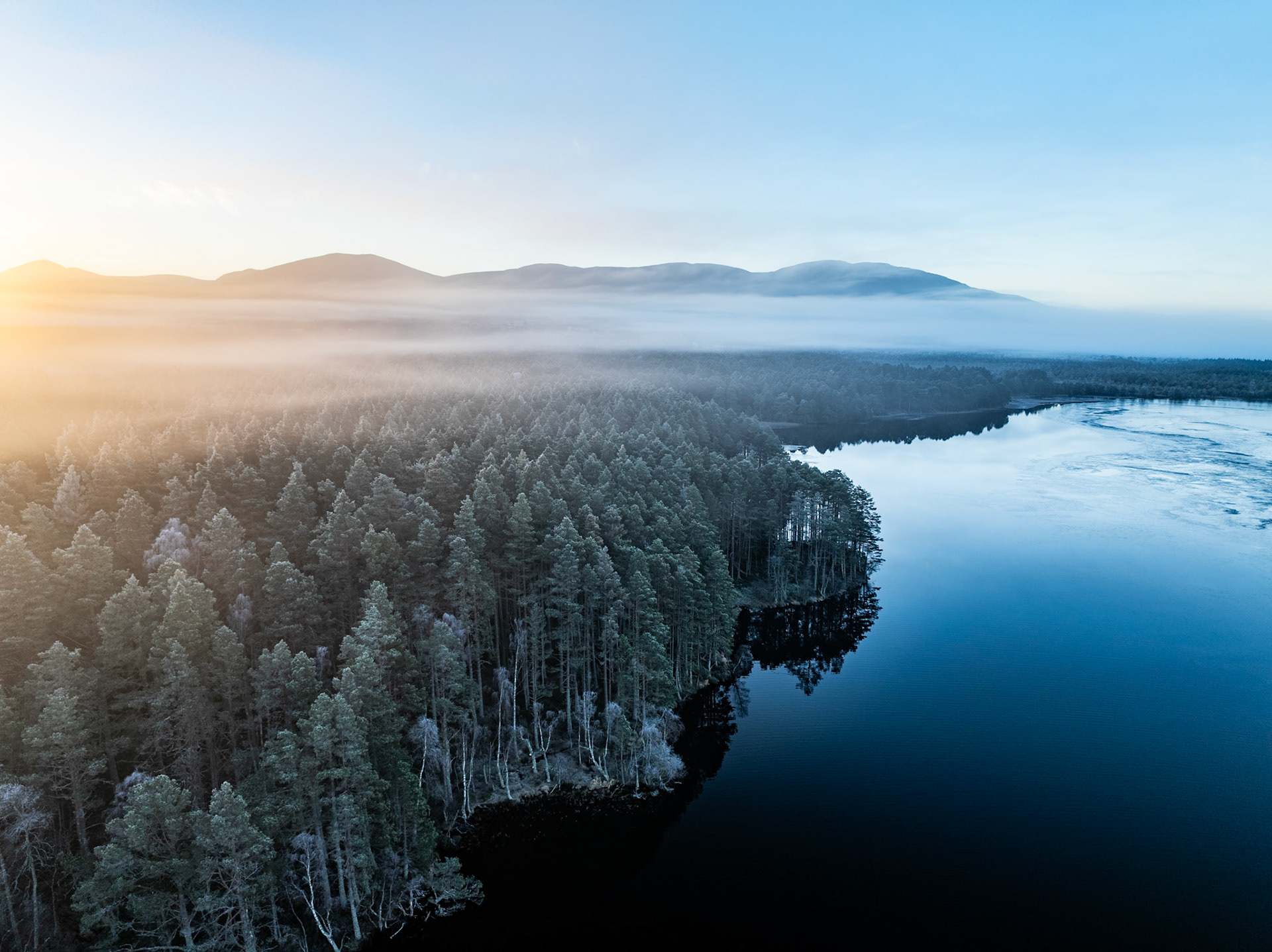
A low temperature inversion smothers the Caledonian pinewoods bordering a still loch in the Cairngorms on a December dawn, the Cairngorm plateau emerging as a dark silhouette above the fog layer. Frost on the upper canopy catches the first raking light from the south-west while the water surface holds a near-perfect reflection of the mist ceiling. The composition resolves the tension between warmth and cold through the diagonal forest edge cutting across the frame.
A temperature inversion fills the Strathspey valley with layered fog at first light, leaving frost-rimed boreal forest emerging through the mist like islands. The Cairngorm plateau silhouettes break the horizon beneath a pale salmon afterglow. Captured from elevation above Nethy Bridge on a still Christmas morning.
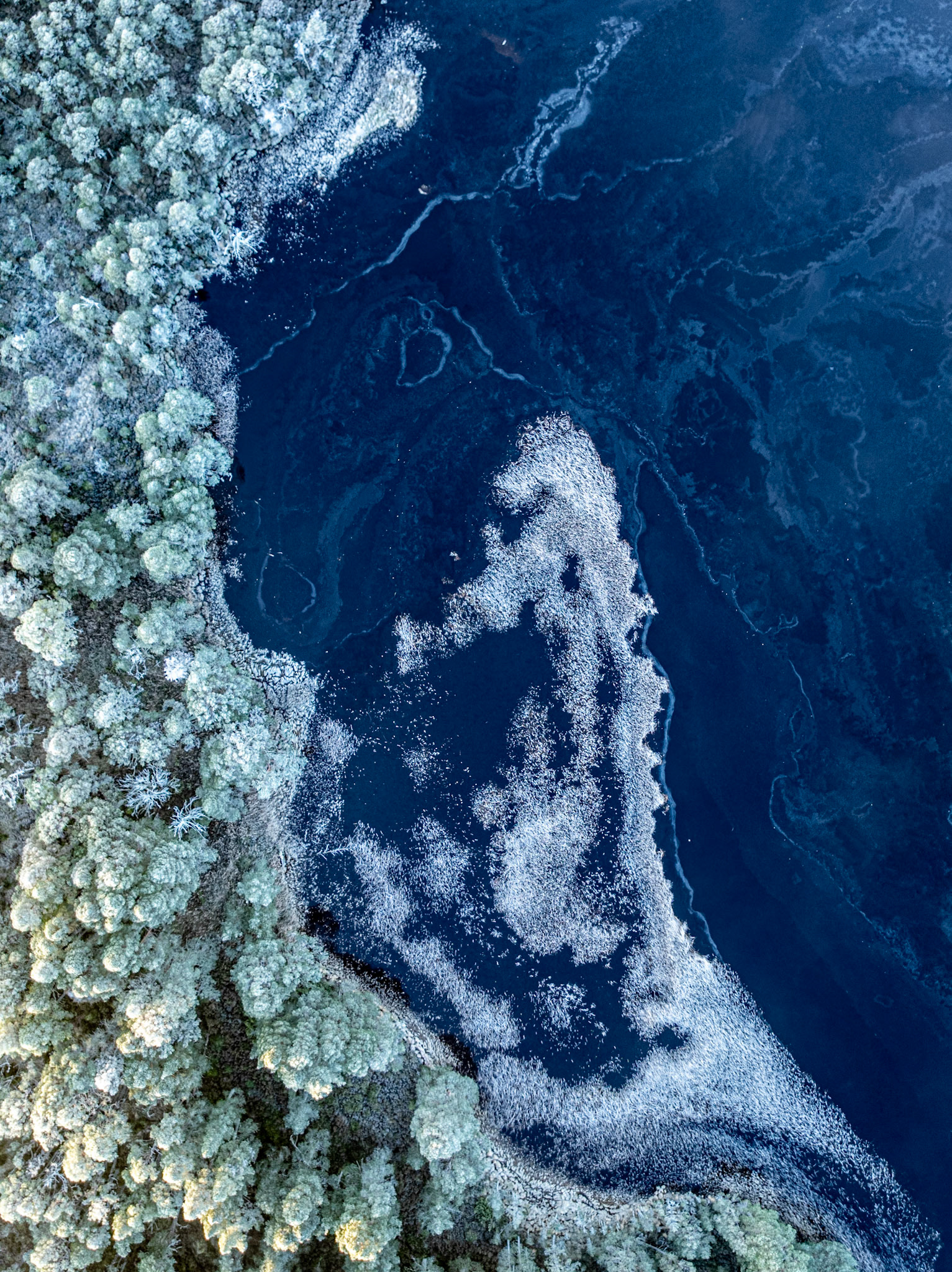
Frost-rimed conifers meet the dark water of a Highland loch at Nethy Bridge, Cairngorms, on a Christmas morning. Fragile ice shelves extend from the treeline into the deep blue water, their organic forms echoing the curvature of the shoreline above. Shot directly overhead, the compressed perspective dissolves the familiar boundary between forest and water into near-abstraction.
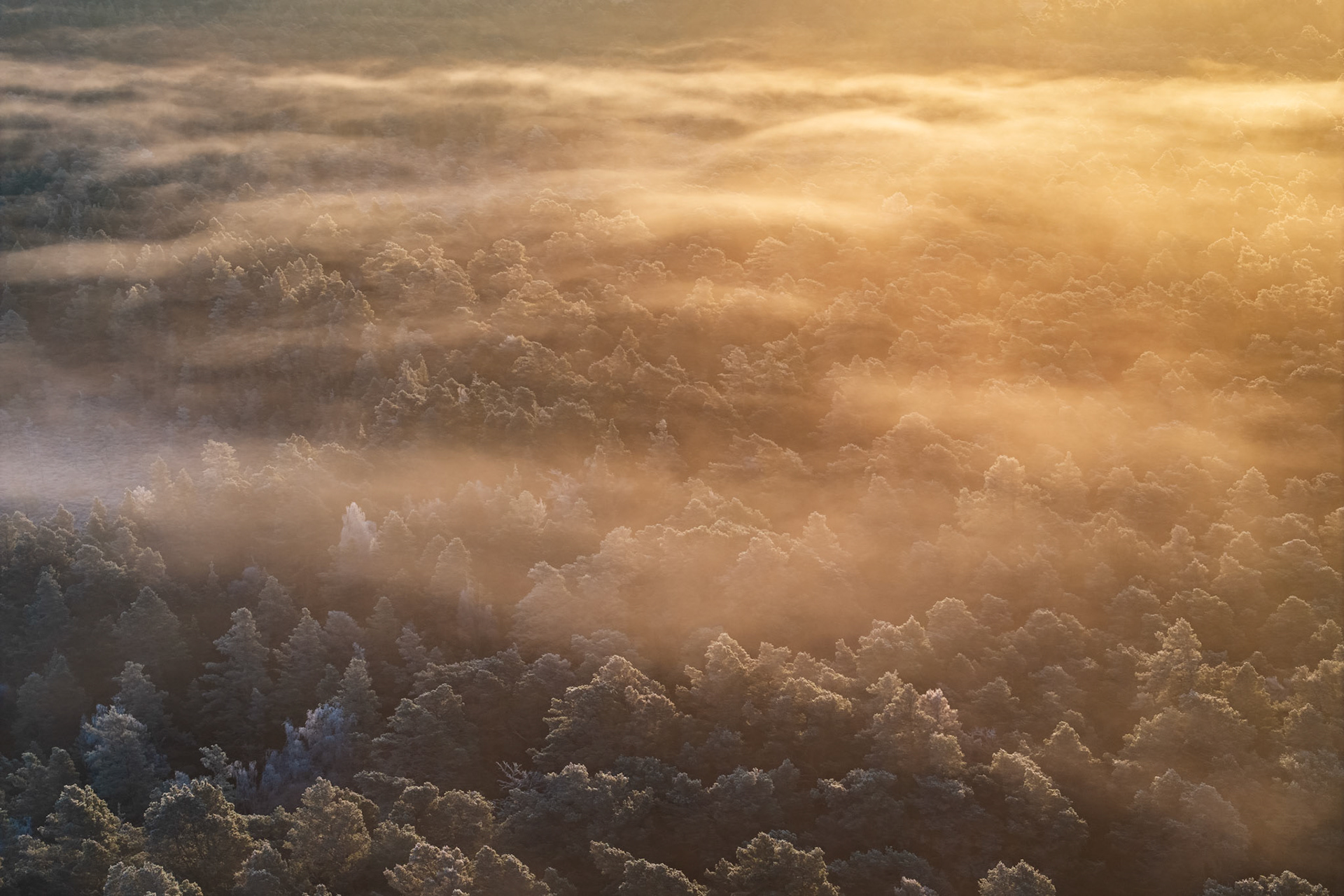
A temperature inversion settles over frost-laden pinewoods in the Cairngorms on Christmas morning, the rising sun dissolving the mist into horizontal bands of amber light. Hoarfrost rims every canopy, softening the distinction between cloud and tree until the forest becomes almost oceanic. Shot from altitude, the image strips the scene to atmosphere and pattern alone.
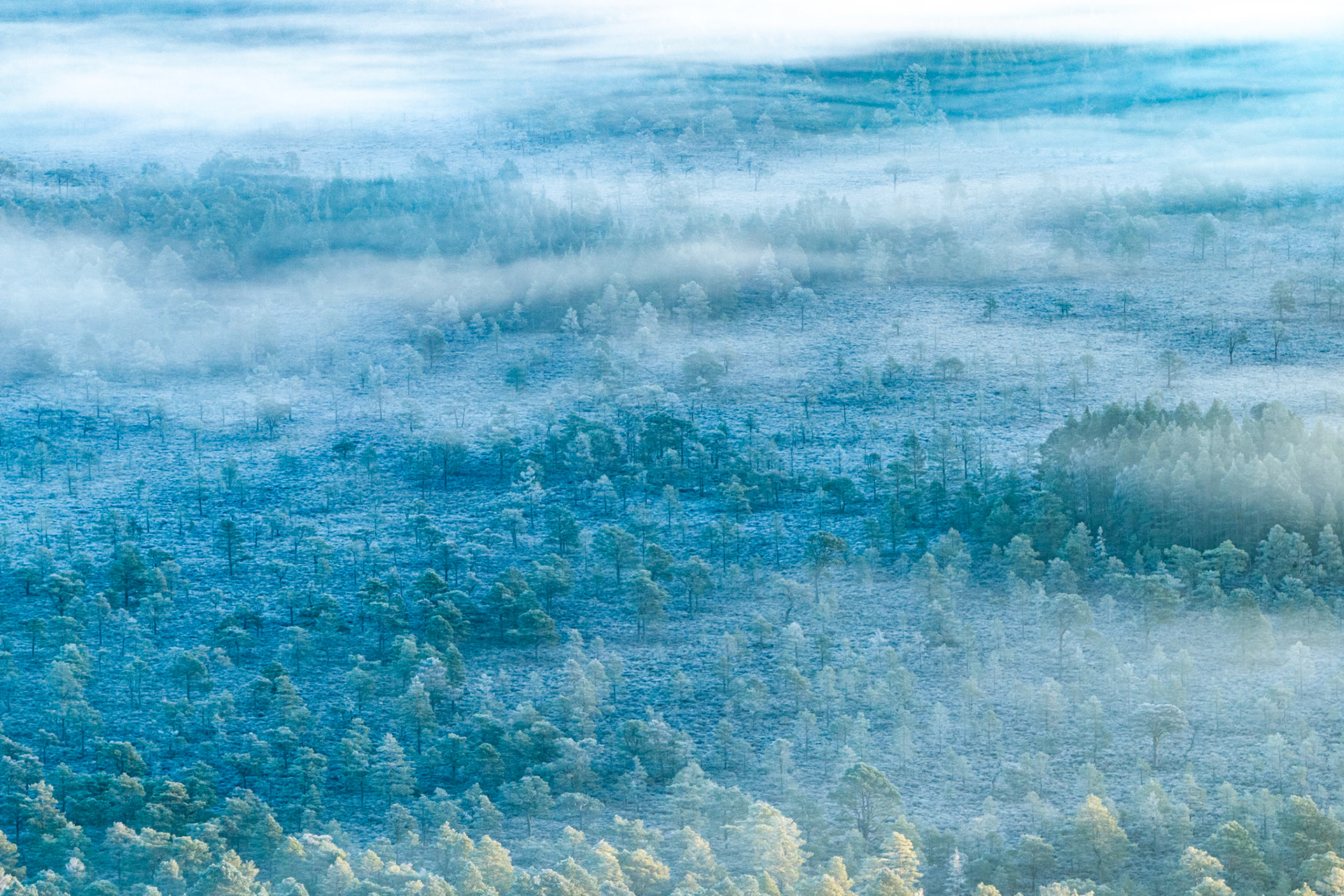
A temperature inversion settles in horizontal bands across a frost-covered boreal bog and scattered Scots pine near Nethy Bridge, Cairngorms, on a winter morning. The mist stratifies the scene into successive planes of blue-white, erasing depth and reducing the forest to a pattern of silhouetted crowns. First light catches the nearest canopy with a faint warmth that offsets the cold blue of the upper layers.
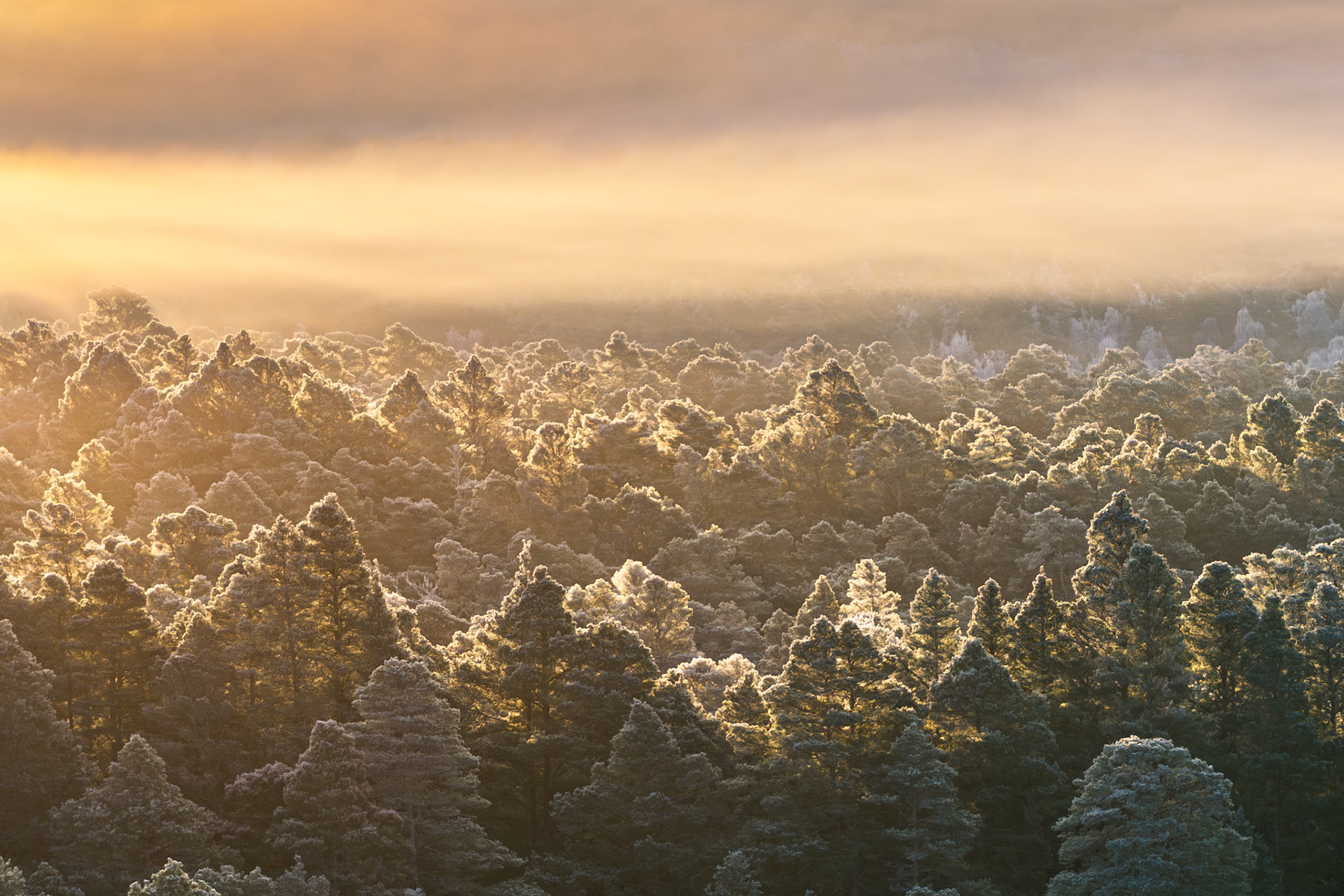
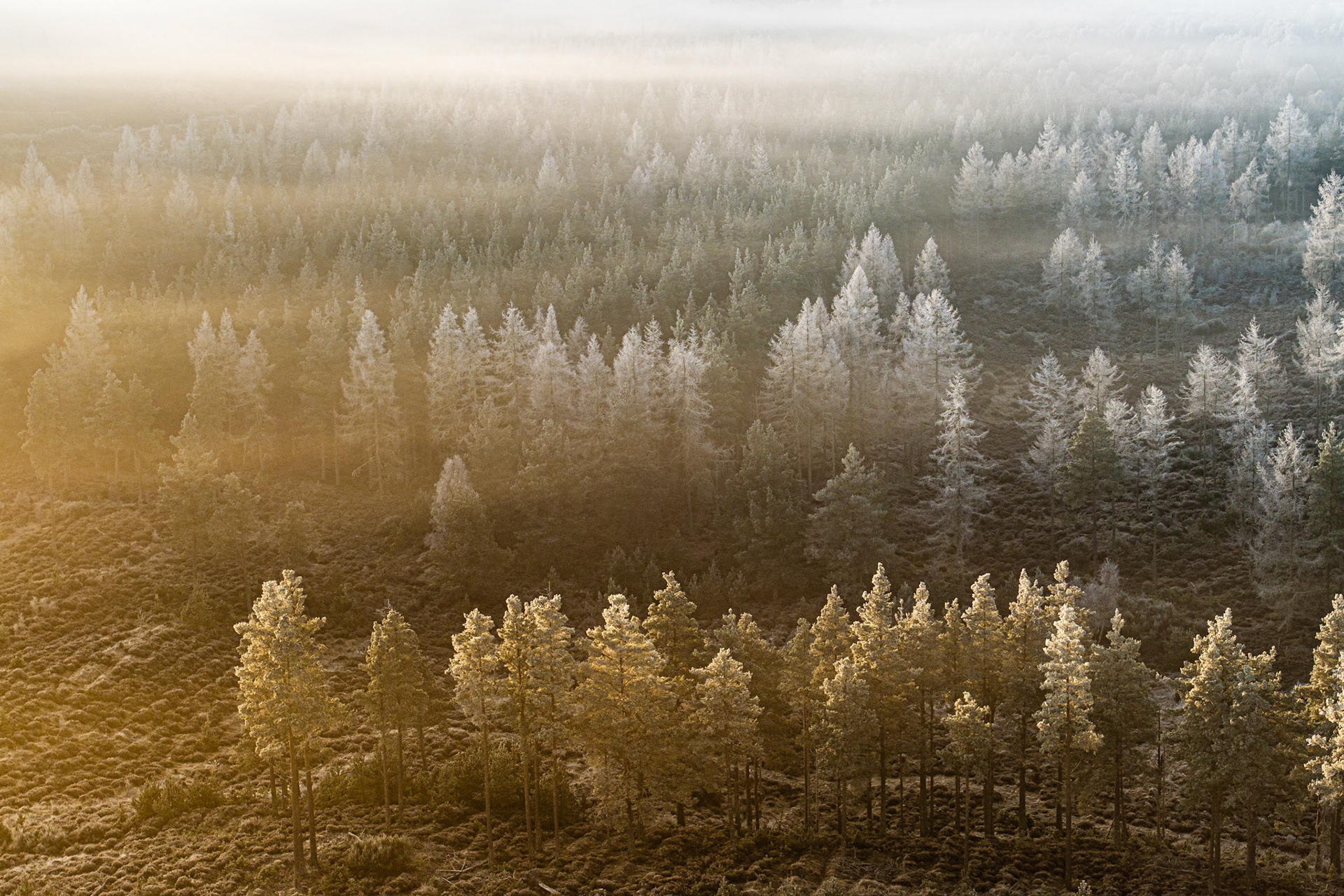
Hoarfrost coats a Scots pine canopy above Nethy Bridge on a winter dawn, the low sun catching each frosted crown against a soft inversion layer that erases the middle distance. The aerial viewpoint compresses the forest into an almost abstract surface of ice and warm light, the mist dissolving the horizon into the sky.
A temperature inversion traps low mist across a Scots pine plantation near Aviemore on a December morning, the hoarfrost catching the low raking light in bands that shift from warm gold at the forest edge to cold silver in the deeper canopy. Aerial perspective flattens the scene into near-abstraction, the tonal gradient reading almost as a single sustained breath held across the trees. Captured Christmas morning 2025, Cairngorms National Park.
A low winter sun catches the leading edge of a frost-covered conifer plantation above Aviemore, the warm raking light dissolving into cold hoar-grey as the eye moves deeper into the fog. Shot from above on Christmas morning, the image reads as near-abstract — a clean diagonal boundary between light and shadow bisecting the forest canopy. The Cairngorms plateau holds its habitual inversion, compressing the atmosphere into a single luminous band.
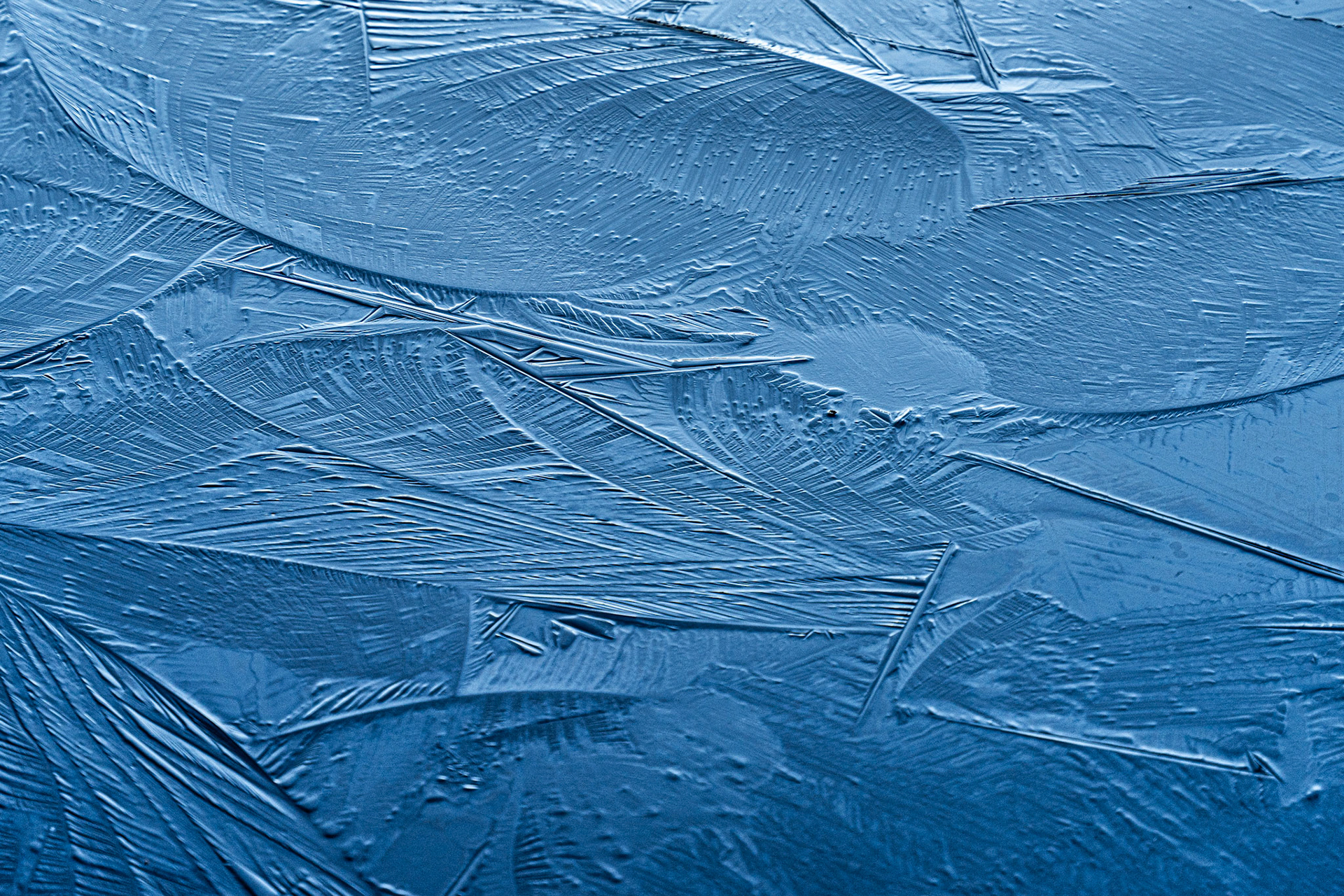
Overlapping sheets of ice crystal formations cover a flat surface, their radiating needle-like dendrites and smooth swept lobes rendered in uniform steel blue. The monochromatic palette and raking light reveal fine surface topography across the frozen plane. Captured at close range, the image reads as pure texture and pattern.
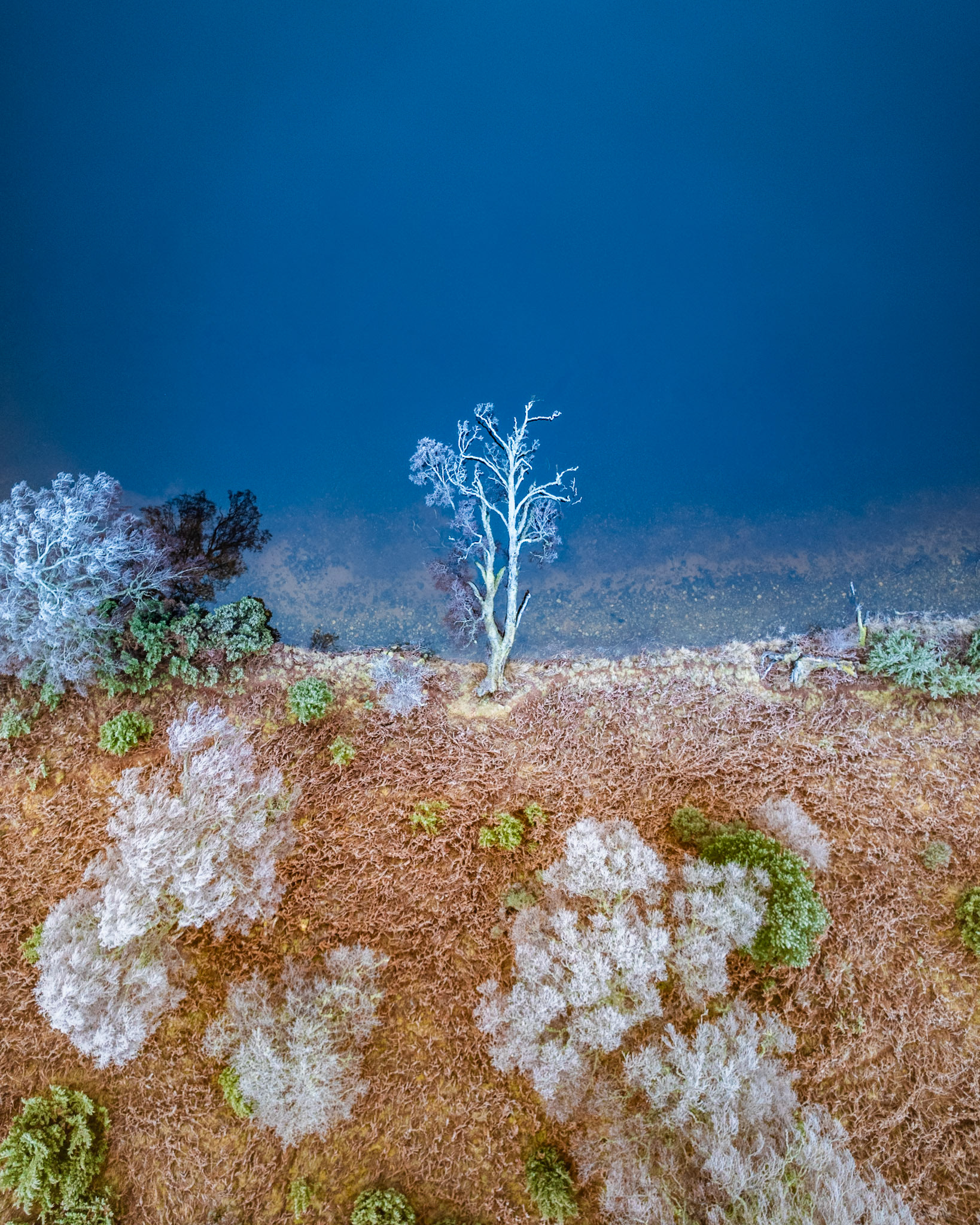
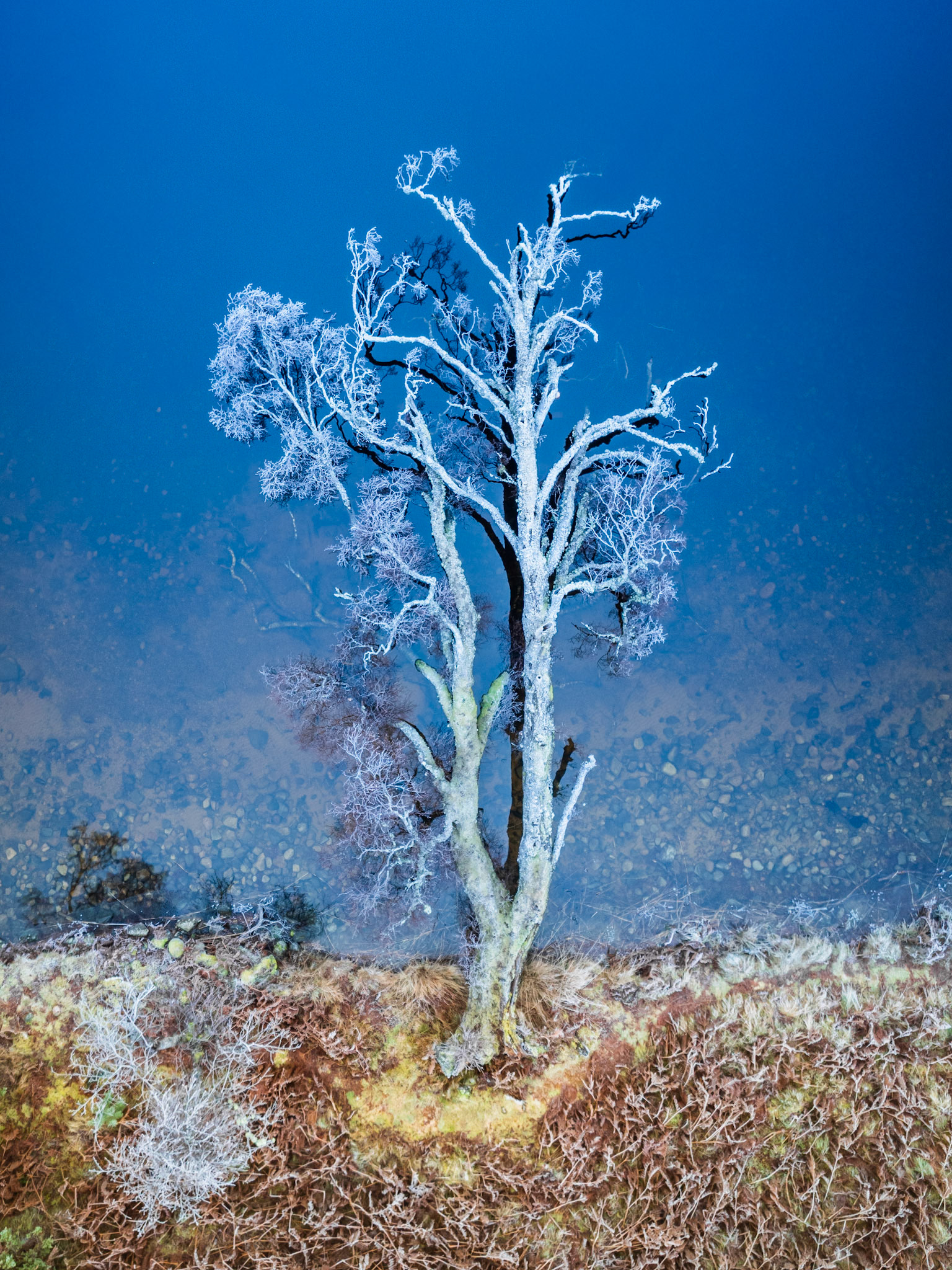
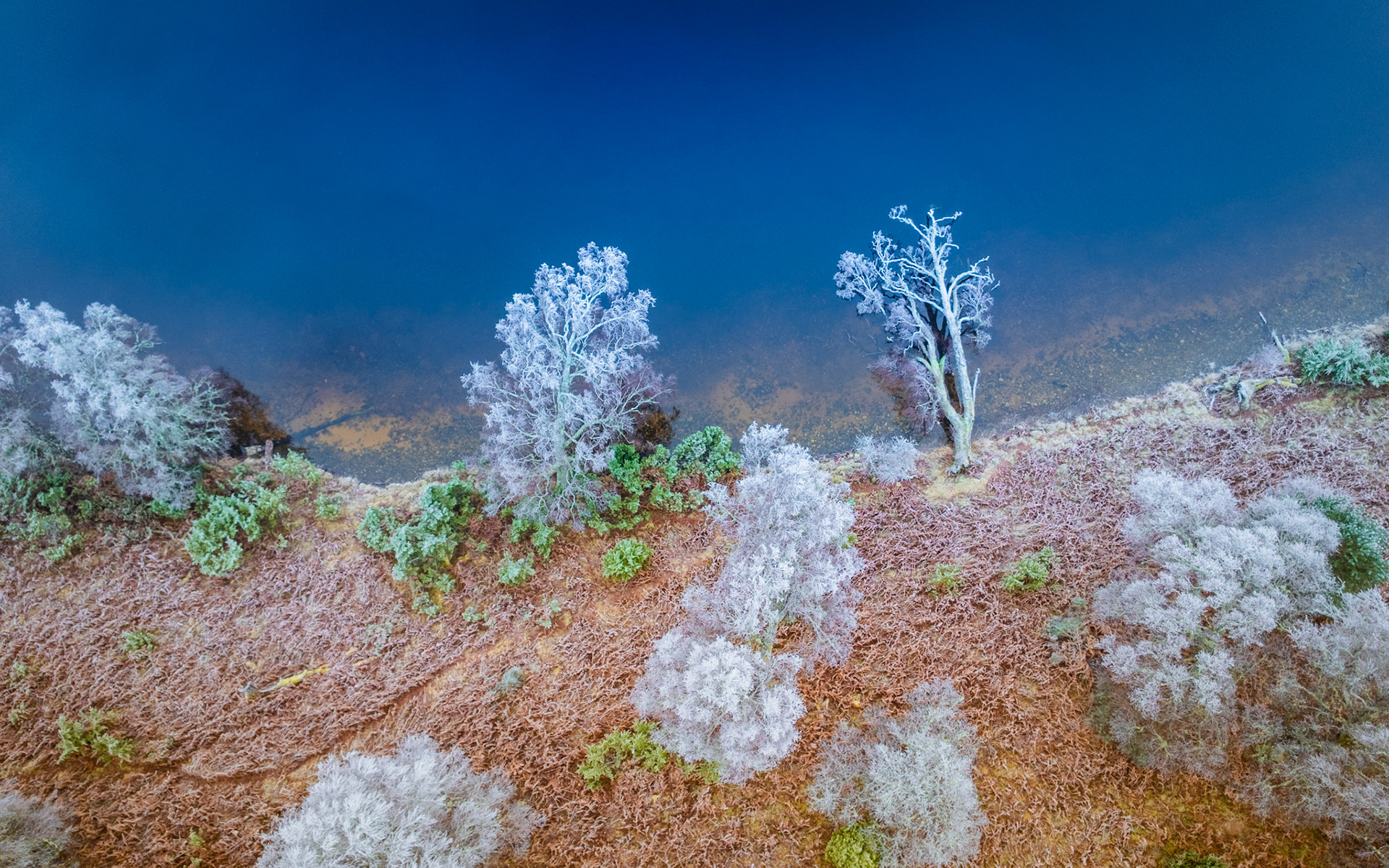
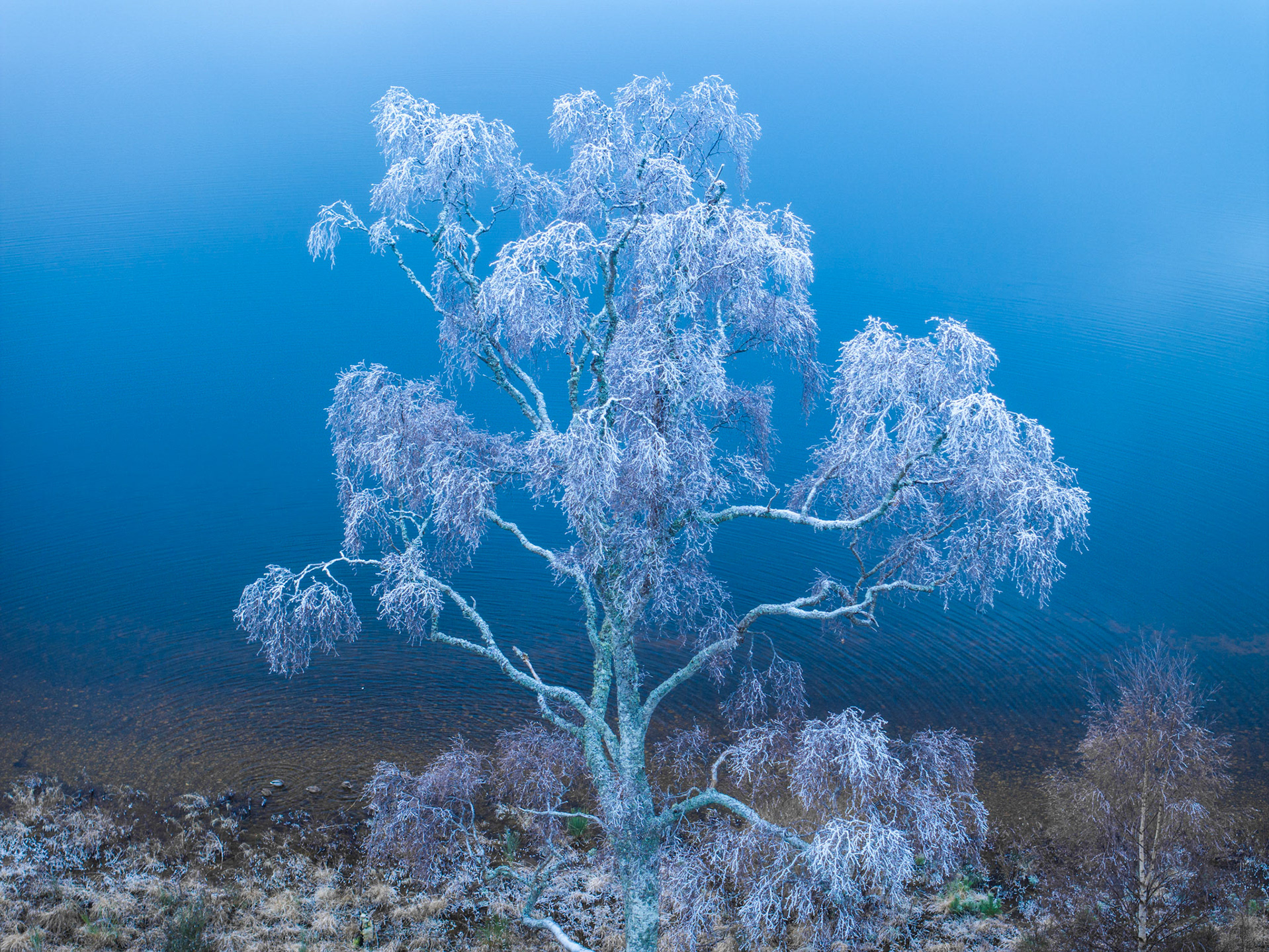
A frost-rimed silver birch stands at the edge of a dark loch on the Cairngorms plateau, its bleached limbs catching the last cold light of a December afternoon. Seen from directly above, the transition from hoar-frosted heather moorland to deep ultramarine water compresses the scene into a near-abstract band of ochre, brown and blue. The lone tree anchors the composition at the boundary between land and water.
A heavily frosted birch stands isolated above a frozen loch surface on the Cairngorms plateau, photographed from directly above in the cold blue light of a December morning. The aerial perspective compresses tree, shoreline and loch bed into a single plane, stripping the scene of conventional depth and lending the frost-whitened canopy an almost coral quality against the deep cobalt water.
An aerial view of a frost-encrusted lochside in the Cairngorms, December 2025. Hoarfrost coats birch trees and heather along the shoreline, their white forms suspended between the tawny moorland and the deep blue-grey mirror of still water. The tilted perspective dissolves conventional horizon, reducing the scene to texture and tonal contrast.
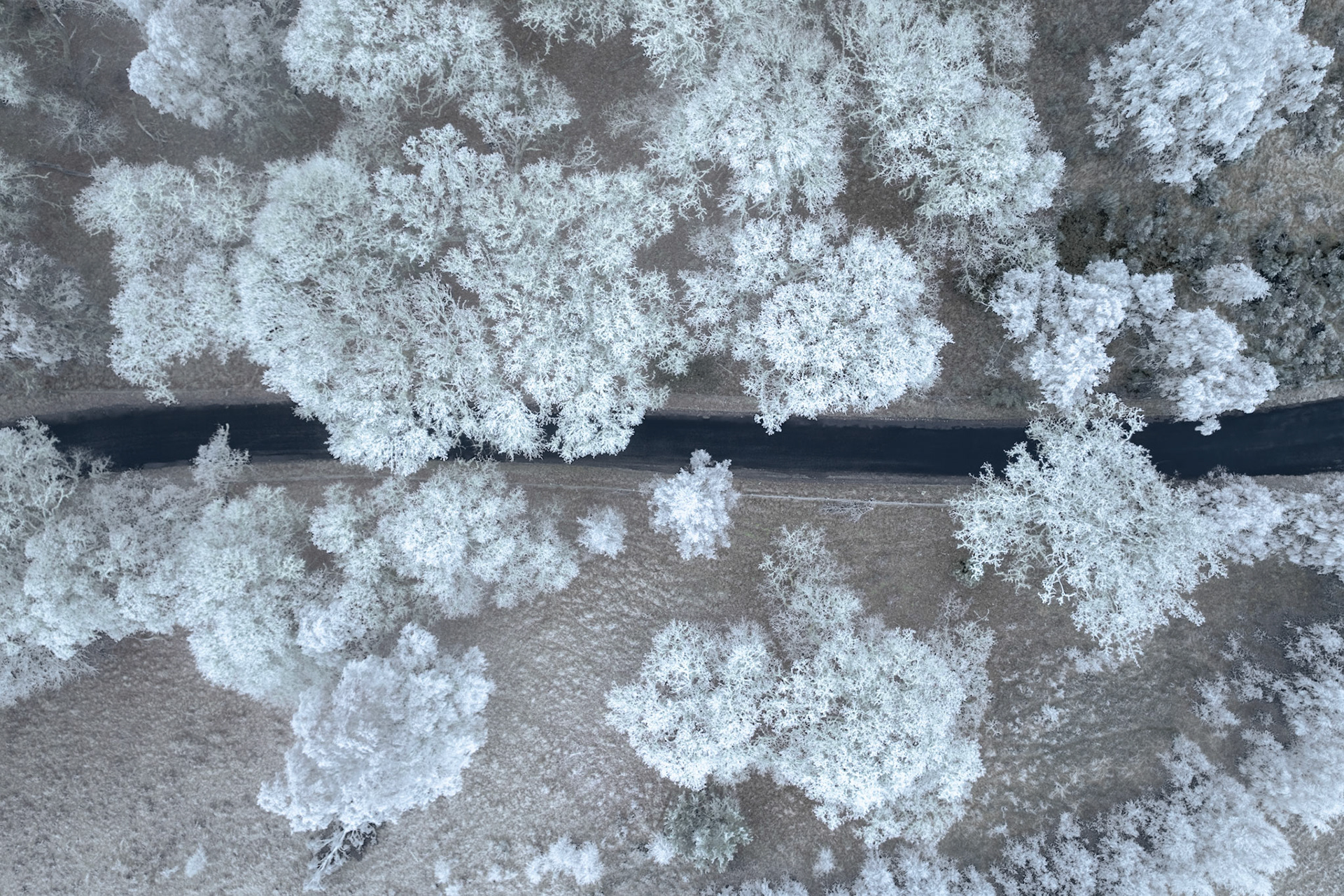
A dark tarmac road bisects frost-laden birch and Scots pine canopy near Aviemore, Cairngorms, photographed from directly overhead in flat winter light. The near-total rime coverage reduces each tree crown to a white botanical form against grey-brown moorland grass, the road's dark thread the sole directional element in an otherwise tonally compressed scene. Overcast conditions have stripped away shadow and colour, leaving the image to work entirely on pattern and contrast.
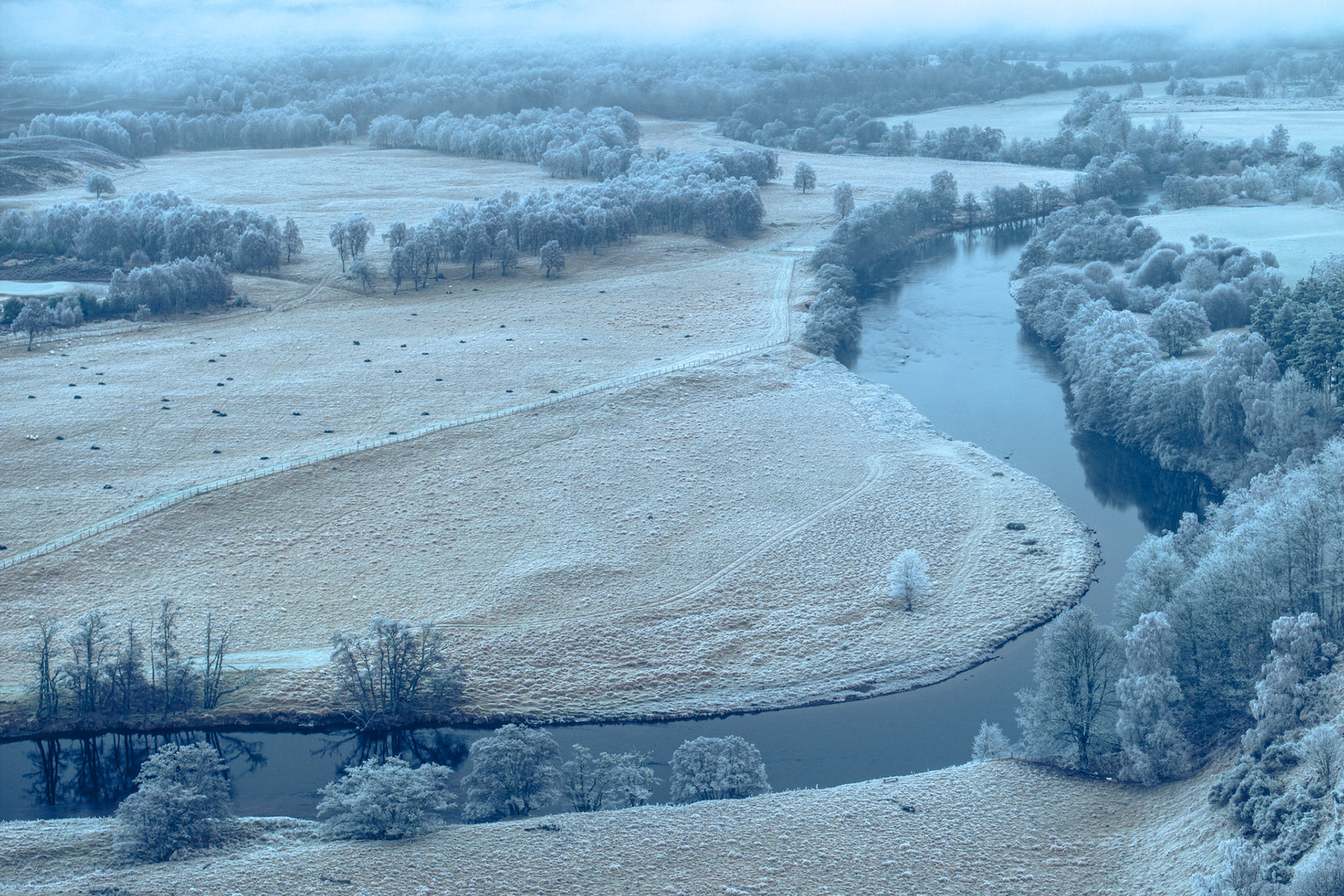
A meander of the River Spey curves through frost-locked flood meadows near Aviemore, the surrounding birch and alder woodland coated in heavy hoarfrost. Low cloud suppresses the horizon, compressing the scene into a near-monochromatic wash of blue-white. Livestock scatter across the fields below, the only mark of scale in an otherwise abstracted winter valley.
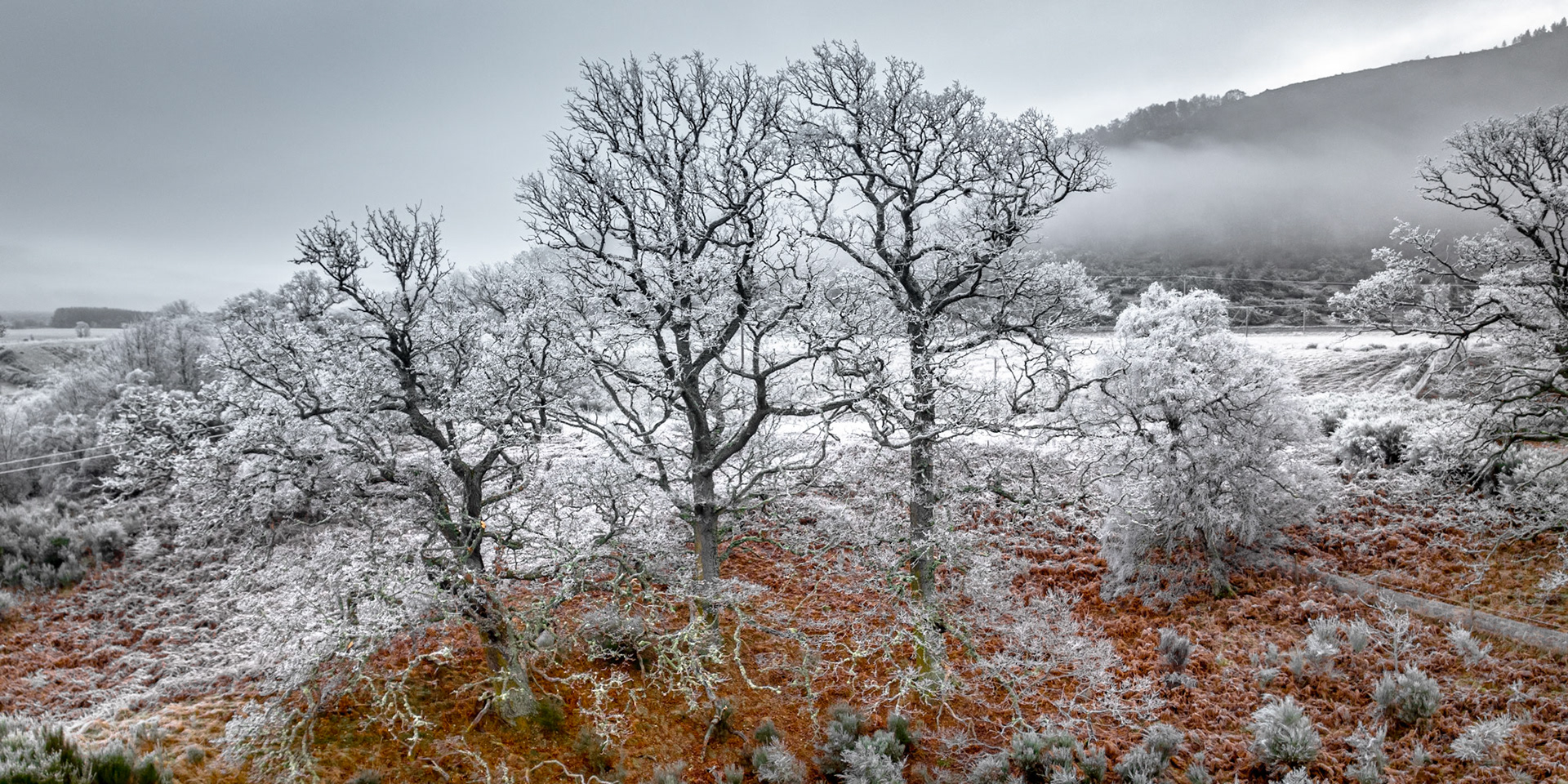
A grove of mature oaks stands heavily rimed with hoarfrost on the floor of Strathspey, Cairngorms National Park, December 2025. The warm ochre of dead bracken beneath provides the only colour against a near-monochrome scene of frosted understorey and hill fog rolling off the slopes above. The elevated drone position reveals the full extent of the frost event across the valley floor.
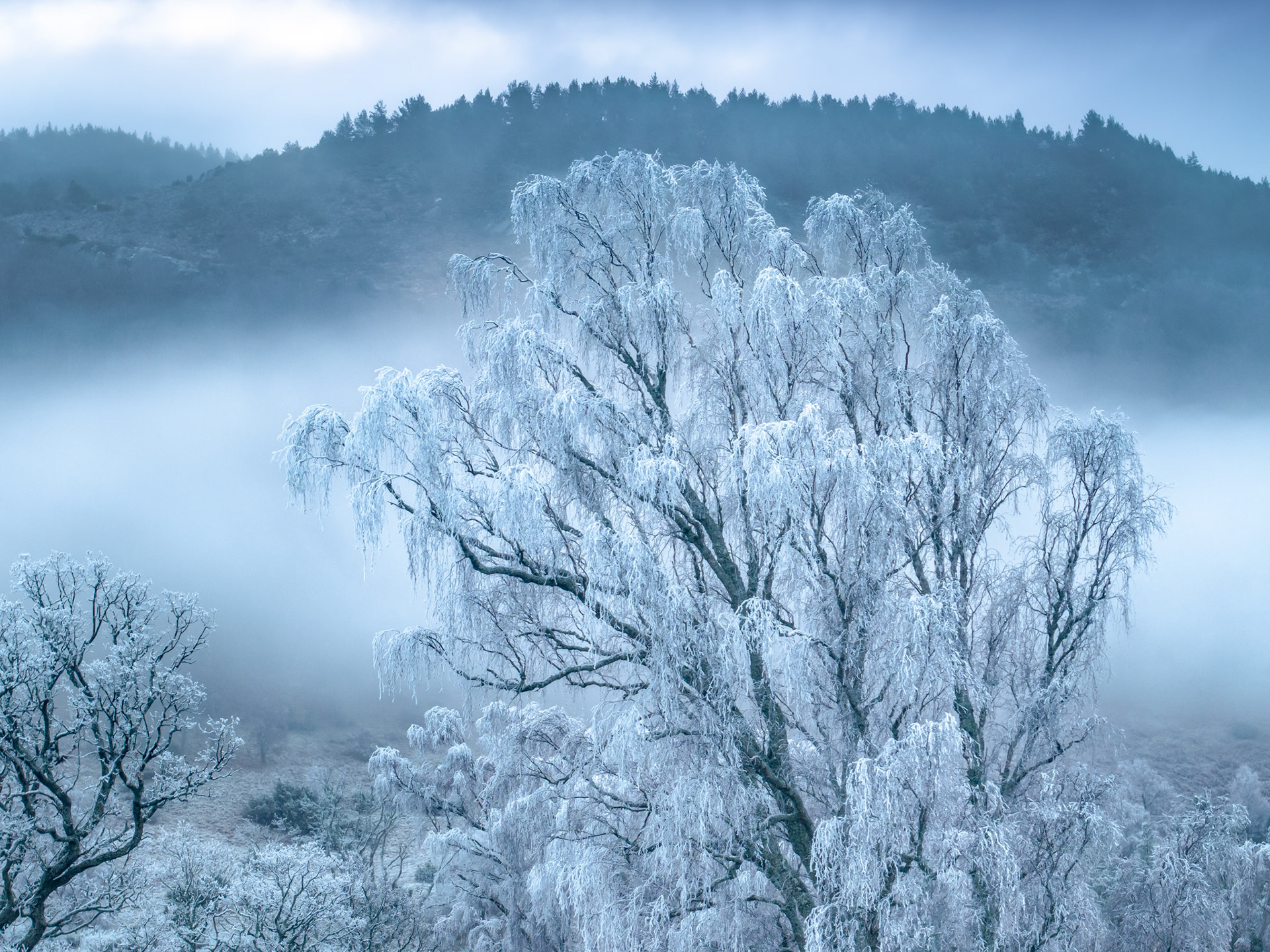
A heavily frosted birch emerges above a temperature inversion in Strathspey, Cairngorms National Park, December 2025. The mist pool fills the valley floor while a conifer-clad ridge recedes into cloud above, compressing the scene into a near-monochromatic study of cold and stillness. The aerial vantage isolates the dominant tree against the white atmosphere without reducing it to abstraction.
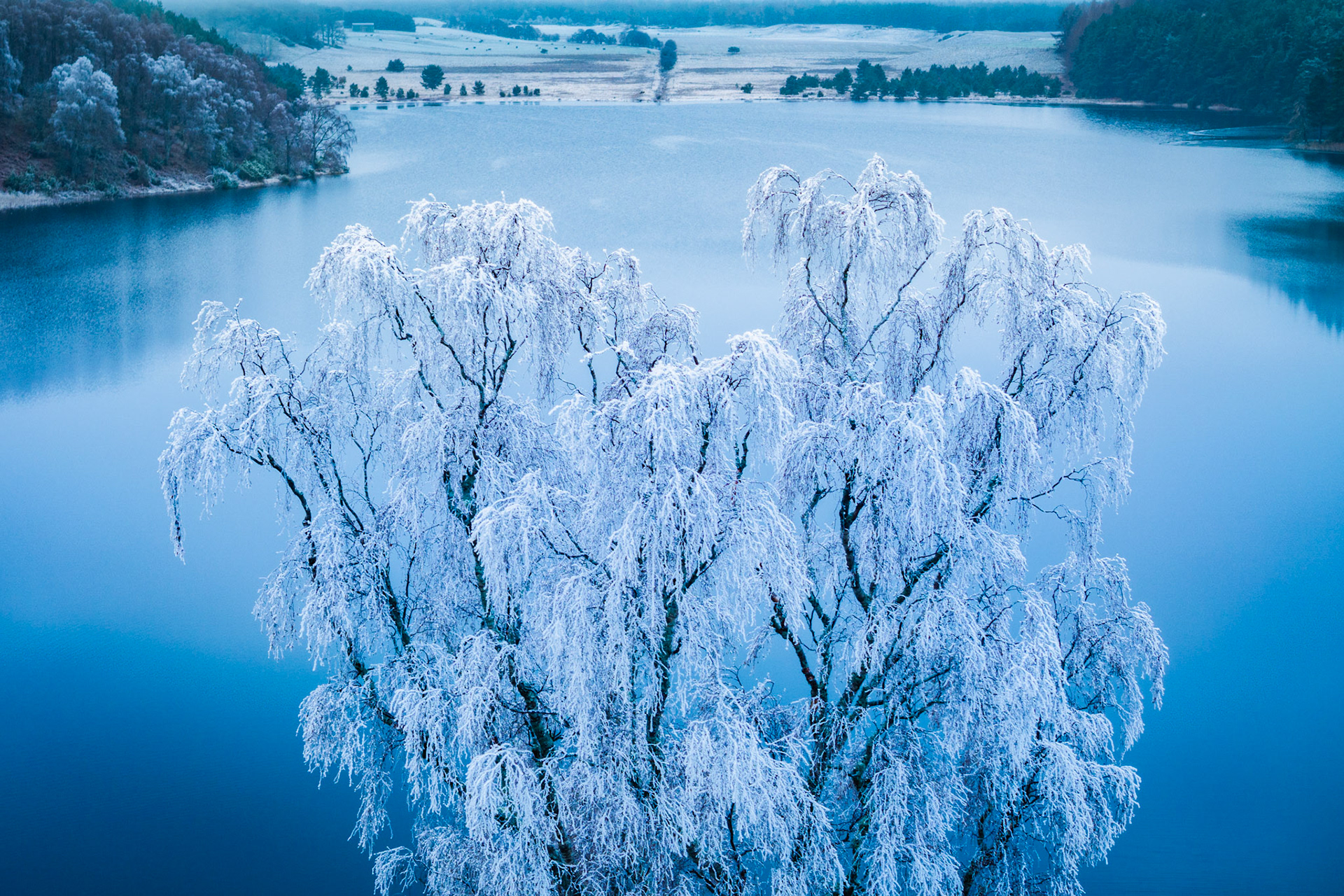
A cluster of birches, heavily rimed with hoarfrost, rises above the calm surface of a loch near Aviemore in the Cairngorms. Shot from altitude in the blue pre-dawn light of a December morning, the white canopy reads almost as smoke against the steel-blue water. The frost-covered woodland and open fields of the valley floor recede quietly into the distance.
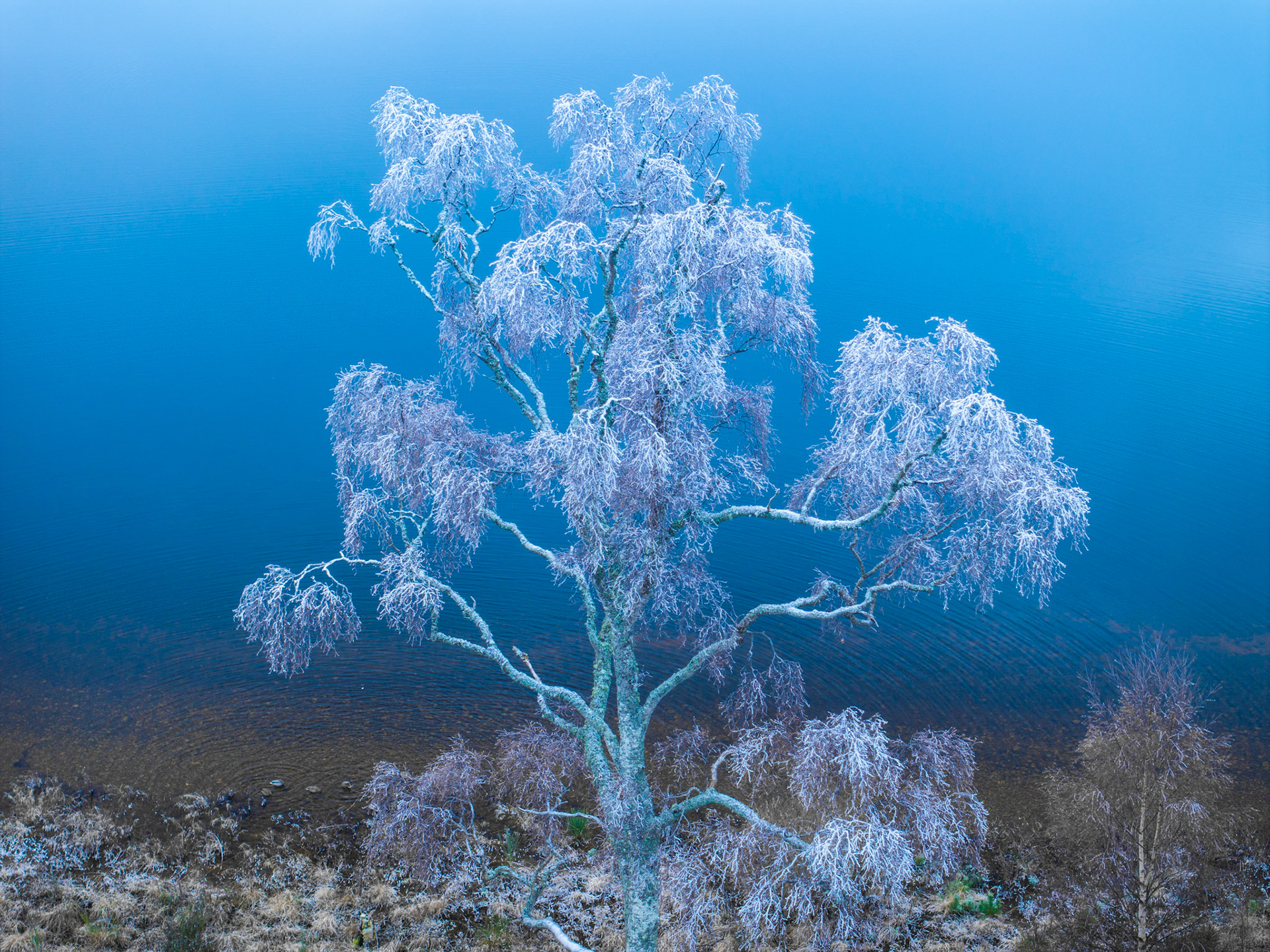
A hoar-frosted silver birch stands at the margin of a still loch in the Cairngorms, photographed from directly above in the cold blue light of a December morning. The mirror-calm water flattens to a near-abstract wash of deep cobalt behind the white-etched canopy, stripping the scene to pure form and tone. Aerial perspective removes any horizon, leaving tree and water as the only subjects.
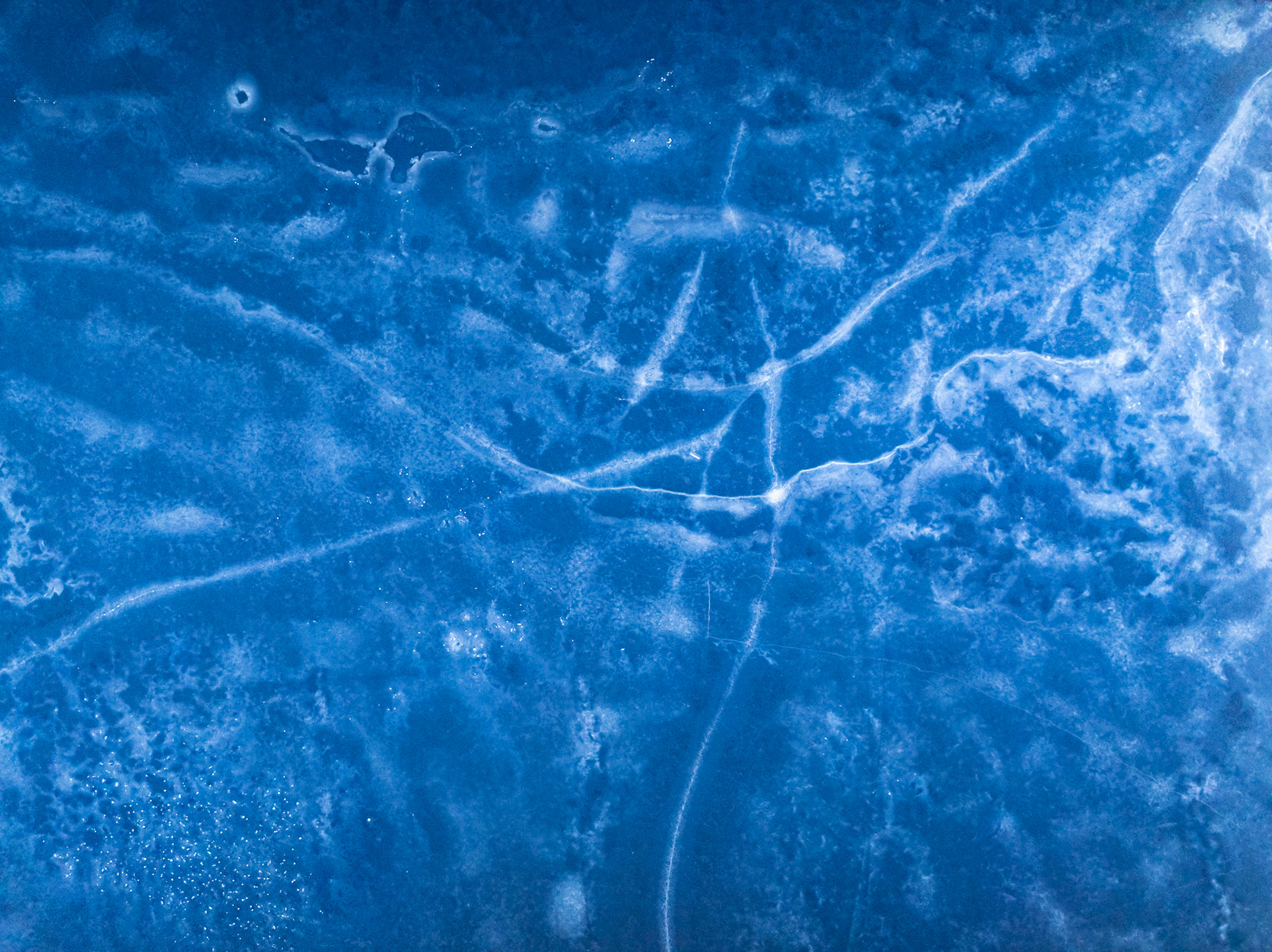
A network of stress fractures radiates across the surface of frozen ground near Nethy Bridge, Cairngorms, captured from directly above in late December. The monochromatic blue palette — deepened by low winter light and the drone's angle of incidence — renders the ice as something closer to celestial cartography than familiar landscape. Frost crystals and air pockets beneath the surface add granular texture at the margins.
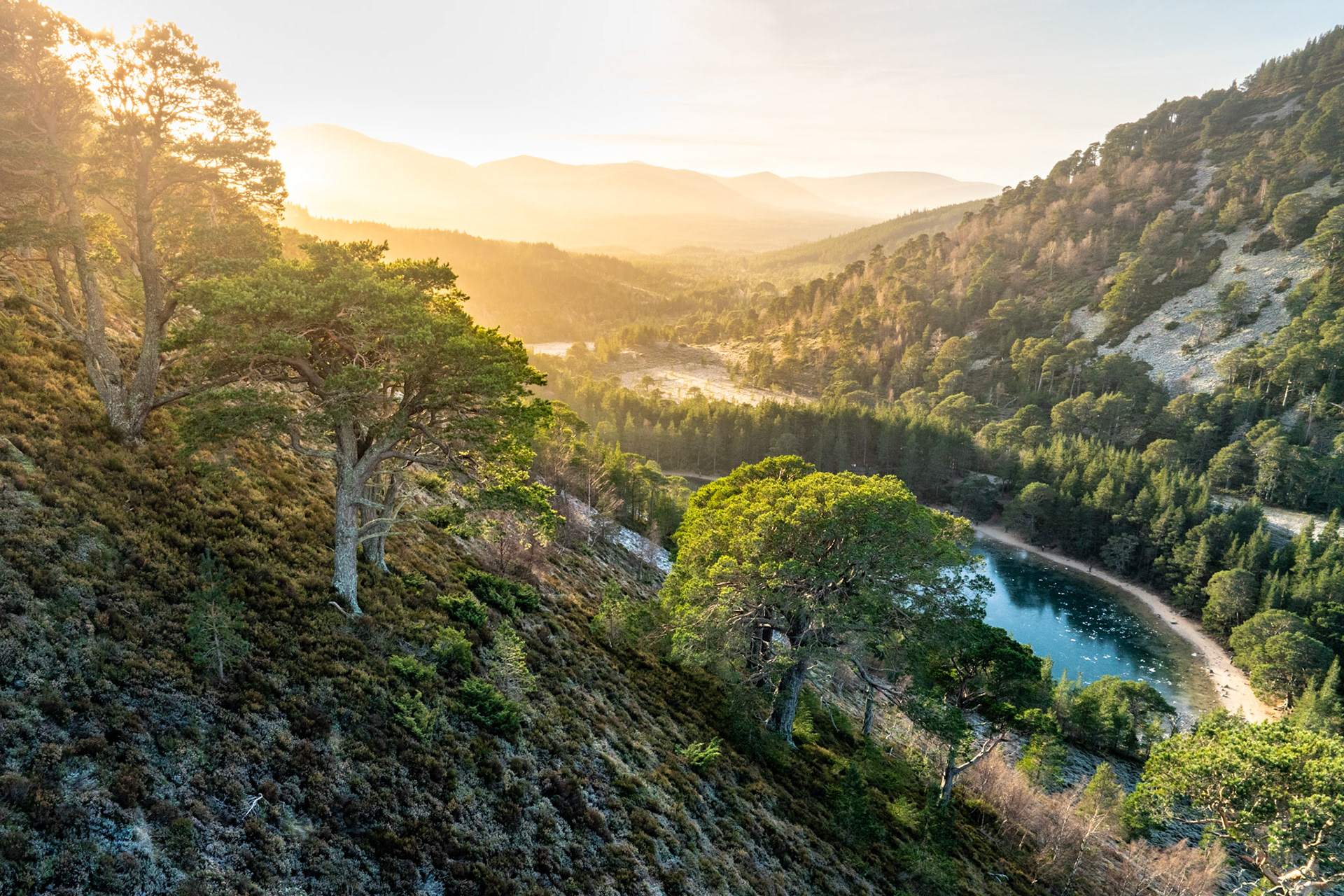
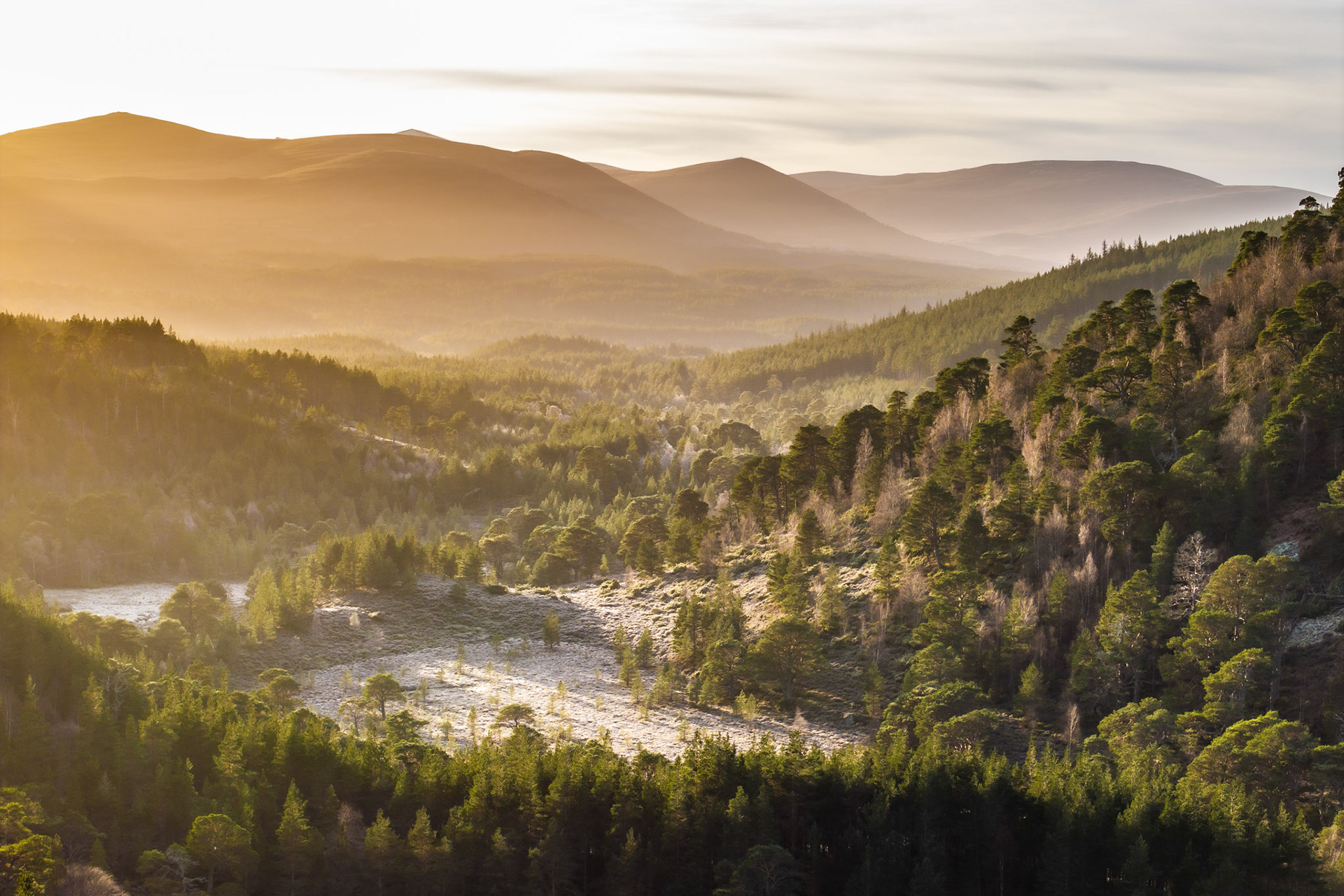
An aerial view looking west along a forested river valley in the Cairngorms, the watercourse curving through ancient Scots pine and mixed woodland below sculpted hillsides. Layered mountain ridges dissolve into a warm, low sun on a clear winter afternoon, the cold-toned river contrasting with the golden atmosphere above. The elevated vantage gives scale to the valley's depth while isolated pines on the foreground slope anchor the composition.
Low winter sun rakes across the upper Dee valley near Aviemore, illuminating a braided river channel threading through ancient Caledonian pinewoods. Receding ridges of the Cairngorms dissolve into atmospheric haze, the warm sidelight separating each plane of the landscape in tonal layers. The bare birch mixed through the Scots pine canopy confirms the depth of the season.
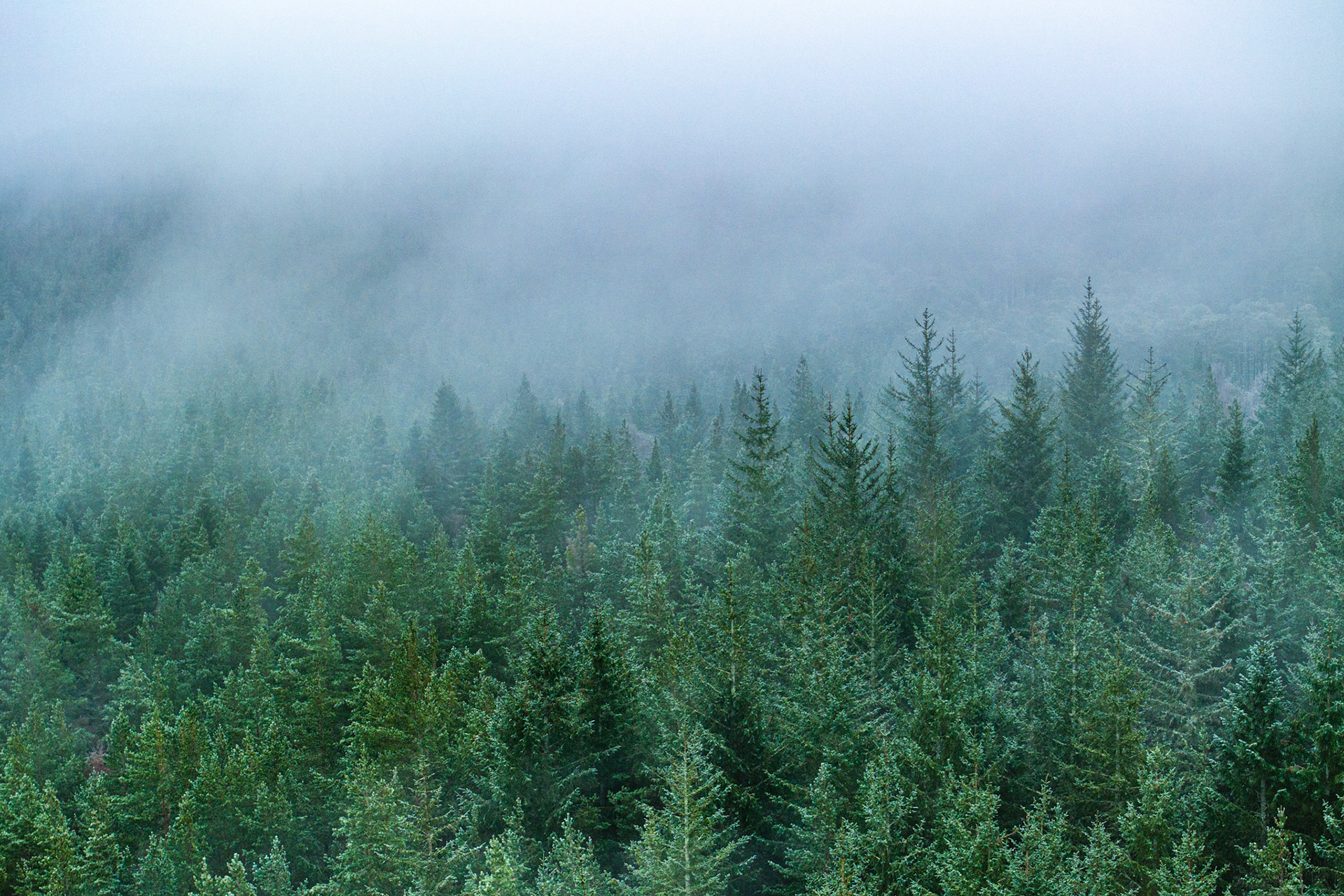
A dense stand of conifers on a hillside near Kingussie dissolves into low cloud, the mist erasing the upper canopy and compressing the scene into layered tones of grey-green. The aerial vantage flattens perspective, reducing the forest to texture and gradient. Captured in late December, the muted palette and diffuse light give the image a quiet, suspended quality.
A temperature inversion pools across the Strathspey valley floor near Nethy Bridge on a winter solstice dawn, mist threading between stands of Scots pine and birch while the low sun catches the upper fog layer in warm relief. The loch or river channel in the foreground anchors the composition, its dark surface a counterweight to the luminous cloud above. The Cairngorm massif recedes silhouetted behind, lending scale to the inversion depth.
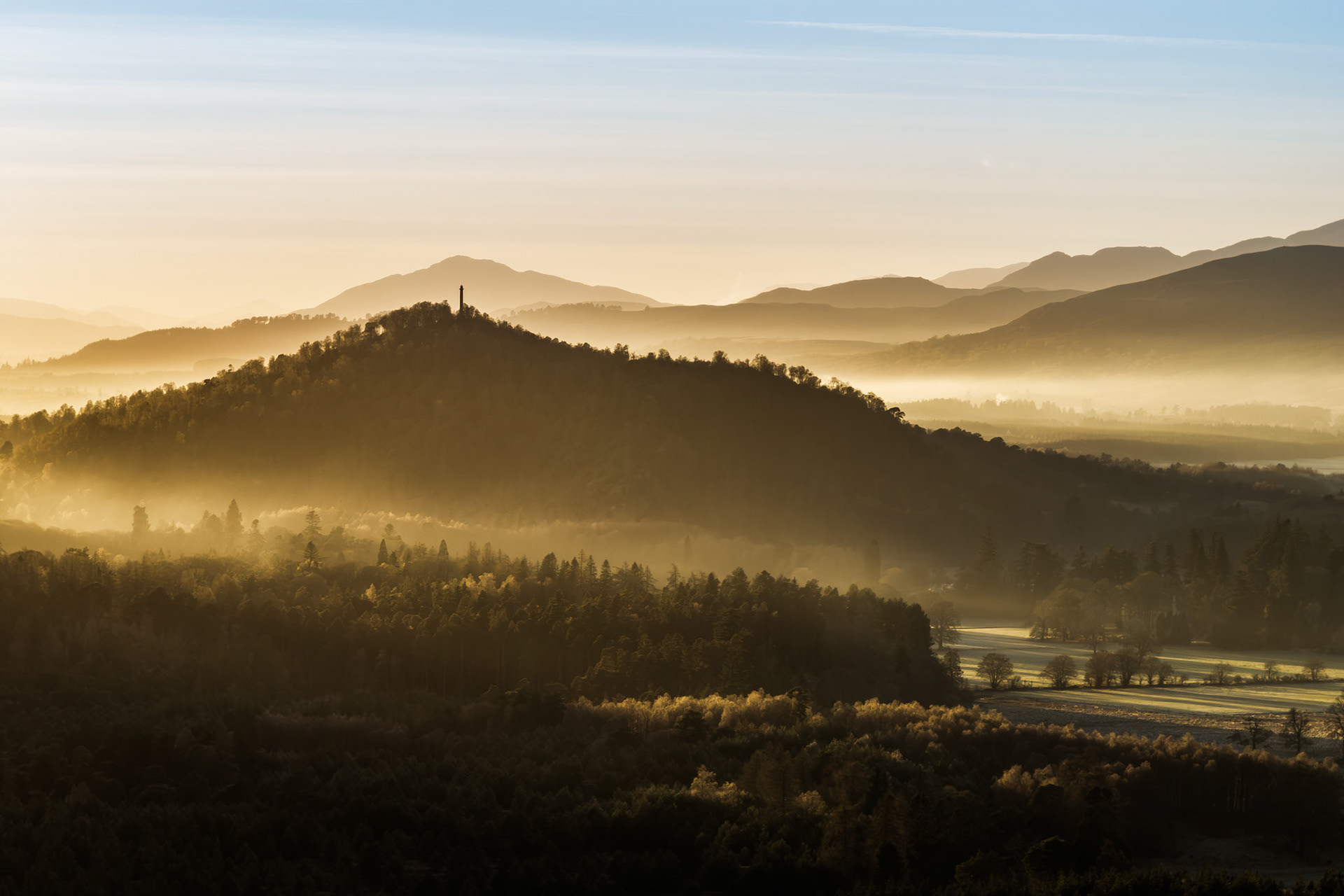
A temperature inversion pools valley mist between forested ridges near Aviemore, the Cairngorms, on a December morning. A solitary monument crowns the nearest wooded hill, its silhouette the only vertical interruption in a composition built entirely from receding planes of light and atmosphere. The distant Highland peaks dissolve into a warm, pale sky, compressing depth into something almost painterly.
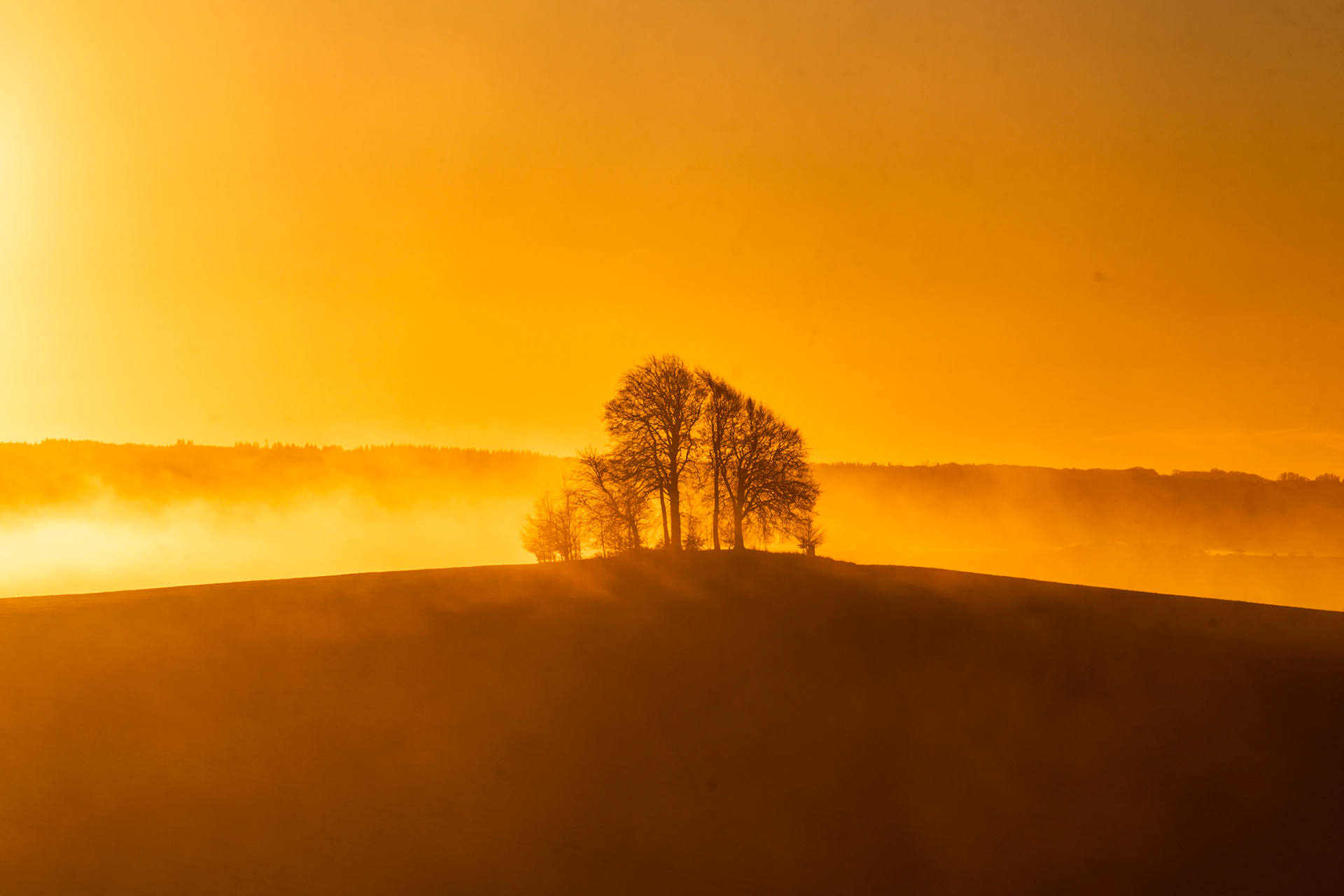
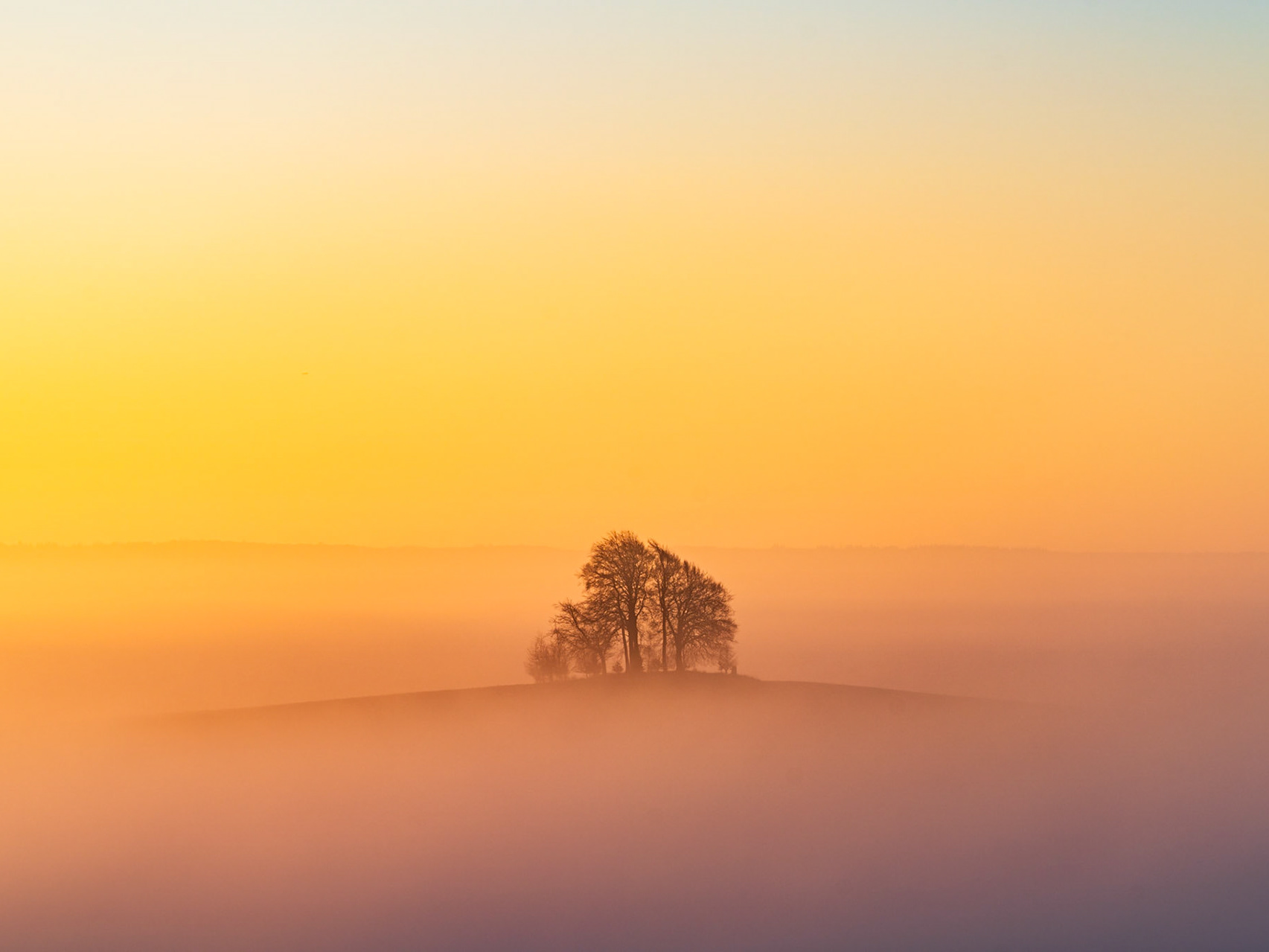
A small cluster of bare-branched trees crowns a rounded hilltop as ground fog rolls across the mid-distance, backlit by low winter dawn light that saturates the scene in deep amber. The silhouetted treeline of a wood in the background adds a second horizontal layer, reinforcing the sense of depth within the inversion. The dark foreground slope anchors the composition and throws the illuminated fog bank into sharp relief.
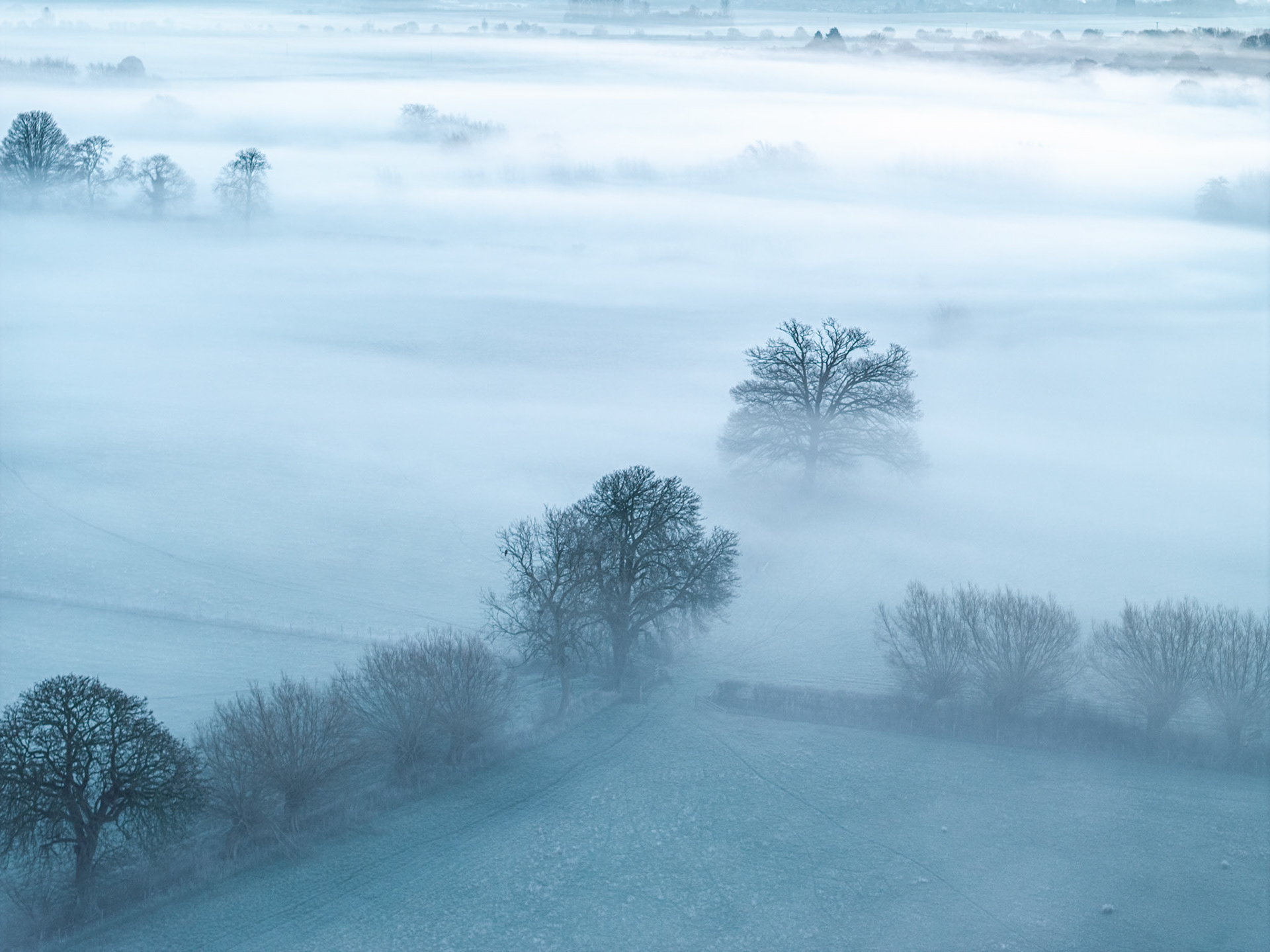
A temperature inversion settles across the Thames Valley near Wallingford, submerging the farmland in dense fog while bare oak trees emerge as dark silhouettes at varying depths. The elevated drone perspective compresses the receding layers of mist into near-abstract bands of cool blue-grey, with hedgerow trees in the foreground providing scale and anchoring the composition.
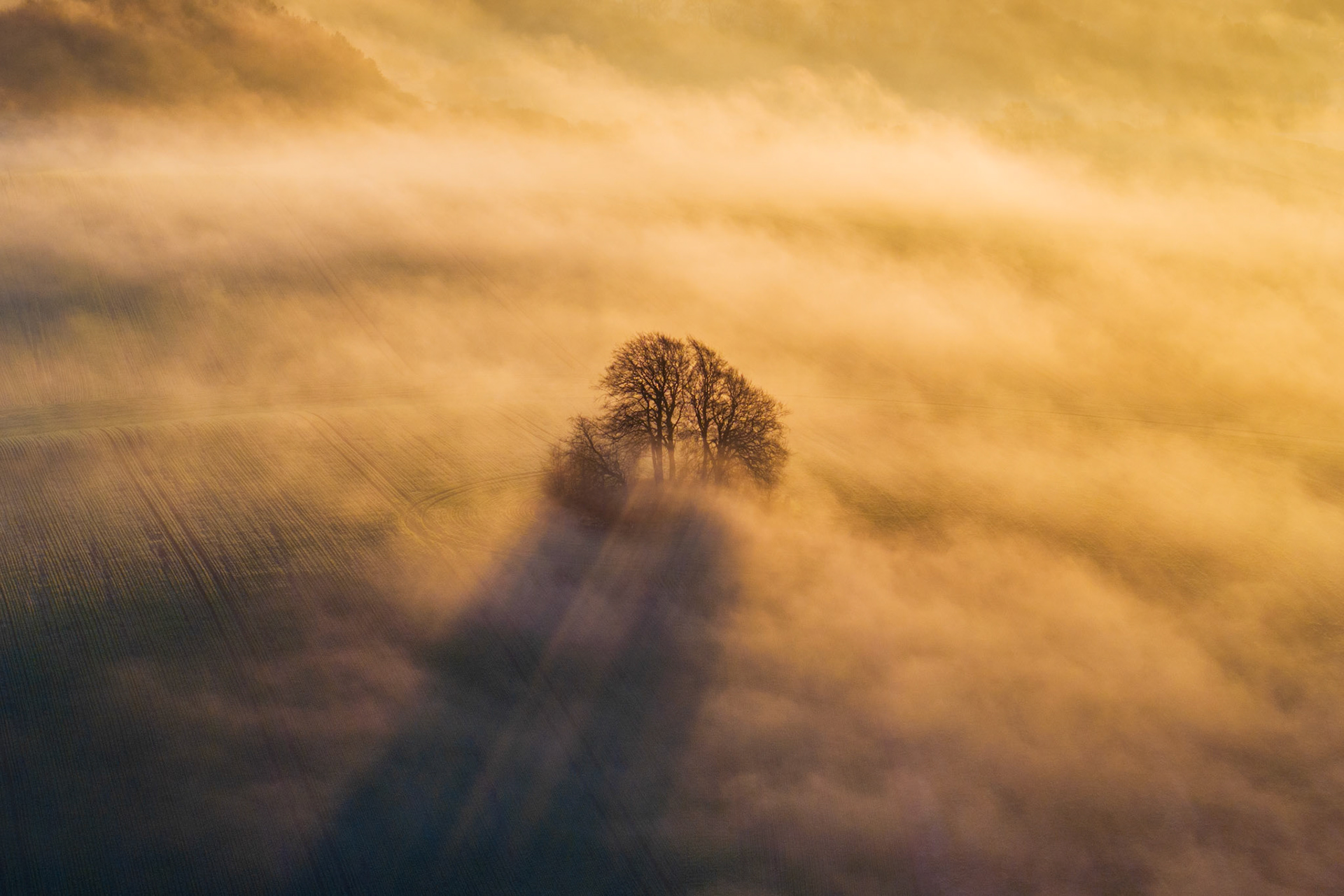
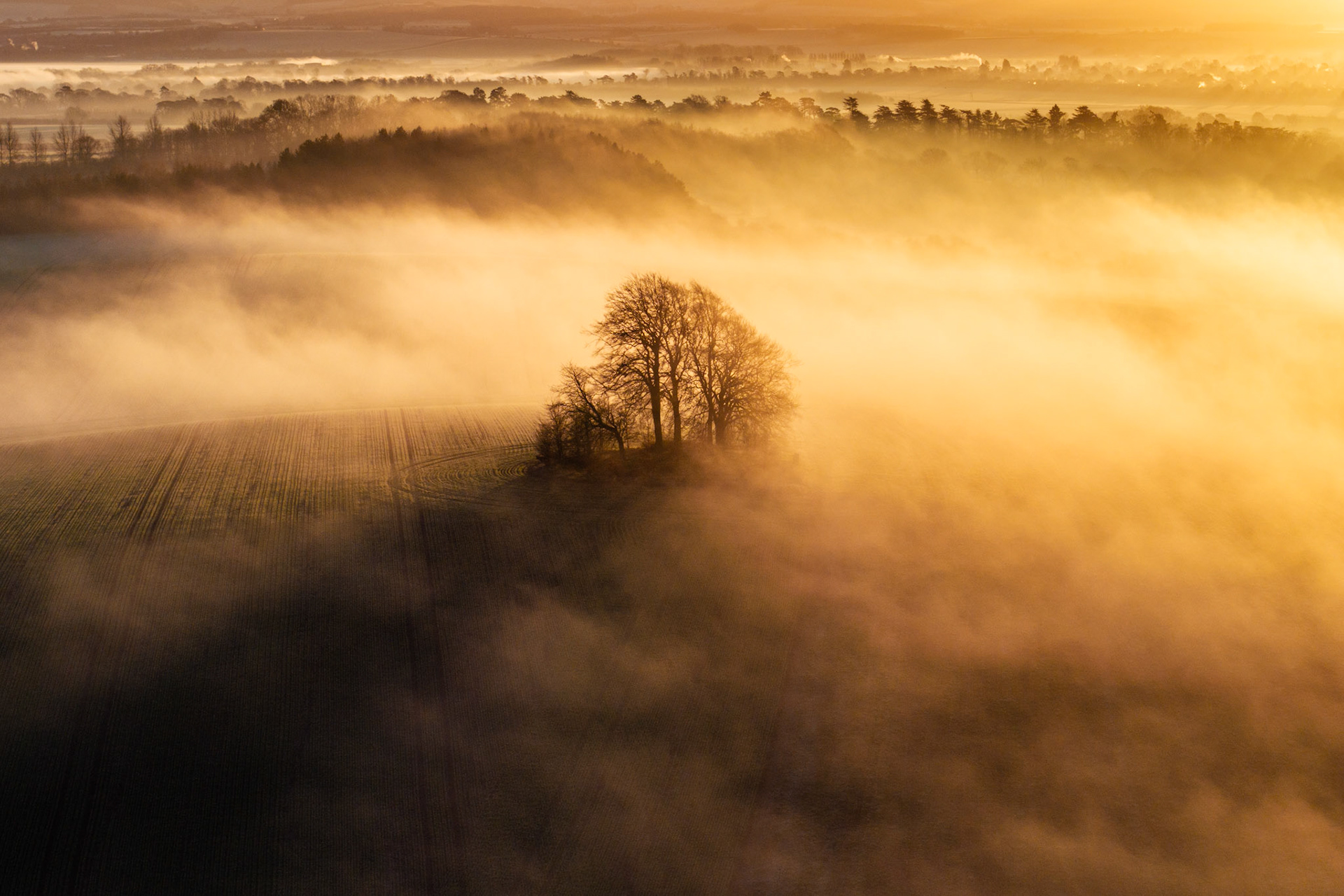
A small cluster of bare winter trees at Brightwell Barrow, near the Wittenham Clumps in Oxfordshire, emerges from a shallow fog inversion above arable farmland. Shot from directly above at low altitude, the trees cast a long shadow through the mist toward the viewer, anchoring the composition against a sea of warm golden vapour. The diagonal tension between fog layers and the singular dark form gives the image an abstract quality rare in aerial landscape work.
A small copse on Brightwell Barrow, near the Wittenham Clumps in Oxfordshire, emerges from a shallow temperature inversion across the farmland, January 2026. Low winter sun catches the fog from the east, reducing the landscape to a single silhouetted subject against a field of luminous amber. Tractor lines in the crop below anchor the image to the agricultural plain being consumed by the mist.
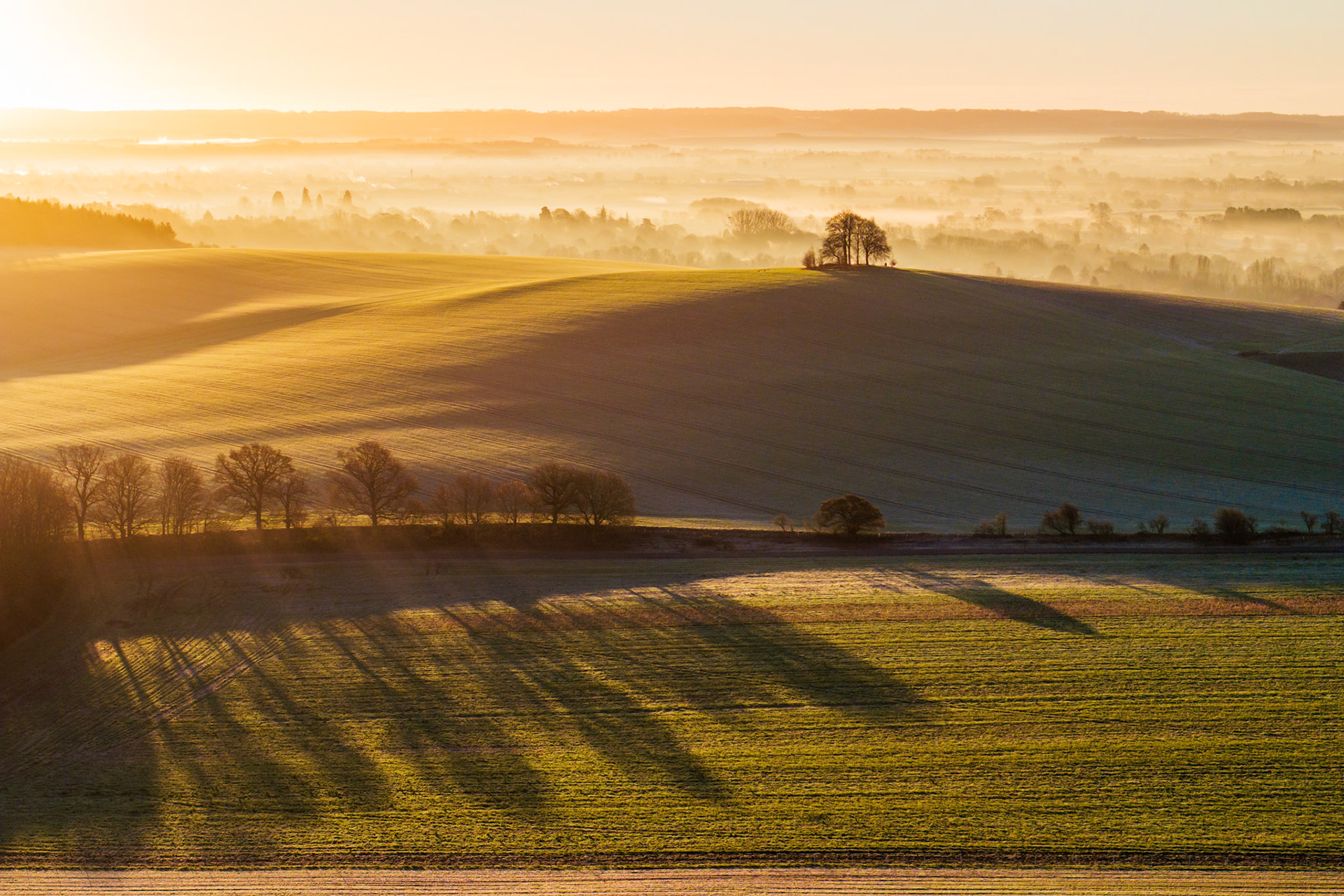
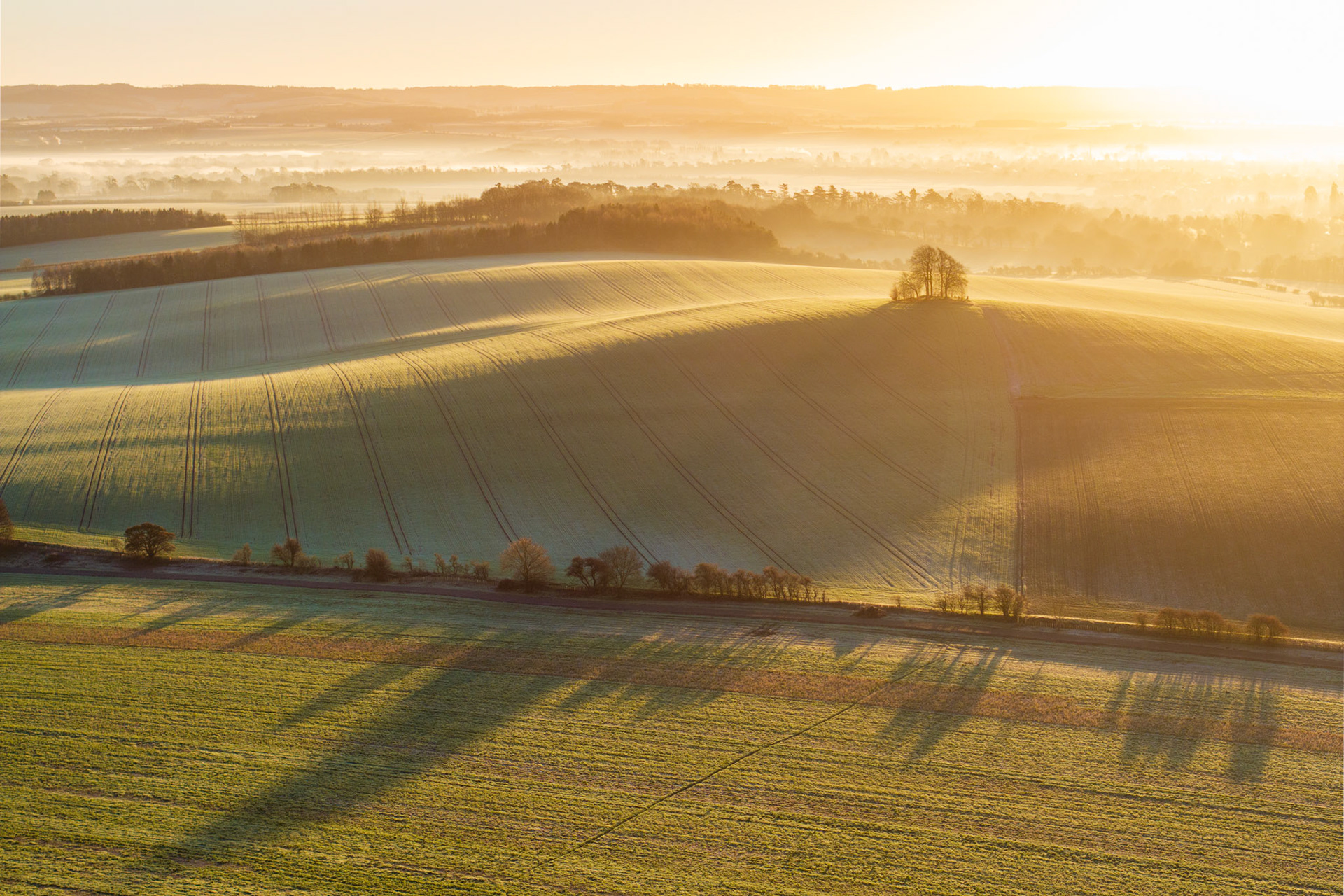
A temperature inversion fills the Vale of White Horse with low mist at first light, seen here from above Brightwell Barrow near the Wittenham Clumps in Oxfordshire, while long tree shadows rake across frost-dusted arable fields on the downland above Abingdon. A small copse crowns the nearest hill, its silhouette caught between the lit flank and the mist-dissolved distance beyond. The layering of warm light, cool shadow, and atmospheric depth gives the scene an unusual structural clarity for an aerial frame.
Low winter sun rakes across frost-covered arable downland at Brightwell Barrow, near the Wittenham Clumps in Oxfordshire, casting long tree shadows across the foreground field while ground mist pools in the valley beyond. The copse crowning the barrow anchors the composition against receding layers of fog and warm backlight. Crop-tramlines radiating across the hillside add unexpected graphic structure to an otherwise pastoral scene.
Bare beech trunks recede into dense fog on a still January morning in the Chilterns, Oxfordshire, the cool blue cast of pre-dawn light flattening the woodland into successive planes of tone. Fallen leaf litter on the forest floor anchors the foreground, while the mist erases all distance beyond the middle canopy. The restrained palette and rhythmic spacing of the trees give the scene a graphic quietness rarely achieved without a clear structural accident.
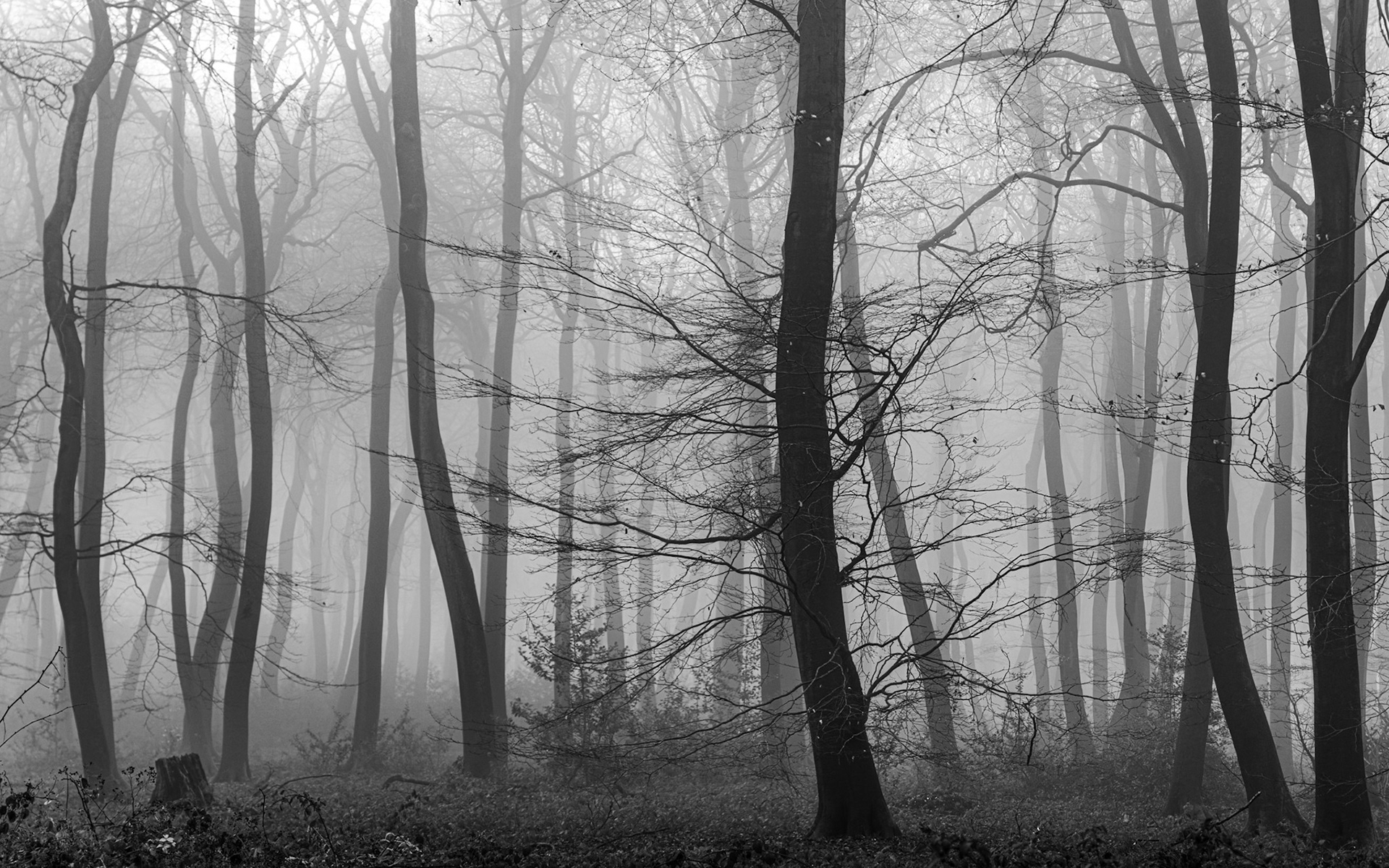
Leafless beech and understory shrubs recede into dense winter fog in the Chilterns, Oxfordshire, the tonal recession creating a natural layering from dark foreground trunks to pale dissolved canopy. A low-branching suppressed tree at centre-right anchors the composition against the vertical rhythm of the surrounding stems. The monochrome conversion amplifies the mist's diffusing effect, stripping the scene to structure and tone.
Bare beech trees in the Chilterns recede into dense winter fog, their sinuous trunks forming overlapping planes of tone from dark foreground to pale grey distance. A carpet of fallen leaves grounds the composition, while the diffuse overhead light suppresses shadow and unifies the scene into near-monochrome blue. The fog is thick enough to erase the forest floor's horizon, lending this Oxfordshire woodland an unresolved, contemplative stillness.
A beech branch clings to its final rust-coloured leaves against a fog-filled interior of Chilterns woodland in Oxfordshire, the background reduced to pale vertical columns of unseen trunks. Captured in the blue-grey stillness of a January morning, the image draws tension from the contrast between the intricate tracery of bare twigs and the scattered warmth of unreleased autumn foliage.
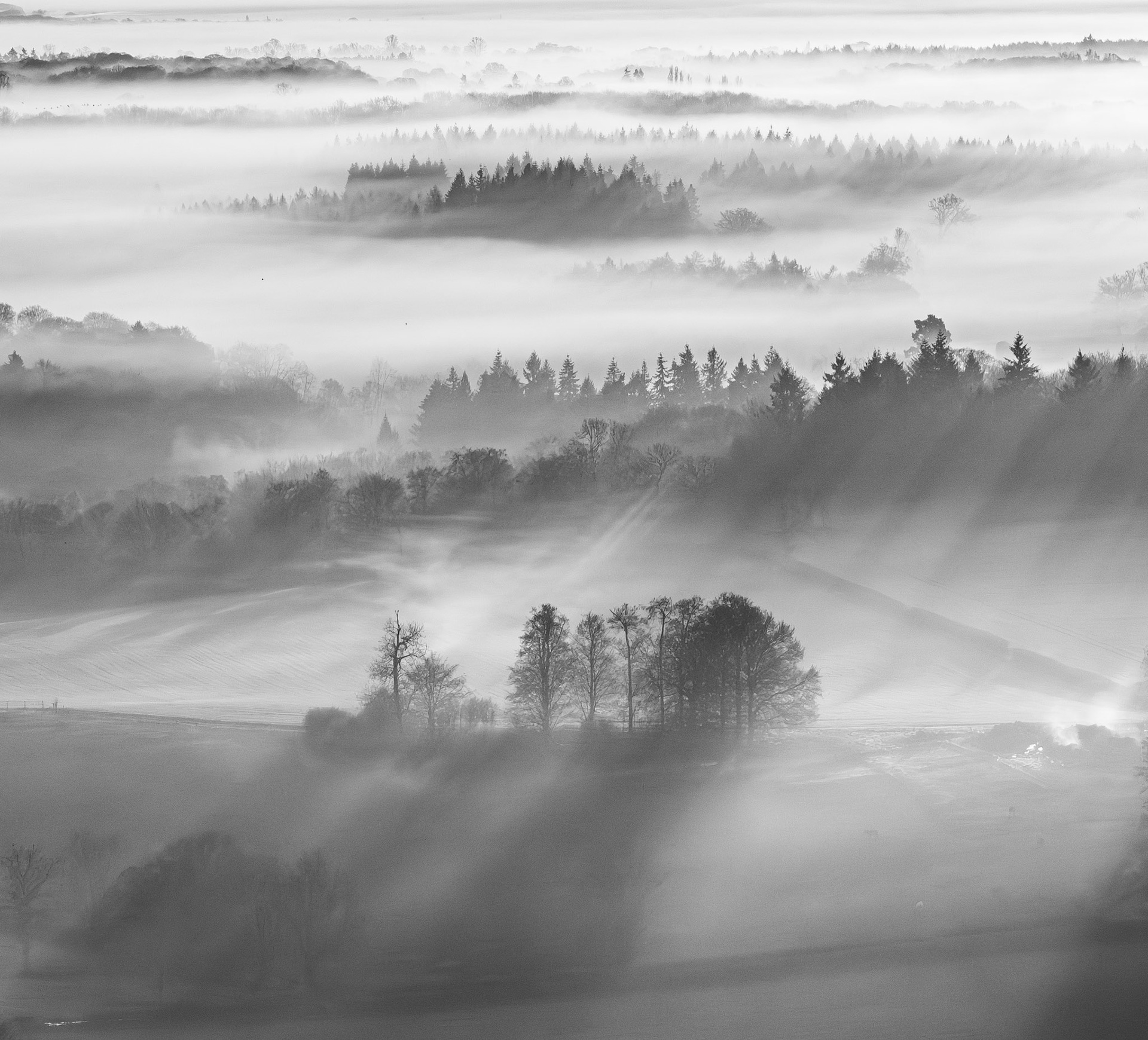
A temperature inversion fills the Thames Valley lowlands with layered fog, isolating copses and conifer ridgelines as dark silhouettes against luminous white. Shot from elevation above Henley-on-Thames in late January, the compression of a long focal length stacks the receding planes into near-abstract bands of tone. A church spire emerges faintly at mid-distance, the sole human measure in an otherwise elemental scene.
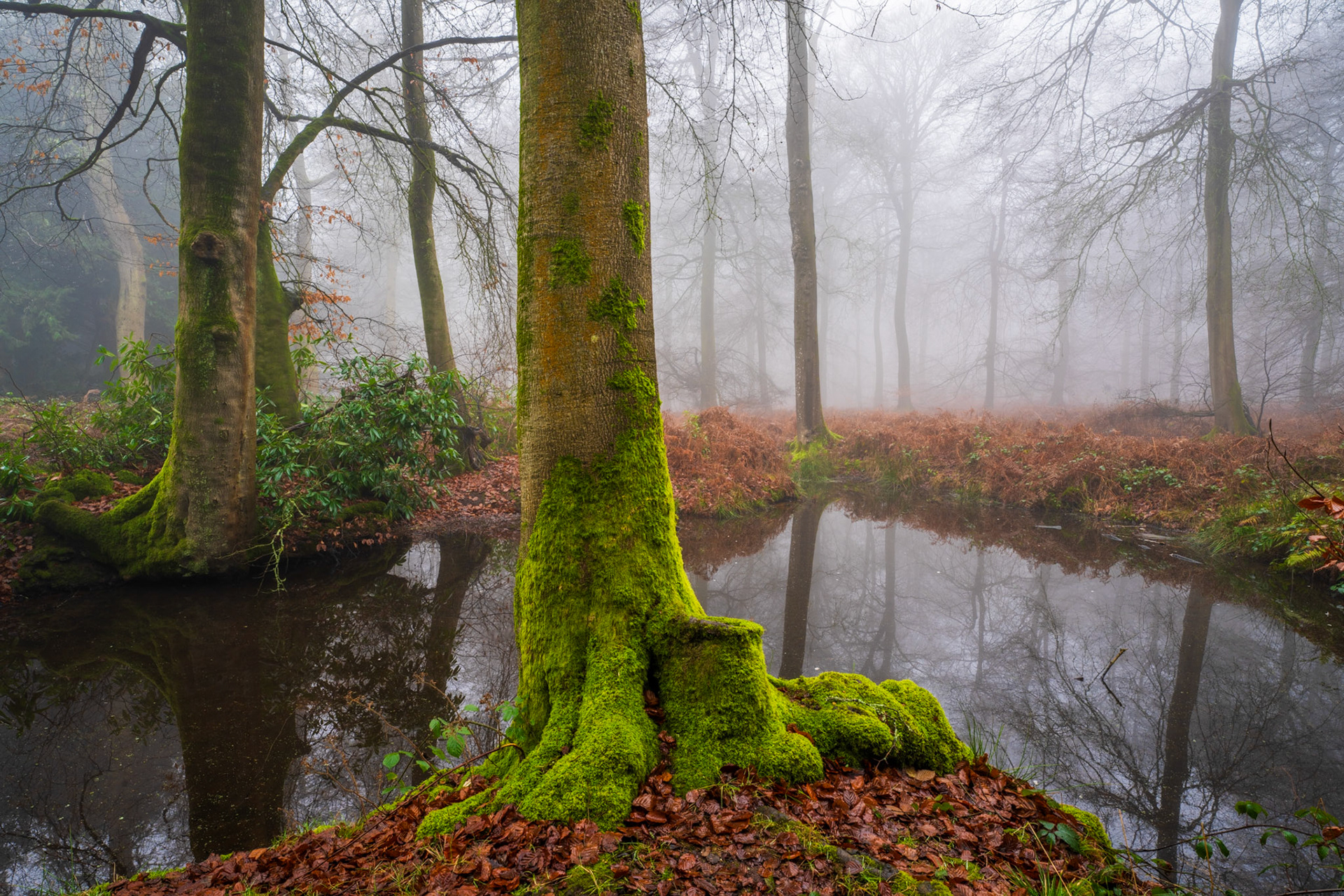
Bare beech trunks recede into fog on a still winter morning in the Chilterns, Oxfordshire, their pale bark contrasting with a floor of copper leaves and vivid moss. A gnarled stump anchors the mid-ground, drawing the eye through the rhythmic vertical forms. The diffuse light and absence of wind give the scene an interior quietness characteristic of upland beech woodland in deep winter.