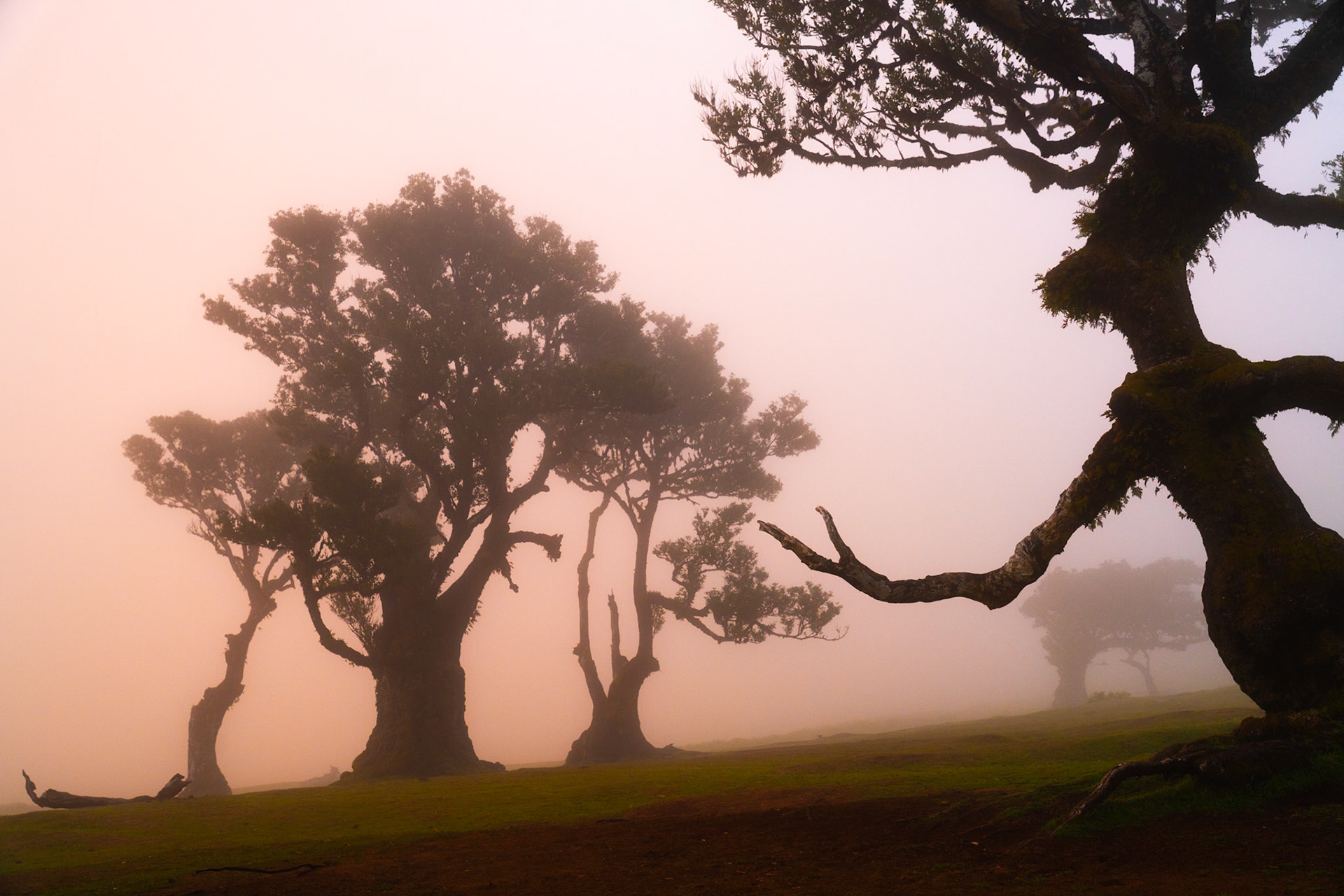
High on Madeira's northwestern plateau sits Fanal, a stand of ancient til laurels — some centuries old — that spend much of their lives inside cloud. The trees are vast, twisted and half-ruined, part of the laurisilva forest that earned this corner of the island UNESCO World Heritage status, and when the fog rolls up from the valleys they turn into silhouettes with no background at all.
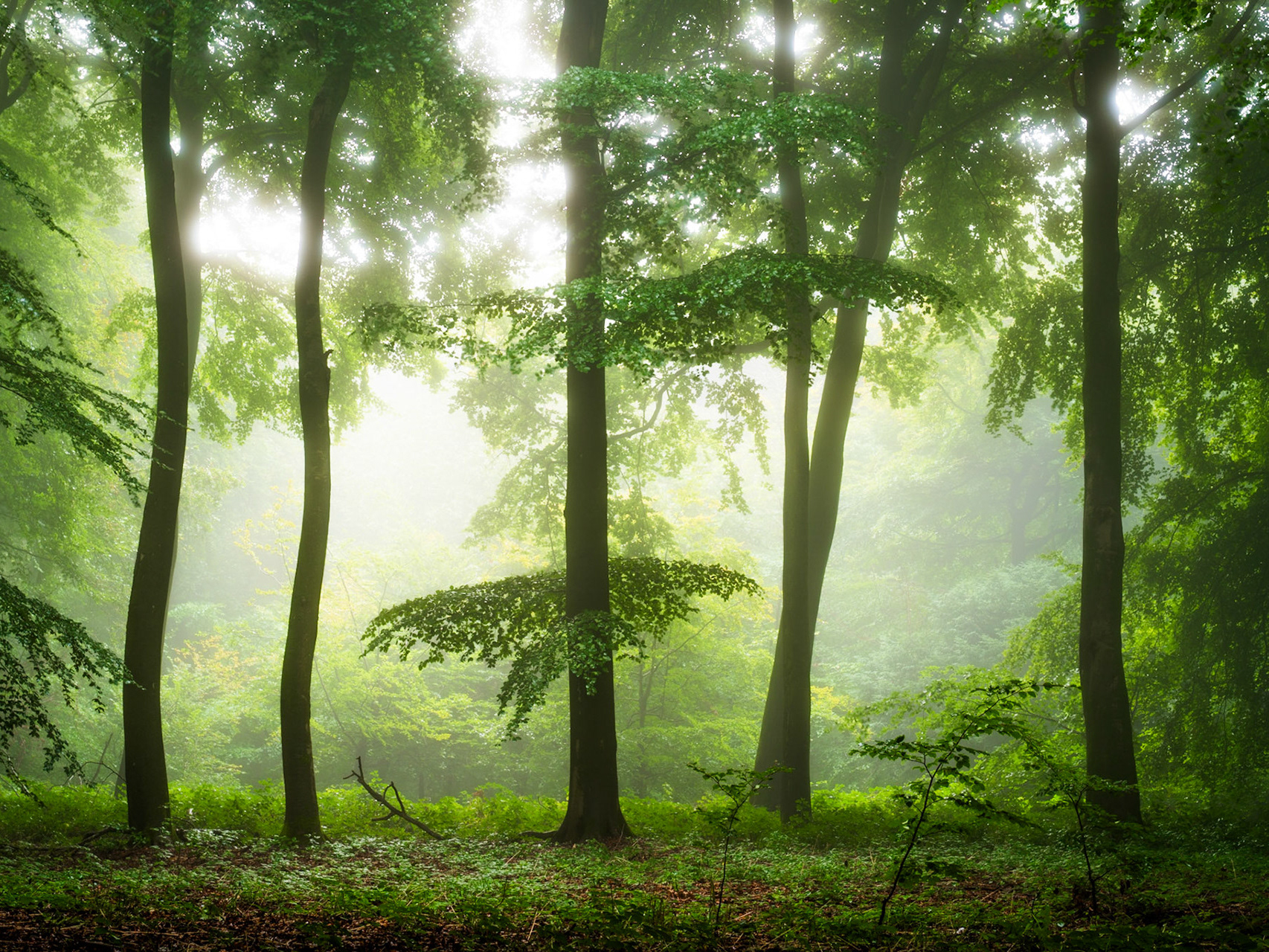
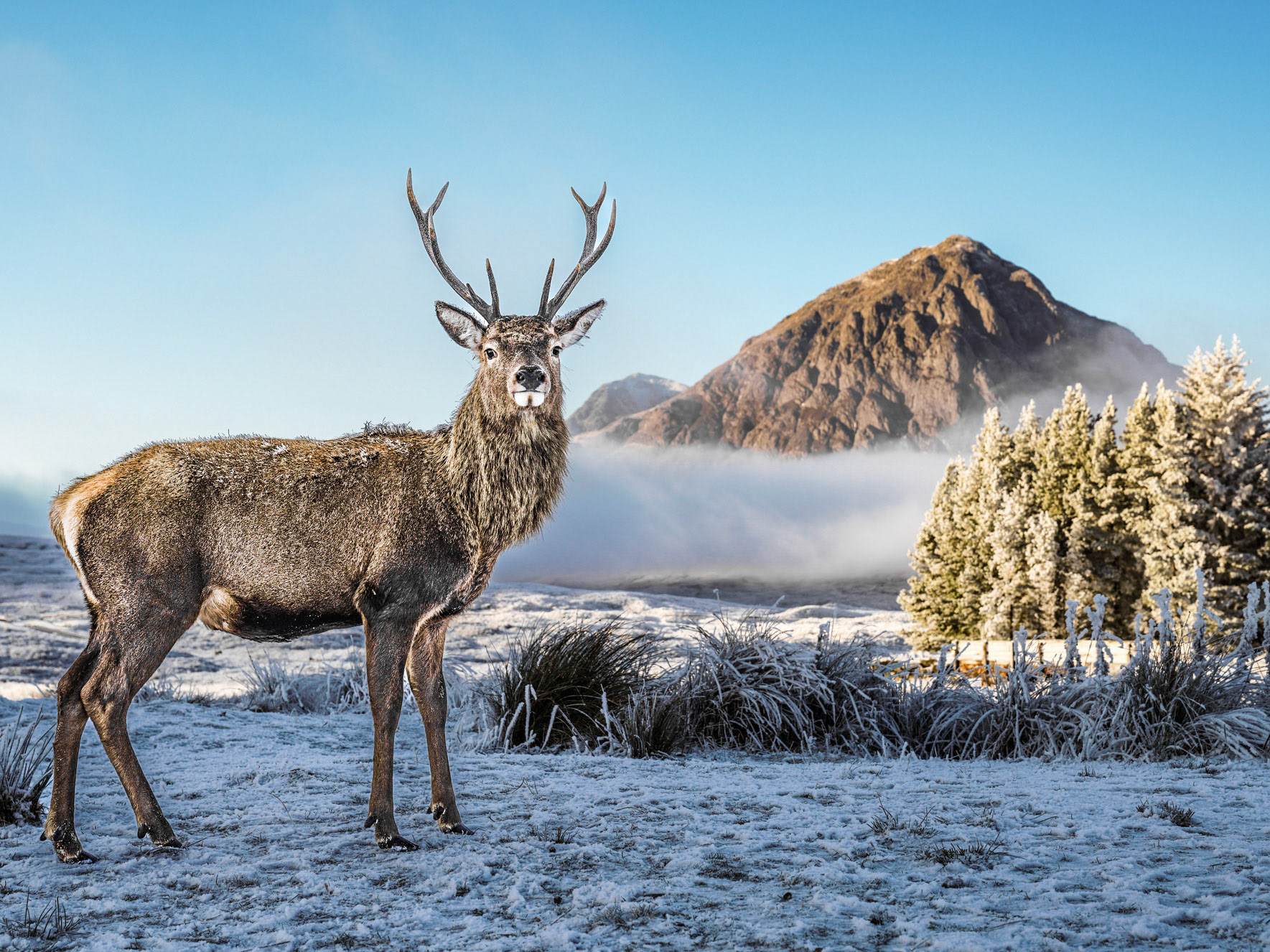
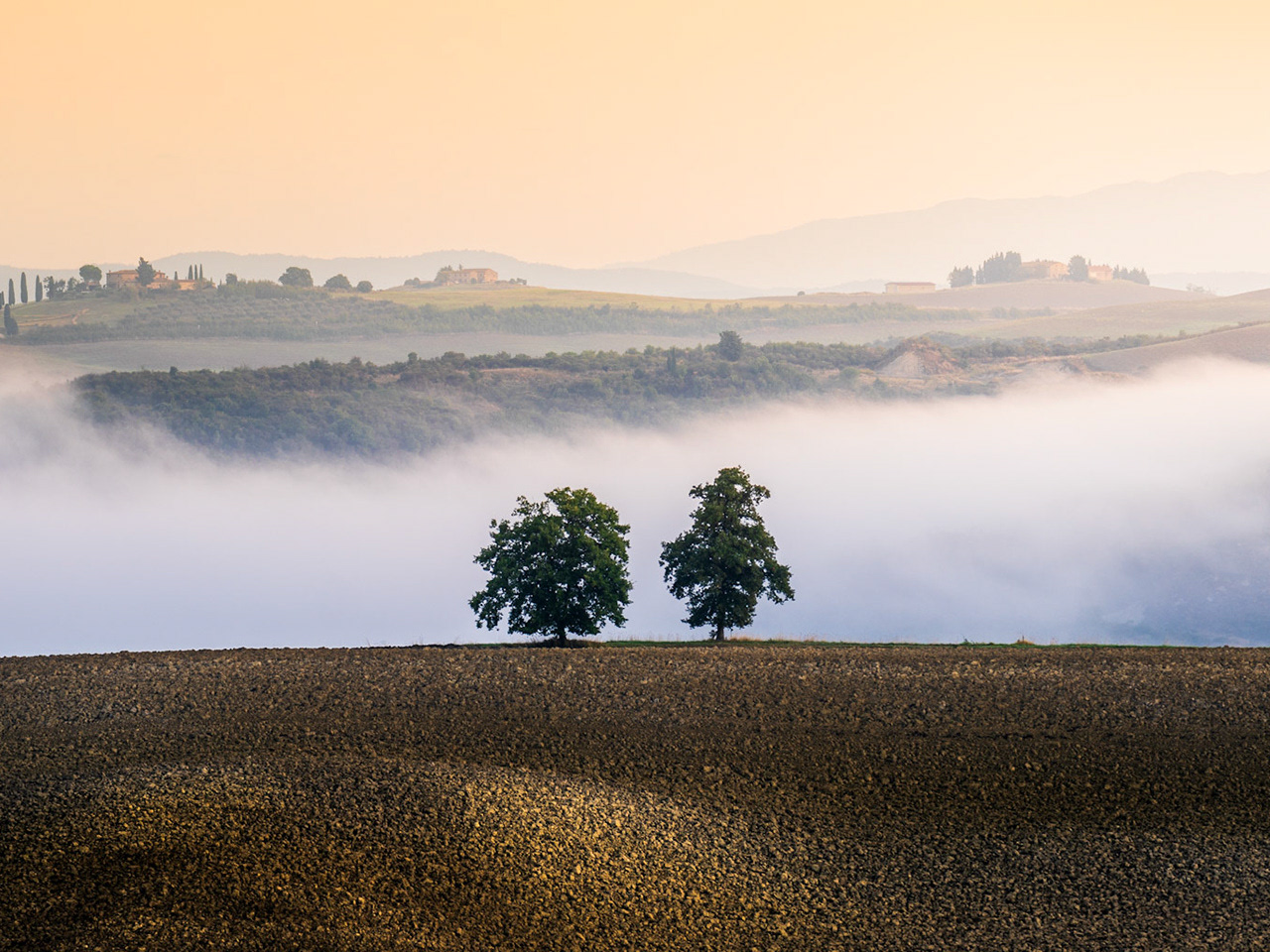
For a woodland photographer used to English beech, Fanal is both familiar and completely alien. The craft is the same — work in fog, isolate a tree, wait for the density to shift — but the subjects are stranger: limbs like antlers, moss to the canopy, cattle drifting through the murk. Conditions change by the minute; the difference between a flat scene and a strong one is often thirty seconds of thinning cloud. This collection was made over repeated visits to the plateau, mostly in the hours after dawn when the cloud sits lowest.
Get in touch if you'd like any of these as a fine art print.
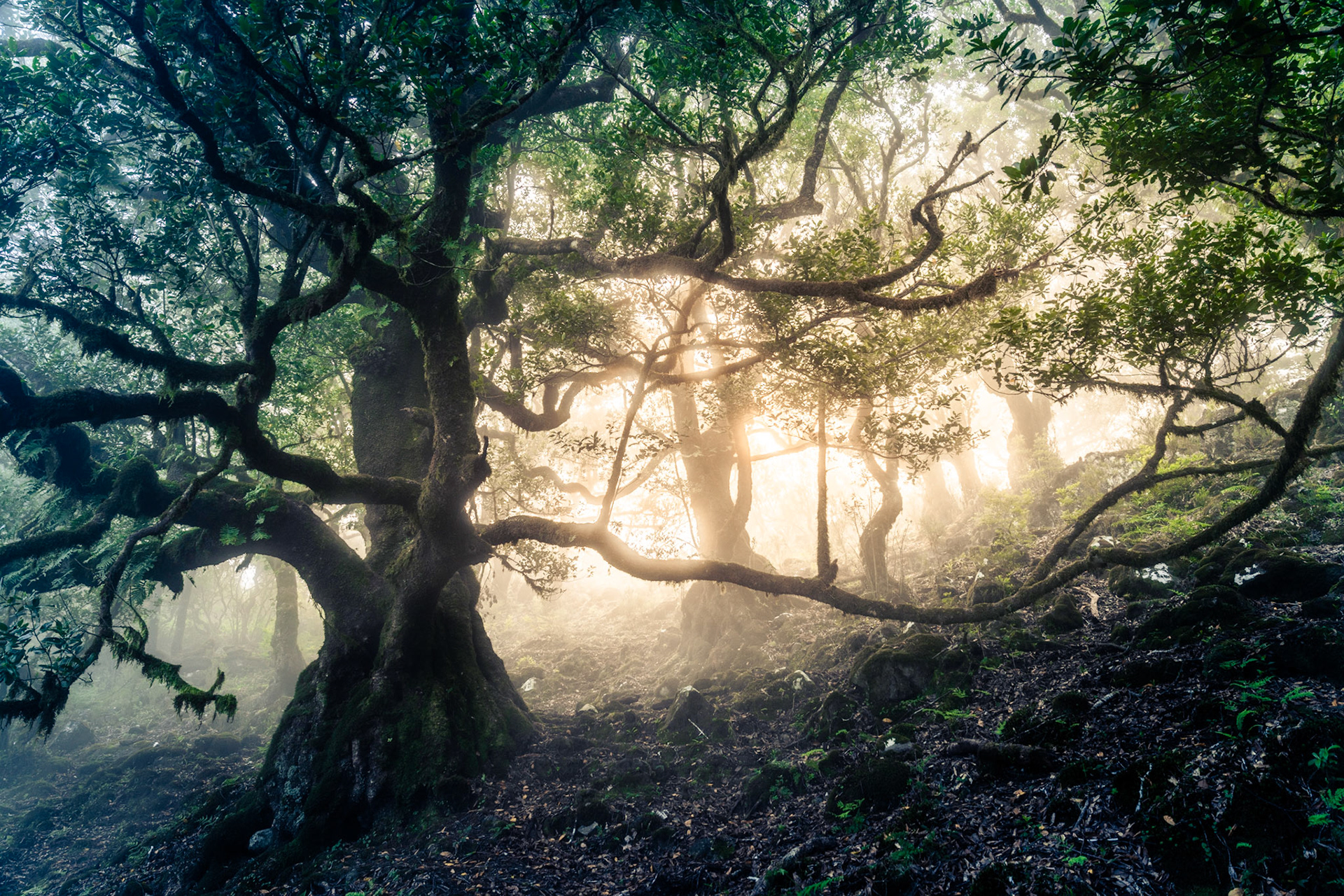
Mist drifts between contorted laurel-forest trees as low dawn light ignites the mid-ground, throwing the gnarled foreground canopy into dark silhouette. The layering of shadow, fog, and warm backlight gives the scene a rare spatial depth. Moss-hung branches and rocky ground flora suggest this is laurisilva rather than temperate beech woodland.
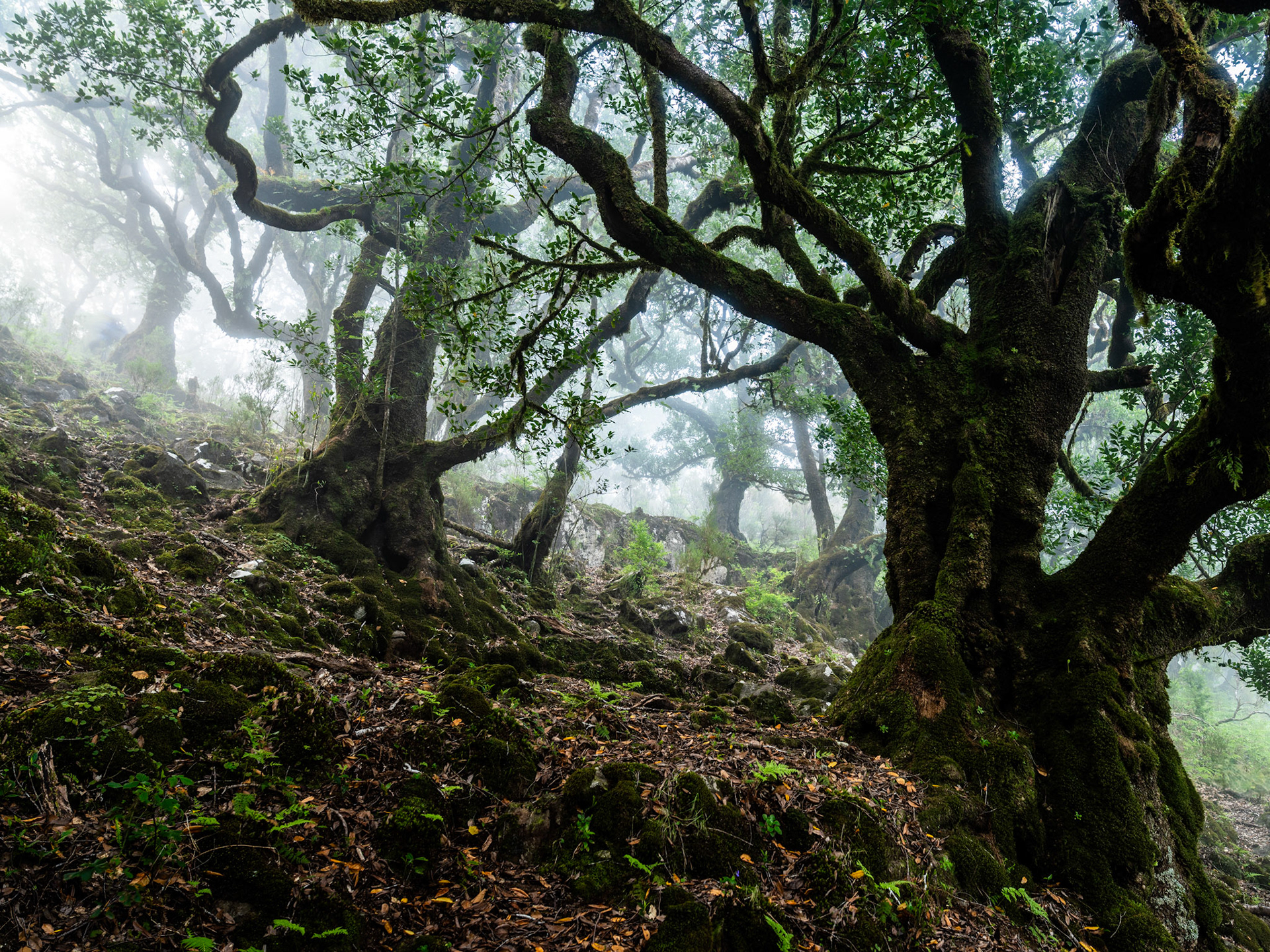
Ancient moss-clad trees cling to a steep rocky slope as morning fog filters through the canopy, softening the mid-distance into pale luminescence. The twisted architecture of the foreground trunks frames a natural corridor that draws the eye deep into the forest interior. The combination of low viewpoint, diffuse light, and mossy ground flora gives the scene an unusual sense of primordial depth.
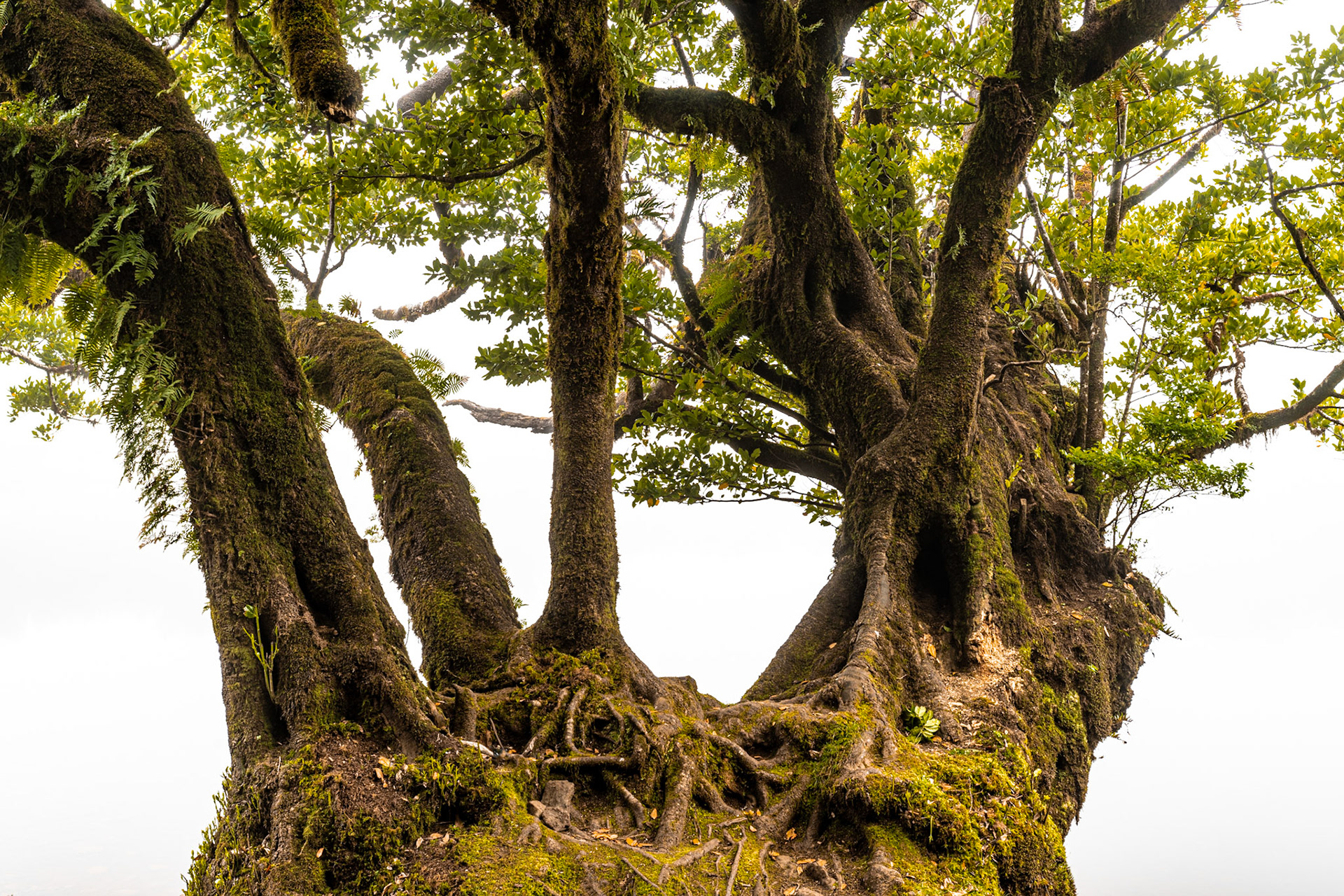
A gnarled, multi-stemmed laurisilva tree photographed from below, its moss-covered root mass and interlocking trunks filling the frame against a flat white sky. The upward perspective compresses the canopy into a dense architectural lattice of dark bark and fresh spring foliage. Epiphytic ferns colonise the lower limbs, signalling the humid conditions of a Macaronesian cloud forest.
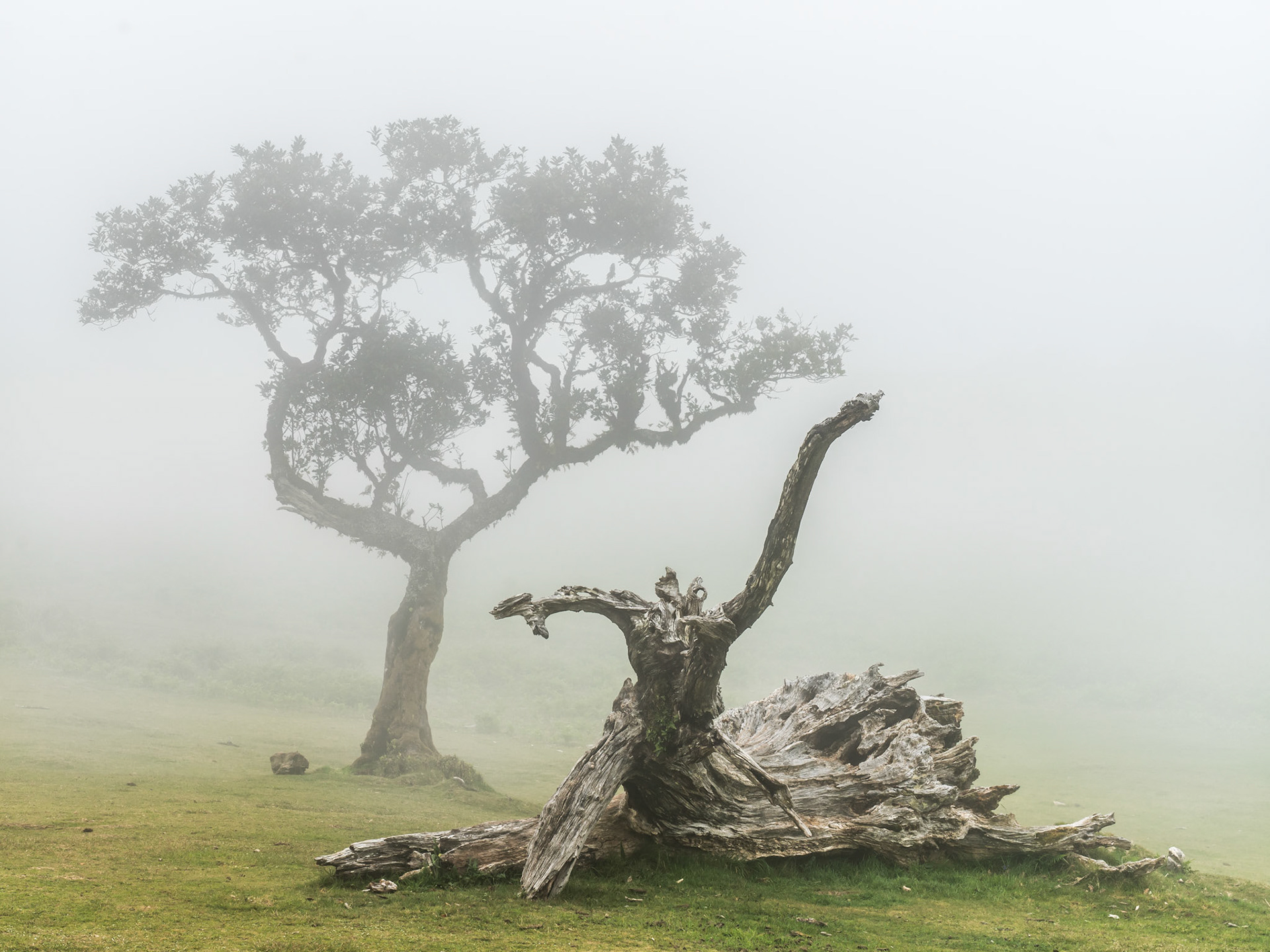
A fallen laurisilva trunk, bleached and contorted, lies on the plateau grassland of Fanal while a living til tree recedes into low cloud behind it. The pairing of decay and persistence, rendered in flat fog-light, strips the scene to its essential dialogue between death and continuity.
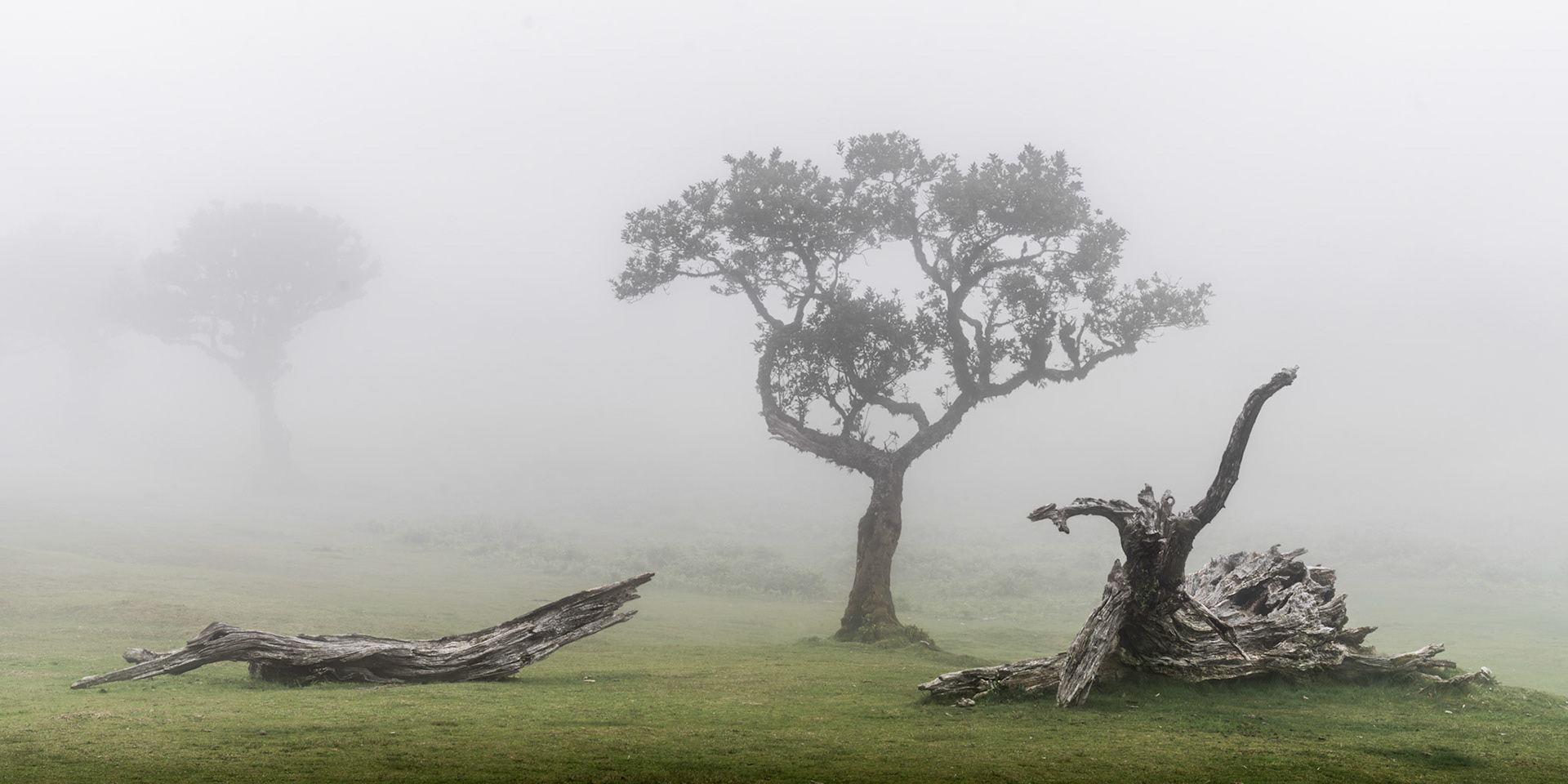
A lone laurisilva tree emerges from dense fog in the ancient laurel forest of Fanal, Madeira, flanked by two fallen and heavily weathered trunks. The ghost of a second tree recedes into the mist behind, compressing the scene into a single tonal plane. The panoramic frame and monochrome conversion heighten the stillness and geological age of the forest floor.
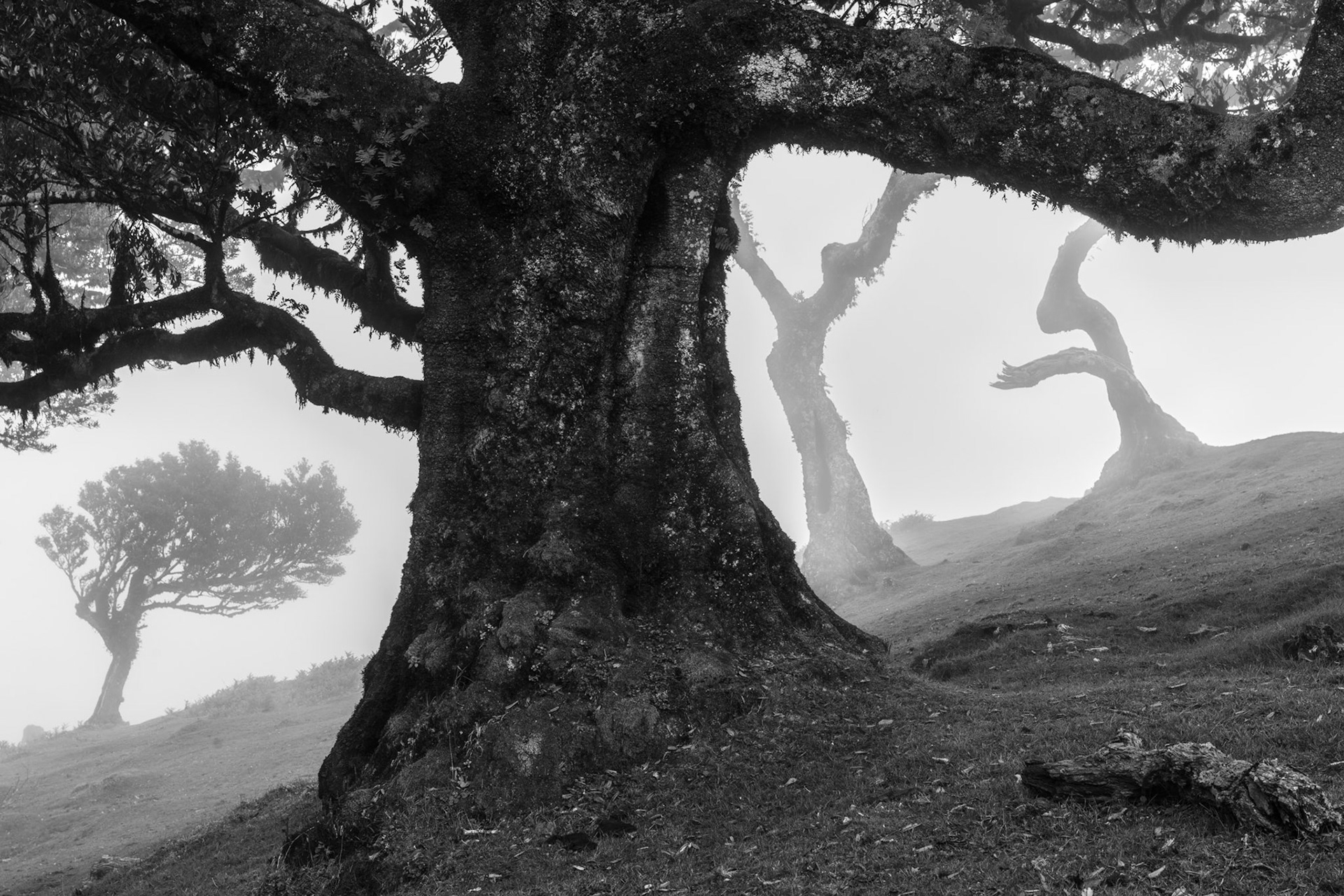
A massive moss-encrusted laurisilva trunk dominates the foreground while a contorted dead tree and fog-shrouded companions recede across the hillside. The mist compresses depth and isolates each form, lending the scene a quality closer to myth than landscape. Fanal plateau, Madeira, May.
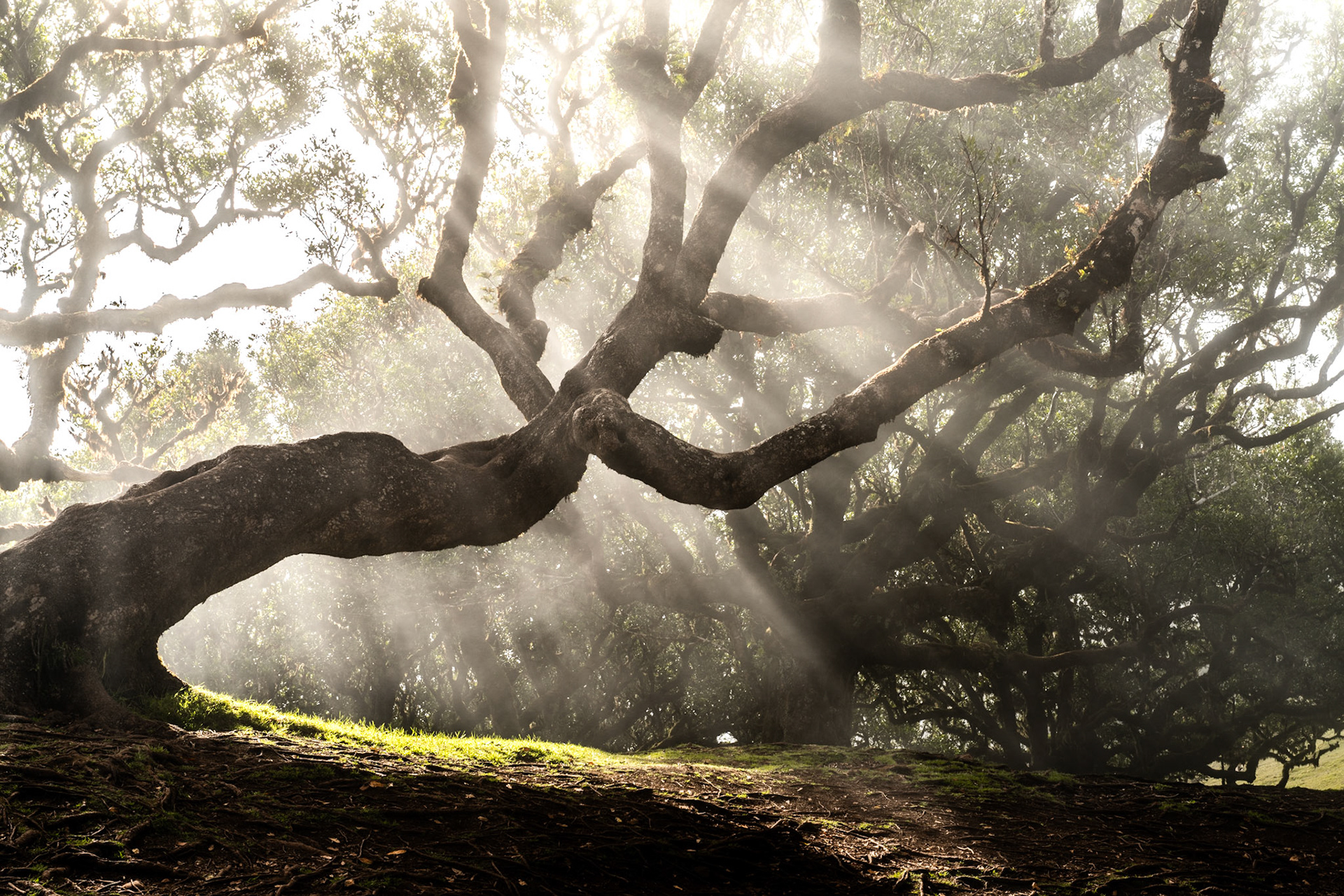
Crepuscular rays break through a canopy of laurisilva forest, illuminating the twisted limb of a veteran tree as mist drifts between the trunks. The low angle places the gnarled branch as a strong foreground diagonal, anchoring the composition against the soft diffusion of backlit fog. A patch of moss-edged grass catches the first direct light at bottom left, grounding an otherwise aerial scene.
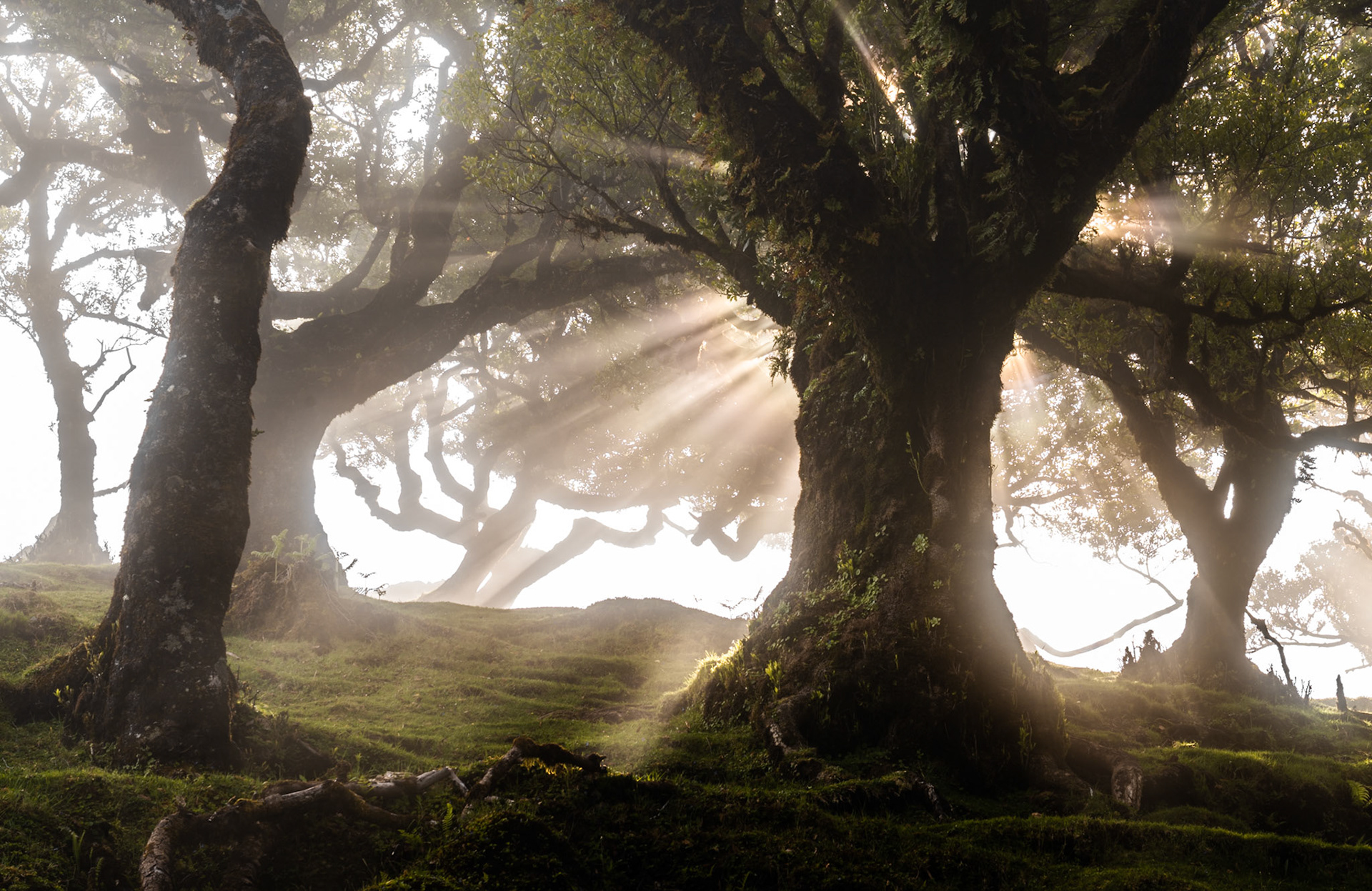
Crepuscular rays break through ancient laurisilva canopy in low morning mist, the gnarled moss-draped trunks framing a luminous gap in the forest interior. The diffuse atmosphere renders mid-ground trees as silhouettes, compressing depth and lending the scene an otherworldly stillness characteristic of Madeira's Fanal plateau. Captured at dawn in late May, when seasonal mist regularly pools among the laurel woodland.
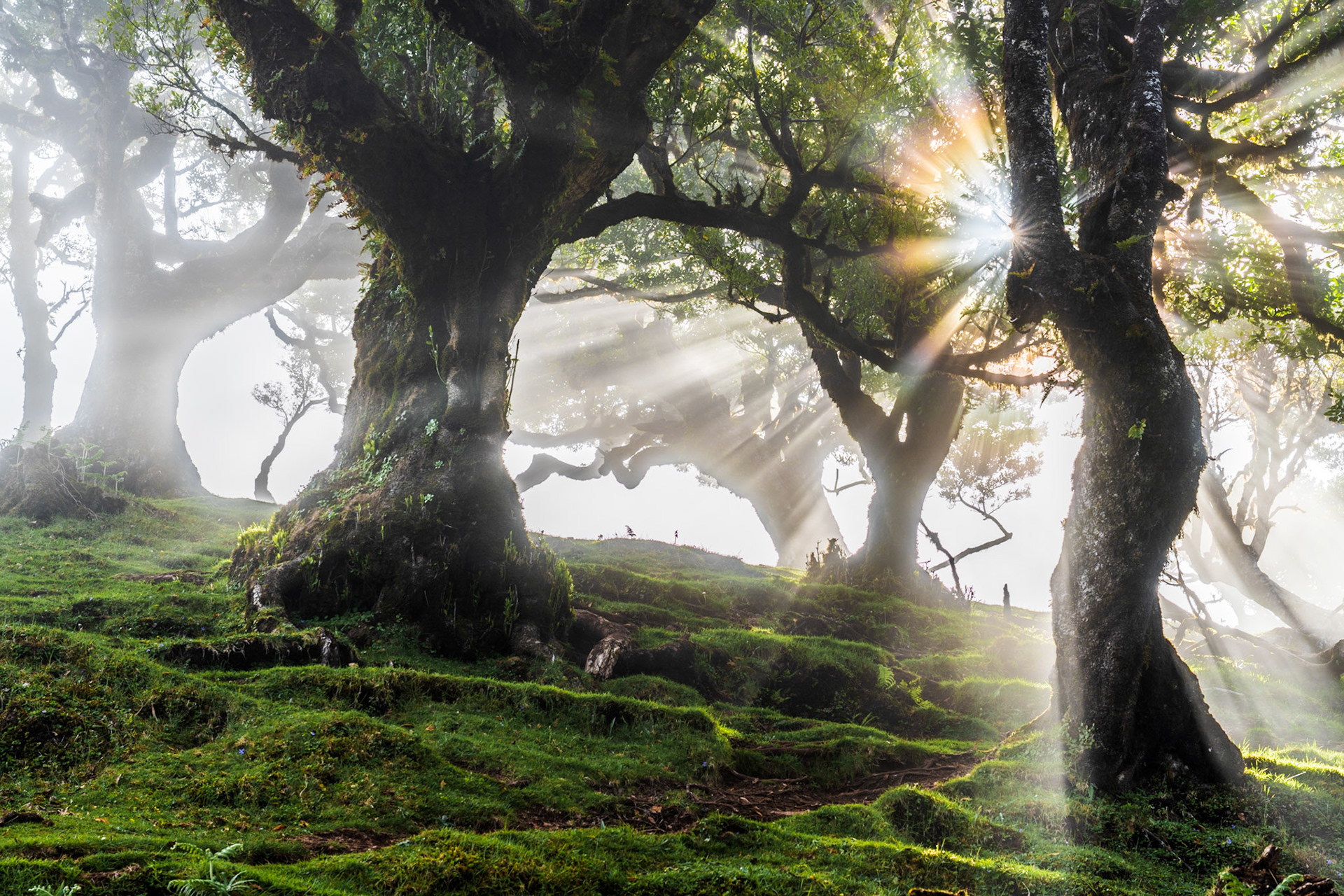
Ancient laurisilva trees on the fog-draped plateau of Fanal, Madeira, at first light in late May. Crepuscular rays break through the canopy arch formed by two gnarled trunks, illuminating a moss-carpeted hillside and a solitary figure in the middle distance. The combination of endemic laurel forest structure, low cloud, and directional sunlight produces an atmospheric compression that is rarely this resolved.
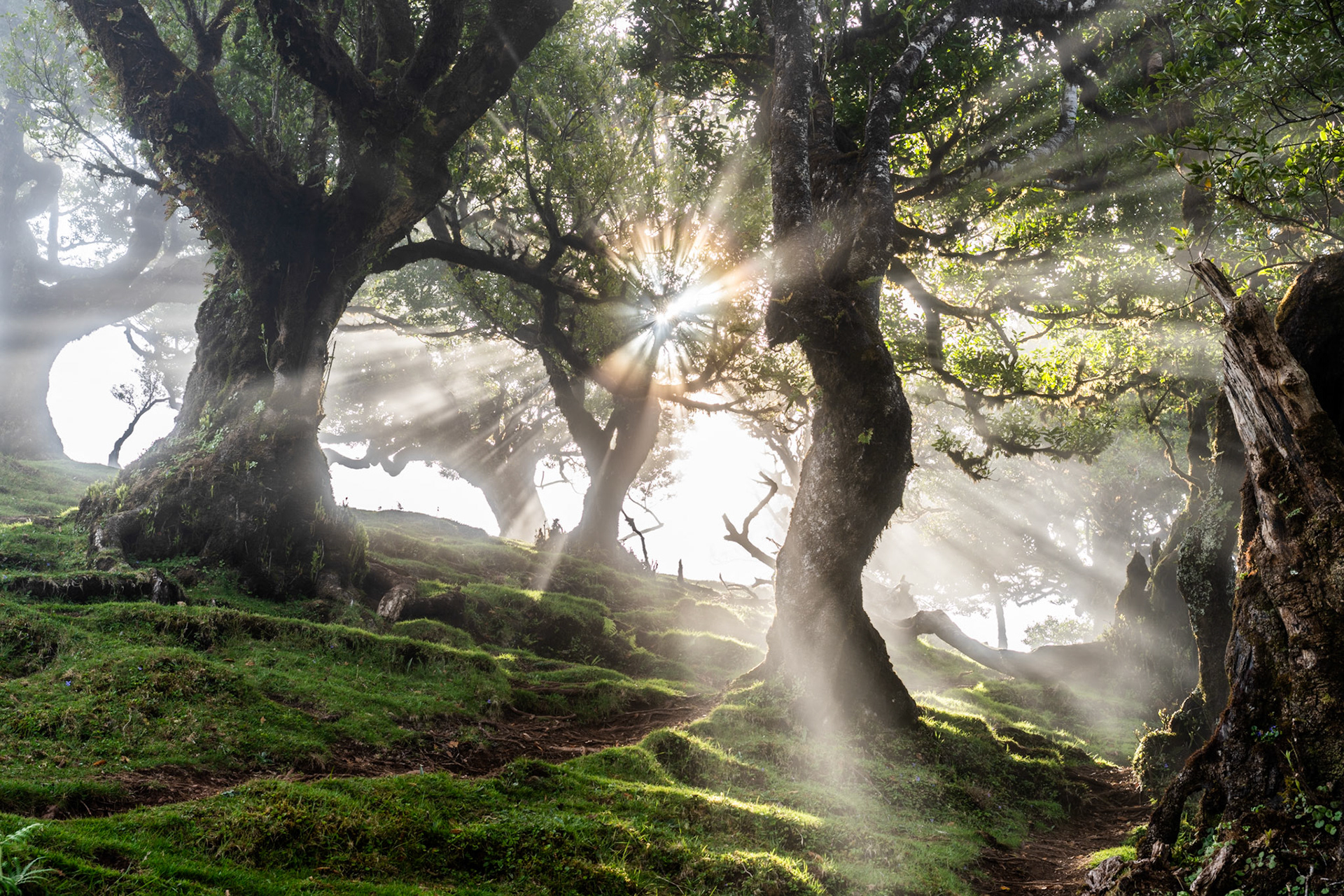
Crepuscular rays break through a gap in the ancient laurel canopy of Fanal forest, Madeira, the mist-laden air rendering each shaft of light as a solid column. Gnarled, moss-draped trunks frame a steep woodland path, their contorted forms characteristic of the UNESCO-listed laurisilva. The low sun angle and residual cloud create a quality of light rarely sustained beyond a few minutes.
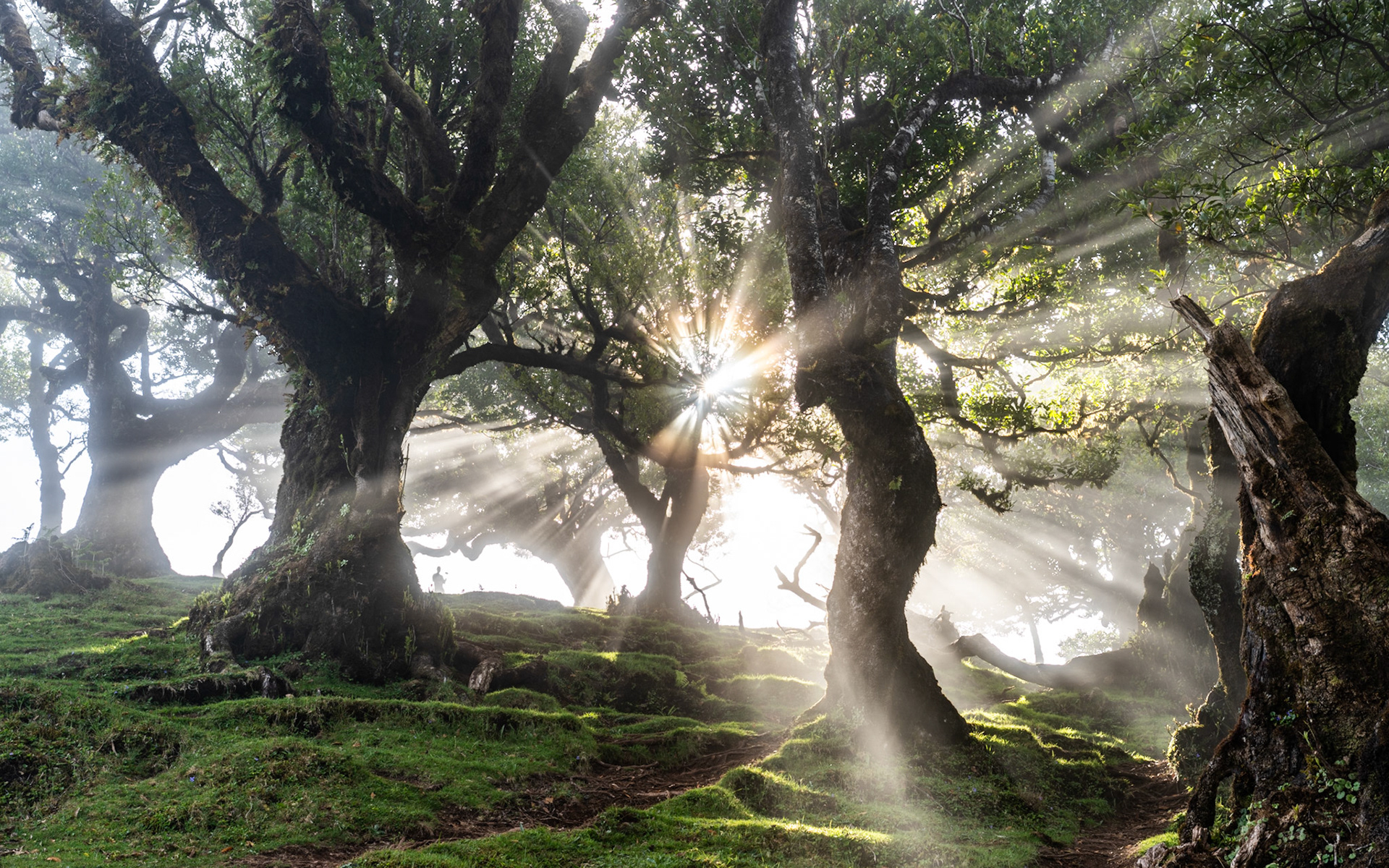
Ancient laurel trees in Madeira's laurisilva forest channel early-morning sunbeams through mist-laden air, the crepuscular rays fanning across a moss-carpeted hillside. The gnarled, lichen-covered trunks frame a luminous gap where a distant figure provides quiet scale. Captured at dawn in late spring, the image balances the forest's primordial weight against the transience of passing light.
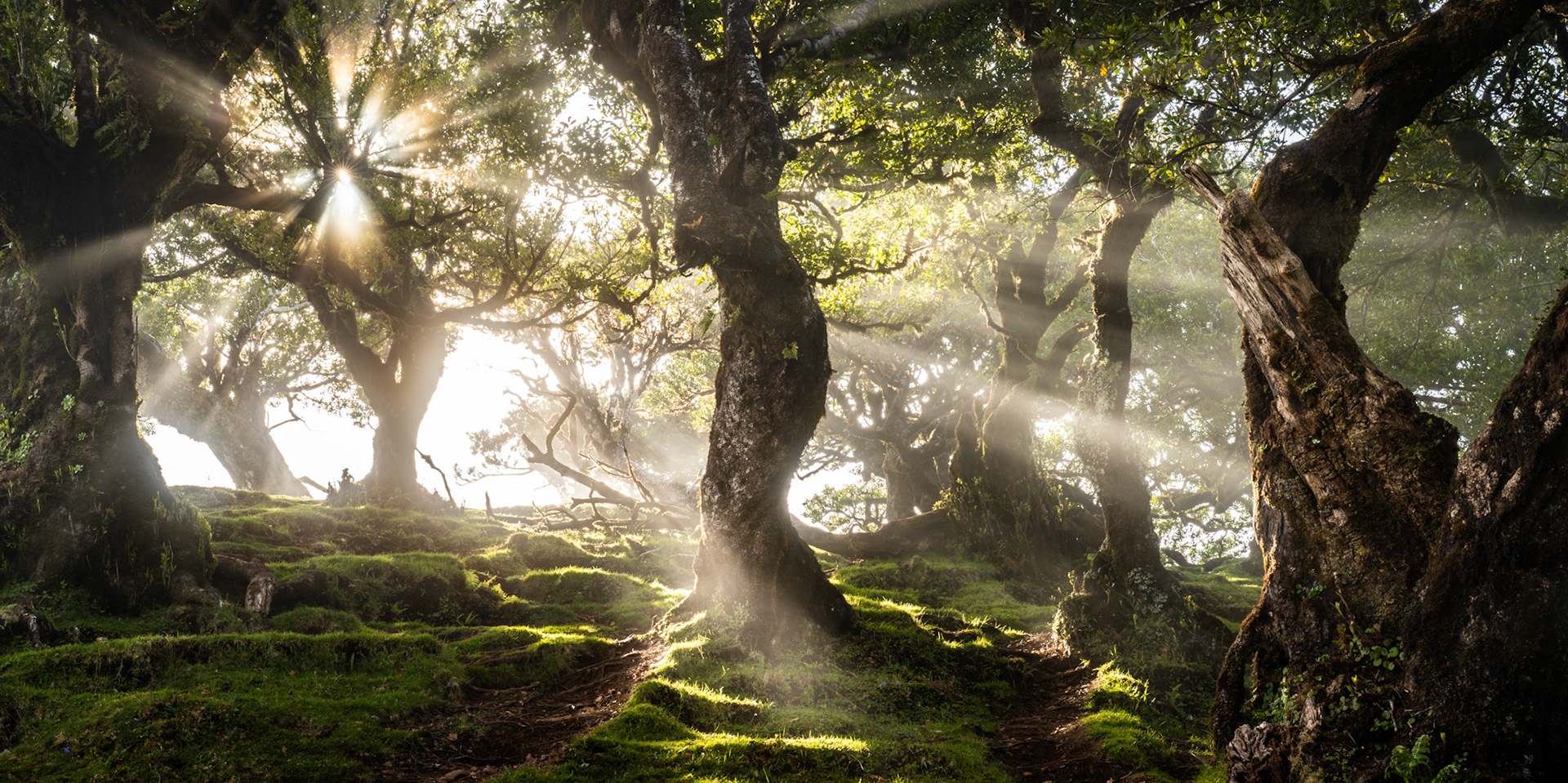
Sun rays pierce the canopy of ancient laurel forest at dawn, scattering through mist to illuminate a moss-carpeted floor. The gnarled, twisting trunks of Madeira's laurisilva — a remnant of the Tertiary-era forests that once covered southern Europe — frame shafts of light in a scene of rare atmospheric density. The panoramic framing holds the disorder of the woodland in careful tension with the ordered geometry of the light.
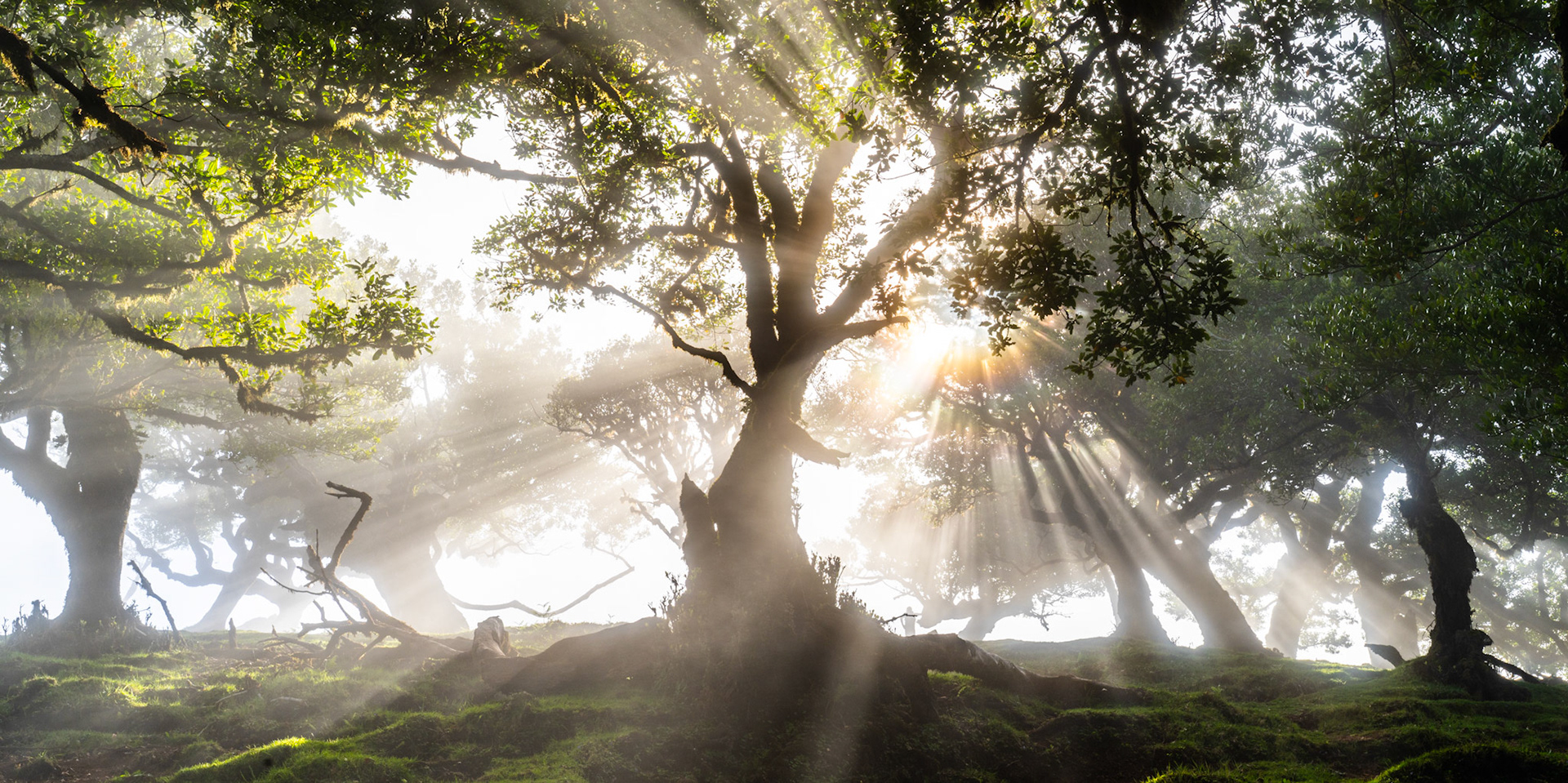
Crepuscular rays break through morning mist in the ancient laurel forest of Fanal, Madeira. The gnarled trunk of a centuries-old til tree anchors the frame as diffused light fans outward through layered fog, revealing the sculptural root systems and moss-covered ground beneath the canopy. The wide panoramic crop deepens the sense of depth and primordial stillness.
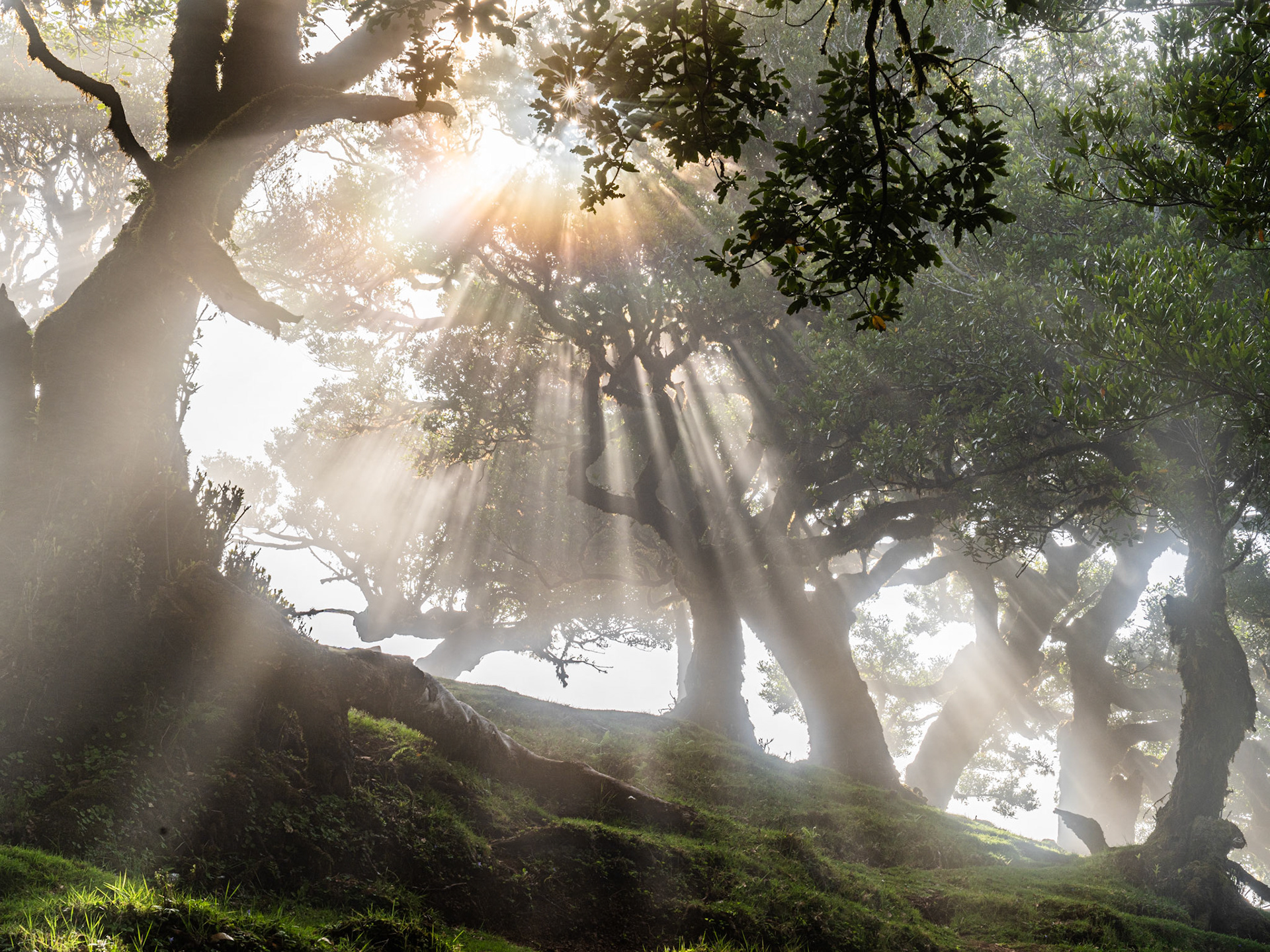
Crepuscular rays pierce the fog canopy of an ancient laurel forest, casting discrete shafts of light between gnarled, moss-rooted trunks. The low sun strikes from just above the treeline, isolating each beam against a diffuse white background. Fanal forest, Madeira, early morning in late spring.
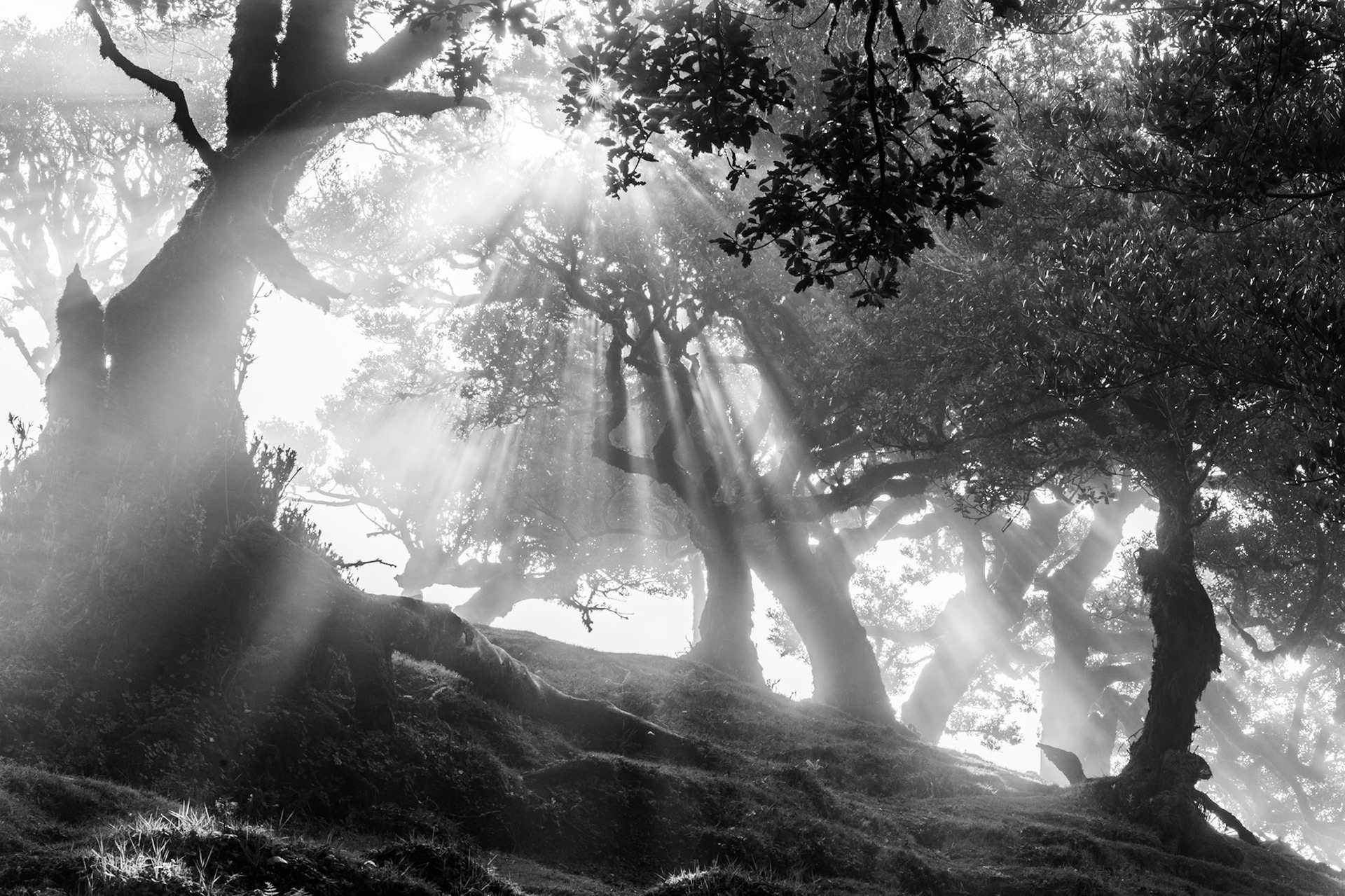
Crepuscular rays fracture through the canopy of ancient laurel forest, their shafts caught in residual mist rolling across a moss-covered hillside. The monochrome rendering strips the scene to pure tonal drama, the gnarled silhouetted trunks framing cascading light against a luminous background. Fanal forest, Madeira, late May dawn.
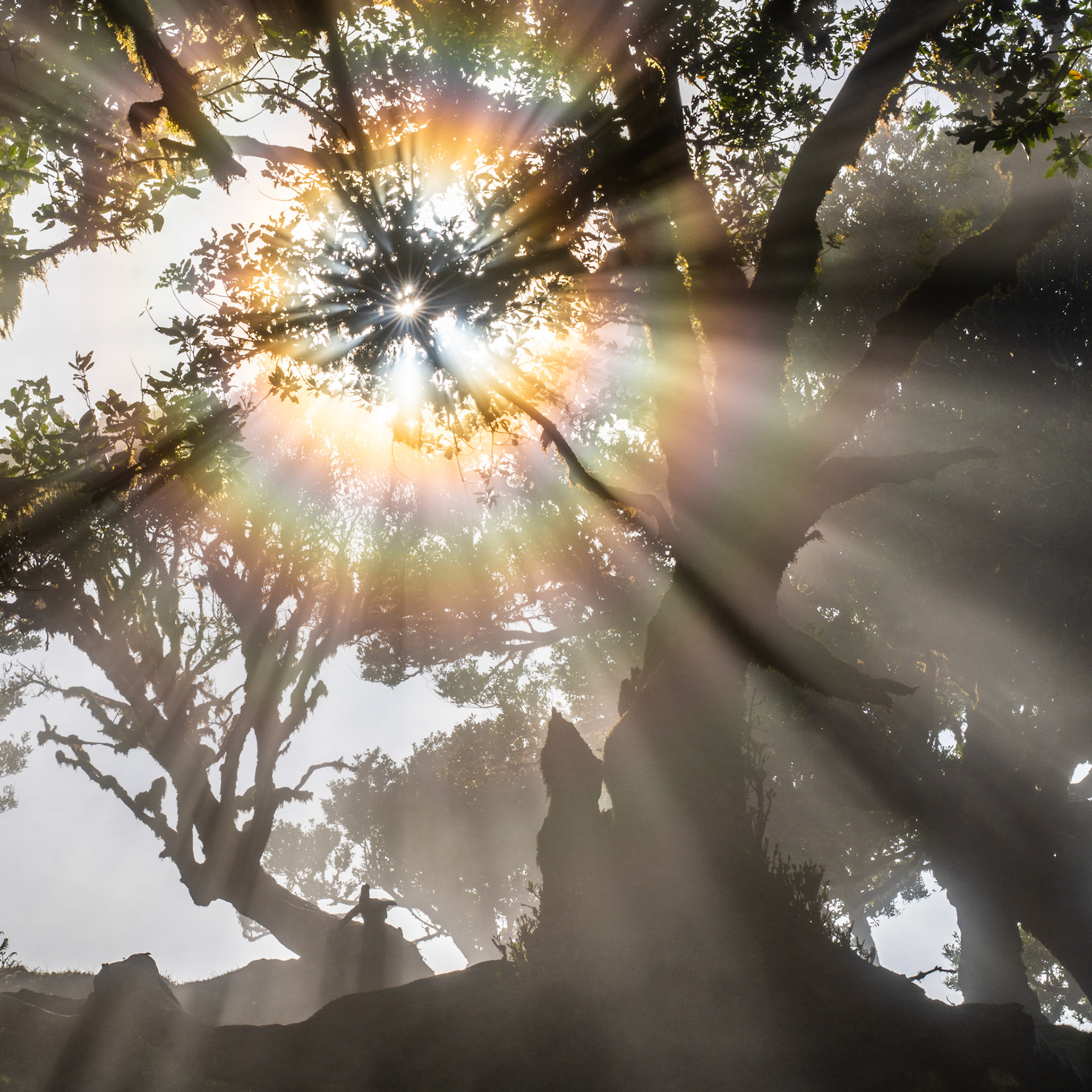
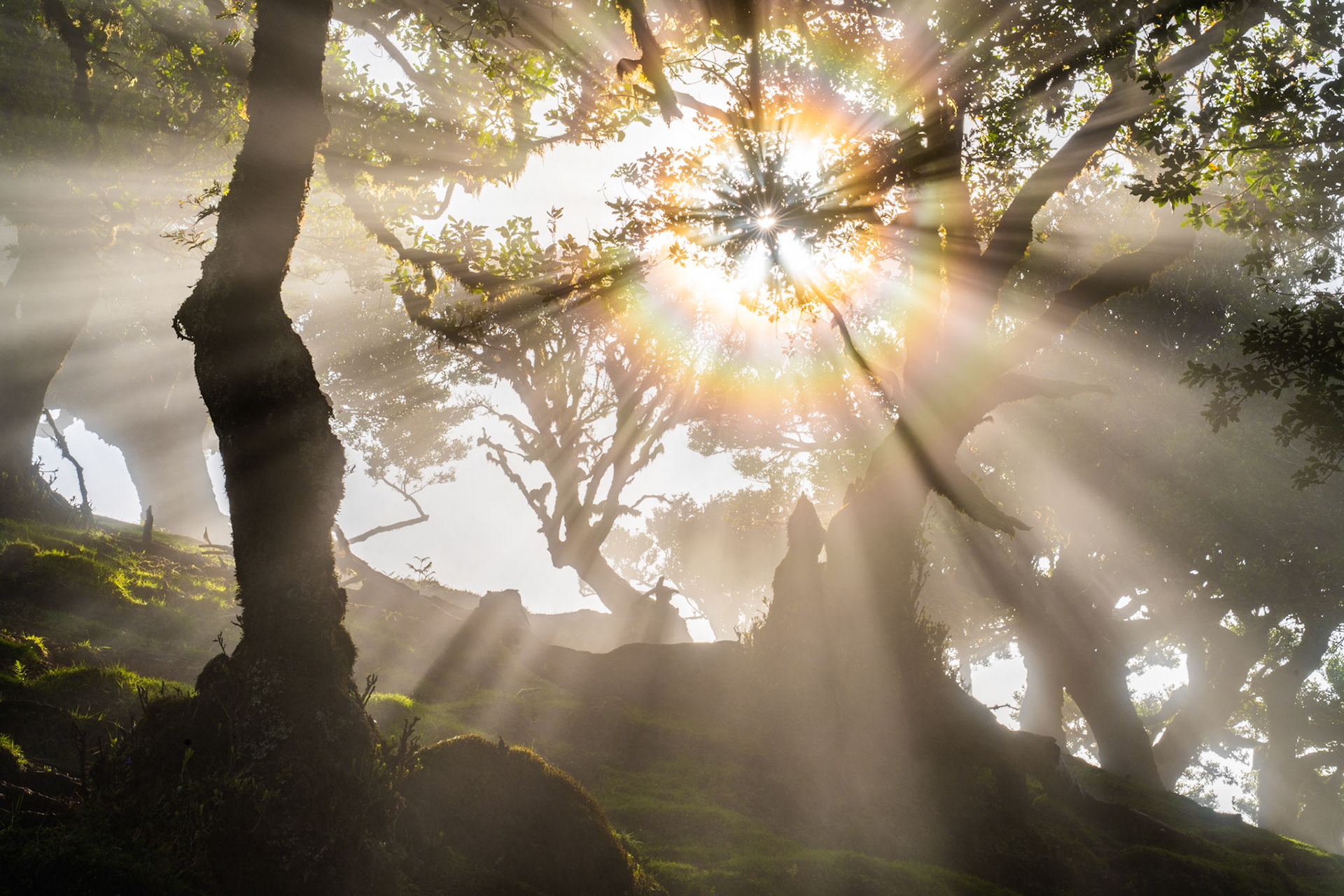
Crepuscular rays fan through the canopy of a laurisilva woodland as low mist lingers between moss-covered trunks at dawn. The starburst sun, partially occluded by interlocking branches, illuminates suspended moisture in near-theatrical shafts, while the forest floor remains deep in shadow. The stillness of the scene and restraint in the edit give the image a quality closer to observation than spectacle.
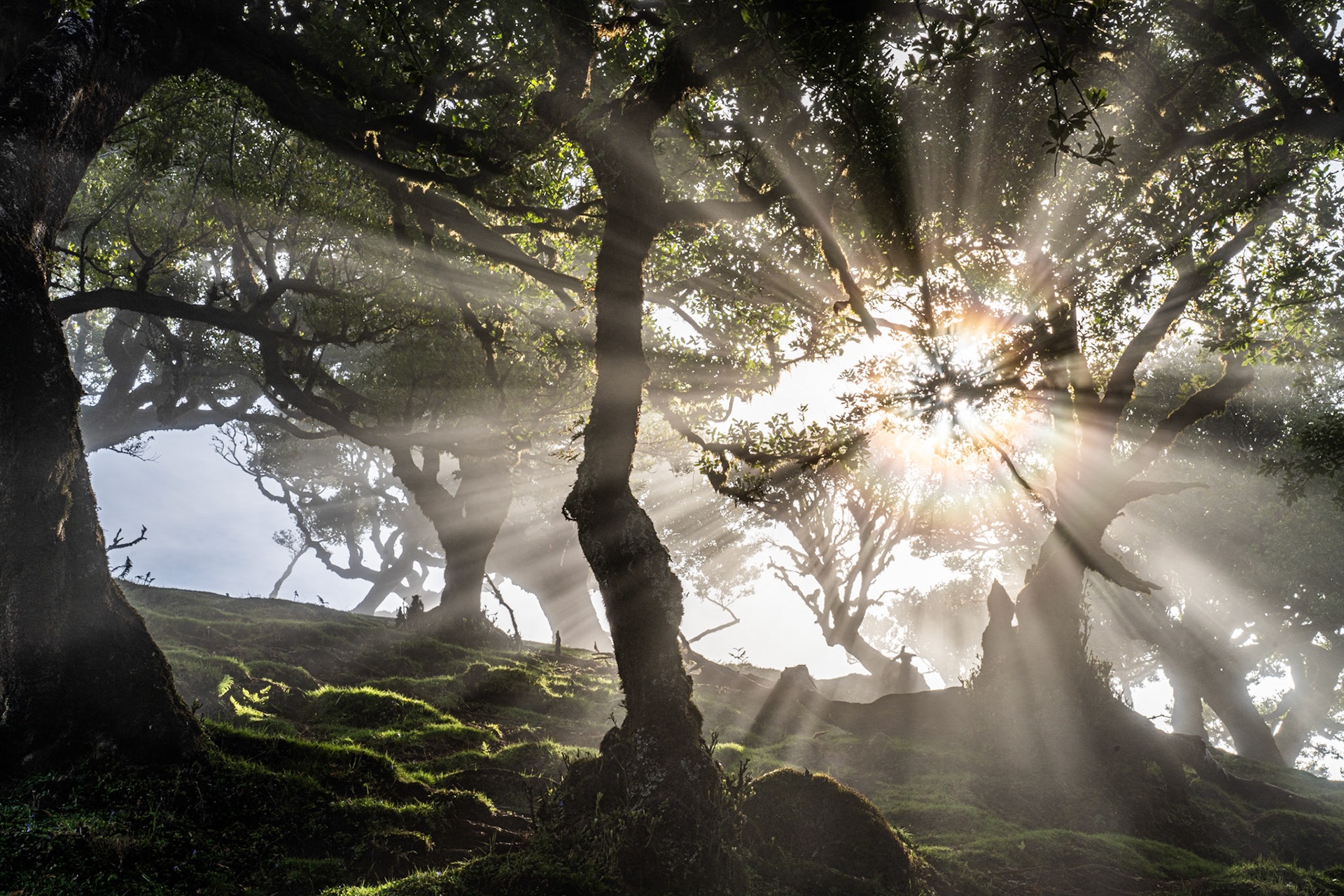
Crepuscular rays pierce the canopy of an ancient laurel forest, illuminating moisture-laden air above a moss-carpeted slope. The gnarled, spreading forms of old-growth Til trees frame the sun as it breaks through low cloud at dawn. The scene captures the primeval character of Macaronesian laurisilva, a habitat unchanged in form since the Tertiary.
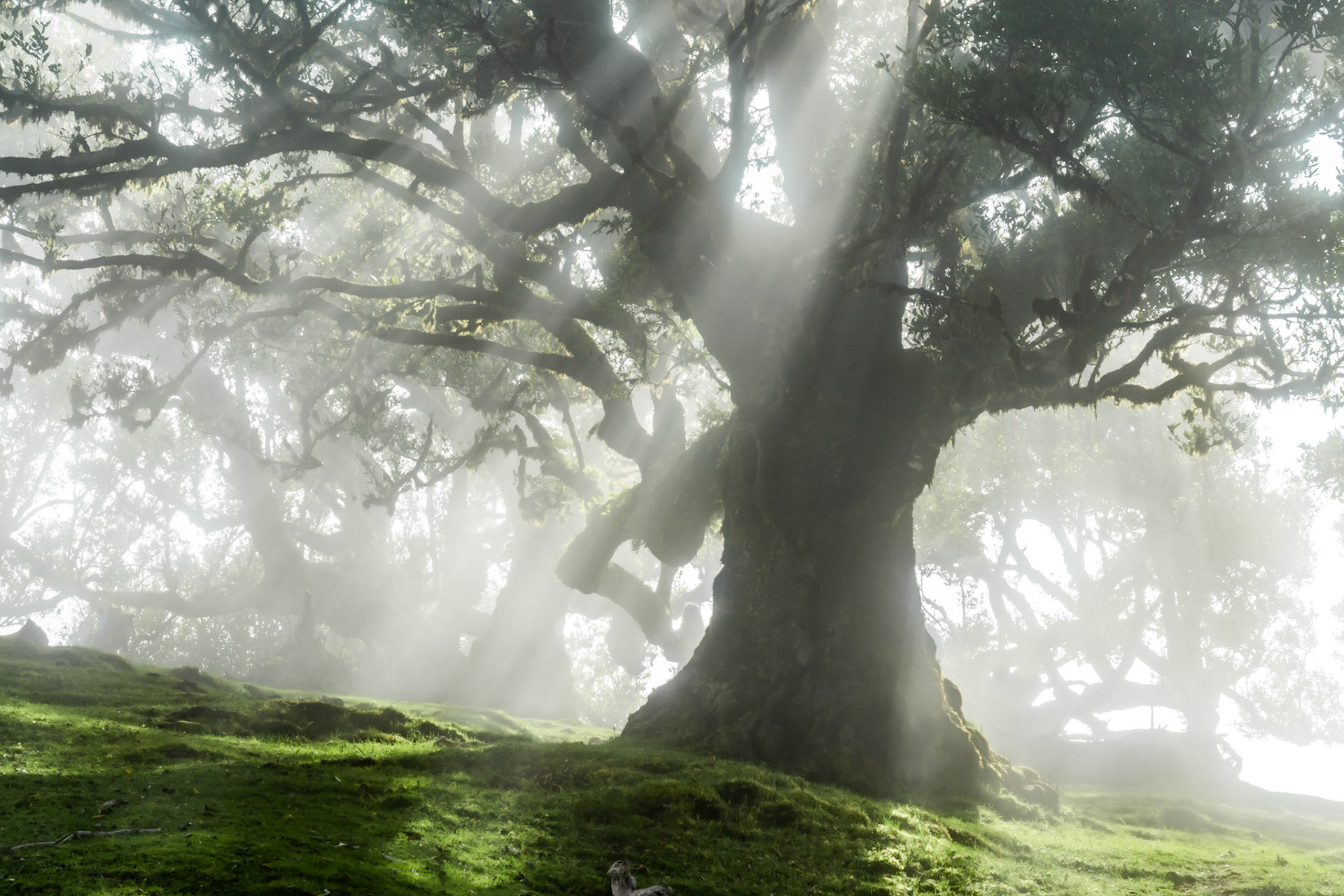
A veteran laurel tree in the laurisilva forest of Fanal, Madeira, caught as morning sunbeams penetrate low cloud. The massive gnarled trunk anchors the frame while crepuscular rays diffuse through the canopy above a vivid moss-covered floor. The composition balances intimate scale with the cathedral weight of a UNESCO-protected forest.
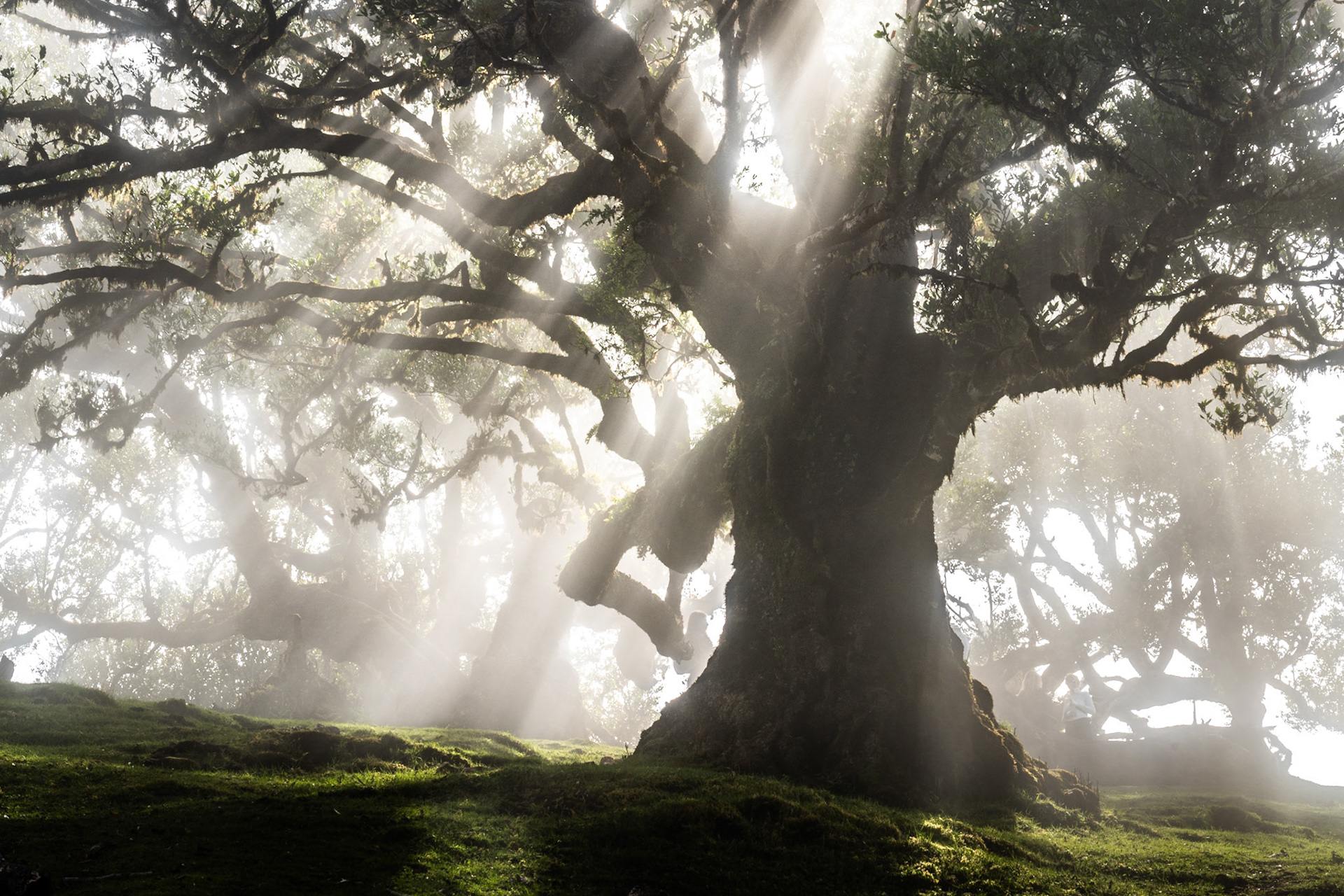
God-rays break through morning fog around a veteran Til laurel in the ancient laurisilva forest of Fanal, Madeira. The diffused backlight renders the gnarled trunk in near-silhouette against luminous mist, while moss-covered ground roots anchor the composition. The convergence of crepuscular rays and fog density is precise — a condition that lasts only minutes.
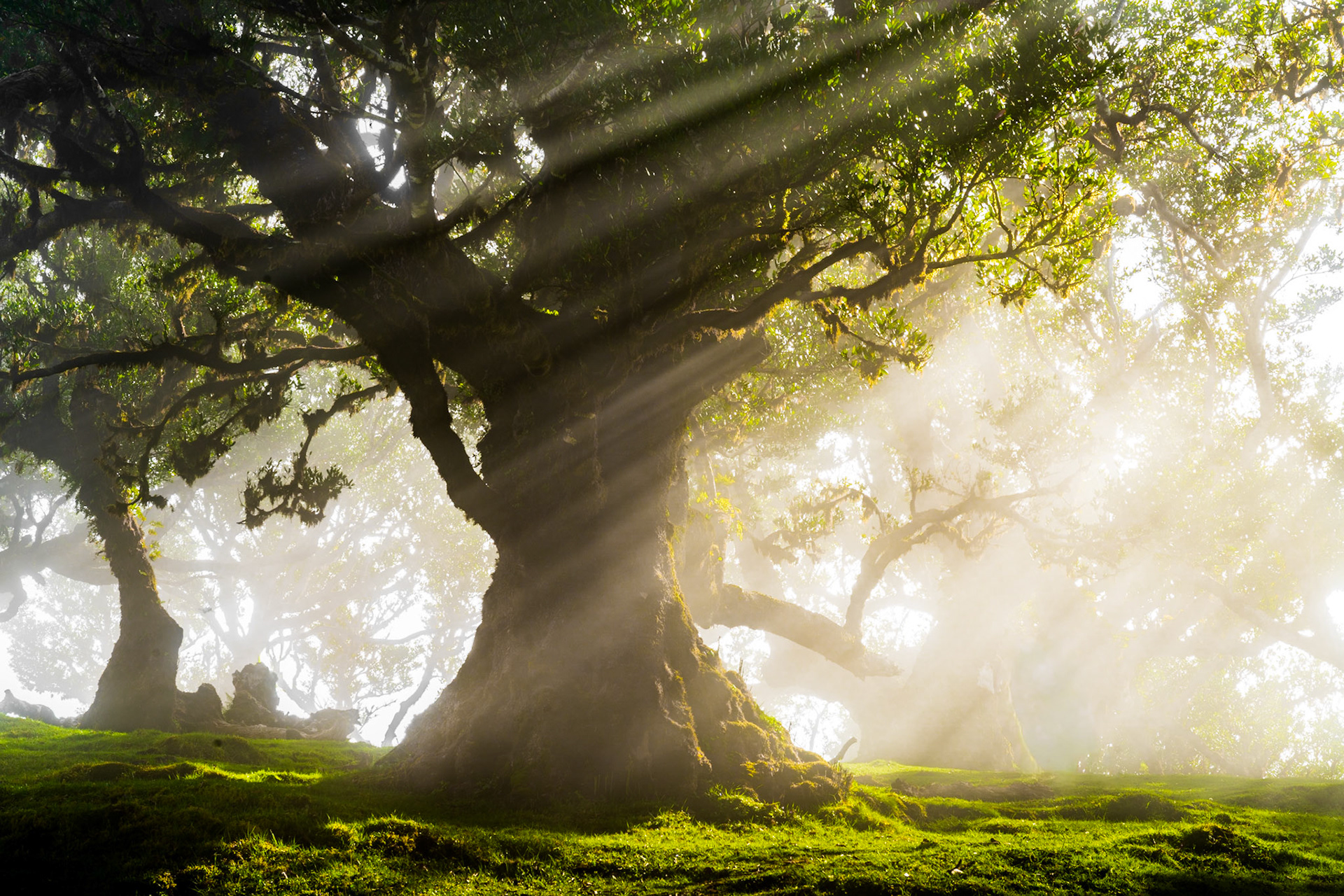
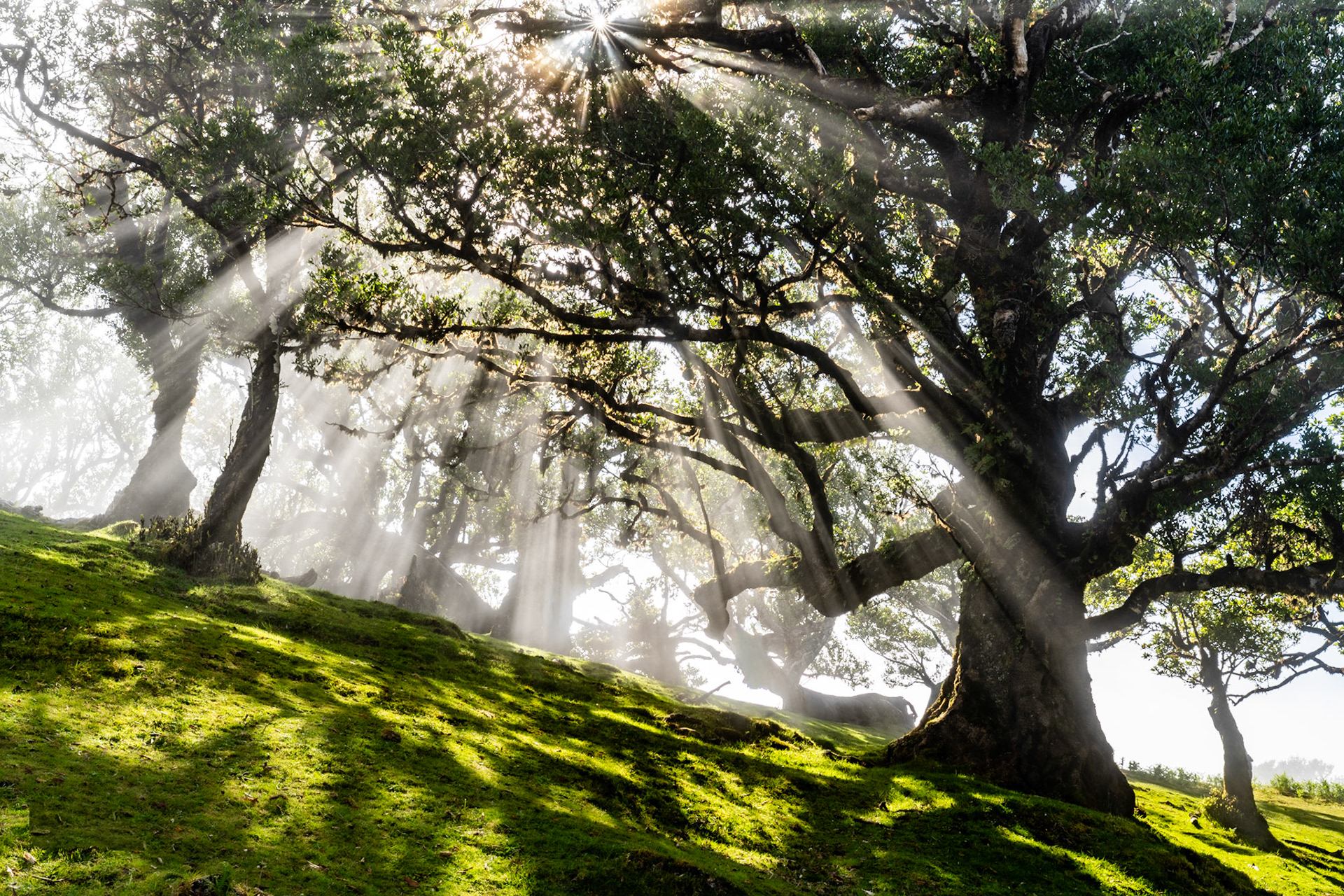
Crepuscular rays pierce the canopy of ancient Til laurel trees on a mist-laden slope, the low sun fracturing into a starburst through interlocking branches. Ground fog diffuses the light into distinct shafts, throwing sharp shadows across the moss-carpeted hillside. The scene is consistent with the laurisilva forest of Fanal, Madeira, a UNESCO-listed relict habitat of the Macaronesian laurel forest.
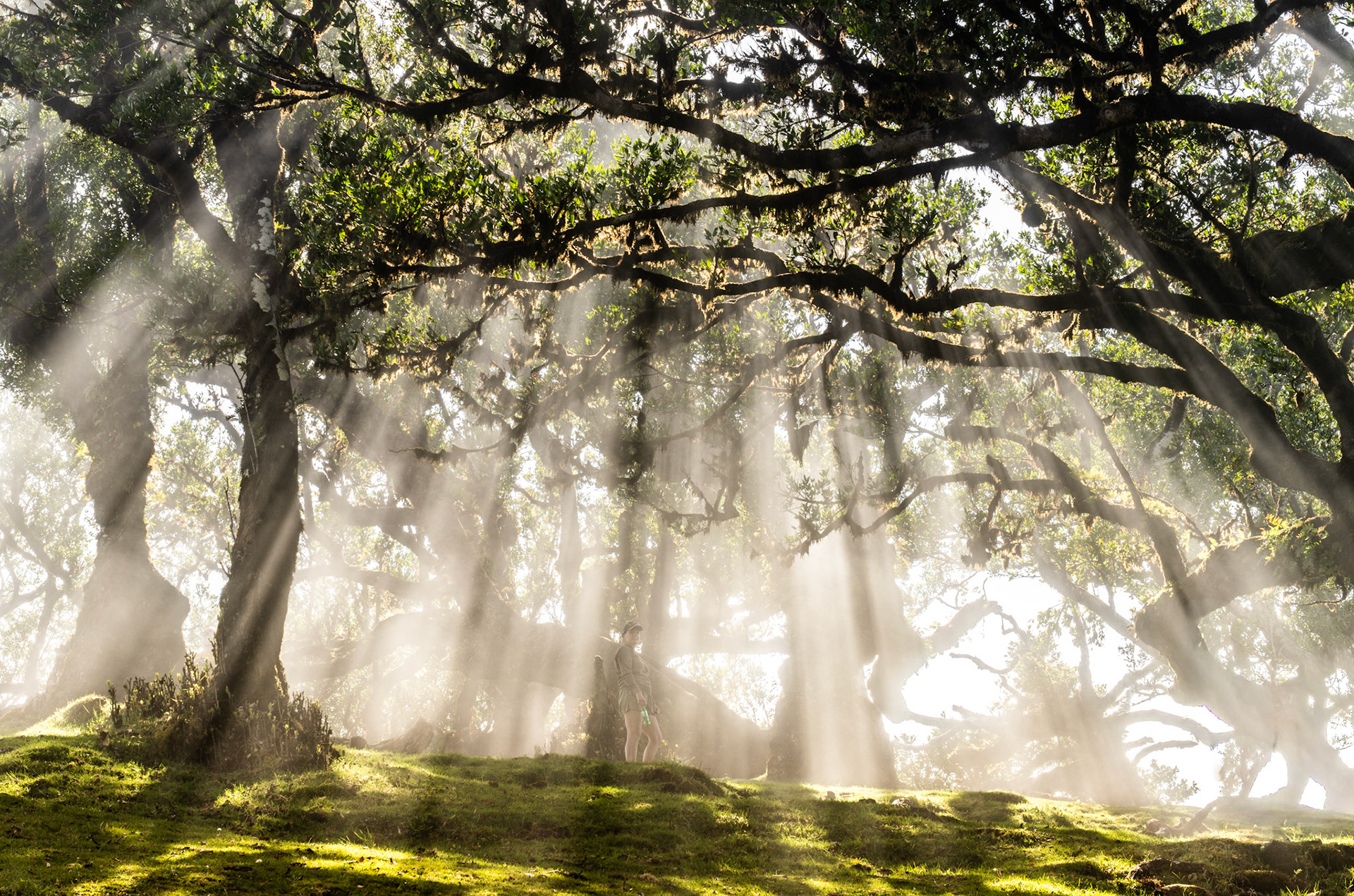
Crepuscular rays pierce the canopy of an ancient laurisilva woodland, illuminating drifting mist between moss-covered trunks. A solitary figure stands mid-frame, dwarfed by the arching boughs and suffused light, providing both scale and quiet human resonance. The mossy ground and humid haze are characteristic of Madeira's UNESCO-listed laurel forest.
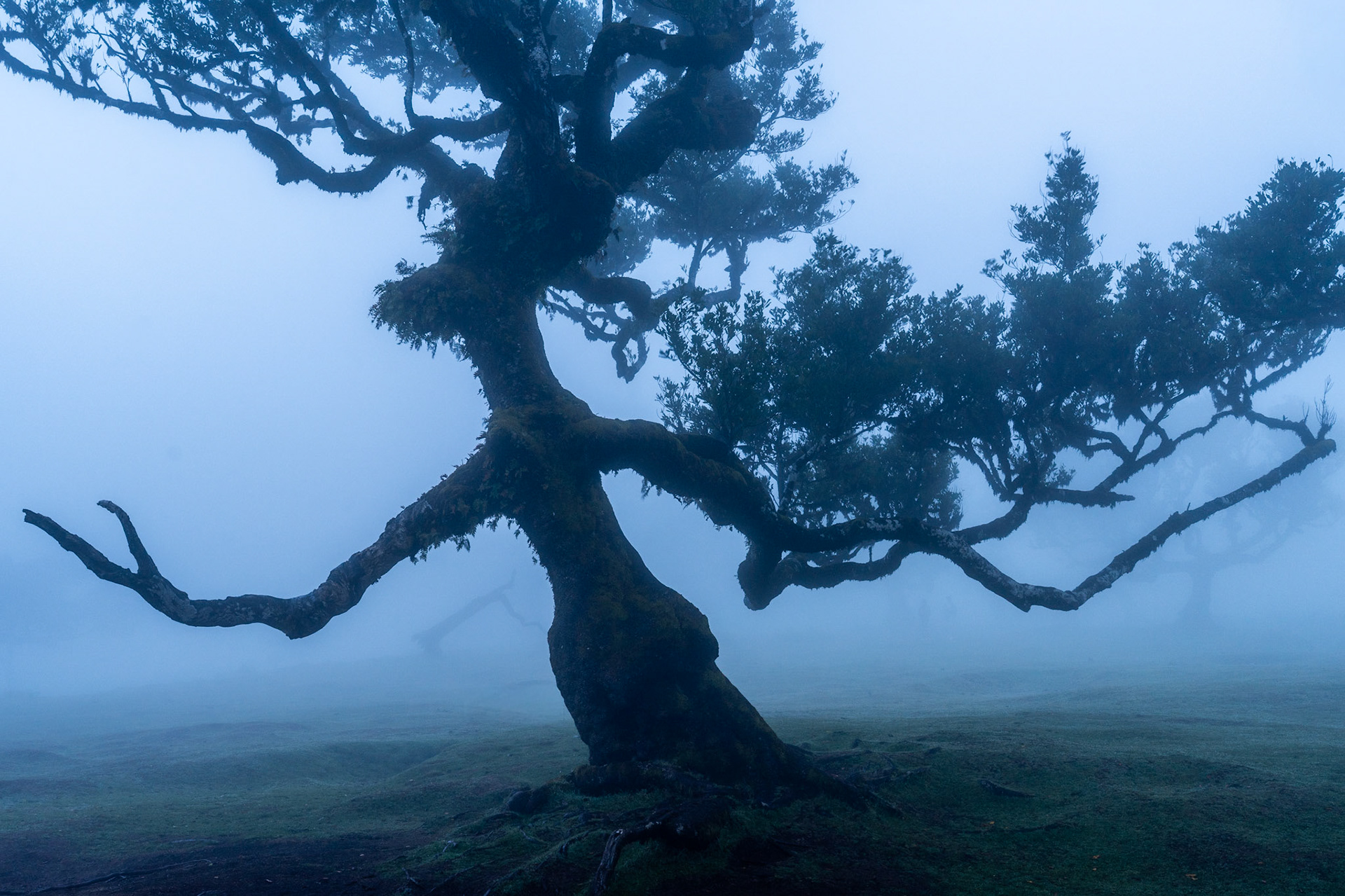
A massively contorted laurisilva tree emerges from dense cloud in the Fanal plateau, Madeira. The gnarled trunk and outstretched limbs read almost figuratively against the cold blue-grey void, while moss-covered roots anchor the composition to the saturated ground. Diffuse fog erases all background detail, isolating the tree's sculptural form with quiet authority.
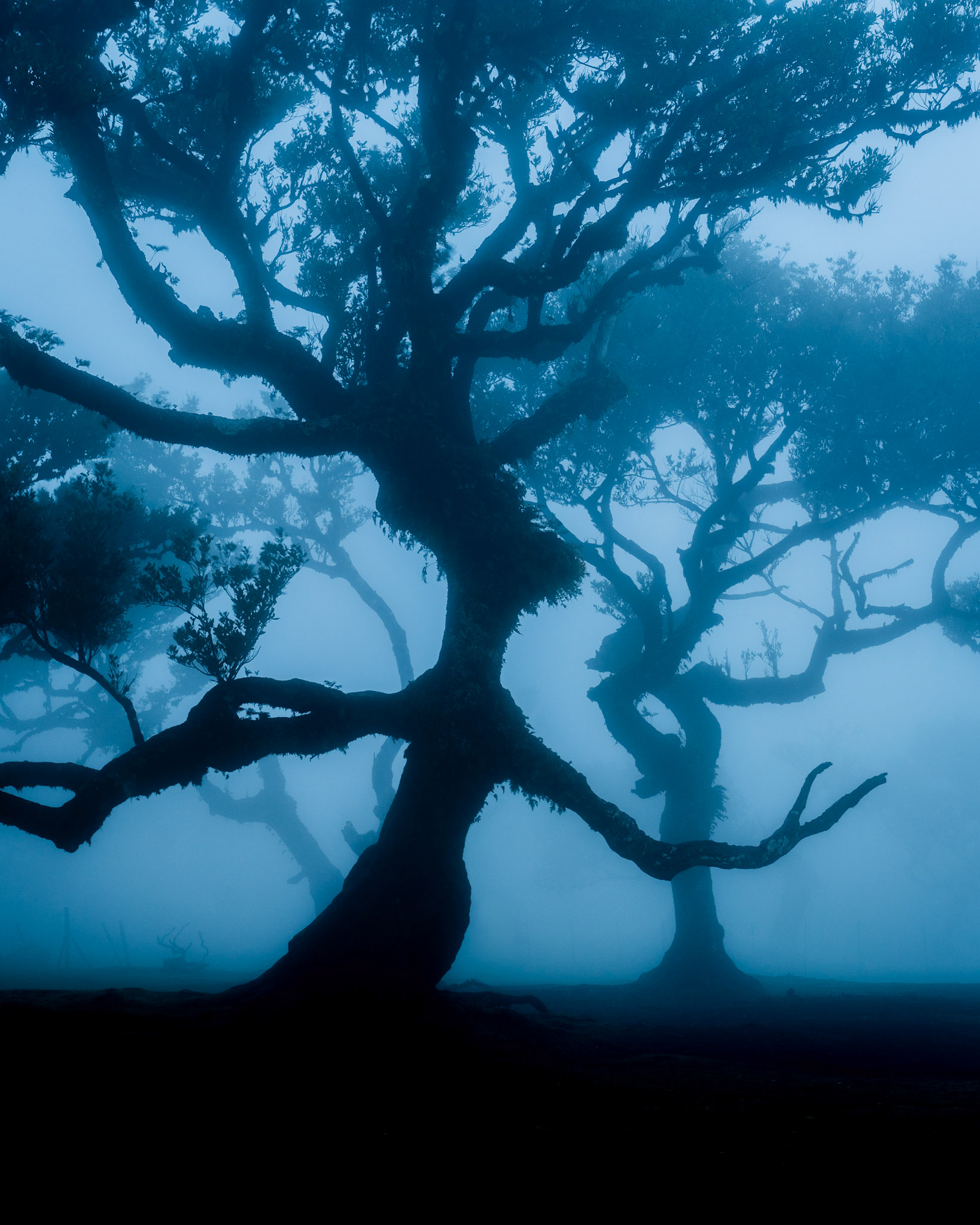
A gnarled laurisilva tree dominates the foreground, its twisted limbs reaching into dense fog that erases all distance and colour. Receding trees dissolve into a cold blue murk, creating a strong sense of layered depth within the forest. The near-silhouette treatment and monochromatic palette give the scene an otherworldly stillness.
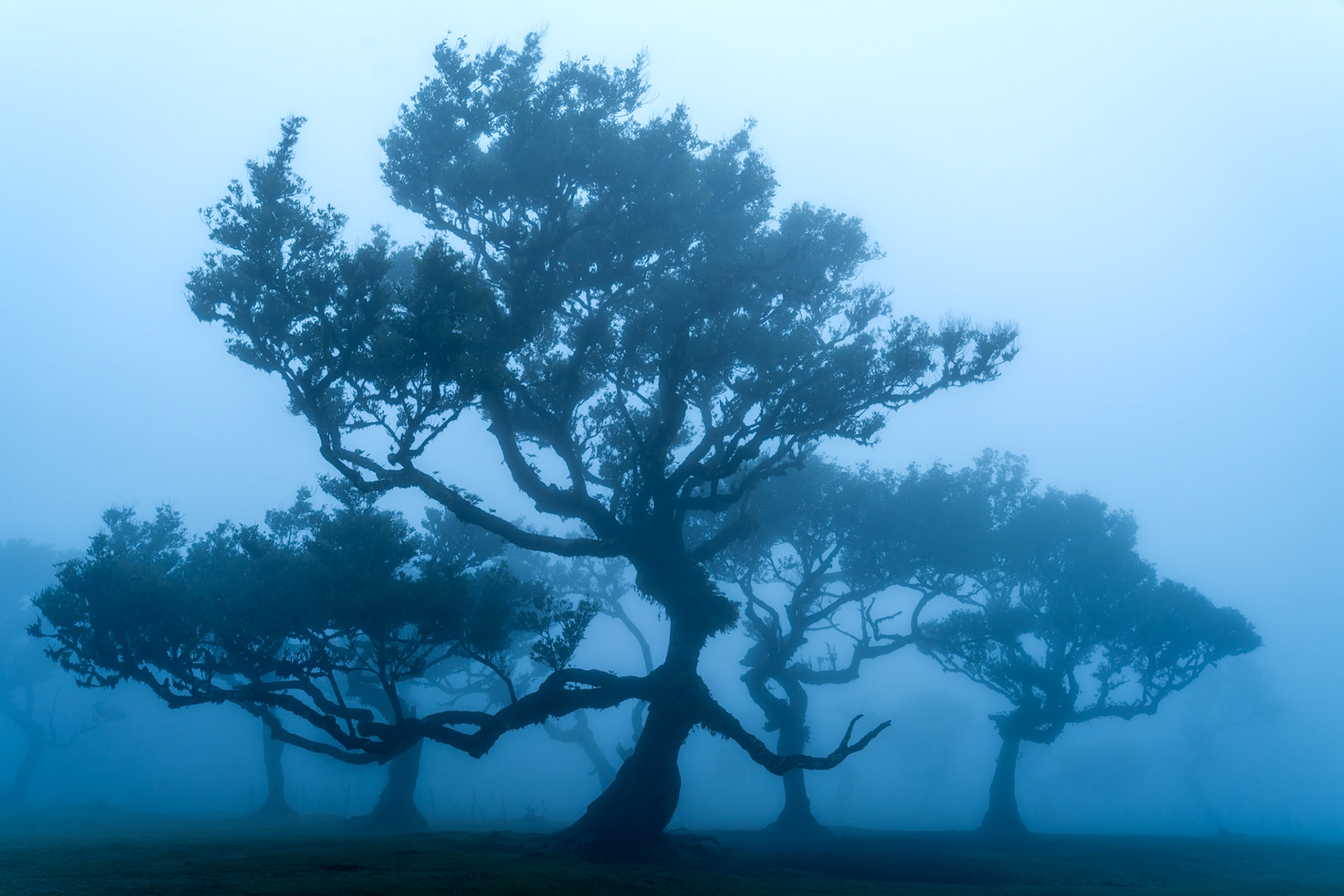
Ancient Til laurel trees emerge from dense cloud in Fanal forest, Madeira, in the pre-dawn stillness of late spring. The dominant foreground tree, its limbs twisted horizontally by centuries of trade-wind pressure, anchors a recession of silhouetted forms that dissolve progressively into the blue-grey murk. Flat, diffuse light strips the scene of colour, leaving structure and atmosphere to carry the image.
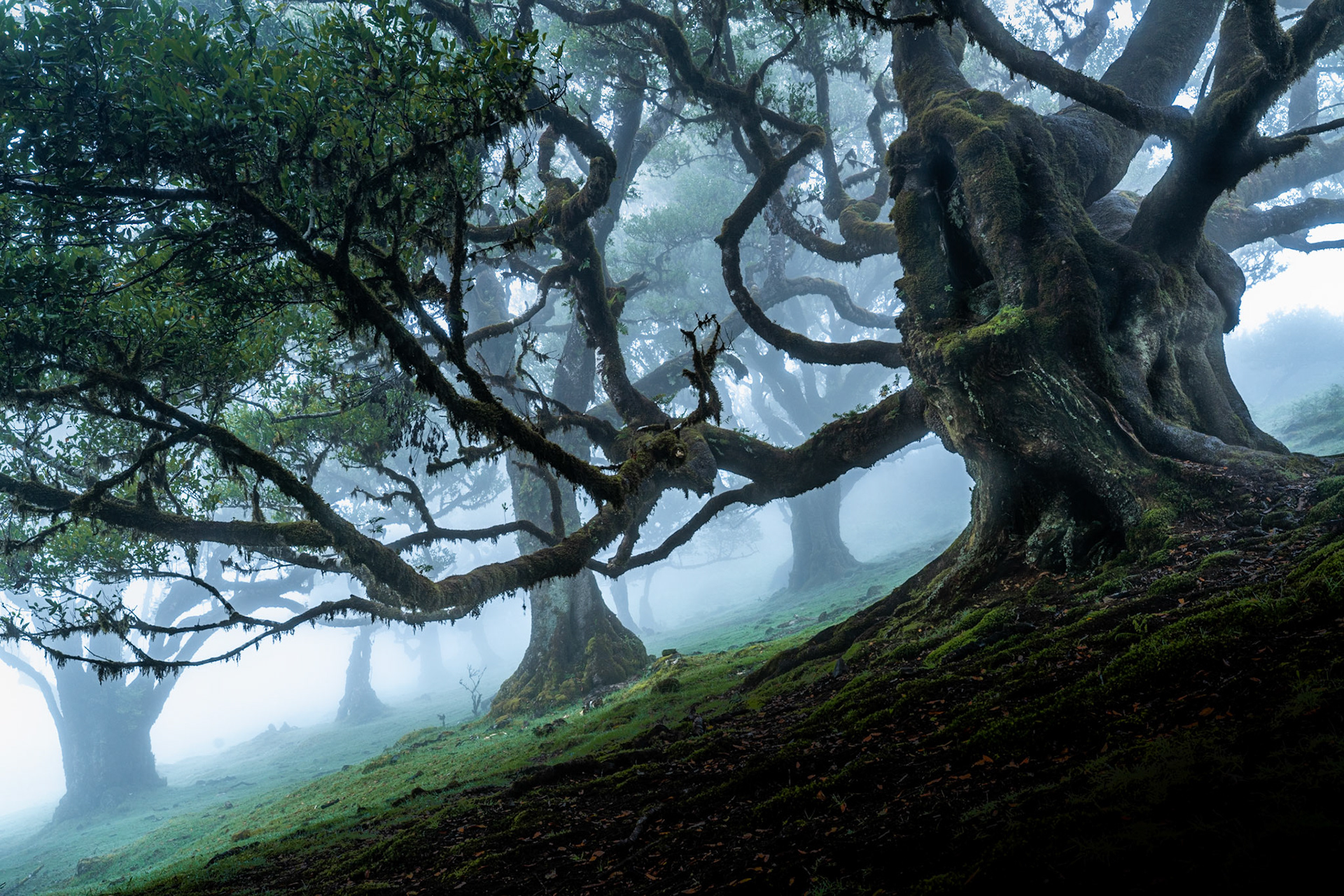
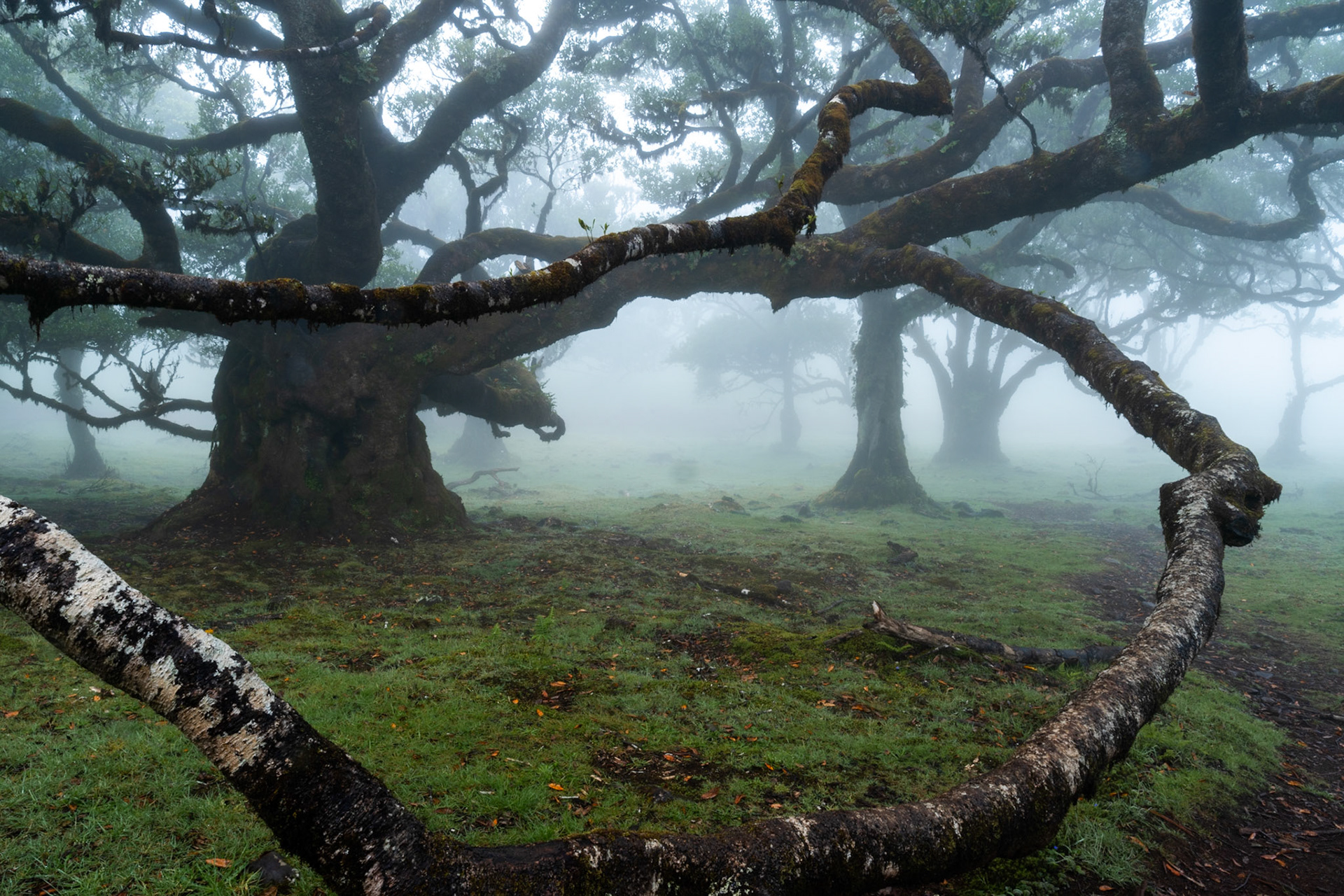
Centuries-old laurisilva trees emerge from dense cloud in the ancient laurel forest of Fanal, Madeira. A fallen branch arcs across the foreground, framing the mist-shrouded trunks receding into the middle distance. The diffuse dawn light and layered fog compress depth, lending the scene an almost prehistoric stillness.
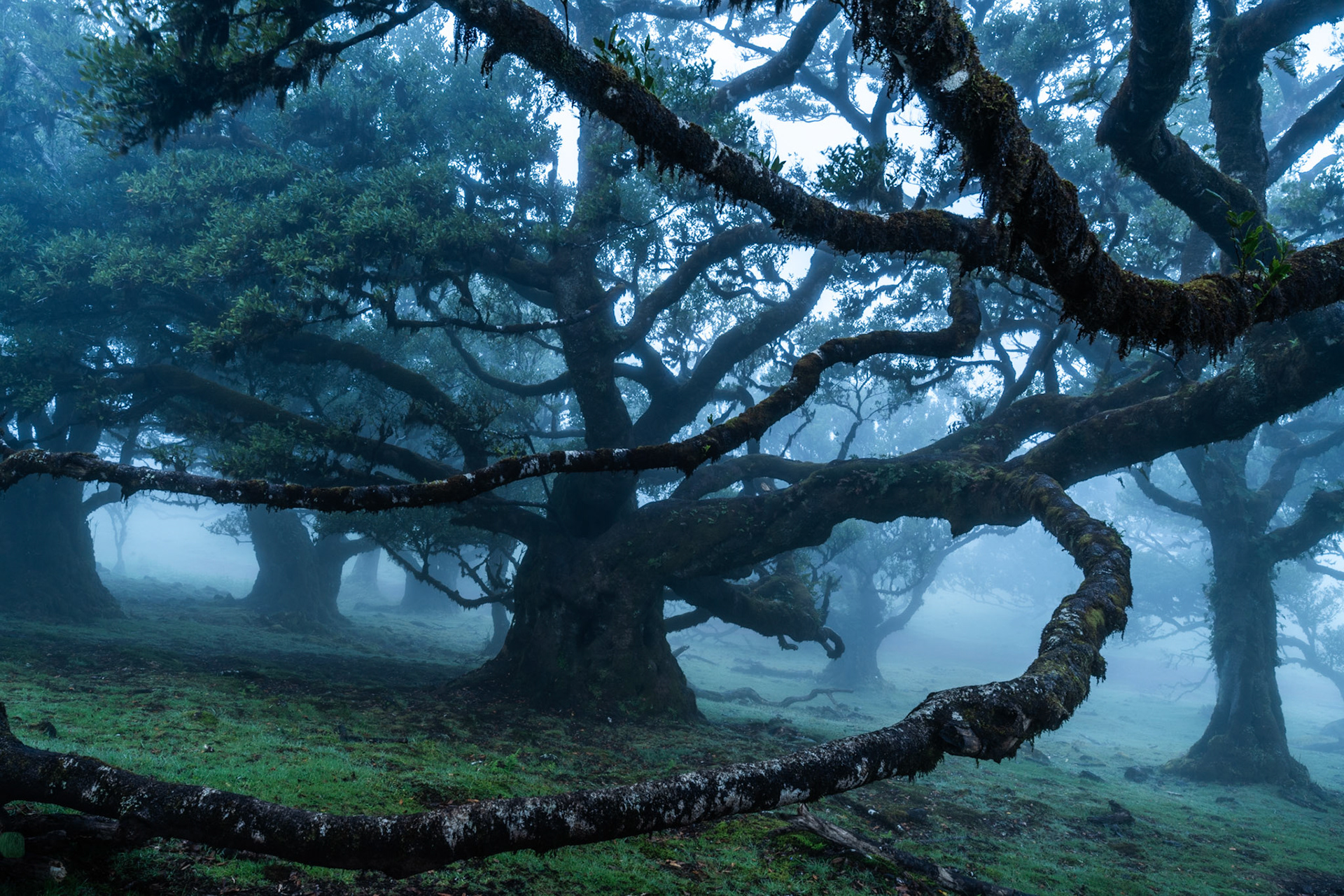
A veteran laurisilva tree spreads massive, moss-laden limbs through dense fog in the ancient laurel forest of Fanal, Madeira. The fallen foreground branch leads the eye into a receding corridor of gnarled forms, each successive tree dissolving further into blue-grey vapour. The cool, monochromatic palette and near-symmetrical chaos of the canopy give the scene an authority that transcends the picturesque.
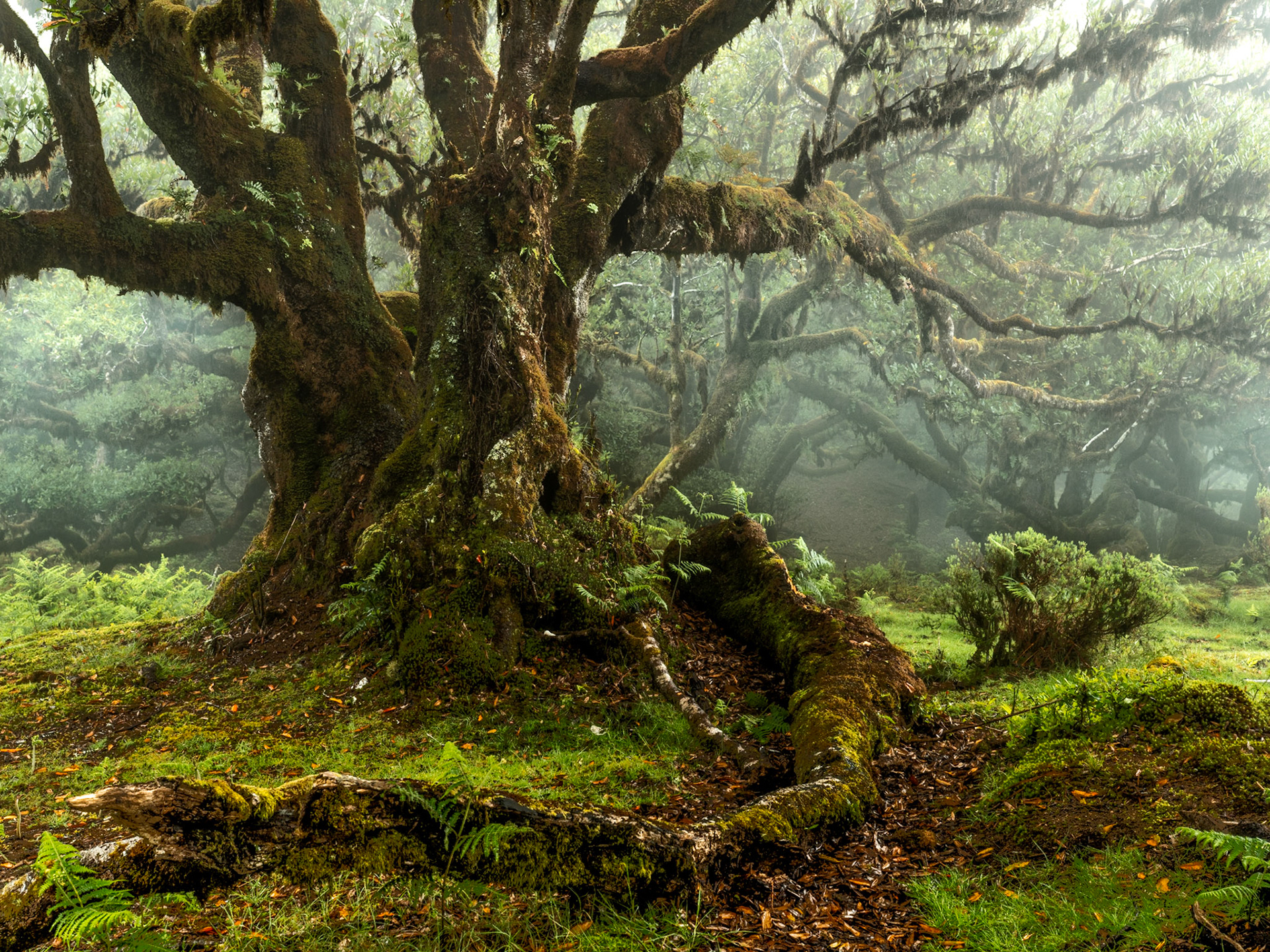
A veteran laurisilva tree anchors the foreground of Madeira's ancient laurel forest, its moss-laden trunk and serpentine surface roots commanding the frame while fog softens the receding canopy into pale abstraction. The close viewpoint and low angle emphasise age and mass, the surrounding ferns and mosses lending a Tertiary-era stillness to the scene.
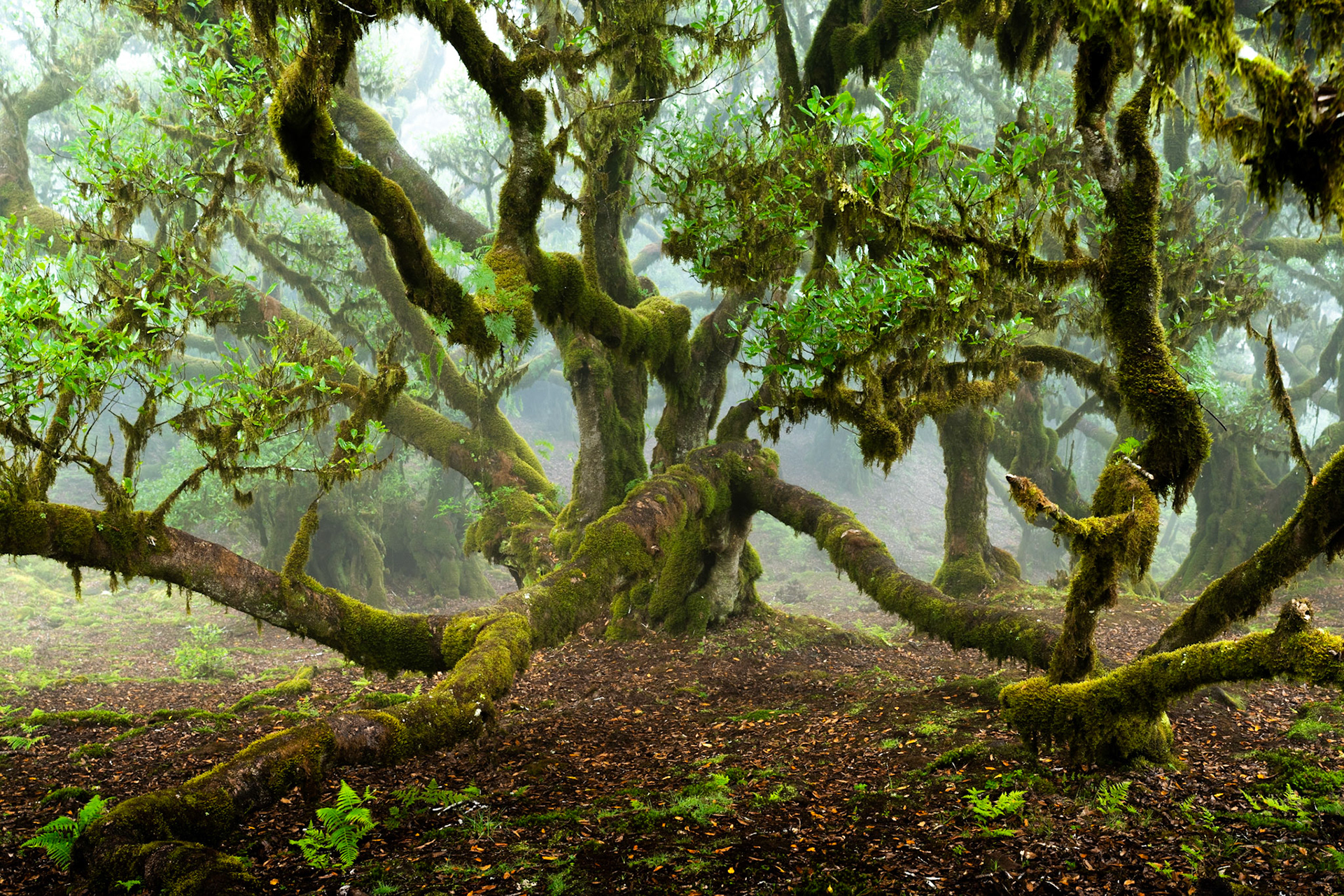
A gnarled, moss-laden laurisilva tree spreads contorted limbs across the forest floor in early morning mist. The layered fog dissolves the background canopy into pale silhouettes, concentrating attention on the elaborate architecture of the foreground trunk and branches. Ferns and leaf litter on the bare ground anchor the composition in the quiet of a spring dawn.
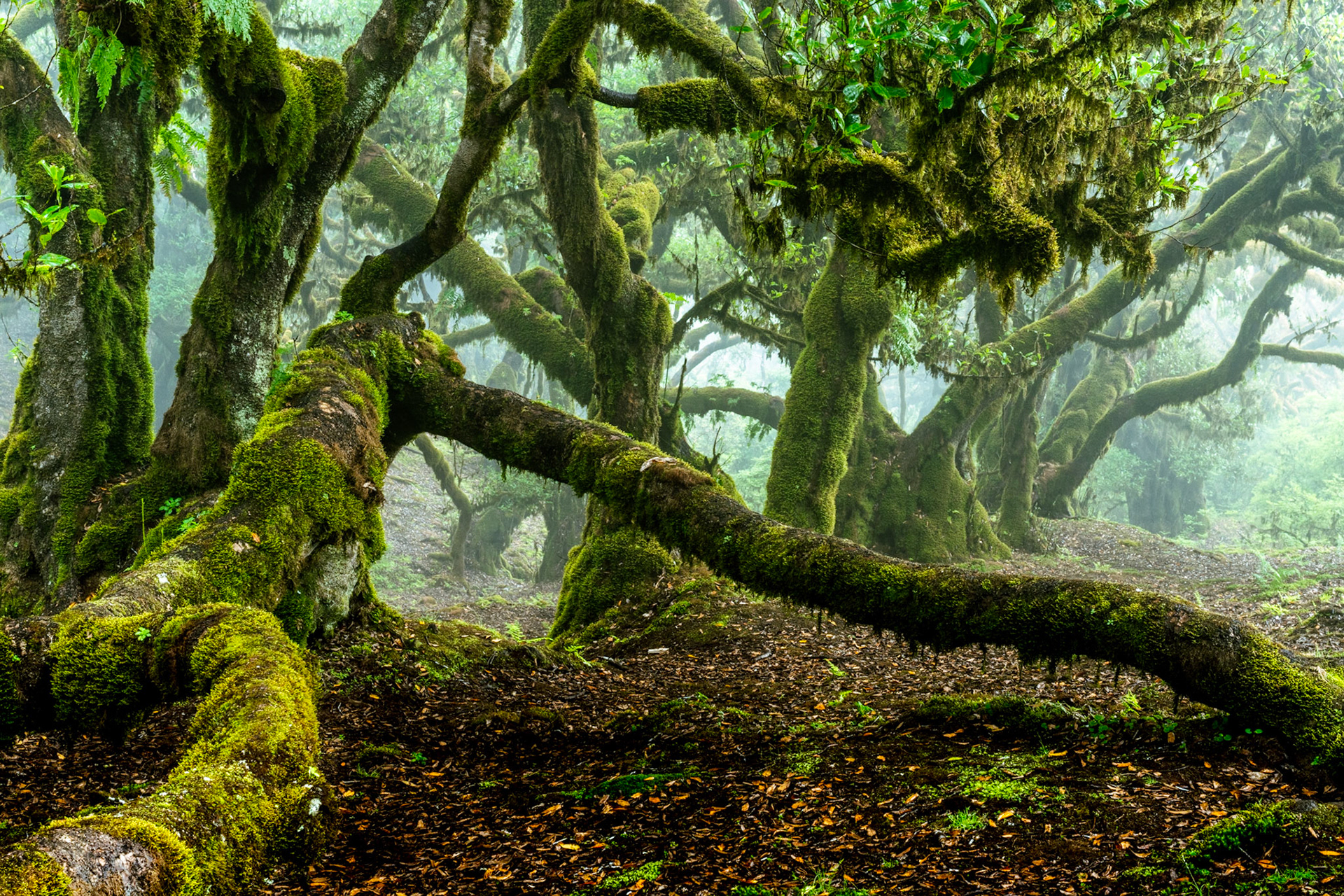
Ancient laurisilva trees draped in moss recede into fog in the highland forest of Madeira. A fallen trunk cuts diagonally across the foreground, anchoring the composition against the softly dissolving middle distance. The saturated greens and diffuse light suggest early morning cloud immersion within the laurel forest zone.
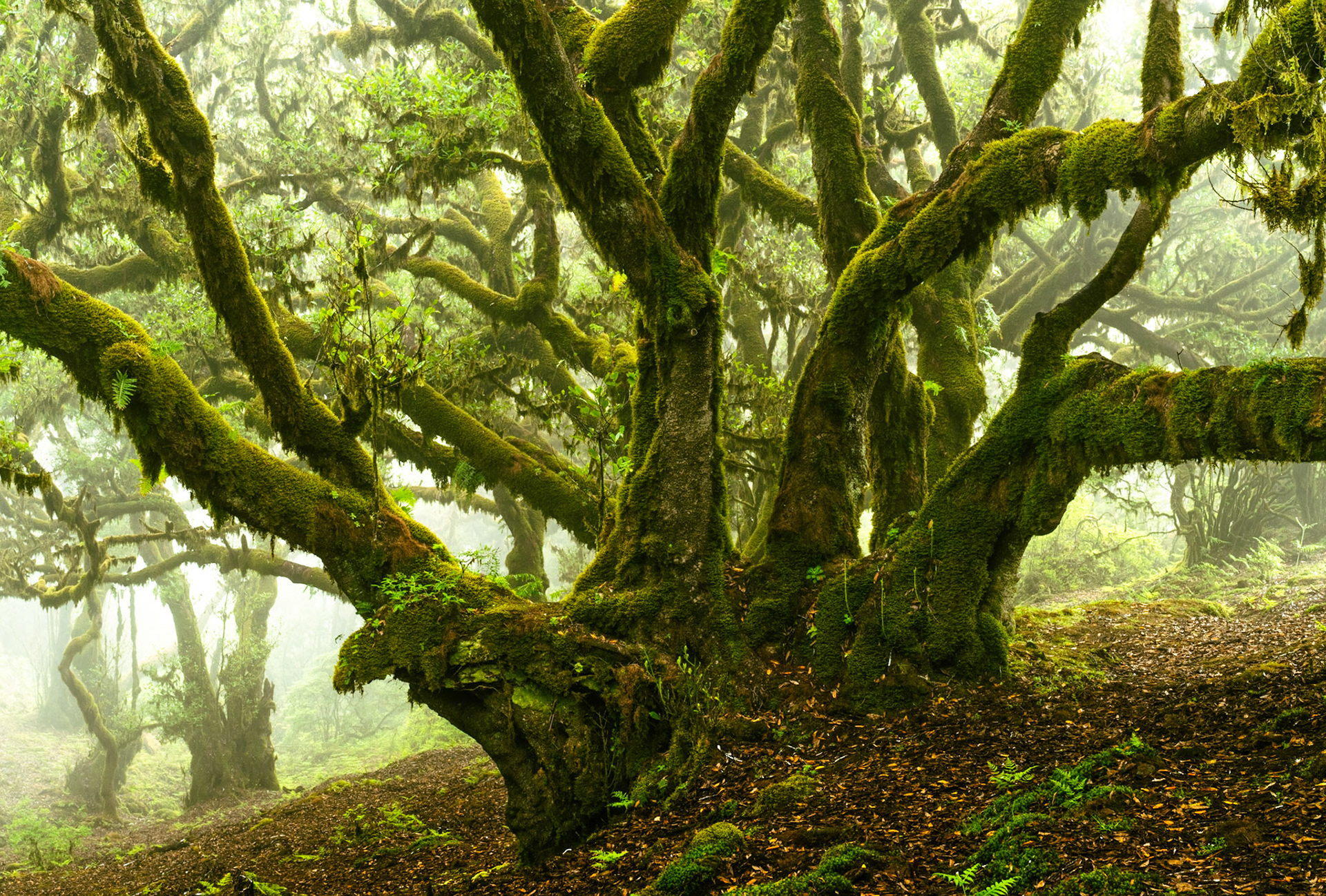
A veteran laurel tree spreads its moss-laden limbs through the cloud forest of Madeira, its gnarled trunk rising from a floor of fallen leaves and emerging ferns. Mist softens the mid-ground, isolating the foreground structure against a pale luminous backdrop. The image captures the primeval density of Laurisilva habitat at its most atmospheric.
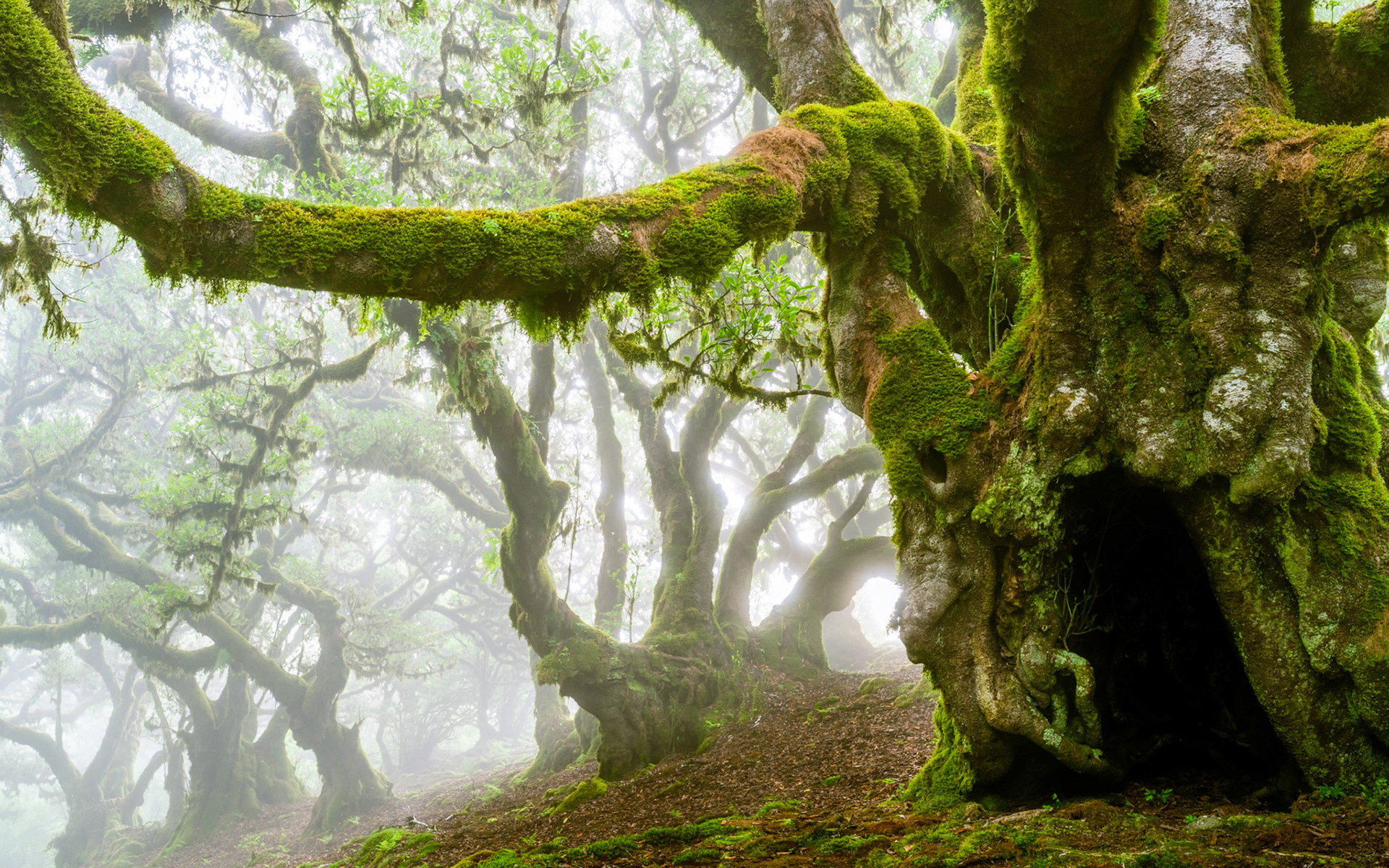
A gnarled laurisilva tree dominates the foreground, its bark and sweeping branches thick with vivid moss, while fog dissolves the forest into pale silhouettes behind. The hollowed trunk and arching limb overhead create a natural frame that draws the eye deep into the receding woodland. Captured in still, diffuse morning light, the scene conveys both the antiquity and the ecological richness of a Madeiran laurel forest.
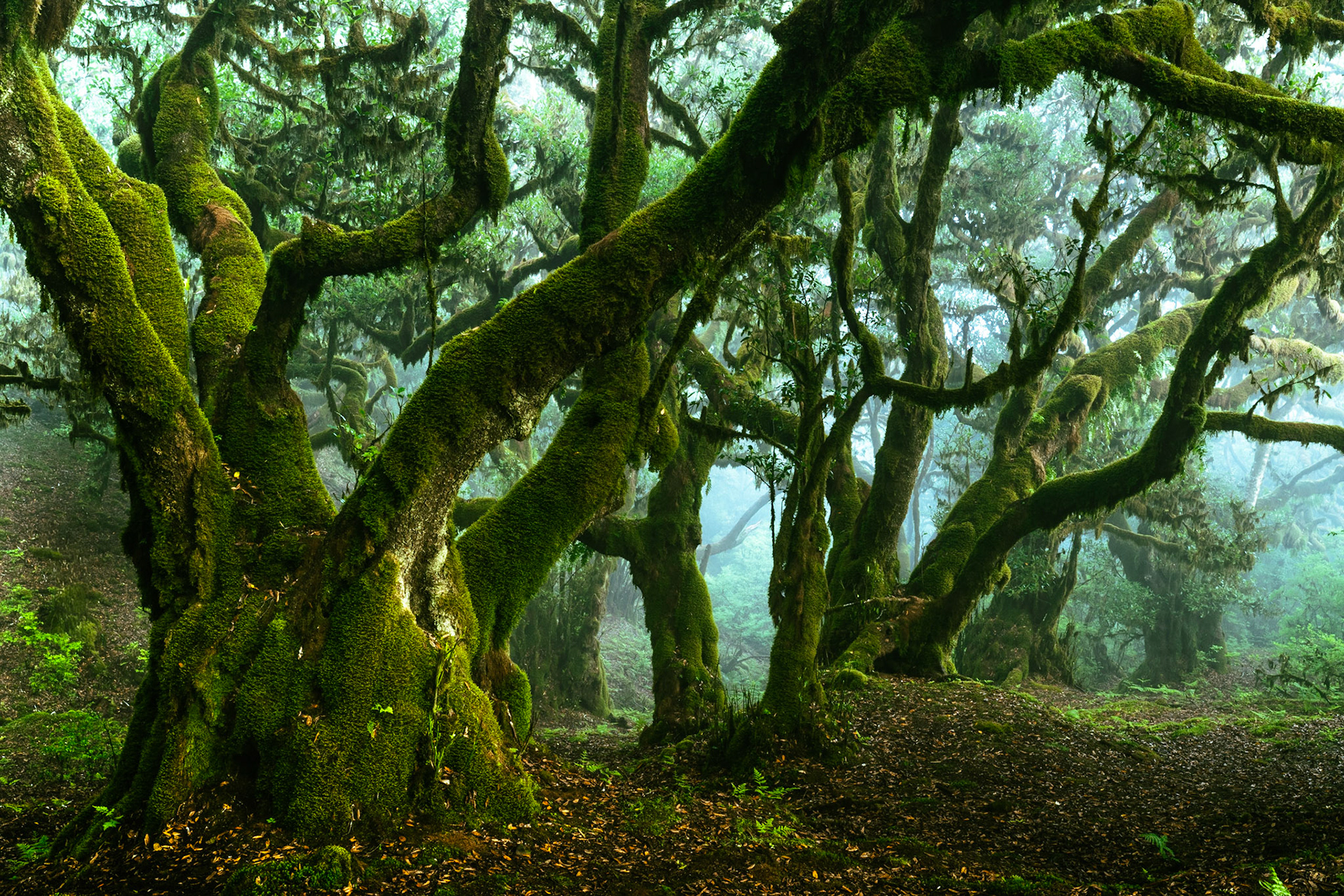
Ancient laurel trees draped in vivid moss recede into low cloud in the laurisilva forest of Madeira. The gnarled, multi-stemmed forms fill the frame with interlocking structure, while mist dissolves the canopy into pale ambiguity beyond. Fallen leaves on the forest floor confirm the season's quiet turn.
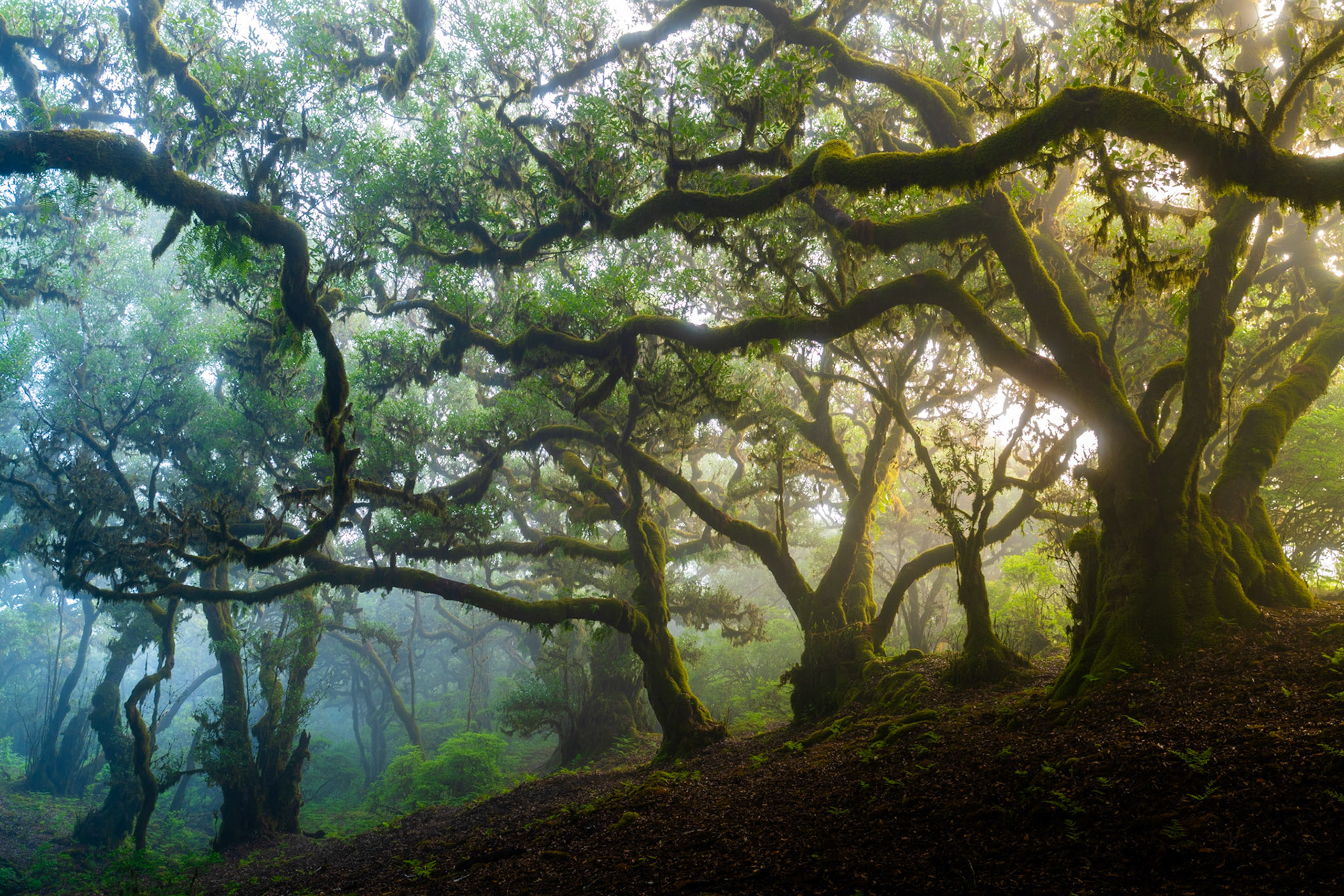
Ancient laurel trees arch through dispersing mist in the Madeiran laurisilva, a relict forest of Tertiary origin. Diffuse dawn light catches moss-laden limbs reaching across the frame, the mid-ground dissolving into layered fog. The interplay of tortured branch structure and soft atmospheric depth gives the scene an uncommon stillness.
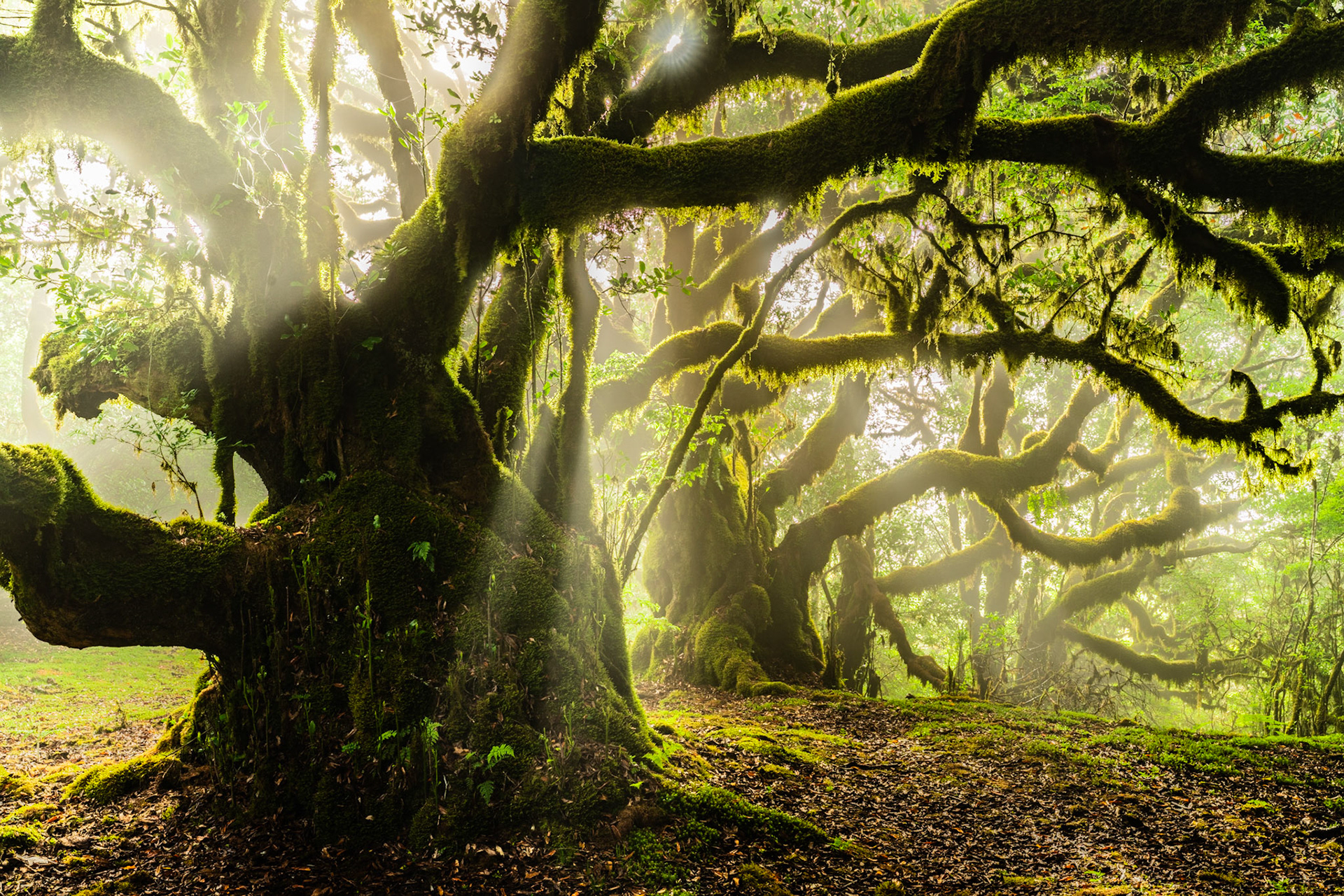
Ancient moss-draped laurisilva trees catch early morning sunbeams filtered through mist, the gnarled limbs extending horizontally across the frame in a canopy of deep green. The forest floor of leaf litter and moss patches anchors the composition beneath a luminous, fog-diffused background. The light quality and tree morphology are consistent with the laurel forests of Madeira, a UNESCO-listed Tertiary relict ecosystem.
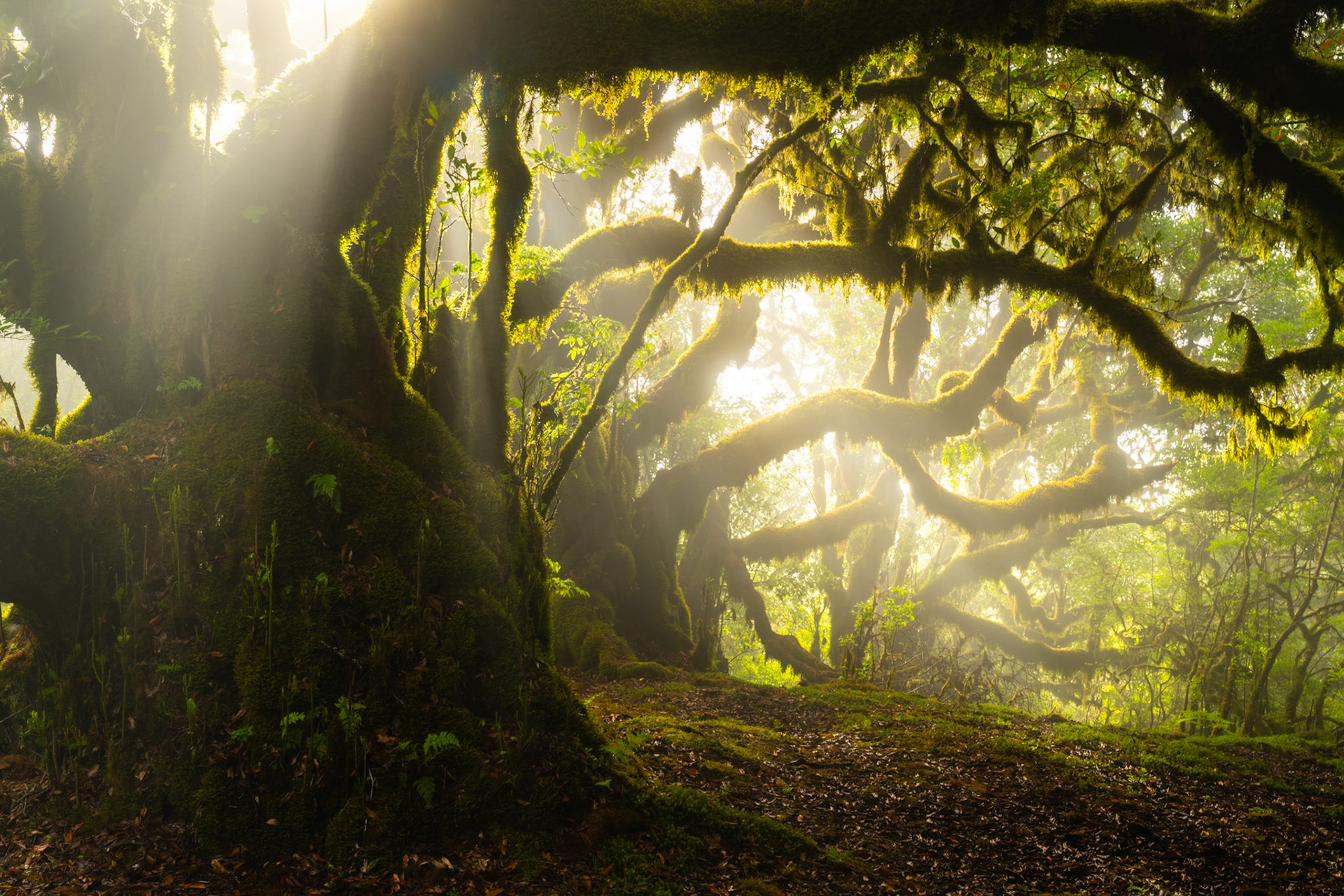
Crepuscular rays break through morning mist in a laurisilva forest, illuminating the contorted, moss-draped limbs of an ancient laurel. The low angle places the viewer within the canopy architecture, the path drawing the eye toward a luminous, fog-softened interior. Captured at first light, when brief atmospheric conditions transform the forest into something close to elemental.
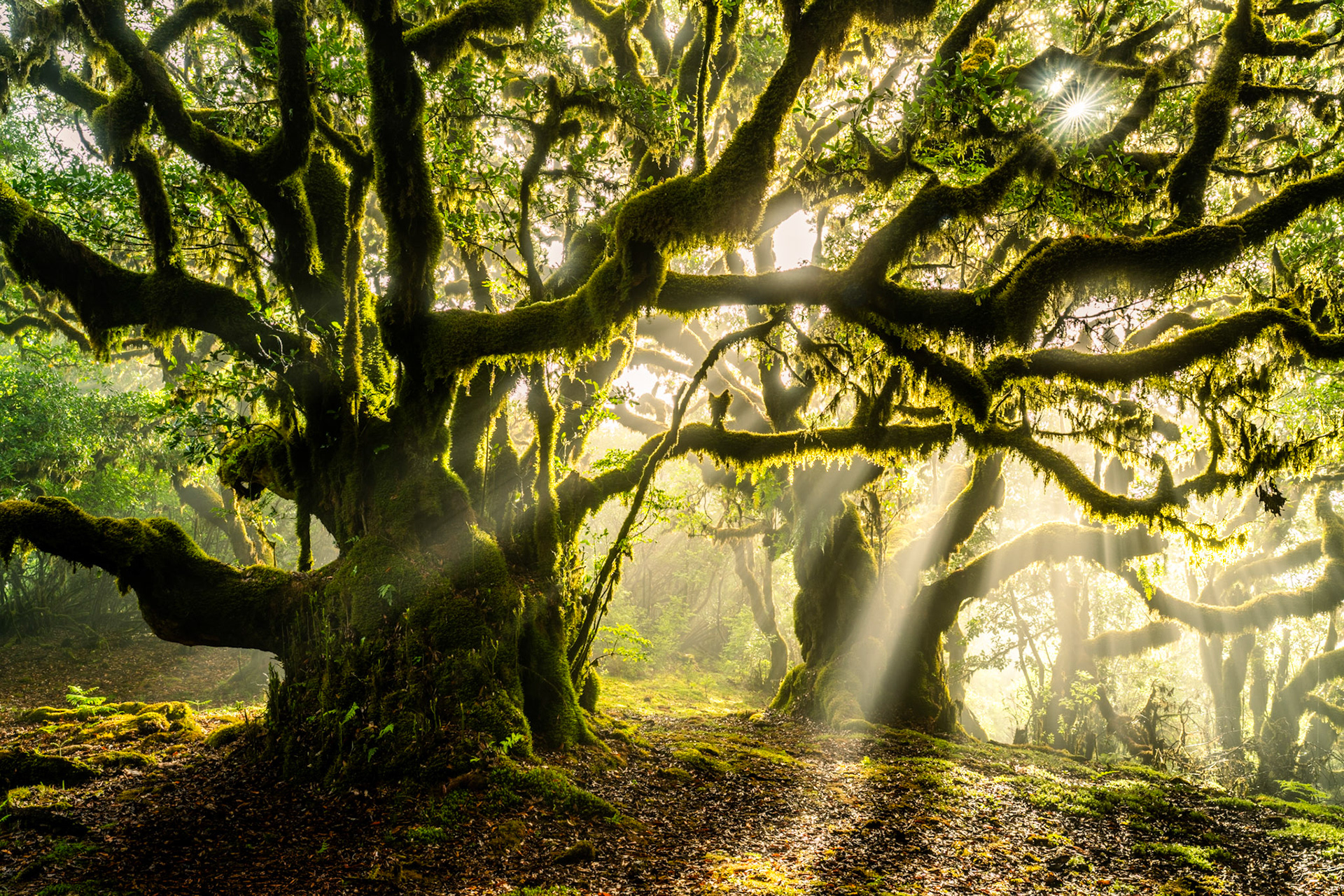
Crepuscular rays break through a canopy of ancient moss-draped laurel trees in the laurisilva forest of Madeira, the low morning sun casting discrete shafts through residual cloud mist. The gnarled, lichen-encrusted boughs and hanging epiphytes frame a path of leaf litter, giving the scene a quality of great antiquity. The starburst sun in the upper right anchors the light source with precision.
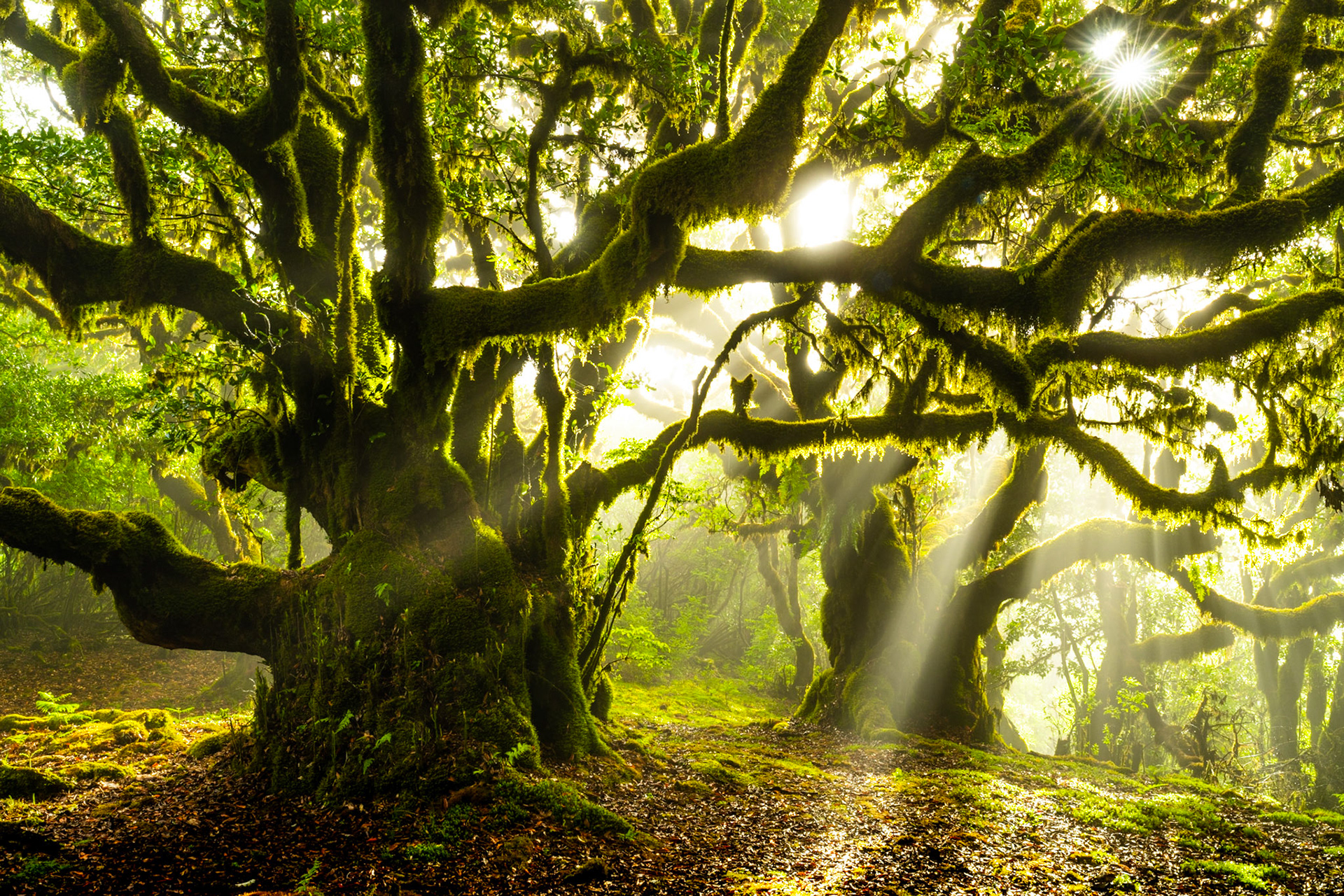
Crepuscular rays pierce the canopy of a moss-laden laurel forest at dawn, the branches of an ancient tree draped in fern and bryophyte against a luminous wall of mist. The Laurisilva of Madeira, a UNESCO-listed relic of the Tertiary period, holds this quality of light only briefly each morning when cloud and sun align at the forest edge. The image works through structural tension — the weight of the horizontal limbs pressing against vertical shafts of light.
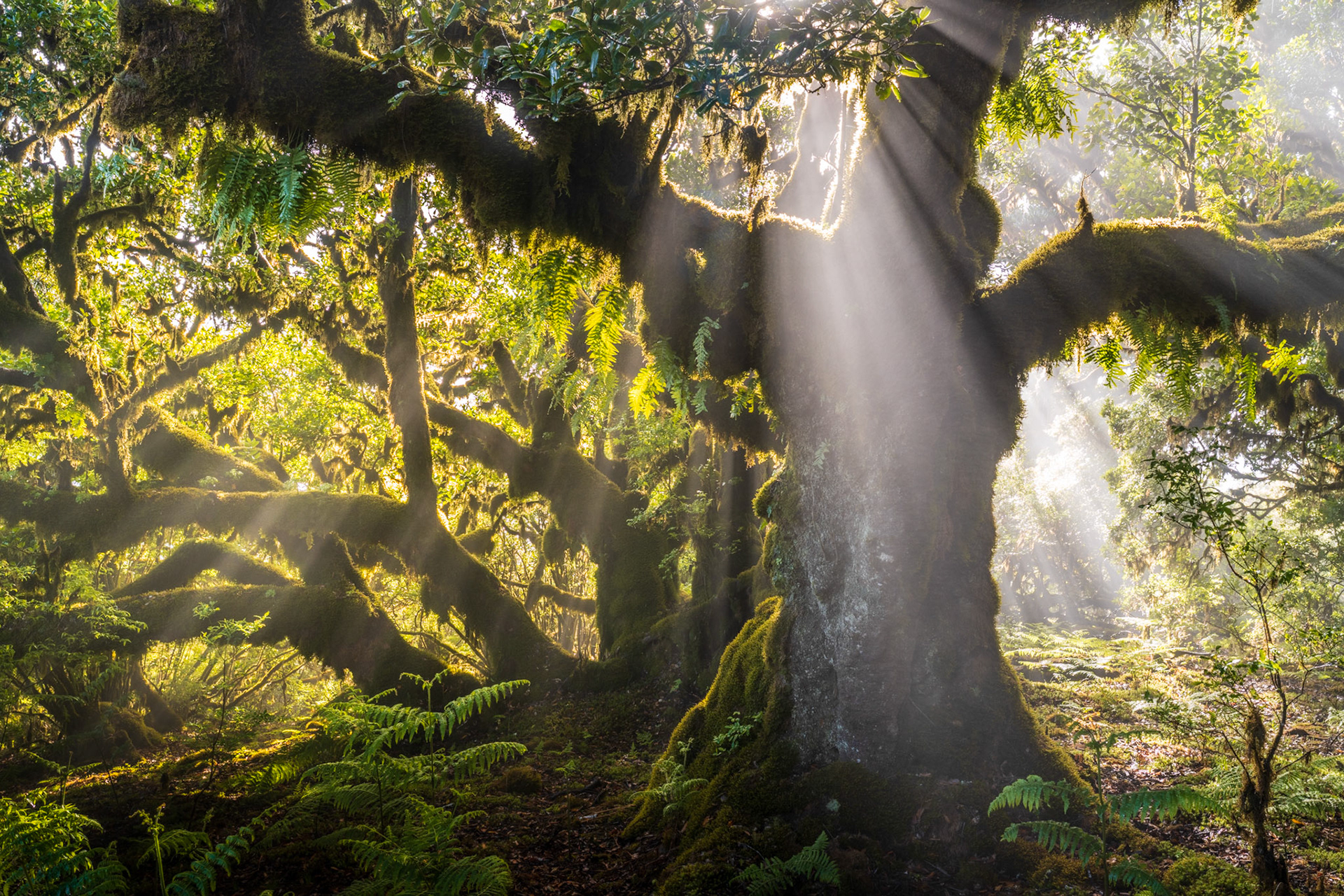
Crepuscular rays break through the canopy of an ancient moss-draped laurel, scattering in the moisture-laden air of the Madeiran laurisilva forest at dawn. The gnarled, fern-hung limbs and buttressed root system suggest a tree of considerable age, its mass anchoring a scene of unusual atmospheric intensity. Mist acts as the medium that renders the light visible, transforming a woodland interior into something close to elemental.
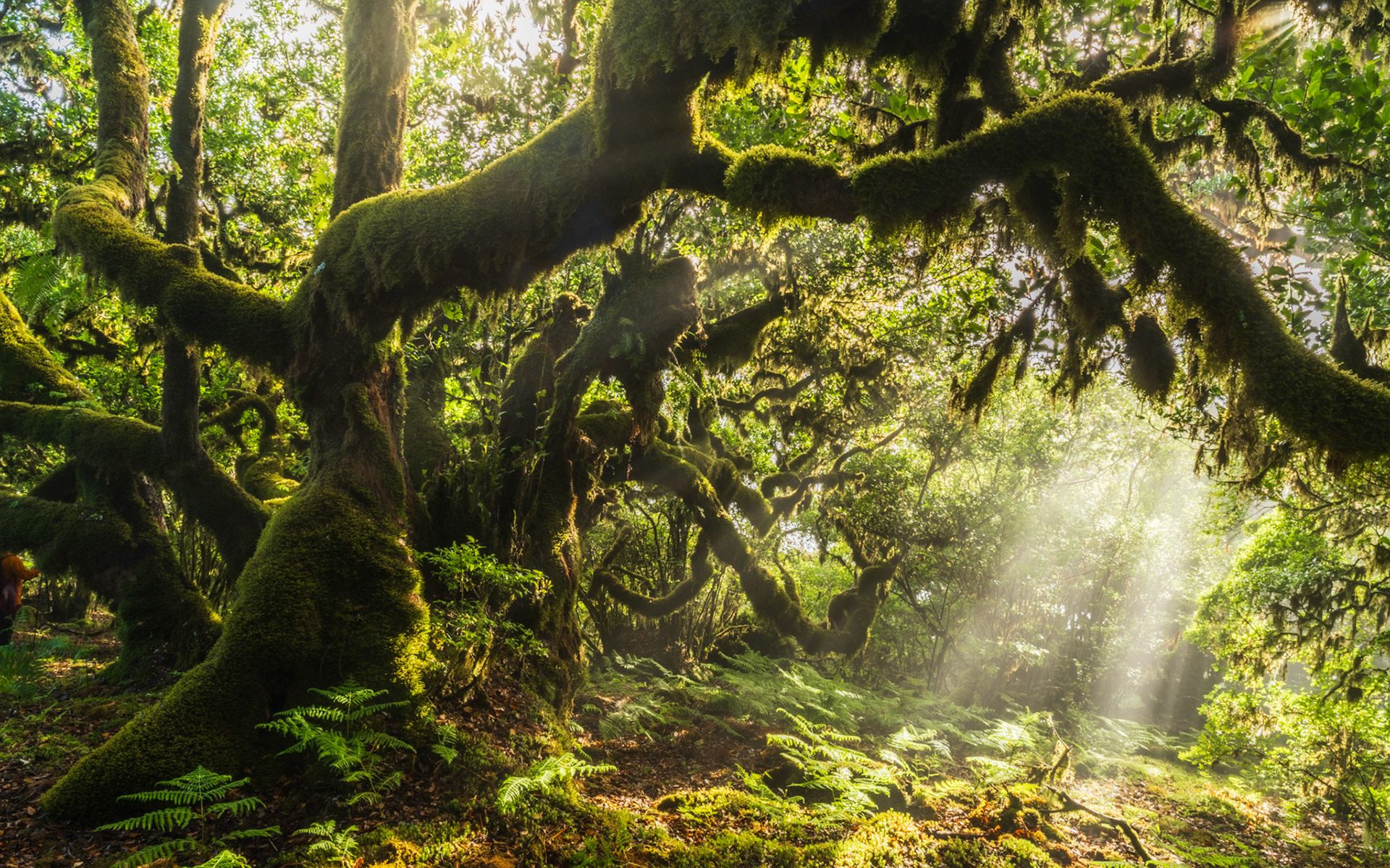
Twisted, moss-laden laurel trees arch across a forest interior as shafts of early morning light cut through residual mist. The gnarled limbs and dense bryophyte cover are characteristic of the Laurisilva, the ancient laurel forest of Macaronesia. Ferns carpet the forest floor beneath a canopy undisturbed for millennia.
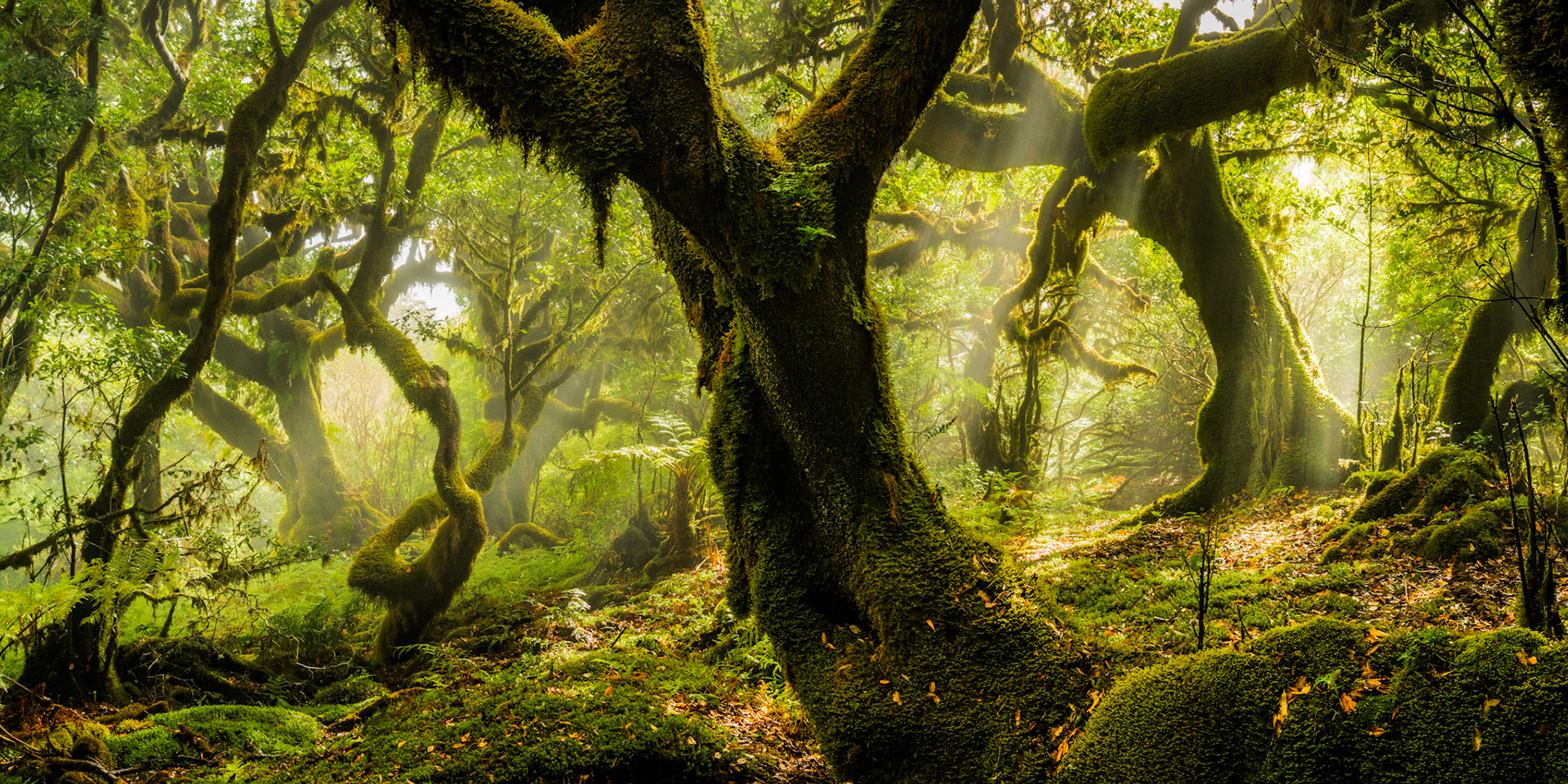
Moss-draped trees emerge from dawn mist in Madeira's ancient laurisilva forest, their contorted forms framing shafts of early light penetrating the canopy. The wide panoramic frame holds both the gnarled foreground trunk and a recession of twisted boughs dissolving into haze, creating a layered depth rarely achieved in dense woodland. Fallen spring leaves and a carpet of moss ground the image in transient season.
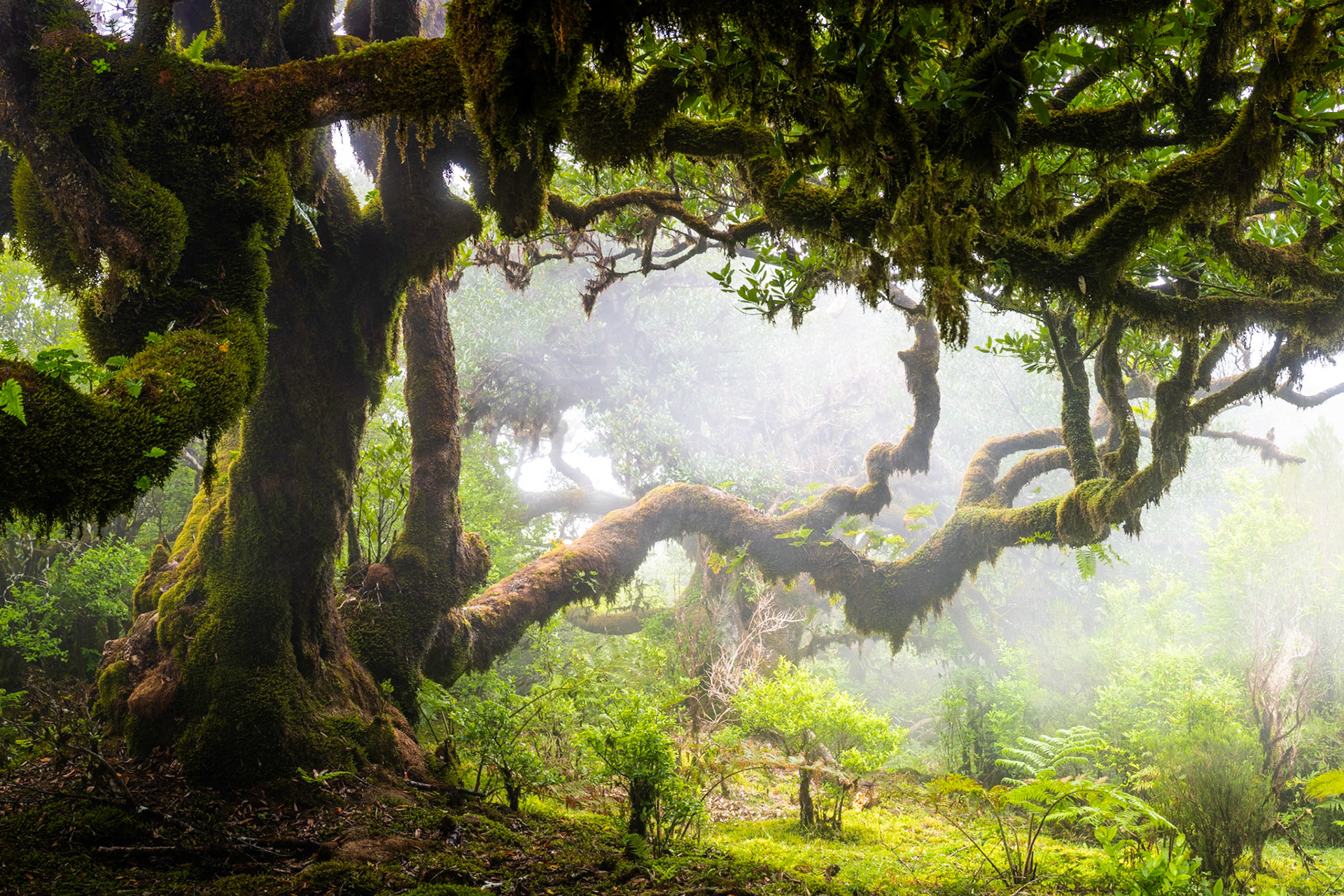
A veteran laurel tree spreads moss-laden limbs through the fog of Madeira's laurisilva forest. Mist diffuses the midday light into something close to dusk, erasing distance and drawing the eye along the serpentine branch that crosses the frame. The ancient, contorted structure and dense epiphytic moss speak to centuries of cloud-forest humidity.
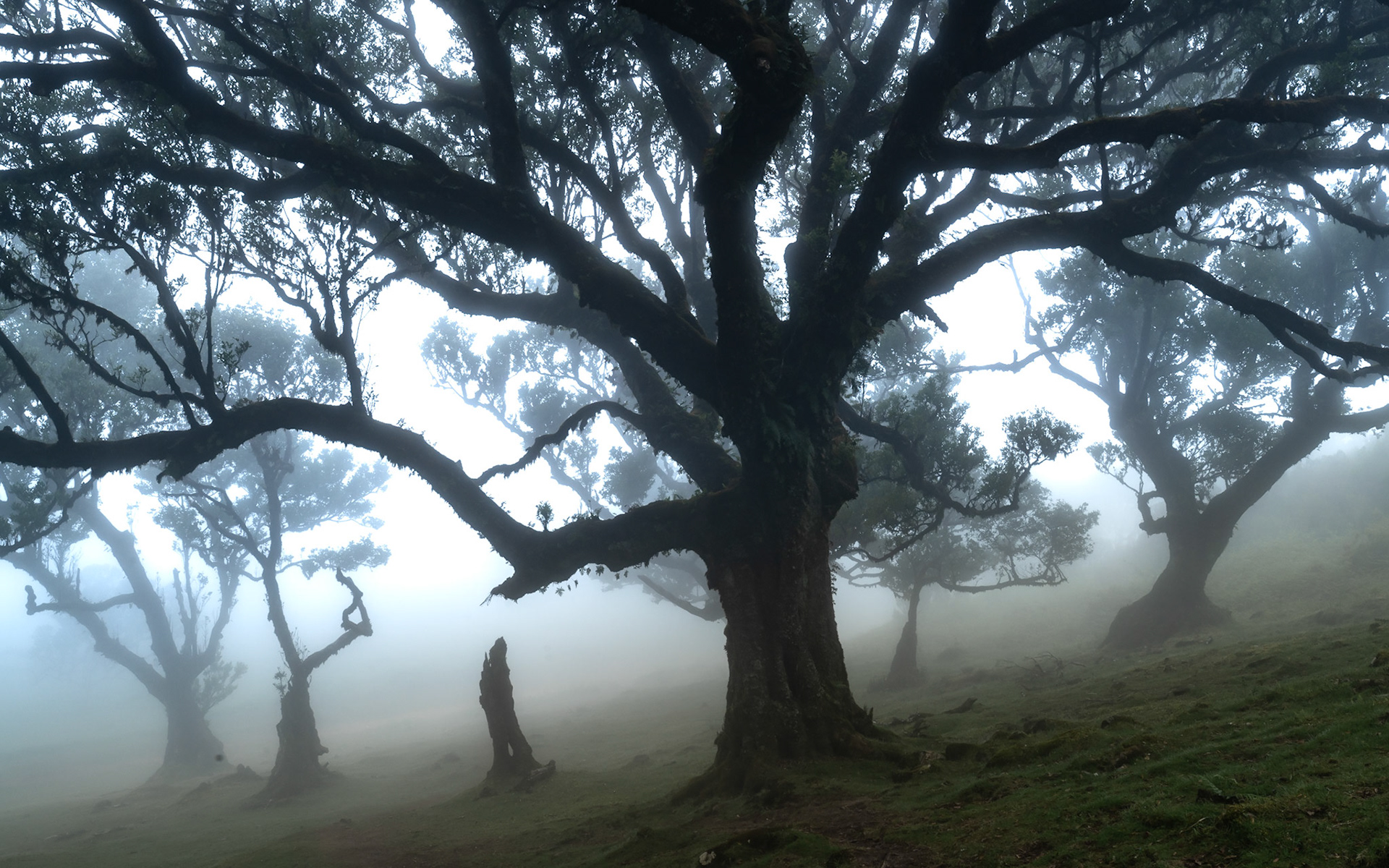
Old-growth laurisilva trees emerge from dense cloud on the Fanal plateau, Madeira. The fog reduces the forest to successive planes of silhouette, isolating the dominant foreground trunk against a luminous, featureless mid-ground. Captured in the flat diffuse light of early afternoon, the image reads as a study in depth and arboreal form.
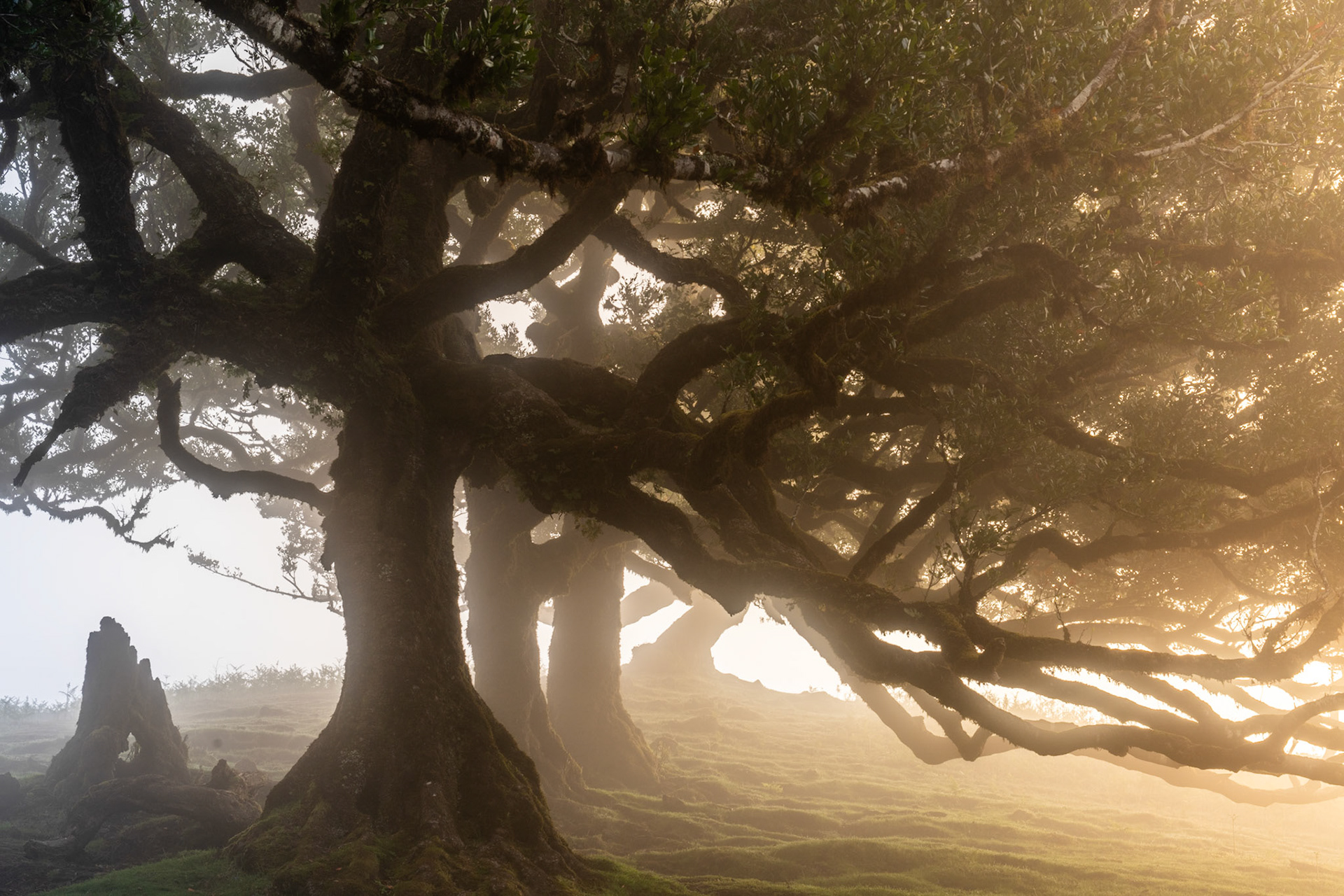
A veteran Til tree — Ocotea foetens — spreads its contorted limbs through dense fog at Fanal, Madeira's ancient laurisilva forest. Warm backlight from low dawn sun filters through the cloud, silhouetting the twisted branch structure against a luminous ground mist. The gnarled root buttresses and mossy plateau floor reinforce the age and isolation of this extraordinary tree.
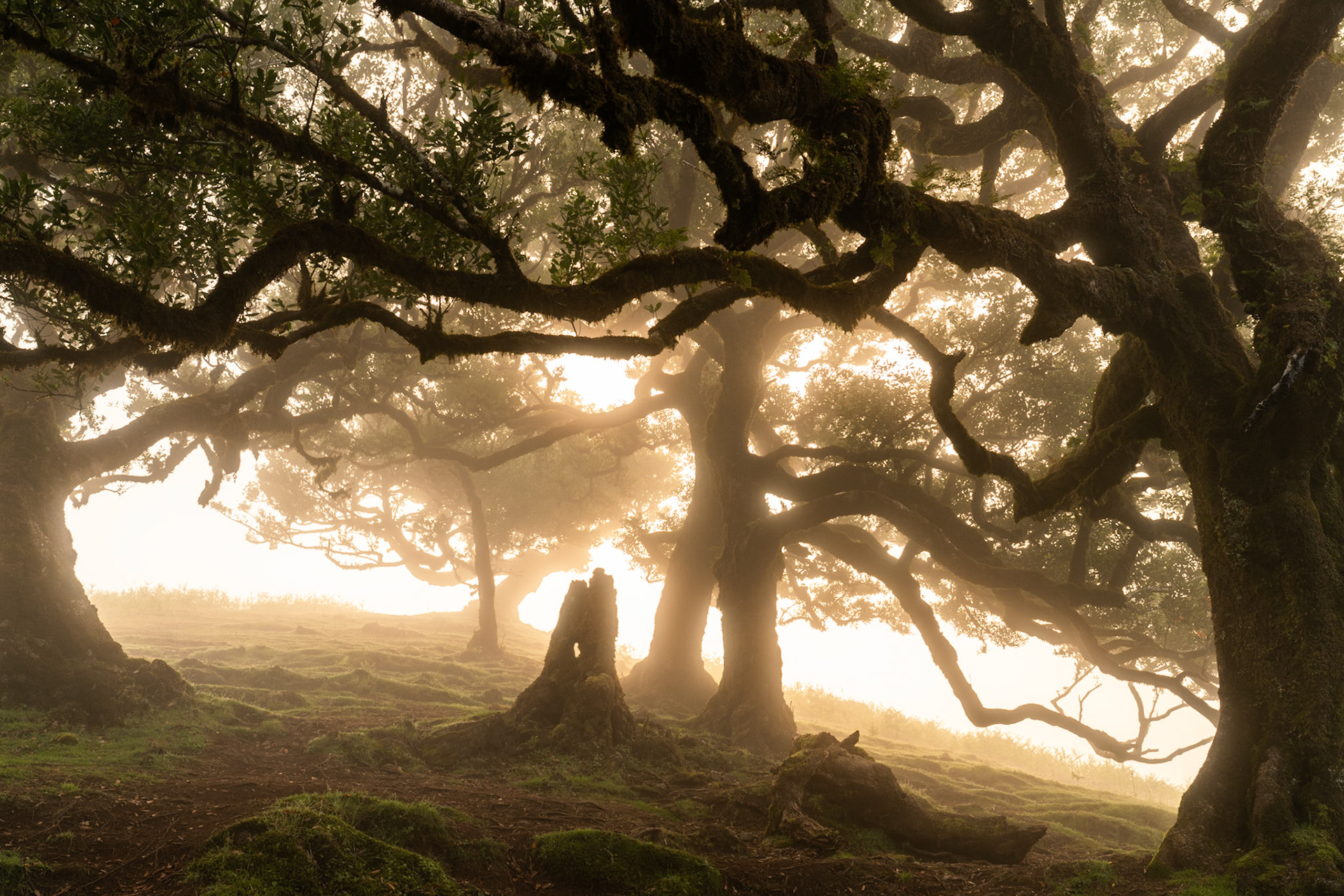
Veteran laurisilva trees emerge from dense fog at first light in Fanal, Madeira. The diffused warm glow backlit through the canopy dissolves distance and silhouettes the gnarled, moss-covered trunks against a luminous ground mist. The composition uses the natural frame of arching branches to draw the eye through successive planes of receding trees.
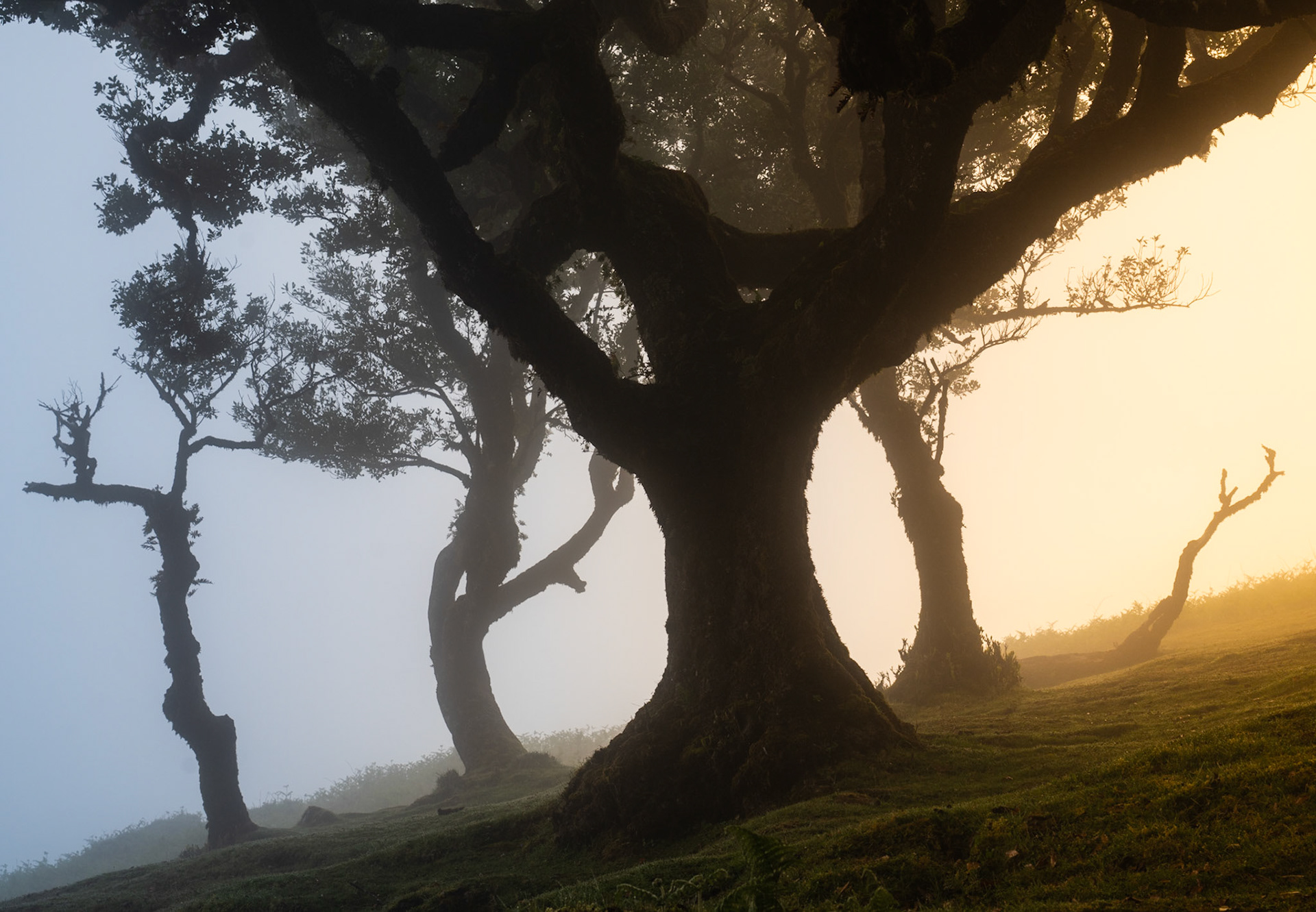
A massive laurisilva tree dominates the foreground in Madeira's Fanal forest, its gnarled trunk silhouetted against a striking division of cold blue mist to the left and warm amber fog-light to the right. The tonal opposition — cool shadow world against glowing dawn — gives the composition an almost theatrical tension without artifice. Supporting trees recede into layered fog, reinforcing both depth and the forest's primordial scale.
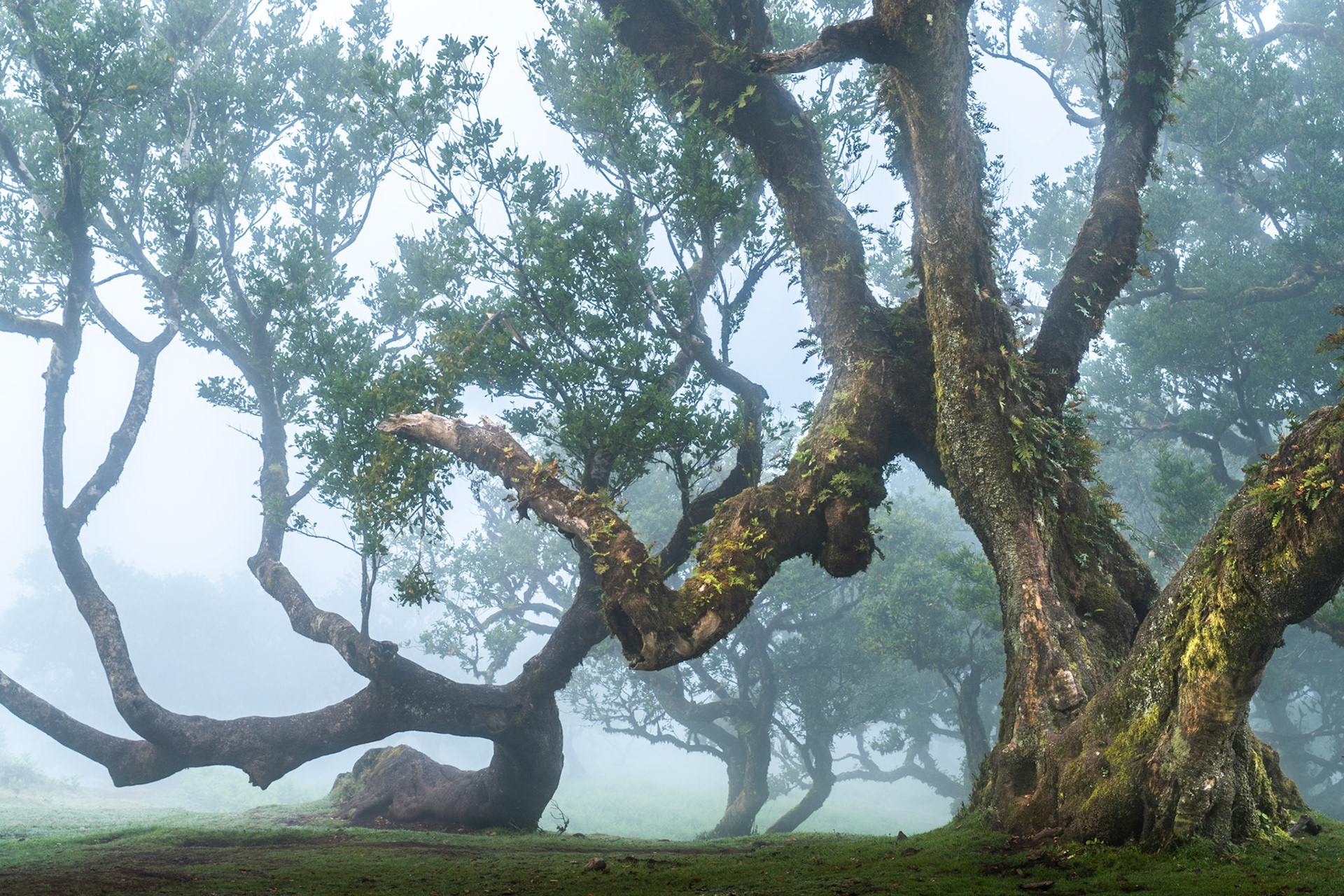
Veteran laurisilva trees emerge from low cloud in the Fanal plateau, Madeira. The contorted limbs of centuries-old til and laurel recede into mist, their moss-laden bark recording the persistent humidity of this relict forest. Diffuse light flattens contrast just enough to let form and atmosphere carry the image.
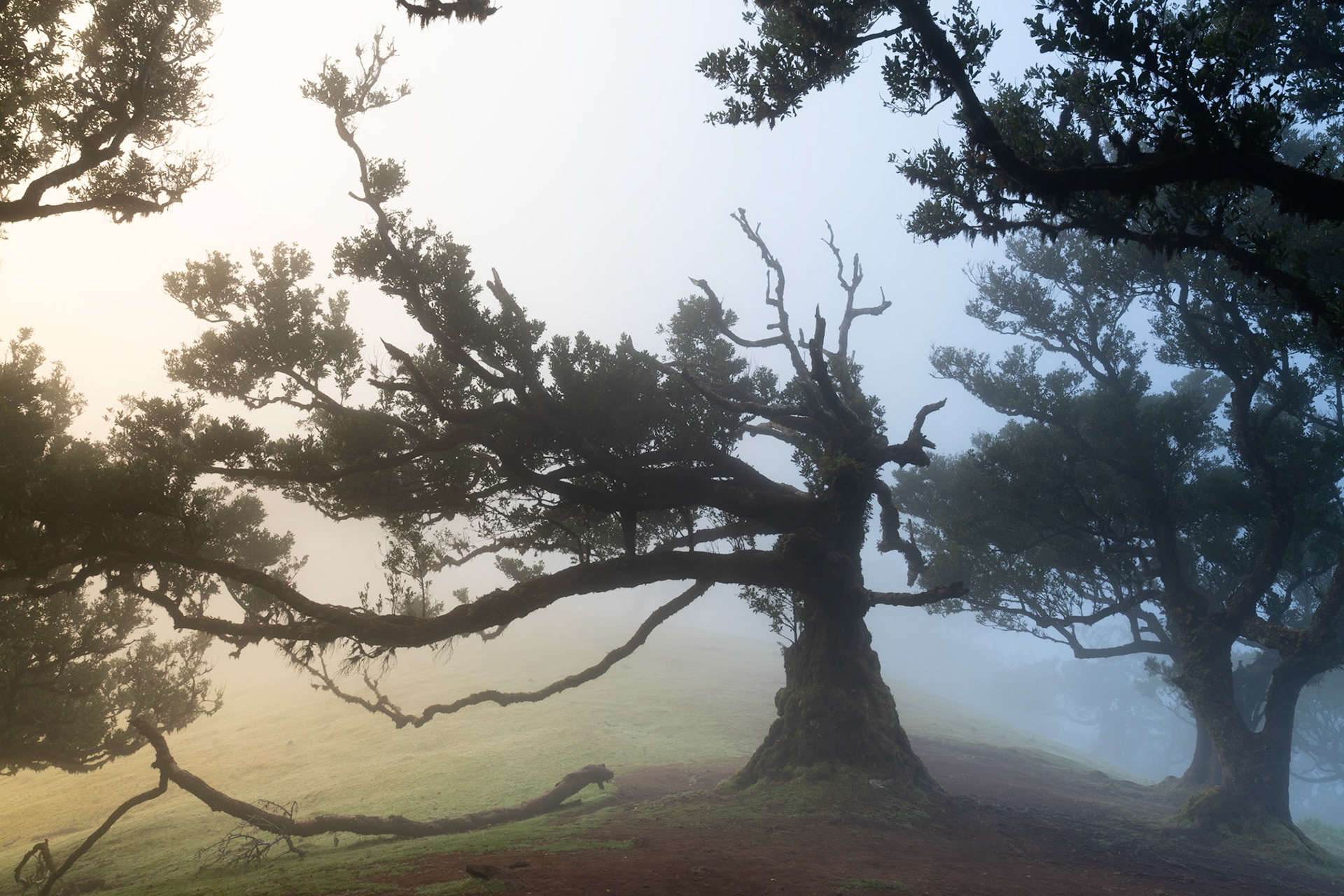
A monumental laurisilva tree spreads its wind-tortured limbs into dawn mist, its gnarled silhouette suspended between warm backlight and cold blue fog. The fallen branch arcing to the ground echoes the age and weight of the tree, while receding forms dissolve into the vapour behind. The scene carries the atmosphere of Fanal, Madeira's ancient laurel forest.
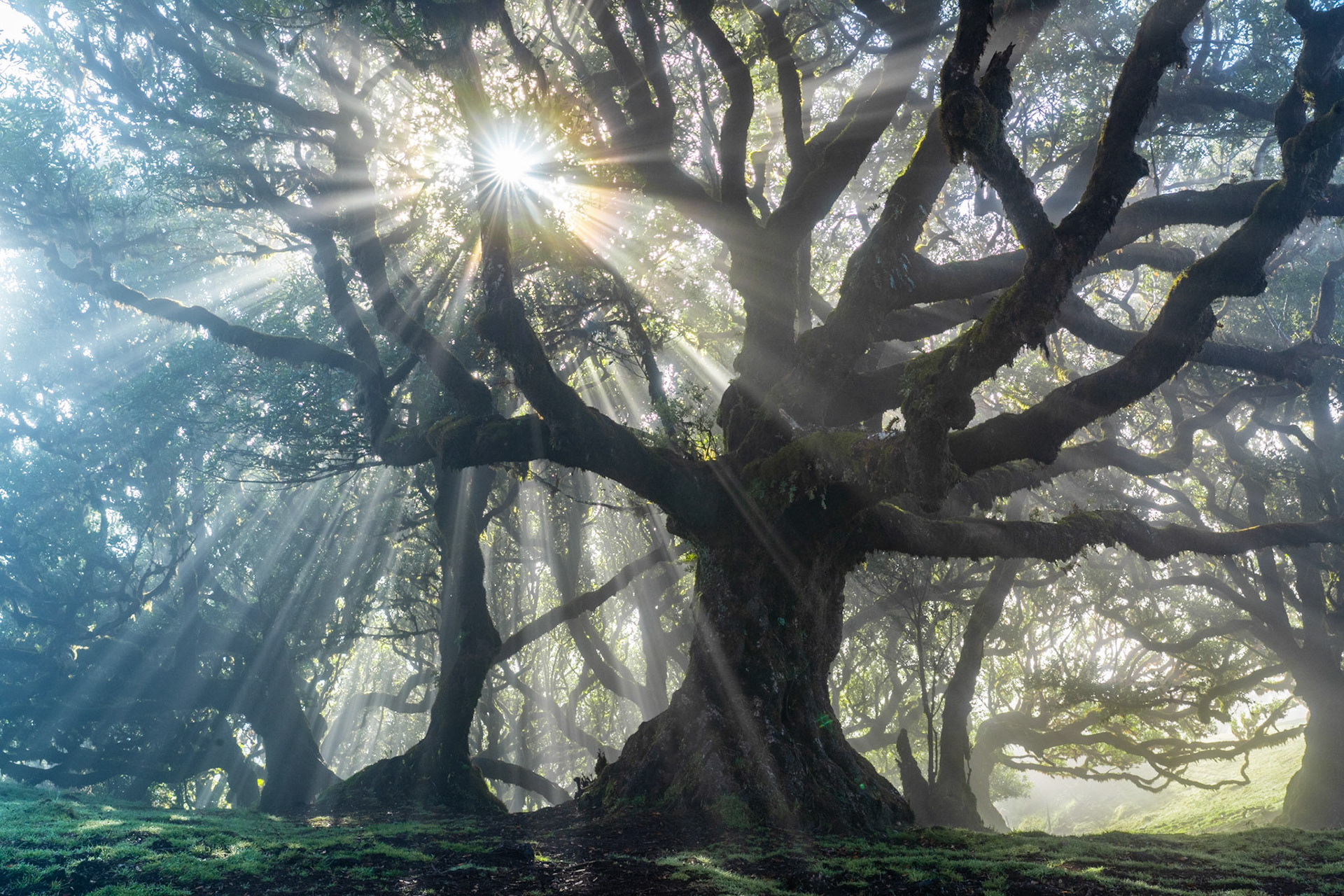
A veteran laurisilva laurel, its moss-clad trunk splitting into broad spreading limbs, stands at the centre of the Fanal plateau as early morning sunbeams fracture through residual sea-mist. The crepuscular rays radiate from a near-central sun star, lending the scene an almost ceremonial stillness. Mist pooling beneath the canopy separates foreground from the receding woodland behind.
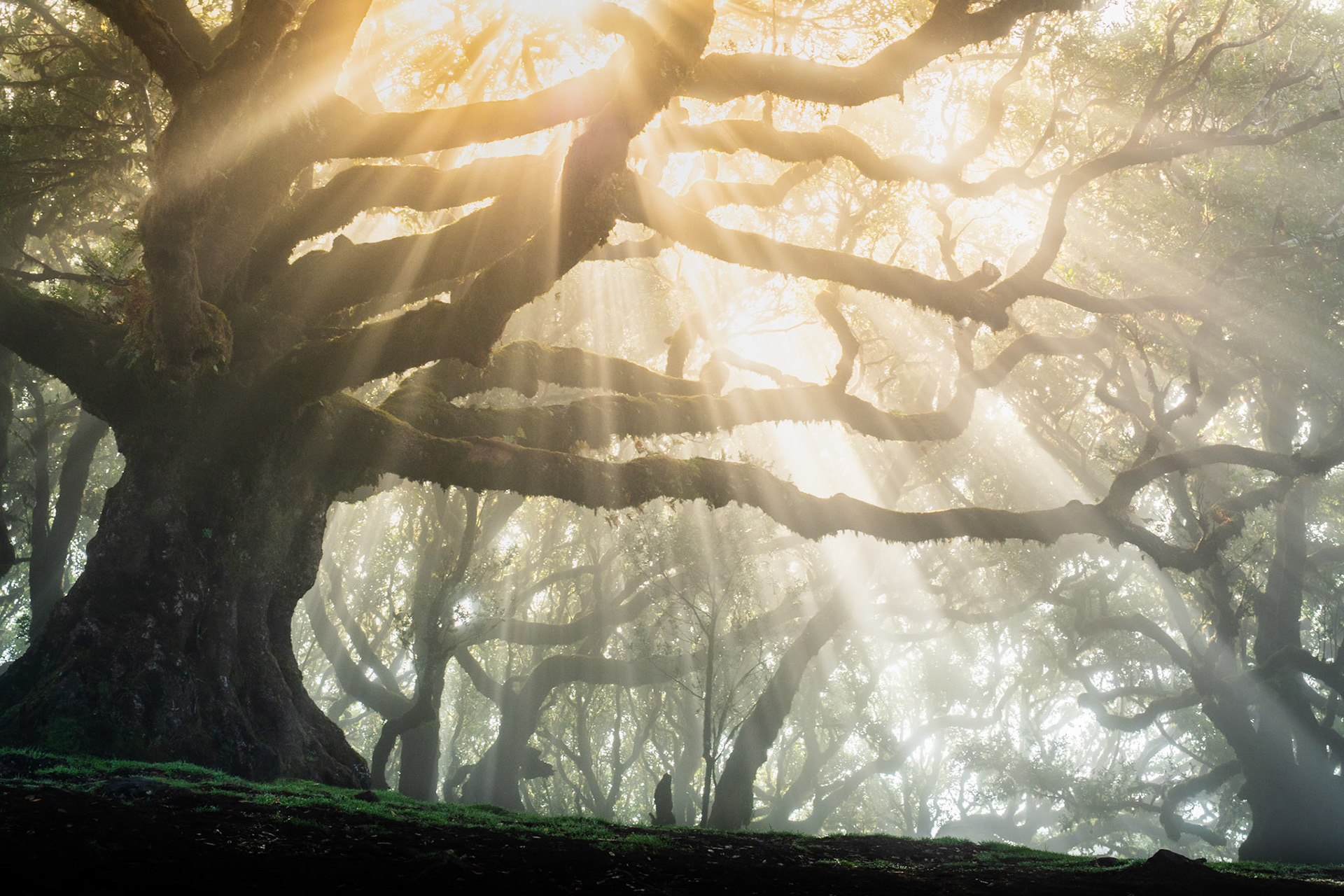
Crepuscular rays penetrate fog between the sprawling limbs of old-growth laurisilva trees, most likely within the laurel forest of Garajonay or Fanal, Madeira. A solitary figure stands at the forest floor, lending scale to the cathedral-like spread of the dominant trunk. The mist acts as a scattering medium, rendering each beam distinct against the dark understory.
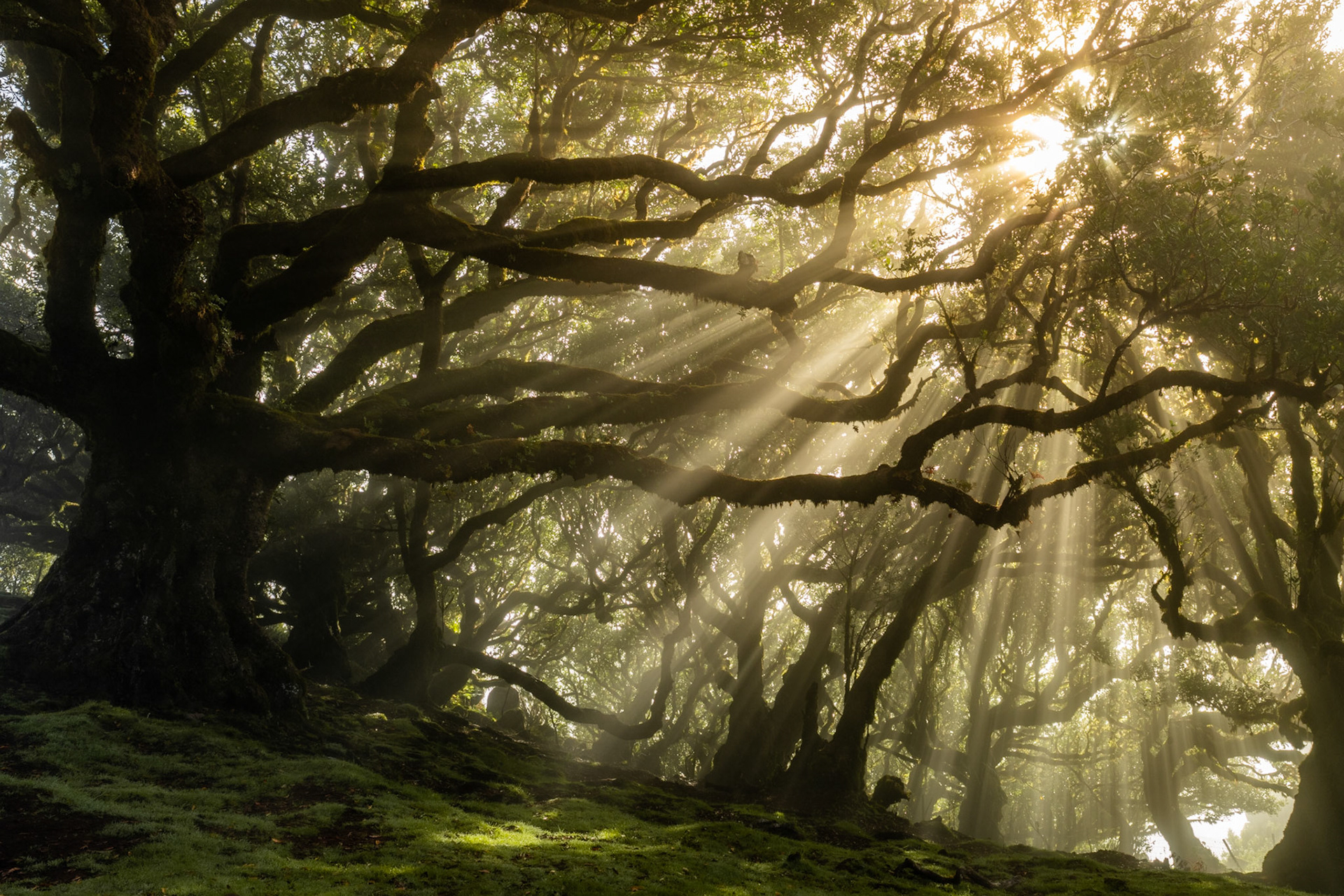
Crepuscular rays penetrate the mist-laden canopy of an ancient laurel forest, most likely within the Fanal plateau of Madeira's UNESCO-listed laurisilva. The gnarled, moss-cloaked trunks frame the light into distinct shafts, a fleeting atmospheric condition requiring precise positioning within a closed, low-contrast interior.
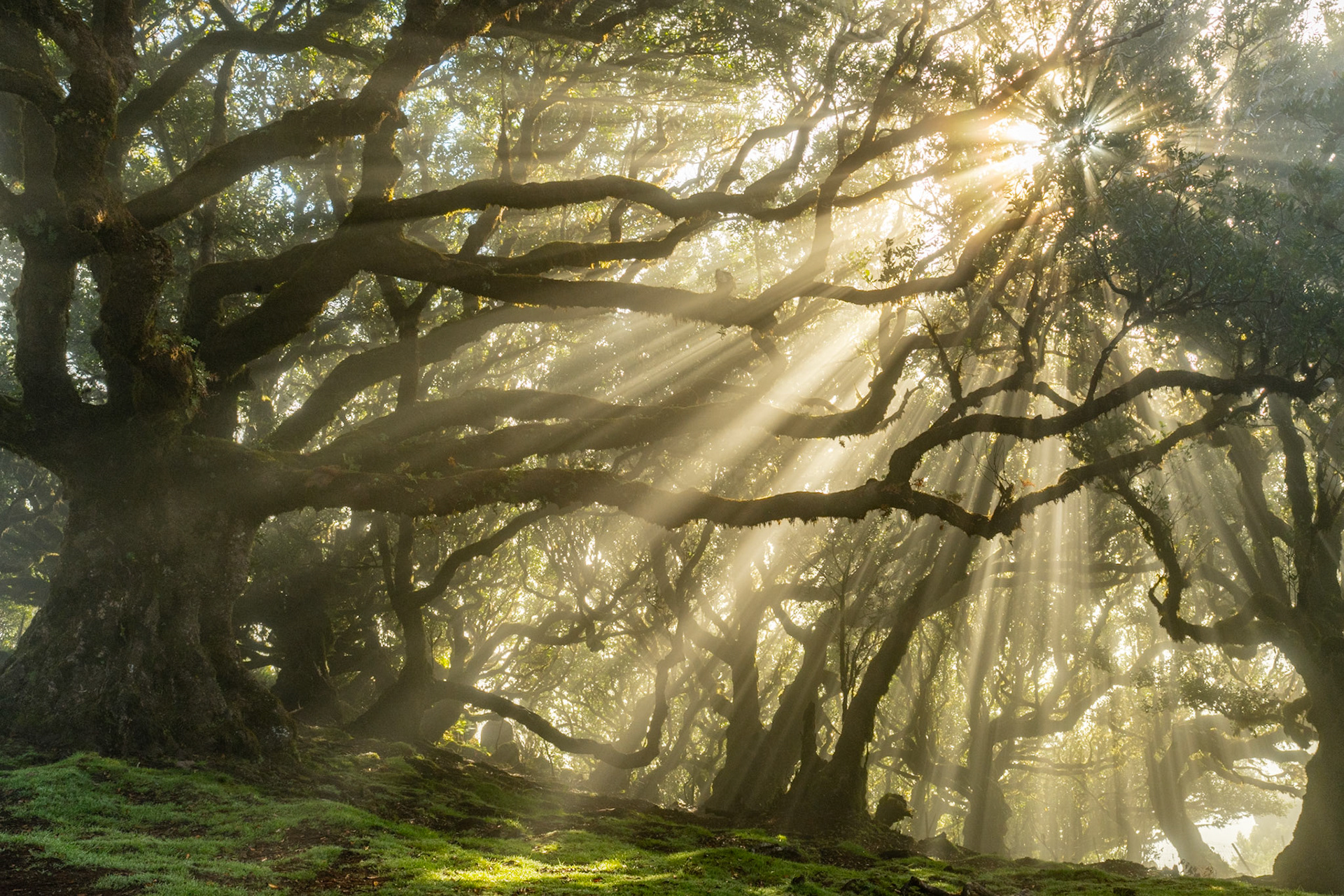
Crepuscular rays pierce a canopy of ancient laurel trees as morning mist lingers between the trunks. The interplay of silhouetted branches against diffused backlight gives the forest a cathedral quality, the moss-carpeted floor anchoring the composition below. Fanal forest, Madeira, is the most plausible location given the distinctive gnarled laurisilva structure.
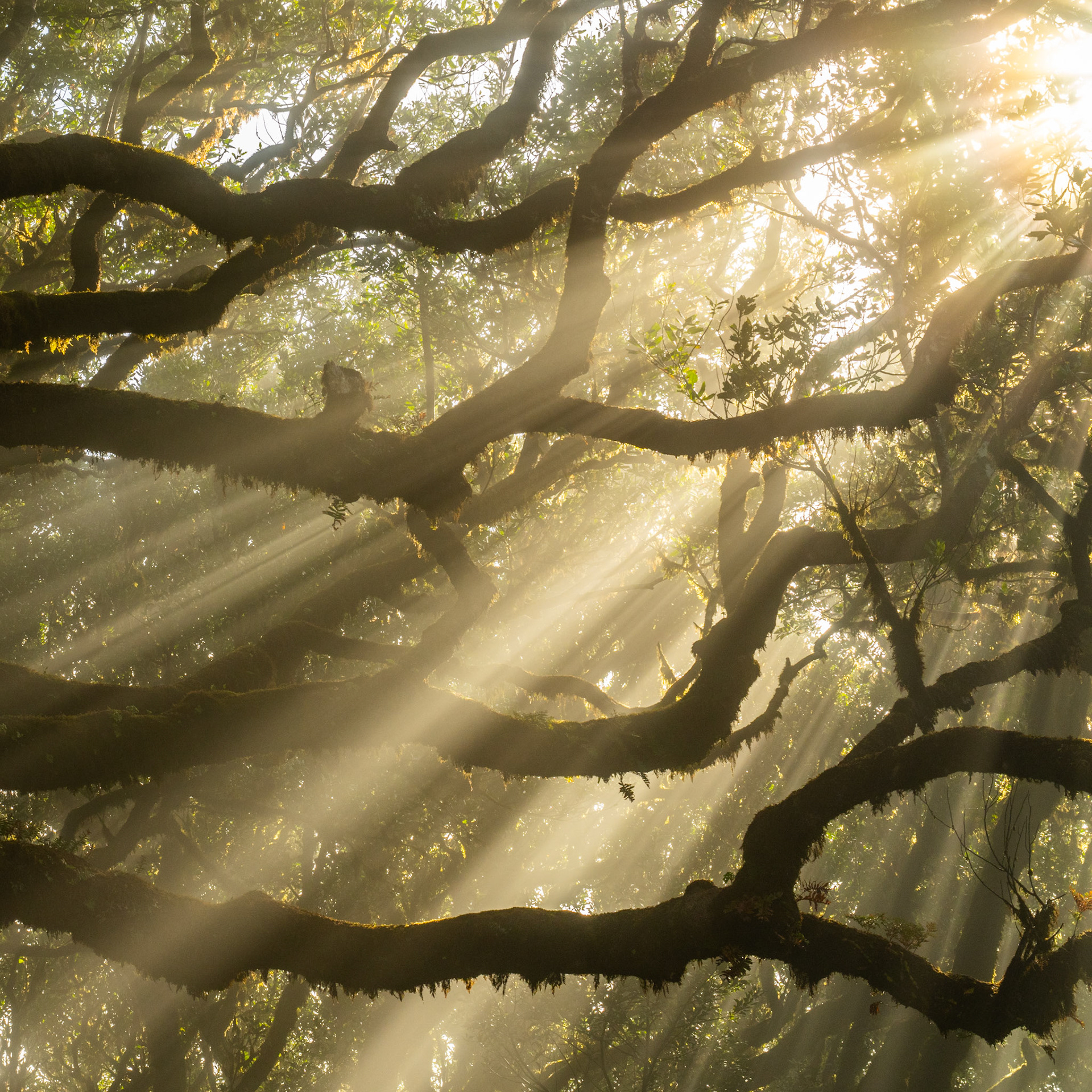
Crepuscular rays pierce a canopy of moss-draped laurel or evergreen oak, the mist dense enough to render each shaft of early-morning light as a discrete, near-tangible column. The interlocking branches fill the frame with structural complexity without obscuring the luminous quality of the air between them. A rare alignment of atmospheric conditions and low sun angle gives the scene an interior stillness more felt than explained.
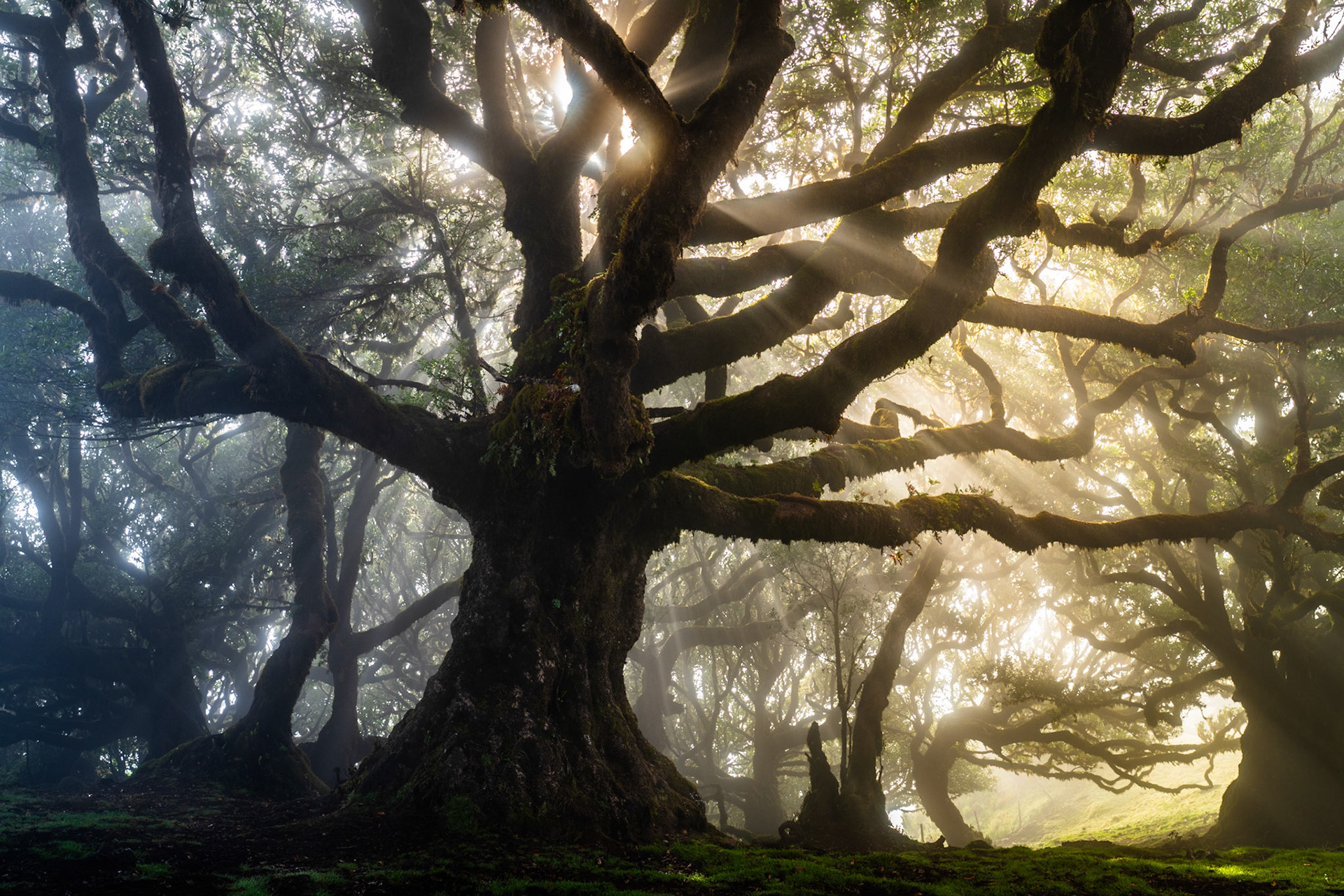
Crepuscular rays break through mist-laden laurel forest in the ancient laurisilva of Fanal, Madeira, illuminating the gnarled, moss-covered limbs of a centuries-old Til tree. The low sun pierces the canopy at a shallow angle, rendering the suspended moisture as visible columns of light between silhouetted trunks. The composition holds the dominant tree in near-silhouette, allowing the luminous background to carry the image's emotional weight.
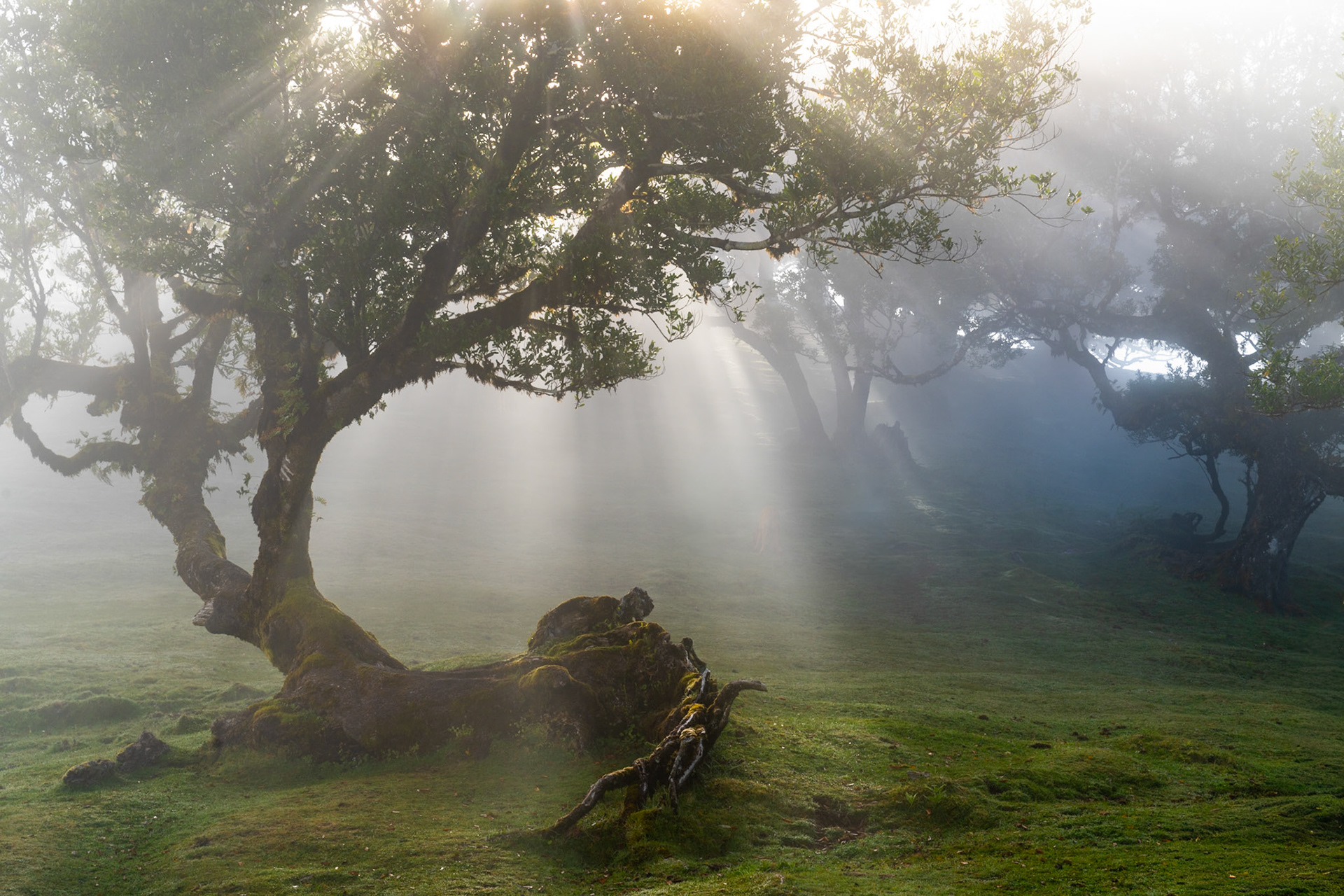
Crepuscular rays filter through ancient laurel trees in the Fanal forest, Madeira, as morning mist lingers at altitude. The gnarled, moss-covered roots of a veteran tree occupy the foreground, while successive layers of fog dissolve the background into near-abstraction. The quality of light and the sculptural character of the subject combine to produce an image of rare atmospheric coherence.
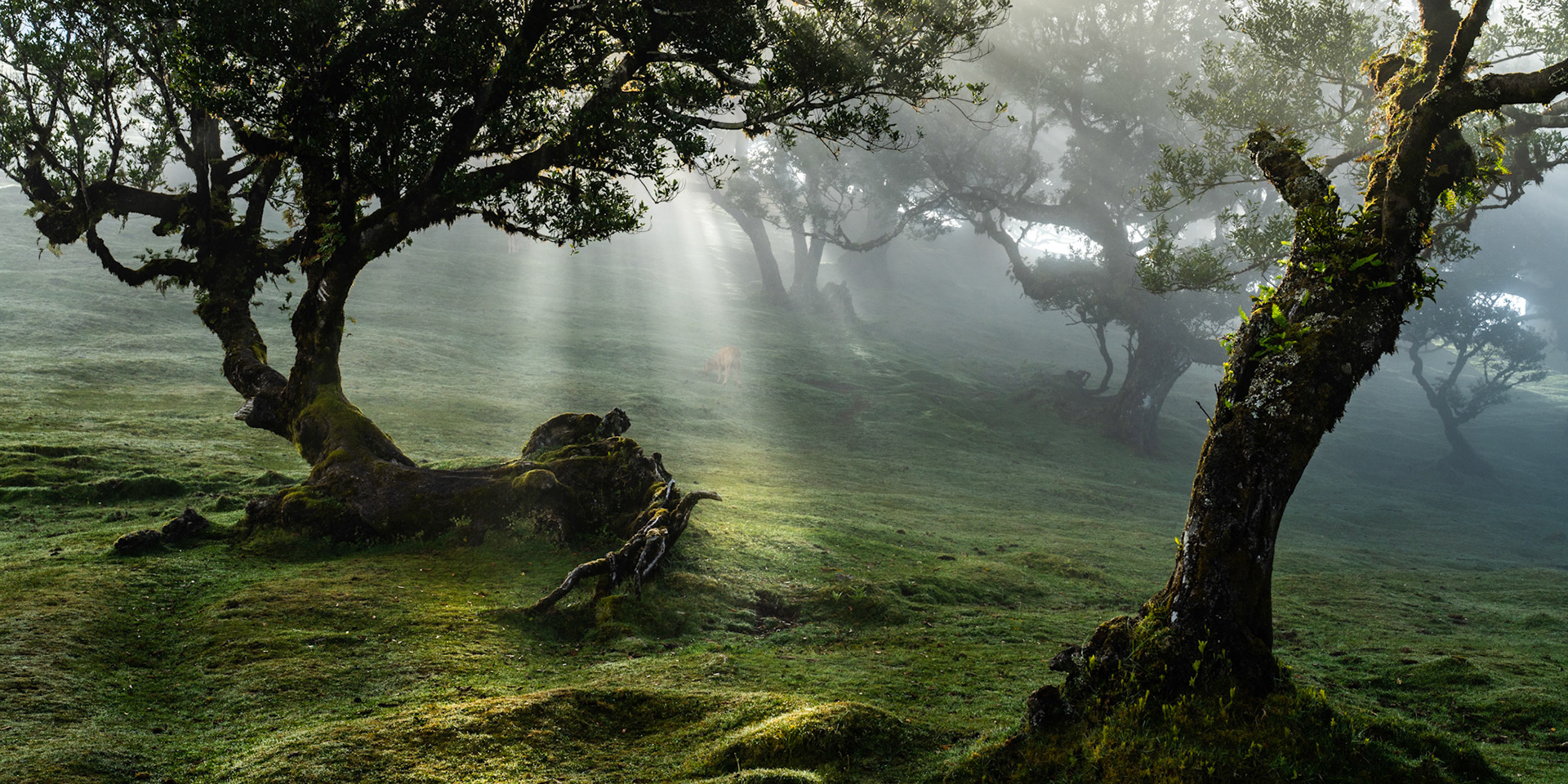
Crepuscular rays penetrate the laurisilva canopy of Fanal forest, Madeira, illuminating moss-covered ancient til trees emerging from low cloud. A grazing cow stands half-dissolved in the mist at mid-distance, anchoring the scale of the scene. The horizontal frame holds the tension between the dark, sculptural foreground roots and the luminous, receding fog.
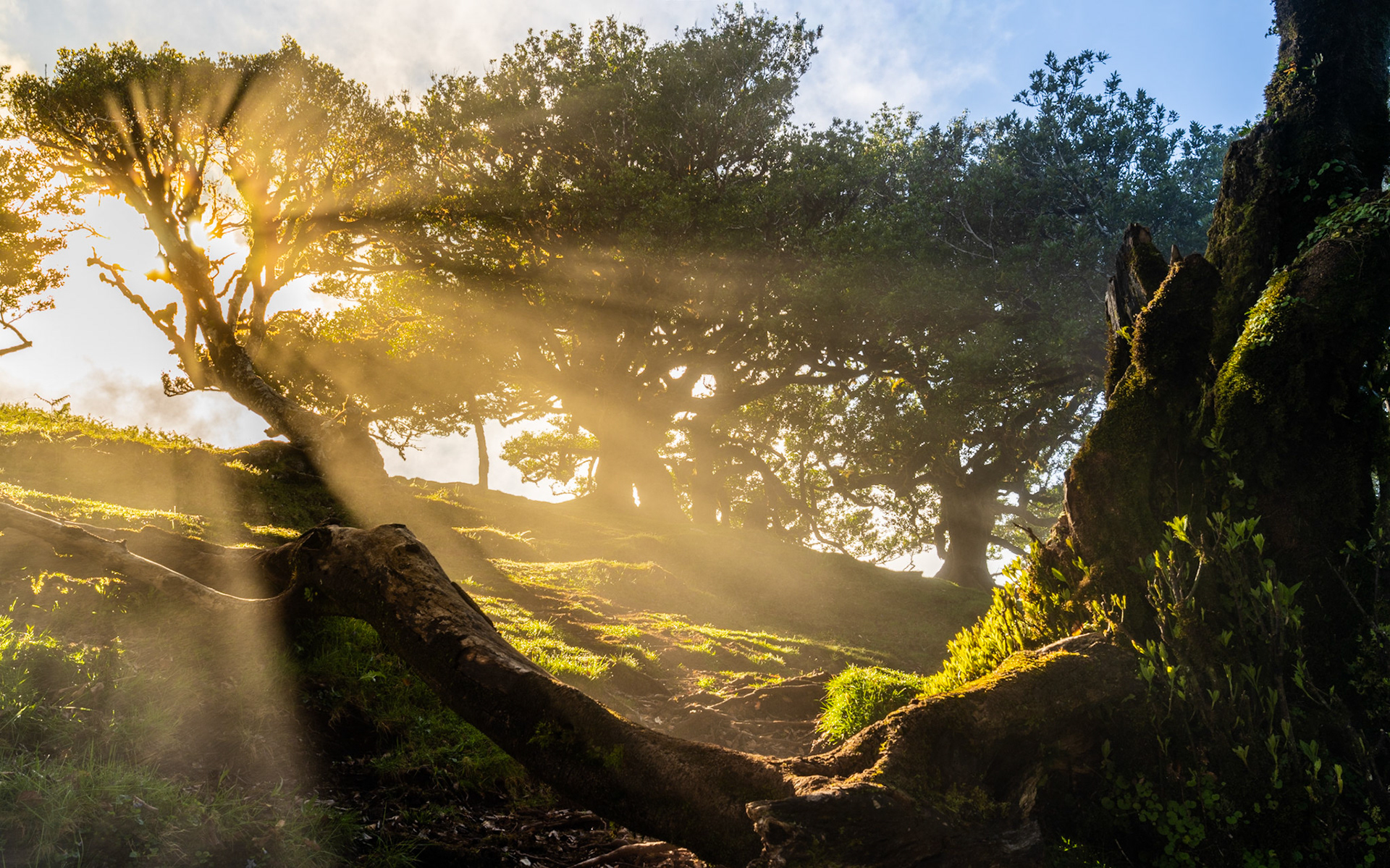
Shafts of early morning light break through the canopy of a laurel forest, illuminating mist drifting between ancient wind-shaped trees. The low viewpoint, anchored by a gnarled root system in the foreground, places the viewer within the forest floor. The combination of crepuscular rays and residual cloud vapour gives the scene rare atmospheric depth.
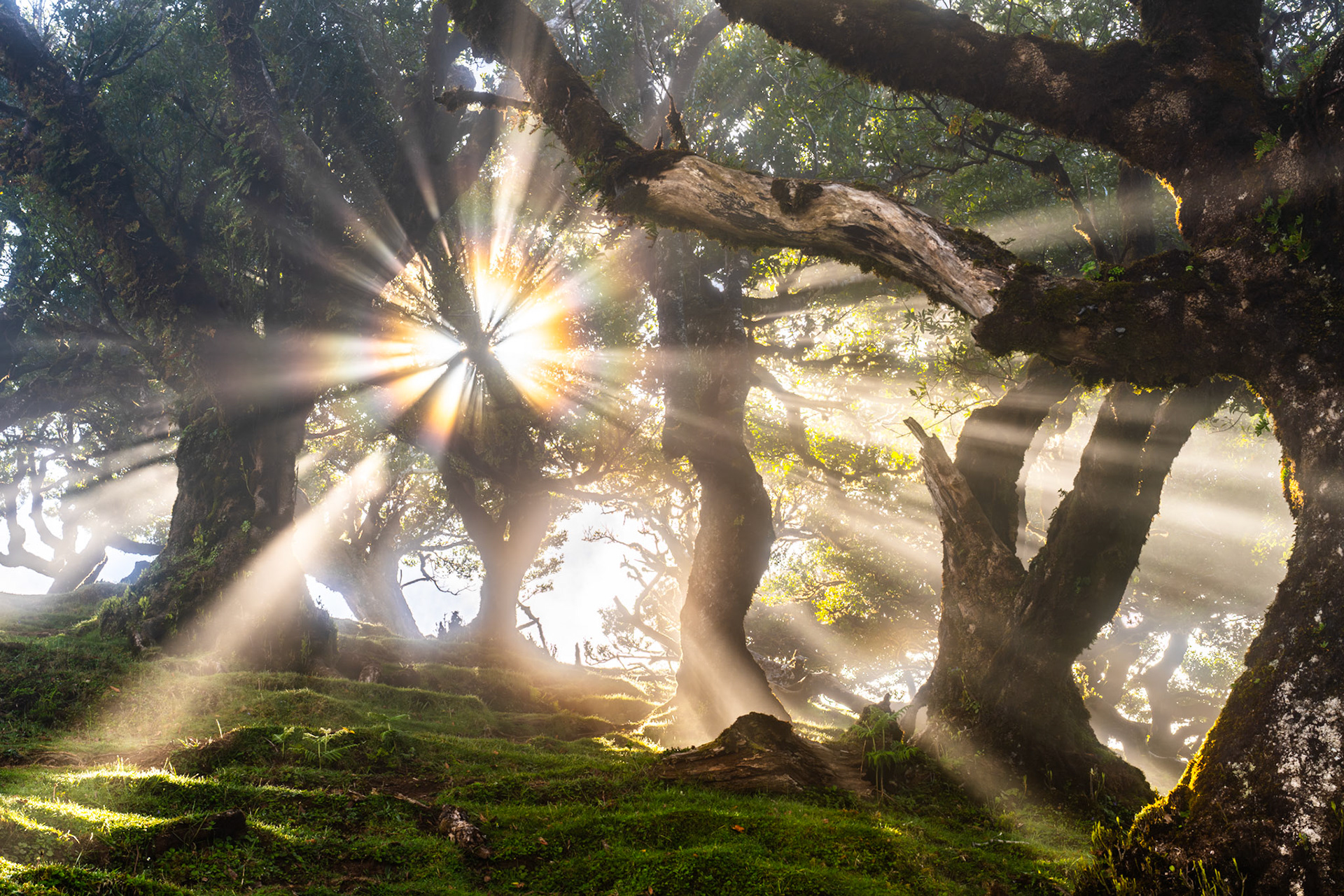
Sunbeams fracture through a gap in the ancient canopy of a laurisilva forest, the low morning sun creating pronounced star-bursts where it pierces the mist between moss-covered trunks. The combination of atmospheric moisture and dense, gnarled boughs frames the light as a structural element rather than a backdrop. Fanal forest, Madeira, is unmistakable in the character of these centuries-old Til and Laurel trees.
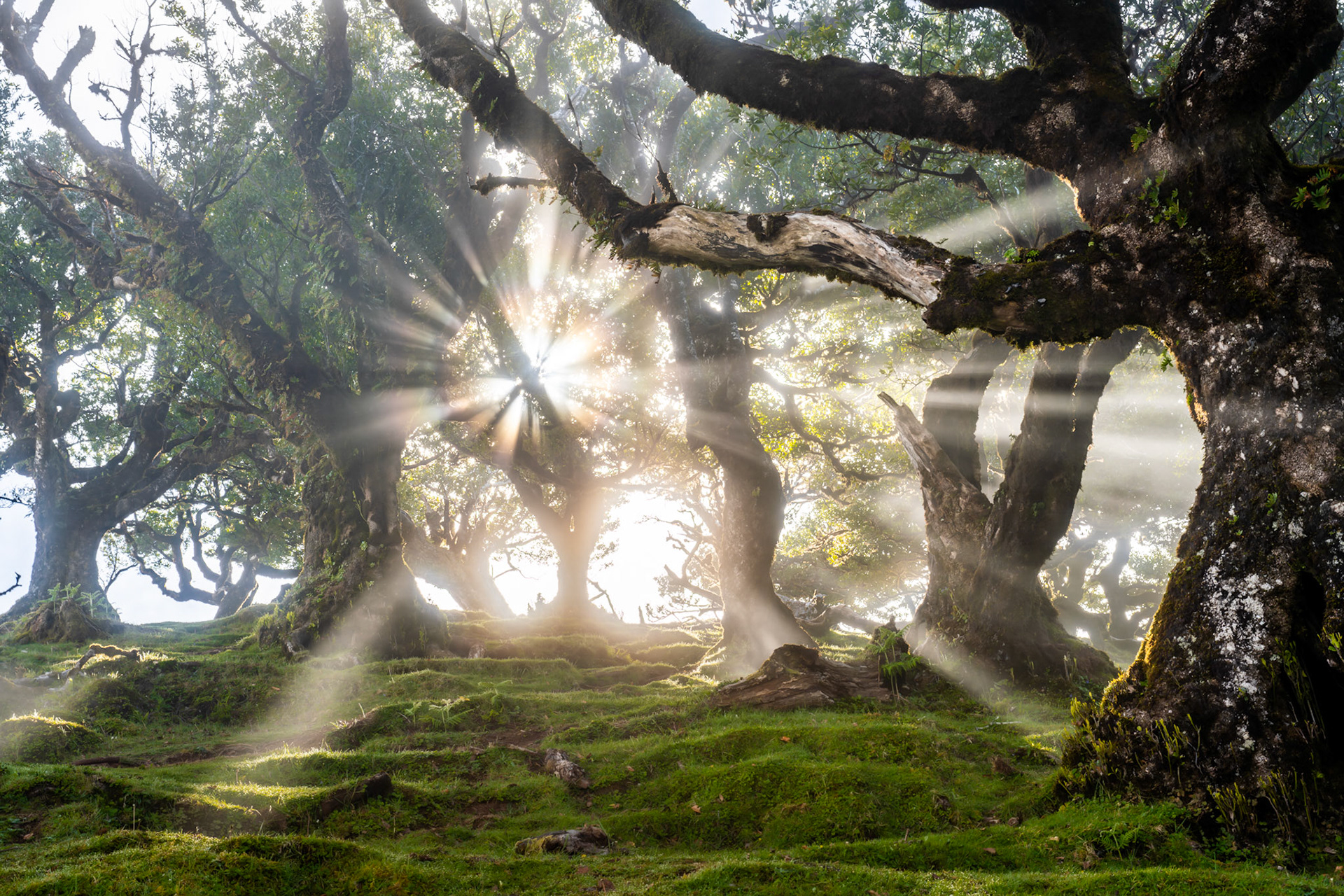
Ancient laurel trees channel early-morning sunbeams through mist in the old-growth forest of Fanal, Madeira. The gnarled, moss-covered trunks frame a luminous core where diffused light refracts against suspended water droplets, creating crepuscular rays of unusual intensity. The mossy ground plane anchors the composition beneath the arching canopy.
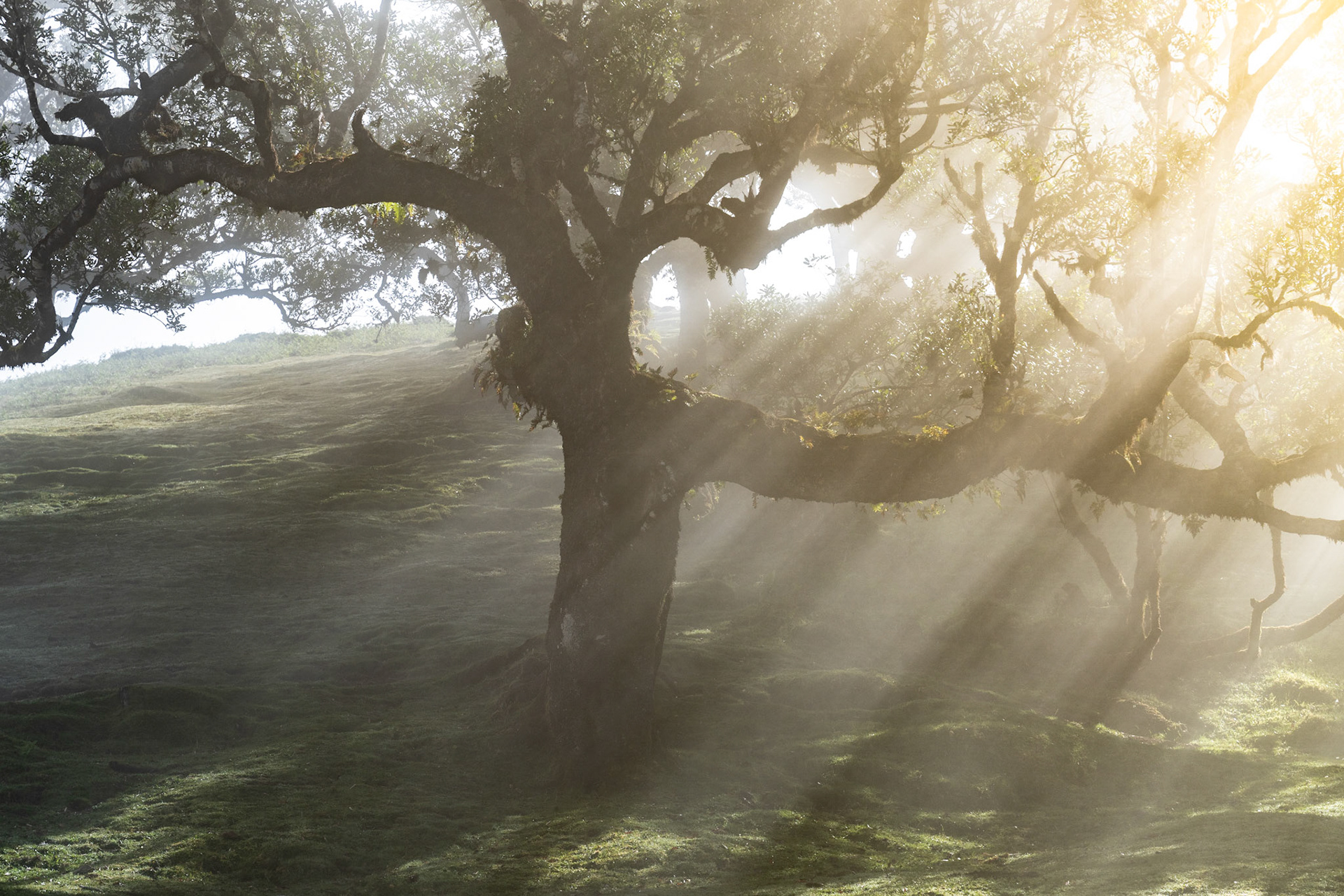
Crepuscular rays pierce morning mist through the ancient laurel canopy of Fanal, Madeira, casting radiating shafts across a moss-carpeted plateau. The gnarled, moss-draped trunk of a Til tree anchors the frame against the dissolving fog, its sweeping lateral branch cutting through the light. The quality of atmosphere and the tree's character are well-matched; the slight luminosity burn in the upper right sits just inside acceptable limits for competition.
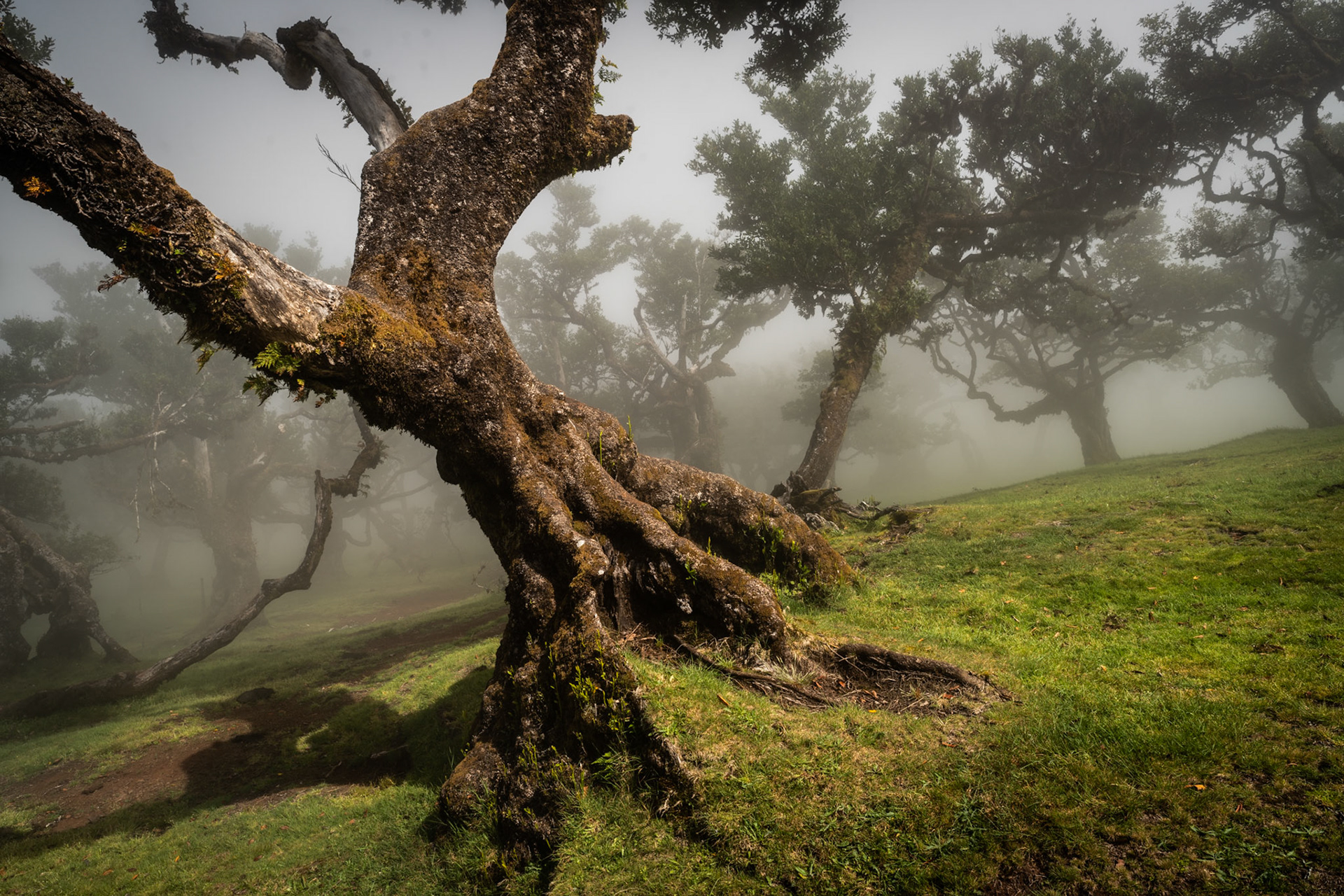
Ancient Til laurel trees emerge from dense cloud in the Fanal forest, Madeira, their moss-encrusted trunks contorted by centuries of Atlantic weather. The foreground subject splits into crossing limbs that draw the eye through successive layers of mist toward the ghost-like canopy beyond. The diffuse light and muted palette hold the mood without sentimentality.
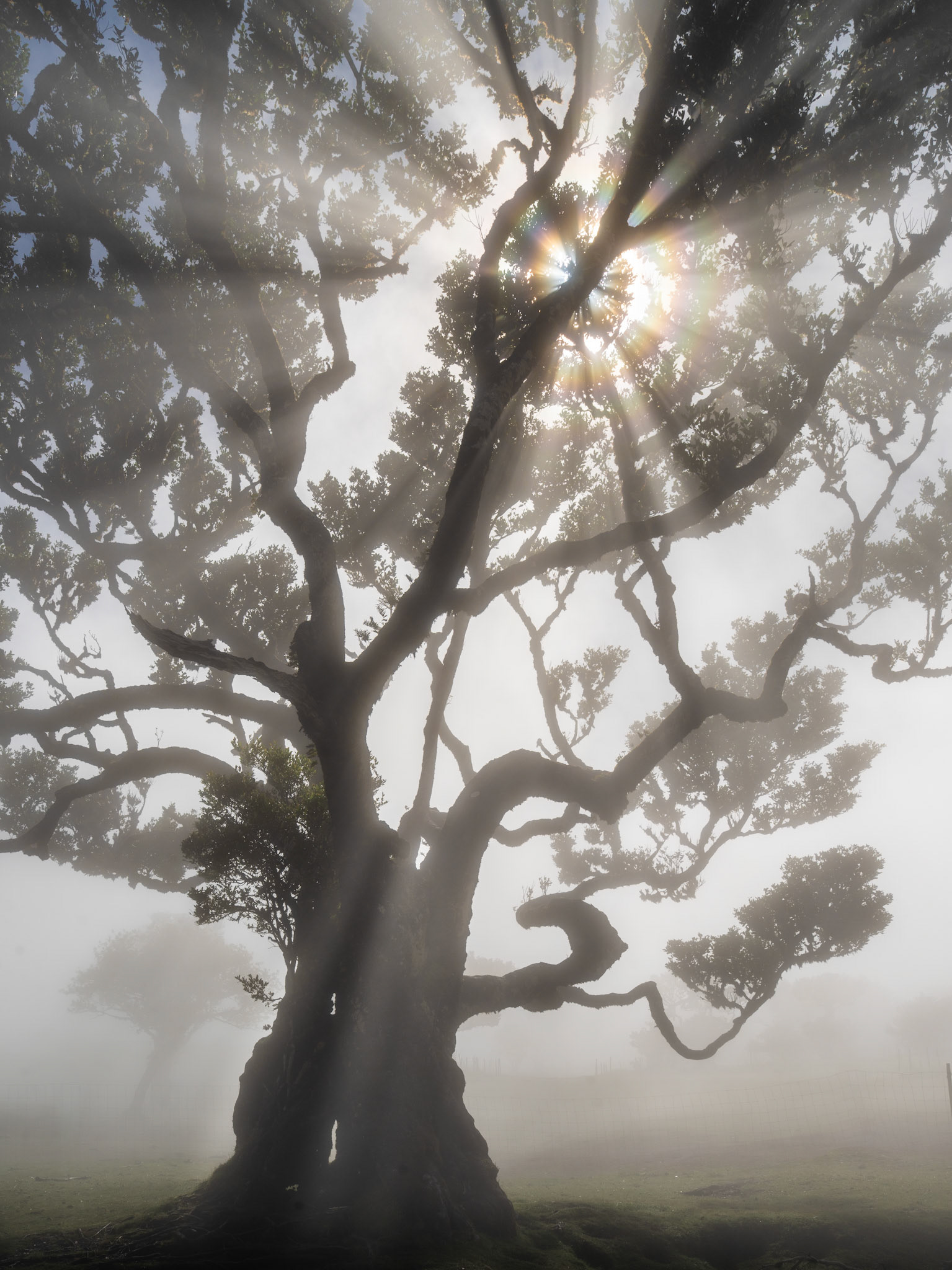
An ancient laurisilva tree rises through dense cloud at Fanal, Madeira, its twisted limbs filling the frame as a sunstar breaks through the canopy. The fog reduces the surrounding forest to pale suggestion, isolating the gnarled trunk against a luminous, diffuse sky. The low shooting angle and upward perspective emphasise the scale and character of a tree that may predate the Portuguese settlement of the island.
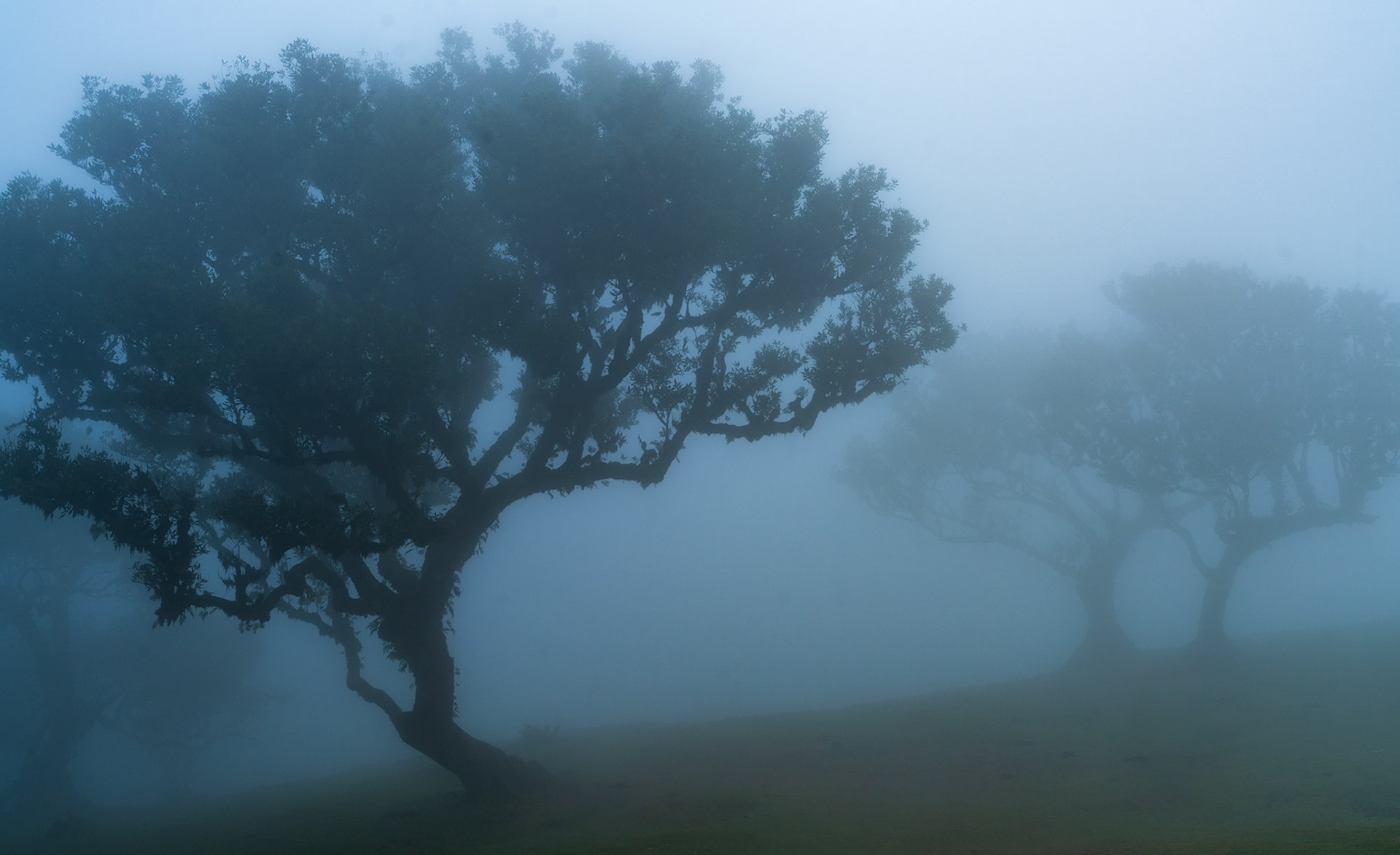
Wind-shaped laurisilva trees dissolve into dense fog at dusk, the foreground specimen leaning as though still pressed by the trade winds that sculpted it. The receding second tree anchors the depth without crowding the composition. Blue-cast residual light gives the scene its characteristic cold stillness.
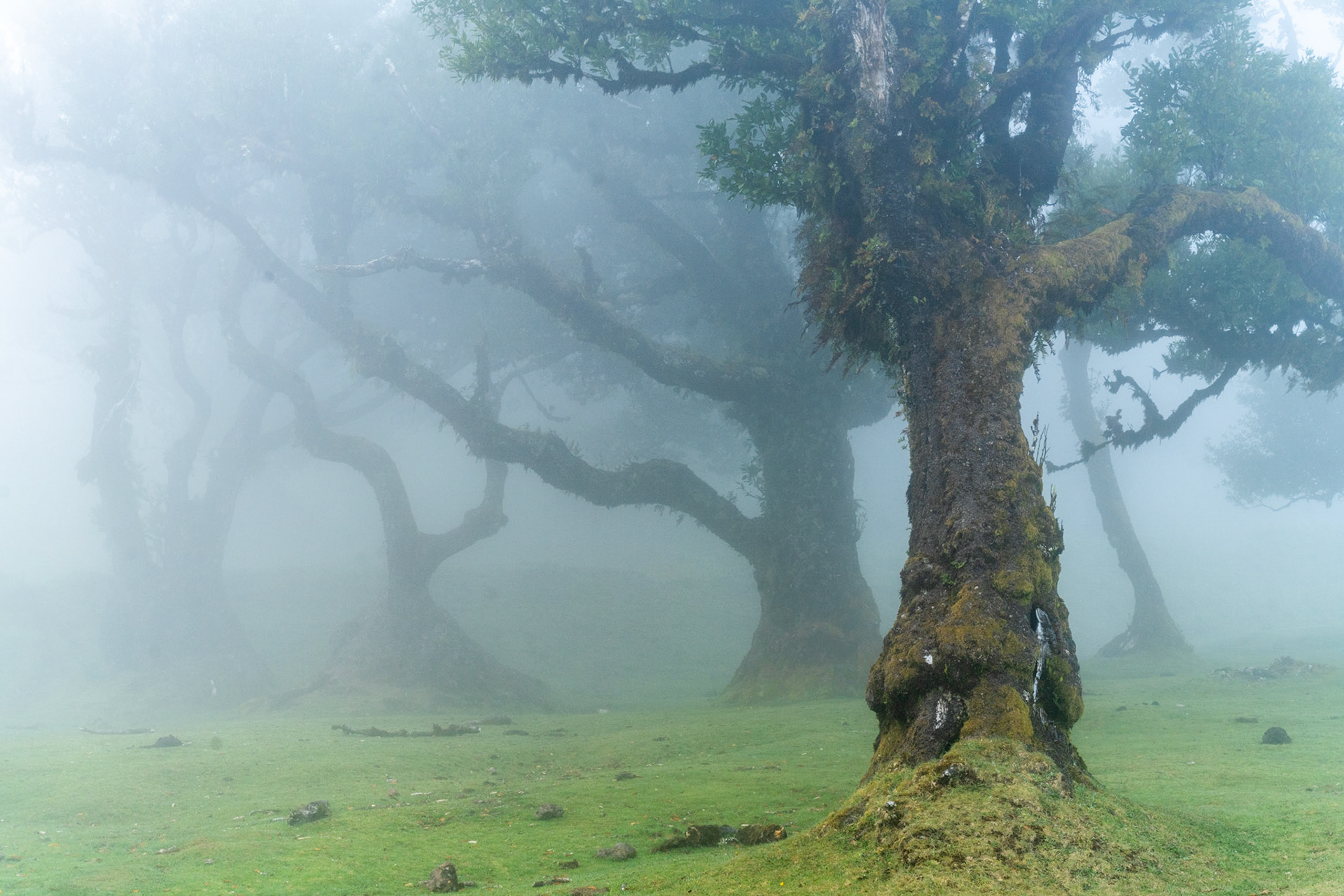
Ancient laurisilva trees emerge from dense cloud in the Fanal plateau, Madeira. The gnarled, moss-laden trunk of the foreground specimen anchors the composition while successive trees dissolve into fog, creating a recession that implies age and remoteness. The saturated green of the cropped grass contrasts with the cool blue-grey of the mist, giving the scene both depth and unease.
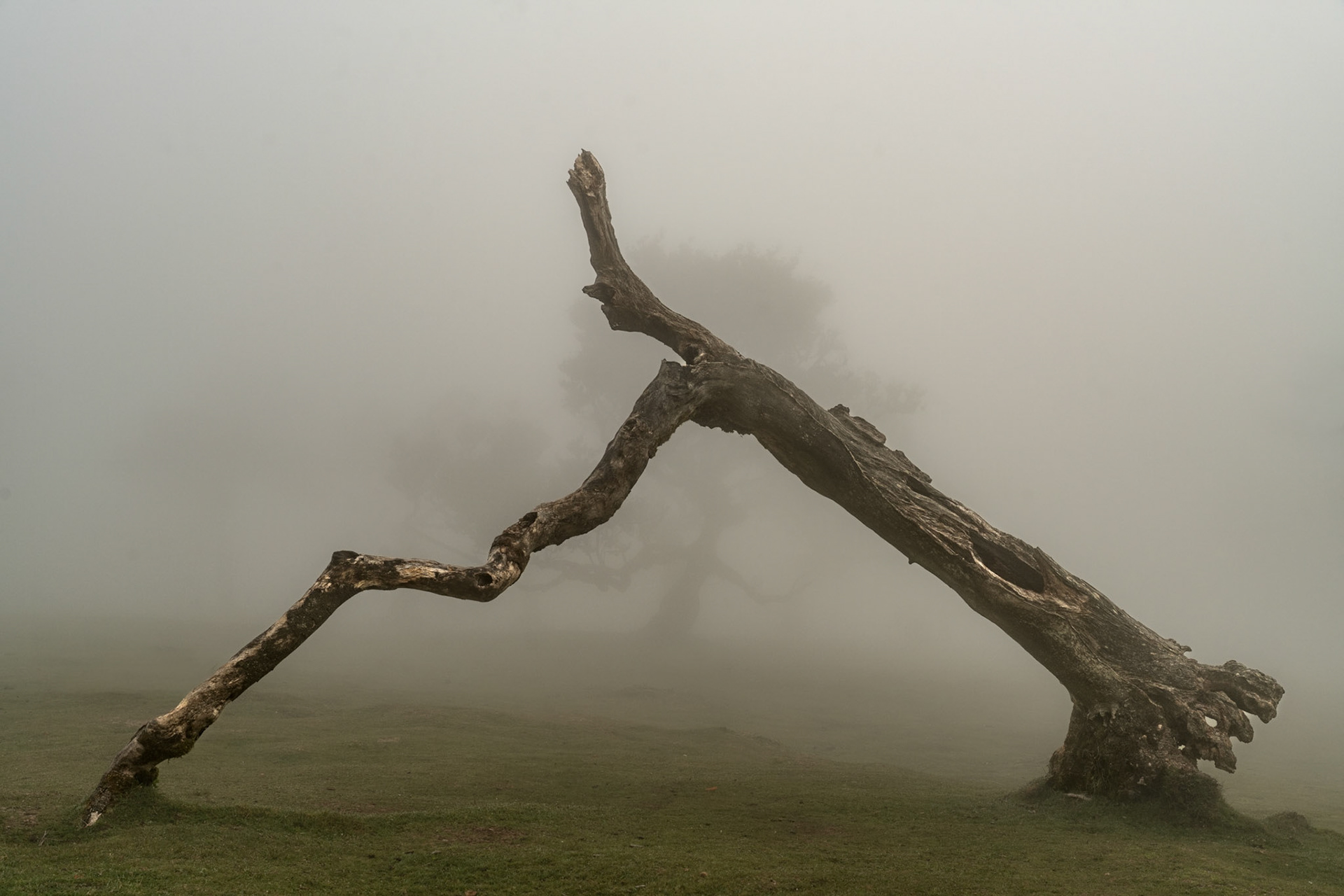
A collapsed ancient tree, stripped of bark and reduced to bare structural limbs, spans the frame against a fog-bound hillside. The trunk's articulated arch — braced by a lower branch against the grass — reads almost as a figure mid-stride. A living tree dissolves into the mist behind, lending quiet depth to an otherwise severe composition.
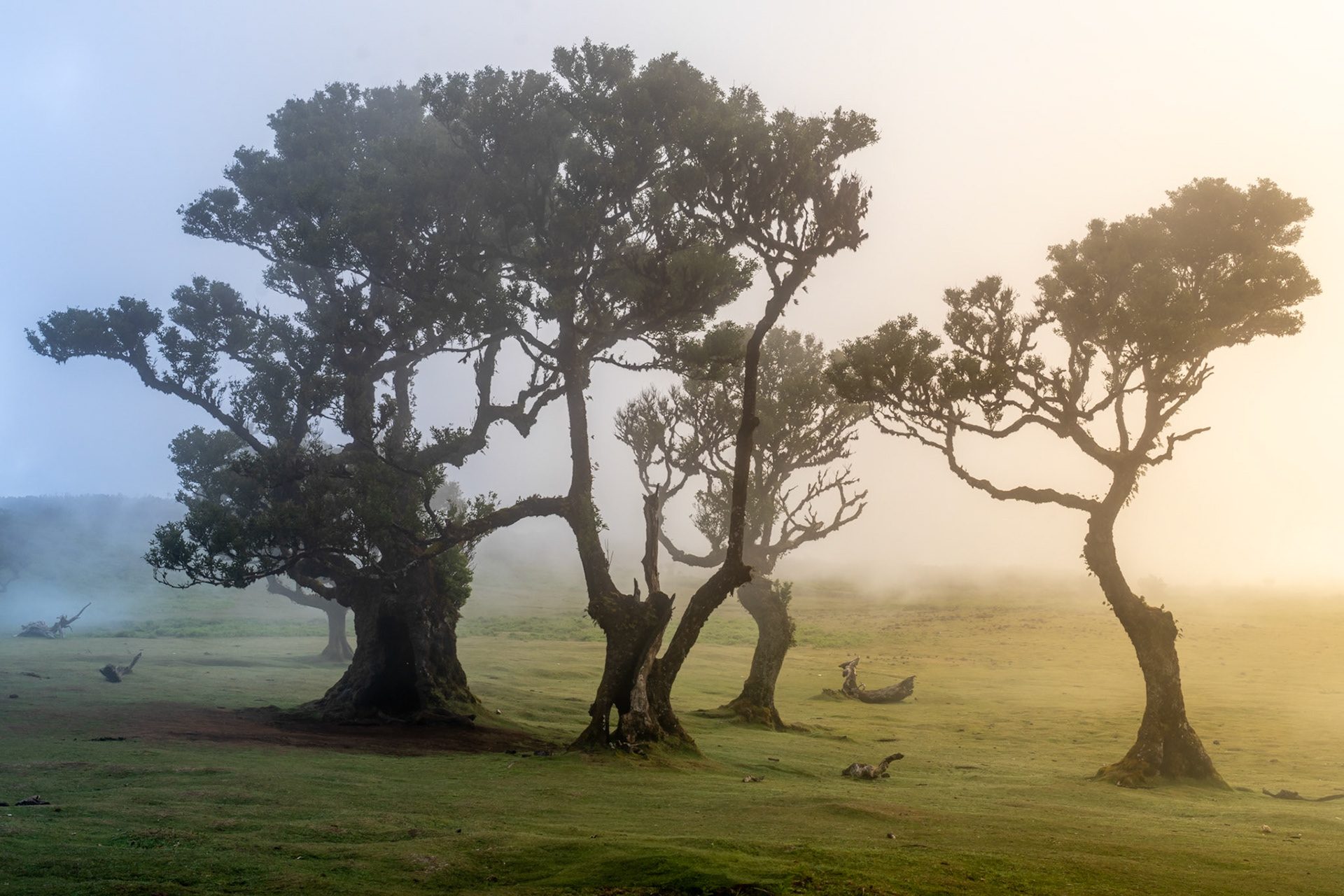
Ancient Til laurel trees emerge from dense cloud at the Fanal plateau, Madeira. The fog reduces the scene to a sequence of silhouetted forms receding into luminous white, each twisted trunk distinct yet dissolving into the next. Captured in late evening light, the image sits between clarity and erasure.
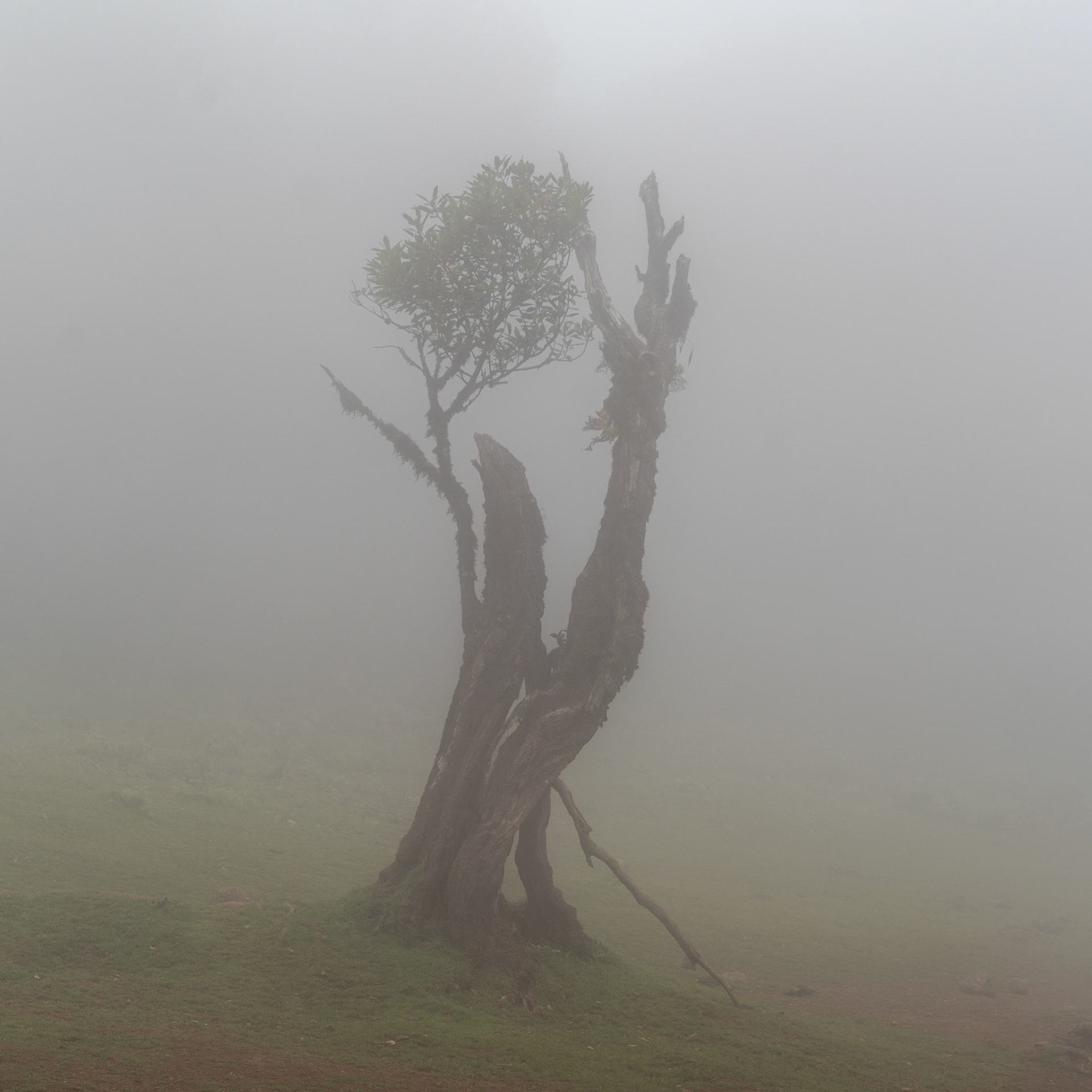
A storm-damaged laurisilva tree, its trunk split and bark stripped, persists in dense cloud on high ground. A single canopy of laurel foliage crowns the wreckage, caught between life and decay. The fog reduces all context to a pale void, isolating the subject with quiet severity.