The Chilterns are where most of my photography happens and where my woodland photography journey began. A long chalk escarpment of ancient beech woodland, dry valleys and downland running northeast from the Thames, the hills are a National Landscape that rewards repetition — the same wood can look ordinary for ten mornings and extraordinary on the eleventh, when fog drifts through the trees at first light.
This collection is a portrait of that patch: beechwoods in every season, red kites over the escarpment, frost in the bottoms, and the particular stillness of the hills before the first dog walkers arrive. Much of my award-recognised woodland work — including images from my British Wildlife Photography Awards winning portfolio — was made within these few square miles.
If you live in or love the Chilterns, these images are available as fine art prints; local landscapes make the most personal wall art. Get in touch if you'd like any of them printed.
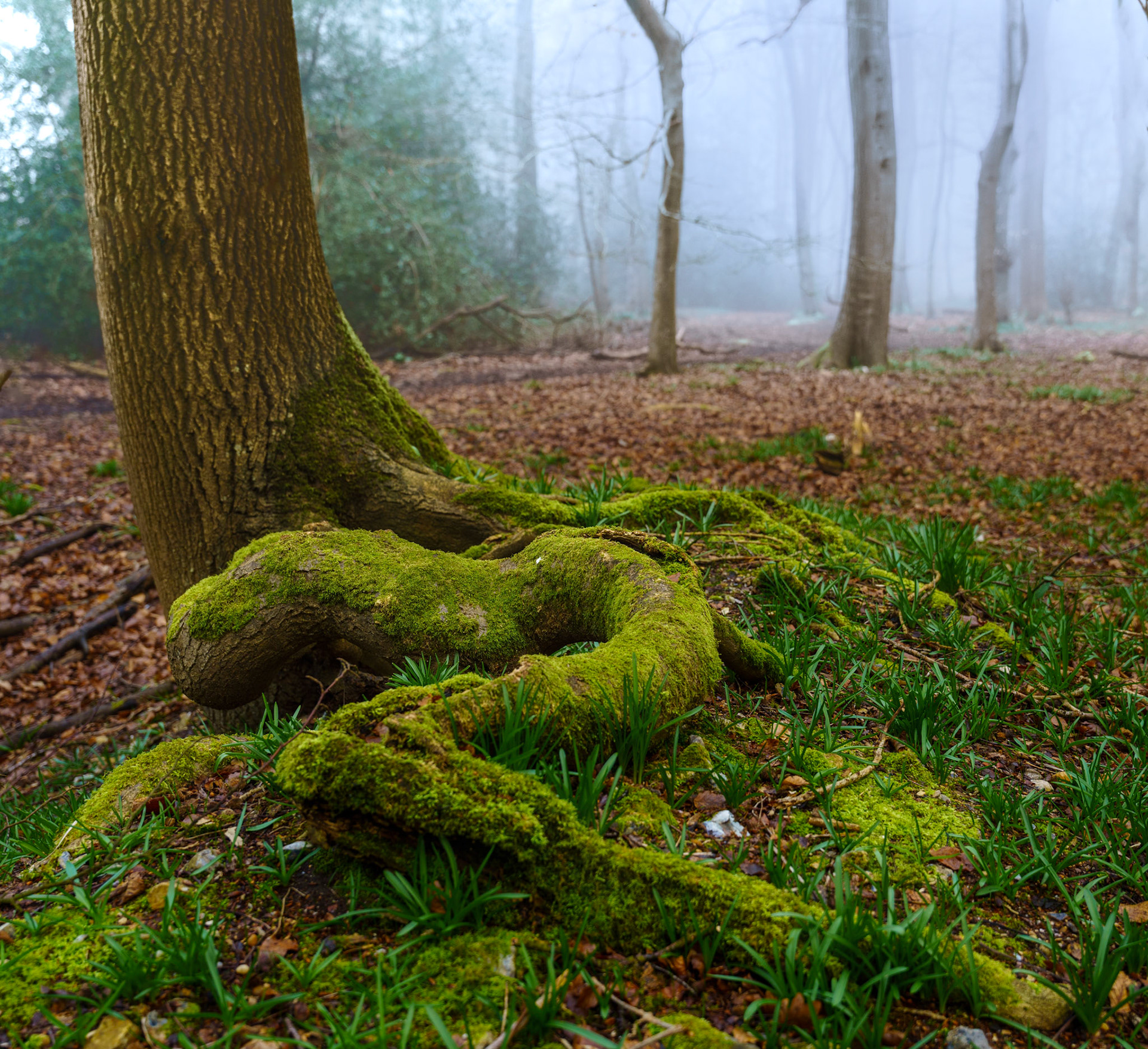
Moss-covered surface roots sprawl across a woodland floor in the Chilterns, Oxfordshire, still emerging from winter, with bare trees dissolving into dense morning fog beyond. The low viewpoint draws the eye along the sinuous root forms, contrasting vivid green moss and early grass shoots against the muted, leaf-littered ground. Early March mist softens the background into near-monochrome, anchoring the image in the quiet transition between seasons.
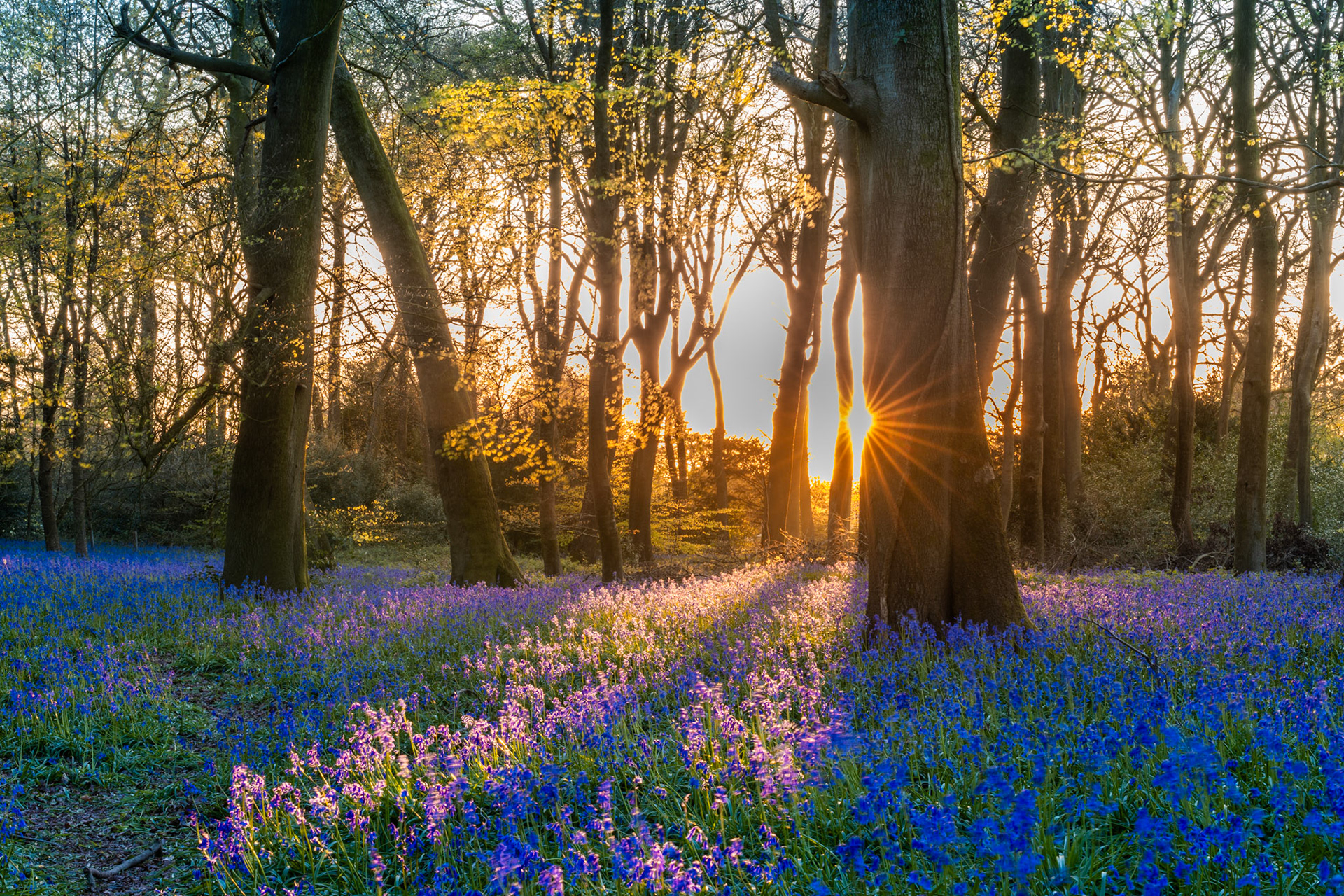
Bluebells and sunset sun star amongst old beech woodland, Chilterns, England
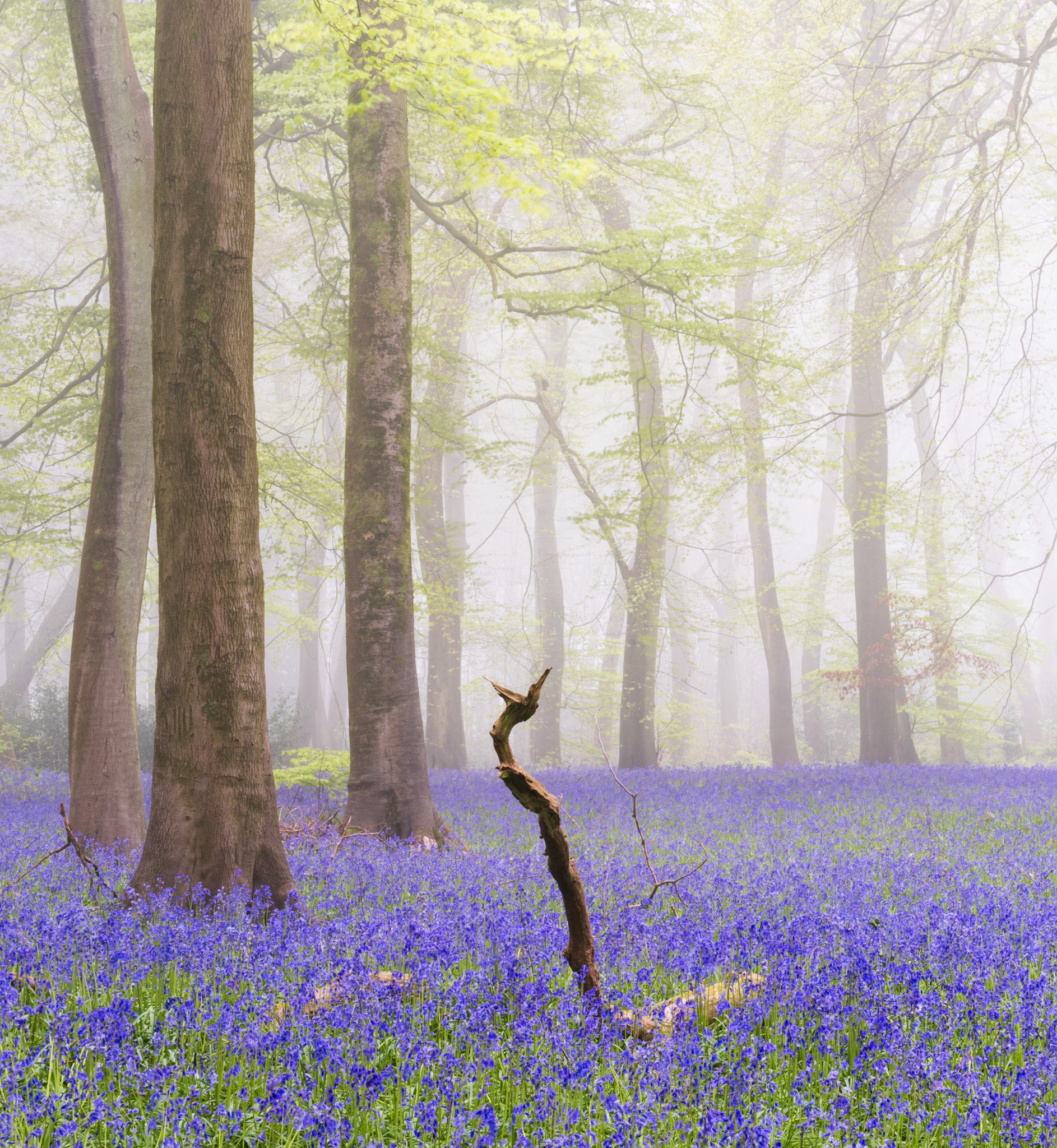
A dense carpet of bluebells covers the woodland floor beneath emergent beech canopy in the Chilterns, Oxfordshire, the early-morning mist softening the background into successive planes of grey and pale green. A single gnarled dead branch rises from the flower mass at centre frame, providing a point of tension against the calm horizontality of the scene. Captured at first light in late spring, when the bluebell peak and the beech flush briefly coincide.
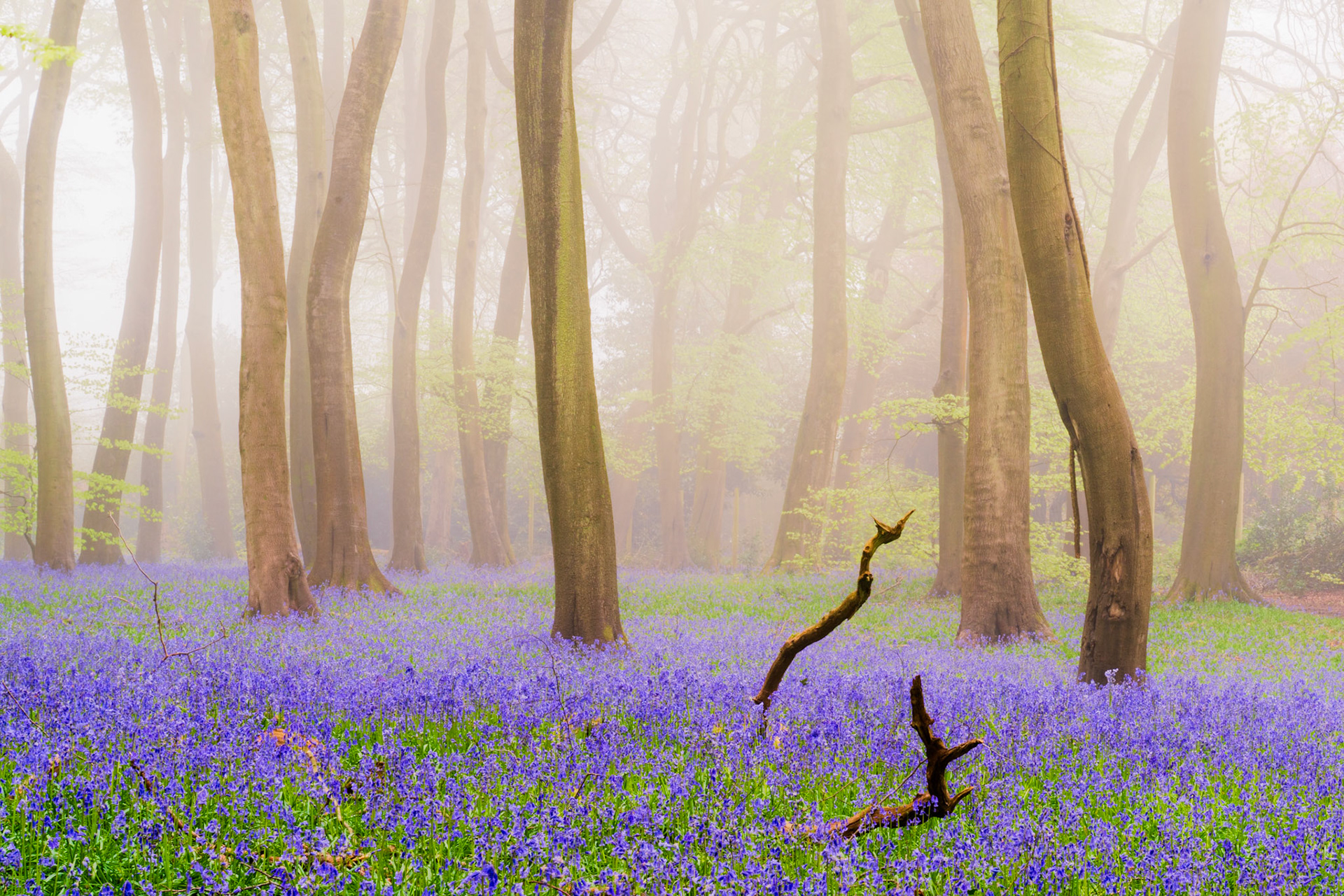
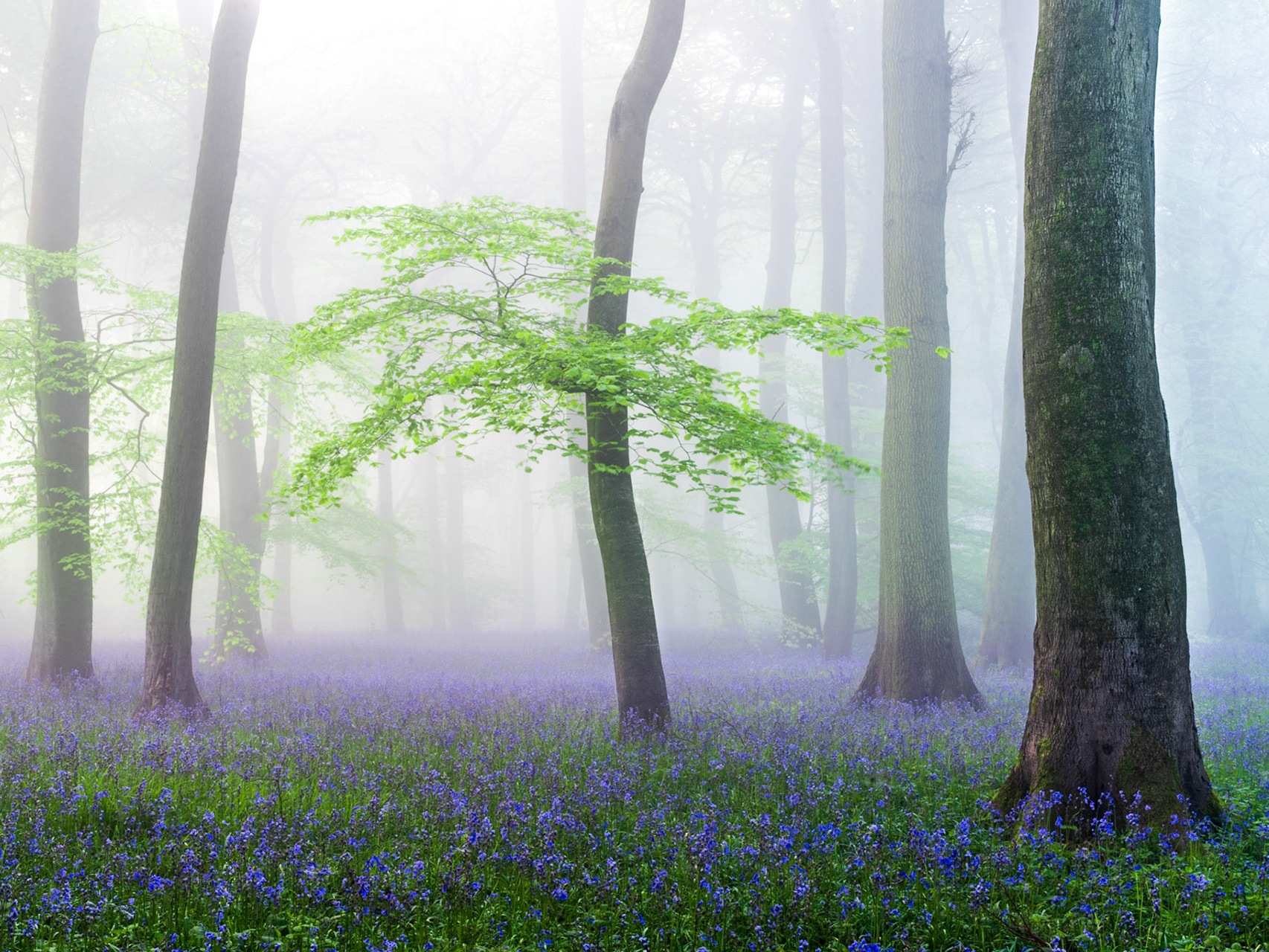
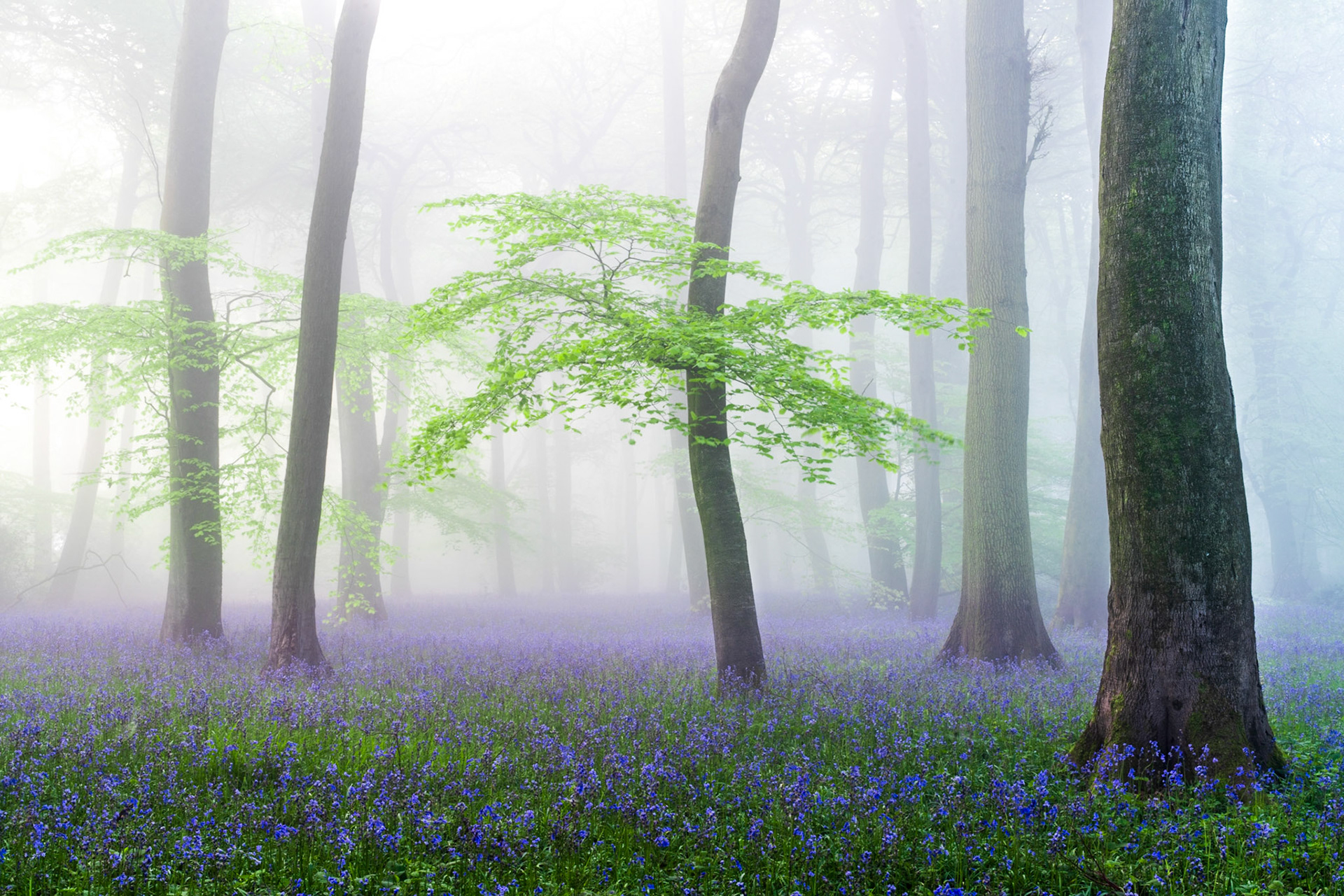
Foggy beech woodland with extensive carpets of bluebells, Chilterns, UK
Fresh green growth on Beech trees above a beautiful carpet of bluebells, Chilterns, England
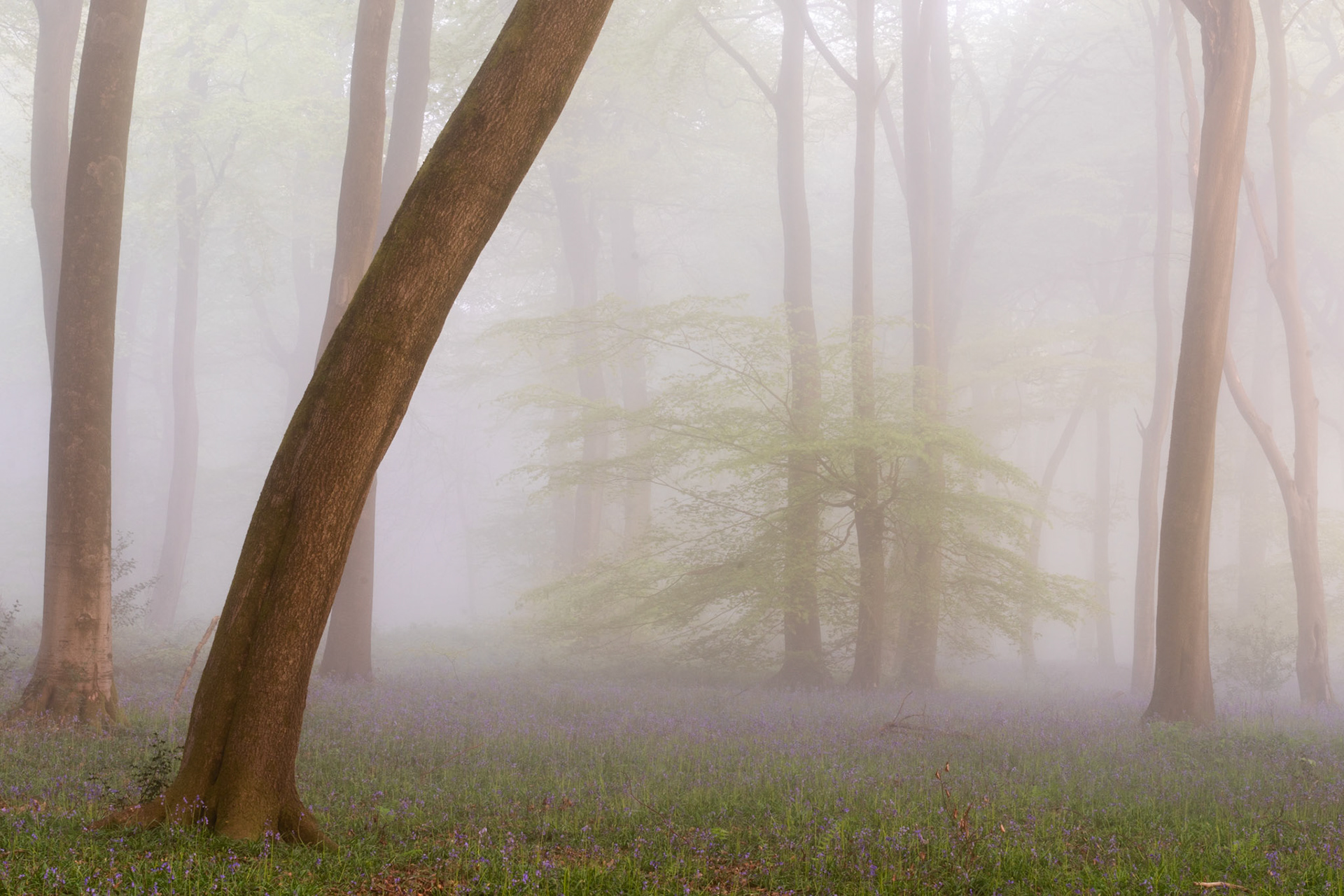
Dense spring fog softens the interior of a beech woodland in the Chilterns, Oxfordshire, at dawn, reducing the further trees to pale silhouettes while a low, spreading shrub — possibly a young yew — holds its green form as a quiet focal point. A carpet of bluebells covers the woodland floor, their colour muted by the diffuse light. The leaning foreground trunk introduces diagonal tension into an otherwise still composition.
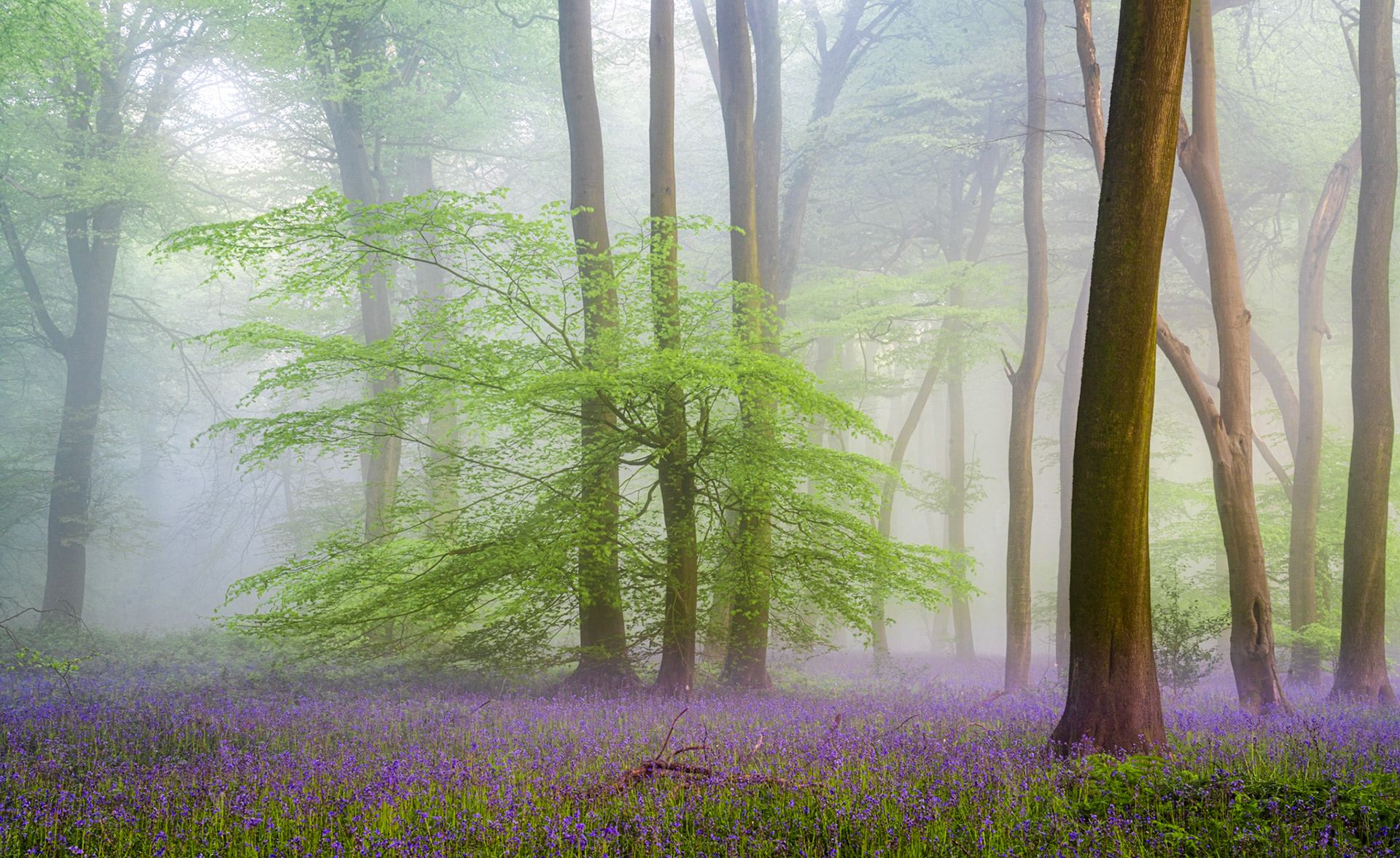
Fresh green growth on Beech trees above a beautiful carpet of bluebells, Chilterns, England
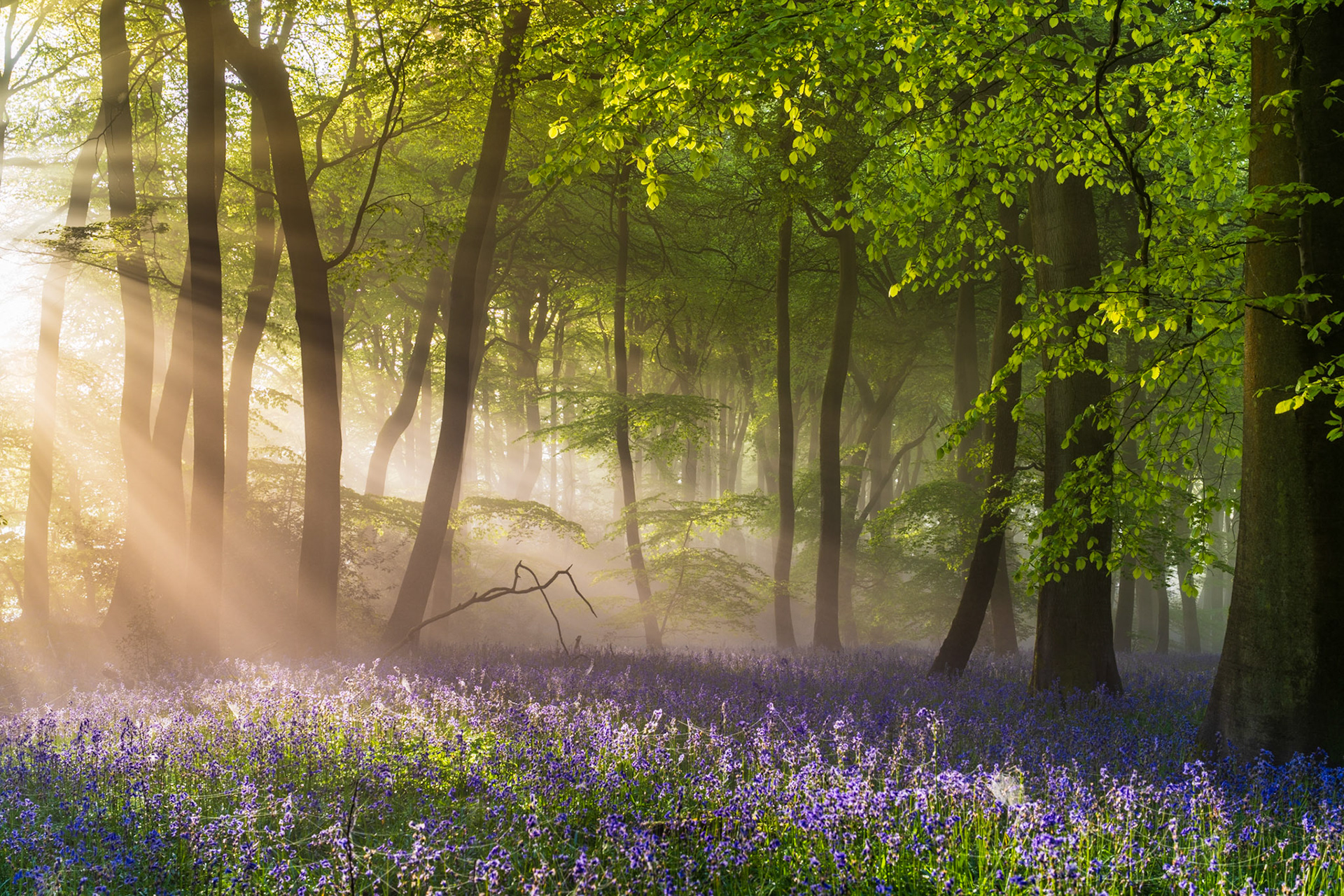
Sunrise Sunbeams Springtime Bluebells, Chilterns, UK (Awarded)
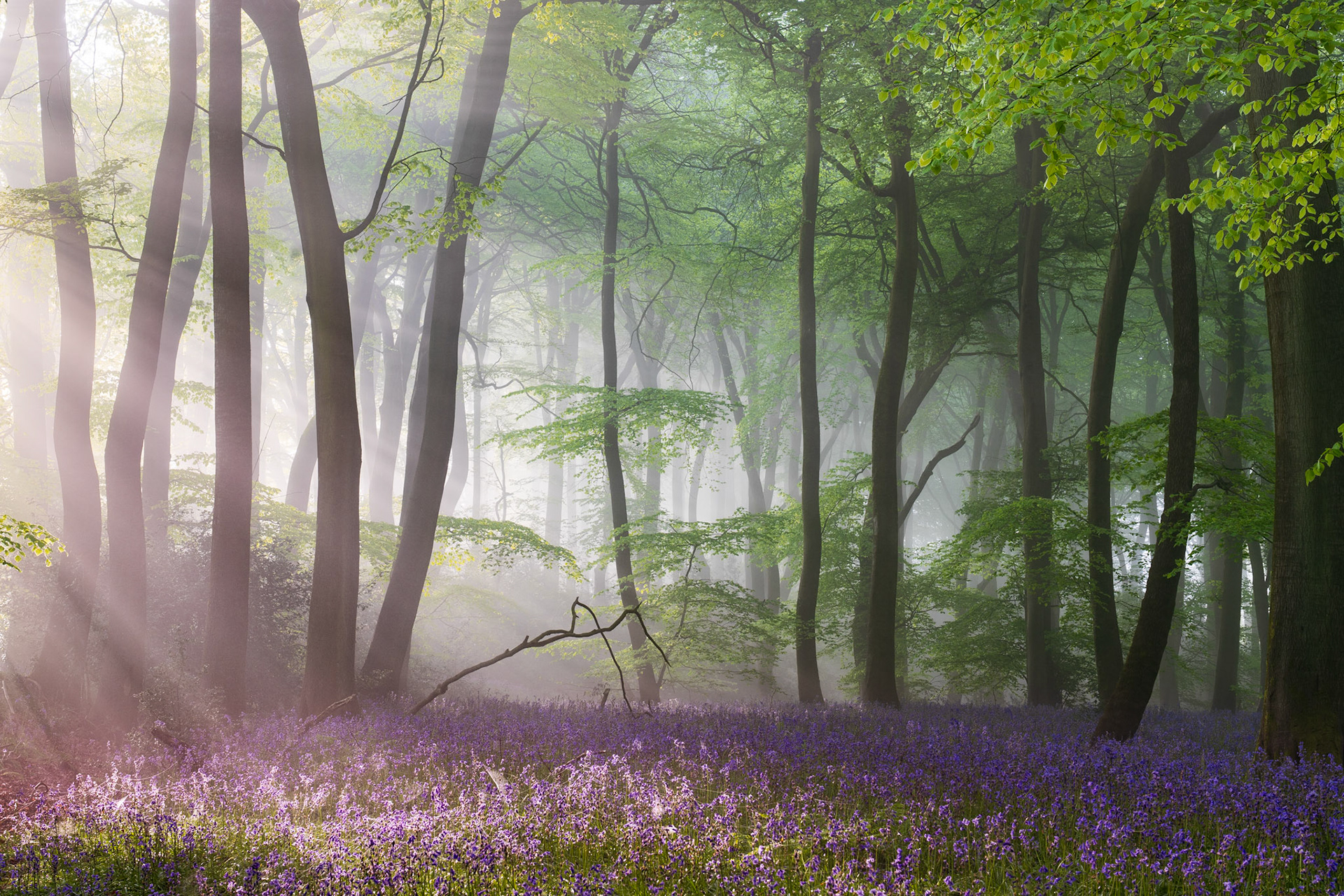
Sunbeams rake through morning mist in a beech woodland in the Chilterns, Oxfordshire, carpeted with bluebells at peak bloom. The low-angled light catches individual shafts between smooth grey trunks, lifting the violet floor against a pale, fog-softened interior. A fallen branch in the mid-ground anchors the composition without disrupting the stillness.
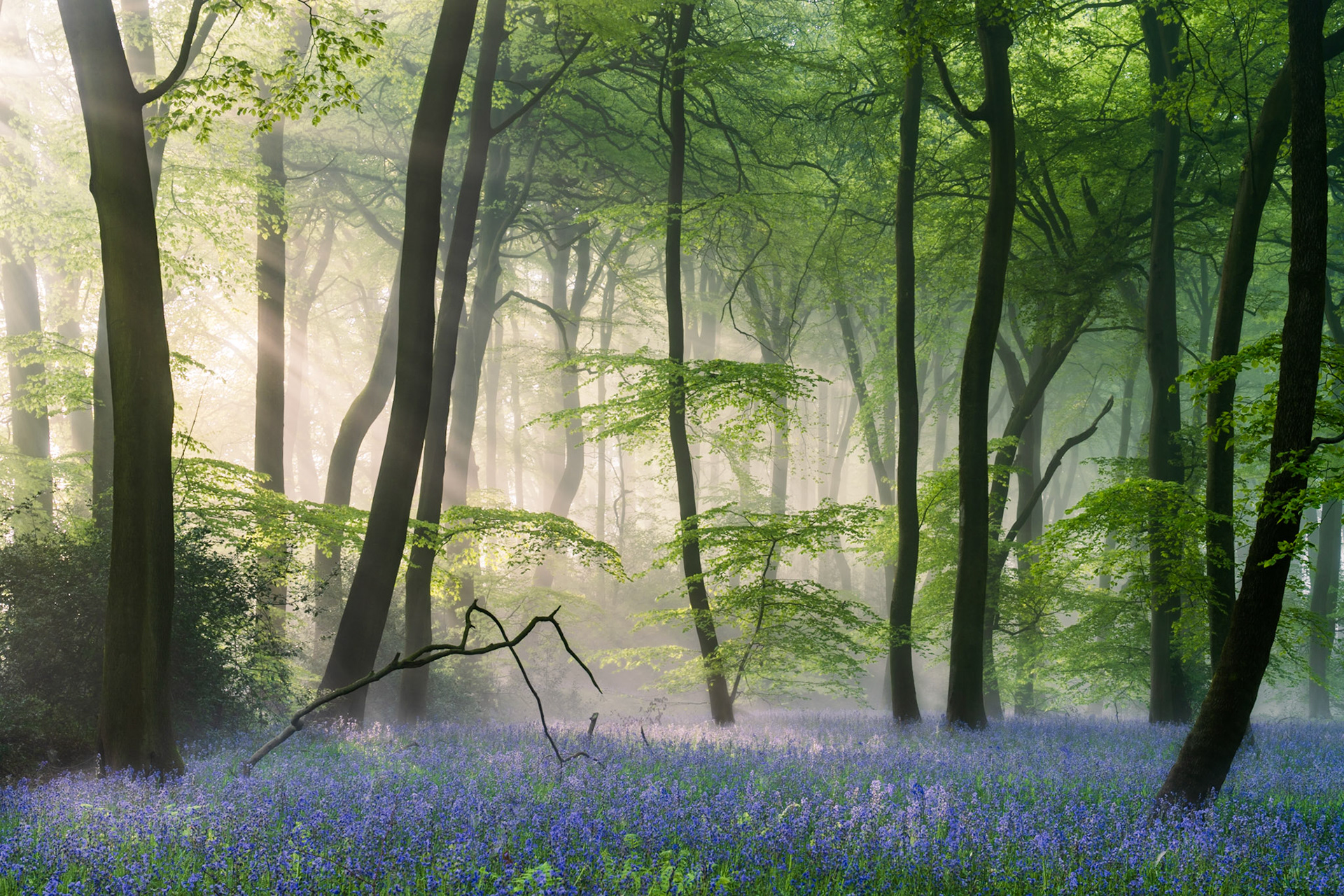
Springtime Sunbeams Bluebells, Chilterns, UK (Awarded)
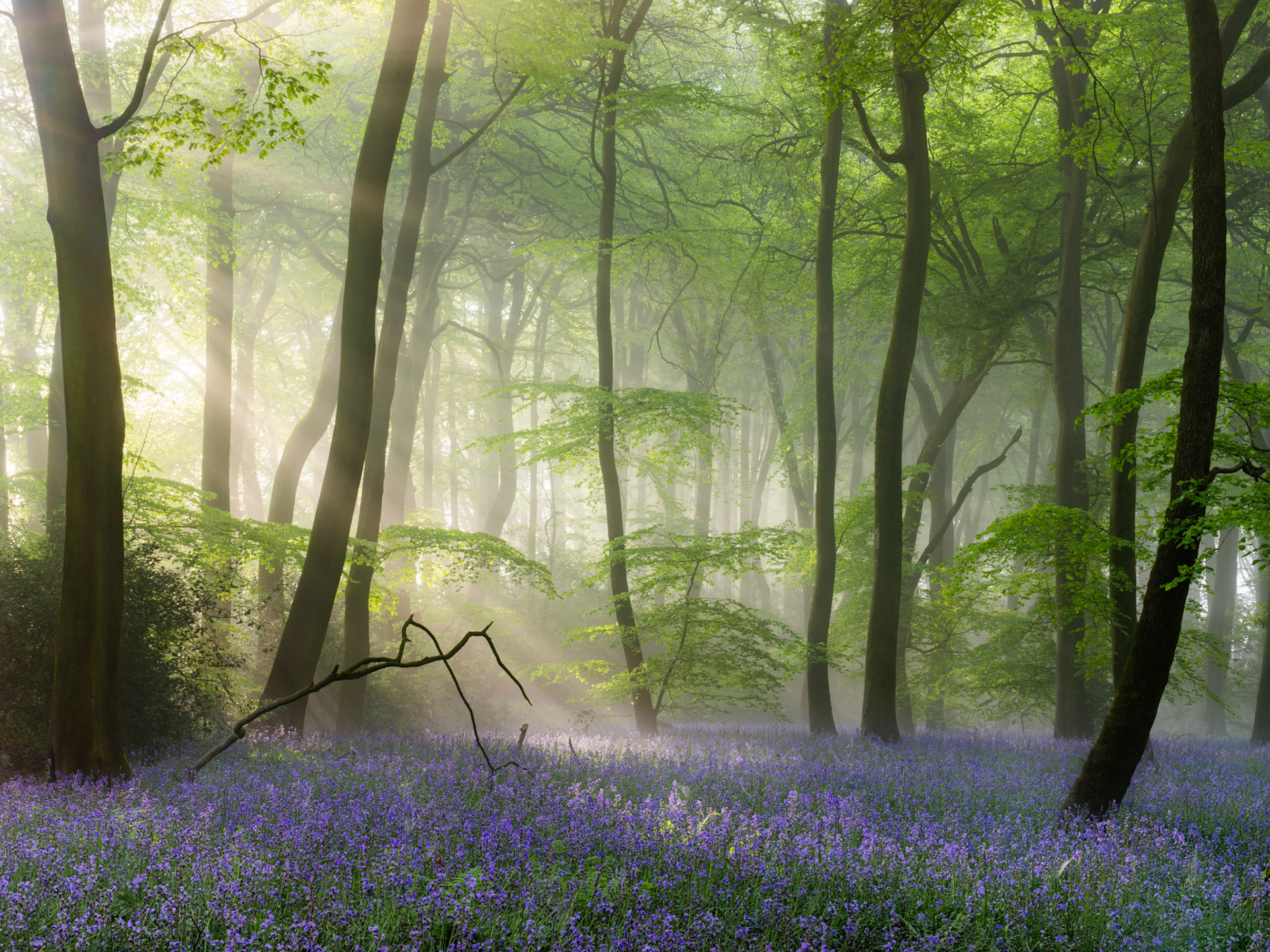
Crepuscular rays filter through fresh beech canopy into a bluebell-carpeted woodland floor in the Chilterns, Oxfordshire, the ground mist catching each shaft of early morning light. A fallen branch in the middle distance adds structural tension without disturbing the stillness. The compression of the intimate focal length holds the scene in quiet equilibrium.
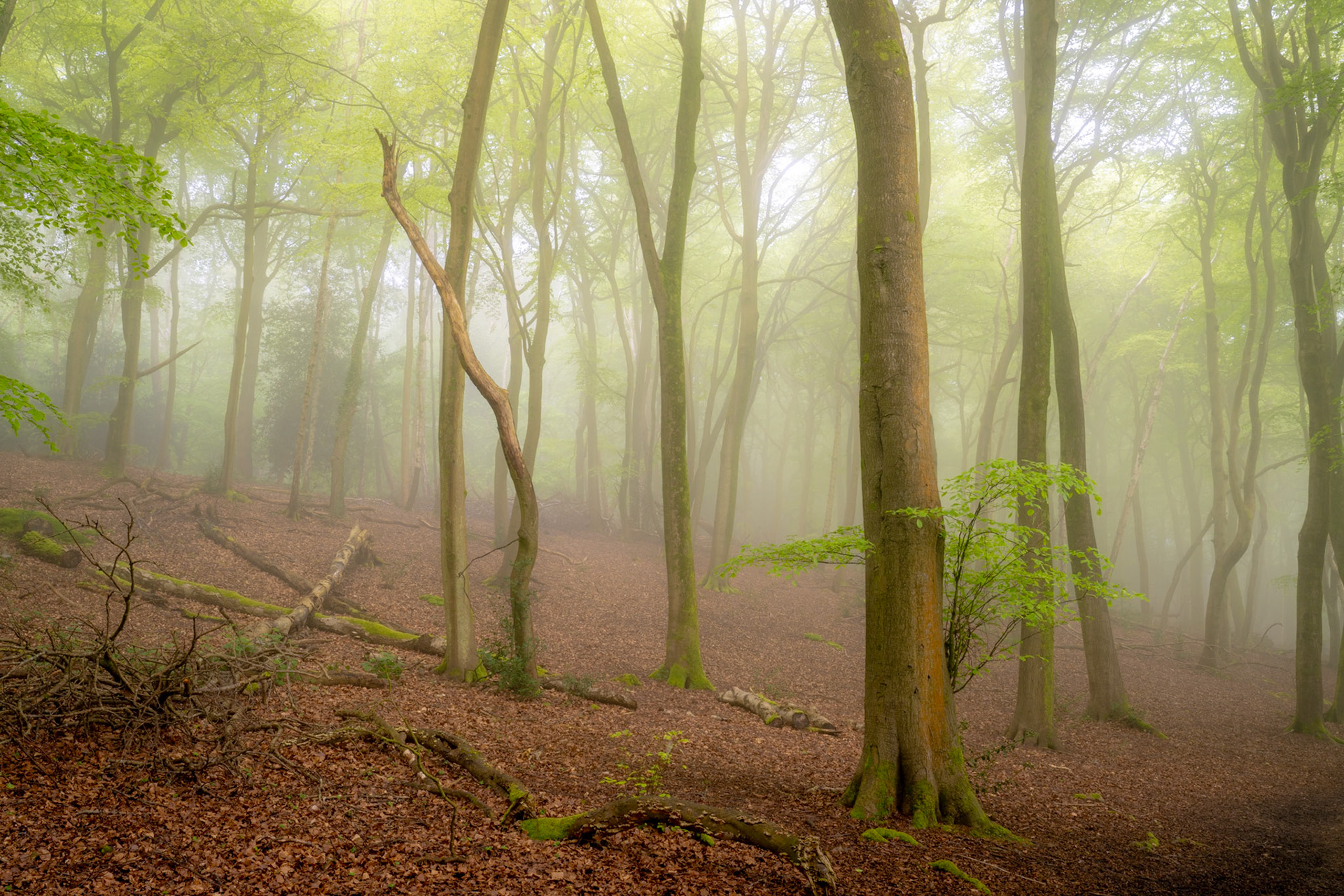
Mist softens the middle distance of a mature beech woodland in the Chilterns, Oxfordshire, in early May, when the canopy is just breaking into fresh leaf. Fallen timber and moss-covered roots anchor the foreground, while a young sapling at the base of the dominant trunk introduces a counterpoint of vivid green. The quiet diffusion of light through the fog creates a layered recession that draws the eye deep into the stand.
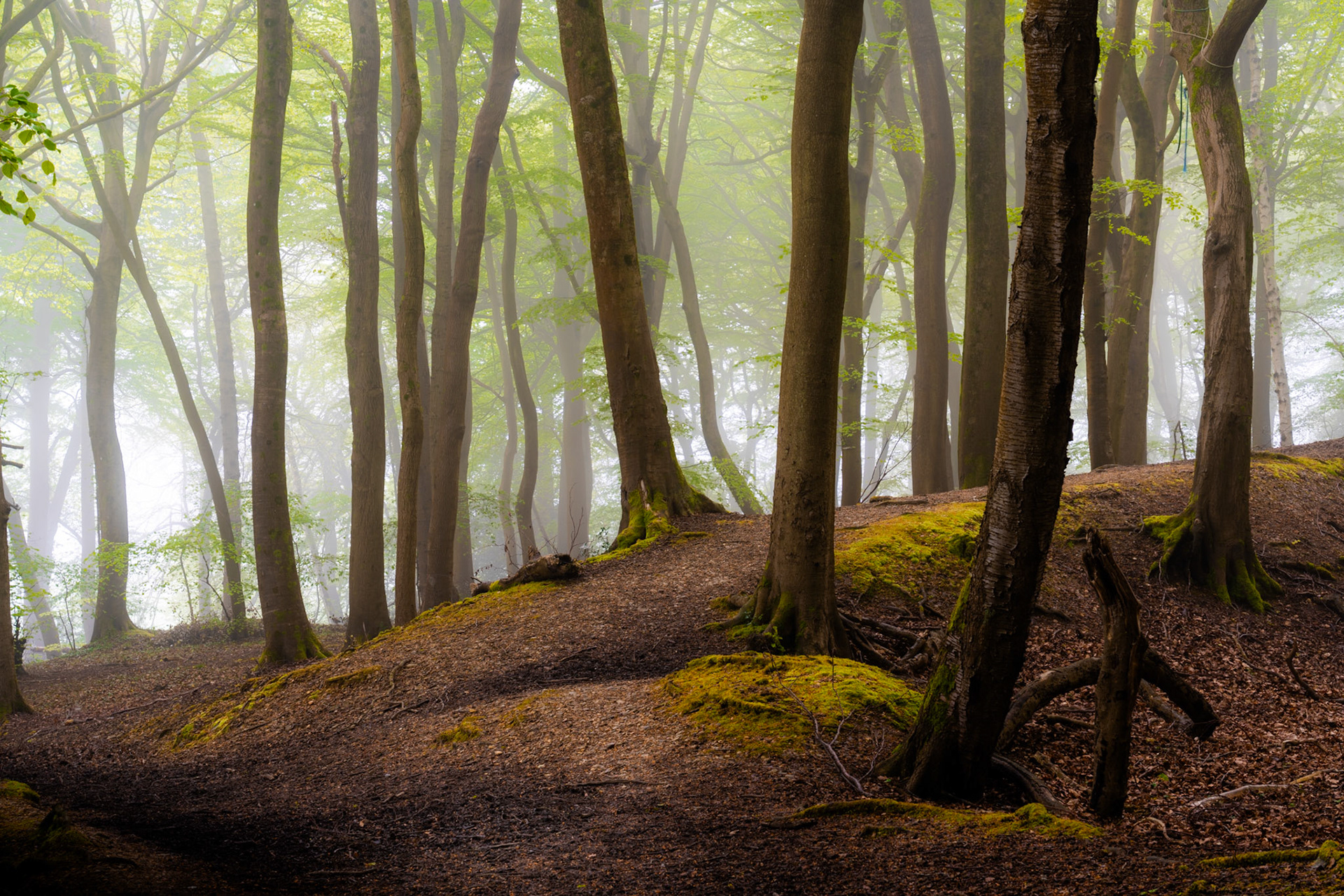
Mature beech woodland in the Chilterns, Oxfordshire, on a misty spring morning, the canopy just breaking into fresh leaf. Fog compresses the middle distance into pale layers of grey-green, while moss-covered root buttresses and exposed root systems anchor the foreground. The sloping floor and lateral spacing of the trunks create an unhurried recession through the stand.
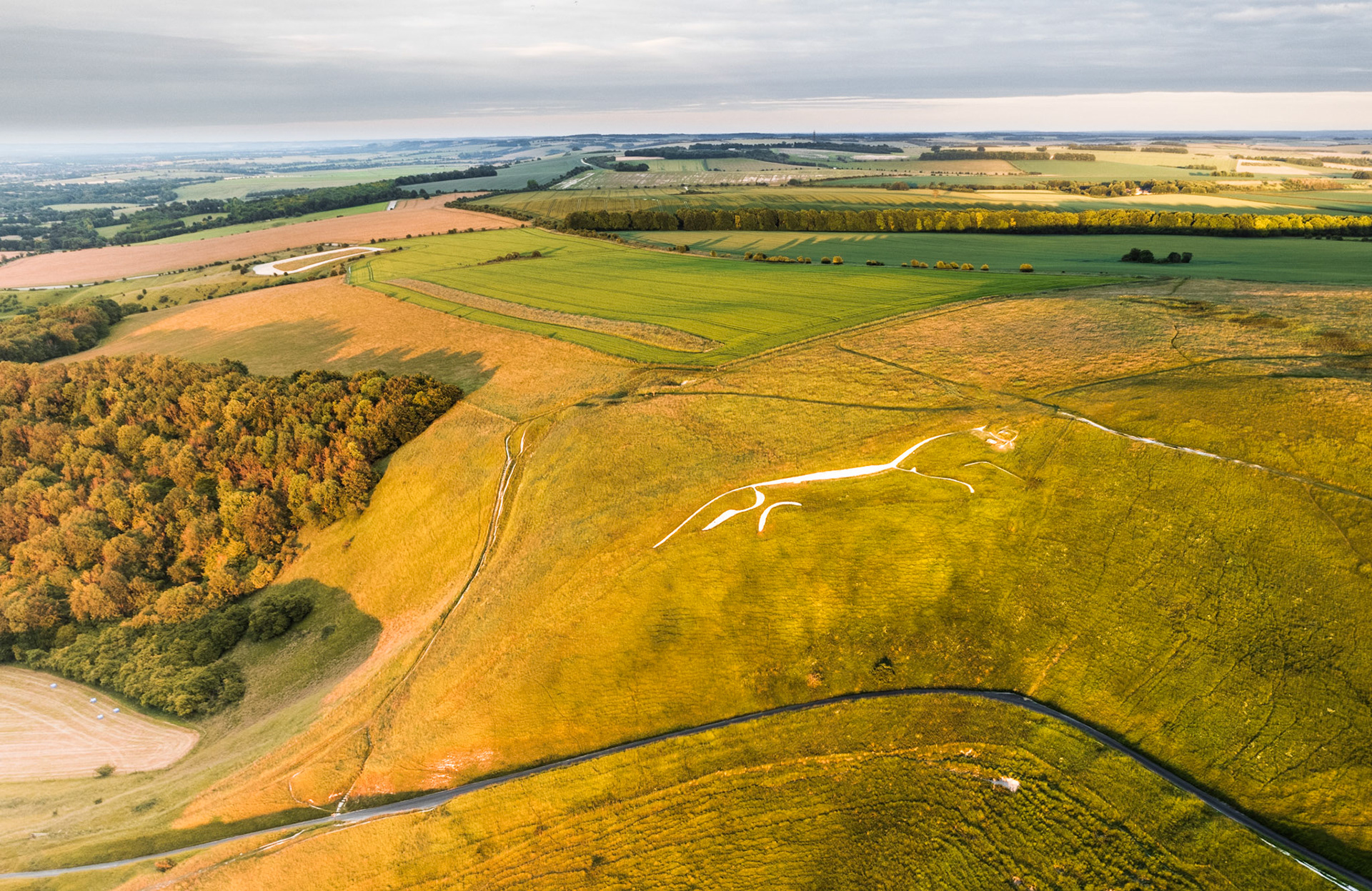
The Uffington White Horse — an Iron Age chalk figure on the Berkshire Downs — seen from altitude in raking evening light that sharpens the carved outline against the hillside. Autumn-toned woodland flanks the scarp to the left, while the patchwork Vale of White Horse extends to a soft horizon. The low sun briefly unifies figure and landscape in a single warm register.
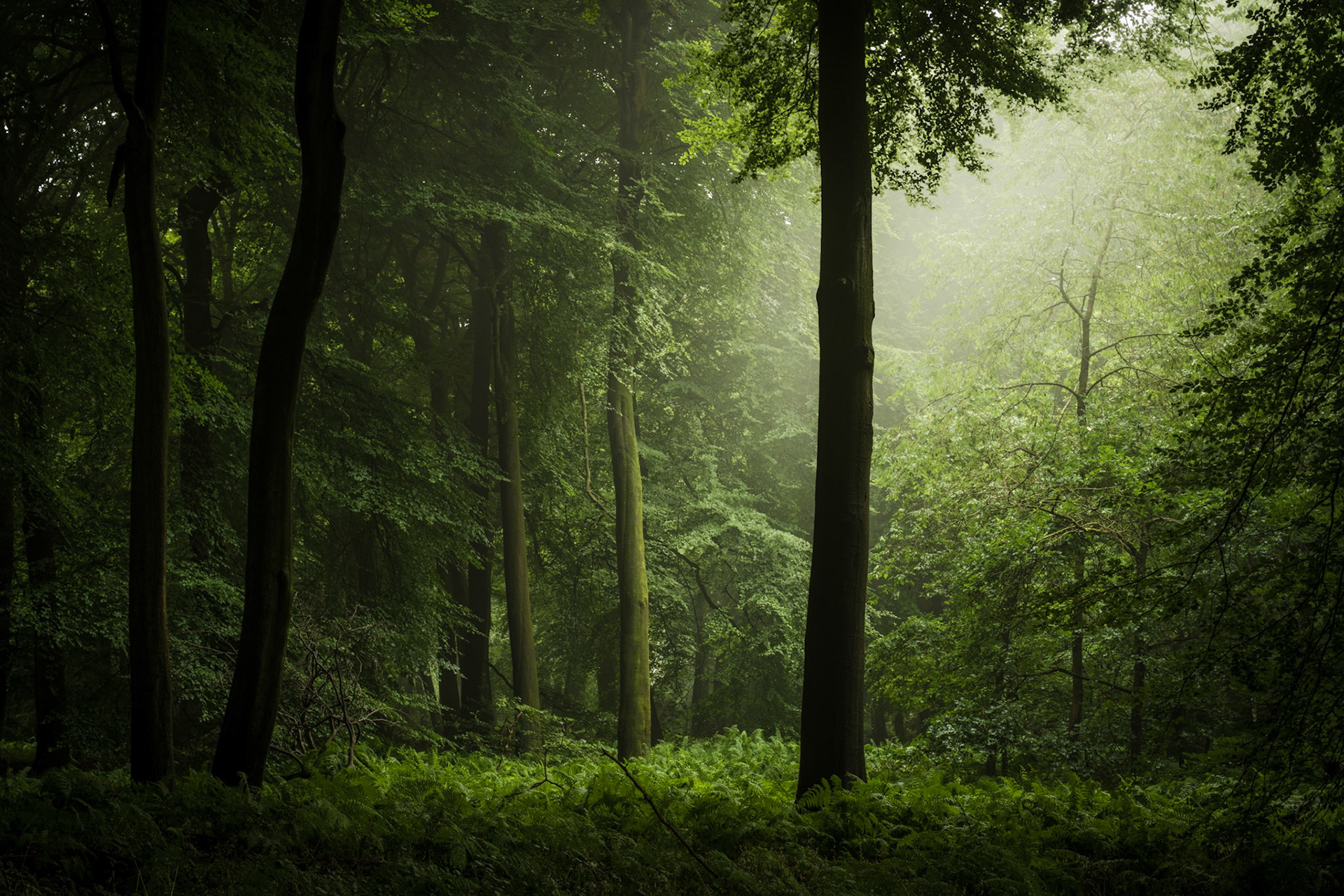
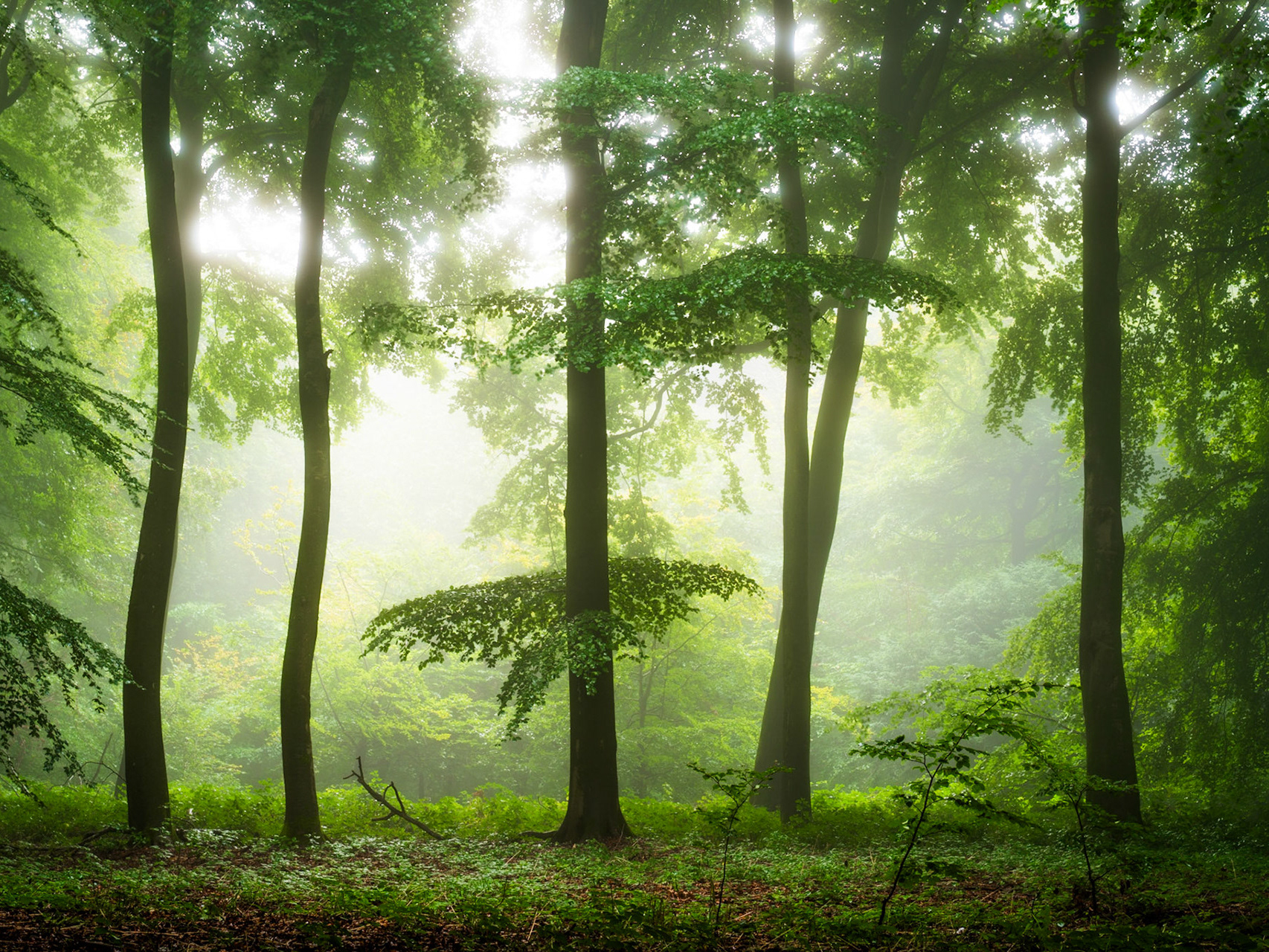
Diffuse morning mist lifts through a mature broadleaf woodland in the Chilterns, Oxfordshire, backlighting a canopy of summer beech and oak and reducing the mid-ground to soft planes of green. Ferns carpet the floor between straight-trunked beeches, anchoring the composition while the illuminated fog dissolves detail towards the upper frame. The restrained palette and quiet tonal separation give the image a contemplative stillness unusual for high summer.
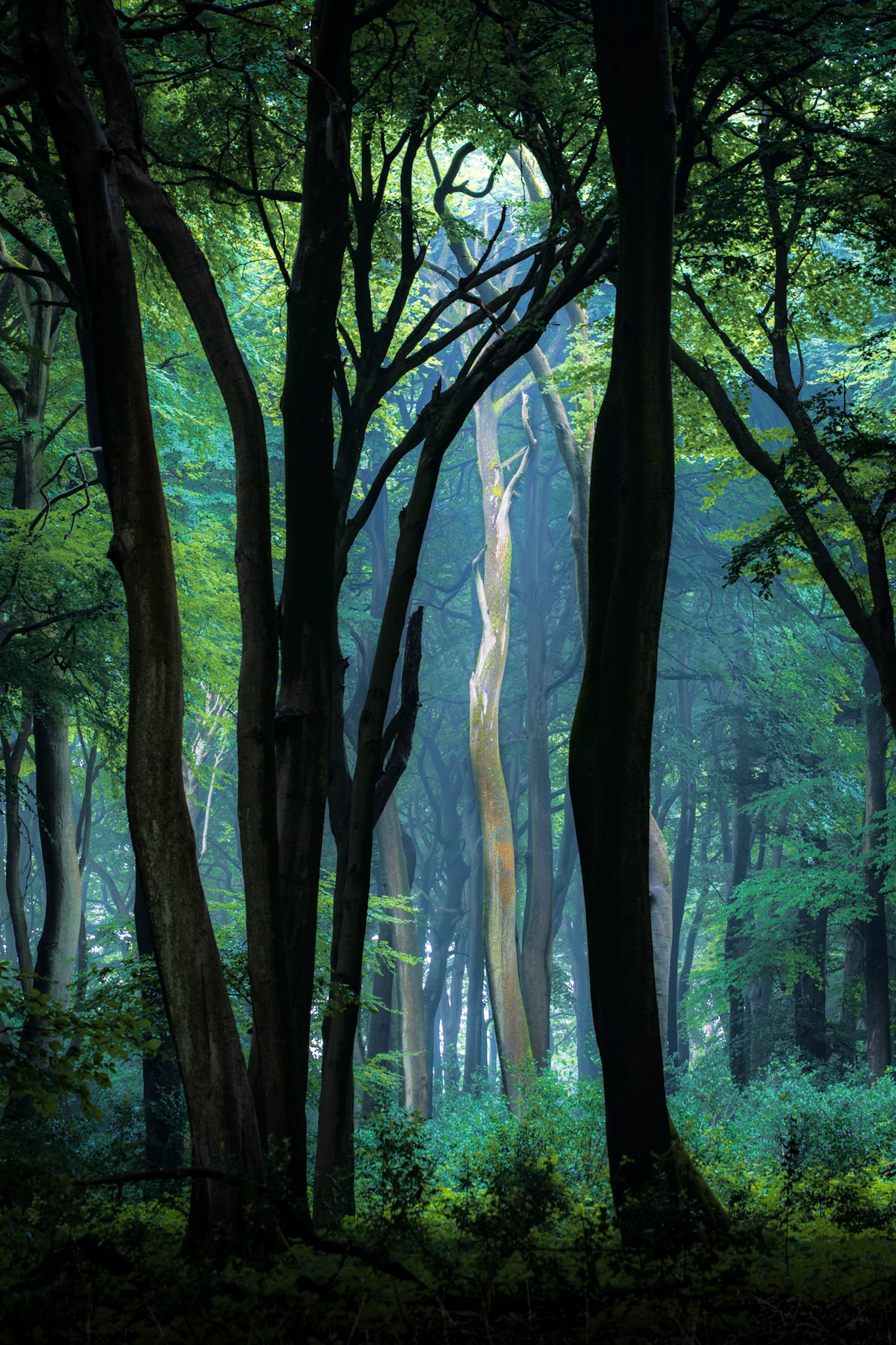
From the dark into the light, woodland, England, UK
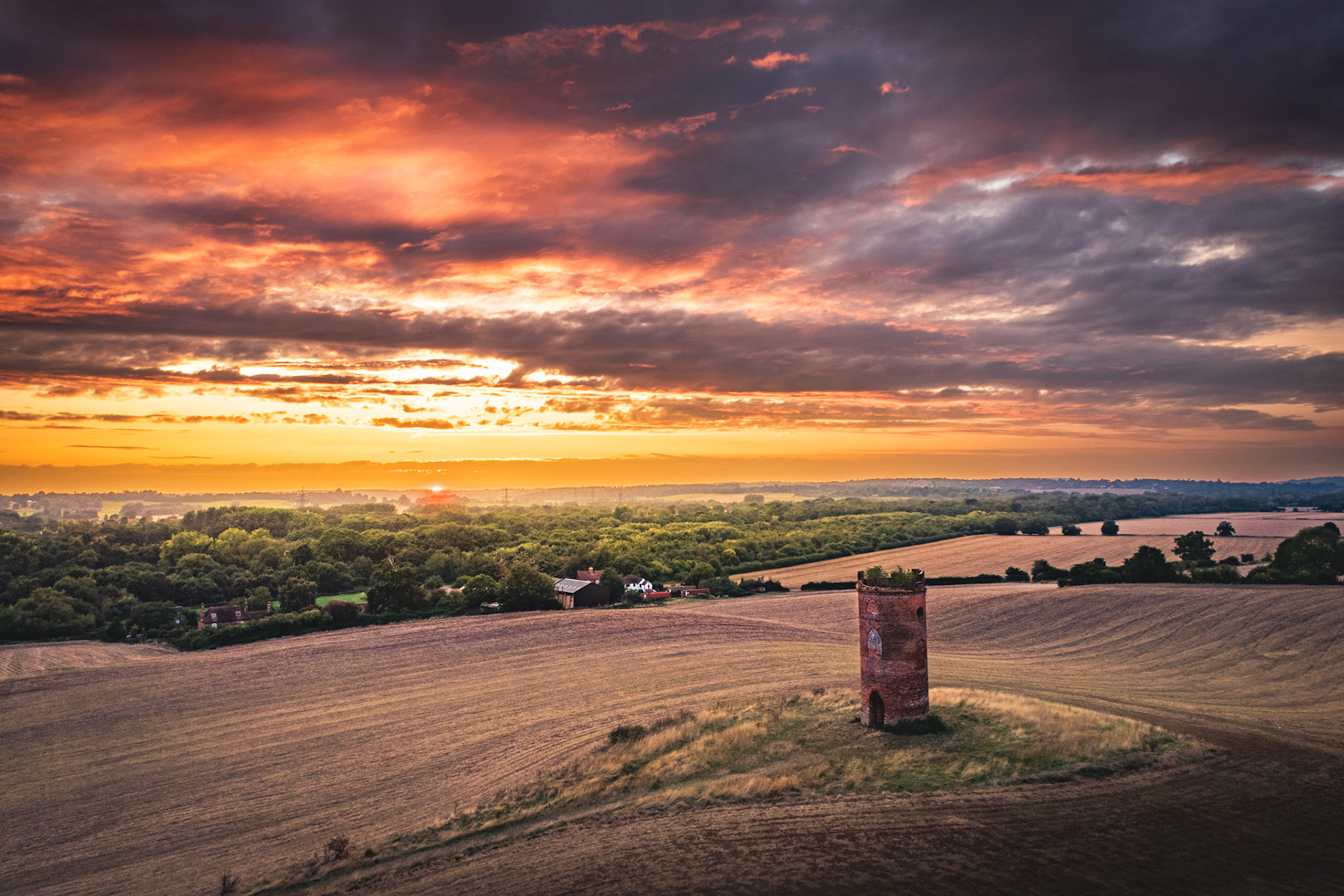
A ruined brick tower stands alone on a harvested hillside above the Thames Valley, south of Reading, as the sun drops below a distant tree line. Heavy cumulus catches the last orange light while mist gathers in the valley floor below. The composition uses the folly as a solitary anchor against a wide, dramatic sky.
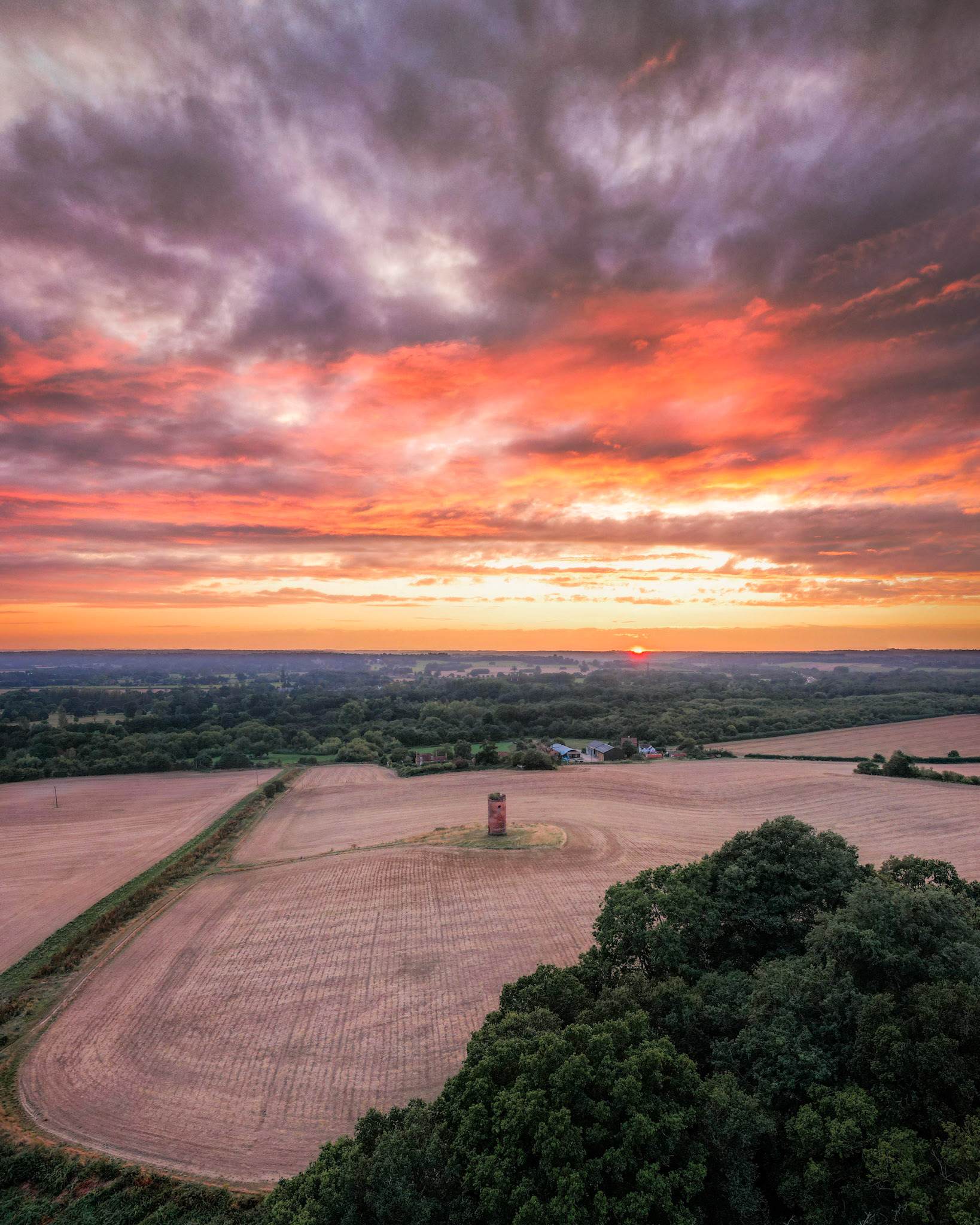
An isolated brick tower stands within a harvested arable field south of Reading, shot from altitude at the moment of sunset. Dramatic altocumulus cloud catches the last orange and violet light above a softly layered horizon of mixed farmland and woodland. The lone structure anchors an otherwise open composition, lending scale to the wide agricultural plain beneath.
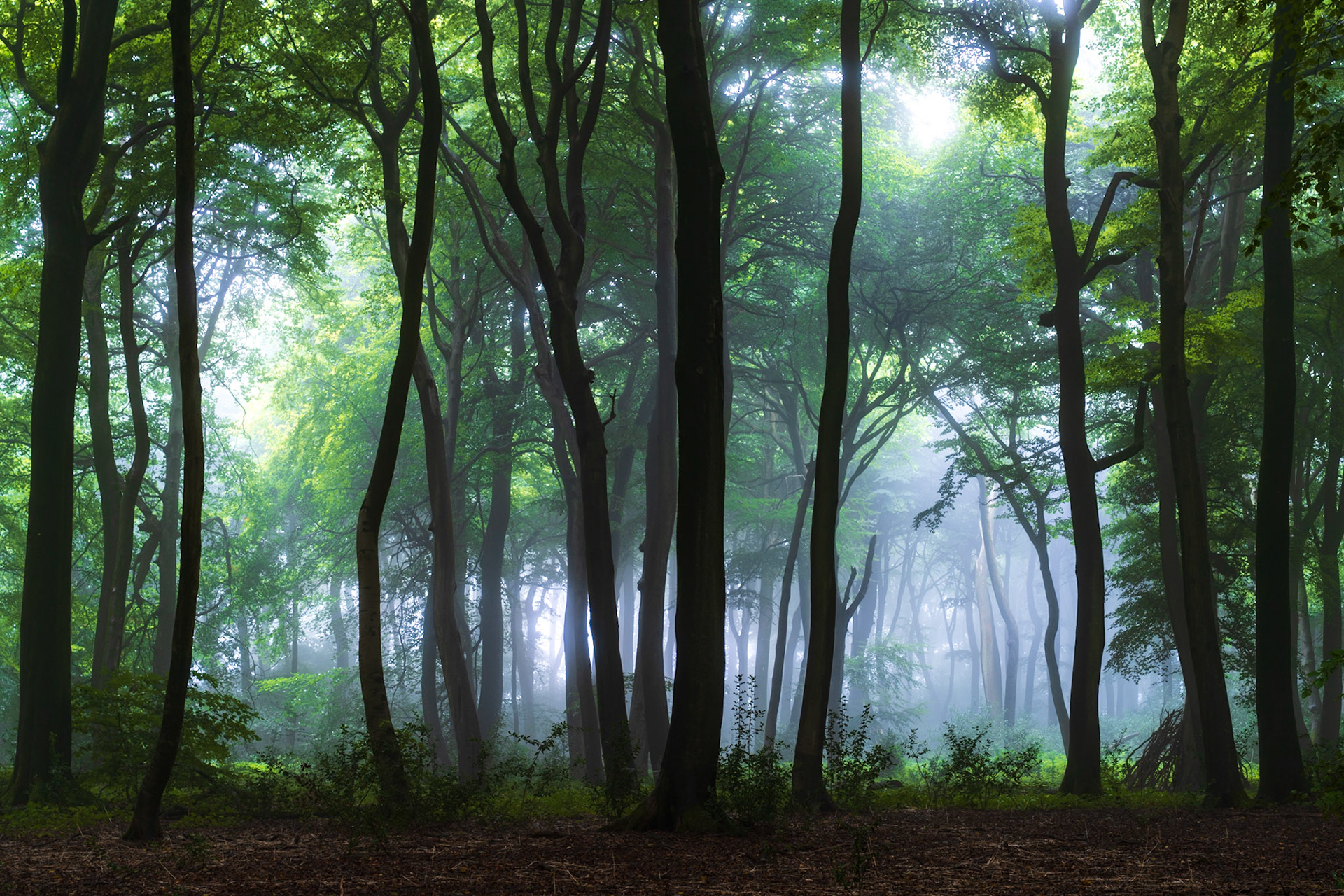
Ground mist lingers between tall beech trunks in the Chilterns, Oxfordshire, at early dawn, the sun breaking through the canopy to backlight the fog and separate successive layers of woodland into receding planes of blue-grey. The forest floor remains in deep shadow, drawing the eye into the luminous middle distance where the atmosphere thickens.

Late Summer / Early Autumn Fog, lush greens, beautiful beech trees with tons of character, Chilterns, UK
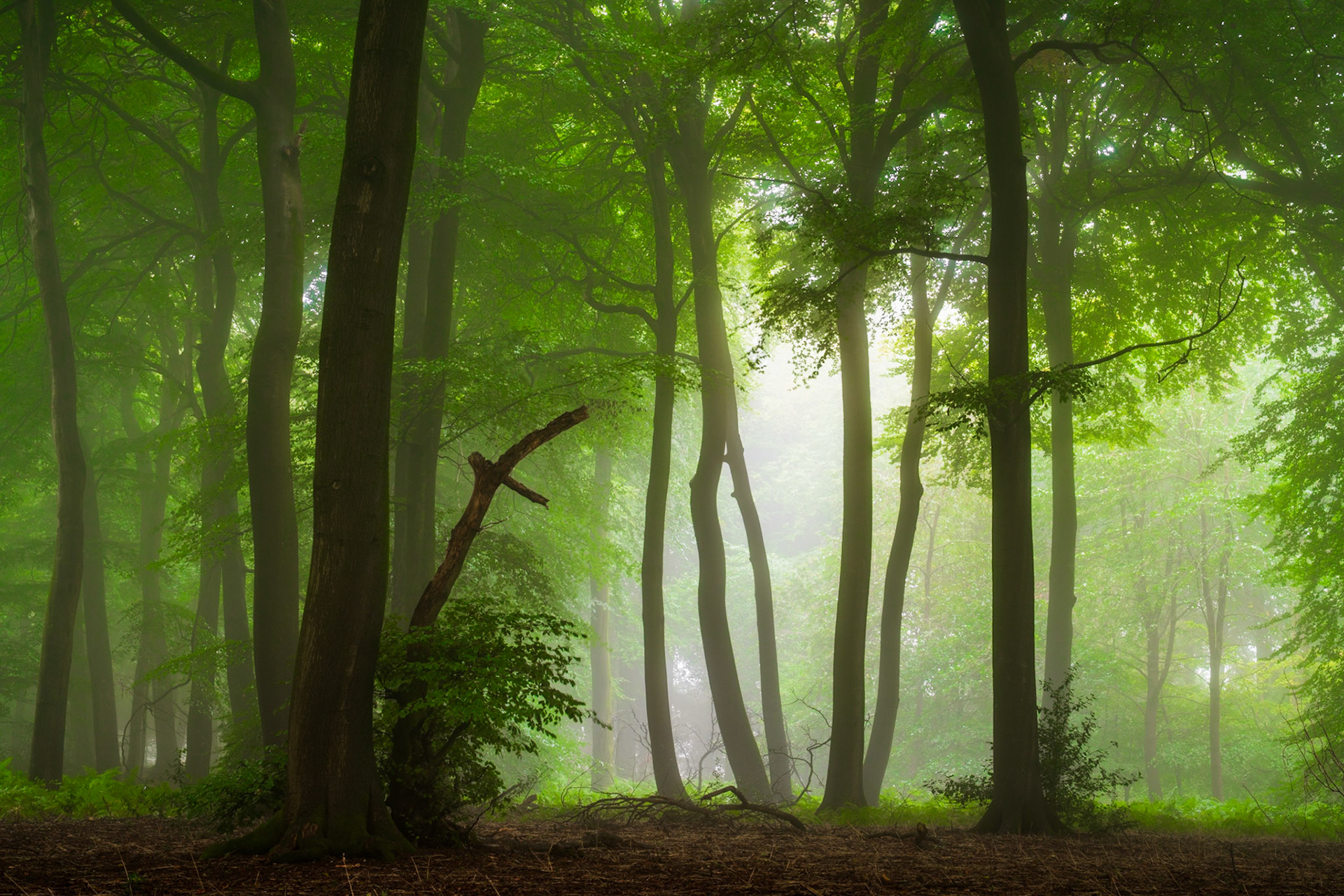
Late Summer / Early Autumn Fog, lush greens, beautiful beech trees with tons of character, Chilterns, UK
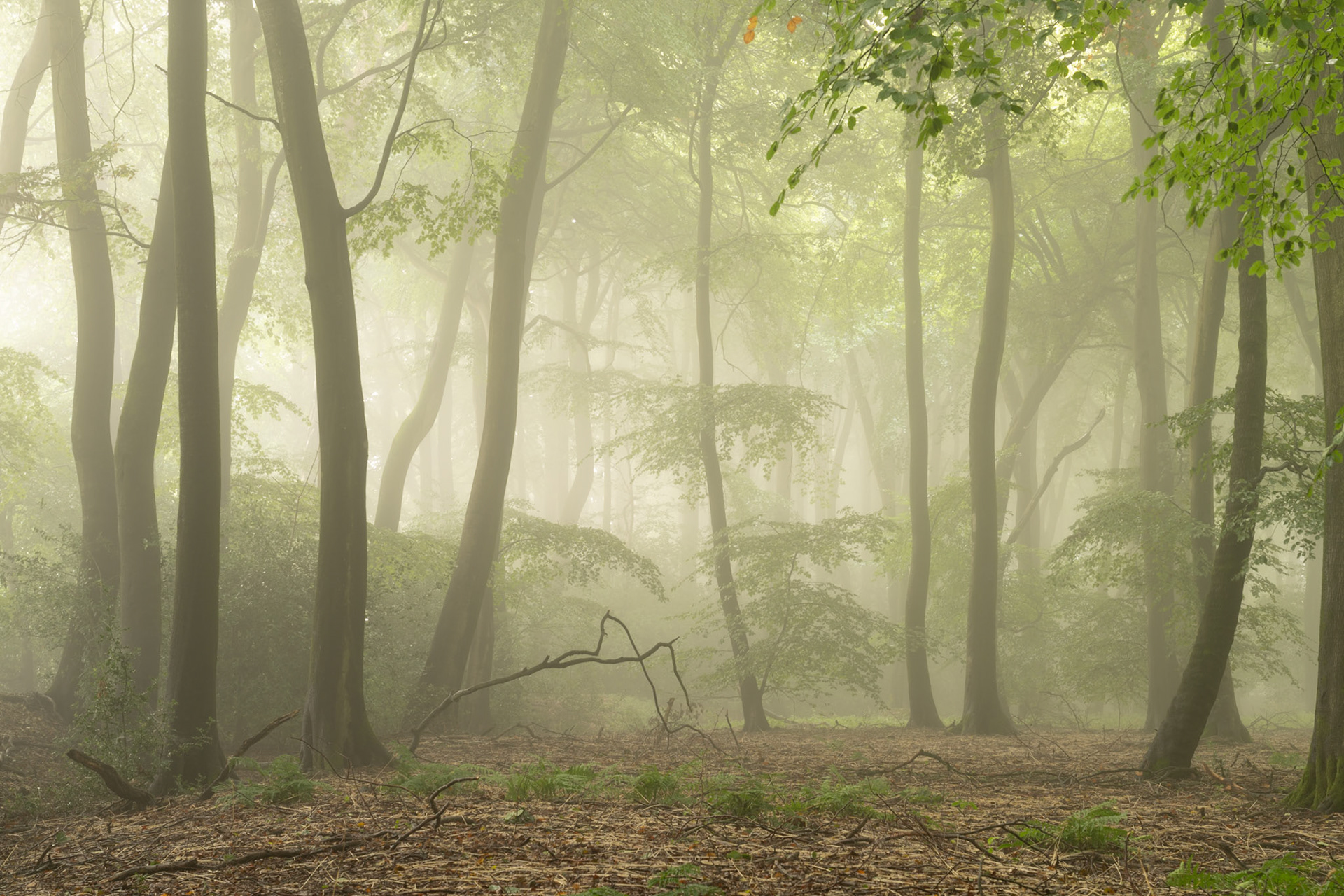
Dense early-morning fog filters through a stand of beech in the Chilterns, Oxfordshire, softening the vertical rhythm of the trunks into successive planes of grey-green. A fallen limb occupies the mid-ground, its angular form echoing the lean of the living trees above. The forest floor of dry leaf litter and scattered fern suggests late summer at the cusp of turn.
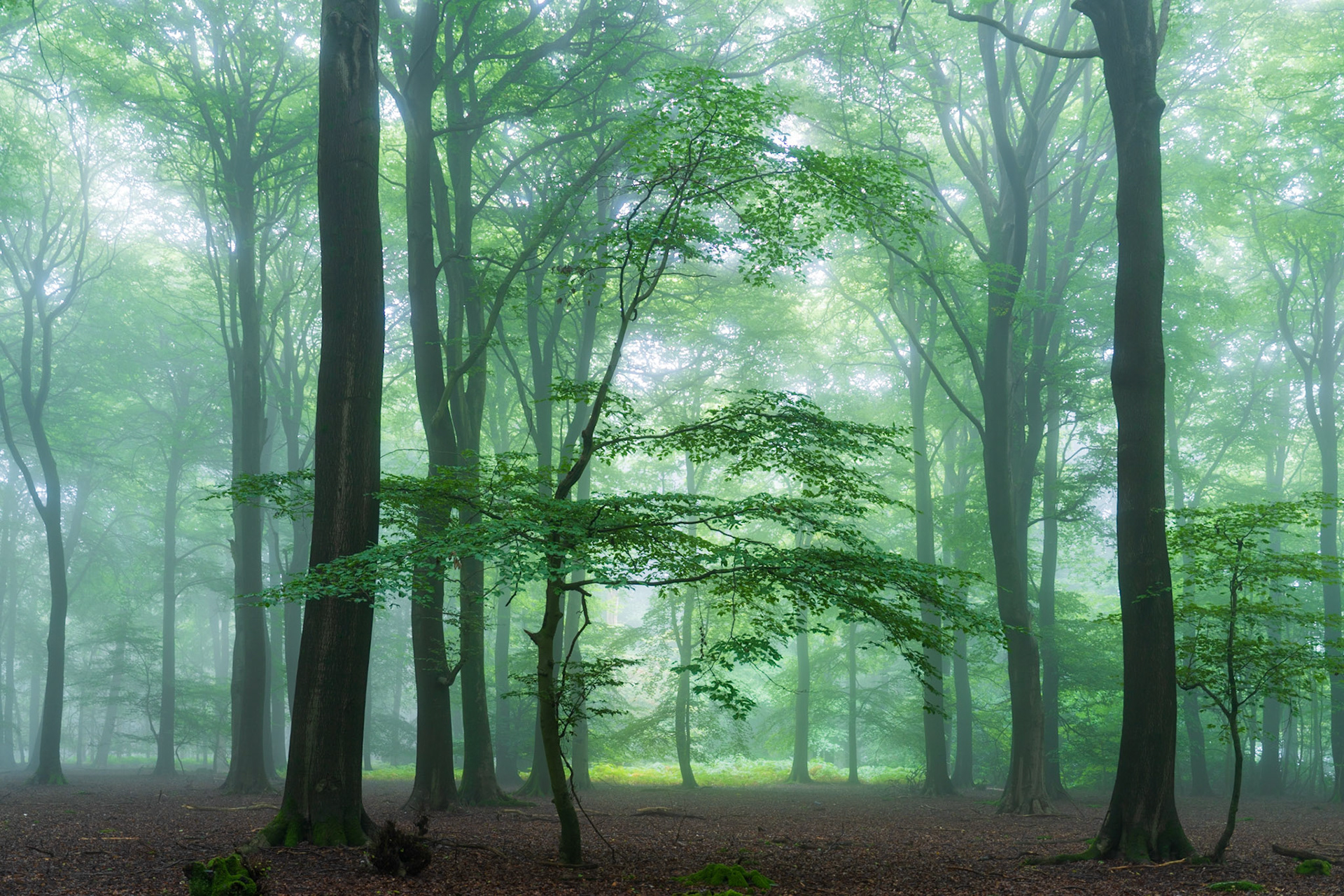
Dense mist settles between mature beech trunks in the Chilterns, Oxfordshire, diffusing the early-morning light to a soft, even green. A young beech sapling in the middle distance draws the eye through successive planes of receding trees, each rank progressively dissolved by fog. The dark leaf-litter floor anchors the composition against the luminous canopy above.

An incredible display of mushrooms and fungi on this fallen beech stump. Captured in The Chilterns, near Henley, Oxfordshire, England.
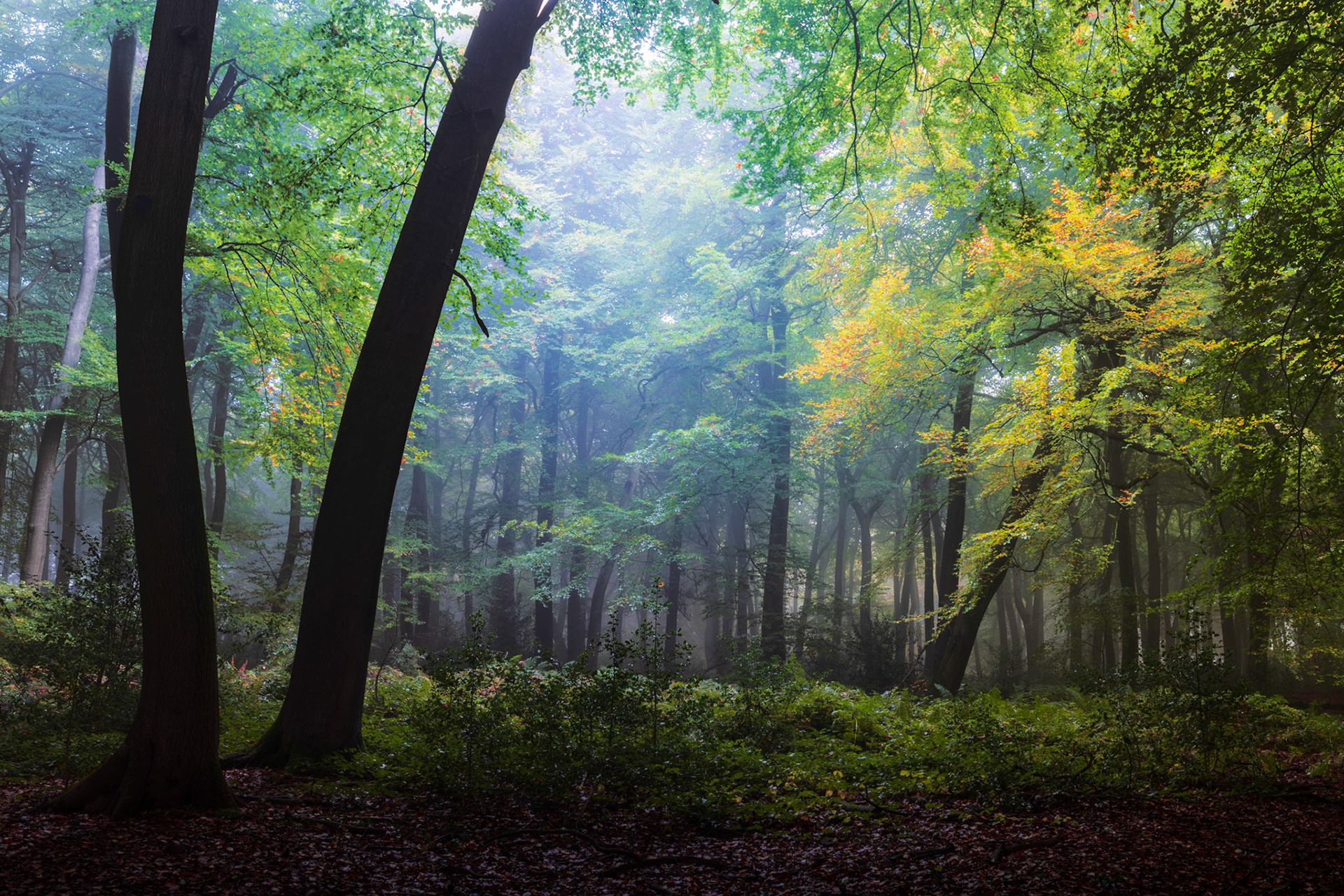
Early autumn mist settles between mature beech trees in the Chilterns, Oxfordshire, at the transitional moment when foliage shifts from green to amber. Diffused light filters through the canopy, separating successive planes of trunk and understorey and lending the interior a quiet luminosity. The leaf litter floor and low shrub layer ground the image in the particular stillness of an October morning.
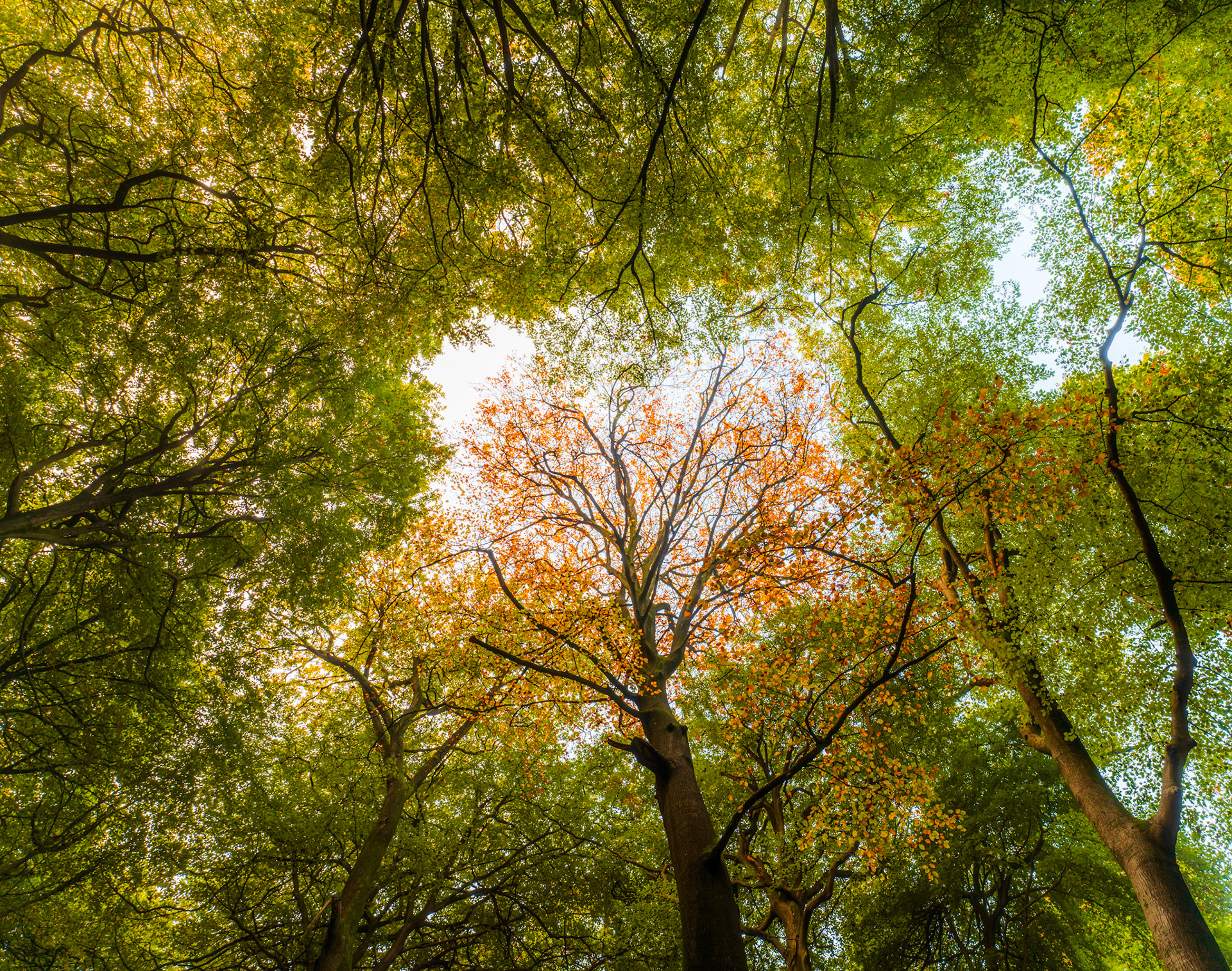
A worm's-eye view into a deciduous woodland canopy in the Chilterns, Oxfordshire, taken at the cusp of seasonal change, one central tree already deep in autumn russet while surrounding beeches retain their summer green. The overcast sky diffuses light evenly through the gap, isolating the copper crown against pale white. The composition rewards the transitional moment rather than full autumn colour.
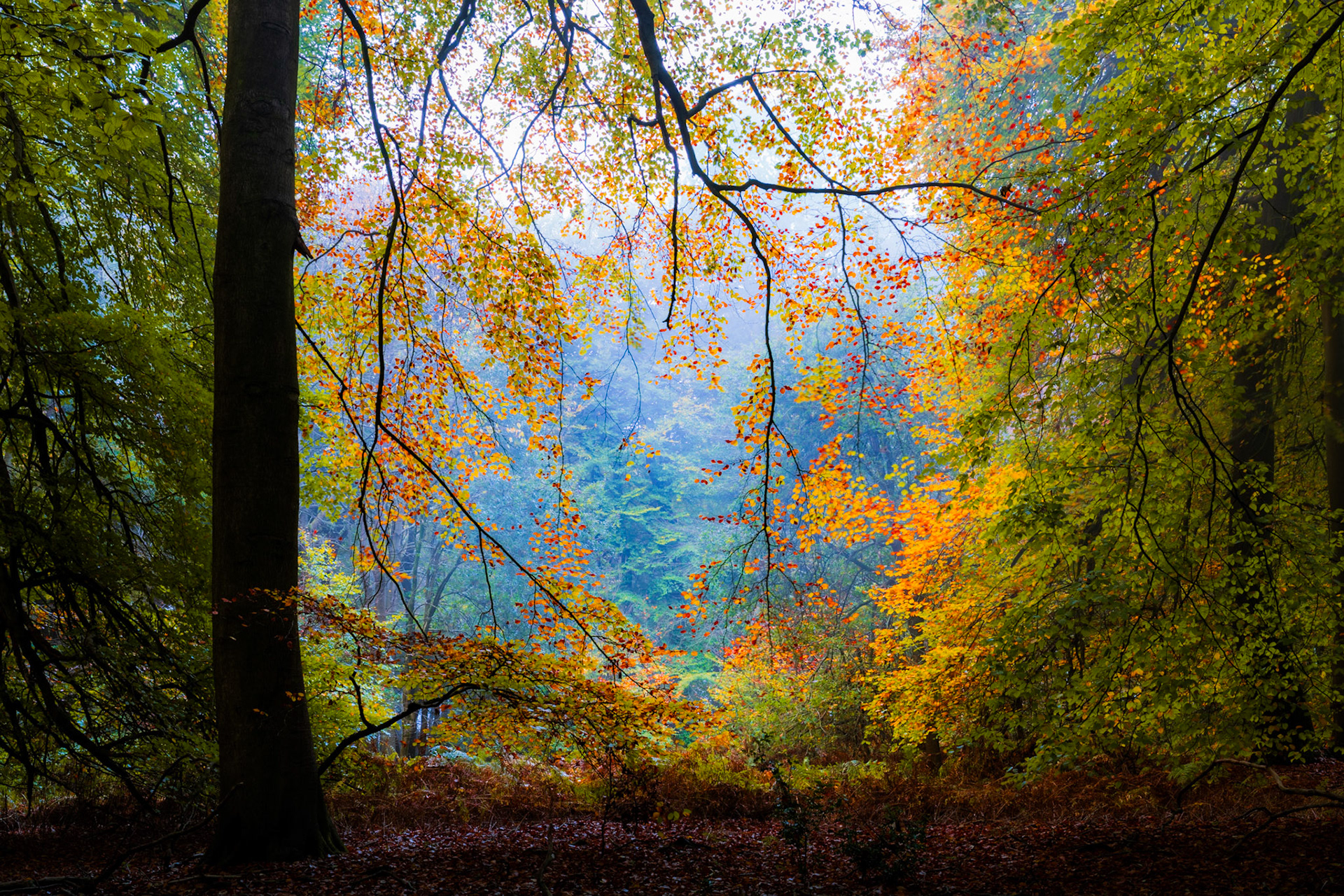
Beech leaves are the beautiful autumn palette of colour.
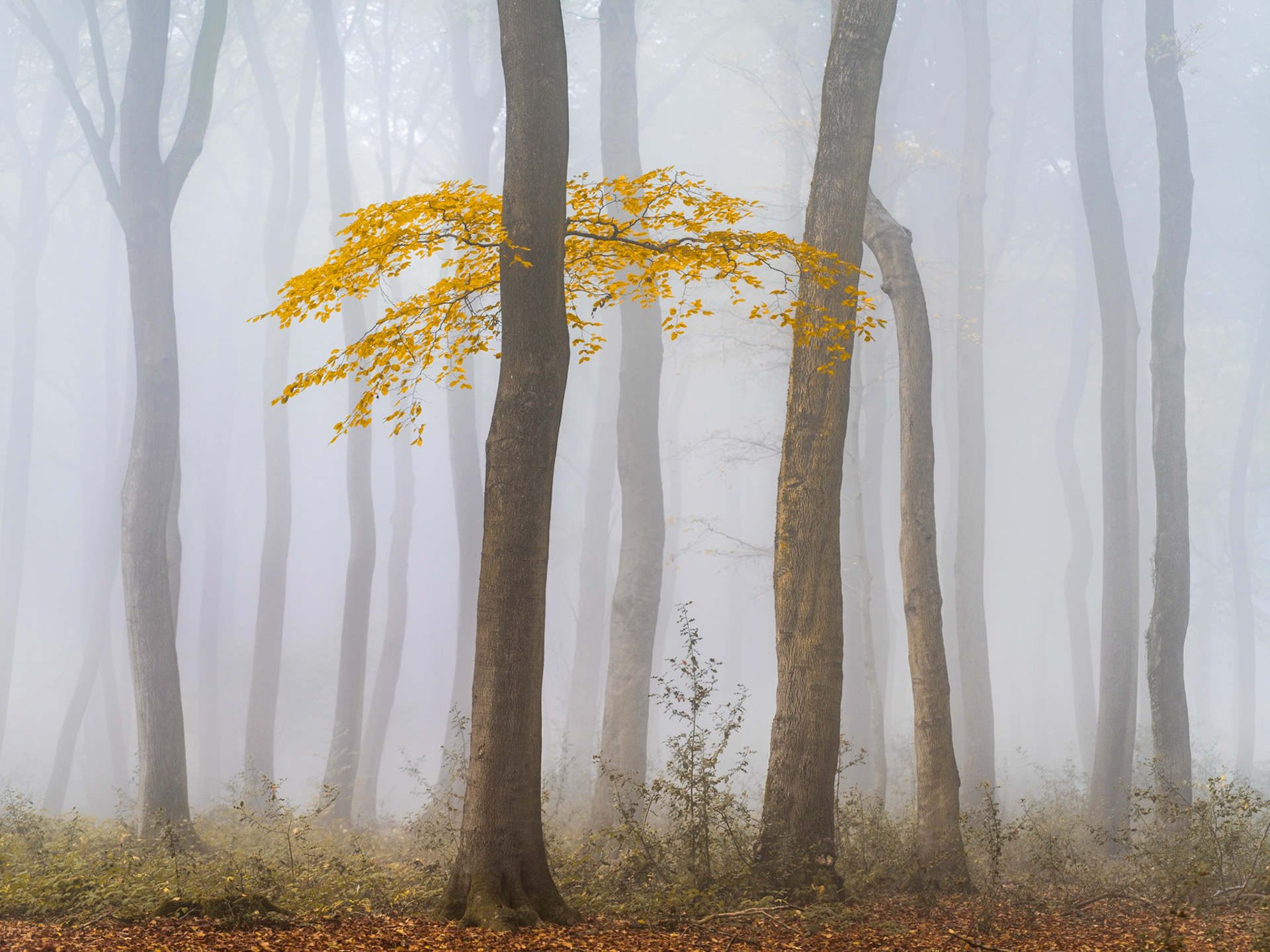
The lower branches of this Beech tree stand alone against it's neighbouring trunks. Golden leaves stand out against the fog, creating a brilliant focal point.
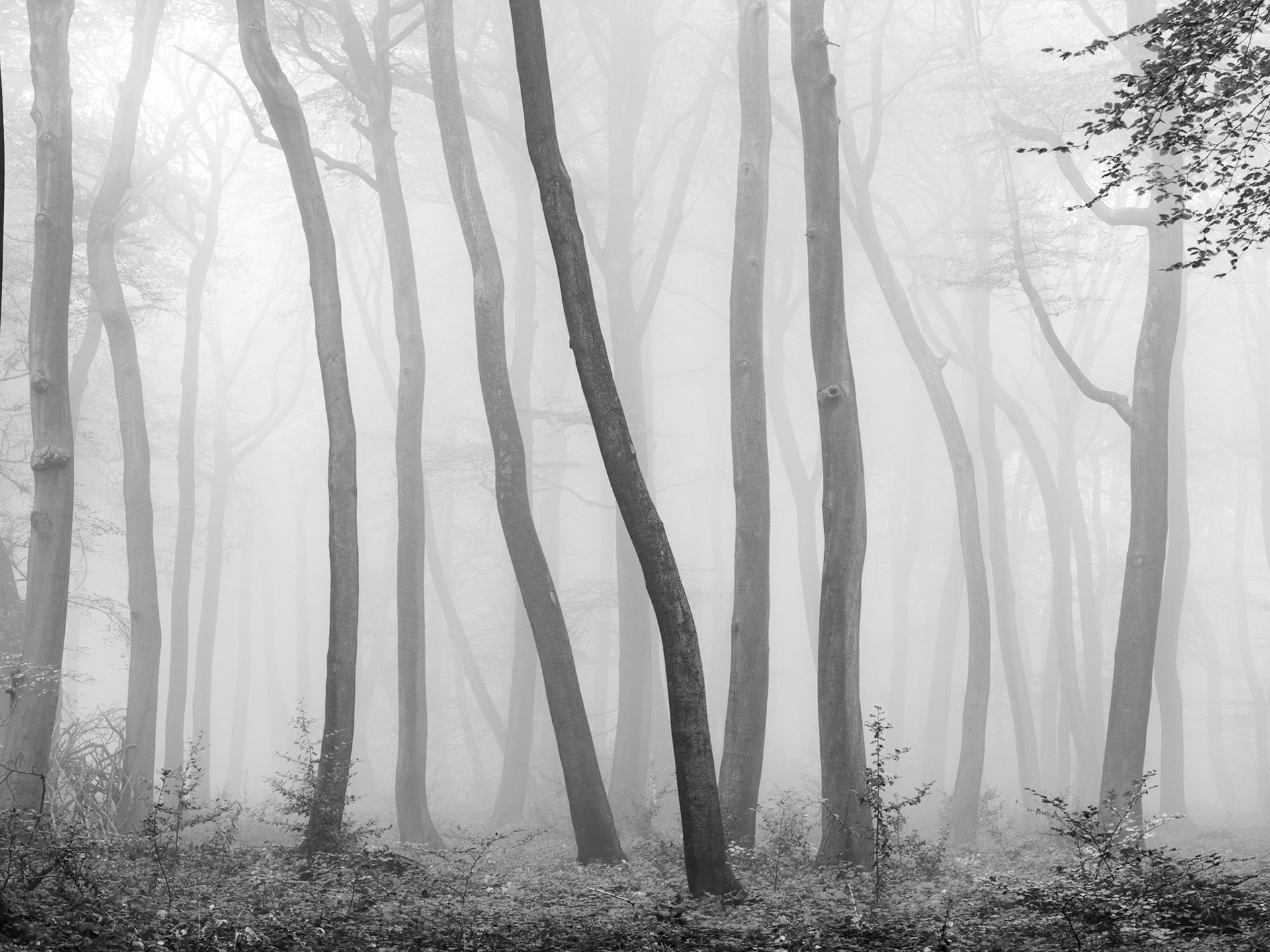
Dense autumn fog reduces a stand of beech woodland in the Chilterns, Oxfordshire, to a sequence of slender, curving trunks receding into white. The near-total suppression of tonal range creates a graphic flatness that is broken only by the textured bark of the two foreground trees and scattered leaf litter on the woodland floor. Converted to monochrome, the image strips the scene to its structural essentials.

Dense autumn fog reduces a stand of beech woodland in the Chilterns, Oxfordshire, to receding layers of grey-blue, the slender trunks holding their form while remaining foliage—yellow and amber—offers the only warmth. The compression of the intimate focal length flattens the depth into something closer to pattern than place, yet the slight lean and curve of individual trees keeps it rooted in the specific. Captured at dawn on the last day of October.
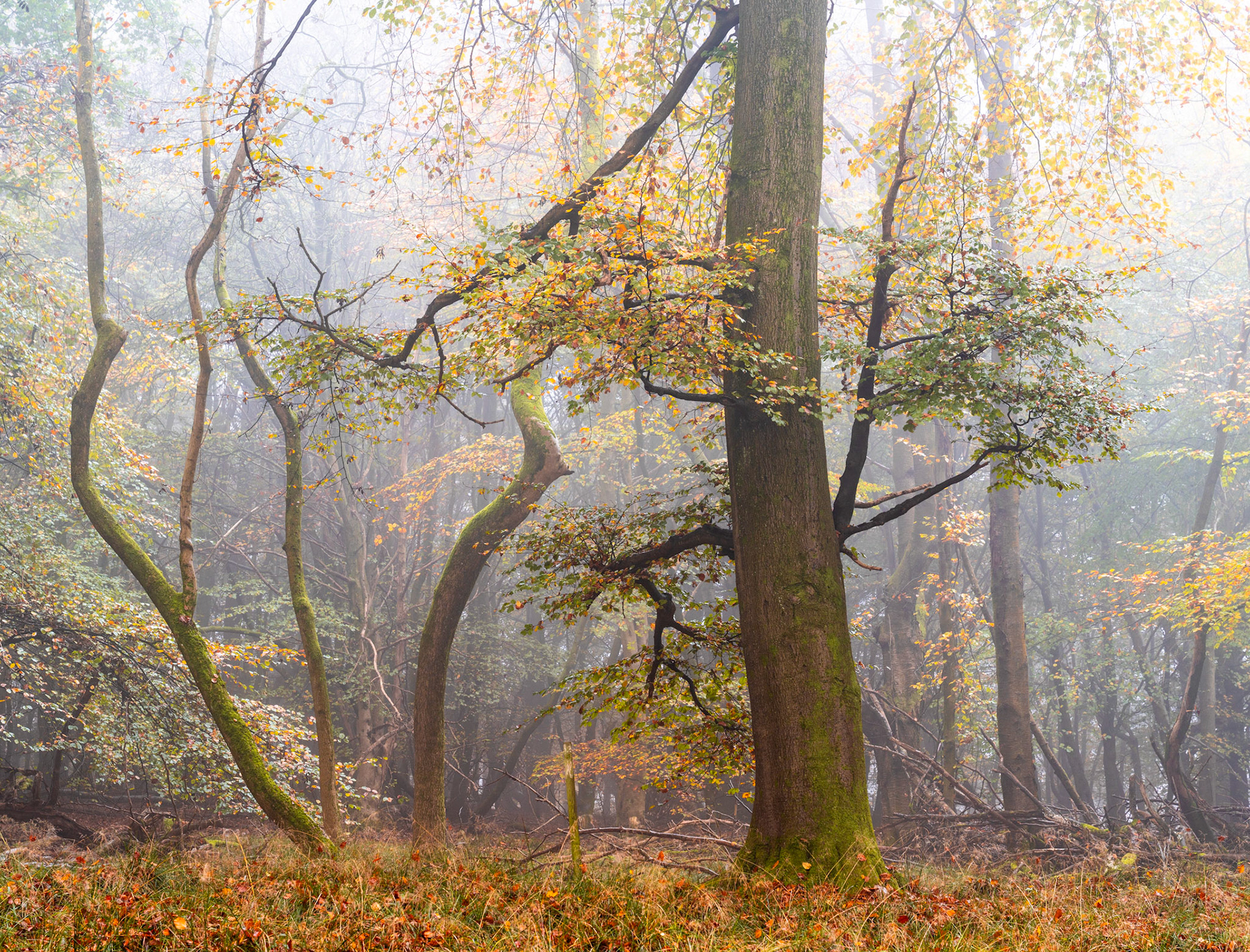
A stand of beech and mixed broadleaves in peak autumn colour on the Chilterns escarpment in Oxfordshire, the canopy thinning to reveal sinuous branch structures diffused by morning mist. The dominant vertical trunk anchors a composition of competing curves and bare limbs, the fog compressing the background into pale layers of receding woodland. Captured at dawn in early November, the scene sits between full leaf and bare winter form.
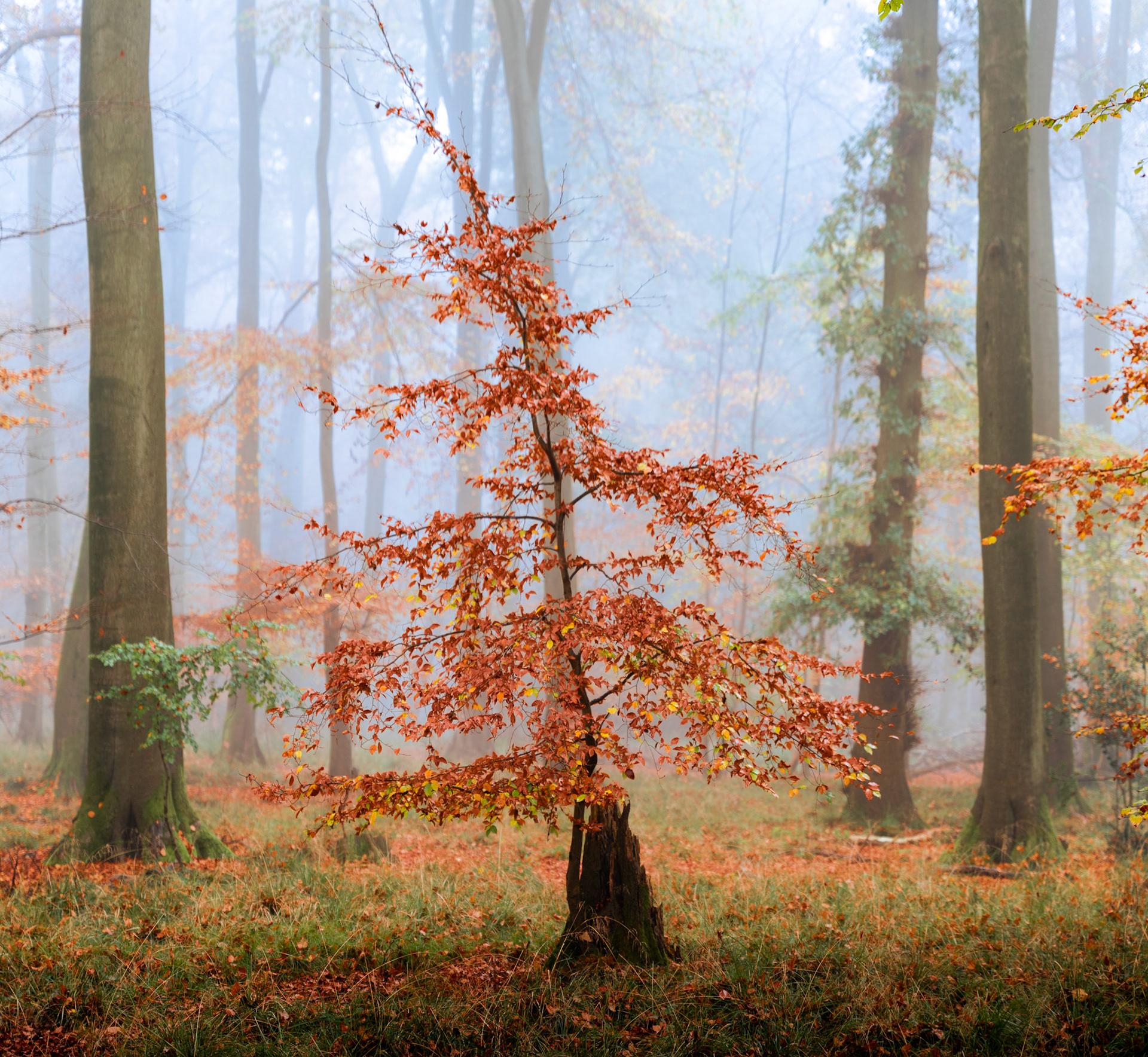
A young beech sapling, sprouting from an old coppice stool in the Chilterns, Oxfordshire, holds its copper foliage against a fog-softened stand of mature beeches. The diffuse November light strips the scene of distraction, leaving the tree's layered, almost pyramidal structure as the sole point of focus. Fallen leaves and rough grass complete the understory frame.
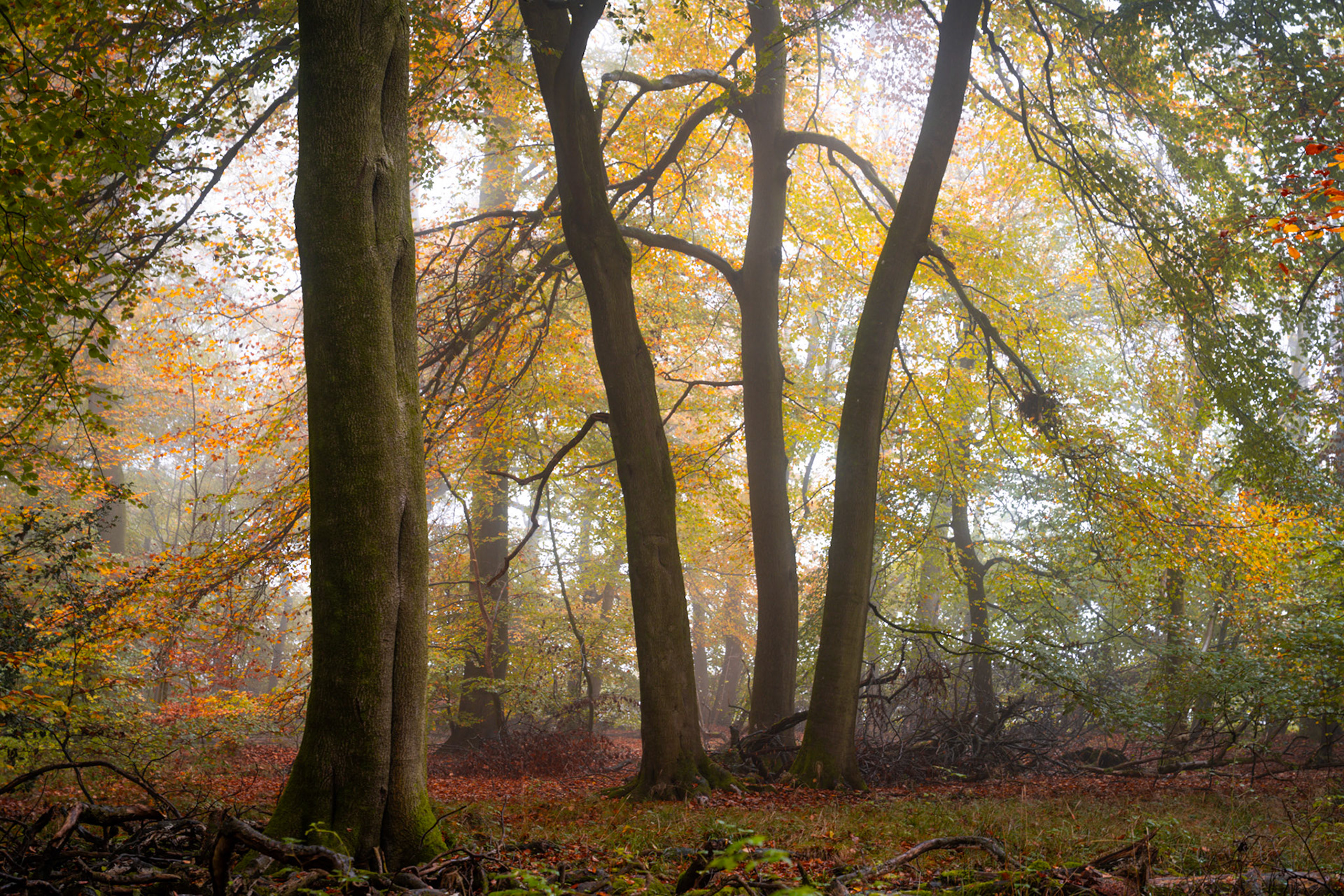
A cluster of mature beech trees stands in soft November mist in the Chilterns, Oxfordshire, their trunks forming a loose colonnade against a diffuse, fog-whitened interior. Fallen leaves carpet the woodland floor alongside tangled deadwood, the canopy still holding remnant amber and ochre foliage at peak leaf-fall. The muted, even light suppresses contrast and lends the scene an interior quiet characteristic of early-morning fog in lowland broadleaved woodland.
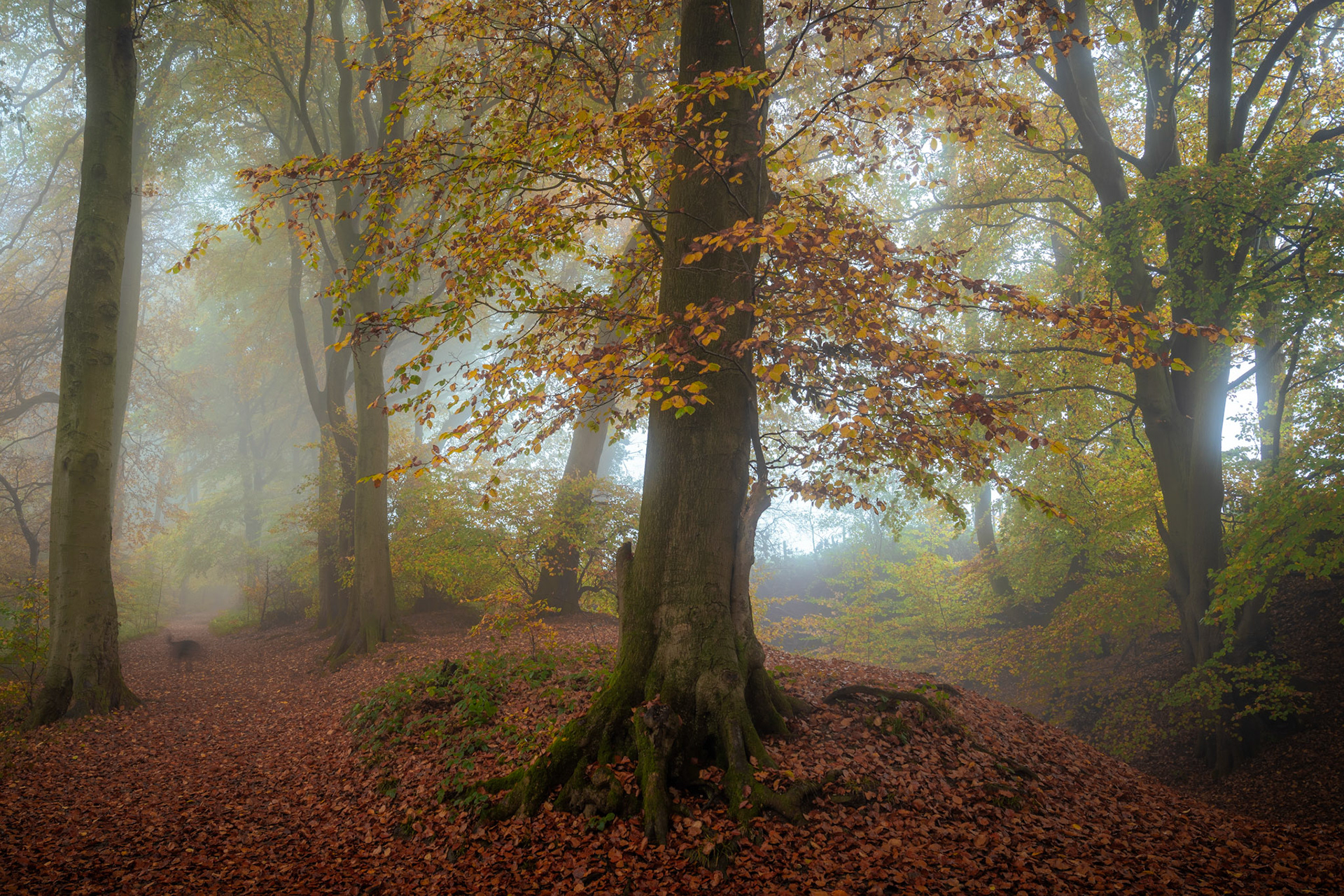
A mature beech stands amid a fog-bound woodland floor in the Chilterns, Oxfordshire, the leaf litter carpeting the ground while mist softens the middle distance to near-white and lends the scene a hushed, suspended quality. The paired trunk structure and exposed buttress roots provide a quiet anchor against the dissolving background. Captured in the early November half-light, the foliage retains enough ochre and amber to confirm the last days of colour before full leaf-fall.
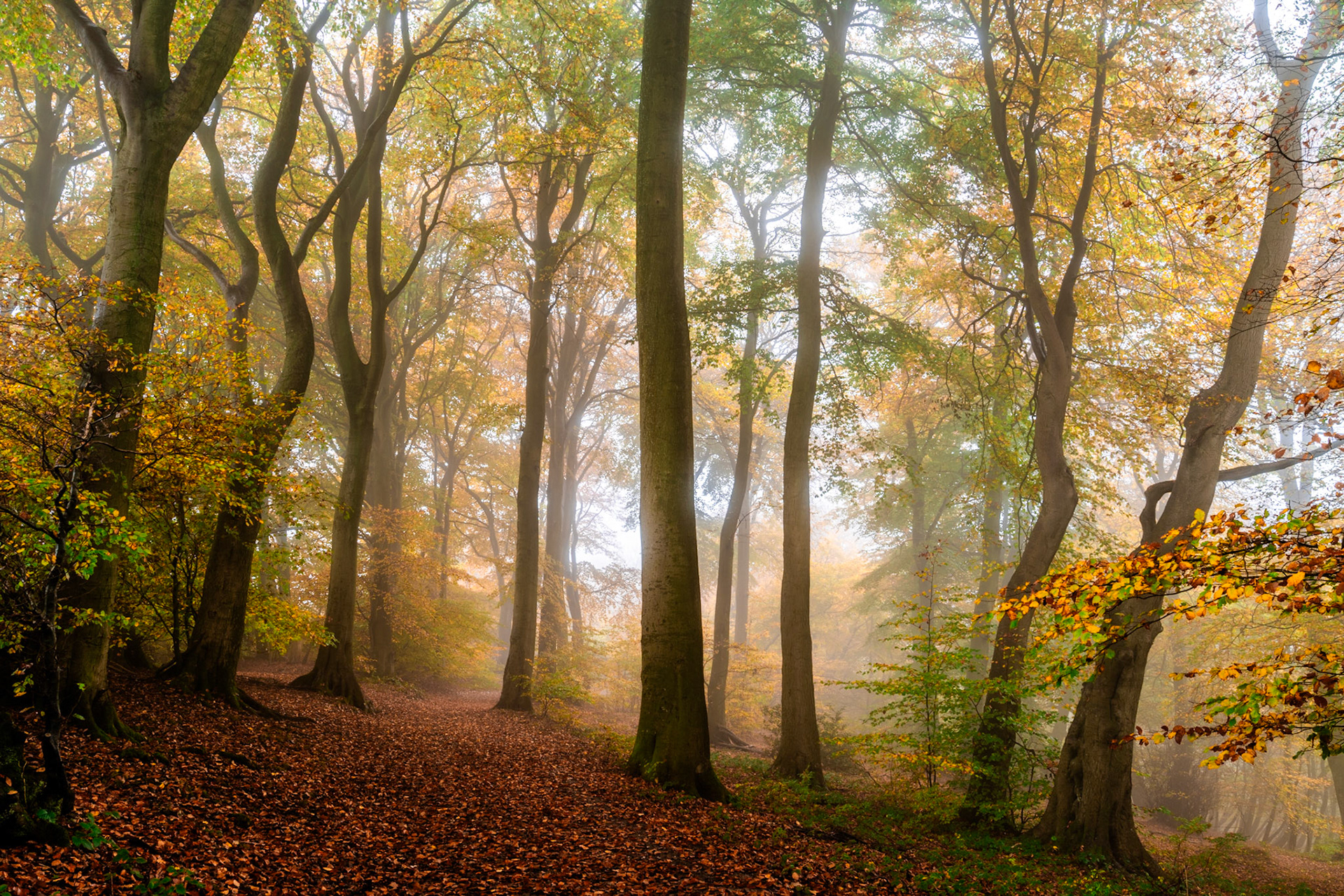
Mature beech woodland in the Chilterns, Oxfordshire, recedes into soft November fog, the leaf-carpeted path curving between grey-smooth trunks into a pale, diffuse middle distance. Retained foliage in amber and olive catches what little directional light the overcast morning allows, creating a layered recession of tone rather than colour. The quiet, unhurried composition suits the subject's stillness precisely.
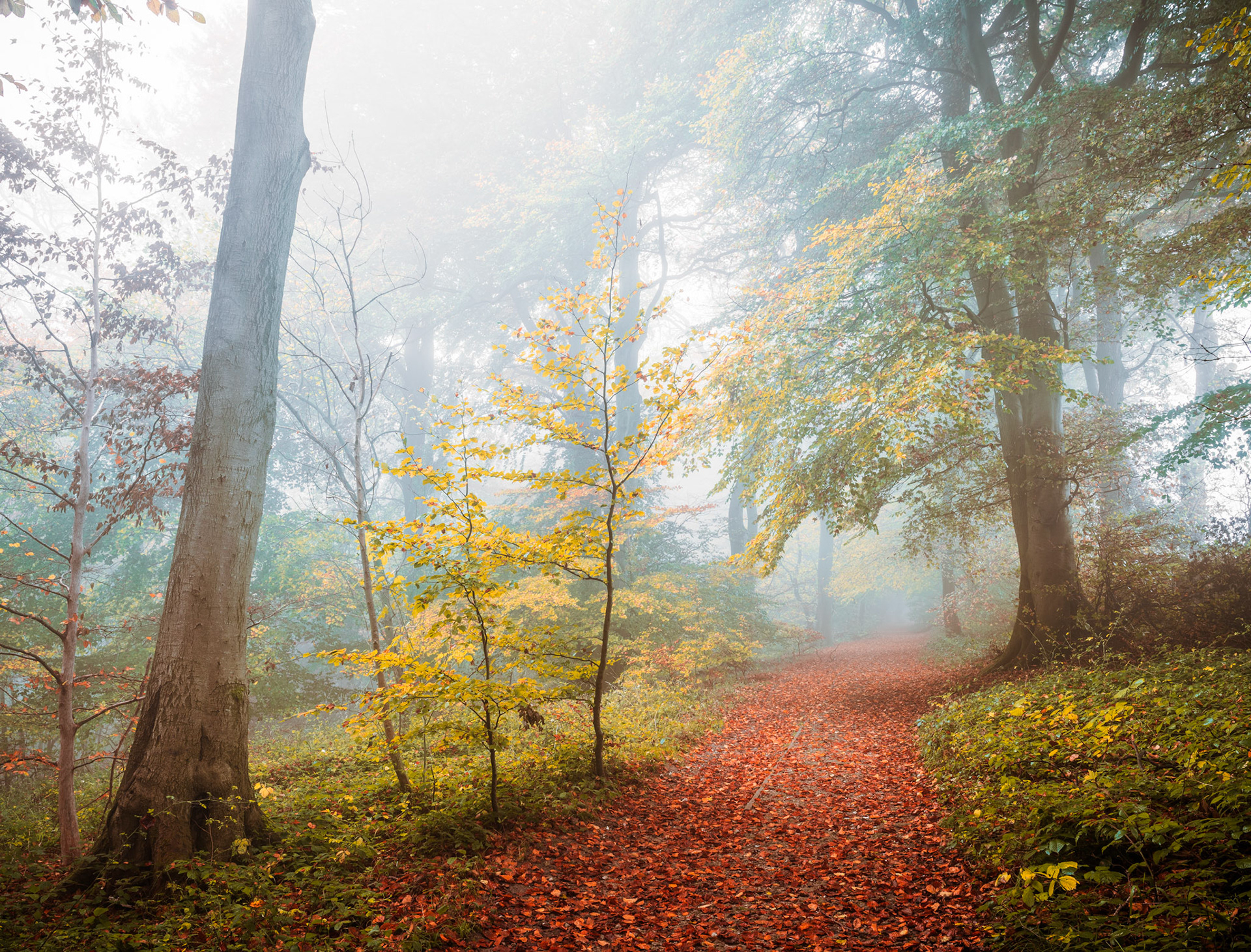
A leaf-carpeted path curves into dense autumn fog among the beech woods of the Chilterns, Oxfordshire, framed by smooth-barked trunks and a young sapling holding the last of its yellow foliage. The diffuse light strips the scene of hard shadows, creating tonal recession that draws the eye deep into the grey-white interior. A quiet, precisely observed moment at the threshold of late autumn.
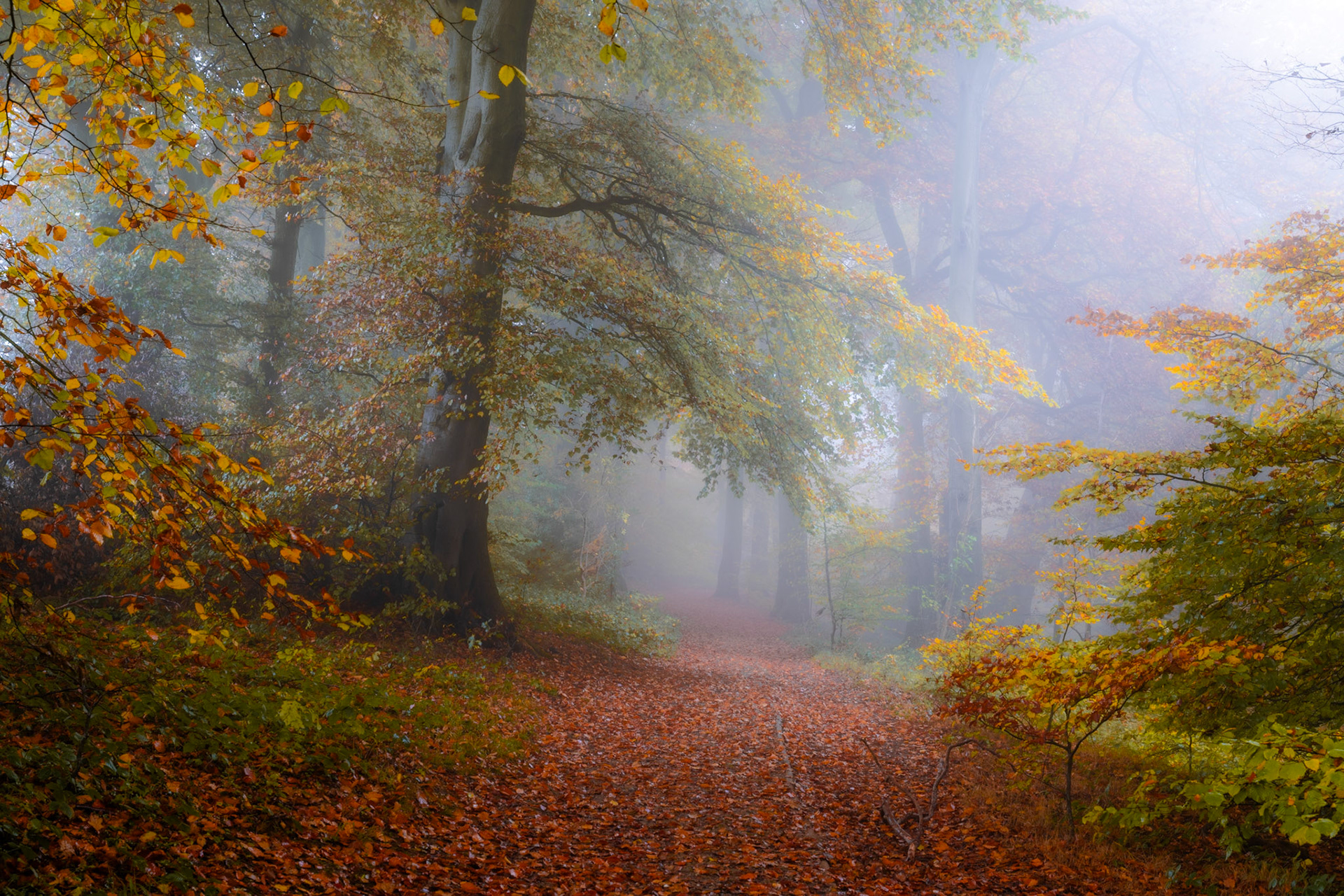
The autumn colours are spectacular in this capture from Aston Rowant woodland in the Chiltern Hills. Fog shrouds the trees giving a painterly effect to this capture.
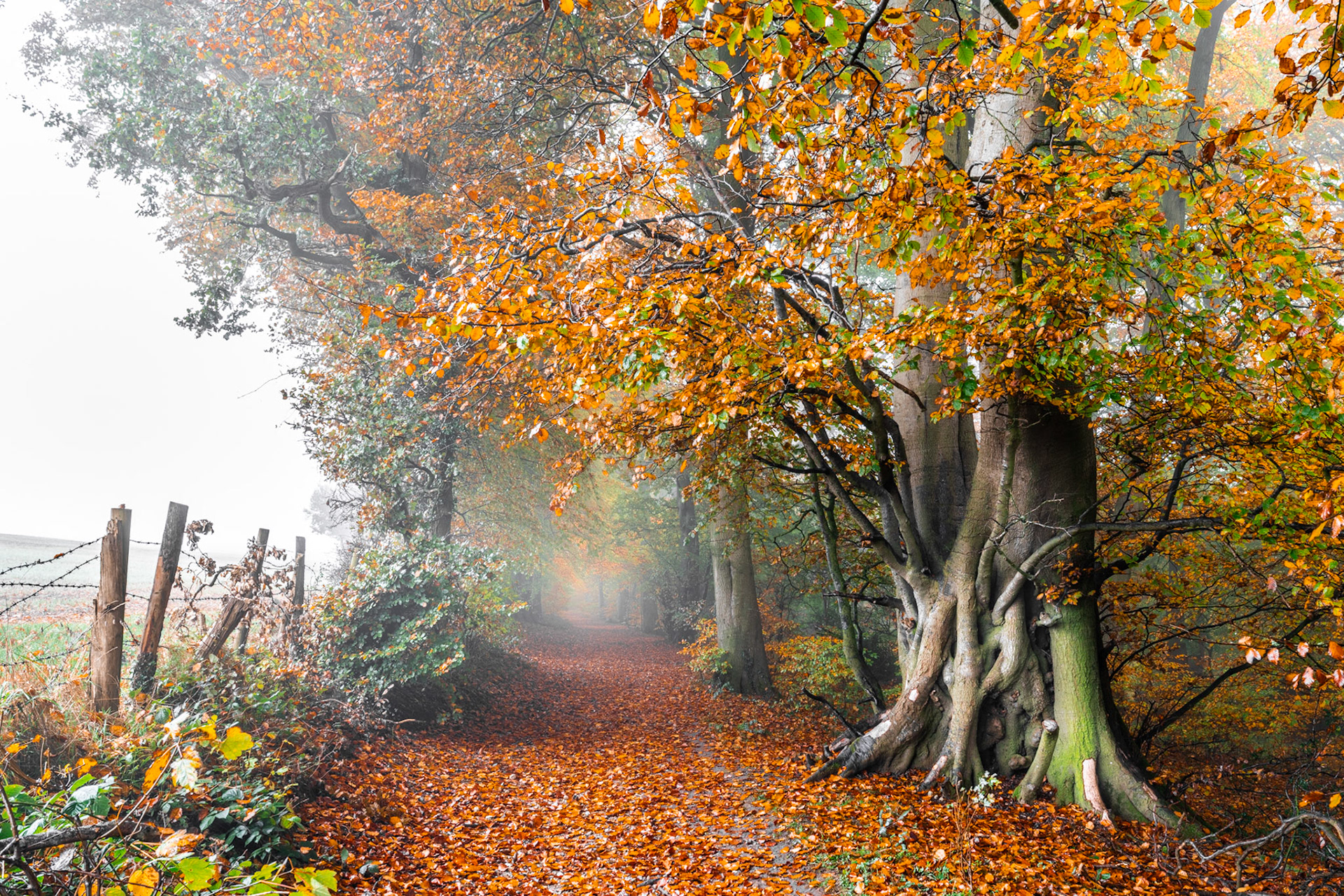
A fog-softened lane in the Chilterns threads between ancient multi-stemmed beech trees in full autumn colour, fallen leaves carpeting the path to a vanishing point lost in mist. The gnarled, ivy-patched root plate of the foreground tree anchors a composition that balances the intimate and the atmospheric. Barbed-wire fence posts to the left suggest a field boundary, characteristic of a high downland track in this part of Oxfordshire in late October or early November.
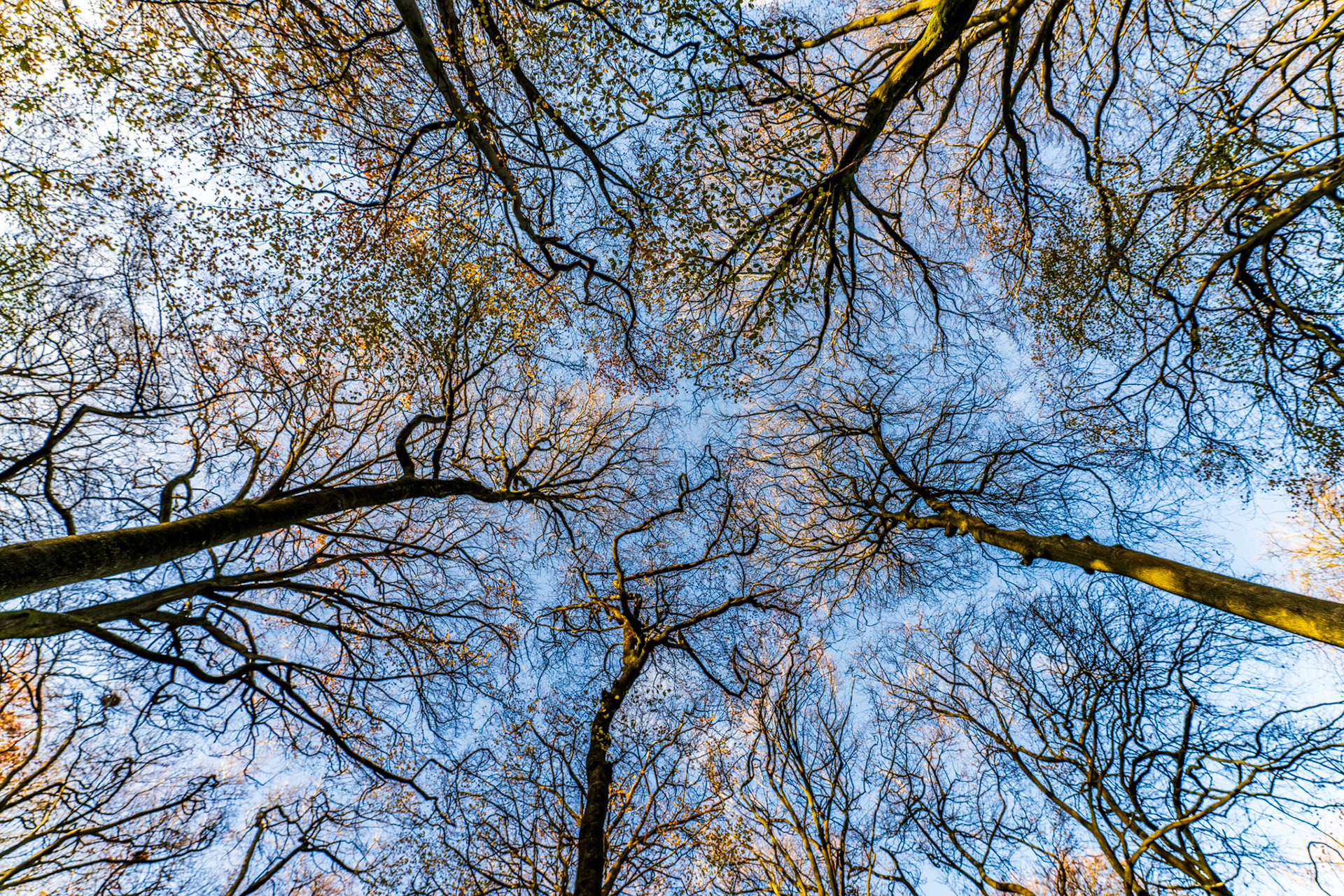
A worm's-eye view through a stand of beech trees in the Chilterns, Oxfordshire, the crowns thinning to bare branches against a pale blue sky in late autumn. Residual amber foliage clings to the uppermost growth while the branching structure fills the frame with dense, overlapping line. The composition draws the eye upward into the fractured light between the crowns.
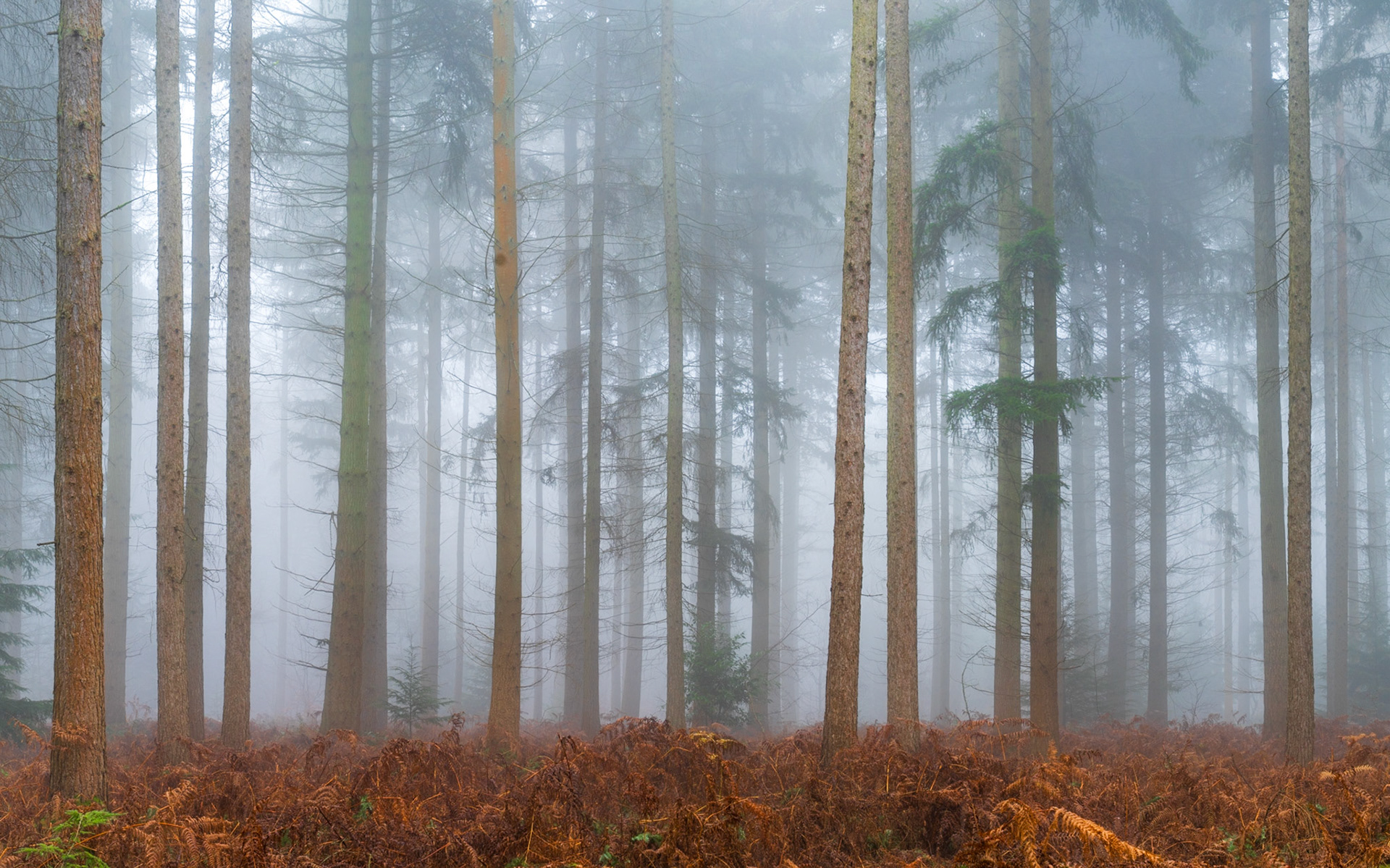
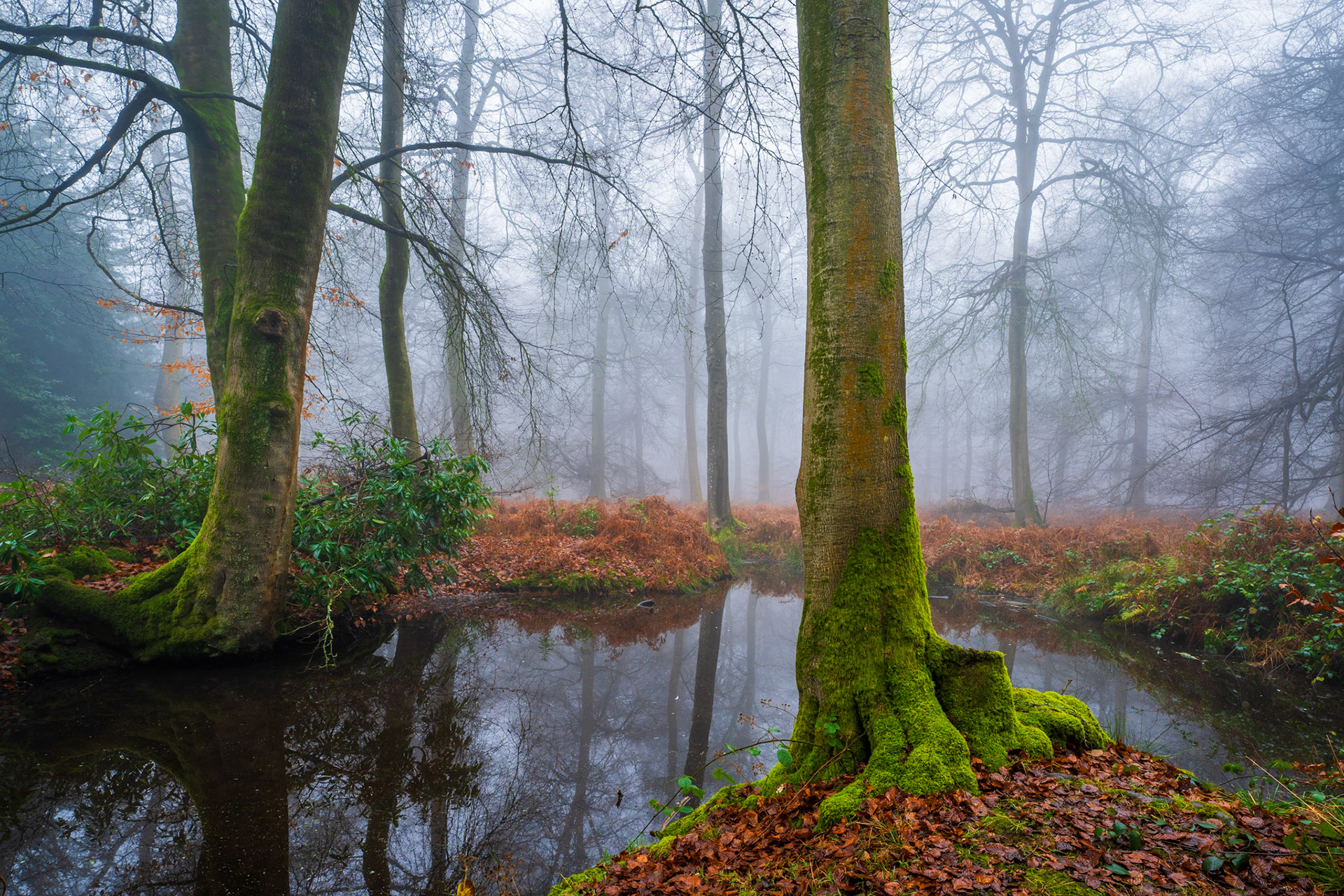
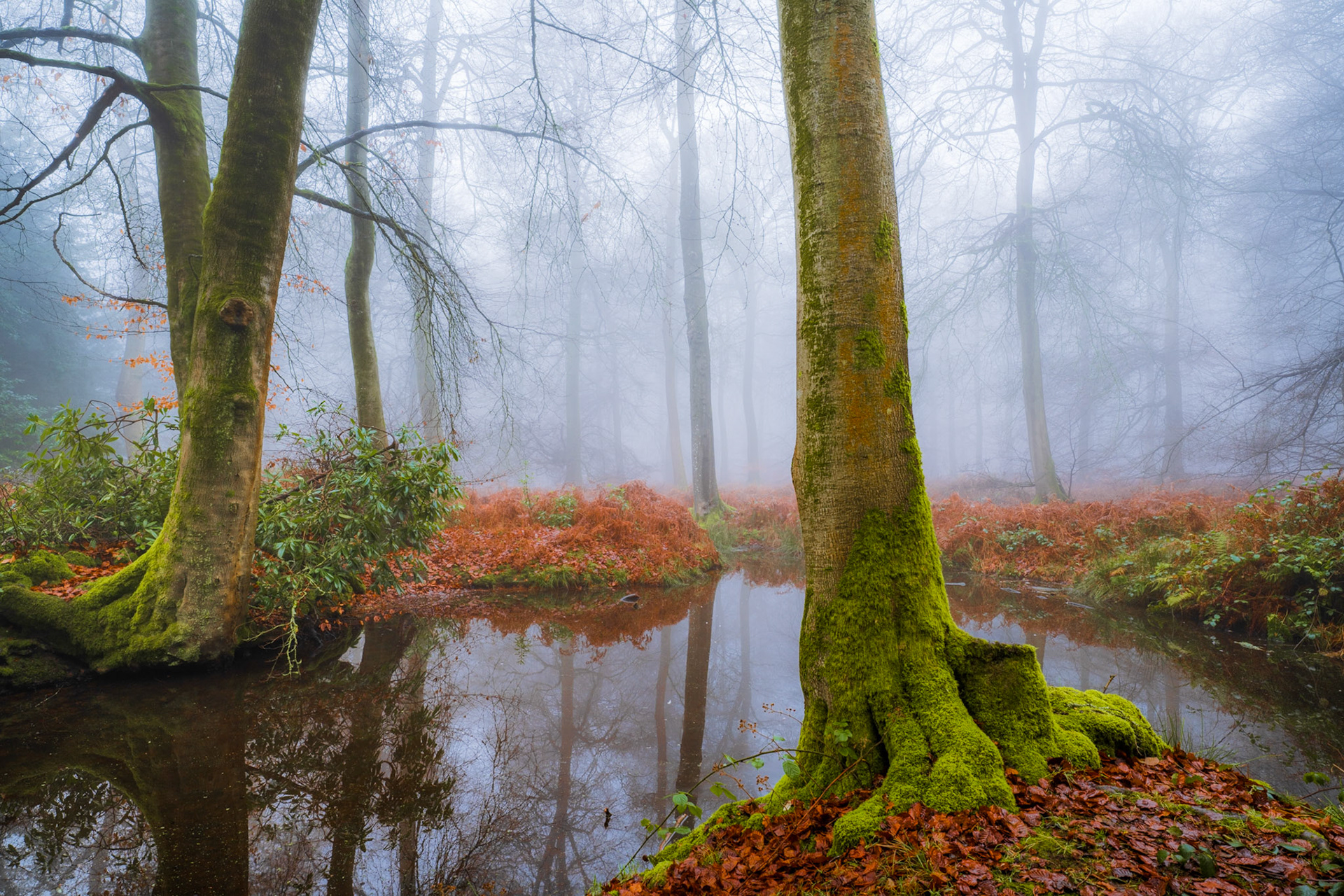
Flood water has pooled between moss-covered beech roots in the Chilterns on a fog-bound December afternoon, mirroring the pale trunks receding into the murk. Russet dead bracken lines both banks, its warm tone set against the cool grey of the mist. The scene sits at the threshold between autumn's remnants and the bleakness of deep winter.
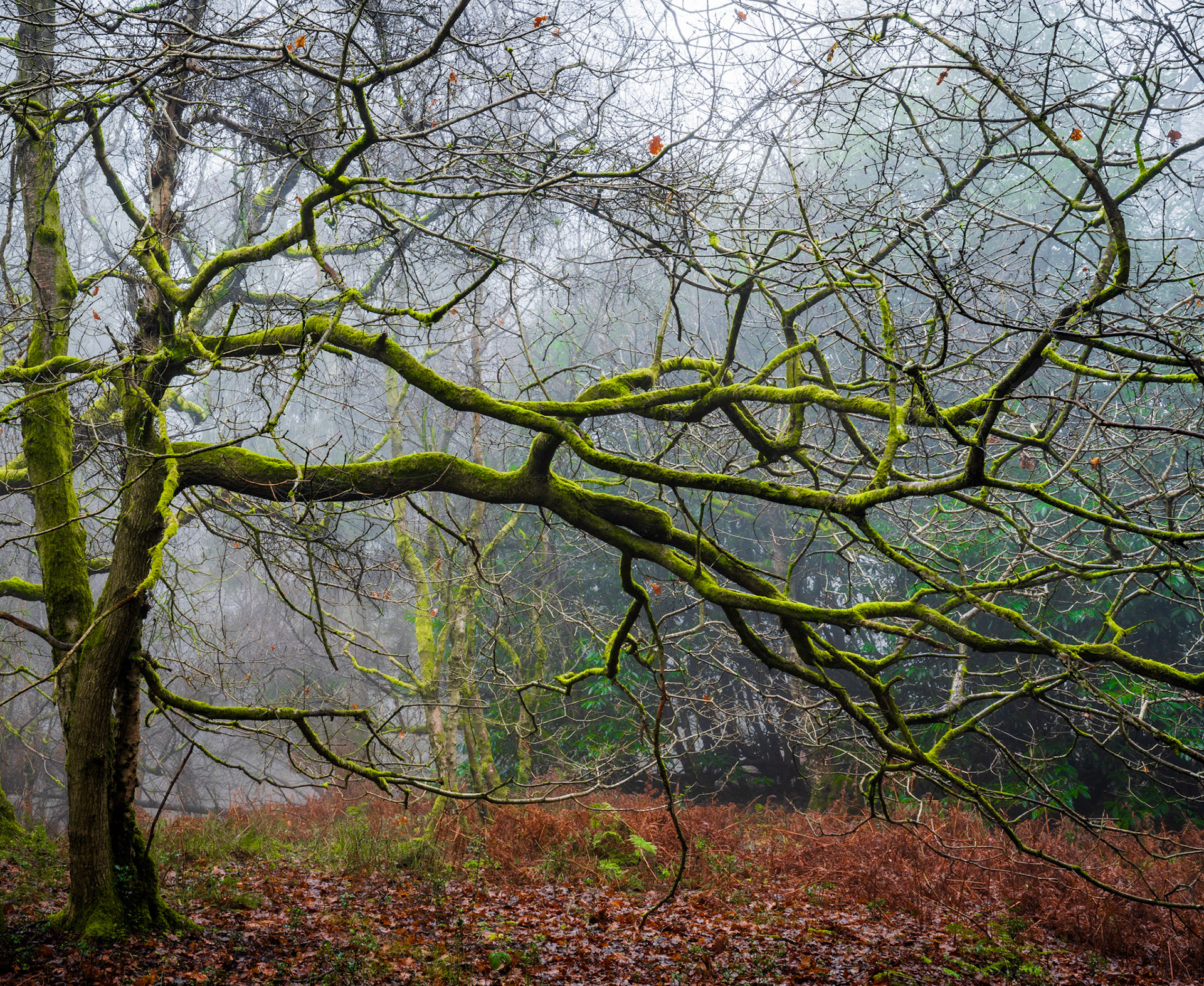
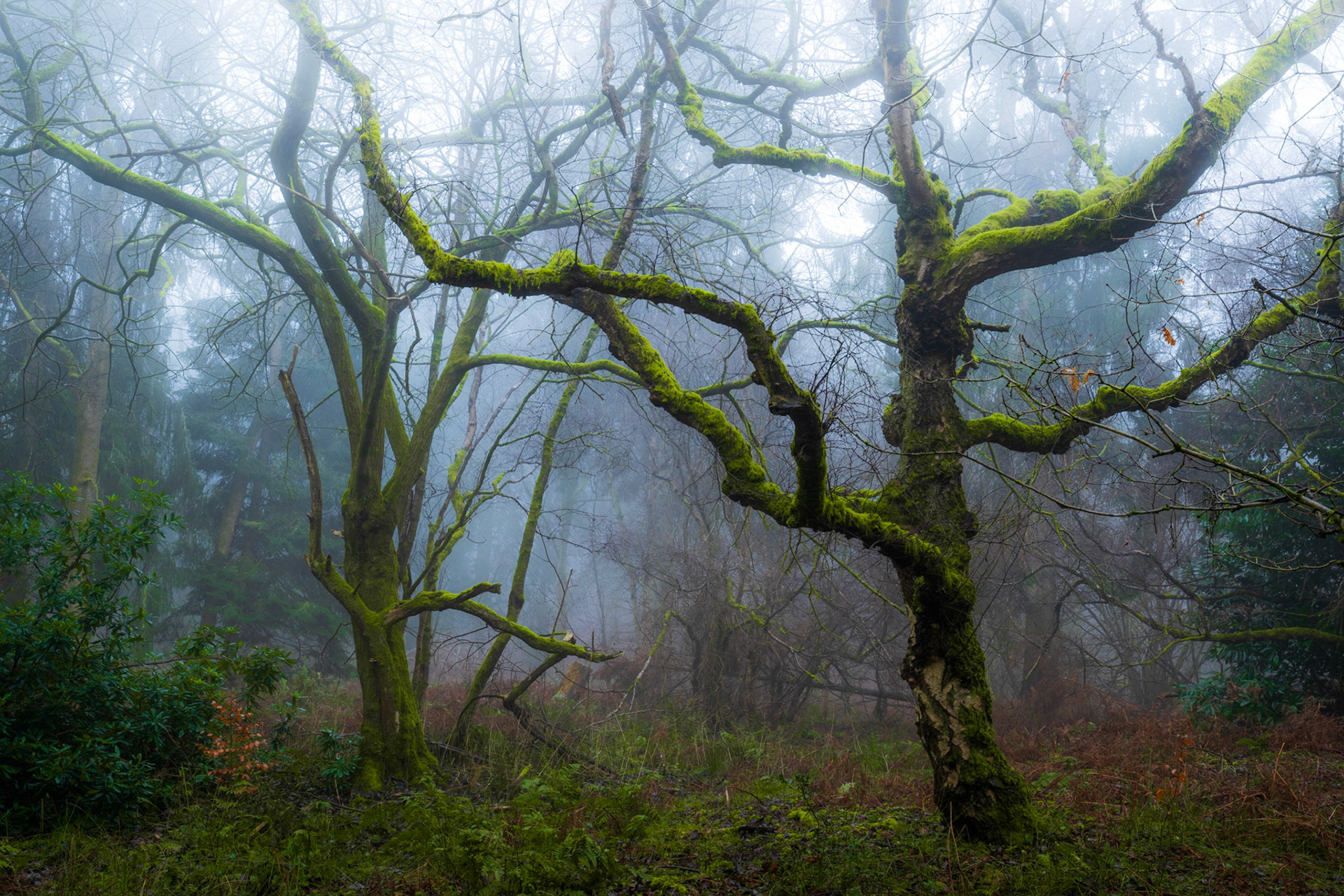
Two trees, both covered in moss, look gnarled and ancient in this winter scene which is full of stubborn fog. A somewhat spooky scene.
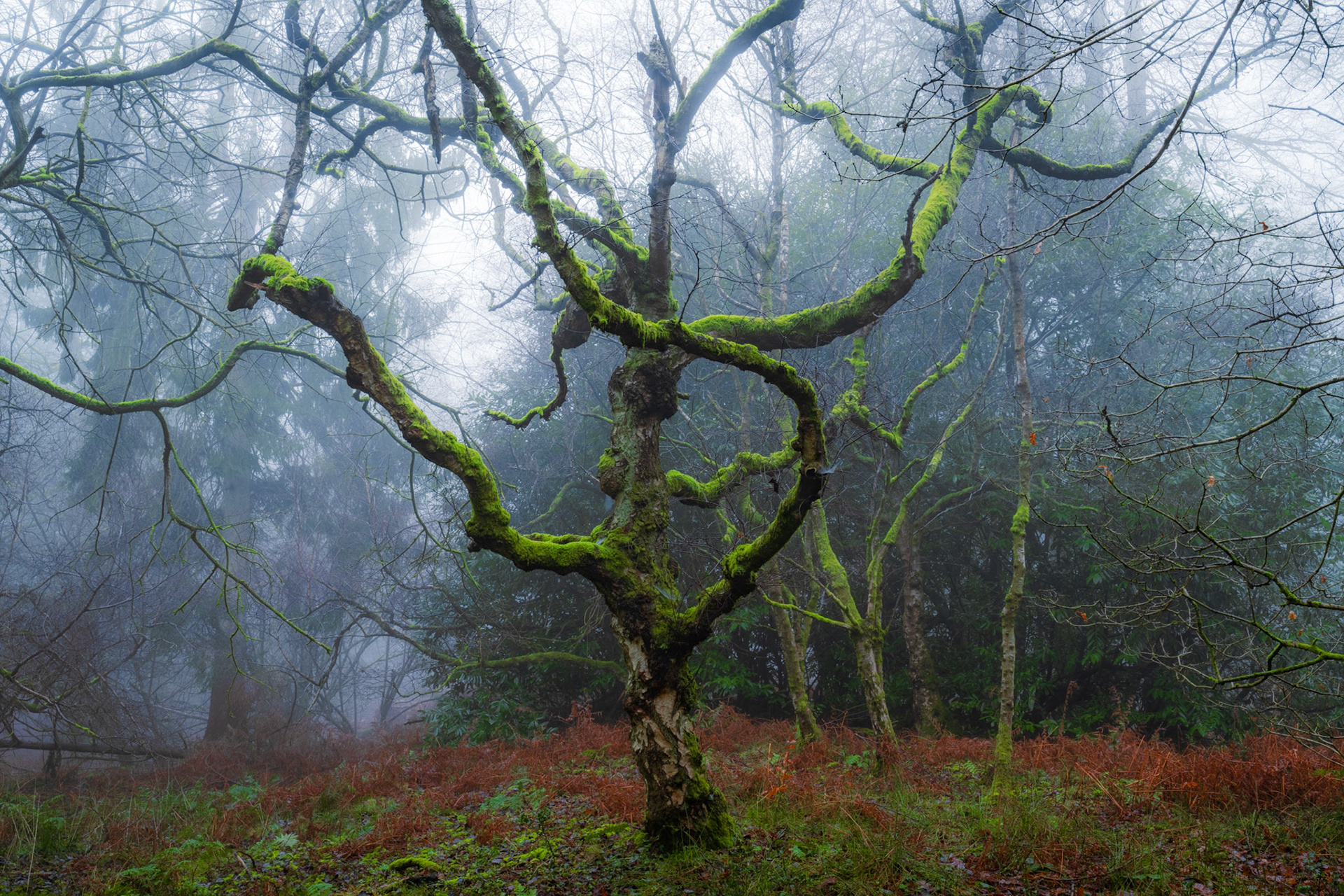
A solitary deciduous tree, its gnarled branches heavily colonised by vivid green moss, stands amid a fog-bound winter woodland. The saturated moss contrasts sharply against the cool blue-grey atmosphere and rust-coloured bracken understory. Diffuse backlight from a mist-obscured sky gives the scene a quiet, otherworldly depth.

A bird of prey crosses a mist-filled valley at dawn in early March above the low ground near Brightwell Barrow, its silhouette suspended between the bare-crowned hilltop copse of the Wittenham Clumps and the fog-islands of woodland below. Temperature inversion has pooled the mist in the Oxfordshire vale, leaving the rounded hill clear and luminous against a soft amber sky. The fortuitous placement of the bird gives the image a precise, unrepeatable quality.
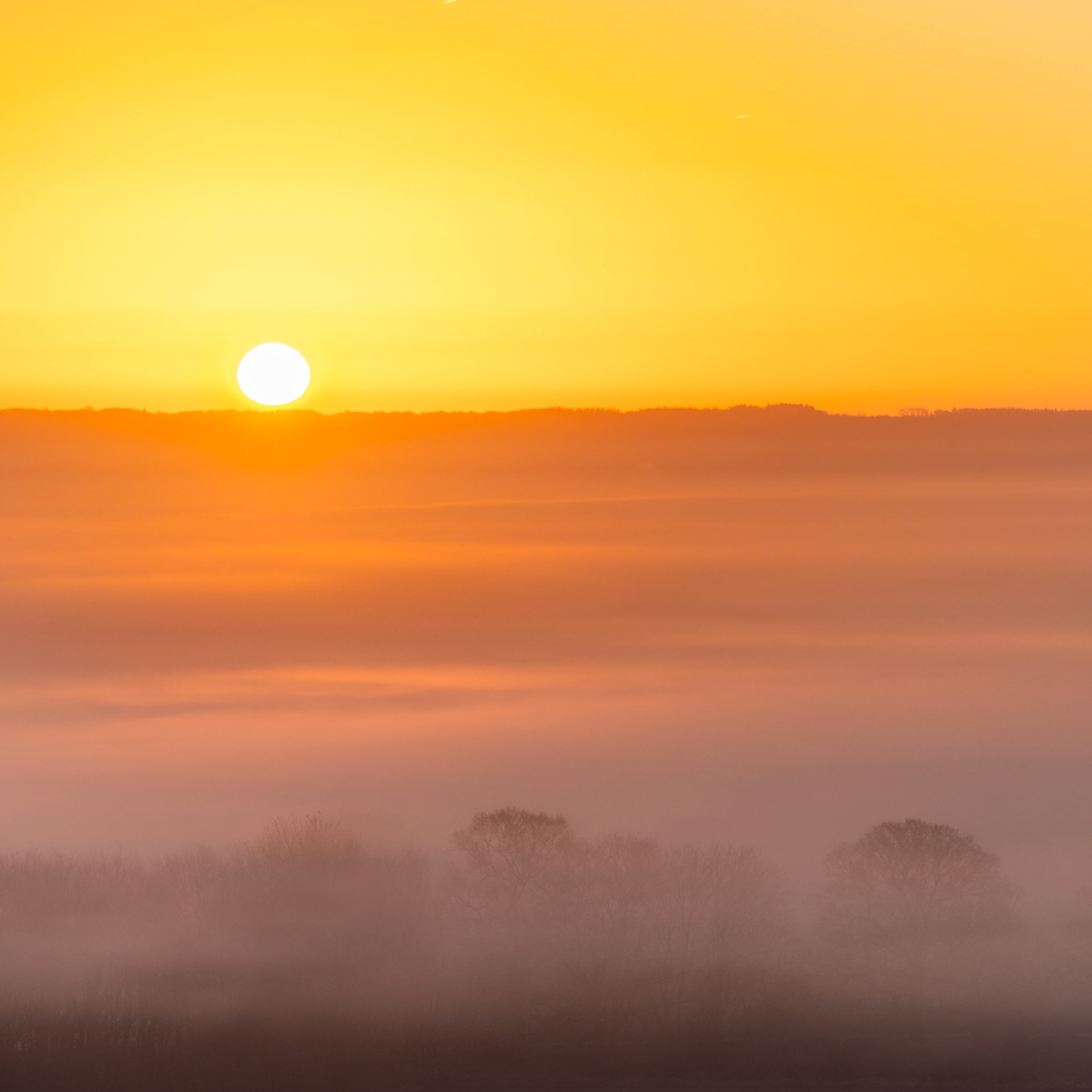
A temperature inversion fills a lowland valley with fog at first light, the sun just clearing a distant treeline silhouette. Trees emerge as dark islands through successive layers of mist, giving the scene its only structural depth. Captured in early March, the bare canopy confirms the landscape is not yet in leaf.
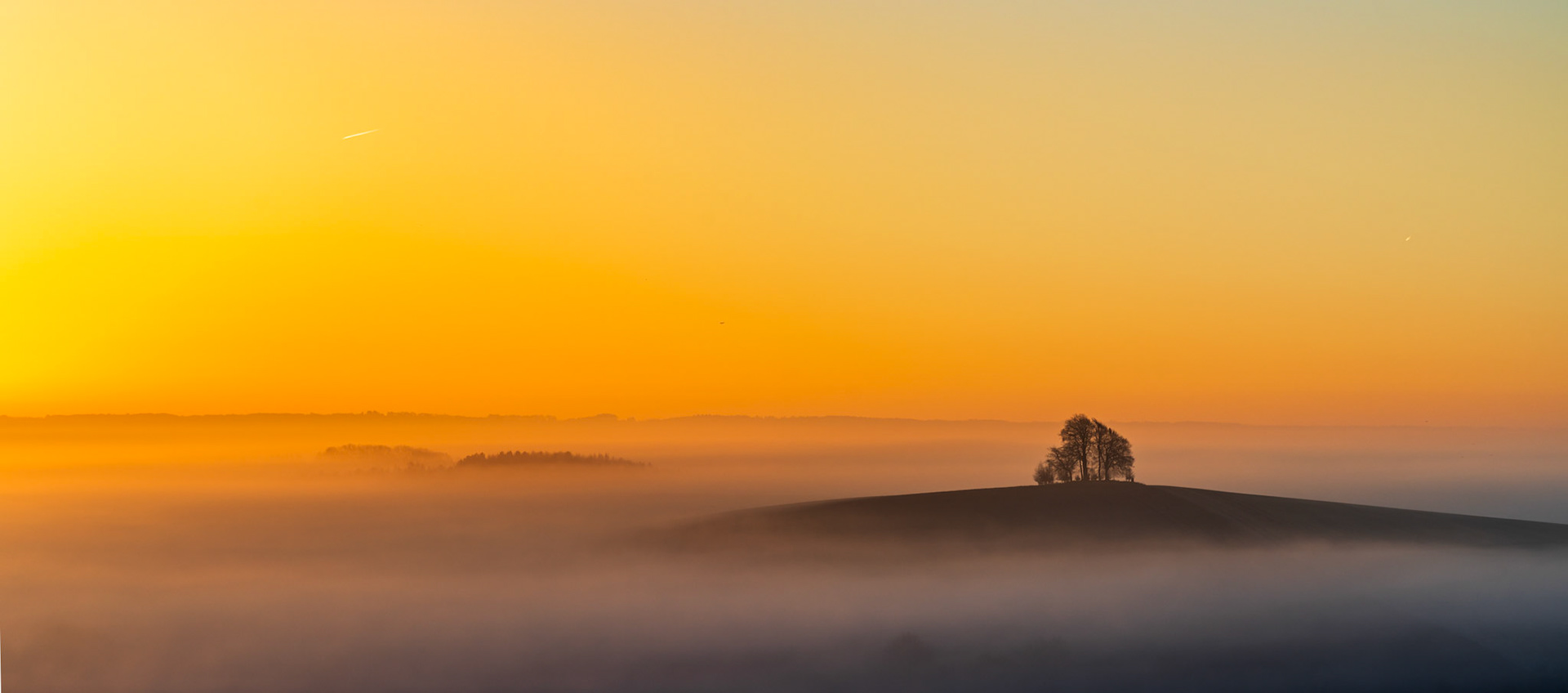
A small copse crowns Brightwell Barrow, near the Wittenham Clumps in Oxfordshire, the rounded hilltop breaking clear of a dense temperature inversion while successive ridges dissolve into amber mist below a cloudless dawn sky. The bare canopy and muted lower tones place this firmly in late winter. The wide panoramic framing balances the solitary tree group against an expansive, graduated sky with quiet confidence.

A solitary bare tree casts a long dark shadow across a fog-covered arable field on the slopes of Brightwell Barrow, near the Wittenham Clumps in Oxfordshire, as low winter sunrise strikes horizontally through the mist. The aerial perspective reduces the scene to near-pure geometry: a diagonal line of darkness dividing cold blue shadow from warm amber light. The tree reads as both subject and instrument, the agent producing the image's central tension.

The small hilltop copse at Brightwell Barrow, near the Wittenham Clumps in Oxfordshire, rises as a dark silhouette above a dense temperature inversion that has consumed the surrounding lowlands in mist. The pre-sunrise sky grades from deep amber at the horizon to pale cream above, lending the scene an almost monochromatic warmth. A second treeline ghosted in the middle distance adds depth without competing for attention.
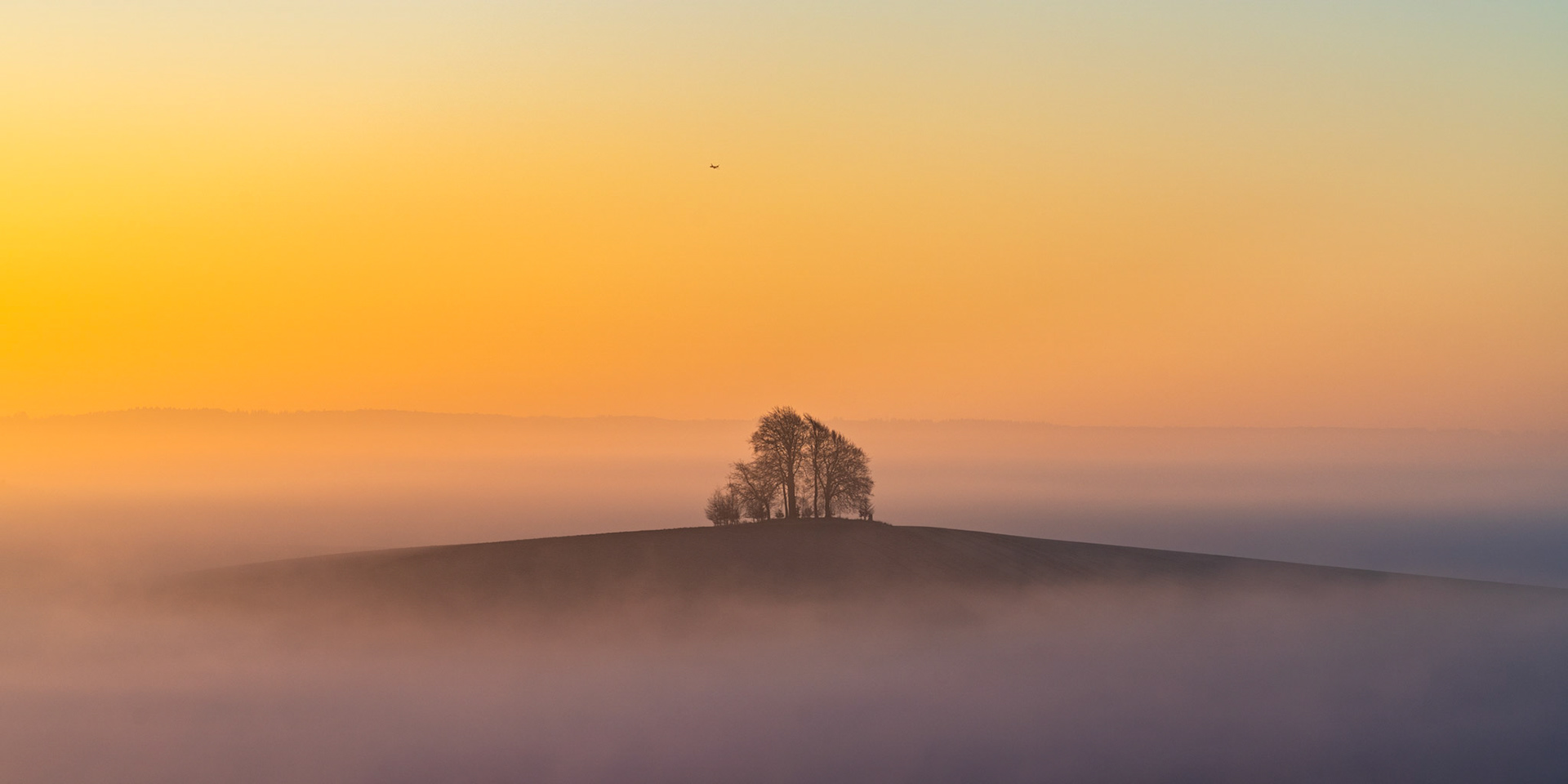
A small copse crowns Brightwell Barrow, one of the higher points near the Wittenham Clumps in Oxfordshire, breaking clear of a temperature inversion that blankets the valley below. The predawn palette shifts from cool lavender at ground level through warm amber at the horizon, compressing the tonal range into a near-abstract arrangement of silhouette and atmosphere. A distant aircraft punctuates the open sky, adding scale without distraction.

An absolutely magical scene from Oxfordshire, where a small group of trees on a 'barrow' stands above the mist, where the sunrise is lighting the scenes in the most beautiful orange, yellow and pink pastel hues.
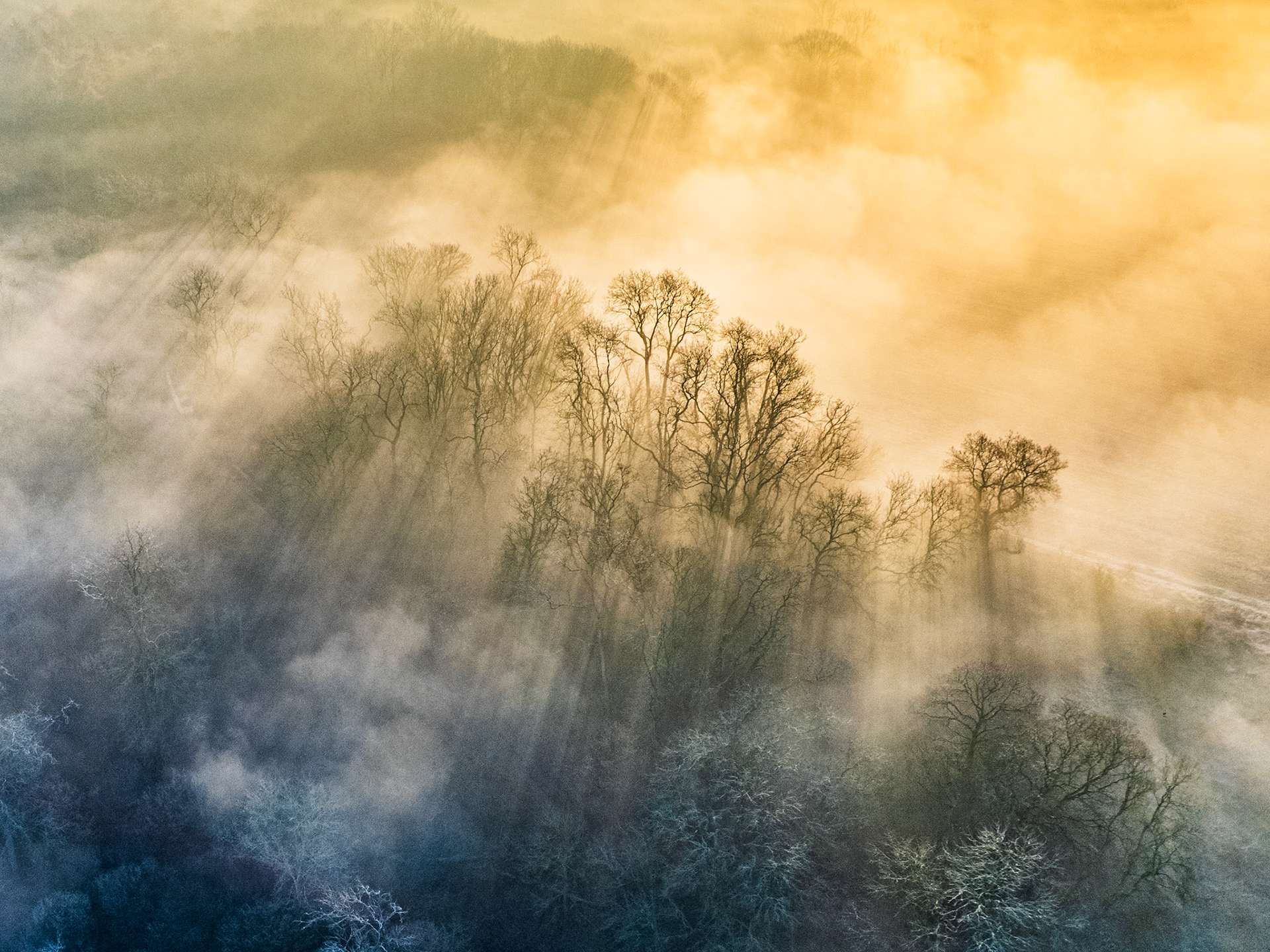
Crepuscular rays penetrate a fog layer over bare-branched woodland near Abingdon-on-Thames, caught from altitude at first light on a frost-held March morning. The diagonal ridgeline of trees divides warm amber light above from cold blue shadow below, the mist acting as a screen on which the beams are made legible. An aerial vantage strips the scene to pure atmosphere and structure.
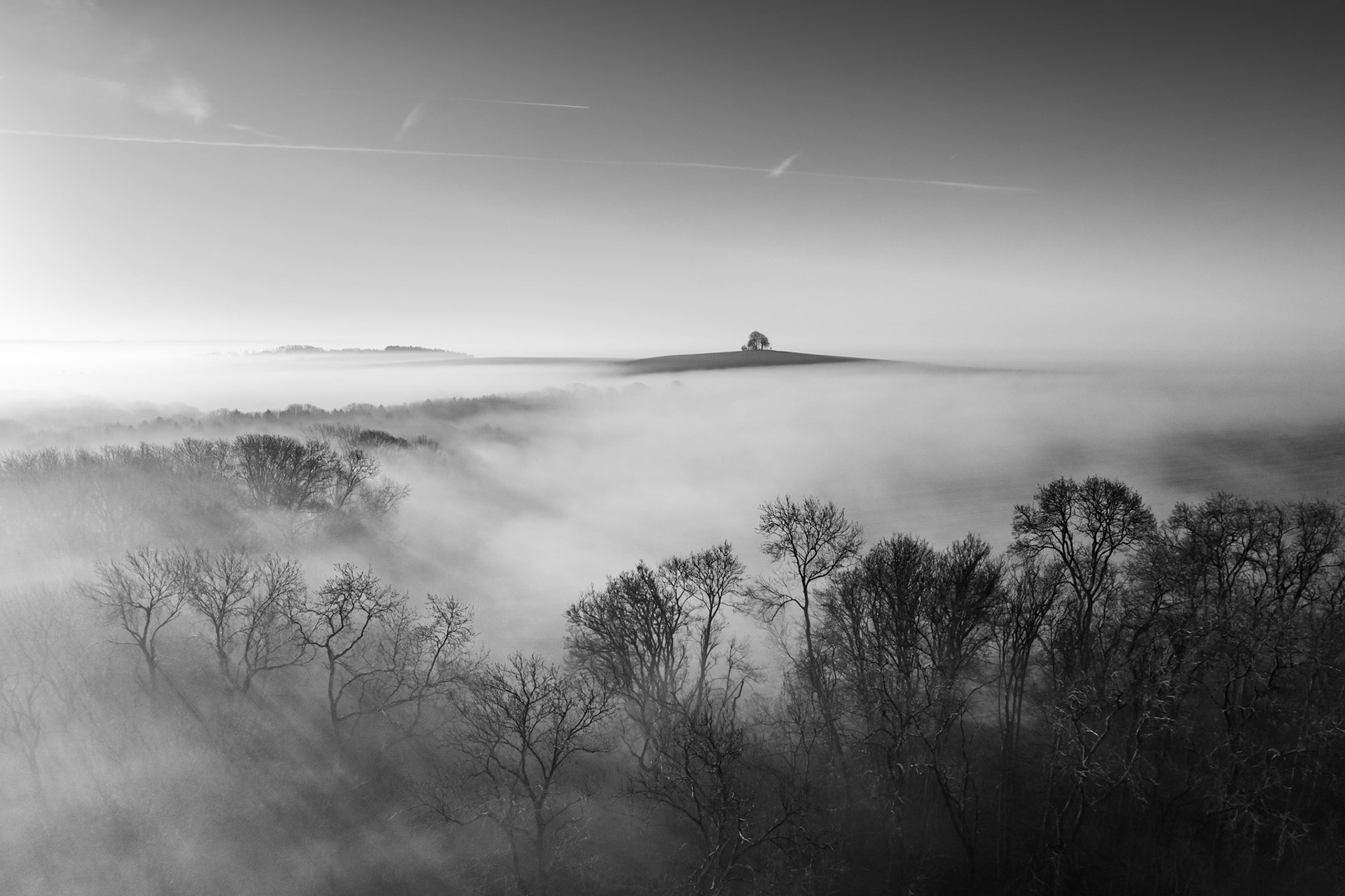
A temperature inversion fills the valley below Abingdon at dawn, submerging bare winter woodland beneath a continuous fog layer while a solitary tree-crowned hill emerges as an island above the white. The monochrome conversion reinforces the tonal separation between the dark filigree of leafless canopy in the foreground and the luminous, backlit mist beyond.
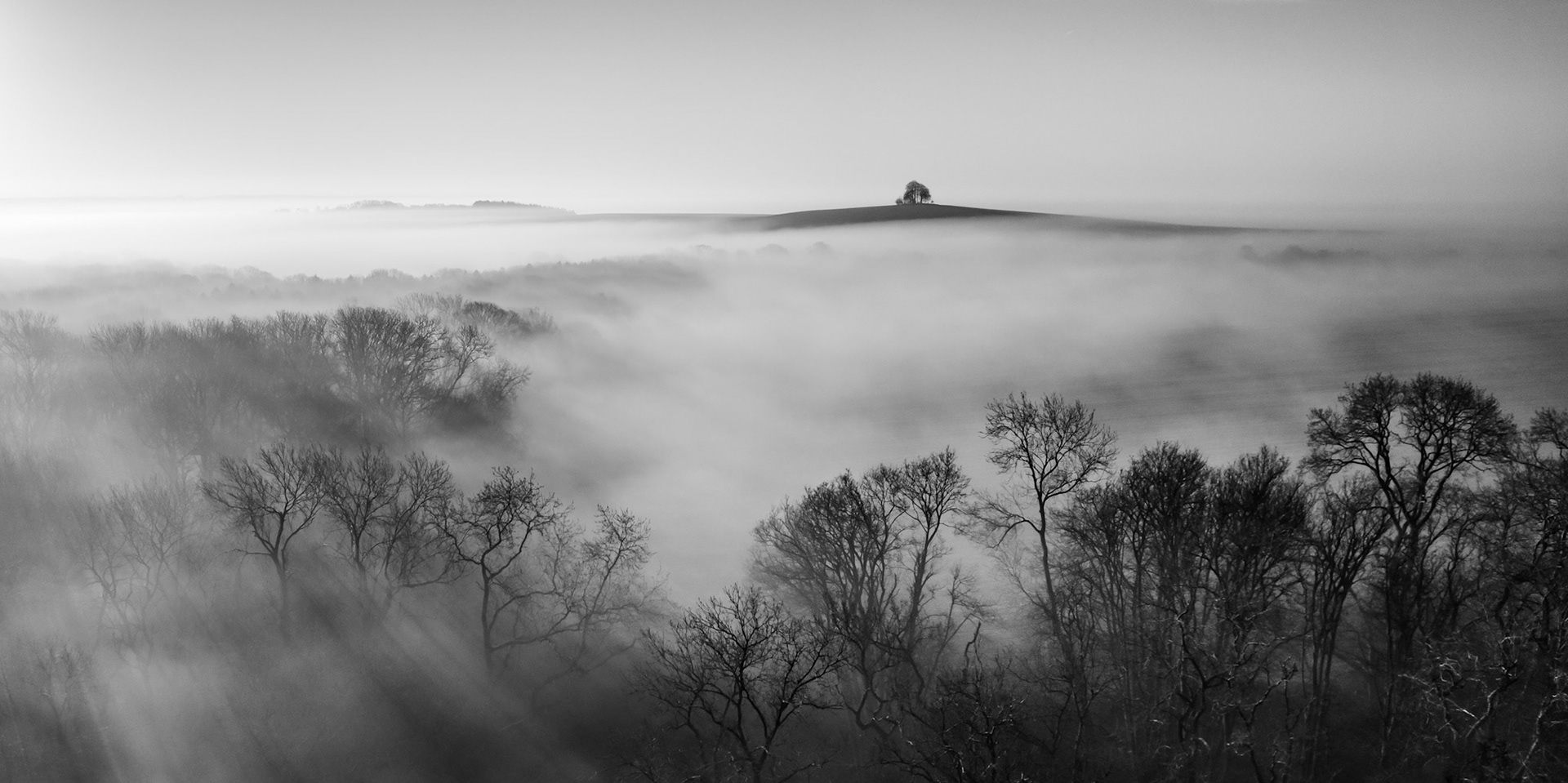
A temperature inversion buries a wooded valley beneath dense fog, leaving a lone clump of trees on a bare hilltop isolated against a pale winter sky. Bare deciduous canopies pierce the fog layer in the foreground, receding in tonal gradients toward the distant hill. Shot from low drone altitude above Abingdon-on-Thames at first light, the panoramic frame distils the scene to three horizontal bands: tree, fog, hill.
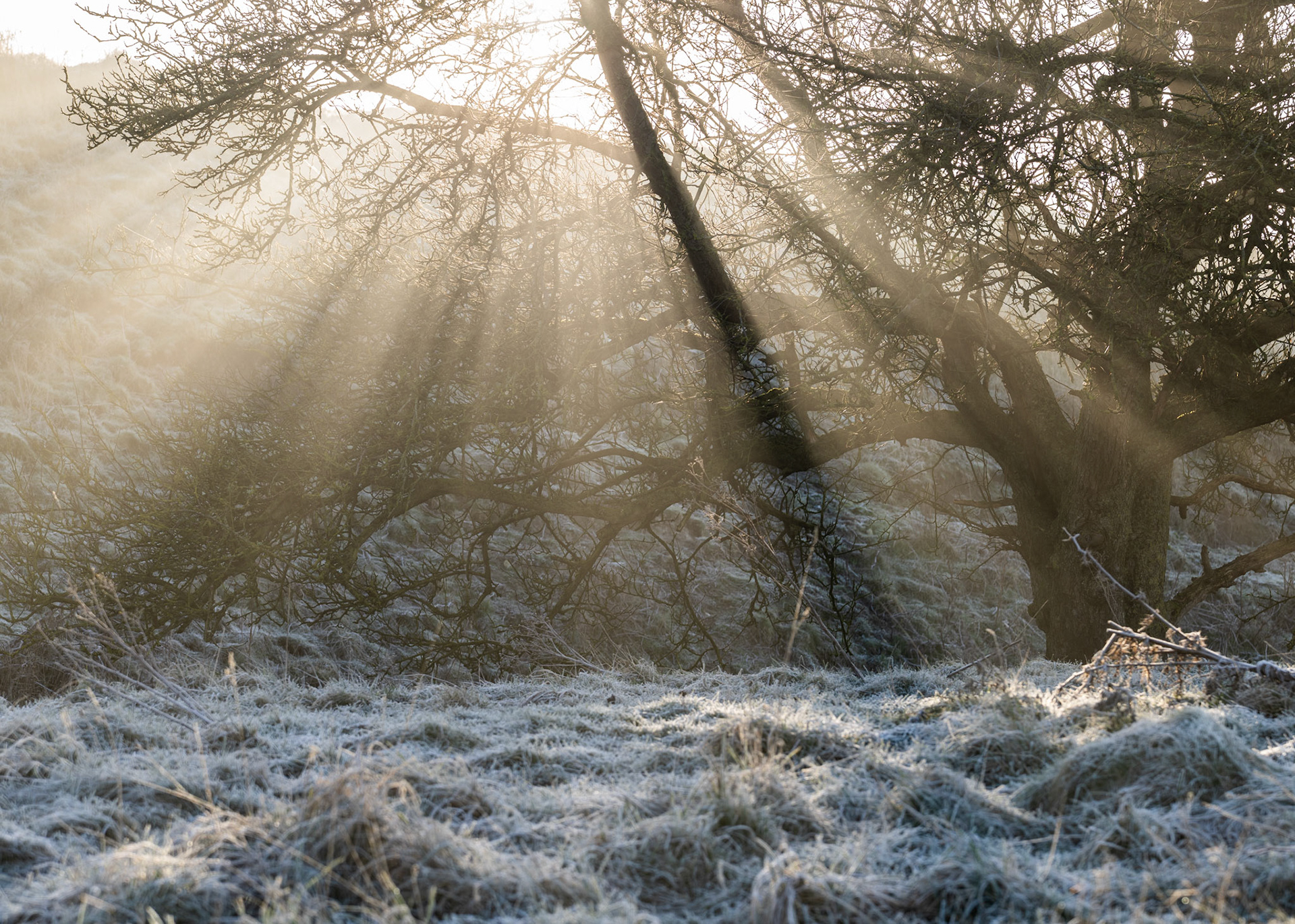
Low winter sun breaks through bare hawthorn scrub on a heavily frosted morning, casting distinct crepuscular rays into ground mist. The hoarfrost on the grass foreground anchors the scene, while the contre-jour exposure holds detail across a wide tonal range. A quiet, precisely observed moment of cold-season light.

Low winter sun breaks through mist behind a spreading hawthorn, casting visible light rays through bare, lichen-covered branches. Hoarfrost holds on the rough grassland and scrub below, the cold blue of the frosted foreground contrasting with the warm backlight. The combination of crepuscular rays and frost suggests a brief, still moment in early morning before the mist fully lifts.
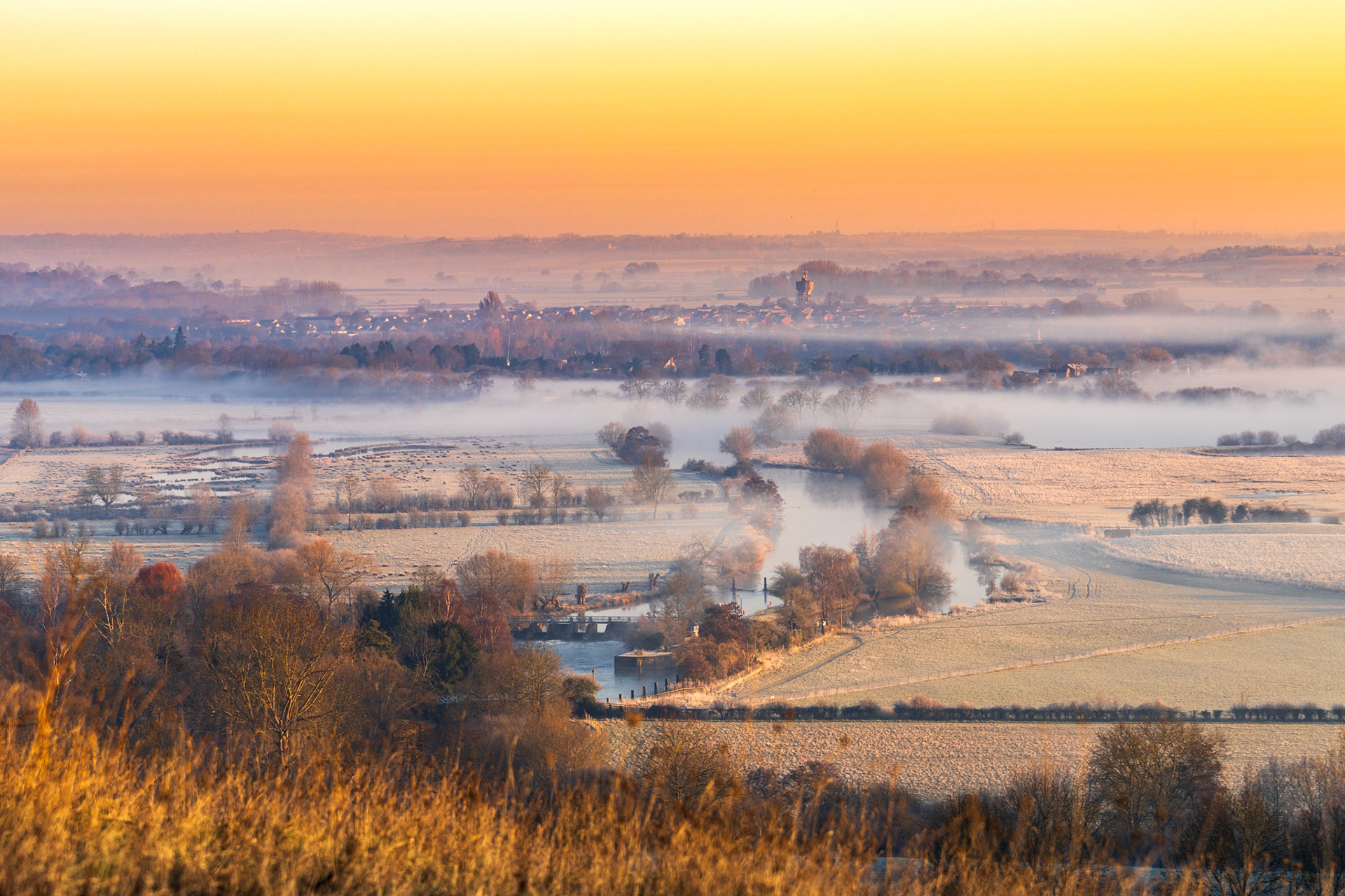
A temperature inversion holds low mist across a frost-silvered floodplain at first light, a river lock and its attendant willows emerging from the white. The amber pre-sunrise sky grades into the haze, compressing the middle distance into soft receding planes. A distant market town, barely resolved through the mist, anchors the human scale against the stillness.

A temperature inversion buries the Thames Valley beneath a continuous fog layer at first light, leaving wooded ridgelines as isolated islands above the white. Warm sunrise light rakes across the mist from the west-northwest, splitting the frame between amber and a cool blue residue of night sky to the east. The compression of aerial perspective draws the fog into a near-abstract surface interrupted only by the dark crowns of emergent trees.
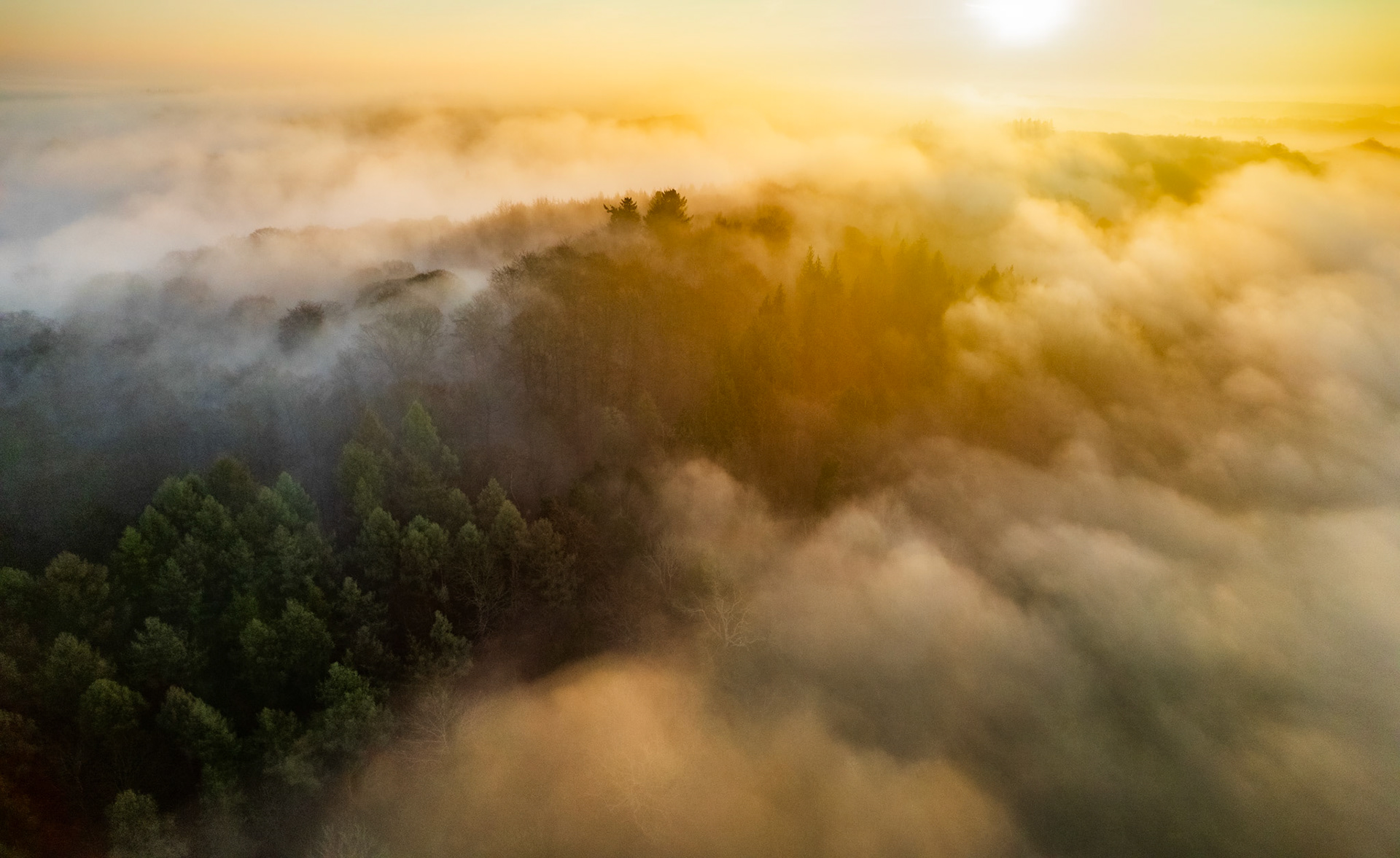
A temperature inversion holds low fog across mixed woodland near Reading, Berkshire, at first light in late March. The rising sun, just above the horizon to the north-east, throws warm golden light across the cloud layer while evergreen canopy breaks the surface in the foreground shadow. The interplay of cool grey fog and amber backlight gives the scene an unusual tonal range for a dawn aerial.
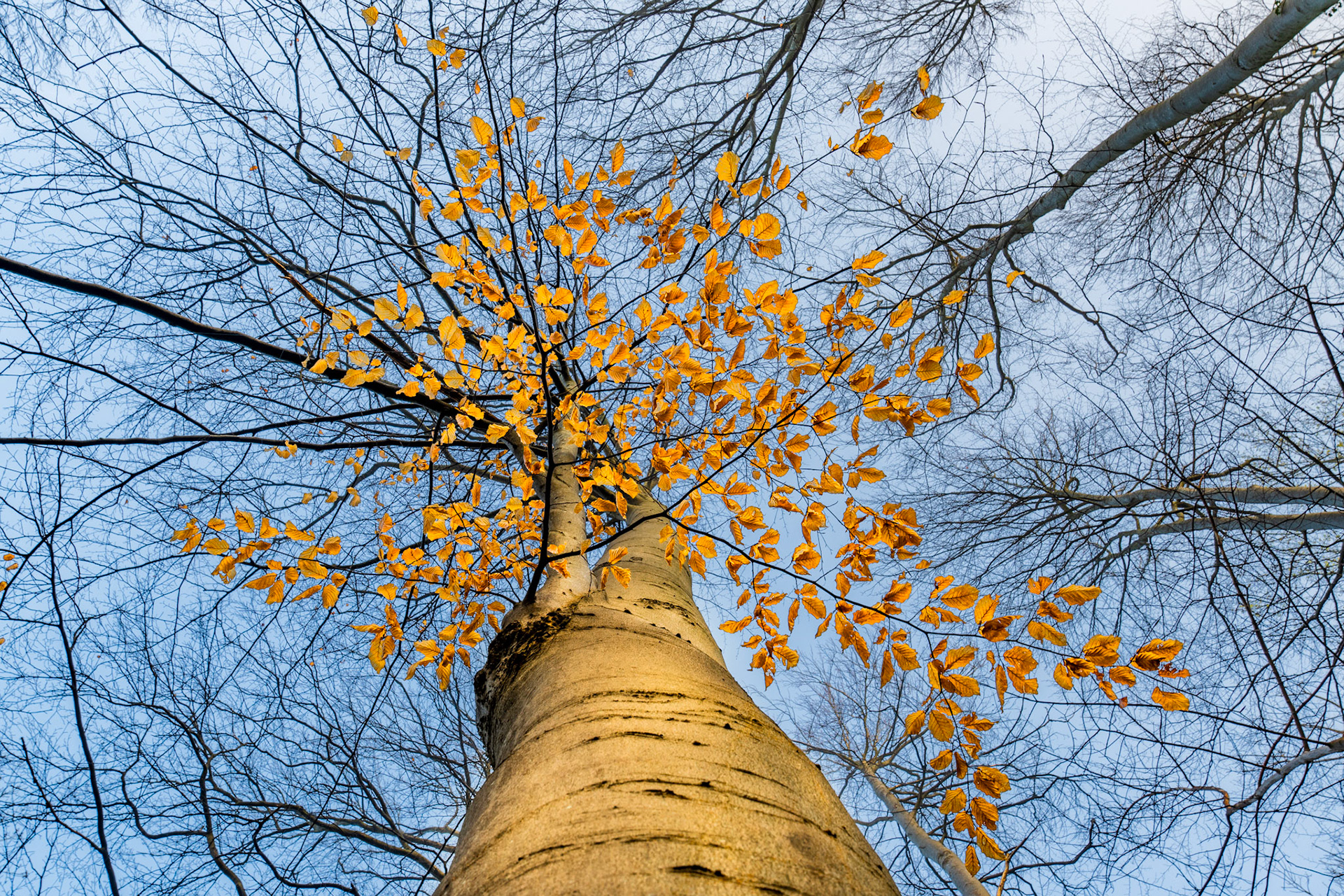
A worm's-eye view up the pale trunk of a beech tree in the Chilterns, Oxfordshire, its upper branches still carrying a sparse scatter of amber-gold marcescent leaves against a pale winter sky. The surrounding trees are fully bare, lending the single canopy an isolated, suspended quality. Captured in the early-morning blue of late March, the image sits at the threshold between winter's end and the first stirrings of spring.
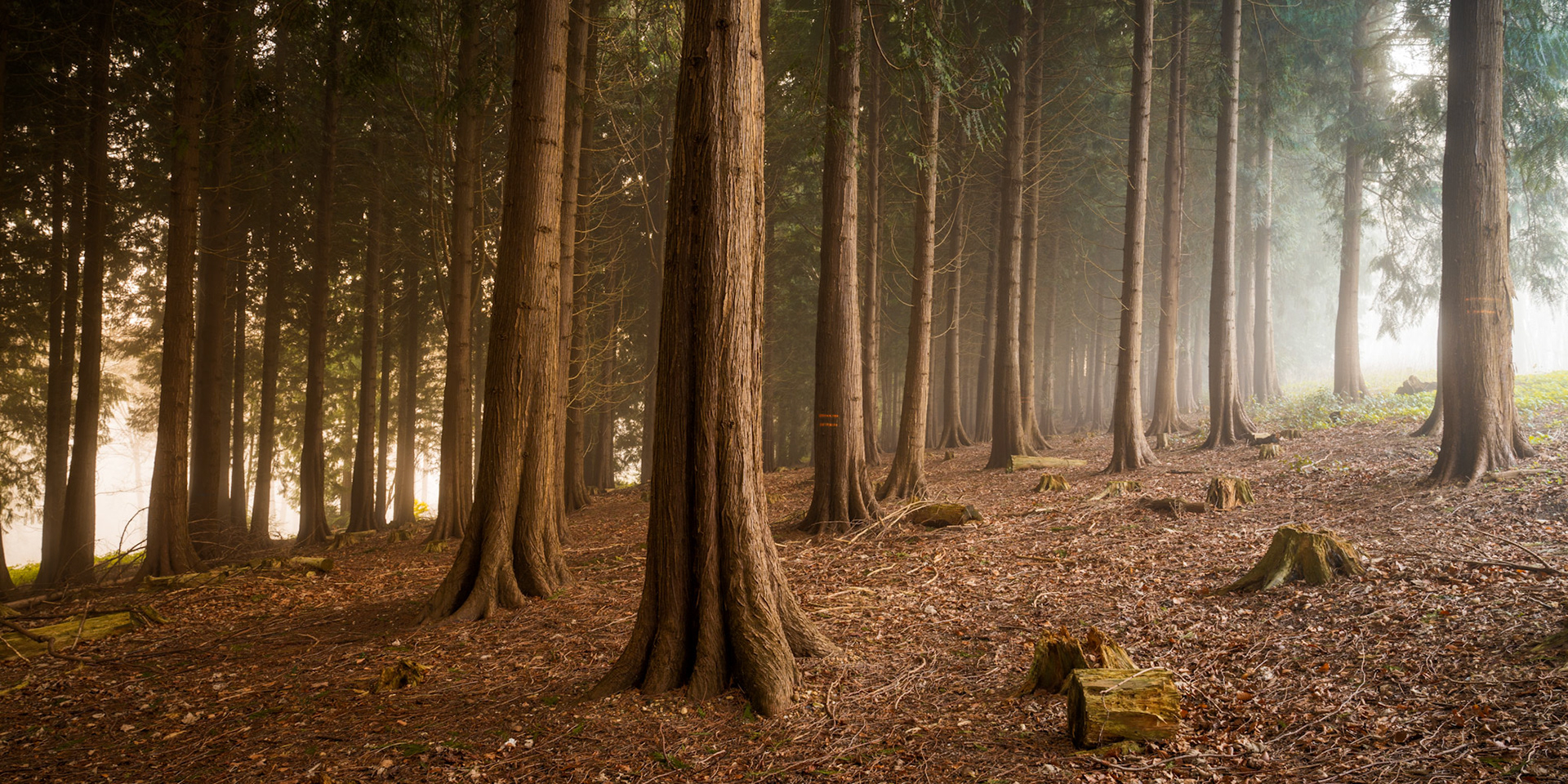
A stand of mature conifers recedes into early-morning mist, the trunks forming rhythmic verticals across a wide panoramic frame. Scattered stumps on the needle-covered floor suggest managed forestry, lending the scene a quiet tension between growth and removal. Diffuse backlight from two directions softens the depth without resolving into distinct sunbeams.
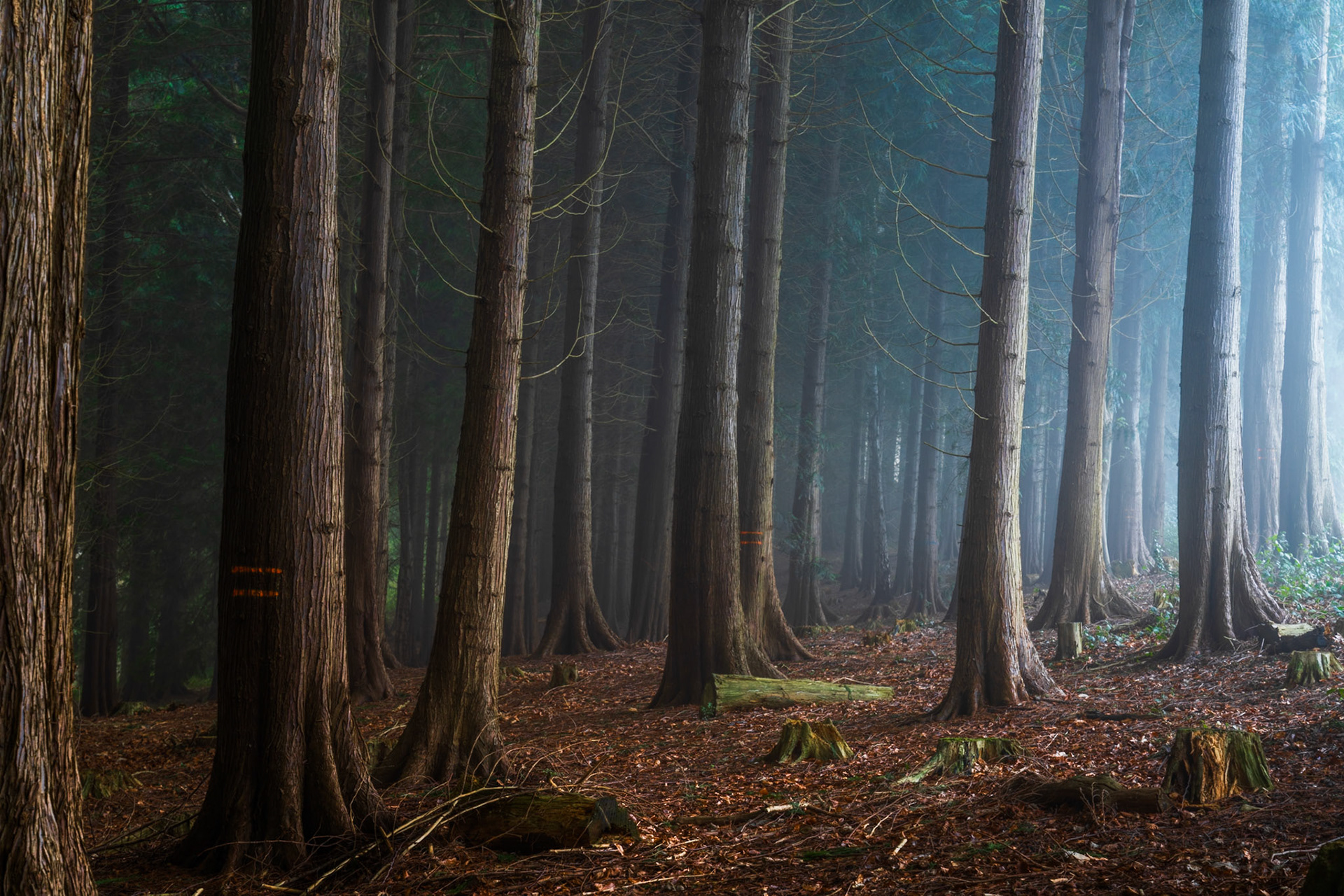
Tall conifers recede into soft morning mist, their bare lower limbs and fibrous bark catching diffuse sidelight. Cut stumps and moss-covered debris on the leaf-litter floor suggest managed or commercial woodland. The cool atmospheric haze compresses depth and lends the stand a quiet, almost architectural order.
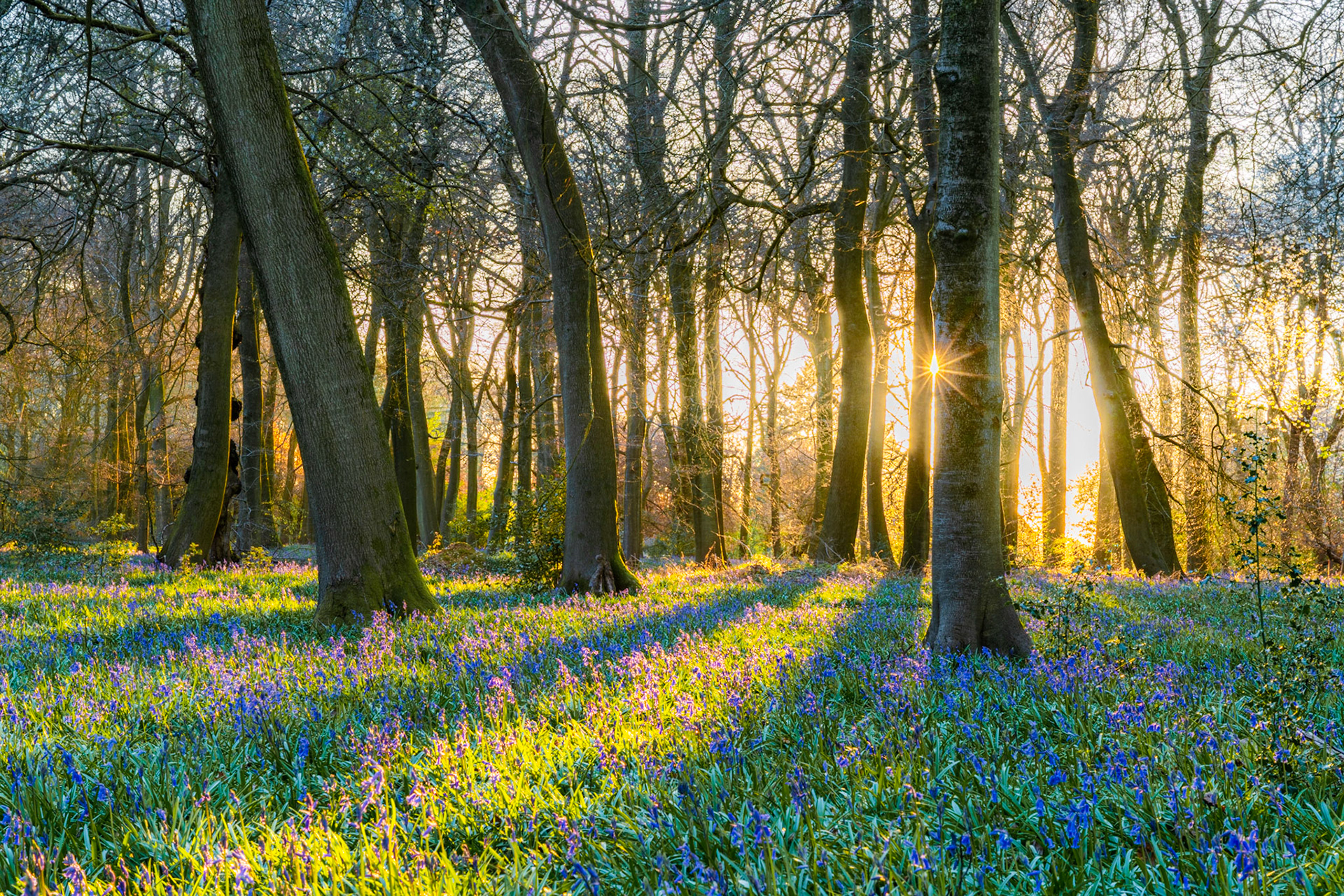
Low evening sun pierces a deciduous woodland floor in the Chilterns, Oxfordshire, carpeted in bluebells at peak spring bloom. Tree trunks cast long shadows across the flowers, while a sunstar forms between two beeches at the woodland edge. The image captures a well-timed moment of directional light, though the composition relies on a familiar arrangement of elements.

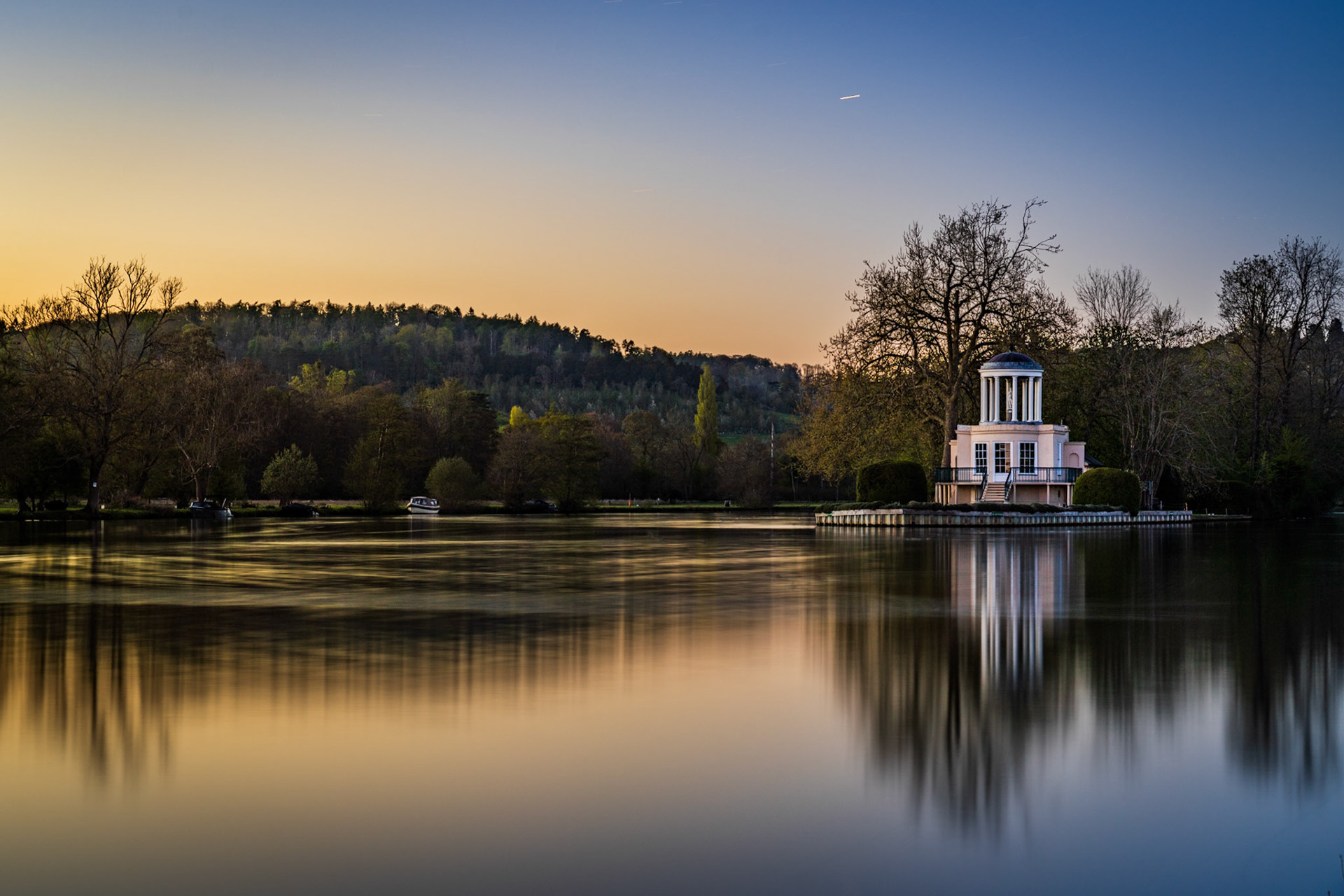
A neoclassical riverside temple catches the last warmth of an April sunset on the Thames near Henley, its columns and dome reflected in long-exposure-smoothed water. The gradient from amber horizon to deep blue zenith frames the building with quiet formality. A vapour trail and moored boats add understated human presence without disrupting the stillness.
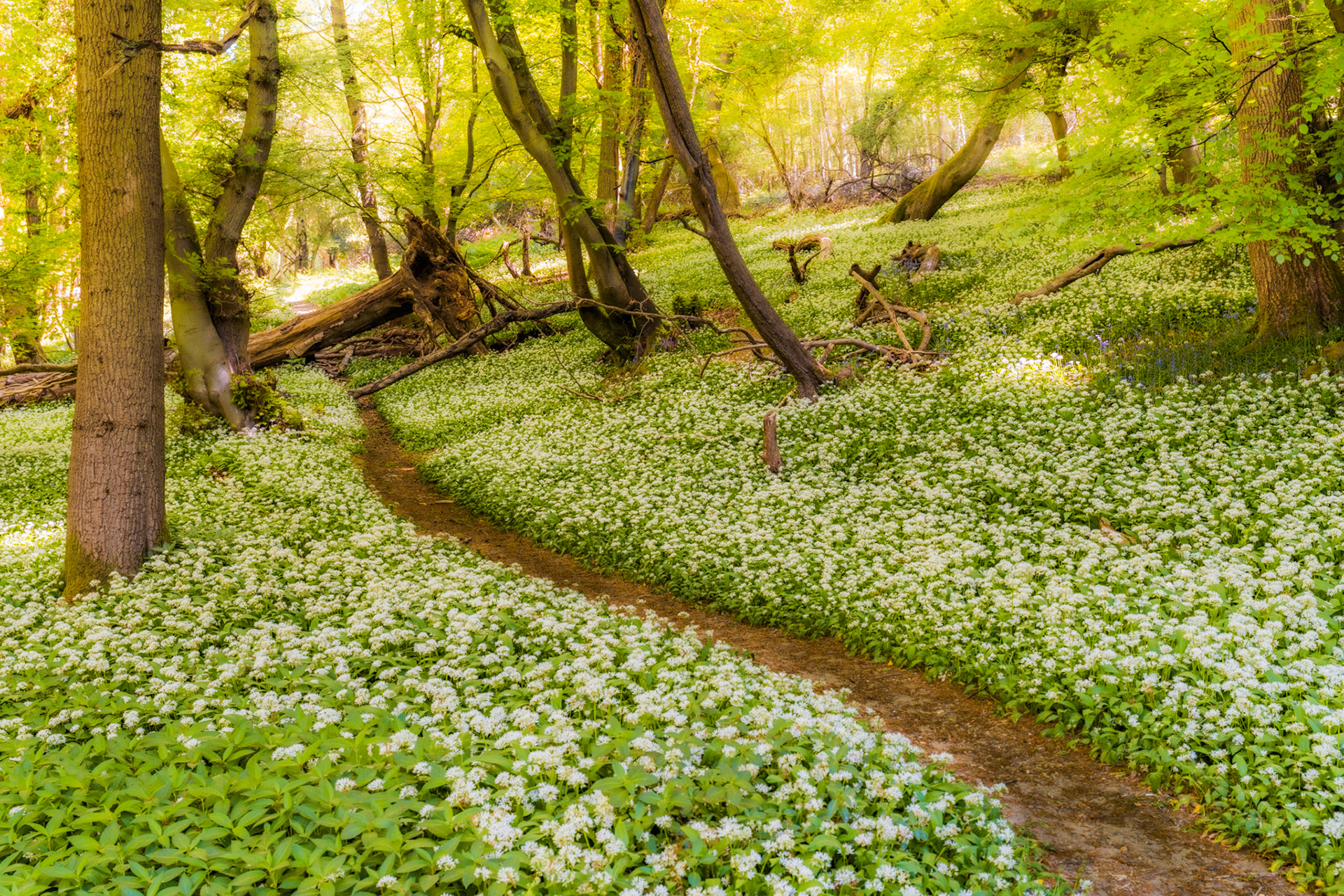
A narrow footpath winds through a dense carpet of flowering wild garlic beneath fresh beech canopy in the Chilterns, Oxfordshire. Backlit spring foliage filters warm light into the woodland interior, lending the scene an almost luminous quality. Fallen timber on the slopes adds structural counterpoint to the softness of the ground flora.
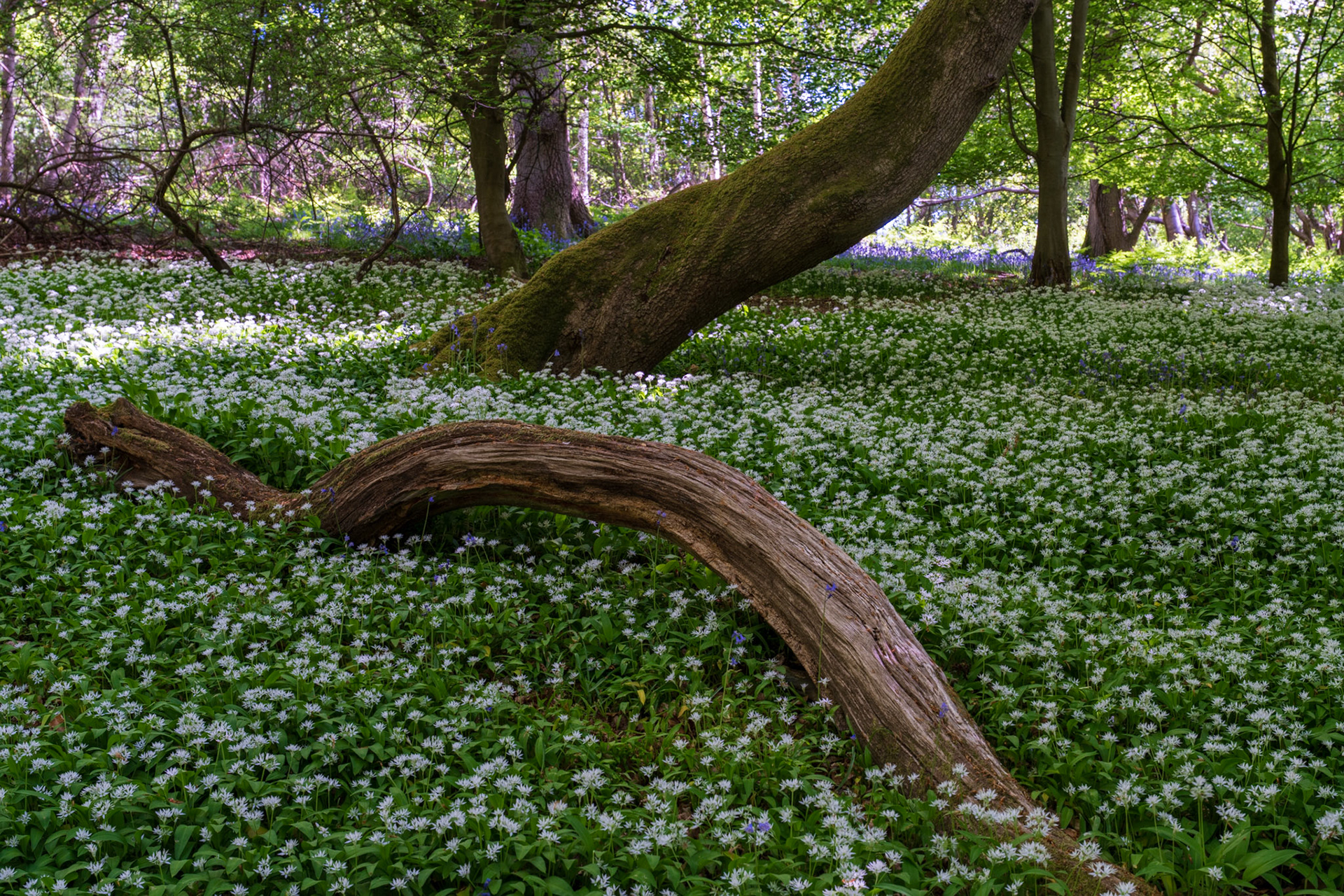
A carpet of wild garlic in full bloom covers the floor of a Chilterns broadleaf woodland in mid-May, while two curved fallen limbs cut diagonal lines through the white-flowered mass. Bluebells persist in the mid-distance, their violet haze softening the transition into the shaded interior of this Oxfordshire woodland. The composition uses the moss-covered leaning trunk as a structural counterpoint to the horizontal sprawl of the foreground log.
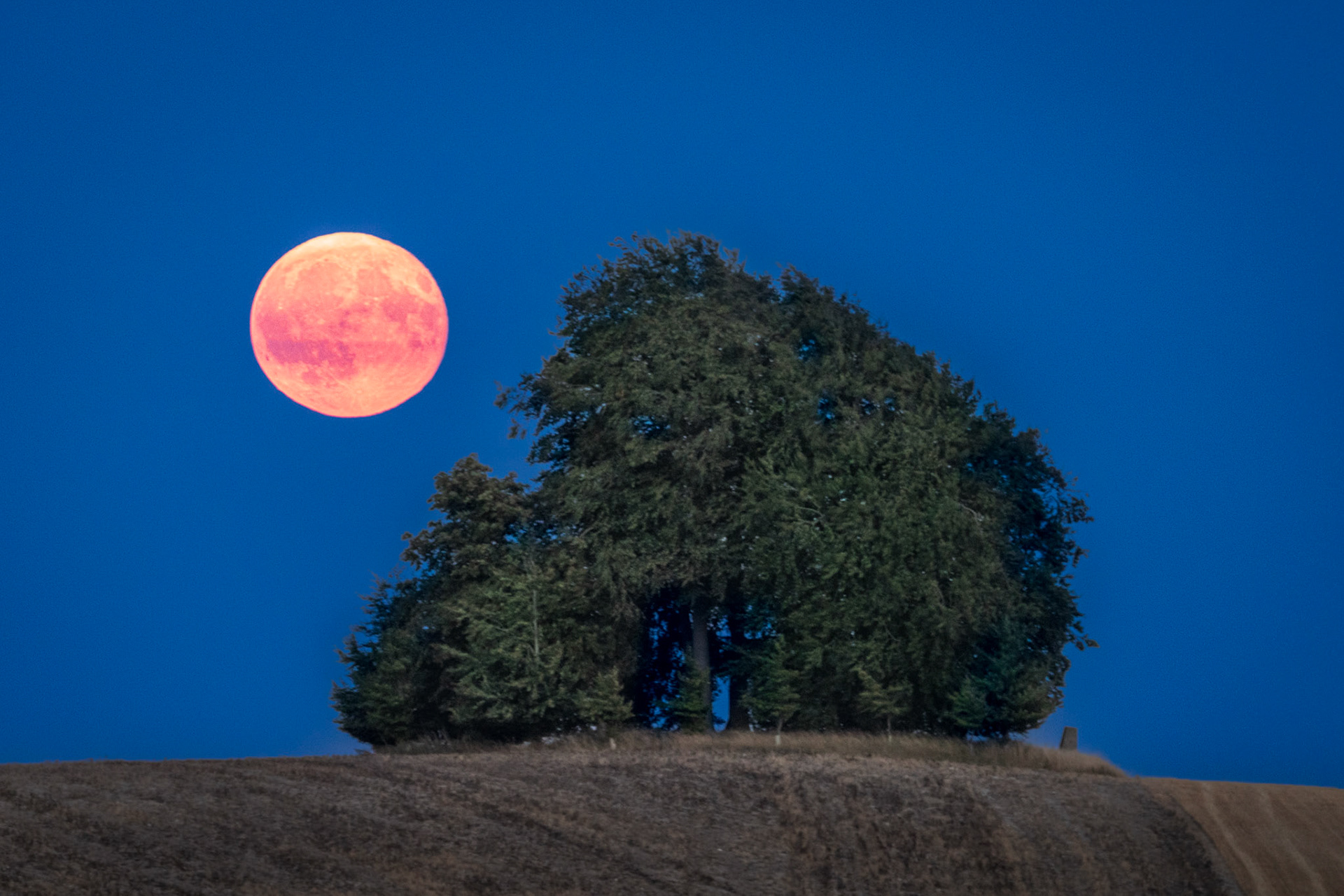
A full moon, deeply orange from atmospheric refraction, rises beside a dense hilltop copse during the blue hour of an August evening. The cluster of mixed broadleaf and conifer trees sits on a bare harvested hillside, its dark silhouette balanced against the moon's disc. The compression of a long focal length draws the two elements into close conversation without merging them.
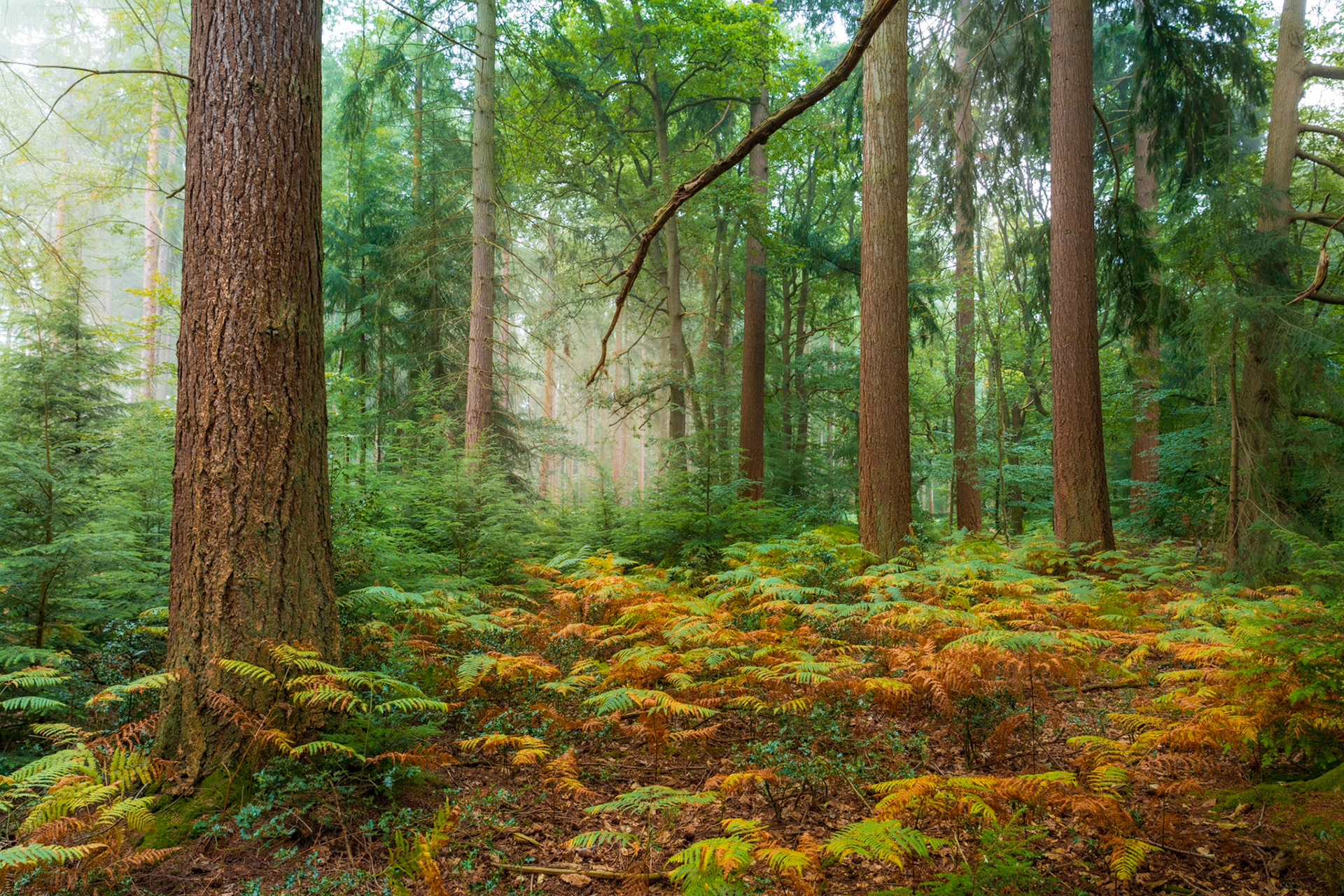
A mixed conifer woodland at dawn, the forest floor carpeted in bracken turning from green to russet in the late-summer heat. Residual mist filters the light between the tall trunks, softening the middle distance and lending the scene a quiet, layered depth. The diagonal branch and dominant foreground trunk anchor an otherwise open composition.
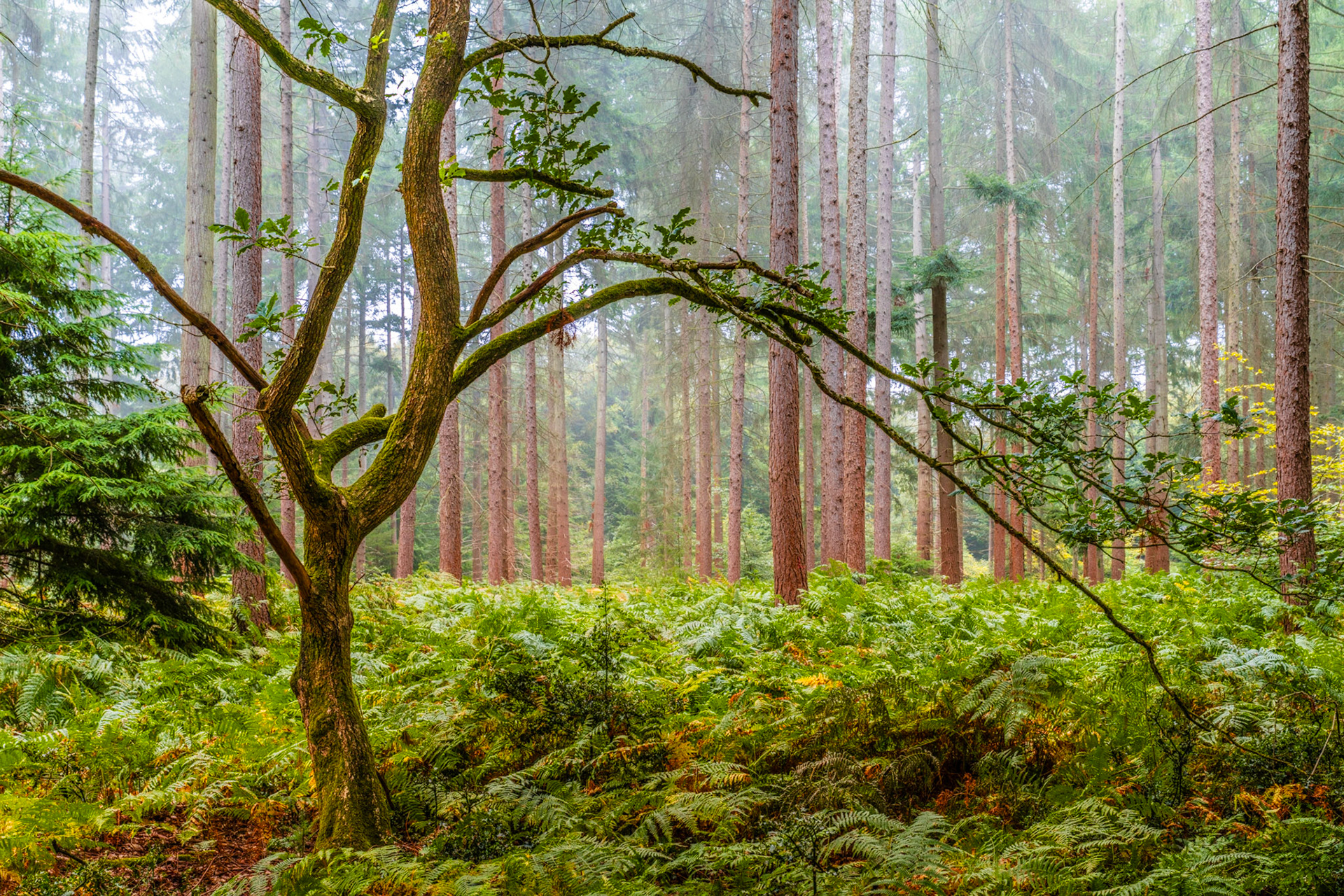
A moss-clad broadleaf tree extends a long lateral branch across a conifer plantation floor carpeted in fern, the tall trunks receding into soft morning fog. The contrast between the sinuous, low-growing tree and the regimented verticals of the surrounding conifers gives the scene quiet tension. Captured in mid-August when the bracken still holds its full summer green.
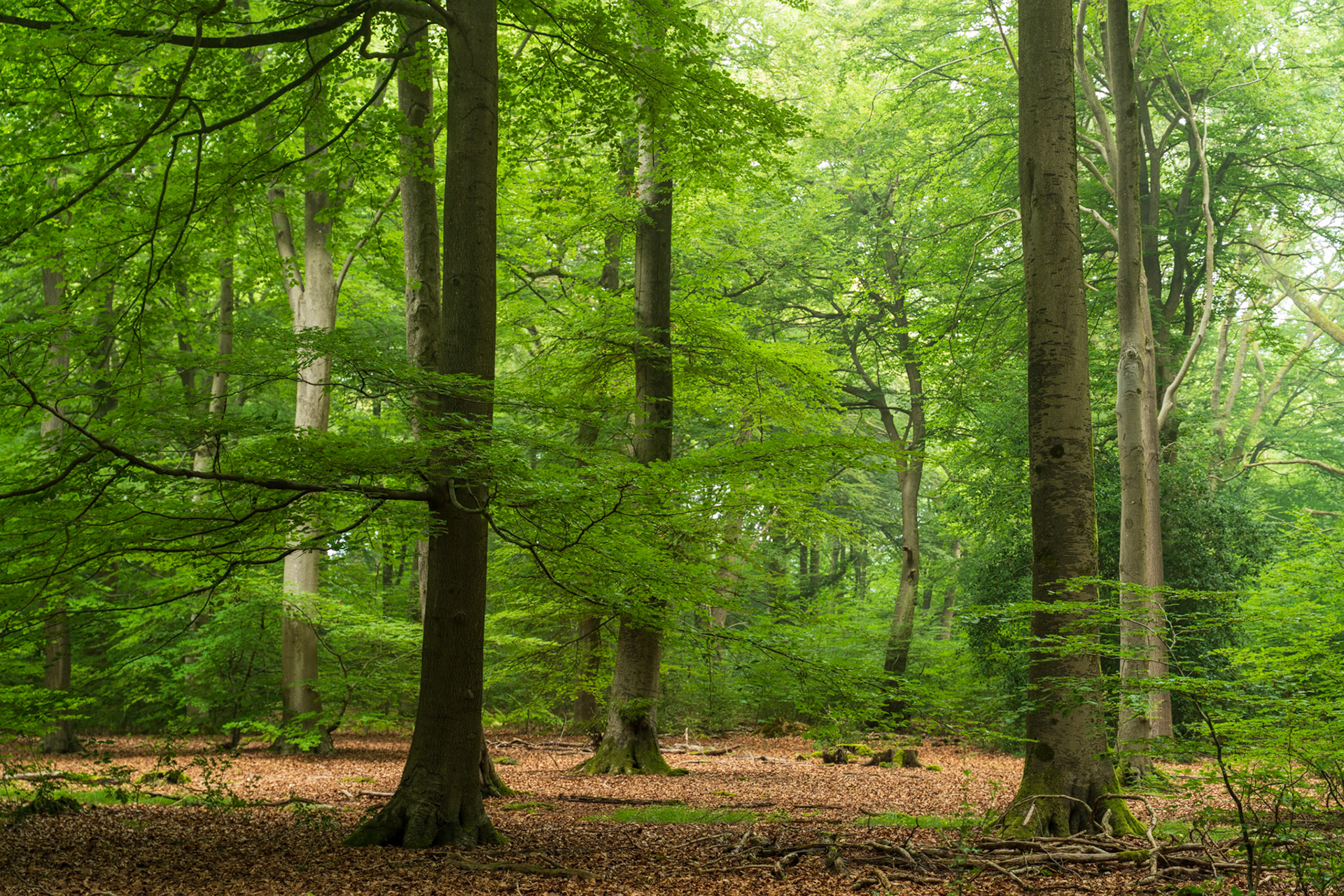
Mature beech trees stand in an open woodland interior in the Chilterns, Oxfordshire, beneath a soft, diffuse summer overcast. Fallen leaf litter carpets the floor in warm ochre tones, contrasting with the fresh canopy green above. Light mist softens the mid-distance, lending the scene a quiet, enclosed quality.
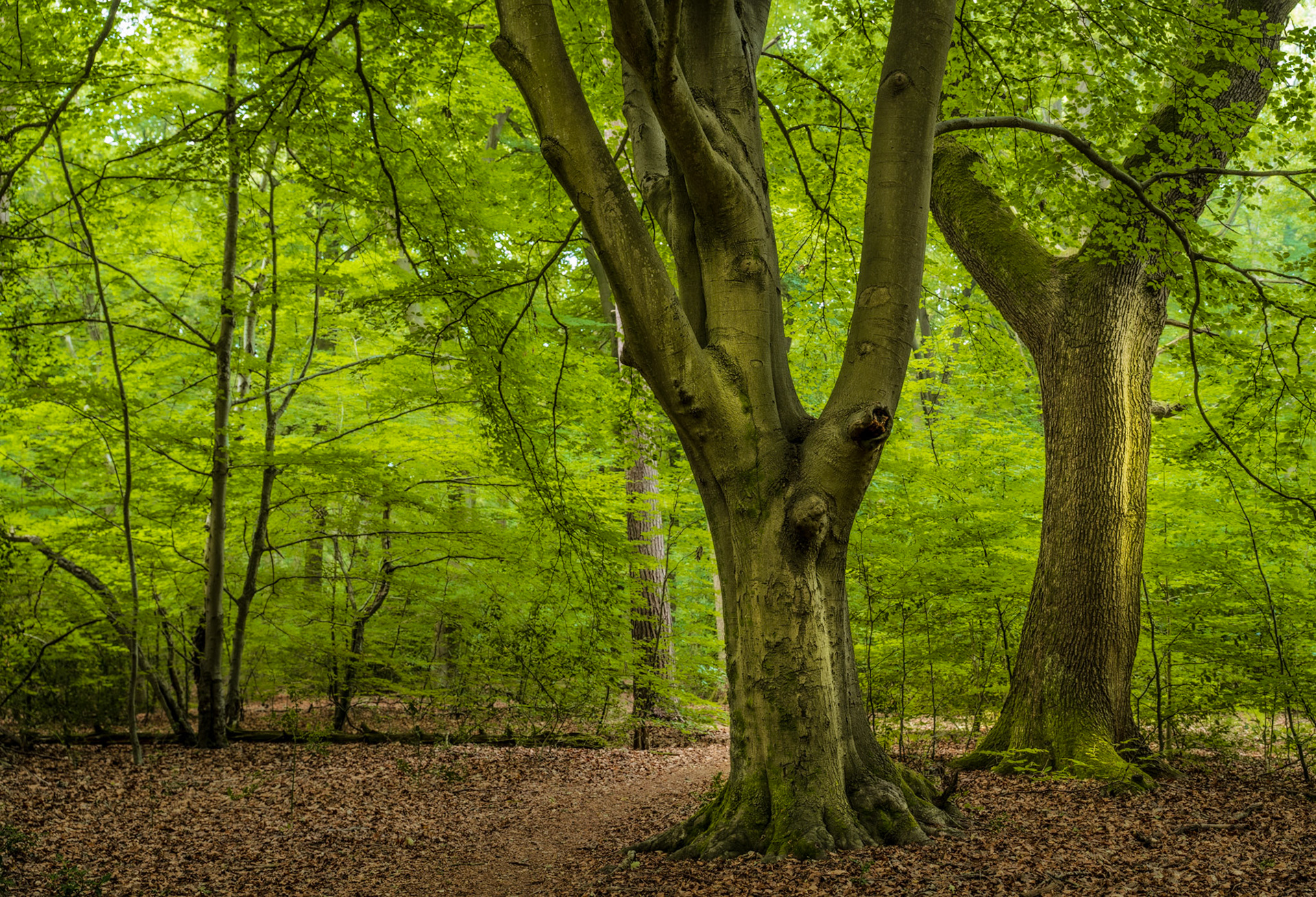
A veteran beech in the Chilterns, Oxfordshire, divides into twin leaders above a leaf-littered woodland floor, its muscular trunk and burr scars set against a canopy in full summer leaf. Soft, directionless overcast light suppresses shadow and saturates the yellow-green foliage, giving the scene an enclosed, interior quality. The absence of a strong focal anchor or atmospheric condition keeps the image within portfolio territory rather than competition grade.

A field of late-season sunflowers, most heads drooping and past their peak, stretches toward a horizon where a stormy sky breaks apart to reveal a broad yellow glow at sunset. The tension between the spent crop and the dramatic sky gives the scene a melancholy, end-of-season quality. Treeline detail on the horizon suggests temperate agricultural lowland.
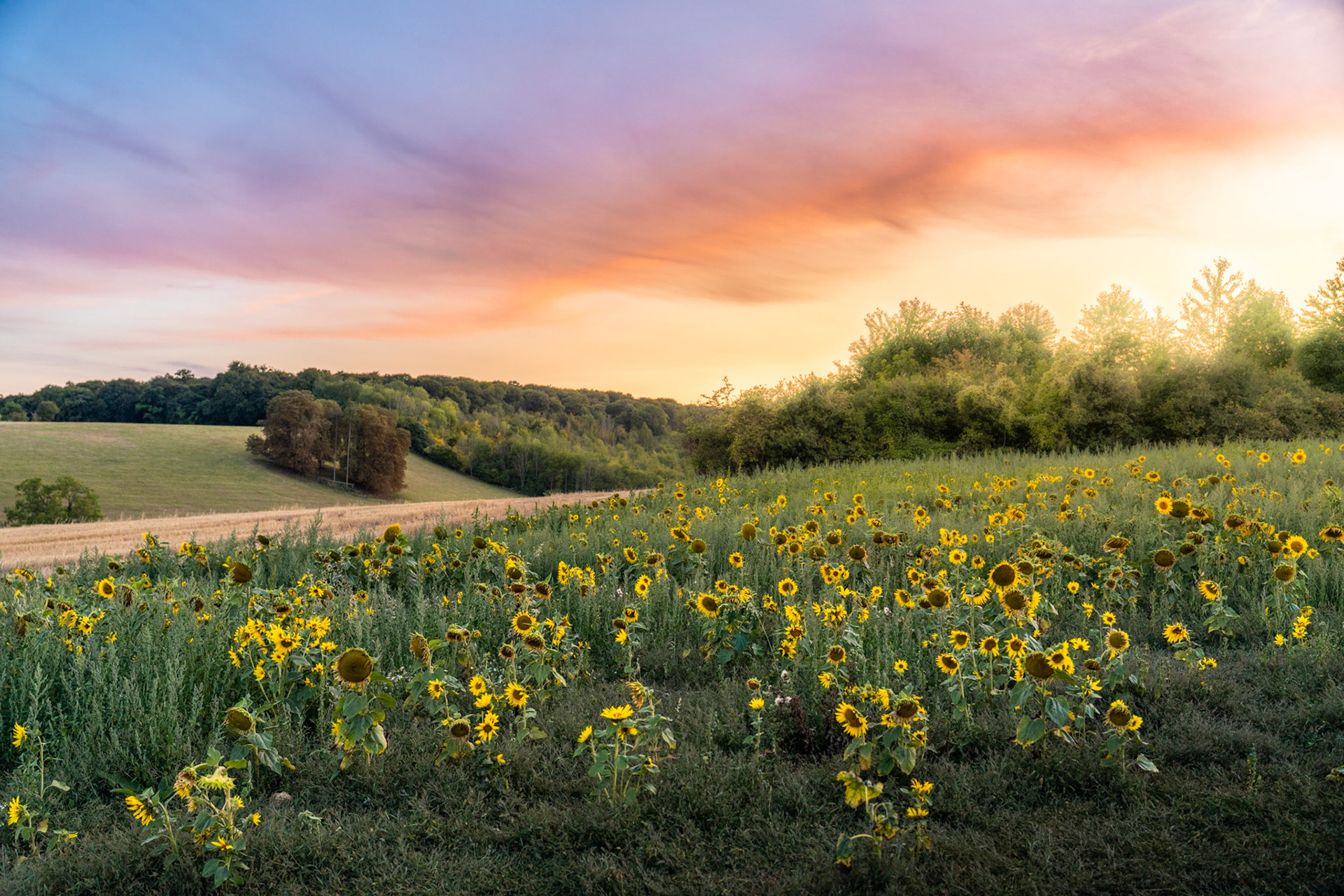
A field of sunflowers occupies the foreground as the sun sets behind a treeline, casting warm light across rolling agricultural land. The sky holds layered cloud in peach and violet tones. The scene is competently exposed but lacks a singular focal point or compositional tension.

Two simultaneous rainbows converge toward the horizon above the patchwork farmland and woodland of the Thames Valley, photographed from altitude during the passage of a summer storm. The compressed aerial perspective renders both arcs as structural elements against a dark cumulonimbus backdrop, with an unusual shaft of bright sky trapped between them. Captured near Henley-on-Thames in late afternoon light, September 2025.
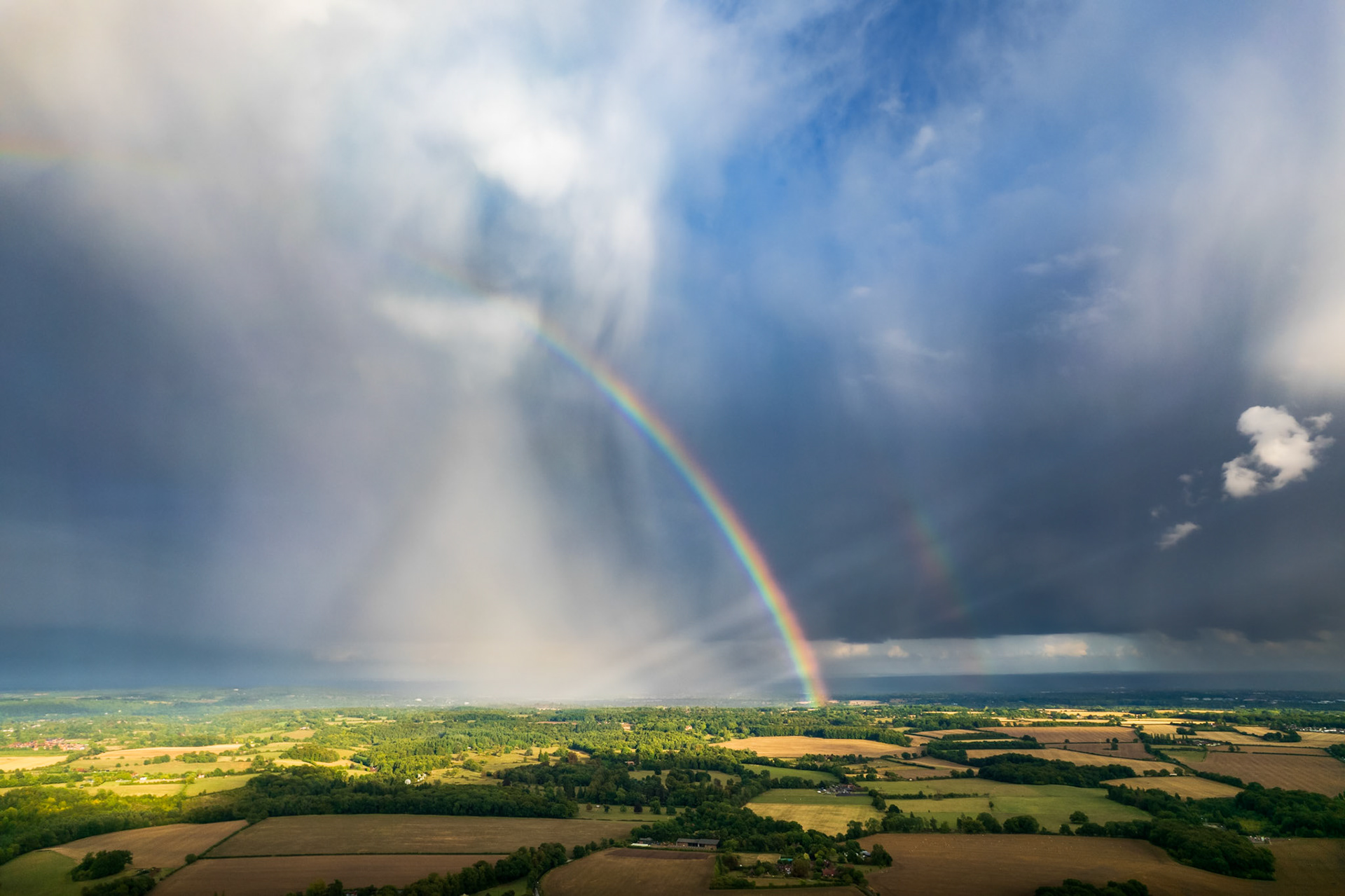
A vivid double rainbow descends through the base of a convective storm cell over the Thames Valley lowlands, captured from altitude as a rain shaft sweeps across a patchwork of summer fields and woodland. The aerial vantage reveals the full arc geometry impossible from ground level, set against a bruised, layered sky still broken by clear blue to the east. The proximity of sunlit crops and dark storm cloud gives the image an unusual tonal compression.
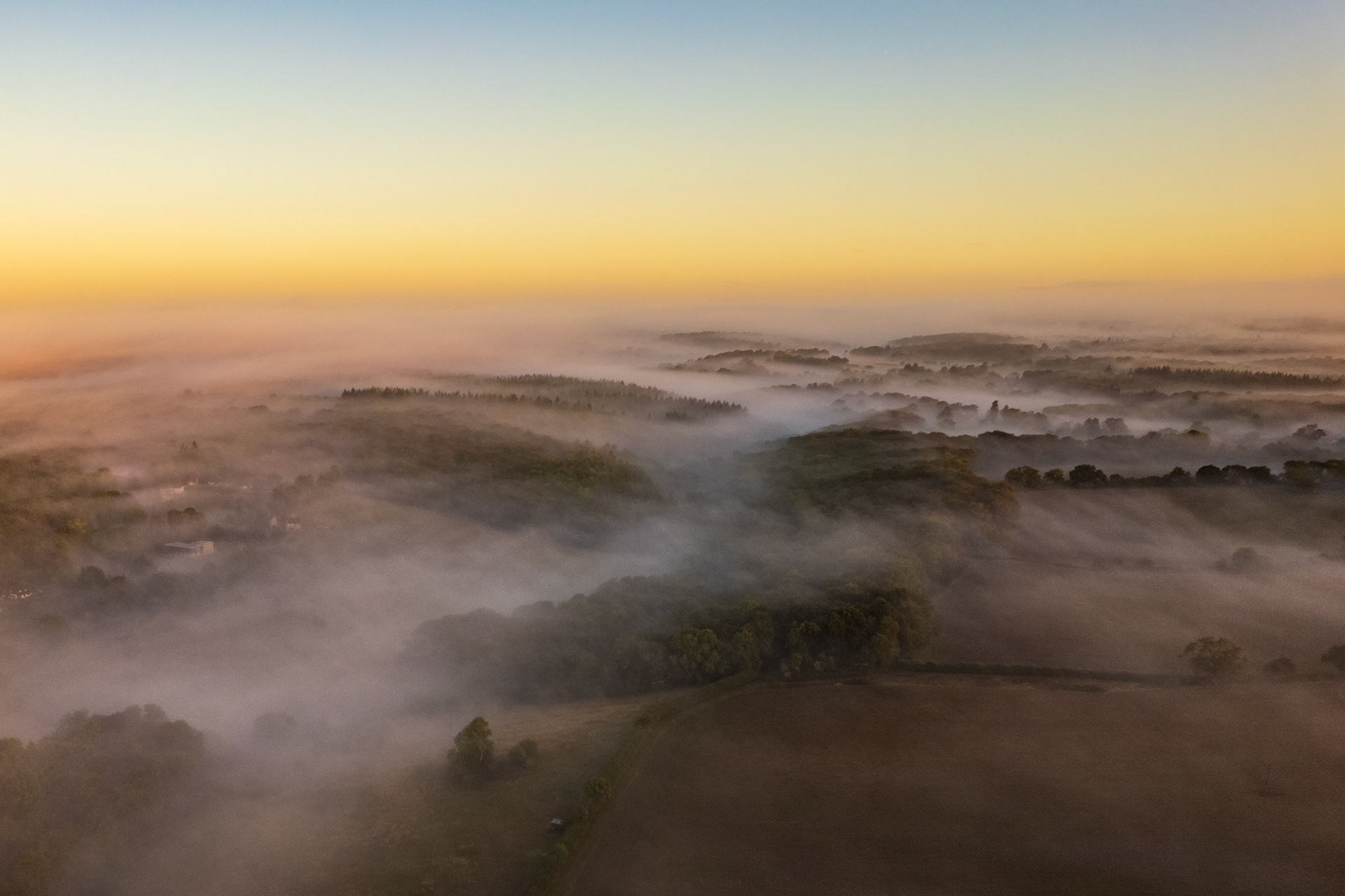
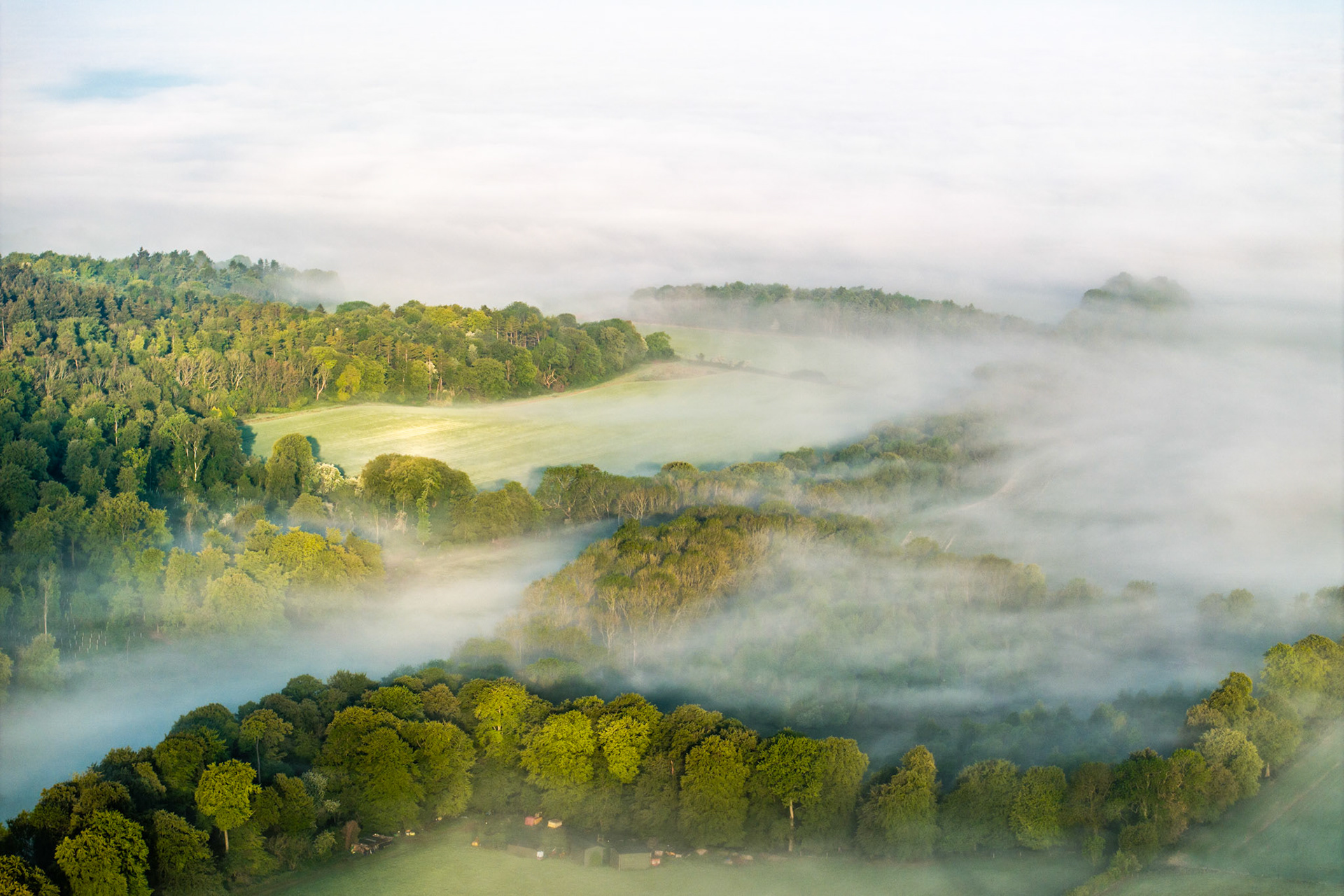
Ground mist pools in the valleys and hedgerow corridors of the Chiltern escarpment south of Henley-on-Thames, photographed from altitude at first light in early September. Tree canopies emerge as islands above the fog, their forms softened by the warm pre-sunrise glow. The layered recession of mist and ridge creates a quiet sense of depth across the rolling farmland.
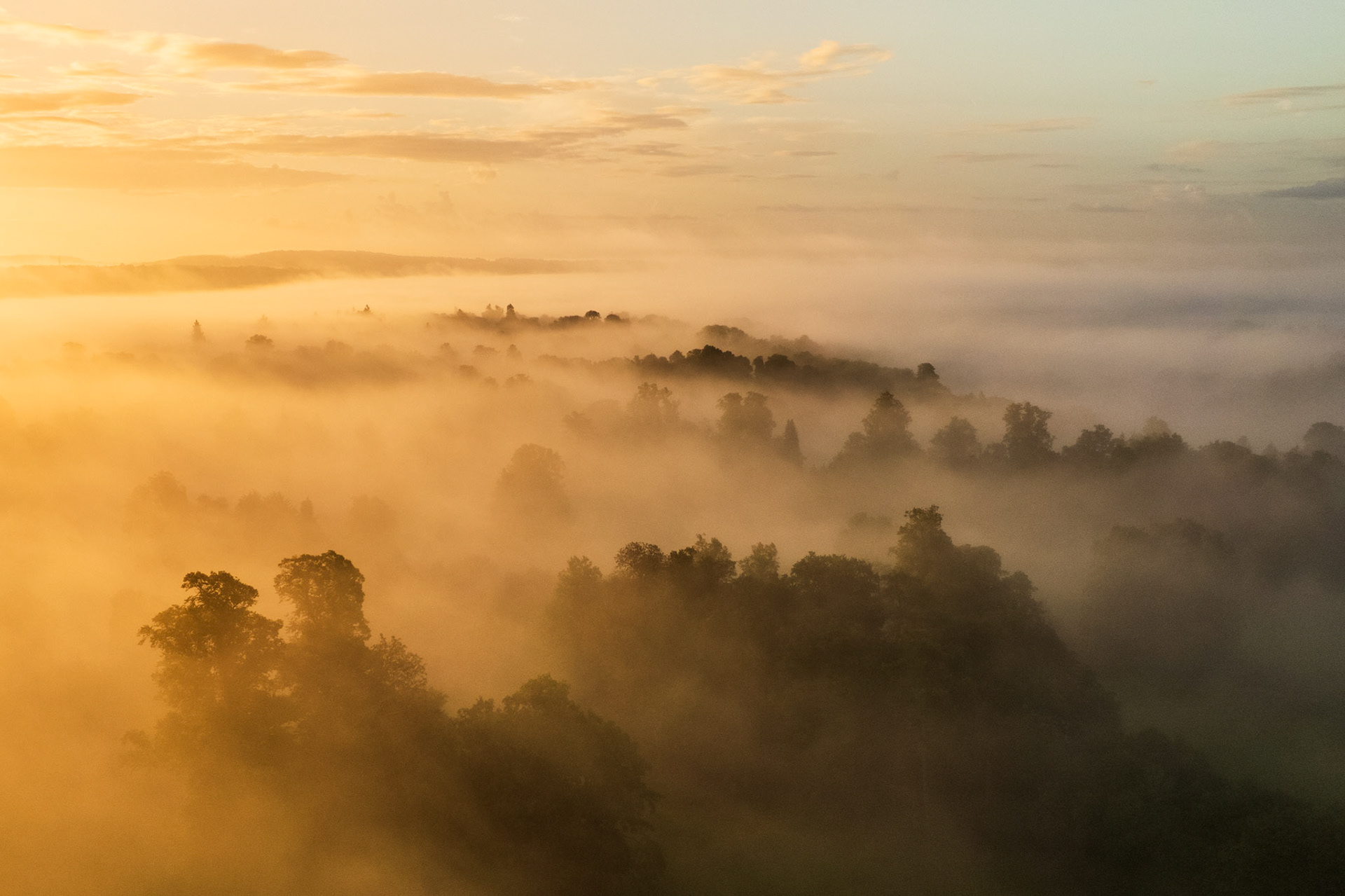
A thermal inversion settles across a wooded valley near Henley-on-Thames at first light, the canopy of deciduous trees breaking through successive layers of fog as warm dawn light rakes in from the south-east. The aerial perspective flattens the landscape into receding tonal planes, with cooler grey mist to the right contrasting the amber wash on the left. The tree crowns, still in full summer leaf, anchor each band of vapour and give the composition its quiet structure.
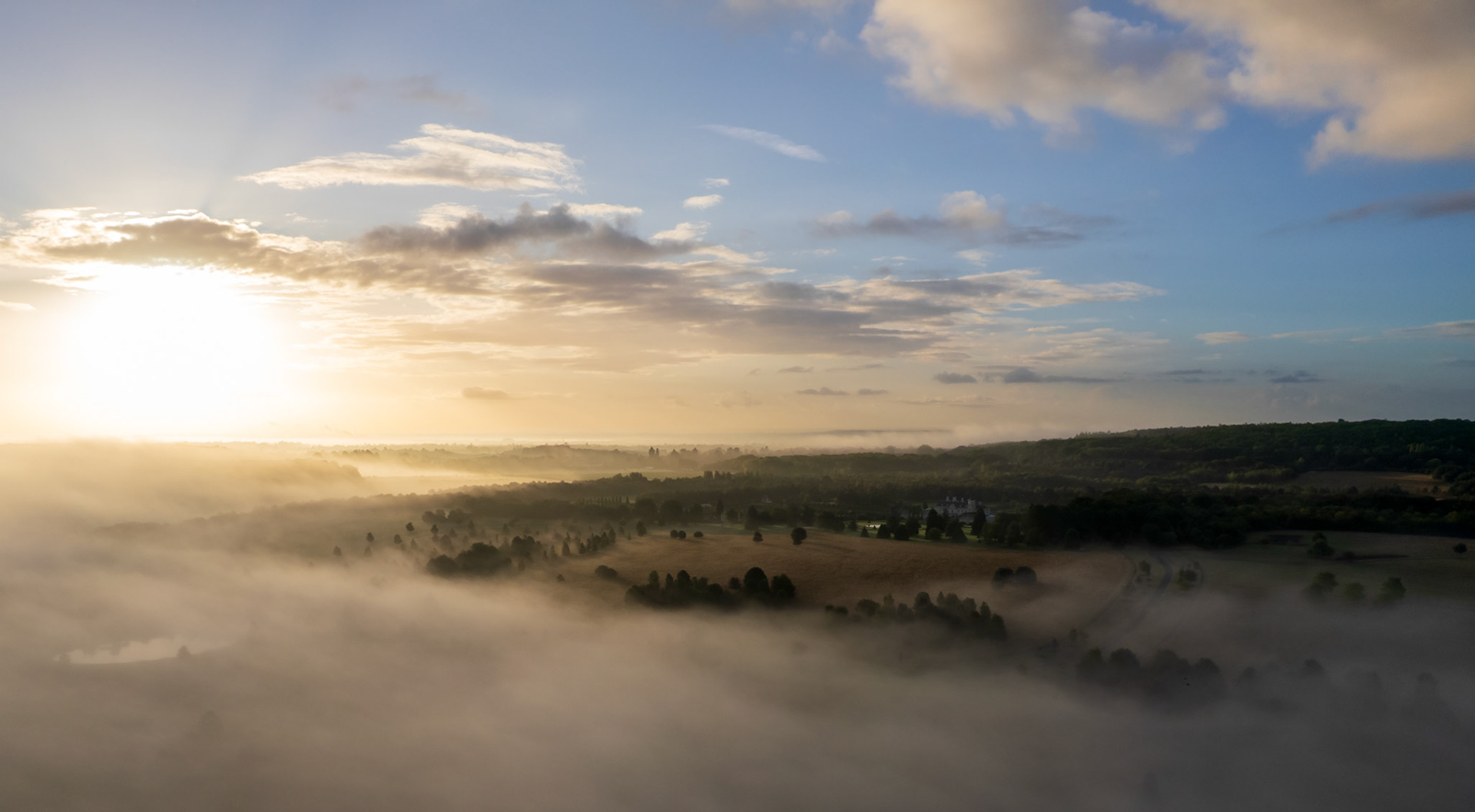
A temperature inversion holds a blanket of fog across the Thames Valley lowlands near Maidenhead, photographed from altitude at first light on an early September morning. Isolated tree crowns and field boundaries break the fog surface, while warm light from the low sun diffuses through the moisture-laden air to the west. A country house sits half-revealed in the middle distance, anchoring the otherwise abstract pastoral scene.
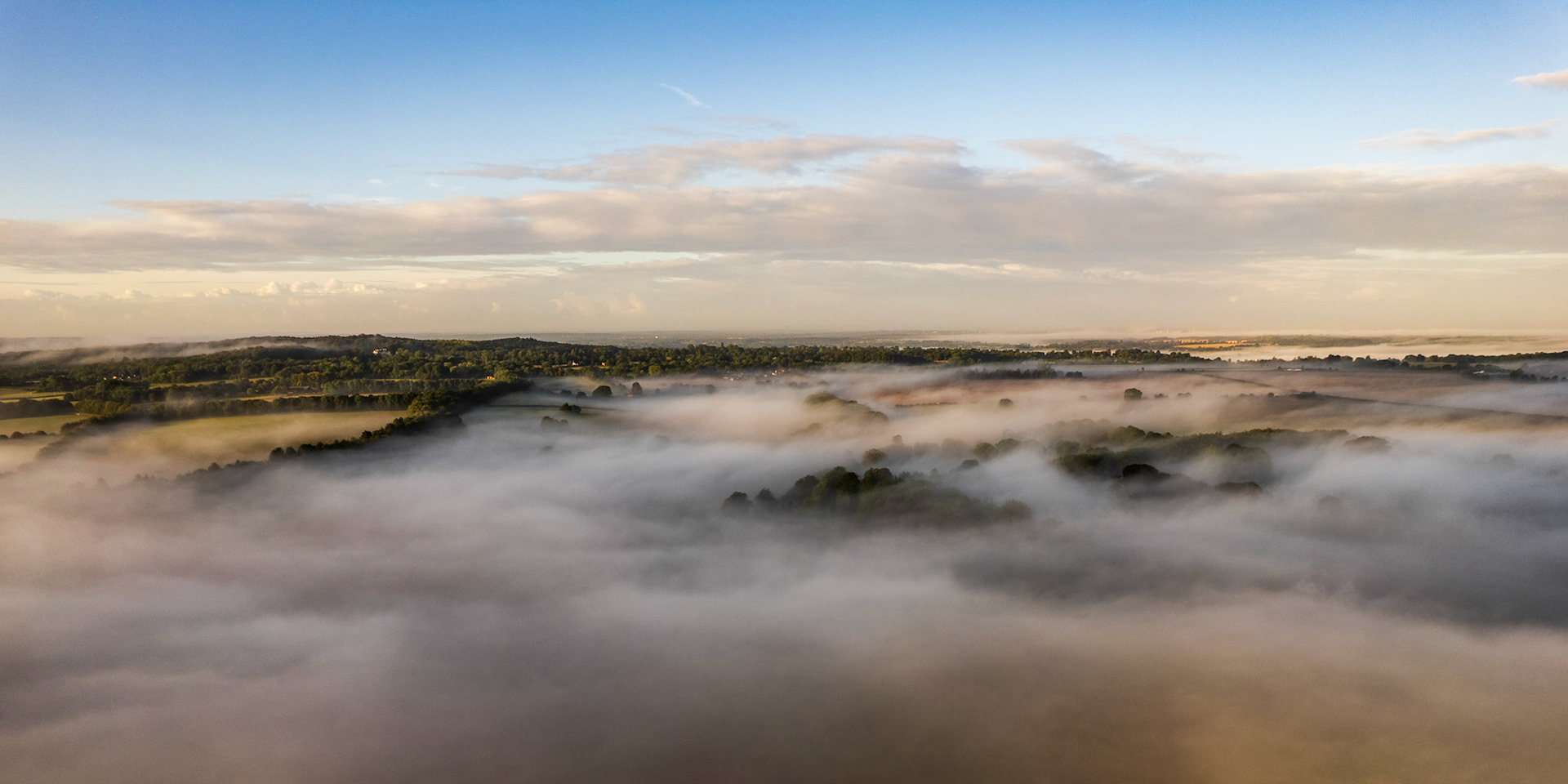
A temperature inversion pins a shallow fog across the Thames Valley lowlands near Maidenhead, submerging the fields while tree canopies and distant wooded ridges remain above the surface. Captured at first light in early September, the aerial vantage reveals the fog as a continuous, almost liquid plane, broken only by the crowns of mature broadleaf trees. The soft, diffuse illumination holds the scene in a quiet, pre-colour state.
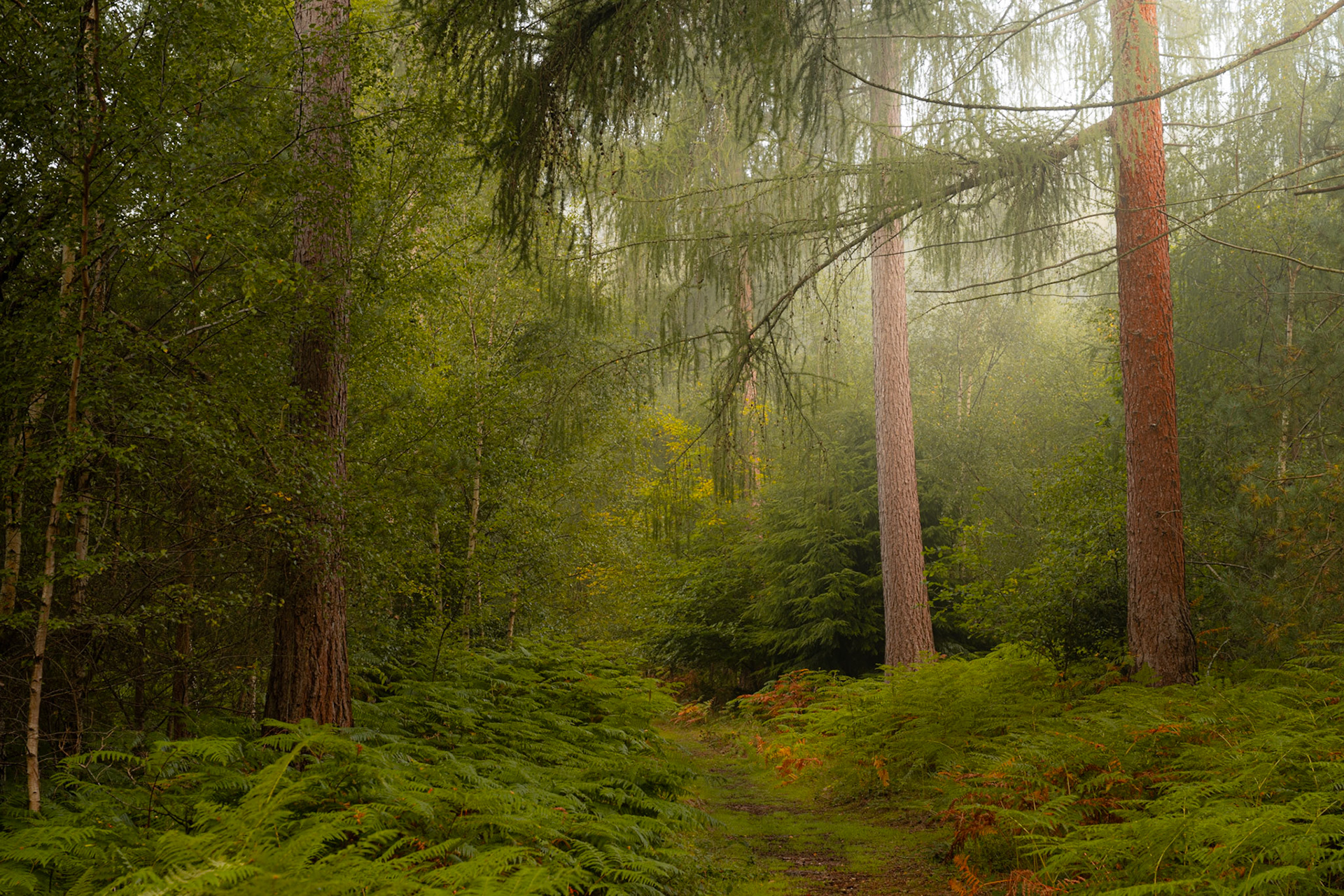
Mist settles between mature conifers and silver birch in a mixed British woodland at dawn, the diffused light catching suspended moisture above a fern-lined track. A foreground carpet of bracken shows the first rust tones of early autumn. The soft luminance in the middle distance creates a sense of depth without a defined focal point.
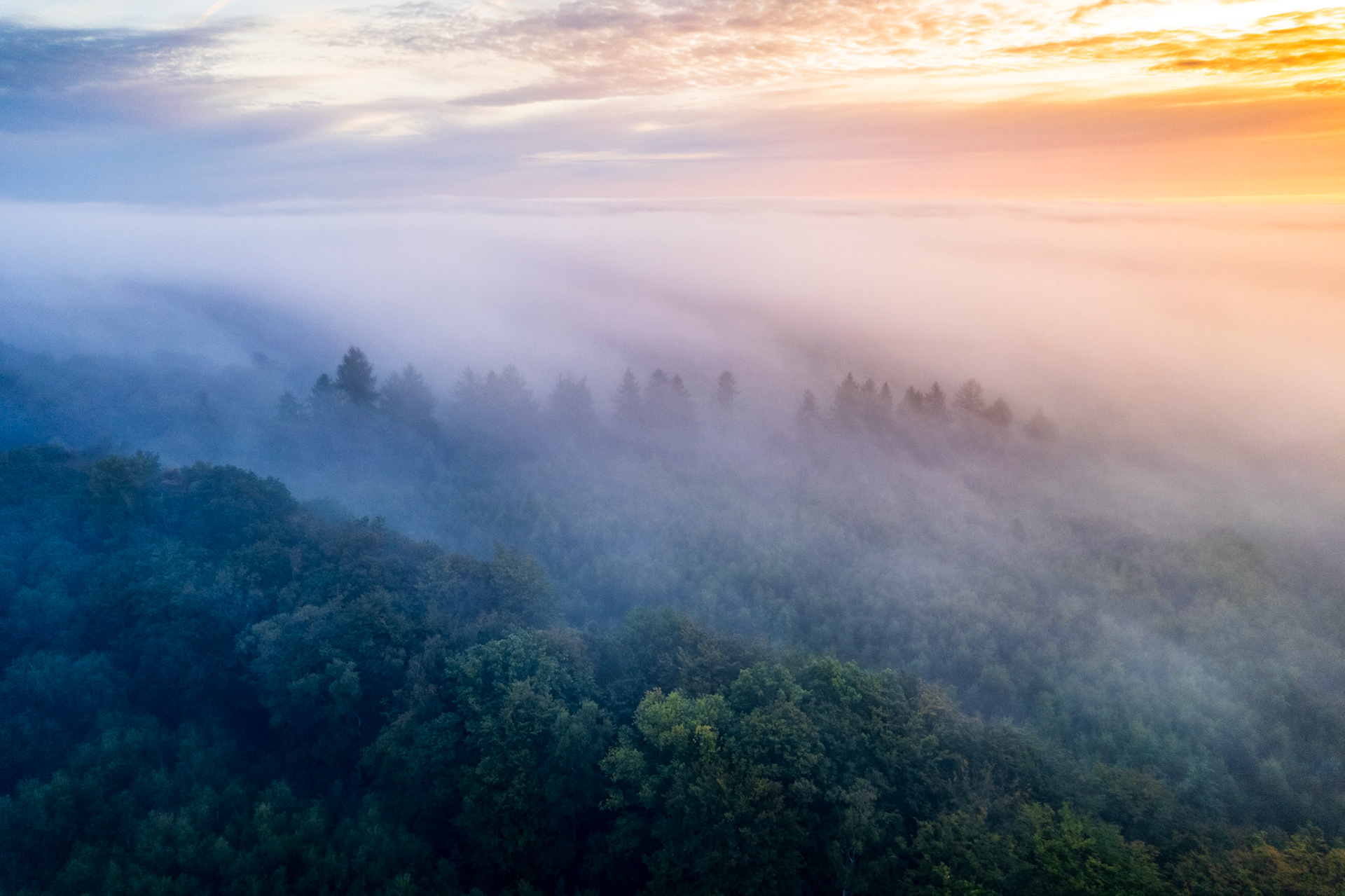
A temperature inversion traps dense mist in the valley below Henley-on-Thames, the canopy of mixed deciduous woodland emerging from the fog bank as dawn light warms the eastern sky. Conifers along the ridge-line break the fog surface in a ragged silhouette, separating cool blue shadow below from the peach and amber of the rising sun. The aerial perspective collapses the familiar into something close to abstraction.
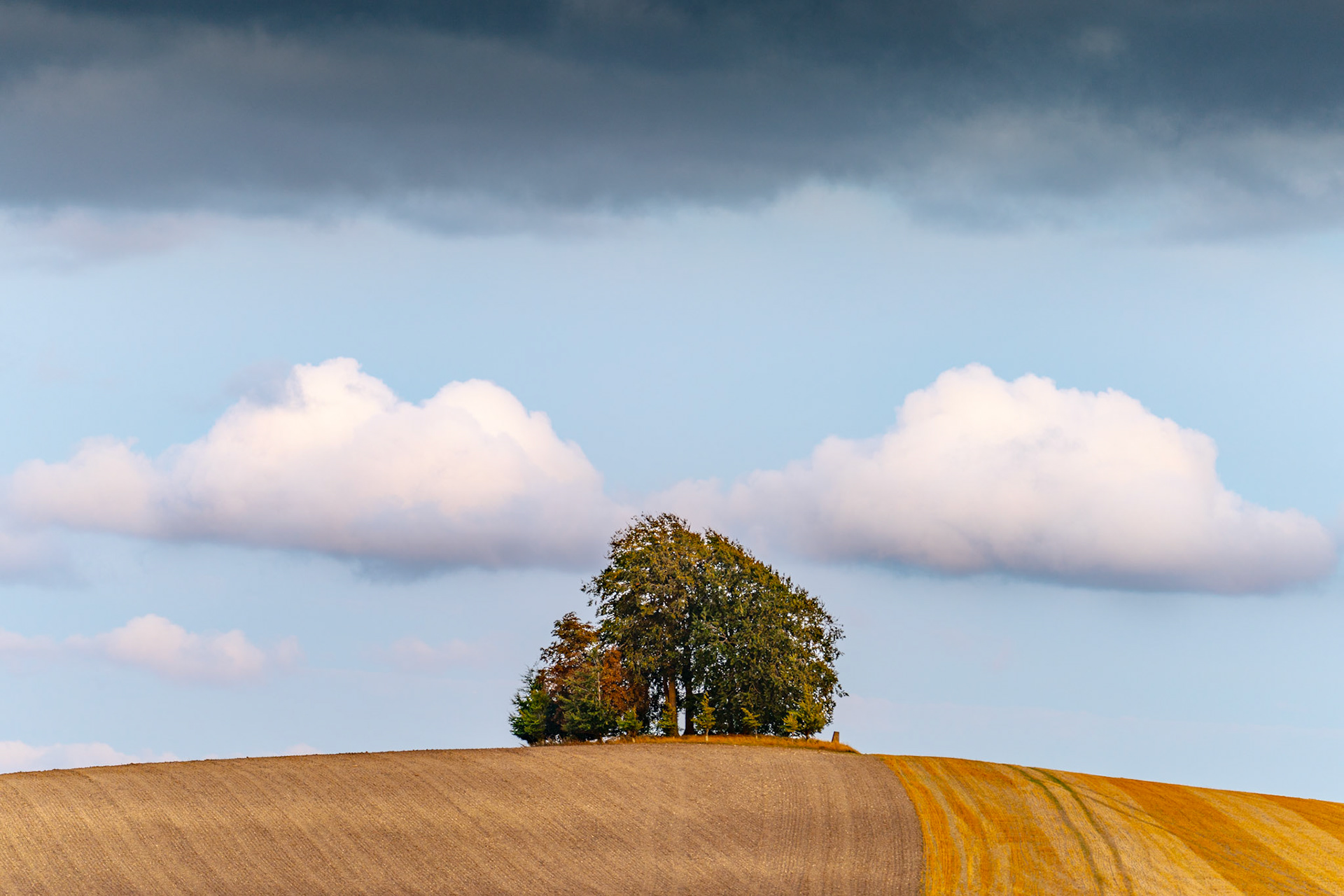
A tight cluster of broadleaved trees crowns a bare arable hill as storm cloud builds above and late afternoon light catches the ploughed soil below. The symmetry of two flanking cumulus formations and the dark band at the frame's top create a quiet tension around the solitary stand. Tractor lines in the foreground field draw the eye upward to the trees against the clearing sky.
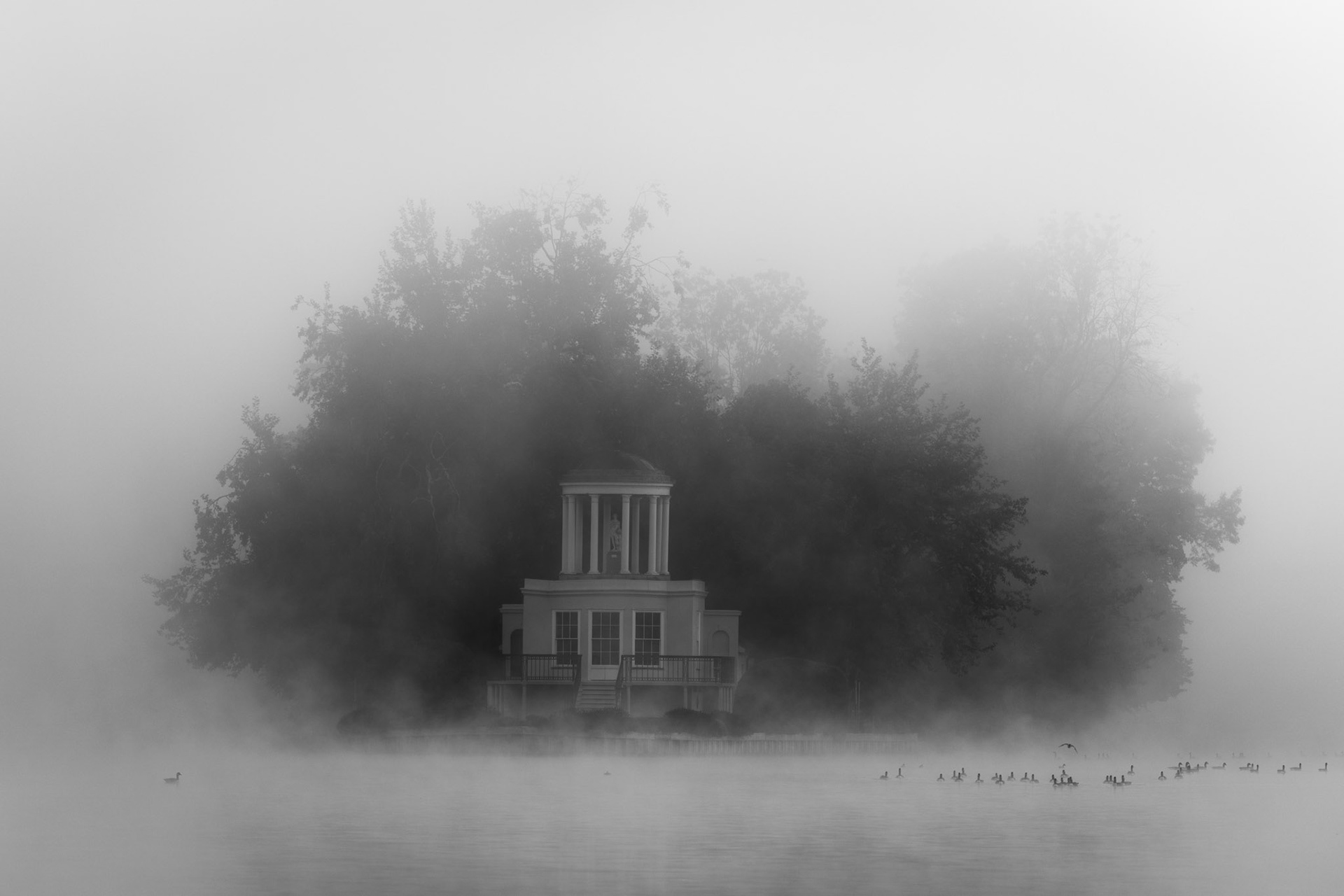
A neoclassical waterside temple emerges from dense morning fog, its columned rotunda framed by a mass of trees that dissolve at the edges into white. A loose gathering of waterfowl rests on the still water below, anchoring the scene in quiet life. The monochrome rendering strips the image to tone and atmosphere alone.
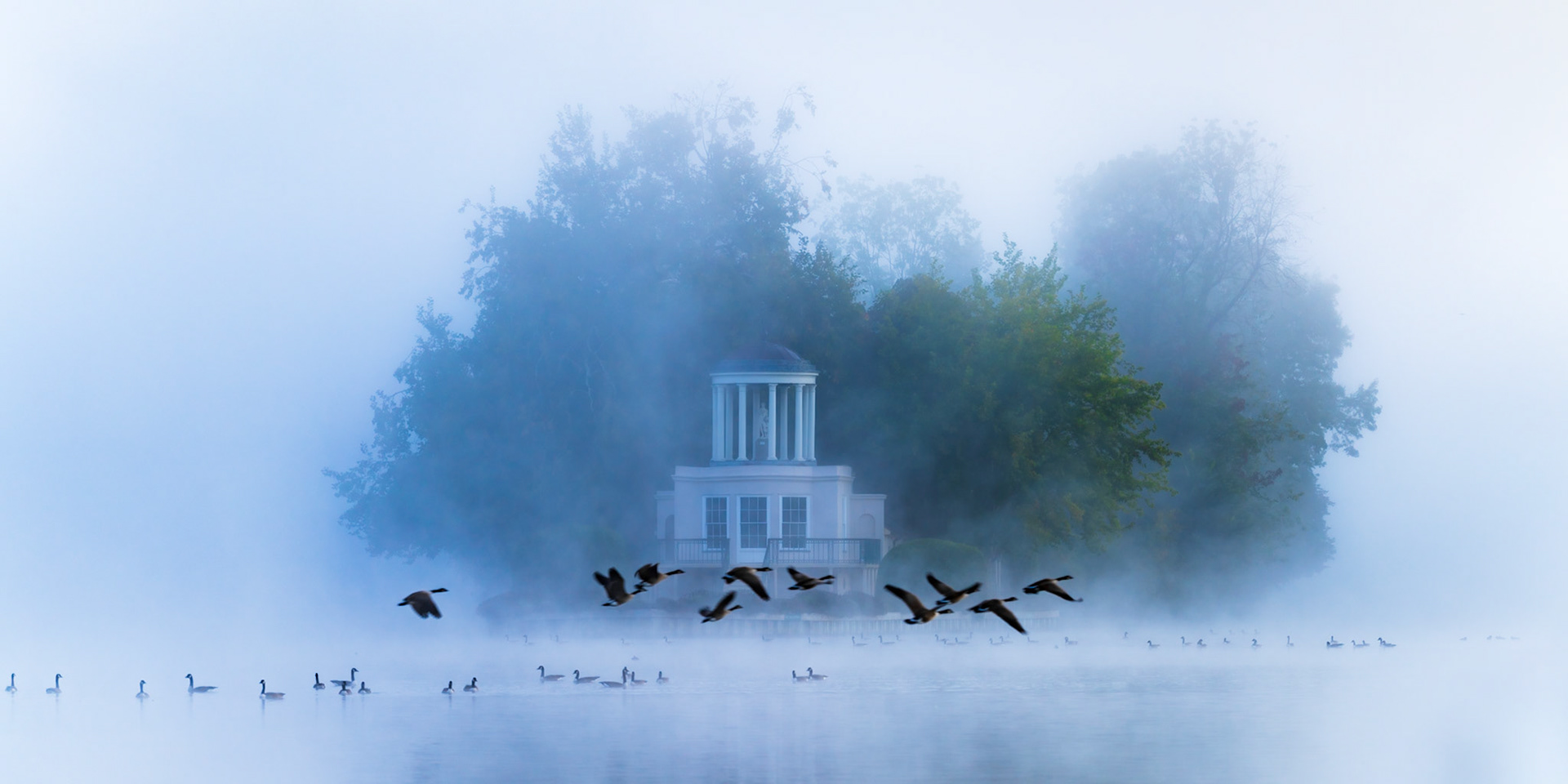
A flock of Canada geese lifts from the water in front of Temple Island, Henley-on-Thames, as dense dawn fog dissolves the treeline into soft blue-grey tones. The neoclassical fishing lodge — designed by James Wyatt in 1771 — materialises just clearly enough to anchor the scene without dominating it. The simultaneous stillness of the swimming birds along the foreground and the kinetic burst of the departing flock creates a rare layering of mood and movement.

Canada geese break from the river in loose formation as early mist dissolves around a neoclassical island folly on the Thames. Warm ground fog diffuses the rising light behind the treeline while a second, denser skein wheels away to the right, lending the scene layered depth and movement. The juxtaposition of wild flight and composed Georgian architecture gives the image an uncommon stillness within its chaos.

A skein of Canada geese wheels through early morning mist above the Thames at Henley, the neoclassical fishing lodge on Temple Island emerging from fog suffused with warm dawn light. The birds fill the frame at every depth, lending scale and movement to an otherwise still scene. Ground mist obscures the waterline, isolating the building between river and sky.
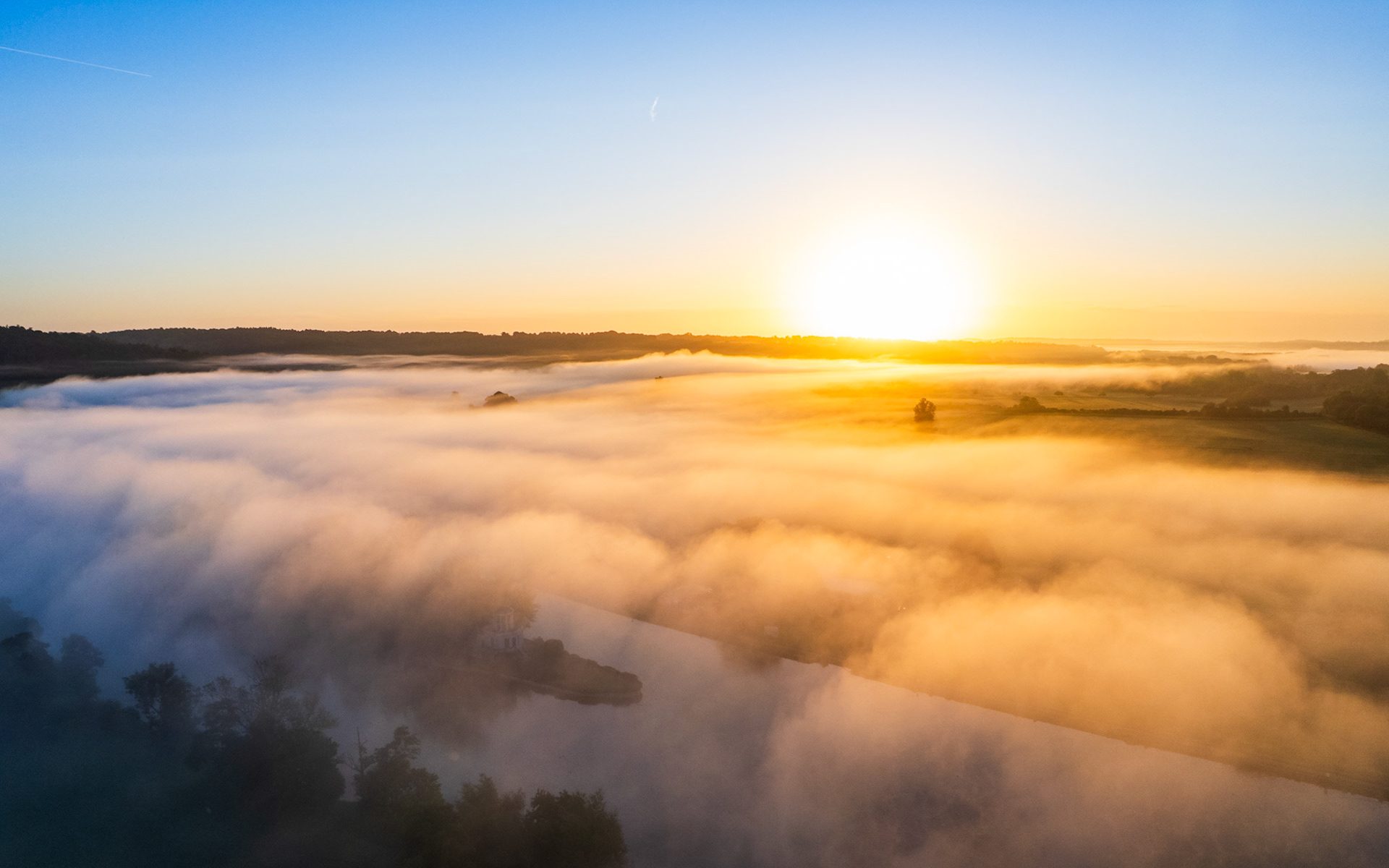
A temperature inversion fills the Thames Valley with dense ground fog at first light, tree canopies and hedgerows breaking the surface like islands. Photographed by drone near Henley-on-Thames in early autumn, the warm solar disc backlit the fog mass from the east, while cooler blue shadow held the foreground. The juxtaposition of luminous mist and dark emerging vegetation gives the scene an almost oceanic quality.
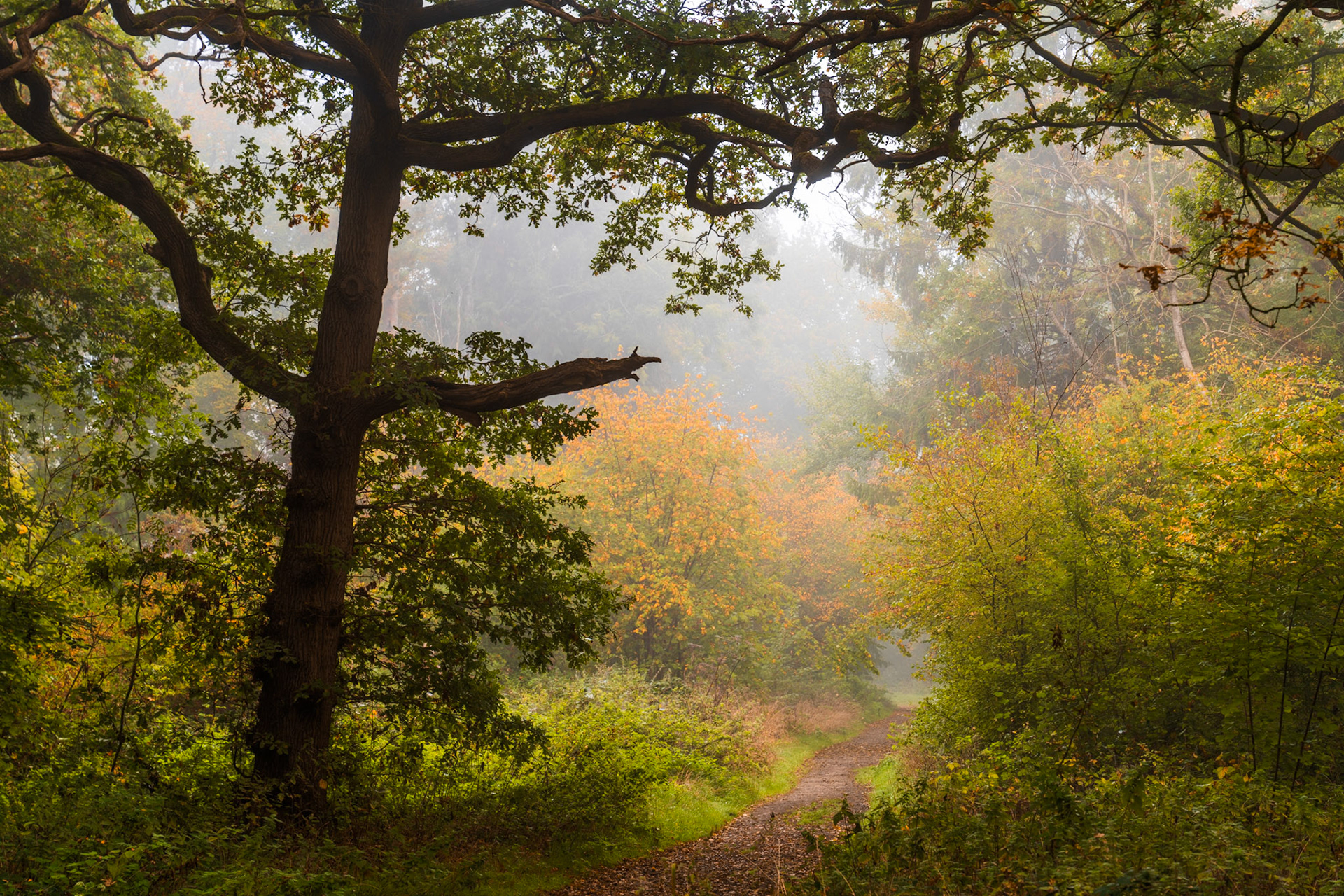
A veteran oak frames a woodland track dissolving into autumn fog, its lateral branch cutting across the middle distance with quiet authority. Early-season colour — amber and ochre in the understorey — is softened by the diffuse light. The path draws the eye into a wall of mist that withholds any resolution.
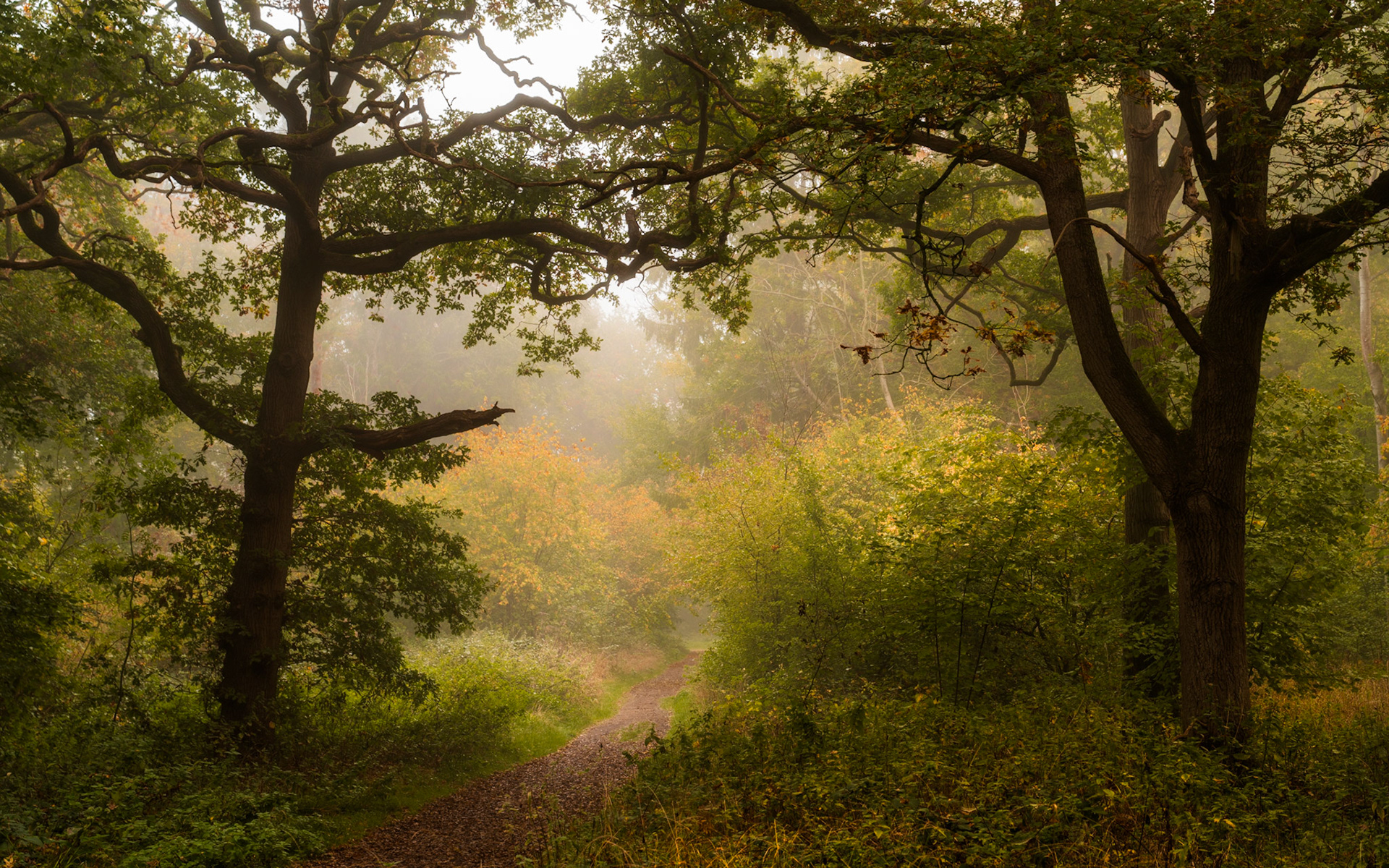
A narrow woodland track in the Chilterns, Oxfordshire, recedes into early-morning mist beneath the arching canopy of two veteran oaks, their gnarled branches framing a softly luminous middle distance. Understorey shrubs are turning to amber and yellow, placing the image at the cusp of autumn. The diffuse backlight and layered depth give the scene a quiet, threshold quality.
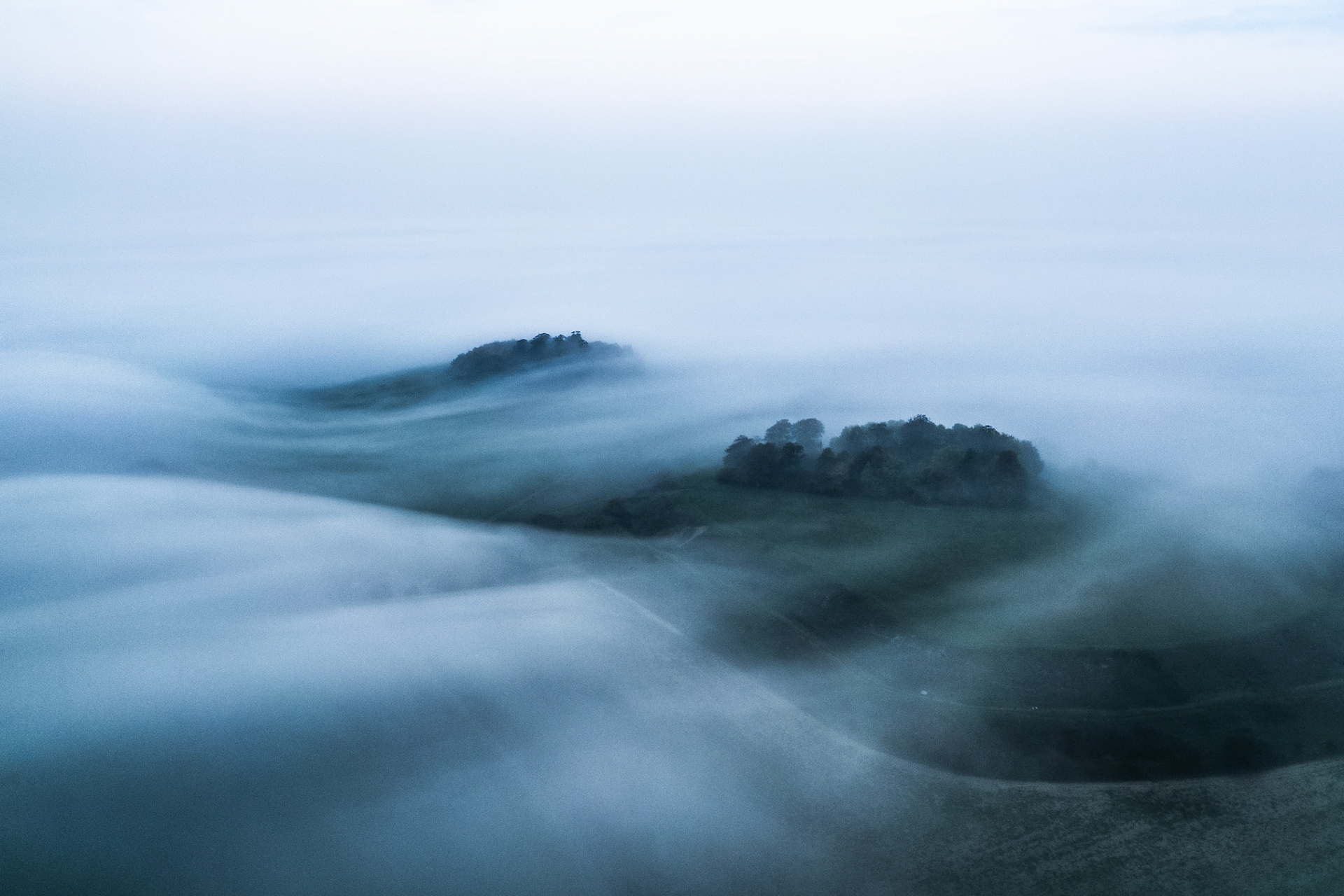
A temperature inversion fills the valleys around Brightwell Barrow and the Wittenham Clumps in Oxfordshire with rolling fog at dawn, leaving two wooded hilltops as dark islands adrift in a monochrome sea. The long-exposure drone frame records the fog's motion as fluid, directional streaks, compressing sky and ground into a single tonal plane. Captured in mid-October near Abingdon-on-Thames, the image sits at the threshold between landscape and pure abstraction.
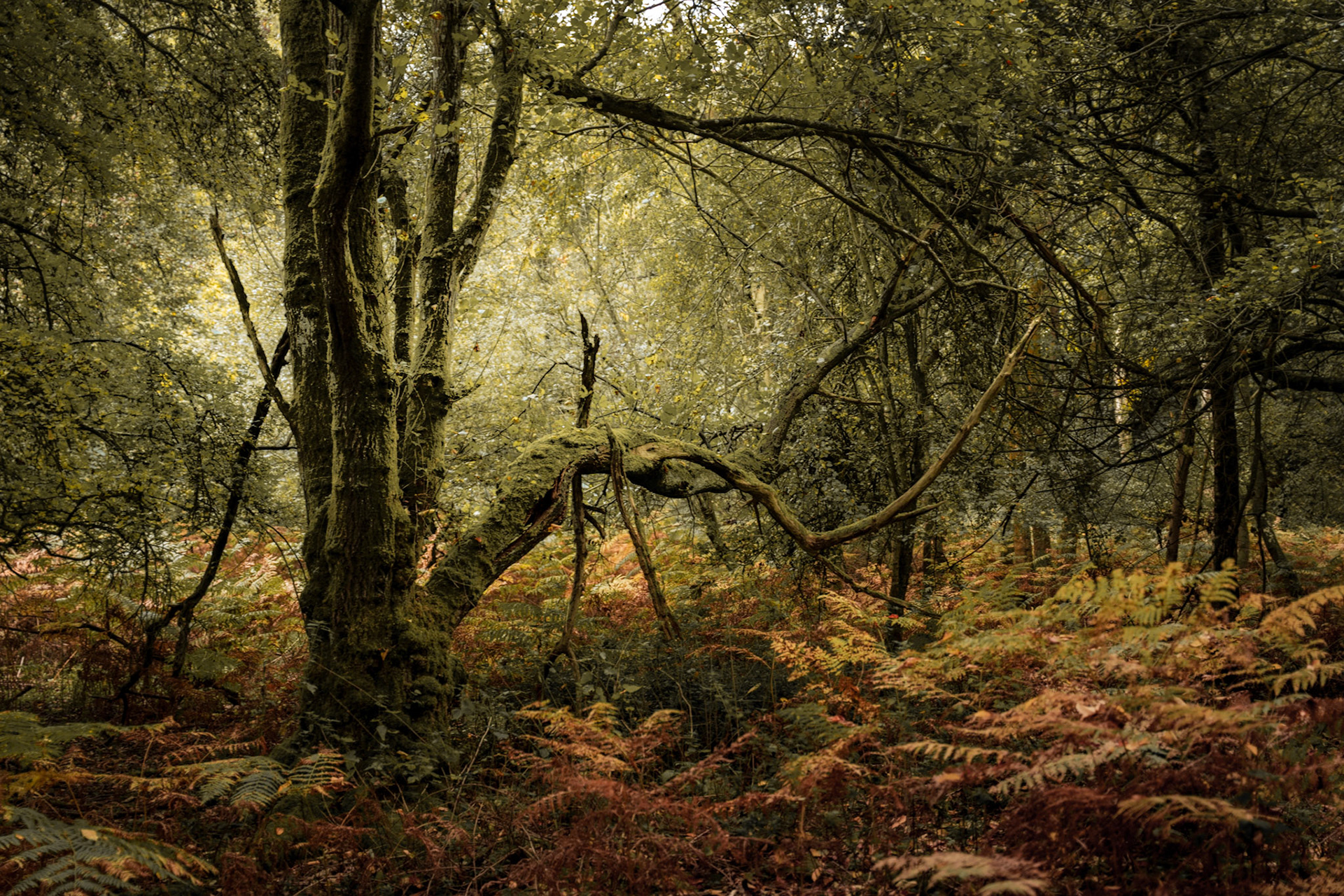
A moss-covered fallen branch arches low through the understorey of a broadleaved woodland, its twisted form echoing the gnarled canopy above. Bracken in mixed stages of autumn die-back carpets the woodland floor, shifting from ochre to deep russet. Diffuse overcast light flattens contrast and draws the eye into the depth of the stand.
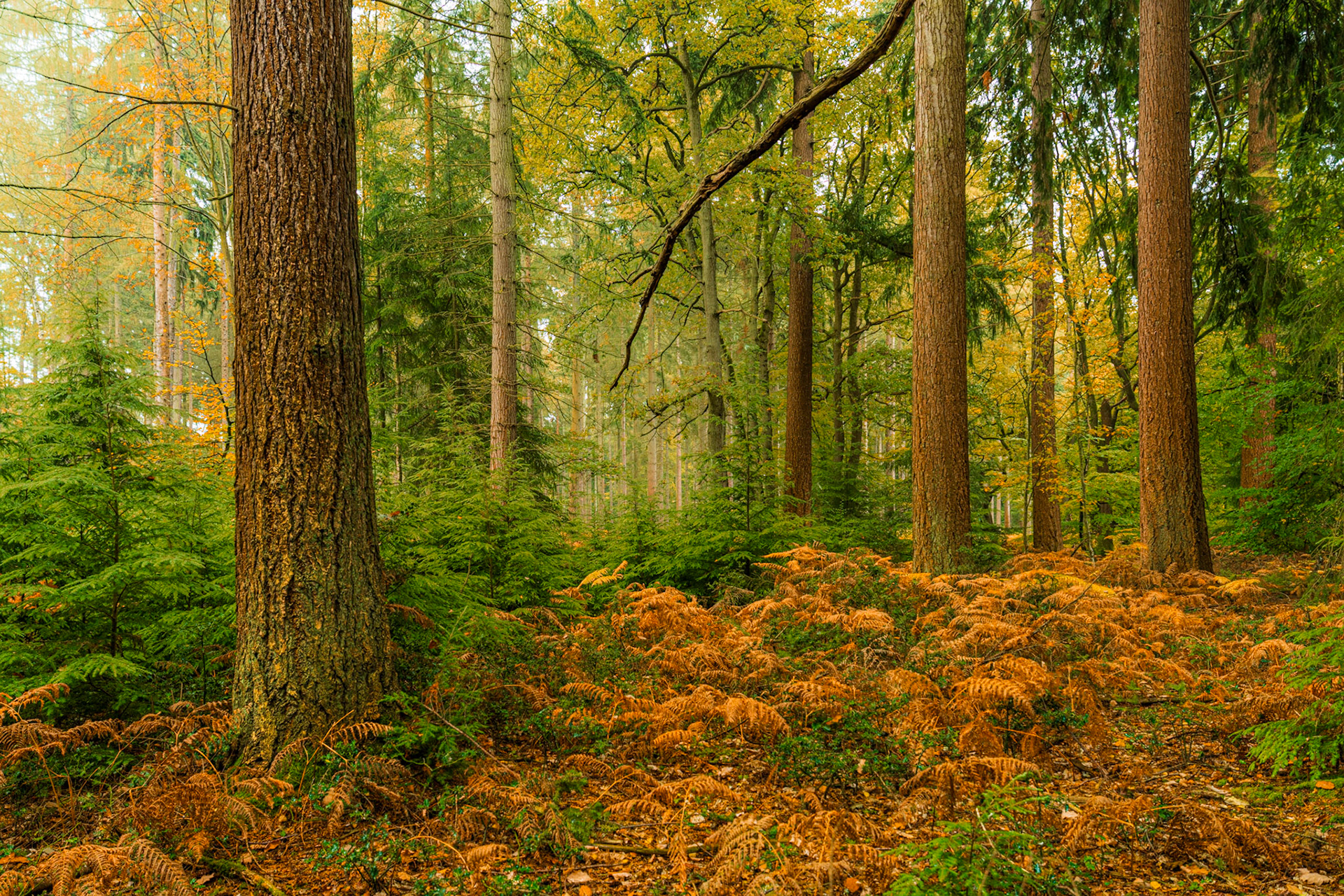
A mixed woodland floor in the Chilterns, Oxfordshire, carpeted in rust-coloured bracken receding between tall conifer and broadleaf trunks in mid-autumn. Soft diffuse light under overcast skies flattens contrast and allows the warm tones of the dying fern to hold against the deep evergreen understorey. The composition lacks a resolved focal point but records the transitional character of the season faithfully.
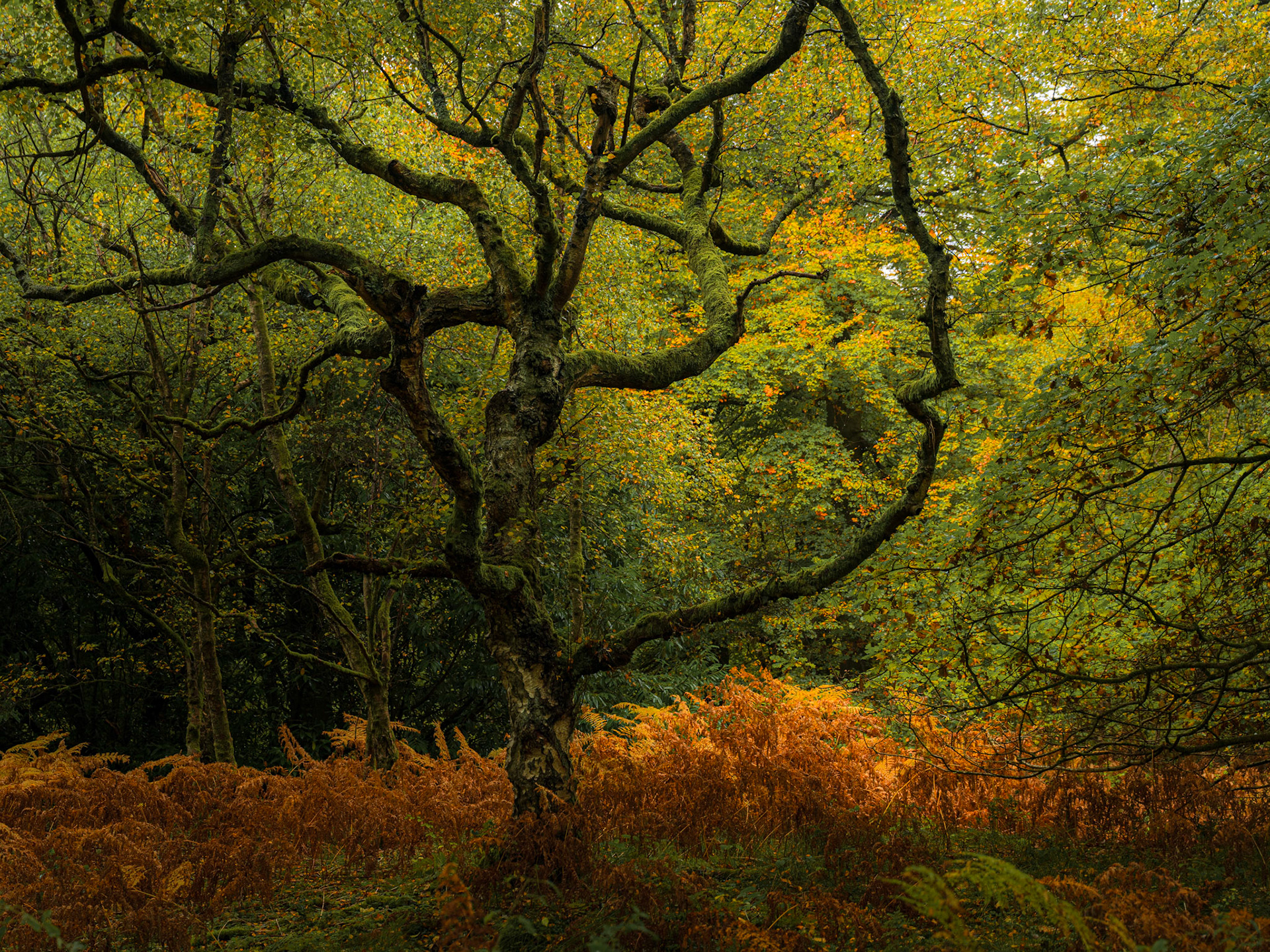
A veteran beech growing in the Chilterns, Oxfordshire, spreads its moss-clad limbs wide across the frame, anchoring a dense autumn woodland interior. Bracken beneath has turned a deep rust, contrasting with foliage still holding green at its peak of colour change. The flat, diffuse light of an overcast October afternoon strips away distraction and keeps the architecture of the tree central.

A solitary bonnet mushroom rises from a dense moss bed, its ribbed cap beaded with raindrops and trailed by fine spider silk catching suspended moisture against a near-black background. The scatter of water particles in the air reads almost as a stellar field, lending the intimate macro scene an unexpected sense of scale. Controlled off-camera flash has isolated both the luminous cap and the vivid green moss from the darkness beyond.
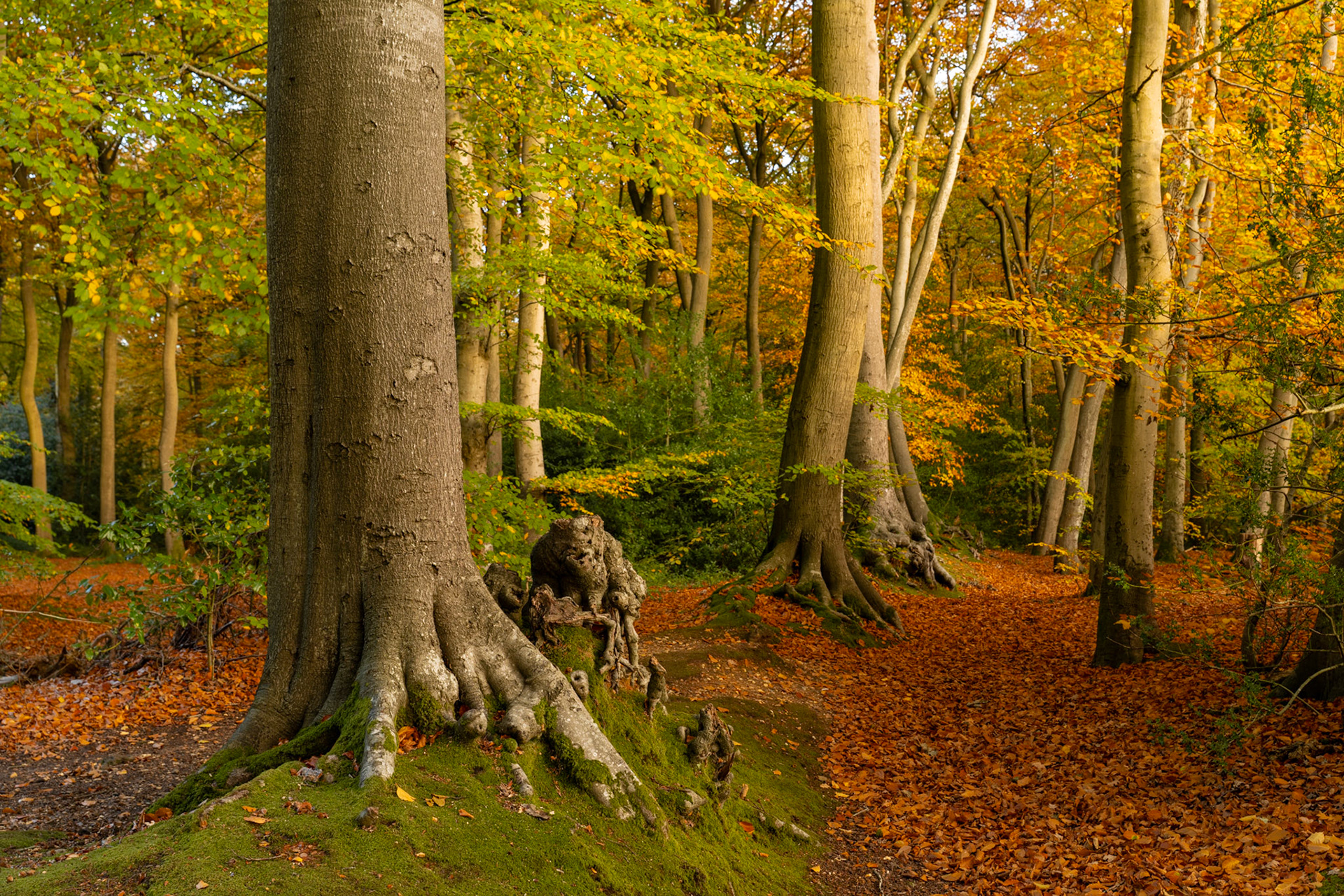
Ancient beech roots grip a mossy bank at the edge of a leaf-strewn path in the Chilterns, Oxfordshire, the canopy holding the last green and gold of autumn. Soft directional light picks out the sculptural form of the buttress roots against a carpet of fallen copper leaves. The receding trunks give depth without revealing a horizon.
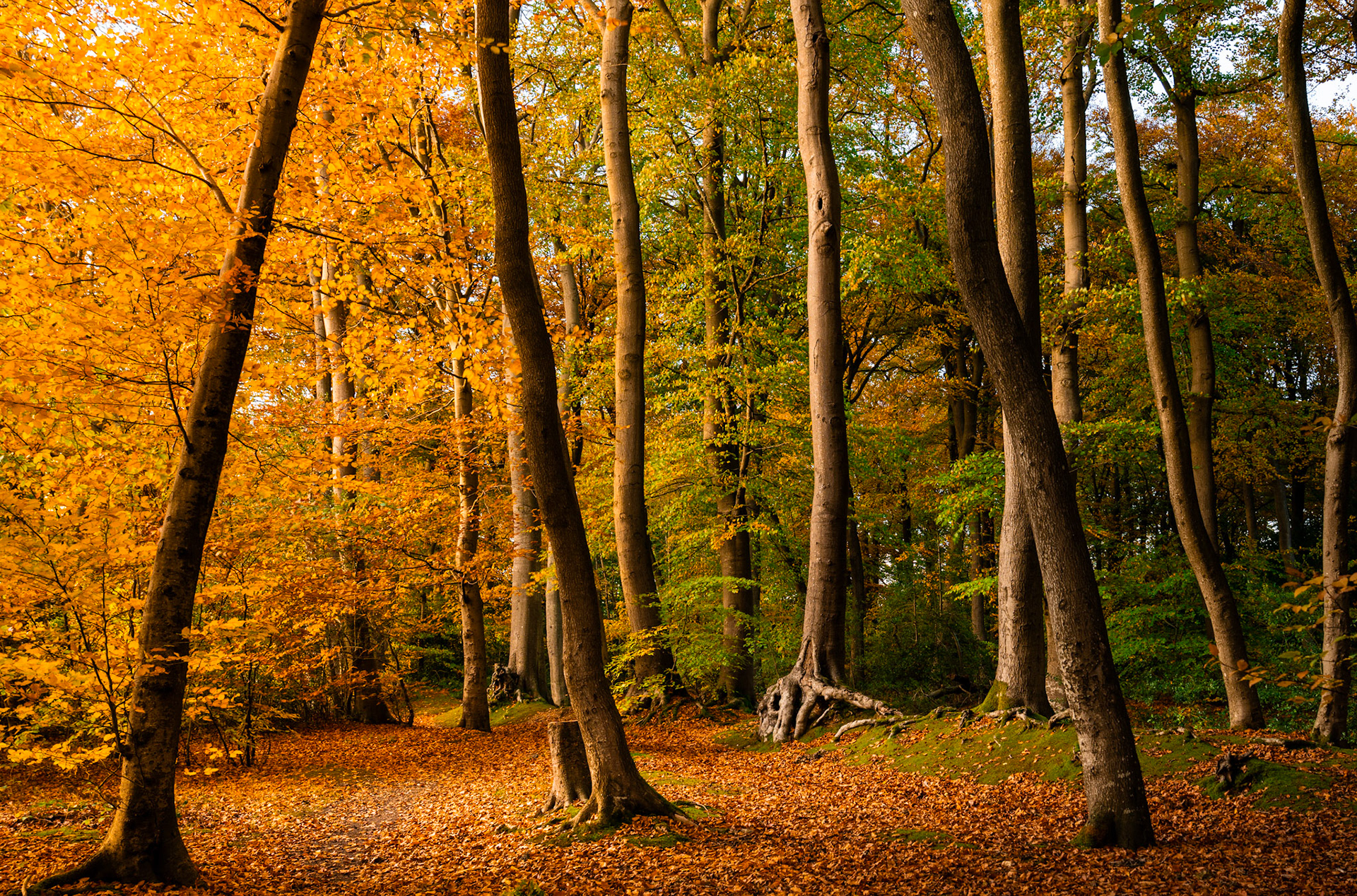
A stand of mature beech trees in the Chilterns, Oxfordshire, photographed in mid-autumn colour, their canopy transitioning from gold on the western side to residual green towards the interior. Fallen leaves carpet the woodland floor around exposed root systems, while dappled afternoon light picks out the smooth grey trunks. The image records the turn of the season with competence, though no single compositional anchor draws the eye.
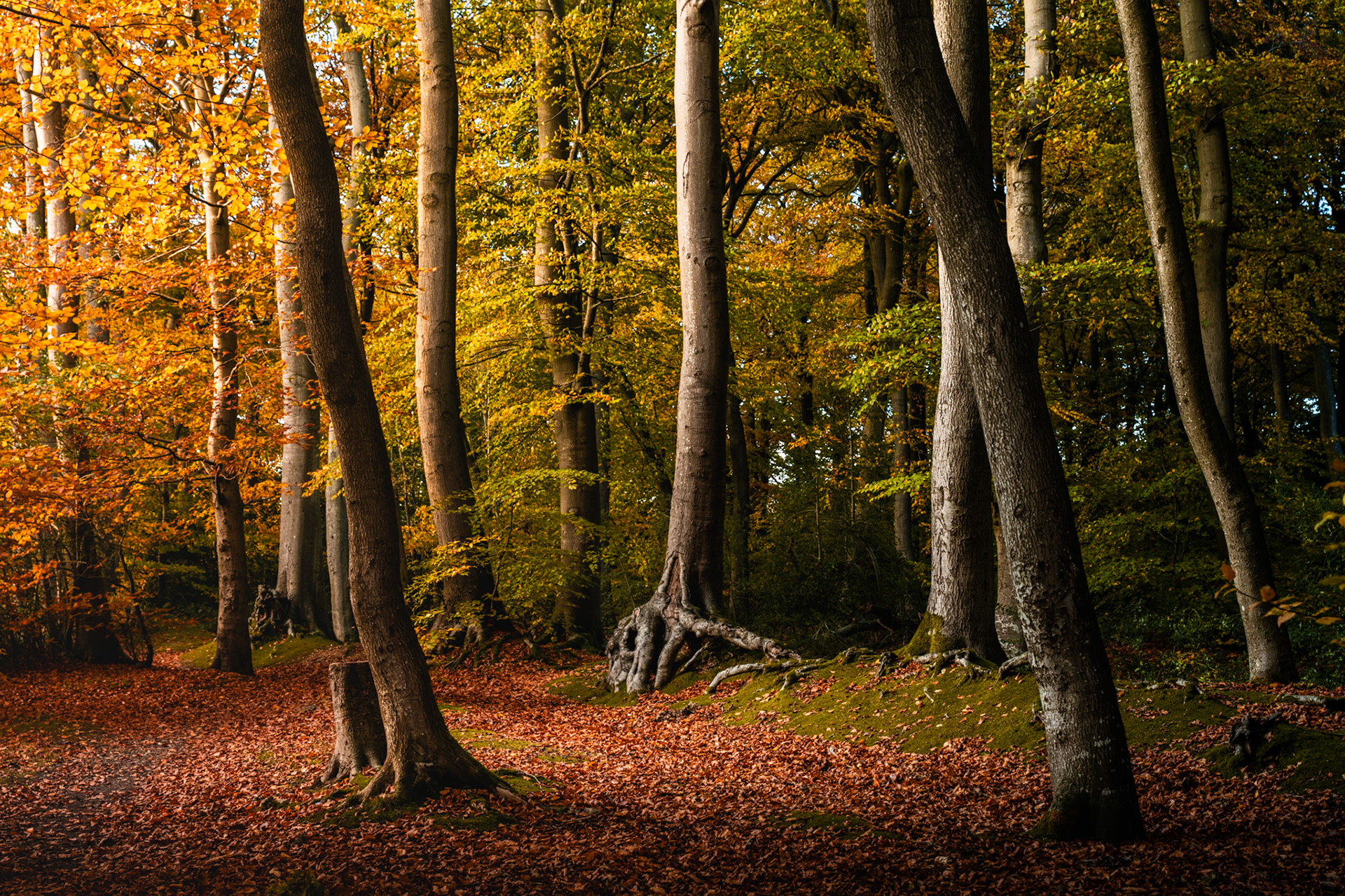
Mature beech woodland in the Chilterns, Oxfordshire, photographed in mid-autumn as the canopy holds a mix of gold and residual green. Low afternoon light catches the smooth grey trunks and a carpet of fallen leaves, drawing attention to an exposed root mass at the centre-ground. The contrast between sunlit foreground and shaded interior gives the scene depth without drama.

Autumn beech leaves drift on a shallow pool in the Chilterns, Oxfordshire, their amber and ochre tones set against blue-grey water and a scattering of green duckweed. The overhead perspective reduces the scene to pure pattern and colour, the leaves distributed with a natural randomness that resists easy composition. Captured in flat November light, the image holds a quiet, unsentimental record of seasonal decay.
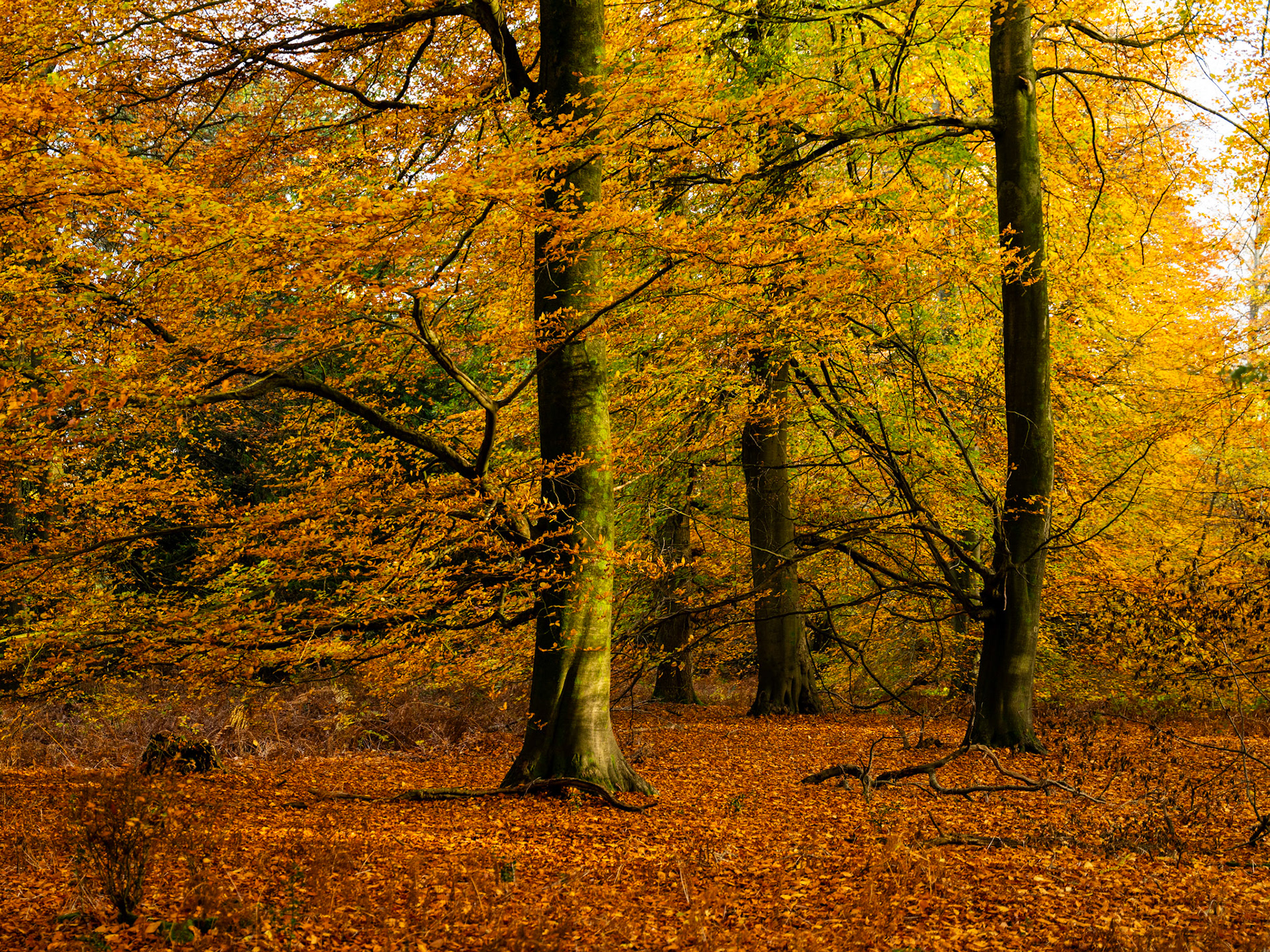
Mature beech trees in full autumn colour stand over a deep carpet of fallen leaves in the Chilterns, Oxfordshire. Flat, diffuse light holds the scene in muted ochres and browns, suppressing shadow contrast. The woodland interior is well observed but lacks a strong compositional anchor to lift it beyond the competent.
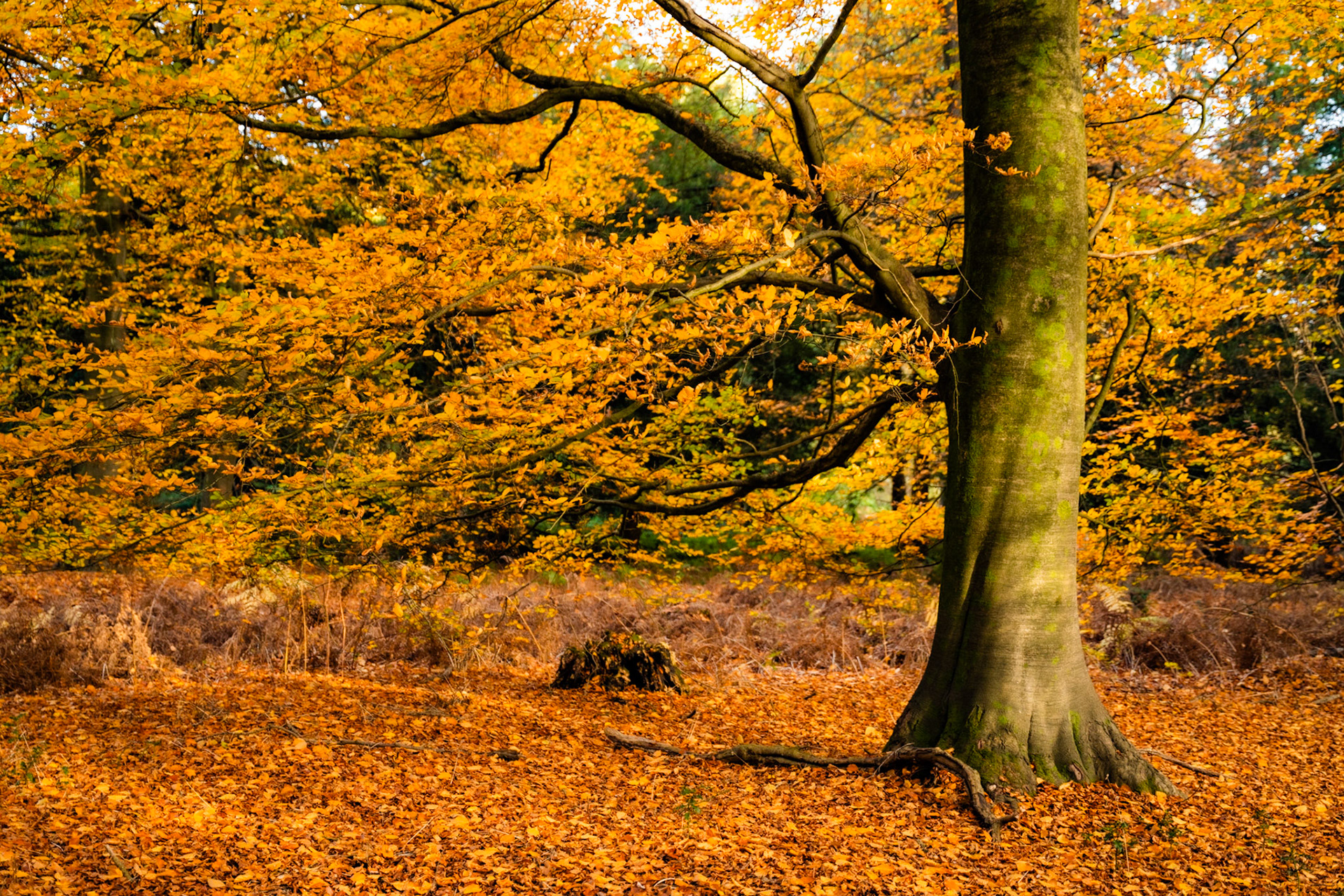
A mature beech stands at the woodland edge in the Chilterns, Oxfordshire, its canopy still holding amber foliage above a floor deep in fallen leaves. Bracken and heathland scrub behind suggest a forest margin. The flat midday overcast gives even illumination but little mood.
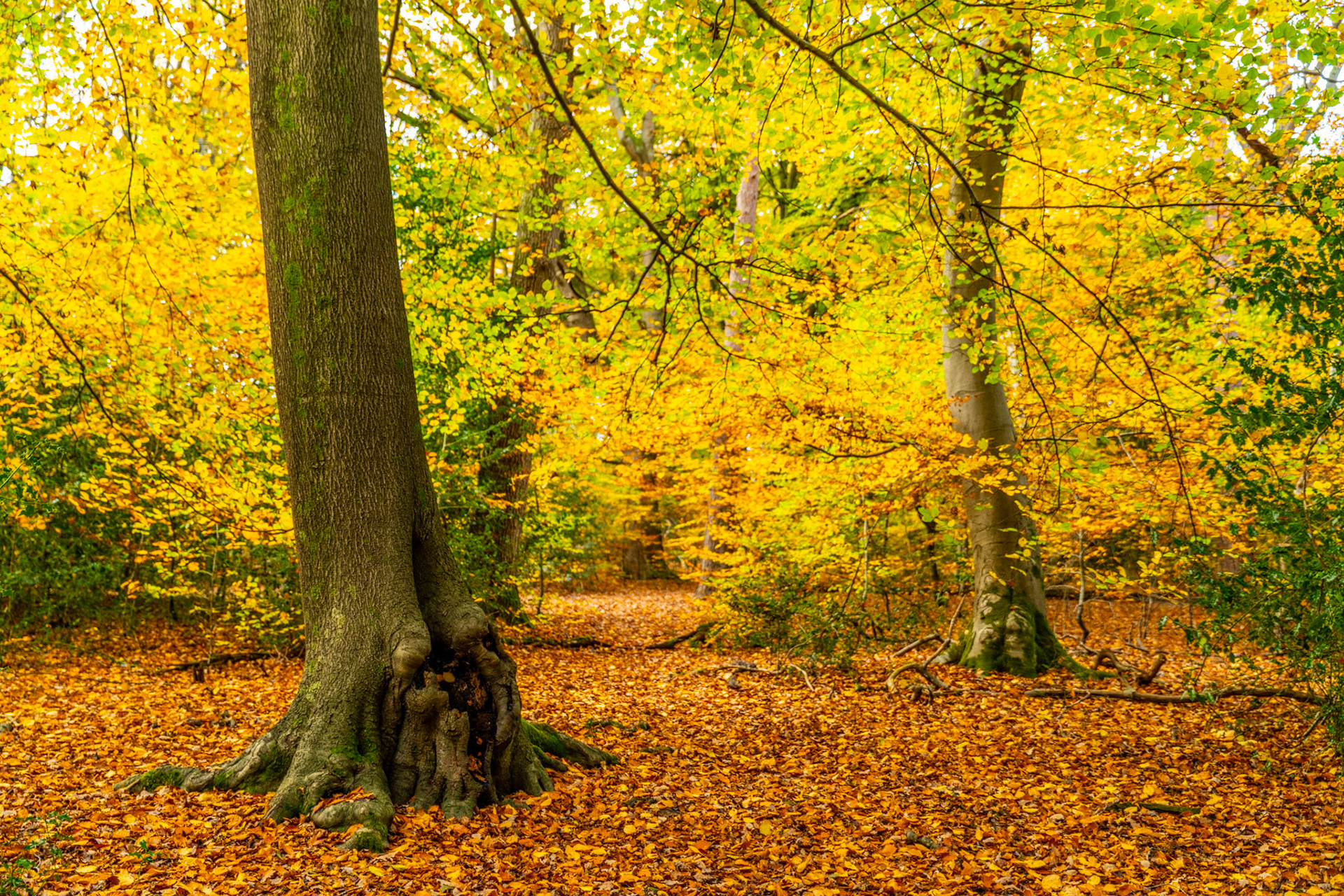
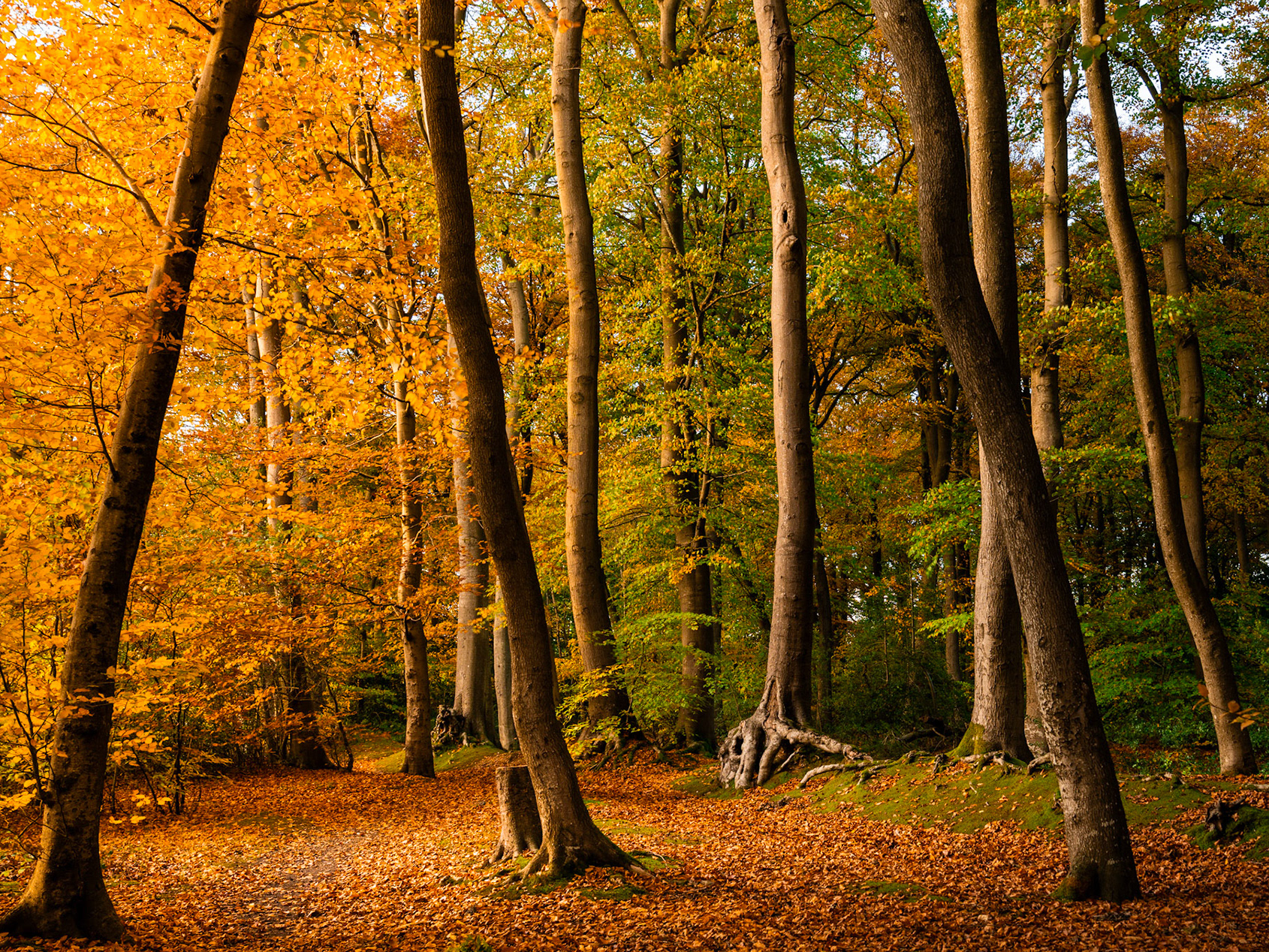
A mature beech woodland in the Chilterns, Oxfordshire, photographed at peak autumn colour, the forest floor carpeted with fallen leaves in amber and copper. Diffuse overcast light flattens the canopy into a dense wall of yellow-green, while the gnarled base of a foreground trunk anchors the composition. The scene reads as early November, colour still largely held in the canopy.
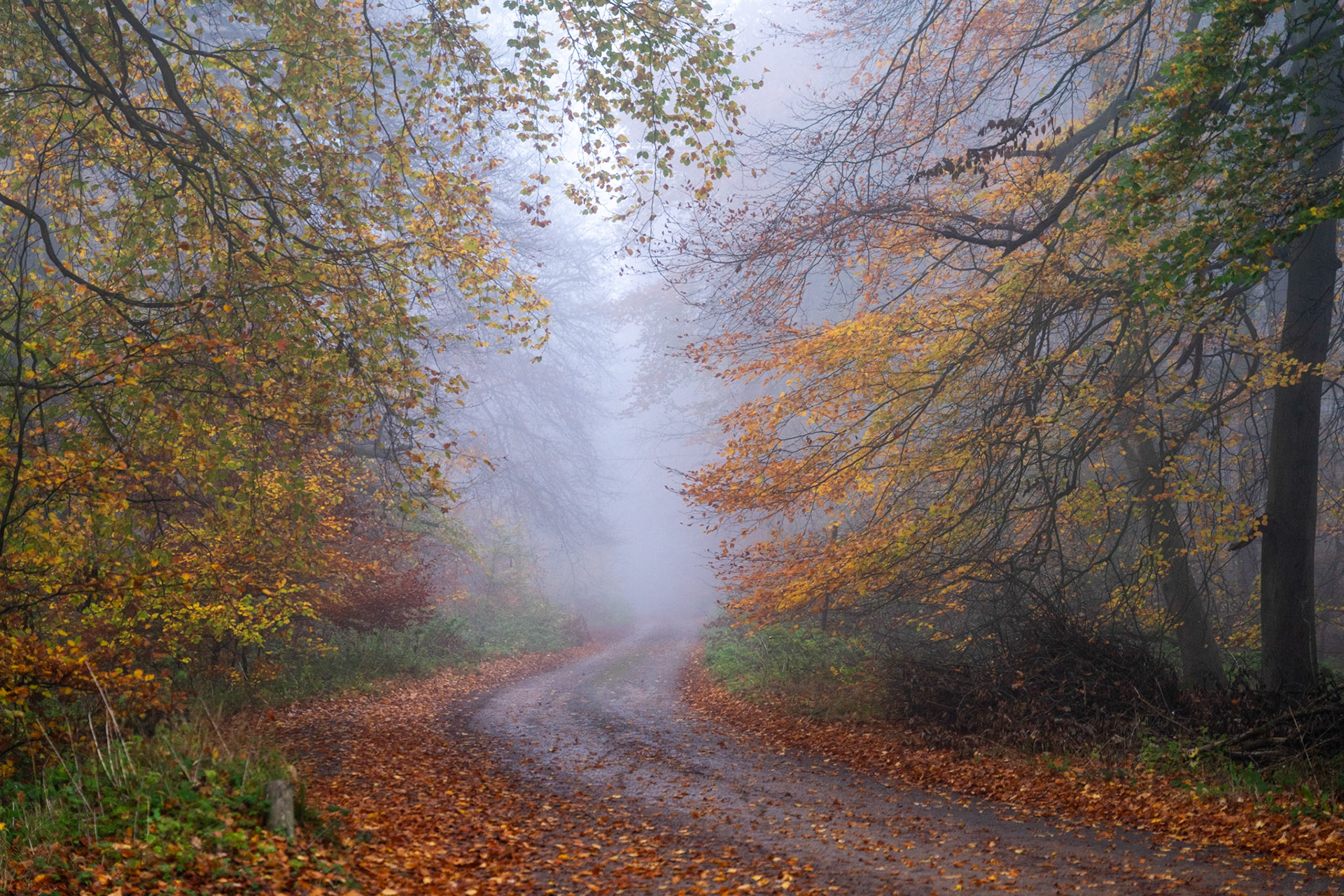
A leaf-covered woodland track in the Chilterns curves into dense autumn fog, framed by beech trees in their final colour before leaf fall. The mist erases the middle distance cleanly, creating a strong sense of depth and quiet enclosure. Captured in the early morning of a November day in Oxfordshire, the cool diffuse light keeps tonality subdued and consistent.
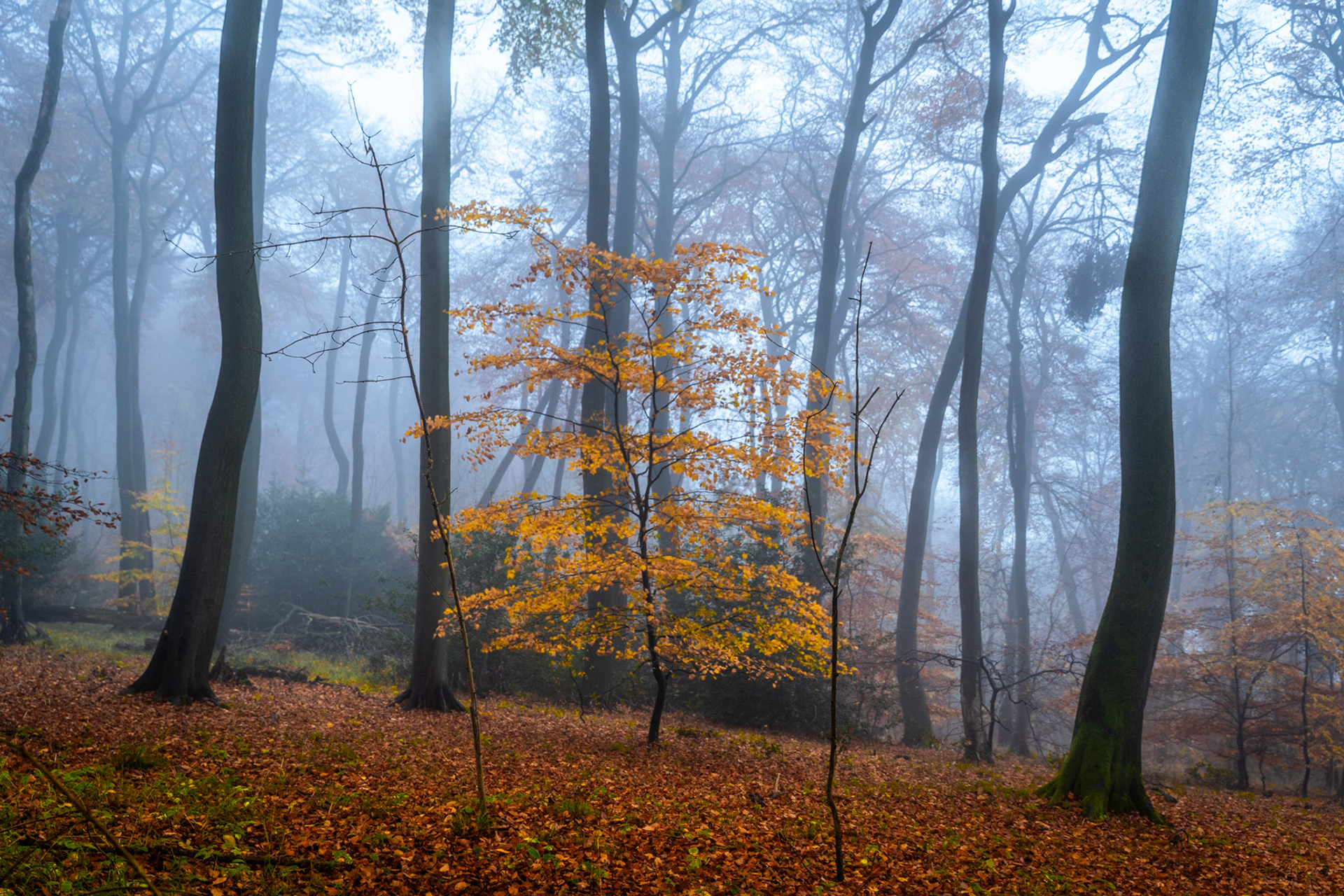
A solitary young beech retains its amber foliage amid a fog-filled stand of mature trees in the Chilterns, Oxfordshire, stripped nearly bare. The cool blue of the mist suppresses the background to silhouette while the warm ochre of the sapling's leaves draws the eye inward. Captured at dawn in late autumn, the image holds the pause between seasons with quiet authority.
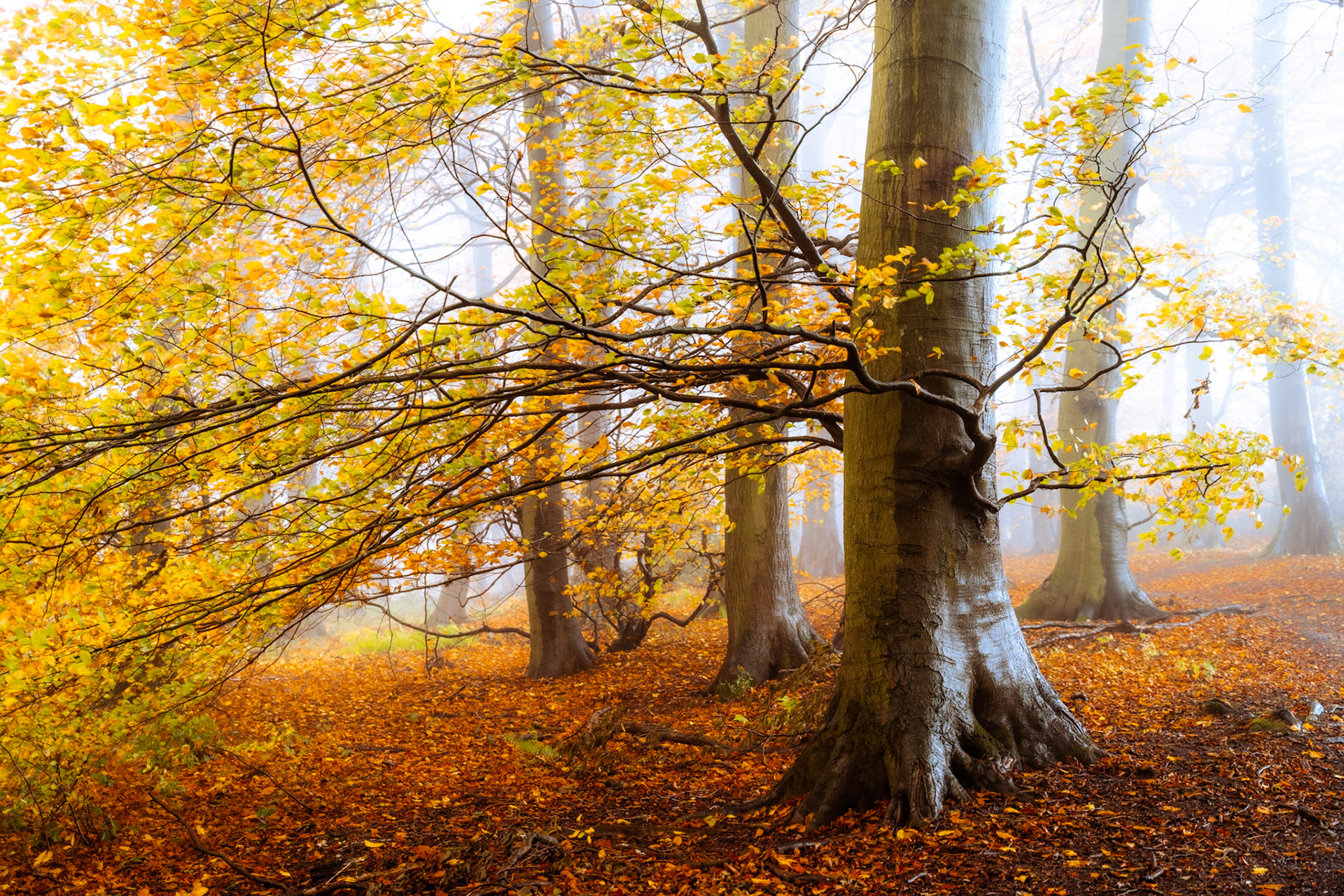
A veteran beech in the Chilterns, its branches arching low across a floor thick with fallen leaves, holds its last autumn colour against dense morning fog. The mist erases the woodland's depth, compressing the stand of smooth-barked trunks into a layered, near-monochromatic distance that contrasts with the warm amber and yellow of the foreground canopy. The composition centres on the tree's character — the knotted branch union and buttressed roots — rather than spectacle alone.
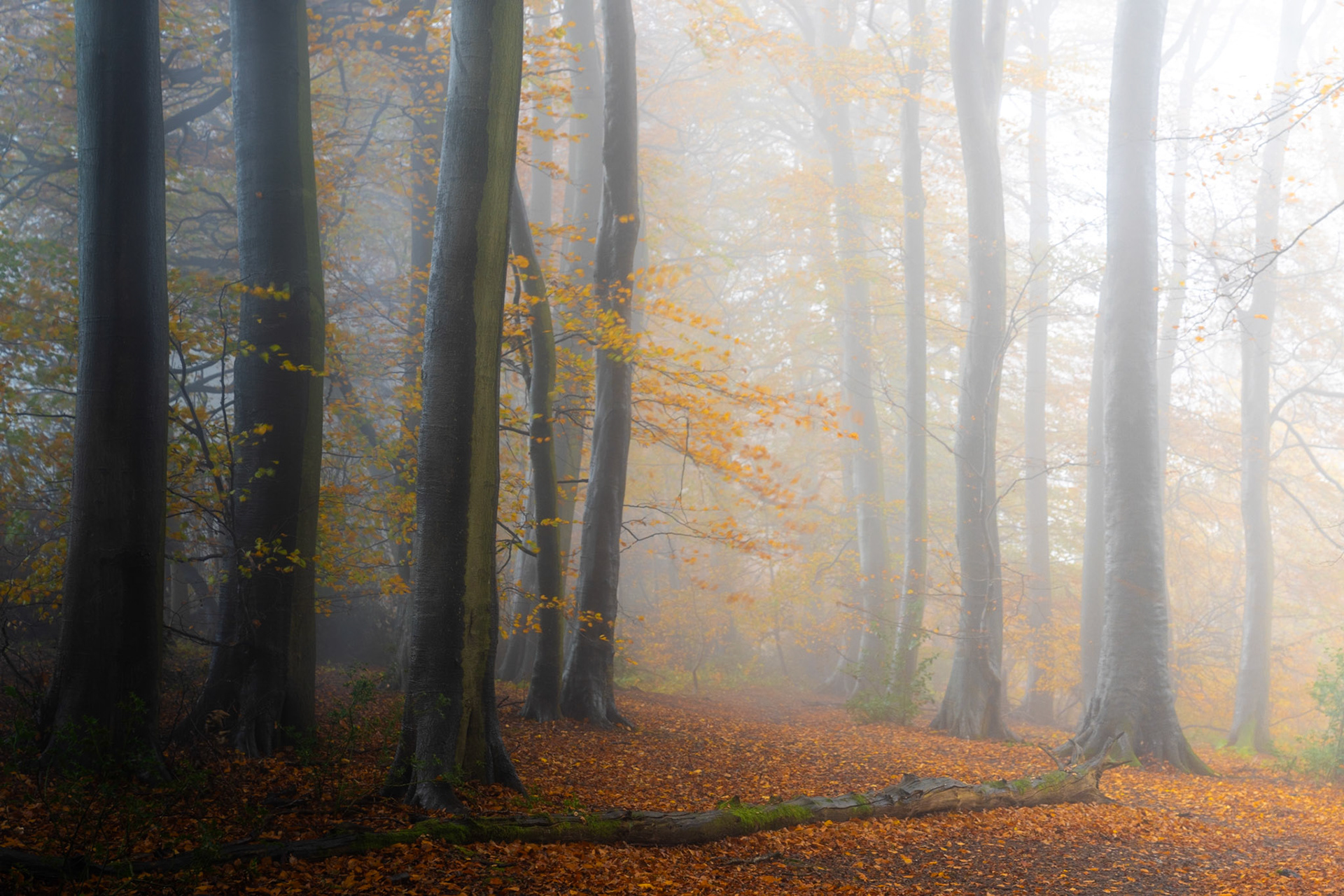
A mature beech woodland in the Chilterns, Oxfordshire dissolves into dense autumn fog, the dark foreground trunks giving way to luminous, mist-softened forms beyond. Fallen leaves carpet the woodland floor beside a moss-covered fallen branch, while clinging amber foliage filters the diffuse light. The tonal shift from near-black to near-white creates a natural depth that rewards prolonged attention.
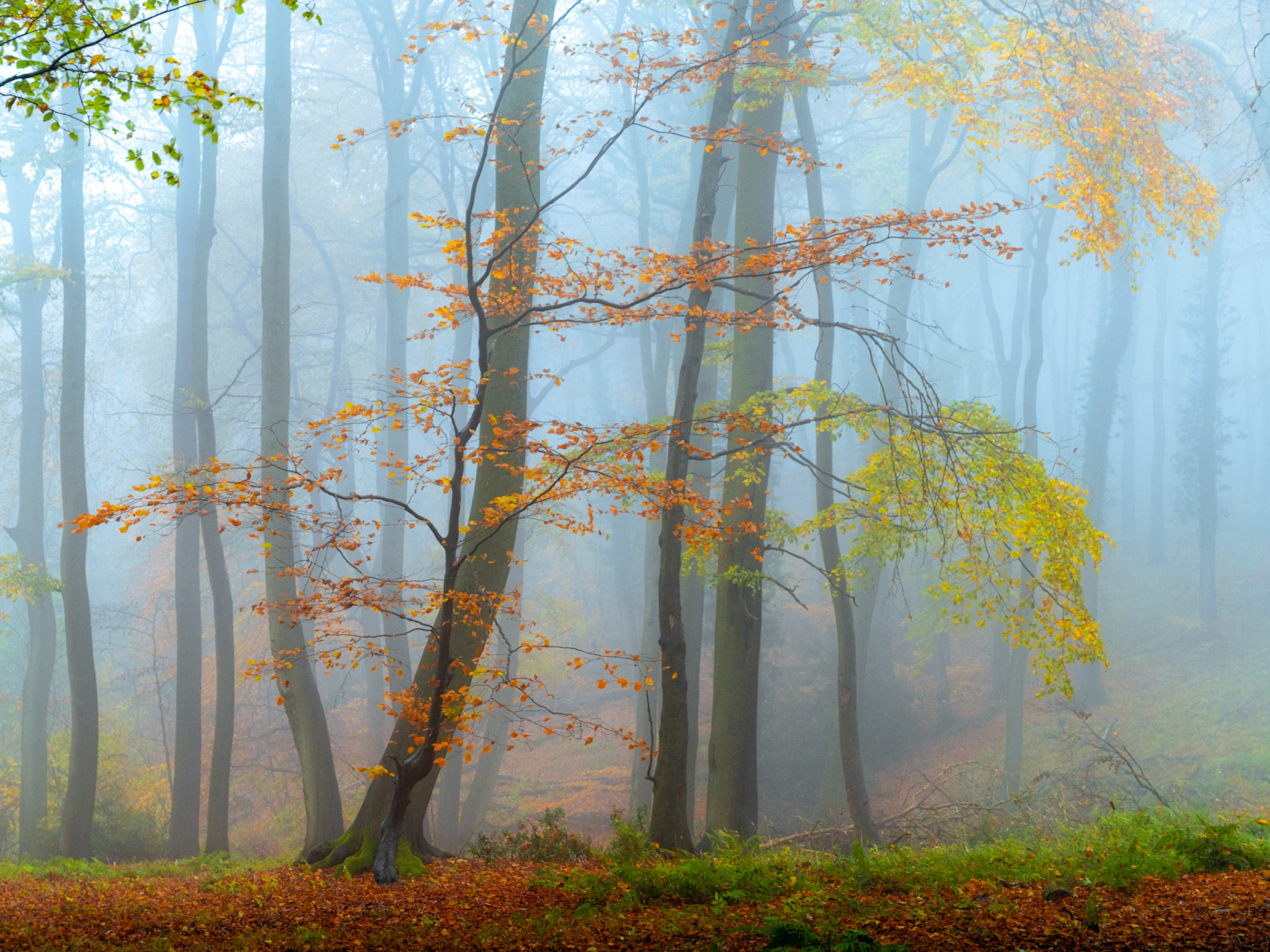
A young beech retains its copper leaves against a stand of tall, fog-softened trunks receding into a pale November morning in the Chilterns, Oxfordshire. The mist compresses depth and drains colour from the background, leaving the foreground foliage to carry the warmth of late autumn. A carpet of fallen leaves and low ferns anchors the composition at ground level.
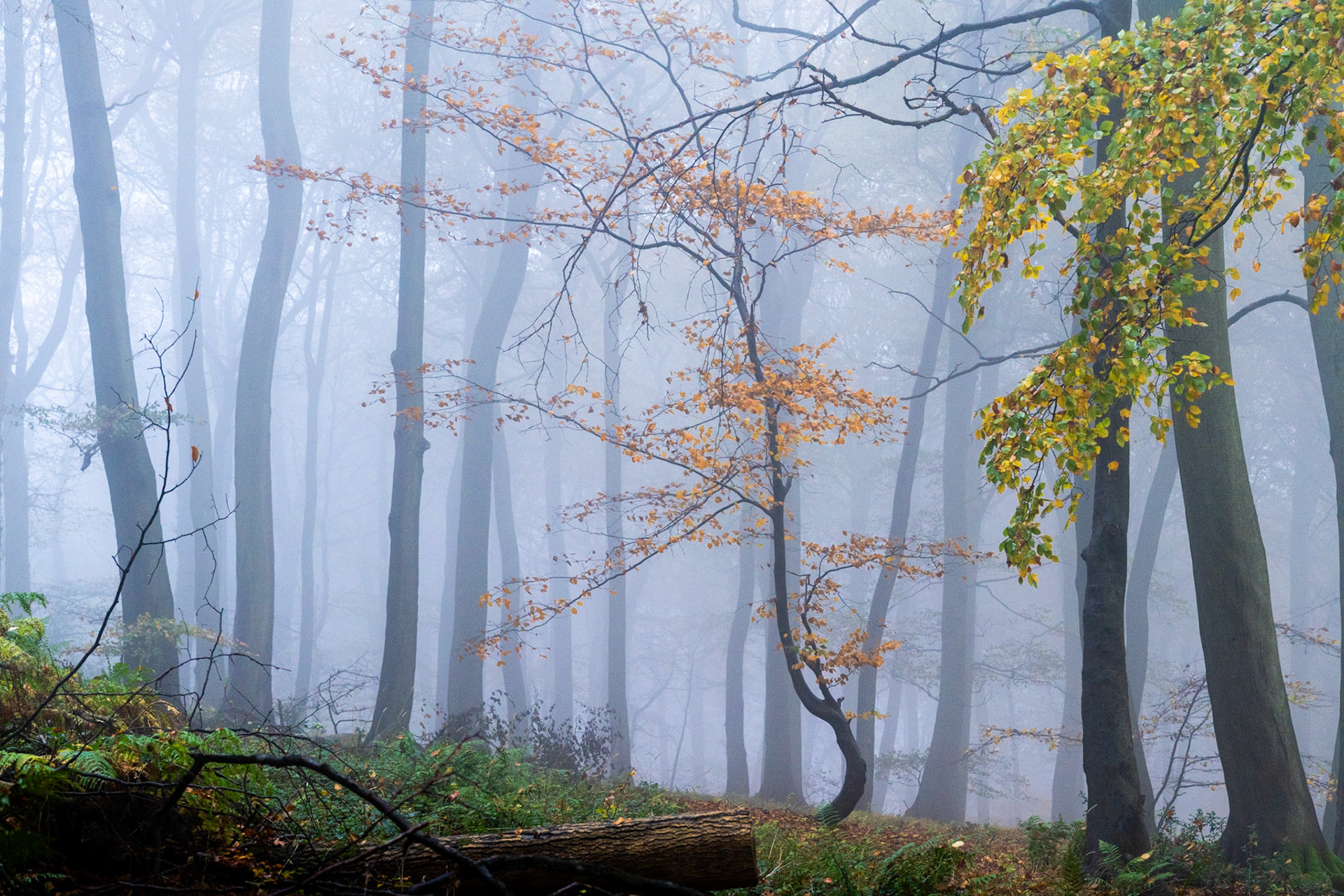
In a Chilterns beechwood in Oxfordshire, a slender, wind-leaned beech holds its last amber foliage against a wall of November fog, while fallen timber and ferns anchor the foreground. The receding columns of mature trees dissolve into a pale, luminous background, compressing the woodland into distinct tonal planes. Capture at 08:02 places the light at the transitional edge of dawn, just before the mist begins to thin.
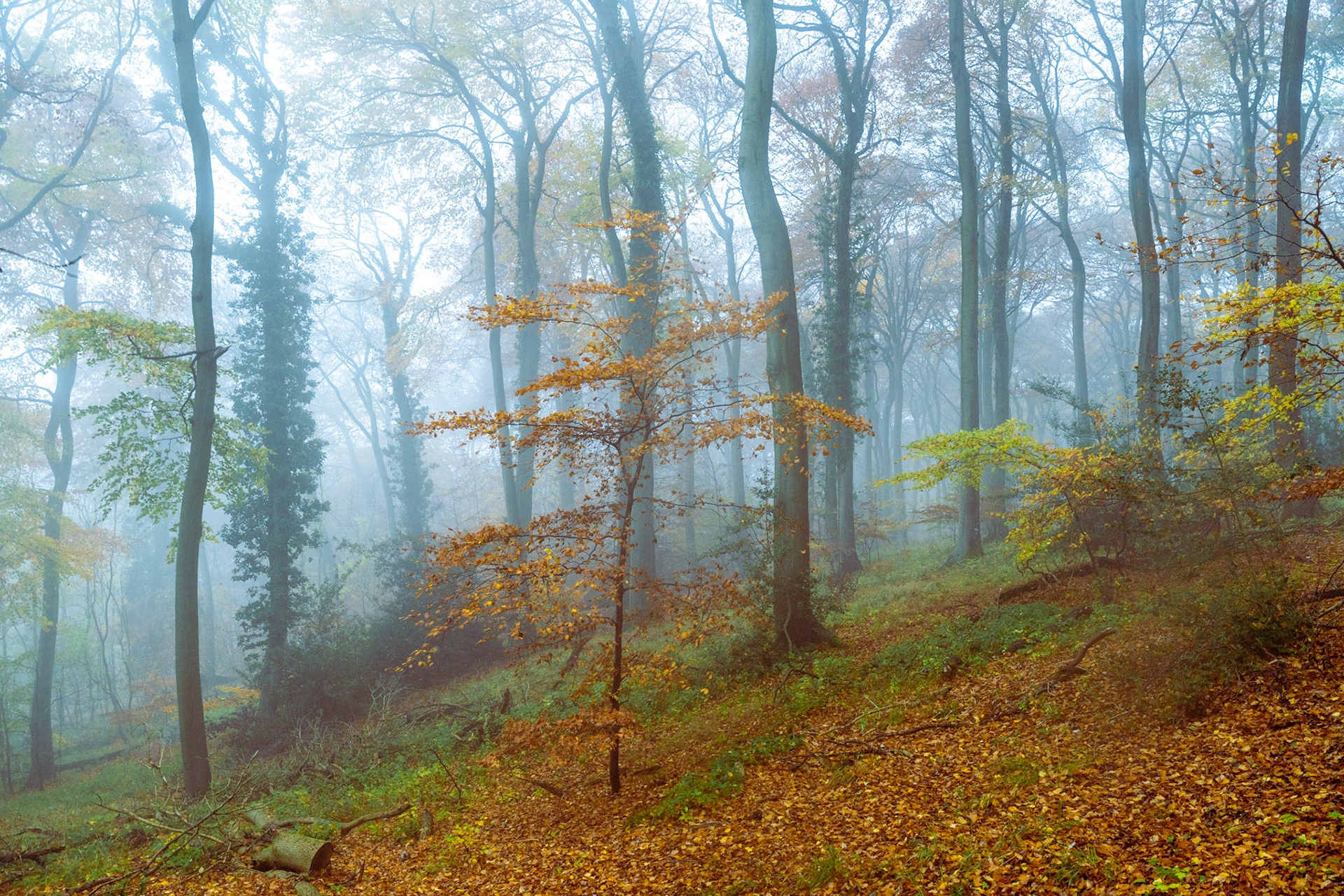
A young beech sapling in the Chilterns retains its amber foliage against a receding colonnade of mature trunks dissolving into autumnal fog. The carpet of fallen leaves and the slope of the Oxfordshire woodland floor give structure to an otherwise soft, diffuse scene. Captured at dawn on a still November morning, the mist compresses depth and mutes the background to near-monochrome.
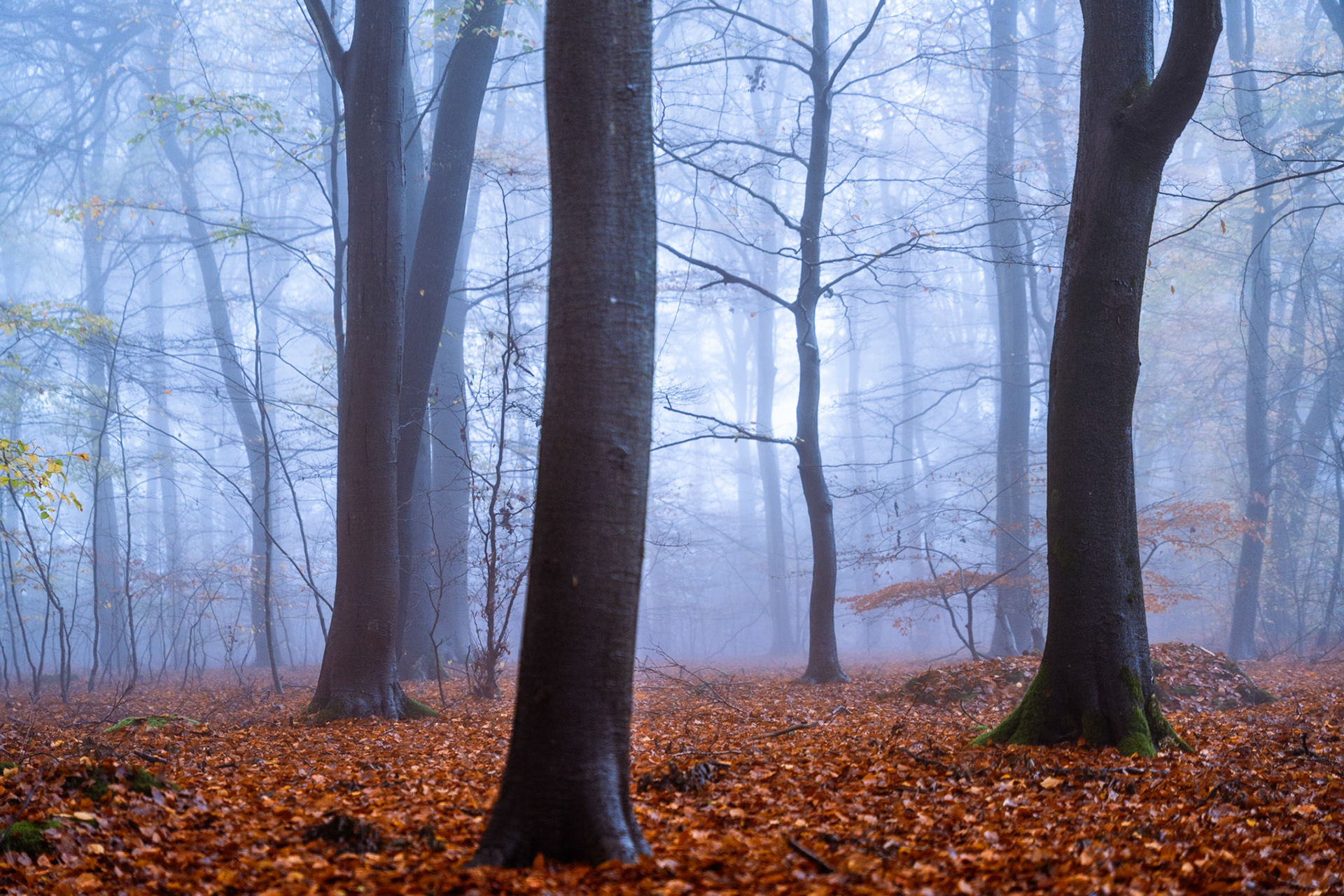
Mature beech trees stand in dense autumn fog in the Chilterns, Oxfordshire, their bark dark against a cold blue-white diffusion of mist. A carpet of fallen copper leaves covers the woodland floor, contrasting sharply with the spectral mid-ground where trunks dissolve into vapour. The layering of near, mid, and far planes gives the scene unusual depth for a still, overcast morning.
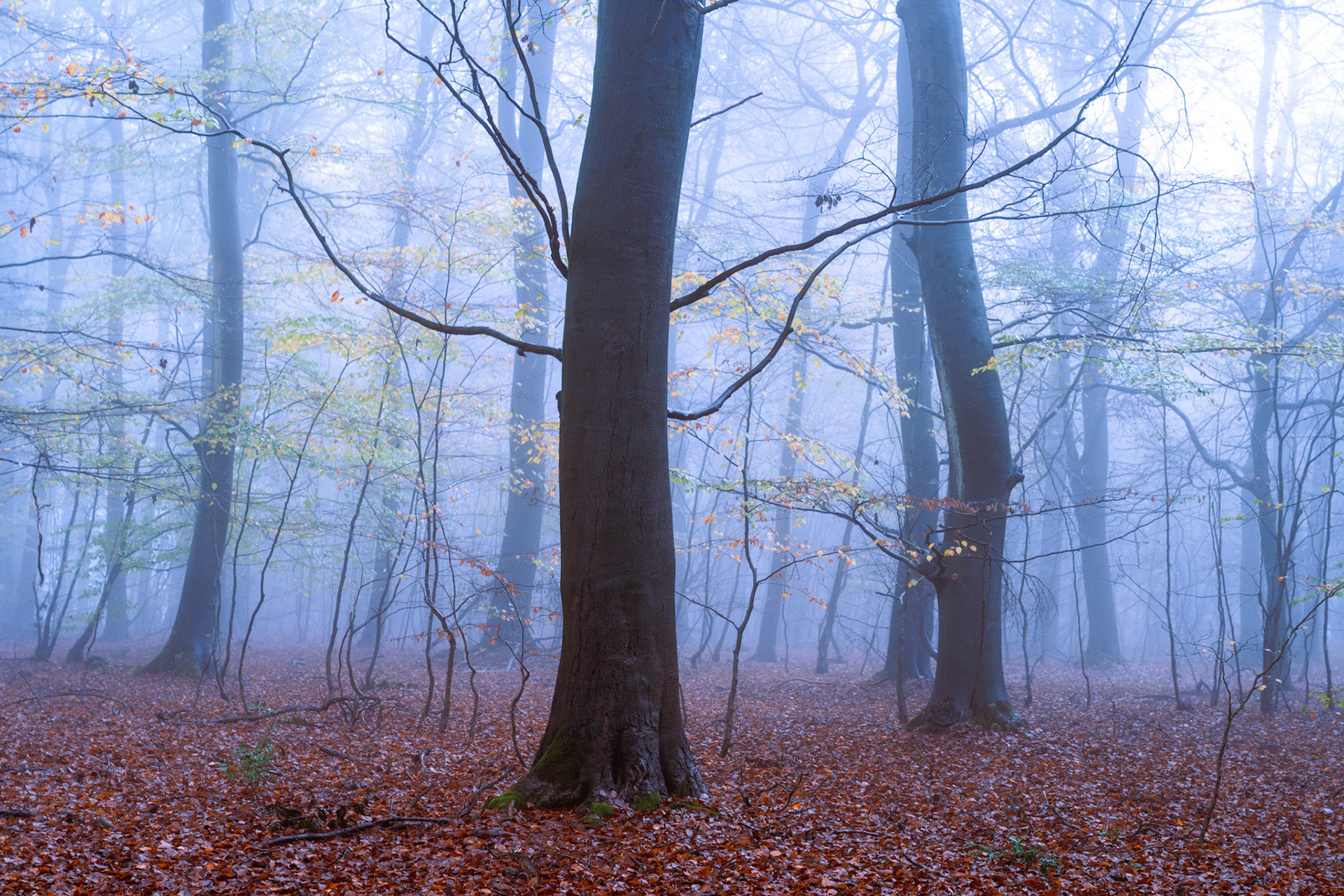
A mature beech stand in the Chilterns, Oxfordshire, at the close of autumn, the canopy stripped to its last leaves as thick fog compresses depth into successive planes of grey and blue. The warm copper of the leaf litter anchors the scene against the cool monochrome of the fog, and the central trunk holds the composition without dominating it.
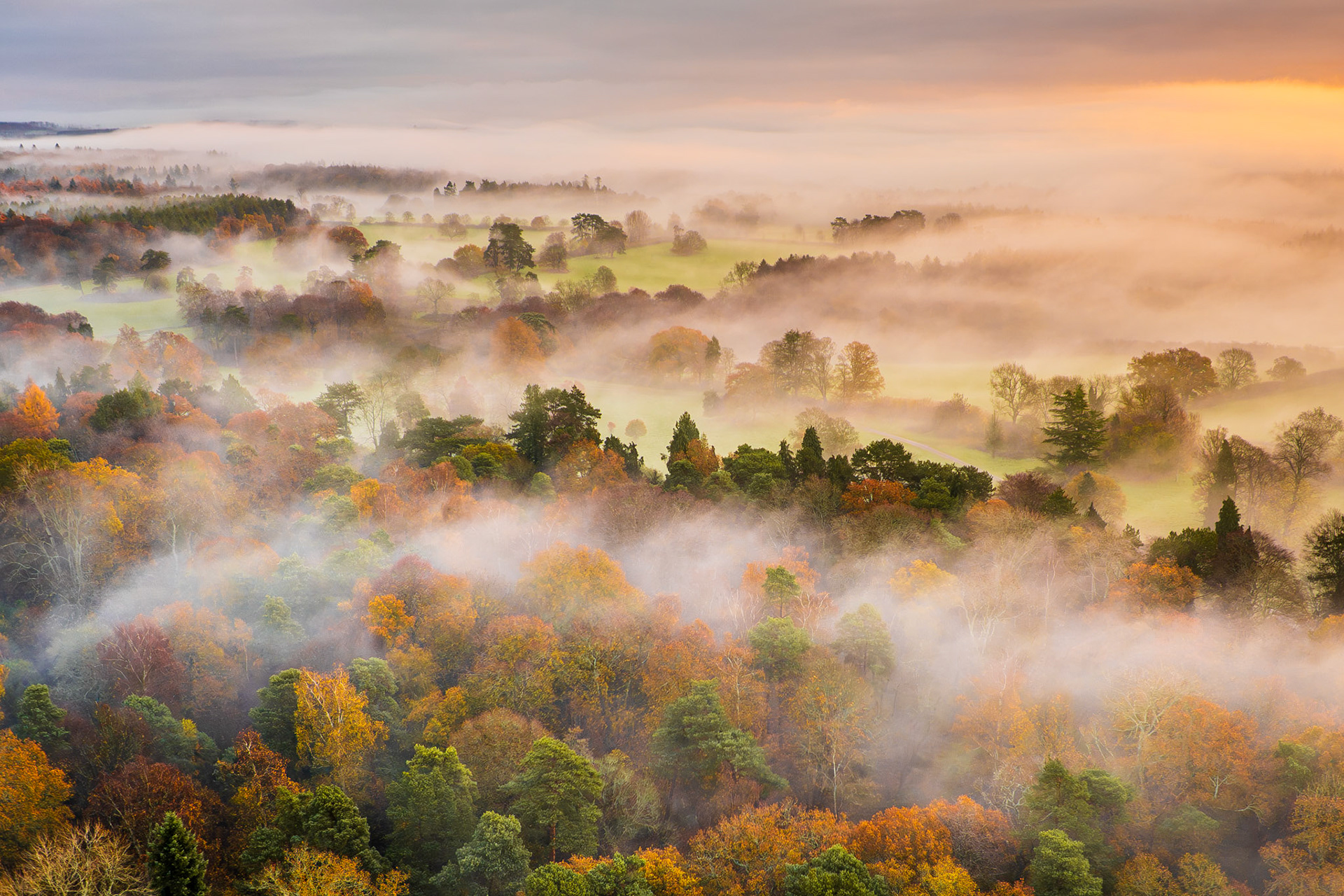
A temperature inversion holds low cloud among the autumn canopy of a Thames Valley woodland at dawn, the rising sun catching the mist from the south-east and warming the scene to amber. Photographed from altitude above Henley-on-Thames, the layered fog separates foreground trees from the open pasture beyond, creating a sequence of receding planes that dissolves into the glowing horizon. The restraint of the palette — amber, ochre, and soft grey — gives the image an unusual quietness for aerial work.

A nadir aerial view over mixed deciduous woodland near Henley-on-Thames reveals the fragmented palette of late autumn: yellowing oak and field maple alongside bare-branched specimens and persistent evergreen scrub. Flat overcast light suppresses shadow and foregrounds the textural complexity of individual crowns, the dark forest floor visible between them lending depth to an otherwise planar composition.
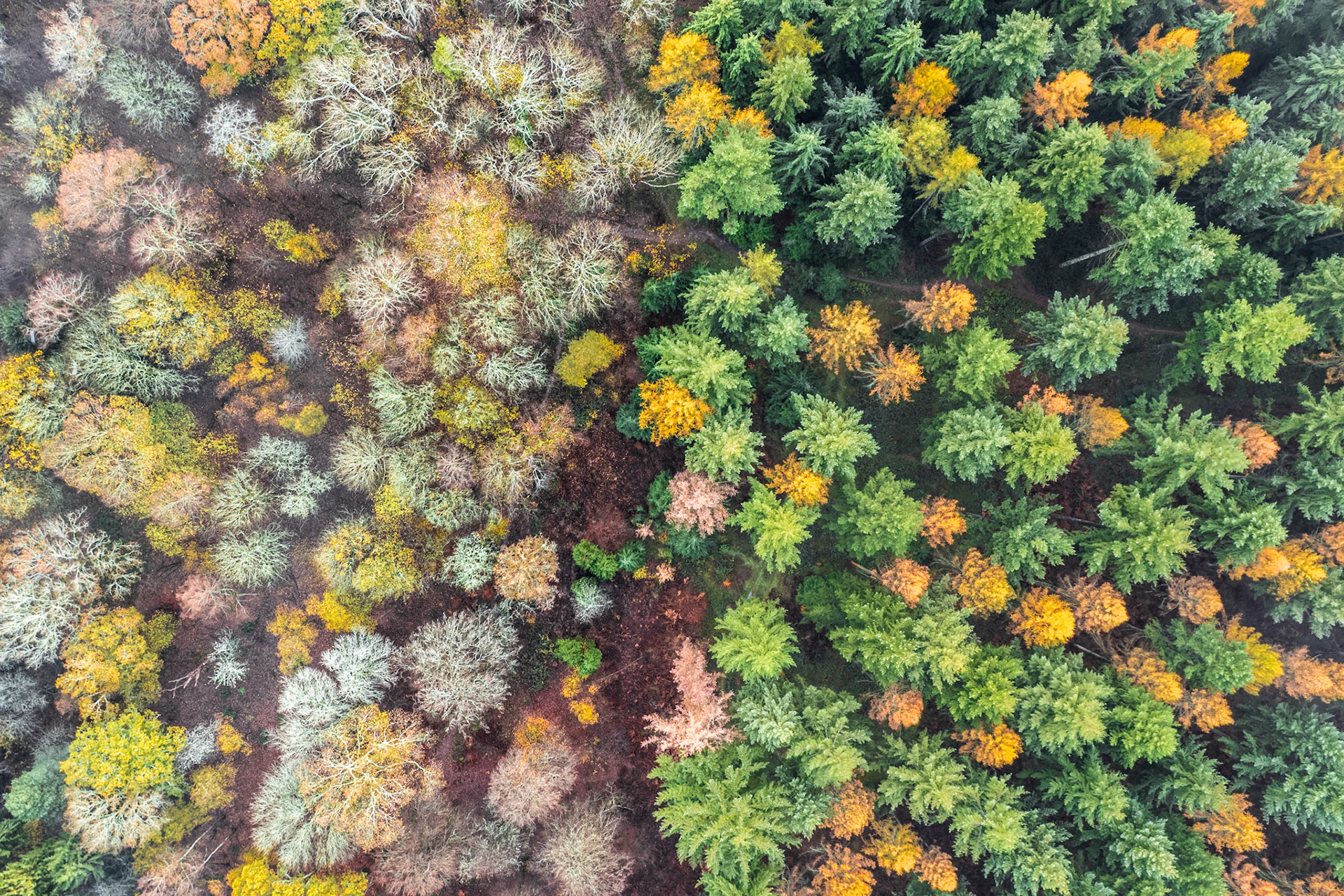
A vertical aerial view above woodland near Henley-on-Thames reveals a sharp ecological boundary dividing open scrub — pale, lichen-silvered and sparsely canopied — from a dense stand of mature conifers in deep green. Captured in mid-November, the transitional foliage holds residual autumn yellows against the muted tones of approaching winter dormancy. The diagonal fault line between the two tree communities carries the composition without artifice.

A nadir aerial view over mixed deciduous woodland near Henley-on-Thames records the uneven progress of leaf fall in mid-November, where yellow-gold crowns of oak and field maple sit alongside bare branch structures and the dark cones of retained evergreens. The flat, diffuse light of an overcast morning suppresses shadow and allows the tonal range of the canopy — ochre, buff, pale green and ash-white — to read as near-abstract patchwork.

An overhead view of mixed coniferous woodland near Henley-on-Thames reveals larch crowns turning gold among the evergreen spruce, the interplay of colour forming a natural mosaic across the canopy. Captured in mid-November as deciduous conifers approach peak colour loss, the flat overcast light suppresses shadow and flattens the composition into near-abstraction. The scatter of amber crowns punctuating deep green gives the image its only structural rhythm.
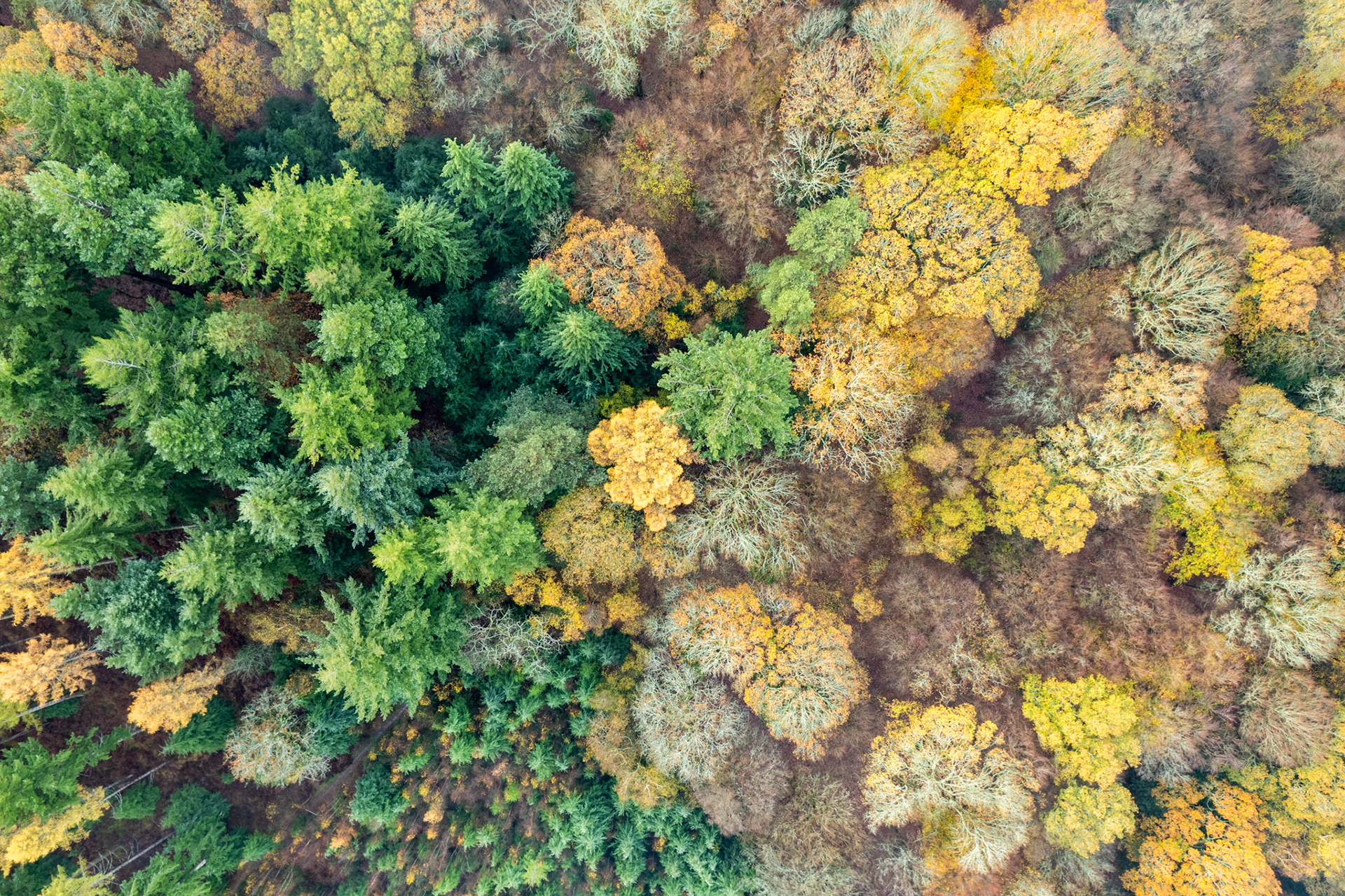
A nadir aerial view over mixed woodland near Henley-on-Thames captures the transition between evergreen conifers and deciduous trees in mid-autumn senescence. The diagonal drift from dense green on the left to muted yellows and bare crowns on the right records the uneven pace of leaf-fall across species. Flat overcast light suppresses shadow and keeps the colour palette honest rather than dramatic.
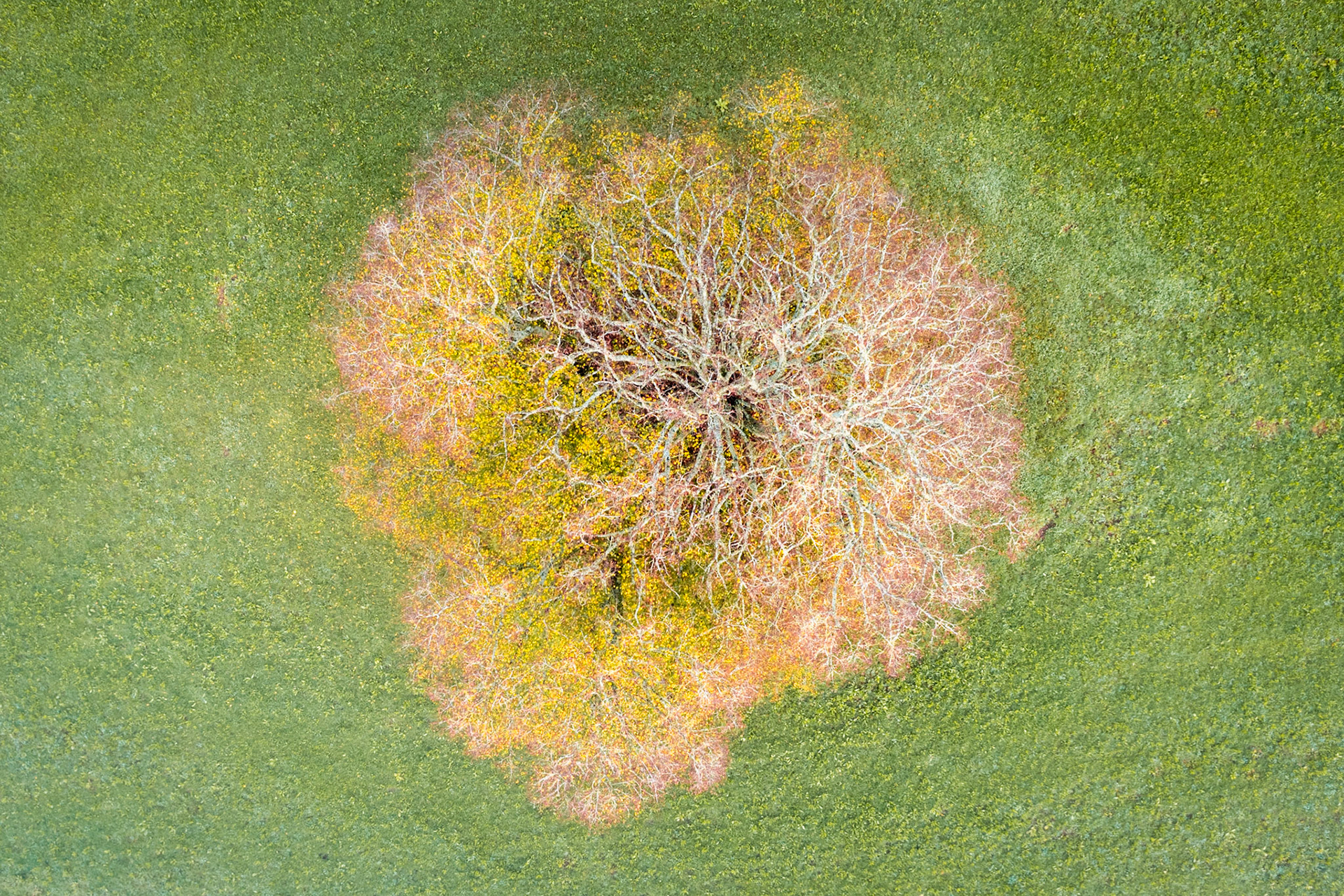
A mature deciduous tree photographed directly overhead from altitude above a field near Henley-on-Thames, its bare branch structure radiating outward like a neural network against a disc of amber and ochre fallen leaves. The surrounding cropped grassland, speckled with late wildflowers, frames the canopy as a self-contained form. Captured in mid-November, the image sits at the threshold between late autumn and winter dieback.
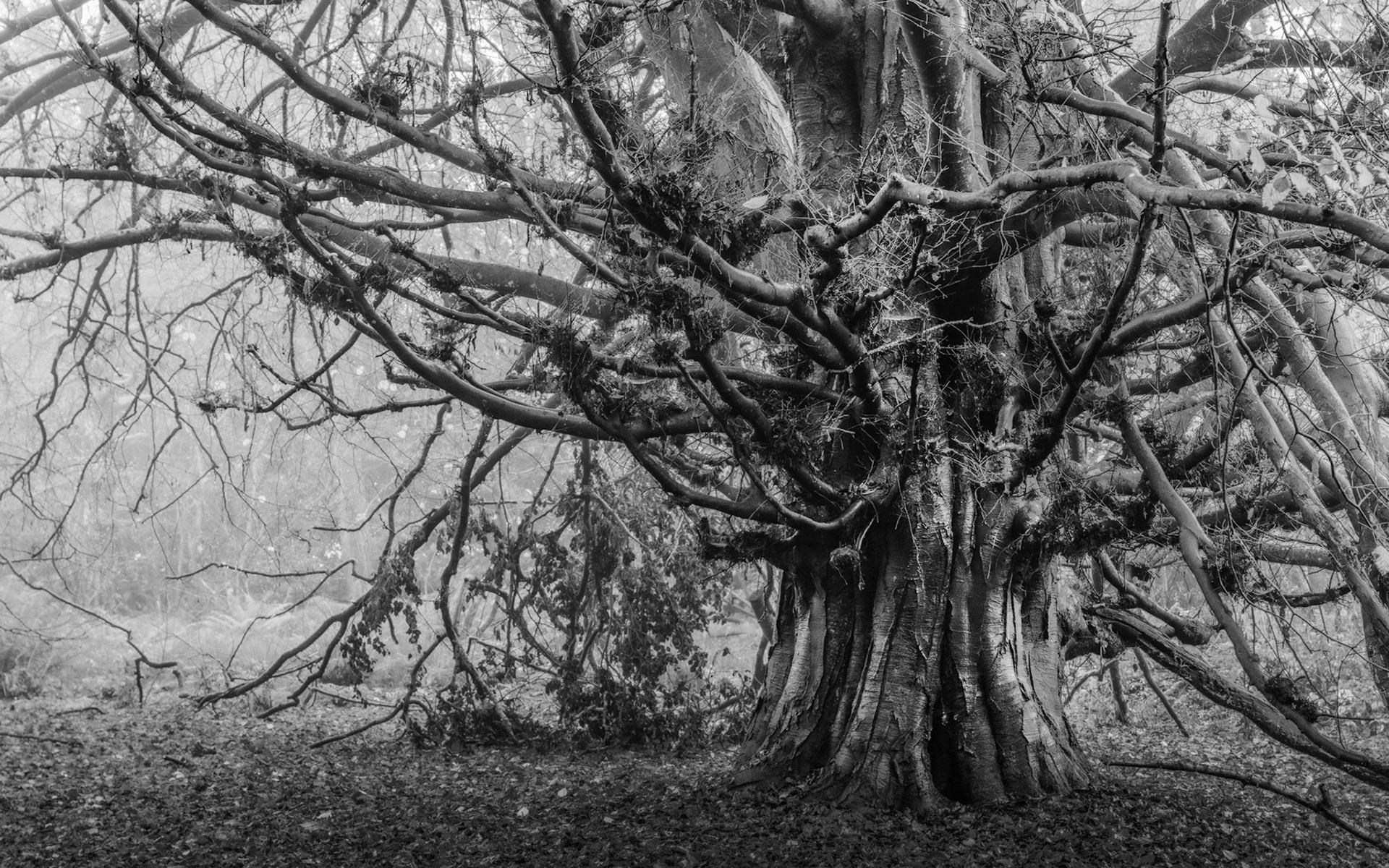
A multi-stemmed veteran tree, likely yew or hawthorn, spreads its moss-colonised limbs through bare winter woodland under a flat, diffuse sky. The monochrome treatment suppresses colour distraction and allows the gnarled architecture of trunk and branch to read with sculptural clarity. Muted background tones recede into soft grey, isolating the subject without artifice.

A small white bracket or bonnet fungus emerges from a moss-covered branch, its translucent cap catching diffuse winter light against a soft bokeh of bare deciduous canopy. The low angle places the subject against open sky, isolating the delicate form with unusual clarity. The vivid moss provides the only warmth in an otherwise cool, subdued palette.
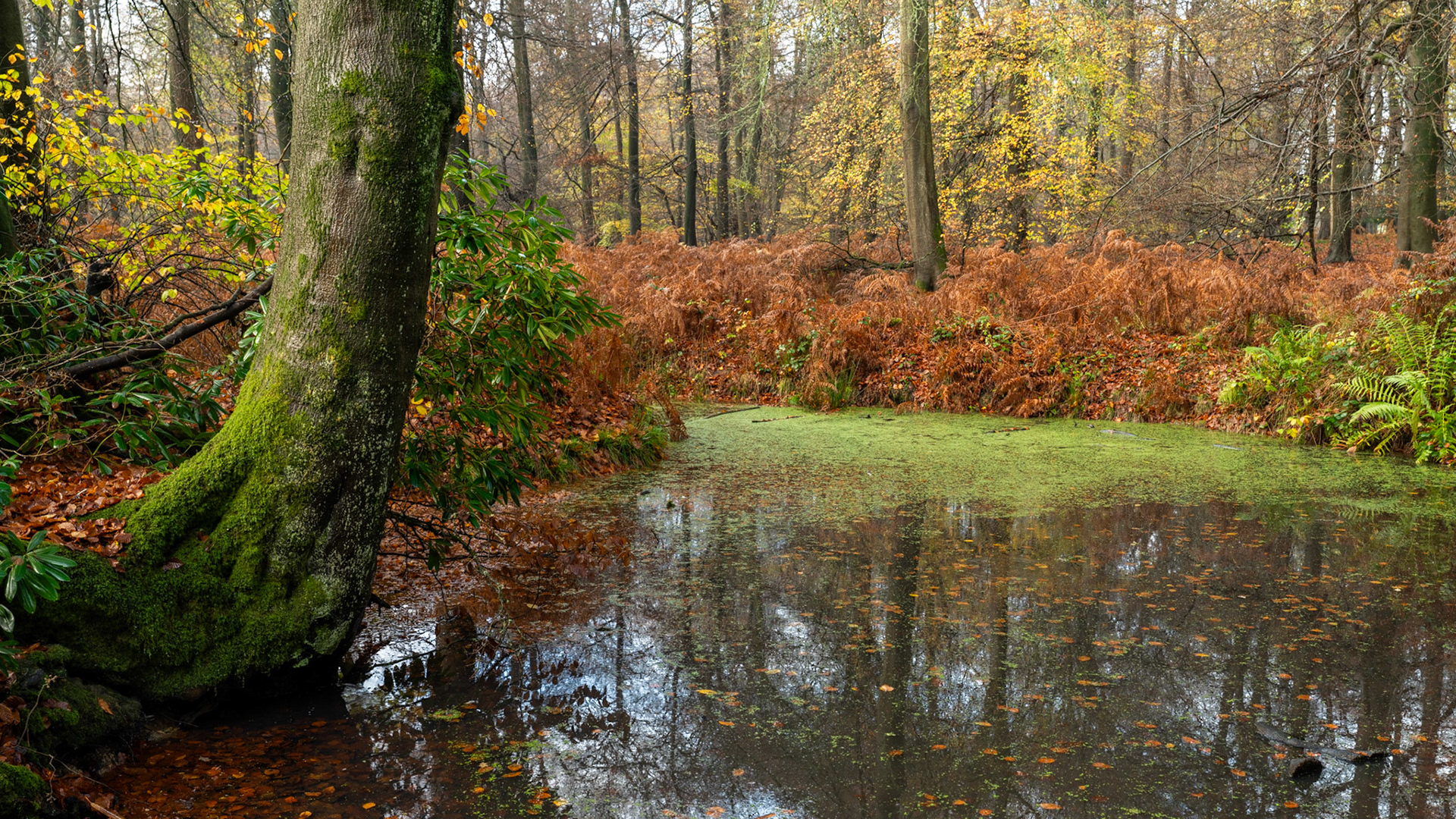
A shallow woodland pool in the Chilterns, Oxfordshire, fringed with collapsed bracken and moss-covered beech roots, holds a still reflection of bare November canopy above. Fallen leaves drift at the water's edge where duckweed colonises the shallower reaches. The flat overcast light flattens depth but preserves the muted palette of late-season decay.
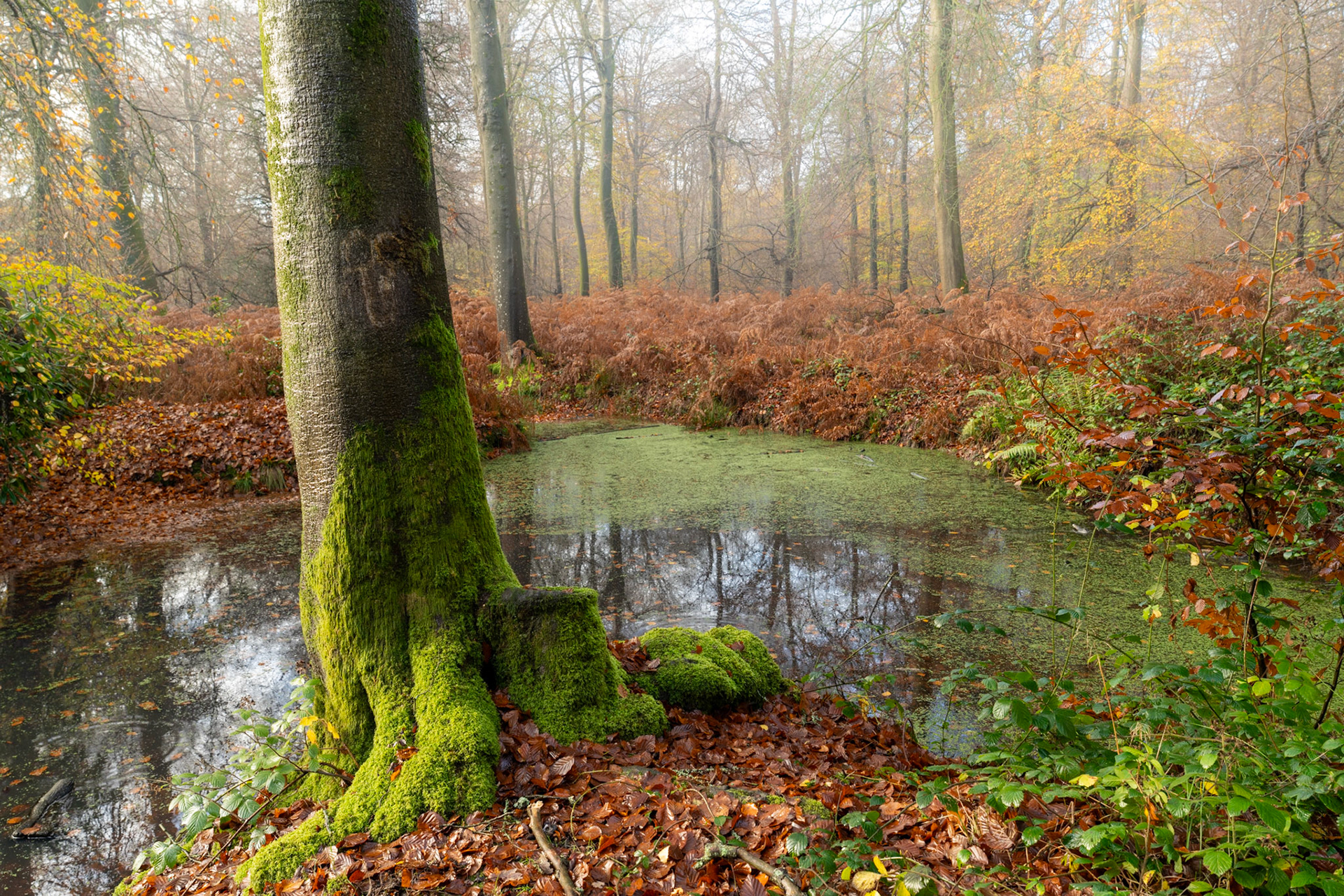
A moss-covered beech trunk rises from a shallow flood pool in the Chilterns, Oxfordshire, its still surface reflecting bare canopy through late-autumn fog. Dead bracken and fallen leaves frame the water on all sides, compressing the scene into a quiet study of seasonal transition. The soft diffused light holds the scene in a muted palette of rust, ochre, and green.

Autumn tree reflections fragment across the surface of a still woodland pond, disturbed by a single point of disturbance that sends concentric rings outward through duckweed and fallen leaves. The interplay of dark trunks, pale birch bark, and scattered ochre leaves creates a compressed, painterly plane. Captured in flat, even light that preserves tonal subtlety across the water's surface.
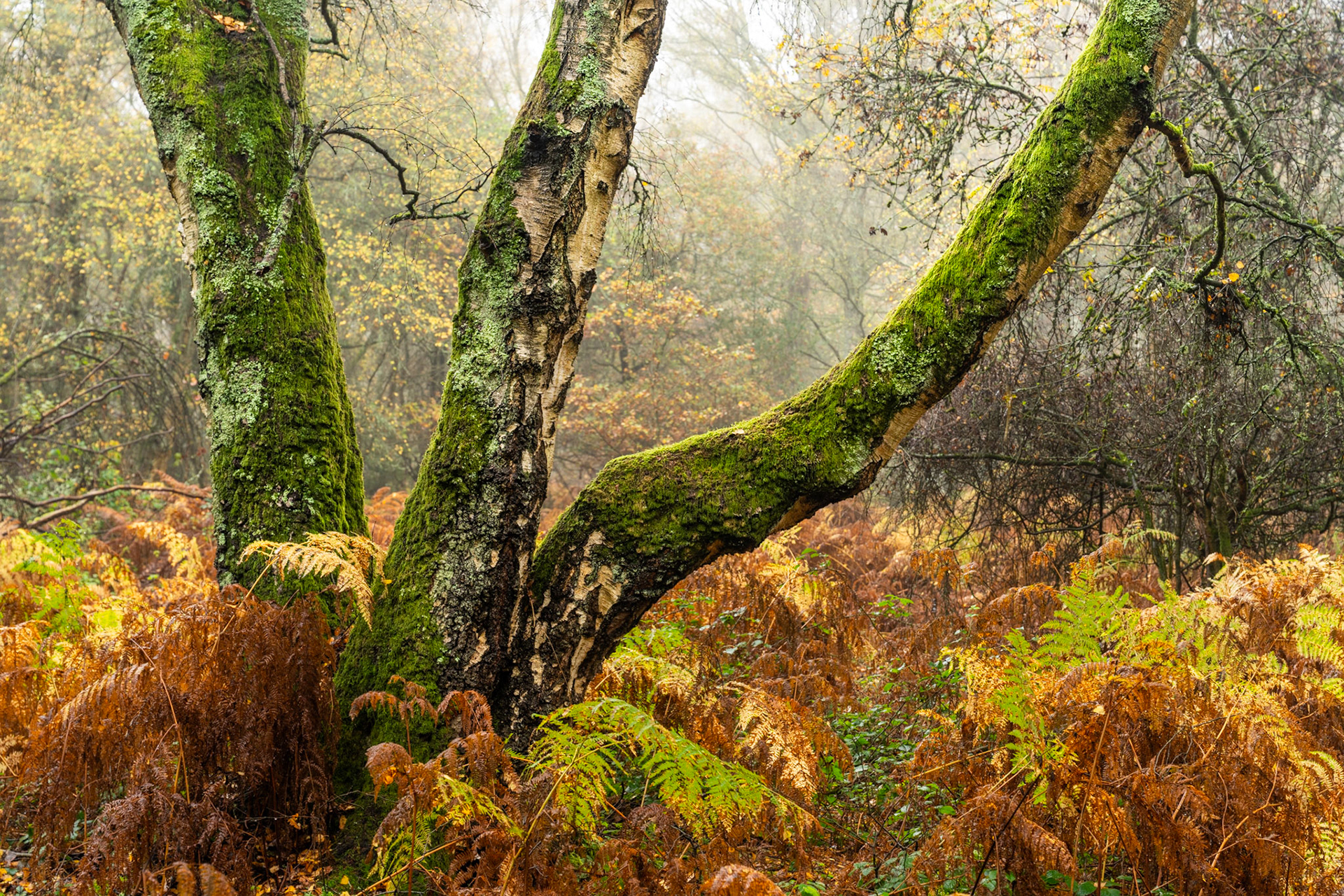
A multi-stemmed silver birch, its bark peeling and trunks heavily colonised by moss and lichen, stands among dying bracken in fog-softened deciduous woodland. The muted November light suppresses contrast, allowing texture and colour temperature — warm russet ferns against cold grey air — to carry the image. No single trunk dominates, which dilutes the focal hierarchy but sustains an honest woodland intimacy.
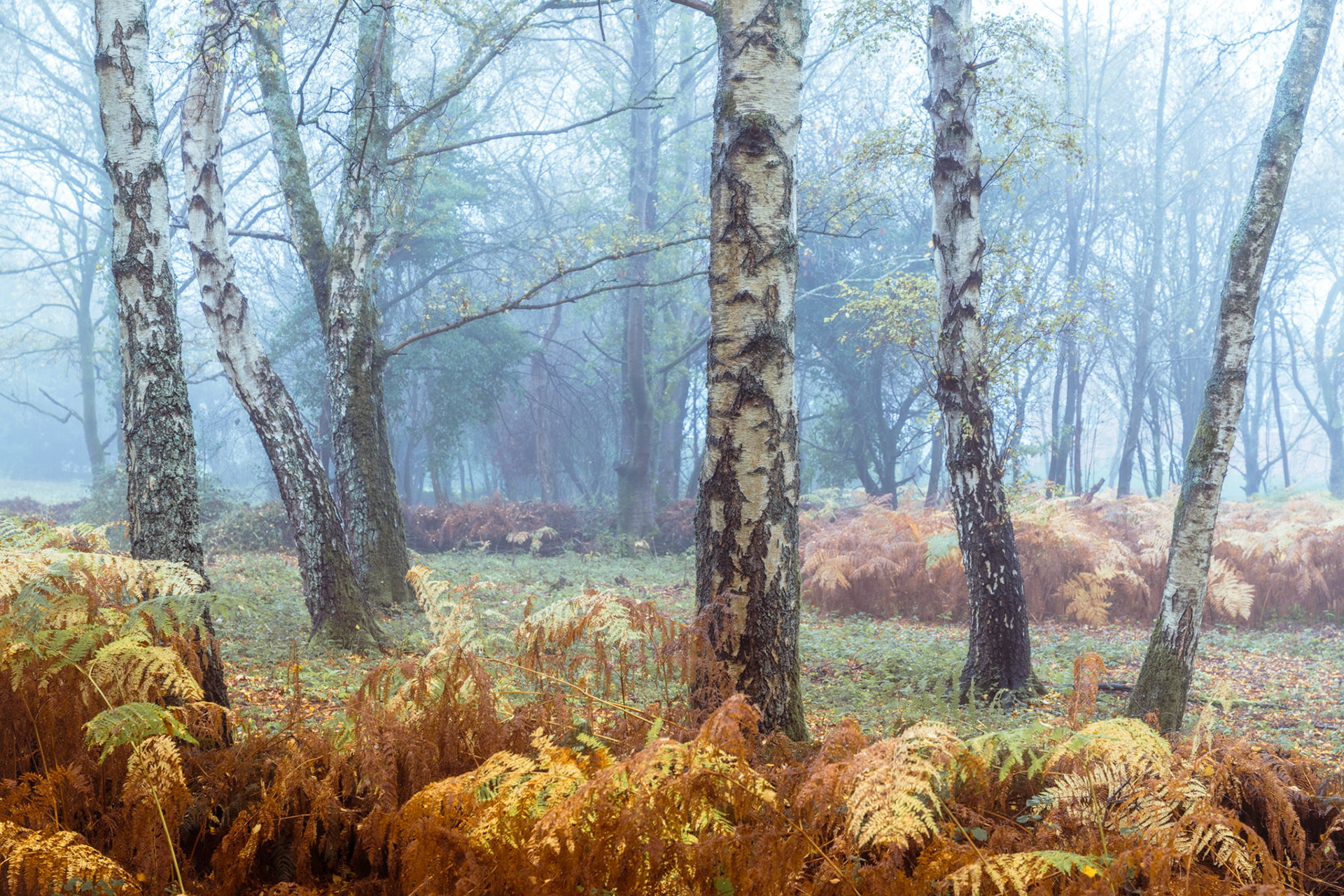
Silver birches rise through autumn fog, their white bark contrasting with a dense understorey of rust-coloured bracken in late seasonal decline. The soft diffusion of moisture-laden air compresses depth and mutes the treeline into pale silhouette. A quiet, intimate woodland interior caught at mid-morning on a still November day.
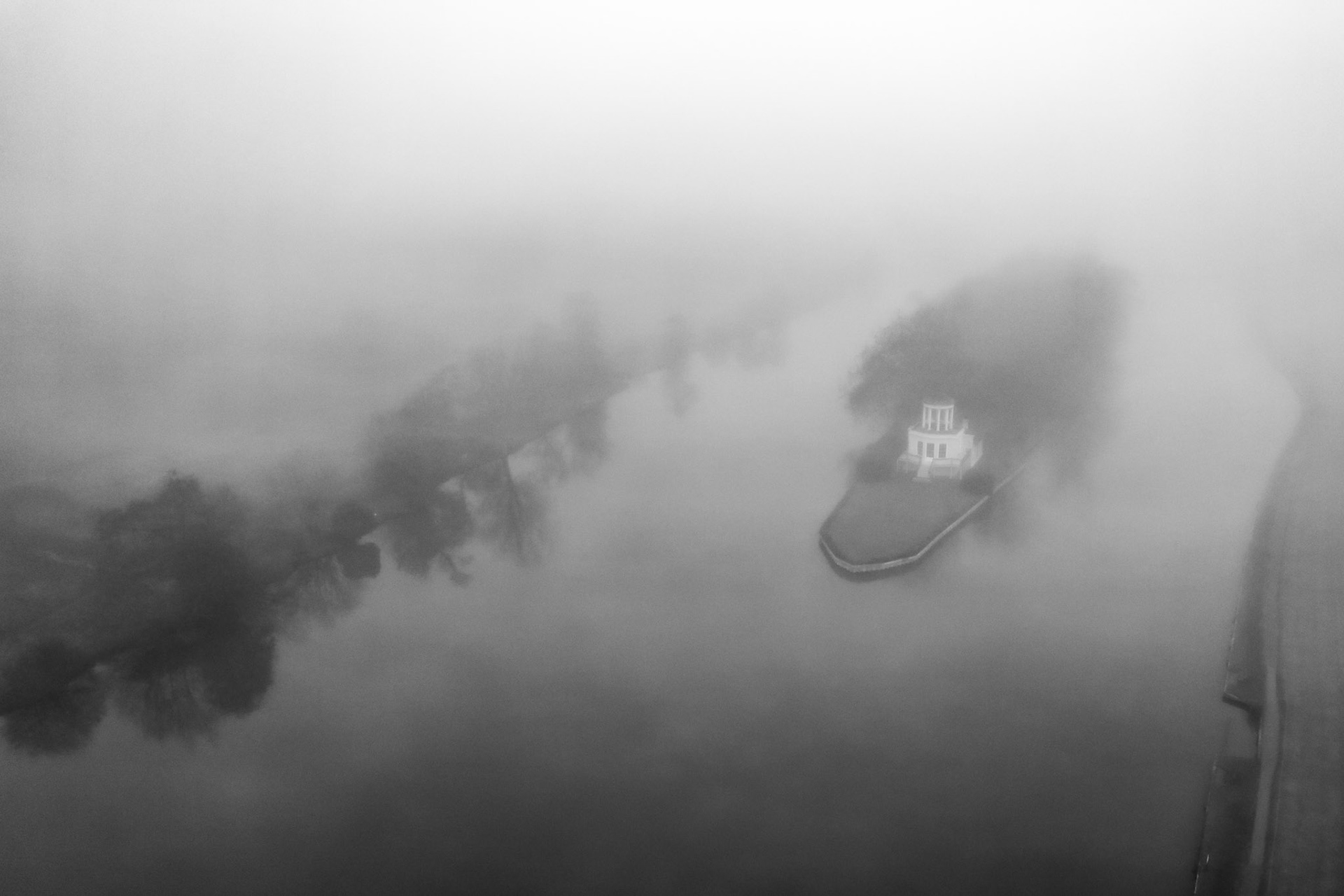
A dense fog inversion envelops the Thames at Henley, reducing a riverside property and its tree-lined peninsula to ghost forms suspended between obscurity and resolution. Shot from altitude at dawn in December, the monochrome conversion strips the scene to tone and shape alone, the lone white building acting as the sole anchor in an otherwise dissolved world.
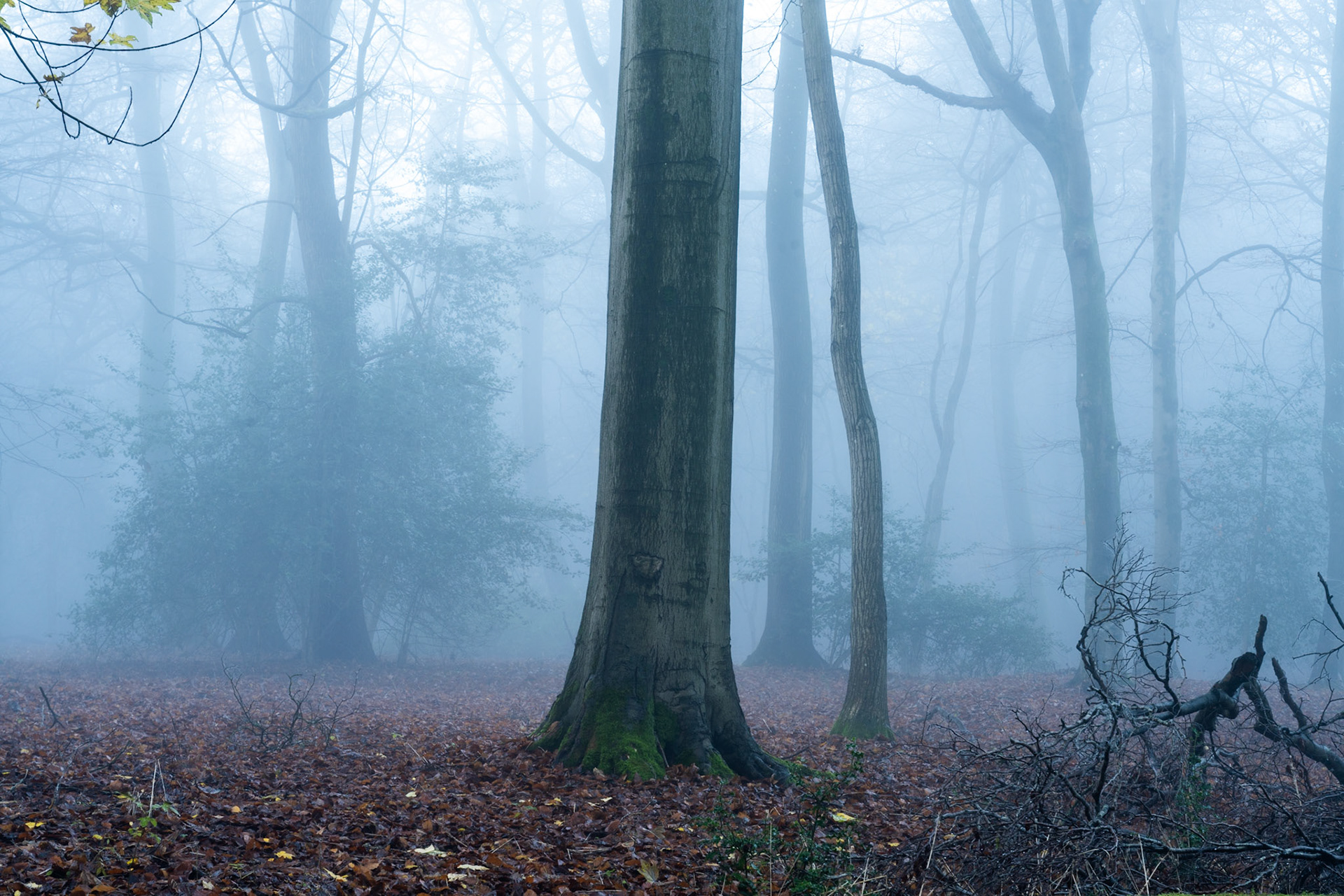
A mature beech stands at the edge of visibility in dense winter fog in the Chilterns, its moss-patched base anchoring a floor of fallen leaves. The curving stem of a neighbouring tree draws the eye into the softened middle distance, where further trunks dissolve into blue-white air. Dead wood in the foreground adds quiet texture without distraction.
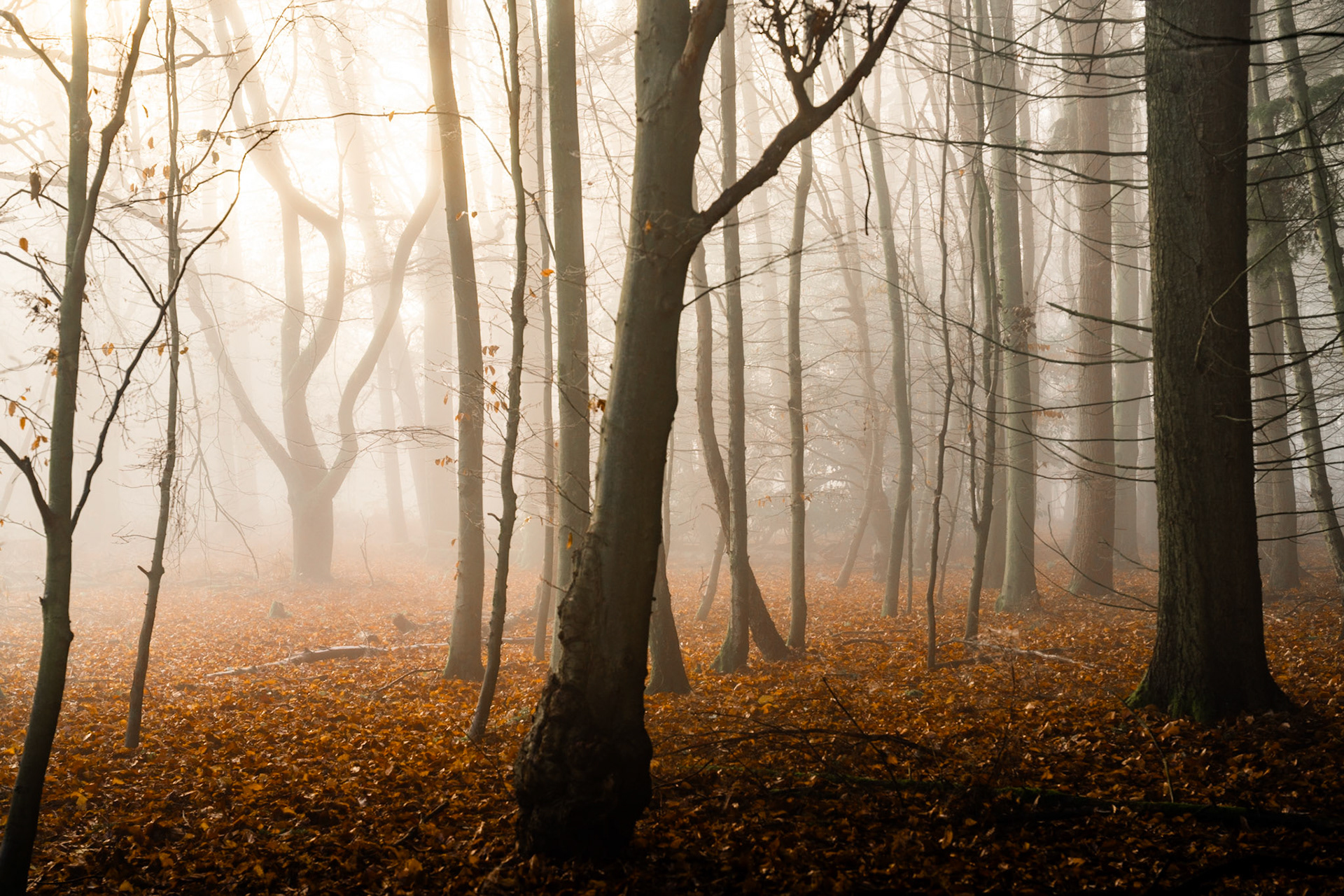
Bare beech trunks recede into dense fog on a December morning in the Chilterns, Oxfordshire, the forest floor carpeted in rust-brown fallen leaves. Diffuse backlight from the upper left creates a pale, luminous atmosphere through the leafless canopy. The layering of trunks gives depth, though the composition lacks a clear singular anchor to draw the eye.
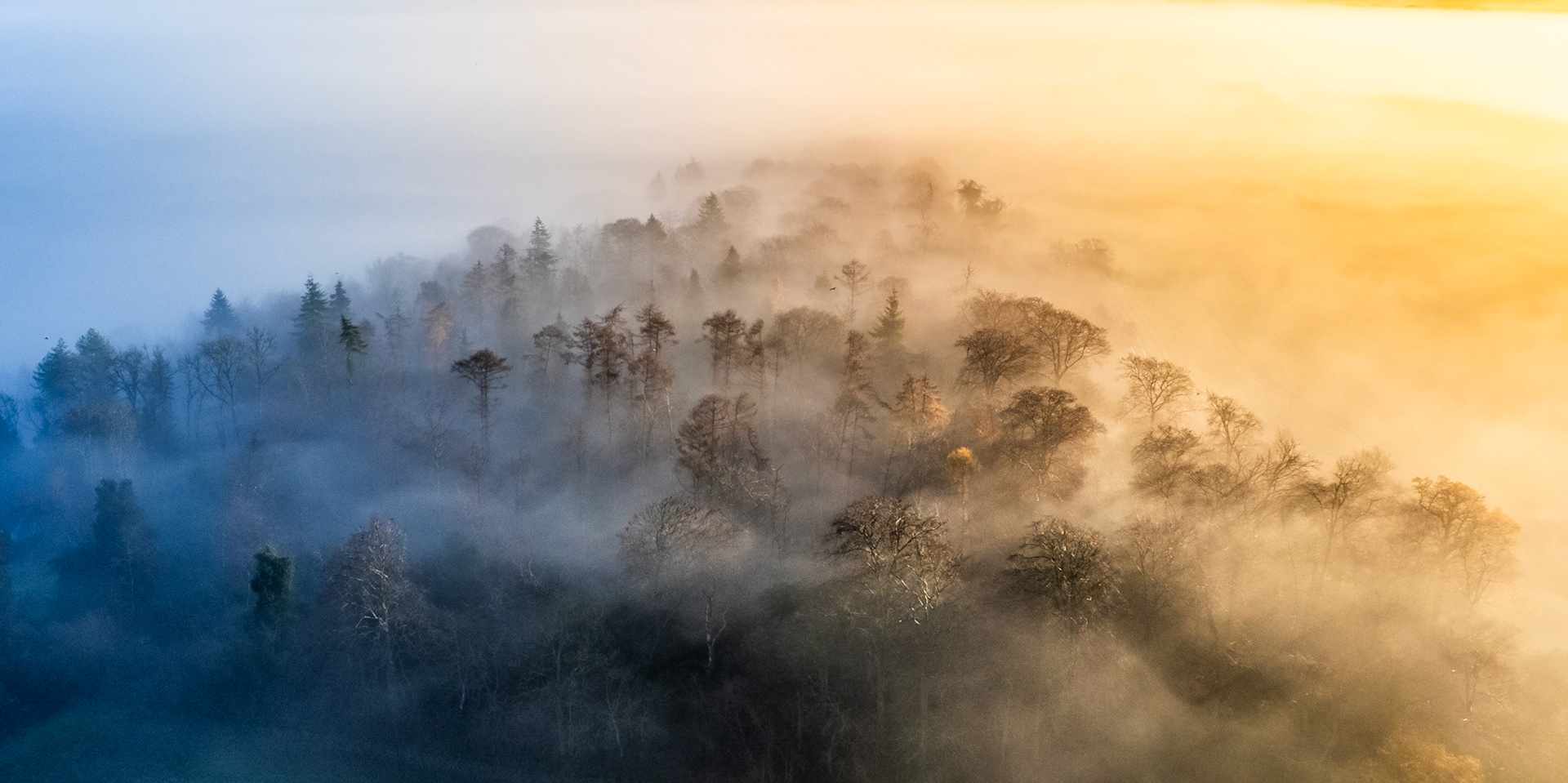
A wooded hillside near Henley-on-Thames emerges as an island above a valley fog inversion at dawn, the warm sunrise light bisecting the scene diagonally against cold blue shadow. The layered mist strips the landscape to silhouette and tone, reducing mixed broadleaf and conifer canopy to pure form. Captured from altitude, the composition turns a familiar Thames Valley hillside into something suspended and otherworldly.
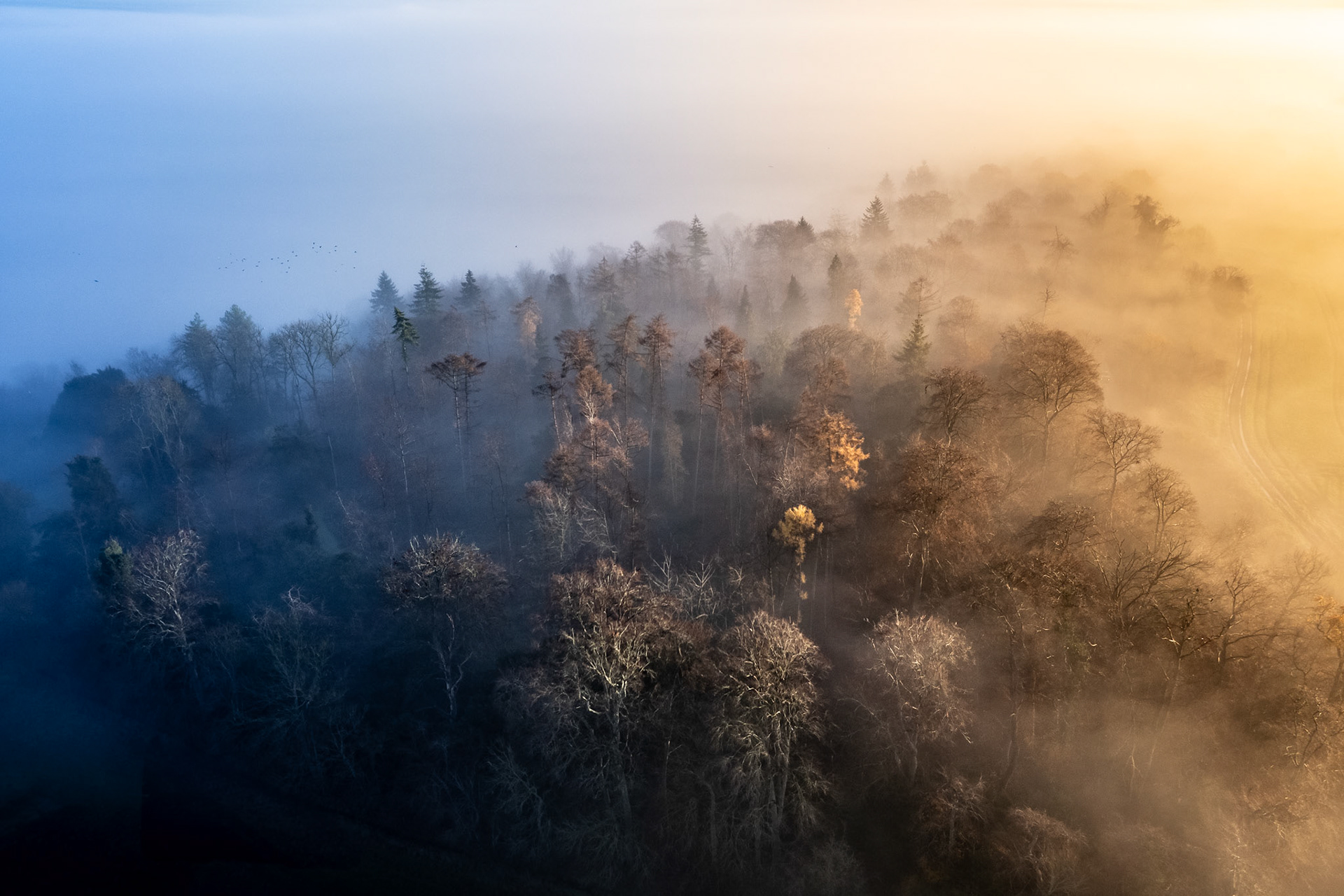
Low winter sun breaks through inversion mist over a mixed woodland hill above the Thames valley, splitting the canopy between cold blue shadow and warm golden light. The aerial perspective reveals the fog rolling through the treetops at near-crown height, rendering bare deciduous crowns and standing conifers as separate tonal registers. A loose flock of birds drifts through the blue half of the sky, anchoring scale in an otherwise abstract composition.
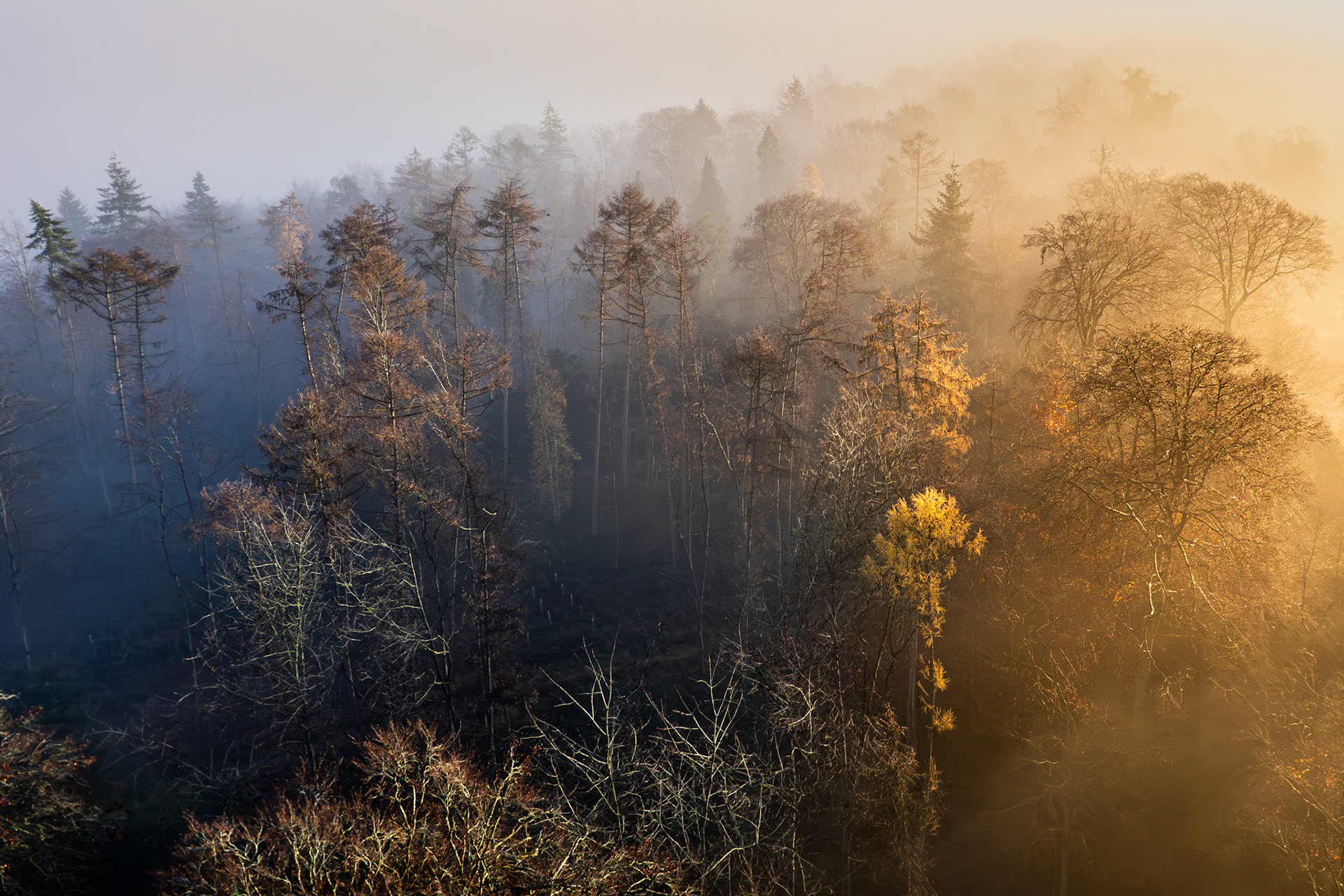
Low winter mist pools between mixed conifers and broadleaved woodland above the Thames valley, a shaft of golden morning light bisecting the canopy and splitting the frame between cold shadow and warm illumination. The aerial perspective flattens the treeline into a single plane of competing tones, the fog acting as a diffuser that separates lit and unlit halves with unusual clarity. Captured near Henley-on-Thames in early December, when the valley holds its mist longest after dawn.
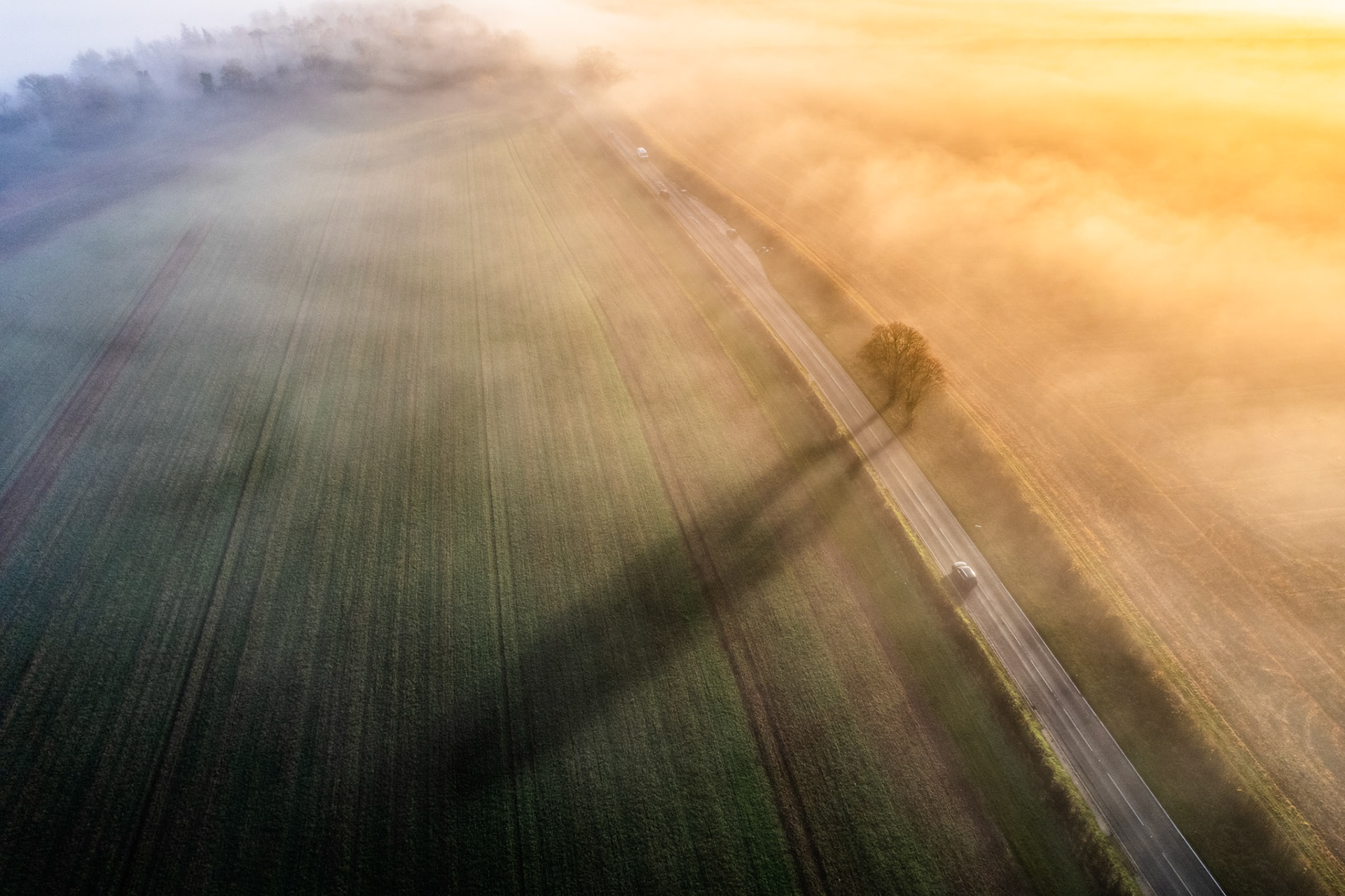
A solitary roadside tree casts an elongated shadow across frost-edged winter arable fields near Henley-on-Thames, its silhouette dramatised by low December sun breaking through advection fog. The diagonal of the road divides warm golden light from blue-grey shadow, while passing cars reduce to white specks within the dissolving murk. The aerial perspective abstracts the landscape into planes of tone and texture.
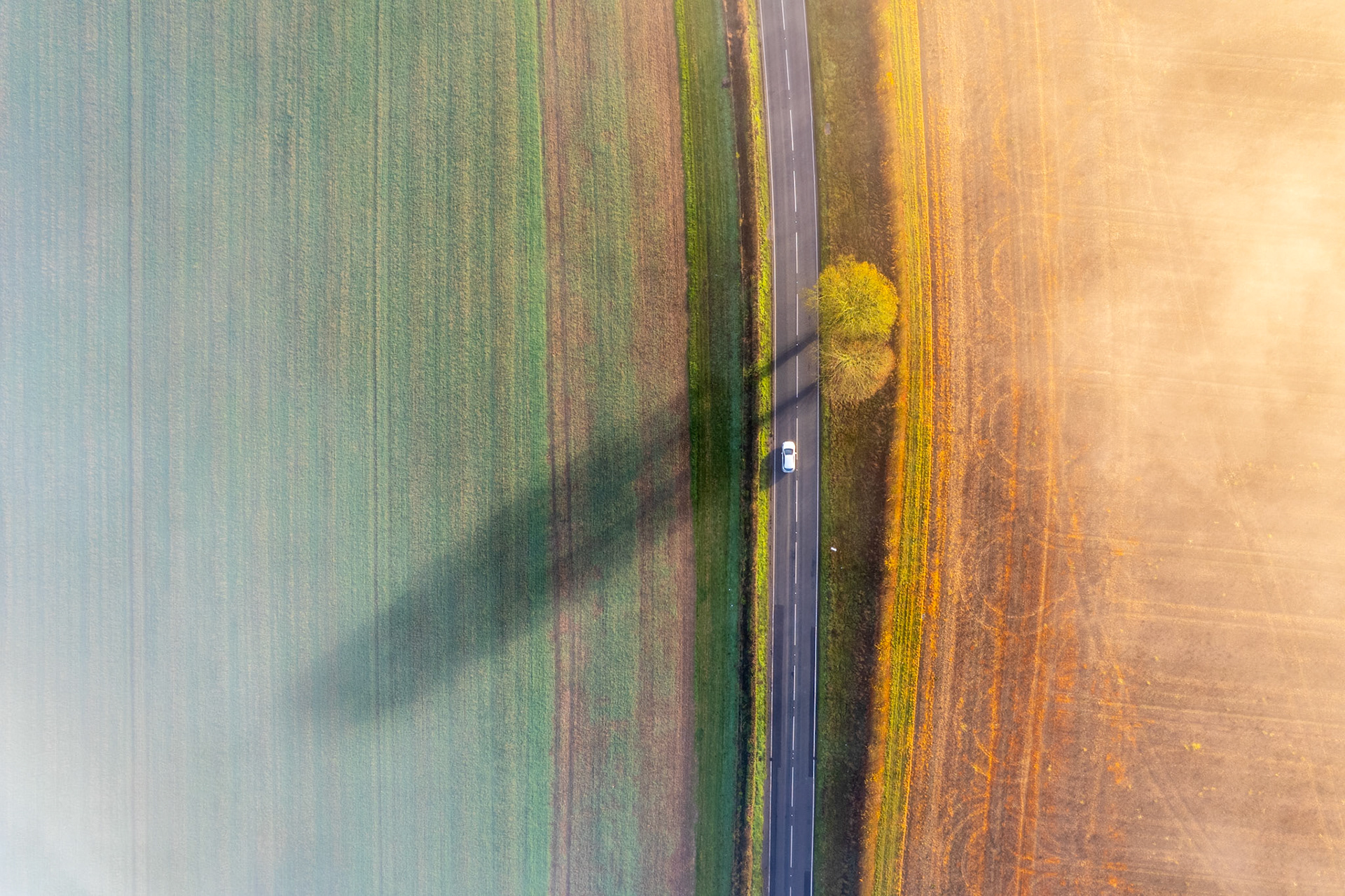
A low winter sun casts the elongated shadow of a roadside tree across ploughed and sown fields near Henley-on-Thames, the geometry bisected by a two-lane road and a single passing car. Shot from directly above at first light, the image sets a cooler, shadowed agricultural plain against warm haze dissolving the eastern field into near-abstraction. The solitary tree anchors the composition, its crown and shadow forming a single diagonal axis across the frame.
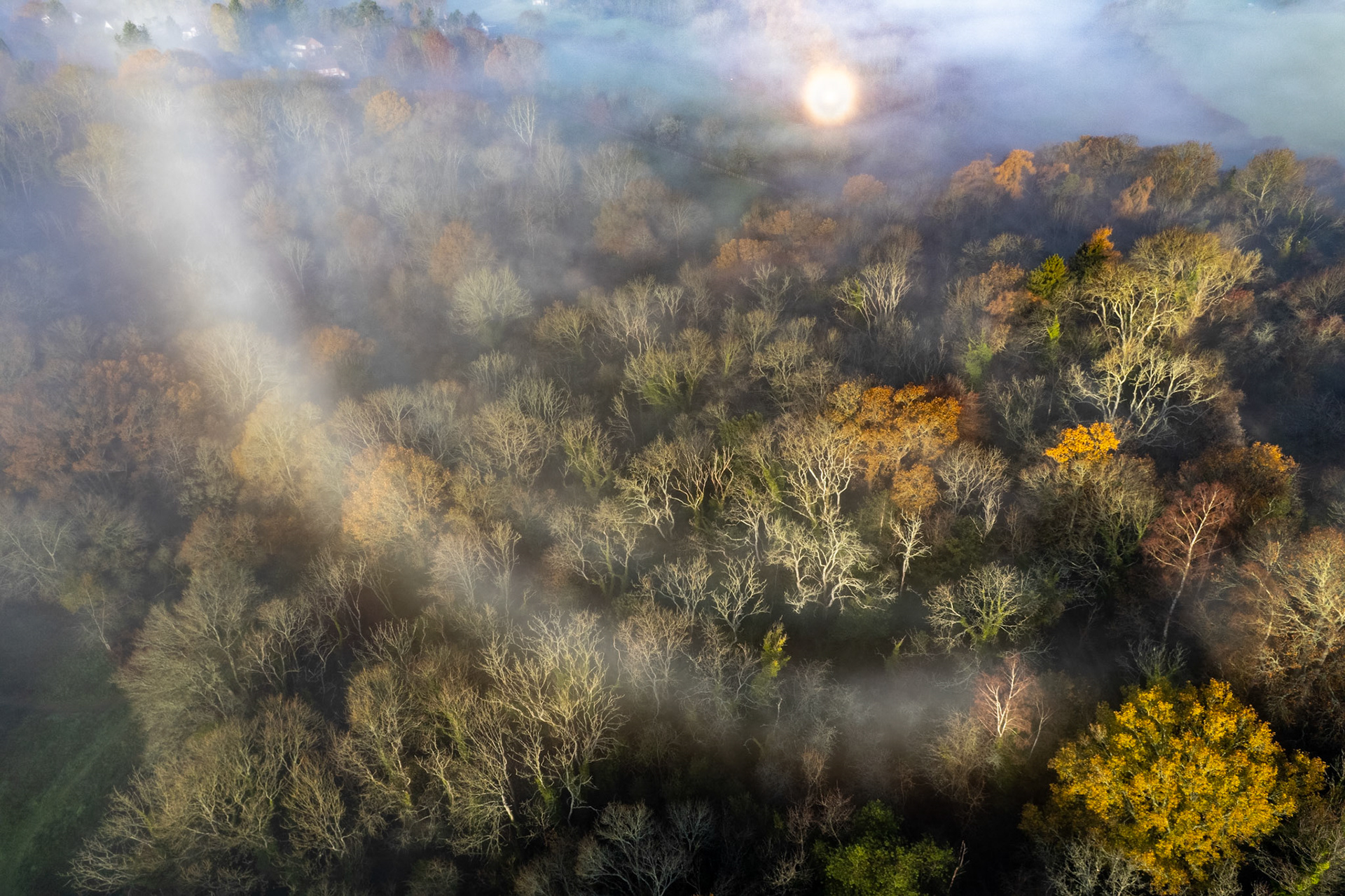
Low morning fog threads between the crowns of a mixed deciduous woodland near Henley-on-Thames, caught from directly above at the moment a diffused sun burns through the upper mist layer. The aerial perspective flattens the canopy into an abstract plane of late-autumn colour — amber, ochre, and bare silver-grey — while tongues of vapour animate the composition with lateral movement. A hint of settlement visible at the upper frame grounds the scene in the settled English landscape.
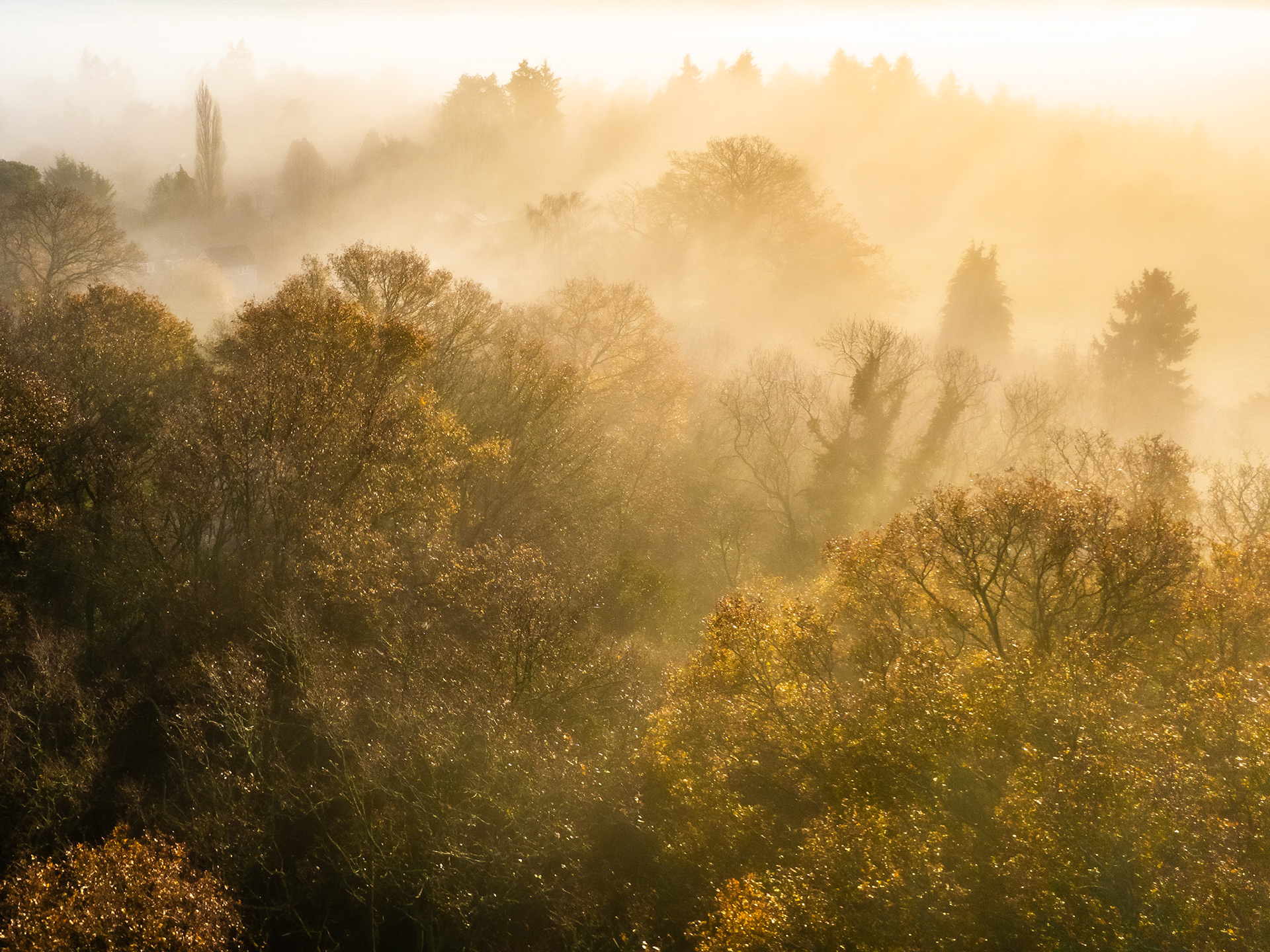
A temperature inversion holds fog among mixed deciduous woodland above Henley-on-Thames, caught at the moment low winter sun begins to burn through. Layers of canopy recede into the murk, the foreground trees still holding remnant autumn colour against bare mid-ground stems. The aerial vantage compresses depth, turning atmosphere into almost pure texture.

Low autumn sun breaks through a gap in mixed woodland in the Chilterns, Oxfordshire, casting distinct crepuscular rays between two moss-based beech trunks. A carpet of fallen leaves covers the forest floor while backlit golden foliage frames the burst of light. The mist implied by the visible rays adds depth to the receding treeline.
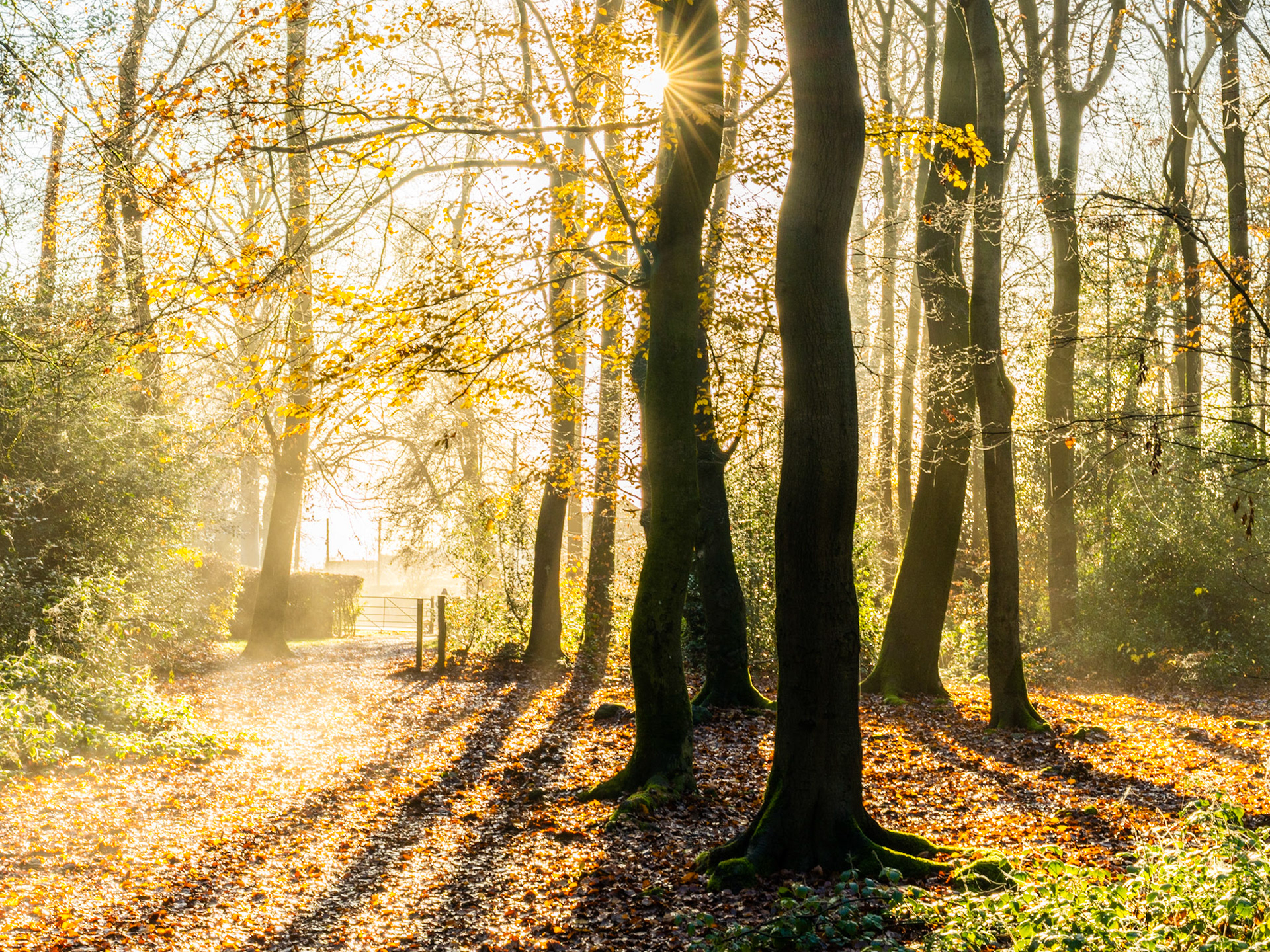
Low winter sun breaks through thinning beech canopy in the Chilterns, Oxfordshire, casting long shadows across a leaf-strewn woodland track. Residual mist catches the light between the trunks, drawing the eye toward a farm gate at the wood's edge. The juxtaposition of deep shadow and luminous haze gives the scene quiet tension.
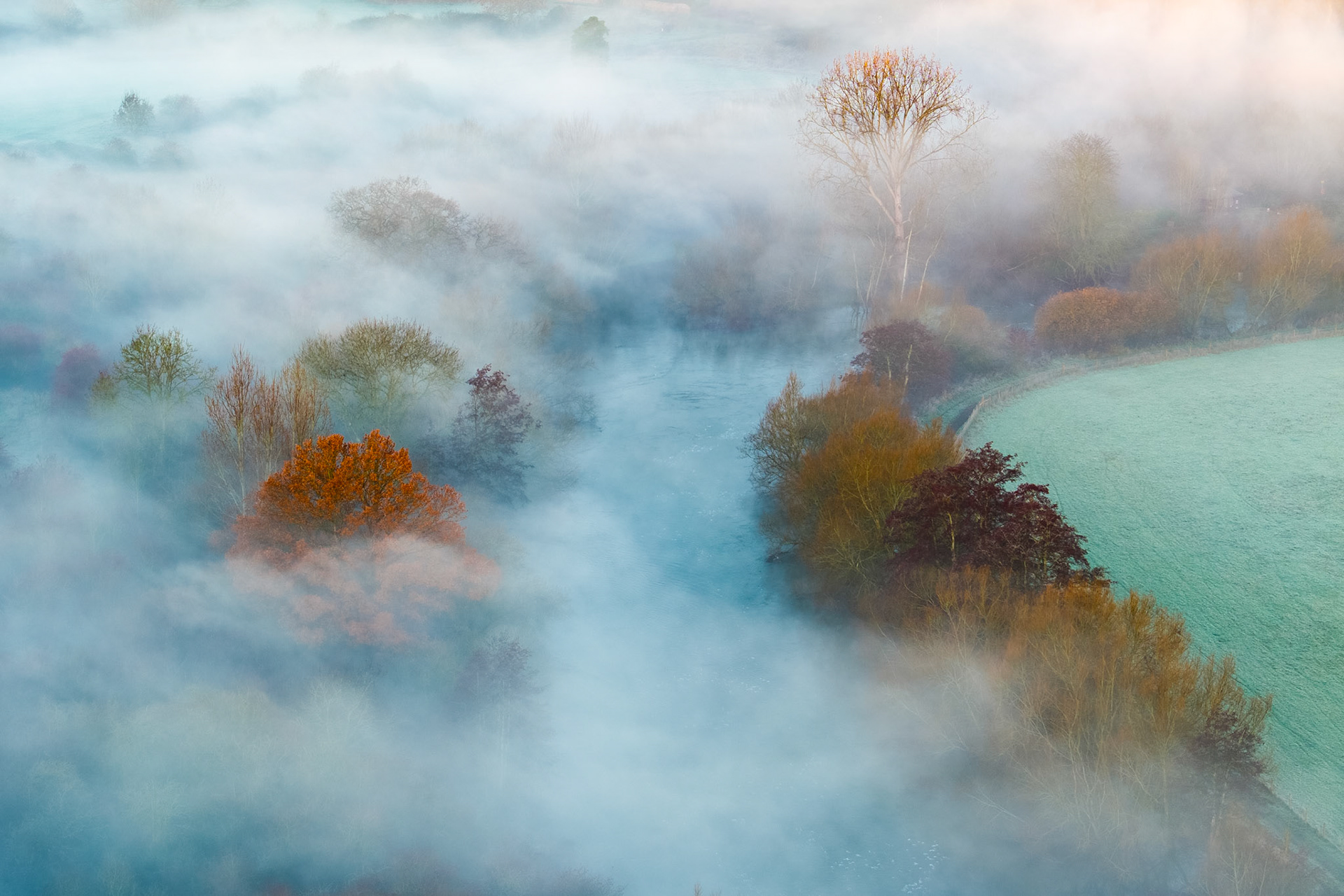
A temperature inversion smothers the Thames valley near Abingdon at first light, leaving trees in full autumn-to-winter transition stranded above a slow-moving sea of cold fog. A frosted meadow breaks clear to the right, its pale green a quiet counterpoint to the amber and burgundy crowns emerging from the mist. The aerial perspective dissolves conventional landscape geometry, reducing the scene to colour, texture, and atmosphere.
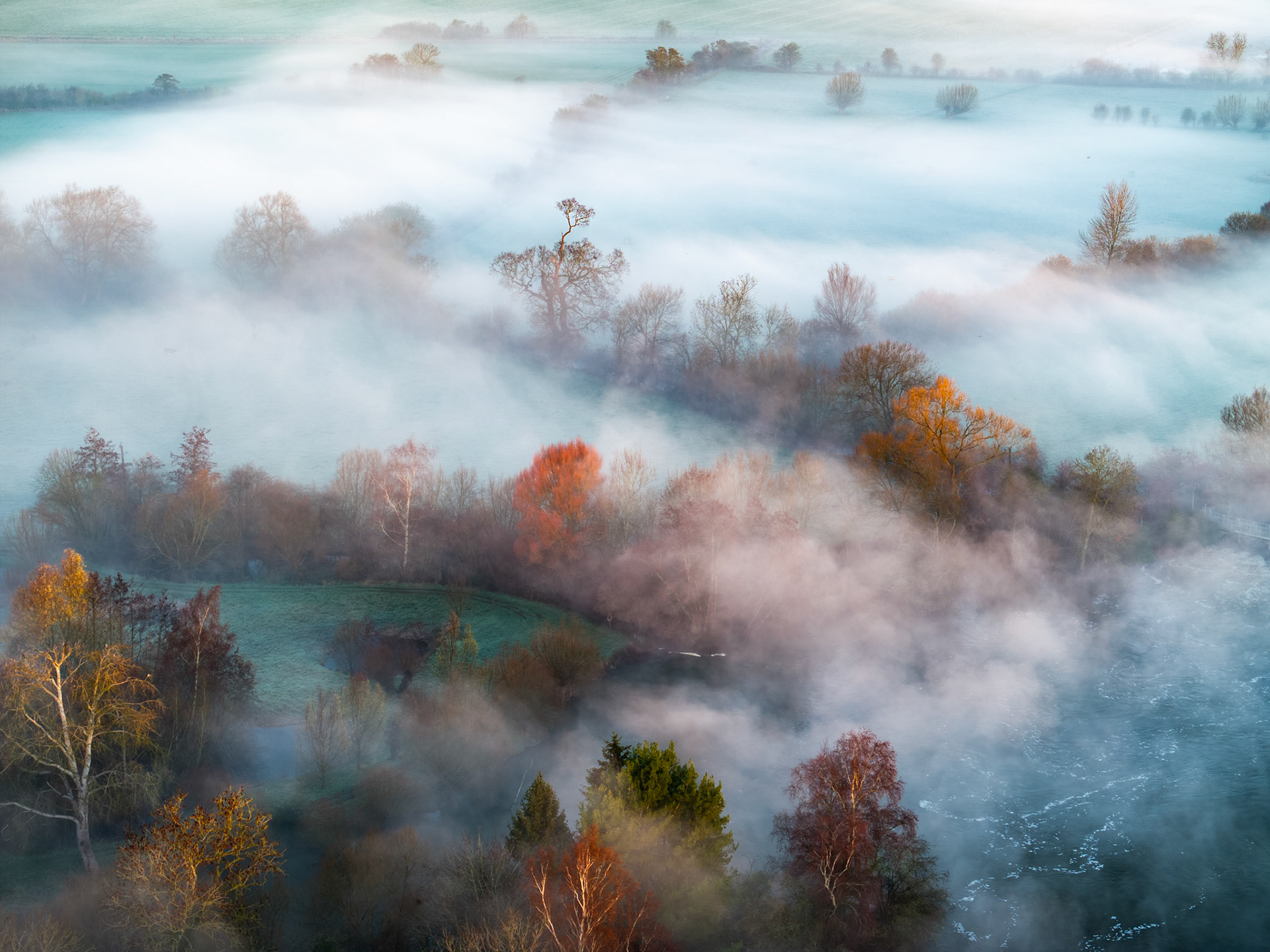
A temperature inversion settles across the Thames Valley near Wallingford, submerging hedgerows and fields beneath a continuous white plane while isolated trees in late autumn colour rise through the fog layer. Shot at low drone altitude, the diagonal ridge of emerging woodland divides the composition, giving structure to an otherwise formless sea of mist. The pale warmth catching copper and amber crowns against the cool tonal ground is what lifts this from record to image.
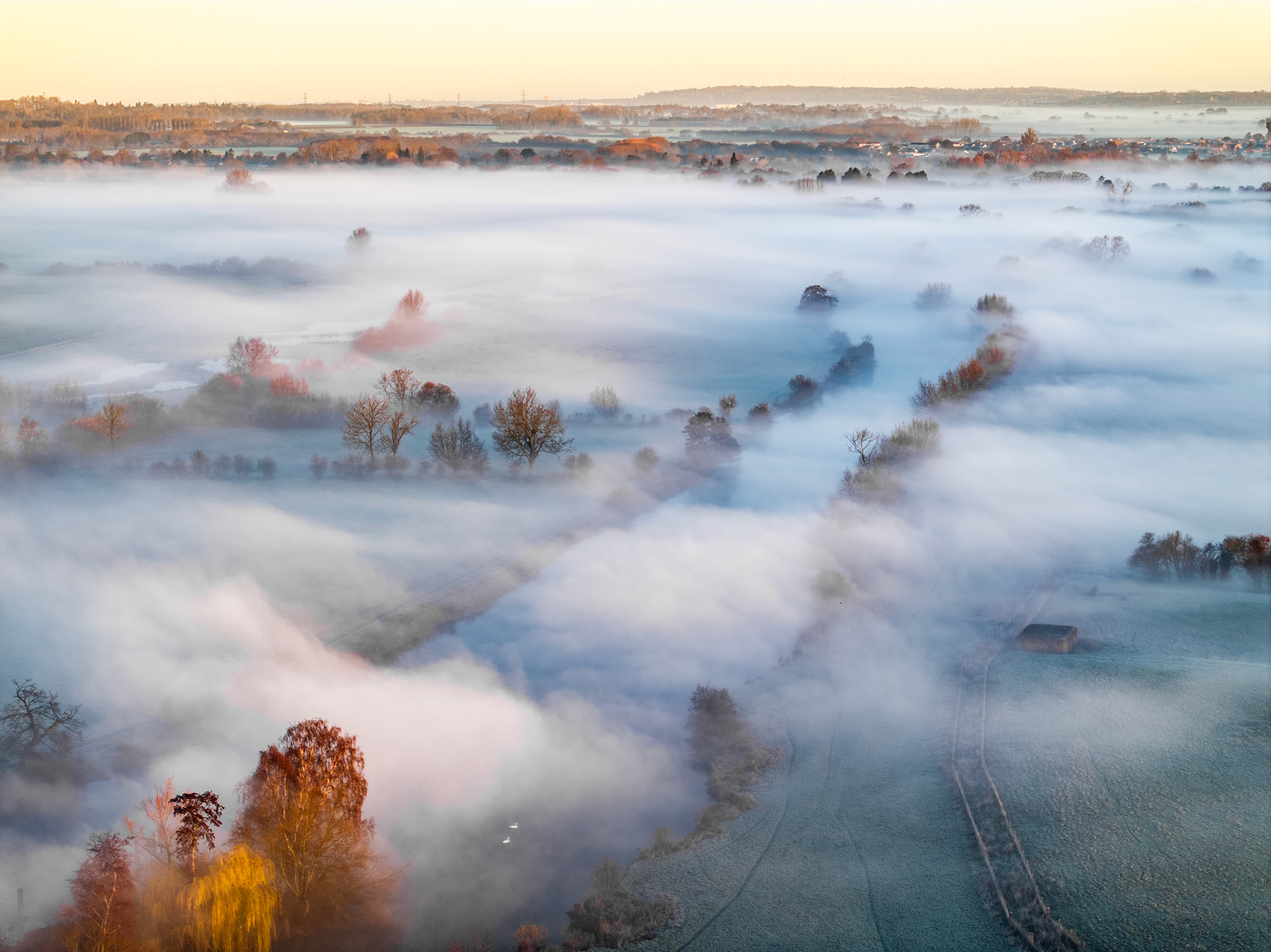
A temperature inversion fills the Thames Valley floor near Wallingford, submerging hedgerows, farm tracks and scattered woodland to their crowns. Autumn-coloured trees pierce the fog layer, lit warm from the east as first light catches the upper canopy. A frost-whitened field in the foreground anchors the scene against the dissolving middle distance.

A temperature inversion smothers the Thames valley near Wallingford, leaving only the crowns of riparian trees and the ghost of the river channel visible from altitude. The cool blue of open water mirrors the sky between successive fog banks, while amber willow stems provide the only warm note in an otherwise tonal composition. Captured at dusk in mid-December, the image reads as pure abstraction without surrendering its sense of place.
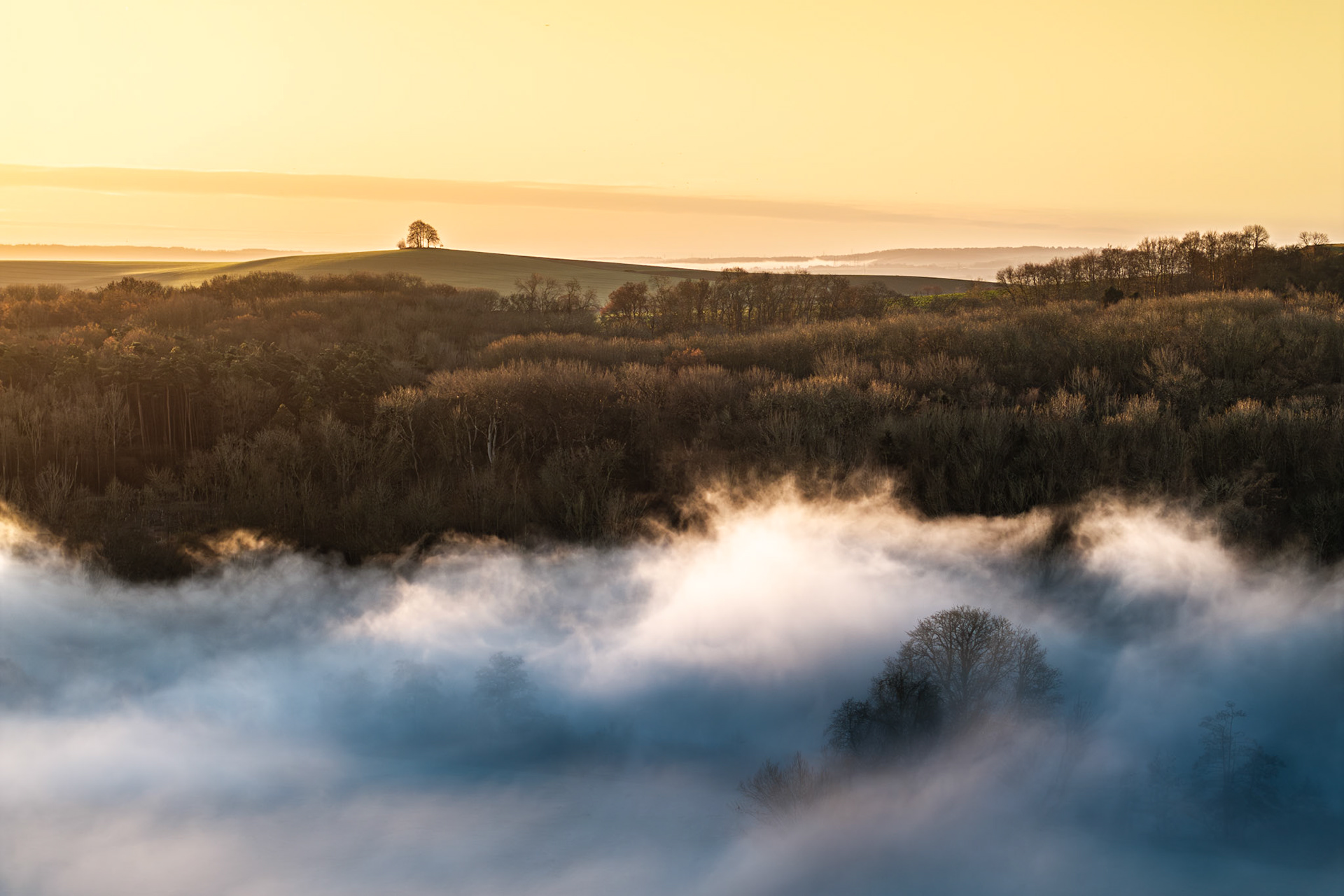
A temperature inversion fills the valley floor with dense fog while bare woodland emerges at the cloud margin, near Wallingford on the Oxfordshire Downs. A lone tree group crowns the distant hill in silhouette against a pale winter dawn sky. The foreground mist, lit from below, separates into distinct layers that give the scene unusual depth and spatial ambiguity.
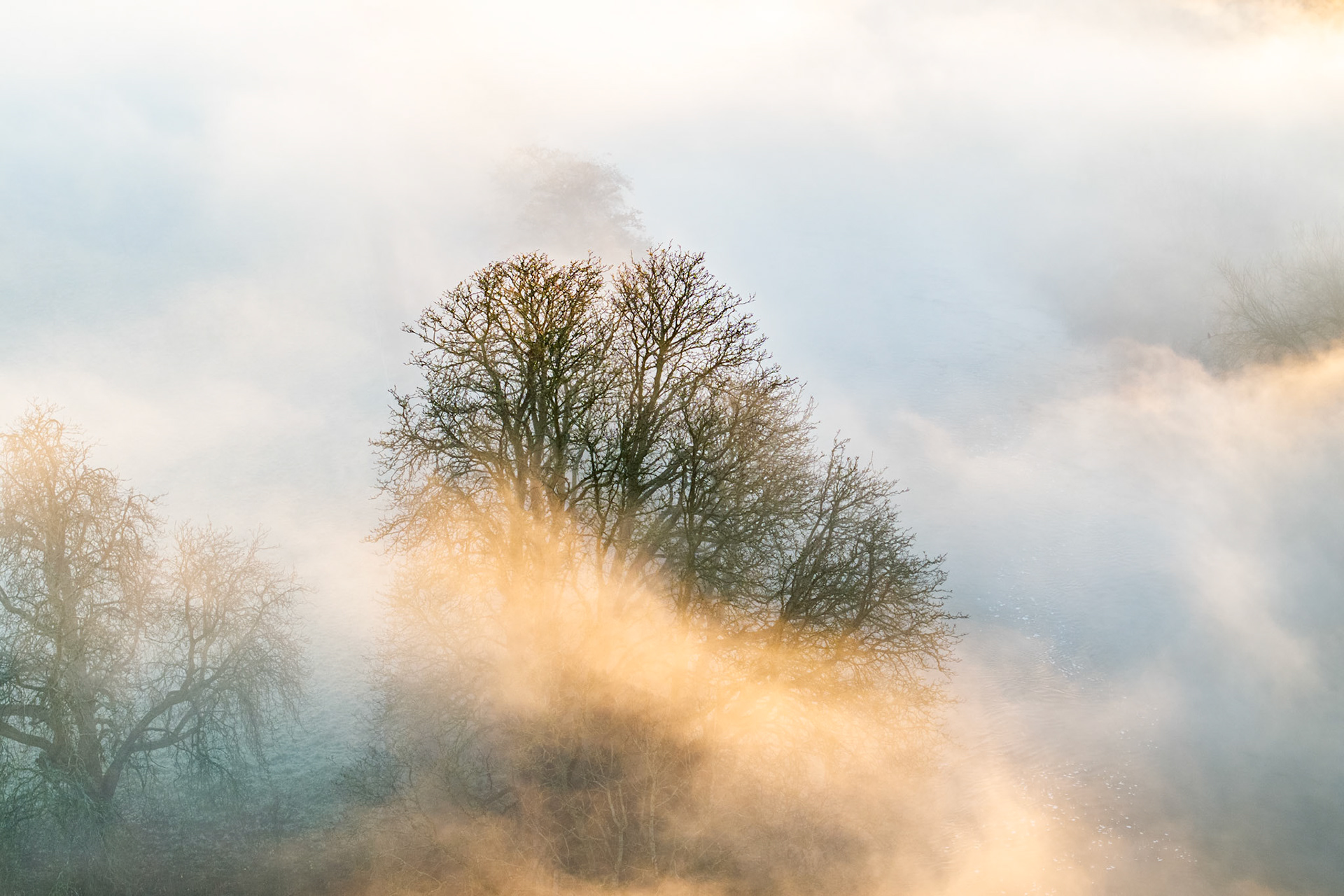
Bare-branched deciduous trees emerge from rolling valley fog near Wallingford, Oxfordshire, during a winter temperature inversion. Warm low sunlight scatters through the mist in raking diagonal bands, reducing the landscape to layers of amber and cool grey. The aerial vantage dissolves any sense of ground, leaving the canopy suspended in luminous vapour.
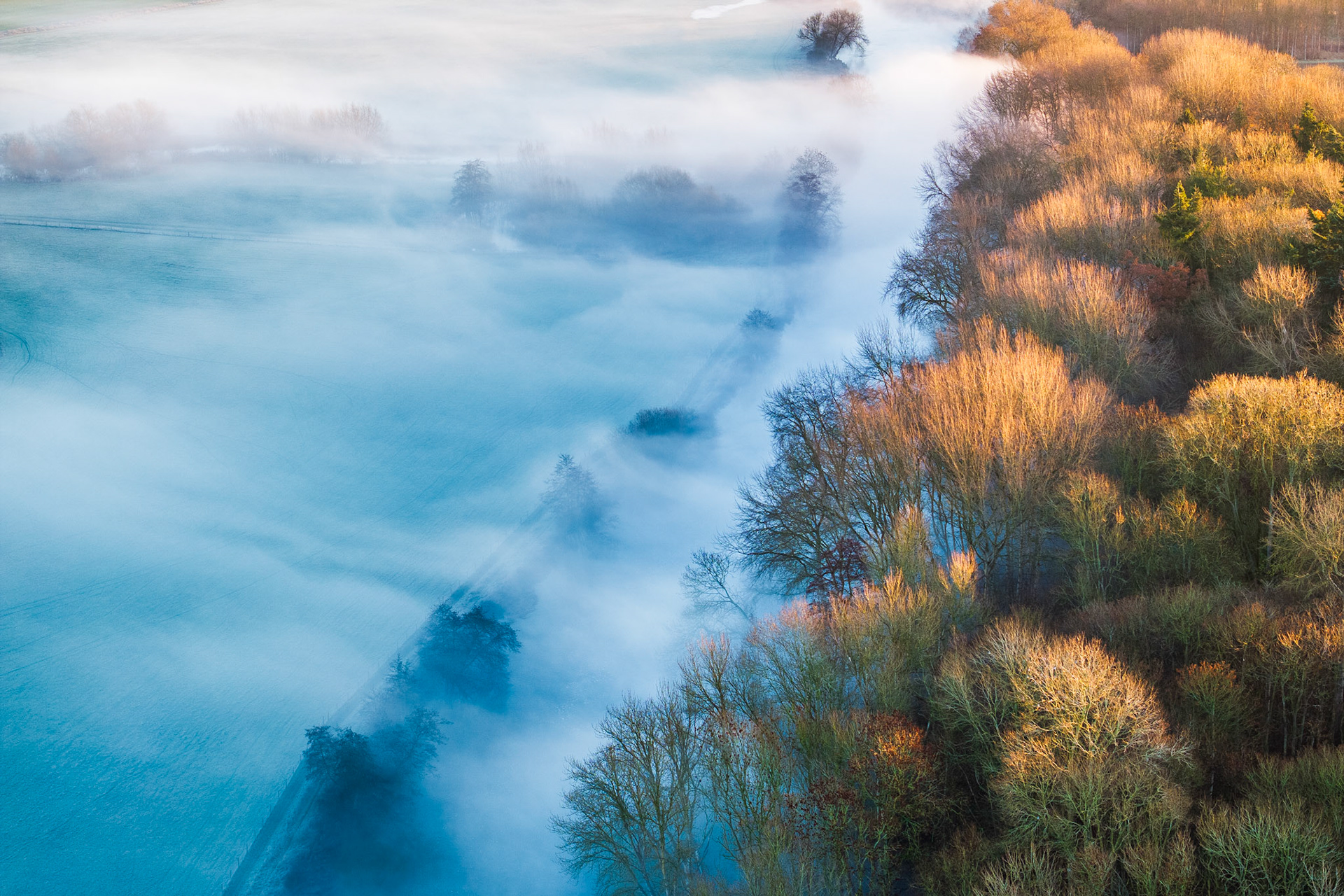
Low winter fog pools across frost-hardened floodplain fields beside the Thames near Abingdon, held in place by a sharp temperature inversion. Riparian trees on the wooded margin catch the first warm raking light from the south-east, their amber canopies standing clear above the mist while isolated hedgerow trees trail long shadow-wakes across the blue-white fog surface below. The diagonal edge between lit woodland and submerged plain carries the composition with controlled tension.

Low winter sun rakes across frost-covered arable fields near Abingdon-on-Thames, casting long parallel shadows from a bare hedgerow treeline across the crop rows below. The geometry of cultivation — tractor lines, ridge furrows, and the disciplined stand of leafless trees — resolves from the air into near-abstract pattern. The colour contrast between the warm, lit upper field and the cool shadow-blue of the lower one gives the image its structural tension.
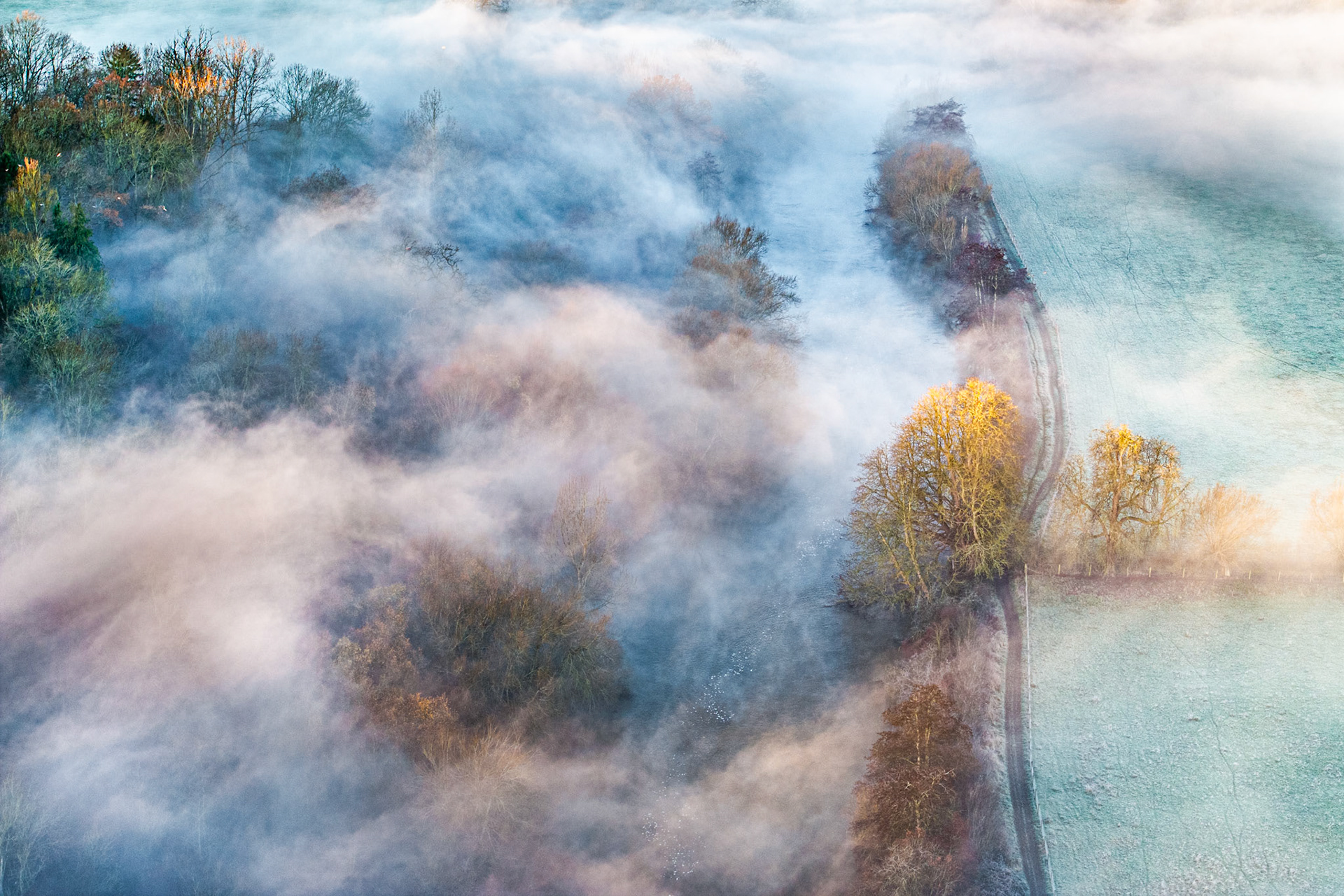
A country road emerges briefly from a low fog inversion blanketing the Thames Valley near Wallingford, Oxfordshire. Golden-leafed trees catch the first winter light above the mist, their canopies isolated like islands in a slow-moving sea of cloud. The aerial vantage transforms a familiar agricultural landscape into something close to abstraction.
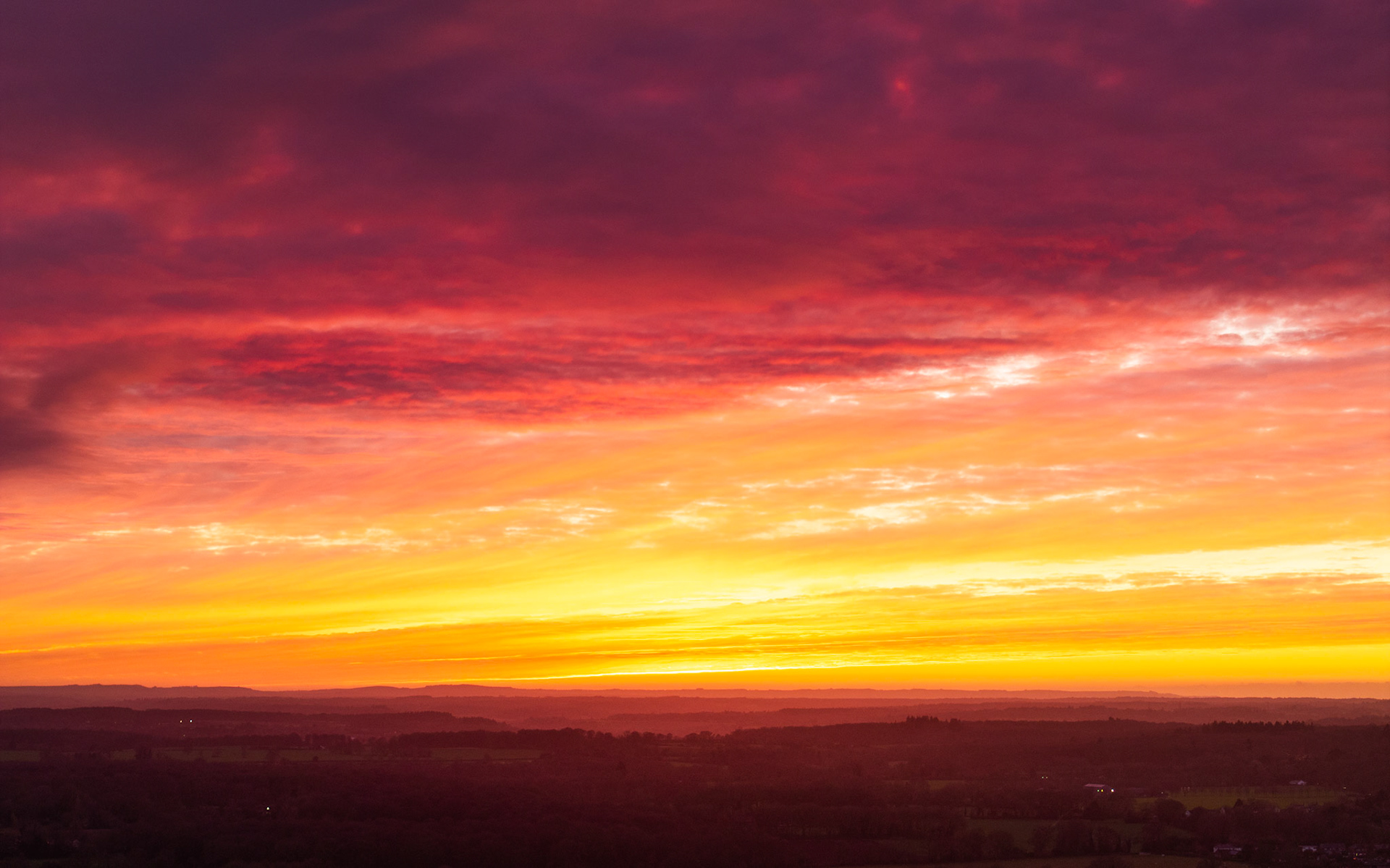
A drone vantage above the Thames Valley records the final seconds of dawn colour before winter sunrise, the sky grading from deep crimson through amber to a luminous yellow band at the horizon. Layers of low cloud catch the light in horizontal strata while the darkened valley floor below retains scattered settlement lights. The composition is dominated by sky, leaving the landscape as a minimal anchor.
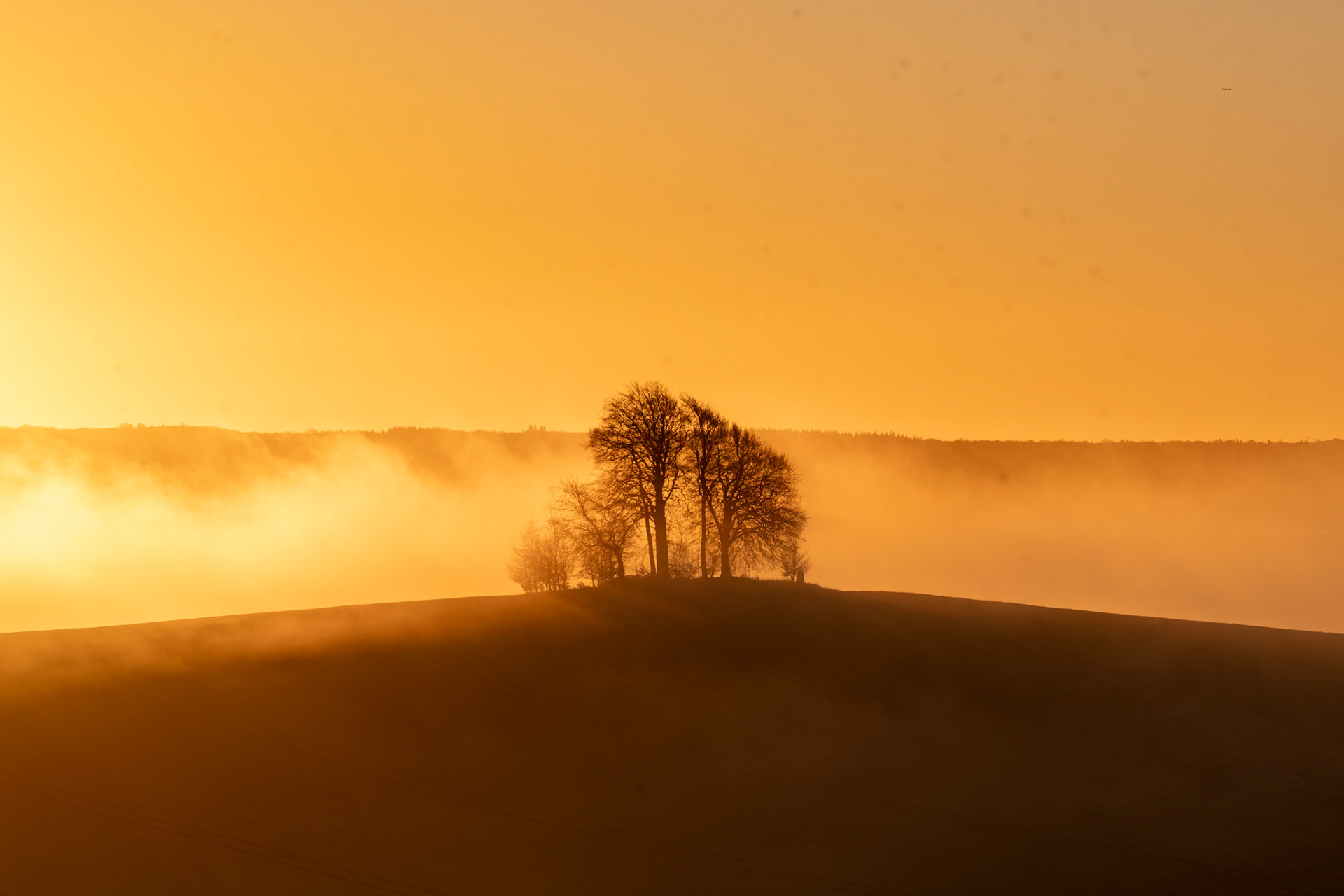
A tight copse of bare-branched trees crowns a rounded hill as ground fog rolls across the surrounding farmland at dawn. The backlit mist separates the hillock from a distant treeline, reducing the scene to layered silhouettes against a saturated amber sky. Captured in mid-January, the leafless canopy and low sun angle fix the moment precisely in the dormant season.
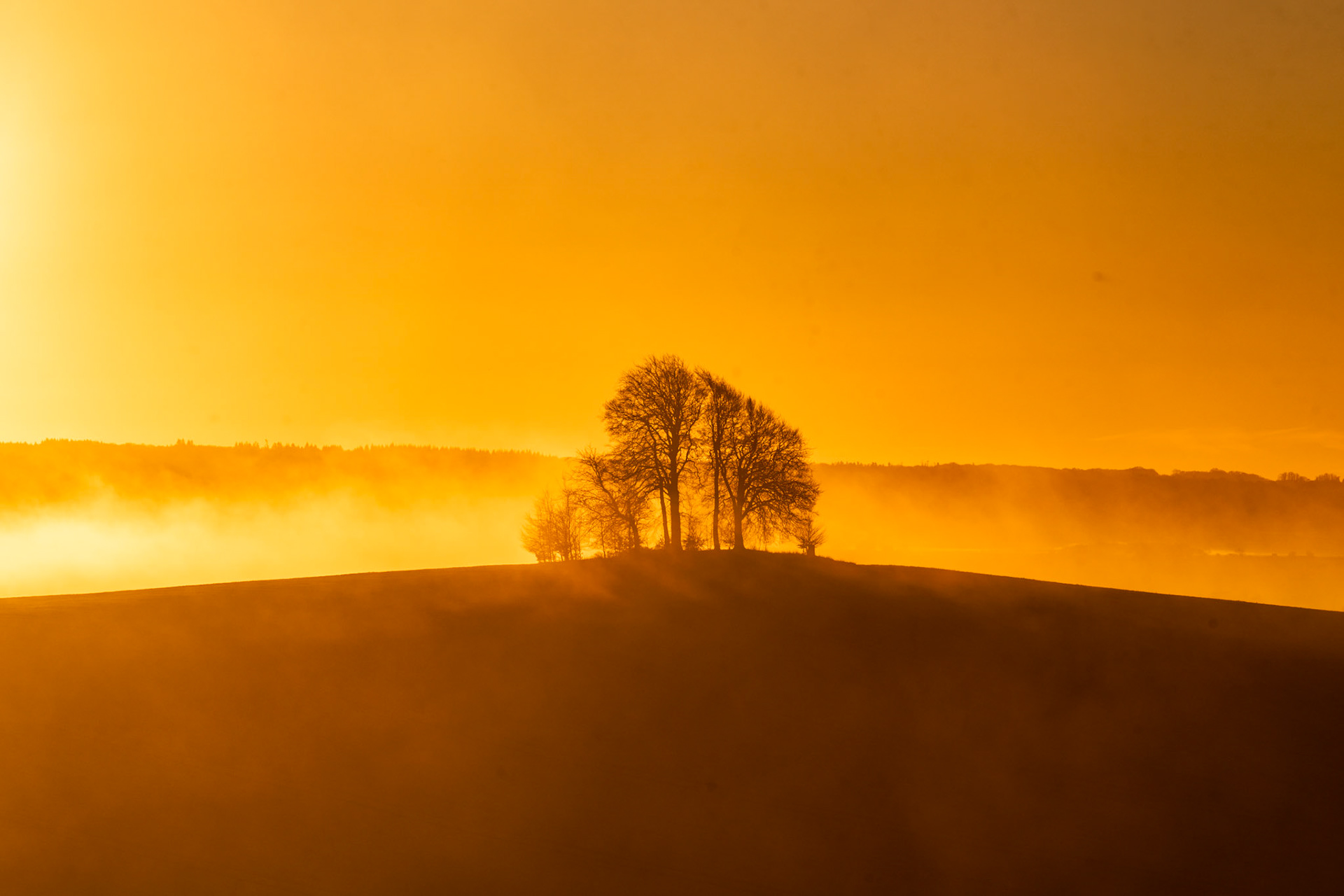
A small cluster of bare-branched trees crowns a rounded hilltop as ground fog rolls across the mid-distance, backlit by low winter dawn light that saturates the scene in deep amber. The silhouetted treeline of a wood in the background adds a second horizontal layer, reinforcing the sense of depth within the inversion. The dark foreground slope anchors the composition and throws the illuminated fog bank into sharp relief.
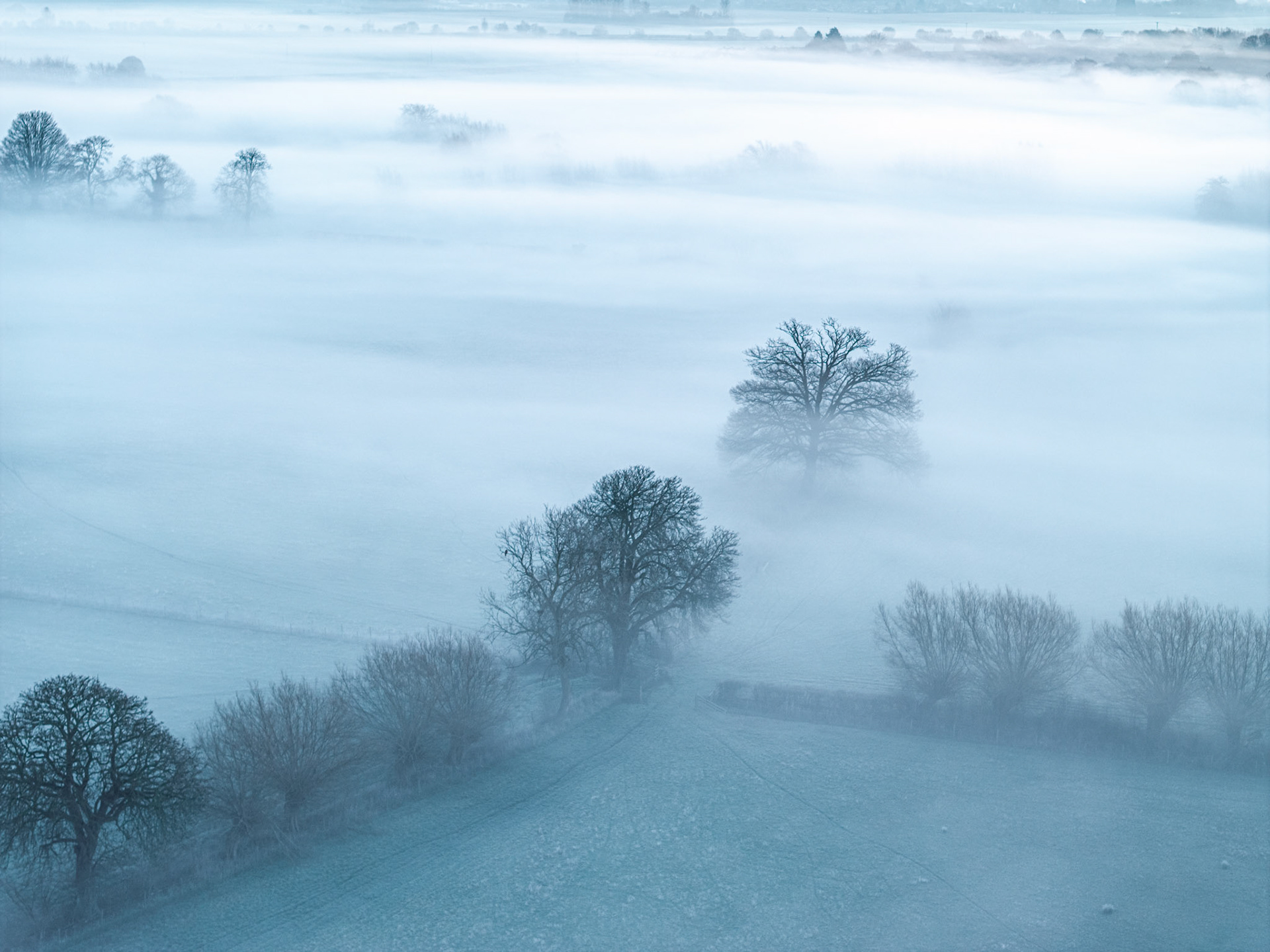
A temperature inversion settles across the Thames Valley near Wallingford, submerging the farmland in dense fog while bare oak trees emerge as dark silhouettes at varying depths. The elevated drone perspective compresses the receding layers of mist into near-abstract bands of cool blue-grey, with hedgerow trees in the foreground providing scale and anchoring the composition.
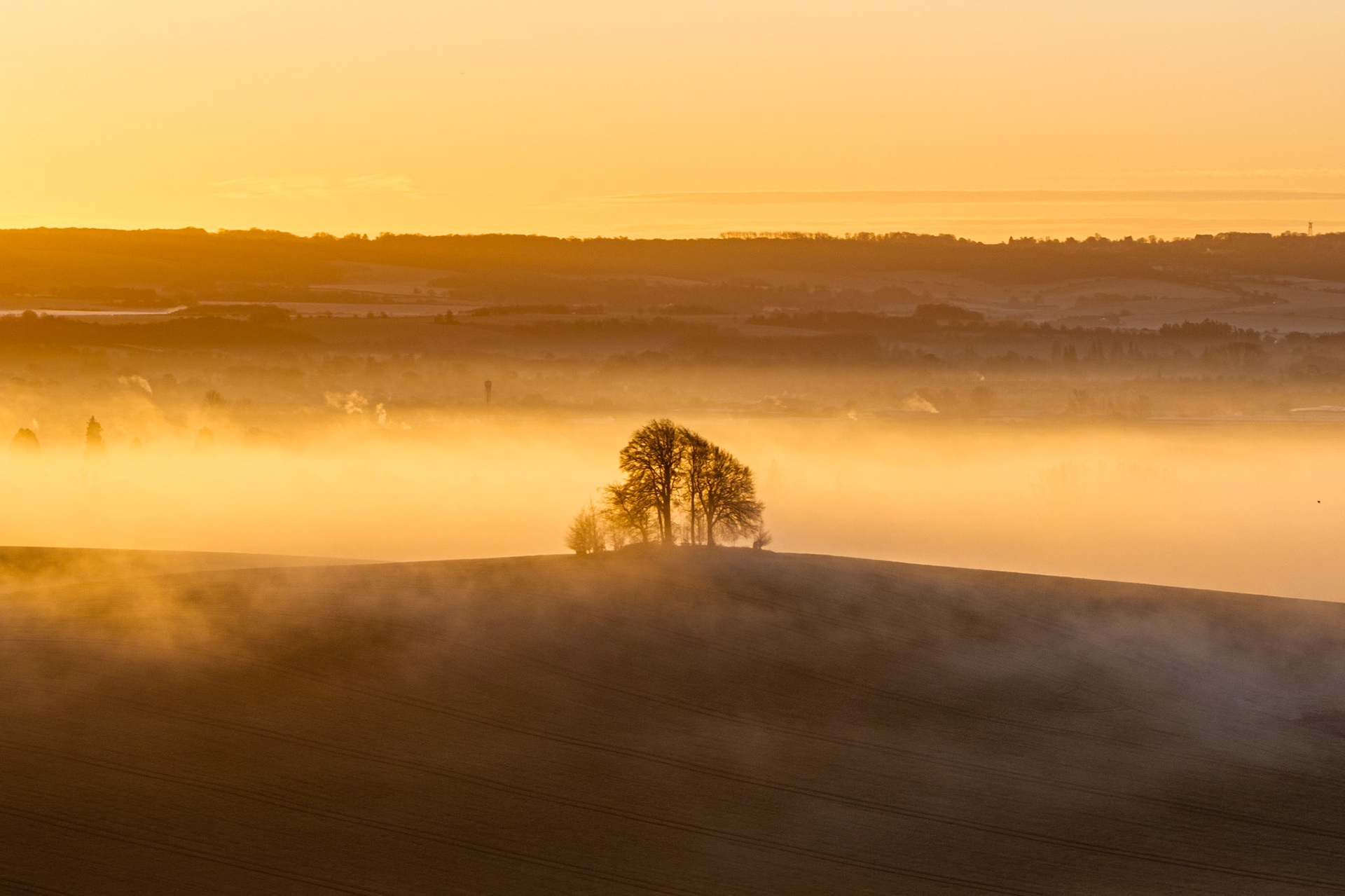
A small copse crowns the low ridge of Brightwell Barrow, near the Wittenham Clumps in Oxfordshire, its bare winter canopy silhouetted against a dense radiation fog bank at dawn. The temperature inversion has pooled mist in every hollow across the Vale of White Horse, reducing the rolling arable landscape to a series of luminous amber layers. The drone vantage isolates the trees as the sole vertical anchor in an otherwise dissolving world.
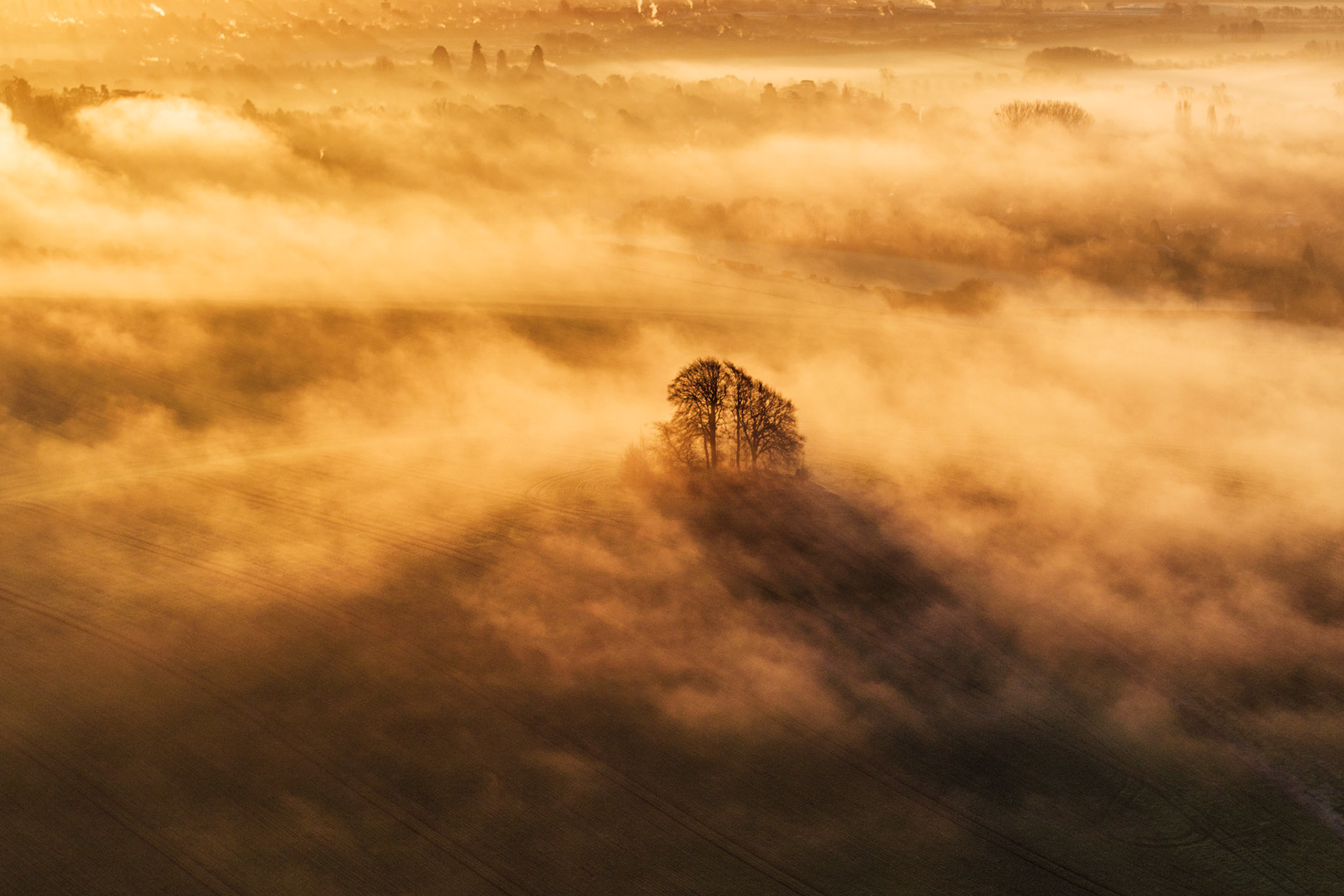
Bare winter trees crown Brightwell Barrow, the low knoll near the Wittenham Clumps in Oxfordshire, rising above a valley floor dissolved by temperature-inversion fog. Shot from altitude at first light on a January morning, low sun backlit the mist into layered golden strata, leaving the trees as the single fixed point in an otherwise formless landscape. The shadow cast downslope through the fog introduces a geometry that separates this from the conventional aerial mist photograph.
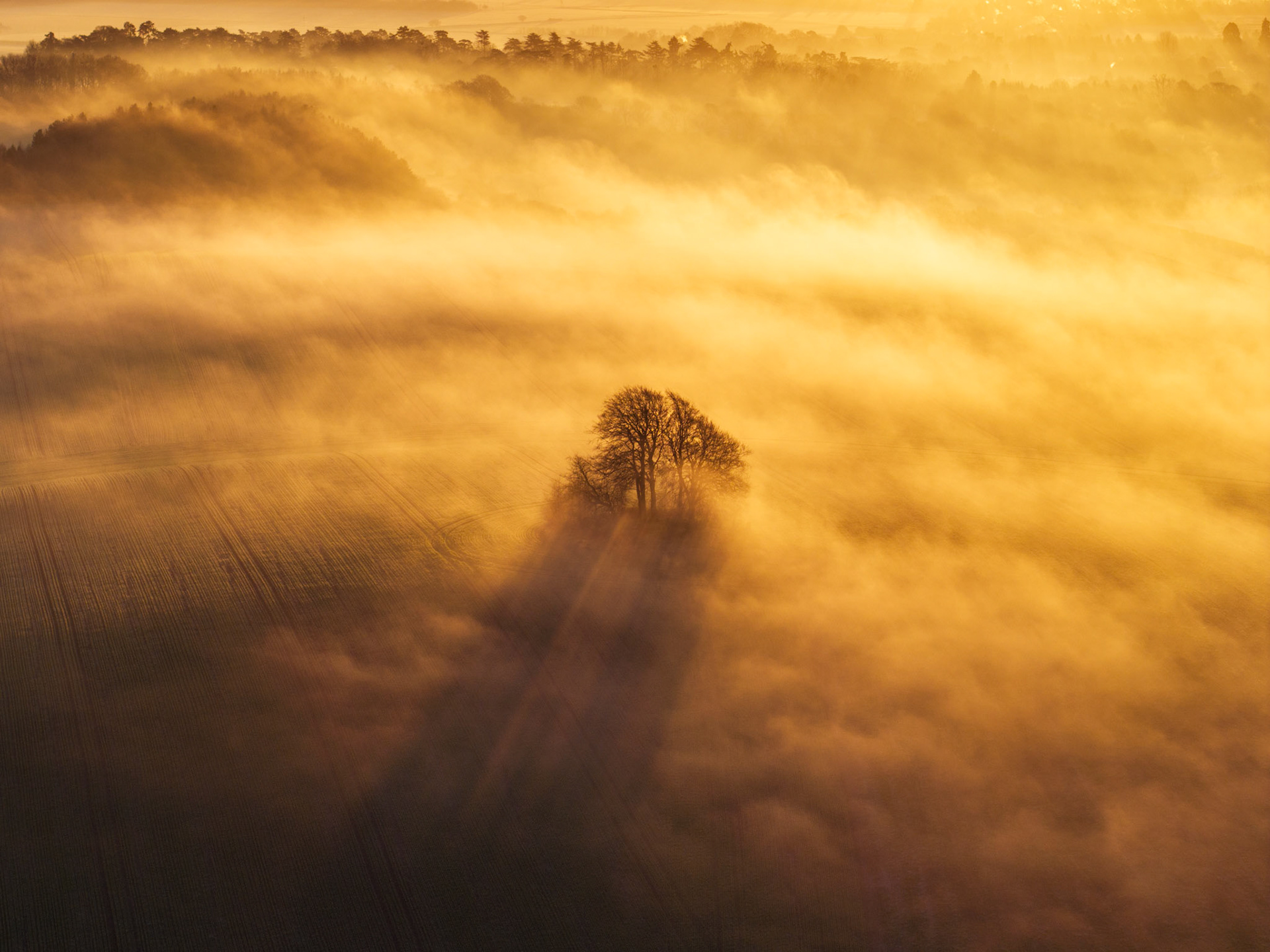
A cluster of bare winter trees rises through a low fog inversion above the Vale of the White Horse at first light on a January morning, photographed from the air above Brightwell Barrow near the Wittenham Clumps in Oxfordshire. The mist pools between the ridgelines while the stand of deciduous trees casts a raking shadow across the ploughed field below, the scene suffused in deep amber from a sun just above the horizon. The aerial vantage strips the composition to its essentials: a dark focal point against a luminous, layered atmosphere.

A small cluster of bare winter trees at Brightwell Barrow, near the Wittenham Clumps in Oxfordshire, emerges from a shallow fog inversion above arable farmland. Shot from directly above at low altitude, the trees cast a long shadow through the mist toward the viewer, anchoring the composition against a sea of warm golden vapour. The diagonal tension between fog layers and the singular dark form gives the image an abstract quality rare in aerial landscape work.
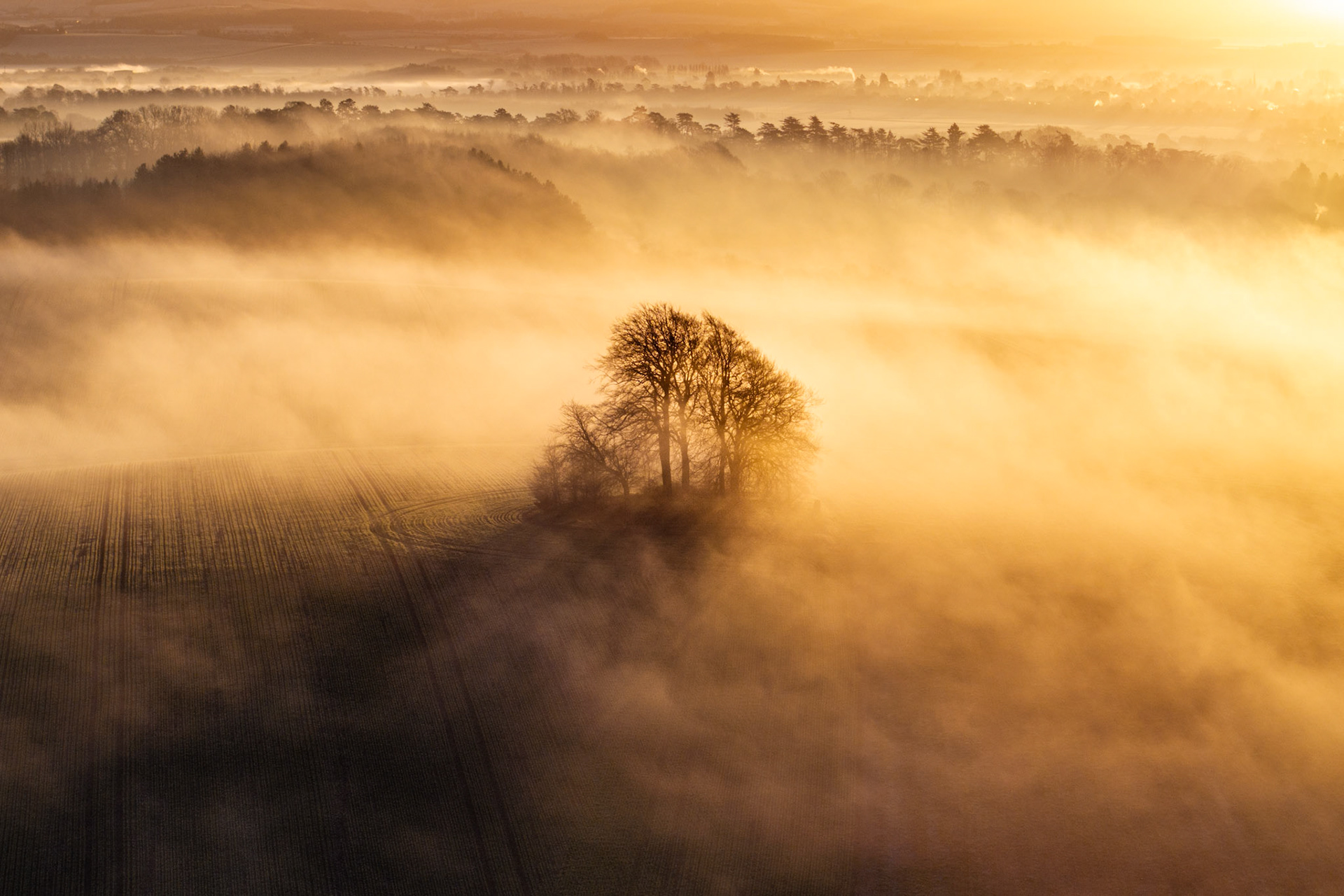
At first light in January, the ancient burial mound of Brightwell Barrow — set in arable farmland below the Wittenham Clumps in Oxfordshire — emerges as a silhouette of bare winter trees from a shallow temperature inversion. Low dawn sun from the east backlights the fog, compressing the landscape into layered planes of amber and shadow. Tractor tramlines in the field below anchor the composition, lending scale to the isolation of the trees on the barrow.
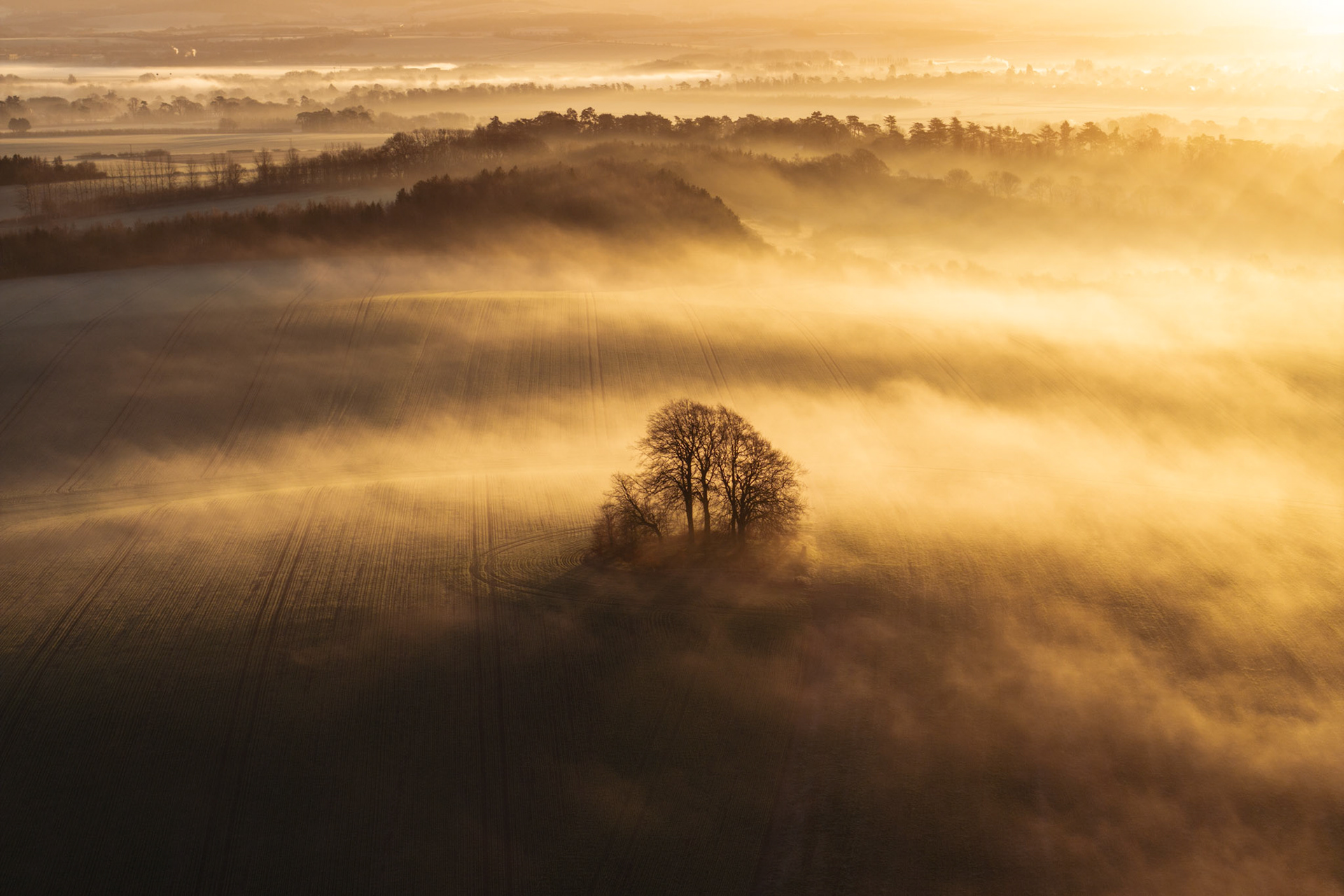
A small copse of bare-limbed trees emerges from a low temperature inversion rolling across arable fields on the slopes of Brightwell Barrow, near the Wittenham Clumps in Oxfordshire, photographed from altitude at first light in January. The mist moves in layered bands, backlit by a low winter sun, reducing the surrounding farmland to tonal abstraction. The isolated stand of trees anchors the composition as the sole vertical element in an otherwise formless, luminous ground.
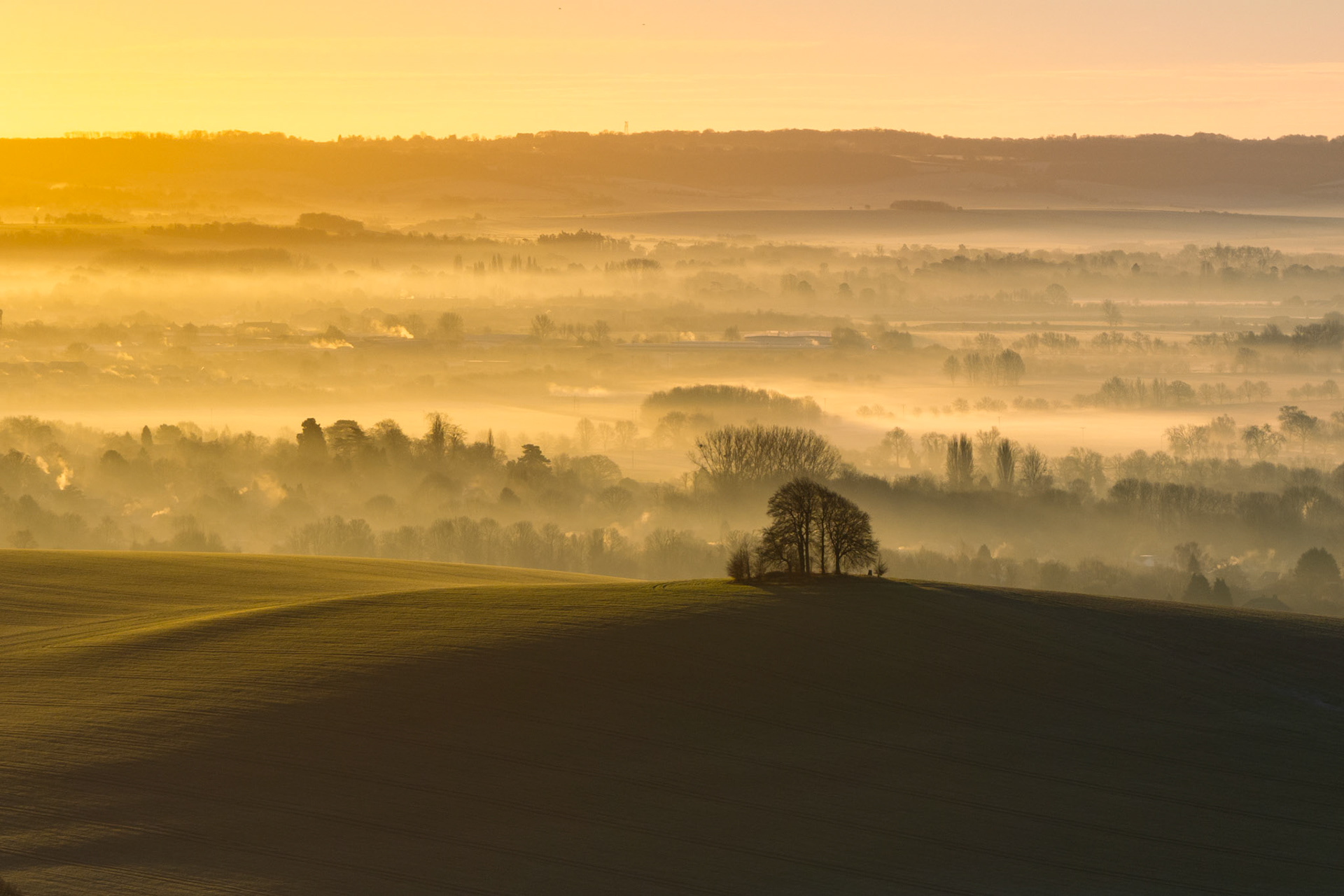
A small copse crowns a dark hilltop above the fog-filled Vale of White Horse near Abingdon, January dawn. Ground-hugging mist has pooled in distinct horizontal layers between bare tree lines, compressed by temperature inversion, while a pale golden sky bleeds light across the entire scene. The lone cluster of winter trees acts as a pivot between the shadowed foreground field and the luminous, stratified valley beyond.
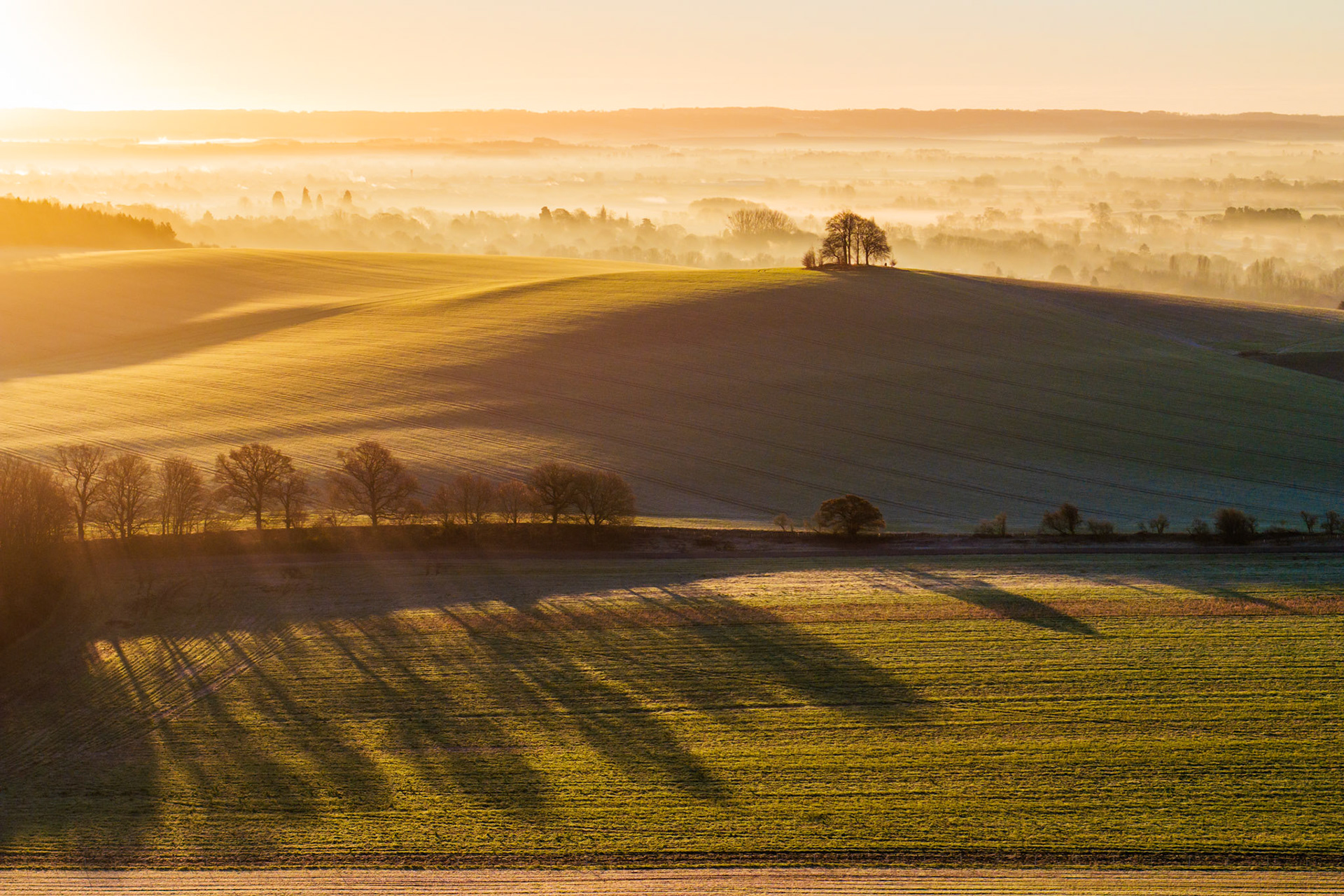
A temperature inversion fills the Vale of White Horse with low mist at first light, seen here from above Brightwell Barrow near the Wittenham Clumps in Oxfordshire, while long tree shadows rake across frost-dusted arable fields on the downland above Abingdon. A small copse crowns the nearest hill, its silhouette caught between the lit flank and the mist-dissolved distance beyond. The layering of warm light, cool shadow, and atmospheric depth gives the scene an unusual structural clarity for an aerial frame.
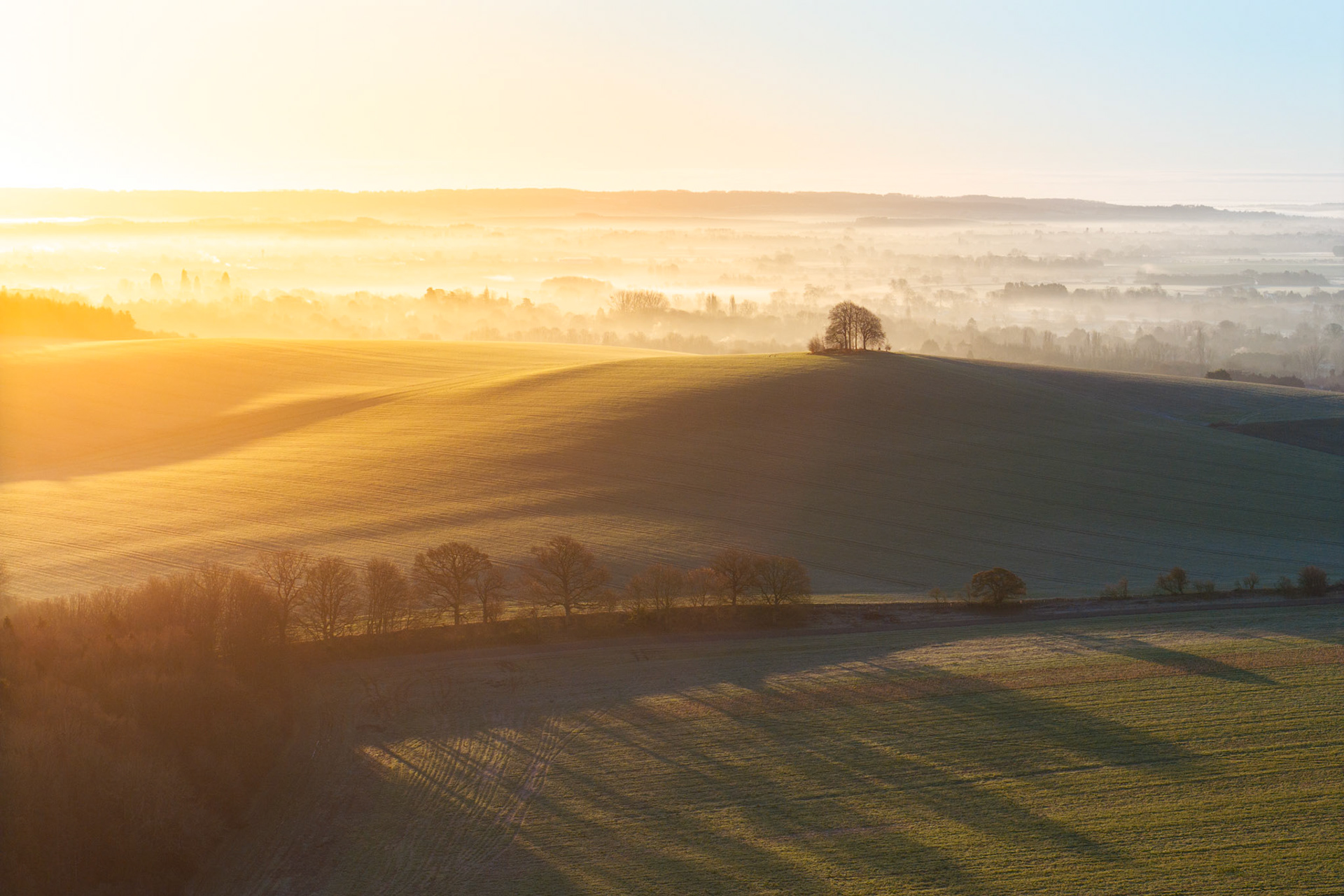
Low winter sun rakes across ploughed downland at Brightwell Barrow, near the Wittenham Clumps in Oxfordshire, casting long tree shadows across frost-touched fields while a temperature inversion buries the Thames Valley under a still white sea. A small copse on the hill crest holds the middle ground against the dissolving distance. Captured from altitude at first light, the image turns agricultural geometry into something closer to abstraction.
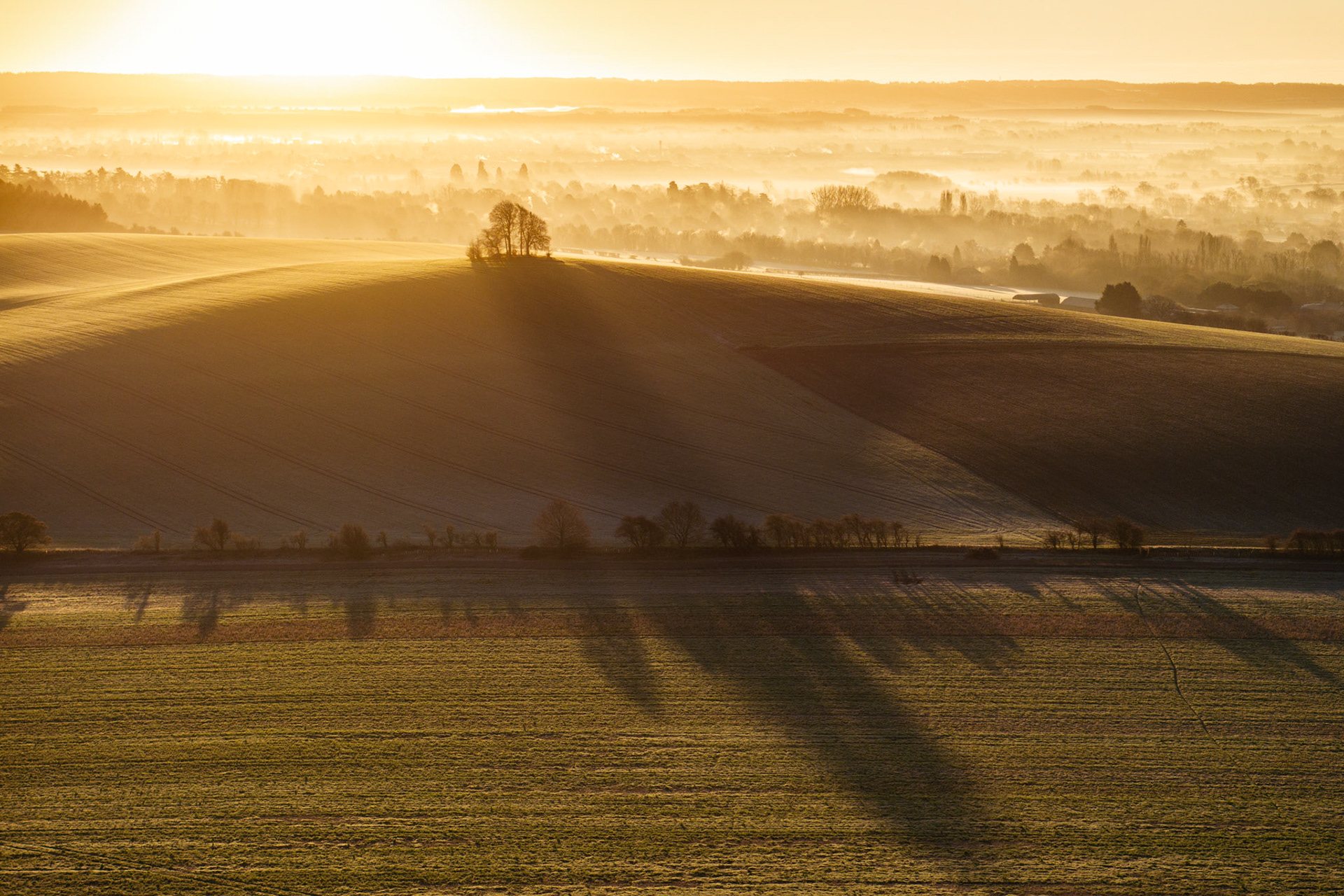
Low winter sun breaks across the ploughed chalk hillside of Brightwell Barrow, near the Wittenham Clumps in Oxfordshire, casting long tree shadows across frost-silvered pasture while a temperature inversion fills the Vale of White Horse with layered mist. A small copse crowns the barrow's summit, silhouetted against the luminous distance. The aerial vantage reveals the undulating field geometry of these Oxfordshire downs as they dissolve into the fog.
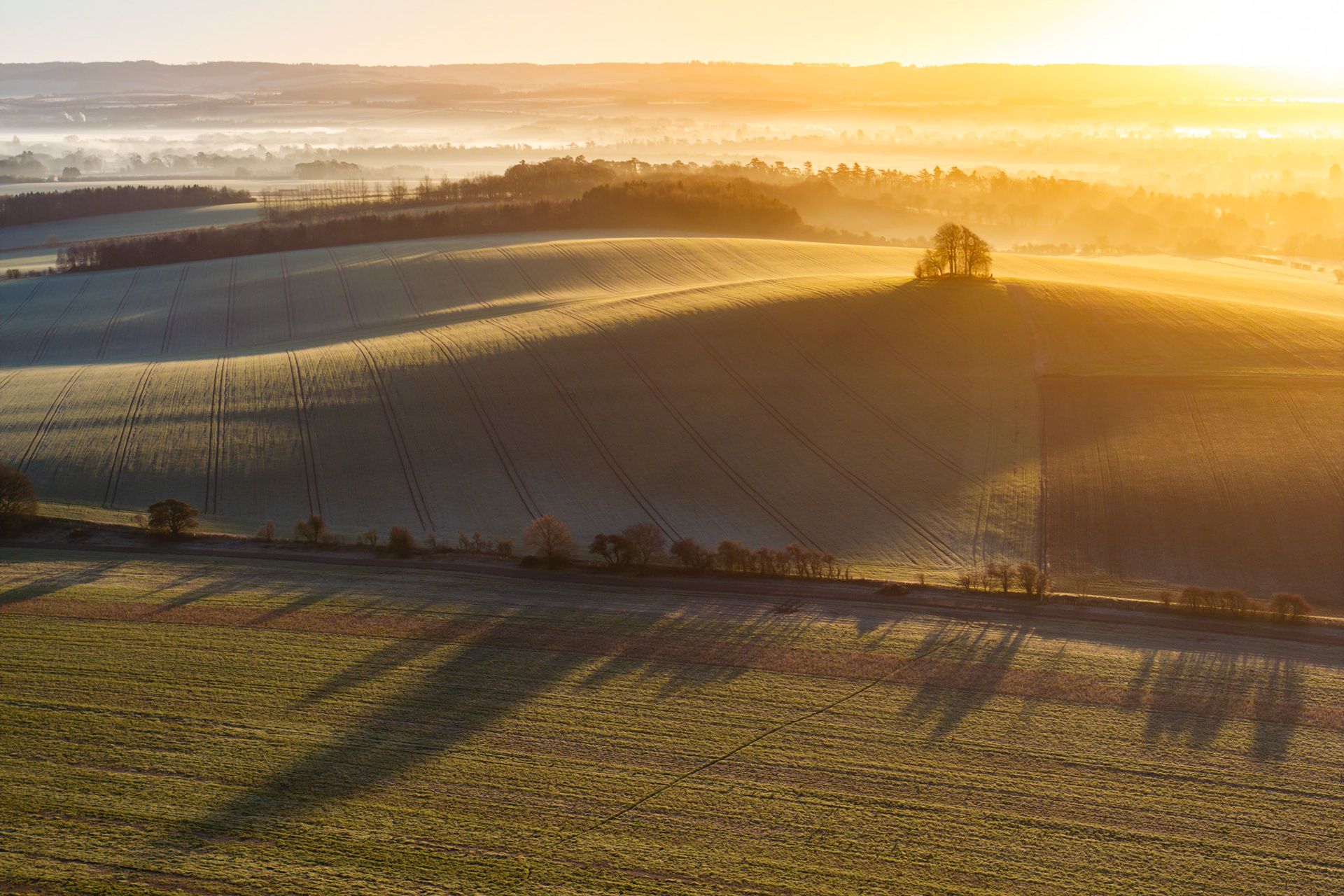
Low winter sun rakes across the frost-covered chalk downland at Brightwell Barrow, near the Wittenham Clumps in Oxfordshire, casting long tree shadows across field tramlines on the Vale of White Horse below. A clump of bare trees crowns the rounded barrow summit, silhouetted against mist pooling in the middle distance. The aerial angle compresses the rolling topography into near-abstract planes of warm light and cold shadow.
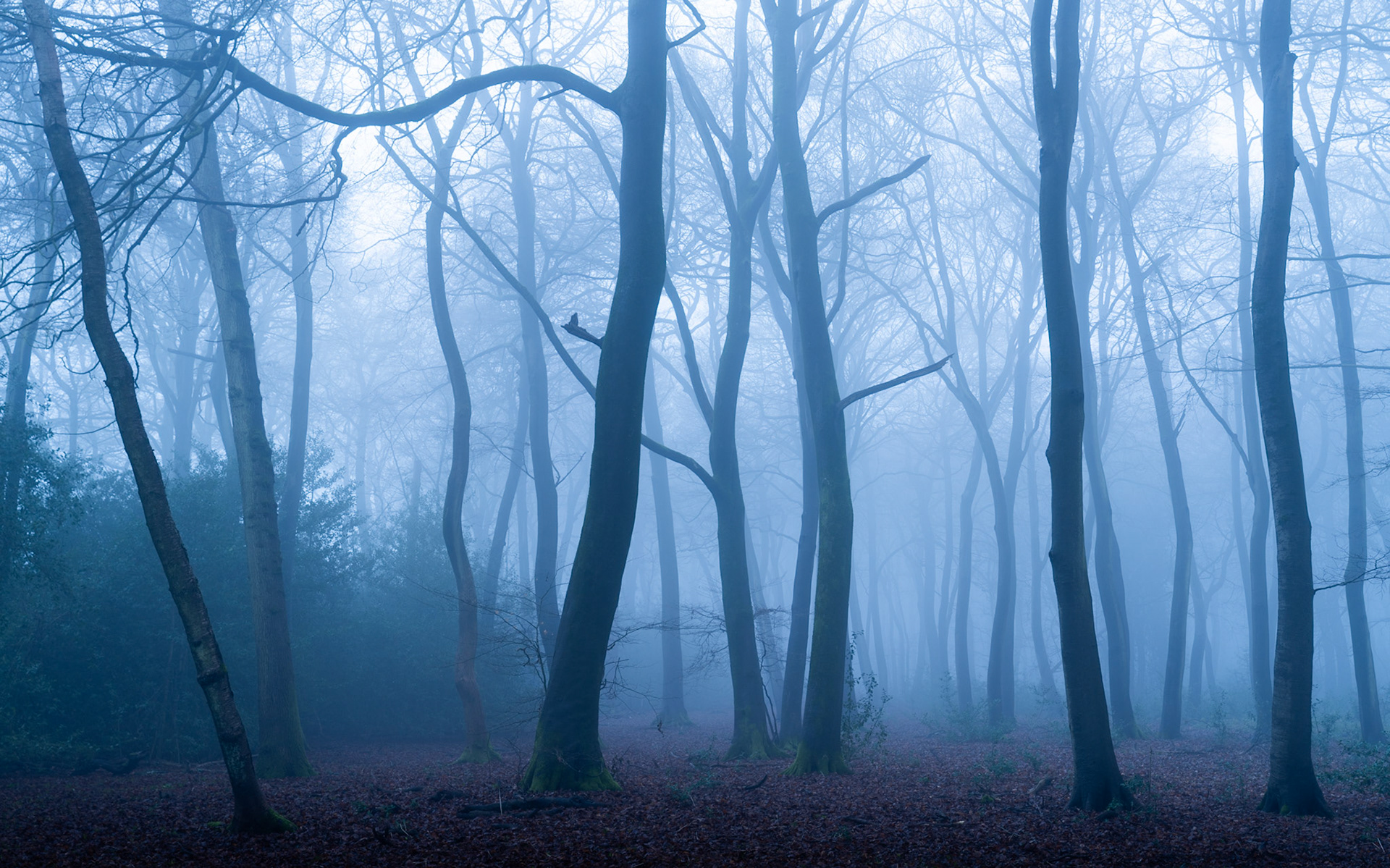
Bare beech trunks in the Chilterns recede into dense winter fog, their sinuous forms dissolving plane by plane into a pale blue-grey ground. The fallen leaf litter anchors a scene that is otherwise almost entirely tonal, the mist erasing depth until the woodland becomes near-abstract. Captured at dawn in January, the light is directionless and cold, lending the image a stillness that feels both quiet and unsettling.
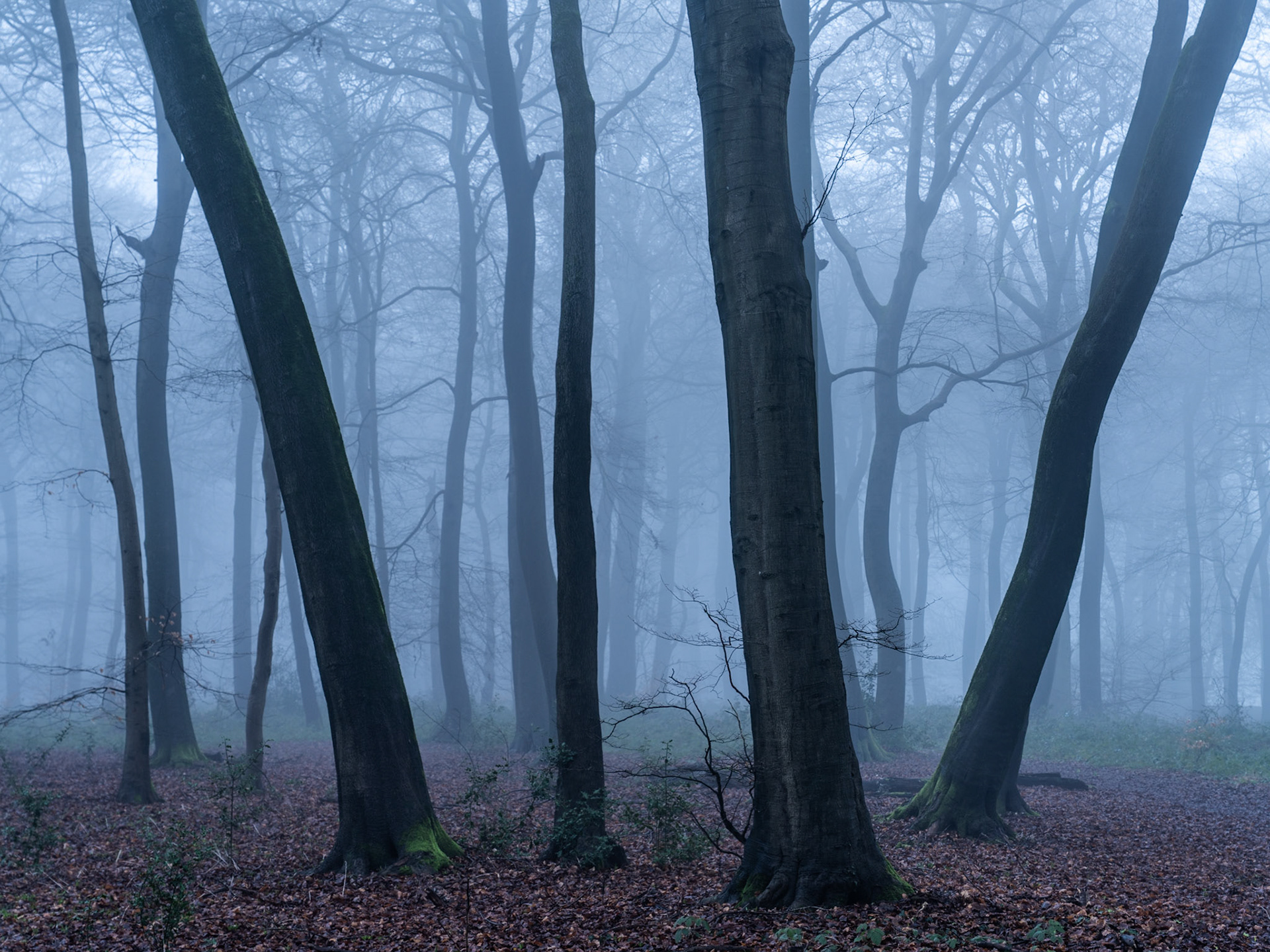
Bare beech trunks in the Chilterns recede into dense winter fog, the cool blue cast of early morning diffusing all distance into soft tonal layers. The diagonal lean of the foreground trees animates an otherwise still interior, drawing the eye through successive planes of diminishing detail. Fallen leaf litter and moss-stained bark anchor the composition at ground level.
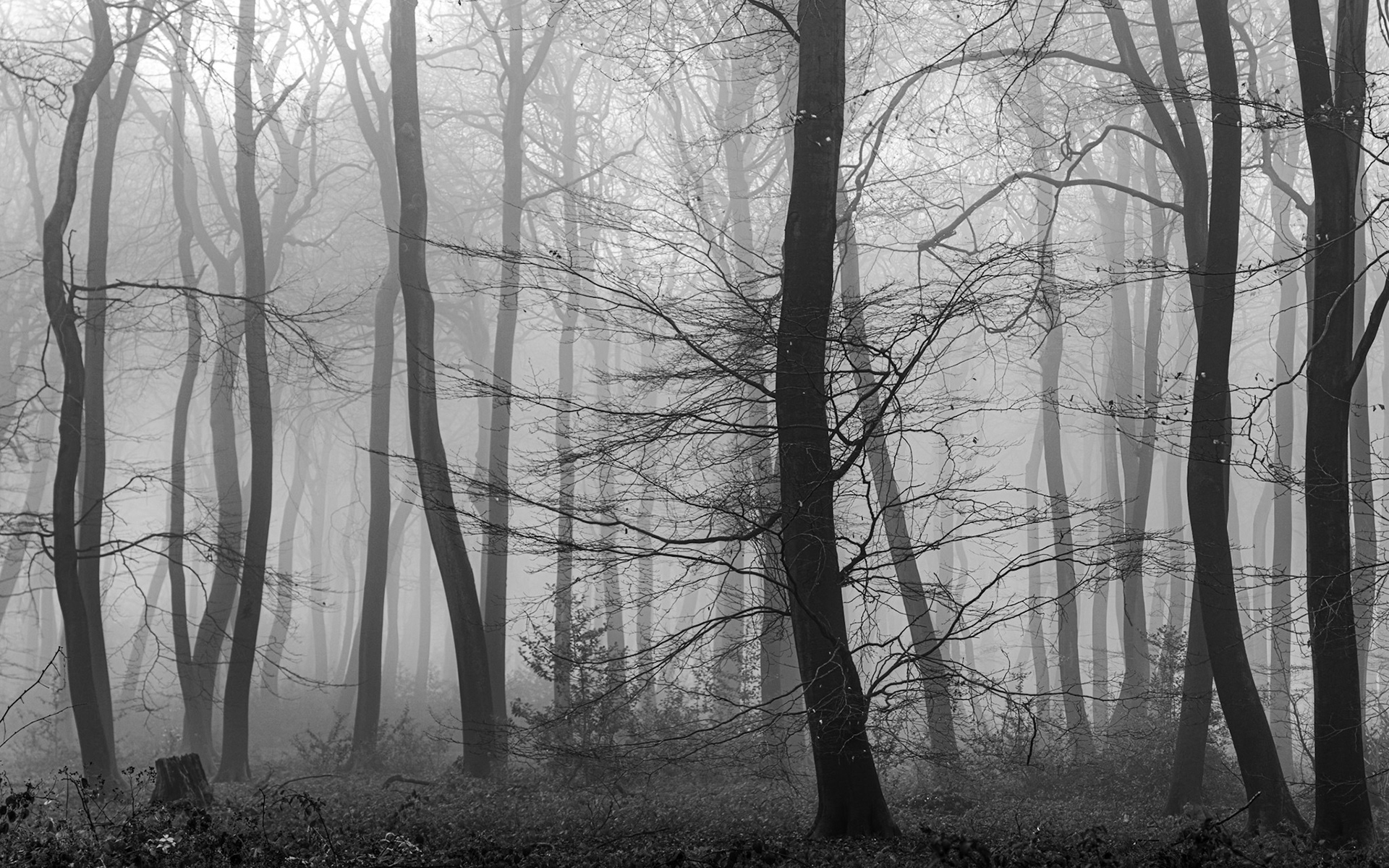
Leafless beech and understory shrubs recede into dense winter fog in the Chilterns, Oxfordshire, the tonal recession creating a natural layering from dark foreground trunks to pale dissolved canopy. A low-branching suppressed tree at centre-right anchors the composition against the vertical rhythm of the surrounding stems. The monochrome conversion amplifies the mist's diffusing effect, stripping the scene to structure and tone.
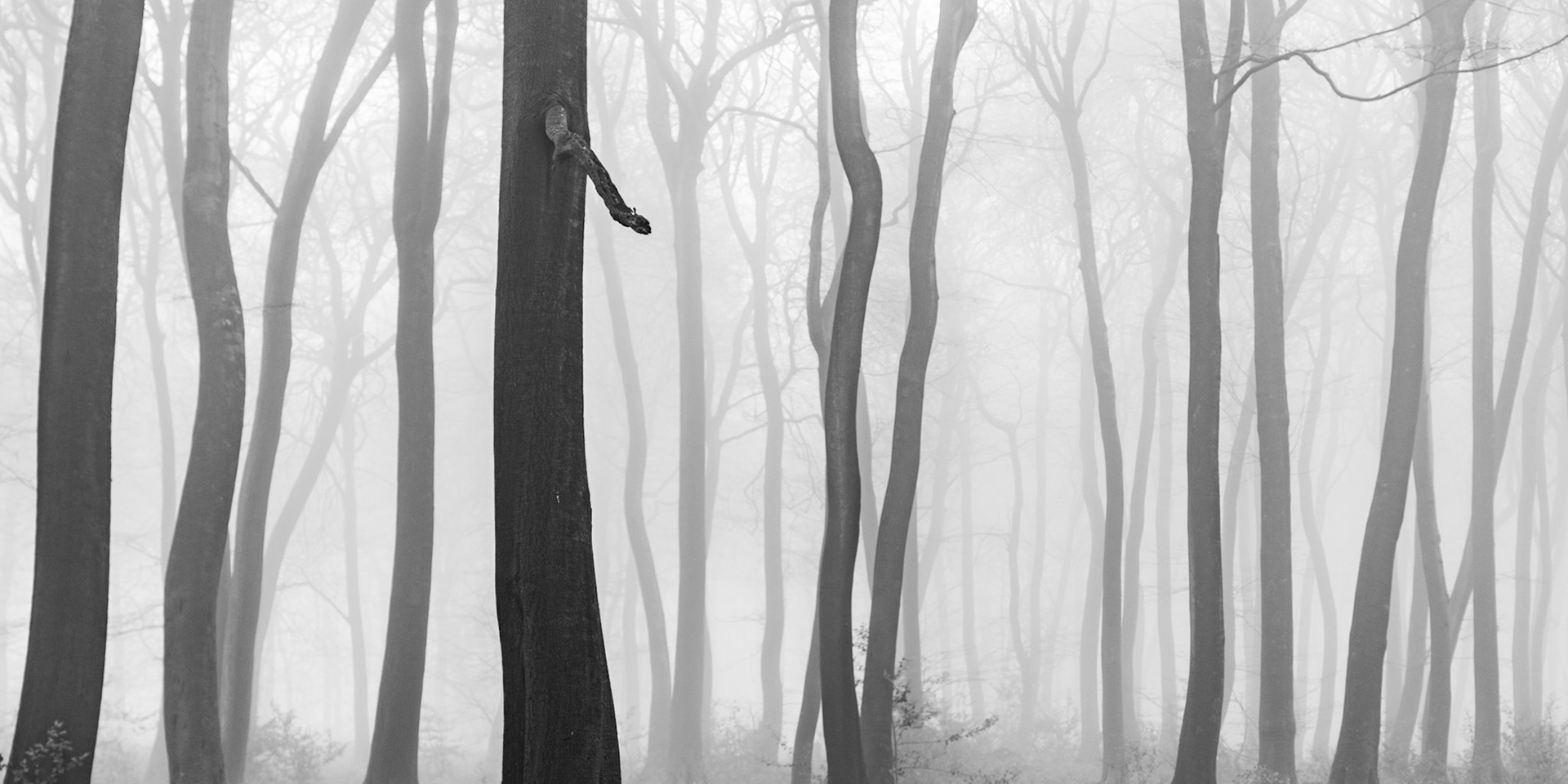
Bare beech trunks in the Chilterns recede into dense winter fog, each successive plane dissolving further into pale grey. The wide panoramic frame compresses the stems into a near-rhythmic sequence, while a single gnarled stub on the dominant foreground trunk provides the only textural anchor. Monochrome conversion accentuates the tonal gradation from deep charcoal to near-white, sustaining the mood without artifice.
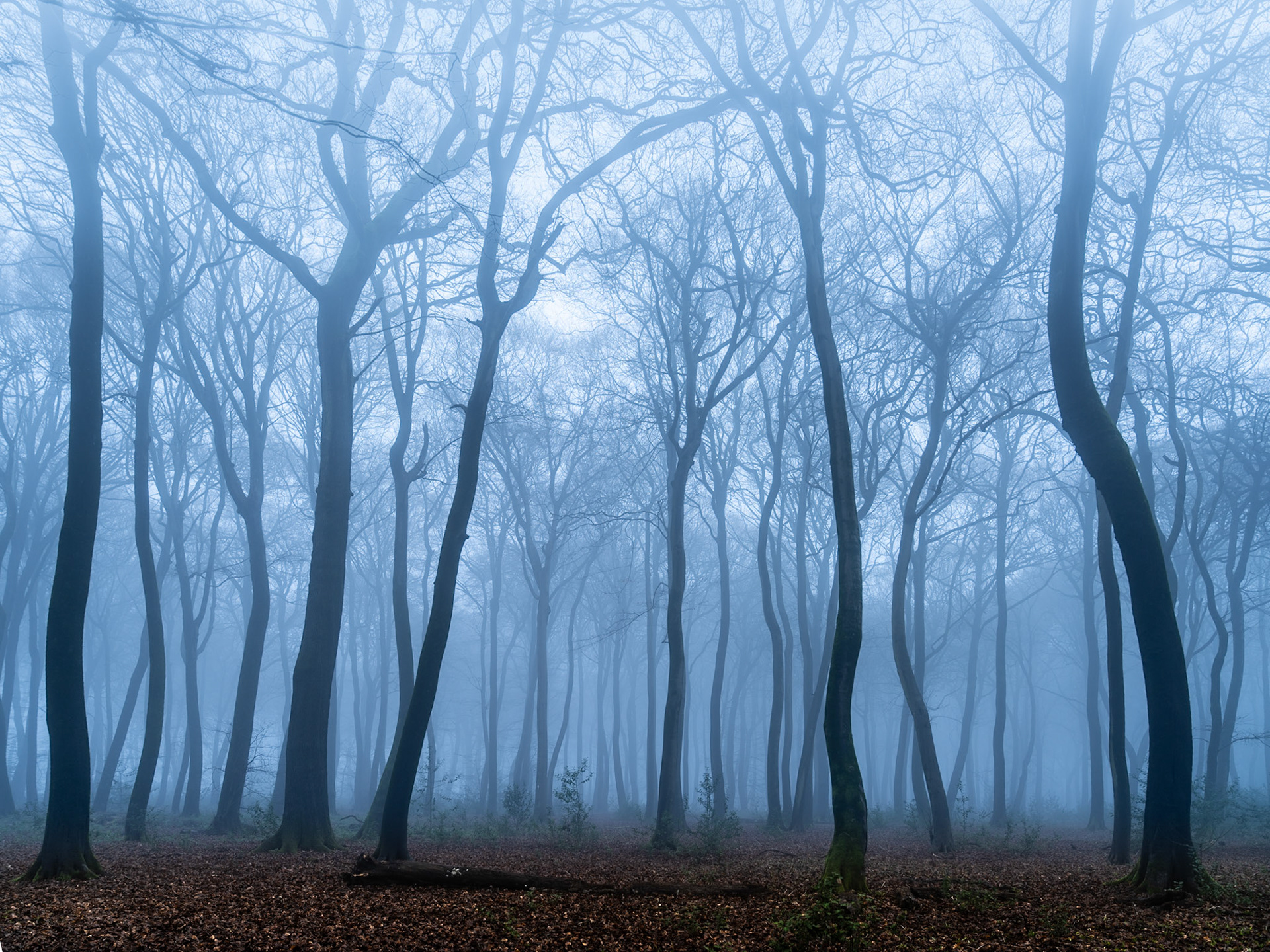
Bare beech trees in the Chilterns recede into dense winter fog, their sinuous trunks forming overlapping planes of tone from dark foreground to pale grey distance. A carpet of fallen leaves grounds the composition, while the diffuse overhead light suppresses shadow and unifies the scene into near-monochrome blue. The fog is thick enough to erase the forest floor's horizon, lending this Oxfordshire woodland an unresolved, contemplative stillness.
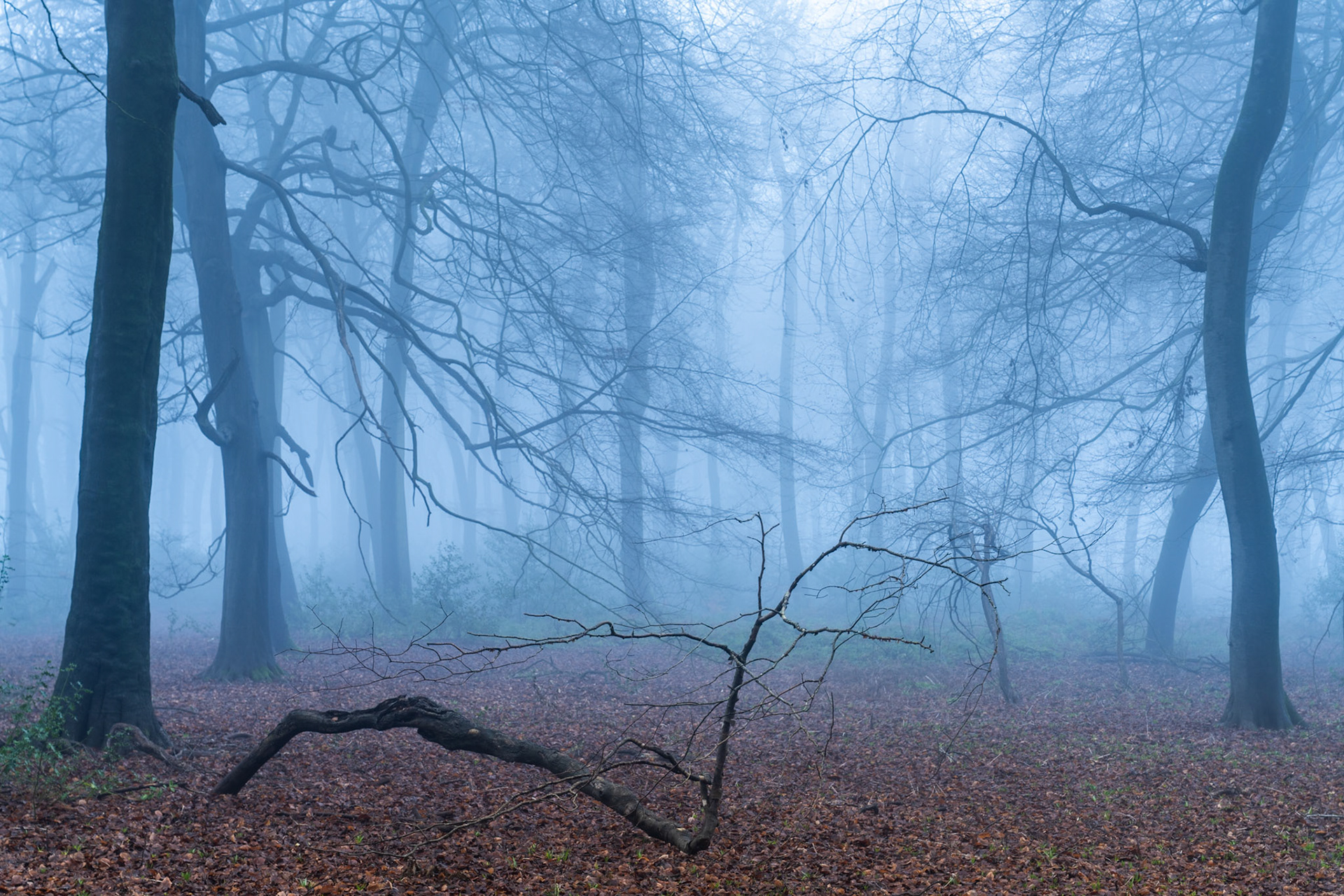
A fallen branch lies across a leaf-littered floor in a Chilterns beechwood as dense winter fog reduces the surrounding trees to graduated silhouettes. The serpentine limb in the foreground provides a strong near-to-far anchor, drawing the eye into the pale, receding trunks beyond. The cool blue cast suggests early morning light diffused entirely by fog, with no direct sun penetrating the canopy.
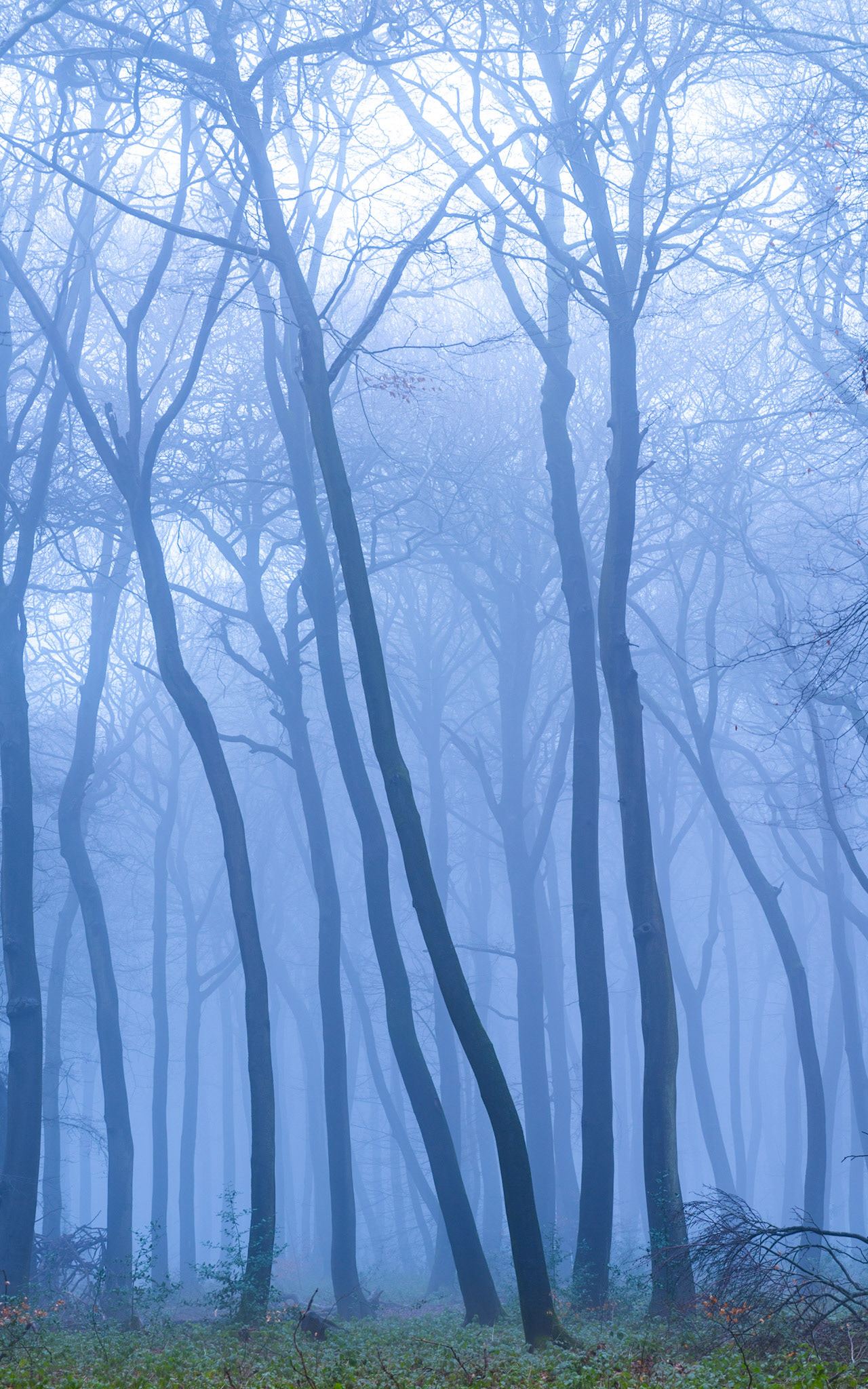
Bare beech trunks in the Chilterns recede into dense winter fog, their sinuous forms creating a layered rhythm of diminishing tone. Diffuse backlight from a low Oxfordshire sky separates each plane of the wood, compressing depth into a near-monochromatic blue-grey. A scatter of ivy at the base anchors the verticals without competing with the stillness above.

A beech branch clings to its final rust-coloured leaves against a fog-filled interior of Chilterns woodland in Oxfordshire, the background reduced to pale vertical columns of unseen trunks. Captured in the blue-grey stillness of a January morning, the image draws tension from the contrast between the intricate tracery of bare twigs and the scattered warmth of unreleased autumn foliage.
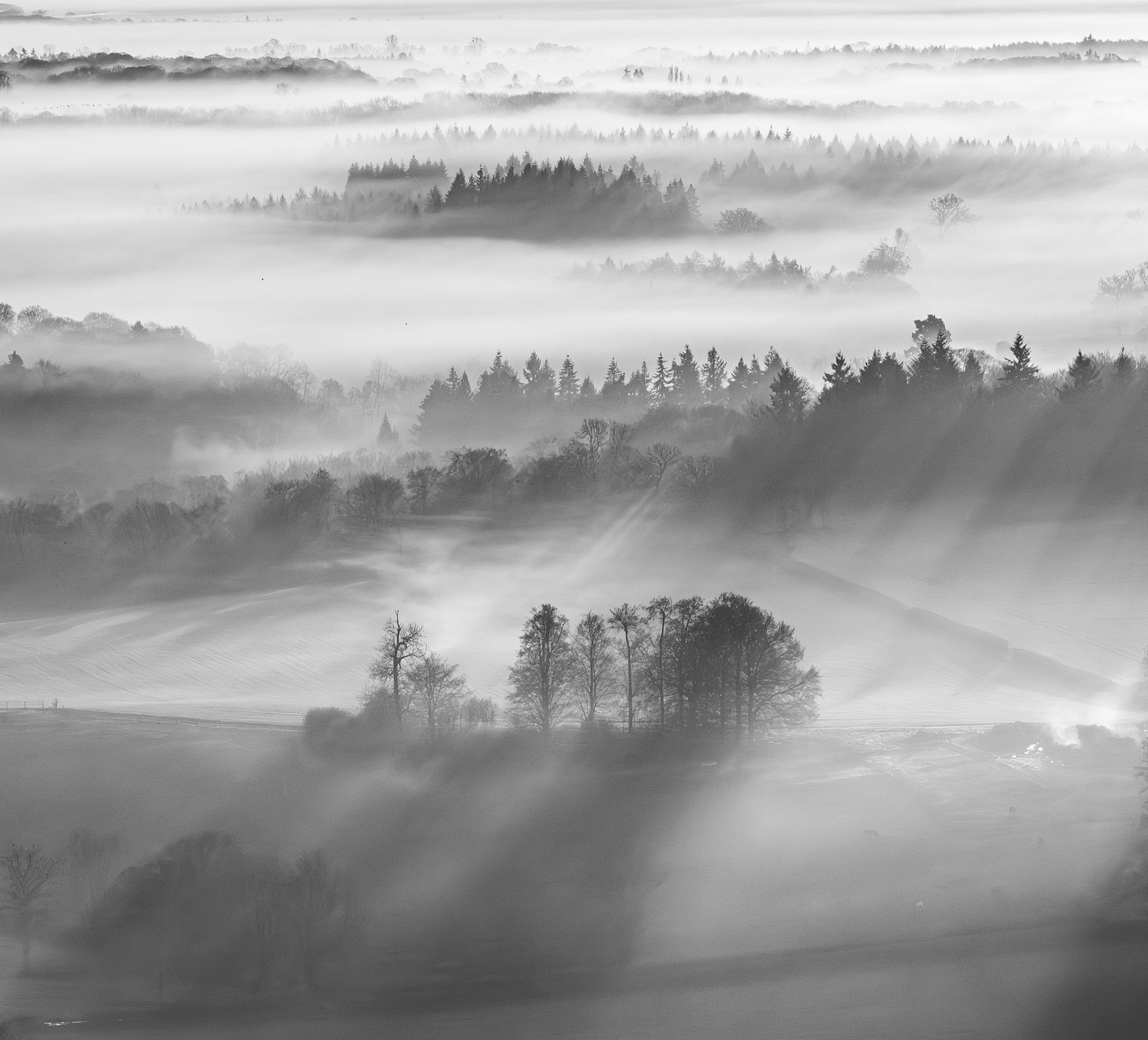
A temperature inversion fills the Thames Valley lowlands with layered fog, isolating copses and conifer ridgelines as dark silhouettes against luminous white. Shot from elevation above Henley-on-Thames in late January, the compression of a long focal length stacks the receding planes into near-abstract bands of tone. A church spire emerges faintly at mid-distance, the sole human measure in an otherwise elemental scene.
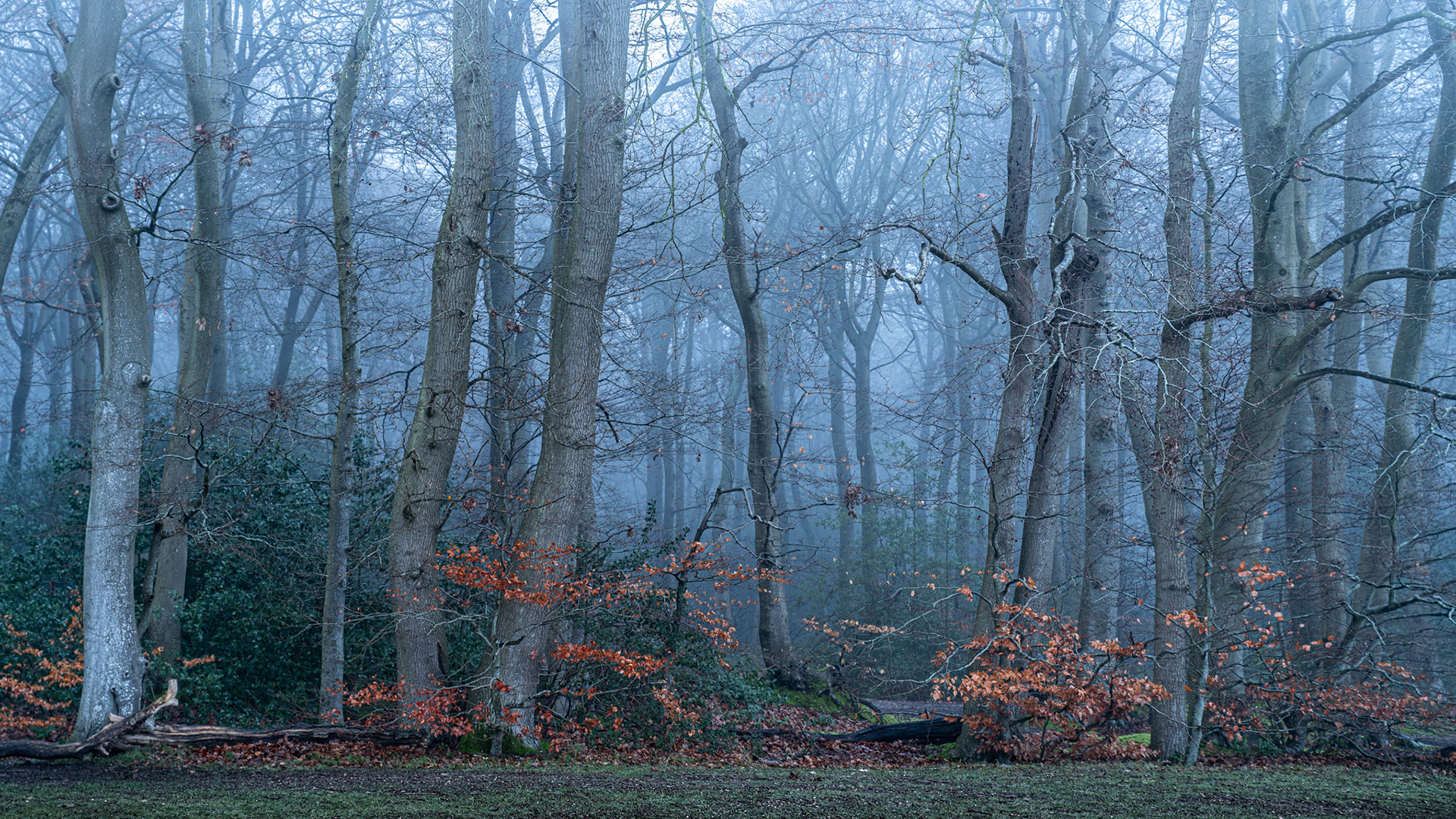
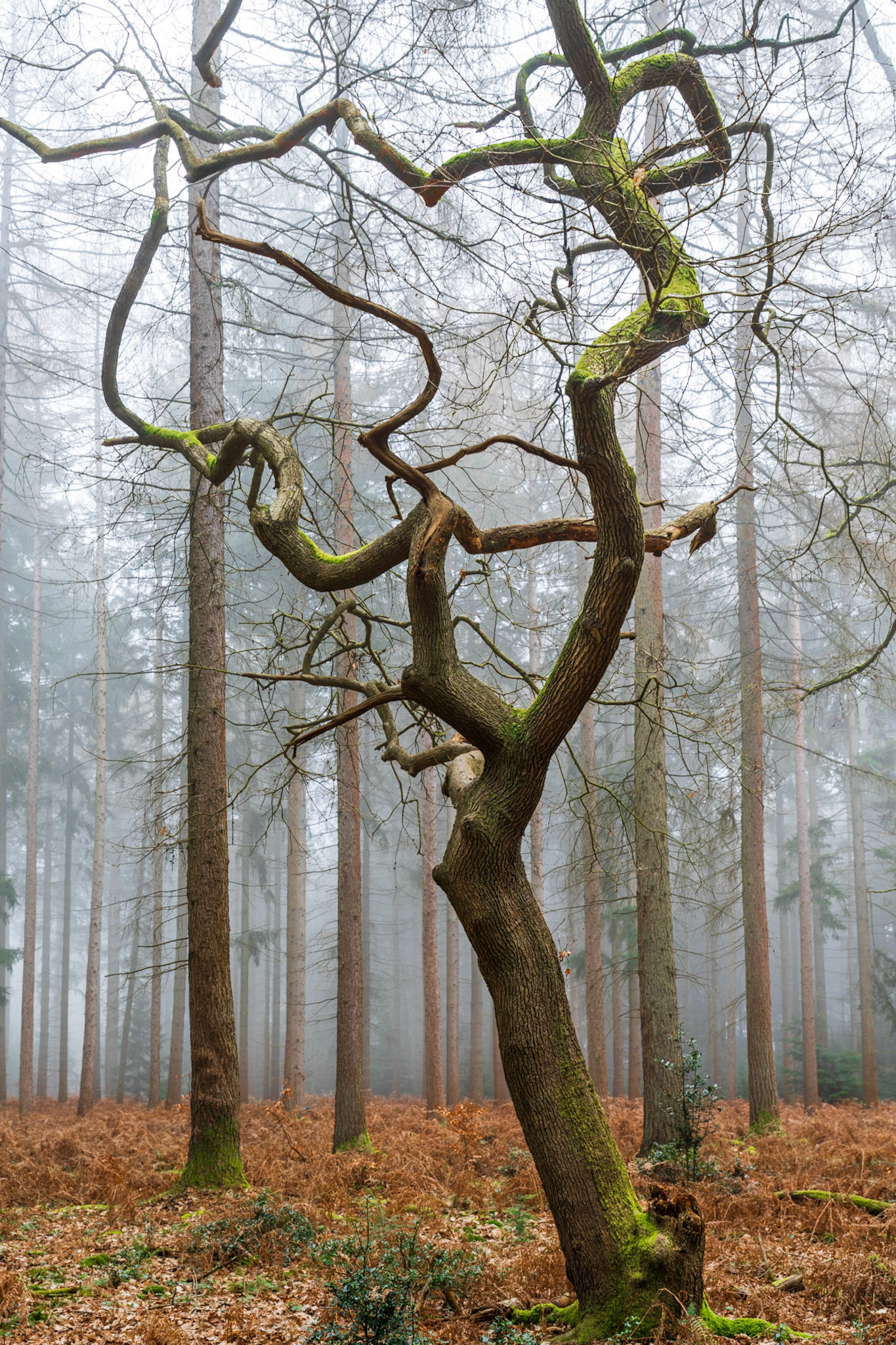
A contorted broadleaved tree — likely an oak — stands amid the straight trunks of a conifer plantation under dense winter fog. The writhing branch structure contrasts sharply with the regimented verticals behind, while bracken litter and patches of moss anchor the scene to the forest floor. Fog compresses the background to a pale wash, isolating the subject with quiet authority.
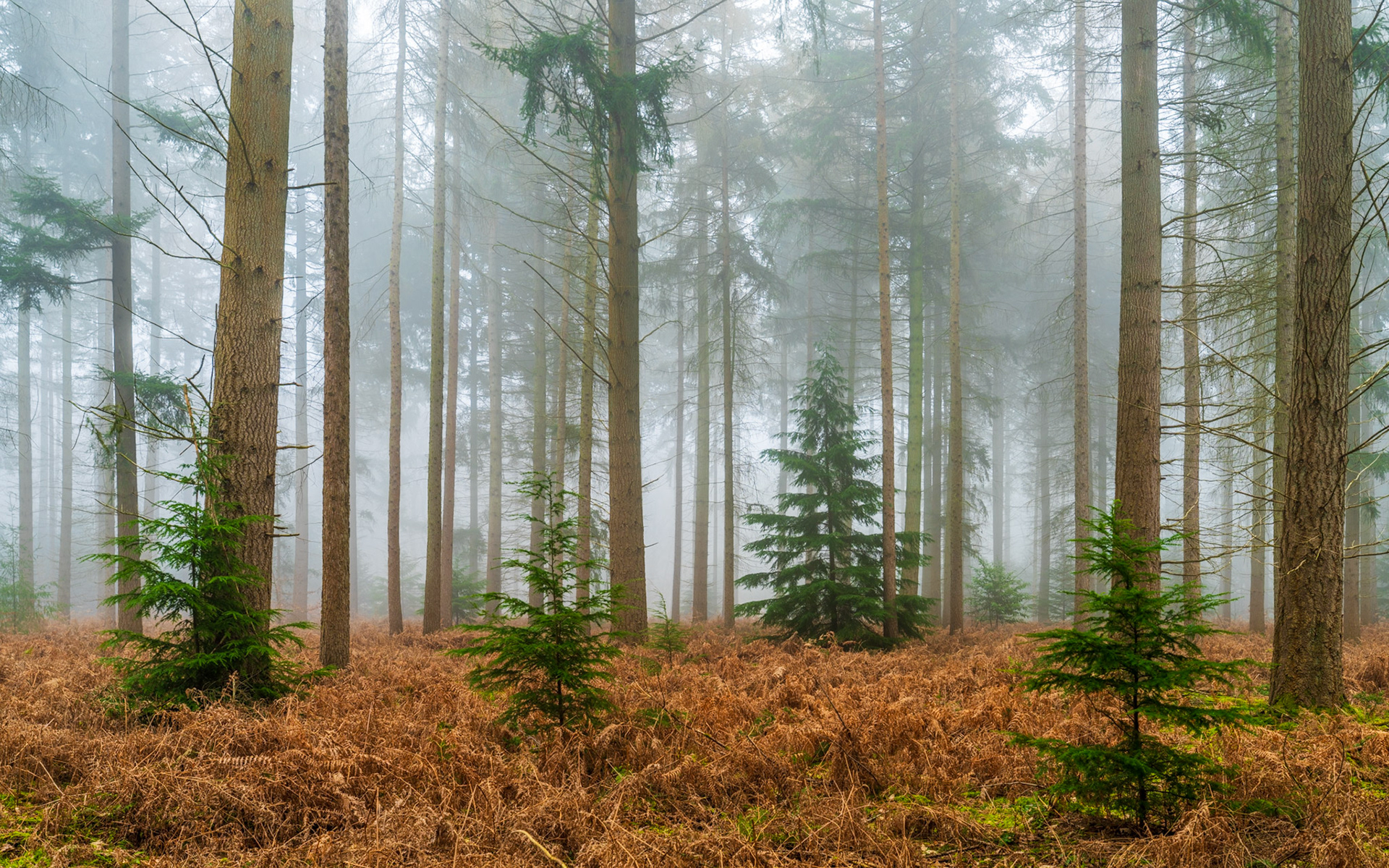
Young conifers emerge through a carpet of dead bracken beneath a mature plantation shrouded in late-winter fog. The lone sapling at centre acts as a quiet focal point, framed by the vertical rhythm of tall trunks receding into mist. A restrained and atmospheric study in depth and scale.
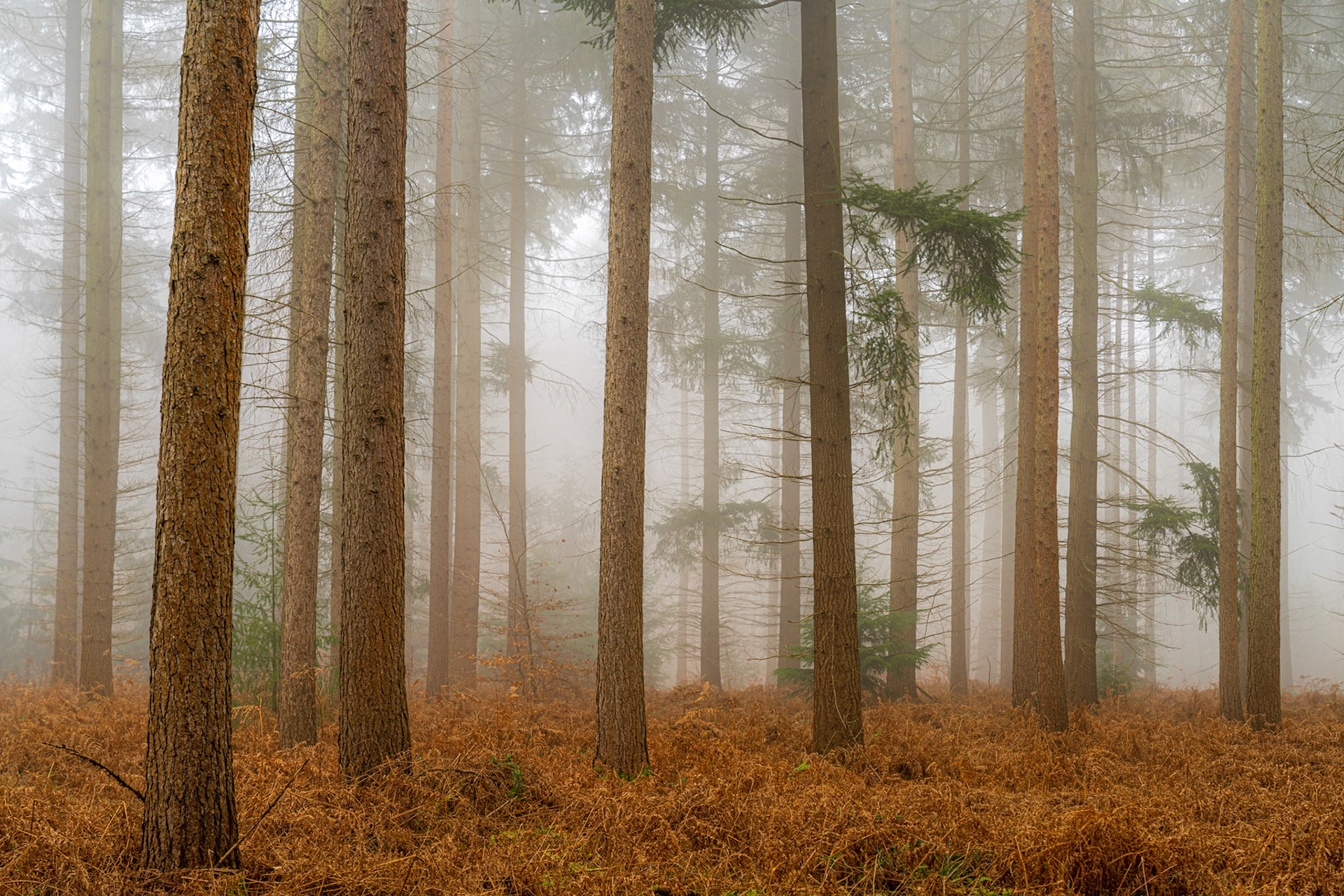
Dense fog softens a conifer plantation to a sequence of receding trunks, the forest floor carpeted in rust-coloured bracken. The low viewpoint compresses the vertical rhythm of the trees while mist erases any clear horizon, lending the scene a quiet, directionless depth. Captured in early morning light that keeps the palette cool and muted.
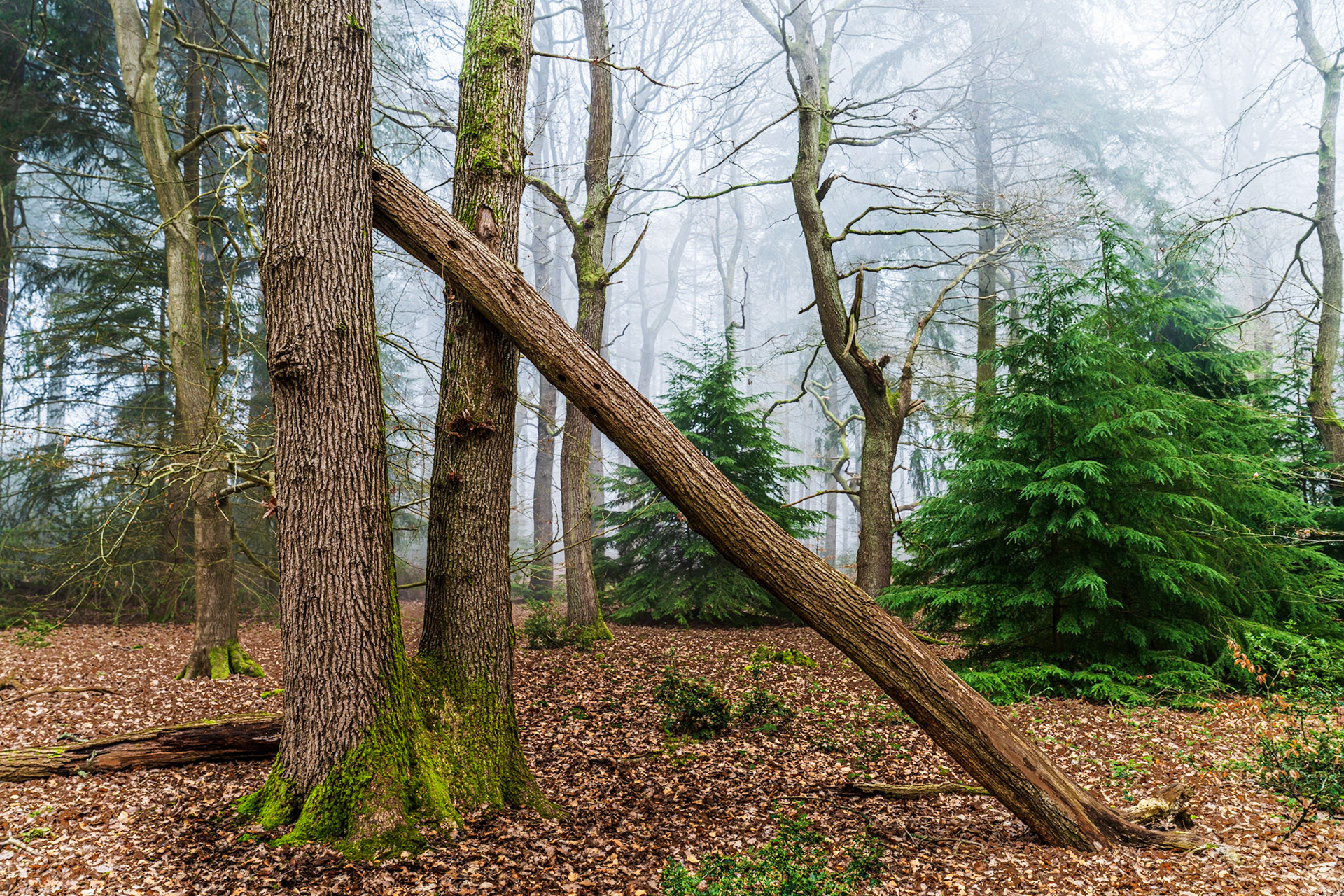
A fallen trunk leans at a diagonal against standing deciduous trees in a mixed woodland softened by winter fog. The interplay of the angled dead wood with the vertical uprights creates a geometric tension within an otherwise quiet scene. Evergreen yews or spruces punctuate the mid-ground with saturated green against the pale, moisture-laden air.
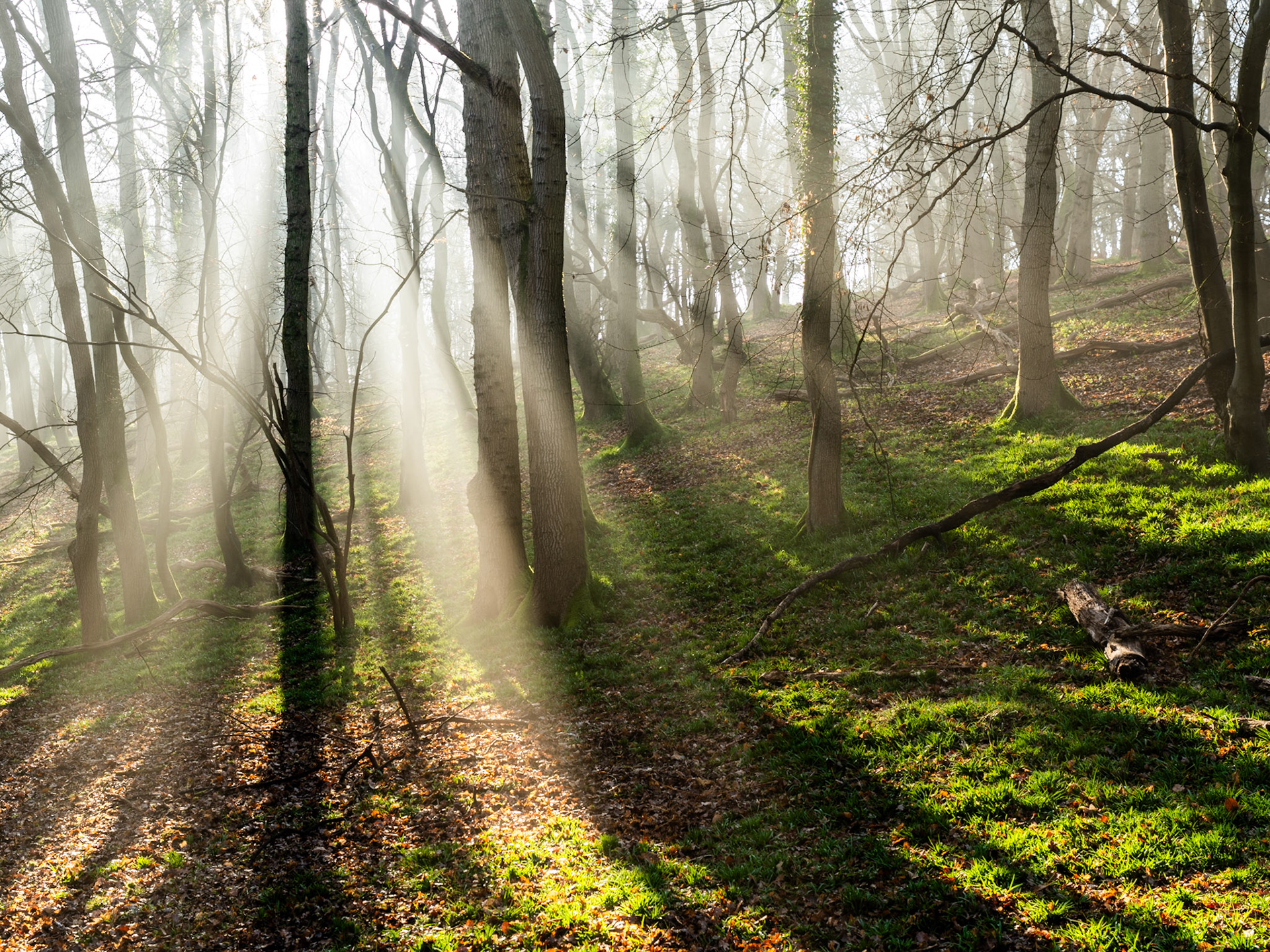
Crepuscular rays pierce low morning mist between bare-branched deciduous trees in the Chilterns, Oxfordshire, casting hard shadow bands across a leaf-litter floor edged with vivid early-spring grass. The interplay of shadow and illuminated vapour gives the scene a rare tonal range, from deep forest shadow to near-white diffusion at the source. Fallen timber and undulating ground anchor the middle distance without competing with the light.
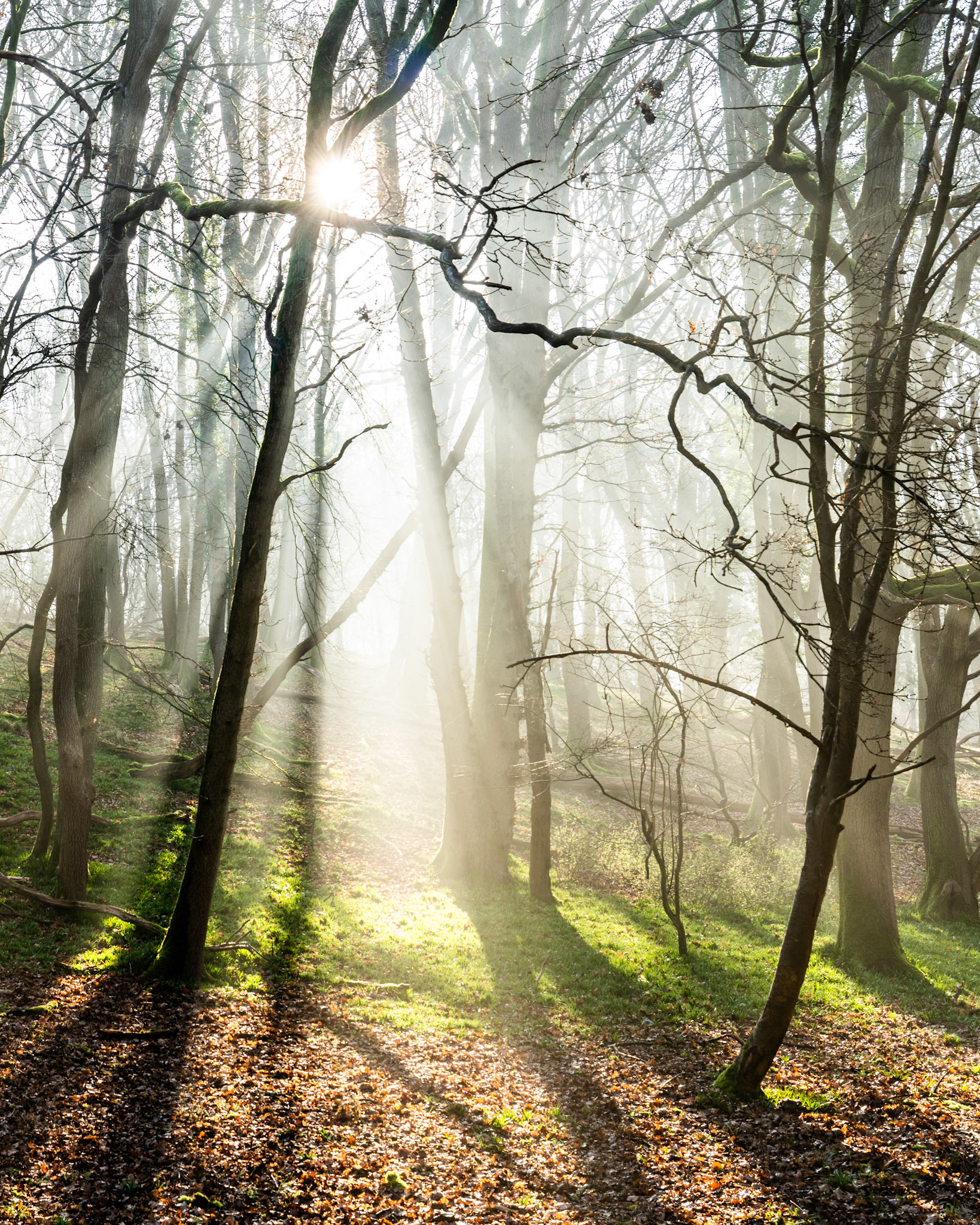
Crepuscular rays break through bare deciduous woodland in the Chilterns, Oxfordshire, on a misty late-winter morning, the low sun rendered as a starburst between two dominant trunks. Leaf litter on the woodland floor and moss-covered banks on either side frame the column of light, while receding trees dissolve into fog. The scene sits at the transitional moment between winter dormancy and the first suggestion of spring growth.
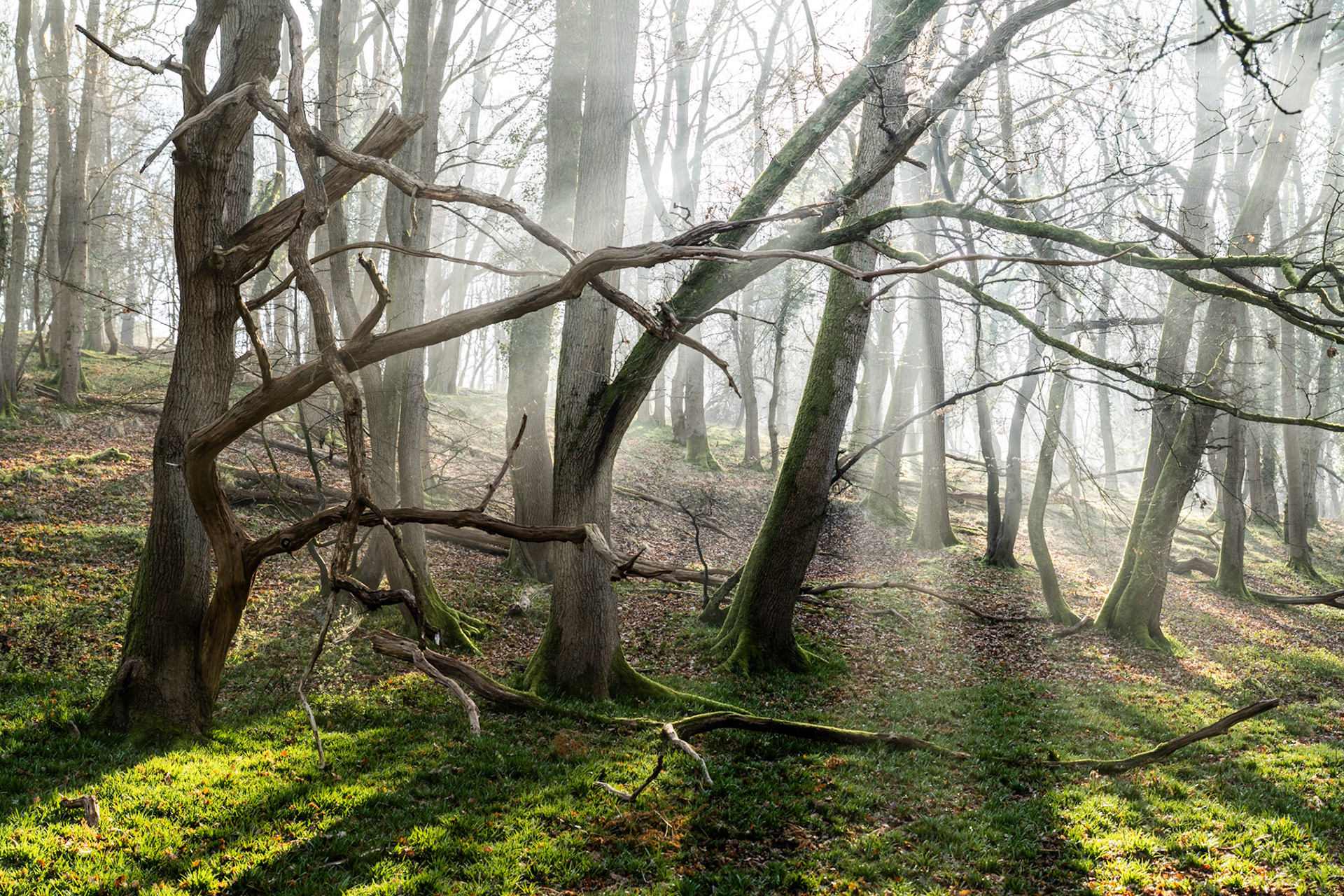
A collapsed dead limb arches across the understorey of a misty beech woodland in the Chilterns, Oxfordshire, in early spring, the trees still bare and the ground vivid with fresh moss. Low morning light filters through the fog in loose shafts, picking out the texture of bark and branch against a soft, receding stand of trunks. The undulating earthwork floor and ancient form of the fallen tree give the scene an uncommon structural tension.
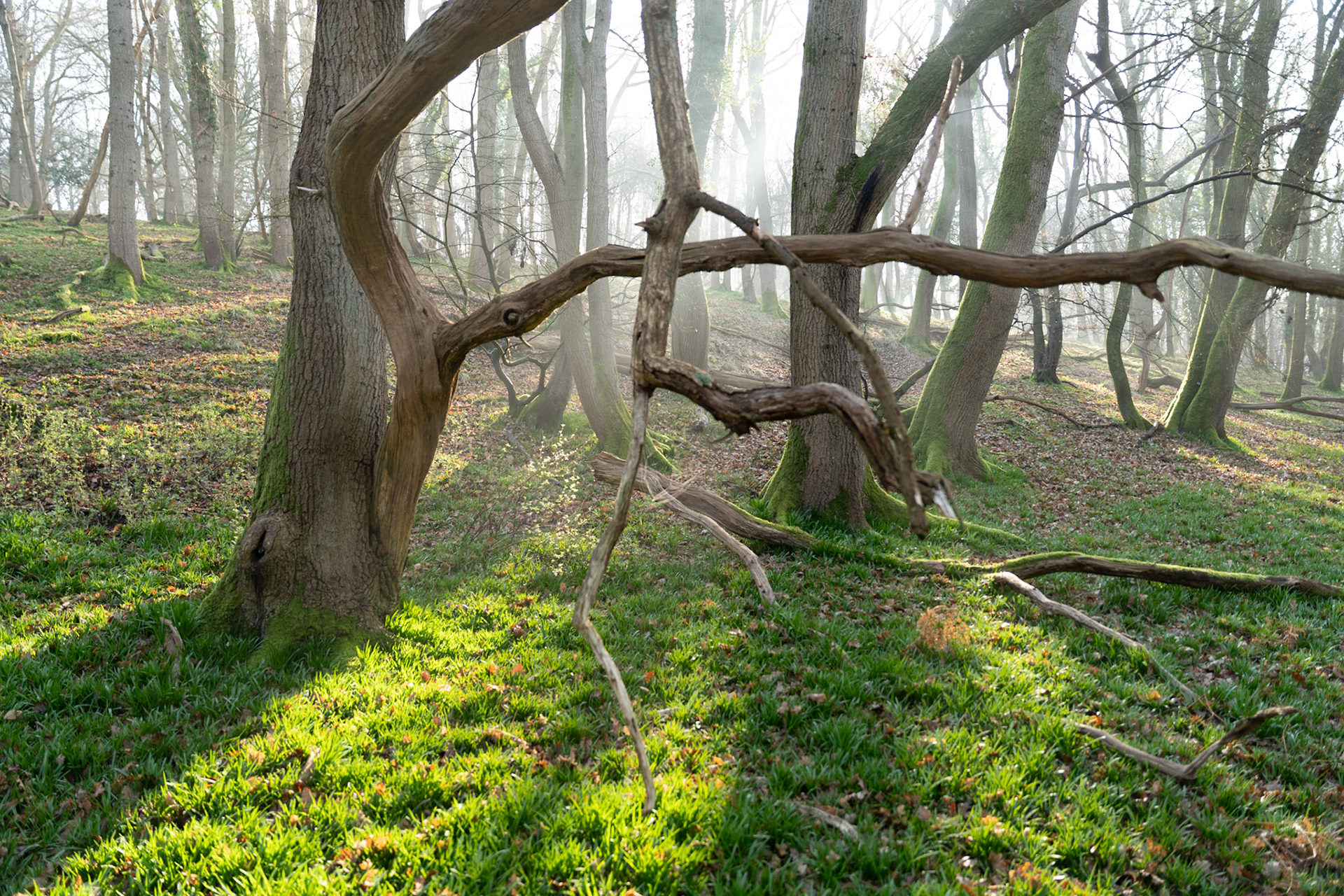
A fallen branch suspended between woodland stems in the Chilterns, Oxfordshire, frames a receding stand of bare-limbed beeches dissolving into early-morning mist. The low viewpoint emphasises the sculptural geometry of the deadwood against a soft green moss carpet, with diffuse sunbeams threading through the canopy beyond. Late winter into early spring, date consistent with the leafless crowns and fresh ground vegetation.
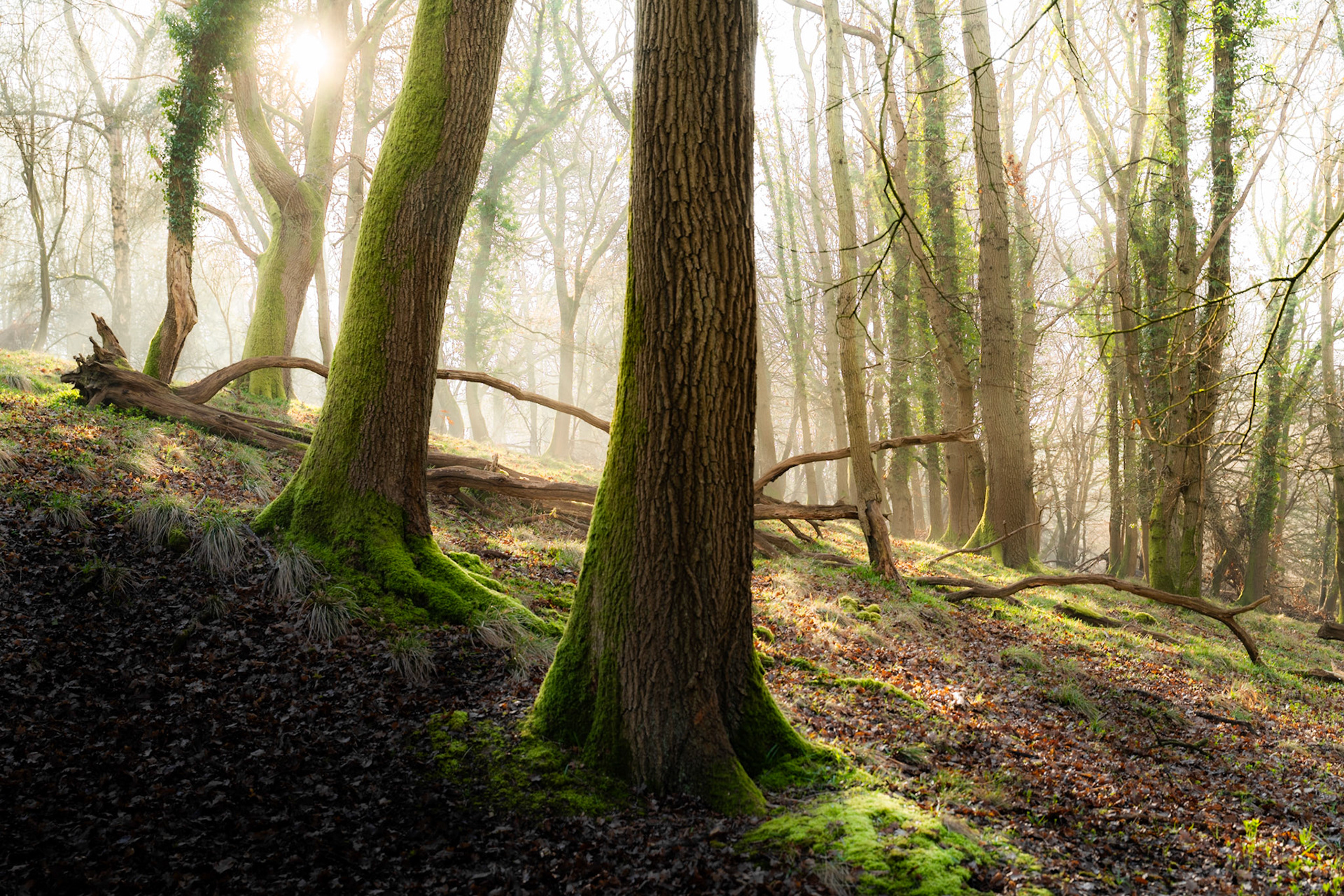
Two moss-clad trunks stand at the edge of a shallow woodland hollow in the Chilterns, Oxfordshire, a fallen bough curving behind them into the mist. Weak March sun pierces the canopy from the upper left, casting a diffuse backlight through still-bare branches. The contrast between the vivid moss on the near bark and the pale, receding fog gives the scene its quiet depth.
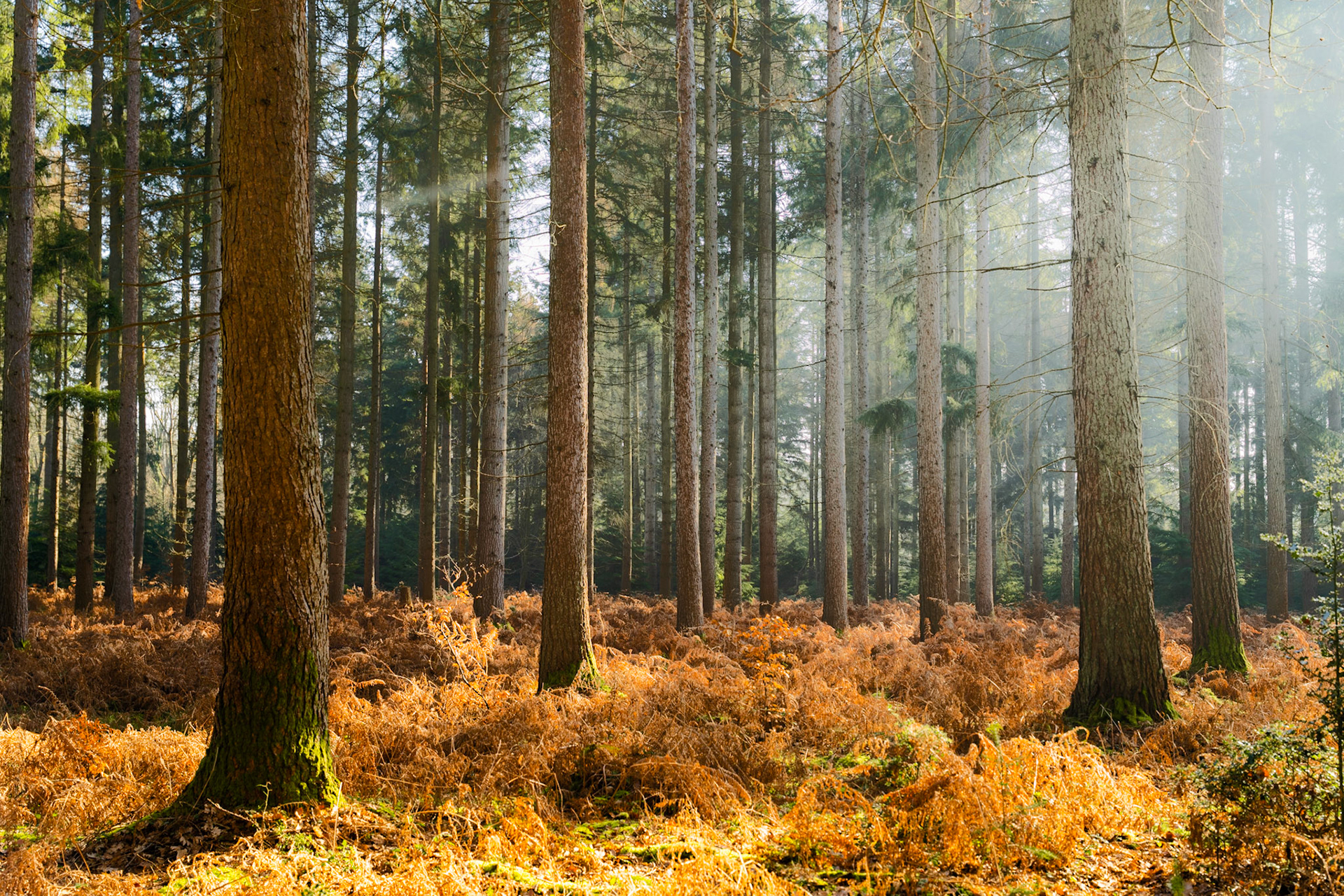
Low winter sun drives shafts of light through a managed conifer plantation, illuminating a dense carpet of bracken in its dormant, rust-coloured state. The mist thickening toward the background compresses the rows of tall trunks into receding planes, lending the scene a quiet geometric order. Captured on a still morning at the cusp of late winter.
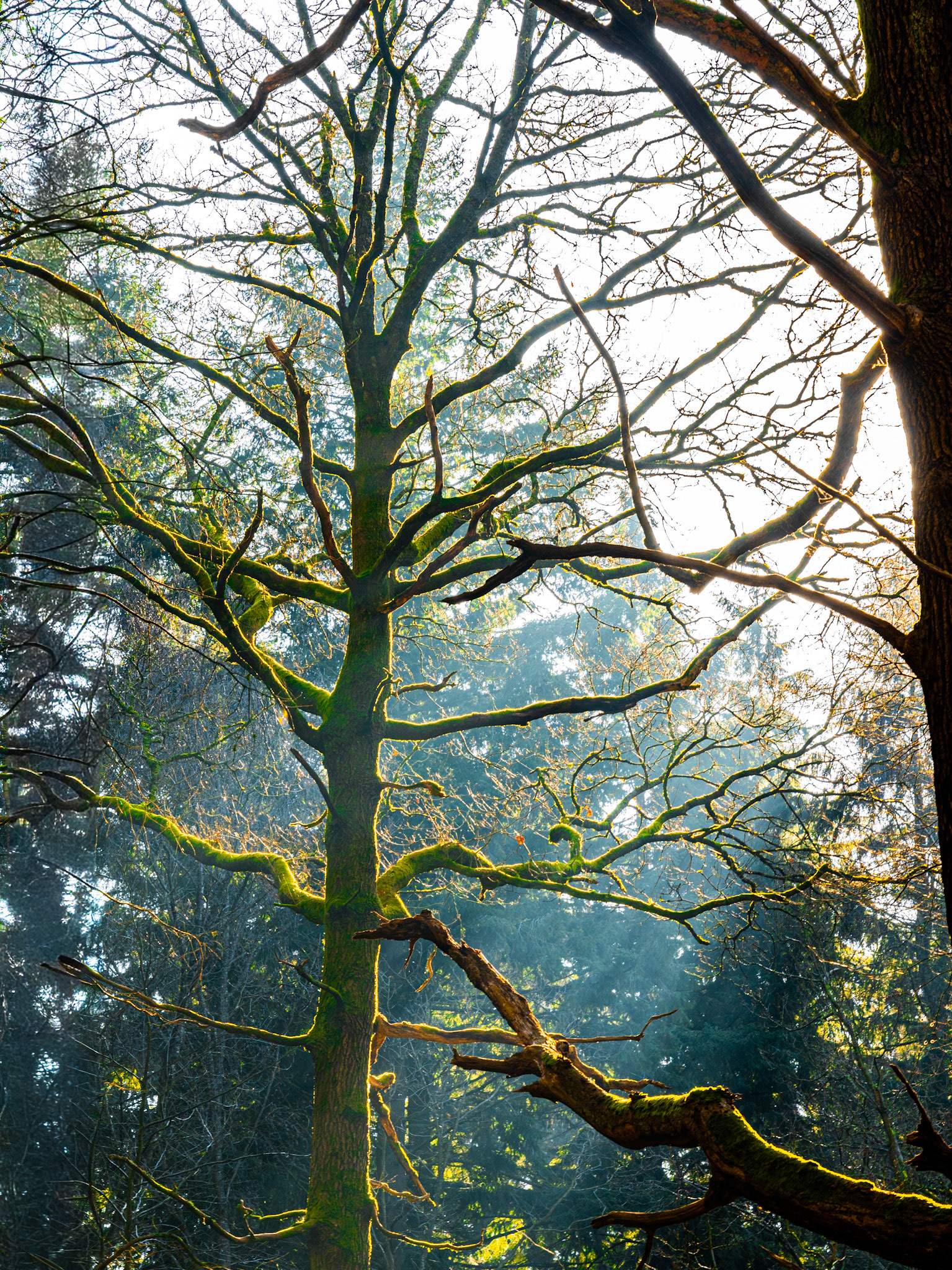
A mature deciduous tree, its bark and bare branches thickly colonised by moss, stands backlit against diffuse winter sunlight filtering through a mixed woodland. A fallen limb, equally moss-covered, sweeps across the lower frame, anchoring the composition. The rim-lighting separates each branch from the soft atmospheric haze behind, giving the scene a quiet, almost luminous quality.
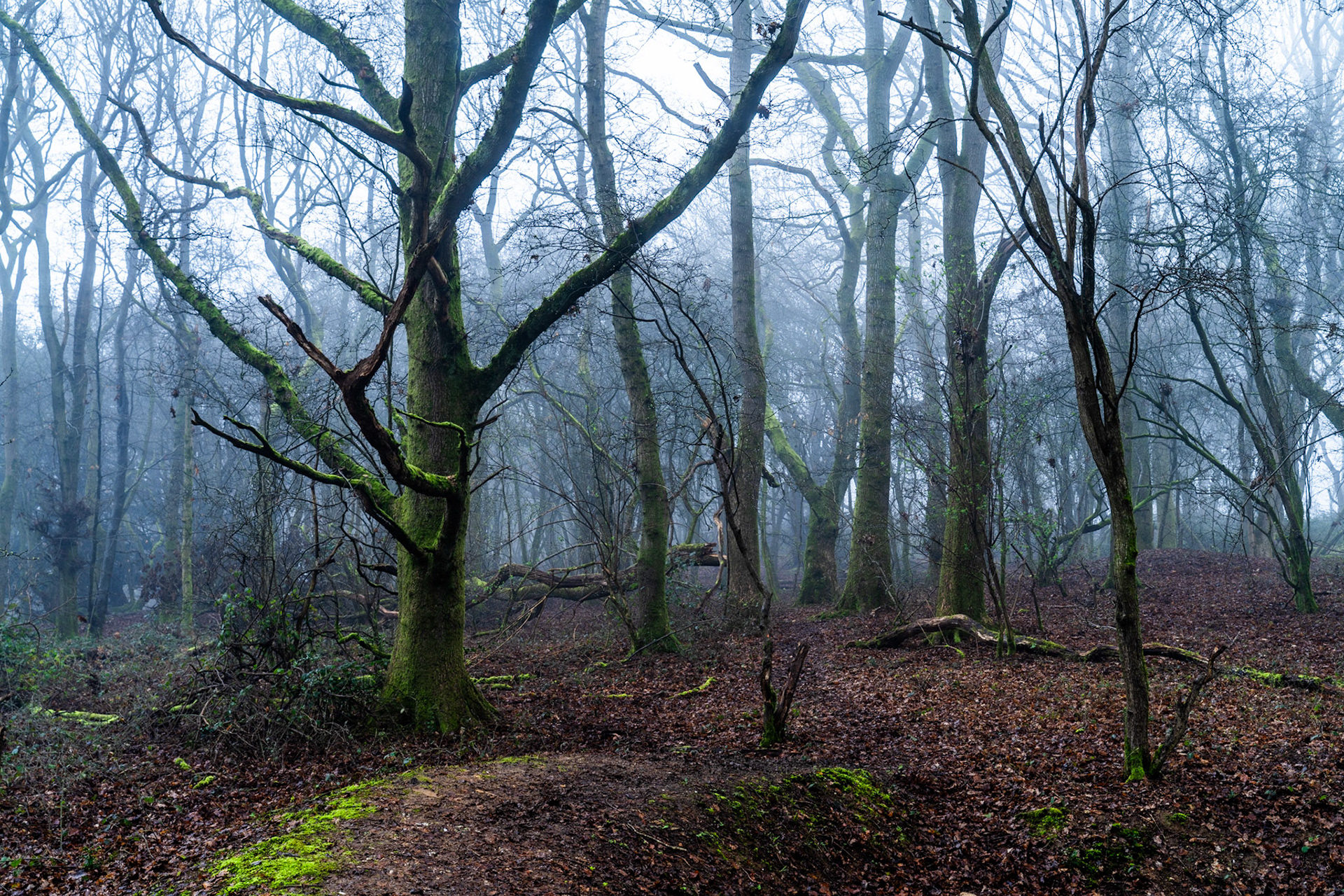
Bare deciduous woodland in the Chilterns, Oxfordshire, photographed in early-morning fog, the foreground trees carrying vivid moss on their lower bark while receding trunks dissolve into a cool grey middle distance. The leaf-litter floor and fallen timber suggest an undisturbed ancient woodland edge, likely early March before bud-break. Diffuse flat light preserves the layered depth without competing highlights.
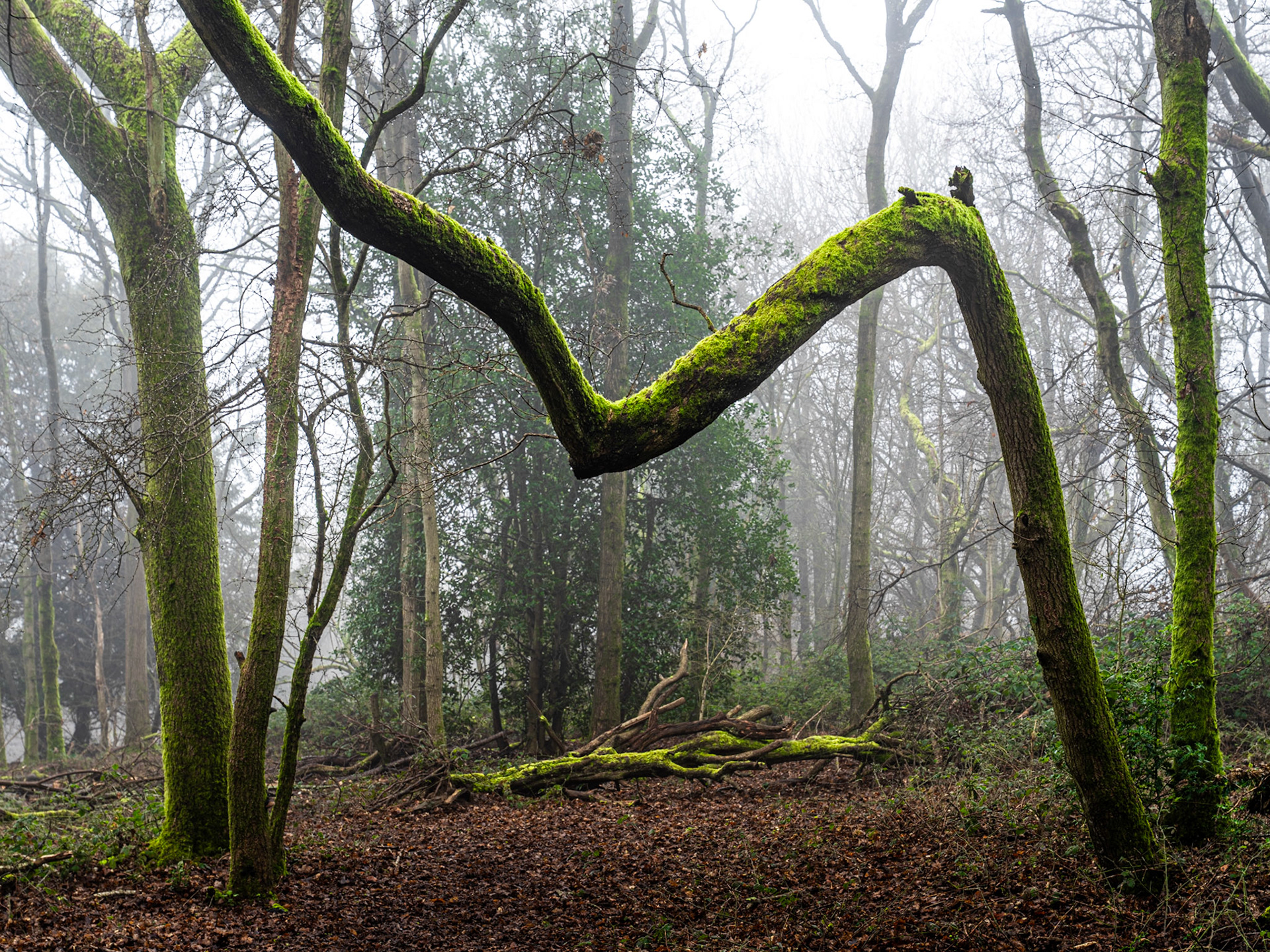
A heavily moss-covered branch arcs between two leaning trunks in the Chilterns, Oxfordshire, forming a natural gateway into fog-softened woodland in late winter. Fallen deadwood and a leaf-litter floor anchor the foreground, while bare and evergreen trees dissolve into diffuse grey beyond. The sculptural geometry of the branch commands the frame with quiet insistence.
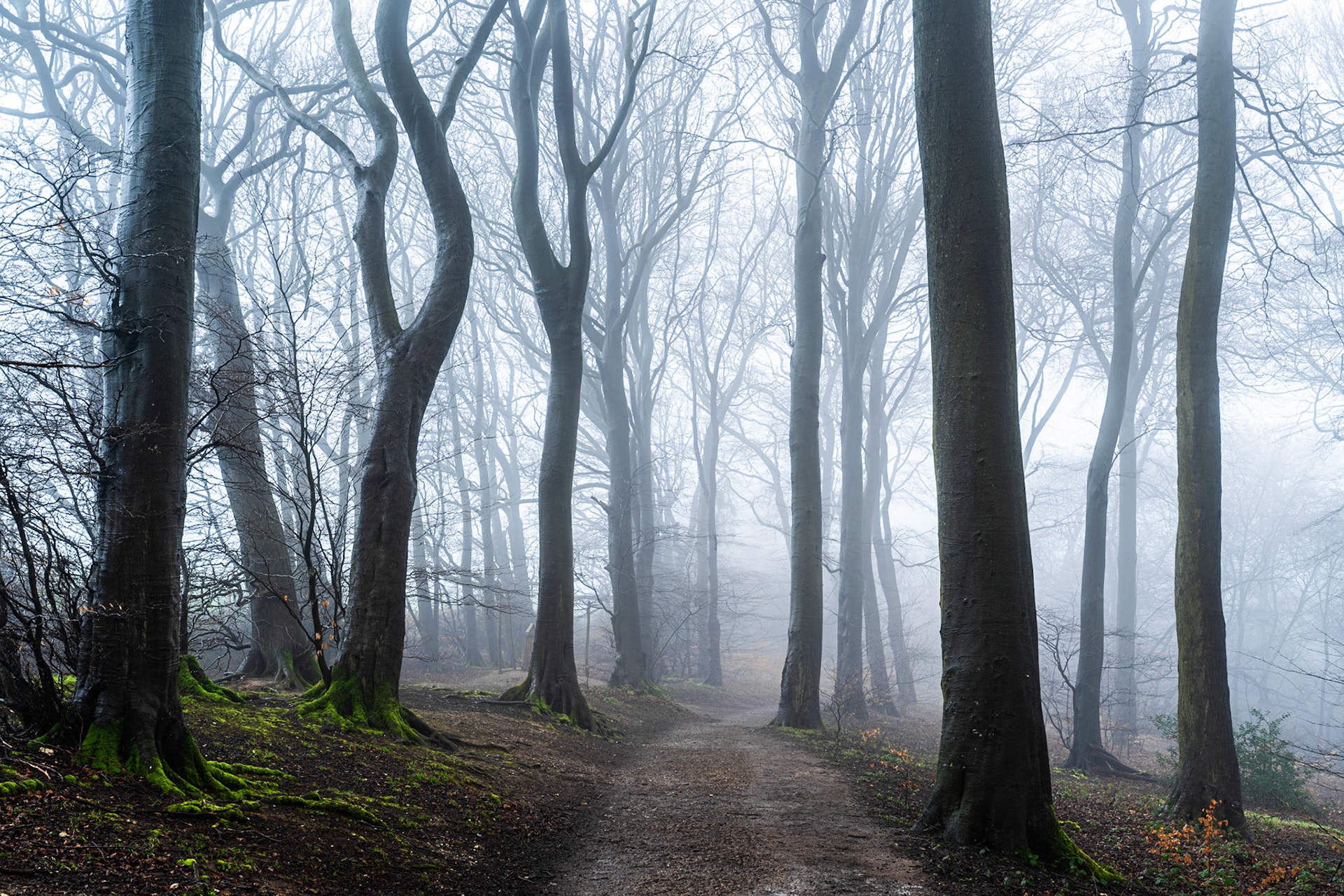
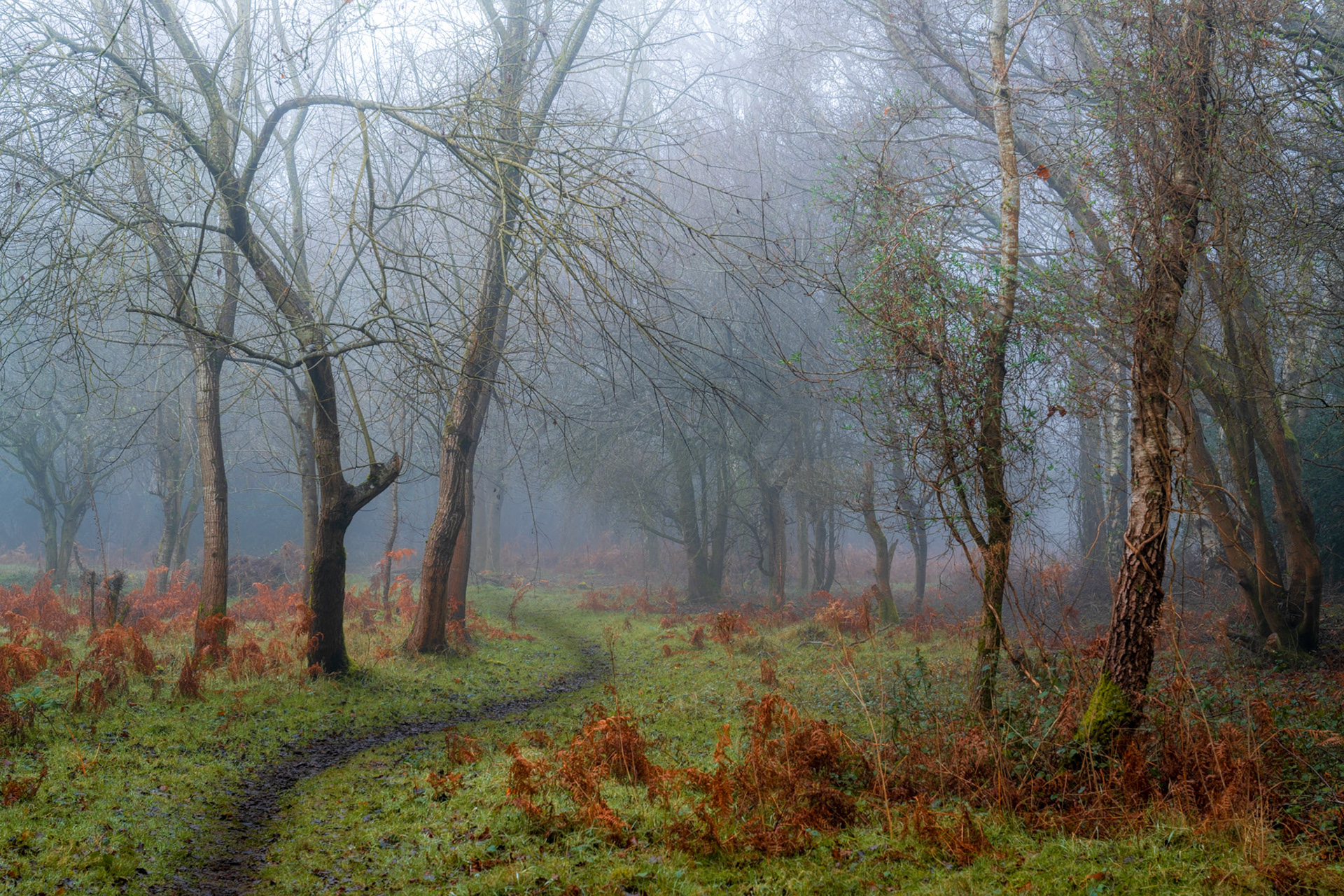
A woodland track in the Chilterns curves into dense winter mist between bare beech trunks, their moss-clad roots anchoring the foreground while successive layers of fog dissolve the canopy into pale abstraction. The cool, diffuse light and receding depth lend the scene a stillness that reads as studied rather than incidental. Captured at dawn in early March, when the Oxfordshire beechwoods remain leafless and the fog thickens rather than burns off.
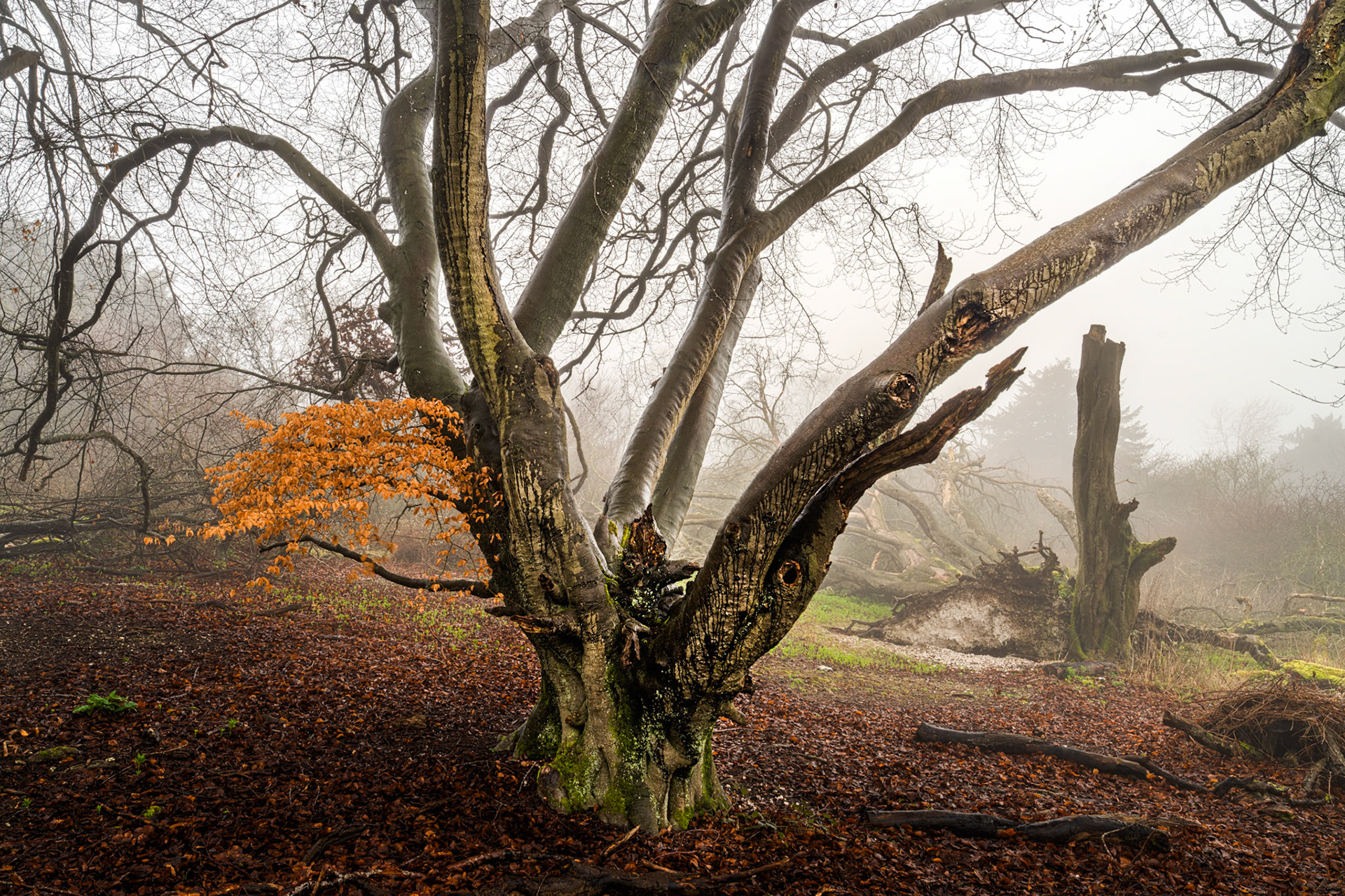
A veteran multi-stemmed beech in the Chilterns retains a cluster of marcescent copper leaves against the grey of a foggy late-winter morning. The gnarled, knotted bole carries the character of centuries, while fallen timber and a standing dead snag recede into the Oxfordshire mist behind. The carpet of decomposing beech leaf litter anchors the composition in the quiet decay of the season.
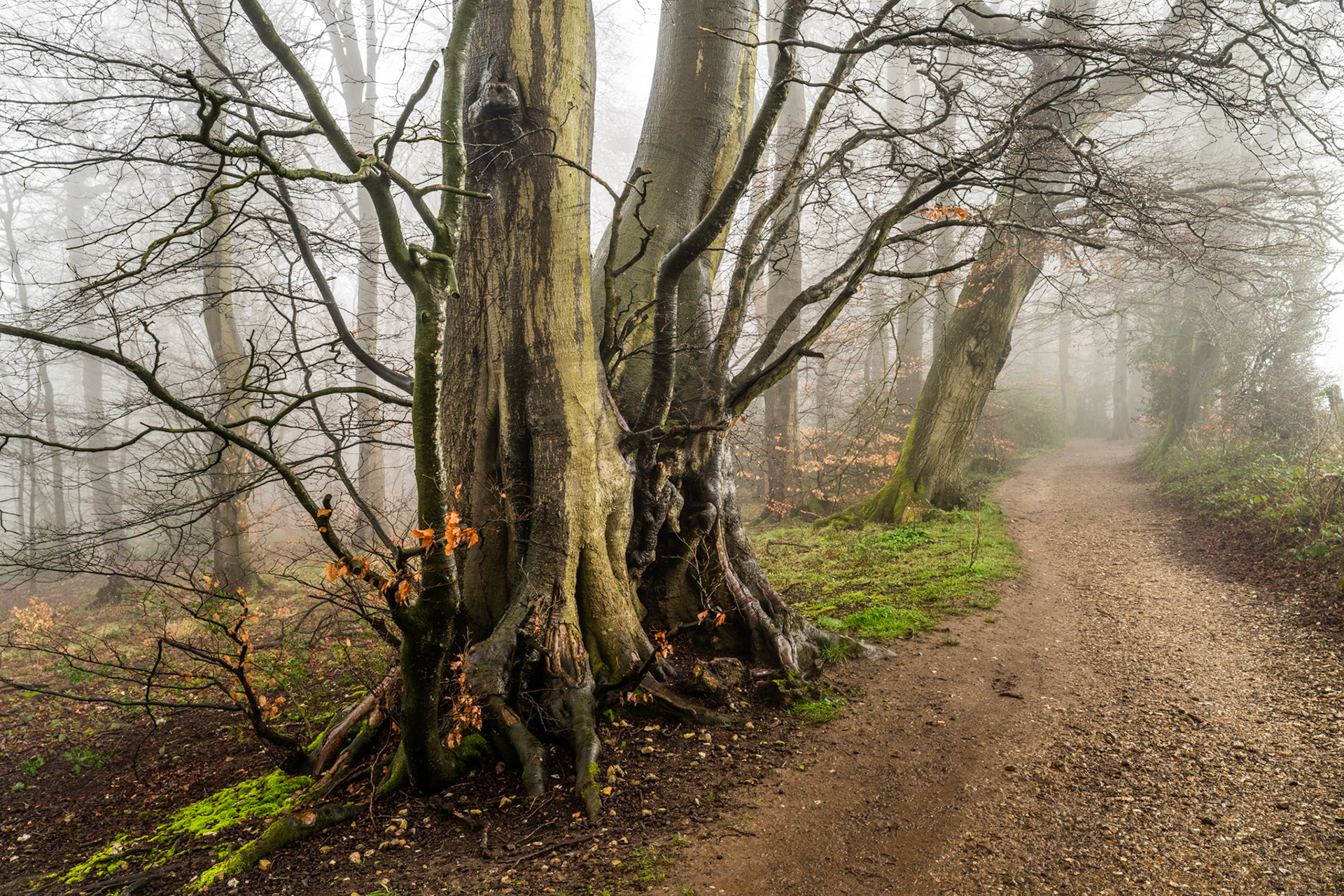
A cluster of ancient, multi-stemmed beech trees stands beside a woodland path in the Chilterns, Oxfordshire, as winter fog reduces the middle and far distance to pale grey. The gnarled, fused root bases and moss-covered ground contrast with the receding path that draws the eye into the obscured interior, the last clinging beech leaves adding the only warmth of colour.
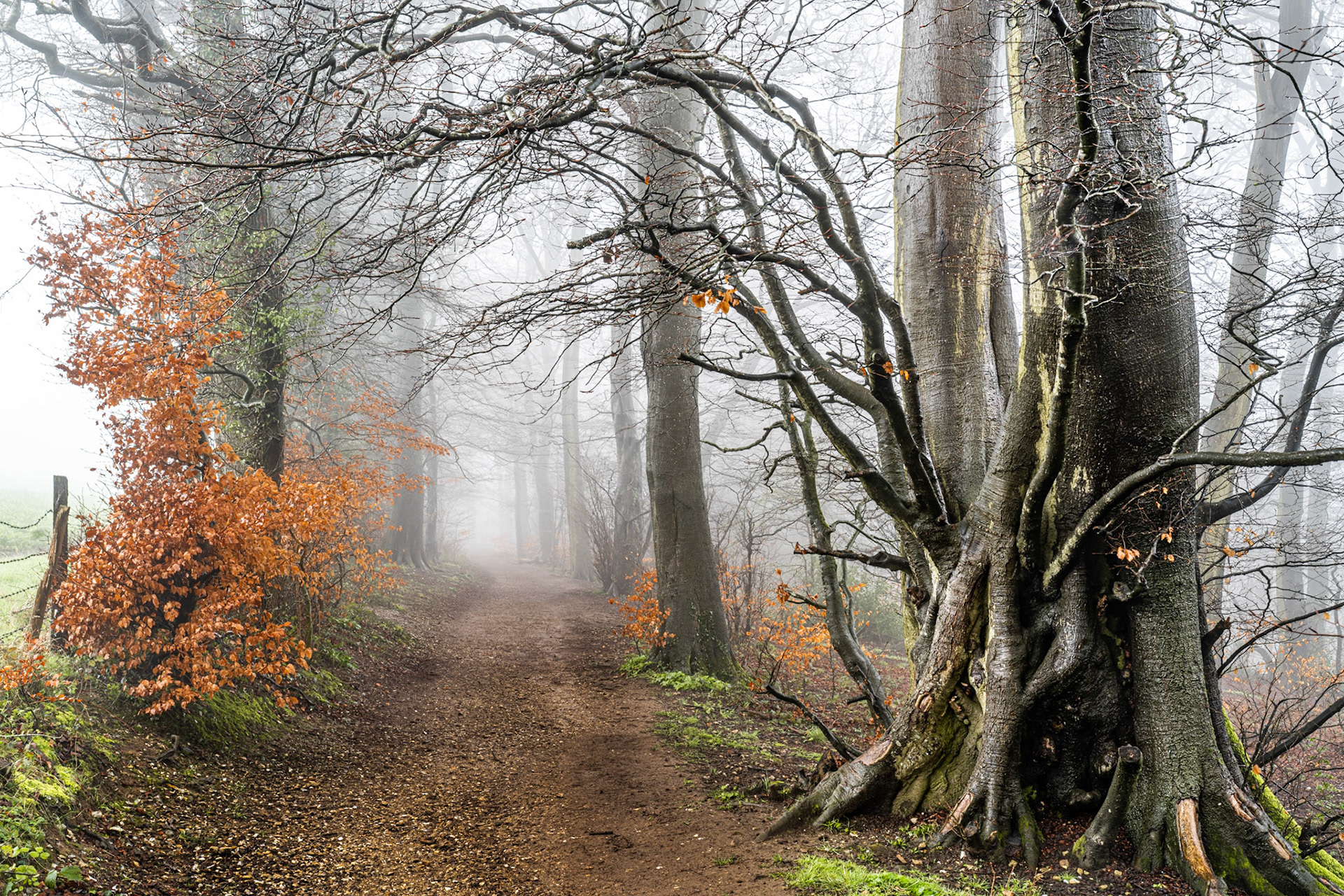
A broad dirt path draws the eye into dense fog between ancient beech trees in the Chilterns, their bare branches interlocking overhead to form a natural arch. Clinging copper leaves on low beech scrub provide the sole warmth against the monochrome grey of mist and bare bark. The receding tree line dissolves entirely into white, leaving the destination unresolved.
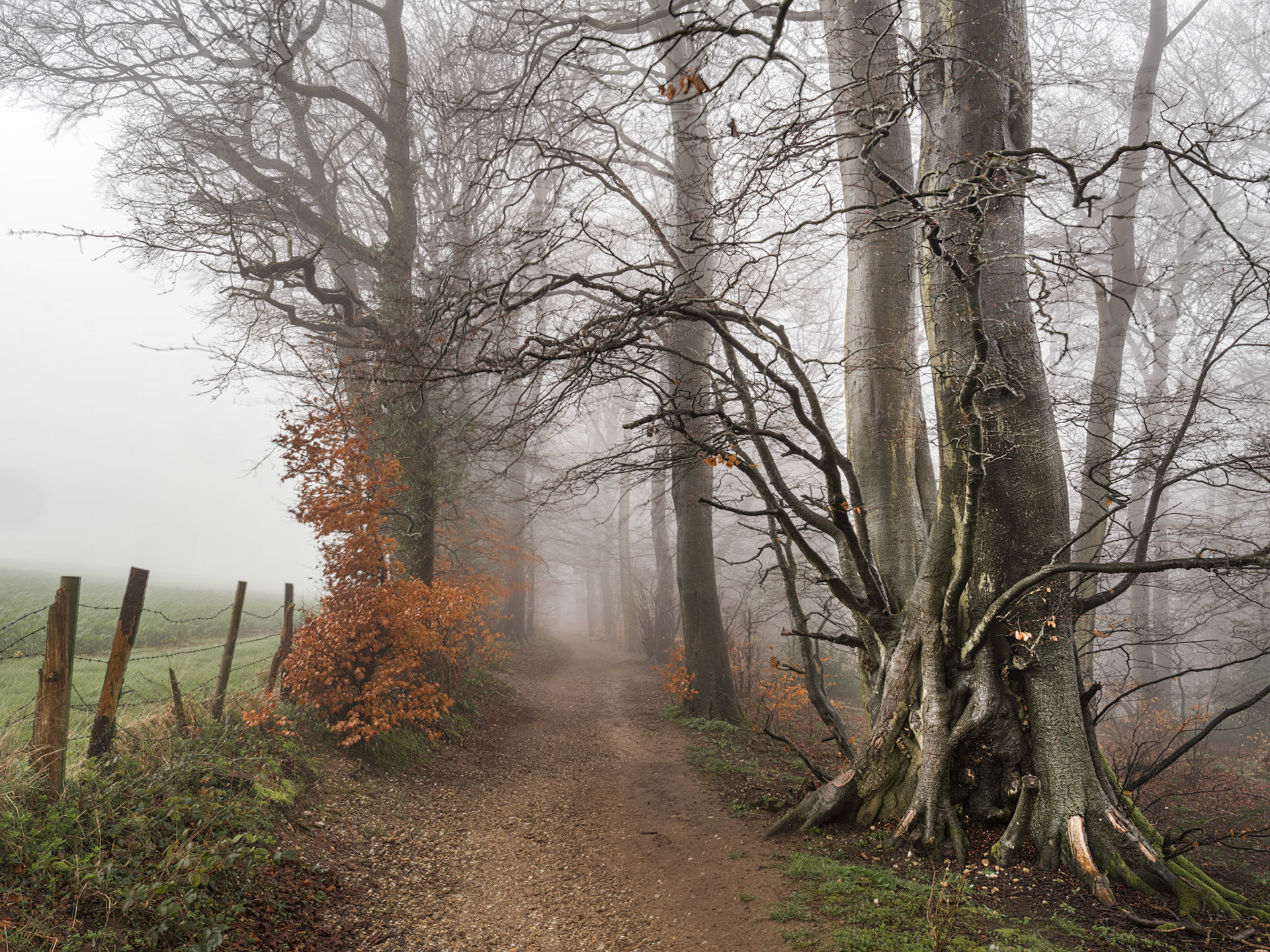
A gravel path curves into dense autumn beechwood in the Chilterns, Oxfordshire, the trees dissolving into thick morning fog beyond. The gnarled root mass of a veteran beech anchors the right foreground, its twisted form contrasting with the ghostly recession of trunks behind. A barbed-wire fence and remnant copper leaves provide quiet counterpoint to the monochromatic atmosphere.
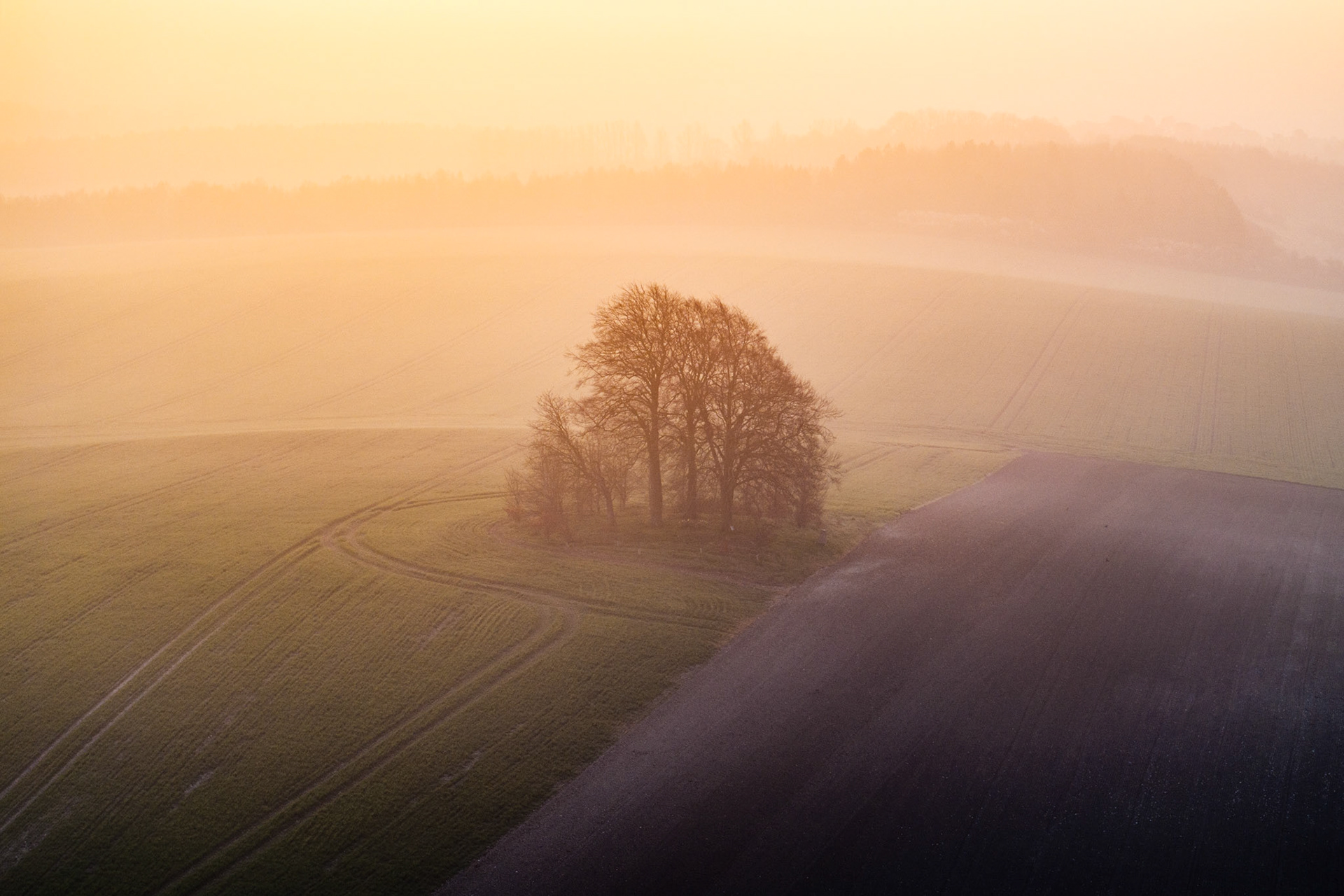
A small copse of bare-branched trees stands isolated on Brightwell Barrow, the low hill rising between arable fields a short distance from the Wittenham Clumps in Oxfordshire, as dawn mist pools across the surrounding farmland. Shot from altitude at the spring equinox, the warm backlight reduces the scene to layered planes of gold and shadow, the tractor lines radiating outward from the copse lending quiet geometry to the composition.
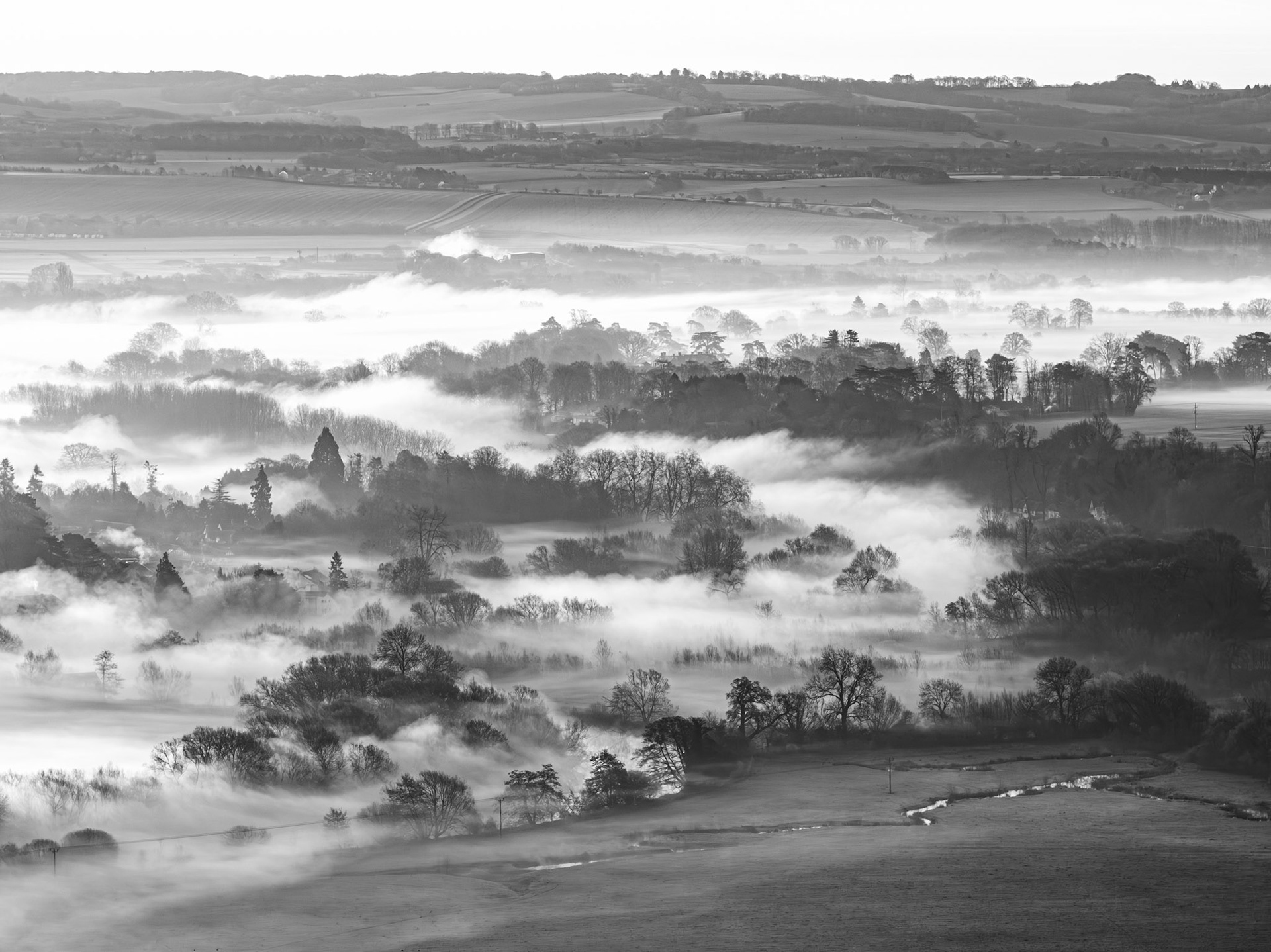
A temperature inversion fills the Thames Valley near Wallingford, submerging the lower ground in dense radiation fog while the bare-branched trees of the valley floor emerge as dark silhouettes between the mist layers. Shot from elevation, the compression of tonal planes across multiple fog bands gives the scene a graphic, almost painterly structure. The monochrome conversion strips out any distraction, leaving only the interplay of light, vapour, and form.
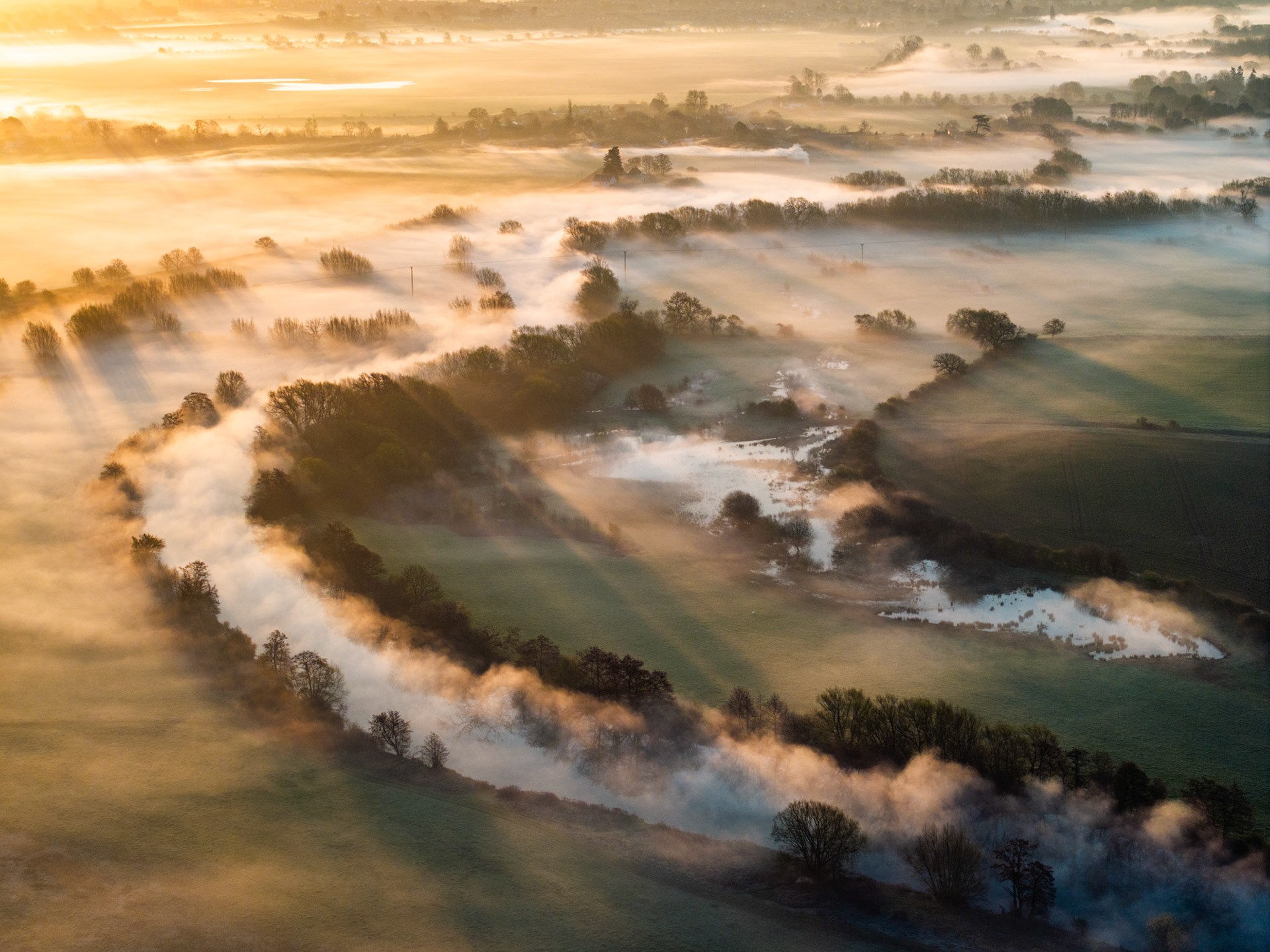
A meandering river valley near Wallingford is submerged beneath a temperature inversion at dawn, the mist pooling along the watercourse and tracing every curve of the floodplain. Bare riparian trees emerge as silhouettes through the vapour while crepuscular rays fan across the scene from low in the west. Flooded fields catch the light between the fog banks, giving the aerial view an almost topographic clarity.
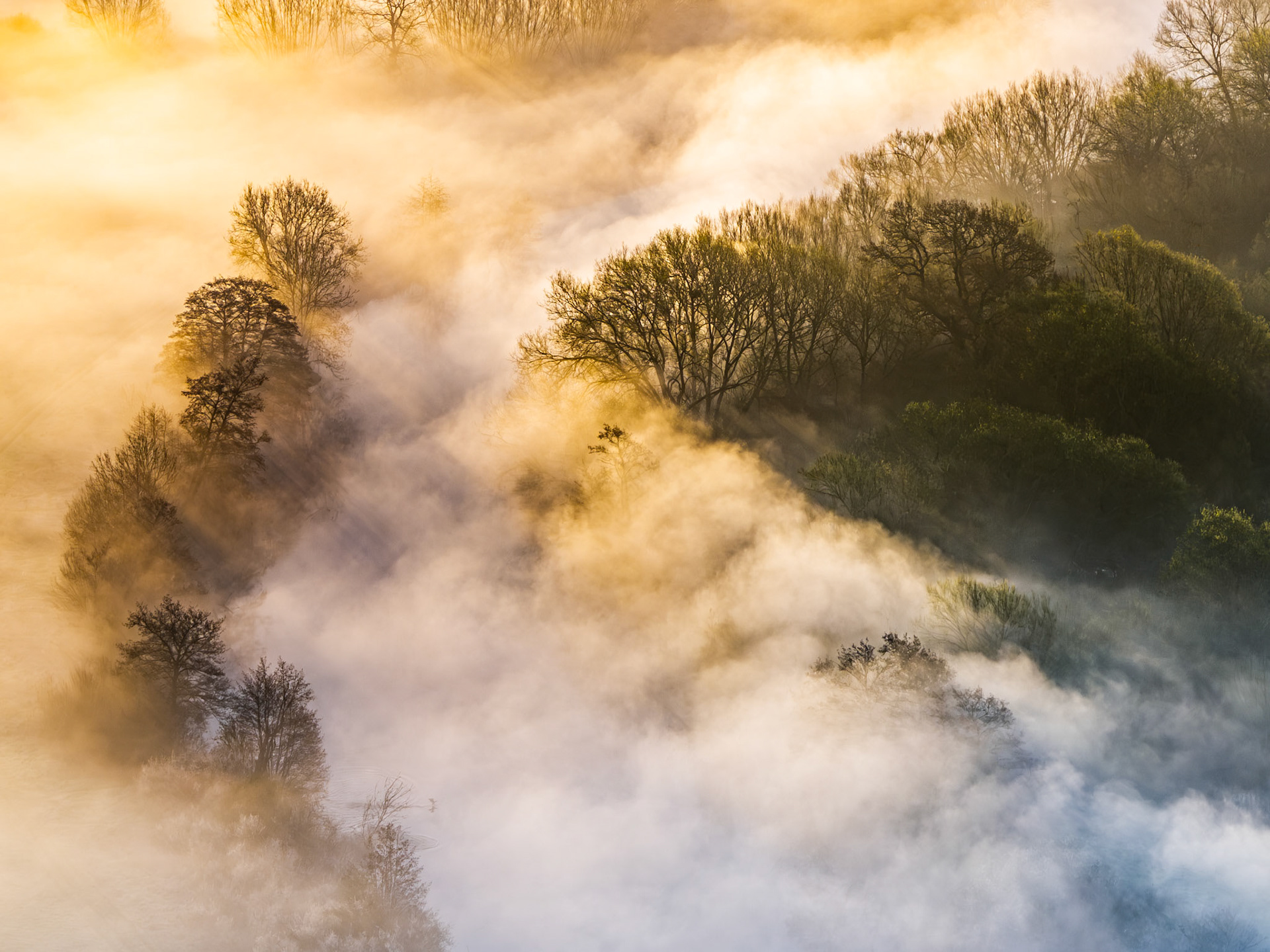
Ground mist pools and breaks across a wooded valley near Wallingford on a March morning, the low sun catching the fog from behind to separate warm and cool tones across a single frame. Bare and evergreen canopies emerge at different heights through the inversion layer, giving the scene an uncommon sense of depth and movement. The aerial perspective dissolves conventional landscape structure into something closer to ink and breath.

Ground-hugging mist rolls through bare-canopied riparian woodland above the Thames Valley at Wallingford, caught at the moment sunbeams pierce the inversion layer and separate light from shadow across successive tree lines. The aerial perspective dissolves the landscape into layered planes of amber and cold white, reducing woodland to silhouette and vapour to form. Captured at the spring equinox, when overnight cold and morning warmth conspire to produce conditions of this density and movement.

Ground mist rolls across the Thames floodplain near Wallingford on a March morning, partially obscuring bare and budding riverside trees whose canopies frame a mirror-calm channel reflecting cloud and open sky. Cormorants roost and lift from a prominent tree on the right bank, their silhouettes providing precise scale and biological context within an otherwise abstract composition. The interplay of warm mist-light against cool water reflection gives the image an uncommon spatial ambiguity.
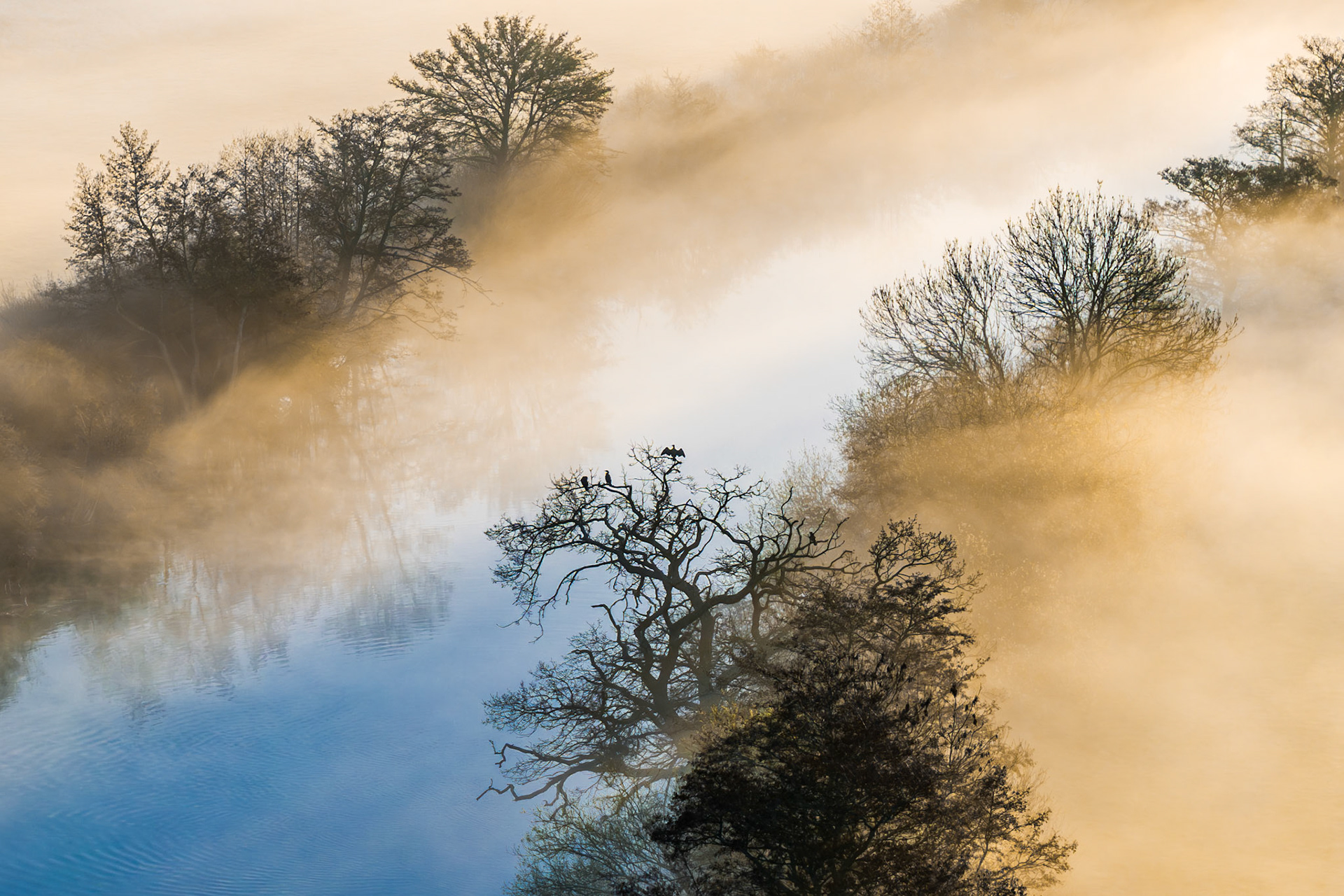
A cormorant spreads its wings from a bare oak standing in the River Thames near Wallingford, as a temperature inversion floods the valley with warm morning mist. The aerial perspective collapses foreground and distance into layered planes of silhouetted canopy and pale water, the bird providing a precise focal anchor within the abstraction. Captured at the spring equinox, when leafless trees retain enough transparency to hold the composition without closing it.
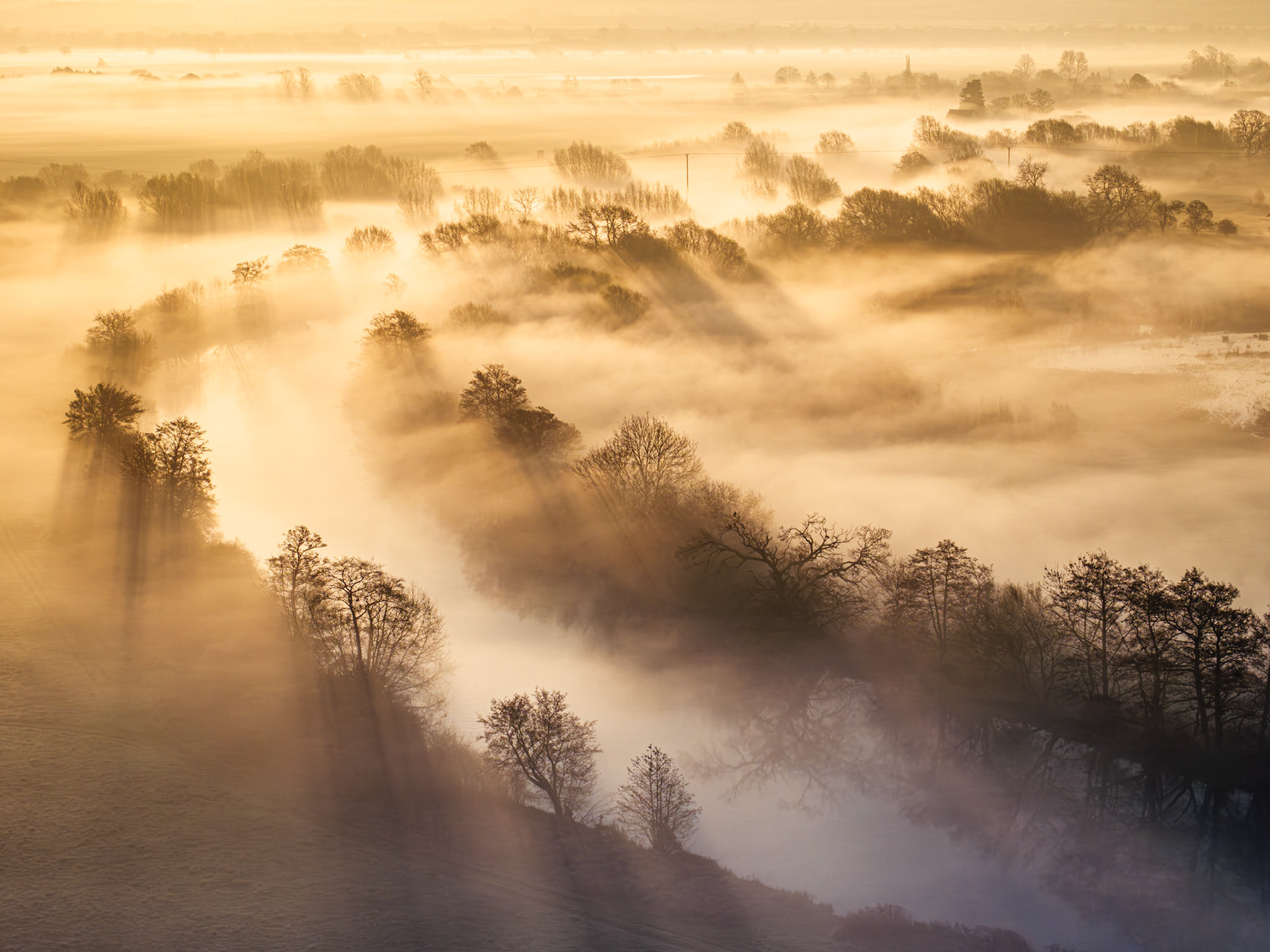
A temperature inversion fills the Thames Valley near Wallingford at dawn, submerging the hedgerows and field boundaries beneath a continuous fog layer. Bare-limbed trees puncture the surface in loose diagonal lines, casting crepuscular rays that radiate across the mist in warm, directional light. The elevated drone perspective compresses the receding treelines into layered planes, rendering the familiar agricultural landscape briefly unrecognisable.
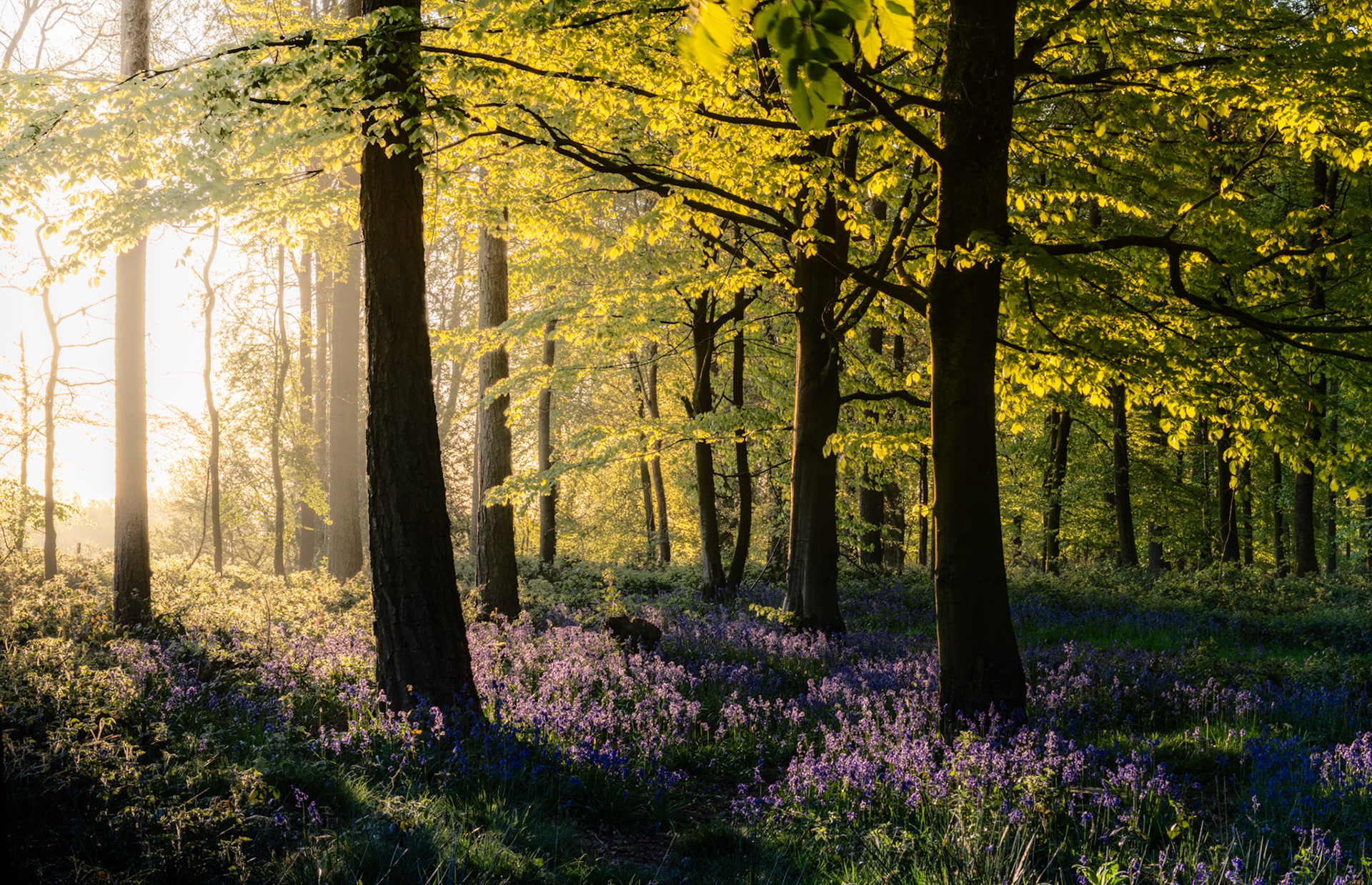
Low dawn light filters through a broadleaf woodland in the Chilterns, Oxfordshire, where fresh spring leaf casts long shadows across a dense carpet of bluebells. Residual mist softens the background trees and amplifies the backlit glow on the canopy. The composition holds depth without a single dominant subject, relying instead on the layered rhythm of trunks receding into the haze.
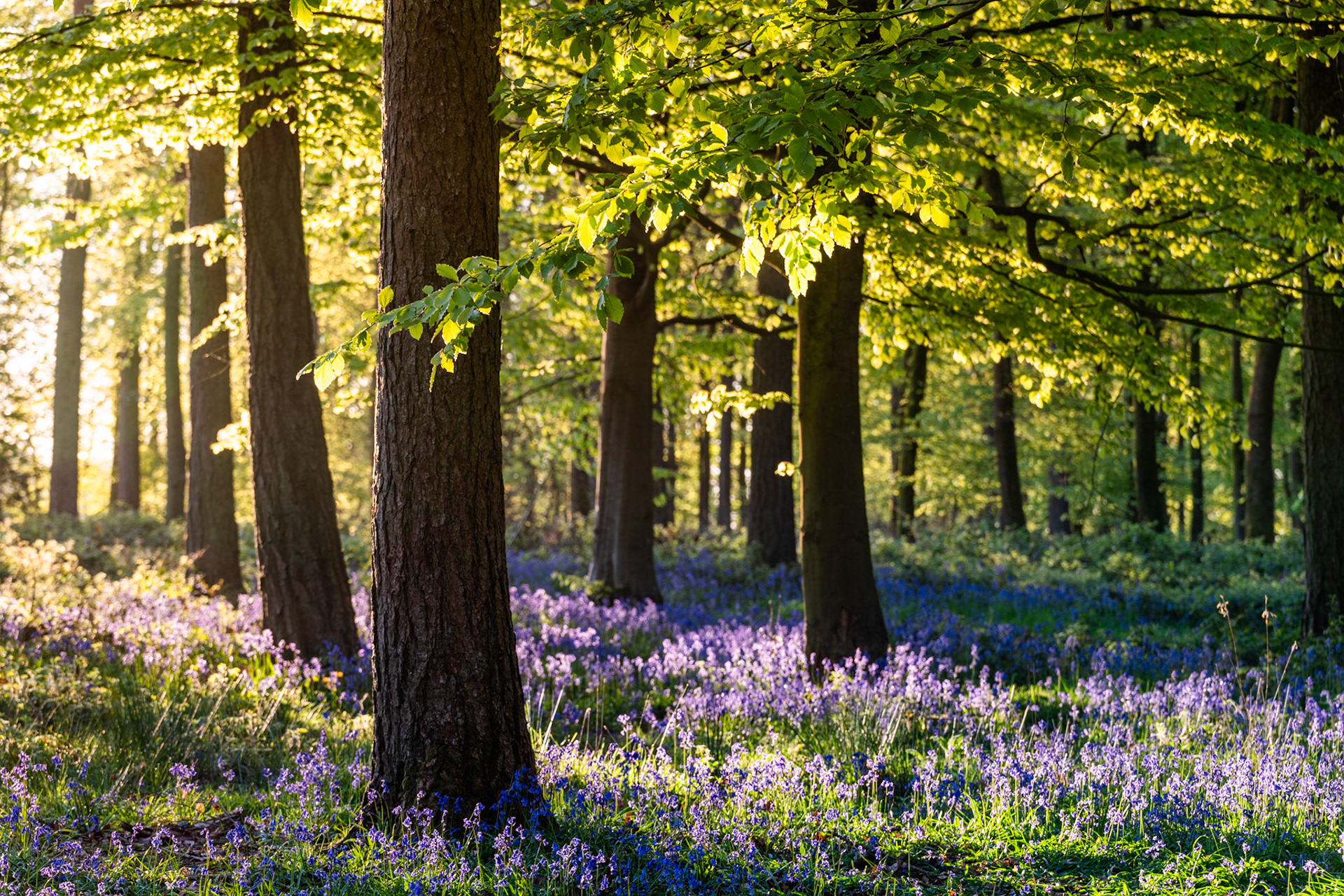
Low dawn light rakes through a beech woodland in the Chilterns, Oxfordshire, where fresh spring leaf casts long shadows across a dense carpet of bluebells. The backlighting ignites the emerging canopy and picks out individual flower stems against the shadowed forest floor, creating a strong tonal contrast between warmth above and cool violet below. Captured at first light when the angle of the sun still holds depth within the trees.
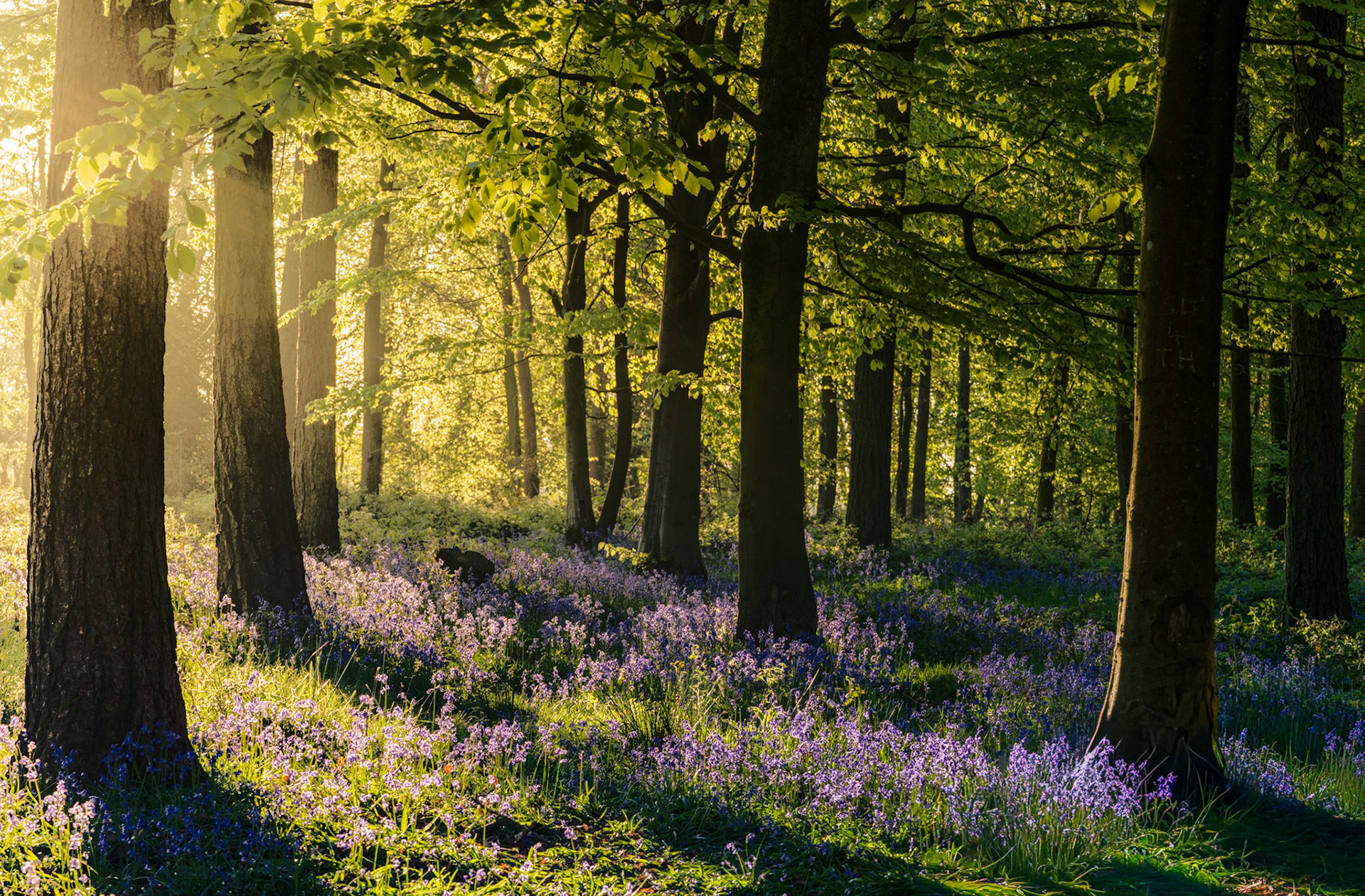
Low dawn light rakes through a broadleaf woodland in the Chilterns, Oxfordshire, at full spring flush, casting the bluebell carpet in alternating bands of shadow and warm backlight. The luminous canopy, still in fresh leaf, amplifies the glow while the dark trunks provide counterpoint to the violet ground layer. The combination of raking sidelight and peak bluebell coverage makes this a well-timed, controlled image.
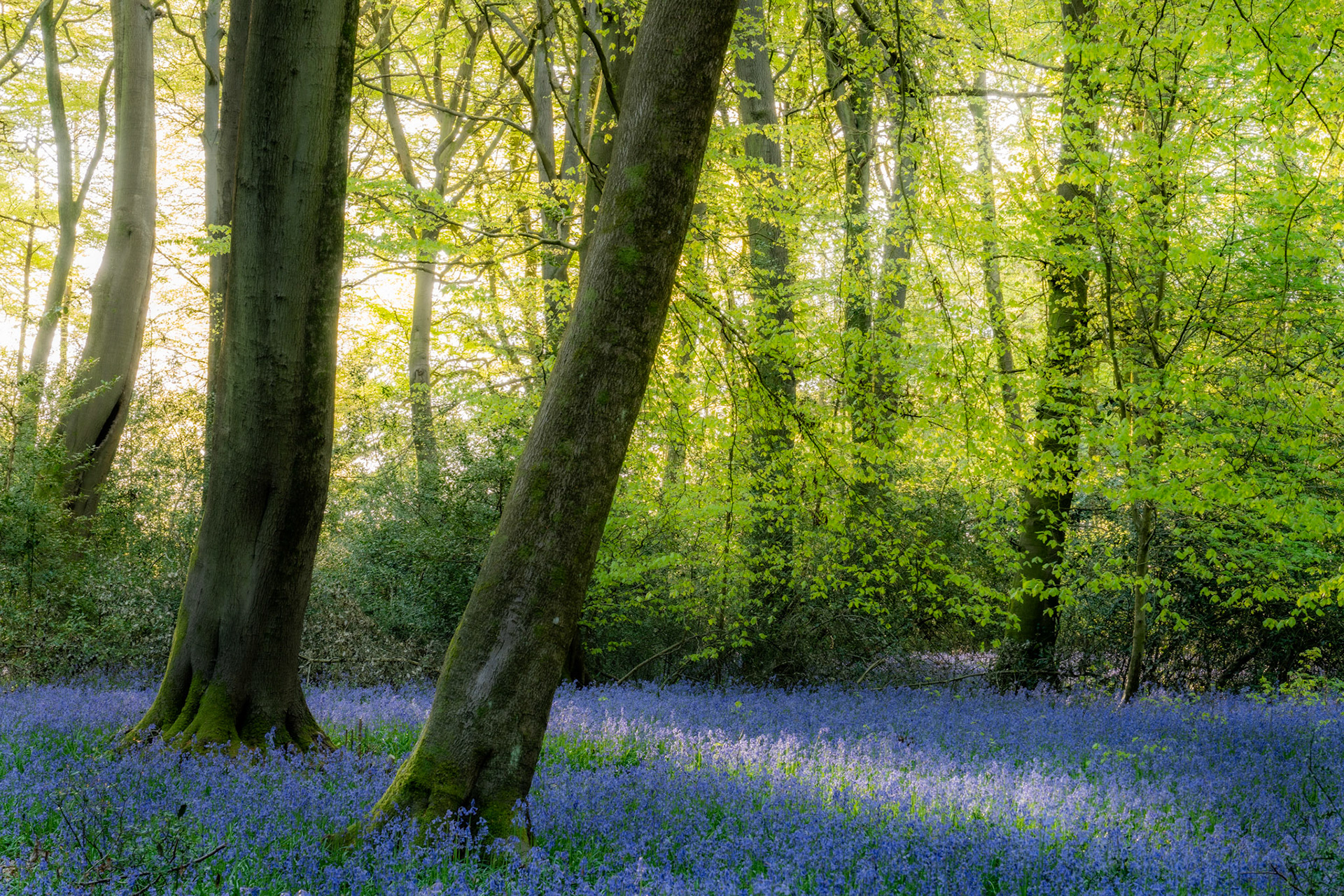
A dense carpet of bluebells spreads beneath the smooth grey trunks of beech trees in the Chilterns, Oxfordshire, caught here in fresh spring leaf. Early morning sidelight filters through the canopy, separating trunk forms from the luminous yellow-green foliage behind. The pairing of blue ground and backlit green canopy gives the composition its quiet tension.
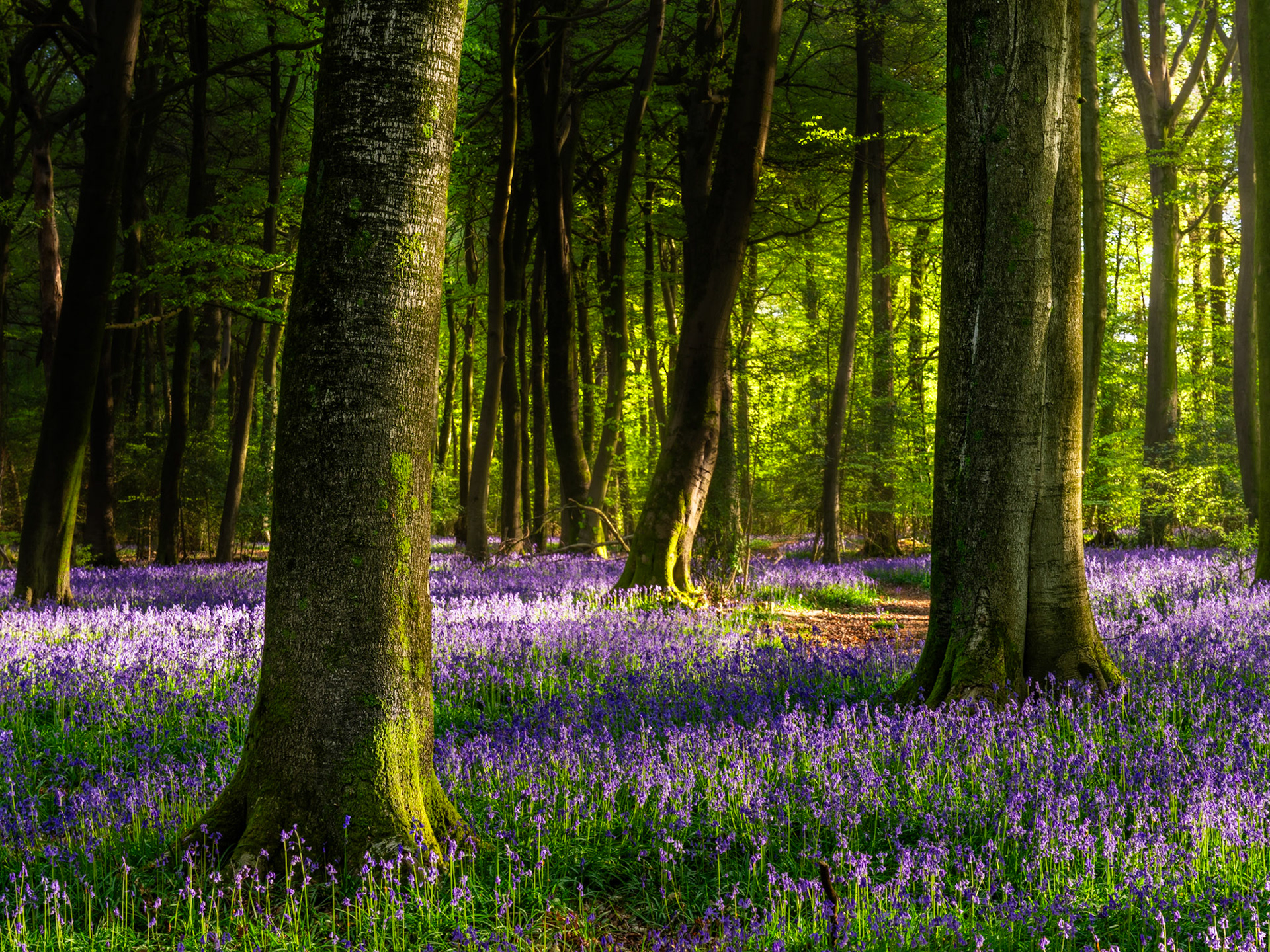
A carpet of native bluebells covers the floor of a mature beech woodland in the Chilterns, Oxfordshire, under low, raking early-morning light. The near-vertical trunks divide the frame into planes of deep shadow and luminous spring green, the backlit canopy separating the darkness of the foreground from an interior that appears almost to glow. The density and even coverage of the bluebells, combined with the quality of the light, lift this beyond a record shot into something with sustained visual weight.
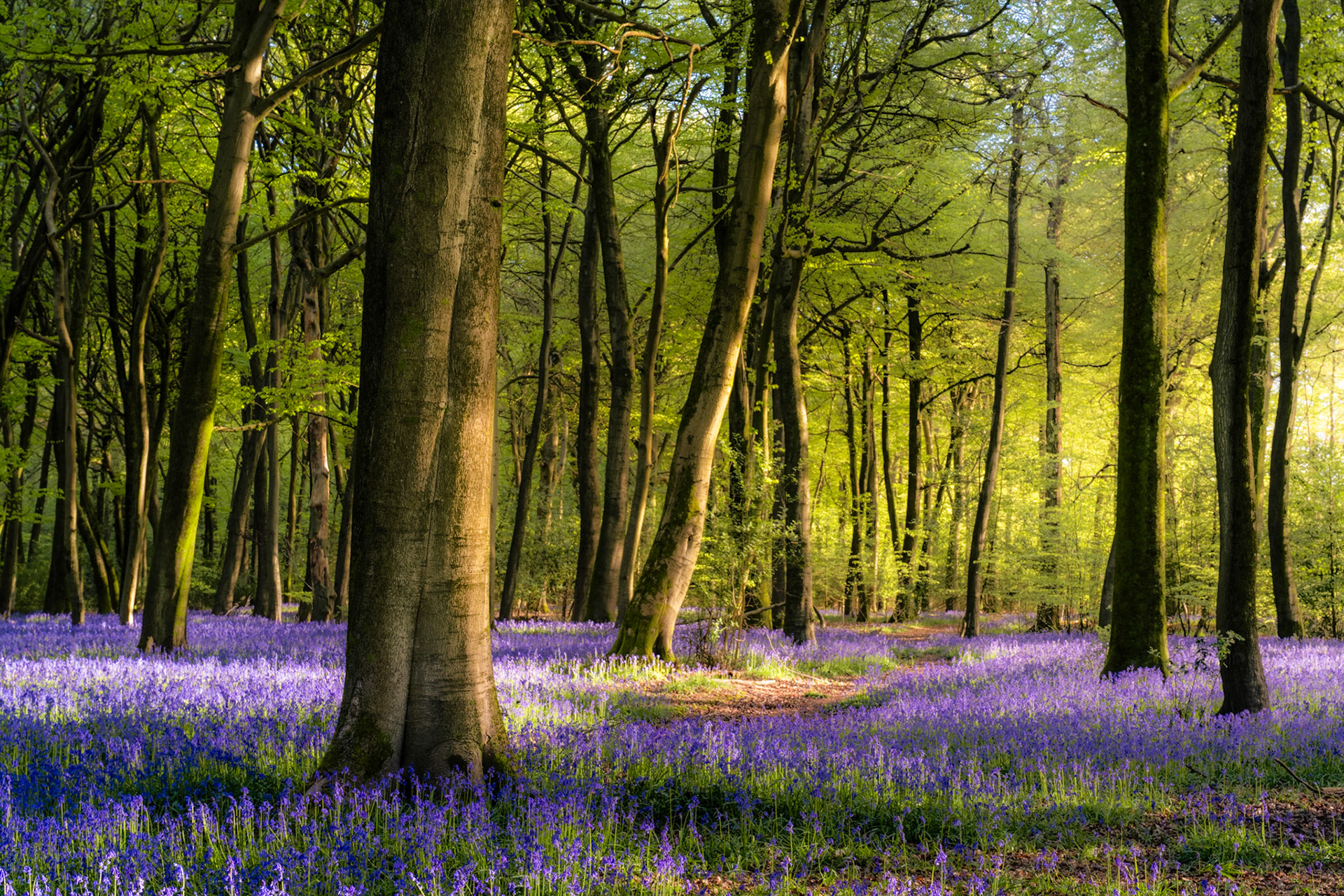
Low dawn light filters through the emerging beech canopy of the Chilterns, illuminating a dense carpet of bluebells across the woodland floor. A narrow path winds between the trunks toward the brightest point of the backlit clearing, creating a natural draw into the frame. The tension between the shadowed foreground trees and the luminous interior gives the image unusual spatial depth for its intimate scale.

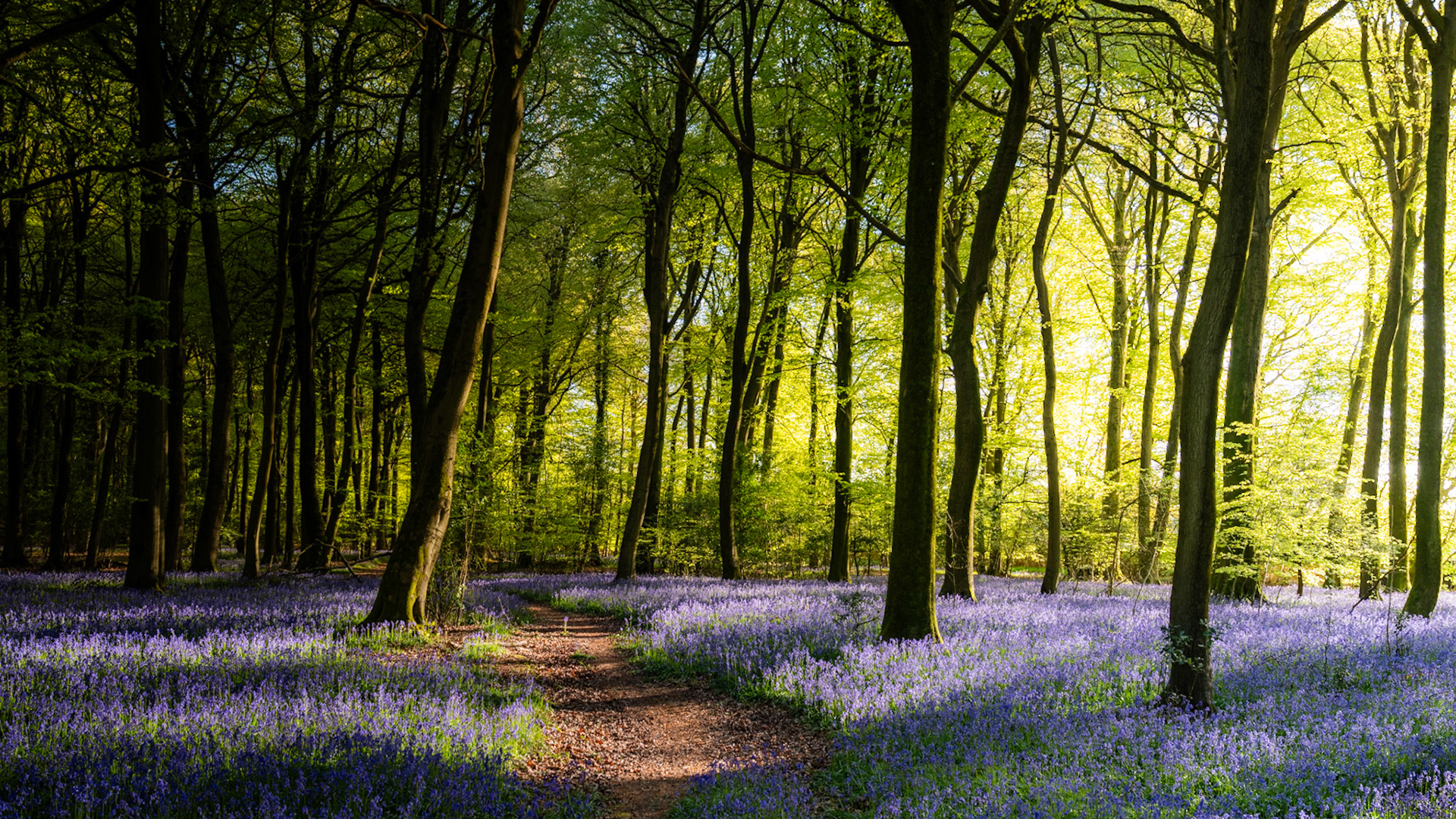
A narrow earth path winds through mature beech woodland in the Chilterns, Oxfordshire, its floor carpeted in flowering bluebells and lit by low spring morning light breaking through the canopy from the east. The contrast between the dark foreground trunks and the backlit, lime-green foliage creates depth and draws the eye into the wood. Timing places this at peak bluebell season, with the low sun angle suggesting early morning capture consistent with the recorded time.
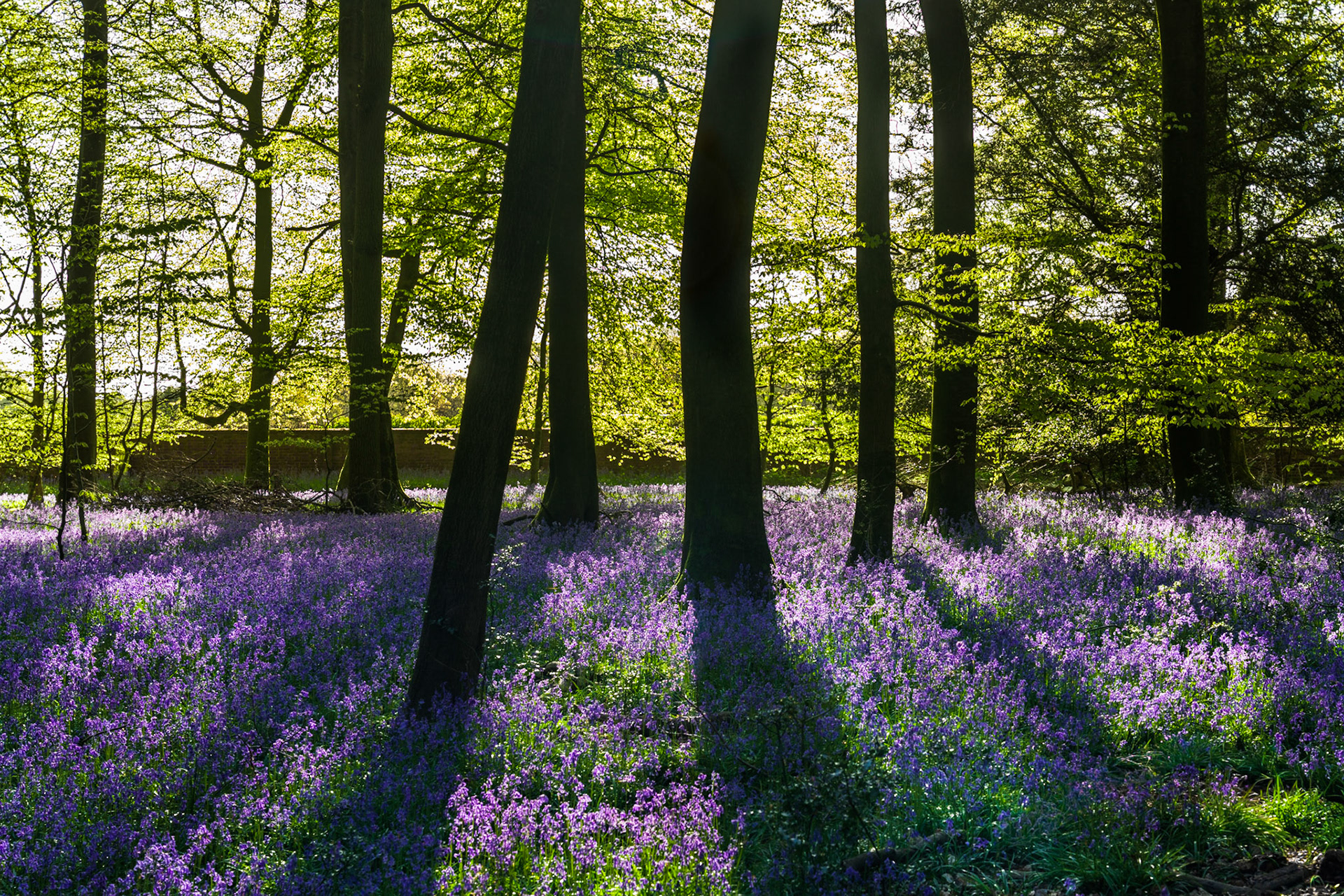
Backlit beech trunks rise from a dense carpet of native bluebells in full flower across a Chilterns woodland floor, the low early-morning sun igniting the fresh canopy from behind and casting the foreground into dappled contrast. The compression of the intimate focal length locks the viewer within the interior rather than surveying it from a distance. Captured at dawn in late April in Oxfordshire, the image holds the brief window when leaf emergence and bluebell peak coincide.
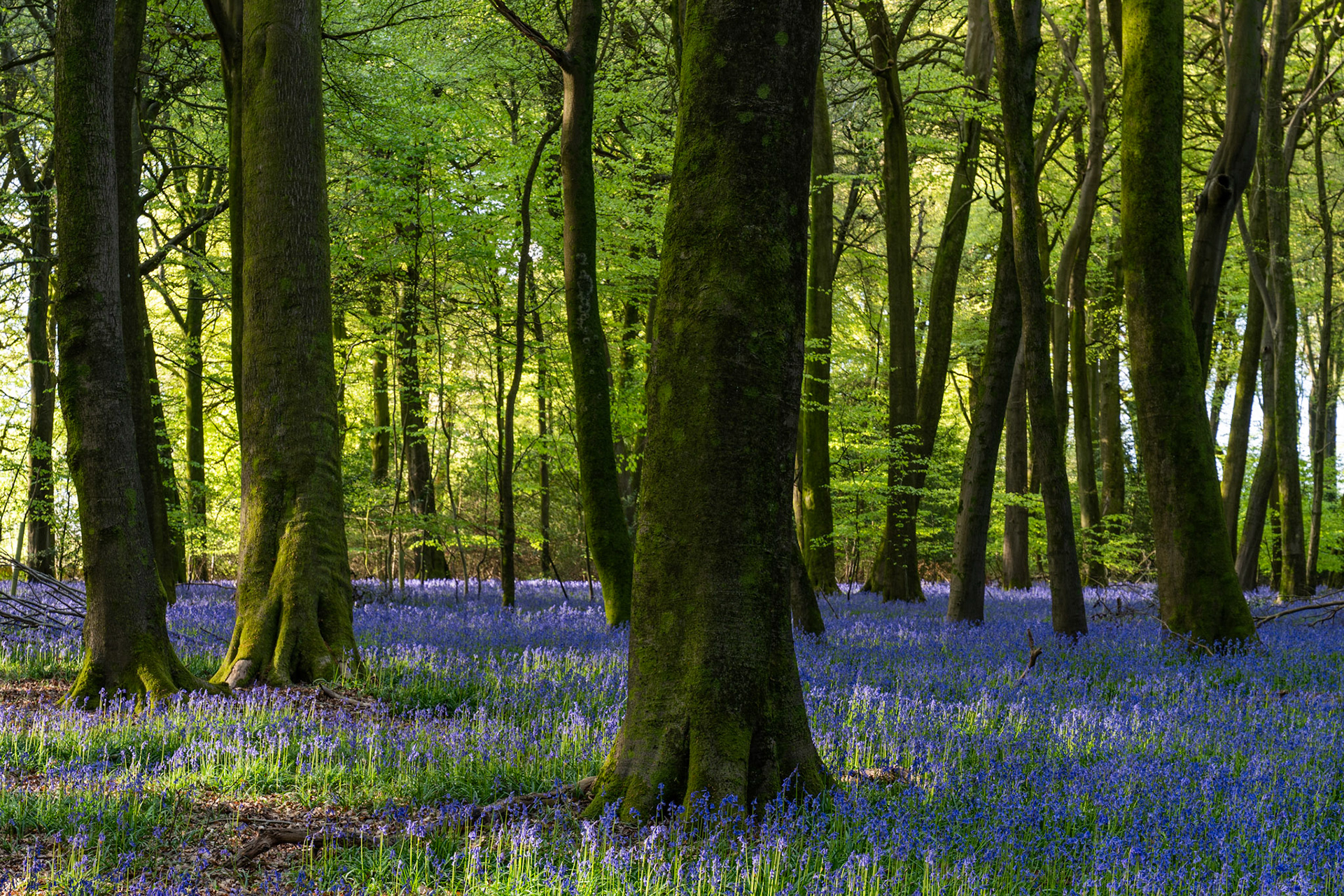
A beech woodland floor in the Chilterns, Oxfordshire, carpeted in native bluebells and photographed in the low raking light of an April dawn. The moss-covered trunks anchor the composition while back-lit canopy foliage creates depth through the stand. Light is clean and directional, lending the scene quiet luminosity without drama.
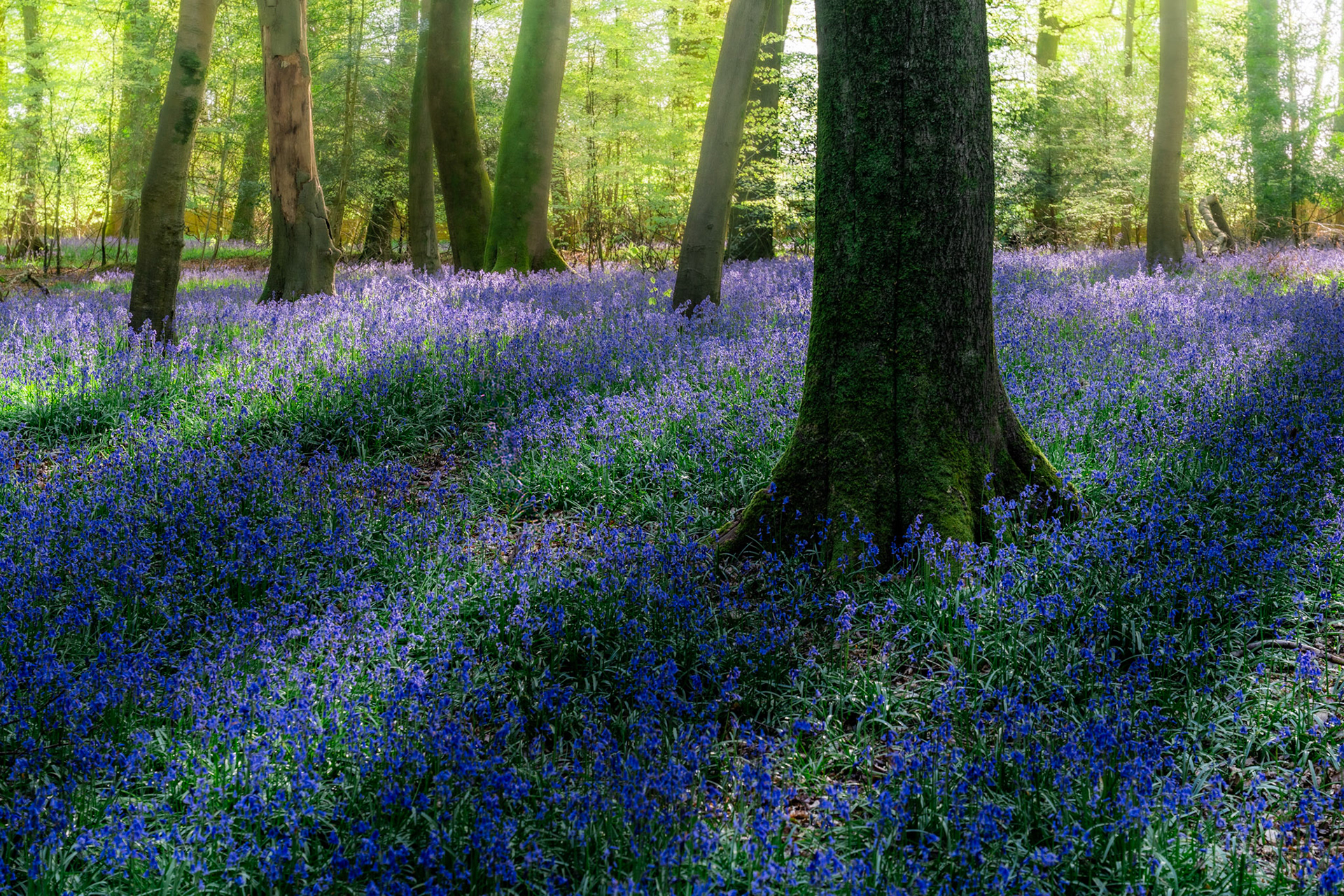
Native bluebells carpet the floor of a mature beech woodland in the Chilterns, Oxfordshire at dawn, their violet mass interrupted by the moss-clad base of a foreground trunk. Soft back-light filters through unfurling canopy, lending the mid-distance a luminous, almost hazy quality that reinforces the seasonal brevity of the spectacle.

An intentional camera movement exposure made in the Chilterns, Oxfordshire abstracts a bluebell-carpeted beech woodland into vertical streaks of violet and green. The technique dissolves individual stems and trunks into pure colour relationships, preserving the structural rhythm of the trees above the flower layer. Captured at dawn in late April, the image sits firmly in the ICM tradition of British spring woodland.
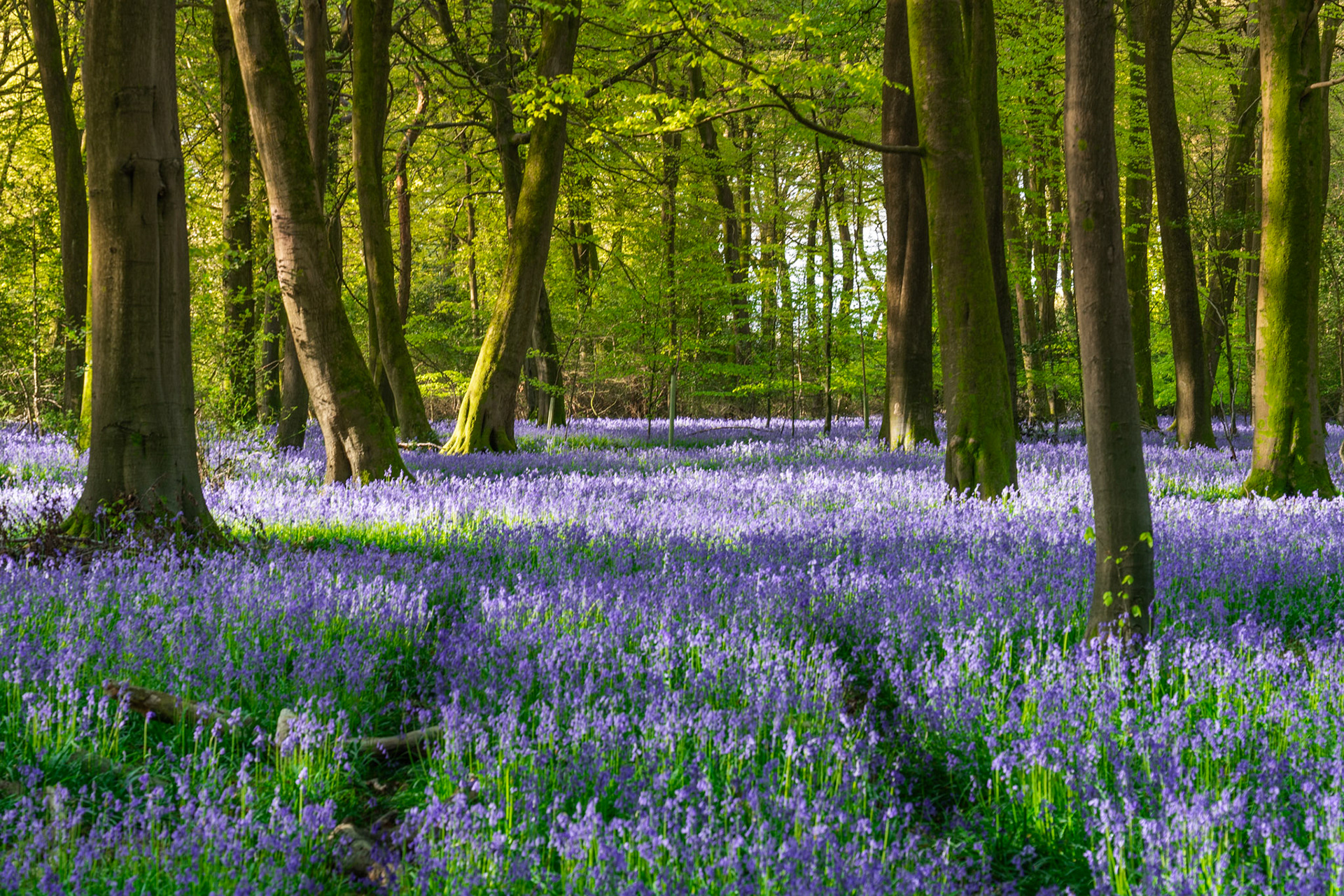
A carpet of native bluebells floods the floor of a deciduous beech woodland in the Chilterns, Oxfordshire, photographed at dawn in late April, the low raking light catching the moss-covered trunks and fresh canopy growth above. The depth of flower coverage and the recession of tree stems into the mid-distance give the scene quiet structural rhythm. No mist is present, but the early-morning quality of light lends a softness that restrains what might otherwise read as a saturated subject.
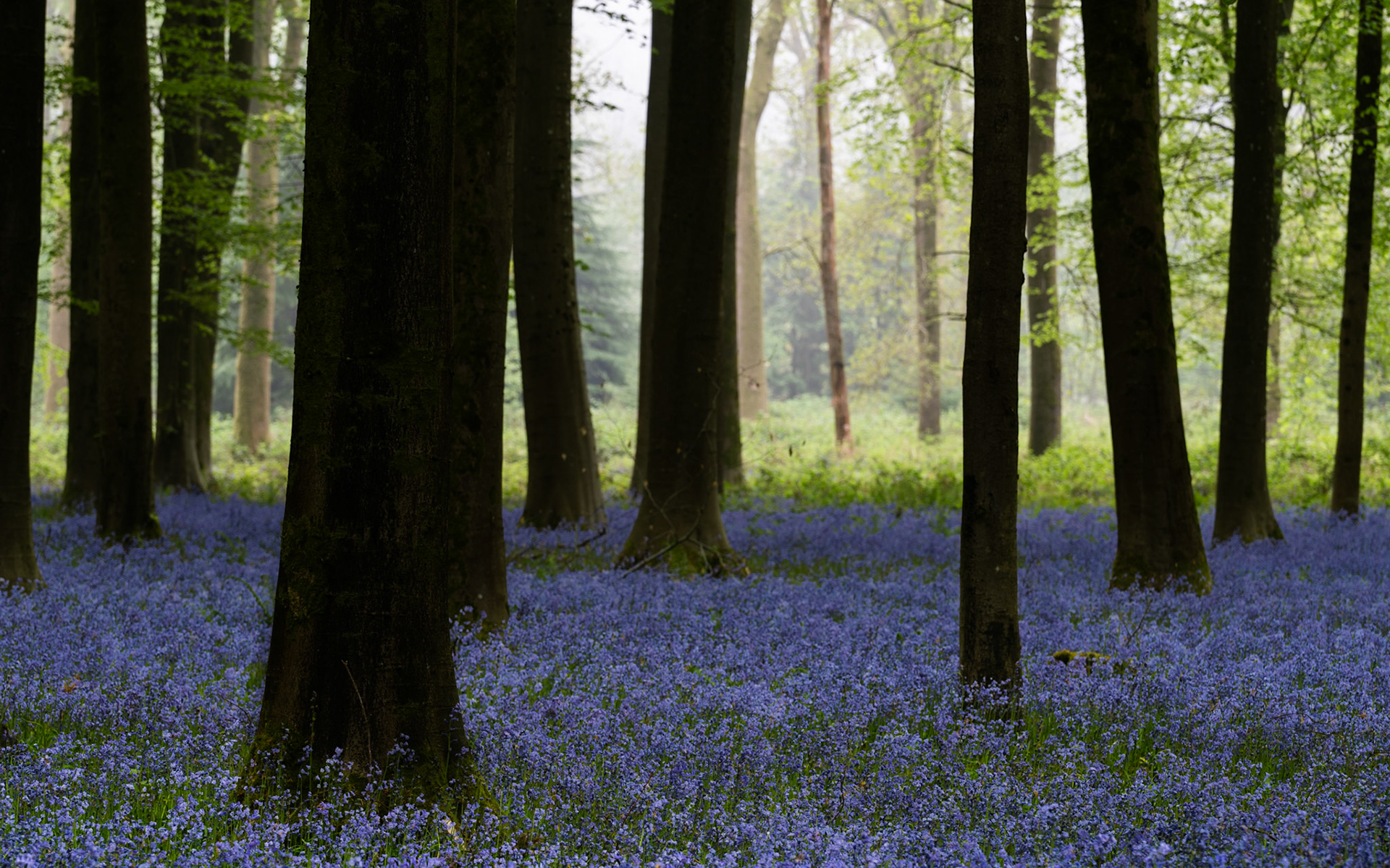
A carpet of bluebells spreads between mature beech trunks in Micheldever Wood, Hampshire, on a misty spring dawn, the soft diffused light dissolving the mid-ground into pale luminescence. Dark foreground trunks anchor the composition against the glowing depth of the wood beyond.
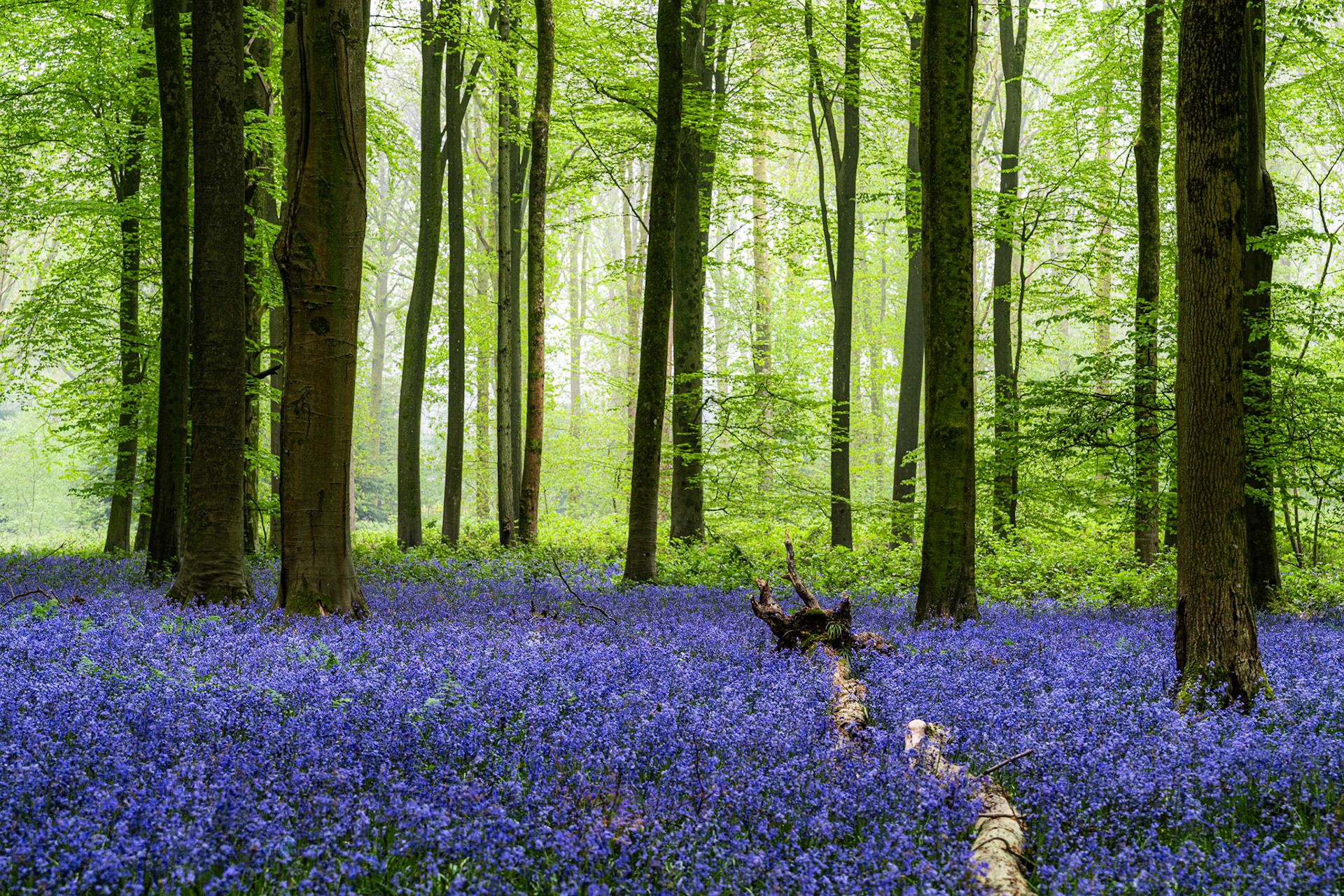
A dense carpet of bluebells covers the floor of a misty beech woodland at Micheldever Wood in Hampshire, the trees in fresh spring leaf. Soft diffused light and atmospheric haze dissolve the mid-ground trees, creating depth without drama. A fallen log anchors the foreground, breaking the uniformity of the floral canopy.

A temperature inversion buries the Thames Valley beneath a flat sea of cloud at dusk, the gibbous moon suspended in a sky grading from powder blue through rose to lavender. Shot from elevation above Abingdon-on-Thames, the compression between cloud ceiling and clear upper atmosphere creates a horizon line of unusual stillness. The near-total absence of hard edges gives the frame a quality closer to watercolour than photography.
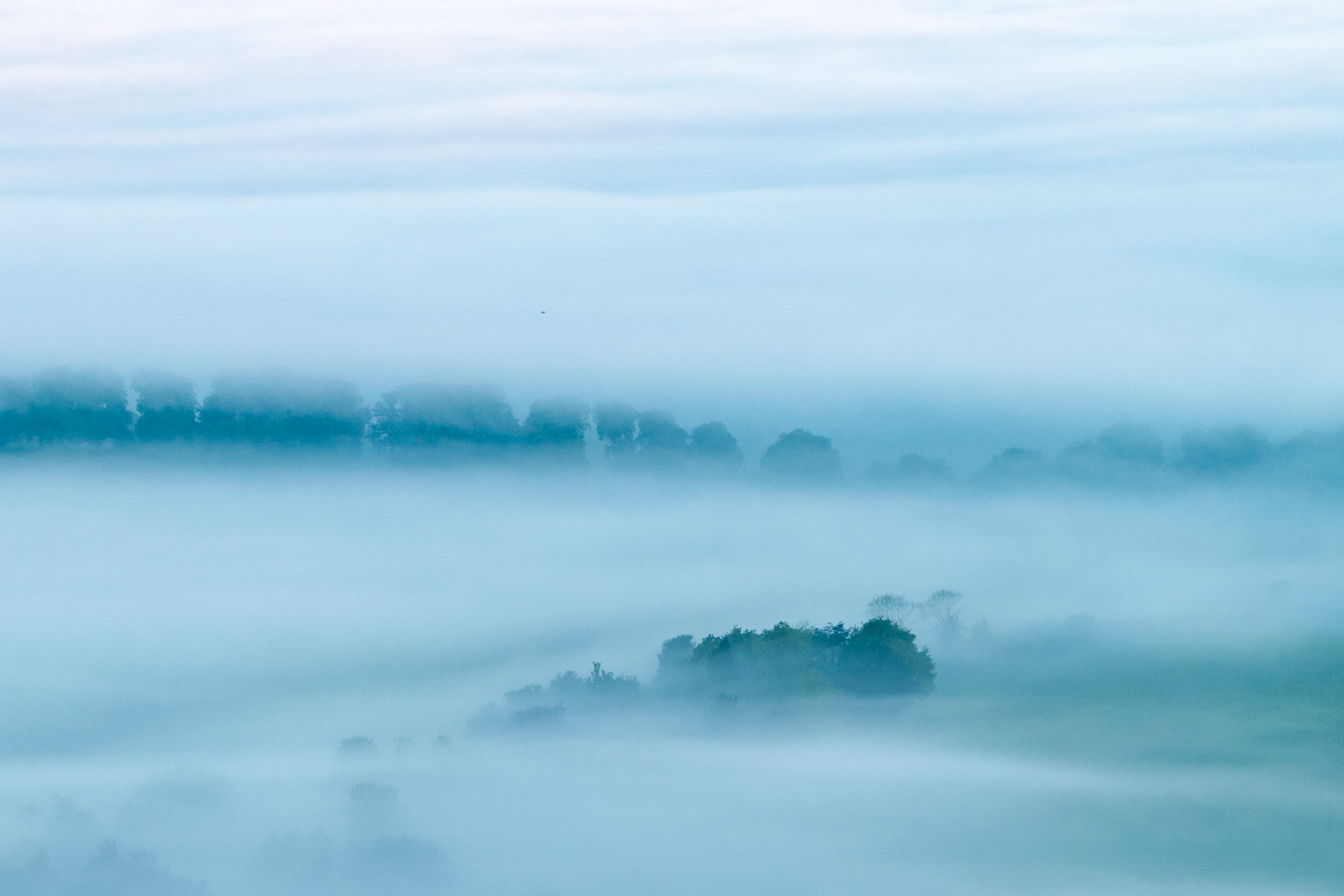
A temperature inversion settles over the Thames Valley near Henley, reducing the lowland to layered planes of pale blue fog. Isolated tree canopies emerge as dark islands, the furthest treeline fading almost entirely into the overcast sky. The graduated recession of tones gives the scene an almost monochromatic, painterly quietness.
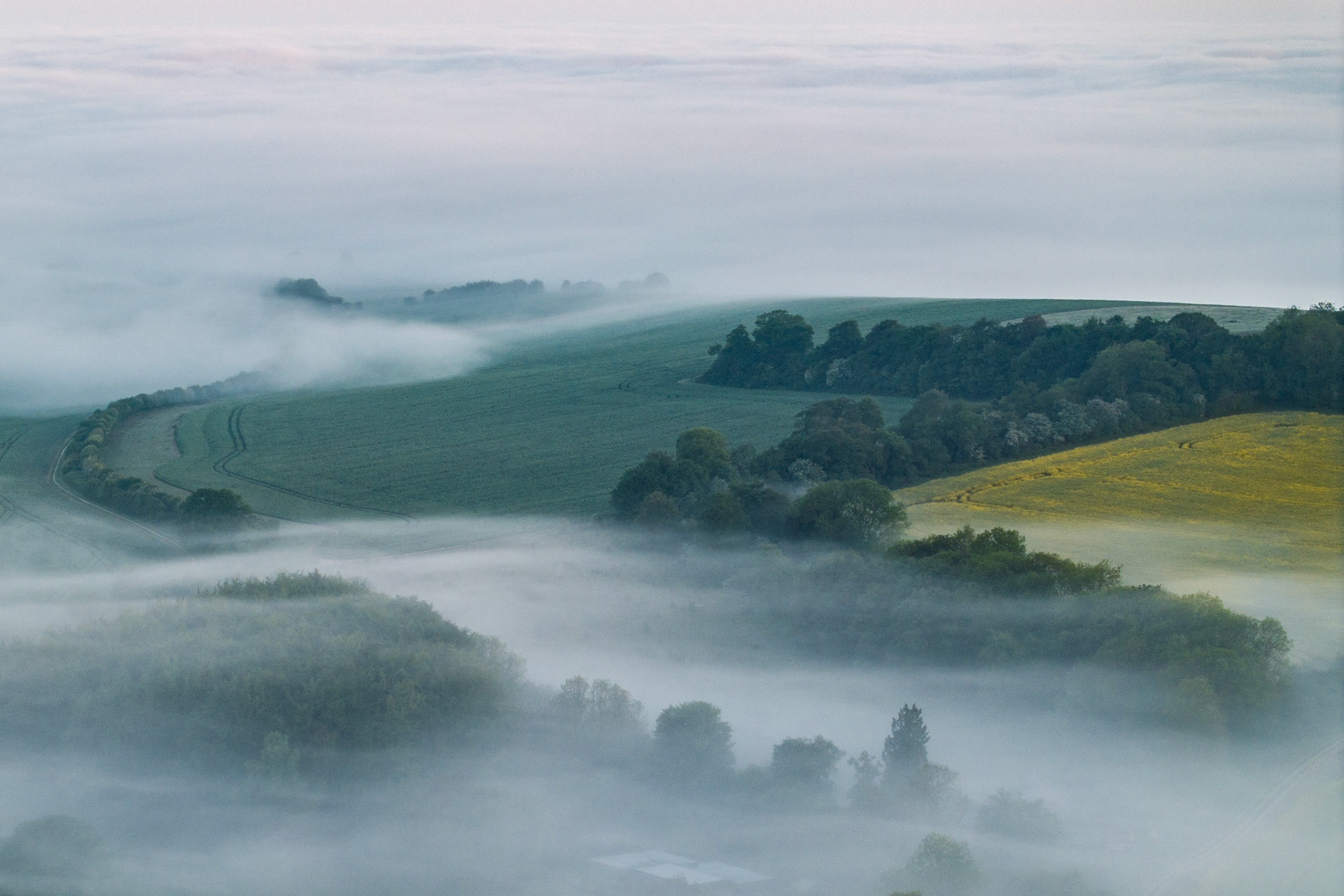
A temperature inversion fills the valley floors of the Chiltern scarp with dense mist, leaving the upper downland clear and green. Tree canopies emerge as islands from the fog, while a curving farm track traces the hillside above the cloud. The rapeseed yellow on the right flank anchors the muted palette with a note of early season colour.
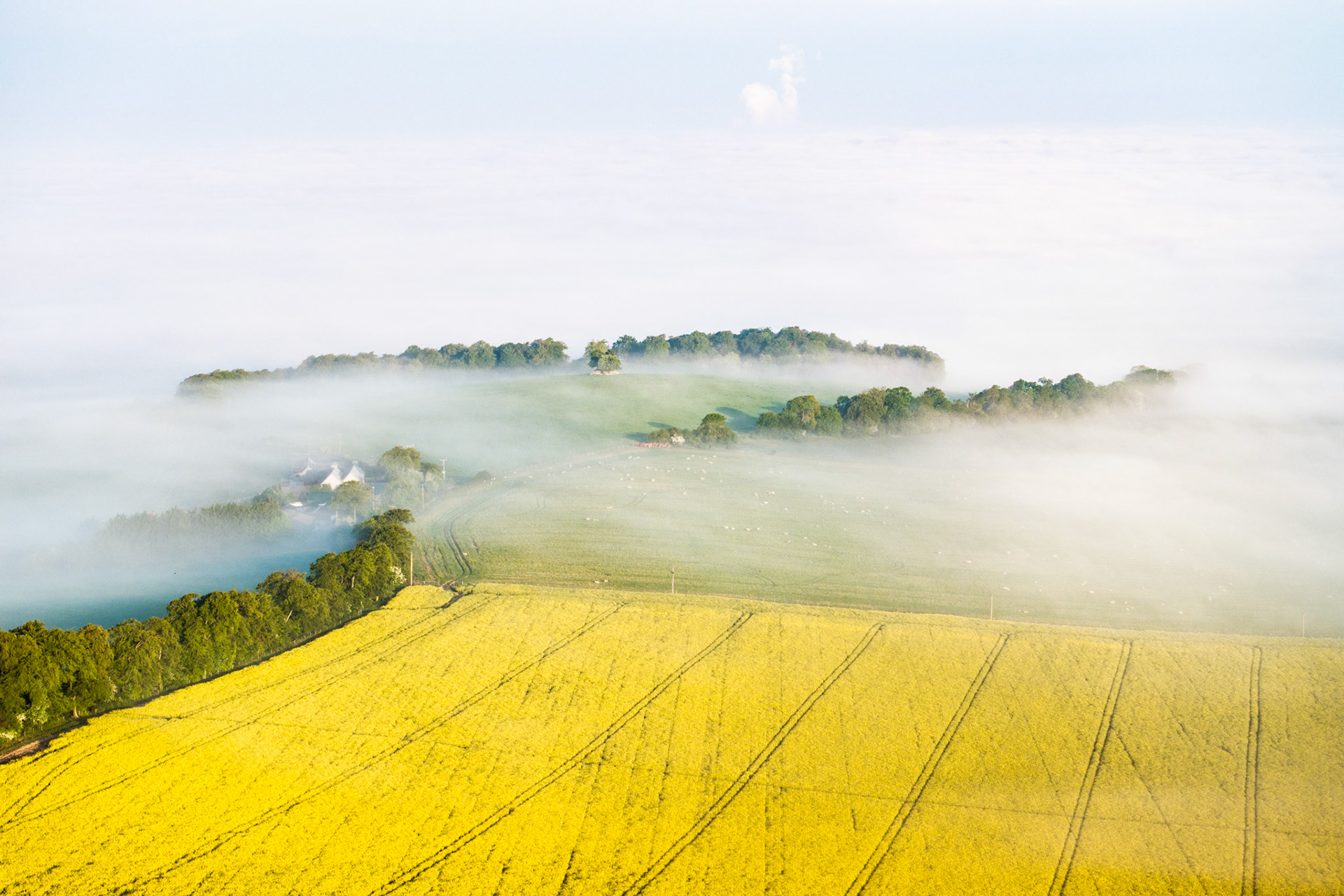
A low temperature inversion pools fog through the valleys around Henley-on-Thames, leaving a copse of mature broadleaf trees stranded above the white. A rapeseed field in full spring bloom anchors the foreground, its tractor lines drawing the eye toward the obscured farmstead and grazing livestock beyond.
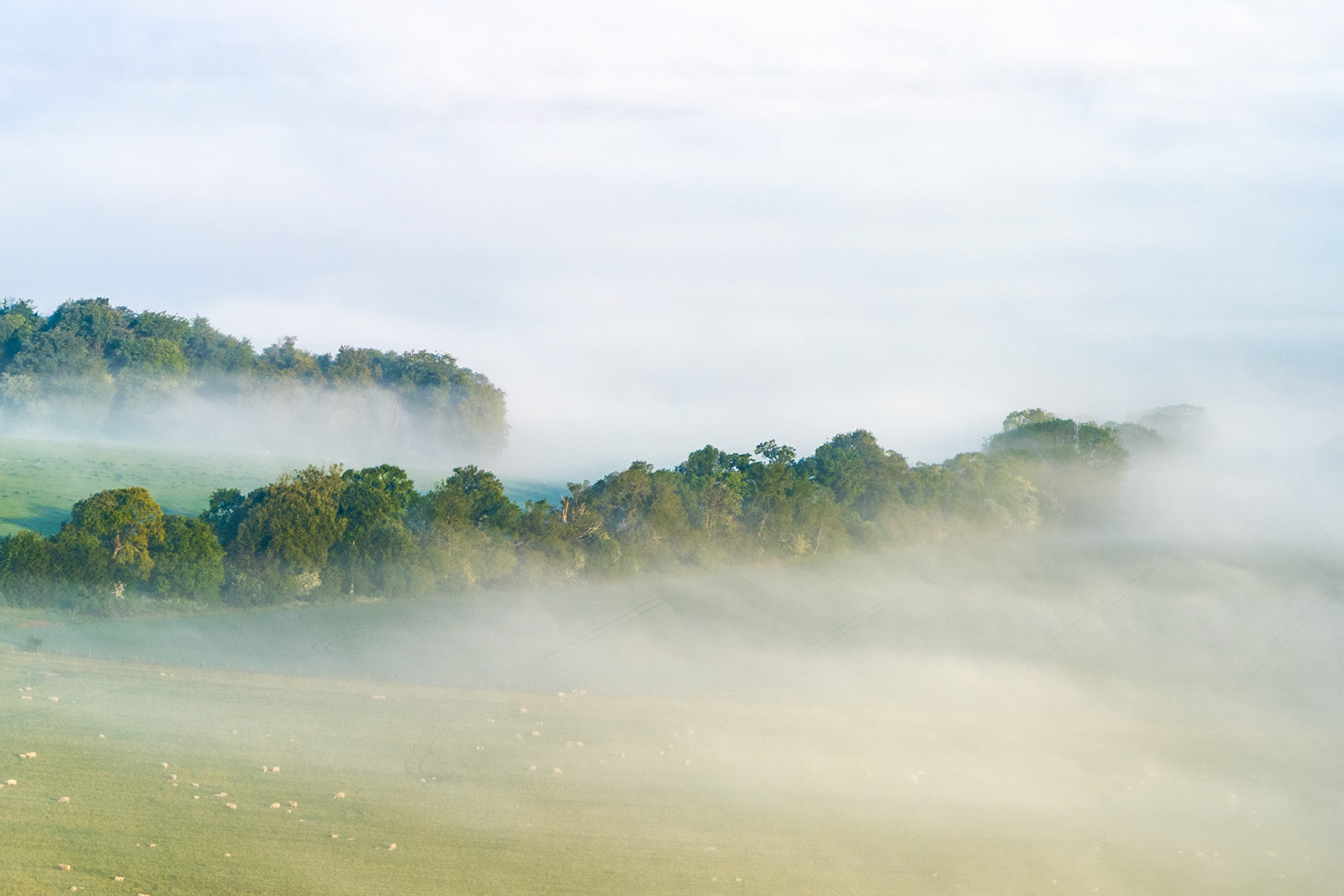
A band of valley fog pools across chalk downland near Henley-on-Thames, half-submerging a treeline of mature oaks and reducing the grazing sheep below to pale flecks. Captured from altitude in early afternoon as a residual temperature inversion holds the mist low against the hill slope. The layering of fog, canopy and overcast sky compresses the scene into quiet horizontal planes.
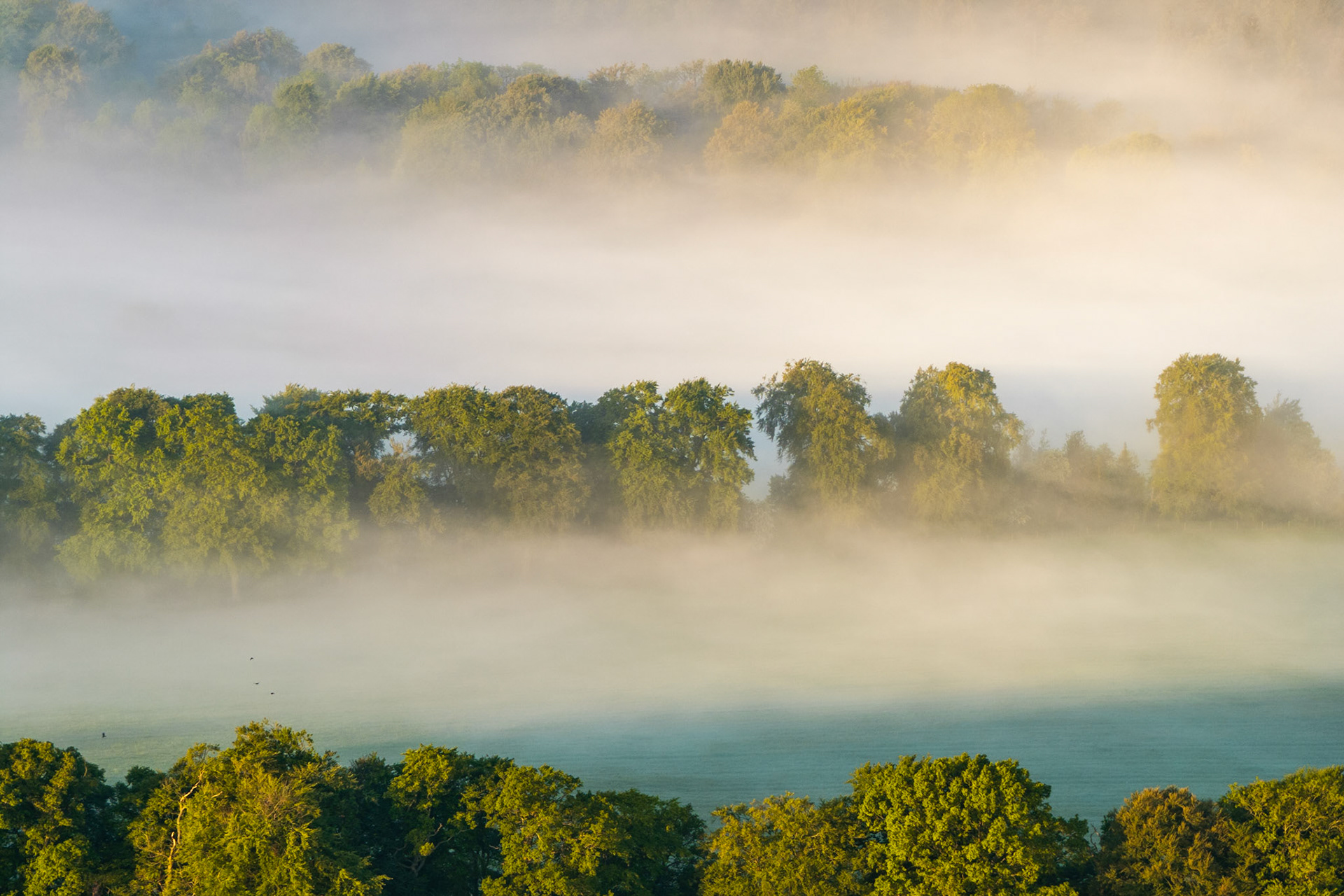
A temperature inversion settles over the Thames Valley near Henley, stratifying the morning mist into distinct bands between successive rows of oak and mixed woodland. Low sun from the east catches the upper canopy, separating warm gold from the cool blue-grey air pooled in the valley floor. The compression of the drone viewpoint collapses depth into near-abstract horizontal registers.
A nadir aerial view over a flowering oilseed rape field near Wallingford, Oxfordshire, in early May. Tractor tramlines score the yellow canopy in parallel diagonals, bisected by a single vertical service track. The flat midday light flattens the texture, reducing the field to near-monochromatic pattern.
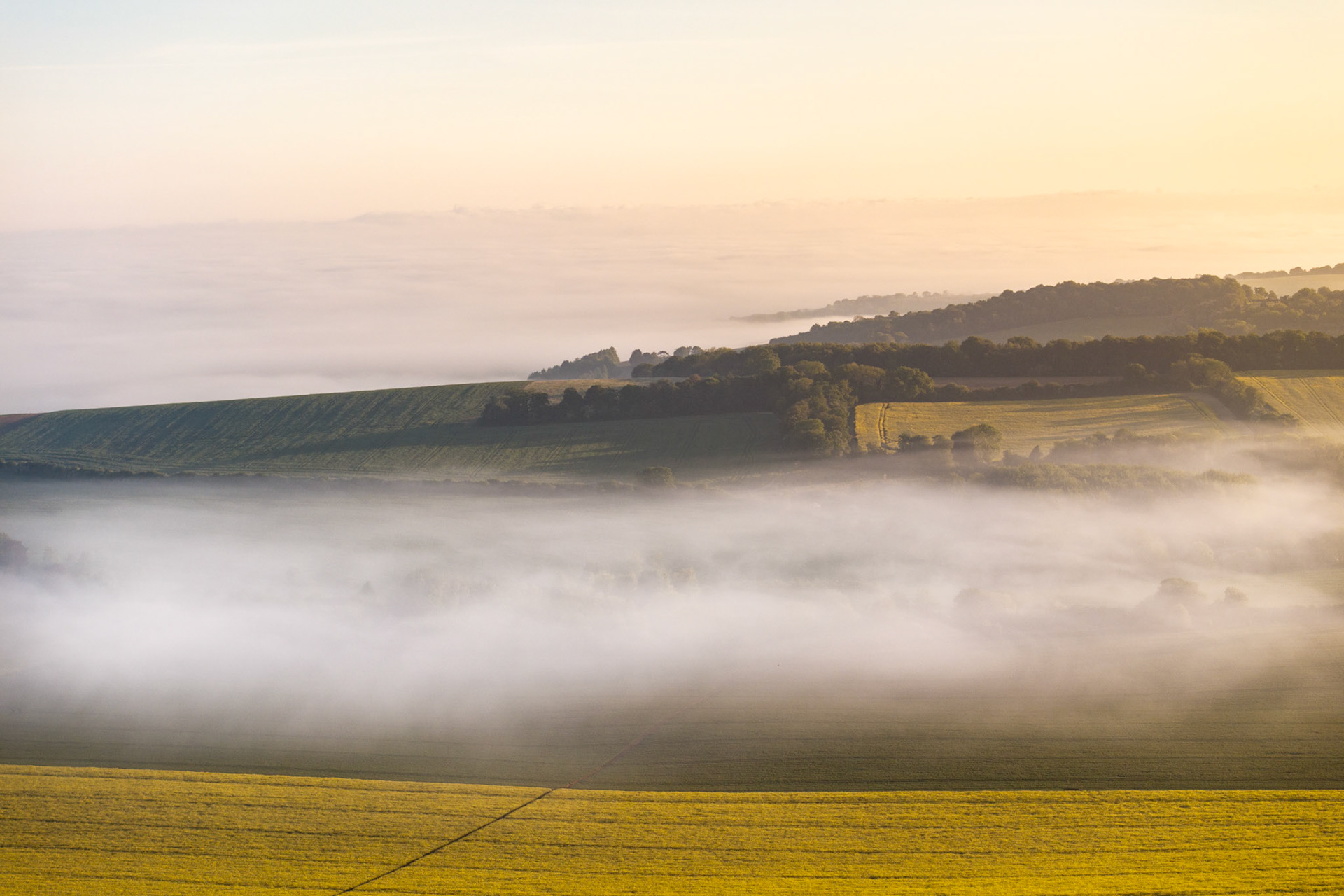
A temperature inversion fills the valley below the Chiltern escarpment near Henley-on-Thames, the fog pooling in horizontal bands while the higher ground—arable fields, mixed woodland, and a distant treeline—emerges in early morning warmth. The layering of mist, hill, and pale sky creates a compressed, almost tonal recession that rewards careful looking. Captured from altitude, the aerial perspective clarifies the topography in a way ground-level shooting could not.
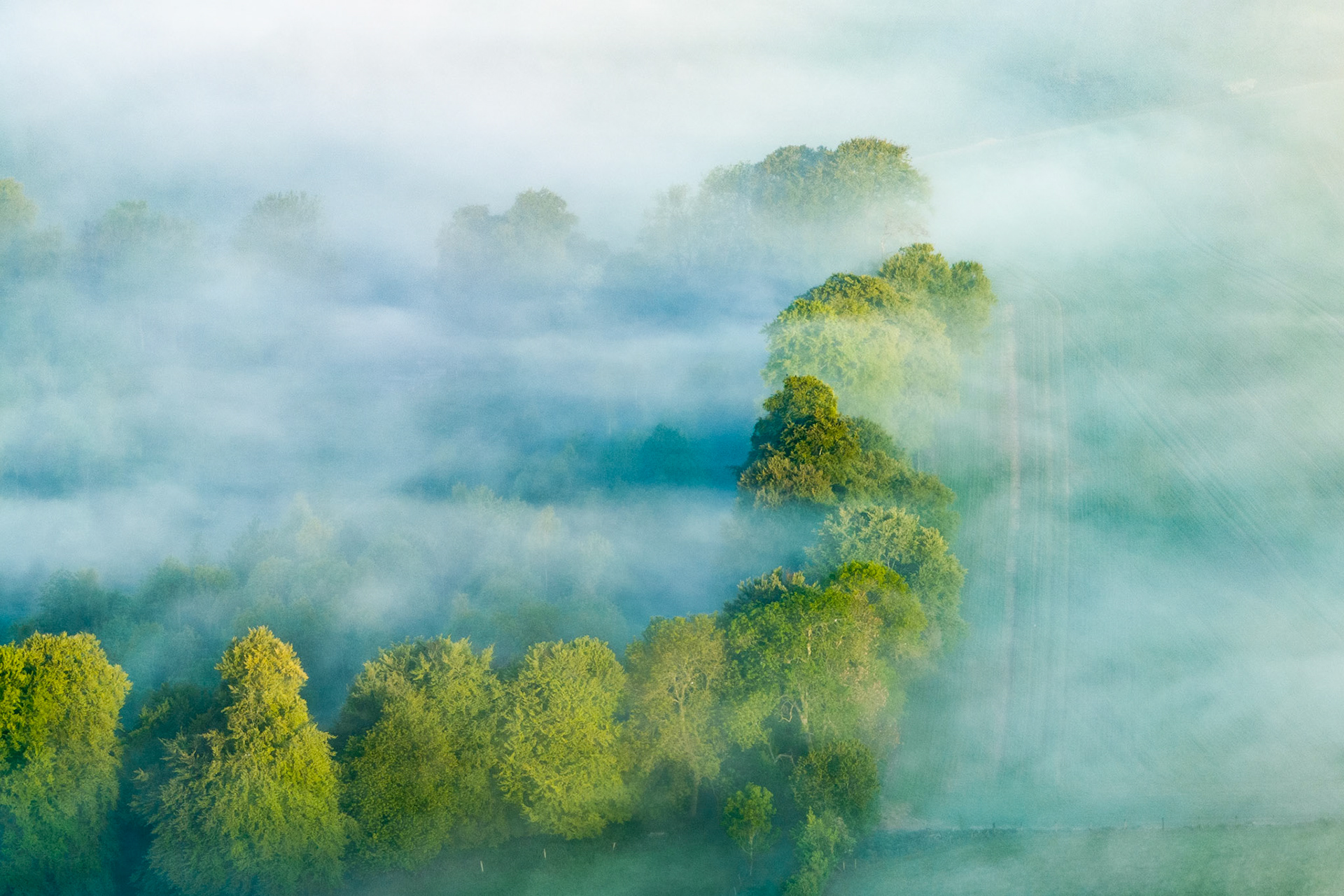
A temperature inversion settles over mixed deciduous woodland near Henley-on-Thames, the upper canopies of oak and ash breaking the mist layer in raking early-season light. The aerial vantage compresses depth into alternating bands of green and pale vapour, giving the scene an almost topographic quality. Shot in early May, the fresh foliage retains its acid-green translucency before the summer canopy densifies.