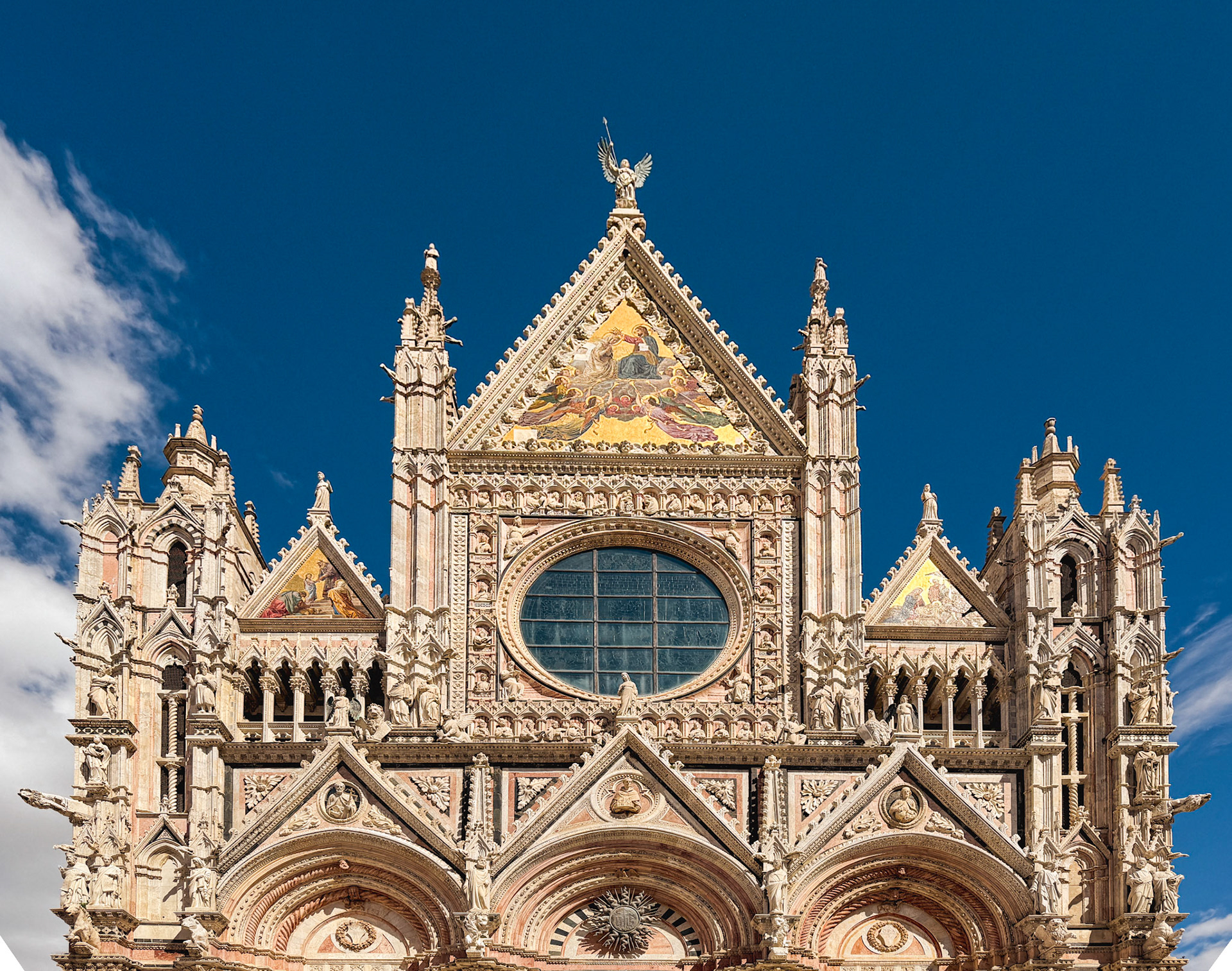
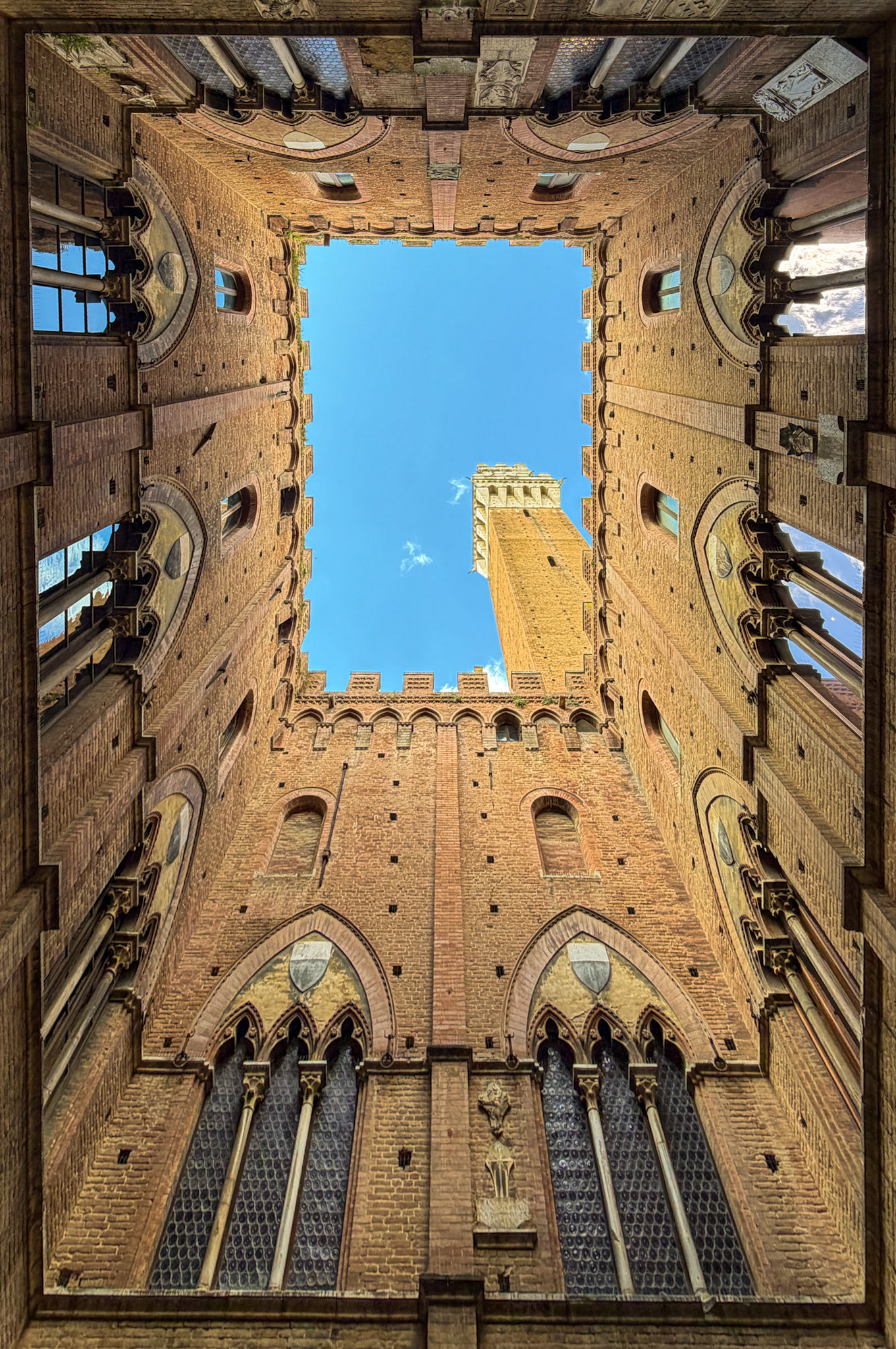
Looking straight up from the inner courtyard of the Palazzo Pubblico, Siena, the Torre del Mangia rises through a rectangular opening of medieval brickwork into a clear September sky. The symmetry of the Gothic arcade below anchors the composition, compressing centuries of civic architecture into a single vertical frame.
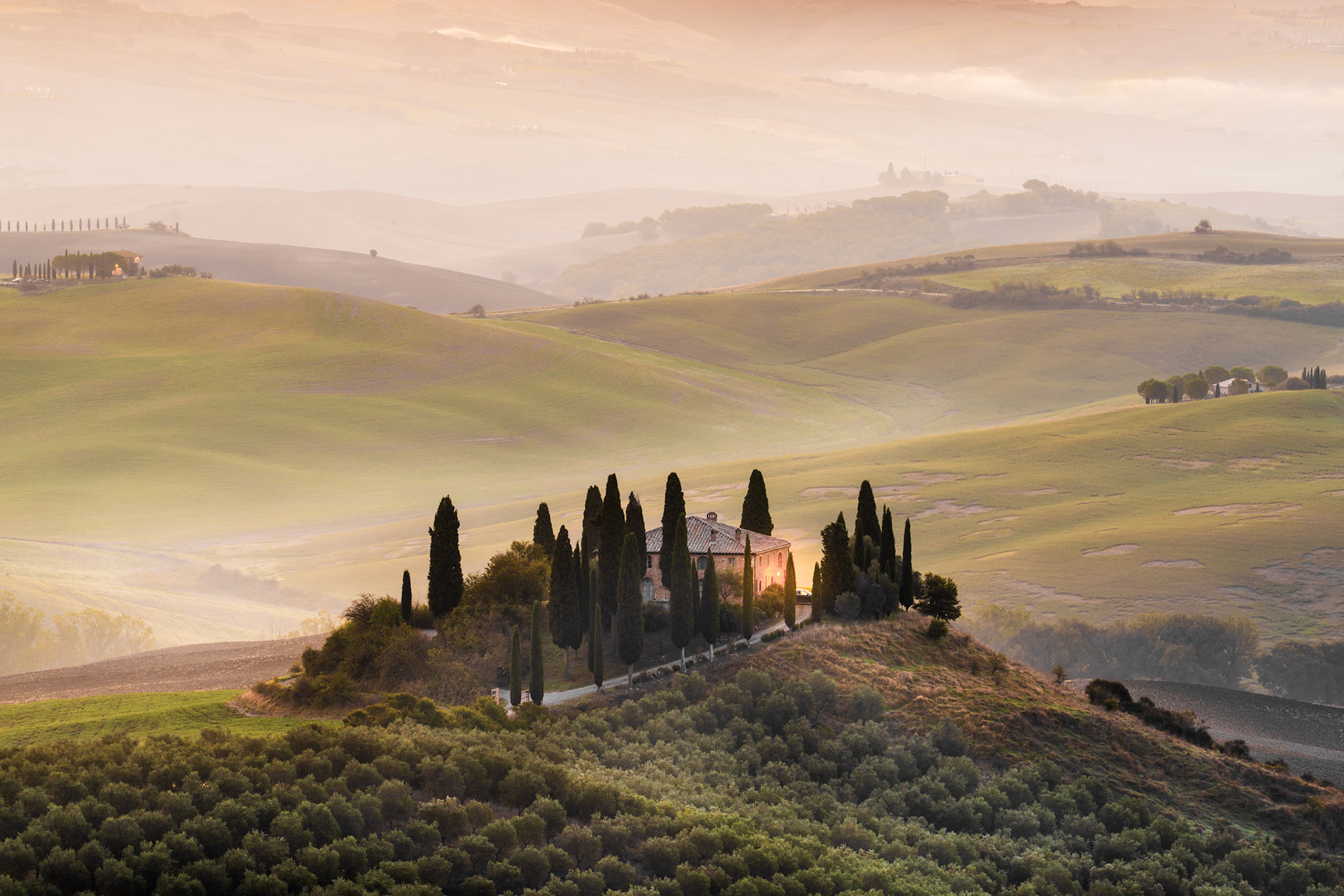
A stone farmhouse surrounded by Italian cypress trees sits on an isolated hilltop as dawn mist softens the rolling terrain into receding planes of pale green and ochre. Warm light catches the farmstead's facade while the wider valley remains submerged in haze, creating a strong tension between the anchored foreground and the dissolving middle distance. The layered topography and atmospheric depth suggest the Val d'Orcia region of Tuscany in early autumn.
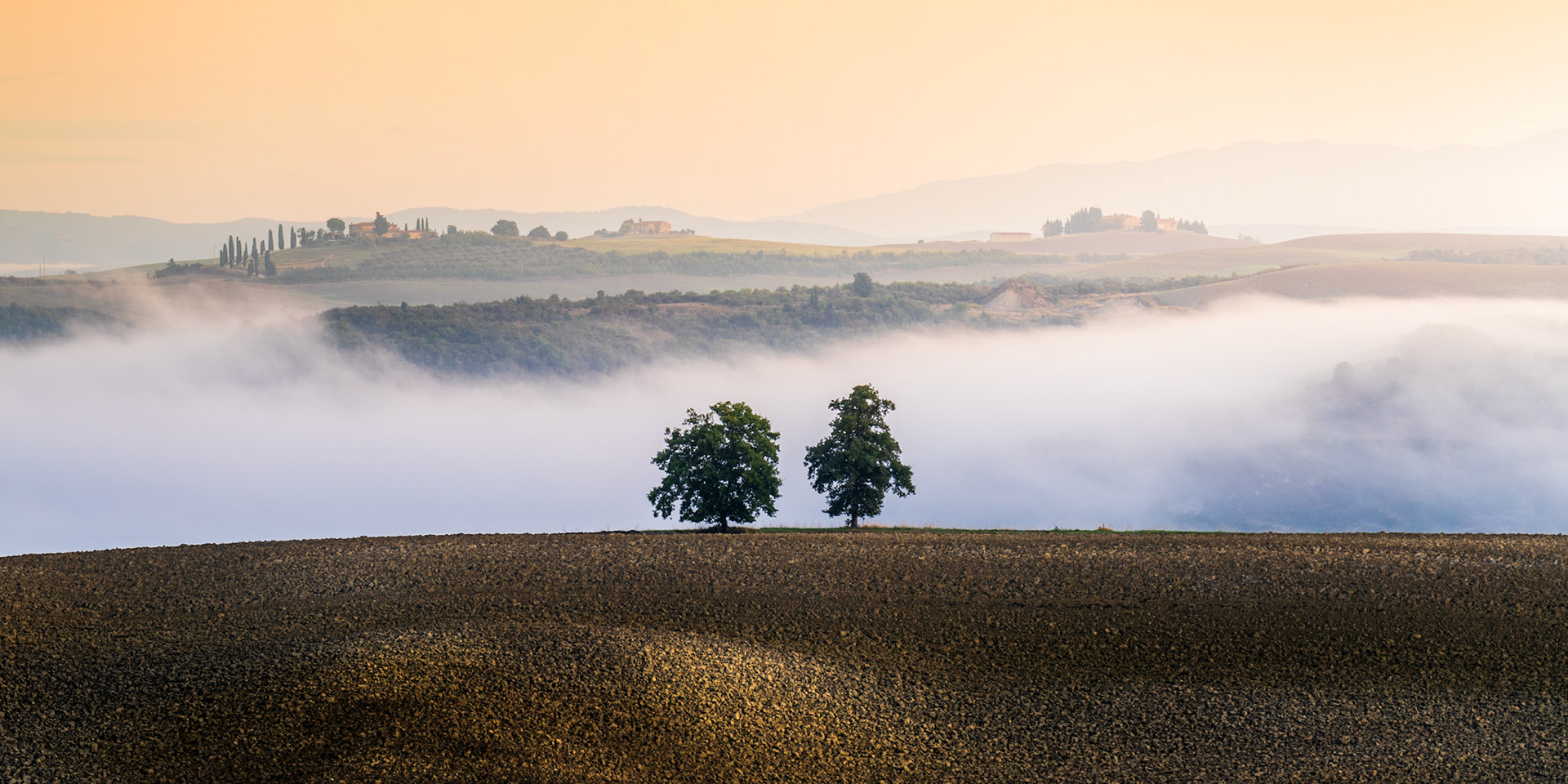
A temperature inversion fills the valley floor with low cloud at first light, isolating two broadleaf trees on a ploughed ridge. Cypress-lined farmsteads emerge from the mist on the middle hill, placing this firmly in the Tuscan landscape of the Val d'Orcia. The panoramic frame compresses four distinct layers of depth — tilled earth, cloud, wooded hillside, and a peach-toned dawn sky — into a composition of severe economy.
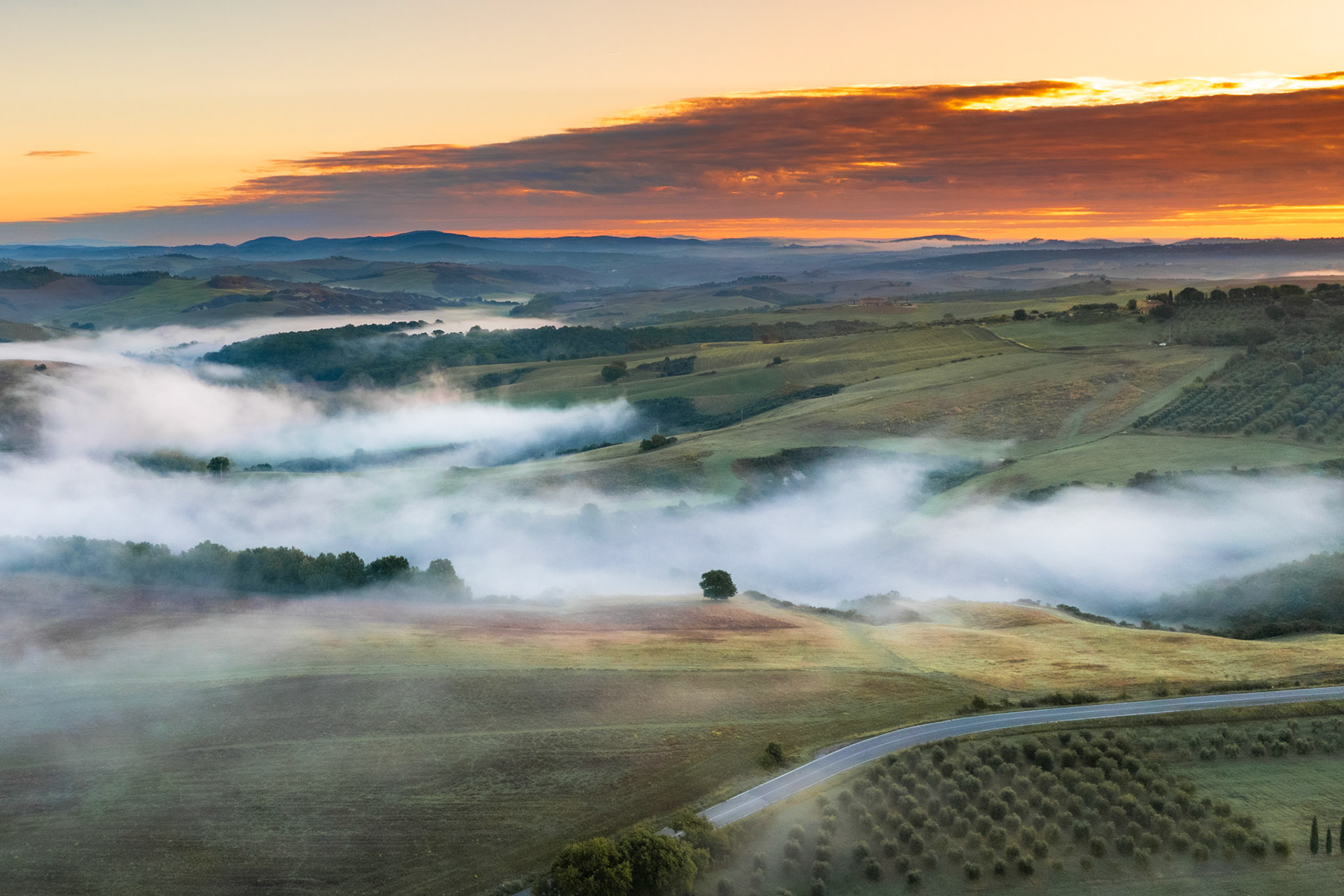
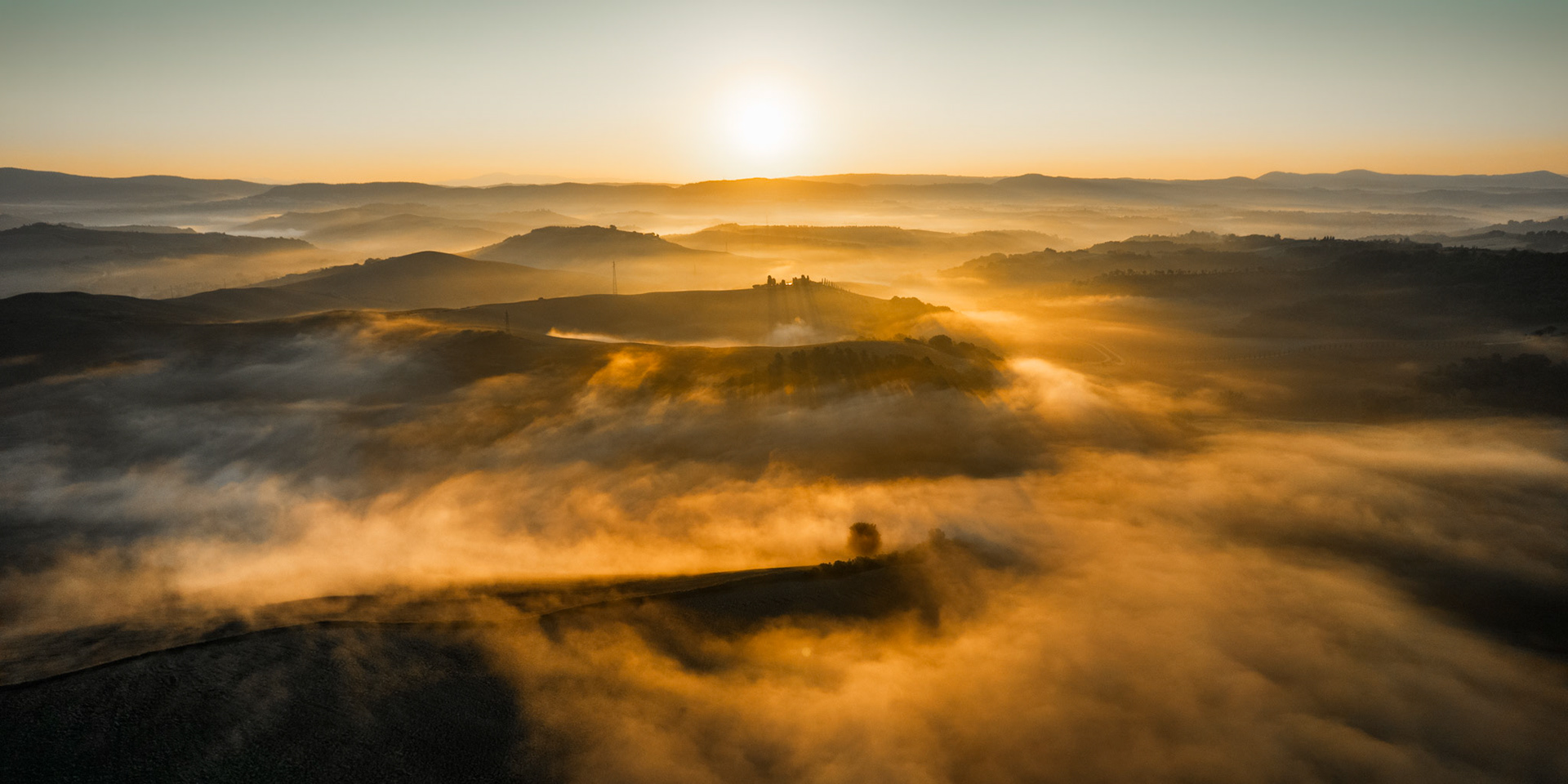
Ground-level inversions pool between the rolling hills of the Val d'Orcia at dawn, the mist threading between tree lines and farmland as the sky ignites above the distant Apennine ridge. Shot from altitude, the layered recession of fog, hill and cloud gives the scene its depth. Autumn colour is still emerging in the canopy below.
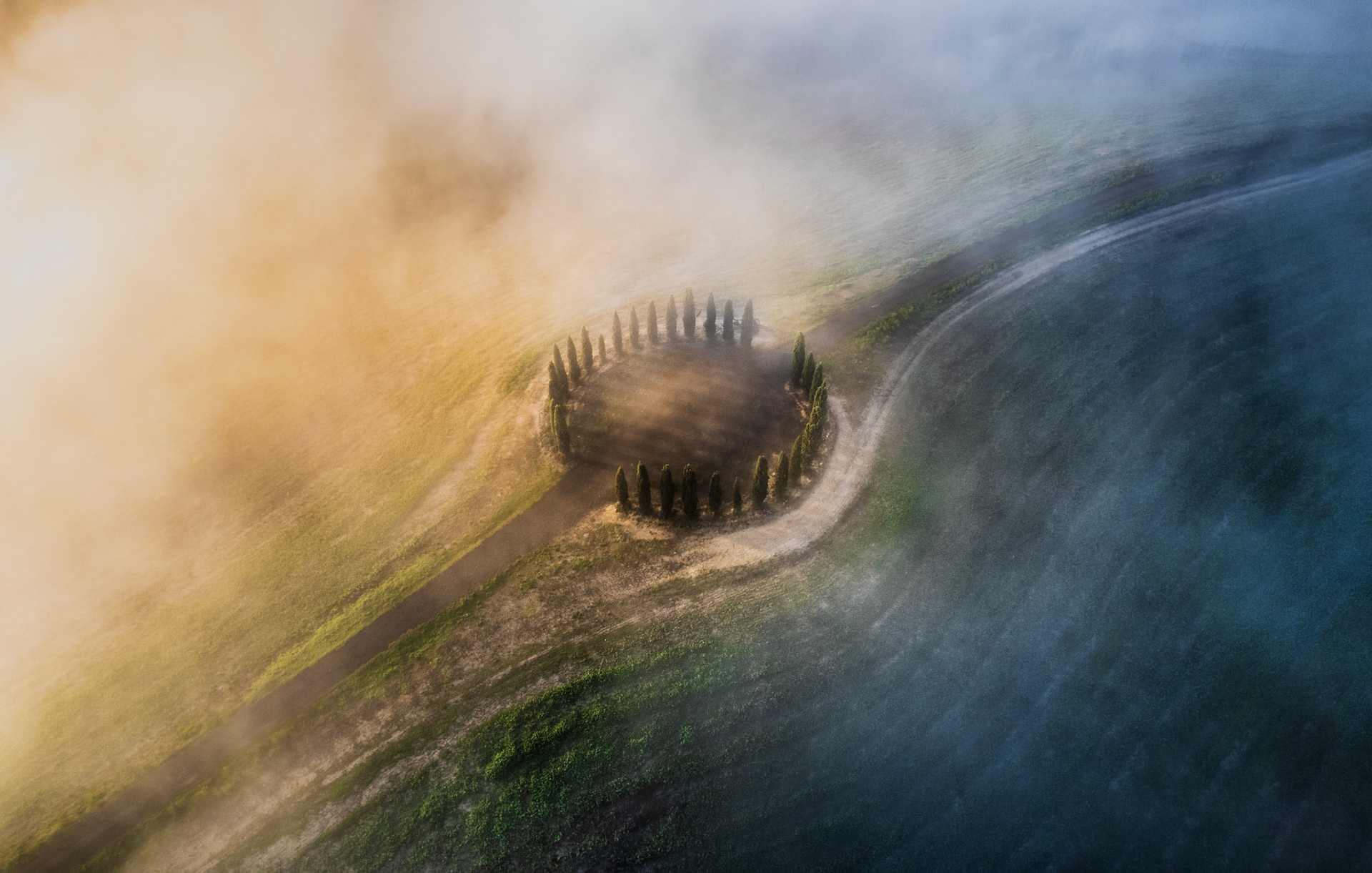
A ring of Italian cypress trees emerges from breaking fog above the Val d'Orcia, Tuscany, at dawn. The collision of warm amber light from the west and cool shadow to the east bisects the frame, reducing the encircling driveway and ploughed fields to graphic form. Captured from altitude as the inversion layer momentarily parted, the composition transforms a familiar agricultural landmark into something close to pure abstraction.
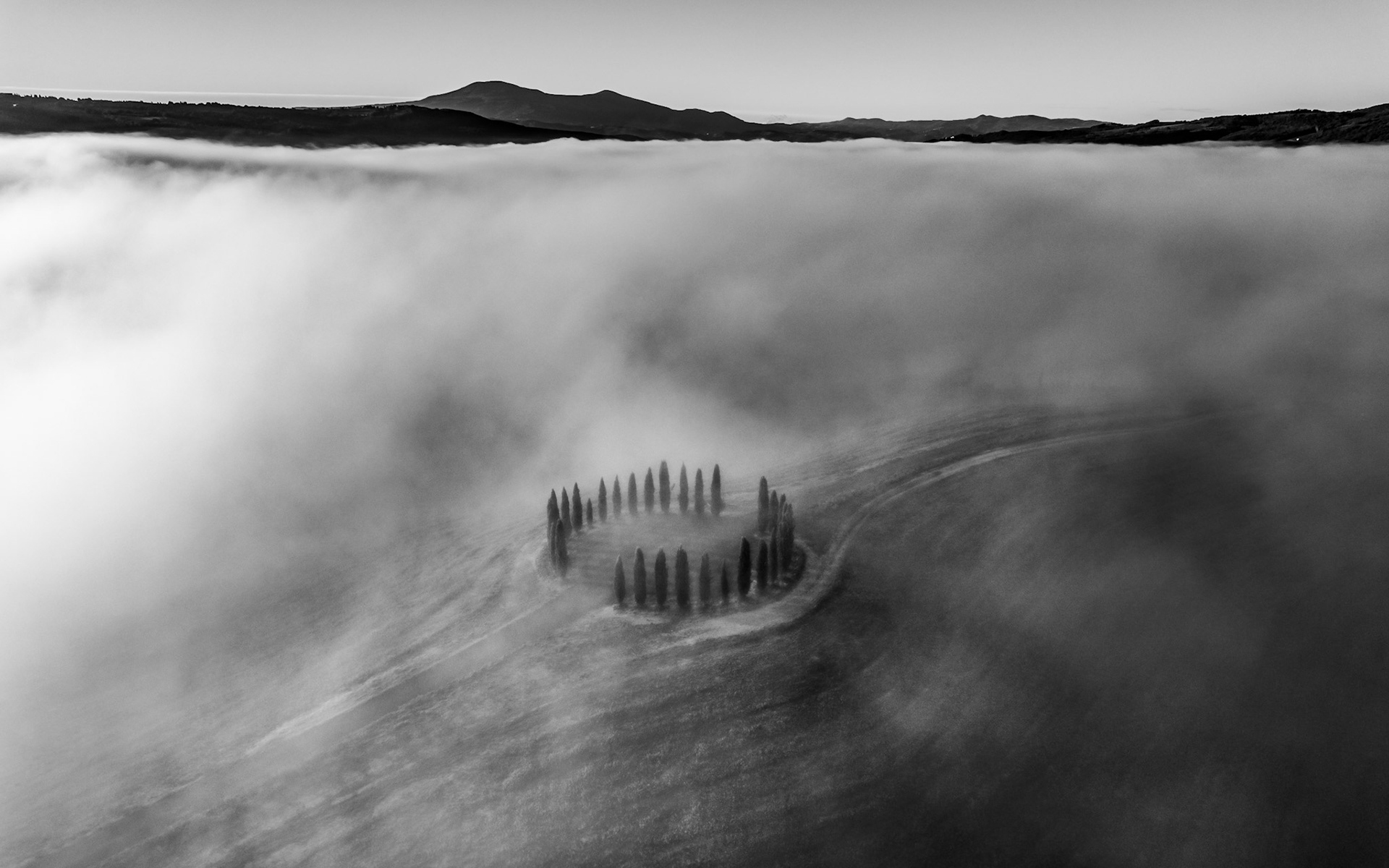
A ring of cypress trees emerges from a valley fog inversion above San Quirico d'Orcia, the circular grove reduced to a near-abstract island adrift in white. A winding track curves around its base before disappearing into the mist, while the Tuscan hills hold the fog's upper boundary in the far distance. The monochrome conversion strips the scene to form, tone, and stillness.
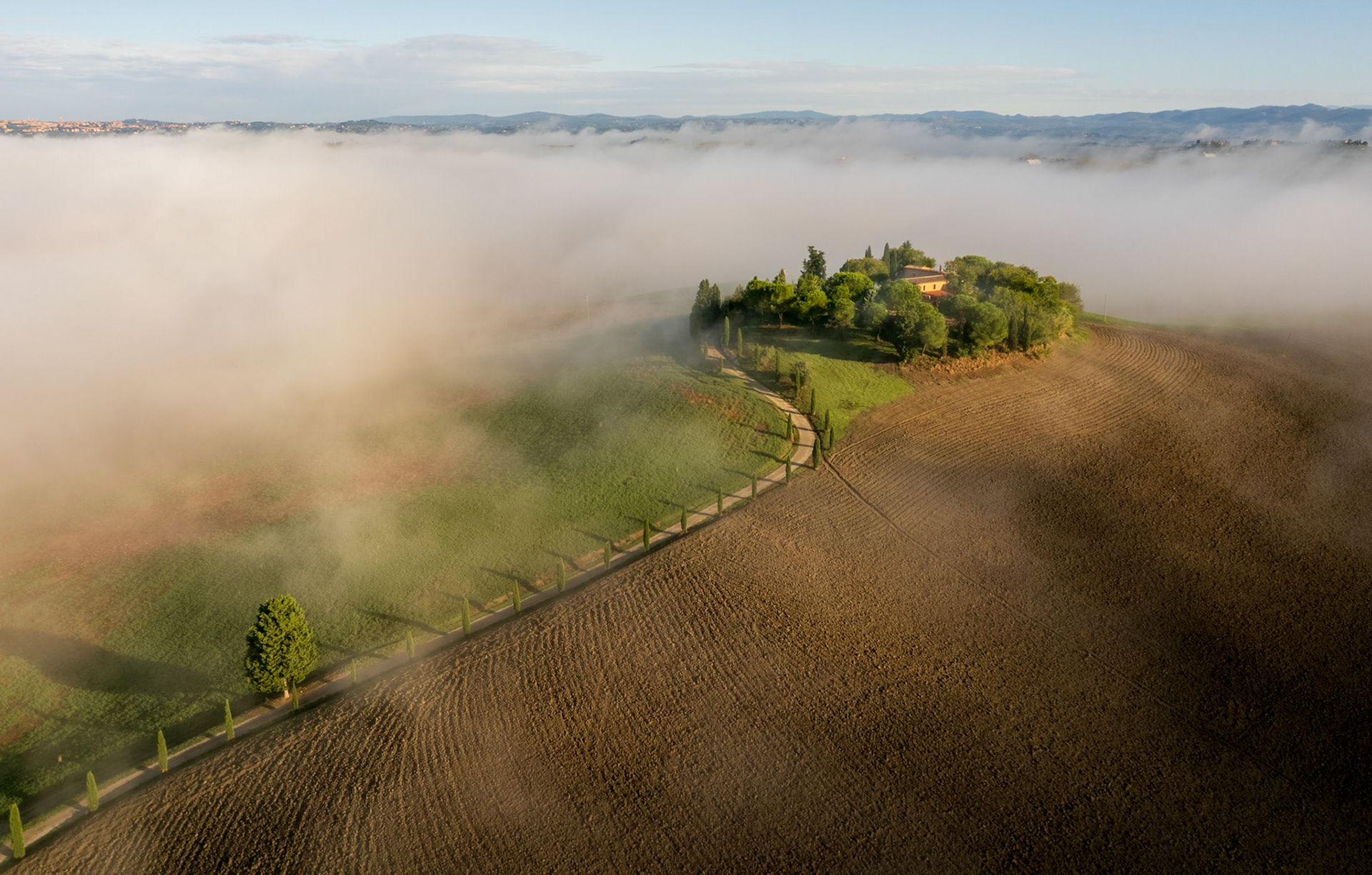
A Tuscan farmstead crowns a low hill above the Val d'Arbia, its cypress-lined avenue emerging from a shallow fog inversion that erases the valley floor. Shot from altitude in early-morning light, the ploughed field's parallel furrows draw the eye toward the hilltop grove, the mist lending the isolated estate the quality of something adrift. Captured near Monteroni d'Arbia in late September at the point where dawn warmth begins to thin the overnight fog.
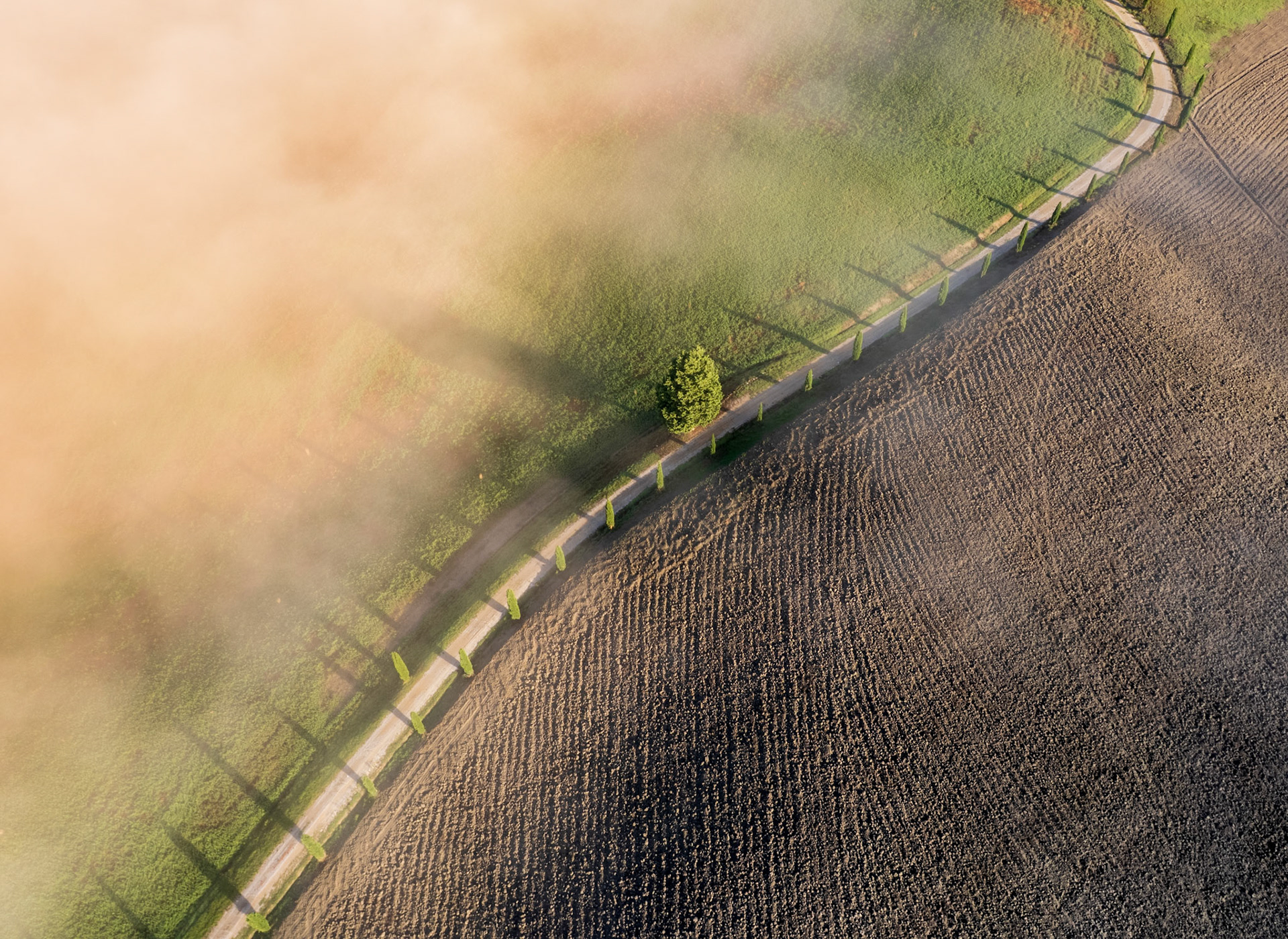
A cypress-lined farm road curves through contrasting fields near Monteroni d'Arbia, Tuscany, as low autumn mist burns off under early morning light. The diagonal road bisects ploughed earth and green pasture, while a solitary broader tree anchors the composition at mid-frame. Long shadows cast by the cypresses reveal raking light just above the horizon.
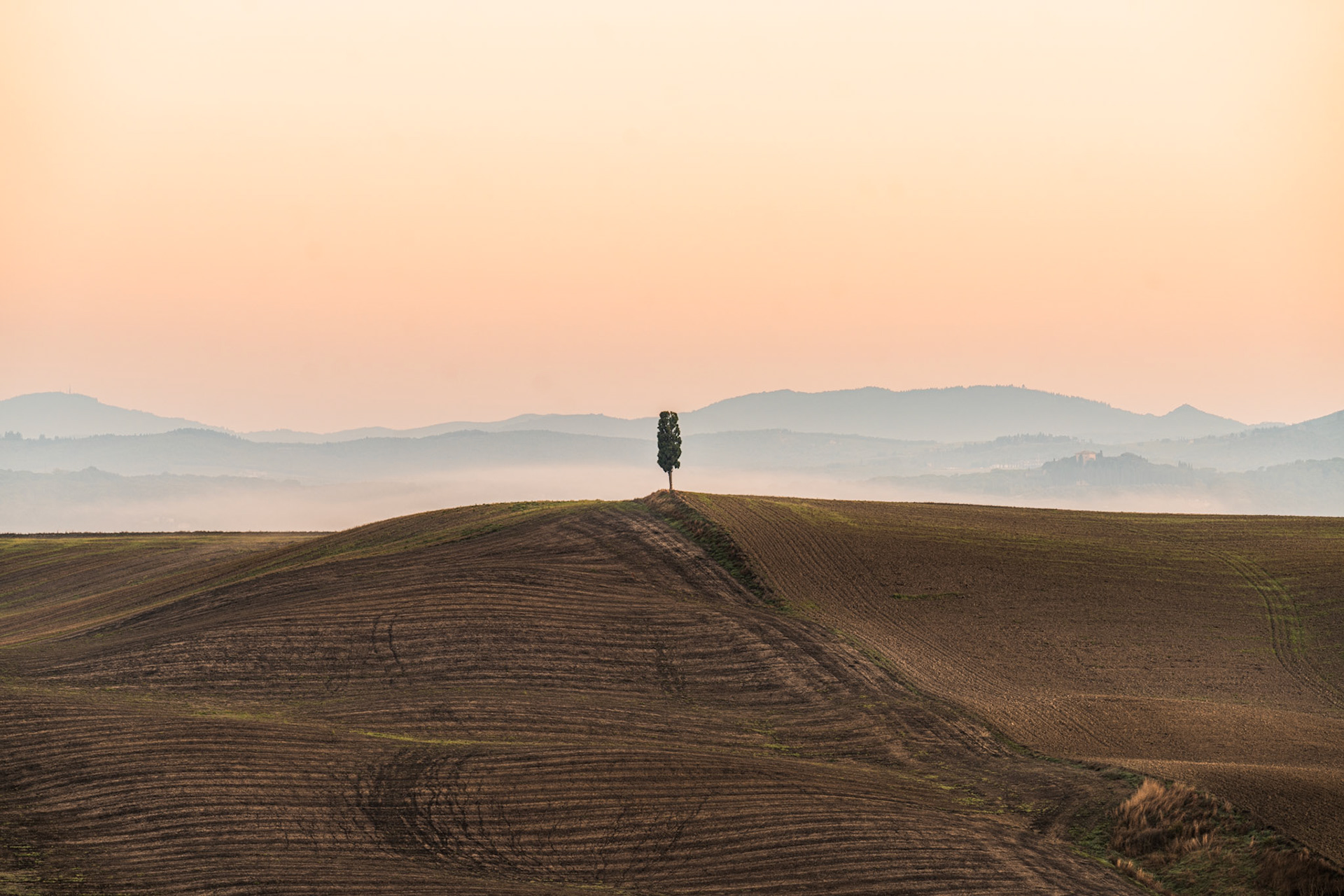
A solitary cypress stands on the crest of a ploughed hill, silhouetted against layered valley mist and a pale apricot sky. Receding ridgelines dissolve into the haze, compressing the middle distance into a sequence of tonal planes. The furrow lines of the foreground field draw the eye upward to the single vertical form at the skyline.
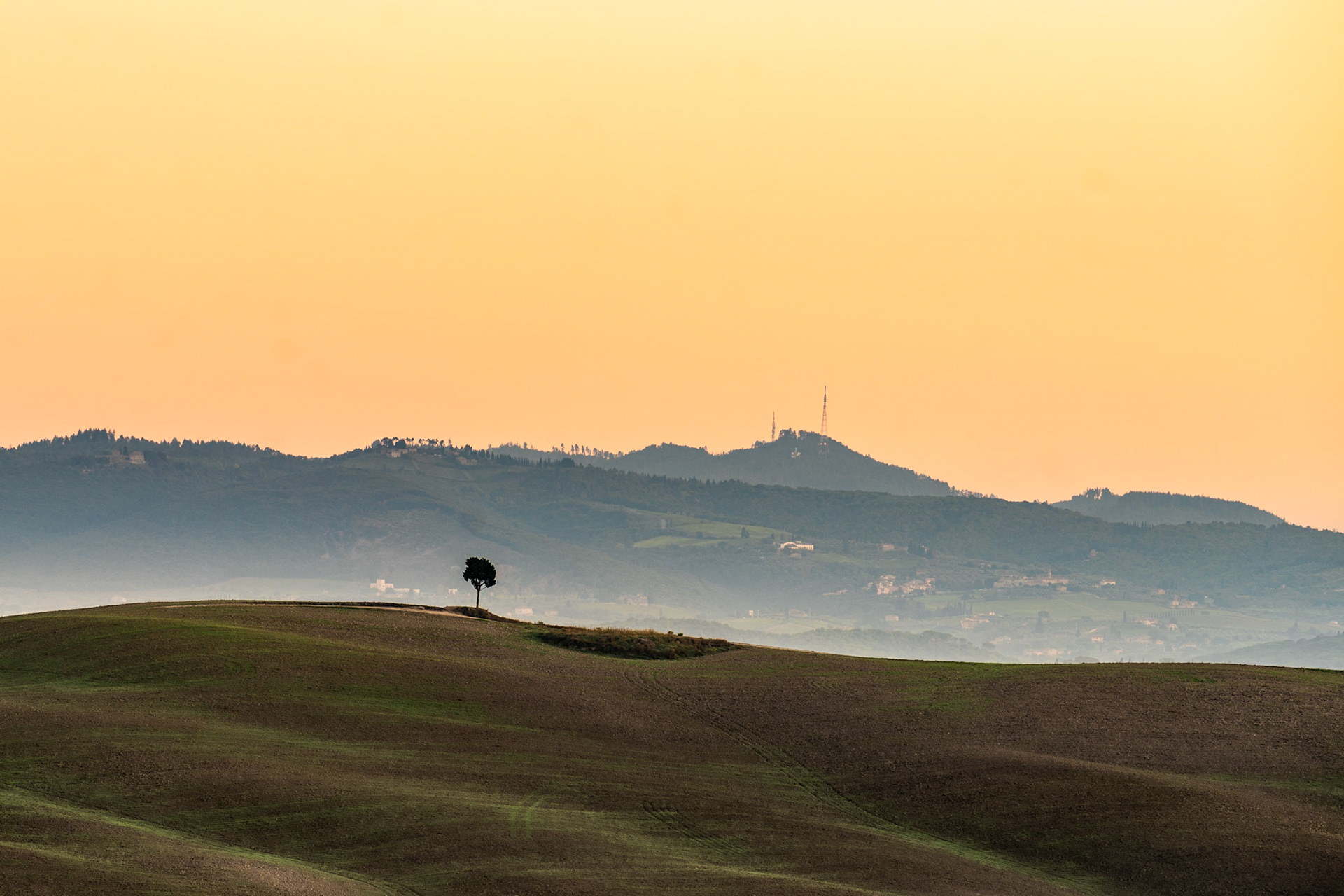
A solitary tree stands on a bare hillcrest, silhouetted against receding layers of misty hills under a warm peach dawn sky. Atmospheric haze dissolves the middle distance into pale blue bands, separating foreground agricultural slopes from wooded ridgelines beyond. The composition is anchored by the tree's precise placement against the tonal gradient where land meets sky.
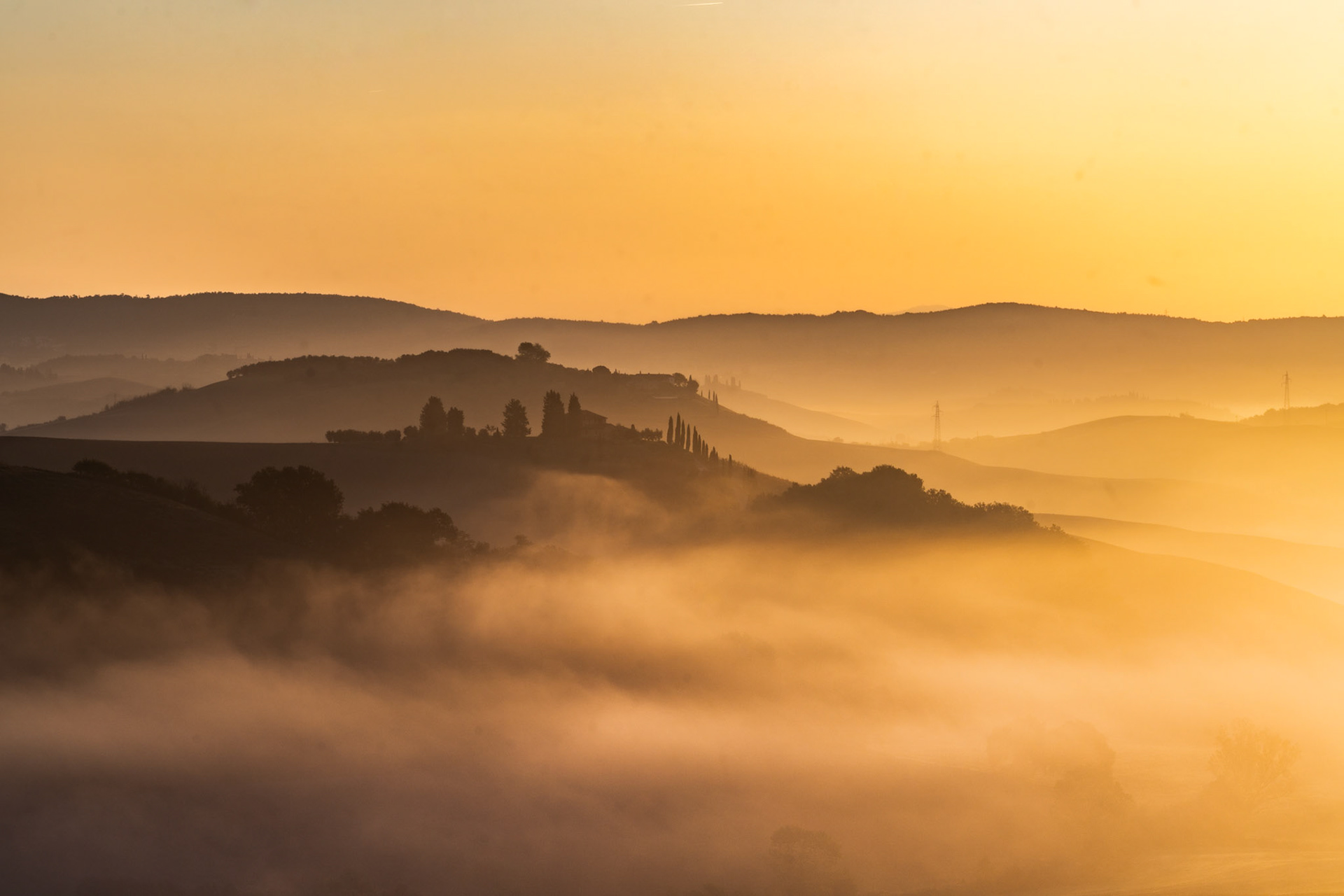
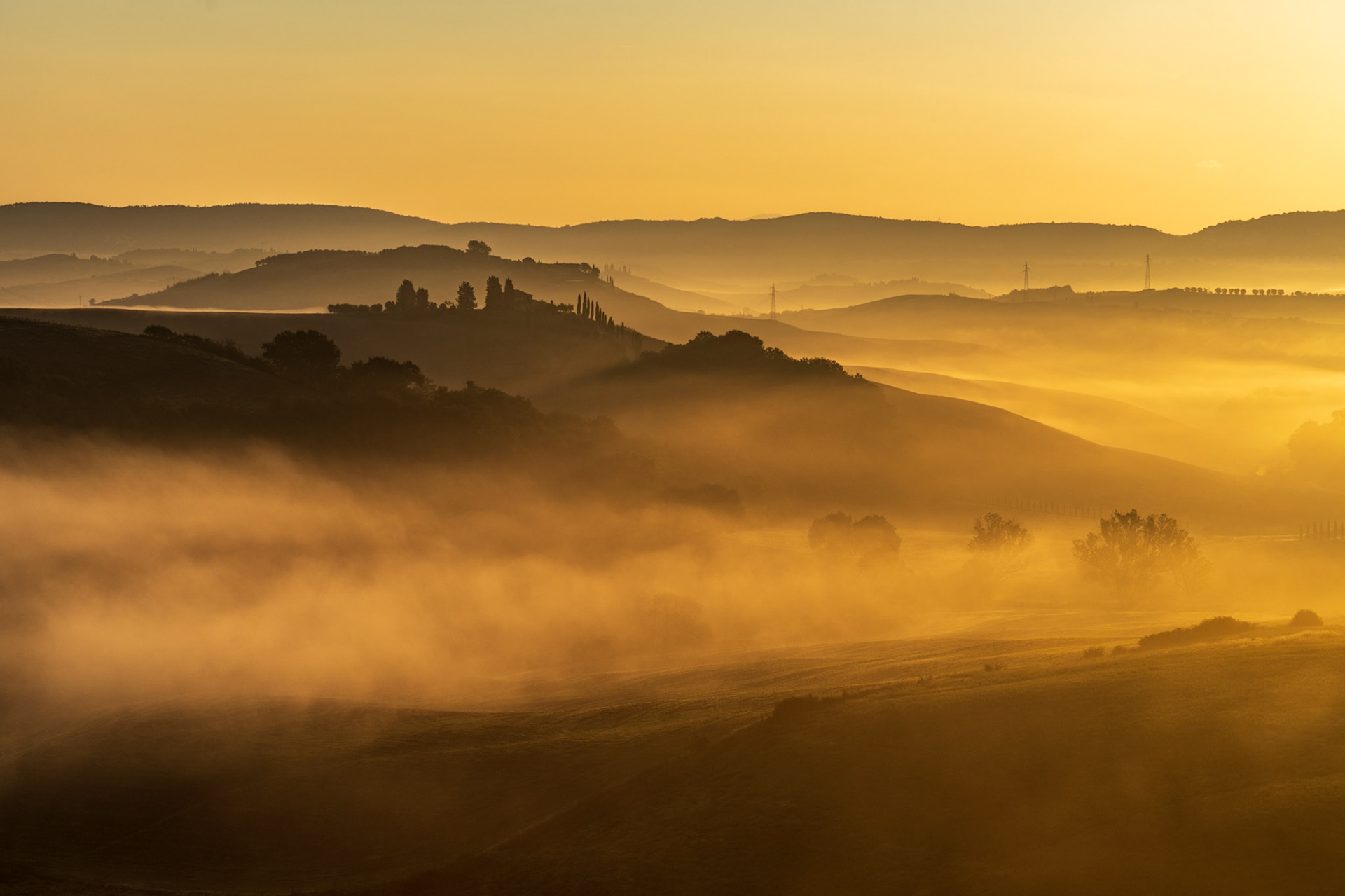
Layers of ground fog pool between rolling hills at first light, the warm amber sky backlighting successive ridgelines into graduated silhouettes. Cypress trees on a central hill anchor the composition against the dissolving mist below. The scene has the character of the Tuscan or central Italian Apennine landscape at autumn dawn.
A temperature inversion fills a broad valley with dense fog at first light, tree lines emerging as successive dark registers against the amber haze. The layering of mist, silhouetted woodland, and receding hills creates a strong sense of aerial depth without elevation. Captured in late September, the warm backlight and cool blue of the far ridgeline suggest the brief window between fog-lock and dissipation.
Ground fog pools in the valleys between successive hill ridges as dawn breaks, each layer of mist separating the silhouetted landforms into distinct tonal planes. Cypress-like trees on a central knoll provide the only vertical counterpoint to the horizontal banding of fog and hillside. The warm ochre cast of the low sun reduces the scene to near-monochrome warmth, suppressing detail in favour of recession and depth.
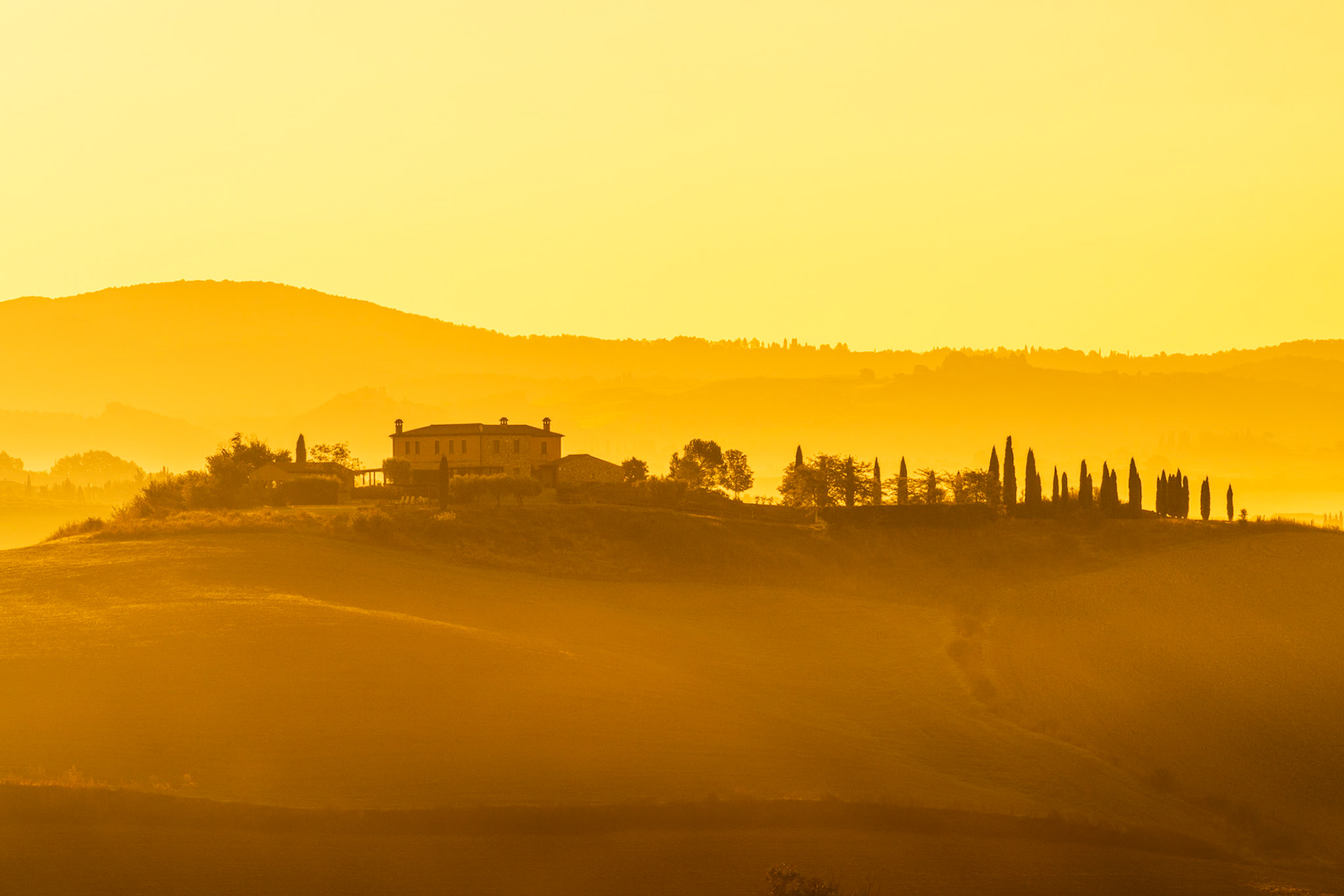
A Tuscan farmhouse and a row of Italian cypress trees sit on a rolling hillside, rendered almost entirely in silhouette against a dense amber haze. Layered bands of mist separate the undulating foreground from a receding ridge line, compressing the scene into a series of warm, near-monochromatic planes. The image is unmistakably Mediterranean in character, distant from the photographer's usual British subject matter.
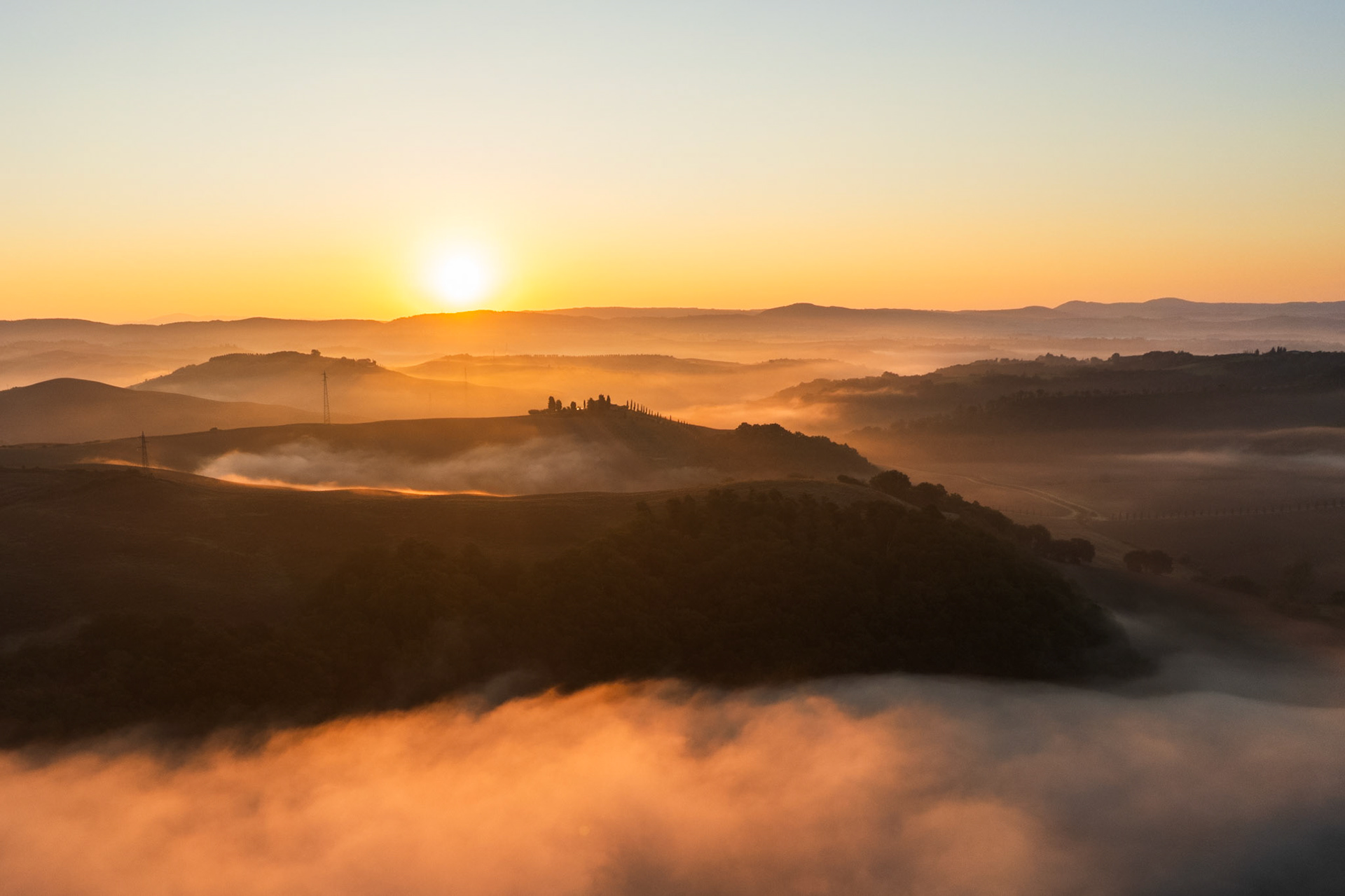
A temperature inversion fills the Val d'Orcia valleys with layered mist at dawn, isolating a hilltop farmstead and its cypress avenue as a lone silhouette against the rising sun. Aerial perspective compresses the rolling Sienese hills into receding tonal bands, the foreground fog mass anchoring the frame. Captured in the last minutes before the inversion burned clear.
Low-lying fog pools between the rolling hills of the Crete Senesi at dawn, lit from behind by a rising sun still close to the horizon. A lone farmstead on an isolated hillock breaks the surface, anchoring the composition amid the dissolving mist. The image was captured from altitude, compressing the layered landforms into a quiet, painterly sequence of receding planes.